
TítuloExchange policy credibility through the lens of the carry trade: The Mexican peso and the Brazilian real
15
0
0
Texto completo
(2) C. Fernández-Herraiz et al. / European Journal of Government and Economics 7(2), 123-137.. risk. Carry trade in foreign exchange has been the subject of a long tradition of academic research that goes back to the analysis of the non-interest rate default and the various explanations for the existence of a forward premium on foreign exchange transactions. Thus, following the progressive liberalisation of exchange rates in the 1970s, the empirical evidence of this failure and the difficulty of structural models in reproducing the behaviour of currency prices generated an interest from the academic world and from practitioners that has remained active to this day. In our view, the connection between carry trade, shadow banking and foreign exchange policy already implies an in-depth reflection on the functioning of today's financial markets. One might therefore wonder whether it is not the financing of trade in these assets that underpins carry trade strategies, and whether the ocean on which they are traded is not shadow banking. In short, a system in which leverage and liquidity end up being the front and back of the same thing. Where leverage (and liquidity) are also pro-cyclical. And where the set of agents that use the same rules: basically carry strategies and portfolio rebalancing based on the use of Value at Risk (VaR) models. The foreign exchange market is both the largest financial market and a largely deregulated market. It is also one of the markets where carry trade strategies have been most exploited by professional speculators. Our study aims to explore the extent to which the existence of shadow banking rewards speculative strategies based on simple and reproducible rules. These conditions may imply that in the currency markets, destabilizing speculative strategies offer consistently attractive and lasting results over time. If this were so, we would be calling into question the social role of speculators in today's financial markets and thus delegitimising some of the freedom of action enjoyed by financial institutions and institutional investors in the currency markets. The main contribution of the paper to current research in the area of exchange rates and policy intervention in currency markets is the connexion established between exchange policy credibility and ex post carry trade returns from stylized carry trade strategies employed by professional speculators. Long lasting attractive performance coming from destabilizing carry trade specifications gives rise to reasonable doubts regarding exchange policy credibility perceived by the markets. The paper is structured as follows. Section two covers the foundations of carry trade activity, its connection with shadow banking and our definition of destabilizing currency carry trade. Section three defines the set of strategies that we will use in the next section. Section four covers our empirical analysis of the Mexican peso and the Brazilian real within the May-2000 to May-2018 sample and explores the consequences of the evidence presented in terms of exchange rate policy credibility. The last section covers the main conclusions of our analysis and potential next steps in this research.. 124.
(3) C. Fernández-Herraiz et al. / European Journal of Government and Economics 7(2), 123-137.. 2. Carry trade in the forex market and a brief reference to carry to risk.. The academic interest in the study of the carry trade in the foreign exchange market can be traced from the observation of a double empirical problem. First, the inability of the structural models of the 1970s to provide a better prediction for currencies than a random walk with no trend (Meese and Rogoff, 1983). Secondly, the finding by various authors, including Hansen and Hodrick (1980) or Fama (1984), of a breach of the Uncovered Interest Parity (UIRP) on exchange rates, and the "discovery" of the forward premium puzzle. An important part of the literature has been devoted to the discussion of the unfulfilment of the uncovered interest rate parity. In fact, academic interest in the carry trade emerges as a byproduct of empirical evidence of such empirical puzzle. Ongoing research has mainly focused on justifying the 'forward premium' in two ways. The first category of explanations, which most authors subscribe to, maintains the assumption of rational expectations, and interprets the systematic component of the forward market prediction error as a risk premium: "Time varying risk premium" that fits naturally with models based on the stochastic discount factor. The second category attributes the systematic component of forecasting errors in forward transactions to systematic errors in market participants' expectations, at least within the sample. This phrase is intended to be as general as possible to incorporate issues such as problem weight, learning, adverse selection, and other types of error patterns that seem statistically significant within the sample. The definition does not necessarily have to imply that market participants are irrational - in fact they are not so in the learning approach, for example, or in incorporating the assumption of problem weight. However, such an approach also opens the door to behavioural finance approaches. The strategic relevance of exchange rates for financial stability and exchange policies points the way to potential explanations based on the analysis of the credibility of these policies, in view of structural deviations that encourage destabilising carry trade activity. There is a wide recognition among practitioners of the three basic speculation models with a top-down approach to currency portfolios. First, the strategies based on the carry, the foundation of this work. Second, momentum strategies, for which a basic rule of thumb is established: invest in those currencies that have appreciated in a given period or invest in those currencies in a basket with the best relative price performance. Finally, there are strategies based on the valuation of currencies, based on models that allow us to estimate how reasonable the "price" of a currency is in relation to those other variables or effects that are relevant. These strategies are called "value" strategies. The first two strategies could be considered destabilizing speculation. Instead, the third strategy produces stabilizing speculation. In many cases, the literature has worked on the analysis of combinations of these basic strategies. For example, Jordá and Taylor (2009) or Barroso and Santa-Clara (2015). In our empirical work, for example, carry and momentum strategies will be mixed as a way of improving the performance derived exclusively from the carry.. 125.
(4) C. Fernández-Herraiz et al. / European Journal of Government and Economics 7(2), 123-137.. The lack of connection with fundamentals that produces the destabilizing characteristics of the first two models was already recognized in a previous article by Prado-Domínguez and Fernández-Herraiz (2015). The expression of the carry to risk ratio was formally obtained from the Sharpe ratio, showing its neutrality to valuation models, and applicability to carry trade strategies in foreign exchange markets. Mounting trading activity based on carry specifications limits the volatility of the currency pair, so it feeds back the carry-to-risk variable, making it progressively more attractive, and therefore, more interesting for the agents involved. In other words, the very activity of carry trade increases the carry to risk (everything else constant) making it more attractive for a speculator who uses this ratio as a trigger for his trading activity. This activity introduces the well-known feedback phenomenon, which can also be found in other forex trading strategies such as momentum strategies (Osler, 2012). This type of trading activity corresponds to the way in which this work defines destabilizing speculation. This is a type of speculation that reinforces the progressive detachment between currency valuation and currency price, introducing also a temporary perception of low volatility in the exchange rate. This process permeates the theme of all this work and is clearly reflected in the carry strategies. The destabilizing carry is a process in which a non-trivial set of traders take positions in the same direction, cumulatively over time, reducing volatility and producing a false sense of stability in the strategy. For us, this is the dynamic that usually sets the stage for instability scenarios of the kind that is regularly found in exchange rate crisis models. This type of speculation, much less noisy since it is part of a process of fragile complementarity such as those mentioned by Gabor (2014), can be maintained for quite some time and is one of the main causes of the growing deviation between the value and price of the currency. That's why we think this is the real destabilizing speculation, the one that is not seen or, at least, attracts much less attention from policy makers and the media. It is only a matter of time before these developments end up in a currency crisis. The advantage of this explanation is that it supports the same solution for first-generation crisis models and second-generation crisis models in the style of the review discussed in, for example, Krugman, Rogoff, Fisher and McDonough (1999). This opens a possible reflection for central banks which would be as follows: are there options available to reduce the attractiveness of carry trade strategies, especially for those investors who are more leveraged, or those who notoriously operate at shorter maturities? There is no an easy answer to this question, but the prize is high. For example, reducing the social cost of maintaining international reserves. This true hedging strategy, as such, is subject to significant costs. Rodrik (2006) estimates this cost at a loss of income equivalent to 1% of annual GDP. We will see that exchange policy credibility plays a key role in the ability of speculators to use carry trade strategies. For our empirical analysis we will focus on the Mexican peso and the Brazilian real, and how currency speculators act as potential free riders and not as agents which provide liquidity or ensure valuation stabilization.. 126.
(5) C. Fernández-Herraiz et al. / European Journal of Government and Economics 7(2), 123-137.. 3. The introduction of liquidity in carry trade strategies in foreign exchange.. We introduce liquidity in the carry trade strategy including trend following indicators that trigger a trading orders for each of the specifications. The dynamic rules aim to avoid as far as possible the consequences of static carry trade strategies that are sprinkled by specific market events of certain virulence 1. Such strategies are compatible with the sale of catastrophic insurance on the market activity. The insurer, in our case the speculator in a carry trade strategy, will obtain profits that are not too high but relatively stable, dotted with periods of heavy losses. This is the idea that allows Cochrane (1999) to venture the correct hypothesis that carry speculators are implicitly selling puts, that is, selling insurance. In fact, Ilmanen (2012) shows that the sale of insurance and lottery tickets is very well paid in the markets, and, in particular, in the carry trade strategies. But going even beyond the Ilmanen (2012) appreciation, if it is possible to obtain liquidity in our positions when the trend of positive results breaks down, then, following the simile, it would be possible to obtain a significant part of the "premiums" without fully assuming the cost of the insured "claims". Our specifications of dynamic carry trade activities include two potential sources of return. First, the carry, the interest rate differential offered by the currencies. We use the 3-month interest rates 2, capitalized over the period in which the position is held. Secondly, the evolution in the price of the currency pair in which we are invested. This strategy assumes that the operator is financed at market prices in the financing currency and invests in the target currency, also at market prices. The first specification is a long only strategy. This specification acts as the benchmark and the passive strategy. The trader takes the position at the beginning of the period and makes no adjustments. Therefore, this strategy could be a good benchmark for the other specifications. These would be the results of a passive strategy, product of taking exposure to this source of risk On the contrary, the two following specifications share one element in common. Liquidity will be used opportunistically to enter and exit the strategy based on parameterized work rules. In our case, the rules will be based exclusively on the use of conventional moving averages. The trigger that will deliver the changes in the positioning of dynamic strategies will be the difference in moving averages between a very short-term average and a longer-term average 3. This trigger will allow dynamic strategies to remain liquid temporarily or even take a "short" carry position. 1 Such behaviour of carry strategies has often been described by professionals as "picking pennies in front of a rollercoaster" or as "going up by stairs and down the elevator". 2 Our strategy is based on the implementation of a carry trade strategy, the most common in academic research, so we use short-term rates. The choice of the three-month rate from among other possible terms (1 month, 6 months, day or week, for example) makes it easier to compare the currencies used since all accounts have this reference in the period considered. Because of the close relationship between shortterm rates, we do not believe that repeating the strategy with other rates will significantly alter the results. 3 We need an average with a sufficiently short term to resemble our daily prices. By default, we will use the 5-day average, which represents the trading week. For the long term average, and since we do not intend to make a trading strategy that involves a large amount of trading, we use the market year reference, i.e. 250 days. As this is not an optimised strategy, the results should be robust to changes in the averages used, provided the spirit of the strategy is maintained.. 127.
(6) C. Fernández-Herraiz et al. / European Journal of Government and Economics 7(2), 123-137.. The first of the dynamic models will be called long-flat strategy, and it is a specification that will remain invested in the “peso” or the “real” until the trigger is activated. The position is then closed. The strategy is reactivated again when the moving averages reverse their order. When the carry strategy is deactivated, we consider that the operator does not obtain remuneration in excess of the monetary assets in dollars. In our view, this is a conservative approach to measure the performance. The third specification, also dynamic, will be called long-short strategy, and is built using the same instruments as the previous strategy, but with a modification of the trading criteria. In this case, when the trigger is activated the trade takes short positions, reversing the strategy towards a long position of USD and short position of the carry currencies. Therefore, in this case, the long position closing trigger automatically activates a short position on the carry currency/long position in dollars. The trading motivation behind this third approach is to try to take advantage of the moments of deactivation of the long carry trade strategy, which are normally associated with high volatile market movements in the currencies considered.. 4. Empirical analysis.. The empirical analysis focuses on the last eighteen years, a period from May 2000 until May 2018 and uses daily closing price data for the currencies considered: the Mexican peso and the Brazilian real. The performance of the carry trade strategies in each of the two individual currencies are presented and commented below. The outcome of the analysis will provide information about the evolution of the carry strategy, for each particular specification. We also present the breakdown of the returns of the carry strategy between those resulting from the appreciation/depreciation of the currencies in question (currency performance) and those resulting from obtaining the interest rate differential (carry component). The performance of the strategies will be measured on the basis of widespread performance indicators, such as the Sharpe ratio, Sortino ratio and Calmar ratio, as well as information on the long term annualised return and volatility.. 4.1 Carry trade on the Mexican peso.. The Mexican peso is undoubtedly the most liquid currency in the LATAM region. It is a freely convertible currency, which makes it a candidate for all types of carry strategies. Our simplified carry model considers only the returns from the money market remuneration of the exposure to the peso, as well as the impact of changes in the price of the exchange rate pair. The performance of the simplified individual carry strategy in the Mexican peso during the period offers little room for comfort to a carry trade speculator. The specification of dynamic strategies does not significantly improve the results of the long only carry.. 128.
(7) C. Fernández-Herraiz et al. / European Journal of Government and Economics 7(2), 123-137.. Table 1: Results of the carry strategies on the MXN 5:2000-5:2018, daily data.. Long MXNUSD Average. Only. Long Flat. Long Short. Annual. Return. 0,65%. 0,89%. 0,30%. Standard Deviation. 11,40%. 6,97%. 11,40%. Downside Deviation. 8,36%. 5,06%. 7,91%. Maximum Drawdown. 39,36%. 19,26%. 38,23%. Sharpe Ratio. 0,0573. 0,1274. 0,0266. Sortino Ratio. 0,0782. 0,1756. 0,0384. Calmar Ratio. 0,0166. 0,0461. 0,0079. Source: Authors elaboration from financial series obtained from Bloomberg.. Table 1 shows that the annualised excess return on dollar-denominated risk-free assets offered by the strategies is less than 1%. This is a very low yield spread, particularly if we relate it to the volatility of the strategies, between 6.97% and 11.40% for the whole period. One way to look at these outcomes in aggregate is to check Sharpe's ratios. With figures between 0.027 and 0.127, the strategies would have offered between 2 and 12 basis points of annual excess yield for every 10 points of volatility during this long period. Low returns, high risk and poor performance. Even the Long Flat strategy, characterised by a significant reduction in risk (6.97% volatility compared to 11.40% for the Long Only and Long Short strategies), does not provide maximum drawdown levels over the period (Max DD) capable of withstanding substantial levels of leverage. The poor results are consistent under any of the performance measures (Sharpe, Sortino or Calmar), in all cases very small. The long only strategy in the Mexican peso over the past fifteen years has offered a performance which is apparently compatible with a sound management of the exchange rate policy, or a market perception of exchange credibility. Taking the entire sample into account, the yield derived from the interest rate differential in favour of Mexico is almost completely offset by the depreciation of the currency, something that is clearly observed in Figure 1.. :. 129.
(8) C. Fernández-Herraiz et al. / European Journal of Government and Economics 7(2), 123-137.. Figure 1. MXNUSD Long Only Carry. Source: Authors elaboration from financial series extracted from Bloomberg.. But the focus of our analysis is the dynamic specifications of carry trade speculation. The improvement in annualised returns obtained by the long–flat strategy is not significant, nor would it correspond to the expectations of a trader interested in speculating in the foreign exchange market. The results in terms of performance ratios are better than those of the long only strategy, but as mentioned above, these improvements are too poor to be considered seriously. In addition, the rule used does only partially prevent losses due to the depreciation of the peso, as can be seen in the Figure 2.. Figure 2. MXNUSD Long Flat Carry. Source: Authors elaboration from financial series extracted from Bloomberg.. A raised key component of the active trading strategy issue is that the simplified trading rule employed does not improve the results of the portfolio. It is therefore logical that the results of the second dynamic strategy, the long-short strategy, which uses the same rule to trade the. 130.
(9) C. Fernández-Herraiz et al. / European Journal of Government and Economics 7(2), 123-137.. long or short the carry currency, will not achieve significant success either. Moreover, in the case of the long-short strategy, there is a negative effect due to the short position built on the strategy in the periods in which the trading rule reverses the positions. In those periods, the strategy is long the US dollar versus the Mexican peso, so it yields negative carry returns. Therefore, the potential outcome achieved by actively trading the currency is reduced by the negative interest rate differential. In view of the results, it does not seem likely that speculators have generally maintained a continuous destabilizing carry trade strategy throughout the period considered. It looks like Mexican arrangements in terms of exchange policy stability are well in place to curb the impact of carry trade speculative strategies similar to those presented in the analysis.. 4.2 Carry trade on the Brazilian real.. The Brazilian real is an exotic currency, since free convertibility is not allowed. However, Brazil has a highly developed domestic financial market according to the regional standards. In this case, liquidity materialises more in the forward markets, specifically in non-derivable products. Depending on the capabilities, reputation and scale of the speculator, on shore or off shore carry trade speculative activities could be put in place. Our stylized carry model considers only the returns from the money market yield differential of the exposure to the real, as well as the impact of changes in the price of the exchange rate pair. Table 2 indicates that the long only strategy in Brazilian reals, unlike the case of the Mexican peso, does offer attractive returns and performance for potential speculators in the sample period considered.. Table 2. Results of the carry strategies on the BRL 5:2000-5:2018, daily data.. Long BRLUSD Average. Only. Long Flat. Long Short. Annual. Return. 6,84%. 9,79%. 10,96%. Standard Deviation. 17,00%. 11,05%. 17,00%. Downside Deviation. 11,91%. 7,71%. 11,99%. Maximum Drawdown. 47,04%. 17,04%. 26,04%. Sharpe Ratio. 0,4024. 0,8861. 0,6449. Sortino Ratio. 0,5744. 1,2704. 0,9139. Calmar Ratio. 0,1455. 0,5748. 0,4210. Source: Authors elaboration from financial series obtained from Bloomberg.. The annualised excess return on dollar-denominated risk-free assets offered by the strategies was between 6.84% and 10.96%. It is important to bear in mind that we have the liquidity of the carry strategy and the possibility of using leverage opportunistically. Remember. 131.
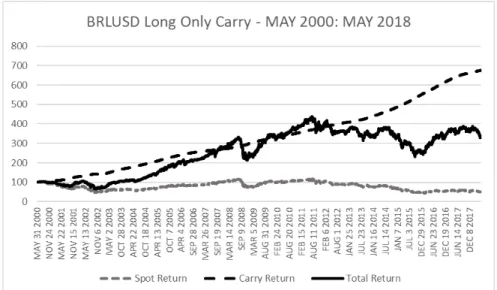
(10) C. Fernández-Herraiz et al. / European Journal of Government and Economics 7(2), 123-137.. that the numbers presented in the summary table are considered for a fully funded position, so it would always be possible to increase the profitability and risk of the model. In fact, given that the Sharpe ratio is invariant to leverage 4, the speculator could decide on the level of market risk chosen, the volatility and, from there, estimate the expected return through the ratio. Moreover, the results presented are 'in excess', so that this strategy could be built on a cash position in dollars which would also serve as the collateral for the carry strategy. The carry trade strategy on the Brazilian real offers richer options to compare dynamic carry trade specifications, and the different opportunities and risks they offer to the speculator. We observe that active strategies that take advantage of the existing liquidity in the market, considerably improve the performance of the passive strategy. This improvement can be checked in the performance ratios, both in the consideration of symmetric risk (Sharpe ratio) and in the consideration of asymmetric risk (Sortino ratio) or in the specific analysis of the worst returns obtained (Calmar ratio) during the sample period. Figure 3 shows that the excess returns and the effect on the exchange rate of the currency pair have the right signs, i.e. the real is depreciated against the dollar over the period as a whole. However, this depreciation does not compensate for the high profitability offered by the carry component.. Figure 3. BRLUSD Long Only Carry. Source: Authors elaboration from financial series extracted from Bloomberg.. It could be argued that the passive strategy performance is a natural expression of the required risk premium involved in buying Brazilian reals. This risk premium for a long term period may signal a situation of permanent low exchange policy credibility. But the focus of our analysis are the dynamic specifications, and how shadow banking tools, liquidity and leverage,. 4 The Sharpe ratio is invariant to leverage when deposit rates and short-term financing rates are considered equal in the money markets. This is an unrealistic simplification for retail segments, but in the institutional market could be much closer to reality. In addition, if we use derivative instruments for position-taking, the risk-free rate applied in the replication portfolio equations normally considers, for simplicity, the same risk-free rate in the short term.. 132.
(11) C. Fernández-Herraiz et al. / European Journal of Government and Economics 7(2), 123-137.. potentially creates better options for speculators if not properly handled by currency authorities. The long-flat strategy on Brazilian real offers more attractive results than pure exposure to this asset class. The evidence during the sample supports the hypothesis that the opportunistic use of liquidity and the leverage offered by the market increase the potential returns for the strategy. A speculator may consider this strategy for its portfolio of available strategies. An annualised return in excess of 9.79%, with long term volatility around 11.05% over a period of 18 years, represents an attractive outcome. Another point of interest of the strategy, which would encourage the use of leverage by an interested speculator, is the low level of maximum drawdown of the strategy, of only 17.04%. The returns are even more compelling when we consider that the strategy keeps cash over long periods of time without considering any excess return. Any speculator would look for alternative uses of this liquidity during the “flat” periods.. Figure 4. BRLUSD Long Flat Carry. Source: Authors elaboration from financial series extracted from Bloomberg.. The yield spread reaches a 7.15% annualised, a lower result than the long only strategy (11.10% annualised), which is systematically invested and therefore obtains a higher carry. This is the product of a lower exposure to the Brazilian money market in the period, due to the application of the trading rule. This reduction is offset by a significant improvement in the impact on spot exchange rate losses. In fact, as can be seen in Figure 4, the long-flat strategy in the Brazilian real allows the speculator to achieve positive returns in the component derived from the evolution of the currency, with annualised returns of 2.76% which are added to the results of the carry. The specification provides an ideal adjustment case. The speculator keeps a comfortable exposure to the interest rate spread offered by the Brazilian real, without incurring in high losses due to the depreciation of the exchange rate. A good example of Ilmanen (2012) hypothesis about the options for speculators to capture a significant part of the "premiums" without fully assuming the cost of the insured "claims". The combination of both effects has a very positive impact on the performance ratios of the strategy. A Sharpe ratio of almost 0.9, Sortino ratio higher than 1 and a maximum drawdown of. 133.
(12) C. Fernández-Herraiz et al. / European Journal of Government and Economics 7(2), 123-137.. only 1.54 times the volatility of the portfolio. Since the trading rule significantly improves results compared to the long only strategy, it is reasonable to think that the long-short strategy can also offer attractive results. In the initial summary we saw how the long- short strategy offered results similar in volatility to the long only strategy, but with annualised returns that went from 6.84% to 10.96% in the sample period considered. Not only that, but the maximum drawdown suffered by the strategy in the period is much lower (approximately 26%) or around half of the heavy losses of the long only strategy. Given the results obtained, it is more than likely that there are traders working with refinements on these strategies within their portfolios. In contrast to the evidence obtained on the Mexican peso, in the case of the Brazilian real, the use of financing and market liquidity allows for comfortable speculation with an attractive expectation of returns versus risk. The leveraged strategies in this simplified trend following model offer flexibility of accommodation for both domestic-licensed and non-deliverable local-currency derivatives that are settled for differences. The question now is how to reconcile a potential risk premium for the “insurers” of the Brazilian real with higher rewards for the “free riders”. The less the credibility of the exchange policy perceived by the market participants, the more the opportunities for dynamic destabilizing carry trade speculation activities. These strategies could turn to market financing (shadow banking) as a source of leverage and liquidity. The dynamic strategies presented do not rely on any model of currency valuation. If these strategies were common in the market, they will generate continuous scenarios of potential destabilizing speculation, in terms of persistent deviation from equilibrium. Finally, note that neither the long-short strategy nor the long-flat strategy include any relation to critical variables such as the price of reference commodities, consideration of relevant variables for sovereign risk analysis or reference to a change in appetite for global or specific currency risk. Nor do they incorporate a reflection on monetary policy scenarios, considerations on reference rate yield curves, analysis of the country's political strategy, or its capacity to impose certain fiscal or monetary rules. Finally, the strategies do not use spot currency flow analysis techniques, or information on non-commercial activity in the currency futures, or information on flows in other related assets such as the local stock exchanges. Both Brazilian active strategies are agnostic to economic and market developments. This is important because it implies, for example, that the strategy develops its trading rules without reference to a hypothetical anchor of fundamental value of the currency. It could be that the model recommends being long on the currency in a situation of overvaluation, or that it recommends being short on a situation of potential undervaluation. It is in this sense that we affirm that carry strategies in foreign currencies can become destabilizing speculation, delegitimizing at this point the social role of the speculator. Evidence presented for the sample period offers two different realities for the Mexican peso and the Brazilian real. The exchange rate policy of the Mexican peso seems to be much more stringent in curving carry trade speculative opportunities. Moreover, in view of the market. 134.
(13) C. Fernández-Herraiz et al. / European Journal of Government and Economics 7(2), 123-137.. participants there seems to be a higher degree of exchange policy credibility attached to the Mexican peso in terms of carry trade destabilizing speculation.. 5. Conclusions.. We tested different specifications of carry trade dynamic strategies for the Mexican peso and the Brazilian real that produced substantially different long term outcomes. The performance of the different specifications signals the exchange policy credibility perceived by the market participants. Trend following carry trade strategies can remain active for long periods of time depending on the credibility perceived by the market participants. Speculation built on market financing allows participants to buy and sell without relying on currency valuation or other fundamental anchors or predictors. These types of strategies illegitimate the role of speculators, because they propel destabilizing instead of stabilizing speculation. The approach developed suggests that the exchange rate policy of the two currencies is substantially different in the sample period. In addition, our approach suggests that through the lens of different dynamic carry trade specifications it is possible to assess the perception of exchange policy credibility by market actors. The Mexican peso offers close to zero returns, and poor performance metrics for the sample of the last 18 years. Our analysis suggests that this situation is the outcome of credible exchange policies designed to curb general specifications of dynamic carry trade destabilizing speculation. The evidence provided on the Brazilian real, on the contrary, signals potential attractive opportunities for long term dynamic carry trade strategies. The authors understand that the Brazilian real is perceived by the market as a currency with a lower level of exchange policy credibility. In that sense, destabilizing speculation as defined in our paper has being possible during the sampling period. The evidence also suggests that the failure of the Brazilian real exchange policy to detect and provide the tools to curb this type of speculation during the sample period creates the conditions to reinforce potential carry trade destabilizing activities. In fact, due to the leverage invariance property of the Sharpe ratio, and taking the ex post results obtained by this strategy, we found that it could have been implemented in the period with much higher leverage. Such leverage may be comparable to the examples by Darvas (2008) in his reflection on optimal leverage in dollar-based speculative carry portfolios. It is not impossible that during the sample period a non-trivial number of agents have been pushed to develop such strategies, which could have compromised the integrity of the market and the financial stability of Brazilian real denominated assets. This outcome implies strong exchange policy implications for the Brazilian real. Understanding the link between carry trade strategies and speculators behaviour is important for the correct design of optimal policies of intervention in currency markets. In fact,. 135.
(14) C. Fernández-Herraiz et al. / European Journal of Government and Economics 7(2), 123-137.. one could also argue that the carry trade strategies, even if destabilizing in the short term, can help exert pressure on governments to conduct credible macroeconomic policies if properly internalized. Future research on this topic may extend the scope of the analysis to other emerging market currencies and the way exchange credibility is perceived by the markets. Other complementary metrics like the carry to risk ratio and its different specifications could also be explored to develop robustness checks or complementary analysis.. References. Barroso, P., & Santa-Clara, P. (2015). Beyond the carry trade: Optimal currency portfolios. Journal. of. Financial. and. Quantitative. Anaysis. 50(5),. 1037-1056.. doi: https://doi.org/10.1017/S0022109015000460 Cochrane,. J.. (1999).. New. facts. in. finance.. NBER. Working. paper. num.. 7169.. doi: https://doi.org/10.3386/w7169 Darvas, Z. (2008). Leveraged carry trade portfolios. Discussion Papers, Institue of Economics, Hungarian Academy of Sciences, MT-DP-2008/22.doi: https://doi.org/10.2139/ssrn.1102151 Fama, E. (1984). Forward and spot exchange rates. Journal of Monetary Economics 14, 319338. doi: https://doi.org/10.1016/0304-3932(84)90046-1 Financial Stability Board (2018). Global shadow banking monitoring report. Gabor, D. (2014). The IMF´s Rethink of Global Banks: Critical in Theory, Orthodox in Practice. Governance 28(2), 199-218. doi: https://doi.org/10.1111/gove.12107 Hansen, L., & Hodrick, R. (1980). Forward exchange rates as optimal predictors of future spot rates:. an. econometric. analysis.. Journal. of. Political. Economy. 14(3),. 319-338.. doi: https://doi.org/10.1086/260910 Ilmanen, A. (2012). Do financial markets reward buying or selling insurance or lottery tickets? Financial Analysts Journal 68(5), 26-36. doi: https://doi.org/10.2469/faj.v68.n5.7 Jordá, O., & Taylor, A. (2009). The carry trade and fundamentals: Nothing to fear but FEER itself. NBER Working paper num. 15518. doi: https://doi.org/10.3386/w15518 Krugman, P., Rogoff, K., Fisher, S., & McDonough, W. (1999). Currency Crises. In M. Feldstein, International capital flows. Chicago: University of Chicago Press, 421-470. Meese, R., & Rogoff, K. (1983). Empirical Echange Models of the Seventies. Do They Fit out of Sample? The Journal of International Economics 14, 3-24. doi: https://doi.org/10.1016/00221996(83)90017-X Osler, C. (2012). Market Microestructure and the Profitability of Currency Trading. Annual Review of Financial Economics 4(1), 469-495. doi: https://doi.org/10.1146/annurev-financial110311-101726. 136.
(15) C. Fernández-Herraiz et al. / European Journal of Government and Economics 7(2), 123-137.. Prado-Dominguez, J., & Fernandez-Herraiz, C. (2015). A Sharpe ratio based measure for currencies.. European. Journal. of. Goverment. and. Economics. 4(1),. 67-75.. doi: https://doi.org/10.17979/ejge.2015.4.1.4307 Rodrik, D. (2006). The social cost of foreign exchange reserves. NBER Working paper 11952. doi: https://doi.org/10.3386/w11952 Shiller, R. (2012). Finance and the good society. New Jersey: Priceton University Press.. 137.
(16)
Figure


+2

Documento similar