collisions
A. Alonso-Izquierdo∗Departamento de Matematica Aplicada, University of Salamanca, Spain
(Dated: December 7, 2017)
In this paper the study of collisions between kinks arising in the family of MSTB models is addressed. Phenomena such as elastic kink reflection, mutual annihilation, kink-antikink transmu-tation and inelastic reflection are found and depend on the impact velocity.
INTRODUCTION
Over the last decades, solitary wave solutions in non-linear field theories have played an essential role in the explanation of new phenomena in diverse branches of Physics, e.g., Condensed Matter [1–5], Cosmology [6], Optics [7], etc. This fact has drawn attention to the scat-tering of these objects. Studies on this issue concerning the kink solutions which appear in (1+1) relativistic one-component scalar field theories with a potential with two o more degenerate minima have revealed unexpected be-haviors. For example, the dynamics of interacting kinks and antikinks in the archetypal φ4 model, described by Campbell, Schonfeld and Wingate in the seminal paper [8] exhibits a fascinating structure. For kink-antikink collisions where the initial relative velocity v is greater than the critical speed vc ≈ 0.2598, these single solu-tions collide, bounce back and escape but ifv < vc they are compelled to collide a second time. In this last case, a kink-antikink bound state (bion) is formed except for certain initial velocity ranges (resonant windows) where the kink and the antikink escape after a finite number of impacts due to the resonant energy transfer mechanism. In addition, the resulting separation velocity versus col-lision velocity graph displays a fractal structure [9]. An analytical explanation of this feature using the collective coordinate method is given in [10]. Similar results have been found for kink-antikink interactions in the modified sine-Gordon model [11], polynomial models [12–16], non-polynomial models [17, 18] and coupled two-component
φ4models [19, 20], kink-impurity interactions in the sine-Gordon andφ4models [21–25], soliton-defect interactions in the sine-Gordon model [26] and the collision of vec-tor solitons in the coupled nonlinear Schr¨odinger model [27, 28]. Negative radiation pressure, where a kink hit by a plane wave is accelerated towards the source of radia-tion is another remarkable phenomenon which can occur in this type of models [29, 30].
In this paper a new pattern in the dependence of the kink separation velocity as a function of the collision ve-locity is described. It arises in the one-parameter fam-ily of (1+1)-relativistic two scalar field MSTB models (named after Montonen-Sarker-Trullinger-Bishop). In this case, the potential is the fourth-degree polynomial isotropic in quartic but anisotropic in quadratic terms,
U(φ1, φ2) = 12(φ12+φ22−1)2+12σ 2φ2
2 . This model is a natural generalization of theφ4model in two-component scalar field theories, which further preserves the presence of two minima. Indeed, the MSTB model is a phys-ical system with a proud history. In 1976 Montonen, searching for charged solitons in a model with one com-plex and one real scalar field, discovered by fixing the time-dependent phase for the complex field, the previ-ously mentioned model [31]. Two different types of static topological kinks were found for the parameter range
σ ∈ (0,1): the first one joins the potential minima by means of a straight line, whereas the second type fol-lows an elliptic trajectory. In a previous paper [32] Ra-jaraman and Weinberg had identified the first class of these solutions and had described the qualitative behav-ior of the second type in a more general model. Sarker, Trullinger and Bishop established from an energetic point of view that kink solutions of the second type are sta-ble while those of the first type are unstasta-ble [33]. Fur-ther analysis of kink stability in this model were per-formed in [34, 35]. In 1979 Rajaraman [36] discovered a non-topological kink for the parameter value σ = 12 whose orbit is a circle. The discovery of this new type of solitary wave prompted several numerical investigations by Subbaswamy and Trullinger. These authors numeri-cally found that there exists a continuous family of non-topological kinks that describe closed orbits [37, 38]. In 1984, Magyari and Thomas [39] showed that the system of static field equations is completely integrable by find-ing two constants of motion. Indeed the system is not only completely integrable but Hamilton-Jacobi separa-ble by using elliptic coordinates. This fact was used by Ito to analytically describe the whole static kink variety [40]. It was proved by applying the Morse index theorem to the kink orbit manifold that the non-topological kinks are unstable [41–43]. In 1998 new two-component scalar field theory models that exhibit the same properties than the MSTB system were identified [44]. In 2008, a system-atic classification of these generalized MSTB models was established in [45]. The extension of the MSTB model toN-component scalar field theories as well as the iden-tification of the static kink manifold and the analysis of kink stability is completed in [46, 47]. Furthermore, the promotion of the MSTB model to the quantum realm is dealt with in [48], where the semiclassical mass of the
stable static topological kinks is computed in the gener-alized zeta function regularization context.
The issue addressed in this paper is the study of the collisions between two stable topological kinks in the MSTB model that carry opposite topological charges al-though they do not form an antikink-kink pair because they describe different orbits. In this case a complex de-pendence of the scattering outcome with respect to the collision velocity is found: ranges of collision velocities where the kinks elastically and inelastically reflect, mu-tually annihilate or transmute in its antikinks coexist. In addition, sequence of resonant windows arise for some values of the model parameterσwhere the kinks collide several times before escaping and moving away.
The organization of this paper is as follows: in Section 1 the MSTB model is introduced and its static kink va-riety is determined; in Section 2 the scattering between stable kinks with opposite topological charges is numeri-cally analyzed and the results are described and, finally, in Section 3 some conclusions are drawn.
MODEL AND STATIC KINKS
We shall deal with a one-parameter family of (1+1)-dimensional two-coupled scalar field theory models whose dynamics is governed by the action
S=
Z d2x
1
2∂µφa∂ µφ
a−U[φ1, φ2]
. (1)
Here φa :
R1,1 → R, a = 1,2, are dimensionless real
scalar fields and Minkowski metricgµν is chosen asg00=
−g11 = 1 and g12 = g21 = 0. The notation x0 ≡ t and x1 ≡x is used from now on. The MSTB potential functionU in (1) is given by
U(φ1, φ2) = 1 2(φ
2 1+φ
2 2−1)
2+σ 2
2 φ 2
2 , (2)
where the parameterσ∈(0,1).
FIG. 1. MSTB potential and elliptic orbits of the stable topo-logical kinksK(q,1)(solid curve) andK(q,−1)(dashed curve).
The Euler-Lagrange equations derived from the action (1) lead to the coupled nonlinear Klein-Gordon equations
∂2φ1
∂t2 −
∂2φ1
∂x2 = 2φ1(1−φ 2 1−φ
2
2) , (3)
∂2φ 2
∂t2 −
∂2φ 2
∂x2 = 2φ2(1−φ 2 1−φ
2 2−
σ2
2) . (4)
The action functional (1) is invariant by the symmetry group G = Z2 ×Z2 generated by the transformations
πi : φi → −φi with i= 1,2. The potential (2) has two degenerate absolute minima A± = (±1,0), see Fig. 1. The solutions belonging to the finite energy configura-tion spaceC ={K(x, t)≡ (φ1(x, t), φ2(x, t))∈ R×R :
E[K(x, t)]<+∞}must asymptotically connect elements of the setM ={A+, A−}. This allows us to define the topological chargeq= 12 |φ1(+∞, t)−φ1(−∞, t)|, which is a physical system invariant.
The static kink variety in this model, which consists of two types of topological kinks and a family of non-topological kinks, are given as follows:
– (1a) The four stable topological kinks
Kstatic(q,λ)(x) =qtanh(σx), λp1−σ2sech(σx) , (5)
where x = x−x0 with x0 ∈ R, are placed on the
elliptic orbit φ2
1 +φ22/(1 −σ2) = 1. Here q = ±1 is the topological charge and λ = ±1 distinguishes if the second field φ2 is positive o negative, see Fig. 1. Charge conjugation turns a kink into its antikink, i.e.,
K(q,λ)(x) = K(q,λ)(−x) = K(−q,λ)(x). The energy of these solutions isE[Kstatic(q,λ)(x)] = 2σ(1−σ2/3).
– (1b) The pair of unstable kinks
K(q)static(x) = (qtanhx,0) , (6)
whereq=±1, connect the minimaA+andA− by means of the straight line φ2 = 0. These solutions are more energetic than the previous kinks,E[Kstatic(q) (x)] = 4/3. – (2) Finally, there exits a family of unstable non-topological kinksNstatic(x;γ) = (φ1(x, γ), φ2(x, γ)) with
φ1(x;γ) =
(σ−1)(1 +e1) + (σ+ 1)(e22+e3) (σ−1)(1 +e1)−(σ+ 1)(e22+e3)
,
φ2(x;γ) =
2(σ2−1)e2(e3−1) (σ−1)(1 +e1)−(σ+ 1)(e22+e3)
,
being e1 = exp[2(1 +σ)(¯x+σγ)], e2 = exp[σ(¯x+γ)],
e3 = exp[2(¯x+γσ2)] and γ ∈ R. They describe closed
orbits which begin and end at the point A+. Similar solutions starting and ending at the point A− can be constructed by the transformationπ1. The energy sum ruleE[N(x;γ)] =E[K(q,λ)(x)] +E[K(q)(x)] holds.
NUMERICAL ANALYSIS OF THE K(q,λ)-K(−q,−λ) SCATTERING
form a kink-antikink pair because its trajectories are dif-ferent: theK(q,1)kink is defined in the semiplaneφ2>0 while theK(−q,−1) solution lives in φ2 < 0, see Fig. 1. The initial configuration consists of two well separated boosted static kinks
K(q,λ)(x−x0, t;v0)∪K(−q,−λ)(x+x0, t;−v0) (7)
which are pushed together with collision velocityv0. Here
K(q,λ)(x, t;v
0) = K (q,λ)
static[(x−v0t)/
p
1−v2
0]. The con-catenation (7) describes a closed elliptic curve starting and ending at A−. The non-linearity of the evolution equations (3) and (4) forces us to employ numerical sim-ulations to describe the behavior of the scattering solu-tions. We use the modified algorithm described by Kas-sam and Trefethen in [49], which is spectral in space and fourth order in time. We also complement the previous scheme with the use of the energy conservative second-order finite difference Strauss-Vazquez algorithm [50] im-plemented with Mur boundary conditions [51], which ab-sorb the linear plane waves at the boundaries and let more control over the radiation evolution. The two pre-vious numerical schemes provide identical results.
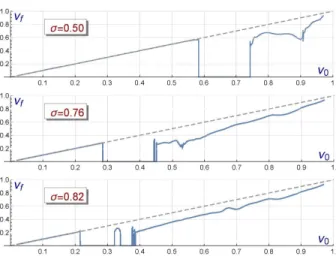
FIG. 2. Final kink velocity as a function of the initial ve-locity for theK(q,λ)-K(−q,−λ) collisions for several values of σ. Zero final velocity indicates mutual kink annihilation. For the sake of comparison a dashed line characterizing an elastic scattering is plotted.
The dependence of the final velocityvfof the scattered kinks with respect to the impact velocityv0is displayed in Fig. 2 for several values of the parameter σ. Five types of initial velocity windows can be distinguished in these scattering processes:
– (1) Elastic reflection windows: For low colli-sion velocities the kink scattering is almost elastic. This process symbolically represented as K(q,λ)(v
0) ∪
K(−q,−λ)(−v0) → K(q,λ)(−v0)∪K(−q,−λ)(v0) is illus-trated in Fig. 3, where the evolution of the kink com-ponents is plotted. The kink cores approach each other
with initial velocity v0, collide, bounce back and move away approximately with the same speed.
FIG. 3. K(q,λ)-K(−q,−λ) collision with impact velocity v0 =
0.25 for the model parameterσ= 0.76.
– (2)Annihilation windows: For these velocity intervals the kinks mutually annihilate almost instantaneously af-ter the formation of an ephemeral bound state (bion) formed in the collision. This process characterized as
K(q,λ)(v0)∪K(−q,−λ)(−v0)→radiation is illustrated in Fig. 4. Att= 0 the two well separated kinks are clearly identified but after the impact the resulting configuration consists of plane waves (radiation) around the potential minimumA−=−1.
FIG. 4. K(q,λ)-K(−q,−λ) collision with impact velocity v0 =
0.4 for the model parameterσ= 0.76.
– (3)Transmutation windows: For some ranges of initial velocities theK(q,λ)andK(−q,−λ)kinks turn into its cor-responding antikinks after the collision, see Fig. 5. This process involves the excitation of internal modes (which will be denoted by means of the asterisk superscript) and radiation emission. Therefore, we represent this event asK(q,λ)(v
0)∪K(−q,−λ)(−v0)→K∗(−q,−λ)(−v1)∪
K∗(q,λ)(v1) + radiation withv1< v0.
FIG. 5. K(q,λ)-K(−q,−λ) collision with impact velocity v0 =
0.5 for the model parameterσ= 0.76.
– (4) Inelastic reflection windows: For large enough impact velocities kink reflection occurs again but now in a non-elastic way, such that the event K(q,λ)(v
K(−q,−λ)(−v0) → K∗(q,λ)(−v1) ∪ K∗(−q,−λ)(v1) + radiation withv1< v0 takes place.
– (5) Resonant windows: For some ranges of v0 a reso-nant energy transfer mechanism is triggered, which im-plies that the kinks collide and bounce back a finite num-ber of times before recovering the kinetic energy neces-sary to escape. This phenomenon is illustrated in Fig. 6. Sequences of resonant windows similar to those found in theφ4model appear for some ranges of the parameterσ, see [8].
FIG. 6. K(q,λ)-K(−q,−λ) collision with impact velocityv0 =
0.445 for the model parameterσ= 0.76.
The previously described events are present in the case
σ = 0.76, which we have used as a benchmark in the figures introduced in this paper. In this case the elas-tic reflection regime is defined on the interval (0,0.2849]; two annihilation windows have been identified on the in-tervals [0.2849,0.4434] and [0.4461,0.4512], which con-fine a 2-bounce resonant window (0.4434,0.4461). A quasiresonance arise at the value v0 ≈ 0.5315, which delimitates the transmutation window [0.4512,0.5315) and the inelastic reflection window (0.5315,1), see Fig. 2. For σ = 0.5 the resonant windows are absent while
σ= 0.82 involves the resonant windows [0.3217,0.3401], [0.3756,0.379] and [0.3839,0.3843], but lacks the trans-mutation window.
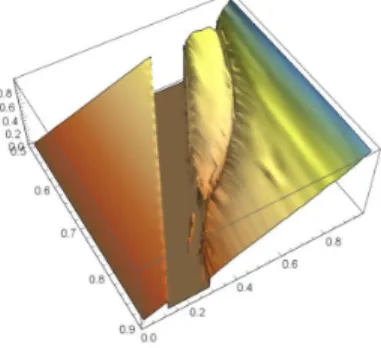
A global vision of the behavior of theK(q,λ)-K(−q,−λ) scattering in the MSTB model can be grasped from Fig. 7, where the dependence of the final velocity vf of the scattered kinks with respect to the initial kink velocity
v0 and the model parameterσcan be visualized in a 3D graphic. The elastic regime for low velocitiesv0is clearly observed, this regime is more prevalent as the parameter
σdecreases. As the collision velocitiesv0increases anni-hilation windows appear for all the values of parameter
σ. We can visualize these windows as a large cannon in Fig. 7. The presence of quasiresonances carves the val-ley of the landscape displayed in Fig. 7, which meets the cannon for the valueσ≈0.78. The region delimited by the annihilation windows and the quasiresonance curve determines the transmutation windows. The inelastic re-flection regime arises for impact speeds greater than the quasiresonance values and the annihilation velocity win-dows. Sequences of resonant windows with decreasing width emerge inside the cannon for values greater than
σ≈0.78, which are difficult to see in the 3D graphics. An heuristic explanation of the previously described
pattern underlies the orbit evolution of the combined kink K(q,λ)-K(−q,−λ). This configuration traces an el-liptic orbit that starts and ends at one of the points
A± and surrounds the local maxima exhibited by the MSTB potential at the origin in the internal space, see Fig. 1. The kink collision disturbs this loop by introduc-ing perturbations along theφ1 and φ2 component. For low impact velocities the collision provokes small pertur-bations that does not change this configuration, giving rise to the elastic reflection regime. However, for initial velocities in the annihilation window the impact provokes
φ1-perturbations which make the loop jump the potential maximum, the energy losses in form of radiation emission and internal mode excitations prevent the solution from returning to the loop configuration and consequently kink annihilation takes place. When the collision velocityv0is large enough theK(q,λ)-K(−q,−λ)solution carries enough energy to overcome the previous situation, returning to the loop configuration. If v0 belongs to the transmuta-tion windows the inducedφ2-fluctuations flip the elliptic orbit branches with positive and negativeφ2, which im-plies the conversion of kinks into antikinks. In this sense the quasiresonances appear when the φ2-perturbations change theK(q,λ)-K(−q,−λ)solution into the metastable
K(q)-K(−q)configuration after the previous flip. For ve-locities in the inelastic reflection windows a double flip between the elliptic branches is carried out, which im-plies a kink reflection as final result. Finally, for certain intervals ofσ and v0 a resonant energy transfer mecha-nism takes place where the kinks collide and bounce back
N-times before reflecting (N even) or transmuting into its antikinks (N odd).
FIG. 7. Final kink velocity as a function of the initial velocity and the model parameterσfor theK(q,λ)-K(−q,−λ)collisions. Zero final velocity indicates mutual kink annihilation.
CONCLUSIONS
in-elastic reflection, whose presence depends on the impact velocity and the model parameter. A heuristic explana-tion based on the orbit evoluexplana-tion has been suggested. It remains a mayor challenge, deserving further study, to find a detailed analytical explanation based on collective coordinates or other similar techniques.
The author acknowledges the Spanish Ministerio de Econom´ıa y Competitividad for financial support under grant MTM2014-57129-C2-1-P. They are also grateful to the Junta de Castilla y Le´on for financial help under grant VA057U16.
∗
[1] A. Davydov and D. Reidel, Solitons in molecular sys-tems,(1985) Dordrech, D (Reidel).
[2] A. H. Eschenfelder,Magnetic bubble technology, Vol. 14 (Springer Science & Business Media, 2012).
[3] F. Jona and G. Shirane, Ferroelectric Crystals (New York, Dover, 1993).
[4] E. Salje,Phase Transitions in Ferroelastic and Co-Elastic Crystals (Cambridge University Press, Cambridge, UK., 1993).
[5] B. A. Strukov and A. P. Levanyuk,Ferroelectric phenom-ena in crystals: physical foundations(Springer Science & Business Media, 2012).
[6] A. Vilenkin and E. P. S. Shellard, Cosmic strings and other topological defects (Cambridge University Press, 2000).
[7] G. Agrawall, Nonlinear Fiber Optics (Academic Press, 1995).
[8] D. K. Campbell, J. F. Schonfeld, and C. A. Wingate, Physica D: Nonlinear Phenomena 9, 1 (1983).
[9] P. Anninos, S. Oliveira, and R. A. Matzner, Phys. Rev. D44, 1147 (1991).
[10] R. H. Goodman, Chaos: An Interdisciplinary Journal of Nonlinear Science 18, 023113 (2008), http://dx.doi.org/10.1063/1.2904823.
[11] M. Peyrard and D. K. Campbell, Physica D: Nonlinear Phenomena9, 33 (1983).
[12] H. Weigel, Journal of Physics: Conference Series 482, 012045 (2014).
[13] V. A. Gani, A. E. Kudryavtsev, and M. A. Lizunova, Phys. Rev. D89, 125009 (2014).
[14] P. Dorey, K. Mersh, T. Romanczukiewicz, and Y. Shnir, Phys. Rev. Lett.107, 091602 (2011).
[15] E. Belendryasova and V. Gani, “Scattering of the φ8 kinks with power-law asymptotics,” (2017), arXiv:hep-th/170800403.
[16] D. Saadatmand and K. Javidan, Physica Scripta 85, 025003 (2012).
[17] D. Bazeia, E. Belendryasova, and V. Gani, “Scattering of kinks in a non-polynomial model,” (2017), arXiv:hep-th/171107788.
[18] D. Bazeia, E. Belendryasova, and V. Gani, “Scattering of kinks of the sinh-deformedφ4model,” (2017),
arXiv:hep-th/171004993.
[19] A. Halavanau, T. Romanczukiewicz, and Y. Shnir, Phys. Rev. D86, 085027 (2012).
[20] A. Alonso-Izquierdo, Physica D: Nonlinear Phenomena (2017), https://doi.org/10.1016/j.physd.2017.10.006. [21] Z. Fei, Y. S. Kivshar, and L. V´azquez, Phys. Rev. A45,
6019 (1992).
[22] Z. Fei, Y. S. Kivshar, and L. V´azquez, Phys. Rev. A45, 6019 (1992).
[23] B. A. Malomed, Physica D: Nonlinear Phenomena15, 385 (1985).
[24] B. A. Malomed, Physics Letters A136, 395 (1989). [25] B. A. Malomed, Journal of Physics A: Mathematical and
General25, 755 (1992).
[26] R. H. Goodman and R. Haberman, Physica D: Nonlinear Phenomena195, 303 (2004).
[27] Y. Tan and J. Yang, Phys. Rev. E64, 056616 (2001). [28] J. Yang and Y. Tan, Phys. Rev. Lett.85, 3624 (2000). [29] T. Romanczukiewicz, Acta Phys. Polon. B 29, 3449
(2008).
[30] T. Romanczukiewicz, Physics Letters B773, 295 (2017). [31] C. Montonen, Nuclear Physics B112, 349 (1976). [32] R. Rajaraman and E. J. Weinberg, Phys. Rev. D11, 2950
(1975).
[33] S. Sarker, S. Trullinger, and A. Bishop, Physics Letters A59, 255 (1976).
[34] J. F. Currie, S. Sarker, A. R. Bishop, and S. E. Trullinger, Phys. Rev. A20, 2213 (1979).
[35] S. E. Trullinger and R. M. DeLeonardis, Phys. Rev. B
22, 5522 (1980).
[36] R. Rajaraman, Phys. Rev. Lett.42, 200 (1979).
[37] K. R. Subbaswamy and S. E. Trullinger, Phys. Rev. D
22, 1495 (1980).
[38] K. Subbaswamy and S. Trullinger, Physica D: Nonlinear Phenomena2, 379 (1981).
[39] E. Magyari and H. Thomas, Physics Letters A100, 11 (1984).
[40] H. Ito, Physics Letters A112, 119 (1985).
[41] H. Ito and H. Tasaki, Physics Letters A113, 179 (1985). [42] J. M. Guilarte, Lett. Math. Phys.14, 169 (1987). [43] J. M. Guilarte, Annals of Physics188, 307 (1988). [44] A. Alonso-Izquierdo, M. A. G. Leon, and J. M. Guilarte,
Journal of Physics A: Mathematical and General31, 209 (1998).
[45] A. Alonso-Izquierdo and J. M. Guilarte, Physica D: Non-linear Phenomena237, 3263 (2008).
[46] A. Alonso-Izquierdo, M. A. G. Le´on, and J. M. Guilarte, Nonlinearity13, 1137 (2000).
[47] A. Alonso-Izquierdo, M. A. G. Le´on, and J. M. Guilarte, Nonlinearity15, 1097 (2002).
[48] A. Alonso-Izquierdo, W. G. Fuertes, M. G. Le´on, and J. M. Guilarte, Nuclear Physics B638, 378 (2002). [49] A.-K. Kassam and L. N. Trefethen, SIAM
Jour-nal on Scientific Computing 26, 1214 (2005), https://doi.org/10.1137/S1064827502410633.
[50] W. Strauss and L. Vazquez, Journal of Computational Physics28, 271 (1978).