
A cohort based analysis of the influence of minimum wage levels on the labor force participation in the informal sector: quantitative and substitution effects
19
0
0
Texto completo
(2) BORMDORES DEECONOMh Y FNANZAS. Editor JhonJames Mora Jefe,Departamento deEconomía iimora@icesi,edu,co. Gestión editorial - Universidad Departamento deEconomía lcesi. lssN1990.1568 Cuarta Edición, Diciembre de2010.
(3) "A cohort'based analysis of theinfluence of minimum wagelevelsonthelaborforce participation in theinformal sector:quantitative and-substitution effects" By JhonJames MoraandJuanMurot lcesiUniversity (Colombia) andAlcaláUniversity (Spain) Correspondence to: [email protected] Abstract:Thispaperdiscuses theeffectoftheminimum wageonthedecision tojointheinformal jobsector' Weestimated panelof theengagemeñt a pseudo ¡ntneinformal seitorusinganlVprobit. Thefindings showthatan increase in theminimum wageleadsto a substitutio-n effect youngandolderworkers. between Thisresults showthattheitandards effects overthelabor market intheWGMsegmented model aremoderate because anincrease oftheminimum wage doesn't imply totalmobility between sectors. Keywords:Informality, minimum wages, instrumental probit, variable pseudo panel,sample selection bias, JEL:C35,J32 1.Introduction Theminimum wagein Colombia is established through negotiations between representatives of theworkers' union andanemployers' association inDecember year.lf theyfailtoreach every an agreement, thegovernment establishes theminimum wage.Onlyin threeoutof thelasteight years therehasbeenanagreement between bothparties. Theminimum wageis a keyelement ofeconomic andsocialpolicy indeveloping countries, The minimum wageaffectsnotonlyworkers in theformalsector,butalsomanyp-rices andtaxes whicharesetbased on it in Colombia. Forthisreason, thepolicy withrespect to theminimum wageis significant in Colombia whereapproximately percent 56 of allworkers eamtheminimum wage(Hernandez andPinzon 2006,12)and73 percent of allworkers affiliated to thesocial security system earntwoorlessminimum (Arango, salaries Henera andPosada 2OOT,14\. Furthermore, theminimum wageis thebaselevelforwagesin theformalsector,Although there aredifferent explanations as to whatis considered informal andformal, thereseems 1o be a consensus withregard to theeaseof joining theinformal sectorbecause thereareno entry baniers. In theformalsector, on the contrary, laborlaws,company regulations, andfixed minimum wages,amongothers,havebecome entrybarriers, In thiscontext, government intervention intheeconomy viathedetermination of theminimum wagegenerates iñcentives to joinor leavetheinformal either sector; forexample, theminimum wagegenerates incentives to choose onesector, In thisarticle weassume thatthosewhoworkin theinformal sectorhave actually chosen todoso. Compared to otherapproaches to theproblem, thispaperdiffers inseveral aspects, Firsfly, this reviewinvolves a follow-up oftheinformal sectorírom2001to 2005basedontheconstruciion of 1 The authorsare thankfulfor the valuablesuggestions of XimenaDueñasand LuisaFemandaBernatat lcesi University, and thosewho attendedthe IARIWand CLADEAConferences, JhonJamesMoraacknowledges lcesi University and The National Institute of Scienceand Technology (COLCIENCIAS) in Colombia for their-financial assistance..
(4) panel. a pseudo Secondly, weassume theminimum wageto beanopportunity costtojointhe informal sector, Withthe dataavailable from2001to 2005we builtsix cóhorts basedon information of 13metropolitan areas,fromtheinformal sectorin theNational Household Survey fromlastJune,Thisselectionprovidesasample of Sg,24l individualsfortheperiodunderreview, Another contribution ofthispaperisthediscussion ofthehigherminimum wagesoverlaborforce participation. In thestandard WGMtwo-sector modet(Wótch, 1976;Gram-lich, 1976;Mincer, 1976)a higherminimum wageimplieslowwagesin theuncovered or informal sectorbecause of themovements fromtheformaltotheinformal sector,andtheemployment effectsarenegative in yet it is possible theinformal sectorandpositive in theformalsector(Lemos, 2009). inattfre effectsof thehigherminimum wagesonemployment in theinformal sectoraremoderate dueto thesubstitution youngandolderworkers effectsbetween inthelaborparticipation in theinformal sector, Thischaracteristic is particularly important in developing countries wheretheinformality rateis high,andthetotaleffectof thehigher minimum wageoverinformality depends on the proportion ofyoung/older workers overthetotallaborforceparticipation intheinformal sector Thispaperisorganized asfollows: thesecond section discusses theliterature about theeffects of theminimum wageon employment andon boththeformalandinformal sectors, Thethird presents section a modelanddescribes themethodology formodeling theengagement in the informal sector paneldata.Thefourth based onpseudo presents section estimates ofthemodel usingan instrumental probitand presents variable the correction of the selection bias. Conclusions arepresented inthelastsection. 2.- Literature Review Thetheory suggests thattheimpact of minimum wages onthelabormarket depends either on competitive or non-competitive assumptions. In a competitive labormarket, minimum wages established above themarket equilibrium wageresultin unemployment, Ina monopolistic labor market, if theminimum wageis abovethemonopsony wagelevel(butbelowthecompetitive level), employment willincrease. Literature shows ambiguous effects of theminimum wageontheunemployment rate.Cardand (1994) Krueger foundthattherestaurants in NewJersey, where theminimum wagewasraised, expanded theworkforce incomparison to restaurants in Pennsylvania. However, usingdifferent data,Newmark andWasher (1995) foundanincrease in unemployment in NewJersey, CastilloFreeman andFreeman (1992) foundthatin Puerto Ricoa 1070 increase in theminimum wage caused an employment reduction oÍ 5o/o. Withrespect to theresults of Castillo-Freeman and (1992), Freman (1995) Krueger showed thattheresults fragile. arestatistically Bell(1997)found thatin Mexico theminimum wagehashadnoeffectsonwagesintheformalemployment sector, butfoundsubstantial unemployment effects associated withtheminimum wagein Colombia. Suryahadi, Widyanti, Penruira (2003)discuss andSumarto thesubstitution effects:minimum wage decreases employment ofunskilled workers andincrease employment ofwhite-collar workers, In developing countries, Lemos(2007)showed thathigherminimum wagesin Brazilare associated witha reduction of inequality butnotwithloweremployment. (2009) AndLemos also showed thattheemployment effectsareduetoassumptions ofthesegmented or integrated labor market, In Colombia, (1991) Macnac provides thefirstcontrast of informality in Colombia. In Macnac's (1991)bivariate probitmodeltheinformal sectoris identified (excluding withseliemployment.
(5) employers)' The obtained resultsrejecta segmented labormarkethypothesis. However, Macnacls model shows thatwhenanindividual chooses toworkintheformál'sector, thebenefits associated withnotworking areindistinguishable fromthebenefits of working in theinformal sector. (V002) Núñez suggests thatjoining theinformal sector inColombia isa voluntary action ofwhich individuals areaware. Whyshould onechoose onesector oranother? Núñeze602)believes that thereareseveral factors participation thatencourage intheinformal businesi sectbr sincethere is a lenient environment thatfacilitates evasion of labor-related taxes, Thisrefers to evasion of taxessuchastaxwithholding at thesource andotherstate-imposed taxesbased ona formal employment agreement,. However, (2002) Nuñez failstodiscuss theeffects oftruncated sampling in his results whencalculating participation the informal of individuals whoearnmorethan pesos. Colombian $1,200,000 (2003) Ribero anOUiibe,andOrtizandConea(2006) modeted informal employment as the resultof socioeconomic characteristics of an individual, where edu_cation hasa negative effectonthelikelihood of participating intheinformal sector.Depending on thepurpose of thestudy,othervariables havebeenincluded suchas age,position in the household, non'labor gender, income, andfertility, (2003) Ribero didnotmakla selection bias adjustment, andUribe etal,didnotinclude theselection correction inhiscalculations. Finally, Hernández (2006) andPinzon discussed theeffect ofincrease ofminimum wageonlabor participation usingpooled dataandfoundthattherearesubstitution effects onworkérs withan increase in theminimum wage,However, Hemández (2006) andPinzon didnotconsider the pseudopanelmeasurement enordue to the natureof the Colombian data- the official information bytheColombian Department of Statistics doesnotinclude thepossibilig of panel z data- andalsodoesnotdiscuss thesubstitution effects through thecohorts, 3,-ModelSpecificatlon Thelaborforceparticipation showsindividuals thatmaximize theirutilityoverconsumption and leisure, subject to budget constraints anddependent uponthetimeavailable fortheseactivities (Gronau 1973, Deaton andMuellbauer 1980, Pencavel 1986, Killingsworth 1986andBrueand Macpherson 2003). In developing countries, thestandard WGMtwo-sector model(Welch, 1976;Gramlich, 1976; Mincer, 1976)showsthatwhena groupof workers is outside theumbrella of minimum wage legislation, a minimum wageincreases implies thatwages intheuncovered sector fallasa result ofdisplaced workers inthecovered sector moving intouncovered sector employment, Thenthe wageeffectisexpected to bepositive inthecovered sectorandnegative intheuncovered sector (Lemos, 2009). It is evident thattheprediction of theWGMmodelimplies segmentation in thelabormarket, In C_olombia, ArangoandPosada (2001)suggest the possibility of segmentation basedon a discussion of the unemployment rate.Garcíaet al. (2007)discuss iegmentation comparing Mincer regressions fortheformal andinformal sectors, andGarcia et al,(1008) alsouseMincer regressions whichincorporate differences amongcitiesandsectors. UsingMarkovian chains Mora(2010)discusses the possibility of segmented labormarket andfindssegmentation in 2Thereis noconsensus abouttheeffect of theminimum wages onemployment in Colombia. WhileMaloney and Núñez(2003)founda negative relationship between the minimum wagesandemployment, (i0OS¡ nobUins determined thattheminimum wages hasnothadsucha negative effect,.
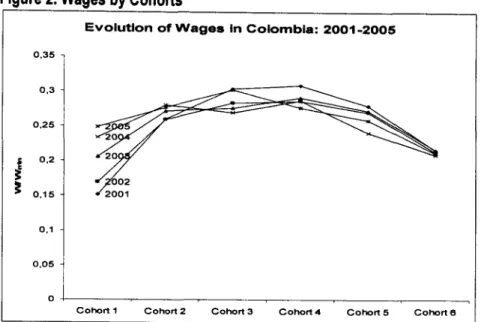
(6) (2002) time using Gálvis (1997), etal.(2000)and Jaramillo professionats Nupia Finally, workers. labor market. is segmented there a i.e. wages, among series findthatthereisnocointegration labormarkets thatif therearesegmented wesuppose Withrespect totheresultsofWGMmodel, wage minimum ofincreased theresults (such Colombia), as,forexample, ina developing country total hand, the other young On workers, and older between effects is moderate duetosubstitution in young/older the proportion workers of to the particular due are labormarket effects on a perfect is not wage with a minimum withinsectors thatthemobility Thus,wesuppose economy. a imposes thatthegovernment wage.Letusassume of theminimum because of thebenefits join the to decision Then,an individuaf's in theeconomy. sector minimum wagefortheformal versus the formal sector working in the of benefits the from comparing results informal sector a standard of formal consists in sector work the Now, sector. intheinformal benefits ofworking costof pension, Theopportunity andhealth. ofsocialsecurity, fixedworktime,andtheguarantee working in the of thebeneflts because andolderpeople leisure foryoungpeople is different participating of decision lt mustbenotedthattheindividual formalor informal sectoraredifferent. sectorwageratioandproduces the formal-informal considering in a specific sectorimplies onthelaborforce. substitution effects or whether or nottheywanttojointheformal areabletochoose Letusassume thatindividuals the (Fields, 2004p.Therefore, 1990;Maloney informal sectorbasedon a set of variables asfollows: canbeestimated sector engagement intheinformal >0 p'(t),t l(0,,*= Ba'CMW(u,I+l(0+ F¡'OUHttl,t+ Fo'Sittl,t+Fr'NL4g,t+pz'Hmalei6,t+. (1). t = 1 , . . . . ,; T. (2). P i 6 ¡ ,1 t =i f P 4 g , t * > 0. * is a latentvariable in a givensectorandli1g,t fromworking eamings thatrepresents Whereli1g,t zero.The"i(t)' or otherwise informal sector work in the chooses to individual onewhenan equals whereN series cross-secüonal independent are thatthe observations indicate subscripts individuals ineachperiod, i therearedifferent Since ineachperiod. individuals areonlyavailable (1985)suggests to obtainconsistent usingcohorts rangesfrom1 to N for eacht. Deaton withthe the estimator variables are usedand adjusting estimators of p whennumeric in the caseof proposed which, (1993) lV-probit approach an Moffitt measurement errors. a set of timeimplies using errors, to measurement variables subject independent continuous variables, anda setoftime-variant invariant variables +roi(t),t S¡lU,t = },1'CitO+2ru,t = +ctl(0,t 2,1'C¡lU+Z(q,t NL49,t +Z¡(t),t+ ro i(t),t CMWig¡,t= 1"1'C¡tU. (3) (4) (5). of joining the whichdecrease thelikelihood of yearsof education, repréSérts thenumber Si6¡,t 2006]. Ortiz and Correa 2003andUribe, 1991,Núñez2002,Ribero informal sector[Macnac (2002) ofparticipating thelikelihood which decreases non-labor income, NL(q,t represents [Núñez whichincreases the (2003)1. represents a maleheadof a household, Hmaleilt¡,t andRibero (Uribe, 2006). OrtizandCorrea intheinformal sector likelihood ofparticipation. informal of "easy€ntry" and "upper-tier" is fundamental because of the characterization 3 Thisassumption (Kucera 2008) employment andRoncolato,.
(7) CMWi¡¡,t represents theinteraction between cohort variables andtheminimum wage,Inyoung - cohorts1 to 3 - theopportunity individuals costof workingintheinformal sectorislow,andwe thesigntobepositive gxPect whenthereisanincrease in[heminimum wage.However, toolder - cohorts4 to 6 - theopportunity individuals costof working in theinformal-sector is high,anda negative signisexpected. OUHilt¡,t isa dummy variable thattakes a valueofeither oneif thereis morethanoneindividual unemployed in a household, or otherwise zero.Weexpected this variable to havea positive sign(Arango andPosada, 2006),The¡ift)variable represents the deviation oftheeffectofthecohortafterbreaking downfixedindividual effects, Therefore, if there areanyfixedindividual effects, thesewillbeconsistent withfixedeffects in thecohort. Finally, Ci6¡in (4)to (6)aretime-invariant cohorts, whereas Zi1q,t represent time-variant variables, With regard to thelatterthereis noagreement asto whichvariables should beincorporated in Zi1q,t. However, sinceeconomic grovrrth is a determining factorwhensettingtheminimum salary,the GDPlagged bya period is usedasZ 19,t. lt is alsoworthnoting thatbinary variables willnotbe subject (Deaton, toconection 1985).. 4.-Data Thelabormarketin Colombia showed anincreasing rateof femalelaborforceparticipation from 1981to 2000.Thefemale laborforceparticipation rosefrom36,46percent in 1g81to 50.87 percent in 1998.Meanwhile, themalelaborparticipation hasremained stagnated forthelast decades, percent i,e.74.28 in 1981and73,98percent in 1998(Luisa Femanda Bernat, Rocio Ribero andJaime Tenjo2004:150). Thismeans gender thatthetraditional gapsin laborforce participation decreased in thelastcentury. Ontheotherhand,therehasbeenan important decrease in the unemployment ratein the pastfew years.According to the Colombian Department (DANE), of Statistics theunemployment dropped from16.6percent in2000to 11.4 percent in2006. In Colombia therearenopanelsurvey statistics on household laborsupply data,Oursample comes íromtheNational (NHS) Housing Survey whichconsists of a timeseries of independent andrepresentative cross-sections collected from2001to 2005bytheColombian Department of (DANE), Statistics Since2000,the DANEhascollected information aboutthe labormarket throughanothermechanism calledContinuous HousingSurvey,The DANEmeasures engagement in theinformal sector based on information aboutworkers or employers whohave lessthan10workers, independent non-professional, non-technical workers, housekeepers, and familyassistants whodo not earnmonetary compensation. Ribero(2003)proposes four defnitions andshowshowtheinformal sector sharechanges substantially depending oneach definition. Hisdefinitions takeintoaccount notonlycompany size,butalsomembership to the social security system, anemployment agreement, andmedical insurance coverage. Basedon DANE's definition of informality, Castillo(2006)estimated informality to be61 percent in2002and58.8percent in2005,However, whenthedefinition doesnotinclude theheadcount size,butthe kíndof employment agreement or memberships, the informal sectorshareis approximately 30percent, whichwasdetermined (2003) byRibero andHernández andPinzon (2006) whofound thattheinformal sector shareisabout 50percent based onmedical insurance coverage,.
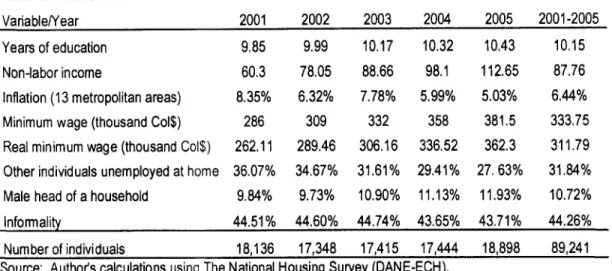
(8) a in health, coverage security whodoesnothavesocial "informal" to referto anyone Wedefine sample of on a andbased pension, tothisdefinition According contract. anda formalemployment whose of individuals wedefined sixcohorts inthelabormarket, individuals whowereengaged were individuals Thus,89,241 from2001to 2005. intheperiod agesrange from18to 56years arelistedinthetable period. variables oftheselected Themeans selected theobserved during below: Table ofthevariables 1.Means 2001-2005. Variableffear. 2001. 2002. Yeans ofeducation Nonlabor income. 9,85. 9.99. 10,17 10.32 10,43. 60,3. 78,05. 88.66. 8.35%. 6.320/0. 7.780/o. (13metropolitan Inflation areas). 98.1. 1 1 2 , 6 5 87.76. 5,99% 5.03% 358 381.5. 332 309 wage(thousand Col$) 262.11 289,46 306.16 336,52 362.3 Realminimum 27,63Yo at home 36.07% 34,67Y031,61%29.410/o Otherindividuals unemployed 9.MYo 9.73o/o10.90% 11j3% 11.93% Maleheadof a household Minimum wage(thousand Col$). 286. 10,15 6.Mo/o. 333.75 3 11 . 7 9 31,84f0 10.72Y0. Informalitv. 44.51Yo 44.60Y044.74Y043.65% 43,71o/o 44.260/o. Number ofindividuals. 18,136 17,348 17,415 17,444 18,898 89,241. (DANE-ECH). TheNational Housing Survey Autho/s using Source: calculations is closeto 10.This number of yearsof education As shownin Table1 above, theaverage showed a number seems to havebeenstableforthepast10years.MoraandMuro(2008) pseudo paneldata.Laborincome andnon1995-2000 alsous¡ng fortheperiod similar average a slight areas,showing for inflation in eachof the metropolitan laborincome wereadjusted growth probably lt noted that drop. mustalsobe andtheinflation improvement dueto economic inthe inallmetropolitan areas.Otherunemployment wagehasbeenincreasing therealminimum period under review. (OUH) 30%throughout theentire households hasremained stable atnearly in theinformal sectoris closeto whoparticipate of households Thepercentage of maleheads ofindividuals eachyear. among thenumber 10%.¿ Finally, arenosubstantial differences there theratiobetween wages and wecalculated andcities Withrespect bycohofts tothewages, aninverted U. realwages cities andfound minimum bymain. qAsshownbyAlmanza (2006)thegapbetween intheinformal sectorhasbeenclosingsincelast menandwomen century..
(9) Figure 2.Wages byCohorts Evolutlon. of Wages. In colombta:2OOl-2OOS. o,35 o,3 o,25 o,2 o,15 o,1 o,o5 o. Source: Autho/s calculations TheNational using Housing (DANE-ECH). Survey In figure2, theratiois increasing in youngcohorts anddecreasing in oldcohorts. Next,we participation explored in the informal labormarket andfoundthatthe informal sectoris not homogeneous bycohorts andregions. Theresults areasfollows: Figure3.Informal sectorratebycohorts Informalsector in Colombia (2001-2005) 0,9 0,8 0,7 0,6 0,5 0,4 0,3 0,2 0,1 0. +- Cohort1 + Cohort2 -+ Cohort3 ---¡+-Cohort4 +--Cohort 5 r Cohort6. $oYgi$"^{.r"9*t"o.S""to" Source: Autho/s calculations TheNational using (DANE-ECH). Housing Survey Figure3 showsthattheyoungest cohorthasthehighest participation in theinformal sector, Medellín isthecitywiththelowest participation intheinformal ratesineachcohort, sector while Cartagena, on theotherhand,hasthelowest participation in theinformal sectorin thefourth cohort period throughout theentire under review,.
(10) 5.-Results (2006) ofparticipation (2003) OrtizandConea (2002), Ribero andUribe, Theestimates byNúñez (2003) Ribero individuals. onlyforworking weredetermined sector employment in theinformal (1997), Ribero and Meza justifies by such as those models, there are other because thisselection (2006) did Uribe, OrtizandCorrea in Colombia. laborparticipaüon represent whichspecifically ofengagement ofthemodel withregard tothis.Theresults considerations notraiseanyspecial below, arediscussed intheinformal sector Table 2.. workers effectsfor informal. Variable / Model. Pool-Probit. Education. -0.0641845 * (0.00049). Non-labor income. 62 0.00001 (0.000003).' 79 0,00251 (0.00621)". Hmale OUN C1-MWR C2'MWR. c3"t,lvvR C4-MWR C5'MWR C6.fvfwR. 0.0534534 .. (0.003ee) 0.0008334 (0.00003r. 39 0.00051 (0.00003r.. (Level) lV-Probit(Ratio) lV-Probit -0.0838423 -0.0679s44 -0.0322U2 * (-0.0002752r- (0.004143)* (0.0048275) -0.0004305 -0,0004799 -0.0002752 (-14.99r'. (0.000062r-. (0,0000727r'. 12 0,06506 * (0.0225352). 0,1824889 * (0.0220179). 0,1568135 * (0.0265475). 0.0812005 (0.00453ffir'. 0.0458268 0.0369982 (0.0047308r' (0.005519r' 0.3771 594 0.0011671 (0.0000304r. (0.0108374f.. 0.0002682 (0.00003).. 266 0.0001 (0.00003).0,0000634 (0.00003).. -0.0001509 -1.M3092. y2 %Success N. (10¡=2264,.rt 70,78% 89,241. 0.1079831 (0.0084813r.. 0.0000816 (0.0000319r' -0.0001 284 (0.0000318).' -0.0002017. 0,0146035 (0.006e588r -0.0356545 (0.0062999r' -0,0465519. (0,0000324r" (0.0058238r' -0.0002936 -0.057555. (0.00003).. Mills. 0.0004916 (0.0000327r'. (0.0e062r' (5)=1042.01 58.8670 89,241. (0.0000334r. (0.005562r' -s.564868 4.800297 (0.1296018r' (0.1 14s766)* =5139.t'l (11¡ =517U.tU (11¡ 68.47Yo 89,241. 66.3170 89,241. (DANE-ECH). TheNational Housing Survey Source. Author's calculations using Enors areshown inparenthesis. Note: Dummy variables forcities areincluded inallregressions andStandard ' .05. P' 't P' .01.. whichis determined basedon model(3)forthe ThefirstcolumninTable2 showsa pooledprobit, of a measurement errorbecause of thenatureof entiresample without considering theexistence The is negative andstatistically significant, thepseudopanel.Thesignof theyearsof education significant on the effectof the minimumwageon each cohortis positiveand statistically probability effectson the of joiningthe informalsector.Onlythe lastcohortshowsnegative.
(11) decision to jointheinformal sector, Thesignsof non-labor income arenotas expected and Hmale wasfound tobenotsignificant. Thelastcolumn inTable2,instrumental probit,showstheestimated variable probability ofjoining s Table2 alsodiscusses theinformal sector paneltechnique. usingthepseudo theexistence of selection biases. Asindicated (2003) byRibero andUribe, OrtizandCastro (2006), estimates of a modelof engagement in the informal sectorfor the entiresample of workers ledto the 6 occurrence ofselection biases because theunemployment choice wasnotconsidered, Theexistence of suchselection biaseswascorrected by estimating andincorporating Mills inverse ratioin model (3).Weestimated thelikelihood of participating based onthenumber of working individuals in thecohortfollowing theworkof Gronau (1974)andLewis(1974)andMora andMuro(2007), MoraandMuro(2007) showed thatit waspossible toconect theexistence of selection biases based ona semi-parametric contrast, whichinvolves incorporating Millsinverse ratio.ThisMillsinverseratiois calculated fromtheproportion ofthelaborparticipating individuals 7 ineachcohort withrespect tothetotalnumber ofindividuals inthecohorts, Theresults showthatallcoefficients arestatistically significant, andthepercentage ofsuccess of themodelis above66 percent. years The of education andnon-labor income havenegative effectsontheprobability ofjoiningtheinformal sector,HmaleandOUNvariables havea positive sign,In orderto consider the relationship between wageandinformality, minimum dummy interactions between thecohorts andtheminimum wagewereincorporated. Weassumed two different typesofinteraction: Thefirstoneconsiders theminimum level(lV-Probit Level), andthe secondoneconsiders the ratioof the wagesoverminimum wages(lV-Probit Ratio).Both interactions showthatanincrease intheminimum produces wage anincrease oftheprobability to jointheinformal sectorin youngcohorts anddecreases theprobability to jointheinformal sectorin oldercohorts. Theseresults showan interesting issue:an increase in theminimum wageproduces substitution effects amongyoungandolderindividuals in the informal labor market,I Finally, the Millsinverse ratiowasnegative andstatistically significant, thusconoborating selection biasinthesample.. s Thevariance'covariance matrixof thelV-probit estimator proposed wasconected usingthemethod byAmemiya (1e78). o Although (2003) Ribero andUribe, (2006) OrtizandCastro areawareof theproblem, (2003) Ribero doesnot consider it. Uribe,OrtizandCastro(2003), ontheotherhand,tryto avoidit byproposing a multinomial modelwhich not onlyfailsto correctthe selection bias,but alsoraisesa discussion aboutthe independence of inelevant altematives. 7Weused274,162 individuals in allcohorts to estimate (seetheappendix theequation of selection for a formal derivation oftheselection bias). s BoeriandGaribaldi (2009)showthatthe regulations in the labormarketproduce wagedifferences between sectors..
(12) 6.-Conclusions workers in the labormarketis a topicthathasbeenrecently Theengagement of informal sector, intheinformal factors ofengagement thedetermining Concerning inColombia, discussed level, the higher higher the educational that the around theassumption thereis onlyconsensus has negative effects. income andnon-labor intheinformal sector, theincentives toengage couldbe country results of theWGMmodelin a developing Ontheotherhand,thestandard youngandolderworkers. Theestimates effectsbetween if therearesubstitution moderate income andnon-labor effect of botheducation thisnegative inthispapercorroborate discussed join sector. onthedecision to theinformal workers of wagesamongformalandinformal havingan impact on thedistribution Besides s, the (2003), (2007, 2009)] Lemos (2004), Núñez and Maloney and Pachón and [Arango theestimates oranother. Therefore, incentives tojoinonesector minimum wagealsogenerates provided effects onthelabormarket. inthispaper showthattherearesubstitution wage abouttheelimination oftheminimum discussion Therefore, werecommend thatthepolitical factors thathavehadan encouraging incorporate ananalysis ofthecunent in Colombia should discussion toconduct a morein-depth lt isalsonecessary impactontheColombian labormarket. policies wagein of the minimum or elimination withrespect to the reduction of advisable Colombia.. sArango (2004), (2003) wages onthe didnotestimate theeffect of minimum andPachón andMaloney andNúñez informal employment share directly.. t0.
(13) panelData Appendix 1.Selection biasinpseudo Inthepseudo panel casewithselectivity bias,thecohort expression willbeasfollows: E(li6¡,t Si6¡,r=1,9¡19 e lc)= I Xilt¡,t, + r¡trl+p¡lo,tlX4g,r, E(X'i1t¡,tF Si6¡,t=1,g(00l.)= E(X'40,t lr)+E11¡lU FlXttl,t,S¡ttl,r1,gi6¡e lc)+E1*,,,,, (1A) e l.) I Xo,r,Silt¡,t=1,gi6¡e I X(u,u,S¡trl,t=1,gitO,t. li6¡,t Where isaninterest variable ina repeated cross-sectional model withmeasurement error.r0 =1,X1t¡,t Andli6¡,t isonlyobserved whenSilt¡,t arecovariateSl ti6¡?t€individual effects int; pi1¡¡,¡ are idiosyncratic errors;i runfor individuals. In the aboveequation, gilge lc impliesinai ttre observation i(t),in theappropriate crosssection, belongs to a specific cohort, thatis, taking expectations conditional to i 0 c (inrandom termsgi0 lr),Thedataconsist of a timeseries ol independent cross-sections sowecanonlyobserve thesameindividual in onegivenperiod of time,Thesolutions paneldatashowthatthedirectprocedure for pseudo forthefirsttermin (1A)implies equation theuseofthesample mean ofthevariables intherespective cohorts. Mora andMuro(2006, 2007)showsthatthesecond termbecomes zerowhilethedeviation of the is independent cohort fom theselection process, Thereis,however, noguarantee thatthelast termequalszero,whichshowsthatthe estimator is inconsistent whenthereis a potential selection bias.Because process theselection doesnotaffectthepresence or absence of a cohortin a specific crosssection, cohorts willcomprise a setof different individuals in each repeated crosssection, andthe presence of different individuals in eachcross-section is independent from the incidental process. truncation Therefore, a randomselection of representative samples ofeachsub-population ofcohorts willcontain different individuals ineach crosssection, Thismakes it necessary tofindanexpression thatallows infening thebehavior of a cohort based onthebehavior of different individuals inthecohort. Thus,thelastexpression in (1A)is, equation E(U,.ttl,tl Silt¡,t=1,g¡t0,te gi6¡,te lc)= E(R¡tod X1t¡,t, lc). (2A). (2A)above, Inequation R¡o,t is Millsinverse ratio,whichshows thetransformation of individual intocohort results results. lt is worthnoting process thatif thenature of theselection is known, thenit is possible parameters to useindividual (estimated process) fortheselection andapply themto themeans of thecohort to obtain a selection indicator foreachcohort, Toevaluate the expression in(2A)MoraandMuro(2007)proposed calculating Millsinverse ratioforthenormitof a consistent estimation proportion of theobserved of individuals in eachcohort,instead of integrating outtheindividual Millsinverse ratioforalltheobserved individuals ineachcohort,, In particular inthefollowing cases: girq,te E(R¡rtld lc)c g(Pc,t)/o(P'.ü. (3A). In (3A)equation Pc,t is theproportion of individuals selected fromcohort c in t time.Finally this expansion of the original specification witha selectivity biasconection termfor equation 3 implies, l i l t ¡ , 1 = X ' i t o , t F + r i ( r ) + R ' ( 0 , r pE+(VV(,ot , 1 rl t;,x, g , X x r ) , r + S ¡ t r l , t ) = 0. roThatis,overallindividuals in a soecific cohort.. ll. (44).
(14) of a thehypothesis involves contrasting biases of selection abouttheexistence Thena contrast implies theuseofa Waldtestof Ho:p=gtt t of p in (4A),thatis,a contrast lackofsignificance bias. selection ofsample ofabsence testofthenullhypothesis. References factores de y salarios 1992-2004: relativos enColombia, 2006.Informalidad Almanza, Catalina. Economía, DNP, Colombia. y de no. Archivos Working Paper 302, ofertademanda, Working Paper no.176, enColombia. El desempleo E. Posada.2001. Arango, Luisy Carlos deColombia. Banco delaRepublica Probit Model, Equation Generalized 1978. TheEstimation ofa Simultaneous Amemiya, Takeshi. 205. Econometrica 46:1193-1 Wages in Colombia: Holding theMiddle Pachón. 2004. Minimum Arango, Carlos andAngelica del Bancode la P¡perno. 280,Bonadores Semana/es witha Biteon the Poor.Working Republica, Colombia. of ManiedWomenin Posada. 2006.Laborparticipation Arango, LuisandCarlosEsteban Economia del Banco de la Republica, Working Paper no, 357, Bonadores de Colombia. Colombia. Posada. 2006.El salario minimo: aspectos Arango, Luis.,PaulaHerrera andCarlos Esteban y otrospaíses, generales Working Paperno,436,Bonadores de sobreloscasosdeColombia Economía delBanco delaRepublica, Colombia. Tenjo, 2004.Evolution ofSalary Differences Bernat, LuisaFernanda, Rocio Ribero andJaime lnWomen for inSixLatin American Countries. atWork: Challenges between MenandWomen Inter Development Bank, Latin America, ed.Claudia Piras. American in Mexico Bell,Linda. 1997. Theimpact of Minimum Wages andColombia. Journal of Labor Economic 15,no,3.pp:S102-5134, (2009). T.,andP.Garibaldi Special IARIW-SAIM on Boeri, Shadow sorting. Conference "Measuring the Developing Countries" in Informal Economy in pdf http://www, iariw,org/papersl2009 l3o/o2}Boeri. wagesreallybites:Theeffecof Castillo-Freeman, A-AndR.Freeman .1992.WhentheMinimum (Eds.), lnmigration theUS-Level Minimum onPuerto Rico'. InG.Borjas andR.Freeman andthe WorkForce, Press, lL. University ofChicago Chicago Castillo, JuanAlberto. 2006.Perspectivas deltrabajo enlasaludy lasociedad, Trabajo informal: no,5,Universidad delRosario. Colombia Mercado laboral. Working Paper (1994), wages andemployment: A CaseStudy Card,David andAnaKrueger Minimum of the FastFooflndustry American Economic Review inNewJersey andPennsylvania, 84:772-93.. t2.
(15) Deaton, Angus, 1985. Panel datafromtimeseries ofcross-sections. Journal ofEconomefncs, 30: 109-126. Fields, GaryS,1975. Rural-urban migration, urban unemployment andunderemployment, and jobsearch activity inLDCs, Joumalof Development Economics 2,No.2:165-187. Galvis,Luis.2002,lntegración regional de los mercado laborales en Colombia, 1984-2000. paperno.27,Documentos Working detrabajo sobreeconomía regional, Banco dela Republica deColombia. García, Gustavo,, Ortiz, Carlos H.andJoseL Uribe. 2007,Lasegmentación delmercado laboral g; colombiano enladécada delosnoventa. Economía Institucional 16;18g-221. García, Andres F.,Mesa,Diana,, andMonica y segmentación Roa,2008.Estructura salarial en el mercado laboral de Colombia: un análisis de las sieteprincipales ciudades, 2001-2005. paper Working no,52,Universidad delRosario. Gramlich, Edward, 1976. lmpact ofminimum wages onother wages, employment, andfamily incomes, Brookings Papers onEconomic Activity 2,409451 Gronau, Robert, 1973. Theeffect ofthechildren onthehousewife's valueoftime,Ihe Joumal of Political Economy 81:5168-51 99 * A Selectivity 1974. WageComparisons Bias.TheJournal of Political Economy 82, n o , 61: 1 1 9 - 1 1 4 3 , Jaramillo, CarlosF.,Astrid,Romero, andOskarA. Nupia,2000.Integración en el mercado laboralcolombiano: paper 1945-1998. Working no.148,Bonadores deEconomía, Banco dela Republica deColombia. Hernández, Gustavo andEnrique Pinzon, y 2006. Elefecto delsalario minimo sobre el empleo losingresos. Working Paper no,316,Archivos deEconomía, DNP,Colombia. Krueger, A.B.1995.Theeffectof theminimum wagewhenit reallybites:A reexamination of the evidens fromPuerto (ed.),Research Rico's, in S.W,Polachek Press, in LaborEconomics, JAI Greenwich Ct. Kucera, DavidandLeanne policy Roncolato. 2008.Informalemployment issues. Twocontested lnternational Labor Review 147 , no.4:321-348. Lemos, Sara.2009.Minimum wageeffects in a developing country. Economics 16:224Labour 237. -------. 2007.Minimum wageeffects across theprivate andpublicsectors in Brazil, Journal of Development Studies 43,no.4,pp.700-720. Lewis, Harold. 1974. Comments on Selectivity Biases in WageComparisons. TheJoumal of Political Economy 82,no.6:1145-1 155, Macnac, (1991), Thierry. Segmented orCompetitive Labor Markets. Econometrica 59:165-187 l3.
(16) Maloney, William F.2004. revisited. World Development Informality 32,No.7:1159-1178, William Maloney andJairoNúñez. 2003,Measuring thelmpact of Minimum Wages: Evidence paper fromLatinAmerican, Working no.9800, NBER. Moffitt, Robert. 1993. ldentification andestimation ofDynamic witha TimeSeries Models of Repeated ns.Journalof Econometrics Cross-Sectio 59:99-1 23. Mora,JhonJames. 2010.Labormarket in Colombia segmentation usingMarkov chains. Universidadlcesi Departmentof EconomicsResearch Paper No. 21. http//papers,ssrn.com/sol3/papers.cfm?abstract_id= 1616361 Mora, JhonJames andJuanMuro. 2008. Sheepskin effects bycohorts inColombia. lnternational Journal ofManpower 29(2):111-121 . 2007.Testing for sample selection biasin Pseudo Panels: Theory andMonteCarlo. Working Papers y Finanzas, 10,Bonadores deEconomía lCESl, Universidad -------.2006.BiasSelection inPseudo PanelData.ln lnternational Conference on Mathematical andSfatlsticalModeling, ed.Minguez, R;Castillo C;Solares C andPruneda, R.E,University of Castilla-La Mancha, Spain. Mincer, Jacob,1976.Unemployment effectsof minimum wages. Journal of Political Economy 84, s87-S104. Newmark, D andW. Washer. 1995."Theeffectof NewJersey's minimum wageincrease on Fast-Food employment A Reevaluation Payroll records"' Using NBER Working Paper No.5224, National Bureau ofEconomic Research, MA. Cambridge Nupia, Oskar. 1997,LaIntegración Espacial de losMercados Laborales: Evidencias Paralas Regiones y Sociedad Colombianas. Desarrollo 40. Ribero, Rocio.2003.Gender dimensions paper of non-formal employment in Colombia, Working no.2003-04. CEDE, Bogota. y Meza,C. 1997.Determinantes Ribero, Ríbero de la participación y laboral de loshombres mujeres en Colombia: 1976-'1995, Working Papern0.63, Archivos de Economía, DNP, Colombia. Robbins, y Desempleo Donald. 2003. Empleo enColombia. Elimpacto delaLegislación Laboral y delasPolítícas (1976/1999/. Salaríales Working Paper no.8. Pontificia Universidad Javeriana, Bogota, Suryahadi, Asep,Wenefrida Widyanti., Daniel Perwira andSudarno Sumarto. 2003,Bulletin of lndonesian Economic Studies, vol,39.no,1:pp:29-50.. t4.
(17) Uribe, Josélgnacio., Carlos Humberto OrtizandJuanByronCorrea, 2006,¿Cómo deciden los individuos en el mercado laboral? Modelos y estimaciones paraColombia. Lecturas de Economía, no.64:59-90, Welch, Finis, 1976. Minimum wagelegislation intheUnited States,q, ln:Ashenfelter, O.,Blum, J. (Eds'), press, Evaluating theLabour Market Effects ofSocial Programs, Princeton University US.. l5.
(18) RESUMEN "BORRADORES DEECONOMIA" Número 1 2 J. 4 q. o. 7 ó. 10 11. 12 13 14. 15. 16 17 18 19. 20. Autor. Título. El efectode las características socio-económicas sobrela JhonJ. Mora consistencia en la toma de decisiones:Un análisis experimental, ¿Crecerparaexportaro exporlarparacrecef El casodel JulioC.Alonso ValledelCauca. La relaciónentre las herencias,regaloso loteriasy la JhonJ. Mora probabilidad de participar en el mercado laboral:ELcasode España, 1994-2000. y desempeño de la propiedad contable:El JuliánBenavides Concentración casolatinoamericano. Price hansmissiondynamicsbetweenADRD and their LuísBerggrun underiying foreignsecurity: Thecaseof Bancode Colombia S.A..BANCOLOMBIA espacial del mercado de la papaen el Valledel JulioC.Alonso y Vanesa Integración Cauca: Dos aproximaciones diferentes,una misma Montoya conclusión JhonJ. Mora Datosde Panelen ProbitDinámicos JulioC.Alonso yMauricioValoren Riesgo:evaluación del desempeño de diferentes Arcos para7 paíseslatinoamericanos metodologias Mauricio Arcosy Julian Efectodelciclode efectivosobrela rentabilidad de lasfirmas Benavides colombianas Differentchannelsof impactof educationon povefi: an Blanca Zuluaga analysis forColombia JhonJ. Moray JoséAlfonsoEmparejamiento entredesempleados y vacantesparaCali Santacruz entre1994y 2005:unanálisis conDatosde Panel, Testingfor sampleselection biasin pseudopanels:fheory JhonJ. Moray JuanMuro andMonteCarlo son las Mujeres Discriminadas?: Enfoque LuisaFemanda Bemat ¿Quiénes Distributivo porGénero delasDiferencias Salariales del IGBCparapredecir su ¿Quétanbuenossonlospatrones JulioCósarAlonsoy Juan comportamiento?: Una aplicacióncon datos de Alta CarlosGarcía Frecuencia Financialmarketand its pattems:a forecast evaluation withhiohfreouencv data La influencia del entomoen el accesoy la realización de CarlosGiovanni Gonzalezestudios Universitarios: Unaaproximación descnptiva caso al Colombiano en la d6cadade losnoventa Los hombresal trabajoy las mujeresa la casa;¿Es la LuisaFemanda Bematy ocupacional otra explicación razonable de las JaimeVelezRobayo segregación diferencias salariales DorsexoenCali? La relaciónentreparticipación laboraly las remesasen JhonJamesMora Colombia Product innovation andadoption in martetequilibrium: The JuanEsteban Cananza caseof digitalcameras CarlosGiovanni GonzalezDesanollos recientessobredemandade educación y sus aplicaciones empíricas intemacionales. JuliocósarAlonso yManuel Patrones del IGBCy valoren Riesgo:Evaluación del sema desempeño dediferentes paradatosintra-día metodorogías. Fecha May-01 Mar-05 Jun-05 Sep_05 Dic-Ob. Mar-06 Jun-06 ^_- ^^ Ago{Jb Dec_06 Mar{7 Jun_07 Sep_07 Dic_07 ¡¡__ ^^ Mar-uó. Jun-08. Sep-08 Dic{g Mar_09 Jun-09 Sep{9.
(19) ¿l. JhonJamesMora. chains Markov usingStochastic Labormarketsegmentation. Dic-09. DEECONOMIA" "BORRADORES RESUMEN Número 22 23 )a 25. Autor. Título. DanielLambardi Germán andtheOpenSourcethreat Innovation Software - Estados Colombia intraindustrial delcomercio Medición Caicedo Carolina 1995-2005 Unidos shocks and withaggregate models dynamic Cananza JuanEsteban Y Estimating in Colombia default to mortgage an application Salvador Navano wage of minimum of theinfluence analysis A cohort-based participation informal sector: in the James Mora force Jhon levelsonthelabor effects andsubstitution ouantitative. Fecha Mar-10 Jun-10 Sep-10 Dic-10.
(20)
Figure
Documento similar
First, it studies the impact of the entrepreneur's capacity (training, experience and confidence) on business performance, and investigates the mediation of other factors such as
The expansionary monetary policy measures have had a negative impact on net interest margins both via the reduction in interest rates and –less powerfully- the flattening of the
Keywords: Metal mining conflicts, political ecology, politics of scale, environmental justice movement, social multi-criteria evaluation, consultations, Latin
For instance, (i) in finite unified theories the universality predicts that the lightest supersymmetric particle is a charged particle, namely the superpartner of the τ -lepton,
These data clearly reveal a complex structure for Spanish CP both in root and embedded clauses: They involve sentences with more than one instance of a complementizer heading
Given the much higher efficiencies for solar H 2 -generation from water achieved at tandem PEC/PV devices ( > 10% solar-to-H 2 energy efficiency under simulated sunlight) compared
Plotinus draws on Plato’s Symposium (206c4–5) – “procreate in what is beautiful” – 3 in order to affirm that mixed love (which is also a love of beauty) is fecund, although
Even though the 1920s offered new employment opportunities in industries previously closed to women, often the women who took these jobs found themselves exploited.. No matter
