
Researching language teachers’ strategies to develop the speaking skills in down syndrome children: a case study
103
0
0
Texto completo
(2) Researching Language Teachers’ Strategies to Develop The Speaking Skills in Down Syndrome Children: A Case Study. A thesis submitted to the School of Languages for the degree of (BA in English Language Teaching) Licenciatura en Enseñanza del Inglés.. By. Ana Patricia Cortés Preza. Benemérita Universidad Autónoma de Puebla.. December 2019.
(3) December 2019.
(4) Dedication To God who has permitted me to live and see how this research project and some others have been completed through my school time. Thanks to his mercy, I can say that I have achieved everything I set out to. To my mom who has been an important part of my education and has given me everything I need to be who I am now. She has worked a lot to give us the best cutting back on herself in some aspects. To my husband who has supported me in each crazy thing I want to do. He has been an essential part to carry out some projects when I was afraid to execute them. He always motivated me. To my friends who made this process a little more relax and funny when I was stressed..
(5) Acknowledgments. I am profoundly grateful to my thesis advisor Ph.D. Eliphelet Rivera Cuayahuitl. His door was always opened whenever I had questions, problems or something to discuss my research project. With his knowledge of the subject, I could develop this investigation in a satisfactory way. He made it easier. He always gave me invaluable direction throughout all of this process and advice when I was lost or when I needed it. A sincerely thank to my readers Mtra. Verónica Guadalupe Morales Martínez and Dra. Maria del Carmen Castillo Salazar who took their valuable time to revise my project and give me feedback to make it better. I will be always thankful because of that. As well as all the knowledge and ideas, they gave me kindly and I really appreciate that. Finally, I would like to thank my professors who were part of my formation to achieve everything I wanted to do in my academic time at the university. Someday I would like to be like all of them, however, I have already taken some good things to combine them and form the professional I am trying to be.. ii.
(6) Table of Contents. ABSTRACT ................................................................................................................... VII CHAPTER I: INTRODUCTION ........................................................................................ 1 1.1 Presentation ............................................................................................................................................ 1 1.2 Problem ................................................................................................................................................... 2 1.3 Research Questions ................................................................................................................................ 3 1.4 Participants .............................................................................................................................................. 3 1.5 Research Context .................................................................................................................................... 4 1.6 Purpose of the study................................................................................................................................ 4 1.7 Justification .............................................................................................................................................. 5 1.8 Conclusion ............................................................................................................................................... 5. CHAPTER II: REVIEW OF LITERATURE....................................................................... 6 2.1 Defining Down Syndrome ........................................................................................................................ 6 2.2 Types of Down Syndrome ....................................................................................................................... 7 2.3 Main Features in Down Children ........................................................................................................... 10 2.4 Inclusion and Exclusion ......................................................................................................................... 13 2.5 Adapting the Curriculum to Teach Down Syndrome Children ............................................................... 14 2.6 Adapting Materials and Activities to Down Syndrome Children ............................................................. 15 2.7 Teaching to Down Syndrome Children .................................................................................................. 16 2.8 Assessment to Down Syndrome Children ............................................................................................. 17 2.9 Def ining the Speaking Skill ......................................................................................... 19 2.9.1 Using the Speaking Styles ................................................................................................................. 19. iii.
(7) 2.9.2 Performing the Speech ....................................................................................................................... 20 2.9.3 Speech Production in People with Down Syndrome .......................................................................... 21 2.9.4 Educational Features in Down Children ............................................................................................. 22 2.9.5 Teaching Speaking English to Down Syndrome Children .................................................................. 22. CHAPTER III: METHODOLOGY ................................................................................... 26 3.1 The participants ..................................................................................................................................... 26 3.2 Participants’ Main Features ................................................................................................................... 27 3.3 Teachers’ Key Features ........................................................................................................................ 27 3.3.1 Teacher Fátima .................................................................................................................................. 27 3.3.2 Teacher Dulce .................................................................................................................................... 28 3.4 Therapist’s Characteristics: María ......................................................................................................... 28 3.5 Instruments ............................................................................................................................................ 29 3.6 Interviews .............................................................................................................................................. 29 3.7 Classroom Observation Sheet .............................................................................................................. 30 3.8 Context of the Study .............................................................................................................................. 31 3.8.1 Fundación Down de Puebla A.C ........................................................................................................ 31 3.8.2 Centro de Atención Múltiple Yolot’si ................................................................................................... 32 3.9 Data Analysis ......................................................................................................................................... 32. CHAPTER IV: FINDINGS ............................................................................................. 34 4.1 Class Observation Analysis ................................................................................................................... 34 4.1.1 First Class Observation ...................................................................................................................... 35 4.1.2 Second Class Observation ................................................................................................................. 37 4.1.3 Third Class Observation ..................................................................................................................... 39 4.2 Materials, Strategies and Class Management ....................................................................................... 40. iv.
(8) 4.3 Interviews .............................................................................................................................................. 46 4.3.1 Teachers’ Interview ............................................................................................................................ 46 4.4 Therapist’s Interview .............................................................................................................................. 58. CHAPTER V: RESULTS ............................................................................................... 63 5.1 Findings of the Research Questions ..................................................................................................... 63 5.2 Class Execution ..................................................................................................................................... 66 5.3 Classroom Organization and Class Observations ................................................................................. 67 5.4 Teachers’ Performance ......................................................................................................................... 72 5.5 Findings from Teachers’ Interviews ....................................................................................................... 73 5.6 Language Therapist............................................................................................................................... 74 5.7 Limitations of the Research ................................................................................................................... 75 5.8 Recommendations for Further Research .............................................................................................. 76. REFERENCES .............................................................................................................. 78 APPENDICES ................................................................................................................ 83 Figures ........................................................................................................................................................ 86. v.
(9) Table of figures Figure 2.1 .......................................................................................................................17 Figure 2.2 .......................................................................................................................18 Figure 2.3 .......................................................................................................................19 Figure 4.1 .......................................................................................................................88 Figure 4.2 ...................................................................................................................... 89. vi.
(10) ABSTRACT The purpose of the present case study is to examine the teacher’s strategies that are used in Spanish class to develop speaking skills in Down Syndrome learners. Besides, identify the interaction that exists between student-teacher and teacher–student with this disability, how teachers include Down Syndrome students in each class to form part of the session and explore how teachers apply their strategies with Down children. In this study will participate, two teachers, one of them is from a foundation specialized in teaching Down learners and the second one from a public school where there are more children with different capacities including Down students. On the other hand, another participant is a therapist who works at the foundation and with diverse disabilities. This research is a case study because of the necessity to know more about children with special needs in the teaching area, in this case Down Syndrome children. The instruments are a chart for each class observation and three interviews with the participants omitting Down learners. This work is expected to serve teachers working with disabled children. It will provide strategies used by teachers with kids with special needs. The research will contribute to provide information on two institutions in case of kids with disabilities focused on Down children. This research also pretends to motivate English teachers and students to work with people with special needs because as teachers and future teachers it can happen.. vii.
(11) CHAPTER I: Introduction 1.1 Presentation It is known that students who suffer Down Syndrome have several problems to develop certain things; some of them have visual problems other ones have writing and speaking problems. All of these facts are reflected when they have to attend the school, especially those students who have already taken therapy in any special center and then they have to go to schools that are not private. There are not specialized schools for those who have a disability, thus parents need to look for average schools either in a public or in a private school. Gavin (2018, paragraph 7) says that ‘Down children can learn and develop new skills throughout their lives, but reach goals at a different pace’. People with Down Syndrome have varied goals for their future, individual expectations of their roles in the family, school, and community. Needless to say that Down students develop their skills in their rate. Nowadays, the English language is useful to find more opportunities in several aspects, to find a good job, to have new friends from different countries, to travel around the world, to get a scholarship and to communicate with someone else. The last point mentioned about communication is one of the most complicated skills to develop when someone is learning a new language. Here is the issue of whether English teachers are qualified to teach and develop speaking skills in children with disabilities, in this case, Down students. Today, English is a requirement as a certificate in some schools, where the exams assess the four skills. In the case of Down children, they have joint problems 1.
(12) when they talk, but teachers have had little attention to teach English to those special children. The process of learning a new language is a difficult task for both, students and teachers, each of them needs concentration and dedication to develop the four skills of language which are speaking, reading, writing and listening, that individuals need to communicate effectively to a native speaker or simply to communicate each other. According to the Naeve (2008, p.1), ‘the learning processes that occur in organizations are not completely self-planned, but directed by organizational needs or another kind of forces external to the individual.’ Nowadays, one of the most important subjects is English, and we can see it in the Secretaría de Educación Pública (2011, p. 40) that tells us the curriculum standards of each digital skill. In the new curricular proposal established in 2016, SEP (Secretaría de Educación Pública) says that ‘students would be able to express their ideas in English and Spanish, English as a second language (L2) with effectiveness in different contexts’. According to the Curricular Map that SEP (2011, p. 41) establishes, in basic education, ‘students start to learn English since the last year of preschool until high school’. The curriculum was proposed to apply it to ordinary students with any disability. Basic education in Mexico based on a specific syllabus for each school subject that some teachers elaborated to achieve the aims proposed at the end of each subject. 1.2 Problem Something that motivated me to carry out this project was the context where I have lived, where there were people with different capacities or special needs who I wanted to 2.
(13) investigate from the perspective of language teaching and learning. My environment has given me the curiosity to know more about people with special needs. In this case, Down children selected to investigate from the perspective of all the people that surround them and in that manner, it is possible to help them to improve the abilities they already have. To know more about this issue, some questions were set up to obtain more information. 1.3 Research Questions The questions addressed for this investigation are as follows: 1. What are the main features of Down Syndrome children? 2. What are the challenges underlying teaching course contents to Down Syndrome children? 3. What is the teaching approach to teach course content in Spanish? 4. How to teach English speaking to children with Down Syndrome? 1.4 Participants This researching was developed in two different institutions to make a comparison between them. The first place is a foundation where there are down children who have different activities to develop their skills. The second place where this project is developed is a public school called Centro de Atención Múltiple Yolot’si in which there are students with different disabilities such as Autism, Cerebral Palsy, Down Syndrome and some others. In both places, children are between the ages of nine to eleven. This issue was observed in some lessons that some Down learners have, to know how the teachers develop speaking skill and what the strategies are used by the teachers to develop it in those special children.. 3.
(14) On the other hand, the main participants are students with Down Syndrome. In both institutions, assist students with this syndrome. The ages of these children range between 10 to 11; this is because children in that range have received more instruction than the youngest. In response to this issue, this investigation aims to know which strategies use two teachers to teach them in specialized schools. In this study participated, an expert therapist, two expert teachers that have worked with disabled children. All of them were interviewed to gain more information to the research project, in order to know more about Down children by their experiences with those type of students. 1.5 Research Context As it was mentioned before, this research was carried out in two institutions. In both institutions, they count with average facilities where special children can study in a good environment and develop their skills to live in real life. However, in the public school, the space that students have to get along with others is not as big as in the foundation. The students who study in the institutions have extra classes as part of their academic education. 1.6 Purpose of the study This work has set the following aims: ➢ Examine the teachers’ strategies used in content classes taught in Spanish to develop the English speaking skills in Down Syndrome learners. As well as to know how Down Syndrome learners develop their skills during class time.. 4.
(15) 1.7 Justification This study is important because of the impact that it will have on the research context. This work is expected to serve teachers working with disabled children. It will provide strategies used by the teacher with kids with special needs. The research will contribute to providing information about two different institutions with disabled learners especially students with Down syndrome. 1.8 Conclusion This study will contribute to society, for the impact that it will have in the real context. However, before getting personal information about the participants, we have to know Down Syndrome children’s main features, in order to know how to support them. In addition, in the literature review we will find some information about other disabilities that will provide light about how other disabled children learn.. 5.
(16) CHAPTER II: Review of Literature. To identify the aspects of this research project, this chapter aims to have an overview of the characteristics that involve Down syndrome specifically in the education area. Education in most of the world is based on standard students; it means that teachers are concentrated on students who do not have any special need. Most English language teachers when coping with a child with special needs in the classroom, have to train themselves to assist this type of learners. This literature review focuses on the main features of Down Syndrome children. The review explores the English skills that they can hand in as well as the language teachers’ strategies to use them with these types of learners. Some of the key topics discussed in this chapter include a description and main features of some medical terms, the types of this syndrome, the mental problems, and cognition they show. 2.1 Defining Down Syndrome To start with this review of literature, it is necessary to know more about the inborn Down Syndrome. As we know, the Down Syndrome (DS) is one of the disabilities of a significant number of children around the world. It has its origins in 1866 when Dr. John Langdon Down who coined this term, started to study people with this special illness and he wrote some articles about the characteristics of them. (Fresquet, 2006). Down syndrome is composed of two different words, ‘Down’ and ‘Syndrome’, the first one honoring Dr. Down’s name and the second word is ‘Syndrome’ that is a set of symptoms and signs that expresses an alteration in the organism (Borrel, et.al.,n.d.). According to 6.
(17) the Foundation John Langdon Down A.C. (n.d., paragraph 1), ‘Down syndrome is a genetic disorder caused by the presence of an extra chromosome in the 21 pair’, which is caused when the Meiosis appears. Khan Academy (2017, paragraph 3) describes ‘meiosis as a cell division that is generated by the feminine and masculine gametes’. In medical terms, chromosomes are structures found in the center of a cell that contains Deoxyribonucleic Acid (DNA) (US National Library of Medicine, 2016). For this irregularity of the chromosomes, these special children have some problems to do things by themselves and to attend the standard/private schools as everyone does. Each special child has to be treated on the basis of the type of syndrome that he/she shows, such types are discussed below in detail. 2.2 Types of Down Syndrome In each disability, there are different types. Down syndrome has a classification to treat each patient to give them a better quality life. As Abrisqueta (1993) (as cited Arregi 1997) mentions that ‘98% of the patients present Trisomy Regular or non-disjunction’. This type of syndrome is caused by an error in the involved chromosomal distribution in which it happens before the fertilization or during the first cell division (meiosis) of the fertilized egg, which forms the embryo. Borrel, et. al., (n.d., p.17) mentions that ‘this problem occurs most frequently in the egg (85-90%) than in the sperm (10-15%)’. However, it also can happen if the age of the mother is not appropriated to have children for example 35 years old (Borrel, et.al.,n.d.). Figure 2.1 shows the cell division emergence of the extra chromosome in the 21 pair.. 7.
(18) Figure 2.1 (Taken from U.S National Library of Medicine, 2016). Another type of syndrome is called Translocation. As Florez and Ruiz (2004, paragraph 4) affirm that ‘around 3,5% of the Down Syndrome cases occur because of the presence of a translocation unbalanced, generally it happens between the chromosomes 14 and 21’. In this process of the fertilization, the egg or the sperm gives a complete chromosome 21 and one more piece is added to another chromosome, this is the only type of Down Syndrome that is the consequence of a parent’s genetic condition. The difference of this type is the triplication of chromosome 21 and the additional chromosome is added to another chromosome (FJLD, n.d.). In the next Figure 2.2, explains the process in which the Translocation is divided.. 8.
(19) Figure 2.2 Taken from GeneReview University of Washington 2016 (as cited U.S National Library of Medicine).. The last type of down syndrome is the most unusual but not the less important and it is called Mosaicism. Dr. Jackson (1996, paragraph 1) states that ‘it describes a condition where a person has two or more types of cells that differ in their genetic make-up. Just about, the 2 – 3 % presents this type of syndrome’. Figure 2.3 below presents the difference between the complete 46 chromosomes and the correct cell division and the cell that is missing in the Mosaicism.. 9.
(20) Figure 2.3 Taken from U.S National Library of Medicine. All of these terms are necessary to understand each student depending on their necessities. 2.3 Main Features in Down Children As noted above, each disabled holds special features and Down Syndrome children are not the exception. We can distinguish these special children. Nevertheless, what are the features that they present? As Madrigal (2004, p.9) says, ‘Down Syndrome children are known especially because they are short and with Asian features’, and she complements with the following list: Down Syndrome children show: ➢ Flat face ➢ Small flat nose. 10.
(21) ➢ Small eyes ➢ Dysplastic ears ➢ Low bone development in the third part of the face Borrel, et. al. (n.d. p. 24) in his work describes the following list with more physical characteristics: ➢ Redundant skin in the neck ➢ Shortening extremities ➢ Branchydactyly ➢ Small mouth. It is important to mention that all of these characteristics make up a special child with Down Syndrome. One of the most important features is the cognitive development. The cognitive development that was known as sensorimotor development, is the way in which children learn by experimenting the world through the senses (Borrel, et. al., n.d.). To know more about the cognitive part, it is important to recognize the term of cognition. Neisser (1976, p 1) (as cited in Brandimonte et.al 2006) affirms that ‘cognitive is the activity of knowing the acquisition, organization and the use of knowledge’. On the other hand, American Heritage Dictionary of the English Language (2000) (as cited Brandimonte et. al., 2006) asserts that ‘cognition is the mental process of knowing, including aspects such as awareness, perceptions, reasoning, and judgment’. It is important to know about the mental process that the student with Down Syndrome shows, this is to help him/her to develop and strengthen that ability on time.. 11.
(22) Cognitive development is one of the essential parts in the process of learning in each student either for special children’s learning or standard students’ learning. Moreover, the following list shows the characteristics that have children with this special need, according to Borrel, et. al. (n.d., p.28) ➢ Neurological impairment ➢ Different patterns of visual preferences ➢ Differences in the amplitude of cerebral event-related potentials ➢ Difficulties to develop tasks in the solution of a problem. Another important characteristic in these special children is the development of their memory. Memory is the mental work place, in which each person can hold and manipulate information (Buckley, 1995). The memory is important to learn whatever you want and maintain new information in it for long periods. There are three types of memory; the first one is sensory memory. According to Galán et al. (2006, p.1), ‘sensory memory is a short-lived persistence of a sensory stimulus in the nervous system, such as iconic memory in the visual system’, in other words, sensory memory is when a signal that comes to the brain through the experiences and one sense. White (2015, paragraph 6) also mentions the term iconic memory and it refers to ‘the visual stimulation that forms a picture in the mind’. The second type is short-term memory. As it was mentioned before, short-term memory keeps information for a brief period. The last type is long-term memory. According to the Macmillan Dictionary (2019, n.p.), ‘this is the part of the memory that permits us to remind things that have happened a long time ago’. In this type of memory, there are two. 12.
(23) classifications. The first one is implicit, it refers to the things or abilities that we do automatically when we have learned them, for example, ride a bicycle. The second one is explicit and it refers to the facts and experiences that we store (Borrel, et.al.,n.d.) Each special child has different problems depending on the type of Syndrome that he or she shows. It is necessary to know what kind of things affect them in order to help them in real life because as it is known, these children suffer discrimination and sometimes exclusion in their own social circle. 2.4 Inclusion and Exclusion Nowadays, one of the things happening in schools is that parents with special children want to include them in ordinary life; it means that they want to see their children coexisting with other children without disability. It is then necessary to differentiate between educational inclusion/exclusion and social inclusion/exclusion as well. Educational inclusion is to integrate all students in activities inside and outside the classroom, giving the confidence to do any activity without any discrimination. Moreover, educational inclusion not only wants the concentration in those special children and put aside the standard students; it proposes schools for everybody, it means, includes all kind of students (SEP, 2016). On the other hand, it is social inclusion; it is almost the same idea that the educational inclusion but the difference is that it includes all the people in a community or society giving them the same human rights opportunities. (Subirats, 2009).In the case of Down Syndrome, the educational inclusion in some standard schools is acceptable. The integration process has promoted the development of better learning opportunities to all of these special children (Borrel, et al, n.d.).. 13.
(24) Similarly, it is the educational exclusion and in the case, it is the opposite of inclusion because as Escudero (2005, p.1) mentions ‘it is the privation of activities in different areas’. Likewise, social exclusion that is the negation of a social group because of the social status or other factors (Jimenez et.al, 2009). Teachers have to consider all of these aspects since they have to incorporate each student in all the activities without any discrimination, likewise, teachers should give the same opportunities, for instance, participate, and express their ideas. As well as they have to create a good atmosphere in which students feel confident, in order to provide new knowledge every day. This could be achieve by doing some adjustments to the curriculum and the regulations in the schools. Even in the society, people need to include all to create a better atmosphere of coexistence. 2.5 Adapting the Curriculum to Teach Down Syndrome Children The curriculum is one of the main points of class development. Wen (2012, p.154) says that ‘curriculum could be seen as a means of achieving specific educational goals and objectives’. Whereas that Westbrook, et. al (2013, p.12) claims that ‘curriculum is the key reference point for teachers, particularly in developing countries, where it is encoded in the official textbook and teacher guides, often the sole resource used by teachers’. It means that a curriculum is a kind of teachers’ guide to obtain their objectives in the class and achieve each of them successfully. Teaching children with Down Syndrome is a challenge because all the aspects it entails. However, concerning the curriculum, teachers need to modify or adapt that curriculum to work also with those special children and at the same time to work with the. 14.
(25) rest of the class; in that way, all students will have the opportunity to learn and participate during the classes. Furthermore, teachers need to think about in which manner they are going to adapt to the curriculum as the materials they could use during class time. 2.6 Adapting Materials and Activities to Down Syndrome Children Another essential part to complement a class is the materials and activities that teachers use during the class. Most of the times, materials and activities are designed to have fun in each session, but the purpose of these things is to reinforce the knowledge already learned, in a dynamic way. Materials and activities are linked with the students’ level, the topic that they are learning and the students’ ages. In this case, it is mentioned some materials and activities that teachers use in a standard class. In previous topics, in which was explained the main features that Down Syndrome children have, it was mentioned that they have strong visual learning modalities. According to Kaçauni (n.d., p.1) ‘the use of visual materials helps young learners easily to understand and realize the main points in the classes’. She also mentions in her study the use of flashcards, postcards, pictures, posters, word calendar, objects, graphics, pictures books, board drawings, gestures, videos and television in two different grades and the results were different from each group because they are used according to the age they are. Those materials and activities are used to teach standard students, it only requires an adjustment to be useful for learners with other capacities. Nevertheless, Grindei and Benlloch (2015, p.9) adapted some teaching materials in a chart and they divided the activities/materials according to the disability that students show. The following list was chosen to generalize the activities that teachers could apply in their lessons when children with disabilities attend regular classes. 15.
(26) ➢ Flow charts are ideal for explaining procedures. ➢ Pictograms and graphics help to locate information. ➢ Audio materials recorded on tape, DVD, or via computer. ➢ Tactile demonstrations incorporated into instruction for understanding concepts electronic dictionaries. ➢ Use of e-books. ➢ Printed material. ➢ Provide poster presentations, Power Point presentations.. These activities can be useful in some cases of disabilities; teachers have to remind that all their lesson plans must be adapted to the circumstances in the classroom. In this issue, those activities can be adapted to teach Down learners, taking into account their characteristics. Remember that lesson plans are never going to be as they are written; they are modified throughout the class depending on the students’ necessities and according to the teacher’s teaching. 2.7 Teaching to Down Syndrome Children Teaching to standard students is always a challenge, but to teach students with special needs is a bigger challenge, especially when teachers are not prepared to do it. There are careers that are focused on paying attention to those special children, but it does not mean that all the parents that have a special child are going to take their child in those schools; sometimes it is not possible for them, because those types of schools are expensive because of the special attention they require. Given the current situation, normally, parents decide to take their children to a standard school or public schools,. 16.
(27) where ordinary students predominate. In this teaching process, one important point is the methodology that teachers follow, that is described as the teachers’ strategies they use to transmit the learning contents to the students. As well, teachers have to know perfectly their students characteristics even if they are special or not. All of this is to take advantage of their weaknesses and strengths and in that way exploit their potential in each class. (Ruiz, 2012). Ruiz (2012, p.31) enlisted some points to teach to Down Syndrome children: ➢ Learning content must be presented with pictures, graphics, drawings, pictograms and diagrams when it is viable, if it is possible, using multiple paths to get information through sight, hearing, touch and even manipulating objects whenever it is possible. ➢ Explain in detail all the activities in the class. ➢ Give concrete instructions instead of large explanations. ➢ Do not compare a student with Down Syndrome with another who is not. The points mentioned above are going to link with the activities and the curriculum that teachers design and adapt to each class, because each class is different and the students are not the same and the necessities of each one change. As well as taking into account the previous manners to teach children with different capacities adapting them to get better results with Down students. This will permit the teachers to assess these type of learners in a better way. 2.8 Assessment to Down Syndrome Children Assessment is relevant to mention in this research. It is one of the facts that teachers have to consider carefully, especially when a special child presents to them in 17.
(28) their classrooms. Teachers know how to assess their students, but what happens with the assessment of those with special needs. According to Anandan (2015, p.2) ‘assessment is evaluate, measure, and document the academic readiness, learning progress, and skill acquisition of students throughout their learning in life’. However, assessment also takes into account the students’ strengths, needs, and the achievement that students have during a period. It is known that there are different types of assessment. One of them is called formative assessment; it refers to the development and achievement of the students in their learning. It is more focused on the knowledge they are acquiring. On the other hand, it is the summative assessment. It is focused on quantitative results, in education it means that this type of assessment is worried on the grades that students have at the end of the course (Northern Illinois University, 2018). In the case of Down Syndrome children assessment, it has to be more personal, for the skills they have, but it should be qualitative to be sure about the learning they are obtaining, and also the assessment is linked with the objectives that teachers adapt in the curriculum for those students. Teachers have to mark the strengths that the special child has to develop in her/his learning. It is important to mention that assessment is not a synonym of exam, the exam was adapted as a modality but they are not the same. In the case of Down students, teachers need to assess daily instead of bimestrial, a six-month course and a four-month course, they need more practice instead of theory, manipulating instead of cognitive, based on observation instead of exams, using different tools for example, portfolios, class work and homework. (Ruiz, 2012.). In that way, students with special needs have the opportunity to do things knowing that they are part. 18.
(29) of the class and they know that teachers consider them to have a feedback from their progress to make each student improve their skills every day. 2.9 Defining the Speaking Skill To develop speaking skill besides the sub-skills, teachers have to take into account the level, the age and the learning style of their students, indeed to know the students’ needs. If the teacher does not know all the necessities, it could be a problem because the results could not be as students and teacher expected. It could be frustrating for both. When a second language is learning, students need the effectiveness of the course to achieve the objective and it is known that the development of speaking skill is the most demanded. In addition, in the development of speaking skill and sub-skills is important to recognize the different functions that imply the speaking performance in daily life (Richards, 2008). However, to develop the speaking skill, it is necessary to know about its styles. 2.9.1 Using the Speaking Styles In a real situation students need to notice what type of speaking style they have to use, it refers to the formal or informal way; it is according to the circumstances they are involved. Teachers must give to the students, different ways to use the language in the mother tongue and when students are learning another language, they have to recognize the vocabulary they have to use. According to Richards (2008, p.18), ‘different styles of speaking reflect the roles, age, sex, and status of participants in interactions and reflect the expression of politeness’. According to Brown and Levinson (1978) (as cited Richards, 2008, p.19) ‘successful management of speech styles creates a sense of politeness that is essential for 19.
(30) harmonious social relations’. People need to know that the purpose of the speaking is to communicate ideas, opinions and points of view, but also to be understood in a conversation when people interact. That is why the speech is important when it is performed in real situations. 2.9.2 Performing the Speech As Richards (2008, p.19) comments that, ‘talk as interaction refers to what we normally mean by “conversation” and describes the interaction that serves a primarily social function’. Brown and Yule (1983) (as cited Richards, 2008, p.19) marked the main features of talk as interaction can be summarized as follows: ➢ Has a primarily social function ➢ Reflects role relationships ➢ Reflects speaker’s identity ➢ May be formal or casual ➢ Uses conversation register It also refers to the situation that is happening and it is focused on what the speaker has said. This serves to give and receive information more clearly. Lastly, it refers to the interaction that exists between speaker and hearer and vice versa (Richards, 2008). Talks as interaction could not be as important as it sounds, but life is based on interactions we have as humans because it is part of our nature and the first sign to approach someone new/else is through the speech, this is because we relate each other. Talking about interaction and production, it is important to know that the production of a good speech in Down learners is not an easy task for all of them, thus we need to know how Down learners try to develop it. 20.
(31) 2.9.3 Speech Production in People with Down Syndrome People with Down Syndrome have some impairment to develop some tasks. One of the most common they have is the development of their speech, that sometimes it is not understandable and lead to a lack of intelligibility. It does not depend on the age; it is just a feature they show. They develop their speech slowly to communicate with others (Bray, 2008). Bray (2008, p.61) mentions that ‘there is a consensus that speech difficulties are common in individuals with Down Syndrome and that consists of a complex interweaving of phonological and motor-speech delay and deviance’. Murillo (1995) (as cited Arregi, 1997, p. 25) says:. It can be said that the linguistic development in children with Down Syndrome maintains a similar pattern than people with normal development execution. It has special characteristic as the slow progress because as behaviors occurs more complex delay increases gradually but the effect of stimulation is beneficial since remedied to some extent delay or slowing.. One important part to the development of speech and other impairments in Down Syndrome children are parents. Considering that, they are the first contact that a child has, in that way, the child starts his/her communication with others (Arregi, 1997). If parents do not support their children to develop their speech, it has been seeing that in many people with this disability when they grow up, they do not have enough vocabulary. It is more restricted and Down learners have difficulty pronouncing words (Bray and Woolnough, 1988 (as cited Buckley, 1993, p. 57)). In some cases when families have a special child, they do not give them the special attention, but parents need to know that the best thing they could do for their children is to take care of them as much as they can, but that does not mean that parents must. 21.
(32) overprotect them because this could be damaging. It helps Down children to have a good relationship out of their comfort area, and socialize with others. Sometimes when these special children do not have an understandable speech, they are isolated from others. It could be improved if they receive early education, knowing all the aspects this implies. 2.9.4 Educational Features in Down Children All students have different characteristics in class development, it also happens with all of those special children when they are at school. According to All Party Parliamentary Group on Down Syndrome (2012, p.15), comments on the guideline that ‘Down Syndrome learners progress slowly in several areas of development, including motor, social, communication and cognition’. The All Party Parliamentary Group on Down Syndrome (2012, p.15) shows a list in which mentions ‘a general Down Syndrome learner profile’. It includes problems on hearing, speech and language, strong visual learning skills, short term auditory, short concentration span, and visual difficulties. All of these areas involve strengths, weaknesses and challenges that Down students have to face every day, not only in their daily life but also at their school life. However, teachers have an important role to make Down students’ skills development. 2.9.5 Teaching Speaking English to Down Syndrome Children Teaching speaking English to Down Syndrome children is based on the way they acquire their own language when they are not English native speakers. The importance of teaching English is to develop the four skills and to have a good proficiency level in the language. One important skill to develop is speaking skill and it is a challenge to achieve for any special child. In the case of Down Syndrome children; it is a big problem when. 22.
(33) they are learning a new language (L2: second language) or also on their own language (L1: first language), because of the joint problems they show, especially when their mother tongue is not English. Speaking is processing information and get the point or meaning that the speaker has said (Burns & Joyce, 1997 (as cited Shaimaa, 2006). It involves the fluency, linguistics, pragmatics, discourse and competences. These elements are required to be understood and to develop in an effective way the skill. When we talk about speaking, we refer to the interaction that is going to exist between individuals to communicate ideas or it is just to socialize and it helps children to understand teachers during school years, because the school is another different environment where children develop their skills in contact with others. These situations concern teachers when they teach Down Syndrome learners because they have certain characteristics than other students do not have. In addition, teachers have some challenges to teach and at the same time to develop speaking skills on those special children because there are not enough books or researches that talk, explain and study this field in depth. When children are learning a new language, they have errors as in their own native language. In this case, teachers need to pay attention in what they want to say and correct them when they are in a free performance. Besides, teachers have to be careful at the time they are correcting because they could generate fear to the students when they are talking. It is better if teachers take notes about the mistakes students commit and after that, teachers can mention them individually or in the general group as the most common mistakes students had as a group. At the same time, it is known that children do not have enough time to practice English outside the classroom; thereby it is essential to take 23.
(34) advantage of the class time to improve their English (Scott & Ytreberg, 1990). All the previous information above could be adapted to teach children with disabilities, in this case, Down Syndrome students, making the relevant changes to have a good process. Scott & Ytreberg (1990, p.41) mention some activities to present a new language orally, in this case, English to young learners. They list the following: ➢ Present the language through the pupils. It refers to interact with all the students, giving examples and their names. For example, Maria can sing, Peter can swim. ➢ Present the language using a pet. Here the teacher could use puppets; it could be an animal or someone familiar for children and a dialog. This is a good way to introduce a topic. Through these material children give opinions and try to guess what is going to be the new topic. ➢ Present. the. language. with. drawings.. With. simple. lines. but. understandable, teacher could use drawings on the board to describe something. The teacher or the student can draw the drawings. ➢ Present the language using silhouettes. This activity is similar than the drawings, it is useful to describe or try to guess an animal, character, fruit, objects, and some others. ➢ Present the language with a chain work. This is used with pictures and word pictures, in this activity, students have to answer and make questions each other according to the images.. 24.
(35) ➢ Present the language using role-play. Role-play is a good way to notice the speaking in children, teacher could give them more feedback, and it is a manner in which students enjoy the class, because they like performing.. There are more activities and suggestions to develop speaking skill in children, for example, pair work, the use of realia, mime, acting, using toy furniture, clothes, cellphones, and charts (Scott & Ytreberg, 1990). There is not enough information about how to teach English to Down Syndrome students, in this case, teachers adapt each activity to develop any skill they want to improve, and such is the case of speaking, with a variety of activities for all kind of young learners. Conclusion Throughout this chapter, it is remarkable that teaching is a big challenge. As teachers, it is necessary to keep in mind all the factors that teaching involves and as it was mentioned, teachers have to include all their students to get as many results as they can from all of their pupils to receive the same opportunities and take advantage of that new knowledge. As we see in chapter II, Down Syndrome children’s main features, how to teach, assess and include them are explained in detail to have a deeper knowledge about the situation that these children have to face every day in real life. Throughout the next chapter, it is discussed each of the participants and the context where Down children are involved with.. 25.
(36) CHAPTER III: Methodology. This chapter aims to analyze in depth the information from the participants, the context of the study and the instruments used to collect information required. This research project is a based research. According to Candy (2006, p.1) explains that a ‘based research refers to an original investigation taken in order to gain new knowledge’. In fact, this research project was focused on how special children, in this case, Down Syndrome children, develop their speaking skills. This work took place in a foundation specialized in teaching Down students and in an elementary school in which there are more children with different disabilities including Down students, coexisting together at school. It was investigated through interviews and some class observation. Interviews were used to collect the necessary data from the experts. The interviewees’ real names were changed to protect their identities. On the other hand, to know how the teachers manage the group and classes, an observation sheet was used. 3.1 The participants It is important to mention that the participants are the most relevant part of this research project because of the impact they may create in teachers’ minds. The main participants are Down Syndrome children from 10 to 11 years old that study hard every day to have an ordinary education. These children attend two different institutions. On the other hand, are the teachers that teach these Down students in their respective classrooms and institutions. Finally, a therapist contributed to this project to complement. 26.
(37) some aspects that identified on Down Syndrome children. All of these data is discussed in detail below. 3.2 Participants’ Main Features The main participants to develop this project are all Down children students from two different institutions. They attend to a foundation specialized in teaching and developing their skills to have an ordinary life. On the other hand, there are students with the same syndrome attending to an elementary school receiving education as ordinary students do. The ages of those kids range between 10 and 11; this is because they have had a longer process than the youngest and that permitted to obtain more advantage to know how these children learn. Nevertheless, teachers are an essential part of students’ development. 3.3 Teachers’ Key Features In the Fundación Down de Puebla A.C, there are teachers and therapists to help Down learners in their development. In this research, one of those teachers supported this project to have an idea about her teaching style in their classrooms with her Down children students. On the other hand, at Centro de Atención Múltiple Yolot’si there are teachers supporting children with different abilities. In this case, Dulce was the teacher who supported this research project with her knowledge and experience in teaching are as well as Fatima does it. More characteristics are explained below. 3.3.1 Teacher Fátima Teacher Fatima is the teacher in charge of a group of students with Down Syndrome at Fundación Down de Puebla A.C [Puebla Down Foundation A.C]. She. 27.
(38) studied Psychology and now she is working with some children at the foundation to develop their skills and improve each of them as well. Teacher Fatima has worked as a therapist for four years and as a teacher for two years and a half. She is studying her Master’s degree in Gestalt Psychotherapy. Her current position is to teach children with Down Syndrome. She teaches different subjects as public schools do, however, she personalize students’ curricula to obtain better results and because that is obligatory at the foundation. 3.3.2 Teacher Dulce On the other hand, another teacher teaches at Centro de Atención Múltiple Yolot’si [Yolot’si Multiple Care Center] that is a special school where there are students with different types of disabilities and there are students with Down Syndrome as well. This teacher studied Psychology and she has a Master’s degree in Special Education. Teacher Dulce has worked with special children and as a teacher for sixteen years. She integrated students in one single class and grade as in an ordinary school does. 3.4 Therapist’s characteristics: María As it was mentioned before, in the foundation, there are also therapists. That is the case of María, who is the children’s therapist at the age mentioned above. She helps students to have better articulation and communication. She has worked as a therapist in other areas for seven years and she has worked with Down children at the Fundación Down de Puebla A.C [Puebla Down Foundation A.C] for four years. María works with learners of different ages in the foundation. As this research project is focused on the. 28.
(39) speaking skill in Down children, the teachers and therapist cooperated with the data collection using two different instruments. 3.5 Instruments The instruments used in this study were interviews and an observation sheet. The interviews were semi structured and the issues that explored include teachers’ strategies, methods, teaching aids, assessment, speaking development, main characteristics in Down students and types of Down Syndrome. This instrument was applied just for the teachers and the therapist because Down children are not able to answer complex questions and they are young to give specialized opinions about their learning process, as well. On the other hand, another instrument used was the observation class sheet. The observations aimed to explore how the teachers managed their classes, especially language class, the strategies they used during that class, how the teachers treated Down students and which teaching aids teachers used to work with their students. This format permitted to collect information from each class in the two different environments where Down Syndrome children were involved. The first instrument applied was the interview, recording audios from each participant to analyze the data gained. 3.6 Interviews The way in which the data to answer this research project was collected was through interviews. Interviews are an appropriate instrument to know points of view from different people about a specific topic and it works to go deeper into the topic. Interviews are designed for each participant, and they were recorded to collect the information and. 29.
(40) to know specialized information. The interviews for the teachers were the same to make a comparison between their responses. On the other hand, the interview for the therapist was different. This is because the area of study is different from the teachers and the questions were set to know more about the children’s articulation development for speaking skill. According to Berg (2007) (as cited Alshenqeeti, 2014, p.39) stated that ‘the value of interviewing is not only because it builds a holistic snapshot, analyses words, reports detailed views of informants; but also because it enables interviewees to speak in their own voice and express their own thoughts and feelings’. Finally, interviews were designed from the general to the specific to cover all the information needed. After the interviews were applied, the classes were observed through the use of an observation format described below. 3.7 Classroom Observation Sheet To know more about the context where the special children are developing their learning, three classes were observed in each school, using a format to collect the data and to know more about the class management, students’ behavior, and teachers’ attitude during the class time and teachers’ strategies. According to the information required to support this research project, the observation sheet was adapted pursuant to the necessities of the project. This instrument permitted to analyze the context in which the participants are developing themselves in each environment and how it affected their knowledge. Once the instruments were ready to use, the permissions were arranged in the research contexts.. 30.
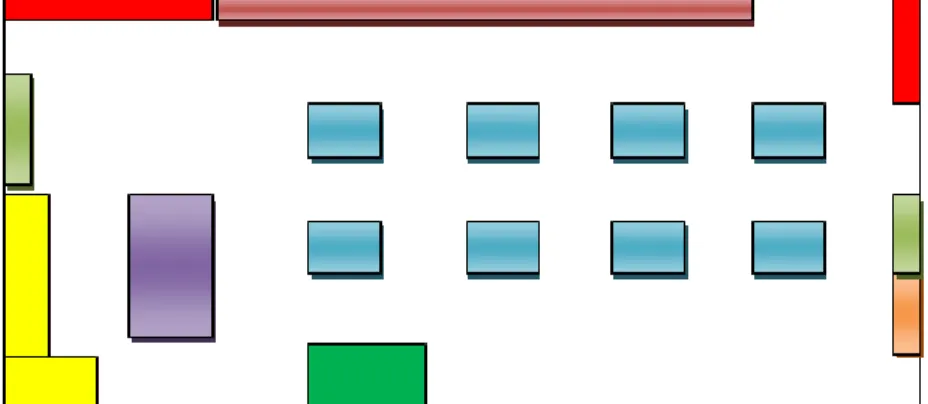
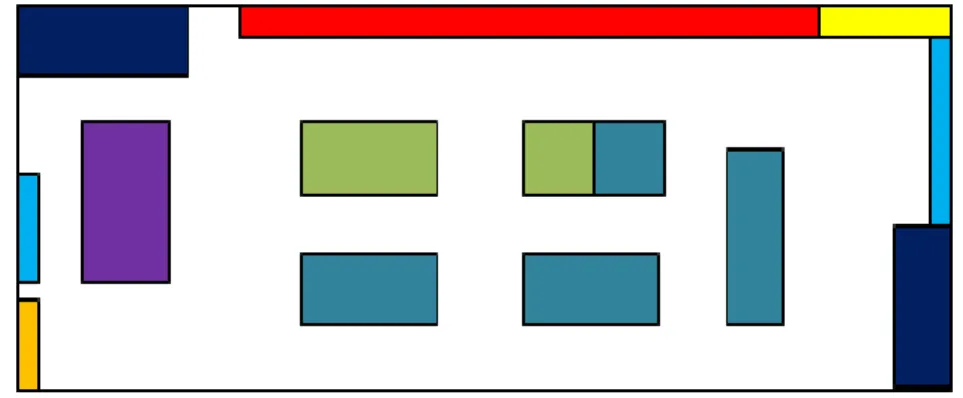
(41) 3.8 Context of the Study As it was specified, this research project was developed in two diverse places. Even though, these two institutions are focused on teaching and develop students’ abilities, both places are different and it could affect or benefit students’ development. These two places were chosen to have different perspectives in teaching children with Down Syndrome, specially focus on the development of speaking skill. One of the places is totally focus on Down students and in their performance during their classes. On the other part, the public school selected was because it includes children with any disability, this includes Down learners. Thus, it is significant to know how this type of students get along with other students and how it benefits or affects their development in comparison to the other school. The context of this study is explained in detail below. 3.8.1 Fundación Down de Puebla A.C The data collection was carried out in a foundation specialized in caring Down Syndrome children only. The center is public and is located in Puebla, Mexico. This foundation adapts the curriculum according to the children’s necessities, using methods, technics and special strategies in order to facilitate their learning and take advantages of their capacities. Each Down student has an individual program to advance more according to his/her needs. This foundation is based on the educational program from Cantabria, Spain. This organization gives special education taking into account the following: ➢ Design and adapt the curriculum map and materials for each individual with different disabilities to take advantage of each one.. 31.
(42) Students receive extra activities such as dancing, art, therapy, music and physical education during the class time. 3.8.2 Centro de Atención Múltiple Yolot’si This special school offers classes to different students who have any disability. They give public education to all of those students with special needs. The basis of its program comes from ‘Plan de Estudios 2011’ taken from SEP. In this school, teachers try to include each student in a common environment as a regular student. Each teacher has to adapt the curriculum according to the necessities that exist in their classrooms, as well. This school pretends to create an environment as regular as possible. Students wear a uniform and their schedule is the same as the regular schools that is from 8:00 to 13:00. Students have extra activities to develop some extra skills. They have therapy, psychology, cooking and computing classes. As teachers, they try to treat them as regular students, if they arrive at school late, students do not have permission to enter, this provokes that students miss classes. Something great from each school is that they have extra activities to complement students’ education and at the same time each school tries to include the students into the society as regular ones. 3.9 Data Analysis The data analysis contributed to have an overview about all the possible problems that Down children have to face at school and in the society. The data collected were analyzed through the audios from the interviews doing a transcription of them, and then once the recordings were in text, the conversations were analyzed identifying key extracts. 32.
(43) relevant to the research questions to give a possible solution to the problem. As for the classroom observations, once we gather the data in the class observation sheet, it was analyzed through the way in which the teachers organized the classes. All the data collected were presented throughout the next chapter in which it is interesting to see the points of view of each participant, from their perspectives and experiences. Conclusion Along this chapter, we could see a description of the participants, the places where they develop their work and how they influence each other to their lives. Needless to say that it was discussed about the instruments that were used to collect the data. The interviews and the class observation were appropriate to carry out the data compilation because it is easy to see professionals’ perspectives from their own voices. All this information is presented below.. 33.
(44) CHAPTER IV: Findings The objective of this chapter is to survey the data collected. Analyzing the responses of each participant and the class observation. To respond to this research project, we need to remind the type of research it is. In this research project will be used as a qualitative research method. Qualitative research is a method to explore deeper ideas, opinions, reasons, and motivation. It is used to gain more information about a specific topic and take more advantage from it. This type of research is useful when someone wants to know extra information about a familiar topic using a specific group of individuals or a case study of one single individual. In qualitative research are used different techniques or instruments as well. For example, interviews, observations, etc. According to Hancock (2007, p.6) qualitative research is focused on how people or a group of people can have different ways of looking at reality, this also incorporates the real world context, report of the experience, people’s behavior in natural settings. This chapter is focused on the data analysis that was obtained during the observation classes and interviews to give a response to the research questions that were set at the beginning of this research project. 4.1 Class Observation Analysis Part of the data collection was obtained through some class observations. It was observed three classes in each institution to compare the teaching strategies, activities/materials, group management and how Down Syndrome students were treated and some other facts to know how students with that syndrome acquire their native. 34.
(45) language in order to adapt each of them to English. Thus, the researcher could determine the ways Down students learn. Below it is a discussion about each class observation comparing both institutions. 4.1.1 First Class Observation In the first observation at Fundación Down de Puebla A.C [Puebla Down Foundation A.C] showed that most of the time class was wasted, provoking that students get distracted easily and the most important thing is that they did not seize the time to learn and improve more their skills. The teacher did not pay attention to all of the students because she was preparing the activities during class time but once she had them, students started to answer their activities. Students' responses were well, but after some time they got bored. From the beginning until the end of the class, the teacher motivated them as well. Nevertheless, the teacher started the class asking to the most advanced student to write the everyday task before to start with any topic. It was to write about the things students learned the day before, the things that were going to learn that day and the date. The teacher had some color paper to do this activity, she had the word ‘yesterday’, ‘today’ and ‘date’ to start to write the information required. After the student finished, the rest of the class had to write those sentences in their notebooks. One important thing is that while the students were doing the activities, the teacher was repeating the words that they did not remember in that moment. Thus, the students could finish their task. In this class, the activity was to solve a ‘word search’ with diverse vocabulary and when the whole class finished, the teacher repeated the answers slowly. 35.
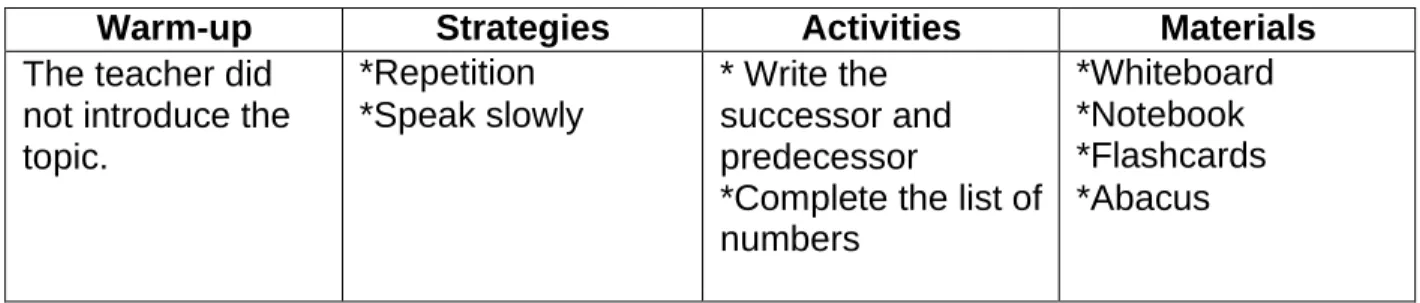
(46) (E-S-C-O-B-A), in order to help students to find the words easily recognizing the sounds of each word. On the other hand, at Centro de Atención Múltiple Yolot’si [Yolot’si Multiple Care Center] as it was mentioned in chapter III, there are students with different disabilities attending the school as a common one. In the first observation class, it could be observed that the main teacher was not teaching to the students because another teacher that was the practitioner from an institution had to complete her professional practices that is why the main teacher let her teach them. It was uncommon that the practitioner's performance affected the students, for that reason the main teacher needed to intervene in the class to help her with the class. The activity at the beginning was about Mathematics, but suddenly it changed into Spanish class, this causes that the class did not have a sequence and some students were focused on Math and others with Spanish. Students got distracted when someone else entered the classroom and when they realized that the teacher was paying attention to other students as well. In the time for Math class, the teacher used the board and flashcards with numbers. They were learning the predecessor and successor number therefore, students wrote in their notebooks the numbers on the board. Once they had them, the teacher started to call some students to pass in front of the class to solve one exercise. After that, the students had more extra exercises to solve by themselves. However, some students needed help to complete the task. During this exercise, the advance students were wasting time because they did not have any activity after they finished, this issue included. 36.
(47) one of the Down Syndrome girls. For those students who did not know how to do the exercise, the teacher used an abacus. When the time that the teacher gave for the activities was almost over, she started to count and the whole class knew that they needed to finish everything on time. At the end, the last ten minutes the teacher changed the class into Spanish, but there was not a sequence it was unexpected to change the class suddenly. The teacher started to ask about students’ homework, but only four students did it, it includes one of the Down Syndrome student. The teacher started with the Down learners and she asked one of them to read her homework, but it seemed that the student did not have confidence when she spoke and the teacher motivated her all the time as well as other students in the class. The other student had problems to write her homework, the teacher had to draw some lines in the student’s notebook as a guide. 4.1.2 Second Class Observation This observation class was almost the same at Fundación Down de Puebla A.C [Puebla Down Foundation A.C]. Four students were absent and this could allow the teacher to have a good class, but it was not as it was expected. At the beginning of the class, the teacher was waiting for more students to start the class, it provoked other students to get bored, just one student was writing on the board some sentences that they normally do before to start each class. That student was one of the most advanced. While the teacher was waiting for more students, she was checking their homework. On the other hand, as the teacher saw that other students did not arrive to the class, she started with an activity about repetition and remind past information using flashcards. It was hard. 37.
(48) for those students who have more problems and the teacher did not say the instructions, she only repeated the words. When this activity was completed, the teacher gave each student individual work, but unfortunately, she did not pay attention to them. Moreover, when the advanced student finished, the teacher allowed him to play with the material they have in the classroom but this caused that other students got distracted and the teacher did not do nothing about this issue. Despite this, the teacher always motivated the students. On the other side, in the second observation class at Centro de Atención Múltiple Yolot’si [Yolot’si Multiple Care Center], the practitioner was there again. Unfortunately, this did not allow seeing how the students' performance is. Another issue was presented in this class when the teacher asked about the homework and only two students did it; this fact did not permit the teacher advance with the whole group because the activity for that class was to create a story with a brainstorm according to students' homework. Thus, the teacher only paid attention to those students who did the homework, putting aside the rest of the group. Down children did not do the homework and they did not work in this class time. This caused that Down students were distracted, but they knew that something was wrong. Half part of the class, some students went to their cooking class, leaving in the class only two students, one Down learner and another student with another disability. The practitioner was assigned to care students in cooking class and the main teacher stayed in the classroom with the rest of the group changing the activity making it more individual and focused on the Down student who had deafness problems, as well.. 38.
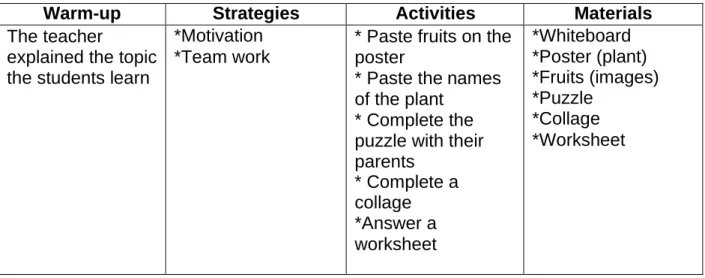
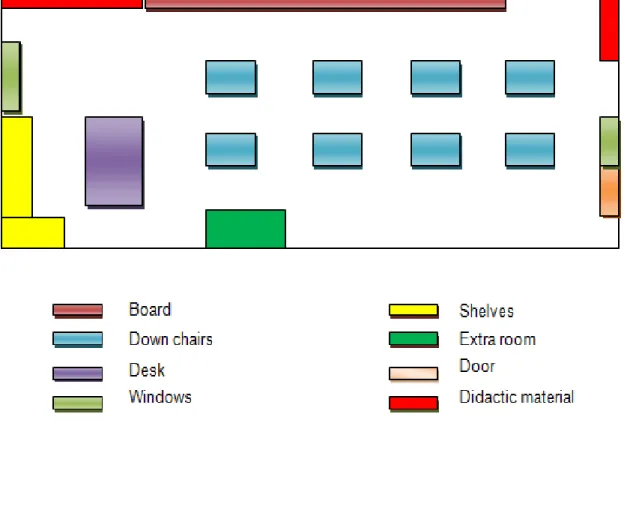
(49) 4.1.3 Third Class Observation This last observation class at Fundación Down de Puebla A.C [Puebla Down Foundation A.C] was special because it was a sample class. This allowed parents to see the process of their children. In that class, the principal of the foundation was there and the parents of most of the students. It was outstanding that in this session, the teacher was prepared to give students- advances. In this case, two students were absent; this allowed the teacher to manage in a better way the class. However, she seemed nervous and it caused that she lost the time. It was noticed that the teacher planned this special class. She used more teaching material than she usually used during other classes. It was realized that in other classes, the teacher prepared all the material and students to present the sample class; it means that the teacher practiced the sample class with the students in order to get good comments from students’ parents and the principal. In this occasion the teacher was motivating each student during the whole class, they felt special because they completed each task and their parents were there supporting them as well. The principal of the foundation was helping the teacher explaining the parents all the work they do to improve students' skills. One of the activities included children’s parents, therefore the class was more dynamic and it could be seen that this type of activities where the teacher includes everyone, Down Syndrome students participated and they were focused on the topic for that class and felt motivated to continue doing each exercise. Differently, the last observation class at Centro de Atención Múltiple Yolot’si [Yolot’si Multiple Care Center] was the last class before to have holy vacations; it caused. 39.
(50) that the teacher wasted time at the beginning of the class. Then, the teacher started with Spanish class asking students what they did the day before. Students were participating, giving their opinions to the teacher and the teacher wrote them as a brainstorm. After some time, half part of the group went to the cooking class again, leaving the main teacher in charge of the rest of the group and at the same time changing the first activity that previously the practitioner was doing. The teacher wanted to dictate a short paragraph to know how the students had developed their writing skills. In this case, there were two Down students and one advanced girl with another disability. As the teacher notices that one Down student could not write in one single row, she helped her to draw some lines as a guide to maintain the order in her writing. On the other hand, the other Down learner could do it by herself, even though she had some spelling problems. In this activity, the teacher helped students to divide into squares to write a letter per square. At the end of these class observations, it could be seen common issues into the classrooms as well as how the teachers and the students managed during class. However, it is essential to observe the materials, strategies and other facts to have data that are more valuable. 4.2 Materials, Strategies and Class Management As far as we know, no previous researches have investigated the way in which Down students can acquire a second language. Nevertheless, here it is a discussion about the materials teachers could use to teach Down Syndrome learners in order to develop their speaking skills based on the data collection from the class observations where the research was conducted.. 40.
Figure


+7



Documento similar
The aim of this paper is to demonstrate that reading authentic literary material in the English as a Foreign Language (EFL) classroom can improve students’ language learning skills as
In the case of speaking, researcher shows that a rich variety of activities might be done to promote this particular language skill in the language
The aim was to improve the students' level of training before attending laboratory practices, to standardize the evaluation among teachers and to involve students in the
In order to delve into this issue, this paper is a case study of two bilingual children whose dominant first language (Spanish) does not require linguistic differentiation
Government policy varies between nations and this guidance sets out the need for balanced decision-making about ways of working, and the ongoing safety considerations
This can make the experience of video calls even more tiring and difficult.. As a result of the factors mentioned above, people are at risk of what is now called “video
• While undergraduate students in Saudi universities are expected to have desired English language skills in order to further advance in their specialized areas of study, writing
a) Train mentors (who can be male or female teachers or students from last semesters) through short videos on mechanisms and strategies to develop skills that enable them to develop
