UNIVERSIDAD DE CUENCA
FACULTAD DE FILOSOFÍA, LETRAS Y CIENCIAS DE LA EDUCACIÓN CARRERA DE LENGUA Y LITERATURA INGLESA
“ECLECTIC LESSON PLANS BASED ON THE NATURAL APPROACH AND THE
TOTAL PHYSICAL RESPONSE METHOD FOR THE DEVELOPMENT OF
COMMUNICATIVE COMPETENCE IN NINTH GRADERS”
Trabajo de Titulación previo a la obtención del Título de Licenciado en Ciencias de la Educación en Lengua y Literatura Inglesa
AUTOR:
Rodrigo José Aguilar Romo C.I. 0941166209
TUTOR:
Lcdo. Juan José Santillán Íñiguez C.I. 0301916144
Rodrigo José Aguilar Romo 2 RESUMEN
Debido al significativo número de bachilleres que finalizan sus estudios secundarios sin alcanzar los niveles de competencia comunicativa en el idioma inglés, establecidos en el Currículo Nacional, el Ministerio de Educación ha tomado medidas con el fin de alcanzar tales niveles. Una de las medidas de mayor importancia, es incrementar la cantidad de profesionales docentes, así como de constantemente brindarles oportunidades para que puedan mejorar su práctica.
Como su principal objetivo, este proyecto propone y provee como ayuda a los docentes de inglés, 10 planificaciones eclécticas basadas en el método Total Physical Response (Respuesta Física Total), y en el enfoque Natural Approach (Enfoque Natural), para el desarrollo de competencia comunicativa en estudiantes de noveno año de Educación General Básica Superior, por lo cual, dichas planificaciones están diseñadas según destrezas planteadas en el Currículo Nacional.
Para lograr el mencionado objetivo, se llevó a cabo una significativa investigación sobre los antecedentes de la enseñanza de inglés en el Ecuador, así como del origen, principios y técnicas del método Respuesta Física Total y del Enfoque Natural. Además, se condujo encuestas dirigidas a estudiantes de noveno año de una institución pública, con el fin de conocer sus preferencias en cuanto a actividades durante el aprendizaje del inglés, las mismas que se consideraron para el diseño de las planificaciones.
Destinar mayor énfasis al desarrollo de las habilidades lingüísticas, ayudará a los estudiantes de una lengua extranjera a lograr el objetivo de estudiarla durante varios años, el cual es comunicarse en dicha lengua extranjera.
Palabras clave: TPR, ENFOQUE NATURAL, EFL, ESTUDIANTES DE NOVENA AÑO,
CURRÍCULO NACIONAL, IDIOMA, HABILIDADES, PLANIFICACIONES
Rodrigo José Aguilar Romo 3 ABSTRACT
Given that the significant number of high school graduates who finish their studies, do not reach the established communicative competence levels in the National Curriculum, the Ministry of Education has implemented courses of action destined to the development and improvement of Ecuadorian students’ language skills. An important aspect relies on the need of incrementing the amount of professional educators, as well as on implementing opportunities for them to improve their practice.
Therefore, as its main objective, this project proposes and provides as an aid to teachers, 10 eclectic lesson plans based on the Total Physical Response method and on the Natural Approach, for the development of communicative competence in ninth grade students of Educación General Básica Superior; therefore, the lesson plans are designed under the performance criteria stated in the National Curriculum.
In order to accomplish the mentioned objective, significant research was conducted on the antecedents of English teaching in Ecuador, as well as on the origin, principles and techniques of the Total Physical Response method and the Natural Approach. Furthermore, surveys were addressed to ninth grade students from two groups in a public high school, aiming to acknowledge their preferences of activities during the process of learning English, for the design of the lesson plans.
To emphasize on the development of language skills, will help the students of a foreign language to accomplish the objective of studying it for several years; the objective of communicating in the foreign language.
Key words: TPR, NATURAL APPROACH, EFL, 9TH GRADERS, NATIONAL CURRICULUM, LANGUAGE, SKILLS, ECLECTIC LESSON PLANS, LEARNING
Rodrigo José Aguilar Romo 4
CHAPTER ONE: DESCRIPTION OF THE RESEARCH………15
1.1Topic……….15
2.2 The Total Physical Response method………...23
Rodrigo José Aguilar Romo 5
2.4 Critics on the Natural Approach and the TPR……….……….28
2.5 Eclectic Practice………29
2.5.1 Description of Eclectic Practice………..29
2.5.2 The Natural Approach and the Total Physical Response method combined into Eclectic Practice………..30
2.6 Communicative Competence ………32
2.6.1 Defining Communicative Competence………32
2.6.2 Developing Communicative Competence………32
2.7 Lesson Planning………...……..35
2.7.1 What is a Lesson Plan? ………35
2.7.2 Purpose of Planning a Lesson………...………35
2.7.3 Elements of a Lesson Plan………36
2.8 The EFL National Curriculum for 9th grade………...…38
CHAPTER THREE: METHODOLOGY……….41
3.1 Research Methods………..41
3.2 Participants……….42
3.2.1 Description of the Survey Participants……….42
3.3 Data Collection Instrument: Survey………...43
3.4 Description of the Administration Process of the Data Collection Instrument………..…43
CHAPTER FOUR: RESULTS AND ANALYSIS………..45
4.1 Analysis of the Survey Results………..…45
Rodrigo José Aguilar Romo 6
4.1.7 Question 7………...56
4.1.8 Question 8………...…58
4.1.9 Question 9………...…63
4.1.10 Question 10………...66
CHAPTER FIVE: LESSON PLANS……….………..68
CHAPTER SIX: CONCLUSIONS AND RECOMMENDATIONS……….140
REFERENCES………...…142
Rodrigo José Aguilar Romo 9 DEDICATION
To a mother who has meant infinite love
To a father who has meant proper guidance
To a family that has meant warmth
To a wife who has meant companionship and support
Rodrigo José Aguilar Romo 10 ACKNOWLEDGEMENTS
My parents took me as far as I needed to go in order to accomplish this goal. My
parents-in-law gave me the warmth of family. My wife gave me infinite support. My friends
encouraged me. I thank all of them for it would have been unimaginably harder to having
written these pages today.
I would also like to thank University of Cuenca and all of those who were my teachers,
for providing the proper educational environment for my professional initiation. I would
specially like to thank Juan José Santillán for having been immensely supportive during this
process. I am also grateful to Unidad Educativa La Inmaculada and its students, for they were
Rodrigo José Aguilar Romo 11 INTRODUCTION
The Critical Period Hypothesis states that certain learning must better take place at a
specific time through the development of childhood to adolescence to adulthood, otherwise the
learning might not be adequate or as valuable as if it had taken place at the proper time.
Furthermore, the Total Physical Response Method, proposed by Dr. James Asher
(1979), states that language learning starts with children internalizing knowledge, being able
to understand it and then to produce it. If we have as humans the innate capacity to acquire our
mother tongue during our first two to three years of age by receiving unlimited input and later
on producing output, it means that our brains are designed to accomplish such thing in such a
way. Therefore, teachers should not insist on teaching a foreign language to their students in
the opposite way, teaching them first to read and write in the target language and then to
converse, which means developing listening and speaking skills later. After all, it is common
knowledge that our species did not first write words but uttered them.
Therefore, this project seeks as its general objective, to compile a series of techniques
and activities from the Natural Approach and the Total Physical Response Method, to establish
eclectic lesson plans based on the current National Curriculum Guidelines designed for 9th grade, as an aid for teachers to develop and improve communicative competence in their pupils.
As a conclusion, this monograph is structured to collect all the information that has
been mentioned to come up with the aforementioned eclectic lesson plans. Nevertheless, it
would not have been possible to design these plans if proper research had not been conducted.
Not only did the researcher investigate about the principles and activities of the Natural
Approach and the TPR, but also about the preferences that a specific group of participants have
throughout the learning process of English, by means of surveys. All the information regarding
Rodrigo José Aguilar Romo 12 qualitative data, has been analysed in several chapters. As a result, the eclectic lesson plans
proposed have been designed in the hope that these might be useful to English teachers in the
Rodrigo José Aguilar Romo 13 CHAPTER ONE: DESCRIPTION OF THE RESEARCH
1.1. Topic
The aim of this project was to aid the development of communicative competence in
ninth graders by means of the provision of 10 eclectic lesson plans based on the Natural
Approach and the Total Physical Response method. The National Curriculum Guidelines for
the 9th grade were the pillar to which these eclectic lesson plans were adapted.
1.2. Delimitation of the Problem
The Ecuadorian level of communicative competence in English is rather disappointing.
Calle A. et al (2012), argue that an example of the main problem is the significant number of
high school graduates who have not developed communicative competence, and hence, cannot
communicate in real contexts or situations (p. 2-6). For his part, McLaughlin states that “the
most important factor to improve the quality of education in developing countries seems to be increasing the amount of professionals in education” (as cited in Calle, A., 2012, p. 5). The
CRADLE1 project was designed in 1993 as a measure to handle and solve the inefficiency in communicative competence development among the country’s inhabitants; though the
initiative had some success, it was not to the expected extent. If one considers that, as Calle A.
et al (2012) mentioned, the decision of the CRADLE project to follow the Natural Approach
and its principles improved the Ecuadorian proficiency level of English in public high schools
(p. 2-6), then it may be inferred that the use of traditional methodologies is one of the main
factors for the persistent low level Ecuadorian students have reached.
Rodrigo José Aguilar Romo 14 During their teaching practice, language educators meet excellent students, among
whom they differentiate two groups. The first, relates to the ones who truly comprehend
English and are able to actually use it in real-life situations; the second group of students
encompasses those who study English as any other school subject, which they may forget after
graduation. Both groups might get good grades, but not all develop communicative competence
in the target language. The problem with the second group’s performance is that they might be
motivated to reach academic excellence yet not to acquire English as a foreign language.
For the previously mentioned reasons, and because according to Criollo and Pulla, in
Cuenca English teachers do not use the target language sufficiently in public schools (as cited
in Calle, A., 2012, p. 5), this monographic work aimed to follow communicative teaching
principles, designing 10 eclectic lesson plans based on the Natural Approach and the Total
Physical Response method. The purpose of this monograph is to aid educators teach English in
a naturalistic manner, as similar as possible to the fashion children acquire their mother tongue.
1.3. Background and Justification
The CRADLE project (1993) was born as an initiative of the Ecuadorian Ministry of Education in order to increase the proficiency of English in the country’s inhabitants. However,
as mentioned above, studies show that even though the CRADLE project, following Krashen and Terrell’s Natural Approach, which focuses on communicative teaching, has increased the
original proficiency from two decades ago, a low level still persists (Calle A. et al, 2012, p.
2-6). This statement sets forth this monograph’s belief that language teachers should continue
working with naturalistic approaches and methods.
Teaching English as the language is -not as any other school subject- has crossed the
Rodrigo José Aguilar Romo 15 to the hypothesis that language learning starts first with understanding and ends with production” (Larsen-Freeman & Anderson, 2011, p. 103). This project attempted to aid the
attainment of the mentioned purpose, by analyzing the Natural Approach and the Total Physical
Response method to design 10 eclectic lesson plans, which have as their main objective to
support the development of communicative competence in English as a foreign language by
trying to emulate the same natural means by which children acquire their mother tongue. One has to consider as well that “after the learner internalizes an extensive map of how the target
language works, speaking will appear spontaneously” (Larsen-Freeman & Anderson, 2011, p.
103); it is on this spontaneity that language teachers should focus.
Moreover, if English is taught by educators as one acquired one’s mother language in
early childhood -without too much conscious effort- the kind of activities that motivate students
take place. Following from this, a study carried out by Xu Liu (2010), from the University of
Beijing, introduced the hypothesis that “[innovative activities like that of] role-play arouses
motivation in English students and that a second language should be taught using new and
creative techniques, therefore, the same old methods should be improved or abandoned” (p.
136). The author of this monograph, however, does not intend to conduct a study on motivation,
but only to emphasize on the importance of activities like that of role-play in learning a foreign
language naturally. Added to that, all the activities of the lesson plans of this project are suitable
to 9th graders.
In addition, the feasibility of this project may become evident in that, according to
Lightbown and Spada (2006), by the age of two most children:
Reliably produce at least fifty different words and some produce many more [in the
Rodrigo José Aguilar Romo 16 language in their first three years, there are predictable patterns in the emergence and
development of many features of the language they are learning (p. 4)
Hence, this monograph intends to take advantage of the natural learning process that occurs in students’ minds.
Furthermore, James Asher, when developing his TPR2 method, argued that children, in learning their first language, appear to do a lot of listening before they speak, and that their
listening is accompanied by physical responses -reaching, grabbing, moving, looking and so
forth (as cited in Brown., 2000, p. 30). Therefore, TPR enhances the improvement of listening
skills, applying techniques based on the imperative mood, where students act out the commands and do a large amount of listening. On the other hand, according to Brown (2000), “TPR
seemed to be especially effective in the beginning levels of language proficiency, but it lost its distinctiveness as learners advanced in their competence” (p. 30); therefore, as 9th graders still
retain some features of young learners, to combine TPR with the Natural Approach seems to
be a wise choice.
Krashen and Terrell’s Natural Approach may complement the TPR as its authors
elaborated on Asher’s claims that a comprehension-based approach was required. Brown
(2000) mentions that, “the Natural Approach advocated the use of TPR activities at the
beginning level of language learning when ‘comprehensible input’ is essential for triggering
the acquisition of language” (p. 31). The previous statement shows that TPR and the Natural
Approach share the belief in the need for an initial silent stage, providing relaxation and time for the student to eventually venture to speak. The same author states that “through TPR and
other forms of input, [as the Natural Approach] students’ language egos are not as easily
threatened, and they aren’t forced into immediate risk-taking that could embarrass them. The
Rodrigo José Aguilar Romo 17 resulting self-confidence eventually can spur a student to venture to speak out” (H. Douglas
B., 2000, p. 32). As a result, the Eclectic practice intended in this monograph is justified.
Furthermore, every development or improvement in the field of language education, by
means of individual so-called communicative and comprehension-based methods and
approaches, is of noticeable importance. In spite of that, language teachers, whether they realize
it or not, practice eclectic teaching all the time, given that they choose principles, strategies,
and techniques from various methods and approaches to better address their specific contextual
needs. What makes them eclectic teachers is:
How many methodological options they think of in order to fulfil a certain teaching
goal. Good teachers know that no principle applies to all students in all contexts for all
purposes. Therefore, every teacher creates their own approach to language teaching,
selecting the best of all methods and approaches as they gain experience (H. D.
Brown, 2000, p. 40-42)
Finally, the aim of all language educators ought to be the improvement of the English
proficiency level of their students. This project was designed precisely for attending to that
Rodrigo José Aguilar Romo 18 1.4. Objectives
1.4.1. General objective
To design 10 eclectic lesson plans, combining principles, techniques, and strategies of
the Natural Approach and the Total Physical Response method, which are suitable for the
National Curriculum for 9th grade in public schools, as an aid for the development of communicative competence in these students.
1.4.2. Specific objectives
➢ To carry out bibliographical research about the Natural Approach and the Total
Physical Response method, in order to identify and compile their most relevant
principles, strategies, and techniques.
➢ To analyze the National Curriculum for 9th grade to identify the most pertinent topics for the lesson plans.
➢ To design and conduct a survey among 9th grade students to identify their topical and
learning preferences.
➢ To combine the selected Natural Approach and the TPR principles, strategies, and
techniques in the design of 10 lesson plans that incorporate the identified topical and
learning preferences.
Rodrigo José Aguilar Romo 19 CHAPTER TWO: LITERATURE REVIEW
2.1. Understanding Approaches and Methods
2.1.1. Defining approach
An approach is a compilation of methods that serve as the steps to accomplish or fulfill
certain tasks; it is a perspective from which one addresses a problem. In the language-teaching context, Brown (2000), defines approach as “theoretically well-informed positions and beliefs
about the nature of language, the nature of language learning, and the applicability of both to
pedagogical settings” (p. 16). For his part, the applied linguist Edward Anthony defined approach as “a set of correlative assumptions dealing with the nature of language teaching and
learning. (…) It describes the nature of the subject matter to be taught” (as cited in Richards &
Rodgers, 2001, p. 19). Brown’s (2000) conceptualization of approach as theoretically
well-informed positions and beliefs about the nature of language, fits Anthony’s conception that an
approach is axiomatic, that is, a self-evident postulate, or an established truth, which takes the form of ‘an overall plan for systematic presentation of language’ (p. 14). Also, the same author,
concluded that teachers ought to select the best of what has been studied and adapt those
insights to their teaching, which in turn can become a teacher’s own principled approach to
language teaching (p. 32). This project, therefore, aims to aid as a starting point for language educators’ own principled approach.
2.1.2. Defining method
On the other hand, a method is commonly known as a compilation of means, ways, and
steps to accomplish a specific goal. What matters to this project, though, is defining method in
the language-teaching context. According to Larsen-Freeman and Anderson (2011), “a method
Rodrigo José Aguilar Romo 20 not a ‘recipe’ to be prescribed to teachers” (p. 6). Furthermore, the same authors state that there
is not one best method but the probability for educators to choose the one that better fits their
teaching philosophy. Similarly, Anthony, half a century ago, defined a hierarchic arrangement
of approach, method, and technique:
The organizational key is that techniques carry out a method which is consistent with
an approach. Method is an overall plan for the orderly presentation of language
material, no part of which contradicts, and all of which is based upon, the selected
approach. A method is procedural. Within one approach there can be many methods
(as cited in Richards & Rodgers, 2001, p. 19)
Furthermore, Richards and Rodgers (2001), intended to establish a different
conceptualization of what is known as method. According to them, the previous hierarchical
arrangement lacked information about the roles of teachers and students assumed in a method,
and did not clarify how an approach, a method, and a technique are related. Therefore, Richards and Rodgers “see approach and method treated at the level of design (…) in which the roles of
teachers, learners, and instructional materials are specified. A method is theoretically related
to an approach, is organizationally determined by a design, and is practically realized in
procedure [technique, in Anthony’s model]” (J. Richards & T. Rodgers, 2001, p. 20). Therefore, the same authors extended Anthony’s original arrangement in an attempt to simplify
the concepts.
In their model, a Method contained an approach, a design, and a procedure. An
approach concerns theory about the native language and the nature of language learning. A
design addresses the general and specific objectives of the method, a selection of the learning
content as well as the tasks and practice activities, the roles of teachers, students, and
Rodrigo José Aguilar Romo 21 by the teacher plus tactics and strategies used by teachers and learners while using the method
(J. Richards & T. Rodgers, 2001, p. 33). In spite of their efforts, their conceptualization of the terms was not established in the field of language teaching as they expected, hence, Anthony’s
hierarchic arrangement has been more readily accepted.
2.2. The Total Physical Response method
2.2.1. Background
Asher (1979) strongly supports the idea that adults [and teenagers] should learn a foreign language in a fashion similar to children’s acquisition of mother-language. “In a
developmental sense, Asher sees successful adult second language learning as a parallel
process to child first language acquisition. He claims that speech directed to young children
consists primarily of commands, which children respond to physically before they begin to produce verbal responses” (Richards & Rodgers, 2001, p. 73). Therefore, the Total Physical
Response method was developed as a means to accomplish this strong L2 learning belief; this
method seeks the acquisition of a foreign language by having students act out commands only
physically until they feel comfortable enough to venture a verbal response.
2.2.2. Principles
Larsen-Freeman and Anderson (2011), delimitate the following principles from a TPR
class observation:
• For students to enjoy their learning experience, Asher believes that learning has to be based upon the natural way children learn their native language, thus
Rodrigo José Aguilar Romo 22
• The teacher is the director of all student behavior and students imitate until they are ready to speak and become directors as well. According to Asher, “the instructor is the director of a stage play in which the students are the actors” (as
cited in Brown, 2000, p. 30).
• The teaching-learning process is based on phases beginning with modeling commands uttered and performed by the teacher. Then, the students demonstrate
they understand the commands by performing them alone.
• The teacher recombines elements of the commands so that students become flexible in understanding often humorous unfamiliar utterances. After students
learn some of the commands, they learn to read and write them and begin issuing
the commands.
• Initially, the teacher speaks and the students respond nonverbally. Then, the students demonstrate their understanding of the commands.
• TPR reduces the stress of studying another language by allowing students to speak when they feel ready to do so. Feeling of success and low anxiety facilitate
learning.
• Vocabulary and grammatical structures are emphasized over other language areas with the use of imperatives. The spoken language is emphasized over
written language.
• TPR is usually introduced in the student’s native language. After that, meaning is made clear through body movement.
• Formal evaluations can be conducted simply by commanding individual students to perform a series of actions.
Rodrigo José Aguilar Romo 23 2.2.3. Techniques
Commands
The use of commands is the main technique on which TPR is based. Nevertheless,
students may lose interest if their learning faces the same techniques or activities during the
whole course. Teachers, therefore, are free to add elements from their own practice.
Returning to the topic on commands, “at first, to clarify meaning, the teacher performs
the actions with the students. Later the teacher directs the students alone. The student’s actions
tell the teacher whether or not the students understand” (Larsen-Freeman & Anderson, 2011,
p. 111). One way or another, Asher believes it is very important to present only three commands
at a time and once the students feel successful with those, to present three more.
Silent stage
TPR does not force students to speak until they feel comfortable to do so. Once they
start venturing their first verbal responses, a role reversal technique can be applied.
Role reversal
Here the teacher is not the only one giving commands but also the students to other
classmates and even to the teacher. “Asher says that students will want to speak after 10-20
hours of instruction, although some students may take longer. Students should not be encouraged to speak until they are ready” (Larsen-Freeman & Anderson, 2011, p. 112).
Action sequence or operation
Furthermore, making a phone call or grabbing a comb to do one’s hair may look as two
single activities, but they are not. For instance, for one to make a phone call, one must approach
Rodrigo José Aguilar Romo 24 can give those different commands for students to perform, which in turn result in a technique
called action sequence or operation.
2.3. The Natural Approach
2.3.1. Background
Krashen and Terrel (1983) developed the Natural Approach based on the TPR idea of
delaying speech until it naturally emerges, thus creating a silent stage for the student as a
relaxing space to develop their learning. According to Brown (2000), in the Natural Approach:
Learners presumably move through what Krashen and Terrel defined as three stages:
(a) The preproduction stage is the development of listening comprehension skills. (b)
The early production stage is usually marked with errors as the student struggles with
the language. The teacher focuses on meaning here, not on form. […] (c) The last
stage is one of extending production into longer stretches of discourse involving more
complex games, role-plays, open-ended dialogues, discussions, and extended
small-group work. Since the objective in this stage is to promote fluency, teachers are asked
to be very sparse in their correction of errors (p. 31)
2.3.2. Principles
Richards and Rodgers (2001), consider the following Natural Approach principles:
• According to Krashen and Terrel, their approach is empirically based on a theory of second language acquisition, supported by several scientific studies in
a wide variety of language acquisition and learning contexts (as cited in J.
Rodrigo José Aguilar Romo 25
• Also, Krashen and Terrel view language as a vehicle for communicating meanings and messages, where acquisition takes place only when people
understand messages in the target language.
• Language is used in communicative contexts without native language translation.
• Language is taught without reference to a particular theory of grammar nor to its analysis.
• The Natural Approach places less emphasis on teacher monologues, direct repetition, and formal questions and answers, and less focus on accurate
production of target-language sentences.
• The Natural Approach places emphasis on exposure or input.
• It optimizes emotional preparedness for learning and a prolonged period of attention to what the language learners hear before they try to produce language.
• It provides a willingness to use written and other types of materials as a source of comprehensible input (p. 178-181).
2.3.3. Techniques
Krashen and Terrel (1983), claim that “language is best taught when it is being used to
transmit messages, not when it is explicitly taught for conscious learning” (p. 55). Therefore,
the authors based their approach on strategies and techniques that fit such claim.
Visual aids
According to the Natural Approach, visual aids such as pictures, are very useful for they
Rodrigo José Aguilar Romo 26 Vocabulary
Also, vocabulary plays an indispensable role. For the Natural Approach, vocabulary is
not sufficient but inevitably important; the more vocabulary, the more comprehension, and
consequently, the more acquisition of language.
Input synthetization
The foreign language classroom synthetizes input in order to aid the learner in their
acquisition process. The natural environment, in the case of learners who happen to be in
countries where their target language is natively spoken, may offer a wide range of input which
often results too difficult for the learner to understand.
2.4. Critics on the Natural Approach and the TPR
There is no perfect method or approach in any science or study. As a result, in regard
to studies of language, there are always limitations to be considered. Brown (2010), states that
limitations of the Natural Approach are the unlikely successful management of a course where
students begin in a silent stage until their speech emerges, for that speech may never emerge or do so at a different time depending on each student’s progress (p. 31).
On the other hand, as it was previously mentioned in chapter one, according to the same author, “TPR seemed to be especially effective in the beginning levels of language proficiency,
but it lost its distinctiveness as learners advanced in their competence” (p. 30); therefore, as 9th
graders still retain some features of young learners, combining TPR with the Natural Approach
Rodrigo José Aguilar Romo 27 2.5. Eclectic Practice
2.5.1. Description of Eclectic Practice
The application of a unique method in foreign language teaching and its successfulness
rely on variants such as the learning preferences and the type of intelligence of the student, and
the efficacy with which the teacher applies the method, to name a few. If all those pieces fall
into place, one such method might as well be enough. But given that not all students possess the same learning preferences and type of intelligence but learn and think differently, “it is
helpful for learners if they are aware of their own particular learning preferences in order that
they can use an appropriate learning style to suit the particular learning that is being undertaken” (Pritchard, 2009, p. 42) and most importantly, a good educator ought to try
different methods, which combined with the previous one, naturally begin and justify eclectic
practice.
Furthermore, Harmer (1991) mentions the importance of evaluating one’s own practice
as a teacher to see whether the methodology used is working or not:
If we and our students constantly monitor our classes and adjust what we do
accordingly, there is a really good chance that the methods and techniques we use will
be the best for the classes we teach. Pragmatic eclecticism does not just mean that ‘anything goes’. On the contrary, students have a right to expect that they are being
asked to do things for a reason, and that their teacher has some aim in mind which he
or she can, if asked, articulate clearly (p. 97)
In conclusion, eclectic practice means identifying students’ needs and then collecting
the most suitable elements one may need for one’s teaching from different approaches to
Rodrigo José Aguilar Romo 28 language, the selection of the elements combined to achieve the teaching goal ought to be
seriously considered.
2.5.2. The Natural Approach and the Total Physical Response method combined into
Eclectic Practice
The work of Brown (2010), mentions the strengths and also the limitations of different
approaches to language teaching, as well as the importance of combining them in order to
support one another. According to Brown:
Critics of TPR point out that this kind of teaching may only be appropriate for
beginner learners and question how TPR ties in with any real-world needs. Asher
himself says it should be included together with other methods. Yet certain features of
TPR have had an influence. In TPR students do not have to give instructions
themselves until they are ready. This kind of pre-speaking phase was considered of
vital importance to Stephen Krashen and Tracey Terrell in their book The Natural Approach. (p. 90)
Therefore, when Brown argues that TPR should be included with different methods to
make it work at its best, it becomes clear that eclectic practice provides better results.
Furthermore, constraints of eclectic practice may find solution in working with yet another
method.
In addition, this monograph suggests that L2 students should spend more time learning
to speak rather than writing and filling blanks. The lesson plans’ activities are to be
appropriately put into context to simulate real life situations and as a result, prepare the students
to face those situations efficiently. The Natural Approach consists of five basic principles:
Rodrigo José Aguilar Romo 29 Input Hypothesis, and the Affective Filter Hypothesis. All these principles support this
monograph’s idea that students should spend most of their time learning first to speak, and to
accomplish such thing it has to be considered that comprehension precedes production, therefore, “most of the N.A. techniques for classroom activities in early stages are oriented to
giving students comprehensible input without requiring oral production in the target language”,
for the teacher allows a natural order to take place without emphatically correcting mistakes
(Krashen & Terrell, 1983, p. 58-59).
Furthermore, the Total Physical Response is a method “developed in order to reduce
the stress people feel when they are studying other languages and thereby encourage students
to persist in their study beyond a beginning level of proficiency. The way to do this, Asher
believes, is to base foreign language learning upon the way children learn their native language” (Larsen-Freeman & Anderson, 2011, p. 109). The teaching-learning process of the
TPR begins with students imitating commands performed by their teacher. “The teacher next
recombines elements of the commands to have students develop flexibility in understanding unfamiliar utterances” (Larsen-Freeman & Anderson, 2011, p. 109); in the end, students learn
to read and write the commands they imitated at first.
Therefore, the Natural Approach and the Total Physical Response method, combined
into eclectic practice, are adequate for the development of communicative competence, given
that both the Natural Approach and the TPR advocate for a silent stage during the beginning
of the learning process, the students’ need to receive comprehensible input in order to imitate
and thereby produce by themselves later on, and allowing the student a learning natural order
Rodrigo José Aguilar Romo 30 2.6. Communicative Competence
2.6.1. Defining Communicative Competence
Communicative is the ability to communicate authentically in real daily life situations.
Communicative competence is a concept introduced by Dell Hymes (1972) whose original idea
was that speakers of a language need more than grammatical competence in order to be able to
communicate effectively in a language, and for that they also need to know how language is
used by members of a speech community (Smolcic, 2015, para. 2).
The concept was developed as criticism to Chomsky’s linguistic competence, therefore, debate between Hymes’ and Chomsky’s views can be appreciated. While Chomsky believes
that all humans’ grammar skills are absolutely innate, Hymes only agrees to the point of innate
ability to acquire a language, but claims that grammar rules need to be learned for students to
make their messages clear. Conveying clear messages means developing communicative
competence.
2.6.2. Developing Communicative Competence
Authors Canale and Swain in 1980, argued that in order to develop communicative
competence, four different sub-skills need to be developed as well. Those four sub-skills
proposed by Canale and Swain are grammatical competence, sociolinguistic competence,
discourse competence, and strategic competence, which according to Smolcic (2015), are
defined as follows:
Grammatical competence is the ability to recognize and use the different grammatical
structures and patterns of a language and use them effectively in real communication. This
competence includes the appropriate use of grammar -basically syntax-, lexis -vocabulary-,
Rodrigo José Aguilar Romo 31 would be the accurate use of tenses as in I’ve always been in love with you instead of I always have been loved of you.
Sociolinguistic competence is the ability to interpret and know how to use the different
language varieties that occur in social situations and according to several circumstances such
as function or purposes of communication. An example of this would be formal and informal
greetings as Good morning, ladies and gentleman and Hi, how you doing?
Discourse competence is the ability to link ideas across in any text or speech. Cohesion
and coherence are the two basic elements for successful discourse competence. To give an
example of coherence, a short answer to questions like Have you been writing a lot recently?, which would be Yes, I have, shows the use of have as an auxiliary verb that replaces the main verb to write.
Strategic competence is the ability to construct linguistic bridges when for any reason
the flow in communication is interrupted and discontinued. To give an example, translation,
paraphrasing, or miming are strategies that the speaker, especially the learner of a foreign
language, can use when they do not know how to say something in the target language.
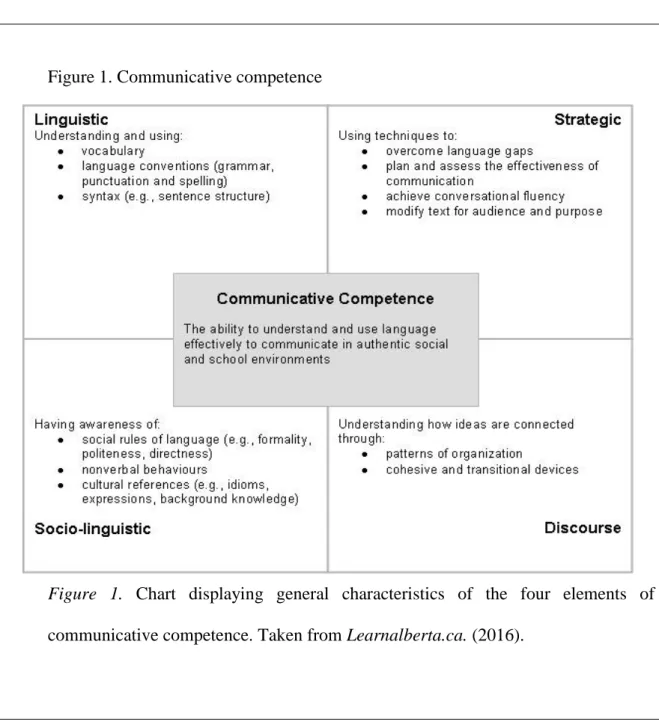
Rodrigo José Aguilar Romo 32 The following chart tells us more about the four elements or competencies involved in
developing communicative competence:
Figure 1. Communicative competence
Rodrigo José Aguilar Romo 33 2.7. Lesson Planning
2.7.1. What is a Lesson Plan?
Harmer (1998) explains the concept of Lesson Plan in terms of functionality and
importance to the students. Harmer mentions that a plan gives an overall shape to the lesson,
and that teachers need to think ahead and have a clear idea of where they want their students
to get. He reasons that even though most of the time a teacher is forced to depart from the plan
to attend any ongoing situation in the class, such as related or even non-related questions from
the students, a plan is still something to go back to. In terms of importance to the students, the
same author explains that students notice when a teacher has devoted time to preparing the lesson and how that suggests professionalism on the teacher’s behalf, and also how planning a
lesson gives students confidence and therefore respond positively to it (p. 121).
Finally, Harmer (1998), provides a rather interesting definition of lesson plan: “No plan
is written on tablets of stone, however. On the contrary, the plan is just that – a plan,
possibilities for the lesson which may or may not come about, in other words” (p. 121). From
this definition, it is clear that in spite of how often happens that teachers must deviate from the
plan, planning a lesson, nevertheless, is of paramount importance in order to conduct a class
efficiently and professionally, and to gain the student’s confidence and respect.
2.7.2. Purpose of Planning a Lesson
According to Harmer (1998), some experienced teachers tend not to plan their lessons
but teach their classes spontaneously, which even for such experienced teachers is not a great procedure, because in Harmer’s own words, “planning helps, then, because it allows teachers
Rodrigo José Aguilar Romo 34 week’s lessons. In the classroom, a plan helps to remind teachers what they intended to do –
especially if they get distracted or momentarily forget what they had intended” (p. 121).
The same author states that another especial situation where planning a lesson is quiet important, is when a teacher’s performance is scheduled for a review, where the selected
observer needs a clear idea of what the teacher is doing.
Finally, Harmer also shares an interesting statement of what are the aims of a lesson
plan, claiming that a good lesson aims to both coherence and variety:
“Coherence means that students can see a logical pattern to the lesson. Even if there
are three separate activities, for example, there has to be some connection between
them – or at the very least a perceptible reason for changing direction. […]
Nevertheless, the effect of having a class do a 45-minute drill would be equally
damaging. The lack of variety coupled with the relentlessness of such a procedure
would militate against the possibility of real student engagement. However present it
might be at the beginning of the session, it would be unlikely to be sustained. There has to be some variety in a lesson period” (p. 122)
Concluding that a lesson must be coherent as well as provide variety in activities for
the students.
2.7.3. Elements of a Lesson Plan
Similarly, according to Harmer (1998) once again, there are four main elements of a Lesson Plan that are part of any teacher’s plan, whether experienced or in training. The first
element is who the students are, meaning number, ages, sexes, and general behavior. The
second element is the content to be taught and studied by the teacher and the students
Rodrigo José Aguilar Romo 35 teacher’s personal approach to the lesson, the how. “For each activity, the teacher will usually
indicate how long she expects it to take and what classroom materials or aids she is going to use” (p. 123). The last element considers two things: what might go wrong and whether the
current lesson fits in with previous lessons or the ones to come (p. 122-123).
Nevertheless, Harmer (1998) provides more detailed information by describing sections that can be usually found in teachers’ plans. He claims that a common section is called
Description of the class, which has to do with the first element of a lesson plan already mentioned, including as much information as possible about their students. Another section is
called Aims, where teachers think about what will be the achievements of the activities selected, for instance, acquiring more vocabulary or developing more fluency. A third section is Timing, which is commonly known to teachers, where teachers set a time limit to an activity depending
on its importance. Moreover, whenever teachers think ahead of what might go wrong during
class, they often have a section called Anticipated problems, that helps them deal with any problems that may occur. Also, teachers have in their plans a section called Teaching aids, which of course reminds them if they are going to use worksheets copies, the board, speakers,
or a projector, to name a few. Lastly, the Procedure section indicates a teacher the kind of activity they are working with, which students are going to participate first and last, or if they
Rodrigo José Aguilar Romo 36 2.8. The EFL National Curriculum for 9th grade
Ministerio de Educación (2016), sets three main objectives upon which the current
English as a Foreign Language National Curriculum has been designed. Those objectives are:
“To develop learners’ understanding of the world – of other cultures and their own –
and to communicate their understanding and views to others through English. To
develop the personal, social, and intellectual skills needed to achieve their potential to
participate productively in an increasingly globalized world that operates in English.
To create a love of learning languages starting at a young age, by means of engaging
and positive learning experiences, in order to foster students’ motivation to continue learning English throughout EGB and BGU, as well as work and beyond” (p. 16)
In order to achieve these objectives, the EFL curriculum is based upon specific core principles: the communicate language approach; content and language integrated learning (CLIL); international standards; thinking skills; and a learner-centered approach.
This monographic work has been designed toward the goal of developing
communicative competence through the TPR and the Natural Approach. On the other hand,
the EFL curriculum also aims to the development of communicative competence, although not
through the same language teaching approaches but its core principles which include a
communicative language approach and a learner-centered approach. This curriculum states that a “language is best learned as a means to interact and communicate, rather than as a body of
knowledge to be memorized” and that “teaching methodologies should reflect and respond to
learners’ strengths and challenges (…)” (Ministerio de Educación, 2016, p. 3). The EFL
curriculum also pursues communicative competence mainly through the Content and Language
Integrated Learning model –CLIL- that adheres cultural and cognitive aspects of learning with
Rodrigo José Aguilar Romo 37 Approach; this fact supports the value of this work as a handful tool for English teachers. The
new EFL curriculum presents the implementation of the 4Cs framework: Content, Culture,
Communication, and Cognition; framework that “becomes a conceptualization of CLIL” (as
cited in Coyle, 2007), and this curriculum also presents the integration of five curricular threads
as follows: Oral Communication (includes speaking and listening), Reading, Writing,
Language through the Arts, and Communication and Cultural Awareness. These five curricular
threads support eclectic planning given their diversity.
In addition to aspects about the development and designing of curricula, Richards (2010), mentions that “much debate and discussion about effective approaches to language
teaching can be better understood by recognizing how differences in the starting points of curriculum development have different implications and applications in language teaching” (p.
7-8), meaning that even though educators may tend to follow a single direction in the creation
and the development of a curriculum, there are differences in the direction of the design of a
curriculum. Richards, therefore, makes a distinction between forward design, central design, and backward design:
Forward design means developing a curriculum through moving from input, to process,
and to output. Central design means starting with process and deriving input and output
from classroom methodology. Backward design as the name implies, starts from output
and then deals with issues relating to process and input (p. 8)
The direction that designers of the current EFL National Curriculum followed was that
of the backward design, starting from the objective of having students reach a B1 level according to the CEFR –Common European Framework of Reference-, from which
MINEDUC –Ministerio de Educación-, subdivides the levels stated by the CEFR. According
Rodrigo José Aguilar Romo 38 PRE A1 level, subdivided into PRE A1.1; 4EGB and 5EGB students are to reach a A1 level at
the end of 5EGB, subdivided into A1.1 and A1.2; 6EGB and 7EGB students are to reach an
A2 level, subdivided into A2.1 and A2.2, by the end of elementary school.
High school students reinforce their knowledge obtained from 4EGB until 7EGB. In 8th and 9th grade, students move from A1.1 to A1.2; in 10th grade and 1BGU –Bachillerato General Unificado-, students reinforce levels A2.1 and A2.2. Finally, students advance from the A2.2
level to a subdivided B1.1 in 2BGU, and to a B1.2 in 3BGU (p. 10). As this monographic work
was aimed to the development of communicative competence in 9th graders, its goal is to have
them reach the A1.2 level of language proficiency as proposed by the new EFL curriculum,
moving on to the contents to be taught an finally to the activities used to fulfill the mentioned
Rodrigo José Aguilar Romo 39 CHAPTER THREE: METHODOLOGY
3.1. Research Methods
Nugrahenny T. Zacharias (2012), states in regard to the question of what is
research that “perhaps, this is one of the most important, yet difficult questions to address” (p. 5); for that reason, Zacharias presents a short collection of definitions of research as an attempt to contextualize the term in second language education, such as: …simply
gathering the information you need to answer and help you solve the problem, by Booth, Colomb, and Williams; …what I’m doing when I don’t know what I’m doing, by Von
Braun; and if you steal from one author, it’s plagiarism; if you steal from many, it’s
research, by Mizner (as cited in Zacharias, 2012, p. 5). Likewise, McKay states that “quantitative studies usually start with a (written) hypothesis that needs to be “tested” by
conducting the research. In contrast, qualitative studies start with the assumption that the research topic must be understood holistically” (as cited in Zacharias, 2012, p. 9).
Furthermore, the present project was developed from a mixed research
approach. For one part, it comprised the conduction of bibliographical research, meaning
qualitative research, and on the other hand, the application of a survey, which is a technique
inherent to quantitative research. According to Bernal (2010), the quantitative method tends
to generalize and normalize the collected data, while the qualitative method aims to the understanding of a social situation as a whole (p. 60). In regard to Bernal’s statement, the
bibliographical research conducted for the completion of this project, provides information
about the general knowledge obtained by the linguistic community on its main topics; and
Rodrigo José Aguilar Romo 40 In addition, it is imperative to stress that this project does not attempt to achieve
generalization but only to understand the learning preferences of a selected group of students as a means to the elaboration of this monograph’s lesson plans.
Furthermore, it is important to mention that the research process of this monograph presents validity. According to Bernal (2010), “a measurement instrument is
valid when it measures that for which it is intended [and], validity indicates the degree to which conclusions may be inferred from the results obtained” (p. 247-248). .Validity is
present in this monograph since the information that was intended to be obtained from the surveys, i.e., the participants’ preference regarding activities to be used during the English
learning process, was indeed acquired. These results were indispensable for the design of this project’s lesson plans.
3.2. Participants
3.2.1. Description of the Survey Participants
The eclectic lesson plans designed in this monograph were intended for 9th graders, therefore, the 9th “A” and 9th “B” students from Unidad Educativa Central “La Inmaculada”, located in Totoracocha in the city of Cuenca, were selected as the Survey
participants, as the author of this monograph graduated from this institution. The names of
the participants, who are teenagers from 12 to 14 years old, remain anonymous for they are
under age. The total number of the students who participated in the survey was seventy six,
thirty seven from 9th “A” and thirty nine from 9th “B”. Given the uncertainty of the participant’s level of proficiency in the English language which by their age should be
between A1.1 and A1.2, a Spanish translated version of the survey was implemented to
Rodrigo José Aguilar Romo 41 3.3. Data Collection Instrument: Survey
The data collection instrument was a survey; its objective was to determine the
learning preferences of English of the participants. In order to fulfill such purpose, the
survey consisted of three different types of questions, making a total of ten questions.
The first type, consisting of 7 questions, demanded the students to select only
one option regarding the importance they give to learning the foreign language, and the
difficulties they find during the process, as well as their opinion on what skills ought to be
developed first and what skills afterwards.
The second type of questions, in a total of 2, required the participants to select
as many options as they wished from a total of twenty eight options, about activities that
help them to better understand the language throughout the learning process. Finally, the
third type was a single question that asked the participants to give their opinions regarding
what can be done by teachers to improve their classes, meaning their teaching skills and
performance. A sample of the survey in English can be found in Annex 2.
3.4. Description of the Administration Process of the Data Collection Instrument
The beginning of the Administration Process was marked by obtaining the permission from the authorities in Unidad Educativa Central “La Inmaculada” to conduct
the survey among the students from 9th “A” and 9th “B”. The authorities granted their
permission after a personal meeting with the Vice-principal; nevertheless, they asked to
review the survey beforehand.
After the permission was obtained, a date to conduct the survey was scheduled
Rodrigo José Aguilar Romo 42 students were not reluctant to provide their answers but completed the questionnaire in a
Rodrigo José Aguilar Romo 43 CHAPTER FOUR: ANALYSIS AND RESULTS
4.1. Analysis of the Survey Results
As mentioned above, the objective of the survey was to determine the learning
preferences of English of the participants, and in order to fulfill such purpose, the
instrument consisted of three different types of questions, making a total of ten. For an
adequate comprehension, the results are analyzed and displayed below by means of
tables and figures.
4.1.1. Question 1
How important is it to you to learn English?
Very important Important A little important Not interested
Results:
OPTIONS ANSWERS PERCENTAGE
a. Very Important 24 31,57%
b. Important 45 59,21%
c. A little important 7 9,21%
d. Not interested 0 0,00%
Rodrigo José Aguilar Romo 44 The results of this question show a significant interest in learning English among
the participants. Although, most of them think that learning English is important, they
do not do so at a greater extent, as can be seen in Chart 1. Lightbown and Spada (2006),
refer to motivation as a significant factor affecting language learning and the interest reflected by students of the target language, motivation that sets forth from the learners’
communicative needs and their attitudes towards the second language community. They also mention Robert Gardner and Wallace Lambert, in that they “coined the terms
INSTRUMENTAL MOTIVATION (language learning for more immediate or practical
goals) and INTEGRATIVE MOTIVATION (language learning for personal growth
and cultural enrichment)” (p. 64). Lightbown and Spada’s insight on motivation and Gardner and Lambert’s terms, may explain the results observed in Chart 1 regarding
the importance that the participants give to learning English. As the majority of the
participants consider English important but not very important to learn, it might be inferred that this is so because they don’t perceive an immediate need of communicating
in English. Furthermore, they might think they will not be in such need within the
0 5 10 15 20 25 30 35 40 45 50
d. Not interested c. A little important b. Important a. Very important
CHART 1:
IMPORTANCE IN LEARNING ENGLISH
Rodrigo José Aguilar Romo 45 distant future, or they are reluctant to learn English due to a lack of interest towards
English native speakers and their cultures.
4.1.2. Question 2
How difficult is it for you to learn English?
Very difficult Difficult Easy Very easy
Results:
OPTIONS ANSWERS PERCENTAGE
a. Very difficult 6 7,89%
b. Difficult 43 56,57%
c. Easy 23 30,26%
d. Very easy 4 5,26%
TOTAL 76 100%
0,00% 10,00% 20,00% 30,00% 40,00% 50,00% 60,00% Very easy
Easy Difficult Very difficult
CHART 2:
ENGLISH LEARNING DIFFICULTY
Rodrigo José Aguilar Romo 46 As it can be appreciated, the results of this questions reveal that most of the
participants consider learning English feasible as a goal, yet hard to reach. Therefore, there is a probability that the participants’ considerations may be due to their age after
a possible lack of enough input of English during their early childhood. Nevertheless,
a foreign language can be learnt if sufficient effort is put into it. Furthermore,
Lightbown and Spada (2006) state that second language learners have the advantage of
knowing how languages work. However, on the other hand, the disadvantage of having
knowledge about how the foreign language works may lead them to make mistakes that
first language learners would not make (p. 30). Older or foreign language learners rely
more on their cognitive maturity and metalinguistic awareness for they no longer have
access to the innate language acquisition that young children have.
4.1.3. Question 3
Which of the following skills do you think is more important to learn?
Speaking Listening Writing Reading
Results:
OPTIONS ANSWERS PERCENTAGE
a. Speaking 46 60,52%
b. Listening 14 18,42%
c. Writing 8 10,52%
d. Reading 3 3,94%
e. Incorrect or No answer 5 6,57%
Rodrigo José Aguilar Romo 47 The results displayed from this question show a clear preference from the
participants to learn speaking first rather than writing, reading or listening, although
this last one goes hand in hand with the speaking skill. Therefore, it may be considered
that the participants prefer oral communication to be taught to them before they learn
to read and write. Such preference, agrees with how often one actually communicates
in written form. Furthermore, such preference by the participants is a result of their “cognitive maturity and metalinguistic awareness –which- allow older learners to solve
problems and engage in discussions about language” (Lightbown and Spada, 2006, p.
30). At this stage, students are starting this process of cognitive maturation. However,
having an idea of how languages work, may be an advantage for older learners which
in turn may motivate them to put more effort towards the learning of the target language,
and also venture longer utterances given their preference and confidence for oral
communication.
0,00% 10,00% 20,00% 30,00% 40,00% 50,00% 60,00% 70,00% Incorrect or No answer
Reading Writing Listening Speaking
CHART 3:
SKILLS SIGNIFICANCE
Rodrigo José Aguilar Romo 48 4.1.4. Question 4
Which skill is more difficult for you to develop and learn?
Speaking Listening Writing Reading
Results:
OPTIONS ANSWERS PERCENTAGE
a. Speaking 13 17,10%
b. Listening 11 14.47%
c. Writing 28 36,84%
d. Reading 12 15,78%
e. Incorrect or No answer 12 15,78%
TOTAL 76 100%
On the one hand, in contrast to the results from question 3, the outcome of this
question reveals that participants see Writing as the hardest language skill to develop
0,00% 5,00% 10,00% 15,00% 20,00% 25,00% 30,00% 35,00% 40,00% Incorrect or No answer
Reading Writing Listening
Speaking
CHART 4:
ENGLISH SKILLS LEARNING DIFFICULTY
Rodrigo José Aguilar Romo 49 and learn, meaning they consider Speaking as the most important yet not as the most
difficult skill to achieve, which suggests that they might develop Speaking more
eagerly. On the other hand, reasons why they find Writing so difficult are how stressful
it is for students in general to study grammar, which they need in order to create texts,
the amount of language they need according to the type of texts they are supposed to
create, and that all the writing process requires more effort. Harmer (1998), states that “it’s all a question of what language the students have at their command and what can
be achieved with this language” (p. 80). Therefore, it seems imperative to part from
students’ knowledge into more challenging writing tasks. Furthermore, Harmer (2004),
mentions four stages for students to follow to produce any type of writing. These stages
are planning, drafting, editing, and final draft. However, Harmer also states, in regard
to the stages, that:
There are two reasons why [the order of the stages] is not entirely satisfactory.
In the first place, it tells us little about how much weight is given to each stage,
but, more importantly, by suggesting that the process of writing is linear it
misrepresents the way in which the majority of writers [students] produce
written text. The process of writing is not linear, as indicated above, but
rather recursive. This means that writers [students] plan, draft, and edit but then often re-plan, re-draft, and re-edit (p. 5-6)
Therefore, it is comprehensible that students find writing tasks quite stressful,
considering that going -and re-going- through the four stages of planning, editing, drafting, and final draft, demand a lot of effort from them.
Similarly, Harmer (1998) also concludes that there is an unlimited number of
Rodrigo José Aguilar Romo 50 the students’ knowledge of language, their interests and what will be useful for them as
well as motivate them while writing, are greatly important factors to be considered. For
the reasons stated above, it is likely that the participants selected the Writing skill as the
most difficult to develop and learn, because they might have had the wrong experiences
with writing tasks in school. For instance, they may have been asked to produce a text
for which they were not appropriately prepared; they may have been forced to write a
large amount of texts, which caused in them a growing dissatisfaction in regard to
writing activities.
4.1.5. Question 5
What pair of skills do you think that should be learnt first?
Listening-Speaking Reading-Writing
Results:
OPTIONS ANSWERS PERCENTAGE
a. Listening-Speaking 39 51,31%
b. Reading-Writing 36 47,36%
c. Incorrect or No answer 1 1,31%
Rodrigo José Aguilar Romo 51 Similarly, the results from this question go along with those of the previous two
questions. In question 3 the participants selected Speaking as the most important skill to be
learnt, and in question 4 they selected Writing as the most difficult skill to learn. Therefore, it
was expected for them to choose Listening and Speaking as the skills that ought to be learned
first, due to the importance they give to oral communication and the preference they have
towards it, as well as due to their consideration of Writing as the hardest skill for them.
4.1.6 Question 6:
From 1 to 4, being 1 the first and 4 the last, number the order to acquire the following
skills according to your judgement:
Reading Listening Writing Speaking
Results:
OPTIONS (FIRST SKILL) ANSWERS PERCENTAGE
0,00% 10,00% 20,00% 30,00% 40,00% 50,00% 60,00% Incorrect or No answer
Reading-Writing Listening-Speaking