The effects of government debt market financialization on debt
sustainability in an economic uncertainty context: the case of
Spain
Matilde Massó
Universidade da Coruña, Spain
DRAFT – PLEASE CITE THE PUBLISHED ARTICLE:
Competition & Change 2016, Vol. 20(3) 166–186 DOI: 10.1177/1024529416636191
Abstract
The financialization of capitalist economies is closely related to the creation and commercialization of debt and its derivatives. This article analyses the relationship between the financialization of the government debt market and debt sustainability in Spain between 1996 and 2013. The article shows how the financialization of the Spanish government debt markets has been designed to favour liquidity through debt policy innovations, but on the other hand, it allowed investors to take speculative positions on the market’s perception of default risk. The quick growth of public over indebtedness to finance the government’s deficit and the costs of the financial system aid, produced a lack of credibility for Spanish debt sustainability and the government’s solvency. I will show that the institutional mechanisms that allowed to transform the banking crisis into a sovereign debt crises lie on the micro structure of government debt markets and its degree of financialization.
Keywords
Introduction
Financial markets have reached unprecedented importance in the world's economy; they are key to globalization and contemporary capitalism (Bell, 1976).
Financialization is the concept used to define the increasingly significant role played by financial systems in contemporary societies. It is understood here as a profit growth strategy developed by financial corporations from the 1970’s onwards in the core capitalist economies. This strategy drives and is driven by complex changing processes such as deregulation, globalization and financial innovation (Engelen, 2008). At the centre of this strategy is the management of risk, a central tool of the financial industry, and an essential instrument to generate business opportunities. For operational purposes, financialization will be defined following Hardie’s approach ‘as the ability to trade risk; both taking and trading the risk on the performance of an asset’ (2011:143). The breadth and depth of financialization depends on the characteristics of national market structures, the financial instruments traded in that market, and the type of investors that participate in it.
a set of internal structural imbalances affecting the components of public deficit and external debt, can explain the progressive rise of public debt since 2008. However, these alone cannot explain the worsening of the borrowing conditions imposed by markets later, between 2011 and 2012. The main question being addressed is the extent to which the government debt market’s degree of financialization may prompt the formation of speculative bubbles, causing a vicious circle by which the mere fear of non-sustainability makes non-sustainability more likely, because of worsening government debt borrowing conditions. The conclusion is that the higher the level of government debt market financialization, the higher the possibility of generating situations of sovereign debt crisis marked by a government’s difficulty to borrow on a sustainable basis. This conclusion is consistent with Hardie’s (2011) analysis in relation to emerging markets. In analysing the evolution of public and private indebtedness and the financialization of the government debt market’s micro structure, following Aalbers (2008), the different strands in financialization literature are connected (see Krippner, 2005) by arguing that a government’s demand for liquidity in government debt markets and the process of financial innovation are intrinsically linked.
This article examines these interconnections in the case of Spain, where the banking model is highly dependent on real estate and credit. These characteristics, together with the rapid growth of government debt markets, make Spain a special case deserving attention in its own right, particularly as it stands outside the experience of Anglo-American capitalism.
sections. A specific analysis of the Spanish case is introduced in the third section in order to understand the central trends of the Spanish growth model. An analysis of the degree of financialization in the structure of Spanish debt is undertaken and then followed by an analysis of the evolution of public and private indebtedness. The paper concludes by highlighting the relationships between indebtedness and financialization.
Financialization and the valuation of assets
This section examines definitions and debates surrounding financialization and liquidity.
Financialization
Since the end of the 1990s, there has been much discussion of the notion of financialization, particularly in the fields of sociology and economics. The term has even gone beyond academic spheres and been incorporated with a certain naturalness into popular discourse about the crisis. The multiple approaches used to define the term financialization highlight the complex character of this concept.
It is evident that the recent financial crisis has prompted scholarly interest to analyze the impact of financial markets on social, political and economic-productive spheres. However, according to Engelen (2008), this interest has not always been accompanied by sufficient effort to provide adequate conceptualization and measurement of the term. As Dore (2008) concludes, ‘financialization is a bit like globalization - a convenient word for a bundle of more or less discrete structural changes in the economies of the industrialized world’ (:1097).
response to declining productivity in the late 1960s (Grahl and Teague, 2000; Boyer, 2000).These scholars have posited a relationship between the fall of profitability in the productive system and the search for new sources of profitability of non- financial firms in financial markets.
The second approach points out the emergence of a new conception of the nature of the firm, the so-called share-holder value, by which firms come to be viewed as a bundle of assets rather than organisations with productive purposes (Clark and Wójcik, 2007; Lazonick and O’Sullivan, 2010 ).
A third approach considers the financialization of everyday life, analysing the participation of individuals in financial markets and the emergence of new values about risk-taking and indebtedness (Martin, 2002; Lapavitsas, 2009).
This article conceives financial markets as socio-technical combinations (MacKenzie, 2009). That is rather than financialization being viewed as an anonymous process of change, it encompasses a set of transformations led by agents in the form of financial corporations, governments and supranational institutions. Financial markets, experience greater or lesser degrees of financialization depending on the rules and structure of markets that enable actors to speculate with risk on the performance of an asset (Hardie 2011)
As a profit growth strategy, financialization can be described both as a process and as a product. The notion of financialization, as a process is related to a series of changes that began to develop globally in the 1970s. These changes encompass a number of new organizational, mathematical and technological developments, which have enabled this unprecedented expansion of the financial sector. The following processes characterize some of the most recent developments.
Firstly, financial disintermediation has meant a less significant role for traditional financial intermediaries in favour of direct operations in the capital markets. In Spain, this process of disintermediation has particularly affected Treasury finance, but it has been less effective in non-financial private sector finance, largely due to the superiority of the banking system within financial spheres. However, financial expansion is not shaped by technology, rather the design of financial markets is politically shaped providing benefits for some actors, while simultaneously creating losses for others (Fligstein, 2001; McKenzie, 2009).
finance and refers mainly to the transformation of credit (mainly mortgages) into securities that can be sold or transferred. This disassociates the loan from the issuing agent, thus separating itself from the balance sheets of these entities. This process implies that the risk of non-payment associated with these instruments is not eliminated, but is instead transferred from the issuer to the purchaser of these securities (Ingham, 2008). Securitization needs to be understood within the context of intense financial innovation since the late 1970s in major financial centres around the world (MacKenzie and Millo, 2003; Pardo-Guerra, 2012; Weatherall, 2013).
Thirdly, it is critical to consider the role played by the state and supranational institutions that were active agents of this transformation. The deregulation of the financialsystem, the process of removing legal and administrative restrictions in order to promote free competition in the market, were basic pre-conditions for the initial development of these processes.
The valuation of assets
is associated with the properties of perfectly competitive markets, where buyers and sellers meet easily and frequently. But free markets are ideal abstract models. Rather, the creation of the conditions for liquidity depends on the structure of markets and government regulations (MacKenzie et al., 2012).
Following Carruthers and Stinchcombe (1999: 353), three basic mechanisms underpin the creation of liquidity: first, a continuous auction in which a crowd of buyers meet a crowd of sellers; second, market makers who for a small margin, are willing to take the risk of transferring large quantities and maintaining a continuous price; third, the creation of homogeneous and standard commodities.
These mechanisms, separately or together, allow buyers and sellers to be ready to trade with each other at a price they can quickly agree on, and to know the commodities they transact in. For this reason liquidity is ‘an issue in the sociology of knowledge’ (see Mackenzie et al, 2012).
market mechanisms, that depend on elaborate institutional investors, market rules and government regulations (Carruthers and Stinchcombe 1999). At the same time market liquidity depends on how primary and secondary markets are interconnected; the capacity to transfer a debt from one creditor to another is conditioned by a consensus about information that relates to a debtor’s solvency over time.
Financialization and liquidity have different characteristics and at the same time they are intrinsically linked: a highly financialized market structure involves a market design that favours liquidity through debt policy innovations that make the market more attractive to foreign investors, while a highly liquid market is one where it is possible to sell and buy quickly, but without significantly impacting its price.
The creation of liquidity therefore enhances financial expansion through risk management. The claim that financialization is a function of market structure and investor type and behaviour suggests that financialization is connected to the intentional and unintentional creation of conditions for liquidity. Likewise, the conditions for financialization may prompt the formation of speculative bubbles more easily. In the case of government debt markets this involves negative assessments on the country’s future solvency. The question of how the market creates a consensus about a country’s solvency and credibility is a complex and disputed issue directly linked to the concept of debt sustainability, which is explored in the next section.
Debt sustainability and the ‘impossibility principle’
markets. While the concept of debt involves a complex power relationship between creditor-debtor, mediated by institutions that distribute rights and obligations between parties (Carruthers, 2005). The concept of indebtedness has to do, more precisely, with the debtor’s capacity to repay the creditor. Therefore indebtedness has to be analysed in relation to debt sustainability.
The analysis of debt sustainability is not simply the outcome of a mathematical formula. It is more complex than the debt-to–GDP ratio, rather, it is a dynamic factor that must take into account other variables in relation to the economic and fiscal structures and political institutions (Rodríguez-Diez, 2013). Therefore, despite debt-to-GDP ratio being an important factor of sustainability, it is not possible to set a universal threshold of debt from which one can say that above that point a particular country’s debt is unsustainable. This issue adds a new and difficult challenge, in establishing the method used to define which debt ceiling should be set in a particular country.
Debt sustainability is therefore an ambiguous concept. Following Wyplosz (2007):
Debt sustainability is a vexing issue. Its importance is immediately obvious but it escapes
any easy definition. This situation is not unheard of in economics; price stability and full
employment are examples of other crucially important policy objectives that cannot be
simply defined. Yet, while price stability or full employment can both be measured with a
reasonable degree of precision, debt sustainability cannot be measured directly (2).
The impossibility principle (Wyplosz, 2007) refers to the unforeseen nature of debt sustainability and therefore the unfeasibility of assessing it with certainty, because it is based on guesses about a country’s future solvency and labour and economic policies.
The IMF’s own definition, on which that of the EU is based on (see European Commission, 2014) suggests that a debt is sustainable when a borrower is expected to be able to continue servicing it without a large correction to its income and expenditure balance. Debt sustainability, thus, reflects a country’s ‘solvency, liquidity and adjustment capacity’ (IMF 2013: 147).
According to the IMF, ‘a government is solvent if the present value of its current and future primary expenditure (net of interest) is no greater than the present value of its current and future stream of income receipts’ (2013: 147). Therefore solvency requires to elaborate judgments about future scenarios that are largely unpredictable. The conditions for solvency and therefore sustainability, are linked to future predicted balances, and not just the current debt level (Wyplosz, 2007). In addition, it is not only the debt itself that must be forecasted, but also other factors such as GDP and exports.
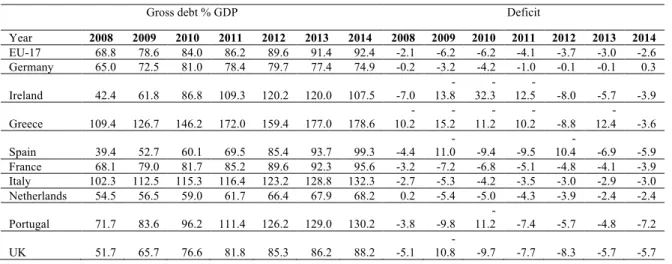
‘self-fulfilling solvency trap’ whereby investors increased their subjective assessment of the probability of default on the Spanish public debt that should have had a lower objective default probability, according to its current debt to GDP ratio, that in 2011 was the second lowest in the EU, and its deficit, two points lower in the same year when compared to 2009 (see table 5). The sovereign spreadi increased accordingly to reflect that higher subjective probability (Lapavitsas, 2012). Therefore the fear of non-sustainability makes non-non-sustainability more likely.
The question of debt sustainability can be applied to either external debt or to the public debt. Following Wyplosz (2007) the process of analysis is identical, once it is noted that the external debt is linked to developments in the primary current account balance just, in the same way as the public one is to the primary budget balance. From an economic point of view, the analysis of net external debt sustainability is the fundamental tool used by financial markets and rating agencies to measure the risk of lending to a specific country. Therefore the ratio of net external debt to GDP is considered to be the main cause in explaining the differences between the yield of bonds within the Eurozone. Similarly, debt sustainability depends, in turn, on the predictions of GDP growth, the interest, and exchange rates as well as inflation.
assessments, credibility appears as an important component of DSA that can trigger vicious and virtuous circles.
Evidently, at high debt levels the borrowing needs of governments are also high, but its borrowing capacity on a sustainable basis will depend on how much lenders will finance, at what cost and what conditions lenders impose. Private lenders ‘will obviously lend only when the debt will be repaid’ (Hardie 2011: 142), but what are the implications if this condition is in the context of a stable fiscal system, a solid democracy and membership to the European Union, as in the case of Spain, Ireland, Portugal or even Greece. As noted, a high debt is not necessarily unsustainable if markets consider it as appropriate, that is, not excessive according to assessments about future solvency, the evolution of budget balances, GDP and interest rates. As there is no official procedure to determine whether debts are excessive (Wyplozs, 2007: 27), convincing lenders that the debt will be repaid is a question of ensuring credibility through policy making.
At the same time, bringing the debt down when current debt levels are considered excessive can be costly in terms of employment and growth, because in the hope of reducing borrowing requirements, governments usually adopt macroeconomic policies designed to compress demand, reducing public spending, cutting wages and reducing taxes. This may have negative effects on employment and economic activity and therefore it may worsen the financing conditions imposed by markets to countries with debts assessed as excessive. For this reason, a lack of credibility can trigger vicious circles and consequently, open the door to speculation on government debt securities.
The vicious circle of banking and sovereign risks: the Spanish case
The Spanish economy has gone through a significant financializationii process in recent decades. The main feature of financialization in Spain comes from the huge credit bubble created since the late 1990s. The Spanish economic model for the period 1996-2007 was originally considered a ‘success’ case by many economists (Royo, 2009): economic growth remained above the European average, job creation rates were significant, inflation was under control; and all this was compatible with public budget surplus. However, underpinning this growth pattern was over-indebtedness.
Further deregulation of the Spanish financial sector within a single market without internal frontiers, where goods, labour and capital circulate freely, has caused an unprecedented increase in the expansion of financial capital. The establishment of the Euro in 2002, helped to sharpen the fundamental features of the Spanish growth model. Low real interest rates in the European periphery, the deregulation of intra-community financial movements and the absence of currency risk prompted massive capital flows into the Spanish economy. Beyond the huge credit bubbles in the real estate and construction industries, it was the root cause of the current account deficit problems due to, among other factors, tax fraud associated with these sectors, and illegal withdrawal of money from the productive and redistributive cycles.
Although the origin of the crisis in Spain can be found in the financial system, the banking bail-out and the economic recession which exacerbated a sovereign debt crisis that made the lack of a political union in the Euro zone evident (see Lapavitsas, 2012). In 2010 the financial sector in Spain went through a major restructuring process in response to strategic and administrative errors identified in the precrisis period (Rodríguez -Fernández, 2012). This process affected savings banks in particular, which resulted in a reduction from forty-five to just two of these institutions between 2009 and 2014. The financial restructuring, which started late, in 2010, has been carried out through mergers and acquisitions (Campuzano et al., 2013).
Nonetheless, the financing/funding problems encountered by the Spanish Government were triggered, fundamentally, by the impact of the worsening of banking risk, and not by public over-indebtedness that, in 2011 was among the lowest in Europe (see Table 5). The banking crisis, together with a set of structural internal imbalances affecting the components of public deficit and external debt, can explain the progressive rise of public debt since 2008. However, these alone cannot explain the worsening of the borrowing conditions imposed by markets later, between 2011 and 2012, when the sovereign spread, measured by the difference between the yield of 10-year Spanish bonds and 10-year German bonds, stood at 637 basic points. This raises questions as to the nature of the market mechanisms that enabled investors to speculate with different types of sovereign risks and how the financialization of markets affected the sustainability of debt. These arguments are developed in the following sections.
Financialization as a business strategy of financial corporations is a function of the actors that participate in financial markets (Hardie, 2011). The financialization of the investor can be defined, according to Hardie, as a strategy to trade risk in order to gain profitability on the performance of an asset. Similarly, the financialization of government debt markets depends on the legal restriction related to borrowing and selling shortiii and on the existence of a variety of authorised transactions ensuring liquidity and reducing credit risks.
This definition connects the macro and micro levels that financialization encompasses: the central process of technological, regulatory and institutional change and investors’ trading strategies. At the same time, this definition highlights the way in which different levels of financialization are negatively associated with different levels of debt sustainability in contexts of economic and social uncertainty.
Following Hardie’s (2011) analysis of emerging markets, financialization in Spain will be analysed by considering three dimensions: the volume of trading, the importance of financial innovations and the structure of government debt.
The volume of trading
and issues of a new debt security and the same security in tranches.
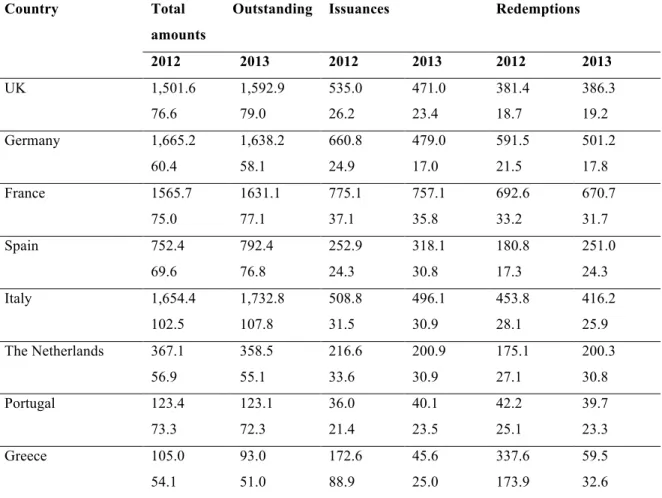
The size of debt markets in the European Union varies considerably, both in absolute and relative terms. Italy has the largest government debt market, standing at 1.7 trillion Euros in 2013, followed by Germany, France, UK and Spain with an outstanding amount of EUR 792 billon (see Table 1). Most European countries, including Greece, showed a declining trend in general government borrowing requirements, except Spain and Portugal that experienced a sharp increase in public GDP to debt ratio and therefore in the issuing of securities.
Table 1. Outstanding amounts and transactions of debt securities issued by the general government (face value) in billions and as a percentage of GDP
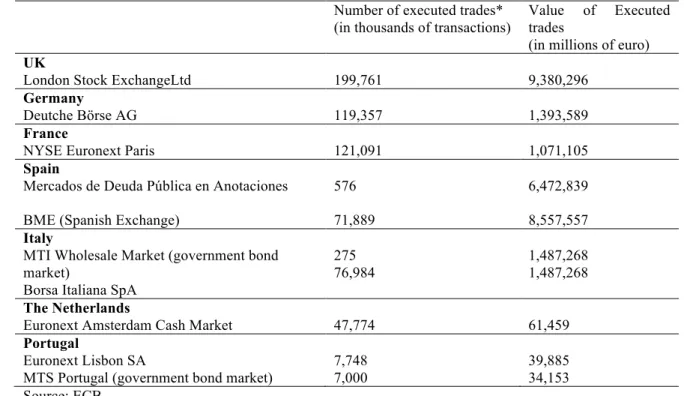
market is significantly high compared to the rest of the European countries, and taking government debt security can be bought and sold. As a result of an institutional market design it has to be combined with other indicators to complete a measure of
London Stock ExchangeLtd 199,761 9,380,296
Germany
Deutche Börse AG 119,357 1,393,589
France
NYSE Euronext Paris 121,091 1,071,105
Spain
Euronext Amsterdam Cash Market 47,774 61,459
Portugal
*Unsecuritised derivatives and repos are not included
operations create the appropriate market conditions for liquidity and profitability opportunities, in order to attract investors. In relation to these types of operations, the key feature that differentiates the Spanish market from the rest of the European markets is the predominance of double or buy-back transactions (called repos). In these operations contracting parties simultaneously agree two single transactions, a buy and a sell, one on the spot and the other in the future or both in the future. The buyer in the first transaction will be the seller in the second and vice versa. These are firm transactions, with the sale and repurchase price previously agreed at a given date. This buy-back arrangement entitles the holder of the asset to collect coupon payments on maturity. In 2014, according to the Bank of Spain, the volume of repos in the secondary government debt market represented 61 per cent of the total transactions. This percentage remained at high levels, an average of 85 per cent during the decade prior to the crisis, and has fallen sharply since 2011. When considering the structure of transactions, the importance of repos reflects the demand for liquidity of government bond investors.
by these instruments in the 2007 US crisis and the Greek sovereign debt crisis of 2008. The amount of short selling can be measured by the size of the sovereign credit default swap (CDS) marketv. CDSs are financial instruments that transfer credit risk from one party to another. Credit risk arises from the possibility of default on a pre-agreed payment, and the purchase of CDS insures against the loss of the pre-agreed payment, thereby shifting the risk to the seller of the CDS. An investor may wish to sell a bond or buy a CDS when s/he believes that the credit risk will rise. In this way s/he reduces his exposure to the credit risk and potentially gains from negative views of evolving credit risk of a sovereign bond (European Commission, 2010).
Similarly to the DSA (Standardised Debt Sustainability Assessment), the main fundamental factors for assessing the possibility of default risk (credit risk) of a country are the rising government deficit and debt levels. These factors, together with the liquidity level of CDS and government debt markets, undermine CDS pricing. Evidently all these elements are interwoven, but the liquidity of the CDS market is greater compared to the bond cash market, precisely because CDS contracts can be used to take speculative or naked positions (see endnote number 4) on the basis of market’s perception of default risk.
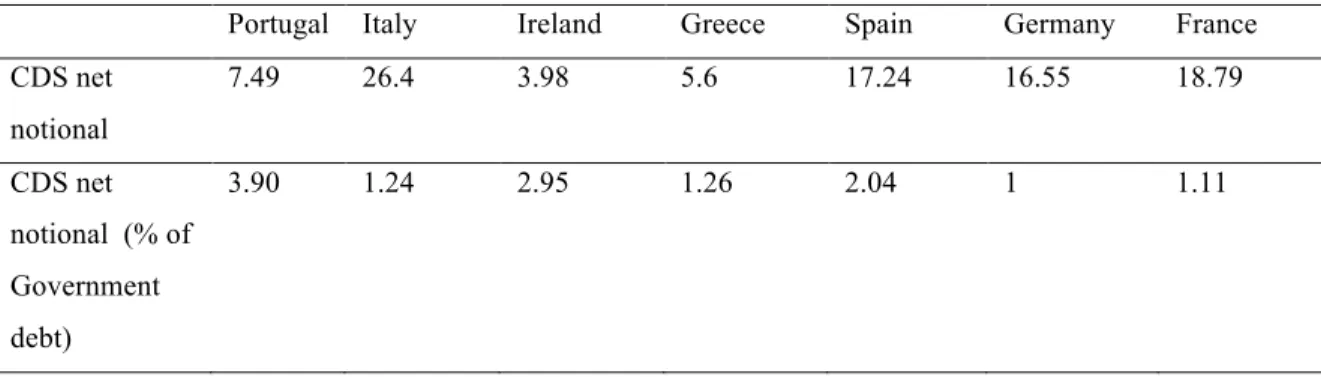
Table 3. Size of the Sovereign Credit Default Swaps (CDS) market (February 2011, in USD billion.) Portugal Italy Ireland Greece Spain Germany France CDS net
notional
7.49 26.4 3.98 5.6 17.24 16.55 18.79
CDS net notional (% of Government debt)
3.90 1.24 2.95 1.26 2.04 1 1.11
Considering the volumes traded in the sovereign CDS market (see Table 3), one can see that the notional value in the Spanish market was USD 17.24 billion, significantly higher than other peripheral countries in the Eurozone. Similarly, CDS contracts as a percentage of government debt market in Portugal, Ireland, Italy, Greece and Spain ranged from between 3.9 per cent and 1.2 per cent a low proportion compared to the amount of sovereign bonds issued in those countries. Nevertheless, the size of the Spanish CDS market is comparatively high considering both, the net notional value and its proportion to government debt issuance.
In November 2012 the European Securities and Market Authority (ESMA) introduced a prohibition on uncovered or naked CDS transactions. The new regulation meant that those entering into CDS positions related to a sovereign issuer must have an underlying exposure to the risk of default of that sovereign issuer or of a decline in the value of the sovereign debt of that issuer. However, in January 2013, the CNMV (Comisión Nacional del Mercado de Valores) lifted the ban of naked short selling CDSs and sovereign bond transactions.
The structure of the debt
The presence of foreign investors (non-resident holdings of bond securities) is considered a relevant indicator of government debt market financialization. Existing studies (Andritzky, 2012) have provided evidence for the relationship between the investor base and yields, which suggests that an increase in the share of securities held by non-residents is associated with a decline in yields, but an increase in the level and volatility of yields.
stimulate the liquidity of the secondary market in government debt and co-operate with the Secretary of the Treasury and Financial Policy in order to diffuse government debt both domestically and abroad. The number of foreign market markers in the Spanish government debt securities market stands at 50 per cent of the total. This percentage is significantly high, even more considering that although the share of non-resident holdings has increased markedly during the last decade in all G-20 countries with the exception of Canada and Japan, after 2007 the trend has slowed, and even reversed in the case of the southern European countries (Andritzky, 2012).
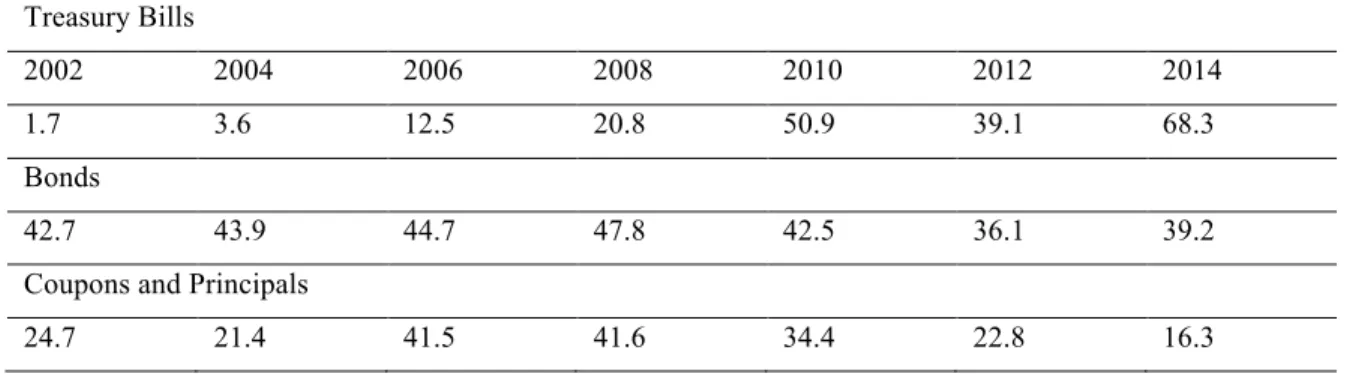
Similarly, looking at the investor base by types of instruments (Table 4) reveals large differences between Treasury Bills and Government Bonds. The first are issued at 6, 12 and 18-month maturities, whereas bonds are issued at 3, 5, 10, 15 and 30 year maturities. The clear preference of foreign investors for short-term fixed income instruments, which pay all interest at maturity, shows a strategy to hedge and reduce risk exposure by investing in short term instruments.
Table 4. Percentage of foreign debt holders by financial instrument, 2002-2014 Treasury Bills
2002 2004 2006 2008 2010 2012 2014
1.7 3.6 12.5 20.8 50.9 39.1 68.3
Bonds
42.7 43.9 44.7 47.8 42.5 36.1 39.2
Coupons and Principals
24.7 21.4 41.5 41.6 34.4 22.8 16.3
Source: Bank of Spain
inclusion of other variables such as the investor type, the role played by the European Central Bank in the purchase of sovereign bonds of peripheral countries, and the analysis of entry and exit barriers to the market. However, that analysis exceeds the objectives of this article. Notwithstanding, the amount of foreign sovereign debt holders can be considered an indicator of market’s liquidity and financialization.
The financialization of the Spanish government’s debt market structure is linked to a variety of properties such as a high density of trades, a predominance of repo transactions, a high volume of sovereign CDS trading and a debt composition characterised by a high rate of non-resident debt holders and market makers. This type of structure has been designed to favour market liquidity, a constant concern for the Spanish government due to its structural deficit problems. However, these properties can also worsen borrowing conditions in an economic uncertainty context, where trading sovereign risk offers attractive business opportunities, resulting in increased volatility and undermining debt sustainability.
Public debt sustainability: public deficit and the evolution of public debt
creation of the Euro, and organized the way multilateral fiscal surveillance is conducted within the European Union (Eurostat, 2014). The Treaty obliges Member States to comply with budgetary discipline by respecting two criteria: a deficit to GDP ratio and a debt to GDP ratio not exceeding reference values of three per cent and 60 per cent respectively. These reference values are based on Government Financial Statistics (GFS) concepts. Government deficit is the net lending / net borrowing of general government as defined in the European System of Accounts (ESA95). Government debt is defined as the total consolidated gross debt at nominal value in the following categories of government liabilities: currency and deposits, securities other than shares excluding financial derivatives, and loans.
Table 5. General government consolidated gross debt and deficit
pattern in Spain that was in turn closely connected to credit given to the real estate and housing sectors.
The evolution of EDP (excessive deficit procedure) debt in government administrative bodies (central government, municipalities, autonomous regions and social security administrations), reached anunusually high peak. In the middle of 2006, public debt represented 38.9 per cent of GDP, well below the limit of 60 per cent set in the Maastricht Treaty, while in 2012 the figure stood at 85.4 per cent of the GDP. To analyze the reasons behind this increase, we must consider how the deficit components of public expenditure and revenue have evolved. Furthermore, it is also necessary to look at the effects of debt deficit adjustment on measures that are not reflected in the deficit but, on the other hand, appear in the debt, such as aid to the financial sector.
Spain has always been well below the European average in respect of total government spending. According to Eurostat data, in 2007, Spanish public spending represented 39.2 per cent of the GDP, 6.5 percentage points below the EU-27 average; the end of 2007 there was a surplus of €20.73 billion; and in 2009, there was a deficit of €116.37 bn.,
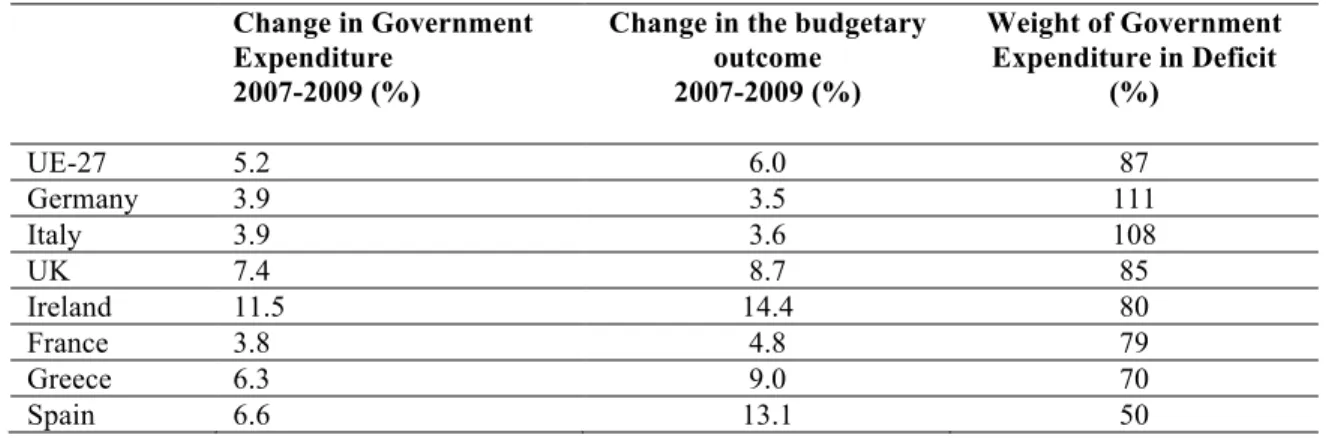
The deterioration of public sector deficit was not exclusively due to increased spending, but also to falling revenue. Table 6 shows that increased spending accounted for 50 per cent of Spain's deficit increase, while the EU average was 87 per cent. This made Spain the country where increased spending least explains deficit problems, in contrast to Germany, where budgetary decline is mainly due to expenditure.
Table 6. Weight of General Government Expenditure as a proportion of GDP, 2007-2009 Change in Government
Similarly, of the 28 EU countries, Spain was ranked 23rd with a total revenue of 37.2 per cent of its GDP, 8.2 points below the European average. This placed it below Latvia (35.1 per cent), Bulgaria (35.0 per cent), Ireland (34.5 per cent) and Lithuania (32.7 per cent). In turn, Spain's total tax burden, including social security contributions, was only 33.3 per cent of the GDP, 7 points below the EU-28 average (40.3 per cent). It was ranked 20th, below Portugal and Greece. Falling revenues were particularly dramatic between 2007 (37.6 per cent of GDP), and 2009 (31.4 per cent), down 6.2 points, equivalent to €67.88 bn in just 2 years.
According to official data, from 1970 to 2009, the implicit tax burden on labour income, including income tax and social security contributions, increased from 27 per cent to nearly 38 per cent in the EU However, the equivalent burden on capital income decreased from 38 per cent in 1980 to 30.5 per cent in 2009. In Spain from 2000 to 2009,the tax burden on labour income increased by 5.4%, while capital income fell by 15.9%.
At the same time, debt interest payments had a notable impact on expenditure in Spain. In 2006, interest rates accounted for 1.6 per cent of the GDP, about €9.77 billion, and in 2013, the figure rose to 3.4 per cent of the GDP, €34.91 billion in Spain. This increase of two percentage points meant that the costs of debt trebled from 2.5 per cent of public expenditure in 2006 to 7.6 per cent in 2013, leading to greater indebtedness and increased spending on paying interest on debt.
From 2010 onwards, public debt growth was closely linked to financial aid going from the government to bailing-out banks, mainly savings banks. Although in 2007 government administration debt in the form of total liabilities only represented 20 per cent of what is required from the Spanish economy, in 2013 it accounted for 50 per cent. This significant growth rate was due to a series of acts of parliament to address the crisis, in particular the granting of credit by the central government, financed with public debt, which caused a huge amount of authorized public debt and alterations in the maximum indebtedness limit.
risk, that triggered the sovereign debt crises between 2011 and 2012. Nonetheless, the extent that these factors, together with structural imbalances, are able to affect the worsening of borrowing conditions, depends on the financialization of markets and financial instruments. This is explored in the next section.
Financialization and the evolution of private debt
In Spain private debt incurred by financial institutions, households and non-financial corporations, in the form of total liabilities, represented 314.9 per cent of the GDP at the beginning of the economic growth cycle in 1996. This had increased to 587.4 per cent in 2006, and 569.3 per cent by the end of 2013 - a quantity three times the total value of goods and services produced by the Spanish economy. However, the level of indebtedness has been different for each group of the socio-economic actors.
Financial institutions played a leading role in this process, which can be explained by the current banking model. The banking model is mainly retail and is highly dependent on lending to the construction and real estate industries (Fernández-de-Lis and Garcia-Mora, 2008). The model is closely linked to the specifics of the Spanish economic growth pattern, being heavily focused on the property sector and highly reliant on external funding.
U.S. (Garrote et al., 2013). In Ireland, between 2002 and 2009, private debt to GDP ratio increased by 165 percentage points, reaching 330 per cent of its GDP. In Spain, the increase was also very noticeable, debt went up 75 percentage points, reaching 214 per cent of its GDP, between 2002 and 2009. Although debt in the United Kingdom and United States grew more slowly, UK debt still reached a level similar to Spain's (although starting from a higher point). In all four countries, there was a noticeable increase in household debt, mainly to finance house purchases. In the cases of Ireland and Spain, there was an additional source of vulnerability, associated with the debt of corporations linked to the real estate sector.
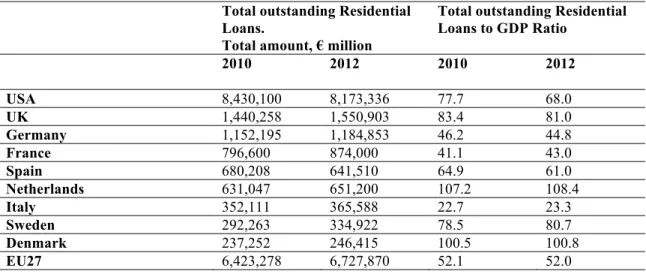
A deleveraging process in the private sector, especially households and non-financial corporations, began in 2009. This was largely due to a decline in activity and to difficulties in obtaining finance, especially for small and medium businesses. Regarding households, mortgages were the main component of the debt which in 2010 represented 64.9 per cent of the GDP, as shown in Table 7. This percentage was relatively high in comparison to this ratio in Italy or France, but lower than in the USA, UK or Holland, where the rate was 107 per cent.
Table 7. Total Outstanding Residential Loans, 2010 and 2012 Total outstanding Residential
Netherlands 631,047 651,200 107.2 108.4
Italy 352,111 365,588 22.7 23.3
Source: European Mortgage Federation
The link between the debt of financial institutions and government debt comes mainly through two channels: so-called recapitalization measures, which accounted for 26 per cent of total aid between 2009 and May 2013 and liquidity measures which accounted for the rest. Regarding recapitalization measures, some €63.55 billion has been injected into the financial system by the state since 2009. €41.27 billion of this amount was supplied using the European Stability Mechanism (ESM), created to facilitate financial support for countries in the Euro zone.
This included instruments such as Asset Protection Schemes (APS), which are guarantees that provide financial entities with insurance against risks acquired from other entities, with potential losses in their loan portfolios. Another measure is to purchase toxic assets using the Deposit Guarantee Fund (DGF) and the SAREB, popularly known as the ‘bad bank’. Further measures include debt guarantees to promissory notes, bonds and subordinated debt; and, finally, preferred shares or convertible preferred bonds subscribed by the Fund for Orderly Bank Restructuring (FROB).
Both have had a direct or indirect impact on public debt, but also on the public sector deficit. This has been mainly due to the debt interest and financial costs related to the European loan (from the ECB).
received and its impact on public debt is not easy to calculate. This is because its quantification depends on each instrument, and mainly because the huge amounts behind the rescue would be difficult to explain by the political and financial elites. However, according to the Bank of Spain Economic Bulletin (2013), the effects of aid to the financial sector were responsible for a 22.8 per cent increase in EDP (excessive deficit procedure) public debt between 2008 and 2012. Financing requirements due to falling revenues and increased government spending account for 71.1 per cent of this variation, while the effect of the GDP variation accounts for six per cent.
In addition, implicit guarantees to citizen deposits under €100,000, backed by the Deposit Guarantee Fund (DGF) must be added. At the end of 2012, this covered deposits of financial institutions which amounted to the sum of €795.13 billion. According to Sanchez Mato (2013), this amount should be counted as debt, given the fact it is guaranteed by the state and also due to the financial insufficiencies of the DGF (Deposit Guarantee Fund).
Paradoxically, relief measures to the financial sector tried to resolve this situation of insolvency at the cost of plunging public administrations into a sovereign debt crisis. A crisis prompted by the economic actors' loss of confidence in the solvency of the Member States (Sweedberg, 2011). This is even more paradoxical when we consider that the creditors of the public debt are mostly domestic financial institutions. As Stiglitz says, ‘if the Spanish government bails out the banks and banking rescues the government, the system becomes a voodoo economy’ (Expansion, 11/06/2012).
This article has analysed the relationship between indebtedness, debt sustainability and financialization. The concept of indebtedness has to do with the debtor’s capacity to return future payments back to creditors. Debt sustainability can be considered a dimension of indebtedness because it is connected to a ‘country’s capacity to finance its policy agenda and service the ensuing debt without unduly large adjustments’ (IMF, 2013: 147).
This article shows that there is not a simple relationship between these concepts. In the case of Spain, financialization of the government debt market is associated with a debt market structure, characterised by a high density and value of executed trades, a significant importance of short selling and a relevant presence of debt holding foreign investors. Government debt market financialization is linked to the institutional arrangements aiming to provide liquidity to the market. At the same time, these institutional structures enable investors to trade risk on the basis of their expectations and perceptions on debt sustainability.
This model of financialization can undermine debt sustainability by increasing borrowing costs and therefore altering the social justice principles on which European democracies are based. Exceeding debt limits and budget deficits set by Maastricht have impeded government debt capacity to meet other basic needs such as education, health and pensions.
explain the sovereign debt crisis which existed in Spain between 2011-2012 is complementary to those explanations based on psychological behaviour of investors who simply act following the markets’ trends when information is asymmetric (Kindleberger and Aliber, 2005).
At the same time, this article shows the importance of structural deficit problems that affect public spending and revenues. The effects of the banking bail out on public deficit and debt can account for the increase in the public debt to GDP ratio, but these factors alone cannot explain successfully how the public debt spreads between 2011-2012. The financialization of government market structure is argued here to explain the worsening of sustainable borrowing by allowing intense trading of risk on the performance of sovereign debt securities.
The limitations of available statistics (Hardie, 2011; Andritzky, 2012), to analyse financialization suggest that further comparative research is needed, combining quantitative and qualitative approaches. Nevertheless some theoretical conclusions are needed in order to understand the role played by shaping policy-making institutions when it comes to explain the expansion of the financial system. This article points out, following Hardie (2011) and MacKenzie (2009), that together with analysing the impact of this broad process of change referring to globalization, deregulation and financial innovation, it is important to focus research on the specifics of market structures. This may avoid considering financial systems as neutral and anonymous structures, and refocus scholarly attention on institutional structures
Funding: This work was supported by the Spanish Ministry of the Economy and Competitiveness [CSO2013-46794-R]
Acknowledges:
The author would like to thank Ian Hardie and two anonymous referees for helpful comments on previous
drafts, and also the editors of Competition and Change, especially Jane Hardy, for the time spent providing
insightful critiques on the first version of this paper. The results and interpretations are the sole
responsibility of the author; none of the above should be held to account for any errors, omissions or
opinions expressed herein.
References
Andritzky J. (2012) Government bonds and their investors: What are the facts and do they matter? IMF Working Paper 112/158. Available at: http://www.imf.org/external/pubs/cat/longres.aspx?sk=26004.0 (accessed 23 November 2015).
Bell D (1976) The Cultural Contradictions of Capitalism. New York: Basic Books. Berges A and Ontiveros E (2011) La banca minorista tras la crisis. Papeles de Economía Española, 130: 192- 205.
Blommestein HJ (2010) A public debt management perspective on proposals for restrictions on short selling for sovereign debt. OECD Journal: Financial Market Trends 2010 (2): 1-7.
Boyer R (2000) Is a finance-led growth regime a viable alternative to Fordism? A preliminary analysis. Economy and Society 29 (1): 111-114.
Calvo A and Paúl J (2012) El crédito al sector privado en España: del crecimiento desbordado a la fuerte restricción. REVESCO. Monográfico: La financiación complementaria y la respuesta de la economía social: la situación de des-crédito bajo la
crisis financiera 109: 13-44.
Campuzano B, Conlledo F and Palomo R (eds) (2013) Los Mercados Financieros. Valencia: Tirant lo Blanch.
Carruthers B and Stinchcombe A (1999) The social structure of liquidity: flexibility, markets and states. Theory and Society 28: 353-382.
Comisión Nacional del Mercado de Valores (2012) IV Informe Annual sobre Ayudas Públicas en España.
Clark GL and Wójcik D (2007) The Geography of Finance: Corporate Governance in the Global Marketplace. Oxford: Oxford University Press,
Dore R (2008) Financialization of the global economy. Industrial and Corporate Change 17 (6):1097-1112.
Engelen E. (2008) The case for financialization. Competition & Change,12: 111–119. Epstein G. (2005) Introduction: financialization and the world economy. In: Epstein G (ed.) Financialization and the World Economy. Cheltenham, UK: Edward Elgar, pp. 3– 16.
Ertuk I, Froud J, Sukhdev J; Leaver A, Williams K. (eds) (2008) Financialization at work. Oxford: Routledge.
European Commission (2010) Report on sovereign CDS European Commission (2010). Available at: http://www.fd.nl/csFDArtikelen/WEB-HFD/y2010/m12/d06/20852775 (Accessed 23 November 2015).
European Commission (2014) Assessing Public Debt Sustainability in EU Member States: A Guide. Occasional Papers 200. Available at:
Banco de España 15: 57- 72.
Fligstein N (2001) The Architecture of Markets. An Economic Sociology of Twenty-First-Century Capitalist Societies. Pricenton: Pricenton University Press.
Garrote D, Llopis G and Vallés J (2013) Los canales de desanpalancamiento del sector privado: una comparación internacional. Boletín Económico del Banco de España Noviembre 2013: 69-80.
Gordo L, Hernández P and Pérez J (2013) La evolución de la deuda pública en España desde el inicio de la crisis. Boletín Económico del Banco de España Julio- Agosto 2013: 77-95.
Grahl J and Teague P (2000) The régulation school, the employment relation and financialization. Economy and Society 29 (1):160-178.
Hardie I (2011) How much can governments borrow? Financialization and emerging markets government borrowing capacity. Review of International Political Economy 18 (2): 141-167
Ingham G (2008) Capitalism. Cambridge: Polity Press.
IMF (2013) Public sector debt statistics: guide for compilers and users. Available at: http://www.tffs.org/PSDStoc.htm (accessed 23 November 2015).
Kindleberger Ch and Aliber R (2005) Manias, panics and crashes. A history of financial crisis. New Jersey: John Wiley and Sons.
Krippner G (2011) Capitalizing on Crisis. The Political Origins of the Rise of Finance. Cambridge, MA: Harvard University Press.
Lapavitsas C (2009). El Capitalismo Financiarizado: Expansión y Crisis. Madrid: Maia Ediciones.
Lapavitsas C (2011) Theorizing financialization. Work, Employment and Society 25 (4): 611-626.
Lapavitsas C, Kaltenbrunner, G, Labrinidis D, Lindo D, Meadway J, Michell J, Painceira E; Pires E, Powell J, Stenfors A, Teles N, Vatikiotis L (2012) Crisis in the Euro zone. London: Verso.
Lazonick W and O’Sullivan M (2010) Maximazing shareholder value: a new ideology for corporate governance. Economy and Society 29 (1): 13-35.
Mackenzie D (2009) Material Markets. How Economic Agents are Constructed. Oxford: Oxford University Press.
MacKenzie D and Millo Y (2003). Constructing a market, performing theory: The historical sociology of a financial derivatives exchange. American Journal of Sociology 109 (1): 107–145.
Mackenzie D, Beunza D, Millo Y (2012) Drilling through the allegheny mountains: liquidity, materiality and high frequency trading. Journal of Cultural Economy 5 (3): 279-296.
Massó M and Yruela M (2016) La financiarización en España: ¿La emergencia de un nuevo modelo de acumulación? Revista Española de Investigaciones Sociológicas (forthcoming).
Medialea B (2012) Deuda, banca y recortes. Anuario 2012. Fundación Primero de Mayo. Available at: http://www.1mayo.ccoo.es (accessed 23 November 2015).
Pardo-Guerra J P (2012) Financial Automation, Past, Present and Future. In: Knorr-Cetina K and Preda A (eds) Oxford Handbook of the Sociology of Finance. Oxford: Oxford University Press, pp. 567- 586.
Partnoy F. (2004) Infectious Greed: How Deceit and Risk Corrupted the Financial
Markets. London:Profile Books.
Rodríguez-Diez MV (2013) Los análisis de la sostenibilidad de la deuda. Estructura y reformas. Boletín Económico del ICE 3046: 19-30.
Rodríguez-Fernández JM (2012) Las cajas españolas: el final de la escapada. In: Alonso, L.E. and Fernández-Rodríguez C. (eds) La Financiarización de las Relaciones Salariales. Madrid: Catarata, pp. 280-297.
Roubini N (2001) Debt Sustainability: How to Assess Whether a Country is Insolvent. Report, Stern School of Business New York University, New York, December.
Royo, S. (2009) After the fiesta: The Spanish economy meets the global financial crisis. South European Society and Politics,14 (1):19-34.
Sweedberg R (2011) The Role of Confidence in the European Debt Crisis. CSES Working Paper Series 63.
Van der Zwan N (2014) Making sense of financialisation. Socio-Economic Review 12: 99–129.
Weatherall J (2013) The Physics of Wall Street: A Brief History of Predicting the Unpredictable. Boston, MA: Houghton Mifflin Harcourt.
Wyplosz Ch (2007) Debt sustainability assessment: The IMF approach and alternatives. HEI Working paper 03/2007.
i The Spread is the difference between the yield on a country's bond issue and the yield on a comparable bond, issued by a benchmark, that in Europe is a 10-year German bond.
ii To see an in depth analysis of the process of financialization of the Spanish economy, see Massó and Yruela, 2016.
iii Short selling is the sale of a security that is not owned by the seller, or that the seller has borrowed. Short selling is motivated by the belief that a security's price will decline, enabling it to be bought back at a lower price to make a profit. Short selling may be prompted by speculation, or by the desire to hedge the downside risk of a long position in the same security or a related one.
iv The general government sector comprises the subsectors: central government, state government, local government and social security funds.