UNIVERSIDAD ESTATAL PENÍNSULA DE SANTA ELENA
FACULTY OF EDUCATION AND LANGUAGES
ENGLISH TEACHING CAREER
TITLE
“WIX, A FREE WEBSITE BUILDER AS A TEACHING TOOL
FOR THE ENHANCEMENT OF EXTENSIVE READING
SKILLS TO STUDENTS OF FIRST YEAR BACHILLERATO
AT UNIDAD EDUCATIVA P.C.E.I. MANUELA SAENZ,
PROVINCE OF SANTA ELENA, 2015-2016”
RESEARCH PAPER
As a prerequisite to obtain a:
BACHELOR´S DEGREE IN ENGLISH
AUTHOR
AURORA DEL ROCÍO RUEDA VILLA
ADVISOR
MSc. KLEBER LOOR ZAMBRANO
UNIVERSIDAD ESTATAL PENÍNSULA DE SANTA ELENA
FACULTAD DE CIENCIAS DE LA EDUCACIÓN E IDIOMAS
CARRERA DE LICENCIATURA EN INGLÉS
TEMA
“WIX, A FREE WEBSITE BUILDER AS A TEACHING TOOL
FOR THE ENHANCEMENT OF EXTENSIVE READING
SKILLS TO STUDENTS OF FIRST YEAR BACHILLERATO
AT UNIDAD EDUCATIVA P.C.E.I. MANUELA SAENZ,
PROVINCE OF SANTA ELENA, 2015-2016”
TRABAJO DE TITULACIÓN PREVIO A LA OBTENCIÓN DEL TÍTULO DE
LICENCIADA EN INGLÉS
AUTORA
RUEDA VILLA AURORA DEL ROCÍO
TUTOR
MSc. KLEBER LOOR ZAMBRANO
LA LIBERTAD – ECUADOR
II
La Libertad, December 11th, 2015
ADVISOR´S APPROVAL
In my role as Advisor of the research paper under the title “WIX, A FREE
WEBSITE BUILDER AS A TEACHING TOOL FOR THE
ENHANCEMENT OF EXTENSIVE READING SKILLS TO STUDENTS OF FIRST YEAR BACHILLERATO AT UNIDAD EDUCATIVA P.C.E.I. MANUELA SAENZ, PROVINCE OF SANTA ELENA, 2015-2016” prepared by AURORA DEL ROCIO RUEDA VILLA undergraduate student of the English Career, Faculty of Science of Education and Languages at Peninsula of Santa Elena State University, I declare that after having oriented, studied and reviewed this research, I approve it in its entirety, because it meets the requirements and is sufficient for its submission to the evaluation of the academic tribunal.
Sincerely
III
STATEMENT OF AUTHORSHIP
I, Aurora del Rocío Rueda Villa, with ID number 0914784244, undergraduate student from the Peninsula of Santa Elena State University, Faculty of Education and Languages, as a prerequisite to obtain a Bachelor´s degree in English, in my role as author of the research paper “WIX, A FREE WEBSITE BUILDER AS
A TEACHING TOOL FOR THE ENHANCEMENT OF EXTENSIVE READING SKILLS TO STUDENTS OF FIRST YEAR BACHILLERATO AT UNIDAD EDUCATIVA P.C.E.I. MANUELA SAENZ, PROVINCE OF SANTA ELENA, 2015-2016”, certify that this research is of my authorship, except for the quotes and reflections used in this research paper.
IV
BOARD OF EXAMINERS
.
Dra. Nelly Panchana Rodríguez, MSc. Lcda. Glenda Pinoargote Parra, M.A. ed. FACULTY OF EDUCATION ENGLISH TEACHING AND LANGUAGES DEAN CAREER DIRECTOR
MSc. Kléber Loor Zambrano MSc. Sandra Caamaño López ADVISOR SPECIALIST PROFESSOR
V
DEDICATION
This work is dedicated to my family, who encouraged me to go ahead and finish this important time of my life. To the memory of my dear mother who was my example and pride and who taught me the meaning of perseverance to become someone in the life.
VI
ACKNOWLEDGMENT
First of all I thank God, who guided me throughout this process, to my advisor MSc. Kléber Loor Zambrano, who would have never accepted anything less than my best efforts, to Unidad Educativa P.C.E.I Manuela Sáenz, Institution that offered me the facilities to carry out this project and to a special person who always provided me unconditional support and has been a fundamental part in the completion of this work.
VII
DECLARATORY
“The present content of this Research work is of my responsibility, the intellectual patrimony of itself belongs to the Peninsula de Santa Elena State University”
DECLARATORIA
“El contenido del presente Trabajo de Titulación es de mi responsabilidad, el patrimonio intelectual del mismo pertenece a la Universidad Estatal Península de Santa Elena”
VIII
TABLE OF CONTENT
ADVISOR´S APPROVAL………..II STATEMENT OF AUTHORSHIP ... III BOARD OF EXAMINERS ... IV DEDICATION ... V ACKNOWLEDGMENT ... VI DECLARATORY ... VII TABLE OF CONTENT ... VIII CHARTS... XII GRAPHICS ... XIII ILLUSTRATIONS ... XIII ATTACHMENT ... XV PICTURES ... XVI ABSTRACT... XVII
INTRODUCTION ... 1
CHAPTER I ... 2
THE PROBLEM ... 2
1.1 Title ... 2
1.2 Statement of the Problem ... 2
1.2.1 Context ... 2
1.2.2 Critical analysis ... 3
1.2.3 Formulation of the Problem ... 4
1.2.4 Guideline questions ... 4
1.2.5 Delimitation of research object ... 4
1.3 Significance of the research ... 5
1.4 Objectives of the research ... 6
1.4.1 General objective ... 6
1.4.2 Specific objectives ... 6
CHAPTER II... 7
LITERATURE REVIEW... 7
IX
2.1.1 Information and Communication Technology (ICT) in Education ... 7
2.1.2 What is WEB 2.0 ... 8
2.1.3 Website ... 9
2.1.4 Wix ... 12
2.1.4 English Teaching ... 12
2.1.5 Reading skills ... 22
2.1.5.2 Extensive reading ... 25
2.2 Philosophical basis ... 26
2.3 Fundamental categories ... 29
2.3.1 Education ... 29
2.3.2 Teaching Learning process ... 29
2.3.3 Technology ... 29
2.3.4 Information and Communication Technology (ICT) ... 30
2.3.5 Web 2.0 ... 30
2.3.6 Wix ... 30
2.3.7 Reading Skills ... 30
2.3.8 Extensive Reading ... 30
2.4 Legal Basis ... 31
2.4.1 Hypothesis... 31
2.4.2 Variables of study ... 31
CHAPTER III ... 32
METHODOLOGY ... 32
3.1. RESEARCH APPROACH ... 32
3.1.1. Quantitative Method ... 32
3.1.2. Qualitative Method... 32
3.1.3. Inductive-deductive Method ... 32
3.1.4. Scientific Method ... 33
3.1.5. Observation Method ... 33
3.2. LEVEL OR TYPE OF RESEARCH ... 33
3.2.1. Field Research ... 33
3.2.2. Bibliographic Research ... 33
3.2.3. Correlational Research ... 33
X
3.3. POPULATION AND SAMPLE... 34
3.3.1. Population ... 34
3.4. VARIABLES OPERATIONALIZATION ... 35
3.4.1. Independent Variable: Wix, a free website builder. ... 35
3.4.2. Dependent Variable: The Extensive Reading Skills. ... 36
3.5. TECHNIQUES AND INSTRUMENTS FOR DATA COLLECTION ... 37
3.5.1. Techniques ... 37
3.6. DATA COLLECTION PLAN ... 37
3.7. DATA PROCESSING PLAN ... 39
3.8. ANALYSIS AND INTERPRETATION OF RESULTS ... 40
3.8.1. INTERVIEW DIRECTED TO MSc. MARÍA DE LA CRUZ TIGRERO, PRINCIPAL FROM “UNIDAD EDUCATIVA P.C.E.I. “MANUELA SÁENZ” ... 40
3.8.2. INTERVIEW DIRECTED TO SPECIALISTS, MSc. IVÁN CORONEL SUÁREZ, WEBMASTER OF UPSE AND ING. RODOLFO BUSTOS, SYSTEM DIRECTOR OF SUINLI, GRADUATED IN PARTICULAR OF LOJA UNIVERSITY. ... 42
3.8.3. INTERVIEW TO ENGLISH TEACHER, LCDO. WILLIAM ASCENCIO. ... 44
3.8.4. SURVEY DIRECTED TO STUDENTS ... 46
3.8.6. ANALYSIS OF RESULTS CHART- STUDENTS ... 56
3.8.7 Analysis of results – students ... 57
3.9. CONCLUSIONS AND RECOMMENDATIONS ... 57
3.9.1. Conclusions ... 57
3.9.2. RECOMMENDATIONS ... 58
CHAPTER IV ... 59
THE PROPOSAL ... 59
4.1. INFORMATIVE DATA ... 59
4.2. PROPOSAL BACKGROUND ... 60
4.3. SIGNIFICANCE ... 60
4.4. OBJECTIVES ... 61
4.4.1. General Objective... 61
4.4.2. Specific Objectives... 61
4.5. DESIGN AND DEVELOPMENT OF THE PROPOSAL... 61
4.5.1. What is WIX?... 62
4.5.2. HOW WAS THE WEBSITE DESIGNED? ... 62
XI
4.5.3 DESCRIPTION OF “A WEBSITE FOR EXTENSIVE READING” WEBSITE ... 66
4.6. IMPLEMENTATION ... 92
4.7. EVALUATION ... 98
4.8. RESULTS ... 99
4.8.1. DIAGNOSTIC TEST RESULTS ... 99
4.8.2. WEB SITE ACTIVITY RESULTS ... 100
4.8.3. GLOBAL SCORES PER ACTIVITY ... 101
4.8.4. COMPARISON DIAGNOSTIC TEST AND FINAL TEST RESULTS ... 101
4.9. ANALYSIS OF THE STUDENTS’ RESULTS ... 103
4.10. STRATEGIES OF IMPROVEMENT ... 103
4.11. CONCLUSIONS AND RECOMMENDATIONS ... 104
4.11.1. CONCLUSIONS ... 104
4.11.2.RECOMMENDATIONS ... 105
CHAPTER V ... 106
ADMINISTRATIVE FRAMEWORK ... 106
5.1. RESOURCES ... 106
5.1.1. Institutional ... 106
5.1.2. Humans ... 106
5.1.3. Materials ... 106
5.1.4. Technology ... 106
5.1.5. Economic ... 107
5.2. SOURCE MATERIALS ... 108
1.- TIMETABLE... 108
2. REFERENCES ... 109
XII
CHARTS
Chart # 1: Population ... 34
Chart # 2: Independent Variable ... 35
Chart # 3: Dependent Variable ... 36
Chart # 4: Data Collection Plan ... 38
Chart # 5: Data Processing plan ... 39
Chart # 6: Interest in English... 46
Chart # 7: Importance of English classes ... 47
Chart # 8: Use of internet to study English ... 48
Chart # 9: Use of internet by the English teacher ... 49
Chart # 10: Importance of Internet within the English Learning Process ... 50
Chart # 11: Use of internet to enhance reading skills ... 51
Chart # 12: Gadgets used to surf the net ... 52
Chart # 13: Use of websites to enhance reading skills ... 53
Chart # 14: Contribution of websites to enhance reading skills ... 54
Chart # 15: Acceptance of website to enhance reading skills ... 55
Chart # 16: Survey Directed to Students ... 56
Chart # 17: Diagnostic Test Results ... 99
Chart # 18: Web Activities Results ... 100
Chart # 19: Global Scores per Activity ... 101
Chart # 20: Comparison between Diagnostic Test and Final Test Results ... 101
Chart # 21: Strategies of Improvement ... 103
Chart # 22: Timetable ... 108
Chart # 23: The Constitution of Ecuador... 122
Chart # 24: The Law of Intercultural Education ... 122
XIII
GRAPHICS
Graph # 1: Interest in English ... 46
Graph # 2: Importance of English classes ... 47
Graph # 3: Use of internet to study English ... 48
Graph # 4: Use of internet by the English teacher ... 49
Graph # 5: Importance of Internet within the English Learning Process ... 50
Graph # 6: Use of internet to enhance reading skills ... 51
Graph # 7: Gadgets used to surf the net... 52
Graph # 8: Use of websites to enhance reading skills ... 53
Graph # 9: Contribution of websites to enhance reading skills ... 54
Graph # 10: Acceptance of website to enhance reading skills ... 55
Graph # 11 : Analysis the Results ... 103
ILLUSTRATIONS Illustration # 1: Wix logo ... 62
Illustration # 2: Sign in ... 62
Illustration # 3: Register the username and password ... 63
Illustration # 4: Welcome to Wix ... 63
Illustration # 5: Choose the favorite template... 64
Illustration # 6: Templates’ categories ... 64
Illustration # 7: Templates related to education ... 65
Illustration # 8: Video tutorial to desing the website ... 65
Illustration # 9: Final design of the “A Website for Extensive Reading” ... 66
Illustration # 10 : Welcome of “A Website for Extensive Reading” ... 67
Illustration # 11: Project of “A Website for Extensive Reading” (1) ... 68
Illustration # 12: Project of “A Website for Extensive Reading” (2) ... 68
Illustration # 13: Extensive Reading Resources Of “A Website for Extensive Reading” 69 Illustration # 14: Extensive Reading Resources Of “A Website for Extensive Reading” 69 Illustration # 15: Short Stories of “A Website for Extensive Reading” (1) ... 70
XIV
Illustration # 17: Short Stories of “A Website for Extensive Reading” (3) ... 71
Illustration # 18: Love and Romance of “A Website for Extensive Reading” ... 71
Illustration # 19: Love and Romance of “A Website for Extensive Reading” ... 72
Illustration # 20: Fairy Tales of “A Website for Extensive Reading” ... 72
Illustration # 21: Fables of “A Website for Extensive Reading” ... 73
Illustration # 22: Poems of “A Website for Extensive Reading” ... 73
Illustration # 23: Humorous of “A Website for Extensive Reading” ... 74
Illustration # 24: Thriller of “A Website for Extensive Reading” ... 74
Illustration # 25: Parables of “A Website for Extensive Reading” ... 75
Illustration # 26: Bible of “A Website for Extensive Reading” ... 75
Illustration # 27: Funny of “A Website for Extensive Reading” ... 76
Illustration # 28: Proverbs of “A Website for Extensive Reading” ... 76
Illustration # 29: Animals of “A Website for Extensive Reading” ... 77
Illustration # 30: Mythological of “A Website for Extensive Reading” ... 77
Illustration # 31: Short Videos of “A Website for Extensive Reading” (1) ... 78
Illustration # 32: Short Videos of “A Website for Extensive Reading” (2) ... 78
Illustration # 33: Additional Resources of “A Website for Extensive Reading” ... 79
Illustration # 34: Additional Resources of “A Website for Extensive Reading” ... 79
Illustration # 35: Oliver Twist of “A Website for Extensive Reading” ... 80
Illustration # 36: Football of “A Website for Extensive Reading” ... 80
Illustration # 37: Seumas and his Wife of “A Website for Extensive Reading” ... 81
Illustration # 38: Seumas and his Wife of “A Website for Extensive Reading” ... 81
Illustration # 39: The Storm of “A Website for Extensive Reading” ... 82
Illustration # 40: Elwin and Allorah of “A Website for Extensive Reading” ... 82
Illustration # 41: Sarah-Claude-Ringo of “A Website for Extensive Reading” ... 83
Illustration # 42: Pick the Meaning of “A Website for Extensive Reading” ... 83
Illustration # 43: Jane Eyre of “A Website For Extensive Reading” ... 84
Illustration # 44: The Time Machine of “A Website for Extensive Reading” ... 84
Illustration # 45: The Kitten of “A Website for Extensive Reading” ... 85
Illustration # 46: Rikki-Tikki-Tavi of “A Website for Extensive Reading” ... 85
Illustration # 47: Alice´s Adventures “A Website for Extensive Reading” ... 86
Illustration # 48: Cartoons of “A Website for Extensive Reading” ... 86
Illustration # 49: Crossword of “A Website for Extensive Reading” ... 87
XV
Illustration # 51: Extensive Reading Activities of “A Website for Extensive Reading”.. 88
Illustration # 52: Extensive Reading Activities of “A Website for Extensive Reading”... 88
Illustration # 53: Extensive Reading Activities /Facebook of “A Website for Extensive Reading” ... 89
Illustration # 54: Assessment of “A Website for Extensive Reading” ... 89
Illustration # 55: Assessment of “A Website for Extensive Reading” ... 90
Illustration # 56: Assessment of “A Website for Extensive Reading” ... 90
Illustration # 57: Assessment of “A Website for Extensive Reading” ... 91
Illustration # 58: Contact of “A Website for Extensive Reading” ... 91
Illustration # 59: Implementation of “A Website for Extensive Reading” ... 92
Illustration # 60: Implementation of “A Website for Extensive Reading” Facebook ... 92
Illustration # 61: Implementation of “A Website for Extensive Reading” Facebook ... 93
Illustration # 62: Implementation of “A Website for Extensive Reading” Facebook ... 93
Illustration # 63: Implementation of “A Website for Extensive Reading” Facebook ... 94
Illustration # 64: Implementation of “A Website for Extensive Reading” Facebook ... 94
Illustration # 65: Implementation of “A Website for Extensive Reading” Facebook ... 95
Illustration # 66: Implementation of “A Website for Extensive Reading” Facebook ... 95
Illustration # 67: Implementation of “A Website for Extensive Reading” Facebook ... 96
Illustration # 68: Implementation of “A Website for Extensive Reading” Facebook ... 96
Illustration # 69: Implementation of “A Website for Extensive Reading” Facebook ... 97
Illustration # 70: Implementation of “A Website for Extensive Reading” Facebook ... 97
Illustration # 71: Implementation of “A Website for Extensive Reading” Facebook .... 98
Illustration # 72 : Diagnostic Test ... 98
ATTACHMENT Attachment # 1: Survey to Students (1) ... 112
Attachment # 2: Survey to Students (2) ... 113
Attachment # 3: Interview to the English Teacher ... 114
Attachment # 4: Interview to the Principal ... 115
Attachment # 5: Interview to the Specialists ... 116
XVI
Attachment # 7: Diagnostic Test (2) ... 118
Attachment # 8 Final Test (1) ... 119
Attachment # 9 Final Test (2) ... 120
Attachment # 10: Test Rubric ... 121
Attachment # 11 Anti-Plagiarism Certificate ... 123
Attachment # 12 Certificate of the Principal ... 126
Attachment # 13 Digital Learning Matrix ... 127
PICTURES Picture # 1: A group of first year students ... 128
Picture # 2: A group of first year students attending classes ... 128
Picture # 3: Explaining the Diagnostic test ... 129
Picture # 4: Students Making the Diagnostic test ... 129
Picture # 5: Induction to Website “A Website for Extensive Reading” ... 130
Picture # 6: Induction to Website “A Website for Extensive Reading” ... 130
Picture # 7: Student watching “A Website for Extensive Reading” ... 131
Picture # 8: Student working in “A Website for Extensive Reading” ... 131
Picture # 9: Interview to the Principal of Unidad Educativa “Manuela Sáenz” ... 132
Picture # 10: Interview to the English Teacher of Unidad Educativa “Manuela Sáenz” 132 Picture # 11: Interview to the Specialist at UPSE ... 133
XVII
UNIVERSIDAD ESTATAL PENÍNSULA DE SANTA ELENA FACULTY OF SCIENCES OF THE EDUCATION AND LANGUAGE.
ENGLISH CAREER.
“WIX, A FREE WEBSITE BUILDER AS A TEACHING TOOL FOR THE ENHANCEMENT OF EXTENSIVE READING SKILLS TO STUDENTS OF FIRST YEAR BACHILLERATO AT UNIDAD EDUCATIVA P.C.E.I. MANUELA SAENZ, PROVINCE OF SANTA ELENA, 2015-2016”.
Author: Aurora del Rocío Rueda Villa Advisor: Msc. Kléber Loor Zambrano
ABSTRACT
Information and Communication Technologies (ICT) have influenced our society and, more importantly, have caused a great impact on the education field contributing on the acquisition and consolidation of knowledge in students of all ages, as a result, educators have realized its importance becoming tutors along the teaching and learning process. Reading is one of the main skills that a student must acquire; therefore, one of the easiest ways to motivate students is through extensive reading. Extensive Reading is “the reading for pleasure”, it cannot be imposed, it was intended to engage students into the wonderful world of books and stories through the use of a free website builder (Wix), “A website to improve Extensive Reading” as a teaching tool was designed in order to improve this skill outside the classroom. Qualitative, quantitative and inductive-deductive methods were applied; interviews to specialists and survey techniques were implemented as well. The main aim of this research is to demonstrate the improvement of the Extensive Reading skills to students of First year Bachillerato at Unidad Eduactiva P.C.E.I. through the implementation of activities and resources in a friendly Website; after the implementation of the proposal it was evidenced that students developed their Extensive reading skills in 14,17%. It was concluded that ICT have become essential tools that facilitate the teaching-learning process and a free website builder as a teaching tool can contribute to improve the Extensive Reading skill.
1
INTRODUCTION
Today technology has become one of the main supports of education. A facility that technology provides us is the possibility of creating websites for educational purposes, thus promoting the participation of students and teachers inside and outside the classroom. This will allow them to develop their skills in the teaching learning process of the English language.
Reading in English is one of the main skills that a student must acquire; therefore, one of the easiest ways to motivate students is through extensive reading or reading for pleasure, where students choose their text preference for reading. Extensive reading facilitates student acquisition and learning vocabulary and developing their knowledge. "A Website for Extensive Reading" has been designed to enhance reading skills through the use of this important technological tool, Wix, a free website builder.
This research has been structured in five chapters, which are divided in:
Chapter I, The Problem, describes the problem statement, significance of research, critical analysis, objectives and so on, whose purpose is to become a successful research.
Chapter II, Literature Review, gives details about research preview, philosophical, sociological and legal basis and hypothesis about this research.
Chapter III, Methodology, explains methodological strategies in order to get a success research. This chapter contains levels of research, population, sample, techniques and instruments, data collection with the respective analysis and interpretation, conclusion and recommendations.
Chapter IV, The Proposal, expresses the solution to the problem and analyzes the outcomes of this research
2
CHAPTER I
THE PROBLEM 1.1Title
“WIX, A FREE WEBSITE BUILDER AS A TEACHING TOOL FOR THE ENHANCEMENT OF EXTENSIVE READING SKILLS TO STUDENTS OF FIRST YEAR BACHILLERATO AT UNIDAD EDUCATIVA P.C.E.I. MANUELA SAENZ, PROVINCE OF SANTA ELENA, 2015-2016”
1.2Statement of the Problem
1.2.1 Context
In the last few years the use of websites as teaching tools has increased notably. A website is a group of web pages (documents that are accessed through the Internet). A web page can contain any type of information including text, graphics, color, animation and sounds. According to a 2013 report by the Babson Survey Research Group, we can say that although the potential of the internet through websites use has not been fully explored yet, it is obvious that we have entered a new information age in which the links between technology and the education have already been established. The creation of the free websites has motivated a revolution in the teachers' perspective, as a teaching tool offered via net. It does not cost anything, there are not any monthly fees and everything can be uploaded to your websites. Another important aspect is that you can use websites according to your available time; you can access them at any time of day, after finishing work or after leaving school.
3 example, the use of these websites has increased significantly the opportunities in teaching - learning, especially in the development of skills in English language because they are giving the ease of study in a more simple way, even when the learner is at home, they can do the homework and practice through some educational exercises, as games and other methods that increase the level of their knowledge. There are several website creation tools on the web, such as Google Sites, Jimdo, Kafafa, SchoolRack, Snappages, Webnode, Webs, Weebly, Wikispaces, Wix and others that are free, easy to use, and they do what they say they will do.
1.2.2 Critical analysis
In the province of Santa Elena, one of the main problems identified in educational institutions is the lack of interest in students to learn a new language, especially in distance education, since students do not have time to learn another language, which reduces the opportunities to obtain competitive graduates in this level of Education.
At Unidad Educativa P.C.E.I. “Manuela Sáenz” of the Province of Santa Elena, created on October 14, 2014, it has been noticed that students of first year bachillerato show have little interest in learning English; the reading skill is especially undeveloped, since learning time in the classroom is limited and they don’t practice as required. Moreover, it has been observed that English teachers are using traditional methodologies in the classroom and they are not applying modern technological tools that permit students to improve their knowledge and to develop their reading skill.
4
1.2.3 Formulation of the Problem
Could Wix, a free website builder, as a teaching tool, enhance the extensive reading skills to students of first year bachillerato at Unidad Educativa P.C.E.I. Manuela Sáenz?
1.2.4 Guideline questions
● What is a website?
What kinds of free website exist?
What are Extensive Reading skills?
How will technology influence the enhancement of extensive reading skills in the students of first year at Unidad Educativa P.C.E.I. “Manuela Sáenz”?
Is it necessary to implement a free website builder as a teaching tool for the enhancement of extensive reading skills to students of first year at Unidad Educativa P.C.E.I. “Manuela Sáenz”?
1.2.5 Delimitation of research object
FIELD: Education.
AREA: English.
ASPECT: Enhancement of Extensive Reading skills using a free website builder as a teaching tool.
TITLE: “WIX, A FREE WEBSITE BUILDER AS A TEACHING TOOL FOR
5 OF FIRST YEAR BACHILLERATO AT UNIDAD EDUCATIVA P.C.E.I. MANUELA SAENZ, PROVINCE OF SANTA ELENA, 2015-2016”.
PROBLEM: The low level of reading skills and deficient use of technology in the classroom to students of first year at Unidad Educativa P.C.E.I. “Manuela Sáenz”, province of Santa Elena, school year 2015-2016”.
TIME LIMITATION: The research will be held during the academic year 2015-2016.
POPULATION LIMITATION: Students of first year at Unidad Educativa P.C.E.I. “Manuela Sáenz”.
SPACE LIMITATION: Unidad Educativa P.C.E.I. “Manuela Sáenz”.
CONTEXT LIMITATION: This research will be focused on the influence of a free website builder as a teaching tool for the enhancement of extensive reading skills to students of first year bachillerato at Unidad Educativa P.C.E.I. “Manuela Sáenz”.
1.3 Significance of the research
This research work was conducted because students of first year bachillerato at Unidad Educativa P.C.E.I. “Manuela Sáenz” are not interested in reading in English; for that reason, their skills are not correctly developed, thus preventing the full language learning and their application in daily tasks. Therefore, this work intends to improve this problem.
6 songs, poems, opinions and others. Teachers and students will share this website at any time to perform exercises that stimulate their knowledge, increasing their independent study as well. With the different types of reading exercises that they will find on this page, students will be motivated and interested to continue practicing this skill.
Through this proposal students and teachers will benefit since students will be able to improve their Extensive Reading skills and teachers will save time teaching the language, also both are going to improve their digital competence skills through the use of internet and internet tools as well.
This proposal will benefit all the actors (teachers, students, director and parents), especially students who are going to be the direct beneficiaries of this research and implementation since they will be up to date with the use of technological resources in education.
1.4 Objectives of the research
1.4.1 General objective
To evaluate the impact of free website builder as a teaching tool through analysis of web 2.0 services applied in education for the enhancement of extensive reading skills to students of first year at Unidad Educativa P.C.E.I. “Manuela Sáenz”, province of Santa Elena, 2015-2016.
1.4.2 Specific objectives
To identify the problems of reading skills during the teaching learning process.
To assess the level of interest in reading English in students using a free website builder
7
CHAPTER II
LITERATURE REVIEW
2.1 Previous research
Nowadays, technology is considered a fundamental tool that the teacher has to work in the classroom to contribute to develop and improve the skills of the students. In this way, the teacher is not limited to the blackboard and the textbook but rather uses the Internet as a tool not only for learning but as a source of motivation for learners. This tool promotes and encourages meaningful learning; it also contribute to the cognitive structure in people.
In the last decades the use of technology has been used to promote the learning of languages, like English, due to this trend it has become for excellence the global language of communication and the most used around the world.
In English teaching, technology has the role to encourage student’s interest in the direct knowledge of a foreign language and customs of different English-speaking countries; has been used for teachers adding resources to increase attention and motivation of the student and thus improving performance inside and outside of the classroom. In addition to this, new technologies make it possible to adapt the pace of learning English to needs of different learners, making learning more effective and moving according to assimilation and progress.
2.1.1 Information and Communication Technology (ICT) in Education
8 Georgsen, M., & Zander, P-O. (2013) say that “Educational technology has developed quite significantly through the ages. Whereas our remote ancestor "teachers" perhaps scribbled with sticks in the dirt, later generations used clay tablets, papyrus and paper. The latter is still a very powerful means for distributing knowledge. Considering modes of teaching and learning, there are aspects handled in a better way with technology”.
Currently we are living in the technology age, computers and especially Internet, where communication plays a very important role in education; frequently, these technological advances allow us to be updated about advantages and tools that this new virtual world offered.
Georgsen, M., & Zander, P-O. (2013) consider that “Knowledge is power, or put differently, the power of knowledge improves the human condition. ICT is the most effective means to achieve knowledge. Hence ICT as educational tool is essential for empowerment, especially so for lesser developed communities”.
The use of Information and Communications Technology (ICT) at different levels and educational systems have a significant impact on the development of student learning and strengthen their competencies for the life and the work that will facilitate their insertion in the knowledge society. It has been shown that ICT in education can be helpful for both teachers and students.
2.1.2 What is WEB 2.0
9 Web 2.0 can be seen as a group of principles that join in a king of solar system position that shows some of those regulations in a variable extension from that basis (O'Reilly, 2005).
It gives us the opportunity to create and share information and opinions with other Internet users and not just a communication receiver. Web 2.0 technologies can profoundly change the way we work and interact with colleagues and customers in all types of organizations. One of these collaboration tools are the websites.
Thanks to Web 2.0, exist a lot of applications accessible that allow to work in a website in a very simple way; it does not need much time, only a little creativity and to have basic computer knowledge (Cantwell, 2010).
It is an application that allows us to use multiple resources just having basic computer knowledge and creativity.
2.1.3 Website
According United Online Web Services (1995) “A website is a collection of web pages (documents that are accessed through the Internet). A web page is what you see on the screen when you type in a web address, click on a link, or put a query in a search engine”. A web page includes a lot of information type, like a text, graphics, color, sound and animations. “A website can consist of one page, or of tens of thousands of pages, depending on what the site owner is trying to accomplish”.
All websites that we find through the internet constitute the World Wide Web (WWW).
10 Website typically includes multiple pages having a predefined structure or layout for presenting content which, unlike the structure, may be updated and changed frequently. The structure of the page may include various arrangements of menus to navigate the site, windows or “frames” including navigation and other tools, and specifically formatted content in predefined areas of the frames. Content may include various objects and object types including, for example, text, graphics, other media and multimedia material such as audio and video presentations, and links to other objects including other Web pages”.
A web site consists of two specific components that defining the web pages, such as the structure or design that is predefined and content that has the ability to be constantly updated.
The websites offer the opportunity to make the class less tedious and easier using technology in the classroom, because they have a lot of information and resources to election that benefits students and teachers in the teaching learning English. Also, you can find sites only for teachers, multimedia, with simple text and variety of language. (Dudeney G. & Hockly N., 2007).
2.1.3.1 Website Builder
A website builder is an online software where people can create a lot of webpages in easy form (Jimdo, 2007).
According to WebBuildersGuide.com (s.f.) there are some advantages that offer the websites builders, among them that you do not need to be a professional in computer systems to create a website; the key is to get a web constructor according to our needs and objectives.
11 According WebBuildersGuide.com (s.f.) Website builders currently have increased their functionality due to the great opportunities that offer to users to customize their websites very easily, changing colors, frames location, structure, etc., that will help you to make web pages unique and original into the same web site.
2.1.3.2 Website Builders in Education
Murray, D. & McPherson, P., 2004 establish that “ESL websites provide a valuable online service for teachers and learners alike. Teachers can find prepared lessons and materials addressing English language development in diverse content areas, curriculum and academic disciplines. Students of all ages, interests and learning goals can independently choose online instructional materials and activities that meet their specific language learning needs, and access them in their own time and at their own pace”.
Through the internet the websites are expanded around the world offering to teachers and students new opportunities in the professional development.
2.1.3.3 Free Website Builders
WebBuildersGuide.com (s.f.) “The burgeoning demand for easily usable website building tools has led to a fairly intense degree of competition in the website development tools’ marketplace. Today, all you need in order to be on way to creating your first website is just the knowledge of the website development tool that offers the service benefits that you are looking for”.
12
2.1.4 Wix
Few years ago, having a website was considered a luxury but nowadays with use of the technology it has become very essential in every area. If we refer to education, this tool certainly makes teaching and learning easier because it allows achieving new knowledge and developing creativity and skills of people who use it. The advantage compared to a few years ago is not accurate to be a programmer to create a site. There are several tools that will facilitate your life to start your presence in internet, one of this is wix.com.
According Wix (2006) Wix was created in 2006 by Avishai Abrahami, Nadav Abrahami & Giora Kaplan, who knowing that to create a website was difficult and expensive, decided to get the opportunity to people to build their own free website without the necessity to know about codes and to be a programmer. Wix have more of 68 million of users in approximately 190 countries around the world. Users of Wix can generate different types of content in a website, only making a drag and drop interface and putting that content in the place that they required. This tool is very important because permits to share information with other people. There are two versions of Wix, free and premium (Cantwell, 2010).
2.1.4 English Teaching
There are many contexts and ways in which English could be learnt, experienced and taught, those differences will have and important effect on what is taught, for example People who study English as a foreign Language and those who study English as a Second Language, the first will use English mostly when they travel or go abroad and the other ones will use it in a daily community life (Harmer, How to Teach English, 2007).
2.1.4.1 English Teaching at Bachillerato
13 gateway to technology, science, education, etc. and it is almost a universal language in communications between people of different nationalities.
The current education contributes to the development of skills and abilities in the students to help them in the formation of thought, scientific and citizen competences and to have a more investigative spirit.
To comply with these challenges, the National Curriculum Guidelines (2014) establish that “the Ecuadorian Ministry of Education (MinEduc) acknowledges the following three key issues: -The importance of the English language as a tool which equips individuals to understand people and cultures beyond linguistic and geographic boundaries; -The need to align the English curriculum to standards like the Common European Framework of Reference: Learning, teaching, assessment (CEFR)—which is internationally recognized and provides a common basis for the elaboration of language curriculum guidelines and syllabi; and -That the Communicative Approach is currently the most recognized, accepted norm in the field of language teaching and learning worldwide because it comprises a theoretically well-informed set of principles about the nature of language and of language learning and teaching. Furthermore, and in agreement with Richards and Rodgers (2001), the MinEduc recognizes that the main objective of the present English curriculum design is to help students to develop their communicative language skills through the consideration of the following principles: -Language is a system for the expression and conveyance of meaning. -The primary function of language is interaction and communication. -The structure of language reflects its functional and communicative uses”.
2.1.4.2 What is the CEFR (Common European Frame References)
14 language learners should be able to do at different stages of the learning process and (2) what knowledge and skills they need to develop to communicate effectively in the target language (Council of Europe, 2003). The CEFR basically proposes a scale of six language proficiency levels that goes from A1, for those who are at a beginning stage, to C2, for those who can use language at high levels of discourse. This simplifies the challenge of understanding and interpreting levels of progress during the learning process and different language qualifications and requirements for learners, teachers, and teacher trainers. As a result, the CEFR aids employers and educational institutions to compare these qualifications easily and how they relate to both locally-tailored as well as international exams. Finally, and in order to provide a common ground for language learning, the CEFR provides assessment indicators for each language skill (i.e. listening, speaking, reading, and writing)”
2.1.4.2.1 CEFR Common Reference Levels
15 in order to execute simple tasks and routine activities that do not require much verbal interaction and in which the information is related to habitual activities. These individuals are also able to express ideas in simple terms related to their past activities, surroundings, and immediate needs”.(National curriculum guidelines EFL Min.Edu, 2014, p.6).
2.1.4.2.2 CEFR Common Reference Levels in the Ecuadorian Educational System
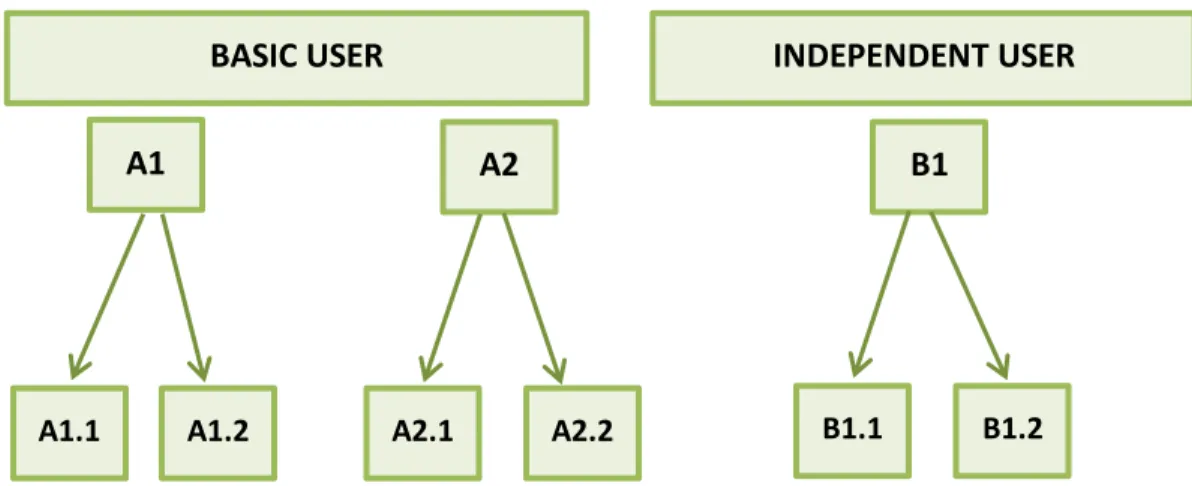
National Curriculum Guidelines (2014) say that "Because the CEFR establishes cut-off points between levels flexibly, allowing scaling the levels and their descriptors to “suit local needs”—yet still relating them back to a common system—the three afore mentioned language proficiency levels will be applied in the public educational system gradually through a branching approach as shown in figure 1 below”:
Figure 1. Levels of proficiency and their application per school year.
2.1.4.2.3 General Objectives
The National Curriculum Guidelines indicates that “By the end of 1st year Bachillerato, students will have reached the communicative competence for A2 proficiency level (basic user), and they will be able to: 1) understand sentences
BASIC USER INDEPENDENT USER
A1 A2 B1
A1.1 A1.2 A2.1 A2.2 B1.1 B1.2
16 and frequently used expressions related to areas of most immediate relevance (e.g. basic personal and family information, shopping, local geography, employment); 2) communicate in simple, routine tasks requiring a simple, direct exchange of information on familiar and routine matters; 3) describe in simple terms aspects of their background, immediate environment, and matters in areas of immediate need; 4) understand, identify, and produce longer, more detailed informational, transactional, and expository texts (e.g. traveling forms, formal letters, biographies, etc.) as well as simple procedural descriptions and narratives (e.g. ‘how to’ instructions and first-person stories); and 5) be aware of some features that make their culture and the foreign culture different as well as develop attitudes to cope with such dissimilarities”.
2.1.4.2.4 English in the First year Bachillerato
2.1.4.2.4.1 Specific Objective per school year
17
2.1.4.2.4.2 Language skills
According to (National Curriculum Guidelines, 2014), “the assessment indicators for every skill are given below”:
LANGUAGE SKILLS
PROFICIENCY LEVEL A.2.2: 1st year Bachillerato
LISTENING
Identify words and expressions used in a slower, yet natural colloquial style, by native speaker and non-native speakers within the public and vocational domain-complementary to the personal and educational background with which they are already familiar.
Understand phrases and expressions related to areas of most immediate priority within the personal, educational, public and vocational domains (e.g. shopping travel, services, workplaces, etc.), provided speech is clearly and slowly articulated.
Within the personal, educational, public and vocational domain, deduce the meaning of unfamiliar phrases and words from a context containing familiar elements.
In their own speech and in the speech and others, understand the principal meaningful contrasts in utterances carried by stress placement and intonation.
18 announcements given publicly within the personal, educational, public and vocational domain (i.e. traffic and tourist information, publicity texts, routine commands, etc.)
Understand and identify the main discussion topic within the personal, educational, public and vocational domain provided that they are conducted slowly and clearly.
Identify the main idea and sequence of event of recorded news reporting public entertainment, events, accidents, etc.
Identify the main point of television news reporting public entertainment, events, accidents, etc., where the visuals support the commentary – provided technological resources are available.
READING
Deduce the meaning of complex words composed of elements (bases and affixes) which are familiar to the learners in transactional, expository, informational, procedural, and narrative texts.
19
Find specific predictable information in longer transactional, expository and informational material (e.g. traveling forms, brochures, etc.) than those presented in previous years as well as in short procedural and narrative texts (e.g. recipes and adventure stories).
Make use of clues such as titles, illustrations, paragraphing, etc. to identify and understand relevant information in written texts types that correspond to the level.
Understand simple instructions from recipes or equipment encountered in everyday life (e.g. public telephone) as well as more complex media articles.
SPEAKING
Production
Repeat new words and expressions which occur in conversations in the personal, educational, public and vocational domains, and make use of such terms and expressions whenever appropriate/necessary.
Explain their likes and dislikes in general.
Give short, basic descriptions and sequencing of everyday events and activities within the personal, educational, public and vocational domains (e.g. their environment, present or most recent job, etc.).
20 past activities, and experiences within the personal, educational, public and vocational domains.
Within the corresponding domains, deliver very short, rehearsed announcements of predictable, earned content which are intelligible to listeners who are prepared to concentrate.
Understand clear, standard speech on familiar matters within the personal, educational, public and vocational domains provided they can ask for repetition or reformulation from time to time.
Interaction
Deal with common aspects of everyday living within the personal, educational, public and vocational domains without undue effort:
- Exchanging views and expressing attitudes concerning matters of common interest (e.g. social life, environment, occupational activities and interests everyday good and services) as well as briefly giving reasons and explanations for opinions.
- Travel, lodgings, and transport (e.g. getting all the information needed from a tourist office).
- Eating (e.g. ordering a meal).
21 what is wanted and asking the price).
- Transactions in shop, post offices, or banks.
- Proposing plans/arranging a course of action and briefly giving reasons and explanations.
- Extending invitations and reacting to being invited.
Interact with reasonable ease in structured situations (e.g. and interview) and short conversations within the corresponding domains, provided they are addressed clearly, slowly, and directly.
Answer straightforward follow-up questions within the personal, educational, public and vocational domains provided they can ask for clarification occasionally and are given some help to express what they want.
When addressed directly in a formal meeting, say what they think about issues within the personal, educational, public and vocational domains, provided they can ask for repetition of key points if necessary.
Follow changes of topic in formal discussion, within the corresponding domains.
22
WRITING
Write short sentences on everyday subjects (e.g. directions: how to get somewhere).
Write about everyday aspects of their environment, e.g. people, places, a job, or study experience in linked sentences.
Write a series of simple phrases and sentences for product packaging, safety notices, brochures, etc.
Complete traveling forms.
Write short “how to” instructions and recipes.
Write short narratives such as adventure or realistic fiction.
Source: National Curriculum Guidelines - Ecuadorian Ministry of Education
2.1.5 Reading skills
Reading is a process where readers interpret the meaning of the information according to reading text. The goal of reading is comprehension (Nunan, 2003).
Making students learn to read English is the most important responsibility of the teacher. Many students aspire to get to read texts or materials in English in order to apply this ability in their careers (specific purposes) or do it for pleasure (Harmer, How to Teach Reading, 1998).
23 Reading contributes to develop imagination and creativity of human beings, enriching the knowledge.
Reading offers great benefits of learning that can improve the language in vocabulary, punctuation, paragraphs, grammar, etc. Likewise, it stimulates the knowledge and allows sharing topics of interest with other people (Harmer, How to Teach Reading, 1998).
Konza, D. (2011) says that Reading is a combination of strategies based on the construction of oral language, the development of specific skills and understanding methods. To make this process work teachers should train students efficiently, according to the needs of each one.
Reading is an essential part in literacy. Since the reading process is very broad, good teachers have sufficient capacity to apply a lot of teaching methods that will be independent and confident students. Among the components of teaching reading are considered the application of new vocabulary, phonological processes and comprehension strategies. Motivation and pleasure are the keys to to get to understand the reading (Catherine, 2013).
Nuttall, C. (2005) say that “Whatever your reason for reading (excluding any reading for language learning), it is not very likely that you were interested in the pronunciation of what you read, and even less likely that you were interested in the grammatical structures used. You read because you wanted to get something from the writing. We will call this the message: it might have been facts, but could just as well have been enjoyment, ideas, feelings (from a family letter, for instance)”.
24 etc.) is the interest to know the content of what is going to read, without being complicated with the grammar rules of the text.
Nuttall, C. (2005) states that “Most people accept that we can at least identify certain strategies which readers can make conscious use of when reading difficult texts. Probably the best way to acquire these is simply to read and read. However, there is evidence that strategy training (or skills teaching - the terms are often used interchangeably) helps”.
There are different readings strategies that contribute to readers easily understand the texts, even if these are difficult.
Reading skill is the ability of the reader to organize information and give meaning to a text. Many readers use an unconscious and automatically form when they read quickly but when it is a difficult text is reversed, the reader applies the skills in consciously way to understand it (Mikulecky, 2008).
To get a better result in the development of the receptive skills, students should practice intensive and extensive reading, which will teach methods to learn and improve the act of reading. While the student can choose the material to read, usually for pleasure, the teacher can direct and design the method of reading (Harmer, The Practice of English Language Teaching, 2001).
2.1.5.1 Intensive Reading
Intensive Reading require a focus on the text with the guidance or supervision of a teacher, making tasks that forces to the learners to understand the meaning of the text that after will be evaluated (Nuttall Christine, 2005).
25 classrooms. Teachers may ask students to look at styles or types of text of different genres such as magazines, poems, websites, novels and others. This election can be classified according to the topic that learners are studying”.
This technique is usually worked in the classroom. The students reading specific information about topics of interest, after a period of time will be evaluated for the teacher.
www.erfoundation.org (2011) explain that “When students ‘read to learn’ (Intensive Reading) they are reading a text to learn something about the language itself – maybe a new word, some grammar and so on. We could call it ‘study reading’ (…) There are typically pre- and post-reading activities and comprehension questions as well”.
With the intensive reading students read to learn new things and demonstrate the results through activities in class.
2.1.5.2 Extensive reading
According to an article of Rustipa, K. (2010) Extensive Reading consists in encourage students to work autonomously. With extensive reading, the student can read in a comfortable way, in any moment, according to their desire and according to the interest of a particular topic.
In Extensive reading, students choose the books or texts that they are going to read, with the advice of the teacher, according to their understanding level. Although these readings will not be evaluated, the students must also work in small groups and make brief comments about that (Mikulecky, 2008).
26 choose books or texts that they want to read and they do it for pleasure, will increase their interest in reading and they will progress faster.
Kredátusová M. (2012) states that “Implementing Extensive Reading into our teaching is a useful experience as it is observed that if students are given the opportunity and encouragement to read they like reading”. Extensive reading is a tool to improve students’ proficiency level.
2.2 Philosophical basis
According to Cantwell, K. (2010), having a website contributes in the teaching learning process, creating an effective communication among students and teachers through the internet. In this site you can find and share a lot of information, materials, styles of learning and resources to work in the classroom and outside it, according to your educational needs. A website offers students a lot of benefits for reading comprehension and you can access them at any moment without worrying about the time.
According to WebBuildersGuide.com (s.f.) “Wix is a popular name in the free website builder market, and offers some pretty impressive and differentiated features that are particularly attuned to the interests and expectations of first time users. Despite the fact that there are many other free website building tools out there that let you create free websites without requiring any HTML expertise on your part, at least the top few of them manage to express a personality of their own, and in those terms, Wix focuses on providing a pretty fulfilling design experience to users. The availability of several configuration items in terms of the design elements of your website, coupled with the mesmerizing range of designer templates that look straight out from the most coveted design labs of the world is easily a differentiator for Wix”.
27 you don't know where to start, Wix gives you several templates with effectives and elegant design where you can choose a model and then modify it to adapt your needs. Just as Wix, there are others Websites for teaching reading that are contributing to enhance the education system inside and outside to the classroom, especially in English language development. Through this method students and teachers can work in independent form from any place with only to have the internet service. The effectiveness of these websites have been tested and are being used by teachers and students to enhance teaching English, especially to encourage the good reading habits.
Starfall.com is a free website created on September of 2002 for the Starfall Education Foundation, with the contribution of the Polis-Schutz family. This project has been carried out for over ten years and is focused on teaching phonics reading and audiovisual interactivity for children up to second grade school (Starfall Education Foundation, 2002).
According Heiner, H. (1998) “SurLaLune Fairy Tales features 49 annotated fairy tales, including their histories, similar tales across cultures, modern interpretations and over 1,500 illustrations. Also discover over 1,600 folktales & fairy tales from around the world in more than 40 full-text Books”
28 For this reason, it is very essential that teacher hold an enjoyable environment into the classroom and motivates the habit of reading in the students.
Motivation is very important point in the process of extensive reading, because it helps to develop of good attitudes towards the study of the foreign language (Bamford & Day, 2004).
Vojtková, N. & Kredátusová, M. (2007), establish that “Extensive reading can be introduced to any kind of EFL class whatever the content, intensity, age of students or their language level, the only condition is that students already have a basic knowledge of foreign language and are literate in it”
According to this author, extensive reading can be used without limitations in the teaching learning processes; the unique requirement is that learners have a basic knowledge of English.
Vojtková & Kredátusová (2007) states that “Extensive Reading is based on reading easy material that contains mostly one to two unknown words per page for general understanding. Students choose their own materials and can stop reading if the material is not interesting for them. There are no tests after reading; student’s personal reaction to reading is the goal. ER imitates reading in the first language in the way that its key elements are purpose and pleasure”.
This technique is based in provide to the students the reading easy material where they decide what information they want or want not to read, according to their preferences.
29 The art of reading contribute to improve the English language in different ways, feeding their knowledge.
According to an article at Maley, A. (2010), the benefits of extensive reading are: “Develops learner autonomy, offers Comprehensible Input, enhances general language competence, helps develop general world knowledge, extends, consolidates and sustains vocabulary growth, helps improve writing, rates and sustains motivation to read more”.
The benefits of extensive reading contribute to develop of skills and abilities in the learners allow them to be more independents and competitive.
2.3 Fundamental categories
2.3.1 Education
If we talk in general terms, education is the way of learning where knowledge, values, beliefs, skills and habits of people going from one generation to another, through the dialogue, teaching, histories and research.
2.3.2 Teaching Learning process
It is the essence of education. To achieve the objectives and goals of education is necessary to apply the teaching-learning process because it is the most important tool to get the progress in the students. On the other hand, it can be said that teaching is learning cause and the effect.
2.3.3 Technology
30
2.3.4 Information and Communication Technology (ICT)
The ICT are collections of new electronic tools that allow processing and transmitting information. This information permits the interaction between people in easier way.
2.3.5 Web 2.0
There is not a precise concept of web 2.0, but it can be said that it is a new version of the World Wide Web, where you can make big changes in the form that the websites are developed and used. A web 2.0 site can permit to users interact with other people into the virtual community.
2.3.6 Wix
It is a free website builder that allows to create some web pages in easy form with interesting designs, based in a flash technology. Wix works online and you can make different animations and personalization using default designs and choice templates. This make that student has more interest in the topic to elaborate.
2.3.7 Reading Skills
Reading is the ability to read text, process it and understand its meaning. Reading skills allows students to develop their cognitive ability and enrich their knowledge, through the discovery of new vocabulary.
2.3.8 Extensive Reading
31
2.4 Legal Basis
The legal base of this research paper is based in:
The Constitution of Ecuador (Article 347, Numeral 8) establishes to include the ICT (Information and Communication Technologies) in the educational process and encourage the connection between the education and productive or social activities.
The Law of Intercultural Education on it article 19 states that the Central Government is in charge of the Education in all its level (Planning, organization and implementation) as well as defining all the requirement in order to ensure a quality Education of all the institutions.
Finally, The Childhood and Adolescence Code establishes on its article 37, numeral 3, that Education must be considered as flexible in order to reach the needs of all children and adolescents considering especial attention to those with disabilities giving an equal opportunity to all.
2.4.1 Hypothesis
The free website builder Wix as a teaching tool will enhance the extensive reading skills to students of first year Bachillerato at Unidad Educativa P.C.E.I. “Manuela Sáenz”.
2.4.2 Variables of study
Dependent variable: The extensive reading skills
32
CHAPTER III
METHODOLOGY
3.1. RESEARCH APPROACH
The aim of this paper research will be based on quantitative and qualitative methodology; these methods will allow to obtain specific results about the enhancement of Extensive Reading Skills to students of First year Bachillerato at Unidad Educativa P.C.E.I. “Manuela Sáenz”.
3.1.1. Quantitative Method
This method will be used in order to collect data related to the use of a free Website builder by the First year Bachillerato at Unidad Educativa P.C.E.I. “Manuela Sáenz”.
3.1.2. Qualitative Method
This project will use the qualitative method in order to gather information about the use of a free website builder as a teaching tool for the enhancement of Extensive Reading skills; the researcher will interview several professionals and specialists, teachers and students, and the Principal of the institution where this project will be implemented.
3.1.3. Inductive-deductive Method
33 P.C.E.I. “Manuela Sáenz”.
3.1.4. Scientific Method
This method will allow to show the real enhancement of Extensive Reading skills by the First year Bachillerato at Unidad Educativa P.C.E.I. “Manuela Sáenz”, using a free website builder.
3.1.5. Observation Method
This method will contribute to find out detailed information about causes and effects of the problem related to the use of a free website builder as a teaching tool for the enhancement of Extensive Reading skills to students of First year Bachillerato at Unidad Educativa P.C.E.I. “Manuela Sáenz”.
3.2. LEVEL OR TYPE OF RESEARCH
3.2.1. Field Research
It will be important the use of the Technology in the English Teaching Process for the enhancement of Extensive Reading Skills regarding the implementation of a free Website builder during the School Year 2015-2016. It will be applied in the students of First year Bachillerato, who show the consequences and weakness involved in the problem.
3.2.2. Bibliographic Research
It will allow to search and select scientific-theoretical foundations on the subject of investigation; the key topics are related to a free website builder and ICT in the Education Field.
3.2.3. Correlational Research
34 (Wix, a free website builder as a teaching tool).
3.2.4. Applied Research
This type of research will allow the use of a free website builder in order to enhance of Extensive Reading skills to students of First year Bachillerato at Colegio Particular a Distancia Manuela Sáenz.
3.3. POPULATION AND SAMPLE
3.3.1. Population
The population of this research is composed by all the 30 students of First year Bachillerato at Unidad Educativa P.C.E.I. “Manuela Sáenz”.
Chart # 1: Population
Nº Description Quantity %
01 Principal at “Unidad Educativa P.C.E.I. Manuela Sáenz” 1 3
02 English Teacher at “Unidad Educativa P.C.E.I. “Manuela
Sáenz” 1 3
03 Professionals 3 9
04 First year Bachillerato at “Unidad Educativa P.C.E.I.
“Manuela Sáenz” 30 85
TOTAL 35 100%
35
3.4. VARIABLES OPERATIONALIZATION
3.4.1. Independent Variable: Wix, a free website builder.
Chart # 2: Independent Variable
CONCEPTUALIZATION DIMENSIONS INDICATORS ITEMS
TECHNIQUES AND INSTRUMENTS
Wix is a free website builder that allows created some web pages in easy form with interesting designs, based in a flash technology. ICT’S Free Websites builders Methodological Strategies Tools Technology Web Sites
Does your teacher use the internet in your English classes?
How do you consider the use of internet within the English Learning Process?
How often do you use internet to study English? Which of these gadgets do you use more to surf the net?
Have you ever used websites with exercises and activities could contribute your reading skills?
Do you consider that a website with exercises and activities could help to enhance your reading skills?
Survey Interview
Camera Video-Camera Guides of Interview