
Using a social media campaign to promote public health awareness among pharmacy students
5
0
0
Texto completo
(2) Leon-Salas AL, Quesada-Morua MS.. INTRODUCTION Public health is a social multidisciplinary practice that seeks the well-being of people promoting better health and preventing diseases, through the research of health-related problems and risks, and community active engagement (1), involving different healthcare professionals like pharmacists (2,3). There is a generalized lack of understanding of the full concept, and the implications public health has on the wellbeing of individuals, families, and communities, leading to poor leadership of different professionals in the field(4,5). Teaching public health to pharmacy students represents an important task due to the need of involving them in disease prevention and healthy lifestyles promotion, at the individual and community levels(2,3,5,6). Pharmacists, as accessible professionals with a solid academic background in areas such as pharmacotherapy, epidemiology, access to care, and prevention services, play an important role in public health and community active engagement(7). The School of Pharmacy of the University of Costa Rica included, since 1999, an undergraduate course named Elements of Public Health, dedicated to exploring public health and epidemiology concepts. This course is on the third year of a five and a half years’ curriculum- and addresses basic concepts of health promotion, social determinants of health, disease prevention, and epidemiology, through traditional lectures. Nonetheless, since 2015, a series of innovating teaching activities have been introduced to engage students in more experiential learning, to increase their understanding of basic public health theories and concepts.. METHODS This descriptive study addresses a new way of presenting pharmacy students to the concept of public health and the role of pharmacists in raising public health awareness, using social media as a platform to present their work. The results of this analysis included perceptions from third and fourth-year students, enrolled during the first semester of 2016 in the Elements of Public Health course (EPHC) at the School of Pharmacy of the University of Costa Rica. Instructions and background to complete this activity were provided during the first day of class. As an introduction, students received a lecture on Social Determinants of Health and a full description of the TIPH activity to be completed during the following week. EPHC professors stated the aim of this activity as promoting the role of public health in the community and to evidence the role of pharmacists in this area. Due to the total number of students enrolled (n=82) and professors assigned to provide guidance (n=2), students were instructed to work in groups of approximately 10 people. Each group member had to publish at least one picture illustrating how public health impact their community or current place of residence. To do so, they used a Spanish-TIPH sign (available at https://thisispublichealth.org) to create a post on their personal Facebook profiles. Each post had to include a full description of why the picture was selected, and how it was related to public health and pharmacy. Students were also asked to use the hashtags #saludpublicafarmaciaUCR and #thisispublichealth to allow the follow-up of every post.. One of these innovative activities is the “This is Public Health” (TIPH) campaign. It was created by the American Association of Schools and Programs of Public Health to promote public health locally and globally through social media, by exposing different actions that can affect individuals, families, and populations´ health(8). Although this campaign has been implemented in more than 30 countries and has a vast number of uses that are evident in social media channels, only three studies had addressed its use to promote public health awareness in different university and community settings(5,9,10).. After a week, the TIPH photos were presented and a discussion on the main findings was conducted during the regular class. At the end of this activity, students completed a brief survey evaluating their perceptions on the adequacy of the didactic strategy to learn new concepts on Public Health (Questions 1-3), its impact on their interest in Public Health (Questions 4-5), the time spent on completing it (Questions 6-7), and its use to promote public awareness on health issues (Questions 8-9). This form was made based on previous published studies(11) and answers were provided using a 5-point Likert-scale (1 = strongly disagree to 5 = strongly agree).. In this study, we describe pharmacy students´ participation in the TIPH campaign as part of the course´s nontraditional teaching activities planned to help them understand the concept of public health, and how pharmacists can contribute to promoting health improvement and disease prevention.. Responses were entered and analyzed using Microsoft Excel® 2016. Participant’s characteristics and evaluation statements are presented in terms of frequencies and percentages. The scale in questions 6 and 7 was reversed since most of the responses corresponded to strongly disagree.. 34. Ars Pharm. 2020; 61(1): 33-37.
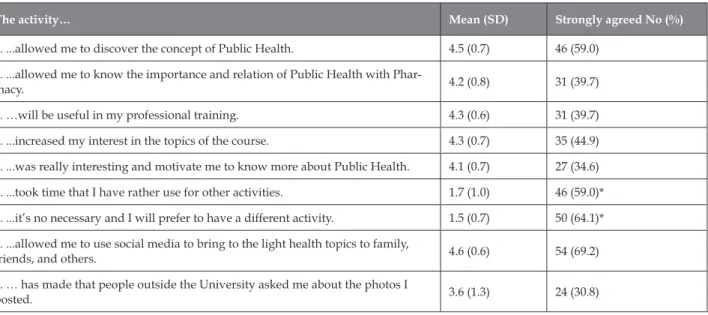
(3) Using a social media campaign to promote public health awareness among pharmacy students. This manuscript has been reviewed and approved by the University of Costa Rica Ethics Committee. RESULTS A total of 82 students were enrolled in the EPHC during the first semester of 2016, of them, 95.12 % (n=78) completed the final evaluation. Overall, students were 22 years old (mean 22.01, SD 1.91), mainly women (n = 55, 70.5%), and taking classes on their third (n = 29, 37.2%) or fourth year (n = 47, 60.3%) of the pharmacy program. As shown on items 1 to 3 of table 1, most of the students thought the TIPH activity allowed them to comprehend the concept of public health, and its relationship with pharmacy (Means 4.5, 4.2, respectively). Nearly all students strongly agreed or agreed on the importance of public health cam-. paigns in their future practice as healthcare professionals (n = 71, 91%). Furthermore, 4 out of 5 students strongly agreed or agreed with the statements that the activity increased their interest in public health (item 4, 84.6%) or motivated them to know more about it (item 5, 82.1%). Time availability is a common concern our students have when completing extra class assignments. However, more than half of respondents (59.0%) strongly disagreed with the following statement “…took time that I have rather used for other activities”. Finally, almost all students strongly agreed or agreed (n = 72, 92.3%) that the use of the TIPH campaign and social media tools are good strategies to present health-related information to people outside the academia.. Table 1. Student´s opinions after implementing the This is Public Health activity. The activity…. Mean (SD). Strongly agreed No (%). 1. ...allowed me to discover the concept of Public Health.. 4.5 (0.7). 46 (59.0). 2. ...allowed me to know the importance and relation of Public Health with Pharmacy.. 4.2 (0.8). 31 (39.7). 3. …will be useful in my professional training.. 4.3 (0.6). 31 (39.7). 4. ...increased my interest in the topics of the course.. 4.3 (0.7). 35 (44.9). 5. ...was really interesting and motivate me to know more about Public Health.. 4.1 (0.7). 27 (34.6). 6. ...took time that I have rather use for other activities.. 1.7 (1.0). 46 (59.0)*. 7. ...it’s no necessary and I will prefer to have a different activity.. 1.5 (0.7). 50 (64.1)*. 8. ...allowed me to use social media to bring to the light health topics to family, friends, and others.. 4.6 (0.6). 54 (69.2). 9. … has made that people outside the University asked me about the photos I posted.. 3.6 (1.3). 24 (30.8). Scale: 1 strongly disagree, 2 disagree, 3 neutral, 2 agree, 5 strongly agree. * Reverse scored for strongly disagree. DISCUSSION Studies had demonstrated that pharmacy students have a good perception of public health courses(12). Teaching public health represents an opportunity to implement diverse didactic strategies as poster presentations(13), public health research projects(14), or, as we present in this paper, the use of social media and international campaigns to promote pharmacy students’ learning of their future role as healthcare professionals. Indeed, the use of this didactic strategy provided a good starting point for our students to feel motivated about public health and the new concepts they were about to learn, as more than half of them considered it a way to increase their interest in the topics to be covered during the semester.. Ars Pharm. 2020; 61(1): 33-37. We successfully used the Spanish-TIPH sign as part of a didactic strategy to promote public health awareness among pharmacy students at the University of Costa Rica. The TIPH campaign has been previously used to promote public health activities in different community settings(5,9,10), however, as Dundas et al(10) have discussed, there is a need for evidence to support its implementation in other settings, such as academia. Consequently, this paper contributes to the body of research supporting the use of the TIPH campaign in academic settings and, to the best of our knowledge, it is the first to show results of using this initiative among pharmacy students in a Latin-American university. Nowadays, the importance of pharmacists and their impact on public health is recognized(15,16). Therefore, pharmacy students need to be challenged to get involved with. 35.
(4) Leon-Salas AL, Quesada-Morua MS.. their communities and to be part of health promotion and disease prevention activities; this can be done by creating opportunities to develop skills and acquire knowledge on public health, through different approaches. Using innovative didactic strategies is a way in which the academia can respond to students that have grown up in an era of technology and social media use(2,17). The academic workload for students between the third and fourth year at the School of Pharmacy of the University of Costa Rica is generally high(18), hence being a challenge to carry academic activities other than classroom lectures and written tests, independently of the course taken. Therefore, this activity was planned to be completed at the beginning of the semester when students have more time available, and their stress levels have proven to be lower(18). As reflected in students’ opinions, time to carry the activity out was not an issue; moreover, students considered worth doing innovative and non-traditional activities in this and other courses of our Pharm D degree. Students´ willingness to participate in the activity could also be related to the fact that they are more comfortable with learning new concepts through blended approaches and with the use of social media for educational purposes, as demonstrated in other studies(19,20). Moreover, students who were part of this activity were able to take a glimpse of the power of social media to raise health awareness and professional recognition among their friends, families, and communities. This study presents the results on the opinion of a cohort of pharmacy students at the University of Costa Rica on using social media to raise awareness on Public Health. Their perceptions on this issue may not be representative of all pharmacy students or courses in our school, thus further research must be conducted to overcome this limitation.. 2.. Palombi L, Kading M, Hayes CJ. The Public health pharmacist and the role of the pharmacy curriculum: a call to action. Currents in Pharmacy Teaching and Learning. 2013; 5, 477– 482. Doi:10.1016/j.cptl.2013.06.011. 3.. Nemire RE, Ward CT, Whalen K, Quinn J, Subramaniam V, Gershon SK. Public health matters: the role of the pharmacist and the academy. Currents in Pharmacy Teaching and Learning. 2010; 2, 2–11. doi:10.1016/j.cptl.2009.12.001. 4.. Clancy A, Svensson T. Perceptions of public health nursing practice by multiple health officials in Norway. Public Health Nursing. 2009; 26(5), 412–420. doi: 10.1111/j.15251446.2009.00799.x.. 5.. Geraghty C, Fanany R. This is Public Health: Australian Students’ Understanding of Public Health. International Journal of Health, Wellness & Society. 2011; 1(2),177-195. doi: 10.18848/2156-8960/CGP/v01i02/41158. 6.. International Pharmaceutical Federation. FIP Education Initiatives. Pharmacy Education Taskforce a Global Competency Framework Version 1. 2012.. 7.. American Public Health Association. The role of pharmacists in public health. Policy Number 200614. 2006. Available. from:. https://www.apha.org/policies-and-ad-. vocacy/public-health-policy-statements/policy-database/2014/07/07/13/05/the-role-of-the-pharmacist-in-public-health. Accessed: July 20, 2019 8.. Association of Schools and Programs of Public Health. This is Public Health. 2019. Available at: https://thisispublichealth. org/resources. Accessed: July 20, 2019. 9.. Chase NL, Dominick GM, Trepal A, Bailey LS, Friedman DB. This Is Public Health: Recycling Counts! Description of a Pilot Health Communications Campaign. Int. J. Environ. Res. Public Health. 2009; 6, 2980-2991. doi:10.3390/ijerph6122980. 10. Dundas KJ, Hansen V, Outram S, James EL. A “Light Bulb. CONCLUSIONS. Moment” in understanding Public Health for undergrad-. It is possible to motivate pharmacy students to know more about their role in Public Health activities using innovative teaching strategies. Public health educators need to explore integrating these strategies with classic classroom lessons and activities, in response to the changing learning needs of students that are growing up within a more technological background.. Health” photo essay task. Front. Public Health. 2017; 5:116.. REFERENCES 1.. Muñoz F, López-Acuña D, Halverson P, Guerra de Macedo. uate students: evaluation of the experiential “This is Public doi: 10.3389/fpubh.2017.00116 11. Moeller KE, Woods B. Pharmacy Students’ Knowledge and Attitudes Regarding Medical Marijuana. Am J Pharm Educ. 2015; 79(6), 85. doi: 10.5688/ajpe79685 12. Shah B, Rahlm H, Yin H, Bhavsar J. (2009). Pharmacy students’ attitudes toward a required public health course and developing a public health program. Am J Pharm Educ. 2009; 73(7), 134. Doi:5688/aj7307134. C, Hanna W, Larrieu M, Ubilla S, Zeballos JL. Las funciones. 13. Kelsch MP, Werremeyer AB. Poster Project to Emphasize Pub-. esenciales de la salud pública: un tema emergente en las. lic Health in the Pharmacy Curriculum. Am J Pharm Educ.. reformas del sector de la salud. Pan Am J Public Health. 2000;. 2011; 75(1), 2. Doi:10.5688/ajpe7512. 8(1/2), 126-134.. 14. Fuentes D, DeGuire N, Patel R, Boyce E. A Team Public Health Research Project for First-Year Pharmacy Students to Apply. 36. Ars Pharm. 2020; 61(1): 33-37.
(5) Using a social media campaign to promote public health awareness among pharmacy students. Content from Didactic Courses. Am J Pharm Educ. 2010; 74 (6): 99. Doi:10.5688/aj740699 15. DiPietro Mager NA, Farris KB. The Importance of Public Health in Pharmacy Education and Practice. Am J Pharm Educ. 2016; 80 (2), 18. Doi:10.5688/ajpe80218 16. Truong H, Patterson BY. Professional and Educational Initiatives, Supports, and Opportunities for Advanced Training in Public Health. Am J Pharm Educ. 2010; 74(7), 122. Doi:10.5688/aj7407122 17. Clauson KA, Singh-Franco D, Sircar-Ramsewak F, Joseph S, Sandars J. Social media use and educational preferences among first-year pharmacy students. Teach Learn Med. 2013; 25(2), 122-8. Doi: 10.1080/10401334.2013.770742 18. Jiménez Herrera LG. Estrés en estudiantes de farmacia de la Universidad de Costa Rica. Actualidades Investigativas en Educación. 2010; 10(2), 1-29. Available from: https://revistas. ucr.ac.cr/index.php/aie/article/view/10114/17965 19. Hamilton LA, Franks A, Heidel RE, McDonough SL, Suda KJ. Assessing the value of online learning and social media in pharmacy. Am J Pharm Educ. 2016; 80(6), 97. Doi: 10.5688/ ajpe80697 20. Benetoli A, Chen TF, Aslani P. The use of social media in pharmacy practice and education. Res Social Adm Pharm. 2015; 11(1), 1-46. Doi: 10.1016/j.sapharm.2014.04.002. Ars Pharm. 2020; 61(1): 33-37. 37.
(6)
Figure
Documento similar
This study aims to explore experiences with writing and its teaching among students in six disciplinary areas (Arts, Health Sciences, Social Sciences, Humanities, Pedagogy in
La aplicación de una perspectiva ética en cualquiera de las áreas de la salud pública (que son básicamente la promoción y la protección colectivas de la salud comunitaria, así
The prevalence and affecting factors on self-medication among students of Kermanshah University of Medical Science in 2014. Prevalence of Self-Medication among Students of
42% of the postgraduates knew that the basal implant utilizes the basal – cortical portion of the jaw bones for retention of the dental implants which are uniquely designed to
Figure 9: This Bar graph shows the association between awareness of mini implants can be used in insufficient interdental space and year of study.In that X axis represents responses
Independent variables will be age, gender, and year of study and dependent variables will be knowledge, awareness, and practice of complementary and alternative
Using chi-square test, the association between gender and knowledge of dental students regarding periorbital hyperpigmentation was analysed..
Background: Needle Stick Injury(NSI) and Sharp Injuries are major hazards in transmission of infectious blood borne diseases among Health Care Workers and Medical
