
A teaching proposal about the slavery period to Foster interculturality and motivation in EFL Education
63
0
0
Texto completo
(2) Table of contents. List of tables ...................................................................................................................... 3 List of figures .................................................................................................................... 4 1. Introduction .................................................................................................................. 5 2. Theoretical Framework................................................................................................. 6 2.1. Cultural dimension in EFL ................................................................................................. 6 2.1.1. Intercultural dimension in language teaching .......................................................................6 2.1.2. Components of intercultural competence .............................................................................7 2.1.3. Teachers and the intercultural dimension .............................................................................8 2.1.4. Scaffolding strategies to teach English through culture ......................................................10 2.2. Motivation and language learning ..................................................................................... 11 2.2.1. Motivation in EFL lessons ..................................................................................................11 2.2.2. Motivation strategies for learners to study historical facts .................................................12. 3. Teaching Proposal ....................................................................................................... 14 3.1. Contextualization .............................................................................................................. 14 3.1.1. General contextualization of the school ..............................................................................14 3.1.2. Information about the school and the students....................................................................14 3.1.3. Course chosen to develop the teaching proposal ................................................................15 3.2. Development of the teaching proposal............................................................................... 16 3.2.1. Timing ................................................................................................................................16 3.2.2. Relationship with the curriculum ........................................................................................17 3.2.3. Objectives and contents of the teaching proposal ...............................................................18 3.2.4. Methodology .......................................................................................................................25. 1.
(3) 3.2.5. Organization of time ...........................................................................................................25 3.2.6. Organization of space .........................................................................................................27 3.2.7. Materials .............................................................................................................................28 3.2.8. Activities.............................................................................................................................29 3.2.9. Assessment of the Didactic Unit .........................................................................................42. 4. Assessment .................................................................................................................. 46 5. Conclusion ................................................................................................................... 48 6. References ................................................................................................................... 49 7. Appendices .................................................................................................................. 52 7.1. Appendix A: General Timetable of the course 5th B .......................................................... 52 7.2. Appendix B: Objectives, Key Competences and Blocks of Contents ................................ 53 7.3. Appendix C: Reviewing the lesson .................................................................................... 55 7.4. Appendix D: Picture of the timeline about the Slavery Period ......................................... 56 7.5. Appendix E: Picture of the special map about the Slavery Period .................................... 57 7.6. Appendix F: Pictures of the online testimonies of the slaves ............................................. 58 7.7. Appendix G: Poem written by the teacher ........................................................................ 59 7.8. Appendix H: Lyrics of the song Buffalo Soldier ................................................................ 61. 2.
(4) List of tables Table 1 - Timing of the teaching proposal .............................................................................. 16 Table 2 - Aims and Justification for this Didactic Unit .......................................................... 18 Table 3 - Competences and Justification for this Didactic Unit ............................................. 19 Table 4 - Contents selected for this Didactic Unit for the 5th B course ................................. 21 Table 5 - Organization of the lessons ..................................................................................... 26 Table 6 - Lesson 1 ................................................................................................................... 29 Table 7 - Lesson 2 ................................................................................................................... 31 Table 8 - Lesson 3 ................................................................................................................... 33 Table 9 - Lesson 4 ................................................................................................................... 35 Table 10 - Lesson 5 ................................................................................................................. 36 Table 11 - Lesson 6 ................................................................................................................. 38 Table 12 - Lesson 7 ................................................................................................................. 39 Table 13 - Lesson 8 ................................................................................................................. 41 Table 14 – Evaluation Criteria selected for this Didactic Unit .............................................. 43. 3.
(5) List of figures Figure 1 - Four Zones of Teaching and Learning. (Mariani, 1997) ......................................... 11 Figure 2 - Organization of the English classroom ................................................................... 28. 4.
(6) 1. Introduction Nowadays, the use of English as a vehicle for communication has increased significantly in the past years. In fact, and taking into account the globalised world in which we live, learning how to use this language for communication has become something essential for the English-as-a-foreign language (EFL) students. Furthermore, it is also important to highlight that there are many ways in which English can be taught. In this case, the idea proposed in this paper is to teach English through an intercultural view. There is a huge necessity of implementing intercultural education in our lessons, thus, the didactic unit proposed in this paper shows a practical example of how to do it in a motivational and interesting way for the students. Moreover, and bearing in mind the importance of teaching some cultural and historical facts to the students, the teaching proposal developed in this paper is based on the topic ‘Slavery Period’. Finally, it is essential to highlight that the main purpose of this paper is to provide a teaching proposal for EFL education in which language is used in a contextualised way, something that is crucial if our intention as teachers is to help our students achieve a meaningful learning by using English as a foreign language.. 5.
(7) 2. Theoretical Framework This proposal has been developed taking into account some theoretical precedents that provide a different view of how English could be taught by focusing the attention on cultural and historical aspects of language. Furthermore, motivation and interest of the students are two aspects that have been taken into account as well.. 2.1. Cultural dimension in EFL First of all, it is important to understand that the English language has a cultural dimension that must be analysed. Sometimes, this cultural dimension is not taught at schools, since it is left aside due to the fact that other aspects of language, as grammar and vocabulary, are considered more important than the culture of this foreign language. Taking into account these ideas, it is essential for the learners of this foreign language to acquire the ability to use English in an appropriate way, bearing in mind some social and cultural aspects which are closely related to the language. 2.1.1. Intercultural dimension in language teaching Something crucial to take into account in this paper is the intercultural dimension, as explained by Byram, Gribkova & Starkey (2002): The ‘intercultural dimension’ in language teaching aims to develop learners as intercultural speakers or mediators who are able to engage with complexity and multiple identities and to avoid the stereotyping which accompanies perceiving someone through a single identity. It is based on perceiving the interlocutor as an individual whose qualities are to be discovered. (p.9). As can be seen, the intercultural dimension is based on tolerance and respect towards the others, since it is constructed by taking into account the human rights as something essential for the social interaction. Additionally, the intercultural dimension is really useful for learners to help them acquire the linguistic competence that they need in an appropriate way, as well as their intercultural competence, since it helps the students to understand those people who have different social identities. 6.
(8) In relation to this last term ‘social identities’, it must be said that they are directly related to cultures. Each person, depending on the place they have grown up and many other characteristics, has different social identities, which include those beliefs, values and behaviours that are acquired by a person who lives in a determined place (Byram, Gribkova & Starkey, 2002). Thus, and in order to summarize all these ideas, it is really important to understand the importance of developing the intercultural dimension in English lessons, as Byram, Gribkova & Starkey (2002) point out: Developing the intercultural dimension in language teaching involves recognising that the aims are: to give learners intercultural competence as well as linguistic competence; to prepare them for interaction with people of other cultures; to enable them to understand and accept people from other cultures as individuals with other distinctive perspectives, values and behaviours; and to help them to see that such interaction is an enriching experience. (p.10). All these aspects have been taken into account for creating the teaching proposal which is developed in this paper, since all the ideas fostered in the intercultural dimension are essential to teach the topic ‘Slavery Period’ in a contextualised and meaningful way. 2.1.2. Components of intercultural competence When focusing the attention on the intercultural competence, it is important to highlight that the main components of this competence are knowledge, skills and attitudes, complemented by the values, which are part of people’s social identities (Byram, Gribkova & Starkey, 2002). In reference to these ideas, the savoirs stated by Byram (1997) must be explained in order to understand the intercultural competence. First of all, the concept savoir is defined by the author as “knowledge of social groups and their products and practices in one’s own and in one’s interlocutor’s country, and of the general processes of societal and individual interaction” (p.58). This concept does not imply knowledge about a specific culture, since the most important is to have the knowledge of how social groups and identities work. As stated by Byram, Gribkova & Starkey (2002): So knowledge can be defined as having two major components: knowledge of social processes, and knowledge of illustrations of those processes and products; the latter 7.
(9) includes knowledge about how other people are likely to perceive you, as well as some knowledge about other people. (p.12). Taking into account this information, it is essential to know how the several savoirs are defined in order to understand better the intercultural competence. Firstly, it is crucial to talk about the attitudes of the intercultural speaker and mediator, these attitudes are related to the savoir être, that implies curiosity and openness which are used to relativise one’s own values, beliefs and behaviours, which means to accept that they are not the only possible nor the most correct ones, or, as Byram, Gribkova & Starkey (2002) put it: “This can be called the ability to ‘decentre’”. (p.12). In the second place, we can find the savoir-comprendre component, which is the ability to interpret a document or event from another culture, but also to explain it and relate it to information from one’s own (Byram, 1997). In the third place, it is also important to talk about the concepts savoir apprendre/faire, which are related to the ability to acquire new knowledge of a culture and cultural practices, as well as the ability to operate knowledge, attitudes and skills in real communication and interaction (Byram, 1997). Finally, savoir s’engager is related to the critical awareness of the intercultural speakers and their values, as well as those of other people, as explained by Byram (1997): “critical cultural awareness/political education: an ability to evaluate, critically and on the basis of explicit criteria, perspectives, practices and products in one’s own and other cultures and countries”. (p.63). As can be seen, intercultural competence includes many aspects that must be taken into account in order to put into practice teaching proposals based on an intercultural view.. 2.1.3. Teachers and the intercultural dimension. After analysing all the information explained in the previous section, it is crucial to highlight that teachers must take into account all the savoirs that have been developed in earlier research. Furthermore, these ideas need to be reflected in the teaching practice of every foreign language teacher in a practical way and, as stated by MacKay (2002), it is important to teach. 8.
(10) the foreign language in a culturally sensitive manner, something that must be done by respecting the local culture of learning. Regarding these ideas, it is essential for English teachers to be familiar with the foreign cultures that are associated with the foreign language they are teaching. Additionally, teachers must have a deep knowledge of their own culture in order to help students find similarities and differences among cultures, avoiding stereotypes and fostering intercultural ideas. Furthermore, teachers must select and organize properly the content, the approaches and also the materials that they are going to use with students, in order to help them become interculturally competent (Sercu, 2006). On the other hand, it must be said that sometimes teachers have not had the chance to experience in first person all of the cultures which their students might encounter, but it is not something to be worried about, as Byram, Gribkova & Starkey (2002) put forward: The teacher’s task is to develop attitudes and skills as much as knowledge, and teachers can acquire information about other countries together with their learners; they do not need to be the sole or major source of information. Skills are just as important as attitudes and knowledge, and teachers can concentrate as much on skills as upon knowledge. (p.12). Nowadays, the idea of the traditional teacher who was the only person who had the knowledge is not valid anymore, since teachers do not have to know everything about the target culture. Indeed, the intercultural dimension does not imply a simple transmission of information about a foreign country, since the intercultural dimension is concerned with other aspects as, for instance: helping learners with their intercultural interaction, show them the influence of social identities and also help them with their perceptions and make them know how important they are for the success of the communication. (Byram, Gribkova & Starkey, 2002). Moreover, teachers need to be careful with the culture of their pupils, but they also need to be aware of the culture that they bring to the classroom. Even though the English teachers and their students share nationality, there are many cultural assumptions that must be taken into account, since it is impossible to talk about a complete cultural homogeneity. Furthermore, it is widely accepted that effective language learning can only take place in the way explained by 9.
(11) Sowden (2007): “when teachers and learners are constantly engaged in creating a culture of a third kind through the give-and-take of classroom dialogue”. (p.306). Finally, it must be said that teachers need to develop themselves as much as possible, since your integrity as a person and your relationships in the classroom would make possible to develop intercultural relations among the students. This idea is well-described by Sowden (2007): As far as development in classroom is concerned, teachers need to enhance those reflective and critical skills which will allow them to assess and appropriately modify their performance in the light of experience and of the insights provided by research, both their own and that of experts in the field. (p.308). As can be seen, self-exploration is something essential for those teachers who want to help their students in their learning process, since it means to reflect about themselves, something that includes the fact of being critical with their cultural assumptions and also with those values that are transmitted in the English lessons.. 2.1.4. Scaffolding strategies to teach English through culture First of all, the meaning of the concept ‘scaffolding’ needs clarification. In Gibbon’s (2002) words: It is a special kind of help that assists learners in moving toward new skills, concepts, or levels of understanding. Scaffolding is thus the temporary assistance by which a teacher helps a learner know how to do something so that learner will later be able to complete a similar task alone. It is future oriented and aimed at increasing a learner’s autonomy. As Vygotsky has said, what a child can do with support today, she or he can do alone tomorrow. (p.16). This concept has been taken into account during the teaching proposal, since it is designed in order to help students to be critical and independent. Thus, all the resources and materials used during the didactic unit, but also the methodology, try to help students achieve their purposes. Firstly, with the help of the teacher but, in the future, these scaffolding strategies 10.
(12) will help them to carry out alone all the activities proposed, achieving in this way autonomy and self-confidence to reach their goals. It is also important to bear in mind the contribution of Mariani (1997) to the issue of scaffolding, which can be seen in Figure 1:. Figure 1 - Four Zones of Teaching and Learning. (Mariani, 1997). Taking into account the information in Figure 1, it is important to highlight that the intention during the didactic unit is to avoid the zones of low challenge and low support, since they are directly related to frustration, anxiety and boredom. It is crucial to avoid these zones since they are deeply negative for the learning process of the foreign language students. That is why the teaching proposal is designed in order to catch students’ attention through the different resources, materials and methodologies. Furthermore, thanks to all the scaffolding strategies used during the proposal, which constitute a high support for the students, they will have the opportunity to learn and also to be motivated and engaged while they are achieving a high challenge thanks to the several activities proposed in the didactic unit explained in this paper.. 2.2. Motivation and language learning 2.2.1. Motivation in EFL lessons First of all, it is essential to understand the meaning of the term ‘motivation’ and its influential role in English lessons. Usually, people use this term to talk about those students who are successful and those who are not, because this term is directly related to success and failure. There are many investigators who have studied the influence of motivation among the students and one of the most important ones is Dörnyei (2001) that explains what motivation is about: “Motivation explains why people decide to do something, how hard they are going to pursue it and how long they are willing to sustain the activity” (p.7). Therefore, the influence 11.
(13) of motivation in English lessons must be taken into account to achieve our purposes as English teachers. In the field of Applied Linguistics, some interesting contributions in the field of motivation have been carried out. In this sense, one of the most important contributions about motivation in relation to English as a foreign language is the one by Gardner and Lambert, both of them Canadian and deeply influenced by their bilingual context in their country (Gardner, 1985). Furthermore, it must be said that the ideas proposed by Gardner are included in the social-psychological period, which lasted from half part of the twenty century until 1990. The ideas of this investigator can be divided into two main components: instrumentality and integrativeness. The first concept is related to the pragmatics gains of learning a second language, which could be an improvement of the salary, the possibility to find a better job, etc. On the other hand, the concept ‘integrativeness’ is explained clearly in the next lines (Dörnyei, 2003): An “integrative” motivational orientation concerns a positive interpersonal/affective disposition toward the L2 group and the desire to interact with and even become similar to valued members of that community. It implies an openness to, and respect for, other cultural groups and ways of life; in the extreme, it might involve complete identification with the community. (p.5). Moreover, it is also essential to take into account that there are four main elements that all the motivated students have in common (MacIntyre, 2002): these students have a goal to achieve, moreover, they feel a strong desire to achieve it, as well as positive attitudes and effort. Thus, the teaching proposal explained in this paper has been created bearing in mind these elements. 2.2.2. Motivation strategies for learners to study historical facts As has been explained previously, this teaching proposal deals with the topic of the ‘Slavery Period', a historical fact which constitutes an essential part of the English language culture in America. 12.
(14) Sometimes it is difficult to motivate the students when they have to study something related to history, above all, if the content is treated in a very theoretical way. That is why there are some proposals, as the ones created by Frederick (1993) that help teachers deal with this problem. The first strategy that this investigator explains is the ‘Brainstorming’, which is based on saying the first ideas that people have about a determined topic. It can be very interesting for the teacher since, by using this strategy, the previous knowledge of the students as well as their misconceptions can be easily found. The second strategy is ‘Visual Representations’, which are incredibly useful for the learning process of the students, as explained in the next lines (Frederick, 1993): Students are motivated by visual reinforcements of their learning not only because as visual learners they can more easily understand and remember a concept if they see it, but also because of the emotions of visualization. Consider the evocative power of slides and other visual media as a way of involving students actively in the interpretation of a single visual image. (p.16). Furthermore, ‘Students Questions’ are also considered really important since they are a useful strategy to develop the critical thinking among the students as well as to improve their learning process (Frederick, 1993). Students questions are based on their curiosity, that is why when students ask questions about the historical fact which is treated, they are motivated to learn about it, something that is an opportunity for the teacher that must not be ignored. Apart from the strategies that have been explained in this section, there are many others which can also be interesting. However, in the teaching proposal explained in this paper the three ideas developed previously are the ones which have been considered the most adequate to teach a historical fact like the slavery period.. 13.
(15) 3. Teaching Proposal 3.1. Contextualization 3.1.1. General contextualization of the school The school where this project was developed is located in La Pobla de Vallbona, which is a town that belongs to the region Camp de Túria, in the province of Valencia (Spain). Nowadays the number of inhabitants of this town is 23,403 (Instituto Nacional de Estadística, 2017). La Pobla de Vallbona can be considered a modern town in which all the citizens can enjoy several services, as public transport or supermarkets, since nowadays the secondary sector is the one which is the most developed and the majority of the inhabitants in this town work in diverse jobs which are related to this sector. However, in the past, the primary sector was the most important, since the Mediterranean weather of this town is really good for the cultivation of many citrus fruits, thus, the majority of the citizens were agricultural workers, something that has changed in these lasts decades. In reference to the education, it must be said that there are two state schools in La Pobla de Vallbona, as well as four semi-private educational centres. Furthermore, there is a public library and a cultural centre in which students can carry out diverse activities organised by the town hall. 3.1.2. Information about the school and the students. The teaching proposal that appears in this paper has been designed for the state school CEIP El Campés, which is located in La Pobla de Vallbona. This centre offers two educational stages, first of all, the second cycle of Pre-school Education and also the stage of Primary Education. Thus, students who attend this school are from 3 to 12 years old. Another point which must be taken into account is that students’ mother tongues are Valencian and Spanish. In the case of this school, Valencian is used as the working language, since all the subjects are imparted using this language (except the English subject and Spanish 14.
(16) language subject). On the other hand, in this school there are some students who come from other countries, as for instance, countries of northern Africa, eastern Europe and some other states of South America, apart from the gypsy ethnic group, which is also relevant in this school. Most of these students know perfectly how to talk and write in Spanish and most of them also in Valencian, although sometimes they need a reinforcement in the process of acquiring this language. Bearing in mind all this information, and taking into account the bilingual and intercultural reality of the school El Campés, it must not be forgotten that, for the students in this school, English is their third or fourth language. The multilingual reality of the students cannot be ignored, due to the fact that it is a fundamental element to take into account in order to develop properly this teaching proposal.. 3.1.3. Course chosen to develop the teaching proposal The teaching proposal developed in this paper has been designed to be carried out with students of the 5th B course of Primary Education. This group is composed by 25 students (15 girls and 10 boys) who are between 10 and 11 years old. In general, most of the students are motivated during the English lessons and they usually show a great disposition when they have to participate in the several activities proposed by the teacher. However, it is sometimes difficult for them to maintain the levels of motivation and attention when the topics treated do not allow them to participate in an active way during the lessons. Finally, it is important to note that 23 of the students are from the town, thus, their mother tongues are Spanish and Catalan. However, there are two students who come from other countries (one from Morocco and the other from Russia). In the case of these students, they do not know how to speak Catalan properly, but they know how to use Spanish perfectly and they do not show meaningful problems with the English language.. 15.
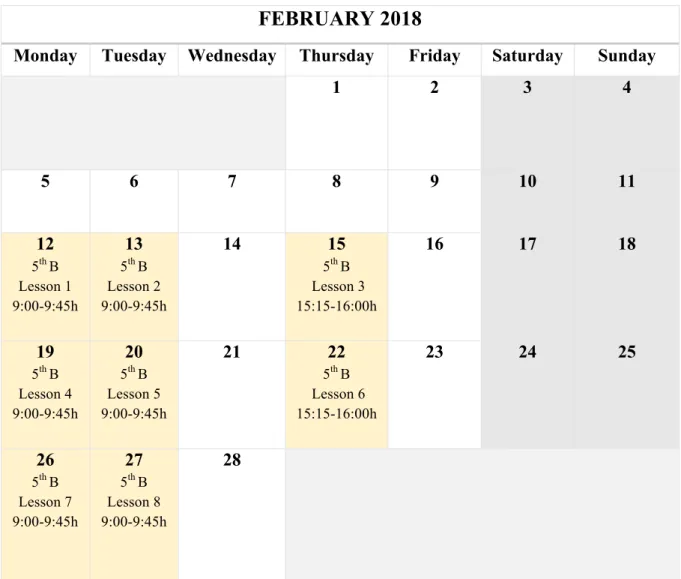
(17) 3.2. Development of the teaching proposal 3.2.1. Timing The teaching proposal is organised in 8 lessons. The month of February is regarded an appropriate month to carry out the didactic unit since there are no holidays or important festivities that can affect the progress of the teaching proposal. Each English lesson lasts 45 minutes, since all the lessons from different subjects last the same (the general timetable of the course 5th B can be seen in Appendix A). Six of the lessons are designed to be carried out in the morning and two of the lessons in the afternoon. All this information can be seen in Table 1:. Table 1 - Timing of the teaching proposal. FEBRUARY 2018 Monday. Tuesday. Wednesday. Thursday. Friday. Saturday. Sunday. 1. 2. 3. 4. 5. 6. 7. 8. 9. 10. 11. 12. 13. 14. 15. 16. 17. 18. th. 5 B Lesson 1 9:00-9:45h. th. 5 B Lesson 2 9:00-9:45h. 19. 20. 23. 24. 25. th. 5 B Lesson 4 9:00-9:45h. th. 5 B Lesson 5 9:00-9:45h. 26. 27. th. th. 5 B Lesson 7 9:00-9:45h. th. 5 B Lesson 3 15:15-16:00h. 21. 22 th. 5 B Lesson 6 15:15-16:00h. 28. 5 B Lesson 8 9:00-9:45h. 16.
(18) 3.2.2. Relationship with the curriculum As stated in the LOMCE 8/2013, December 9, due to globalisation to learn at least one foreign language has become something essential for the students, for their personal development and also for their professional future. The fact of knowing a foreign language is something that has become more important during these last years and, the majority of the times, the language chosen is English. It can be justified due to the fact that English has become, in these last decades, an international language which enables people from different countries to be able to communicate in an effective way. Taking into account that this teaching proposal has been created for a school in Valencia, all the information which is related to the law has been extracted from the Royal Decree 126/2014 and Decree 108/2014, July 4. The first one, the Royal Decree, establishes the educational considerations for Primary Education for all the communities in Spain. The second one, the Decree, establishes all the information related to the Primary Education curriculum in the Valencian Community. In this case, and taking into account the importance that this teaching proposal shows for the English culture, something that has been taken into account are the Sociocultural and Sociolinguistic aspects of language that need to be practised by the students of the fifth year of Primary Education. These aspects include the knowledge of some distinctive characteristics of other countries and their lifestyles. Furthermore, some other aspects are also highlighted, as the study of values, beliefs and attitudes of people from other countries, always taking into account the respect and tolerance among other cultures and their history. All these ideas, by law, need to be worked in the four blocks of contents but, as it has been said previously, sometimes these aspects are not worked or, at least, not properly. In the case of this teaching proposal the focus of the attention is going to be there. On the other hand, it must be said that all the blocks of contents are treated in this teaching proposal. Several contents of each block have been taken into account in the didactic unit, in order to create a complete teaching proposal in which all the skills are worked appropriately to help students develop their linguistic competence in English.. 17.
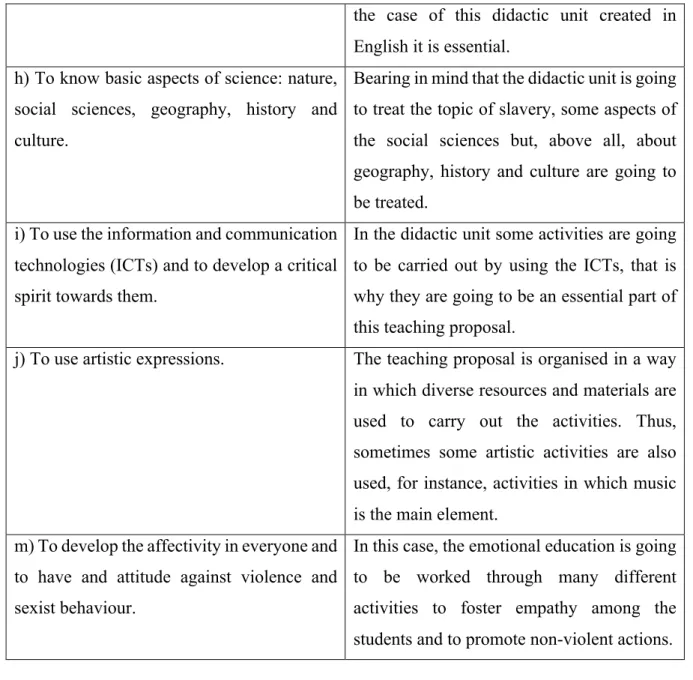
(19) 3.2.3. Objectives and contents of the teaching proposal First of all, and taking into account the information of the Royal Decree 126/2014 and the Decree 108/2014, it must be said that there are some general objectives that need to be accounted for in the teaching proposal explained in this paper. The fourteen general aims, as well as the seven key competences and the four blocks of contents can be found in Appendix B. In this case, these are some general aims that have been chosen as the essential ones for this teaching proposal and the explanation why they have been selected: Table 2 - Aims and Justification for this Didactic Unit. Aims. Justification for this Didactic Unit. a) To know the coexistence rules and to The slavery period is an example of respect the human rights of a democratic something which does not respect the human society.. rights or the basic ideas of a democratic society. That is why this aim is going to be worked a lot during the whole didactic unit.. b) To develop individual and group work, This teaching proposal promotes diverse confidence, curiosity,. critical. sense,. interest,. initiative, ways of working during an English lesson:. creativity. entrepreneur spirit.. and individual work, group work, etc. Moreover, and bearing in mind the importance of motivation, concepts as curiosity, interest or creativity are essential to achieve the goals established.. d) To know and respect differences between This aim is one of the most relevant for this people and cultures. No discrimination.. didactic unit, since it is absolutely related to interculturality.. f) To acquire the communicative competence In this case, this aim is the most interesting in a foreign language and to express and one that must be taken into account in all the understand easy messages.. foreign language lessons and, of course, in. 18.
(20) the case of this didactic unit created in English it is essential. h) To know basic aspects of science: nature, Bearing in mind that the didactic unit is going social sciences, geography, history and to treat the topic of slavery, some aspects of culture.. the social sciences but, above all, about geography, history and culture are going to be treated.. i) To use the information and communication In the didactic unit some activities are going technologies (ICTs) and to develop a critical to be carried out by using the ICTs, that is spirit towards them.. why they are going to be an essential part of this teaching proposal.. j) To use artistic expressions.. The teaching proposal is organised in a way in which diverse resources and materials are used to carry out the activities. Thus, sometimes some artistic activities are also used, for instance, activities in which music is the main element.. m) To develop the affectivity in everyone and In this case, the emotional education is going to have and attitude against violence and to be worked through many different sexist behaviour.. activities to foster empathy among the students and to promote non-violent actions.. With regard to the key competences that must be worked on in Primary Education, this teaching proposal focuses its attention on the next ones that appear, with a justification, in the next table: Table 3 - Competences and Justification for this Didactic Unit. Competences 1. Linguistic competence. Justification for this Didactic Unit Thanks to this didactic unit, students will be able to improve their competence in. 19.
(21) linguistic communication, something that means that they will be able to use English as a tool for oral and written communication. 3. Digital competence. Some activities of this didactic unit need the use of ICTs. Thus, the digital competence is something essential that the students need to develop in order to access to all the information that they need to reach their goals.. 4. Learning to learn competence. This teaching proposal gives to the students the opportunity to be critical and also to reflect about what they have learned but also about their own learning process.. 5. Social and civic competence. Taking into account that this teaching proposal is based on the topic slavery, the social and civic competence is something crucial, since students will be able to understand the social reality that they have nowadays and the one that other people had in the past.. 7.. Cultural. awareness. and. expression In order to help students to be interculturally. competence. competent, it is essential to work this competence which is based on the respect and understanding that all the students need to have among different cultures and other realities in general.. Furthermore, the most adequate contents for this didactic unit have been selected. These contents appear in the Decree 108/2014, which establishes the contents for all the courses of Primary Education in the Valencian Community. In this case, the contents are organised into 4 blocks. Table 4 includes all the information:. 20.
(22) Table 4 - Contents selected for this Didactic Unit for the 5th B course. Contents selected for this Didactic Unit for the 5th B course of Primary Education Block 1: Oral Comprehension. FUNCTIONS: - Description of people, personal information, activities, places, objects, habits and plans. - Narrations of past and current events, real or fictitious, poems and riddles. - Organized, guided or spontaneous interaction STRATEGIES: - Formulation of hypotheses about the content and context. SOCIOCULTURAL AND SOCIOLINGUISTIC ASPECTS: - To know the distinctive characteristics of other countries in relation to their life styles, food and drinks, festivities, leisure, personal relations and familiar relations. - Habits, values, beliefs and attitudes based on the respect and the tolerance: regional cultures, security, traditions, history, countries, states and foreign places that use English as the main language; arts, celebrations and festivities. HIGH FREQUENCY VOCABULARY: - City, village, town. - Emotions: happy, sad, angry, worried and frightened.. Block 2: Oral Production. FUNCTIONS: 21.
(23) - Description of people, personal information, activities, places, objects, habits and plans. - Narrations of past and current events, real or fictitious, poems and riddles. - To establish patterns for the sounds, accents, rhythms and intonation. - Interaction through ICTs with other people. STRATEGIES: - Use of dictionaries, vocabularies. - Techniques to organise the ideas. SOCIOCULTURAL AND SOCIOLINGUISTIC ASPECTS: - To know the distinctive characteristics of other countries in relation to their life styles, food and drinks, festivities, leisure, personal relations and familiar relations. - Habits, values, beliefs and attitudes based on the respect and the tolerance: regional cultures, security, traditions, history, countries, states and foreign places that use English as the main language; arts, celebrations and festivities. - To establish social contacts by using simple ways for communication. HIGH FREQUENCY VOCABULARY: - City, village, town. - Emotions: happy, sad, angry, worried and frightened. - Personal identification: name, age, address, phone number, email. - Daily activities: have lunch, go to the park, etc.. 22.
(24) - Family and friends: mother, father, grandmother, grandfather, uncle, aunt and cousin. TRANSVERSALS: - Effort, concentration, strategies for working in groups and also in an independent way. Block 3: Written Comprehension. FUNCTIONS: - Description of people, personal information, activities, places, objects, habits and plans. - Narrations of past and current events, real or fictitious, poems and riddles. - Use of the written comprehension to have a communication and learn. - Relation among letters and sounds. STRATEGIES: - Use of dictionaries, vocabularies. - Techniques to foster comprehension. SOCIOCULTURAL AND SOCIOLINGUISTIC ASPECTS: - To know the distinctive characteristics of other countries in relation to their life styles, food and drinks, festivities, leisure, personal relations and familiar relations. HIGH FREQUENCY VOCABULARY: - City, village, town. - Emotions: happy, sad, angry, worried and frightened. - Personal identification: name, age, address, phone number, email. - Daily activities: have lunch, go to the park, etc.. 23.
(25) - Family and friends: mother, father, grandmother, grandfather, uncle, aunt and cousin. Block 4: Written Production. FUNCTIONS: - Written comprehension, real or fictitious, about opinions, desires, agreements or disagreements and feelings. - Spelling: correct use of prefixes and suffixes. - Punctuation marks. STRATEGIES: - Strategies to produce a text: planning, organization of the ideas, etc. - Strategies to execute: adequate redaction, selfreview and correction. SOCIOCULTURAL AND SOCIOLINGUISTIC ASPECTS: - To know the distinctive characteristics of other countries in relation to their life styles, food and drinks, festivities, leisure, personal relations and familiar relations. - Habits, values, beliefs and attitudes based on the respect and the tolerance: regional cultures, security, traditions, history, countries, states and foreign places that use English as the main language; arts, celebrations and festivities. - Establish social contacts by using simple ways for communication. HIGH FREQUENCY VOCABULARY: - City, village, town. - Emotions: happy, sad, angry, worried and frightened.. 24.
(26) - Personal identification: name, age, address, phone number, email. - Daily activities: have lunch, go to the park, etc. - Family and friends: mother, father, grandmother, grandfather, uncle, aunt and cousin.. Finally, some Specific Objectives will be also established in each lesson, in order to specify the general information that has been explained above. 3.2.4. Methodology In this teaching proposal the students have an active role in which they are the ones who build their own knowledge through their experiences. Thus, the role of the teacher in this case is to act as a guide that helps the students with their learning process and organizes the lessons and the activities to foster their meaningful learning. In this way, the teacher is not the only person who has the knowledge since, thanks to the Internet, the students have the possibility to access a lot of information when they want to without the necessity to have a teacher who knows everything. That is why in this didactic unit it is crucial to teach the students some strategies and procedures that they can use not only in the several subjects, but also in their daily lives. In reference to the way in which students learn, it must be said that the teaching proposal is composed by many different activities which need to be completed by using a variety of meaningful materials. Moreover, the way in which the activities are carried out is not always the same. For instance, some activities are completed individually, while others imply group work. Thus, the grouping of the students is variable, something that is positive since this way students learn how to work in every way possible.. 3.2.5. Organization of time The organization of the time has been carefully thought, since it is one of the most important aspects that must be taken into account when a teacher prepares a teaching proposal for the students. As students cannot maintain the attention during a long period of time, short. 25.
(27) activities are considered the most adequate for the students of 5th B course. Moreover, all the activities that appear in the teaching proposal give the students the opportunity to interact with the others in an active way. In the suggested lessons, time has been organized following the structure proposed by Richard-Amato (2009) in which the lesson is divided into five different phases:. •. 1st phase – Opening: It is created to catch students’ attention on the main goals of the lesson. It is a way of activating their previous knowledge and also to introduce the topic that is going to be worked on during the lesson.. •. 2nd phase – Simulation: In this part a lead is provided into the main activity in order to create interest among the students.. •. 3rd phase – Instruction: The main activities are taught in this phase, there can be more than one activity and it constitutes the main part of a lesson.. •. 4th phase – Closure: This is the last phase of a lesson and it means to conclude a lesson in a way in which there is a reinforcement about what have been learned during a lesson. Moreover, it also implies to review everything that has been studied.. •. 5th phase – Follow up: In this phase some independent work or homework is assigned. In the case of this teaching proposal, this phase was not always going to be taken into account, since some lessons finished in the fourth phase. Thus, and taking into account the information explained above, a table has been created. in order to organize properly the most important information of every lesson. All the lessons of the didactic unit are going to be summarized in a table like the one proposed below, in which the time needed for each activity is organized taking into account the complexity of each activity: Table 5 - Organization of the lessons. Lesson ___ Minutes. Activities. Materials. Opening:. 26.
(28) Simulation:. Instruction:. Closure:. Follow-up:. As stated by Richards & Bohlke (2011), organising every lesson with the help of a plan is something essential for the adequate development of the English lesson. However, even though it is interesting to follow the ideas that have been planned previously, it is also necessary to make some decisions during the lessons that may imply some changes in the lesson plan. Moreover, the fact of having a lesson plan can also be interesting for teachers, since they can reflect about their teaching practice by taking into account some reflections in relation to the lesson plan. In Appendix C there are some suggestions for the teacher to review each lesson.. 3.2.6. Organization of space With regard to the organization of space, it is important to highlight that all the lessons will be carried out in the English classroom. This classroom has many technological devices that are useful for the students, such as an Interactive Whiteboard, a laptop, a beamer and 5 tablets to work in groups.. 27.
(29) In relation to the organization of the students, they will be divided into 5 groups of 5 people each group. The tables and chairs of the students are arranged in a way so that each member of the group can see the other members and also the teacher. In Figure 2 the general organization of the groups and the classroom is illustrated:. Figure 2 - Organization of the English classroom. 3.2.7. Materials Different kinds of materials will be used for the several activities proposed. First of all, the materials are selected taking into account the use of language that they do since, as stated by Crawford (2002), it is important to know that the language that appears in these materials needs to be authentic, in order to avoid the artificial way in which language is used in some kind of materials such as textbooks. A brief explanation of the materials used during the didactic unit follows: firstly, it is important to talk about the technological devices that are used by the students in order to create this didactic unit. They have the possibility to work with tablets and also with the interactive whiteboard. Moreover, they have access to many different websites in which they can find a lot of information to carry out the activities. Additionally, by using the Internet, the students can work with some texts, videos, pictures, etc. Sometimes they are introduced in print, and on other occasions, students have to access to them through technological devices, that in the case of these students are tablets. Moreover, there are other kind of materials that are also used for their learning process, such as songs and poems, which help them learn English in a more entertaining way. 28.
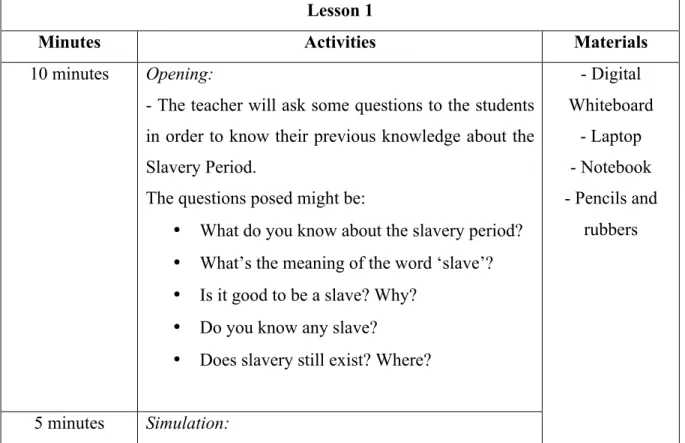
(30) 3.2.8. Activities As stated previously, this didactic unit consists of 8 lessons that contain different activities that students have to complete. In this section, all the activities that appear in each lesson are developed and explained in detail. In relation to the topic that was chosen, the ‘Slavery Period’, it must be said that it was selected since it is an historical fact which is very interesting and it can inspire curiosity in the students, since it is not something that is usually explained at schools. This teaching proposal has been designed to help students understand an important part of the English language culture in America, in order to improve their skills in English while they are learning through an intercultural and motivating way. We turn to explain several lessons that should be carried out in the didactic unit: LESSON 1 Table 6 - Lesson 1. Lesson 1 Minutes 10 minutes. Activities Opening:. - Digital. - The teacher will ask some questions to the students. Whiteboard. in order to know their previous knowledge about the. - Laptop. Slavery Period. The questions posed might be:. 5 minutes. Materials. •. What do you know about the slavery period?. •. What’s the meaning of the word ‘slave’?. •. Is it good to be a slave? Why?. •. Do you know any slave?. •. Does slavery still exist? Where?. - Notebook - Pencils and rubbers. Simulation:. 29.
(31) - Taking into account the information that the students have said, the teacher will briefly explain what slavery is about. 20 minutes. Instruction: - Students will watch a short video called ‘Introduction of Slavery Explained for Kids’ (History Illustrated, 2015). - After watching it, they will have to talk in groups about what they have seen and they will have to write some questions that they have about this topic and try to solve them by themselves.. 9 minutes. Closure: - In relation to the questions that they have written, if they have some of them that they do not know how to answer, they will share it with the teacher and the whole members of the class will have to find an answer.. 1 minutes. Follow-up: - Students will have to ask to their parents what do they know about the Slavery Period as a homework.. The Specific Objectives of this lesson are:. •. To know what slavery is about in general terms.. •. To share information about this topic and to formulate some hypotheses. As can be seen, this first lesson serves as an introduction for the teaching proposal, that. is why the opening of this lesson is quite long, since the teacher needs to have as much information as possible in order to check the information the students know.. 30.
(32) In the opening section the questions that are proposed try to foster critical thinking among the students, since there is not a single correct answer that the teacher wants to hear, all the reflections are acceptable if they are based on students’ critical thinking and ideas. During the questions, students have the possibility to establish dialogues to share their opinions if needed. All the ideas explained in the first phase of the lesson are taken into account in the simulation, when the teacher gives a short explanation of what slavery is about. In the instruction the students learn some basic information about the slavery period through the short video they have to watch. In this video, the information is explained with some drawings and pictures, that is why it is really easy to understand. In relation to the discussion and the questions that students have to suggest, they are able to write them using the grammar tenses that they know, such as present simple, present continuous and past simple. Moreover, in the closure, students have to read their questions and they are given the possibility to discuss them with the other students. Lastly, the follow-up, takes place at home with their parents. LESSON 2 Table 7 - Lesson 2. Lesson 2 Minutes 5 minutes. Activities Opening:. Materials - Tablets. - The teacher will ask to the students if they have. - Timeline. achieved information about the topic ‘Slavery. - Sheets of. Period’, since it was the homework of the previous. paper. English lesson. If they have something to share, they. - Coloured. will have the opportunity to share it with their. pencils. classmates.. - Pencils and rubbers. 5 minutes. Simulation: - The teacher will explain that they will going to work with a timeline. Moreover, the characteristics of the tense Past Simple will be explained again.. 31.
(33) 25 minutes. Instruction: - In this part students will work in groups with a timeline that they will see with their tablets (Slavery Timeline, 2017). The most important information about the slavery period will be explained, from the beginning to the abolishment of the slavery period. - After that, students will have to write a short story explaining, by using their own words, what slavery was about. They will have to use the Past Simple, as well as some comparatives and superlatives. This activity will be done in groups, thus, there will be 5 stories created by all the members of the class.. 8 minutes. Closure: - Students will have to draw individually in a sheet of paper a drawing that represents for them what slavery was about.. 2 minutes. Follow-up: - Learners will have to ask at home to their parents or to other relatives if they know any place in which slavery was a reality in the past.. The Specific Objectives of this lesson are:. •. To better understand what slavery is about, by knowing more details.. •. To learn about the history of the slavery period.. •. To use art to express themselves.. 32.
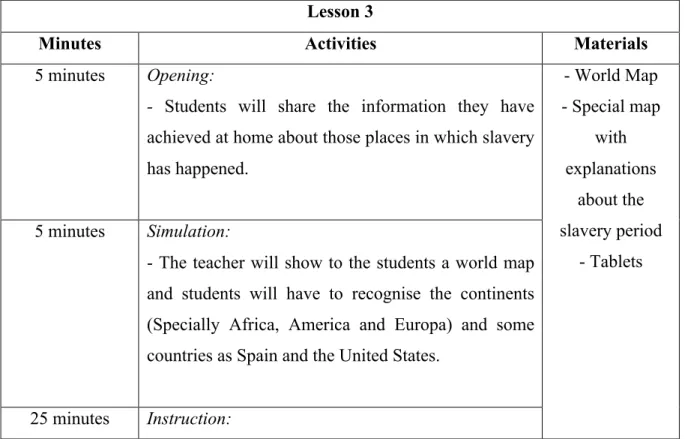
(34) In relation to the opening, students have the possibility to share their opinions. They usually love this kind of activities because they feel that what they have to say is relevant for the rest of the classmates. In the simulation, the concept of ‘timeline’ is explained by the teacher, moreover, the fact of explaining the general rules of the Past Simple is something useful in order to help students remember what this grammar tense is about. The instruction phase is really important in this lesson since here students have the chance to know a lot of new information about the slavery period. A caption of the timeline with the information that students see is in Appendix D. Moreover, they will also have the possibility to write a story in groups, something that is really good to foster students’ creativity and originality. In relation to the closure, the idea of doing an activity which implies art is really interesting, since this way students can express themselves in a different way, since they have done it before by using words. Lastly, the follow-up activity is quite similar to the one of the first lesson. LESSON 3 Table 8 - Lesson 3. Lesson 3 Minutes 5 minutes. Activities. Materials. Opening:. - World Map. - Students will share the information they have. - Special map. achieved at home about those places in which slavery. with. has happened.. explanations about the. 5 minutes. Simulation: - The teacher will show to the students a world map. slavery period - Tablets. and students will have to recognise the continents (Specially Africa, America and Europa) and some countries as Spain and the United States. 25 minutes. Instruction:. 33.
(35) - In this case, students will work with a special map that contains some pictures that represent what happened in the slavery period, as well as some interesting information about the routes that slaves had to do from Africa to America (Houston & Grady, 2015). - After watching and analysing the maps, students will have to find information about slavery in Africa and in America. It will be done in groups, three groups will find information about Africa and the remaining two about America with the tablets. 10 minutes. Closure: - Each group will have to explain in front of the other members of the class the information that they have found about the continent determined.. The Specific Objectives of this lesson are:. •. To learn some geographical information about the Slavery Period.. •. To understand the routes of the slaves in the past. Firstly, the information that students have obtained at home will be shared, the same. way that they have done it in the previous lessons. In relation to the instruction, it must be said that some aspects related to geography are going to be worked on in a visual way, in order to help the students to understand better the world in which they live. In this sense, working with this kind of maps is really interesting, since they show the information in a very graphical way which is really easy to understand for the students. A picture of this map can be seen in Appendix E. Finally, this lesson will finish directly with a closure, in which students will have to practice their oral skills by explaining the information that they have found. 34.
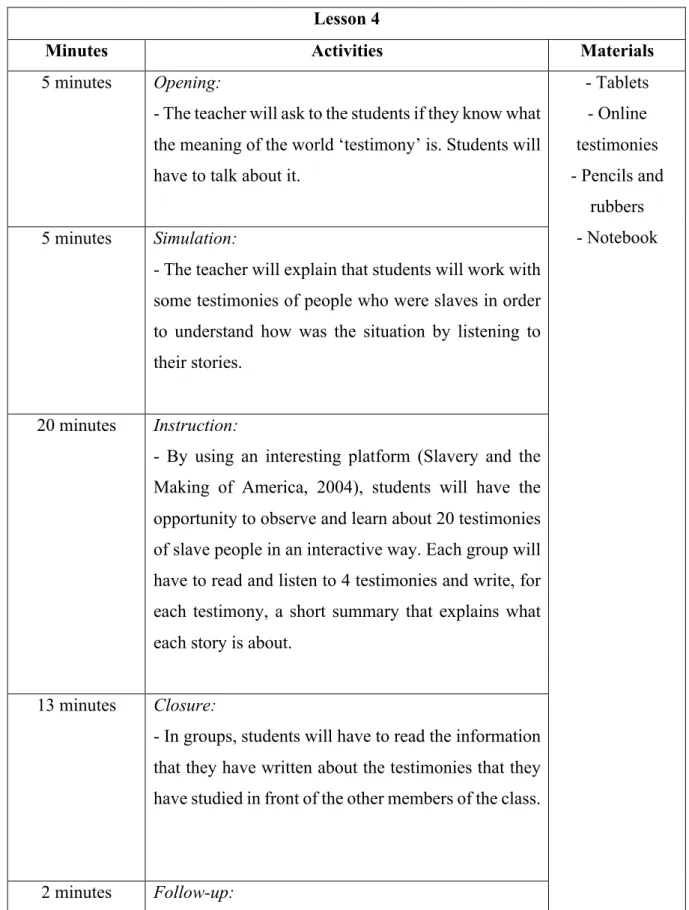
(36) LESSON 4 Table 9 - Lesson 4. Lesson 4 Minutes 5 minutes. Activities. Materials. Opening:. - Tablets. - The teacher will ask to the students if they know what. - Online. the meaning of the world ‘testimony’ is. Students will. testimonies. have to talk about it.. - Pencils and rubbers. 5 minutes. Simulation:. - Notebook. - The teacher will explain that students will work with some testimonies of people who were slaves in order to understand how was the situation by listening to their stories. 20 minutes. Instruction: - By using an interesting platform (Slavery and the Making of America, 2004), students will have the opportunity to observe and learn about 20 testimonies of slave people in an interactive way. Each group will have to read and listen to 4 testimonies and write, for each testimony, a short summary that explains what each story is about.. 13 minutes. Closure: - In groups, students will have to read the information that they have written about the testimonies that they have studied in front of the other members of the class.. 2 minutes. Follow-up:. 35.
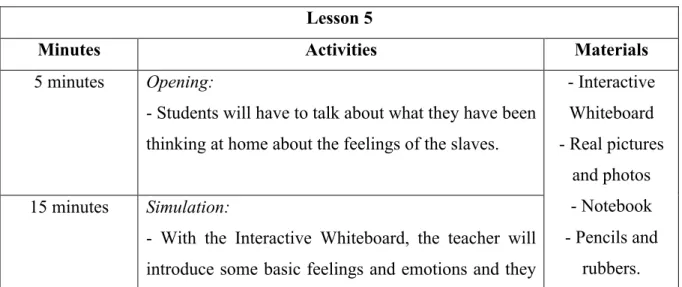
(37) - Each student, individually at home, will have to think about the feelings of the slaves in the Slavery Period.. The Specific Objectives of this lesson are:. •. To foster empathy among the students through the several testimonies.. •. To better understand some cultural and historical aspects of that time. In reference to the opening, this time it works simply as an easy way to introduce the. topic. The simulation part is important because students need to know what they are going to work with since, for sure, it will be the first time for them that they work with testimonies. In this case the instruction phase is the most interesting part since working with resources like this one is incredibly meaningful for the students (in Appendix F a picture of this resource can be found). The closure will be important as well since it will be a continuation of the previous phase. Finally, the follow-up will constitute a way to make students feel interested about the topic which is going to be worked in the next lesson, which is the feelings in relation to the slavery period. LESSON 5 Table 10 - Lesson 5. Lesson 5 Minutes 5 minutes. Activities. Materials. Opening:. - Interactive. - Students will have to talk about what they have been. Whiteboard. thinking at home about the feelings of the slaves.. - Real pictures and photos. 15 minutes. Simulation:. - Notebook. - With the Interactive Whiteboard, the teacher will. - Pencils and. introduce some basic feelings and emotions and they. rubbers.. 36.
(38) will be explained by representing some of them physically. For example, to show a big smile to represent someone who is happy. 20 minutes. Instruction: - Taking advantage of the images that appeared in the testimonies studied previously, students will have to use the vocabulary related to feelings and emotions explained previously to explain the situation that appears in the pictures showed. - Students will have to write in their notebooks what were, in general, the feelings that slaves felt the most.. 5 minutes. Closure: - Since feelings and emotions are something really interesting for the students, they will have some minutes to reflect about this lesson and to analyse the situation.. The Specific Objectives of this lesson are:. •. To apply the knowledge about feelings and emotions to the topic of slavery.. •. To foster empathy through real resources among the students. This time, the opening is quite interesting since students usually like to give examples. about the feelings and the emotions that they feel. Moreover, the simulation phase is quite important since some interesting vocabulary is taught, in order to give to the students the necessary tools to develop this lesson properly.. 37.
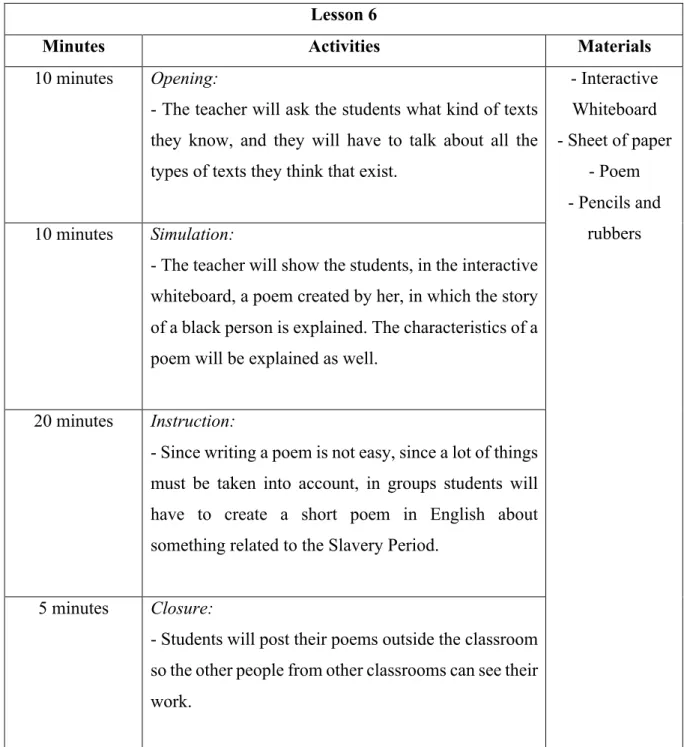
(39) In the case of instruction, it may be really moving for some students, since they can realize how hard was to live a situation like the Slavery Period without having the opportunity to avoid it. Finally, some minutes will be given to the students if they want to continue reflecting about this topic in the closure. LESSON 6 Table 11 - Lesson 6. Lesson 6 Minutes 10 minutes. Activities. Materials. Opening:. - Interactive. - The teacher will ask the students what kind of texts. Whiteboard. they know, and they will have to talk about all the. - Sheet of paper. types of texts they think that exist.. - Poem - Pencils and. 10 minutes. Simulation:. rubbers. - The teacher will show the students, in the interactive whiteboard, a poem created by her, in which the story of a black person is explained. The characteristics of a poem will be explained as well. 20 minutes. Instruction: - Since writing a poem is not easy, since a lot of things must be taken into account, in groups students will have to create a short poem in English about something related to the Slavery Period.. 5 minutes. Closure: - Students will post their poems outside the classroom so the other people from other classrooms can see their work.. 38.
(40) The Specific Objectives of this lesson are:. •. To practise the written skill through a poem.. •. To develop creativity and originality among the students. In this lesson the opening is going to work as a guessing game in which the students. have to think about all the type of texts that they know. It will be a reflection in which the teacher can also take into account the previous knowledge of the students. One of the most important phases in this lesson is the simulation, since the teacher needs to show a poem written by her and also to explain the main characteristics of a poem and how to write it in English. The poem showed as an example can be found in Appendix G. In the instruction part the teacher will guide a lot this activity, since it is not something easy for the students to write a poem in English. The teacher will be helping and correcting the students during their writing process. At the end, it is a good idea to show the work that they have done to other students, as what happens in the closure, it is something that all the kids like a lot and it is a good opportunity for the other students from other classes to learn about this topic. LESSON 7 Table 12 - Lesson 7. Lesson 7 Minutes 10 minutes. Activities Opening: - The teacher will start the lesson by asking some simple questions to the students: •. Do you like music?. •. What types of music do you know?. •. Have you ever listened to reggae music?. Materials - Interactive Whiteboard and the speakers - Lyrics of the song printed - Lyrics of the song (karaoke). 39.
(41) 10 minutes. Simulation:. - Notebook. - The teacher will explain to the students that they are going to work the song Buffalo Soldier, by the singer Bob Marley. The song explains some aspects of the slavery. 20 minutes. Instruction: - The students will sing the song, firstly, they will listen to it and, after that, they will have the lyrics to read them while they are singing. Moreover, after practising, students will have the possibility to sing it in a karaoke. - After that, students will analyse the song a little bit, in order to understand the meaning of the lyrics, moreover, they will have to detect those verbs which are in Past Simple, to practise some grammar. 5 minutes. Closure: - Students will know that the next lesson is the last one of the didactic unit, so they will have a little bit of time to think about some final reflections that they want to share during the last lesson. They can write them down if they want to remember them.. The Specific Objectives of this lesson are:. •. To learn some historical and cultural facts through music.. •. To use artistic expressions to understand some aspects about this foreign culture. Since this lesson is going to be based on a song from Bob Marley, the opening will work. as a preparation for the main activity.. 40.
(42) In the simulation the teacher will introduce the song, by explaining that it is based on what happened in America with the slaves. Moreover, it will also be interesting to give some information with the Interactive Whiteboard about the singer and the type of ‘reggae’ music. The instruction will be the funniest part, since students will have the possibility to sing the song and learn some historical and cultural facts in a very funny way (the lyrics of the song can be seen in Appendix H). Moreover, some grammar will be practised in a contextualized way. Finally, students will have some time to reflect in the closure phase, since perhaps they have something important that they want to share with the other classmates for the last day of the didactic unit. LESSON 8 Table 13 - Lesson 8. Lesson 8 Minutes 5 minutes. Activities Opening:. Materials -Cardboards of. - The teacher will say that this is the end of the didactic. different. unit and she will also say that students will have the. colours. opportunity to share their opinions about the didactic. - Sheets of. unit at the end of the lesson.. paper -Coloured. 5 minutes. Simulation:. pencils. - The teacher will explain the main activity of the. -Scissors and. lesson, that will be to create a big mural called. glue. “Intercultural wall” in which students, after the experience of the didactic unit, will have the opportunity to put some messages in which they explain why everybody needs to be tolerant with people from other cultures. 25 minutes. Instruction:. 41.
(43) - The students will have almost half an hour to prepare the “Intercultural Wall” in the way they prefer and also to write the messages that they want to add there. 10 minutes. Closure: - The teacher will give the opportunity to the students to share their opinion about the didactic unit. - Moreover, students will be invited to give some suggestions for future didactic units. The Specific Objectives of this lesson are:. •. To summarize everything that has been learned in a final lesson.. •. To reflect about all the learning process during the didactic unit. In this case the opening will not be very important since the most important part will be. the instruction, in which students will have the possibility to carry out all the workshop, that will be explained in the simulation phase. Finally, the closure phase is really important in this lesson since what the students say during their interventions will work as feedback for the teacher, something essential that must be taken into account.. 3.2.9. Assessment of the Didactic Unit In this case, the didactic unit was not implemented. Nevertheless, there are some aspects that must be taken into account in the case that this teaching proposal had been carried out in a real English classroom. In the first place, it is essential to take into account the Evaluation Criteria that are proposed for the 5th year in the English subject. The ones that are more adequate for this didactic unit have been selected and can be seen in the next table:. 42.
(44) Table 14 – Evaluation Criteria selected for this Didactic Unit. Evaluation Criteria selected for this Didactic Unit for the 5th B course Block 1: Oral Comprehension BL1.1 To identify the general sense, essential information and main points in very short and simple oral texts in standard language, with simple structures and vocabulary of very frequent use, clearly and slowly articulated and transmitted by live voice or by technical means, about habitual subjects related to their own experiences and interests in contexts related to the personal, public and educational fields, as long as the acoustic conditions are good, that the message is not distorted, so it can be listened again to know what has been said or ask for confirmation and what it is it has visual support or with a clear contextual reference, discriminating sound, accentual, rhythmic. and. intonation. patterns,. and. theirs. communicative intentions. BL1.3 To distinguish sociocultural and sociolinguistic aspects, specific and significant from different countries, as their own characteristics, habits, customs, beliefs, values and attitudes, applying the knowledge acquired to oral comprehension with specific teacher support, respecting the basic rules of courtesy and showing respect for the differences.. 43.
(45) Block 2: Oral Production. BL2.5 To Interpret the demands of the learning tasks and to keep the concentration and effort while doing them, adapting to the changes without being discouraged when it is needed to face difficulties and trying to solve the doubts by their own means, by asking for help if it is needed. BL2.6 To act effectively in team work, accepting their role and work, and striving to achieve common goals, making contributions and valuing those of others and using equal dialogue to resolve conflicts and discrepancies.. Block. 3:. Written BL3.1 To identify the function, the general sense, the. Comprehension. essential information and the main points in very brief and simple written texts in standard language, with simple structures and lexicon of very frequent use, in any type of support or format about habitual topics related to their own experiences and interests in contexts related to personal, public and educational fields, provided they can be read again, counts with paratextual support and discriminate basic spelling, use frequent signals and the sound-letter relationship. BL3.3 Distinguish sociocultural and sociolinguistic aspects, specific and significant from different countries, as their own characteristics: habits, customs, beliefs, values and attitudes and apply the knowledge acquired to the written comprehension.. Block 4: Written Production. BL4.1 Produce supervised, brief and simple written texts, individually, cooperatively or by dialogical approach, applying the basic spelling conventions, graphic patterns and the main punctuation marks to speak of itself, of its immediate surroundings and aspects of his daily life, in predictable familiar situations.. In relation to the assessment criteria, it is essential to classify all the contents that have been chosen in three different ways: conceptual, attitudinal and procedural contents. In the case 44.
(46) of this didactic unit, the procedural contents are the ones which are going to be considered the most important, since this didactic unit is based on the idea that the most important thing is the process and not the final result. Furthermore, students’ attitude is going to be something really important, since it is closely related to motivation. Finally, the conceptual contents are going to be valued as well. Bearing all the above in mind, a suggested distribution of percentages would be:. •. Conceptual contents: 25% of the final mark of the didactic unit.. •. Attitudinal contents: 35% of the final mark of the didactic unit.. •. Procedural contents: 40% of the final mark of the didactic unit. Finally, it should be stated that the assessment of this unit would be done bearing in. mind the three moments of the assessment. First of all, the teacher would do a diagnostic assessment (through questions, previous knowledge, etc.) in order to see what their students know and what they need to reinforce. Furthermore, and during the whole learning process, the teacher would do a formative assessment, which is done along the process in which the students are learning (in the different activities proposed in the didactic unit, with the help of a diary, etc.). Lastly, the teacher would apply the summative assessment, which is based on summarizing in a final result all the learning process of the students.. 45.
(47) 4. Assessment The teaching proposal developed here has not been implemented mainly due to time constrains. Nevertheless, in this section some expected results related to the teaching proposal are explained. The main objectives of this didactic unit are to foster interculturality and motivation among the students during the English lessons. These objectives are quite ambitious since sometimes teachers only want their students to learn how to use the grammar and vocabulary of the foreign language but, in this case, the proposal goes one step beyond, trying not only to help the students to learn these aspects of the foreign language, but also to understand an interesting part of its culture and history. In addition, the fact of enhancing students’ motivation during the whole didactic unit is something really important since, as teachers, we must help our students to learn, but there are many ways to do it. In this case, motivation has been considered something crucial to take into account, since the students of the fifth year that are described in this paper are young learners, with emotions and feelings. Sometimes these factors are left aside and, when they are not taken into account properly, the results are not as good as they should be. All in all, it is expected that the learners will have improved their linguistic competence in English, as well as their intercultural awareness and their motivation in this subject. Furthermore, and taking into account that all the activities proposed in this didactic unit imply active learning, it is also expected that students, when they finish this proposal, will have improved their levels of participation during the English lessons, something that is really positive since participation implies interaction among students and it is essential for a proper development of a foreign language lesson. We also expect that students could improve their skills with the use of diverse resources and materials. In the case of this teaching proposal, a great variety of resources are used, from traditional ones to Information and Communication Technologies. By using so many different kind of resources, it is expected that students improve their skills to find and analyze the information proposed. Moreover, the fact of contrasting information from different sources is crucial to help the students become critical thinkers. As it is known, to be critical is necessary 46.
(48) nowadays not only for the several subjects of the school, but also to be a responsible citizen in the future. Thus, another expected result is to help the students to be independent thinkers thanks to all the tools they have learned during English lessons.. 47.
Figure


+7

Documento similar
Finally, taking into account the degree of match between the education received by the worker and that required in the job, we found that the return to schooling is not uniform
To this end, the activities and teaching materials comprised in the following Didactic Unit are designed following the three-model approach by Carter & Long
Taking into account that the tendency in Spanish schools is to establish a bilingual primary education system (Spanish and English), those students who do not major in English
(2010) and the one proposed in the current study do not take this into account since they always use all descriptors even when one of them may not be appropriate. Thus, a
Professor Grande Covian 9 already said it, and we repeat it in our nutrition classes of the Pharmacy and Human Nutrition and Dietetics degree programs, that two equivalent studies
A didactic unit that takes them into account will show variative and creative exercises for students and they will be able to approach the learning of a foreign
In this document, a proposal is made to study the data that will be generated in the private and anonymous community of the WYRED project, in order to
sized enterprises (M‐SME). In this proposal, we imply that facilitating their development is a natural way to improve their performance,
