
Desarrollo de competencias claves a través del aprendizaje servicio
21
0
0
Texto completo
(2) DEVELOPMENT OF KEY COMPETENCES THROUGH SERVICE-LEARNING DESARROLLO DE COMPETENCIAS CLAVES A TRAVÉS DEL APRENDIZAJE-SERVICIO 1. INTRODUCTION. the objectives of education. The aspect of ter-. T. tiary education in the field of caring professions,. but also psychologists and therapists. These pro-. industry and society in general (Etzkowitz, Web-. fessions have some common features that dis-. ster, Gebhardt, Cantisano Terra, 2000; Vorley &. tinguish them from other occupations. Carrying. Nelles, 2008). Today’s universities are consider-. them out requires a relationship with the client. ing their role society and their relations with its. and the involvement of one’s own personality. constituent parts, institutions and communities.. helping the work process. Caring professions. This link between tertiary education and society. are a system where, on the one hand, helping. is considered the third mission of universities.. (psychologist, social worker, teacher, nurse, doc-. The third mission concept generally includes. tor…), and on the other hand the person we. many of the emerging requirements in relation to. have to help (client, pupil, student, patient…). universities, in particular the requirement to play. (Geringova, 2011).. a more prominent role in stimulating the use of. he term “caring professions”. however, is not only formed by real life itself but. defines a group of professions. also the requirements for university education in. that are based on professional. general. In recent decades, the interest of univer-. assistance to other people. They. sities has shifted from the original focus to two. include, for example, health pro-. main roles: education and research, acting as key. fessions, pedagogical profes-. actors in economic and cultural development, and. sions, professions focused on social assistance,. the transformation into institutions engaged in. knowledge to achieve social, cultural and ecoThe preparation of experts for the performance. nomic development. A strategy, which has been. of the caring professions is determined by sev-. successfully developed in the context of the third. eral factors. One of the most important, there are. mission of universities for several decades around. the needs from real life and reflections of the. the world, is the service-learning strategy. Thanks. state of society and its problems. These factors. to this strategy, universities are able to perform. determine to a large extent both the content and. their core missions in a comprehensive manner. unes núm. 6 - MARZO 2019 - 34 · 54 - issn 2530-1012 - pag. 35.
(3) DEVELOPMENT OF KEY COMPETENCES THROUGH SERVICE-LEARNING A. BROZMANOVÁ GREGOROVÁ / Z. HEINZOVÁ / K. KURČIKOV / L. NEMCOVÁ / J. ŠOLCOVÁ and prepare a new generation of professionals. there is insufficient distinction between the. who can integrate their acquired academic quali-. notion of competency in relation to one another,. ties and professional competencies with social. i.e. the competency in relation to the ability of a. responsibility and an active implementation of. person to perform work well and competences in. their civic roles in society. As explained by Ben-. relation to work which indicate the competence,. son, Harkavy & Puckett (2007), it is an approach. qualification, potential required by a particular. to bridge the gap between higher education. job. Mužík (2012) describes professional com-. institutions and society by increasing the civic. petence as a worker’s ability to occupy a certain. engagement of students and narrowing the gap. job position, to play working roles and to achieve. between universities and communities. The other. a desirable level of work performance. According. starting point for the transformation of education. to Veteška and Tureckiová (2008), the meaning. is the emphasis on developing and shaping the. of the word of competence is used in relation to. so-called key competencies. The development. the ability to perform the work or part of the work. of key competencies is one of the starting points. competently or also to a set of behaviours (how. for the reform of education systems at various. one should behave in order to carry out their. levels of education, not just university education.. work competently). The first concept is used for. The aim of this study, in the context of these chal-. the area of behaviour and refers to personality. lenges, is to highlight the potential for developing. (competence). Elichová (2017) states that com-. key competences of students in the caring pro-. petencies are a hypothetical construct that we. fessions through the service-learning strategy.. believe to be conducive to behaviour in the performance of work. Therefore, most competency. 1.1. Key competencies in the caring professions. models are behaviourally defined, which means “how they are manifested”, in practice it means to work at a certain level. Basically, what we do is. The competencies are skills, knowledge, prac-. reflect competencies, and we believe that when. tical behaviour and attitudes that inform about. we understand what a key factor in the success. how we work in our working life. Knowing which. of the profession is, then we can work with them,. competencies are relevant to our role is very. choose people, train and develop.. important. They help identify the needs of development, and at the same time determine where. Systems of professional competence of the. each individual can use their natural talents.. caring professionals are country-specific. In this area, some uniqueness of the core or standard is. The notion of competence is understood diffe-. also provided by international organizations and. rently in the specialist literature. According to. associations. For example, in 2004, the Internatio-. Mlčák (2005), differences in the definition of. nal Association of Schools of Social Work and the. competences are caused also by the fact that. International Federation of Social Workers both. unes núm. 6 - MARZO 2019 - 34 · 54 - issn 2530-1012 - pág. 36.
(4) DEVELOPMENT OF KEY COMPETENCES THROUGH SERVICE-LEARNING A. BROZMANOVÁ GREGOROVÁ / Z. HEINZOVÁ / K. KURČIKOV / L. NEMCOVÁ / J. ŠOLCOVÁ adopted a Global Standard for Education and Tra-. for their personal fulfilment and development, for. ining in Social Work, which contains a definition. their involvement in society and their successful. of basic competencies which graduates of social. employability. Experts agree that key compe-. work courses should have at their disposal.. tences should be learned by individuals during compulsory schooling, but also in non-formal. In addition to defining competencies that bind to. education or informal learning, and to develop. a particular profession or profession in the field of. them throughout their lives.. caring professions, we meet with the concept of so-called key competencies (also referred to as. Several models of key competency sets are. cross-sectional or transversal competencies).. currently being developed. A unifying tool for. The concept of key competences came about. these models should be the Recommendation. in the 1970s in the field of economics where it. of the European Parliament and the Council. represented a set of specific requirements for the. of the European Union of 18 December 2006. job seeker. In the late 1990s, this concept also. for the European reference framework on key. reached the education sector as a bridge bet-. competences for lifelong learning, comprising. ween the demands placed by employers on the. eight key competences: communication in the. job market and the competency profile of school. mother tongue, communication in foreign lan-. graduates (Blaško, 2013). Similar to the concept. guages, mathematical competence and basic. of competence, the notion of key competence is. competences in science and technology, digital. defined differently and there is no unambiguous. competence, learning to learn, social and civic. agreement in this area. Belz and Siegrist (2001). competences, sense of initiative and entrepre-. define key competences as competencies and. neurship, and cultural awareness and expression.. skills that enable individuals to successfully. The division of key competences into individual. integrate into social and working life, i.e. to hold. areas is orientational, individual competencies. different job positions and functions, to tackle. are mutually intertwined and complementary.. unpredictable problems and to cope with rapid changes in work, social and personal life. Hrmo. According to Belz and Siegrist (2001), key compe-. and Turek (2003a), Turek (2008), consider key. tencies help the individual to cope with reality and. competences as the most important competen-. manage the demands of a flexible world of work.. ces in a set of competencies. They are suitable. They state that key competencies go beyond the. for solving many unpredictable issues and can. limits of individual expertise, have a longer life than. help the individual to cope with rapid changes. expertise and are the basis for further learning.. in work, personal and social life. The European. According to Veteška (2011), key competencies,. Commission (2007) defines key competences as. together with specific professional competencies. a portable and multifunctional set of knowledge,. and competence in the field of methods, form the. skills and attitudes that every individual needs. basis for qualified and competent performance of. unes núm. 6 - MARZO 2019 - 34 · 54 - issn 2530-1012 - pág. 37.
(5) DEVELOPMENT OF KEY COMPETENCES THROUGH SERVICE-LEARNING A. BROZMANOVÁ GREGOROVÁ / Z. HEINZOVÁ / K. KURČIKOV / L. NEMCOVÁ / J. ŠOLCOVÁ individuals and the functioning of the organization.. broken down according to the preference they. At the same time, the acquired and adequately. develop. However, it is self-evident that individ-. utilized key competencies become the guarantee. ual educational or learning strategies simultane-. of employability and the integration of their bearer. ously target several key competencies (Belz &. into different social structures.. Siegrist, 2001).. In the context of caring professions, key com-. One of the teaching strategies that has the. petencies can be considered as one of the core. potential to develop key competencies is ser-. competencies of the profession, and in some. vice-learning. The term service-learning as a. cases professional and key competencies are. denotation of a learning strategy dates back to. mutually intertwined. For example, the ability to. the 1960s in the United States of America and. work in a team is one of the professional com-. has been gradually applied to all levels and types. petencies, but it also belongs to key competen-. of schools. Over the years, service-learning has. cies. The prerequisite for successful and effective. been characterized in various ways. The various. communication with the client is the development. definitions can be grouped into specific catego-. of key communication competencies and so on.. ries, i.e., service-learning as a kind of education, a philosophy, and even a phenomenon (e.g.. Despite the emphasis on the need for the deve-. Jacoby, 1996; Moore & Lan Lin, 2009). Over the. lopment of key competencies, the analysis of the. years, service-learning has been described as a. cross-sectional competency at Slovak universi-. movement and a field (Eyler & Giles, 1999), ped-. ties (Vančo, Srnánková, Blanár, Slovíková, 2016). agogy (Bringle & Hatcher, 1995, Tapia, 2003),. concludes that Slovakia lacks the concept of. and learning technique (Cohen & Kinsey 1994).. developing cross-cutting competencies in a university environment. Such concepts are also. Service-learning is often known in the literature. lacking at universities. Cross-sectional compe-. as pedagogy that combines the service to the. tencies are consequently developed rather intui-. community with learning opportunities offered. tively and as an integral part of teaching, not as. to the involved students (Heffernan, 2001). Ser-. explicit learning objectives.. vice-learning is generally described as a balanced approach to experiential education that can. 1.2. Possibilities for developing key competencies through service-learning strategy. ensure equal focus on both the service provided to the community and the learning that is occurring. In other words, service-learning is perceived as a method by which students can learn. Developing key competences also plays a key. and develop social and professional competen-. role in teaching and learning strategies, train-. cies through active participation in community-. ings, programmes, or modules. Strategies are. oriented experiences that are connected to their. unes núm. 6 - MARZO 2019 - 34 · 54 - issn 2530-1012 - pág. 38.
(6) DEVELOPMENT OF KEY COMPETENCES THROUGH SERVICE-LEARNING A. BROZMANOVÁ GREGOROVÁ / Z. HEINZOVÁ / K. KURČIKOV / L. NEMCOVÁ / J. ŠOLCOVÁ academic curricula and provide them with reflec-. Thanks to instrumental and innovative service-. tive opportunities (Furco, 2011). Nowadays,. learning focusing on the social and professional. international consensus defines service-learning. development of students as well as community. through three key characteristics: 1) a focus on. needs, we are currently experiencing the deve-. efficiently and effectively addressing needs with. lopment of service-learning programmes at. a community, and not just for the community;. universities around the world. In Slovakia, ser-. 2) active student involvement in all stages from. vice-learning for the academic public and educa-. planning to assessment; 3) intentionally linked to. tional practice is a new and still almost unknown. learning content (curricular learning, reflection,. pedagogical strategy. In recent years, this stra-. development of skills for citizenship and work,. tegy has been spreading, especially from one of. research) (Carla, 2017).. the Slovak universities - Matej Bel University in Banská Bystrica, not only within its internal envi-. Studies focusing on validating service-learning. ronment but also in a wider context.. and its connection to the third mission of universities deal with impact on students, on univer-. Since the beginning of the application of service-. sity and its teachers, and on target community. learning at Matej Bel University, the objective. of service-learning activities. The impact on stu-. has been to empirically document the individual. dents is analysed most often. Research studies. implementation phases and outputs of the appli-. documented that service can have significant. cation. Continuous findings are documented in. positive effects on several aspects related to. several studies. One of the expected benefits of. the academic performance of students, social. the application of service-learning is the develo-. and personal development, as well as active. pment of key competences for students, so we. citizenship. Several studies documented also. have decided to empirically verify this aspect of. impact on chosen key competences of stu-. strategy implementation in the classroom.. dents. See for example: Astin a Sax, (1998); Celio, Durlak & Dymnicki, (2011), Conrad &. 2. METHODOLOGY. Hedin, (1991); Eyler, Giles & Braxton, (1997); Eyler & Giles (1999); Eyler, Giles, Stenson &. In this paper, we try to find the answer to research. Gray (2001); Fiske (2001); Melchior, A. Frees,. question: what are the benefits of service-lear-. J., LaCava, L., Kingsley, Ch., Nahas, J., Power,. ning in the development of key competences of. J., Baker, G., Blomquist, J., George, A., Hebert,. Slovak university students of caring professions?. S., Jastrzab, J., Helfer, Ch. & Potter, L. (1999); Morgan & Streb (2001); Reed, Jernstedt, Hawley, Reber & DuBois (2005); Simons & Cleary (2006) Williams, King & Koob (2002) and many others.. Our research had an experimental design. The experimental group of students in caring professions completed a two-semester selective. unes núm. 6 - MARZO 2019 - 34 · 54 - issn 2530-1012 - pág. 39.
(7) DEVELOPMENT OF KEY COMPETENCES THROUGH SERVICE-LEARNING A. BROZMANOVÁ GREGOROVÁ / Z. HEINZOVÁ / K. KURČIKOV / L. NEMCOVÁ / J. ŠOLCOVÁ course Service Learning designed for students. one another and to the public the activities they. of all degree levels from various study program-. have conducted and the outputs, they reflect. mes. An interdisciplinary team of teachers leads. on their own learning process and evaluate the. the subject from various university departments,. whole course of the subject.. and its concept is based on a survey of the needs among students at Matej Bel University. The research data on the assessment of the. (MBU). The aim of the subject is to develop the. change in the subjectively perceived level of key. competences of students needed to implement. competences of students was obtained through. activities for the benefit of other people, to deve-. the Competence Questionnaire in paper-and-. lop key competencies and competencies in pro-. pen form. The students filled out the competence. ject management. The first part of the subject is. questionnaire voluntarily before and after com-. realized in the form of several learning blocks.. pleting the subject of Service-Learning (experi-. By using creative and activation methods of lear-. mental group). At the same time, the control group. ning, students acquire theoretical knowledge as. also completed the questionnaires. We collected. well as practical experience in group dynamics. the data in the academic years 2014/2015,. and team roles. They are aware of the need for. 2015/2016, 2016/2017 and 2017/2018.. consistent planning as well as planning in time, by practical analysis, they recognize the neces-. The experimental group consisted of 114. sity of correspondence of the objective and. respondents, whereas the control group con-. the target group with a selection of promotion. sisted of 30 respondents. The research groups. tools, they train in communication in model situa-. were equal in gender portion, study program and. tions, they acquire budgeting skills, and so on.. year of study. The time interval between the pre-. Reflection proceeds to self-evaluation and eva-. test and post-test was 6 to 7 months.. luation of each activity. In the second phase of the subject, the focus of the activity is transferred to the students who aim to identify their own needs, the needs of the community and school and create activities aimed at meeting the identified needs no later than the end of the summer semester of the respective academic year. In this work they continue to work with their teachers in the form of mentoring. At least twice a month, the suitability of the selected activity as well as its planning, implementation and evaluation are consulted on. At the end of the summer semester, all the students meet together to present to. The students considered 32 specific abilities and skills in total, with the individual skills described in more detail to avoid misinterpretations. The level was judged by a 5-point Likert scale (where 1 meant “very low skill, ability” and 5 “very well-developed skill, ability”). The basic framework for establishing the list of competences was the Recommendation of the European Parliament and of the Council of the European Union of 18th December 2006 on key. unes núm. 6 - MARZO 2019 - 34 · 54 - issn 2530-1012 - pág. 40.
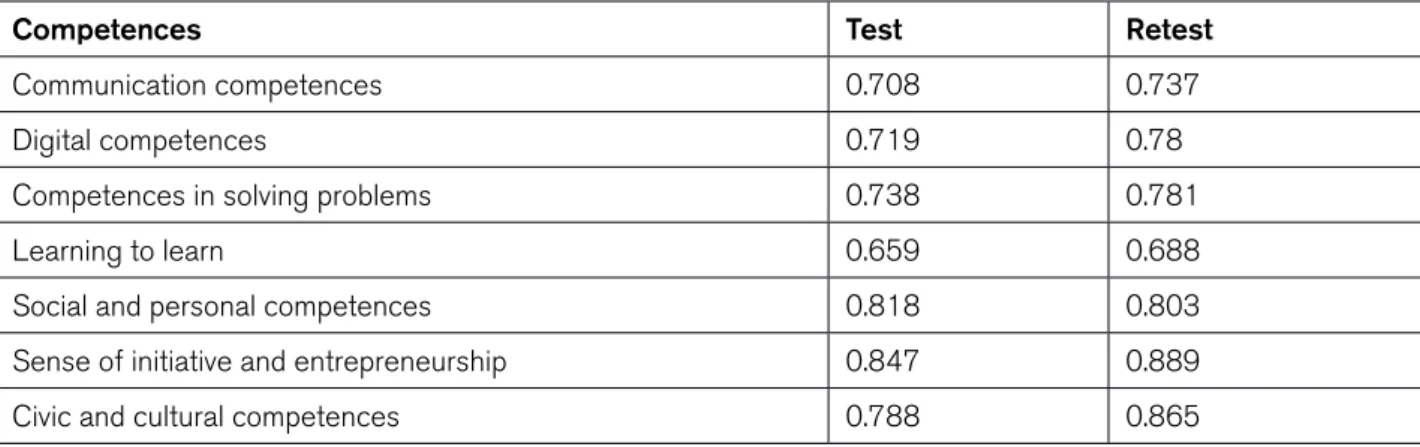
(8) DEVELOPMENT OF KEY COMPETENCES THROUGH SERVICE-LEARNING A. BROZMANOVÁ GREGOROVÁ / Z. HEINZOVÁ / K. KURČIKOV / L. NEMCOVÁ / J. ŠOLCOVÁ competences for lifelong learning, European ref-. flexibility, responsibility and reliability, ability. erence framework and competences included. to tolerate others).. in the on-line tool for validation of competences. •. Sense of initiative and entrepreneurship (rea-. gained through volunteering D-Skills for Employ-. diness for employability, executing one’s. ment. The questionnaire maps the following key. ideas, sense of initiative and entrepreneurs-. competences:. hip, creativity, risk-taking, building and development of one’s professional career) - 9. •. •. Communication competences (readiness to. skills (entrepreneurial attitude and thinking,. speak in one’s mother tongue and in foreign. ability to manage projects, ability to present. languages) - 4 skills (the ability to communi-. and promote, ability to organize one’s time,. cate in the mother tongue, the ability to com-. ability to plan and organize work, ability to. municate in a foreign language, the ability to. adapt to working conditions, ability to lead. listen to others, the ability to participate in the. meetings, ability to lead other people, abi-. discussion) are assessed.. lity to orientate oneself to one’s client) are. Digital competences (readiness to use infor-. assessed.. mation technologies and handling informa-. •. •. Civic and cultural competences (readiness. tion) - 2 skills (computer skills and internet. to engage in civic life and support of cultural. skills) are assessed.. values) - 4 skills (respect for laws and stan-. Competences in solving problems (readiness. dards, ability to provide assistance in critical. for creative, critical and independent prob-. situations, cultural heritage protection, envi-. lem solving) - 3 skills (ability to perceive and. ronmental protection) are assessed.. analyse problems and solve independently. •. and creatively, ability to decide and think. The data reliability was determined by Cronbach’s. critically, ability to cope with stress and work. alpha, and the pre-test and post-test results pre-. in demanding and stressful situations) are. sented in Table 1 point to the satisfactory relia-. assessed.. bility of our research sample data. All Cronbach. Learning to learn competences (readiness. alpha values approximate or exceed the coeffi-. to Learn) - 2 skills (learning and using new. cient of 0.7.. knowledge, ability to self-stimulate learning) •. are assessed.. Statistical analysis of data was performed. Social and personal competences (readi-. through SPSS 19.0. The data of our set did not. ness for relationships with other people, self-. show a normal distribution, so we detected the. development and self-regulation) - 6 skills. difference in the subjectively perceived level of. (ability to develop and manage their person-. competence before and after completing the. ality, self-esteem and self-confidence, ability. Service Learning course by means of the Wilco-. to participate in team work, adaptability and. xon test and Mann-Whitney test.. unes núm. 6 - MARZO 2019 - 34 · 54 - issn 2530-1012 - pág. 41.
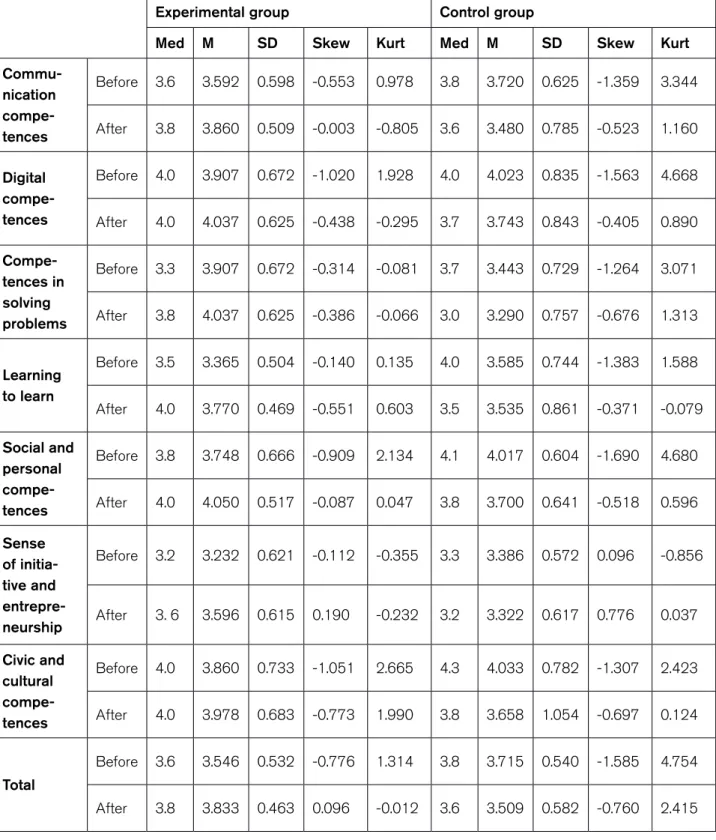
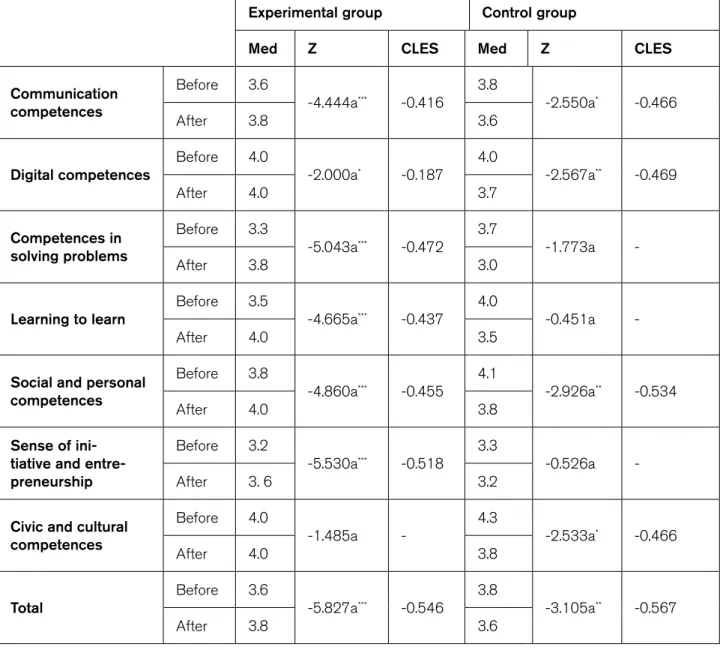
(9) DEVELOPMENT OF KEY COMPETENCES THROUGH SERVICE-LEARNING A. BROZMANOVÁ GREGOROVÁ / Z. HEINZOVÁ / K. KURČIKOV / L. NEMCOVÁ / J. ŠOLCOVÁ Table 1. Data Reliability (Cronbach’s alpha). Competences. Test. Retest. Communication competences. 0.708. 0.737. Digital competences. 0.719. 0.78. Competences in solving problems. 0.738. 0.781. Learning to learn. 0.659. 0.688. Social and personal competences. 0.818. 0.803. Sense of initiative and entrepreneurship. 0.847. 0.889. Civic and cultural competences. 0.788. 0.865. The research data on the subjective perception. 3. RESULTS. of the benefits of completing the subject with the service-learning application was investigated by. The descriptive indicators for key competences. content analysis of the written self-reflections. assessed by Competency Questionnaire (Broz-. of the students which they fill in after comple-. manová Gregorová, 2014) are presented in. ting the subject. Self-reflection is structured into. Table 2.. several areas of intrapersonal and interpersonal dimensions. We performed the analysis of qua-. In the experimental group, we noted statistically. litative data through Excel. We proceeded with. significant differences in the subjective assess-. the coding method, the core categories being. ment of the level of development of key compe-. the key competences identified in the Compe-. tences of students before and after completing. tency Questionnaire. The reliability was issued. the subject based on the overall service-learning. through direct quotations from self-reflection,. strategy and in 6 competences out of 7. Only in. double coding and coding by two researchers.. Sense of initiative and entrepreneurship a statistically significant difference was not recorded. All differences are in favour of testing after completing the subject. In the control group (Table T3), a difference was recorded in 4 out of 7 competences as well as in competences overall.. unes núm. 6 - MARZO 2019 - 34 · 54 - issn 2530-1012 - pág. 42.
(10) DEVELOPMENT OF KEY COMPETENCES THROUGH SERVICE-LEARNING A. BROZMANOVÁ GREGOROVÁ / Z. HEINZOVÁ / K. KURČIKOV / L. NEMCOVÁ / J. ŠOLCOVÁ Table 2. Descriptive indicators of all variables in a sample of the Slovak university students – experimental group (N=114) and control group (N=30). Experimental group. Communication competences Digital competences Competences in solving problems Learning to learn Social and personal competences Sense of initiative and entrepreneurship Civic and cultural competences. Control group. Med. M. SD. Skew. Kurt. Med. M. SD. Skew. Kurt. Before. 3.6. 3.592. 0.598. -0.553. 0.978. 3.8. 3.720. 0.625. -1.359. 3.344. After. 3.8. 3.860. 0.509. -0.003. -0.805. 3.6. 3.480. 0.785. -0.523. 1.160. Before. 4.0. 3.907. 0.672. -1.020. 1.928. 4.0. 4.023. 0.835. -1.563. 4.668. After. 4.0. 4.037. 0.625. -0.438. -0.295. 3.7. 3.743. 0.843. -0.405. 0.890. Before. 3.3. 3.907. 0.672. -0.314. -0.081. 3.7. 3.443. 0.729. -1.264. 3.071. After. 3.8. 4.037. 0.625. -0.386. -0.066. 3.0. 3.290. 0.757. -0.676. 1.313. Before. 3.5. 3.365. 0.504. -0.140. 0.135. 4.0. 3.585. 0.744. -1.383. 1.588. After. 4.0. 3.770. 0.469. -0.551. 0.603. 3.5. 3.535. 0.861. -0.371. -0.079. Before. 3.8. 3.748. 0.666. -0.909. 2.134. 4.1. 4.017. 0.604. -1.690. 4.680. After. 4.0. 4.050. 0.517. -0.087. 0.047. 3.8. 3.700. 0.641. -0.518. 0.596. Before. 3.2. 3.232. 0.621. -0.112. -0.355. 3.3. 3.386. 0.572. 0.096. -0.856. After. 3. 6. 3.596. 0.615. 0.190. -0.232. 3.2. 3.322. 0.617. 0.776. 0.037. Before. 4.0. 3.860. 0.733. -1.051. 2.665. 4.3. 4.033. 0.782. -1.307. 2.423. After. 4.0. 3.978. 0.683. -0.773. 1.990. 3.8. 3.658. 1.054. -0.697. 0.124. Before. 3.6. 3.546. 0.532. -0.776. 1.314. 3.8. 3.715. 0.540. -1.585. 4.754. After. 3.8. 3.833. 0.463. 0.096. -0.012. 3.6. 3.509. 0.582. -0.760. 2.415. Total. Note: Skew – Skewness; Kurt – Kurtosis.. unes núm. 6 - MARZO 2019 - 34 · 54 - issn 2530-1012 - pág. 43.
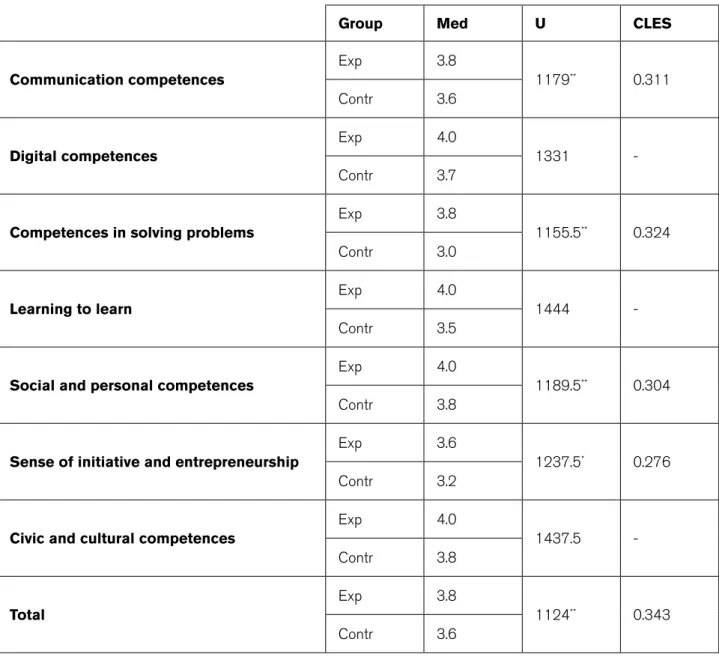
(11) DEVELOPMENT OF KEY COMPETENCES THROUGH SERVICE-LEARNING A. BROZMANOVÁ GREGOROVÁ / Z. HEINZOVÁ / K. KURČIKOV / L. NEMCOVÁ / J. ŠOLCOVÁ Table 3. Differences in the subjective assessment of the level of competence development before and after completion of the subject Service-learning in experimental group (N = 114) and control group (N=30). Experimental group Med Communication competences. Digital competences. Competences in solving problems. Learning to learn. Social and personal competences Sense of initiative and entrepreneurship Civic and cultural competences. Total. Before. Z. CLES. -4.444a***. -0.416. 3.6. After. 3.8. Before. 4.0. After. 4.0. Before. 3.3 3.8. Before. 3.5 4.0. Before. 3.8 4.0. Before. 3.2 3. 6. Before. 4.0 4.0. Before. 3.6. -0.187. -2.567a**. -0.469. -0.472. -1.773a. -. -0.451a. -. -2.926a**. -0.534. -0.526a. -. -2.533a*. -0.466. -3.105a**. -0.567. 3.0 4.0 -0.437 3.5 4.1 -0.455 3.8 3.3 -0.518 3.2 4.3 -1.485a. After. -0.466. 3.7. -5.530a*** After. -2.550a*. 3.7. -4.860a*** After. CLES. 4.0. -4.665a*** After. Z. 3.6. -5.043a*** After. Med 3.8. -2.000a*. 3.8 3.8. -5.827a*** After. Control group. 3.8. -0.546 3.6. Note: Med –median, CLES – Common Language Effect Size. In the testing of differences between experimen-. rences in the groups at the perceived level of. tal and control group before the intervention, we. competence development before and after the. found out significant statistical differences only. service-learning, we were interested in whether. in Social and personal competences (1239.5 ). there was a difference between the groups in. in favour control group. Apart from the diffe-. the post-tests.. *. unes núm. 6 - MARZO 2019 - 34 · 54 - issn 2530-1012 - pág. 44.
(12) DEVELOPMENT OF KEY COMPETENCES THROUGH SERVICE-LEARNING A. BROZMANOVÁ GREGOROVÁ / Z. HEINZOVÁ / K. KURČIKOV / L. NEMCOVÁ / J. ŠOLCOVÁ Table 4 presents the results of our Mann-Whit-. personal competences, sense of initiative and. ney statistical test, where a statistically signifi-. entrepreneurship competences as well as com-. cant difference in communication competences,. petences overall has been demonstrated. The. competences in solving problems, social and. differences were week and average size.. Table 4. Differences in the subjective assessment of the level of competence development between the experimental and the control group after completing the service-learning. Group. Med. Exp. 3.8. Communication competences Contr. 3.6. Exp. 4.0. Digital competences Contr. 3.7. Exp. 3.8. Competences in solving problems Contr. 3.0. Exp. 4.0. Contr. 3.5. Exp. 4.0. Learning to learn. Social and personal competences Contr. 3.8. Exp. 3.6. Sense of initiative and entrepreneurship Contr. 3.2. Exp. 4.0. Contr. 3.8. Exp. 3.8. Civic and cultural competences. Total Contr. U. CLES. 1179**. 0.311. 1331. -. 1155.5**. 0.324. 1444. -. 1189.5**. 0.304. 1237.5*. 0.276. 1437.5. -. 1124**. 0.343. 3.6. Note: Med – median, Exp – Experimental Group, Contr – Control Group; CLES – Common Language Effect Size. unes núm. 6 - MARZO 2019 - 34 · 54 - issn 2530-1012 - pág. 45.
(13) DEVELOPMENT OF KEY COMPETENCES THROUGH SERVICE-LEARNING A. BROZMANOVÁ GREGOROVÁ / Z. HEINZOVÁ / K. KURČIKOV / L. NEMCOVÁ / J. ŠOLCOVÁ. 3.1. Communication competences. 3.2. Digital competences. In the area of communication competences, sta-. Digital competences included an assessment of. tistically significant differences in the subjective. three specific skills. All demonstrated an average. assessment of the level of development of spe-. assessment of their level higher after comple-. cific abilities and skills were recorded in 3 out. ting the Service Learning course. A statistically. of 5 (however, in all, the average assessment. significant difference in the average pre- and. was higher in the output assessment than in the. post-course score was recorded in the ability. input). It was the ability to work with information. to critically and considered access to available. (p = 0.048), ability to participate in a discussion. information (p = 0.049). The development of cri-. (p = 0.000) and the ability to communicate in a. tical thinking was also identified in the analysis. foreign language (p = 0.014). The development. of the self-reflection of students:. of communication competences is confirmed by the self-reflection of students:. “It is necessary to hear the opinion of several people and choose the right solution.”. “Afterwards I learned to communicate more efficiently.” “I also expanded my communication skills.” “I’ve learned that I have a very good ability to communicate efficiently with different types of people because I know how to quickly adapt to their way of communication.” “I discovered that I had the ability to actively. “I learned to look at things and also from a different point of view.” “I’ve learned that not everything that is written on the internet is usable.” “I have once again learned to critically perceive each proposal. Understand the intentions and motives of my group members in relation to the approach to work.”. listen to others…” “… and I also liked being among them and listened to them and enjoyed. 3.3. Competence in solving problems. observing how they live and experience life.” “I learned how to communicate more and discuss with my colleagues and the wider public.”. In the area of problem solving, statistically significant differences were recorded in the average assessment of the level of development of. “I’ve learned to communicate better by e-mail. individual capabilities and skills in both input and. at the official level.”. output testing in two abilities. Students noticed a more developed ability to perceive and analyse. unes núm. 6 - MARZO 2019 - 34 · 54 - issn 2530-1012 - pág. 46.
(14) DEVELOPMENT OF KEY COMPETENCES THROUGH SERVICE-LEARNING A. BROZMANOVÁ GREGOROVÁ / Z. HEINZOVÁ / K. KURČIKOV / L. NEMCOVÁ / J. ŠOLCOVÁ problems and to solve them independently and. they developed both abilities: to learn and use. creatively (p = 0.002) and the ability to cope with. new knowledge (p = 0.003) and self-motivation. stress and work in difficult and stressful situa-. to learn (0.007) proved to be a statistically signi-. tions (p = 0.000). Self-reflective expressions of. ficant development after completing the subject. students in the area of problem-solving develop-. with service-learning strategy. This ability has. ment related to the following concrete benefits:. been documented in self-reflections:. “I’ve learned to find new solutions to pro-. “It helps me better understand the subject I. blems.”. have.”. “I realized I had to take responsibility for my. “I can use it in other studies, for example, in. decisions.”. other subjects and in creating group work. “I was able to perform well under stress.” “I learned to endure more in difficult moments and stay in the group, even if we did not succeed.” “… I have partly overcome my fear that I have always had in the presence of mentally ill children.”. or other school projects.” “I can use the acquired knowledge in theory and practice (service-learning) later in the implementation of another project.”. 3.5. Social and personal competences. “I’ve learned to be more patient when. In terms of social and personnel competences,. someone takes longer to do something. we have statistically significant differences bet-. because it’s more difficult for them.” “… I’ve. ween input and output scores in four specific abi-. also found that nothing is so difficult, and that. lities and skills in six. Their development was also. I just need to persevere”. identified in the students’ self-reflection. Accor-. “… I learned not to give up and go for my goal, which is also very important for a social worker.”. ding to the subjective assessment, students developed the ability to develop and manage their personality (p = 0.023) by completing the Service Learning subject. Within this particular ability in self-reflection, they identified in particu-. 3.4. Learning to learn. lar the benefits in the field of self-discourse and. In the area of learning competences, two specific abilities were assessed: learning and using new knowledge and self-motivation to learn. From the point of view of the students, the ability. self-reflection: “I learned a lot about myself…” “I was able to identify my shortcomings.”. unes núm. 6 - MARZO 2019 - 34 · 54 - issn 2530-1012 - pág. 47.
(15) DEVELOPMENT OF KEY COMPETENCES THROUGH SERVICE-LEARNING A. BROZMANOVÁ GREGOROVÁ / Z. HEINZOVÁ / K. KURČIKOV / L. NEMCOVÁ / J. ŠOLCOVÁ “I discovered that it is very hard for me to. “I will have more confidence in myself than I. work in a team and be part of it.”. had before.”. “I learned that I am a team player.”. We also noted statistically significant differen-. “I found out that I was afraid when I had to. ces in the ability to participate in team work (p =. stand in front of a bigger audience or for a. 0.033) and adaptability and flexibility (p = 0.02).. lot of people, especially when I did not have. The following specific statements from students. any prepared materials or text I had to talk. testify to their development:. about or in the presentations I had to have everything worked out, ready, otherwise I would not be able to do it.”. “I’ve improved my teamwork.” “Thanks to the jointly selected service-lear-. “I found out that I am very stubborn.” “… I’ve. ning activity, I learned how to work more effi-. learned a few positive features about myself.”. ciently in a team.”. “I learned that I am quite easily influenced by. “I have more understanding of the importance. others.”. of what is important in teamwork and how. Based on subjective evaluation, students marked self-esteem and self-confidence as more developed after graduation (p = 0.007). Identified statements in self-reflections:. important it is for everybody in the team to have a role and not for everyone to do everything.” Concerning the responsibility and reliability and ability to tolerate others, we did not notice a sta-. “… I learned that I should not give up because,. tistically significant difference between input. despite so many refusals, there is always at. and output testing, but the average score was. least one person who wants to help.”. higher at the end of the subject. The following. “I have the biggest problem with speaking in front of a lot of people and especially unknown people. I think that through such activities I am more relaxed and gain more confidence in presenting a particular activity.” “Thanks to service-learning, there have been. expressions also reflect the development of these abilities: “Thanks to the jointly chosen service-learning activity, I learned to be more responsible.” “I also learned more responsibility.”. a number of ideas that I have begun to imple-. “I’ve learned to be more patient when. ment because I have gained more self-con-. someone takes longer to do something. fidence.”. because it’s more difficult for them.”. unes núm. 6 - MARZO 2019 - 34 · 54 - issn 2530-1012 - pág. 48.
(16) DEVELOPMENT OF KEY COMPETENCES THROUGH SERVICE-LEARNING A. BROZMANOVÁ GREGOROVÁ / Z. HEINZOVÁ / K. KURČIKOV / L. NEMCOVÁ / J. ŠOLCOVÁ “I learned not to judge others and to find enjoyment in small things.”. • ability to organize one’s time (p = 0.012) “I’ve learned to organize my time better.”. “I realized that we are all different and everyone wants to be useful in their team. Everyone thinks differently and we had to adapt because of that.”. “I learned how to organize my time so that when it was necessary, we could agree on a service-learning meeting, even if I had other plans on some of the days, it was simply that. “… I have learned that each client is different but unique because of that and everybody deserves a unique and personal approach.”. our duties sometimes limited us.” “… that I can better organize my free time.” “… when I need to revise for exams, I know. 3.6. Sense of initiative and entrepreneurship. how to better organize my time.” • ability to plan and organize work (p = 0.005). Sense of initiative and entrepreneurship was the largest group of competences under consideration. The statistically significant differences between the subjective evaluation of the level of development before and after the completion of. “I found out it necessary to start planning and have an alternative plan ready. As there were various problems during the planning of the project.”. the subject were recorded in 8 of the 9 skills and. “Start planning ahead and have an alternative. competences under consideration. We present. plan ready…”. them together with the identified statements in self-reflection of students specifically: • ability to manage projects (p = 0.000) “I learned to plan a project budget and to write an application for a grant.” • ability to present and promote (p = 0.000) “I learned to deal with potential sponsors.” “…I have gained experience in addressing potential project partners.”. “I would be more careful… to better develop the timetable and the plan for the implementation of the activity thereby avoiding unnecessary delay and time wasted…” “I guess I would have started my tasks earlier rather than the last minute.” “I would have another timetable, we might have had less stress… “I’ve learned for the future that it is necessary to work on the activities in advance,” “…I’ve learned to plan out an activity schedule.”. unes núm. 6 - MARZO 2019 - 34 · 54 - issn 2530-1012 - pág. 49.
(17) DEVELOPMENT OF KEY COMPETENCES THROUGH SERVICE-LEARNING A. BROZMANOVÁ GREGOROVÁ / Z. HEINZOVÁ / K. KURČIKOV / L. NEMCOVÁ / J. ŠOLCOVÁ “I learned to perform my tasks at the given. 3.7. Civic and cultural competences. time because it was always a problem for me.”. In the field of civic and cultural competences we didn´t find any statistically significant differ-. • ability to adapt on working conditions (p = 0.013). ences. Even in self-reflections we did not identify the development of these abilities. We have also attributed to this area of competence the bene-. • ability to lead meetings (p = 0.004) “I’ve learned how important the minutes from meetings are.” • ability to lead other people (p = 0.000) “I know how to manage and organise group work, how to lead other people.” “I am capable of coordinating a group of people.”. fits of developing civic engagement and personal and social responsibility that we have identified in the self-reflection of students, and which are also the subject of independent research: “… I’ve found that helping others can fulfill people more than I thought.” “… to not think only of oneself but also on the needs of other people.” “It can help me to develop for the better and to see certain facts with a better outlook.”. • ability to orientate oneself to one’s client (p = 0.001). “It’s a subject that has given me new experience and responsibility towards others.”. “I have learned that sometimes all it takes is a small change in my point of view to change. “I would like to be more committed to these. what would be just another day for someone. real issues in society and things that really. else into a day where they experience some-. work out in the community, and maybe to. thing nice and positive.”. motivate people more in the future to carry out such similar activities for the community,. “I’m proud to have spent an enjoyable time. for society.”. with these people, and I was there just for them at the time.” “I’m proud to help these. “I know that helping other people is unavoid-. people, and they felt good and pleasant at. able and necessary.”. least for a little while.”. unes núm. 6 - MARZO 2019 - 34 · 54 - issn 2530-1012 - pág. 50.
(18) DEVELOPMENT OF KEY COMPETENCES THROUGH SERVICE-LEARNING A. BROZMANOVÁ GREGOROVÁ / Z. HEINZOVÁ / K. KURČIKOV / L. NEMCOVÁ / J. ŠOLCOVÁ. 4. DISCUSSION. to develop the ability to apply what the student has learned “in the real world,” on the ability to. According to our findings, after completing the. solve problems, develop critical thinking and cog-. subject based on the service-learning strategy, a. nitive development. Sevin, Hale, Brown, McAuley. statistically significant shift in the subjective per-. (2016) confirmed the positive impact of service-. ception of the level of development of the key. learning on the development of self-evaluation. competences of the students has occurred. Stu-. of students and their key competences. Their. dents in the caring professions who have under-. results demonstrate the effectiveness of ser-. gone the subject of Service Learning at Matej. vice-learning as a method of preparing students. Bel University consider their core competences. to work with others in practice. Ramson (2014). more advanced after graduation than before gra-. states the positive impact of service-learning on. duating. Differences were noted in 6 groups of. the development of the so-called competences. competences and within specific skills and com-. for employment that match the key competen-. petences at 20 out of 32. In the control group we. ces we are monitoring. A meta-analysis of 62. also found differences in 4 competencies. When. studies involving 11 837 students indicated that,. comparing differences in post-tests between the. compared to controls, students participating in. experimental and the control group, we found. service-learning programs demonstrated sig-. the difference in the four groups of competen-. nificant gains in five outcome areas: attitudes. ces as well as in the overall competences, all in. toward self, attitudes toward school and learning,. favour of the experimental group.. civic engagement, social skills, and academic performance (Celio, Durlak & Dymnicki, 2011).. The results of our research correspond to other similar research into the development of skills,. We realize the limits of our research. The research. competencies or attitudes developed through. was conducted on a small sample of students. the service-learning strategy. In the publication. of Matej Bel University who completed the sub-. At A Glance: What We Know about the Effects of. ject of Service-Learning in the academic years. Service-Learning on College Students, Faculty,. 2014/15, 2015/2016 and 2016/2017 and. Institutions. 1993-2000. completed both questionnaires and self-reflec-. (Eyler, Giles, Stenson, Gray, 2011), the results. tions (total 114 students). We also approached. of dozens of research confirm the impact of. the control group to confirm the impact of the. service-learning for the personal development. service-learning graduation on the development. of students in personal identity, spiritual growth. of subjectively perceived competencies, but it. and moral development, interpersonal deve-. had a lower number of respondents. The lower. lopment, ability to work with others, leadership. number of respondents in the control group is. and communication skills, reducing stereotypes. caused by a lower willingness to fill out a series. and promoting cultural and racial understanding;. of questionnaires which monitor the selected. and. Communities,. unes núm. 6 - MARZO 2019 - 34 · 54 - issn 2530-1012 - pág. 51.
(19) DEVELOPMENT OF KEY COMPETENCES THROUGH SERVICE-LEARNING A. BROZMANOVÁ GREGOROVÁ / Z. HEINZOVÁ / K. KURČIKOV / L. NEMCOVÁ / J. ŠOLCOVÁ competences in the experimental group and, on. nally grow, but also be actively engaged and to. the other hand, the “absence” of suitable respon-. develop their involvement. Service-learning is a. dents. The selection is carried out in such a way. strategy that responds to the challenges of uni-. as to ensure representativeness from the pers-. versity education and contemporary society and,. pective of the year and the study department,. on the other hand, it needs support and unders-. the control group according to this criterion was. tanding from multiple directions for its develop-. composed of only a low number of possible res-. ment the same as other pedagogical strategies.. pondents. We plan to conduct research on a. We realize that the service-learning strategy has. longitudinal basis and to extend it to other varia-. its limits and cannot be applied to each subject.. bles that are likely to be the determinants of the. However, we believe that by attending any course. development of key competences of students. or form, students encouraged to move from self-. through service learning courses (e.g. higher job. education to engaging in their own learning as. satisfaction in the service-learning team, dura-. well as improving life in their neighbourhood.. tion of activity, etc.).. REFERENCES 5. CONCLUSION Astin, A. W. & Sax, L. J. (1998). How UndergradAccording to Hrmo and Turek (2003b), key. uates are Affected by Service Participation.. competences are applicable to most professions. Journal of College Student Development,. (and those not yet existing) and serve to solve. 39(3), 251-263.. many and varied problems, in different contexts,. Belz, H. & Siegrist, M. (2001). Klíčové kompe-. to achieve multiple goals, to be applied not only in. tence a jejich rozvíjení: Východiska, metody,. different professions, but also in different areas. cvičení a hry. Praha: Portál.. of human activity: at school, at work, in social and. Benson, L., Harkavy, I. & Puckett, J. (2007). Dew-. personal life. The acquisition and improvement of. ey’s Dream: Universities and Democracies in. key competences is seen as a lifelong learning. an Age of Education Reform, Civil Society,. process, not only at school, but also in employ-. Public Schools, and Democratic Citizenship.. ment, family, cultural, social and political life, etc.. Philadelphia: Temple University Press.. Acquiring key competencies is not only a matter of personal effort but requires a favourable. Blaško, M. (2013). Kvalita v systéme modernej výučby Košice: Technická univerzita.. social and environmental environment. Service-. Bringle, R. G. & Hatcher, J. A. (1995). A Service. learning is one of the ways to develop these. Learning Curriculum for Faculty. Michigan. competencies.. Journal of Community Service Learning, (2), 112-122.. Service-learning provides students with a struc-. Brozmanová Gregorová, A. (2014). Analýza prí-. tured opportunity to personally and professio-. nosov dobrovoľníctva pre nezamestnaných. unes núm. 6 - MARZO 2019 - 34 · 54 - issn 2530-1012 - pág. 52.
(20) DEVELOPMENT OF KEY COMPETENCES THROUGH SERVICE-LEARNING A. BROZMANOVÁ GREGOROVÁ / Z. HEINZOVÁ / K. KURČIKOV / L. NEMCOVÁ / J. ŠOLCOVÁ v rámci projektu Volwem. Banská Bystrica:. Eyler, J. S., Giles, D. E., Stenson, Ch. M., & Gray,. Univerzita Mateja Bela v Banskej Bystrici,. Ch. J. (2001). At A Glance: What We Know. Platforma dobrovoľníckych centier.. about The Effects of Service-Learning on. Carla, R. (2017). Service-learning in Central and. Colege Students, Faculty, Institutions and. Eastern Europe. Handbook for Engaged Tea-. Communities, 1993 – 2000: Third edition.. chers and Students. Buenos Aires: CLAYSS.. Nashville: Vanderbit University.. Celio, Ch., Durlak, J. & Dymnicki, A. (2011). A. Fiske, E. B. (2001). Learning in Deed. The Power. Meta-analysis of the Impact of Service-. of Service-Learning for American Schools.. Learning on Students. Journal of Experiential. Battle Creek, MI: W.K. Kellogg Foundation.. Education, 34 (2), 164-181.. Furco, A. (2011). Service-Learning: A Balanced. Cohen, J., & Kinsey, D. (1994). “Doing good” and. Approach to Experiential Education. Expanding. scholarship: A service-learning study. Jour-. Boundaries: Service and Learning. Washing-. nalism Educator, 48 (4) 4-14.. ton DC: Corporation for National Service.. Conrad, D. & Hedin, D. (1991). School-based. Geringová, J. (2011). Pomahajícíc profese. Tvořivé. Community Service: What we Know from. zacházení s odvrácenou stranou. Praha: Tri-. Research and Theory. Phi Delta Kappan,. ton.. (72), 743-749.. Heffernan, K. (2001). Service-Learning in Higher. Elichová, M. (2017). Sociální práce aktuální otázky. Praha: Grada Publishing. Etzkowitz, H., Webster, A., Gebhardt, Ch., Cantisano Terra, B., R. (2000). The Future of the. Education. Journal of Contemporary Water Research and Education, 119(1), 2-8. Hrmo, R.,& Turek, I. (2003a). Kľúčové kompetencie 1. Bratislava: STU.. University and the University of the Future:. Hrmo, R. & Turek, I. (2003b). Návrh systému. Evolution from Ivory Tower to Entrepreneurial. kľúčových kompetencií. Košice: Technická. Paradigm. Research Policy, 29(2), 313–330.. univerzita.. European Commission. (2007). Key Compe-. Jacoby, B. (1996). Service-learning in higher edu-. tences for Lifelong Learning. European Ref-. cation: Concepts and practices. San Fran-. erence Framework. Luxembourg: Office for. cisco: Jossey Bass.. Official Publications of the European Communities.. Melchior, A. Frees, J., LaCava, L., Kingsley, Ch., Nahas, J., Power, J., Baker, G., Blomquist, J.,. Eyler, J. S., & Giles, D. E. (1999). Where’s the. George, A., Hebert, S., Jastrzab, J., Helfer, Ch.. Learning in Service-Learning? San Francisco:. & Potter, L. (1999). National Evaluation of. Jossey- Bass.. Learn and Serve American School and Com-. Eyler, J. S., Giles, D. E., & Braxton, J. (1997). The Impact of Service-Learning on College Students. Michigan Journal of Community Service Learning, 4(1), 5-15.. munity Based programs. Waltham: Brandeis University. Mlčák, Z. (Ed). (2005). Profesní kompetence sociálních pracovníků a jejich hodnocení. unes núm. 6 - MARZO 2019 - 34 · 54 - issn 2530-1012 - pág. 53.
(21) DEVELOPMENT OF KEY COMPETENCES THROUGH SERVICE-LEARNING A. BROZMANOVÁ GREGOROVÁ / Z. HEINZOVÁ / K. KURČIKOV / L. NEMCOVÁ / J. ŠOLCOVÁ klienty. Ostrava: Ostravská univerzita, Filozo-. social development. College Teaching, 54(4),. fická fakulta.. 307–319.. Moore, M., & Lin Lan, P. (Ed.) (2009). Service-. Tapia, M. N. (2003). A service-learning proposal. learning in higher education: Paradigms and. for universities. Buenos Aires: Centro Lati-. challenges. Indianapolis: University of India-. noamericano de Aprendizaje y Servicio Soli-. napolis Press.. dario (CLAYSS).. Morgan, W., & Streb, M. (2001). Building Citizen-. Turek, I. (2008). Úvod do problematiky kľúčových. ship: How Student Voice in Service-Learning. kompetencií. Dubnica nad Váhom: Dubnický. Develops Civic Values. Social Science Quar-. technologický inštitút.. terly, 82(1), 154–169. Mužík, J. (2012). Profesní vzdělávání dospělých. Praha: Wolters Kluwer. Ramson, A. J. (2014). Service-learning: A Tool to Develop Employment Competencies for College Students. Journal on Excellence in College Teaching, 25(1), 159-187. Reed, V. A., Jernstedt, C. G., Hawley, J. K., Reber,. Vančo, M., Srnánková, Ľ, Blanár, F., Slovíková, M. (2016). Analýza získavania prierezových kompetencií na slovenských vysokých školách. Bratislava: Centrum vedecko-technických informácií. Veteška, J. (2011). Teorie a praxe kompetenčního přístupu ve vzdelávání. Praha: Educa Service. Veteška, J. & Tureckiova, M. (2008). Kompetence. E. S., & DuBois, C. A. (2005). Effects of a. ve vzdělávání. Praha: Grada Publishing.. small-scale, very short-term service-learning. Vorley, T. & Nelles, J. (2008). (Re)Conceptualis-. experience on college students. Journal of. ing the Academy: Institutional Development. Adolescence, 28(3), 359-368.. of and beyond the Third Mission. Higher Edu-. Sevin, A. M., Hale, K. M., Brown, N. V., McAuley, J.W. (2016). Assessing Interprofessional. cation Management and Policy, 20(3), 119135.. Education Collaborative Competencies in. Williams, N. R., King, M. & Koob, J. J. (2002). Social. Service-learning Course. American Journal. Work Students Go to Camp: The Effects of. of Pharmaceutical Education, 80(2), 1-8.. Service-learning on Perceived Self-efficacy.. Simons, L., & Cleary, B. (2006). The influence of. Journal of Teaching in Social Work, 22(3/4),. service-learning on students’ personal and. 55-70.. NOTAS 1. The contribution is the output of the project VEGA 1/0671/17 “The Influence of Service Learning – Innovative Strategy for Education – on Social and Personal Development and Citizen Involvement of University Students”.. unes núm. 6 - MARZO 2019 - 34 · 54 - issn 2530-1012 - pág. 54.
(22)
Figure
Documento similar
