USE OF CEPSTRUM-BASED PARAMETERS FOR AUTOMATIC
PATHOLOGY DETECTION ON SPEECH
Analysis of Performance and Theoretical Justification
Rub´en Fraile, Juan Ignacio Godino-Llorente, Nicol´as S´aenz-Lech´on, V´ıctor Osma-Ruiz
Department of Circuits & Systems Engineering, Universidad Polit´ecnica de MadridCarretera de Valencia Km 7, 28031 Madrid, Spain
[email protected], [email protected], [email protected], [email protected]
Pedro G´omez-Vilda
Department of Computer Systems’ Architecture and Technology, Universidad Polit´ecnica de Madrid Campus de Montegancedo s/n, Boadilla del Monte, 28660 Madrid, Spain
Keywords: Speech analysis, Pattern classification.
Abstract: The majority of speech signal analysis procedures for automatic pathology detection mostly rely on parameters extracted from time-domain processing. Moreover, calculation of these parameters often requires prior pitch period estimation; therefore, their validity heavily depends on the robustness of pitch detection. Within this paper, an alternative approach based on cepstral-domain processing is presented which has the advantage of not requiring pitch estimation, thus providing a gain in both simplicity and robustness. While the proposed scheme is similar to solutions based on Mel-frequency cepstral parameters, already present in literature, it has an easier physical interpretation while achieving similar performance standards.
1
INTRODUCTION
Analysis of recorded speech is an attractive method for pathology detection since it is a low-cost non-invasive diagnostic procedure (Boyanov and Had-jitodorov, 1997). Although there is a wide range of causes for pathological voice (functional, neural, laryngeal, etc.) and a correspondingly wide range of acoustic parameters has been proposed for its de-tection (see (Jackson-Menaldi, 2002) for summaris-ing tables and typical values), these intend to detect speech signal features that may be roughly classified in only three classes (Godino-Llorente et al., 2006b):
• Short-term frequency perturbations: both in
fun-damental frequency and in formants.
• Short-term amplitude perturbations.
• Noise or, more specifically, speech-to-noise ratio.
Calculation of above-mentioned acoustic parame-ters requires previous and reliable detection of speech fundamental frequency (pitch) (Deliyski, 1993) (Boy-anov and Hadjitodorov, 1997). Nevertheless, pitch detection is not an easy task due to its sensitiveness to noise, signal distorsion, speech formants, etc. (Boy-anov et al., 1993).
An alternative approach to speech signal analy-sis is doing it in cepstral domain, more specifically
in Mel-frequency cepstral domain. Such approach, consisting in classifying patterns of so-called Mel-frequency cepstral coefficients (MFCC), does not re-quire prior pitch estimation and has proven to be fairly robust against different kinds of speech distor-tion (Bou-Ghazale and Hansen, 2000), including that of telephone channel (Fraile et al., 2007), and reason-ably independent of the particular way in which com-putations may be implemented (Ganchev et al., 2005). For these reasons, their application to automatic voice pathology detection has been proposed during the last years (Godino-Llorente and G´omez-Vilda, 2004). Yet, to authors’ knowledge, up to now no physical ex-planation exists on the meaning of MFCC and their relevance on pathology detection.
of parameters is introduced in section 3. The results from the application of these features to the detection of pathologies on voices belonging to a commercial database are reported in section 4. Last, the conclu-sions are presented in section 5.
2
MATHEMATICAL
FORMULATION
2.1
Short-time Fourier Transform
As stated in previous section, the variability of speech signal is a key feature for pathology detection. The need for detecting such variability leads to the conve-nience of employing short-time techniques for speech processing. For this reason, in the following lines the mathematical framework for short-time processing of speech provided in (Deller et al., 1993) is revised.
Let x[n]be a speech signal composed by N sam-ples (n=0· · ·N−1) obtained at a sampling frequency equal to fs; then it can be segmented in frames defined
by:
f[n; m] =x[n]·w[m−n] (1) where w[n]is the framing window:
w[n] =0 i f n<0 or n≥L (2) and L is the frame length. Consequently, f[n; m]has non-zero values only for n∈[m−L+1,m]. If con-secutive speech frames are overlapped a number of l0
samples, then m may have the following values:
m=L+p·(L−l0)−1 (3)
where p is the frame index and it is an integer such that:
0≤p≤N−L
L−l0
(4)
Considering the relation between the frame shift
m and the frame index p, frames without time shift
reference may be renamed as:
gp[n] = f[n+m−L+1; m] =
= f[n+p·(L−l0); m] = (5)
= x[n+p·(L−l0)]·w[(L−1)−n]
where n=0· · ·L−1. From these speech frames, the short-term Discrete Fourier Transform (stDFT) is computed as:
Sp(k) = NDFT−1
∑
n=0
e
gp[n]·e−
j·NDFT2π ·kn
(6)
where NDFTis the number of points of the stDFT, k=
0· · ·NDFT−1 and:
e
gp[n] =
gp[n] i f 0≤n<L
0 otherwise (7)
0 500 1000 1500 2000 2500 3000 3500 4000 4500 5000
10−1
100
101
Frequency (Hz)
E [ | S ( e
j
Ω) | ]
Original speech signal Speech filtered in frequency domain
Figure 1: Average modulus of the short-term DFT for one voice record.
thus, if NDFT ≥L then (6) is equal to:
Sp(k) = L−1
∑
n=0
gp[n]·e
−j·NDFT2π ·kn
(8)
The frequency values that correspond to each stDFT coefficient are:
fk=
fs·NDFTk i f k≤NDFT2
fs·k−NNDFT
DFT i f k>
NDFT
2
(9)
2.2
Short-time Cepstrum
In (Deller et al., 1993), an algorithm for computing the short-time cepstrum from the stDFT is given, un-der the assumption that NDFT>>L:
cp[q] =
1
NDFT ·
NDFT−1
∑
k=0
log|Sp(k)| ·e j· 2πk
NDFT·q (10)
A physical interpretation of cepstrum can be de-rived from the discrete-time model for speech pro-duction that can also be found in (Deller et al., 1993). This model may be written in frequency domain as:
SejΩ=EejΩ·GejΩ·HejΩ (11)
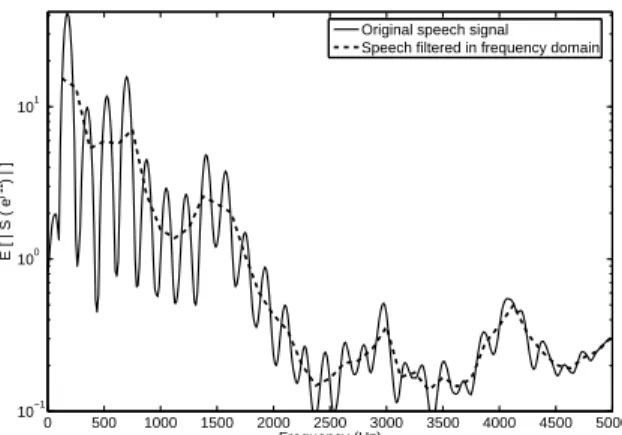
where S ejΩ is the speech, E ejΩis the impulse train corresponding to the fundamental frequency and its harmonics, G ejΩ is the glottal pulse wave-form that modulates the impulse train and H ejΩis, herein, the combined effect of vocal tract and lip ra-diation. These components can be appreciated in fig-ure 1, which corresponds to the average modulus of the short-term DFT calculated from one of the voice records belonging to the database referred in section 4.1.
The quick impulse-like variations in figure 1 cor-respond to the pitch harmonics E ejΩ, and the
0 1 2 3 4 5 6 7 8 9 10 10−2
10−1 100
Quefrency (ms)
Figure 2: Short term cepstrum averaged for all frames of the same voice record as used for figure 1.
to the glottal waveform G ejΩand the formants in-duced by the vocal tract H ejΩ. These formants
cor-respond to the three envelope peaks with a decreas-ing level of energy that are centered at 750 Hz, 1375 Hz and 3000 Hz. In fact, these center frequencies are coherent with the range of typical values given in (Jackson-Menaldi, 2002).
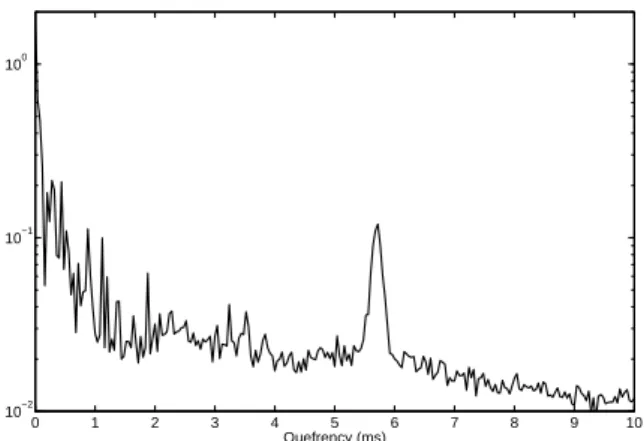
The logarithm operation in (10) converts the prod-ucts in (11) into sums. Consequently, it allows the cepstrum to separate fast from slow signal variations in frequency domain. This widely known fact is il-lustrated in figure 2, where the peak around 5.7 ms clearly identifies the fundamental frequency (175 Hz) and the values below 2 ms correspond to the spectrum envelope.
2.3
Short-time MFCC
Once the stDFT of a speech signal is available, an-other option for further processing, as mentioned in section 1, is the calculation of short-time MFCC (stM-FCC) parameters. For stMFCC computation, only the positive part of the frequency axis is considered (Ra-biner and Juang, 1993), that is, fk≥0 and, therefore,
k≤NDFT/2. In order to calculate stMFCC
coeffi-cients, a transformation is applied to the frequencies so as to convert them to Mel-frequencies fkm (Godino-Llorente and G´omez-Vilda, 2004):
fkm=2595·log10
1+ fk 700
(12)
and the stDFT is further processed through band-pass integration along M equally long Mel-frequency in-tervals, being M=⌊3·log10fs⌋ ( ⌊·⌋ means
round-ing to the previous integer). Namely, the ith interval
(i=1· · ·M) in Mel-domain is defined by:
Iim=
Fm· i−1
M+1,F
m· i+1
M+1
(13)
where Fmis the maximum Mel-frecuency:
Fm=max
k f m
k =2595·log10
1+ fs/2 700
(14)
and the interval length in Mel-domain is given by:
L(Iim) = 2
M+1·F
m (15)
According to previous equations, the NDFTstDFT
coefficients are transformed to M frequency compo-nents as follows:
e
Sp(i) =
∑
fk∈Ii1−
fkm−Fm·M+i1
L(Iim)/2
!
· |Sp(k)| (16)
Last, the qth (q =1· · ·Q) stMFCC of the pth
speech frame, where Q is the desired length of the Mel-cepstrum, is given by cosine transform of the logarithm of the smoothed “Mel-spectrum” (Rabiner and Juang, 1993):
e
cp[q] = M
∑
i=1
log
eSp(i)
·cos
q·
i−1
2
· π
M
(17)
3
CEPSTRAL COEFFICIENTS
BASED ON SMOOTHED
SPECTRUM
3.1
Justification
As stated in section 1, while MFCC parameters ex-hibit both good performance and robustness in feature extraction from speech, they lack a clear physical in-terpretation. On the opposite, cepstrum has a physical meaning (recall section 2.2), yet raw cepstrum coef-ficients are not as useful for speech parametrisation. In the next paragraphs, the reasons for these facts are exposed.
Cepstrum calculation, as formulated in (10), is based on the spectrum estimate provided by the ab-solute value of the stDFT. Due to the logarithm, this gives a result that is proportional to the case of periodogram-based spectrum estimation. However, such estimation is very dependent on the specific val-ues of the original speech frame. A more robust spec-trum estimate can be obtained by smoothing of the periodogram (Blackman and Tukey method, (Proakis and Manolakis, 1996)). In fact, this is what (16) ex-presses in the calculation of MFCC. Therefore, filter-ing of the stDFT may be assumed to be one of the sources of MFCC robustness.
(16). According to that equation, stDFT smoothing for MFCC computation is carried out with a variable-length filter, that is, a Bartlett window whose variable-length decreases for lower frequency bands. Moreover, the smoothed stDFT is downsampled to obtain only M samples in the interval[0,fs/2]that are not uniformly
spaced (Rabiner and Juang, 1993). While the down-sampling is positive in the sense that it reduces the di-mensionality of the problem, its non-uniformness, to-gether with the previous variable-length filtering, ob-scures the interpretation of the output of the cosine transform in (17).
From the previous reasoning, if stDFT is smoothed with a fixed-length filter and its output is uniformly decimated prior to the logarithm compu-tation, the cepstral coefficients in (10) can be trans-formed to a more robust parameter set. Moreover, this is achieved while keeping the physical meaning of cepstrum, since the output of the first operation gives an improved spectrum estimate and the second only limits the length of cepstrum in quefrency domain.
3.2
Formulation
Starting from (8), if the stDFT modulus is smoothed with a Bartlett window of constant length equal to∆f
then the following output is obtained:
S′p(i) =
∑
fk∈Ii
1−
fm
k −i·∆f/2
∆f/2
!
· |Sp(k)| (18)
where Ii = [∆f·(i−1)/2,∆f·(i+1)/2] and the
Bartlett window has been chosen for similarity with (16). Herein, only the positive part of the frequency axis has been considered, as in section 2.3.
If the filtered stDFT is decimated so as to keep only the outputs of consecutive windows with a 50% overlap, this is equivalent to decimation by a fac-tor D=⌊∆f·NDFT/(2·fs)⌋. The modified cepstrum
then becomes:
c′p[q] = D
NDFT ·
NDFT
2·D
∑
k=0
logS′p(k·D)· (19)
· cos
(k−1)· 2πD
NDFT ·q
where only the positive frequencies have been con-sidered, hence computing the inverse DFT as a cosine transform as in (17). c′p[q]has the twofold advantage over cp[q]of being based on a smoother spectrum
es-timate S′p(i)and having a period length that has been reduced by a factor D, thus providing some dimen-sionality reduction.
3.3
Cepstral distances
Differences in cepstrum can be used for speech signal classification. An example of such usage is the defi-nition of the cepstral distance in (Rabiner and Juang, 1993) as the norm of the vector resulting form sub-straction of the two cepstra to be compared. This, if directly applied to pathology detection, would re-sult in comparing the cepstrum of consecutive speech frames so as to assess the variability of the signal. Mathematically:
d2p=
NDFT D −1
∑
q=0
c′p+1[q]−c′p[q]2 (20)
However, bearing in mind the physical interpreta-tion of cepstrum, this definiinterpreta-tion has the drawback of mixing pitch variations with formant and glottal pulse variations. To overcome this problem an individual frame-to-frame cepstral parameter variation analysis is proposed:
dp[q] =
c′p+1[q]−c′p[q] (21)
This way, analysis of the distribution of dp[q]
re-lated to speech formant and glottal pulse variability (low values of q) can be isolated from pitch changes associated to values of q around the pitch period.
4
APPLICATION AND RESULTS
For the purpose of performance analysis, the modi-fied cepstral parameters presented in previous section have been applied to the problem of automatic pathol-ogy detection on recorded voice. The results have been compared to those produced by MFCC. Within this section, first the voice database is presented, sec-ond the used parameter set is specified, third the clas-sifier is described and, last, the results are shown and commented.
4.1
Database
of 16 bits. The subset taken from the database con-tains 53 normal and 173 pathological speakers which are uniformly distributed in age and gender (Godino-Llorente et al., 2006a).
4.2
Parameter sets
For each speech record, cepstrum-based coefficients, as defined in (19), have been calculated. Namely, a filter length∆f =200 Hz has been chosen for sfDFT smoothing. As a consequence, a cepstrum length of(fs−∆f/2)/(∆f/2) =124 samples results. The
choice of∆f is consistent to the approximate length
of the low-band filters used for MFCC calculation (re-call (16)). At first sight, however, it has the draw-back of loosing pitch information of the signal spec-trum. This is illustrated in figure 1 where the filtered DFT has been plotted with a dashed line. Neverthe-less, such filtered spectrum contains information on both harmonic-to-noise ratio (HNR) and glottal pulse waveform (Murphy and Akande, 2005) and HNR is a useful parameter for pathology detection that is closely related to both frequency and amplitude per-turbations of pitch (Jackson-Menaldi, 2002).
Since cepstrum contains information on total sig-nal energy and its distribution among formants, the whole sequence is used as part of the parameter set. As well as the cepstrum, information on its variability is used as an input for the pathology detector. More specifically, the mean and variance of dp[q]for each
value of q are used as descriptors of the cepstrum vari-ability. Therefore, on the whole, a parameter vector of 124×3 elements is produced.
For the sake of comparison, another classifier based on a parameter vector consisting of M =
⌊3·log10fs⌋=13 MFCC coeficients averaged for all
signal frames has also been tested.
4.3
Classifier description
For both classification schemes, a Multilayer Percep-tron (MLP) with two hidden layers, each consisting of 4 neurons, and a single-neuron output layer has been used as a classifier. All neurons have logistic activa-tion funcactiva-tions. An MLP with a single hidden layer having 50 neurons was utilised in (Godino-Llorente and G´omez-Vilda, 2004). The structure herein pro-posed, in contrast, has less free parameters, thus al-lowing a faster learning, and the reduced number of neurons is compensanted by the introduction of an additional hidden layer that permits learning of more complex relations (Haykin, 1994).
10−2 10−1 100
10−2 10−1 100
False alarm probability
Miss probability
Detector based on MFCC Detector based on modified cepstrum
Figure 3: DET plot for MFCC based and modified cepstrum based classifiers.
4.4
Results
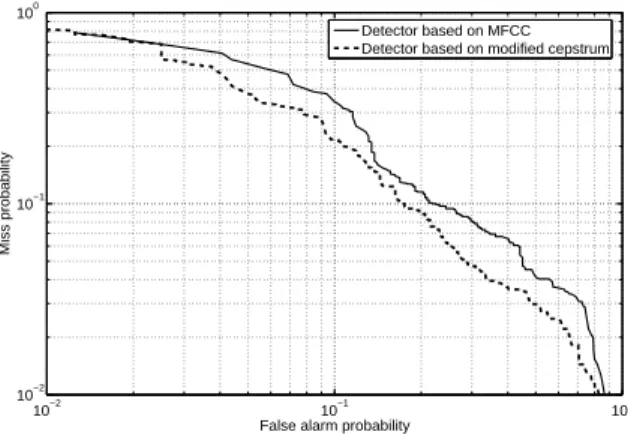
The MLP classifier has been trained with 70% of available speech records in such a way that its out-put is expected to be “1” for pathological voices and “0” for normal voices. The remaining 30% of records have been used for testing. The experiment has been repeated 20 times, each of them with different, ran-domly chosen, training sets. The average results for both MFCC and herein presented cepstrum-based pa-rameters are drawn in the DET plot (Martin et al., 1997) of figure 3.
Plotted results indicate that the performance of the classifier based on the newly proposed set of param-eters is in the same order of magnitude than that of MFCC parameters. To be specific, in terms of equal error rate (EER), that is, for false alarm rate equal to miss rate, the MFCC-based classification yields an experimental error probability of 15 % while the cepstrum-based classification error probability for the same conditions is 14 %. Considering that within this experiment the task of fine-tuning the classifier has not been carried out and that the MLP has been cho-sen as a standard for comparison, the difference in the results is not significant.
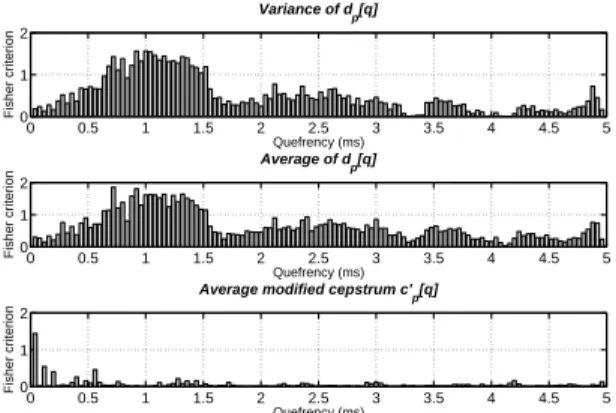
In order to acquire a deeper understanding of the reasons for these results, an analysis of the relevance of cepstrum-based parameters for speech classifica-tion as either pathological or not has been realised. Such analysis is based on the evaluation of the Fisher criterion (Duda et al., 2001) for each individual pa-rameter. The results, differentiated for the three sub-sets of parameters (modified cepstrum, variance of differences and average of absolute differences) are plotted in figure 4.
According to this plot, the most relevant cepstral parameters for pathology detection maybe roughly classified into two groups:
0 0.5 1 1.5 2 2.5 3 3.5 4 4.5 5 0
1 2
Quefrency (ms)
Fisher criterion
Variance of dp[q]
0 0.5 1 1.5 2 2.5 3 3.5 4 4.5 5
0 1 2
Quefrency (ms)
Fisher criterion
Average of dp[q]
0 0.5 1 1.5 2 2.5 3 3.5 4 4.5 5
0 1 2
Quefrency (ms)
Fisher criterion
Average modified cepstrum c’p[q]
Figure 4: Value of Fisher criterion for each cepstral param-eter.
(plot at the bottom of figure 4): these are related to the slowest components of the spectrum enve-lope in figure 1, which, on their side, are asso-ciated to spectral noise levels and HNR (Murphy and Akande, 2005).
• The frame-to-frame variations in cepstrum-based coefficients whose quefrecies are within the inter-val [0.5,1.5] miliseconds approximately: coeffi-cients within that interval correspond to the short frequency range components of the spectrum en-velope. These components, as justified in section 2.2, are related to glottal waveform and speech formants. However, this information itself does not help to discriminate the presence of pathology, as indicated by the low values of the Fisher crite-rion in the bottom plot of figure 4. Instead, frame-to-frame variations of these factors are much more relevant, as depicted in the other two plots of the same figure.
To be more specific, since the voice records of the database used for this experiment correspond to sus-tained vowel phonations, it can be assumed that the vocal tract has very little variations, hence formants do not change and the second group of parameters should be more closely related to changes in the glot-tal waveform. As for the limits of the quefrency in-terval in which parameters from the second group are relevant, the lower limit of 0.5 ms corresponds to the quefrency band that separates slow components of the spectrum envelope (first group of parameters) from faster components (associated to the second set); on the other hand, the upper limit of 1.5 ms corresponds to the highest quefrency range at which the modified cepstrum c′p[q]has significant values. This is shown in figure 5, where a plot of the frame-averaged modi-fied cepstrum of one voice record is depicted.
0 0.5 1 1.5 2 2.5 3 3.5 4 4.5 5
−30 −20 −10 0 10 20 30 40 50 60 70
Quefrency (ms)
Figure 5: 124 modified cepstral parameters from one of the database’s voice records.
5
Conclusions
Speech parametrisation in cepstral domain is a useful technique for automatic pathology detection. Specifi-cally, MFCC have been successfully used for this pur-pose. While the computation of these parameters has an intrinsic robustness due to its independency from pitch extraction and the spectrum filtering, their phys-ical interpretation is obscure because of the non-linear Mel-frequency transformation.
Within this paper an alternative set of cepstrum-based parameters has been proposed. Such param-eters share the robustness of MFCC since they do not require pitch estimation and filtering of the es-timated speech spectrum is also performed. In con-trast to MFCC, the calculation of these newly pro-posed parameters does not involve any non-linear fre-quency transformation and, consequently, their phys-ical interpretation remains clear. Namely, their val-ues have been shown to be related to the amount of noise energy present in speech and the glottal wave-form variability. Both factors are directly associated to laringeal pathologies.
ACKNOWLEDGEMENTS
This research was carried out within projects funded by the Ministry of Science and Technology of Spain (TEC2006-12887-C02) and the Universidad Polit´ecnica de Madrid (AL06-EX-PID-033).
REFERENCES
Bou-Ghazale, S. E. and Hansen, J. H. L. (2000). A compar-ative study of traditional and newly proposed features for recognition of speech under stress. IEEE
Transac-tions on Speech and Audio Processing, 8(4):429–442.
Boyanov, B. and Hadjitodorov, S. (1997). Acoustic analysis of pathological voices. A voice analysis system for the screening of laryngeal diseases. IEEE Engineering in
Medicine and Biology, 16(4):74–82.
Boyanov, B., Ivanov, T., Hadjitodorov, S., and Chollet, G. (1993). Robust hybrid pitch detector. IEE Electronics
Letters, 29(22):1924–1926.
Deliyski, D. D. (1993). Acoustic model and evaluation
of pathological voice production. In Proceedings of
the 3rd Conference on Speech Communication and Technology (EUROSPEECH’93), pages 1969–1972,
Berlin (Germany).
Deller, J. R., Proakis, J. G., and Hansen, J. H. L. (1993).
Discrete-time processing of speech signals.
Macmil-lan Publishing Company, New York (USA).
Duda, R. O., Hart, P. E., and Stork, D. G. (2001). Pattern
classification. John Wiley & sons, New York (USA),
2ndedition.
Fraile, R., Godino-Llorente, J. I., S´aenz-Lech´on, N., Osma-Ruiz, V., and G´omez-Vilda, P. (2007). Analysis of the impact of analogue telephone channel on mfcc pa-rameters for voice pathology detection. In 8th INTER-SPEECH Conference (INTERINTER-SPEECH 2007), pages
1218–1221, Antwerp (Belgium).
Ganchev, T., Fakotakis, N., and Kokkinakis, G. (2005). Comparative evaluation of various MFCC implemen-tations on the speaker verification task. In
Proceed-ings of the 10thInternational Conference on Speech
and Computer (SPECOM 2005), pages 191–194,
Pa-tras (Greece).
Godino-Llorente, J. I. and G´omez-Vilda, P. (2004). Au-tomatic detection of voice impairments by means of short-term cepstral parameters and neural network based detectors. IEEE Transactions on Biomedical
Engineering, 51(2):380–384.
Godino-Llorente, J. I., G´omez-Vilda, P., and Blanco-Velasco, M. (2006a). Dimensionality reduction of a pathological voice quality assessment system based on gaussian mixture models and short-term cepstral parameters. IEEE Transactions on Biomedical
Engi-neering, 53(10):1493–1953.
Godino-Llorente, J. I., S´aenz-Lech´on, N., Osma-Ruiz, V., Aguilera-Navarro, S., and G´omez-Vilda, P. (2006b).
An integrated tool for the diagnosis of voice disorders.
Medical Engineering & Physics, 28(3):276–289.
Haykin, S. (1994). Neural Networks: a comprehensive
foundation. Macmillan College Publishing Company,
New York (USA), 1stedition.
Jackson-Menaldi, M. C. A. (2002). La voz patol´ogica.
Editorial M´edica Panamericana, Buenos Aires (Ar-gentina).
Kay Elemetrics Corp. (1994). Disordered voice
database.version 1.03.
Martin, A., Doddington, G., Kamm, T., Ordowski, M., and
Przybocki, M. (1997). The DET curve in
assess-ment of detection task performance. In Proceedings
of the 5thConference on Speech Communication and Technology (EUROSPEECH’97), pages 1895–1898,
Rhodes (Greece).
Murphy, P. J. and Akande, O. O. (2005). Quantification of glottal and voiced speech harmonics-to-noise ratios using cepstral-based estimation. In Proceedings of the 3th International Conference on Non-Linear Speech Processing (NOLISP’05), pages 224–232, Barcelona
(Spain).
Proakis, J. G. and Manolakis, D. G. (1996). Digital
Sig-nal Processing. Principles, Algorithms and Applica-tions. Prentice-Hall International, New Jersey (USA),
3rdedition.
Rabiner, L. and Juang, B. H. (1993). Fundamentals of
speech recognition. Prentice-Hall, Englewood Cliffs