Monte Carlo simulations of densely-packed athermal polymers in the
bulk and under confinement
Katerina Foteinopoulou, Nikos Ch. Karayiannis, Manuel Laso
H I G H L I G H T S
• Identification of the maximally random jammed state for polymer packings. • Molecular simulation of the phase transition in hard-sphere chains.
• Molecular modelling of the effect of confinement in densely-packed athermal polymers. • Numerical calculation of the topological constraints in polymeric systems.
• First-principles calculation of the scaling regimes in flexible polymers.
A B S T R A C T
We review the main results from extensive Monte Carlo (MC) simulations on athermal polymer packings in the bulk and under confinement. By employing the simplest possible model of excluded volume, macromolecules are represented as freely-jointed chains of hard spheres of uniform size. Simulations are carried out in a wide concentration range: from very dilute up to very high volume fractions, reaching the maximally random jammed (MRJ) state. We study how factors like chain length, volume fraction and flexibility of bond lengths affect the structure, shape and size of polymers, their packing efficiency and their phase behaviour (disorder-order transition). In addition, we observe how these properties are affected by confinement realized by fiat, impenetrable walls in one dimension. Finally, by mapping the parent polymer chains to primitive paths through direct geometrical algorithms, we analyse the characteristics of the entanglement network as a function of packing density.
1. Introduction
How particles or molecules arrange and assemble at the atomic level, under various conditions, is intimately related to the macroscopic properties and behaviour of the corresponding materials. It is thus very important to develop and employ methods and tools to analyse atomic and particulate packing in a wide range of physical systems including, but not limited to, polymers, colloids, semiconductors, composites, liquid crystals and metallic glasses. Through this a reliable structure-property relation can be established leading to novel materials with tailored characteristics. Such a scientific challenge constitutes an ideal application field for molecular simulation, a modelling field which has experienced an enormous growth since its birth
more than half a century ago. Molecular modelling relies heavily on computers, whose power-to-cost ratio keeps increasing una-batedly. Furthermore, technological advances related to compu-ter hardware are expected to continue their growth for the years to come. In parallel, scientific breakthroughs have been achieved in computational algorithms leading to very efficient numerical and simulation methods allowing the simulation of a diverse class of complex systems. Notwithstanding the obvious short-comings related to their relatively infant state, computer simula-tions can robustly address "what if quessimula-tions and effectively model extreme processing conditions in an environmentally friendly, non-destructive manner. Thus, it is not surprising that in the last decades molecular simulations play a prominent role in fields as diverse as physics, chemistry, mathematics, materials science, biology and engineering.
simulated range of packing densities covers from dilute polymer packings up to jammed ones. The employed model is the simplest one for the description of polymer systems, bare of chemical details, but still incorporating excluded volume interactions which play a fundamental role in polymer physics (deGennes, 1980; Flory, 1989). The main motivation is to study how the constraints imposed by chain connectivity affect the structure, packing effi-ciency and phase behaviour of athermal polymer chains with respect to monomeric counterparts.
Starting from the seminal works of Bernal and co-workers in the late 1950s, a wealth of knowledge has been obtained over the years on the structural evolution of random sphere packings with increasing volume fraction cp (Bernal, 1959, 1960; Bernal and Finney, 1967; Bernal and Mason, 1960; Scott et al., 1962). It is now widely accepted that the densest possible random packings in a 3D space, generated through different experimental setups and/ or modelling protocols, are characterized by densities in the vicinity of q>MR¡ ~ 0.64, subject to different generation protocols and conditions (Anikeenko and Medvedev, 2007; Anikeenko et al., 2008; Aste, 2005; Aste et al., 2005; Finney, 1970; Jullien et al., 1996; Scott and Kilgour, 1969; Tian et al., 2014). The established value is about 13.5% lower than the corresponding one for regular packings of non-overlapping hard spheres (<preg ~ 0.7404). The
later value, initially conjectured by Kepler and proven recently by Hales (Hales, 2005; Hales et al., 2010), corresponds to the packing density of the face-centered cubic (fee) lattice. While no such proof exists for the corresponding densest limit of random sphere packings the concept of the maximally random jammed (MRJ) state provides a precise mathematical and geometrical definition of the aforementioned state (Donev et al., 2005a, 2005b; Torquato et al., 2000).
Due to its great importance in many fields the unique char-acteristics of the jammed state have been studied extensively over the last years (Ballesta et al., 2008; Corwin et al., 2005; Donev et al., 2004a, 2004b, 2005a; Goodrich et al., 2012; Keys et al., 2007; Lu et al., 2008; O'Hern et al., 2002, 2003; Zexin et al., 2009). While initial studies focused understandably on dense packing of uni-form spheres research has since been extended to objects with complex, anisotropic shapes (Donev et al., 2006; Frenkel et al., 1988; Haji-Akbari et al., 2013, 2011a, 2011b, 2009; Jiao et al., 2009; Jiao and Torquato, 2011; Torquato and Jiao, 2009; Veerman and
Frenkel, 1991; Xu et al., 2005; Zeravcic et al., 2009). Athermal polymer packings (of hard-sphere chains) fall in the latter cate-gory: while the constituent monomers are well-defined, non-overlapping spheres (of uniform size), the global shape and size of each molecule are highly non-trivial, fluctuate over time, and are distinctly different from one chain to the other.
In the simplest polymer representation, that of the freely-jointed chain model, connectivity is solely imposed by bonds restricting the allowed distance between successive monomers along the chain backbone; bending and torsion angles for triplets (1-3 interactions) and quartets of monomers (1-4 interactions), respectively, can fluctuate freely, limited only by the condition of excluded volume. The non-overlapping condition further dictates all non-bonded interactions between pairs. An apparent funda-mental question thus arises on how polymer connectivity affects the packing efficiency, phase behaviour and jammed state com-pared to monomeric hard spheres. Additionally, chain connectivity endows macromolecular systems with exceptional dynamical, rheological and mechanical properties. This unique behaviour is intimately related to the uncrossability of chains which effectively leads to topological constraints between chains in the form of entanglements (deGennes, 1980; Doi and Edwards, 1988). The original reptation theory, based on the tube model, and more recent theoretical concepts have captured qualitatively and quan-titatively the effect of entanglements on polymer dynamics and
rheology (deGennes, 1980; Doi and Edwards, 1988; Kroger, 2004; Likhtman, 2005; Likhtman and McLeish, 2002; Marrucci, 1996; Marrucci and Ianniruberto, 2004; McLeish and Larson, 1998; Ramirez et al., 2007; Stephanou et al., 2011; Wang et al., 2012). Additionally, density is one of the key factors which affect profoundly the static, dynamic and rheological properties of entangled polymers (Daoud et al., 1975; Doi and Edwards, 1988; Edwards, 1966; Fleer et al., 1993).
Molecular simulations, based on the simple athermal model, can be employed to study how packing density (volume fraction) affects not only local and global polymer structure but also the underlying entanglement network. Primarily, by exploring the whole concentration range from infinite dilution up to the MRJ state a robust definition can be provided to quantify "dense" in the commonly used term of "dense polymer". Once the jammed state is reached it is equally important to study the dependence of various quantities (for example chain size/shape, entanglement spacing, knot complexity, pair distribution function, contact net-work) on packing density. Such analysis will further allow the identification of the distinct scaling regimes, of the corresponding characteristic exponents and of the cross-over concentration thresholds.
Besides the physical significance in addressing the aforemen-tioned fundamental topics there is an additional practical aspect in simulating athermal polymer packings. During the last years momentous progress has been made in the synthesis and char-acterization of colloidal and granular polymers (Brown et al., 2012; Palberg et al., 2009; Vutukuri et al., 2012; Zou et al., 2009). Colloidal macromolecules, by sharing key features with their atomic analogues, allow the direct experimental observation of corresponding quantities at a macroscopic level. Thus, experimen-tal advances in colloidal polymers can greatly benefit from insights gained from detailed simulations on dense athermal polymers. Concepts like jamming (and the MRJ state), observed in computer-generated athermal polymers or in synthesized granular chains, can be related with the glass formation in polymers leading to a unified description and to an improved understanding of the phenomenon.
Zaccarelli et al., 2009). These later crystal structures can be viewed, according to Ostwald's rule (Ostwald, 1897), as intermedi-ate (metastable) thermodynamic stages between the amorphous (random) state and the fee crystal.
From the polymer perspective an obvious extension to the aforementioned findings is to study the effect of chain connectiv-ity on athermal crystallization, trying to provide answers to the following questions: (i) could bond constraints frustrate, prolong or even halt crystal nucleation and growth?, (ii) if crystallization is possible, which are the similarities and differences of the estab-lished polymer crystals with respect to the monomeric ones?, and (iii) how do the crystal morphologies of freely-jointed chains of tangent hard spheres compare to the commonly-encountered lamellar structures of chemically realistic macromolecules?
The hard-sphere model is an admittedly simplified and idealized description for atoms and molecules. In spite of that, addressing the questions raised above through molecular simulations remains a highly nontrivial challenge for dense athermal polymer packings. First, there is a wide range of characteristic time and length scales that dictate the static and dynamic properties of polymers. Second, for long and highly entangled chains, topological constraints render molecular motion very sluggish; chains can only move (reptate) within the bounds of a confining tube even at intermediate con-centrations. At higher densities, above the freezing transition, very slow chain dynamics, related to solidification, further render the application of brute-force MD and of conventional simulations totally impractical. Thus, a robust method must be developed and employed which would allow the efficient sampling of representative polymer configurations in the whole range of packing densities from low concentration up to the jammed state.
During the last decade Monte Carlo (MC) simulations (Allen and Tildesley, 1987; Frenkel and Smit, 2002) have proved to be an excellent alternative for the rapid equilibration of polymer melts and solutions (Theodorou, D.N., Kotelyanskii, M. (Eds.), 2007 Simulation Methods for Polymers. Dekker; Binder, K., 1995. Monte Carlo and Molecular Dynamics Simulations in Polymer Science. Oxford University Press). The main factor for the success of MC in polymer modelling is the development, over the years, of highly sophisticated algorithms which are able to sample very efficiently the phase space of polymeric systems at varied levels of chemical detail. For example in atomistic simulations such localized moves include, among others, the configurational bias (CB) (de Pablo et al., 1992a, 1992b; Laso et al., 1992; Siepmann and Frenkel, 1992) and the concerted rotation (ConRot) (Dodd et al., 1993) algorithms. Full-scale, robust equilibration even for very long chains is ensured through the application of advanced, chain-connectivity-altering moves: the end-bridging (EB) (Mavrantzas et al., 1999; Pant and Theodorou, 1995) and the double-bridging (DB) (Karayiannis et al., 2002a, 2002b). These proceed by removing and re-constructing a properly selected trimer (EB) or pair of trimers (DB) between two different chains producing two new chains whose contours are distinctly different from the original ones. EB and DB have been proven very successful in the simulation of atomistic polymers, with the full-scale of polyethylene-like (PE) systems with chains of up to thousands of monomers being achieved in modest computa-tional time, far exceeding any alternative method (Karayiannis et al., 2002b; Mavrantzas et al., 1999). Such chain-connectivity-altering moves can be further performed in parallel pattern allowing the simulation of well-entangled, industrially-relevant polymer systems (Uhlherr et al., 2002).
While MC simulations, due to their stochastic nature, do not provide information on the dynamics of the simulated system, this is not necessarily a disadvantage. A MC scheme built around "clever" (and unphysical) MC moves is not related to the very slow ("real") dynamics of well-entangled polymers, especially at high volume fractions. Thus, a properly-devised MC scheme can
provide "unphysical" equilibration of the system at rates which are by orders of magnitude faster than the "real" equilibration, as tracked by conventional, brute-force MD. Perhaps the main draw-back of the MC method is that by altering the molecular detail, the chemical constitution, or the simulation conditions the efficiency of established moves is not a priori guaranteed. Consequently, major modifications or even an alternative conceptual approach may be required depending on various factors like for example the explicit representation of the hydrogen atoms in MC simulations of poly(ethylene) in atomic detail (Laso et al., 2006). The trend described above is manifestly valid not only for chemically realistic systems but also for simplified ones at very high concentrations. For example in the simulation of dense athermal packings existing MC algorithms, when directly applied to such systems, show very poor performance with increasing volume fraction. Thus, it is not surprising that past simulations on athermal polymers were limited to relatively low packing densities, below the melting transition q>M ~ 0.545 (Escobedo and de Pablo, 1995; Haslam et al., 1999; Kroger, 1999; Kroger et al., 2003; Malanoski and Monson, 1997; McBride et al., 2001; Vega et al., 2001; Yethiraj and Dickman, 1992; Yethiraj and Hall, 1992).
By properly modifying existing moves for atomistic systems, we have recently proposed a MC scheme which is able to efficiently sample freely-jointed chains of hard spheres even up to the MRJ state (Karayiannis and Laso, 2008a, 2008b). In the following we will give a description of the method and will summarize the main results obtained from such MC simulations on the effect of packing density, chain length and wall confine-ment on structure, local packing, phase behaviour of athermal polymers, as well as on the underlying primitive path (PP) net-work of entanglements.
2. Simulation method
In MC simulations of athermal polymer packings the first obvious problem that one encounters is that, at high volume fractions, the acceptance rate of all local moves (reptation, rota-tion, internal libration (flip), etc.) becomes very small due to very frequent overlaps of the displaced monomer(s) with all unmoved ones. As the acceptance rate of the regular moves drops with increasing concentration so does the equilibration/sampling effi-ciency of the MC scheme. In parallel, in their original atomistic formulation the chain-connectivity-altering moves proceed by removing and adding a trimer (EB) (Pant and Theodorou, 1995) or a pair of trimers (DB) (Karayiannis et al., 2002b). As expected, the already low acceptance rate in the dilute and semi-dilute regimes diminishes at packing fractions higher than the freezing transition.
In an effort to bypass both problems we have introduced a new MC protocol tailored to simulate athermal packings even at very high volume fractions (Karayiannis and Laso, 2008a, 2008b). The two main features are that: (i) all localized moves are executed in a configurational bias pattern and (ii) EB (and DB, as well as the intramolecular variants) are suitably modified so as not to entail any monomer displacement. According to (i) in a local move, instead of picking a single new (trial) position of the monomer to be displaced, nd¡s candidate positions are picked, each one
corre-sponding to a different (randomly-selected) torsion angle. ndis can
be selected in trial-and-error simulations by balancing and fine-tuning the increase in the acceptance rate and the increase in the required computational time per move. The conventional MC algorithm is recovered in the limit of nd¡s = l; at high volume
The sampling bias introduced by the selection of ndis from the old
state to the new one is removed by performing the reverse move in an analogous pattern and by calculating the corresponding weights of the forward (old->new) and reverse (new->old) transitions.
EB, by construction, introduces polydispersity in the chain length distribution. The latter is effectively controlled by casting the simulation in the semi-grand canonical statistical ensemble through proper selection of chemical potentials (Pant and Theodorou, 1995). The simplified version of EB (sEB) is executed as follows: the move is initiated when at least one pair of tangent
Fig. 1. Schematic representation of the simplified end-briding (sEB) move showing
the two possible execution patterns in simulations of athermal polymers. Pattern applicability is subject to the requirement that the lengths of the new chains lying in the allowed interval of molecular lengths. For the move to be initiated an end-mer of the red (dark grey) chain should be tangent to an internal end-mer of the blue (light grey) chain. (For interpretation of the references to colour in this figure legend, the reader is referred to the web version of this article.)
inter-chain neighbours exists in the simulation cell, with the additional requirement than one of the two monomers is a chain end. The move proceeds by properly removing a bond and creating a new one as seen in the schematics of Fig. 1 (Karayiannis and Laso, 2008b). The bond to-be-cut (in the old state) and the bond to-be-formed (in the new state), if such pair exists, are selected in such a way that the two new chains have molecular lengths that fall within the allowed range of chain lengths. By eliminating the trimer bridge construction of the original atomistic EB algorithm and replacing it with the dele-tion/insertion of a single bond the performance of sEB remains very high even near the jammed state. In sharp contrast to any conventional MC moves, the acceptance rate of the sEB algorithm and thus its efficiency increases with increasing packing density (Karayiannis and Kroger, 2009; Karayiannis and Laso, 2008b). Thus, its inclusion (and that of the intramolecular variant, sIEB) in the MC scheme is imperative for the efficient sampling of the long-range chain characteristic at high volume fractions above the melting transition. Another important point to notice is that as density increases, and especially near the MRJ state, the contact network of chains (as quantified for example by the average kissing number) becomes richer (Karayiannis et al., 2009a). Thus, the critical triggering condition for the execution of sEB of finding at least one proper pair of kissing inter-chain neighbours is fulfilled much more easily and more frequently than in dilute packings. This in turn reduces the shuttling effect that often plagues MC according to which two moves of the same kind get sequentially accepted, one being the reverse of the other. Practically, because of the transitional shuttling and the mutual cancelation of the moves, the system remains in the original state; accordingly there is no impact in the equilibration even if both moves get accepted.
Simulated system sizes range from a total of 1200 up to 54,000 monomers and from average lengths of N= 12 up to 1000. In the original version of the MC protocol the tangency condition between bonded spheres was imposed with a fixed tolerance down to machine accuracy (/ = a, with / being the bond length and a the sphere diameter). In the newest version of the MC code bonds are further allowed to fluctuate in the interval [lmin = a, lmax = <y+dl so as to allow the investigation of the role of bond length fluctuations in the phase behaviour. This in turn allows identifying the monomer-like to polymer-like transition of the packing system as a function of bond stiffness (more details follow in Section 3.5).
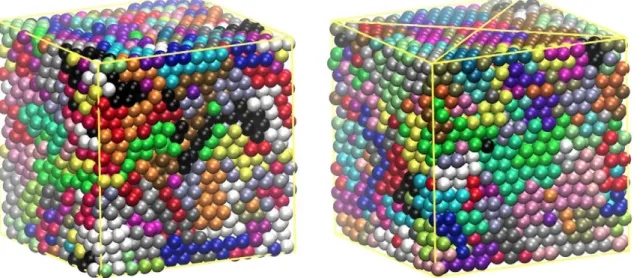
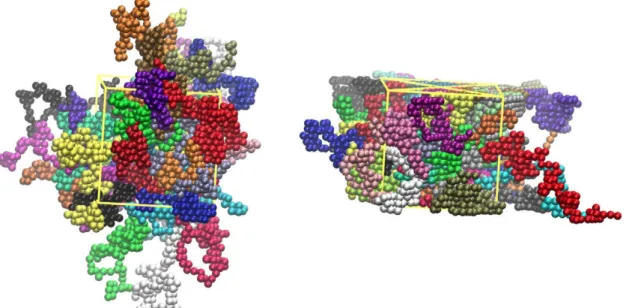
Fig. 2. Snapshots from Monte Carlo simulations on the N= 100 system with 48 chains (4800 hard-sphere monomers) at <p — 0.60: (a) in the bulk and (b) under confinement
in one dimension, with the inter-wall distance being equal to /waU ~ 16.1. Spheres are colour-coded according to their parent chain and sphere centres are wrapped, subject
Simulation cells are rectangular parallelepipeds; for each dimen-sion there is a choice between periodic boundary conditions and flat, impenetrable parallel walls (plates). The former correspond to the bulk case, in the absence of interfacial and/or surface interac-tions. The later can be employed to study the effect of (weak or strong) confinement in one or more dimensions. Initial configura-tions, fully compatible with the applied simulation conditions (periodicity, confinement, bond length fluctuations, chain length distribution etc.), are generated at sufficiently low packing densities so as to guarantee the total absence of hard-sphere overlaps. Then, regular MC simulations are conducted, with volume compressions being attempted at regular intervals. Once the target density is reached, production simulations are carried out under constant volume, typically over tens or even hundreds of billions (109) of MC
steps. Typical system snapshots of dense athermal polymers in the bulk and under confinement can be seen in Figs. 2 and 3.
In the following sections we present and analyse the main results from such extensive MC simulations with varying packing density, chain length, bond length softness and degree of confinement.
3. Results
3.1. The maximally random jammed state of athermal polymers
Jamming, and the corresponding maximally random jammed (MRJ) state in monomeric systems is intimately related to the inability of particles or atoms to move ("rattle") in the close vicinity of their local environment (Torquato et al., 2000). In a quantitative description, a particle is denoted as "rattler" if it is able to perform finite displacements without incurring overlaps with all other particles in the system which are held fixed in space. As the direct antithesis, a jammed particle is one that is effectively immobilized by the surrounding particles. Extending the concept, local jamming is related to a set of contacting particles being jammed, while global jamming demands that all particles and the corresponding
contact-ing groups are collectively jammed (Torquato et al., 2000). Out of all jammed configurations, the MRJ state is the least ordered (or equivalently the most disordered) one (Donev et al., 2005a). Thus, to identify the corresponding MRJ state for athermal polymers, assuming that such state exists, we need to (i) analyse the degree
Fig. 3. Same as in Fig. 2, but with coordinates of sphere centres fully
of (dis)order and (ii) quantitatively identify jamming in chain packings.
The analysis of local structure in atomic and particulate systems can be accomplished through proper metrics including the pair radial distribution function, g(r), the Voronoi tessellation, the rotationally invariant measures (Steinhardt et al., 1983) and the common neighbour analysis (Honeycutt and Andersen, 1987). Recently, we introduced a new descriptor, the Characteristic Crystallographic Element (CCE) norm to identify simultaneously radial and orientational deviations from a specific, perfect crystal structure (Karayiannis et al., 2009b; Karayiannis and Laso, 2008a). Given a reference atom and its closest neighbours (which can be identified through the Voronoi tessellation), the CCE norm is defined in such a way so as to quantify the extent to which this local structure resembles the environment of the site in a perfectly ordered structure. This is accomplished since each crystal structure is fully identified by a unique set of crystal-lographic operations (rotations, inversions, roto-inversions, mir-ror planes, etc.) (Borchard-Ott, 2002; Giacovazzo et al., 2005). In turn, each crystallographic element possesses a number of dis-tinct elements of the symmetry groups. In general, the higher the value of the CCE norm, ex, the larger the discrepancy from the
specific crystal structure X. In the case of a perfectly-ordered local environment with respect to reference X, the value of the corresponding CCE norm is zero (e* = 0). In parallel, a local environment with low CCE norm (ex->0) with respect to crystal
structure X (in other words with high similarity to X) has, by construction of the metric, high CCE norm with respect to a different crystal structure Y (eY>0). Consequently, the proposed
metric is highly discriminating between different crystal struc-tures. This feature renders the CCE norm a robust descriptor to accurately identify crystal nucleation and growth in general atomic and particulate systems (Hoy and Karayiannis, 2013; Karayiannis et al., 2009b, 2009c,2011, 2012, 2013a, 2013b, ; Wu et al., 2014). The mathematical formulation of the CCE descriptor along with details on the algorithmic implementation can be found elsewhere (Karayiannis et al., 2010; Karayiannis et al., 2009b, 2013b). As reported in Section 1, for dense hard-sphere packings the emerging and prevailing crystal morphologies con-sist of close packed sites. Thus, for athermal polymers local structure is identified through the calculation of the fee, hep and fivefold CCE norms (Karayiannis et al., 2011, 2012).
The CCE norm is thus the structural descriptor used to measure the degree of (dis)order in the generated hard-sphere chains. In pursue of the MRJ state of polymer packings the next obvious task is to quantify jamming. Due to the constraints imposed by chain connectivity, direct application of the "rattler" concept is not possible in chain systems. However, a similar scheme can be devised where each hard-sphere monomer attempts minute dis-placements taking into account the imposed bond constraints. For spheres which are either internal monomers or chain ends, such displacements take the form of flip- or rotation-like moves, respectively. If all attempted moves lead to overlaps with all other monomers, which are held fixed in space, the particle is effectively jammed.
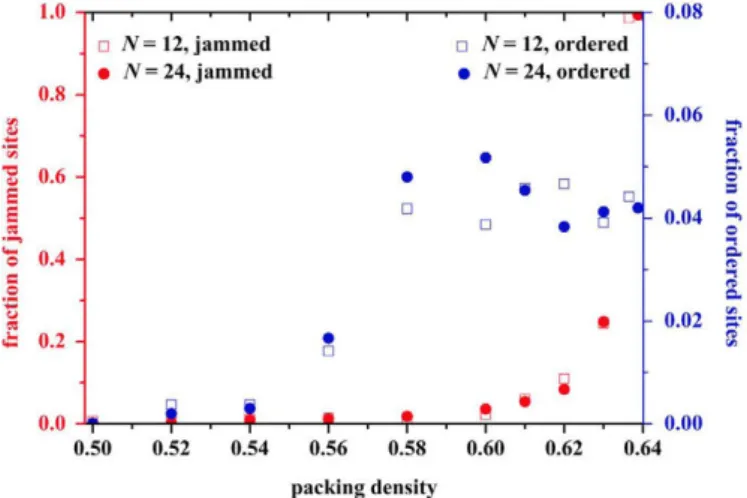
The degree of ordering (crystallinity) and the fraction of jammed monomers are continuously measured throughout the MC simulations. With increasing packing density, the number of sites with hep or fee similarity increases but remains at very low levels compared to the bulk of the system. In parallel, no appreci-able increase is observed for the fraction of jammed sites even at high volume fractions. However, subject to statistical fluctuations, based on the generation protocol and the stochastic nature of the process, once a critical packing density is met the population of "flippers" decreases sharply. At <pMRJ->0.64 jammed sites
consti-tute the overwhelming majority of monomers. The precipitous increase of jammed spheres combined with the very low degree of ordering (quantified by the CCE norm) are the two definite traces to identify the proximity to the MRJ state in athermal polymer packings as seen in Fig. 4.
Based on the above it can be concluded that freely-jointed chains of tangent hard spheres can be packed as efficiently and as densely as their monomeric analogues, reaching equivalent MR] states, (pMR¡(chains) = (pMR¡ (monomers) (Karayiannis et al., 2009d, 2013a; Karayiannis and Laso, 2008a; Laso et al., 2009). This is a non-trivial finding given that chain connectivity endows polymer packings with constraints which are absent in monomeric assem-blies. If conclusive proof existed (and not just numerical evidence) for the correctness of the observed volume fraction at the MRJ for monomeric spheres, one could conclude that it would be impos-sible for chains to pack more densely. In the absence of such a proof, our work very strongly supports the natural conjecture that hard-sphere chains pack as densely as monomeric spheres. The unique nature of chain packings compared to monomeric analo-gues can be understood through simple arguments: At the local level the presence of bond constraints alter the contact network of each site. Equally important, at the global level topological
«.08
i.u
0.8
0.6
0.4
0.2
0.0
-D N = 12,jammed
• N= 24, jammed
t • 1 • 1 • i
•
D
—f—
1
•
D
—t-' D
• 1 '
N=U,
7V = 24
•
n
• *
i »
ordered ordered
D
•
8
0.06
0.04
h0.02 Et
0.00
0.50 0.52 0.54 0.56 0.58 0.60 0.62 0.64
packing density
Fig. 4. (Lefty-axis) Fraction of jammed sites and (right y-axis): fraction of ordered
sites as a function of packing density ip as obtained from MC simulations on the N=12 and 24 systems.
constraints in the form of entanglements exist between chains, which are expected to significantly affect their packing ability, especially at very high densities.
The identification of the MRJ state for hard-sphere chains, primarily answers the fundamental question of the densest possible structure in random polymer packings and how this state compares to the one of monomeric analogues. Furthermore, it provides a definitive, precisely-bounded range (0 < cp < <pMRJ) to
study how structure, size/shape, phase behaviour and topological constraints (entanglements) of flexible chains evolve with pack-ing density. In practical terms, a well-defined classification is offered to eliminate relative arbitrariness in terms and concepts related to polymer physics (for example "dense polymer", "chain collapse" etc).
3.2. Local chain structure
Chain connectivity imposes constraints which force bonded spheres to adopt specific local configurations which are absent in monomeric counterparts. Obviously, with respect to bond lengths the tangency condition (d/->0) results in an inherent contact network. Each sphere-monomer, depending on the position along the chain possesses a kissing number of 2 (internal monomer) or 1 (chain end), with potential implications in the vicinity of the MRJ state (Karayiannis et al., 2009a).
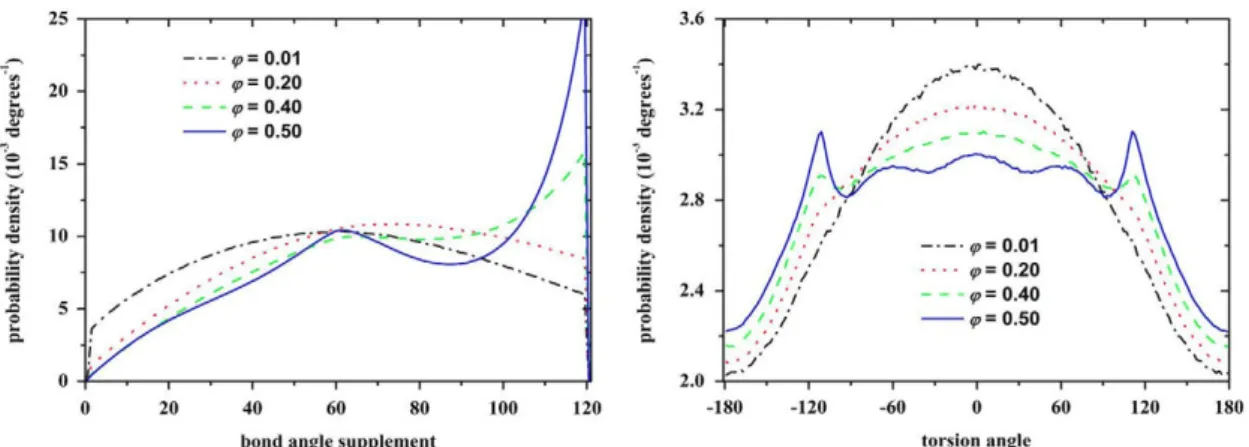
Various potentials and corresponding formulas can be employed to control contributions arising from other types of bond constraints. According to the freely-jointed model adopted here, apart from the bond constraints all other terms, primarily the bending and torsion angles, are allowed to fluctuate freely. In spite of it, and given that all covalent contributions remain subjected to excluded volume interactions, packing density has a profound effect on the conformations of bonded geometry. This can be clearly seen by the evolution of the bending and torsion angle distributions with increasing volume fraction as obtained for the N=100 system in the bulk (Fig. 5) and under confinement (Fig. 6). At very low volume fractions (dilute system) bending and torsion angles are determined solely by intramolecular interactions imposed by bond constraints. As a result, the behaviour can be accurately captured by considering an ideal system of isolated chains with excluded volume being effective for monomers separated by up to 3 bonds (Karayiannis et al., 2009d). As packing density increases chains progressively interact with each other leading to very compact configurations especially in the vicinity of the MRJ state (Karayiannis and Laso, 2008a). Bending and torsion angles adopt specific, favoured arrangements in order to locally minimize free volume. This trend is the main factor for chain compactness, leading, once a critical density range is reached, to the phenomenon of "chain collapse" as will be explained in the following section.
As shown in Karayiannis et al. (2009d, 2013a) specific local arrangements corresponding to prominent peaks in the bending and torsion angle distributions of dense chain assemblies, can be mapped into the polytetrahedral model of disordered hard-sphere packings (Anikeenko and Medvedev, 2007; Anikeenko et al., 2008).
3.3. Characteristic scaling regimes
-—
1
•s o
=
!
20
15
10
5
0
-«.= 0.01 <p = 0.20 f> = 0.40 p = 0 . 5 0
\ .if
/ t
1 /
i
20 40 60 80
bond angle supplement
100
£ 2.8
-60 0 60 torsion angle
180
Fig. 5. Distribution of (left) supplement bending angle and (right) torsion angle for the N—100 chain system, in the bulk, at volume fractions <p — 0.01, 0.20, 0.40 and 0.50.
For torsion angles, zero degrees correspond to the trans (t) conformation.
20
15
III
5
0
-i>=0.01 i>=0.20
ip = 0.40
(ü=0.50
{
-/
I
/
1
/
i
40 60 80 bond angle supplement
-60 0 60 torsion angle
Fig. 6. Same as in Fig. 5 but under 1-d confinement imposed by flat, parallel impenetrable walls. Inter-wall distance is equal to /waU ; 0.20, 0.40 and 0.50, respectively.
63.1, 23.3,18.5 and 17.1, at m = 0.01,
can be quantified through the characteristic ratio, CN, defined as CN= / R2\ / ( N - 1 ) / /2, where ÍR2\ is the mean square end-to-end
distance, ( N - 1 ) is the number or bonds along the chain backbone and / the bond length (here equal to sphere diameter). The logarithm of CN as a function of the logarithm of packing density can be seen in Fig. 7 as obtained from MC simulations on the N=50, 100 and 1000 chains of tangent hard spheres in the bulk. From these simulation data we can accurately identify the scaling regimes along with their boundaries and characteristic exponents on the dependence of chain size on volume fraction (CN ~ cpn).
According to simulation findings (Foteinopoulou et al., 2008; Laso and Karayiannis, 2008; Laso et al., 2009), four distinct scaling regimes can be clearly ascertained, in accordance to theoretical predictions (Fleer et al., 1993), for flexible chains: (i) dilute
(ii) semi-dilute (q>
*,conc
<cp< <p*.mars): ): CN~ ^ -1 0 0 and
(0 < cp < cp*-semr): CN~q>"
CN~cp-02i, .
(iv) concentrated ((p*-cmc <q> < <pMRJ); CN~ cp°. In more detail, with
respect to the scaling exponent in the semi-dilute regime
(R2\ ccNqf with / = (1 -2r/)/(3r/-l), v being the Flory exponent
(v = 0.588) (Chaikin and Lubensky, 2000). corresponding cross-over thresholds have been proposed to be <p*'seml(N) ~ N ~0 7 6 4 (Cotton et al., 1976), q>*-mi^ ~ <pMRJ/2 and q>*-conc ~ 0.59, the latter two being proposed through graph theoretical proof (Laso and Karayiannis, 2008). The predicted values for the threshold con-centrations have been confirmed by present MC simulations.
The scaling regimes along with the corresponding exponents, as established here, are in excellent agreement with past theoretical predictions and available experimental data (Cotton et al., 1976; Daoud et al., 1975; deGennes, 1980; Edwards, 1966; Fleer et al.,
0.8
0.7
0.6
^ 0.5
0.3
0.2
0.1
-i 1 1 1 r- T ' 1 ' 1 ' 1
--0.23
n A Í = 5 0 • J V = 1 0 0
N = 1 0 0 0 slope = -0.23 slope = -1.00
B ^ A -1.00
H
-2.4
- 1 —
-2.1 - 1 — -1.8
- 1 — -1.5
- 1 —
-1.2 -0.9 - 1 — -0.6
- 1 —
-0.3
logl ( l(p)
Fig. 7. Logarithm of the characteristic ratio, log10(CN), as a function of the logarithm of packing density, log10(^), as obtained from MC simulations on the N=50, 100 and 1000 chain systems. Lines with slopes of - 0 . 2 3 and - 1 . 0 0 are drawn as guides for the eye.
exponents the athermal chain model was employed, the present findings are expected to be manifestly valid also for flexible polymer models with more realistic chemical detail.
3.4. Scaling of entanglements
The exceptional dynamic and rheological behaviour of polymer melts and solutions is attributed to chain uncrossability leading to the formation of topological constraints (entanglements). Polymer rheology is intimately related to the concept of entanglements, which lies at the heart of many macromolecular theories (deGennes, 1980; Doi and Edwards, 1988; Likhtman and McLeish, 2002). In this framework, according to the original "tube" model (deGennes, 1980) and the reptation theory (Doi and Edwards, 1988) inter-chain topological constraints restrict chain motion in a "tube-like" region. The axis of the tube, or in other words the primitive path of the chain with its contour length LPP, the tube
diameter aPP (more precisely the Kuhn step length of the tube),
and the molecular weight between entanglements Ne constitute
the key elements of the tube theory. The latter is frequently used to link the theory with experimentally observed rheological properties of polymeric melts through its connection to the plateau modulus (Everaers et al., 2004; Fetters et al., 1999; Foteinopoulou et al., 2009; Theodorou and Tzoumanekas, 2006; Tzoumanekas et al., 2009). Additionally, the derived entanglement statistics can be mapped (Anogiannakis et al., 2012; Foteinopoulou et al., 2008; Steenbakkers et al., 2014) into novel slip-link theories that describe the rheological behaviour of polymeric liquids (Khaliullin and Schieber, 2009; Likhtman, 2005; Marrucci and Ianniruberto, 2004; Masubuchi et al., 2003; Ramirez et al., 2007; Stephanou et al., 2011; Wang et al., 2012).
According to the original tube theory, the primitive path (PP) of a chain is defined as the shortest path that connects the chain ends retaining the topology of the original chain without violating the topological constraints imposed on it from the other chains and whose length decreases continuously during the minimization process (Doi and Edwards, 1988). For a collection of chains the primitive path is the shortest multiply disconnected path (Doi and Edwards, 1988; Kroger, 2005).
During the last decade, a significant amount of modelling studies have been devoted to construct the PP network of a collection of polymeric chains, to identify entanglements and
to compute all related quantities (Everaers et al., 2004; Kroger, 2005; Shanbhag and Larson, 2005; Tzoumanekas and Theodorou, 2006). The algorithms, used to extract the PP network from the original configurations, can be split into two main categories: they either compute the PP network in the course of an energy minimization procedure based on the original PPA algorithm of Everaers et al. (2004) or they rely on a computationally efficient geometric length minimization method like the Zl (Kroger, 2005) and CReTA algorithms (Tzoumanekas and Theodorou, 2006). It has been established, that subject to small statistical fluctuations, both the Zl and CReTA methods provide similar results with respect to the topology and average contour length of the primitive paths (Foteinopoulou et al., 2006; Tzoumanekas and Theodorou, 2006). Moreover the PPA and Zl, when applied to the same configuration of polymer chains, give similar results for the mean primitive path contour length, the error being less than 10% (Hoy et al., 2009).
Independent analyses using the length minimization algo-rithms have demonstrated that PPs do not follow random walk statistics (Foteinopoulou et al., 2009; Tzoumanekas and Theodorou, 2006). The geometric algorithms further provide a direct measure of the number of kinks (entanglements) and accordingly a quantitative description of the underlying PP net-work. The reported relation between PP network-related quanti-ties, invoking the random coil assumption, and corresponding ones obtained by direct measure of the PP mesh was recently interpreted through the concepts of rubber elasticity and treating entanglements as binary contacts (Everaers, 2012).
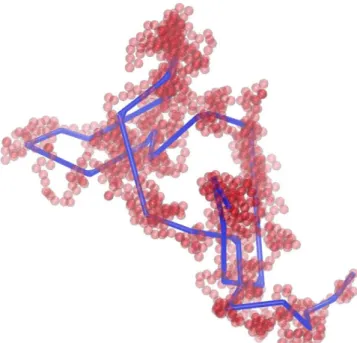
In the present study the primitive paths of athermal polymer packings are extracted through the Zl algorithm (Karayiannis and Kroger, 2009; Kroger, 2005). Fig. 8 shows the derived PP network for the N= 1000 chain system together with the parent chain configura-tions at tp=0.60. In parallel, Fig. 9 shows a snapshot focusing on an isolated, randomly picked, hard-sphere chain and the corresponding primitive path as obtained through the Zl algorithm. Motivated by the corresponding scaling laws for the "parent" chain molecules one can further obtain the corresponding scaling trends also for the primitive paths (Foteinopoulou et al., 2008; Laso et al., 2009).
An alternative measure of topological constrains in macromo-lecules can be obtained through the concept of intra-chain knot which is gaining interest in the last years (Foteinopoulou et al., 2008; Koniaris and Muthukumar, 1991; Laso et al., 2009; Mansfield, 2007a, 2007b; Panagiotou et al., 2013; Qin and
Fig. 9. Parent configuration of a single chain, randomly picked from the 54-chain N—100 system simulated at ip — 0.60, along with the corresponding primitive path (PP). Image created with the VMD software (Humphrey et al., 1996).
Milner, 2011; Rawdon et al., 2008a, 2008b). It is thus tempting to try to correlate the two different forms of topological constraints: entanglements, of inter-chain origin, with knots, an intra-molecular topological quantity. A connection between polymer knots and entanglement distance Ne was established based on
theoretical arguments on the topological entropy of long entangled polymers (Qin and Milner, 2011).
Our studies reveal that for flexible chains there is a direct connection between entanglements and knots in the whole range of volume fraction (Foteinopoulou et al., 2008; Laso et al., 2009). We use the technique proposed by Mansfield (2007a, 2007b) to identify knots, which is based on the identification of the knot group instead of the knot invariants used in other studies. Starting from an arbitrary projection of an embedded graph, this method generates a sequence of representations any of which is a full and complete representation of the knot group. This sequence is compared against the entries in a previous look-up table and if a match is found the knot group is identified. Knots are defined for closed paths, therefore to apply the knot analysis the linear chains of our study are converted into closed polygons (Foteinopoulou et al., 2008; Laso et al., 2009). Numerous closure schemes can be adopted to study knots in linear chains (Mansfield, 2007a). In the present work two approaches are adopted: the most trivial one simply connects the chains ends through a straight line, the other projects rays outward through the ends until they intersect a sphere which entirely circum-scribes the chain, then proceeds by connecting the two rays using a great circle path between the intersection points. It is observed that both methods provide essentially the same results on the scaling of the knot state and complexity with volume fraction (Foteinopoulou et al., 2008).
In Fig. 10 the fraction of knotted chains is compared with the number of entanglements of the PP network as a function of packing density for the N=1000 system. The population of entanglements is measured by two different approaches: (i) by directly counting the number of interior kinks in the primitive paths, Zkink, and (ii) by adopting the random coil assumption for
the PPs (Doi and Edwards, 1988; Everaers et al., 2004). According to the later hypothesis the number of entanglements can be
^ — V
1
X
+
8,
1
T.6
2 . 0
2.4
2 . 8
3.2
3.6 --1.4
-1.6
•
-0.36
U
•
'
1 1
0
<p
-0.32 -0.28
•
~ Ó
' A
1 1
1 1 '
3.9 .
9 .-'
.•
-0.24 -0
•
D
•
1 1 • 1
-3.2
-3.6
-4.0
211
1
•
D
A
•
- > •
•
•
.ip^*
- . '
^
/ " ' AA
A
• z
k i n tZc»il
A knots
i ' i • i '
-3.2
-3.6 J
- -4.0 V
^ -4.4 »
-4.8 S
-5.2
-3.2 -2.8 -2.4 -2.0 -1.6
log.„<*>
-1.2 -0.8 -0.4
Fig. 10. (Left) logarithm of the average number of primitive path segments (divided by the number of bonds) and (right) logarithm of the fraction of knotted chains (divided by number of bonds) as functions of the logarithm of packing density. Inset: zoom in the marginal and concentrated regimes. Lines with characteristic slopes are drawn as guides for the eye.
extracted from the PP contour length Lw and the end to end distance Reeas Zcoi, = «N>/(N- \))((l2PP/R2ee)-1).
Of particular interest is the observation that both entanglements and knots exhibit the same scaling regimes, further characterized by the same crossover concentrations and scaling exponents (Foteinopoulou et al., 2008). Although at first glance entanglements and knots seem uncorrelated, the multi-chain phenomenon of entanglements leaves its mark on the shape of the individual chains which in turn affects the knot state (Laso et al., 2009).
The inter-entanglement distance Ne can be trivially derived
from the PP information so as to investigate its variation with volume fraction. For the calculation of the entanglement distance we adopt the simple Mkink ideal estimator proposed in Hoy et al. (2009). Through such estimators the PP statistics in the (long-chain) polymeric regime can be predicted through application to significantly smaller (short-chain) and computationally-expedient systems. The derivation of Mi<ink is based on measuring directly the
interior kinks in the PP instead of adopting a random coil assumption for the primitive paths; it is defined as the inverse of the slope in the linear regime of the (Z)-versus-N curve. In order to apply this measure, chain lengths in system configurations are required to span a spectrum of different N values with N > Ni, JVi being the threshold value above which (Z) becomes linear with N. It has been shown for atomistic and bead-spring polymer systems (Foteinopoulou et al., 2009; Hoy et al., 2009) and further verified for systems of hard-sphere chains, that (Z) scales linearly with N even when (Z) is less than unity. Therefore the proposed estimator is readily applicable to the majority of the simulated polydisperse athermal systems. For example the simulated N=1000 system contains chains that span the length interval 600 < N < 1400. The Mkink estimator can be derived for the long-chain N= 1000 and be
directly compared with the corresponding predictions as obtained from systems characterized by smaller average chain lengths. The latter are properly chosen so as to have a mean molecular length close to the expected Ne value (usually with N ~ 50-100). Fig. 11
shows the dependence of Ne on packing density demonstrating the ability of the Mkini< predictor to give accurate estimations on
the entanglement spacing for systems with chain lengths deep in the polymeric regime by employing data from short-chain or oligomeric systems.
00
80
60
40
20 -• '
•
i
•
i
u
•
1
• •
1
1 1 '
• N =
i '
1000 • small N
n
•
1 i •
• •
i '
i • i
-•
-.
D D D D
• • • •
ws b
D .1 ' 1 '
0.5
Ü.4
0.08 0.16 0.24 0.32 0.40 0.48 0.56 0.64
Fig. 11. Inter-entanglement distance, M]¿nk, as a function of packing density, q>, as obtained from the N=1000 polydisperse system and from systems of significantly shorter chains (N=50-100).
simulations of entangled athermal chains (Foteinopoulou et al., 2008) is in excellent agreement with the predictions of the thermodynamicalry-consistent slip-link model by Khaliullin and Schieber (2009). Same is true when we compare the distribution of the entanglement spacing against the exponential-type master curve proposed by Tzoumanekas and Theodorou (Kamio et al., 2007; Tzoumanekas and Theodorou, 2006).
3.5. Phase behaviour of hard sphere chains
As reported in Section 1 it is well established, through experi-ments and simulations, that, once a critical volume fraction is met and given enough observation time, monomeric packings of uni-form hard spheres transit from the initial amorphous (random) state to the final crystalline (ordered) one. An obvious question is how chain connectivity affects the phase behaviour. Furthermore, if athermal polymers crystallize how do their phase diagram and the established ordered morphologies compare with the ones of monomeric analogues?
To study the phase behaviour of hard sphere chains we extend significantly the reported MC simulations to reach hundreds of billions (1011) of steps. The local environment of each
sphere-monomer is analysed, at regular trajectory recordings, to identify the degree of similarity to the hep and fee crystals and the fivefold local symmetry. The evolution of the degree of ordering (crystal-Unity), quantified here as the sum of close packed (hep and fee) sites, is tracked by the application of the CCE norm descriptor as explained earlier (Karayiannis et al., 2009b). Fig. 12 shows the fraction of hep- and fcc-like spheres versus MC steps from the
N= 12 at cp = 0.56 and 0.61. htcp = 0.56 the population of ordered
sites remains very low throughout the whole simulation. However, at higher concentration {cp = 0.61) a sharp increase is observed in the fraction of hep- and fcc-like spheres as the simulation progresses. This abrupt growth marks vividly the disorder-order transition which eventually leads to the formation of well-defined crystal structures. Thus, it is evident that at adequately high volume fractions and given enough time, chains of tangent hard spheres (of uniform size) crystallize as their monomeric analogues do (Karayiannis et al., 2010, 2013a, 2013b). Similar findings, confirming crystal nucleation and growth in dense athermal polymer packings have been independently reported in Ni and Dijkstra (2013) from dynamic simulations on chains with soft bond lengths.
.-§ 0.3
1 0.2
0.1
— 1 1 1 1 1 1 1 —
#>=0.56 hep fee <p = 0.61 hep fee
i 1 1 1
r-0 5 1r-0 15 2r-0 25 3r-0 35 4r-0
MC steps (10'°)
Fig. 12. Fraction of closed packed sites (with hep and fee similarity), as quantified
by the CCE norm, versus MC steps as obtained from simulations on the N=12 system at ip — 0.56 and 0.61.
In an isolated, athermal polymer system, given the absence of any energetic interactions (apart from the non-overlapping con-dition of excluded volume), entropy is the driving force that leads the phase transition. This fundamental physical insight has been established for the first time in the classical work of Onsager (1949) on the isotropic-nematic transition of hard rods and the entropy-driven phase transitions have since been studied exten-sively in athermal systems (Eldridge et al., 1993; Frenkel, 1994, 1999, 2000; Frenkel et al., 1988).
As explained in detail in Karayiannis et al. (2010, 2009c), as the originally disordered packing transits to the ordered state, the local environment becomes more spherical and more symmetric. To quantify the structural transition we first identify the enclosing polyhedron around each site as determined from Voronoi tessella-tion. The shape of each Voronoi cell is calculated through two principal measures, asphericity b and relative shape anisotropy k2.
These quantities can be calculated from the eigenvalues of the moment of inertia tensor of the Voronoi cell by treating all vertices as points of unit mass (Karayiannis et al., 2009b, 2009c, 2010, 2013b). The lower the value of b the higher the resemblance of the object to a sphere and the lower the k2 value the higher the isotropy of the shape with respect to the co-moving principal axes frame defined by the normalized eigenvectors. By tracking the evolution of asphericity and relative shape anisotropy as a function of MC steps we observe that both measures show a very sharp drop as the system transits to the ordered state. Thus, it can be concluded that the local environment around each site becomes more spherical and more symmetric in the ordered (crystal) phase (Karayiannis et al., 2009c, 2010, 2013b).
stable phase of dense athermal packings is a crystal consisting of hep- and fcc-like (close packed) sites. For tangent bonded mono-mers, ordered morphologies consist of well-defined, stack-faulted layers (of either hep- or fcc-like character) with a single stacking direction, a structure characteristic of the random hexagonal close packing (rhep) (Karayiannis et al., 2010, 2009c).
While the phase-behaviour of athermal chains shares a wealth of similarities with the corresponding one exhibited by mono-meric counterparts, there exist substantial differences as well. In the limit of tangent monomers (d/->0) and at packing densities near and slightly above the melting point (of monomeric systems), chain connectivity frustrates crystallization (Karayiannis et al., 2013b). For example, at cp = 0.56, freely-jointed chains of tangent hard spheres remain amorphous (Karayiannis et al., 2009c, 2010), while monomeric packings show clearly a first-order phase transition (Karayiannis et al., 2011, 2012).
It can therefore be concluded that constraints related to chain connectivity affect the phase behaviour of athermal chains near melting. To study this effect in detail we additionally allow bond lengths to fluctuate in an interval [/min = <j, lm3X = a+dl] with
varied value of d/(bond softness) compared to the tangent limit (d/->0). As the bond constraints become weaker, a wealth of ordered structures emerge, ranging from random stacks to pure hep and fee crystallites, at concentration ranges where the strictly tangent systems do not crystallize. Representative system snap-shots in the ordered phase can be seen in Fig. 13 as obtained from extensive MC simulations on the N=12 system atcp = 0.5575 with varied bond softness. For comparison, according to the data shown in Fig. 12 the corresponding tangent system with d/->0shows no traces of disorder-order transition at cp = 0.56.
3.6. Athermal polymers under confinement
MC simulations are extended to study the effect of confinement on the static and conformational properties as well as on the phase behaviour of athermal polymers. Confinement is realized through the presence of flat, parallel, impenetrable walls in (at least) one dimension. Hence, the inter-wall distance /wall, which can be
different in each of the three dimensions, enters the list of physical variables that affect polymer properties. Unavoidably, there is a relative arbitrariness in the comparison between a system posses-sing periodic boundary conditions and a confined one. Based on this for the case of 1-d confinement of cubic cells, and in order to define the basic set of parameters, we use the density of the corresponding periodic (bulk) system along with the inter-wall distance.
We should state here that while the effect of confinement has been studied extensively in the literature, the off-lattice simula-tion of confined and dense systems is non-trivial even for mono-meric hard spheres especially with respect to the phase behaviour (Fortini and Dijkstra, 2006; Veshnev and Nurlygayanov, 2011). For polymer packings, the situation is even more complicated as the inter-wall distance (which in general can be different in each direction) is compared not only with the characteristic length of the system (the sphere diameter) but also with the average chain size (as quantified for example by the radius of gyration).
The computational efficiency of the MC protocol in equili-brating the long-range chain characteristics is quantified by the decay of the orientational autocorrelation function of the end-to-end unit vector (u(t) • u(0)), as a function of time, t, measured here in MC steps. u(t) is the chain end-to-end unit vector, at time t, and brackets denote averaging over all chains and recorded frames. The faster (u(t) • u(0)) drops to zero, the faster the chain system loses the memory of the initial configuration. Fig. 14 shows the time decay of (u(t) • u(0)) for the N= 100 system in the bulk (<p = 0.40 and 0.60) and under 1-d confinement. It is clear that chain-connectivity-altering moves (here the sEB and sIEB) provide very rapid and robust long-range equilibration as in the case of chemically more complex polymer systems. In parallel, local relaxation is undertaken by the rest of the MC moves, executed in the adaptive bias pattern, which show high
A^ e
bulk, tp= 0.40 bulk, 0>=O.6O
confined, q> = 0.40,1 = 18a
— confined, w = 0.60, / „ = 16CT
7 T 7 wall
4 6 MC steps (107)
Fig. 14. Orientational autocorrelation function of the end-to-end unit vector
(u(t) • u(0)) as a function of MC steps for the N= 100 system in the bulk (q¡ - 0.40 and 0.60) and under flat impenetrable walls in one dimension. /waU denotes the
distance between the wall boundaries in the case of confinement.
Fig. 13. System snapshots as obtained from MC simulations on the N= 12 system at <p — 0.5575 with varied softness of bond lengths. From left to right: dl = 0.0195, 0.0260,
efficiency. This is demonstrated by the ability of the MC code to track crystallization even at very high volume fractions (as established in the previous section). The rate of local versus global (chain) equilibration can be tuned by altering the corre-sponding attempt probabilities of the local and chain-connectivity-altering MC moves.
Packing density has only a small effect on long-range equili-bration, even at the volume fractions of cp = 0.40 and 0.60 which lie in the marginal and concentrated regimes, respectively. Even in the latter case, close to the MRJ state, the present MC scheme requires only a few millions of steps (corresponding to minutes in wall-clock time) to provide long-range equilibration. Addi-tionally, the trends with respect to the efficiency of the MC algorithm appear to be unaffected by the presence of the impenetrable wall in one dimension. In fact the confined system at the same density as the bulk analogue shows more rapid relaxation than the periodic one. Thus, the proposed MC scheme can be reliably applied to model athermal polymers under spatial con-straints with the ultimate goal to identify the effect of extreme confinement on polymer jamming.
The presence of wall boundaries in one dimension renders the system highly non-isotropic. This in turn, affects all structural properties which either have to be defined in reference of individual dimensions, or have to be reported as a function of the distance to the confining walls. Prominent among the affected quantities is the local monomer density (concentration) which becomes highly anisotropic and heterogeneous under confinement. This is vividly shown in Fig. 15 for the N=100 system at three different packing densities (corresponding to the bulk periodic analogue) with varied inter-wall distances. In order to understand the level of confinement we also report the average dimensions of the chains, as quantified by the root mean square radius of gyration. Anisotropy in concentration is imme-diately apparent by comparing the density profiles at each dimension. Furthermore, the presence of the wall creates hetero-geneity in the density profile, which is distinctly different near the walls than far from them. Characteristic concentration minima and maxima near the walls can be attributed to specific chain conformations in combination with the impenetrability of the wall surface. As density increases, the presence of the wall, even if there is no short- or long-range interaction with the chain monomers, affects the spatial distribution of the latter at ranges that exceed the average size of the chains. At high volume fractions density profile adopts a regular pattern indicative of ordering, in contrast to the uniform one of the corresponding bulk system which remains in the amorphous state at the same packing density. We can thus conclude that by tuning the level of confinement one can control the phase behaviour of dense polymer packings.
4. Conclusions
We have presented the main results obtained from extensive Monte Carlo (MC) simulations on freely-jointed chains of hard spheres of uniform size. Through an effective algorithm, based on chain-connectivity altering moves, we are able to identify the maximally random jammed (MRJ) state of athermal polymer packings and compare its salient characteristics with the ones exhibited by the corresponding state of monomeric analogues. By exploring the full concentration range, we can accurately identify the characteristic scaling regimes of chain size with packing density, the corresponding scaling exponents and the transition thresholds. Through geometric algorithms the parent chain con-figurations are mapped into the underlying primitive path (PP) network of inter-chain topological constraints in the form of entanglements. The corresponding scaling laws can be extracted also for entanglements while a connection is revealed between entanglements and knots, valid from dilute systems up to nearly jammed ones.
As the length of the simulations is increased we observe the spontaneous, entropically-driven crystallization of athermal, initi-ally random packings. The phase (disorder-order) transition shares a wealth of similarities with the one exhibited by monoa-tomic counterparts; bond constraints related to tangency condi-tion seem to frustrate polymer crystallizacondi-tion near the melting transition.
Finally, we presented preliminary results from MC simulations on spatially-constrained polymer systems which are confined, through flat impenetrable walls, in at least one dimension. Comparison can thus be made on how the level of confinement affects the static properties and structure of macromolecules as well as their ability to crystallize.
By being complex and anisotropic systems, athermal polymers constitute a class on their own in the general topic of atomic/ molecular and particulate packing. Due to their chemical simpli-city hard-sphere chains provide an excellent statistical mechanical model to test, verify and guide theoretical concepts related to polymer physics. In a coarse-to-fine modelling approach, athermal polymers can act as the ground case in simulations of progres-sively finer chemical detail.
In the present work we have identified the packing properties of fully flexible linear athermal chains of monomers with uniform size in the bulk and under confinement. Current and future modelling extensions focus on (i) studying the effect of chain architecture on jamming, (ii) the simulation of polymer blends with binary distribution of sphere size, (iii) modelling conditions of extreme confinement with the inter-wall distance being as close as possible to sphere diameter (Termonia, 2011), (iv) the simulation of terminally-anchored polymers in complex geometries
0.8-0.6
0.4-0.2
A
K-f V - •%/ \
x dimension y dimension z dimension (confinement)
--3 0 3
distance from center
- x dimension - y dimension
z dimension (confinement)
-2 0 2
distance from center
- x dimension - y dimension
/. dimension (confinement)
-2 0 2
distance from center
Fig. 15. Local density as a function of the distance from the centre of the (cubic) simulation cell as obtained from MC simulations on the N= 100 system with confinement in
the 2 dimension. From left to right:,? = 0.20,0.50 and 0.56 (packing densities of the periodic analogue) with inter-wall distances of /wan ~ 23.3,17.1 and 16.5, respectively. The
![Fig. 11. Inter-entanglement distance, M]¿ nk , as a function of packing density, q>, as obtained from the N=1000 polydisperse system and from systems of significantly shorter chains (N=50-100)](https://thumb-us.123doks.com/thumbv2/123dok_es/6841699.836969/10.892.457.823.83.360/entanglement-distance-function-packing-obtained-polydisperse-systems-significantly.webp)