I Feel You: Towards Affect-Sensitive Domotic
Spoken Conversational Agents
Syaheerah Lebai Lutfi*, Fernando Fernández-Martínez,
Andrés Casanova-García, Verónica López-Ludeña, and J u a n Manuel Montero
Speech Technology Group, Universidad Politécnica de Madrid, Madrid, Spain {syaheerah,ffm,acasanova,veronicalopez,juancho}@die.upm.es
h t t p : / / w w w - g t h . d i e . u p m . e s /
A b s t r a c t . We describe the work on infusion of emotion into limited-task autonomous spoken conversational agents (SCAs) situated in the domestic environment, using a Need-inspired task-independent Emotion model (NEMO). In order to demonstrate the generation of affect through the use of the model, we describe the work of integrating it with a natural-language mixed-initiative HiFi-control SCA. NEMO and the host system communicates externally, removing the need for the Dialog Manager to be modified as done in most existing dialog systems, in order to be adap-tive. We also summarize the work on automatic affect prediction, namely frustration and contentment from dialog features, a non-conventional source, in the attempt of moving towards a more user-centric approach.
K e y w o r d s : Spoken Conversational Agents, affect prediction, domotic applications, Affective HiFi SCA, frustration, contentment, conversa-tional features, satisfaction judgment.
1 Introduction
E m o t i o n is quintessential for intelligence, to t h e point t h a t psychologists and educators have re-defined intelligence to include emotion and social skill. W i t h t h e mass appeal of computer-mediated agents, computers are no longer viewed as machines whose main purpose is to complete tasks, r a t h e r t h e y are required to have t h e social abilities t h a t h u m a n s naturally d e m o n s t r a t e in their daily interactions. T h u s t h e developments of conversational agents typically move to-wards including socio-emotion content, which upgrades t h e m to being socially intelligent.
This paper concerns the incorporation of a recently developed
task-independent emotional model into a voice-only social domotic agent. Using this
model, the generation of emotion is driven by needs, inspired by human's
mo-tivational system, hence called NEMO (Need-inspired EMOtion Model). The
intention is to incorporate NEMO into existing SCAs in order to enable them
to be affect-sensitive. This is accomplished by predicting user affective states
and responding to them with appropriate affective responses, through an
emo-tional text-to-speech system. The focus of the paper is not on NEMO in itself
(which has been described elsewhere [13]), but how this model will be used in
non-adaptive applications, in order to make them more adaptive to the users'
emotion. Though NEMO is a generic and task-independent architecture, actual
events and situations are required in a specific domain in order to run this model.
Therefore to demonstrate affect sensing and generation through the use of this
model, we describe the work of integrating this model with a natural-language
mixed-initiative High-Fidelity-control spoken dialog (henceforth 'HiFi-NEMO')
towards the goal of a socially intelligent HiFi agent. Specifically, this part is
described in the first part of the paper. The second part focuses on building a
real-time automatic detection of affect, as robust automatic detection is vital to
any affect-sensitive system.
2 Infusing Emotions into t h e HiFi Agent
We attempt to infuse emotions into an existing HiFi agent using NEMO. The
baseline (non-adaptive version) HiFi system is a proprietary system developed
by Grupo Technología del Habla (GTH), (see details in [8]). As mentioned
ear-lier, NEMO is a need-inspired system, whereby the agent elicits an emotion
that is coherent with the situation in view of its different needs. One of the most
influential needs for the agent's emotion modification, is the Success need.
There-fore, this section focuses on the Success need. The Success level is influenced by
various events that are related to different tasks. Previously this was done by
updating a predefined percentage of an individual event (values differ according
to events). For example, in the previous prototype of NEMO that was put to
test with a domotic robot, Groucho, whose main tasks are to manage various
domestic appliances (see [13,14]
r), an event detected by sensory inputs such as
user touching or caressing the agent's face might have a fixed value of 0.5,
indi-cating a medium success level or winning a game might have a fixed value of 0.7,
a high success level. In integrating NEMO with the HiFi spoken conversational
agent though (henceforth 'HiFi-NEMO'), we moved a step ahead by adopting
a more user centric approach, using machine learning to automatically predict
the said values by learning from past evaluation's data using a trained classifier,
described later in Section 3. An interaction event is predicted as good or bad
(and also of how good or bad) and the corresponding values will then be taken
to compute the Success need.
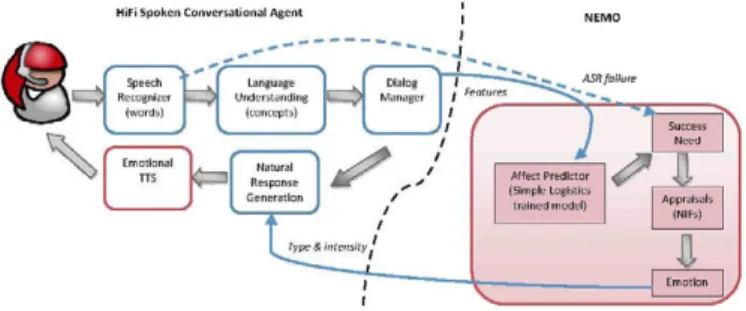
2.1 Architecture of HiFi-NEMO
Most spoken dialog systems have an architecture that is similar to the HiFi SCA,
as shown on the left side of Figure 1. The user utters a sentence and the Speech
Recognizer captures the sounds from the user's speech, matches the recognized
words against a given set of vocabulary. Then the matched words are passed
to the Language Understanding module to extract the concepts (semantic
in-formation) of the sentence. A series of concepts are then passed to the Dialog
Manager to activate dialog goals. The Dialog Manager decides both the actions
to be taken and the feedback to the user for the current dialog turn, and passes
the semantic information to the Natural Response Generator module to
gener-ate a suitable textual response to the user. The text-to-speech (TTS) module
then synthesizes the message and speaks to the user. The original non-adaptive
HiFi SCA version used a non-emotional commercial TTS. A detailed
architec-ture of the non-adaptive system is given in [8]. In converting the HiFi SCA into
HiFi Spoken Conversational Agent
Fig. 1. The architecture of HiFi-NEMO
need satisfaction to decrease rapidly, and so when a good event (turn) appears
right after, (and the user is now predicted to be in a positive emotion), the agent
will not immediately change its state to a joyful one, but rather surprised or
neu-tral, depending on the situation. Conversely, if the agent is in a joyful state for
sometime, and continues with turns that are perceived as good (user predicted
to be satisfied in consecutive turns), the drive to gratify its Success need will not
be as significant as in the other case, and so its joyful state reaches its maximum
and starts decaying into a a neutral state, though it continues to perceive the
ongoing events as positive ones.
It should be noted however that the Dialog Manager receives dialog features
only when the Speech Recognizer is successful in detecting the user's words.
When a speech recognition failure occurs, the failure event updates the agent's
Success need directly, bypassing the Dialog Manager (as indicated by the
dot-ted arrow in Figure 1). A failure message is passed to the need module which
decreases the agent's Success satisfaction level.
Next, the agent's Success need information updates the rest of the modules in
NEMO and to generate an emotion that is coherent with the agent's assessment
of its current Success need. Finally the chosen emotion matches against the
nat-ural response generation for a suitable response content and is synthesized into
a speech response of a specific intensity of the chosen emotion by an Emotional
TTS. This TTS is built by [2] and is used in replacement of the original
neu-tral one. It is capable of generating speech in various colourings of the Big Six
emotional categories, proposed by [6]¡neutral, joy, sadness, fear, anger, surprise
and also a combination of these. This is done by interpolating the prosodical
variation of one emotion into another.
3 A u t o m a t i c Detection of Affect
to model affect. While many studies focus on numerous channels for affect
detec-tion, very few have explored dialog as a potential source [4]. User affect could be
mined from conversational elements, which are always cheaper and are usually
obtained with little or no computational overhead. However, since the focus of
this paper lies on modeling affect in the HiFi agent, we limit this section into
summarizing the method and the outcome of the experiments carried out in
au-tomatic affect detection using the data from two studies that will be described
shortly.
We also focus on discriminating affect between two classes: contentment and
frustration, two types of emotions that are known to be prevalent within spoken
HCI. These two categories of affect represent positive and negative user
emo-tional state and their varying intensities (e.g., at the end of an interaction, a
particular user might have felt intensely contented with the system when the
user gave a score of 5 or 'excellent' (in a 5-point scale), and rather frustrated
when he or she gave a score of 3)
23.1 User and Annotator Studies
To model affect by predicting user satisfaction, we used the HiFi-AV2 corpus [9],
collected during a user study. HiFi-AV2 consists of audiovisually recorded
infor-mation of real, non-acted interactions (N=190 interaction sessions) between user
and non-adaptive version of the HiFi agent. In this study, users interacted with
the HiFi agent hands on and at the end of each interaction, they rated the HiFi
agent by providing a score between 1-5 Likert point (1 being very poor to 5, very
good). Later, we used a reduced version of the same corpus to obtain satisfaction
and affect-labelled data from several independent annotators. The corpus was
reduced to 10 speakers that were chosen randomly (N=100 sesions) to downsize
manual labelling efforts. This study was similar to the first one, except that the
annotators also perceived user emotion in each interaction - the annotators were
given a set of full recordings (from the start until the end of an interaction) and
they were free to label as many defined emotions (the nuances within the six
basic emotions proposed by [6]) detected throughout the whole interaction. It is
important to note that the annotators were asked to rate the agent based on the
perspective of the user, and were naive on real-users ratings - in other words the
annotators put themselves in the users' shoes and rated the system as how the
users should have rated the system. Thus we could view both datasets as that of
users' actual ratings and targeted ratings (by annotator). Additionally we also
now have affect-labelled data by annotators.
3.2 Affect Classification from Conversational Features
In order to obtain a model of user affect, we conducted two experiments;
Ex-periment I was evaluated on the satisfaction-labelled data from both user and
a n n o t a t o r subject group. Experiment II involved t h e emotion-labelled d a t a by a n n o t a t o r s . In b o t h types of experiments, we applied s t a n d a r d classification tech-niques in which several classifier schemes were utilized with t h e intention of comparing t h e performance of t h e various classification techniques, a p a r t from determining which technique(s) yield t h e best performance. T h e Waikato Envi-r o n m e n t and Knowledge Analysis ( W E K A ) [15] was used foEnvi-r these puEnvi-rposes. One or more classification algorithms were chosen from different categories including rule-based classifiers (ZeroR as baserate and O n e R ) , functions (SimpleLogistic, SMO), m e t a classification schemes (Multischeme, MultiBoost, AdaBoost) and trees (J48). A 10-fold cross validation technique was used for all t h e classifica-tion tasks.
3 . 3 D a t a R e d i s t r i b u t i o n
All satisfaction-labelled d a t a s e t s were first resampled in order to obtain a more uniformed distribution; samples with similar outcomes were grouped together, and this was repeated five times to satisfy all combinations of classification prob-lems as shown in Table 1. This way we were also able to determine which clusters obtained optimized classifications.
4 S u m m a r y of Results a n d Discussions
4 . 1 E x p e r i m e n t I ( M o d e l 1)
Table 2 presents t h e statistically Table 1. Datasets re-clustered according to significant improvements of classifi- similarity of score points into all possible corn-cation results over baserate in per- binations of classes
centage accuracy for Experiment I. Results revealed t h a t there was a significant effect of t h e subject type: F ( l , 4 0 ) = 8 3 . 0 7 , p < . 0 0 1 , par-tial fy2=.68. Classifiers evaluated on
user d a t a mostly revealed worse re-sults t h a n baserate with exception to SMO, whilst at least three clas-sifiers t h a t were evaluated on
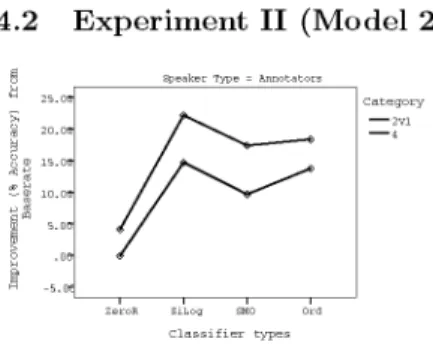
an-n o t a t o r d a t a show sigan-nificaan-nt improvemean-nt (at p < . 0 0 1 ) over baserate ian-n each category, with exception to category 3V2 and 2V2. This indicates t h a t most classifers were able to predict satisfaction from dialog features based on t h e annotator d a t a , suggesting t h a t a n n o t a t o r s were more impartial when judging t h e HiFi agent. Classification evaluated on a n n o t a t o r d a t a however yielded in-teresting result and is more suitable to be used for user affect modeling. T h u s we now focus on t h e results from a n n o t a t o r d a t a . T h e chart in Figure 2 il-lustrates t h e interactions between t h e factors t h a t obtained t h e best classifi-cation improvements for annotator dataset, t h a t are statistically significant.
Category
Five (original class) Four
Three (version 1) Three (version 2) Two (version 1) Two (version 2)
-4 . 2 E x p e r i m e n t II ( M o d e l 2)
— «> 1 0 . o o
Fig. 2. Summarized interaction chart
for annotators dataset
Experiment II involved classification eval-u a t e d on t h e emotion-labelled d a t a based on i n t e r - a n n o t a t o r agreement. T h e com-p u t a t i o n t h a t derive such agreement was adopted from [3]. Results revealed t h a t t h e SMO scheme yielded t h e best sta-tistically significant (at p < . 0 1 ) improve-ment of classification over baserate, with improvement of 13.2%, followed by t h e Ordinal and Simple Logistics schemes, with 9.8% and 9.2% improvements
respec-Table 2. Comparisons of significant
im-provements in classification accuracies in detecting satisfaction score from conver-sational features (for both user and an-notator datasets)
Category Classifiers
Base rate SiLog SMO Ord
U
tively, b o t h statistically significant at p < . 0 5 B o t h satisfaction and emotion-agreement d a t a are
signifi-cantly correlated (Pearson r = . 2 9 , at p < . 0 1 ) b u t provide complementary in-formation to model user affect. T h e d a t a used for Model 1 involved users provid-ing a satisfaction score at t h e end of each interaction; a global average score t h a t represented t h e user's opinion of t h e agent - t h a t could also be consid-ered as t h e best representation of score for each t u r n , should we have to r a t e t h e system on a t u r n basis. T h u s this infor-mation is suitable to be used to predict user affect on a turn basis. O n t h e other hand, Model 2 involved a n n o t a t o r s per-ceiving user emotion at different loca-tions of a particular interaction, when t h e emotions displayed were most obvi-ous. However t h e information on t h e ex-act locations within t h e interex-action was not noted. Hence this kind of prediction
is suitable to be performed at t h e end of t h e whole interaction, in order for t h e agent to be alerted t h a t t h e user has been frustrated at some point during t h e interaction.
Five 38.0 36.0 Four 38.0 36.0 Three (version 1) 71.0 47.0 Three (version 2) 38.0 53.0 Two (version 1) 71.0 53.0 Two (version 2) 93.0 83.0
U A - 49.3 - 53.1 - 64.0 -- 75.0 -U -A 44.6 43.4 61.1 50.7 -74.4 -U A - 51.3 - 52.0 - 62.5 -69.4
-S iLog= Functions. -Simp leLogistics, S M O = F u n c t i o n s . S M O , O r d = M e t a . O r d i n a l . U = U s e r d a t a , A = A n n o t a t o r d a t a . Results were t r u n c a t e d t o display only t h e best statistically significant
classification improvements (at p < . 0 5 )
5 Conclusions, Current and Future Directions
O u r main contribution is to show t h a t t h e Dialog Manager of t h e baseline system were neither modified nor hardwired with affect-related rules as done in most existing dialog systems, in order to be emotionally rich. Instead t h e dialog manager communicates with t h e emotion system and manages t h e dialog using t h e emotionally-relevant features provided by t h e emotion classifier. Addition-ally, t h e emotion classifier is based on a learning-by-example m e t h o d (of past d a t a ) , not an imperative, hand-crafted one. These minimize costs in two ways; first, not only t h e requirement for domain-specific expert knowledge can be re-duced, b u t t h e a d a p t a t i o n is also more user centric. Second, this model could also be re-used in new b u t similar domains, with minimum l a b o u r . O u r second con-t r i b u con-t i o n is con-to show empirically con-t h a con-t conversacon-tional feacon-tures, a non-convencon-tional source, could be used as a single source to model user affect reliably by predict-ing satisfaction ratpredict-ings, however within a limited-task domestic domain. The conversational features were t h e predictors and t h e satisfaction j u d g m e n t s were t h e target. For this task we used an a n n o t a t i o n m e t h o d t h a t is less sophisti-cated (such as t h e use of untrained judges to r a t e b o t h satisfaction j u d g m e n t s and emotions) and smaller array of features for classification tasks. Nevertheless, emotion classification improvements achieved statistically significant results over baserate.
We have implemented t h e emotion classifier into t h e emotion model, and t h e latter is incorporated into t h e HiFi agent to make it more affective. We have also developed a suitable response generation model according to t h e various intensities of t h e predicted user frustration and contentment. F u t u r e work in-volves a series of cross evaluations t h a t will be conducted between users and a d a p t a b l e / n o n - a d a p t a b l e versions of t h e agent to compare t h e findings.
References
1. Bailey, J.E., Pearson, S.W.: Development of a tool for measuring and analyzing computer user satisfaction. Management Science 24, 530-545 (1983)
2. Barra-Chicote, R., Yamagishi, J., King, S., Montero, J.M., Macias-Guarasa, J.: Analysis of statistical parametric and unit selection speech synthesis systems ap-plied to emotional speech. Speech Commun. 52(5), 394-404 (2010)
3. Callejas, Z., López-Cózar, R.: On the Use of Kappa Coefficients to Measure the Reliability of the Annotation of Non-acted Emotions. In: Andre, E., Dybkjser, L., Minker, W., Neumann, H., Pieraccini, R., Weber, M. (eds.) PIT 2008. LNCS (LNAI), vol. 5078, pp. 221-232. Springer, Heidelberg (2008)
4. D'Mello, S.K., Craig, S.D., Witherspoon, A., McDaniel, B., Graesser, A.: Auto-matic detection of learner's affect from conversational cues. User Model User-Adap. Inter. 18, 45-80 (2008)
5. Doll, W.J., Torkzadeh, G.: The measurement of end-user computing satisfaction. MIS Quarterly 12, 259-274 (1988)
6. Ekman, P., Friesen, W.: The Facial Action Coding System: A technique for the measurement of facial movement. Consulting Psychologists Press (1978)
8. Fernández-Martínez, F., Ferreiros, J., Lucas-Cuesta, J.M., Echeverry, J.D., San-Segundo, R., Córdoba, R.: Flexible, robust and dynamic dialogue modeling with a speech dialogue interface for controlling a hi-fi audio system. In: Proceedings of the IEEE Workshop on Database and Expert Systems Applications (DEXA 2010). Springer, Bilbao (2010)
9. Fernández-Martínez, F., Lucas-Cuesta, J.M., Chicote, R.B., Ferreiros, J., Macias-Guarasa, J.: HIFI-AV: An audio-visual corpus for spoken language human-machine dialogue research in Spanish. In: Proceedings of the Seventh Conference on Inter-national Language Resources and Evaluation (LREC 2010), European Language Resources Association (ELRA), Valletta, Malta (May 2010)
10. Gelbrich, K.: Beyond just being dissatisfied: How angry and helpless customers react to failures when using self-service technologies. Schmalenbach Business Re-view 61, 40-59 (2009)
11. Kernbach, S., Schutte, N.S.: The impact of service provider emotional intelligence on customer satisfaction. Journal of Services Marketing 19(7), 438-444 (2005) 12. Locke, E.A.: The nature and causes of job satisfaction. Consulting Psychologists
Press, Palo Alto (1976)
13. Lutfi, S., Barra-Chicote, R., Lucas-Cuesta, J., Montero, J.: Nemo: Need-inspired emotional expressions within a task-independent framework. In: Proc.of Brain In-spired Cognitive Systems (BICS), Madrid, Spain (July 2010)
14. Sanz-Moreno, C , Lutfi, S., Barra-Chicote, R., Lucas-Cuesta, J., Montero, J.: De-sarrollo de un asistente domótico emocional inteligente. In: XIX Jornadas Telecom I + D , Madrid, Spain (November 2009)