Conversation Skill In Adult Learners
Author
David Mauricio Carvajal Murcia
Advisor
Henry Carvajal
Universidad Nacional Abierta y a Distancia UNAD Escuela Ciencias de la Educación
ii
This research project is dedicated to my father, who taught me that the best kind
of knowledge to have is that which is learned for its own sake. It is also dedicated to my
mother, who taught me that even the largest task can be accomplished if it is done one
step at a time and my brothers and sister who have always expressed proud of having
their oldest brother completing his University Studies.
Finally, it is dedicated to my students and teachers who have motivated me
throughout these years to train as a professional and to impart, with ethics and
iii Title
level in English conversation skill in adult learners.
Author(s) David Mauricio Carvajal Murcia
Editorial Universidad Nacional Abierta y a Distancia
Date Oral Defense Date: 04, 17, 2020
Keywords
Communicative Approach, adult learner, learning needs,
English skills, level B2, First English, Common European
Framework of Reference for Languages (CEF or CEFR).
Description
This research project intends to give light on the possibilities
given by the communicative approach to help adults achieve
level B2 in the English speaking skill according to the
Common European Framework of Reference for Languages.
Sources
The sources used for this research project include a survey
asked to adult English learners, a sample test, literature
research and careful observation.
The literature research focused on authors like Jack C.
Richards and Theodore Rodgers with their book Approaches
and Methods in Language Teaching – Communicative
Language Teaching. Elsie Szecsy who wrote for the
Encyclopedia of Bilingual Education. Kirsten Schaetzel and
Sarah Young with their work Content standards for teaching
iv
besides talking with them about it, they were asked a survey
that provided real facts and useful information.
Contents
This study begins by conceptualizing, exploring, and
identifying a series of theoretical material concerning the
Communicative Approach, the adult learner, the B2 level of
conversation, and the material and teaching approach utilized
at English First Institute in Timbio, Colombia.
Afterwards, it presents a series of data concerning the strategies
and activities teachers and students use to develop the speaking
skill at the same institute. Data is collected by using an
electronic survey and the application of a sample of a B2
conversation test to verify the effectiveness and usage of
Communicative approach.
Finally, this study assesses the data collected at the institute
by contrasting it with the theoretical foundations, strategies
and activities on the Conversation approach and adult
learner’s theories in order to generate the discussion,
conclusions and recommendations.
Research Line
This study can be found within the research line of
Argumentation, Pedagogy and Learning, of the school of
education – ECEDU of the Open and Distance National
v Conclusions
adult student goes beyond the structure of language to focus
mostly on producing the speaking and communicative
competence.
This approach encourages the active use of English in the
classroom, which in turn stimulates students to speak in
English outside the classroom as well. It is pertinent for
teaching adults because it relies on adults’ interests, previous
experiences, first-language influence, background, personal
interests and needs, and reasons for learning.
Strategies, materials, activities regarding the communicative
approach are being followed poorly in the English First
Institute as a consequence the effectiveness on development
of English skills as well as results in standardized test
suggested by the CEFR is below expectation.
It is suggested that the Communicative approach be regarded
as a great framework to enhance English Conversational skills
in adult learners in any institute. In addition, it is
recommended that teachers study, learn and apply the
theoretical background, the techniques, strategies, activities,
student’s role that the CA offers so that students can be
vii
get B2 level in English conversation skill in adult learners. Licenciatura en inglés como
Lengua Extranjera, abril, 2020, Universidad Nacional Abierta y a Distancia.
The main purpose of this research project is to explore the effectiveness that the
Communicative Approach can present to help adult students achieve level B2 in English
speaking skill according to the Common European Framework of Reference for
Languages (CEFR). It was carried out in the English First Institute (EFI) of Timbio,
Cauca since the institute proclaims itself of applying the communicative approach for
teaching English to adult learners.
The research was carried out using the Mixed Method which allowed to utilize the
quantitative and qualitative approach. It permitted to integrate the information gotten
through a theoretical research on the CA, AL, the CEFR and the EFI with the results
gotten on an e-survey and a conversation mocking test.
The theoretical research showed that the CA can have an effective impact for
teaching adult learners to improve their conversation skills, since this approach considers
students’ needs, uses one on one or small groups practices, emphasizes the use of
authentic material, and etc. The previous characteristics are the same kind of things adult
learners look for when learning English. According to the e-survey the CA concepts,
strategies, materials, activities are rarely being used in the Institute and as consequence,
students’ are not reaching a B2 level according to the CEFR.
It can be concluding that could be theoretically the CA is effective for teaching
viii
and followed as a main method to teach English Conversation to adult learners.
KEY WORDS: Communicative Approach, Adult Learner, English skills, First
ix
Foremost, I thank God for giving me the opportunity to train myself personally and
professionally, through experiences that have consolidated my formation to know how to be and
know how to do throughout these years. To my parents, I thank them for the effort, love and
support that they have given me to achieve this academic process.
In addition, I would like to express my sincere gratitude to my advisor Prof. Henry
Carvajal for the continuous support of my research, for his patience, motivation, enthusiasm, and
immense knowledge. His guidance helped me in all the time of research and writing of this
research project. I could not have imagined having a better advisor and mentor for my project
research. Last but not least, I thank each of the teachers who, with their teachings and advice,
x
DEDICATION ... ii
SPECIALIZED ANALYTICAL SUMMARY ... iii
ABSTRACT ... vii
ACKNOWLEDGEMENTS ... ix
TABLE OF CONTENTS ... x
LIST OF TABLES ... xiii
LIST OF FIGURES ... xiv
CHAPTER I ... 1
Introduction ... 1
Significance of the Study ... 2
Statement of the Problem ... 3
Hypothesis... 4
Objectives ... 4
General Objective ... 4
xi
Literature Review ... 6
The Communicative Approach ... 6
Adult learners ... 11
The need to know: ... 12
The learners’ self-concept ... 13
The role of the learners’ experiences ... 13
Readiness to learn ... 14
Orientation to learning: ... 15
Motivation ... 15
Common European Framework of Reference (CEFR) and B2 Level ... 20
English first book ... 28
First English Institute ... 30
CHAPTER III ... 34
Methodology ... 34
Research Line ... 34
Research Approach ... 34
xii
Instruments ... 37
Data Analysis Method ... 38
Data Collection ... 39
Timetable ... 39
CHAPTER IV ... 40
Results and Discussion ... 40
Discussion ... 51
CHAPTER V ... 58
Conclusions and Recommendations ... 58
REFERENCES ... 62
APPENDIX ... 66
Annex 1: Data Collection Instrument ... 66
Annex 2: Mocking Test ... 72
xiii
1 Reference levels of the CEFR ... 21
2 CEFR Common Reference Levels: Global Scale (Council of Europe 2001:24) .22
3 Classification of the CEFR levels ... 26
xiv
1 How adults learn deeply ... 16
2 Multiple intelligences of Howard Gardner ... 17
3 A representation of the CEFR's model of language use and learning ... 24
CHAPTER I Introduction
This research project has as a main purpose to explore the existing possibilities
that the communicative approach can present to help adult students achieve level B2 in
English speaking skill according to the Common European Framework of Reference for
Languages (CEFR). It intends to benefit English teachers and instructors of adults as well
as educational institutions as it shows a wide range of possibilities that the
Communicative Approach offers in teaching English to adults. It also intends to benefit
those adult learners by providing them tools that might benefit and enhance their learning
process.
This study begins by conceptualizing, exploring, and identifying a series of
theoretical material concerning the Communicative Approach, the adult learner, the B2
level of conversation, and the material and teaching approach utilized at English First
Institute in Timbio, Colombia.
Afterwards, it presents a series of data concerning the strategies and activities
teachers and students use to develop speaking skill at the same institute. Data is collected
by using an electronic survey and the application of a sample of a B2 conversation test to
verify the effectiveness and usage of the Communicative approach.
Finally, this study assesses the data collected at the institute by contrasting it with
the theoretical foundations, strategies and activities on the Conversation approach and
adult learner’s theories in order to generate the discussion, conclusions and
Significance of the Study
With the globalization, the need for speaking English and not only reading or
writing it has increased greatly for adult learners. They need to be able to speak it fluently
and understand what others say. Being able to communicate in English not only enhance
learners’ possibilities to access different levels of education, but also help them to be
more open minded about cultural differences. Therefore, this study focuses researching
on an approach that presents diverse strategies, activities and materials to help learners to
develop their communicative competences.
Working for an English Institute, in Popayan and Timbio, Colombia, from 2016
to 2019, giving classes to group of executive adults and teenagers with different
backgrounds as well as reflecting on material, strategies and the real level of
conversation students reach after completing some month of study, are the reasons this
research need to be carry out.
This study is appealing since it analyses the possibilities that the communicative
approach can have in adult learns who want to develop a level B2 in conversation, in the
English First Institute but its findings can be projected to any other institutes where
English is taught.
The data collected and analyzed throughout the research could be utilized as
support to refute or accept educational proposals that promote the acquisition of
The results of the assessment of materials, strategies and English level reached
will help to reinforce, modify or cut with some practices which are or are not having a
positive impact in the development of the Speaking level in adult’s learners.
In brief, by exploring the Communicative Approach and the way it is applied at
the English First Institute, this study intends to find out the effectiveness and best
strategies for working in adults in order to get a B2 speaking level. This research project
seeks to benefit language educators who need to know the most appropriate
circumstances under which adult students learn, and what are the mental processes and
conditions that facilitate their learning process and make it interesting, effective and
successful since the learning needs of adult students are different from those of little
children.
Statement of the Problem
Learning a language is always a challenge, but in most cases, it seems to be much
more difficult for adults than it is for children and teens. The Communicative Approach
offers a wide range of opportunities and possibilities that can help adult learners improve
their communicative competences.
Therefore, it is necessary to know the characteristics of this approach that make it
appropriate for teaching English to adults. It is also essential to understand what makes
the difference in the learning process of those different age groups, and what the way in
which adults learn a language is.
Additionally, it would be meaningful to verify if an institute like the English First
teaching, can get their students to perform a B2 speaking skill after certain months of
studying with them.
Bearing in mind the last statement, this project research is developed around the
following question:
How effective could be the communicative approach in developing the speaking
competence in English to adults in order to achieve B2 at English First Institute?
Hypothesis
The Communicative Approach offers effectiveness to help develop the
communicative competences in English to adults so that they can attain level B2 of the
Common European Framework of Reference for Languages.
Objectives General Objective
To recognize the effectiveness of the Communicative Approach for developing
speaking skills in adult learners.
Specific Objectives
• To determine the main theoretical foundation related to the communicative
approach as well as the main concepts related to adult learners and the way this
approach can be suitable to help adults develop their communicative competence
• To identify the main strategies and activities used at the English first Institute to
help students to reach a B2 in Conversation skill by applying and e-survey and an
B2 conversation assessment.
• To assess the impact of the communicative approach used at the English First
Institute by contrasting the theoretical foundation on the communicative approach
CHAPTER II Literature Review The Communicative Approach
Developing the speaking skill has always been a challenge in foreign language
teaching and the need for communicating effectively, appropriately and fluently in
English, has always been a plus for speakers of other languages.
In seeking for developing the conversation skill in a second or a foreign language,
a great number of approaches have been created. The audiovisual, audio-lingual,
audiovisual, direct, total physical response, community, suggestopedia, and
communicative approach are samples of some methods or approaches utilized during
certain times and specific needs of people.
During different times, the focus of language teaching and learning has changed
from being teacher-centered to one that was concerned with students' initiative and
development. Some approaches used prescriptive methods where language teaching and
learning was seen as a matter of habit formation based on grammar structures; but
knowing a language necessitates creativity and, as Littlewood (1981) said, it requires
"functional communication activities" as well as using the language in "social interaction
activities".
Richards (2006) proposed two methodologies to achieve the goal of
communicative language teaching; these process-based methodologies are Content-based
instruction (CBI) and Task-based instruction (TBI). CBI is a methodology that favors the
acquisition of language through the use of the content; in addition, it allows to link and
used in order to provide learners with opportunities to be involved in meaningful tasks.
The former are tasks in which interaction among learners is necessary but the task itself
will not be found in the real world while the latter are tasks designed from authentic
materials such as newspapers, store brochures, pamphlets, maps, magazines, fiction and
no-fictions books, novels, TV advertisements among others. These materials can enhance
real communicative activities as follows: commenting news, solving problems,
expressing a point of view, sharing personal experiences, comparing, among other real-
life situations.
As Richards and Rodgers (2014) report, there is more information about
Communicative language teaching than learning theory. For this reason, they believe that
it is necessary to discuss the three elements of the learning theory that can be
distinguished in some communicative language teaching practices. The first element is
the communication principle that relates to the activities focused on the use of real
communication. The second is the task principle which focuses on the use of language to
carry out meaningful tasks. Finally, the third one is the meaningfulness principle in which
the language used must be meaningful to the learner.
There is a great number of activities aimed at developing learners' communicative
competence using communicative processes, such as information sharing, negotiation of
meaning, and interaction. Similarly, the use of games, role plays, simulations, and task-
based activities are necessary to support classes in which the Communicative language
teaching approach is used (Richards and Rodgers, 2014).
The Communicative Approach is conducted in the direction of enhancing
instructional process (Menking, 2002; Qinghong, 2009). The Communicative Approach
goal is to improve student's communicative competence, which consists mainly of
sociolinguistic competence, discourse competence and strategic competence (Kachru,
1989; Koike and Tanaka, 1995). Cited by Demirezen Mehmet (2011)
Individual learners have different interests, styles, needs, and goals, which should
be met in the design of instructional methods. Therefore, learning materials and
techniques must be developed "based on the particular needs manifested by the class"
(Applebee 1974: 150). Cited by Richards and Rodgers (2014)
The Communicative Approach (CA) is a classroom methodology that demands
pairing and grouping of learners to enhance negotiation of meaning, development of
confidence by engaging in tasks and activities that are fluency-based. The role of a CA
teacher is more of a facilitator of learners' task performance because learners do more
talking than in a traditional classroom. With CA, activities, and tasks set up by the
teacher involve real-life situations which include games, role-playing, simulations and
problem-solving (Finocchiaro and Brumfit, 1983: 91)
Hymes (1972) held that the goal of language teaching is to develop
communicative competence, and that linguistic theory must include communication and
culture. According to Hymes (1972), a person with communicative competence has
knowledge and ability for language use. Howatt (1984) talks about a "strong" and a
"weak" version of Communicative Language Teaching, where the weak version has
referred to learning to use English, while the strong one means "using English to learn it."
The Communicative Approach has gone by way of some phases. The first phase
changed the syllabus from one based on the structure to one based on communicating
meaning (Wilkins 1976). The second phase is composed of analyzing learner needs as an
essential component of the approach (Munby 1978). In the third phase, the focus was on
developing group-oriented learning activities (Prabhu 1987).
The communicative approach looks for developing some communicative
competences in speaking which include: Leading students to acquire a reasonably logical
progression within and between ideas; they ought to be able to transmit purpose as they
adapt their ideas to the vocabulary and structures they know as English speakers. As they
progress in the speaking skill, they need to cultivate an appropriate tone of voice,
pronunciation, grammar, and intonation. It is also important for them to be able to use
physical expressions to support their message and show confidence and enthusiasm in
speaking.
Some fundamental characteristics of Communicative Language Teaching, as
described by Finocchiaro and Brumfit (1983) are: Its goal is communicative competence,
not linguistic competence. Meaning and contextualization are fundamental. Dialogues
have communicative functions and are not memorized. Learning a language is learning to
communicate. Any device that enhances learning is accepted. Attempts to communicate
must be encouraged throughout all the learning process. The translation may be used only
when students need or benefit from it. Teachers help learners in any way that motivates
them to use the language. Language is created by the student, often through trial and
error. Accuracy is judged within the context. Motivation will spring from the interest in
Communicative Language Teaching supports a wide variety of classroom
procedures where students learn English by using it to communicate. CLT integrates all
the language skills in communication and its goal is to promote authentic and meaningful
communication and it also promotes fluency.
The Communicative Approach is a humanistic approach to teaching and gives
priority to the interactive processes of communication. Johnson and Johnson (1999)
identify five characteristics of the Communicative Approach:
1. Appropriateness: Language reflects situations and must be appropriate to those
situations so that learners have the opportunity to use formal and casual speaking
terminology.
2. Learners need to be able to create and understand messages with real meaning.
3. CLT activities engage learners in the use of cognitive processes necessary for
second language acquisition.
4. Students can learn from their errors.
5. CLT encourages the integration of skills, rather than practicing individual skills
one at a time.
In the communicative approach, the learner is a negotiator between him/herself,
the learning process, the object of learning, and other learners. The teacher is a facilitator
and independent participant in the group. Besides organizing resources, the teacher is also
a resource. Teachers guide classroom procedures and are contributors to students'
learning. Instructional materials promote communicative language use, including text-
Hymes (1972) held that the goal of language teaching is to develop
communicative competence, and that linguistic theory must include communication and
culture. According to Hymes (1972), a person with communicative competence has
knowledge and ability for language use. Howatt (1984) talks about a "strong" and a
"weak" version of Communicative Language Teaching, where the weak version refers to
learning to use English, while the strong one means "using English to learn it." (1984:
279).
After analyzing these different authors, it can be seen how the CA outlines the
following statements: language is acquired throughout communication principles,
grammar is not to be followed step by step going from the easy to the difficult but be
presented according to conversation situations, the conversation must go beyond
grammatically correct sentences or phrases and focus in situation and moment so that a
series of statements can complement each other give sense to an interaction in the target
language, language must be contextualized around learners' need and purpose of the
interaction, practice in pairs and role-playing are paramount when trying to get
meaningful intents of communication, the material is to be presented in the target
language, use of native language must be restricted, teacher role must be focused on
facilitating learning by researching about how to get students immersed in learning,
observing of students' needs, generating moments of full interaction with and among
students and looking for authentic material and being a continuous motivator of learners.
Adult learners
Over the past 50 years, adult English-language standards have reflected two
teaching. Newer standards on student learning focus on what students need to learn and
actually do learn (Daggett 2000), rather than on what scholars think that they should
learn.
John Firth said that language needs to be studied in the socio-cultural context of
its use, including participants, their behavior and beliefs, the objects of linguistic
discussion and word choice. Most adult English students like to express their learning
necessities, what they need and want to learn; they often ask a question like "how do you
say…?" They will be motivated to speak in English if they can talk about their interests
and if they feel that they can express their thoughts. (Richards & Rodgers, 2001: 158).
As Mezirow (1981:15) claims andragogy is "an organized and sustained effort to
assist adults to learn in a way that enhances their capability to function as self-directed
learners". The concept of andragogy "meant art and science of helping adults learn, and
was ostensibly the antithesis of the pedagogical model" (Knowles, Holton & Swanson,
2005:59). Importantly, Knowles (1984) assumed adult learning is a complex process in
which learners acquire knowledge only under certain conditions.
Knowles (1984) associated andragogy with a range of instructional practices that
could be used by instructors to maximize learners' abilities. Assumptions of the
andragogical model and their applications in teaching are presented below.
The need to know:
Adults need to know why they learn something to be able to undertake to learn;
otherwise, they do not make an effort to improve. Also, it is important to trigger students'
need to learn. According to Knowles, Holton & Swanson (2012), the level of adults'
and where they want to be". Moreover, the scholars suggest that adults' learning could be
enhanced by "Personnel appraisal systems, job rotation, exposure to role models, and
diagnostic performance assessments. In other words, adults are more likely to make
intellectual growth if they are properly motivated.
The learners’ self-concept:
Adults need to feel capable of making their own decisions to develop their "self-
direction". Additionally, they feel resistant when some rules are imposed on them.
According to Brookfield (1986) "Facilitators should create environments where adults
develop their latent self-directing learning skills". Knowles (1975) assumes that the "self-
directing concept is a process in which individuals take the initiative, with or without the
help of others" In other words, Knowles suggests that adults can learn more efficiently
and quickly if they are encouraged to take initiative and choose a learning strategy that
they would benefit from the most. Moreover, the scholar assumes that adults who
passively wait to be taught by their teachers are less likely to gain educational growth
than those students who are actively involved in their learning process. Following
Knowles, Holton& Swanson (2012) "As adult educators become aware of this problem,
they make efforts to create 21 learning experiences in which adults are helped to make
the transition from dependent to self-directing learners".
The role of the learners’ experiences:
Adults enter an educational activity with a great volume of life experience that
can either prompt or hinder their educational growth. Firstly, adults can use these
experiences to their advantage since they are often aware of the goals that they want to
responsible decisions. On the other hand, the accumulation of life experience can be
problematic in a learning process since adults have already developed habits and they can
reject new ideas that are proposed in the learning environment. It is improper to devalue
or ignore adults' as quite often adult learners "define themselves in terms of the
experiences they have had" (Knowles, Holton & Swanson, 2005). Hence, it is a
challenging task for educators to accept adults' identities and needs and to help them
overcome learning obstacles. Importantly, teaching adults requires diverse teaching that
taps into the experience of the learners, such as group discussions, simulation exercises,
problem-solving activities, case methods, and laboratory methods instead of transmittal
techniques". Additionally, collaborative work can help students open their minds to new
ways of thinking.
Readiness to learn:
In learning easier tasks should precede more difficult activities to avoid
disappointment and possible pitfalls. This developmental movement is "a developmental
task which arises at or about a certain period in the life of the individual, successful
achievement of which leads to his happiness and success with later tasks, while failure
leads to unhappiness in the individual, disapproval by the society, and difficulty with
later tasks" (Knowles, 1980). Specifically, the materials or teaching strategies that are
used at an improper time can hinder learners' development and result in educational
failure. It is therefore advisable to devise adult-education programs following the
assumption that the materials should be well sequenced and timed. As Knowles explains,
(1980) "If the teachable moment for particular adults to acquire given learning is to be
with their developmental tasks". Planning lessons to appropriate sequence is therefore
important.
Orientation to learning:
Adults are practical in their orientation to learning, which means that they usually
make an effort to learn, provided that they perceive learning helpful in their daily life
experiences. Similarly, by virtue of nature, they do not come into an educational activity,
if they realize that they will not benefit from learning in their daily life situations. As
Knowles, Holton & Swanson (2005) suggest, "…adults are life-centered (or task-centered
or problem-centered) in their orientation to learning" in contrast to children who are
"subject-centered". Adults are likely to perform various tasks quicker and more
effectively if they are able to apply knowledge in real life. Thus, it is crucial to remember
that school textbooks should be as authentic as possible so that adults can find some real-
life applications in them.
Motivation:
Adults engage in an activity if they are properly motivated. Scholars have various
definitions of motivation, however, "Most social scientists see motivation as a concept
that explains why people think and behave as they do." (Weiner, 1992 in Włodkowski,
2008:1). Understanding learners' thinking and behavior facilitate students' learning.
It is worth noting that originally Andragogy consisted of 4 assumptions, but it has
grown from four to the six described above over time. Specifically, assumption number 1
(the need to know) was added in 1990, whereas assumption number 6 (motivation to
learn) in 1984. All in all, the Andragogical Model promotes independence and self-
environment. Moreover, learners should participate in a variety of activities that include
discussions and problem-solving issues. Since adults learn what they need to learn so that
learning programs should be organized around real-life applications. Furthermore,
learning experiences should refer to the specific needs and expectations of adult learners
to create a meaningful and relevant learning environment.
Adults need to understand the rules; they need more explicit details than children.
Additionally, new knowledge should be built based on previous knowledge. Children
implicitly acquire a second language, but adults learn through explicit and declarative
knowledge (DeKeyser, 2000; Harley & Hart, 1997). (Muñoz, 2003:129).
The following image shows some key points to consider in adult learning:
Figure 1.
1How adults learn deeply
Note: Source: Robertson and Chang (2014).
It is very important to consider what Howard Gardner identified as a series of
"multiple intelligences" (MIs) so teachers may prepare meaningful lessons and activities
that will help different types of students learn easily. Gardner (1993) identified MIs that
develop separately within our brains and which can be highly developed. Teachers must
allow learners to participate in activities using intelligence at which they do excel
(Richlin, 2006: 30-31).
Following is a graphic that shows the nine types of multiple intelligences or
learning styles of Gardner:
Figure 2.
2Multiple intelligences of Howard Gardner
Note: Source: Ostwald/Kowald, Tracy. (2014). Connections Academy.
Concerning language learning, there were several studies conducted in the 1970s,
which may be summarized in following generalizations (Muñoz, 2003: 2):
(1) Adults proceed through the early stages of syntactic and morphological
development faster than children (where time and exposure are held constant).
(2) Older children and adults acquire faster than younger children (where time and
exposure are held constant).
(3) Acquirers who begin natural exposure to the second language during childhood
generally achieve higher second language proficiency than those beginning as
adults. (Krashen et al., 1979/1982, reprint: 161).
While both, children and adult people may acquire a foreign or a second
language, eventually, those who begin younger will have better performance (Muñoz,
2003: 129). Here, it is necessary to make the distinction between language acquisition
and language learning:
The acquisition is the "natural" way; it parallels language development in children
as they acquire their first language. It is an unconscious process that involves the natural
development of language proficiency through understanding and using the language for
meaningful communication. Acquiring a language is a subconscious process during
which there's no awareness of grammatical rules. For acquiring a language, the learner
needs to have a source of natural communication.
Learning, on the other hand, it refers to a process in which conscious rules about a
language are developed. It results in explicit knowledge about the forms of a language
occur, and the correction of errors helps with the development of learned rules. Language
learning is not communicative; it is the result of being instructed in the rules of language.
According to an experiment devised by Avi Karni from the University of Haifa,
Israel, under controlled conditions, adults can attain even better results than children in
acquiring certain language skills. Small children pick up a new language implicitly,
without giving it conscious thought, while adults are supposed to rely on explicit memory
and learn the rules of a language. Teacher quality is fundamental to helping students
make progress to reach their goals. It is challenging to enhance teacher knowledge and
skills in adult ESL (Schaetzel, Peyton and Burt 2007; Smith and Gillespie 2007).
Taking into account the previous research, it could be deducted that adult English-
language learners have a variety of prior educational and life experiences, English-
language proficiency levels and educational goals. They also have different
circumstances that provide them with opportunities to use and practice English outside
the classroom which in turn affects their learning process. Factors such as language
aptitude, age, and motivation play a part in the way they acquire the English language.
Nowadays with technological advances as well, the use of mobile devices and the
Internet, children, and teenagers have had more exposure to English spoken by natives,
than the majority of adults. Moreover, their level of motivation, as well as the approach
used to teach them English might be different.
For that reason, while adults may acquire a second language at a faster rate at the
beginning, one of the logical reasons for which younger people may have a higher level
of final fulfillment is the exposure to the target language for a longer period throughout
It is clear then, that adult learners present their own set of specific characteristics
when facing a learning process. Involvement in planning, actions, and reflection in
ongoing processes, challenges to solve problems, use of authentic situations and real
situations and level of relevance, among others, are some of those characteristics that can
get them engaged, as well as, they constitute the elements that teachers must bear in mind
when trying to be effective adult language professionals.
Common European Framework of Reference (CEFR) and B2 Level
The University of Cambridge in its manual Using the CEFR: Principles of Good
Practice (2011) provides information that allows to understand what the CEFR is and
how it works. (www.cambridgeenglish.org/images/126011-using-cefr-principles-of-
good-practice.pdf)
The CEFR was developed by the Council of Europe with extensive support of the
University of Cambridge ESOL Examinations.
The CEFR is a framework, which was published by the Council of Europe in
2001, which describes language learners’ ability in terms of speaking, reading, listening
Table 1.
1Reference levels of the CEFR
C2 Mastery Proficient user
C1 Effective Operational Proficiency
B2 Vantage Independent user
B1 Threshold
A2 Waystage Basic user
A1 Breakthrough
Note: Source: Using the CEFR: Principles of Good Practice. (2011). University of
Cambridge, ESOL Examinations. www.cambridgeenglish.org/
The CEFR emerged to serve as a common international framework for language
learning and testing. However, the CEFR is not a seal of approval and it does not cover
every possible context of language use. It is a common international framework for
language learning that may facilitate co-operation among educational institutions in
different countries. It was also expected that it could provide a basis for recognition of
language qualifications. (University of Cambridge. Using the CEFR: Principles of Good
Practice, 2011:5)
The CEFR is helpful to teachers, learners, examining bodies, educational
administrators and it is also used by governments and employers. People from different
countries use the CEFR to explain what level of English they are at and what level of
Following is a basic description of the CEFR levels.
Table 2.
2CEFR Common Reference Levels: Global Scale (Council of Europe 2001:24)
Proficient User
C2
Can understand with ease virtually everything heard or read. Can summarize information from different spoken and written
sources, reconstructing arguments and accounts in a coherent presentation. Can express him/herself spontaneously, very fluently and precisely, differentiating finer shades of meaning even in more complex situations.
C1
Can understand a wide range of demanding, longer texts, and recognize implicit meaning. Can express him/herself fluently and spontaneously without much obvious searching for expressions. Can use language flexibly and effectively for social, academic and professional purposes. Can produce clear, well-structured, detailed text on complex subjects, showing controlled use of organizational patterns, connectors and cohesive devices.
Independent User
B2
Can understand the main ideas of complex text on both concrete and abstract topics, including technical discussions in his/her field of specialization. Can interact with a degree of fluency and spontaneity that makes regular interaction with native speakers quite possible without strain for either party. Can produce clear, detailed text on a wide range of subjects and explain a viewpoint on a topical issue giving the advantages and disadvantages of various options.
B1
Can understand the main points of clear standard input on familiar matters regularly encountered in work, school, leisure, etc. Can deal with most situations likely to arise whilst travelling in an area where the language is spoken. Can produce simple connected text on topics which are familiar or of personal
Basic User
A2
Can understand sentences and frequently used expressions related to areas of most immediate relevance (e.g. very basic personal and family information, shopping, local geography, employment). Can communicate in simple and routine tasks requiring a simple and direct exchange of information on familiar and routine matters. Can describe in simple terms aspects of his/her background, immediate environment and matters in areas of immediate need.
A1
Can understand and use familiar everyday expressions and very basic phrases aimed at the satisfaction of needs of a concrete type. Can introduce him/herself and others and can ask and answer questions about personal details such as where he/she lives, people he/she knows and things he/she has. Can interact in a simple way provided the other person talks slowly and clearly and is prepared to help.
Note: Source: Little, D. Cambridge Journals. Cambridge University Press, 2006: 168
http://faculty.ksu.edu.sa/yousif/ELT%20Resources/Primary%20ELT/the%20common%2
0euroupean%20framework.pdf
The CEFR has nine chapters, plus an introductory section (‘Notes for the User’).
Chapters 2 to 5 are the key chapters for most readers. Chapter 2 explains the approach of
the CEFR and lays out a descriptive scheme which is more detailed in Chapters 4 and 5.
Chapter 3 introduces the common reference levels. Chapters 6 to 9 far based on aspects
of learning, teaching and assessment. (University of Cambridge. Using the CEFR:
Principles of Good Practice, 2011:7)
Chapter 2 of the CEFR describes a model of language use called the ‘action-
Figure 3.
3A representation of the CEFR's model of language use and learning
Note: Source: Using the CEFR: Principles of Good Practice. (2011). University of
Cambridge, ESOL Examinations. www.cambridgeenglish.org/
The figure shows a language user, whose developing competence reflects various
cognitive processes, strategies and knowledge. Depending on the contexts in which the
learner needs to use the language, he/she is faced with tasks to perform. The person uses
language activities to complete the tasks. All of which is conducive to learning. The
language activity in the model is the performance on a speaking, writing, reading or
listening task (real-life task). The teacher observes the activity and gives feedback, which
leads to learning. (University of Cambridge. Using the CEFR: Principles of Good
Practice, 2011:8)
The Cambridge University based on the CEFR has a variety of exams which
allow teachers, learners, employers, etc. to see the level of different qualifications in the
command of the English language of an individual. Additionally, the exams allow
employers and educational institutions to compare easily the qualifications of Cambridge
exams to other exams in their country.
Figure 4.
4Cambridge English exams on the CEFR
Note: Source: Cambridge English Language Assessment (2016)
http://www.cambridgeenglish.org/exams/cefr/
The CEFR is a flexible tool that may help in the preparation of lesson plans
emphasizing in the communicative needs of the students, including varied situations
including dealing with the business, exchanging ideas and information, getting wider
intercultural understanding, etc. This is to be achieved by ‘basing language teaching and
learning on the needs, motivations, characteristics and resources of learners.’ (2001a:3).
(University of Cambridge. Using the CEFR: Principles of Good Practice, 2011:13).
As discussed previously, tasks and interaction are the key notions on the model
proposed by the CEFR and in such way, language may be used with a purpose which
involves communication in order to achieve goals. An example may be to give students
magazines’ stories, then selecting, adapting or writing material for a classroom
newspaper. This kind of task allows working individually or in collaborative groups.
(University of Cambridge. Using the CEFR: Principles of Good Practice, 2011:14).
The Erasmus University Rotterdam, Netherlands (2016) has made the following
classification of the CEFR levels, which is quite clear and will provide an easy to
understand context to move on to the specifics of the B2 level.
(http://www.eur.nl/english/ltc/alumni/cefr/a2/):
Table 3
3Classification of the CEFR levels.
A1 – Beginners
A2 – Pre-Intermediate
Basic user
B1 – Intermediate
B2 – Upper-Intermediate
Independent user
C1 – Advanced
C2 – Proficiency
Proficient user
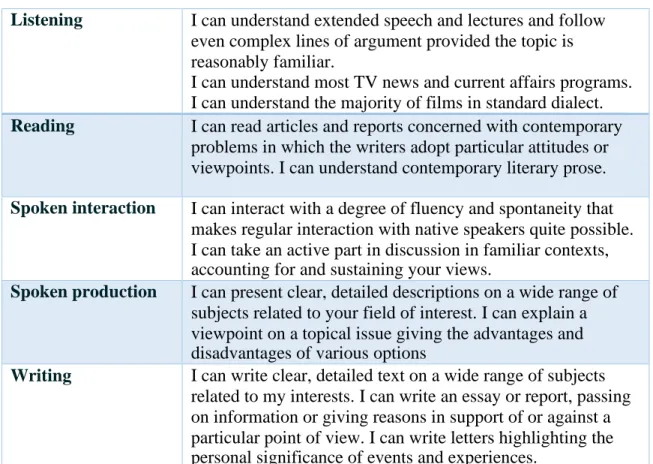
Keeping in mind that the B2 user corresponds to a more advanced with an upper-
intermediate level, succeeding is a table which shows the specific competences that a
student needs to achieve in each of the four main skills in order to be considered an
English B2 level user. The table was designed based on the CEFR Common Reference
Table 4. CEFR LEVEL B2 (Upper-Intermediate): Vantage – can understand the
main ideas of complex text and can produce clear detailed text. Can spontaneously enter
into a conversation.
Table 4.
4CEFR LEVEL B2
Listening I can understand extended speech and lectures and follow
even complex lines of argument provided the topic is reasonably familiar.
I can understand most TV news and current affairs programs. I can understand the majority of films in standard dialect.
Reading I can read articles and reports concerned with contemporary
problems in which the writers adopt particular attitudes or viewpoints. I can understand contemporary literary prose.
Spoken interaction I can interact with a degree of fluency and spontaneity that
makes regular interaction with native speakers quite possible. I can take an active part in discussion in familiar contexts, accounting for and sustaining your views.
Spoken production I can present clear, detailed descriptions on a wide range of
subjects related to your field of interest. I can explain a viewpoint on a topical issue giving the advantages and disadvantages of various options
Writing I can write clear, detailed text on a wide range of subjects
related to my interests. I can write an essay or report, passing on information or giving reasons in support of or against a particular point of view. I can write letters highlighting the personal significance of events and experiences.
Note: (Upper-Intermediate): Vantage. Source: Erasmus University Rotterdam,
Netherlands (2016). http://www.eur.nl/english/ltc/alumni/cefr/a2/
From all the previous research, it may be deducted that the CEFR is a model, a
framework that fits very well with the communicative approach and it is very adequate to
teach adults since it involves communication in the target language in real-world
Reaching the B2 level represents that leaners are able to use the language fluently,
accurately and effectively on a wide range of general, academic, vocational or leisure
topics, marking clearly the relationships between ideas. Learners can communicate
spontaneously with good grammatical control without much sign of having to restrict
what he/she wants to say, adopting a level of formality appropriate to the circumstances.
Can interact with a degree of fluency and spontaneity that makes regular interaction, and
sustained relationships with native speakers quite possible without imposing strain on
either party. Learners can highlight the personal significance of events and experiences,
account for and sustain views clearly by providing relevant explanations and arguments.
Having a conversation B2 learners can engage in extended conversation on most
general topics in a clearly participatory fashion, even in a noisy environment. Can sustain
relationships with native speakers without unintentionally amusing or irritating them or
requiring them to behave other than they would with a native speaker. Can convey
degrees of emotion and highlight the personal significance of events and experiences.
Can keep up with an animated discussion between native speakers. Can express his/her
ideas and opinions with precision, present and respond to complex lines of argument. Can
account for and sustain his/her opinions in discussion by providing relevant explanations,
arguments and comments convincingly.
English first book
English first book is a powerful tool that provides new and simple ways to present
and practice grammar, skills work, pronunciation, vocabulary and videos from
encourages more varied and effective. The first English book is divided into fifteen
modules, each consisting of approximately eight hours of classroom material each
module contains some or all of the following:
• Reading and/or listening and/or vocabulary – and introduction to the topic of the
module. And in incorporates speaking.
• Grammar- input/revision in two Languages focus sections with practice activities
and integrated pronunciation work.
• Vocabulary- includes a Work-spot section which focuses on common words
(have, get, take, etc.)
• Task preparation- a stimulus or model for the task which are often listening or
reading and Useful Language for the task.
• Task- extended speaking, often with an optional writing component.
• Real life section- language needed in more complex real-life situations, usually
including listening and speaking.
• Writing skills
• A Study...Practice…Remember! section- to develop study skills, with practice
activities and a self-assessment section for students to monitor their progress.
Learners are encouraged to take an active, systematic approach to developing
natural, communicative way. There are two language focus sections in each module, in
which grammar is presented using reading or listening texts. Each language focus has a
grammar box focusing on the main language points.
English first book aims to integrate elements of a task-based approach into its
overall methodology. There are structured speaking tasks in each module which include
interviews, mini-talks, problem-solving and storytelling. The primary focus in on
achieving a particular outcome or product. Rather than on practicing specific language.
Learners are encouraged to find the language they need in order to express their own
ideas.
Teachers have the need to use a discovery approach in the teaching of grammar
which allowed students to work out further rules for themselves. This often takes the
form of “test-teach” introductory material, and analysis boxes consisting of questions to
guide students towards forming hypotheses about the language and working out the rules
themselves.
Finally, responding to learners’ individual language needs throughout Students’
Book, during the task and speaking activities, students are instructed to ask their teacher
about any words or phrases they need. The ability to respond to students’ individual
language needs is central to a task- approach.
First English Institute
The First English Institute is a private educational establishment that is based on
determined for the good result of communication in other languages. English First
institute was created in 1998 from the initiative and dream of one of its founders to form
a peaceful, cultured, disciplined and multilingual Colombia. Since then, they have
vigorously worked on the idea and development of an institution that contributes to an
education focused on preparing the most competent students in a globalized world.
Nowadays English First Institute has 16 students.
First English institute has become in a well-known institute because of its
methodology which over the time has made more emphasis on a Communicative
Approach which has given them outstanding results in using different activities,
materials, and strategies suggested by such a book. The method emerges as an instrument
to analyze the learning process of the students to collect the works related to both the
knowledge acquired and their own skills; adequately necessary for reflection on their own
learning process throughout the course from their own work. As a technique, it allows
reflection on its own learning process throughout the course from its own work.
First English Institute focuses its process on English first Book which allows them
to work on the different skills firstly using student’s book which contains listening,
videos, vocabulary, grammar explanations, games and exercises. Secondly workbook
which allows to practice the entire grammar explanations which were given previously on
the student's book, furthermore it contains listening. And thirdly teacher´s book addresses
each exercise about student's book giving the require explanations to resolve them in a
productive way
On the other hand, English First Institute stresses to have a personalized learning
catered to their specific needs, they learn more and faster. Essentially, English First
Institute can achieve better outcomes with its training courses by making them more
personal. Its basis method for a personalized learning is based on four benefits such as
increased engagement, increased motivation, less time wasted and better results. That is
why its classrooms only have from eight to fifteen students.
English First Institute offers a course which is split up in 5 modules, each module
is worked with a different book. Level A1 works with English First Elementary book, A2
level works with English First Pre-Elementary book, B1 level works with First English
Intermediate book, B2 level works with English First Upper-intermediate book and
finally C1 level uses English First Advance book. Each module contains 4 levels which
can be developed during four months and are given by four different teachers. This is due
to English First Institute wants its students learn by adapting the different methodologies,
pedagogy that each teacher has.
Every month the students are assess according to the level they are in.
-Elementary and Pre-intermediate levels must present two exams, firstly an
interview which is taken with a different teacher, Interviewer is able to do questions
according to the grammar, vocabulary and topics they have seen during the level. Finally,
Students take writing exam which is based on grammar rules, vocabulary, reading
comprehension and listening.
-Intermediate, Upper-Intermediate and advance levels must present three exams.
Firstly, Students present a speech about a topic which has been assigned to the students
previously by the teacher or sometimes it is a free topic. The speeches have to be focused
interview which is taken with a different teacher. Interviewer is able to do questions
according to the grammar, vocabulary and topics they have seen during the level and
finally Students do a writing exam which includes specific grammar rules, a lot of
vocabulary, reading comprehension and listening. Apart from that teachers assess their
CHAPTER III Methodology Research Line
As defined in the Article 24 of the Statute of Research UNAD, this study can be
found within the research line of Argumentation, Pedagogy and Learning, of the School
of Education—ECEDU of the Open and Distance National University—UNAD.
Research Approach
This research project was conducted as a “mixed method” The term “mixed
methods” refers methodology of research that presents the systematic integration, or
“mixing,” of quantitative and qualitative data in a single investigation.
The main principle of this methodology is that the integration permits a more
complete utilization of data than do separate quantitative and qualitative data collection
or analysis. The evaluation of Communicative Approach being used in the English First
Institute provide an ideal opportunity for checking the effectiveness of such approach in
adult learners.
Mixed methods research originated in the social sciences and has recently
expanded into the education. As expressed by Creswell and Plano Clark, (2011) mixed
methods procedures have been developed and refined to suit a wide variety of research
questions. Those procedures include advancing rigor, offering alternative mixed methods
designs, specifying a shorthand notation system for describing the designs to increase
communication across fields, visualizing procedures through diagrams, noting research
conducting various forms of mixed methods studies.
According to Creswell and Plano Clark, (2011) the core characteristics of a well-
designed mixed methods study include the following:
• Collecting and analyzing both quantitative (closed-ended) and qualitative (open-
ended) data.
• Using rigorous procedures in collecting and analyzing data appropriate to each
method’s tradition, such as ensuring the appropriate sample size for quantitative
and qualitative analysis.
• Integrating the data during data collection, analysis, or discussion.
• Using procedures that implement qualitative and quantitative components either
concurrently or sequentially, with the same sample or with different samples.
• Framing the procedures within philosophical/theoretical models of research, such
as within a social constructionist model that seeks to understand multiple
perspectives on a single issue—for example, the effect of teaching English
conversation using the communicative approach.
This modality of study is based on the standardization given by the overall
guidelines for elaborating bachelor thesis in the School of Education—ECEDU of the
Open and Distance National University—UNAD.
In brief, as it mentions before, this research has a mixed approach and relies on
collection of qualitative information through the use of a survey, experience in teaching
adult students, and the analysis of samples of students who took the final exam after
having completed 16 months of study English in the English First Institute.
Variables
According to Hernandez, Fernandez and Baptista (2006) a variable is a property
that can fluctuate and whose variation is likely to be measured or observed.
Taking into account the type of mixed study that frames this project, the variables
were determined by the frequency which certain actions were presented in the classes of
students who had studied sixteen months in the English First Institute. To get a clear idea
about the facts that were analyzed according to their frequency, they were grouped in
four categories as follows: teacher’s role, student’s role, activities and strategies used in
class, and results of a mocking test of conversation.
The description and analysis of these actions allowed defining the effectiveness of
using the communicative approach when trying to improve the English level in adult
learners.
Participants
In order to obtain information about the variables, an electronic closed survey was
applied to students who were finishing sixteen months of English study in the second
semester of 2019 at the English First Institute. The study population was made up of 16
students of the mentioned institute, since they were the ones to whom the researcher had
access.
The type of sampling used was the simple random probability, which according to
The method of selection of participants is that of selecting randomly not restricted, where
all individuals of a population have the same opportunity to be included in the sample.
The formula and its variables are described below:
𝑍2𝑝𝑞𝑁
n=
(𝑁 − 1)𝑒2 + 𝑍2𝑝𝑞
where:
n = sample size
Z = reliability = 1.96
p = success rate = 50%
q = failure probability = 50%
N = universe = 16
e = relative sampling error = 5%
1.962 × 0.5 × 0.5 × 16
n=
(16 − 1) × 0.052 + 1.962 × 0.5 × 0.5 = 16
According to the above formula, the sample size was 16 students.
Instruments
An electronic closed questionnaire, generated from the telematics tool called
Surveys - Forms in Google Docs was used to collect the information. The reason why an
electronic closed questionnaire was used, was determined by the possibility that this
questionnaire provides specific answers, either in frequency, intensity, or duration, to
carry out a mixed research, which was the type of study implemented. The link for the
survey was distributed to the participants of the research via institutional email and phone
A mocking test was also applied to the sixteen students via skype. The mocking
test was applied on a pair bases.
Procedures
The collection of information was carried out taking into account the following
three steps: First, the database of students participating in the survey was obtained.
Second, a message through email was sent to the students; this message contained the
title and the objective of the survey, as well as an invitation to participate in it. After the
invitation, the link of the survey was placed so that students could enter freely to answer
the questionnaire.
As soon as students answered the survey, the answers were automatically sent to
an Excel file where the information was collected. After obtaining the data, the tabulation
and subsequent analysis took place in order to comply with the phases of the research.
For the mocking test, students were scheduled for a 20-25-minute session via
skype on a two students at the time bases. Students were assessed following the four kind
of questions that a Fist Certificate of English Test has. As soon as the results were gotten
they were organized in tables so that the discussion could be done.
Data Analysis Method
Statistical analysis was used to analyze the collected data. The results were
presented graphically through pie diagrams. Based on those diagrams, the results were
contrasted, analyzed and discussed bearing in mind the different theoretical information
on the Communicative Approach, Adult learners, levels of English according to the
Common European Framework for Languages in order to obtain conclusions about the
Data Collection
The procedure used for the study, first of all, consists of literature research of the
bibliography found in the virtual library of UNAD, and material found on Academic
Google and books. The information for this research included the survey, the mocking
test as well as discussion and input from the students, and careful observation obtained
through experience teaching adults in English First Institute in Timbio, Colombia.
To finish the process, all the information gathered is analyzed and compared in
order to produce the best and most precise results and conclusions possible.
Timetable
The process for completing this study was carried out during a period of time of 4
months. Here, previous experience by the author is not included, but is considered as a
means to enhance this document.
• Collecting data took one month, including literature research, survey and
observation and applying the English Mocking Test
• Classifying information, one month, observation took throughout this period of
time.
• Analyzing data took fifteen days
• Writing results and confronting information took fifteen days.
• Writing the discussion and conclusions took a month.
• Proofreading took fifteen days.
Teachers at the institute research about the
complexity of teaching languages.
19% 19% Very
frequently Frequently
Occassionally
Rarely
62% Never
CHAPTER IV Results and Discussion
After applying a closed-question survey used as a tool for the data collection in
this study, the obtained results are now presented. The electronic survey was applied to a
sample of 16 students belonging to the English First Institute who have taken sixteen
months of English. The presentation of the survey results as well as the results of the B2
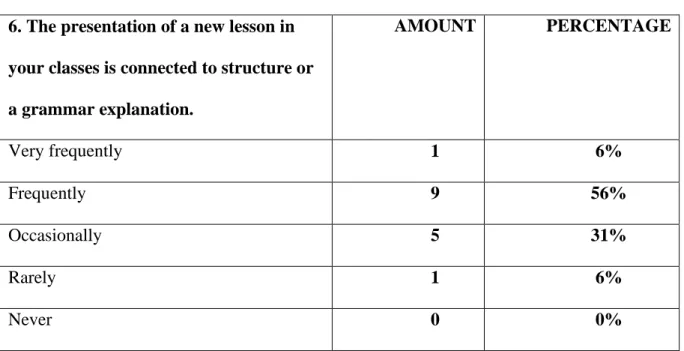
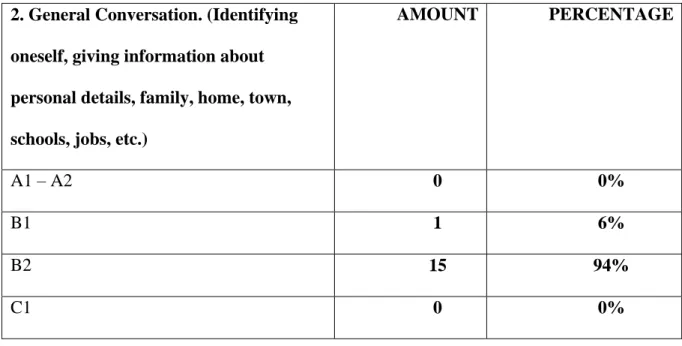
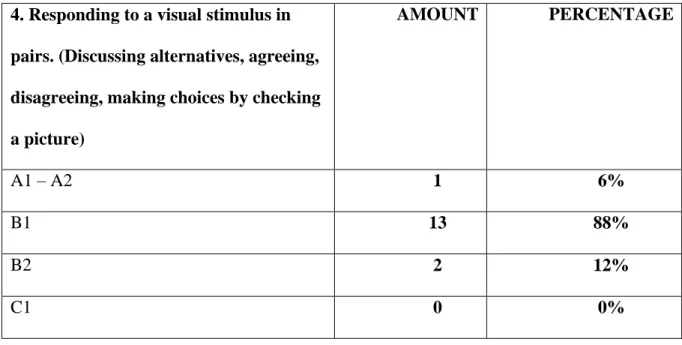
sample test are classified into four categories, delimited by the three to six questions
each.
Category 1. What is the main role of the teacher in class?
This category was answered by expressing the frequency in which the following
statements were presented in the classes:
Teachers organize the content of the course
according to students’ needs
6%
25% Very frequently
Frequently
Occassionally
69%
Rarely
Never
Out of 16 students who responded to the survey, 10 students (62%) said they
rarely saw their teachers researching or commenting about the complexity of language
teaching; 3 students (19%), occasionally heard that; and 3 students (19%), said they never
heard their teachers talking about the complexity of teaching languages.
Chart 2: Teachers organize the content of the course according to students’ needs.
For this question the following results were obtained, 11 students (69%) said
teachers rarely organize the content of the course according to students’ needs; 4 students
(25%) said they never saw the content organized around their needs; and 1 student (6%),
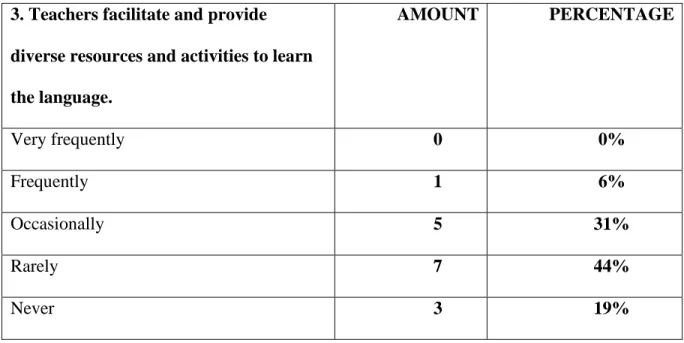
Teachers facilitate and provide diverse resources
and activities to learn the language.
Very frequently
19% 6%
Frequently
31%
Occassionally
44% Rarely
Never
Chart 3: Teachers facilitate and provide diverse resources and activities to learn the language.
From the sample, 7 students (44%) said teachers rarely facilitated and provided
diverse resources; 5 students (31%), occasionally facilitated activities to learn the
language; 3 students (19%), said they never facilitated and provide different resources to
learn the language; and 1 student (6%) said teachers frequently used diverse activities to
learn the langue.
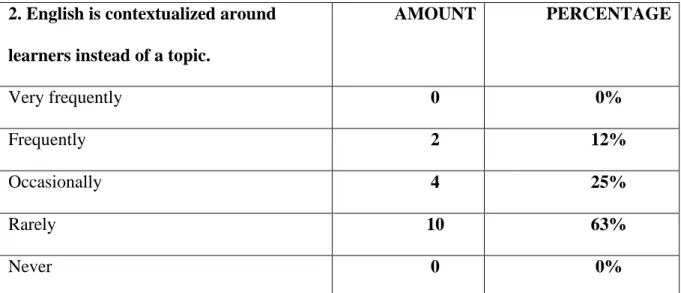
Category 2. What is the main role of students in class?
This category was answered by expressing the frequency in which the following