In collaboration with:
Coworkings
in Catalonia,
Index
1. INTRODUCTION ... 4
2. LEGAL FRAMEWORK AND PUBLIC POLICIES ... 6
2.1 How do we define a coworking space? ... 6
2.2 Legal framework for coworking spaces and services ... 7
2.3 Public policies addressed to coworking spaces in Catalonia ... 7
3. DESCRIPTIVE ANALYSIS OF COWORKING SPACES IN CATALONIA ... 10
3.1 Catalogue of coworking spaces and services ... 10
3.1.1 Methodology ... 8
3.1.2 General characteristics of coworking spaces ... 10
Year of foundation ... 10
Legal status ... 10
Member of a platform ... 11
Location of coworking spaces ... 12
Coworking managers profiles ... 13
3.1.3 Users’ profiles ... 14
Users’ gender ... 14
Users’ age ... 14
Users’ education ... 15
Additional characteristics ... 15
Users’ needs and demands ... 15
3.1.4 The economic dimension of coworking spaces and activities ... 16
Business models ... 16
Specialisation ... 17
Services and available facilities ... 18
Relationship with eco-system ... 20
Coworking trends and forecast ... 21
4. THE EFFECTS OF COWORKING SPACES ... 22
4.1 Social effects ... 22
Social capital ... 22
4.2 Labour effects ... 23
Coworkings as employers ... 23
Coworkers as employers ... 23
New employment structures ... 23
Professional skills and networking ... 23
Coworker Income ... 24
4.3 Economic effects ... 24
New business models ... 24
Benefits for firms ... 25
Real estate effects ... 26
Public-private sector partnership ... 26
4.4 Territorial effects // innovation effects ... 26
People and project mobility ... 26
Territorial Sustainability ... 27
Territorial dynamisation ... 27
Territorial dynamisation in rural areas ... 27
5. SWOT ANALYSIS ... 29
1.
Introduction
Since the opening of the first coworking space in San Francisco in 2006, the number of coworking spaces worldwide has doubled year after year. This remarkable success can be attributed to a growing demand for new, more flexible and cheaper office space among an ever-expanding pool of freelance workers and the emergence of new innovation and business models. Within this context, the European founded COWORKMed (CWM) Project aims to provide a wide analysis of the state of the coworking phenomenon in participating countries and regions. These countries and regions include Croatia, Greece, Région Provence Alpes Côte d’Azur (PACA), Tuscany and Catalonia. In Catalonia the project was led by Barcelona Activa and BIBA Ventures Partners, with the collaboration of Cowocat, the Association of Coworkings of Catalonia.
In order to develop this analysis, different methods of data and information collection were used. On the one side, a survey was carried out in each territory to obtain a catalogue of coworking spaces and services. This survey was conducted through an online questionnaire, which was distributed among the different coworking spaces located in each territory, to be answered by their respective managers. In Catalonia, as there is not a legal definition of coworking, the questionnaire was sent to all the centres and activities which defined themselves as coworking spaces. That is why there was no differentiation between those that fit within the wide accepted criteria to define a coworking and those that do not. Thus, the questionnaire was sent to 172 coworking spaces and it was answered by 40 of them.
Although the rate of response was relatively low as compared with the partner territories (23.3%), the initial census was much bigger in Catalonia than in the other area. Therefore, the absolute number of responses (40 responses) was also higher than that in partner areas. In fact, according with the CWM Project results, Spain is the country with the biggest number of locations of Google Searches under the name “coworking” and Barcelona is the first city in the world ranking.
2.
Legal framework and public policies
2.1 HOW DO WE DEFINE A COWORKING SPACE?
According with the CWM project conclusions, in Catalonia it does not exist a legal definition of what a coworking is as opposed to the other MED areas involved in CWM.
As a consequence, one of the outcomes of the CWM project had to be to find an agreed definition of coworking, which is not exempt of difficulties. As a starting point and based on the literature review about this topic, CWM partners agreed on the following definition of a coworking space: “A coworking space is a physical space aiming to build and implement a dynamic community of users sharing a propensity to foster collaborative, open and sustainable relationships. Coworking spaces are actively managed to promote these goals, also by organising events and activities supporting mutual learning and exchanges and by developing new functional typologies and interactions with other services or centres”. Once the project results will be available, they will agree on the final definition of a coworking space.
This definition is based on three dimensions, which are the following:
i. Community. A community is a dynamic and complex social configuration, so that
there is an interaction between persons coming from different backgrounds and willing to hybridise skills, visions and job opportunities.
ii. Active management. Active management means that some services and
organisational patterns are offered to promote mutual exchange and reciprocal knowledge. That is, there exists a staff dedicated to foster and support interdependence and exchanges between members.
iii. Animation activities. Animation activities are those events and activities aimed at
facilitating any kind of exchange between coworking spaces, their members and all the external dimensions implied in the coworkers’ activities, such as territories or policymakers.
These features distinguish coworking spaces from other seemingly similar activities, like temporary offices or cafes, where there is not a dynamic community, or those initiatives based on renting spaces, where it does not exist active management or animation activities. The community is grounded on a series of values that have been defined in the Coworking Manifesto1. The letter has been signed by most of coworking centres around the world. These values, which are the base of an emerging economic model, include collaboration over competition; community over agendas; participation over observation; doing over saying; friendship over formality; boldness over assurance; learning over expertise; people over personalities; "value ecosystem" over "value chain".
2.2 LEGAL FRAMEWORK FOR COWORKING SPACES AND SERVICES
According with the conclusions of the CWM project, in Catalonia there is not a specific legal framework aimed at regulating coworking spaces or their activities. Also, no specific legal provision has been set up by the Central Government or the European Union.
In fact, this was one of the main concerns of coworking spaces’ leaders that arose in the different Focus Groups and in the interviews as well as in the queries received by Cowocat during the last years. Coworking is not recognised as an economic activity. Therefore, it is not possible to obtain a license that specifically allows the development of this activity when opening a new coworking space. Thus, the general practice for opening a coworking space at the moment sits under the standard procedure in order to start an activity in an office opened to the public. However, if the coworking space includes other services such as coffee or lunch room, 3D printers, nursery, etc. it is necessary to obtain additional licenses for each of these activities.
2.3 PUBLIC POLICIES ADDRESSED TO COWORKING SPACES IN CATALONIA
According to the conclusions of the CWM study, there are not any generalised public policies addressed to promote coworking spaces or their use in Catalonia. This is not the case in some regions of the partner countries, where there exists some funding addressed to coworking spaces (Croatia or PACA) or to coworkers (Italy).
Despite the lack of substantive policies, it is worth mentioning some smaller but interesting public initiatives. First, the Barcelona Council and the district of Sant Andreu have promoted a coworking space (Sinergics) in Baró del Viver2 with the aim of promoting socio-economic development and social value projects in the neighbourhood. This initiative can be seen as a good example of a public-private partnership in this sector. Similarly, several local governments in Catalonia have promoted the opening of public coworking spaces, most of them free of charge or subject to a low price, although they are subject to some limits and conditions to access. Also, the Cowocat Rural Project 3, promoted by the Local Action Group of Mora d’Ebre, which has received the technical support of Cowocat and economic funding from Europe (through the Catalan Government), grants some public and private coworking activities, according to a series of conditions. Finally, many universities are offering their students the possibility of accessing coworking spaces in order to foster entrepreneurship and to raise awareness regarding the benefits of cooperation and co-creation processes.
So far, coworking activities have also been the object of EU calls and have been cited in EU documents or programs as part of larger fields of activities, such as Digital Innovation Hubs. In the same way, in 2013 and 2014 the Department of Culture of the Council of Barcelona made two calls aimed at subsidising digital innovation expenditures in firms, and coworking spaces were allowed to receive these funds under some conditions.
3.
Data collection methodology
The CWM Project carried out a survey in each territory to obtain a catalogue of coworking spaces and services. This survey was conducted through an online questionnaire, which was distributed among the different coworking sites located in each territory. In Catalonia, as there is not a legal definition of coworking, the questionnaire was sent to all the centres and activities which define themselves as coworking spaces, regardless of fitting in the above-mentioned definition. Thus, the questionnaire was sent to 172 coworking spaces and it was answered by 40 of them.
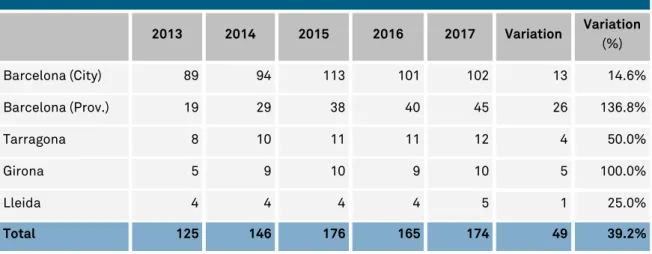
Although the rate of response was relatively low as compared to the partner territories (23.3%), the initial census was much bigger in Catalonia than in the rest of areas. Therefore, the number of responses (40 responses) was also higher. In fact, according with the CWM Project results, Spain is the country with the biggest number of locations found in Google Searches under the name of “coworking”. Additionally, Barcelona is the first city in the world ranking. Table 1 shows the evolution in the number of coworking spaces in Catalonia during the period 2013-2017, by province. As it can be observed, the number of coworking spaces increased by 39.2 percentage points between 2013 and 2017, being the most important growth the one experimented in the provinces of Barcelona (136.8%) andGirona (100%), although in Girona it implied an increase of only 5 coworking spaces.
Table 1. Evolution of the amount of coworking spaces (2013-2017)
2013 2014 2015 2016 2017 Variation Variation (%)
Barcelona (City) 89 94 113 101 102 13 14.6%
Barcelona (Prov.) 19 29 38 40 45 26 136.8%
Tarragona 8 10 11 11 12 4 50.0%
Girona 5 9 10 9 10 5 100.0%
Lleida 4 4 4 4 5 1 25.0%
Total 125 146 176 165 174 49 39.2%
Note that the results of the survey might not be representative of the real characteristics of all the coworking spaces in Catalonia. Despite this, using the questionnaire, we obtain information about:
• The main characteristics of coworking spaces:year of foundation, legal status, being
part of a platform or not and location.
• The users’ profiles: gender, education and profession.
• The economic dimension of coworking spaces and activities:interactions with other
institutions, research centres and SMEs, sectors and specialisations, etc.
2012 or before 17,7%
2013 12,5%
2014 14,6% 2015
26,0% 2016
16,7%
2017 12,5%
4.
Descriptive analysis of coworking
spaces in Catalonia
4.1. GENERAL CHARACTERISTICS OF COWORKING SPACES
Year of foundation
The first Spanish coworking space was opened in 2007 in Catalonia, in the neighbourhood of Gracia (Barcelona). However, already in 1995, a space aimed at providing a coworking space, without being called “coworking space”, opened in Barcelona. In fact, it was not until 2008 when coworking activities started to spread across Europe. As it can be observed in Figure 1, the survey results show that a 17.7% of coworking spaces in Catalonia began their activities before 2012. Specifically, 10 out of 40 of the Catalan spaces where opened before that date.
Figure 1: Year of foundation of coworking spaces in Catalonia (% of total respondents)
Source: CWM Project survey.
Legal status
No 75%
Yes
National; 20%
International; 5% 25%
Company; 40,0%
Assoc./Coop.; 5,0% Public; 12,5%
Other/Not Identifiable; 32,5%
Individual Company; 10,0%
Figure 2. Legal Status of Coworking Spaces in Catalonia (% on total respondents)
Source: CWM Project survey.
Member of a platform
The online questionnaire also asked whether the coworking space belonged to a platform or network. In Figure 3, we can see that 75% of the coworking spaces are not connected to a more extended network of spaces, while 25% are part of a bigger coworking network. That is, 25% of the coworking spaces set up activities with connections extending beyond the localised social or economic initiatives taken by the founders or managers. Among this 25%, 80% are linked with a national network and the remaining 20% to an international one.
Figure 3. Percentage of coworking spaces being part of a larger platform in Catalonia
Rural Area; 10%
Urban/Metrop. Area; 90% Location of coworking spaces
In Table 1 we can observe than more than a half of the coworking spaces in Catalonia are located in Barcelona city. Figure 4 shows us that most coworking spaces (90% of them) are located in urban areas and within a metropolitan area, while only a 10% are located in a rural area. Given the existence of agglomeration economies, it is expectable for most of the coworking spaces to concentrate in the city of Barcelona. In fact, coworking managers were also asked about their reasons for the choice of their location and 57.5% of the coworking managers answered that they had rented the space because of its location, showing that this is a relevant factor4.
Figure 4. Location of coworking spaces in Catalonia
Source: CWM Project survey.
If one wants to take a deeper look to the location issue, there are three major points to consider that are foreseen to condition the spot of these spaces. First, being able to interact with a specific target of users. Second, the potential bounding with external entities, such as universities, companies or other institutions. And third, the ability to cover the territorial needs. In the questionnaire, coworking managers were asked to evaluate in a scale from 1 (strongly disagree) to 5 (strongly agree) each of these points in order to uncover the underlying reason for their specific geographic location. The results show a relative tied outcome. Most coworking managers strongly agree with the fact that their location was due to a specific target of users (with a score of 4.2); and they also agree with the importance of territorial needs and interaction with external actors (with a score of 3.8 and 3.7, respectively).
4 The other options in the questionnaire include being the owner of a building, considering the price of the rented
4,20%
3,70%
3,80%
3,4% 3,5% 3,6% 3,7% 3,8% 3,9% 4,0% 4,1% 4,2% 4,3%
To interact with a specific target of users
To interact with external actors Territorial needs
Figure 5. Specificities due to the geographical localisations in Catalonia
Source: CWM Project survey.
In the cases where the score given to the territorial needs was of 4 or 5, the respondents were also asked to describe what kind of territorial needs they were referring to. In general, the existence of ecosystem connections, the uniqueness of the space in a specific location and the easy access were the most frequent answers. Note that the reason why there is an increase in rural coworking spaces if precisely to respond to territorial needs, either providing coworking services to tourists or responding to the local demand.
Coworking managers profiles
Coworking spaces are not only defined by the characteristics of their location, but also by the profile and features of the person in charge of them. In Catalonia, the main characteristics of the coworking managers are the following:
• There is gender equity between men and women.
• There are similarities between two age ranges – 45% of managers are aged 30 to 40 years old whereas 42.5% are within the 40 to 50 years old range.
• Most of the managers have a tertiary education or equivalent and a profession related with managing spaces and areas.
Male majority 21%
Strong female majority 5%
Strong male majority 5%
Female majority 18% Balance 51%
Up to 24 13,8%
25-34 32,0% 35-44
37,0% 44 and more
17,2% 4.2. USERS’ PROFILES
One of the main aspects considered in all the coworking spaces studies is the users’ profile and their characteristics. Therefore, it is important to analyse if there is some feature – such as gender, age or level of education – shared among them.
Users’ gender
It is interesting to see that there is a slight female majority among coworking users, since women represent the 53.5% of total users. Figure 6 shows that according to coworking managers, the distribution by gender is quite balanced in half of the spaces; while 23% of present a female majority and 26% a male majority.
Figure 6. Distribution by gender in coworking spaces in Catalonia
Source: CWM Project survey.
Users’ age
User’s age is shown in Figure 7 where we can see that 37% of the users are aged between 35 and 44 years old, almost the same rate as those in the 25 to 34 years old range. Therefore, it is relevant to point out that 69% of all coworking users in Catalonia are between 25 and 44 years old. Users with an age above 44 or below 24 years old, hold only the 17.2% and the 13.8% of all coworking spaces, respectively. This is not a surprise, since it is thought that the youngest are less able to lead a company due to lack of experience and the oldest tend to be more reluctant to engage in non-traditional ways of working.
Figure 7. Users by age group
Less than primary, and lower secondary
20%
Upper seconday and post-secondary
non-tertiary 20% Short-cycle tertiary
or equivalent Master or equivalent
42%
Doctoral or equivalent level
18%
Users’ education
As shown in Figure 8, 60% of the users have a level of education equivalent to tertiary education or more. Specifically, 18% of the users hold the highest level of all – PhD or equivalent, and 42% of coworking spaces’ users hold a short-cycle tertiary, master or equivalent. Regarding the rest of users, 20% of them have reached upper secondary and post-secondary non-tertiary education and 20% have primary or lower-education level.
Figure 8. Users by education attainment level in Coworked territories
Source: CWM Project survey.
Additional characteristics
Although we do not have data about the users’ occupations, it is worth noting that around a 23% of the coworking users work remotely for bigger firms and most of the users belong to the software, consultancy and marketing sectors. Additionally, it is relevant to remark that, for 45.8% of the users, proximity to their residence place is one of the main reasons to choose a certain coworking space. Also, 32% of them do not use public nor private transport and 52% of them arrives to the coworking space in less than 10 minutes.
Users’ needs and demands
Coworkers were also asked about which needs are not covered by coworking services, so that they would recommend to develope in the future. Their answers are the following:
• To cover their travel needs to the city, and their need of working from home in touristic places.
• To create more areas to really foster networking and contact among economic agents, to develop local projects and communities and to promote circular economy and local economy.
• To include more private offices within coworking spaces, that is, transforming them in a Hub of firms.
• To establish more rural coworking spaces to give the opportunity to talented professionals in rural areas.
• To foster more specialisation on textile industry, innovation or new technologies.
• To publicly subsidise coworking spaces, especially those in small municipalities.
4.3. THE ECONOMIC DIMENSION OF COWORKING SPACES AND ACTIVITIES
Business models
The idea of coworking originates in 2005 in San Francisco, with the aim of being a space of interaction able to connect technologies, spaces and people. It brought the possibility to create a “third way” of working, since it differs both from the standard work life – with a traditional and well-delimited workplace – and the independent work life as a freelancer – where the worker is based at home in isolation. Thus, the rationale for the earliest coworking spaces was not business-oriented, but to create a space in order to establish communitarian social relations among coworkers.
However, coworking can also be part of an effective business strategy and generate revenues. Since coworking spaces challenge traditional companies, business strategies need to be redefined to achieve efficiency in the new market paradigm. First of all, coworking spaces develop business models based on exploiting underused real estate portfolios, leading global operators to monetise their real estate assets, adapting them for the coworking practice. For example, big companies – such as KPMG at the WeWork Manhattan location – rent their own desks to individual and micro-companies, adapting their location to the coworking practice, and leasing vacant office space to current vendors, subcontractors and business partners with whom they collaborate regularly.
Also, it is worth noting the existence of big spaces aimed at coworking activities, promoted by real estate investors. Examples of this business model include Regus, Colonial or WeWork, which have been set up in Barcelona during the last years, competing with the other small coworking spaces that develop the same activities. Some of these global operators have stepped beyond a business model purely based on real-estate portfolio exploitation, adding additional services, such as talent attraction, knowledge transfer and networking effects.
No 62% Yes
38% Specialisation
Coworking spaces can be both generalist but also specialised. As it can be observed in Figure 9, 62% of the coworking spaces in this study are not specialised in one specific sector. The other 38% are specialised in activities such as services to companies (42.9%), creative industries (28.6%), social innovation (14.3%) and Innovation and Communication Technology (14.3%). Thus, most of the coworking spaces are multi-functional and based on the services sector. The reason behind that is that most of the users are independent workers or SMEs.
However, the information obtained from the Focus Groups and Cowocat we can observe a certain degree of specialisation in coworking spaces. Some examples are the following:
• Néctar: Rural coworking space that holds seasonal events and workshops. The users
work and live in the space, and some of them teach courses like house holding, aiming to be as much in contact as possible.
• Badalab:Fab Lab coworking space.
• Maza Coatelier: Textile Creative Sewing Workshop and coworking space.
• Sinèrgics: Social coworking space.
• The Beach Factory Castelldefels: Summer Seasonal Coworking. Most of coworkers
are foreigners who live in Castelldefels.
• Coespai: Creative coworking, which includes a space to promote and disseminate
creative projects (Les Golfes Artistic Association) and a showroom.
Figure 9. Specialisation of coworking spaces in Catalonia
Source: CWM Project survey.
We can also see some more examples of coworking spaces that are not specialised although they have a clear orientation in a specific sector:
• Tourism (Coworking Rambla Catalonia)
• Communication (Bcnewt, La Magrana Valls)
• Business administration, controlling and mentoring (Alpha Espai Coworking)
70,0%
37,5%
15,0%
52,6%
72,0%
0,0% 10,0% 20,0% 30,0% 40,0% 50,0% 60,0% 70,0% 80,0%
Conference Rooms Bar/cafes Recreational spaces Terrace Others
Services and available facilities
Catalonian coworking spaces have an average of 36.4 desks and 362.3 sq. meters of surface. The surface of the coworking space is very relevant since it might condition the available facilities and, therefore, the services offered to the users. The variation in the number of desks or user’s between coworking spaces is wide, ranging from less than 10 coworkers (in 10.3% of the coworking spaces) to 150 members. This huge difference responds to the also huge difference in surface among these coworking spaces themselves.
Two type of work attitudes can be described. On one hand, one with a continuous and regular use of the place, with a timetable close to the one of a firm’s worker. On the other hand, we can observe another type that could be called “nomad”, with a sporadic use of the working space. Thus, some coworking spaces offer both possibilities, while others do not. In line with this, some of them offer different time schedules, such as part-time, full-time or 24 hours access. As a consequence, the service price structure in coworking spaces is basically divided in two types, the fixed price and the variable price. These two systems confirm the two differentiated needs of the users: the need for a fixed and own workplace, and the need for an intermittent and periodic workplace.
Obviously, all the coworking desks offered include internet access. Additionally, a coworking place can also provide various services and facilities. According with the data, 97.5% of the coworking spaces have common areas and facilities, such as kitchens or meeting rooms, most of them offer web and material directory as well, and participation to internal events – 72.5% and 85% respectively – and some of them – around 50% - offer training sessions and access to a coworking network. Finally, 30% of the coworking spaces offer the possibility to participate in events taking place in other coworking spaces.
In Figure 10 we show the kind of common areas and/or facilities that the coworking spaces offer. As we can see, 70% of the coworking spaces have conference rooms, 37.5% have bars or cafes, 15% have recreational spaces, 52.6% have a terrace, and 72% have other facilities, which are not specified. Thus, the most common areas are the activity rooms, in which one can organise all kinds of events – like internal or external workshops, meetings or others. It is peculiar that within coworking spaces that participated in the study in Catalonia, any of them has a kindergarten service, although some of them care about work-life balance (i.e. Cobaby).
92,5%
60,0%
30,0%
35,0%
22,5%
12,5% 15,0%
0,0% 10,0% 20,0% 30,0% 40,0% 50,0% 60,0% 70,0% 80,0% 90,0% 100,0%
Source: CWM Project survey.
There are many activities that coworking spaces offer such as thematic trainings, individual or collective coaching, knowledge sharing, presentations, exhibitions, networking events, etc. with the exception of food services. In Figure 11 we show these different activities provision in our sample. As we can see, 92% of the coworking spaces offer events and/or workshops to their users and 60% offer training sessions. The remaining services such as seminars (30%), videoconferencing (35%), library (22%) or parking (12%) are not as usual. At the moment, digital and electric fabrication equipment are not usual elements in coworking spaces. Desks and tables are the most typical equipment (94.1% of all coworking spaces). The other reported material is being used in a collaborative space called Fab Lab, characterized for their specificity.
Figure 11. Percentage of coworking spaces offering different kind of services in Catalonia
Source: CWM Project survey.
Relationship with eco-system
One fundamental aspect of coworking spaces is the ability that they have to bond with the eco-system that surrounds them. There are various spill-over effects with regards to the kind of benefits that coworking spaces have from cooperating with local stakeholders. The most recurrent benefits include:
• Involvement in educational, local community and business sectors.
• Creation of spin-off companies from collaboration between coworkers and external agents (universities, public administration, business institutions.)
• Presentation of joint European projects with external stakeholders.
• Taking advantage from external talent.
• Creating common events with other coworking spaces.
In our study, the questionnaire included some questions to understand the way in which coworking spaces are cooperating with the local eco-system. The results show the following:
• 64.1% of the spaces are promoting the participation of their coworkers in external projects. Of these projects, 80% are at the regional/local level.
• In terms of the coworking spaces, 55% are actively participating in external projects, of which 59.1% are local.
• And also, 70.3% promote projects among their coworkers and external stakeholders. It is also relevant that 75% of coworking spaces that claim to be part of a bigger platform cooperate also with the surrounding system such as the local and regional administration, business confederations or educational institutions. The following points arose during the interviews:
• Local administrations are more active and have more connections with coworking spaces.
• It is notorious the lack of connection with the rest of potential agents like universities or business schools. However, even though there seems to be no big relationship, there are some useful and succeeding cases.
It is important to note that we find that the interactions are usually bidirectional, between the agent and the coworking space. That is why we want to highlight the role of Cowocat, which acts like a catalyst among different agents in common projects with a cross-cutting method. Currently, Cowocat has an agreement with the following institutions:
• Agreements with Educational Institutions: Entrepreneurship Institute of Barcelona
(BIE), Salesians de Sarrià (Industry School) and International Centre for Entrepreneurs in Barcelona (ICEB).
• Usual Collaboration with Public Administrations: Barcelona Activa (Barcelona City
Hall), Generalitat de Catalunya, Departament de Coneixement (Government of Catalonia, Knowledge Department).
• Collaboration with Enterprise Associations: Confederation for Small and Medium
These institutions also have their reasons to collaborate with coworking spaces. For example, José Manuel Figueroa González, International and Institutional Relations Director at Centre for Entrepreneurs in Barcelona, told us: “In our case we are using it as a strategical partner to help our entrepreneurs find creative spaces for innovation and for creating their start-ups.” Daniel Furlan from PIMEC, thinks that behind coworking there is an evolution aspect to increase labour participation, connecting it a specific way of living.
Coworking trends and forecast
Coworking shows a significant global diffusion with an impressive annual growth. In total, the number of coworking spaces around the world has increased by nearly 700% from 2011. On top of that, they are also expanding to less urbanised areas.
One of the main reasons for their rising is their amazing profitability both for users and managers. Digital platforms are becoming an increasingly critical membership benefit for coworking, allowing coworkers to better communicate and cooperate in order to be more productive, exploiting the tools, advantages and values behind coworking spaces.
Moreover, new strategies of attracting new users are being carried out, evolving towards diversification and provision of added value services. The new model implies “workplace as a service”, focusing efforts on added services to offer a more pleasant and complete experience. Although the multisector feature is one way to attract new members, other coworking spaces are taking the specialisation way, especially in fields like innovation or communication.
In terms of internal activities there seems to be an increase in connection and cooperation strategies among coworking members. These dynamics are not only used as an internal channel but also with external actors, meaning that the values and ideas behind the coworking experience are spreading and about to be implemented in bigger companies.
Therefore, it is very important to understand the evolution and forecast of coworking spaces and to see whether those are seen as a temporary trend or if they will consolidate. We have asked for the future of coworking in our questionnaire and the majority of respondents thought that it will consolidate as a new type of working. Additionally, respondents think that it will evolve with time and will adapt to the reality of society, being a place for entrepreneurs gathering but also for self-employed or small companies. Coworking managers participating in the Focus Groups think that coworking spaces will tend to make communities more dynamic and better administrated. They also forecast a coworking spaces’ specialisation directly promoted by the coworking manager.
5.
The effects of coworking spaces
In this section we focus on the socio-economic dimension of coworking activities seen from the coworkers’ point of view. In particular, we focus on analysing the beneficial social effects of coworking. That is, how coworking activities can strengthen and support social inclusion by increasing the amount of social capital. We also look on how they can affect the way individuals and companies stay on the market and if and how the networking between different professionals and coworkers can improve transdisciplinary skills. This section is based on the information obtained in the interviews conducted in Catalonia to 25 coworkers.
5.1 SOCIAL EFFECTS
Social capital
In the interviews to the coworkers, we asked about whether coworking spaces organise certain activities aimed at social cohesion and community building, like promoting new work systems (28.2% of the interviewees answered affirmatively), fostering professional relations (35.9%), and acting in the local business network (30.8%) or generating business confidence (5.1%).
Regarding the reasons why coworkers decide to work in a coworking space, networking emerges as the most frequent motivational factor. Also, for most of the respondents, having a motivating work environment and satisfactory social relationships are the main reasons to be in a coworking space. There are some workers that simply do not want to work alone at home and others that find coworking spaces useful for avoiding distractions. In most coworking spaces, the interactions among coworkers occur during lunch time or rest periods – 8% of the respondents consider that they have found a personal friend thanks to the coworking space. Additionally, the interactions with the managing personnel are generally considered to be satisfactory, both for the resolution of operational problems and also for the relational aspects. As predicted, the coworkers who spend less time in the coworking space do not interact as much with the other coworkers.
Work-life balance
Coworking spaces have also impact on the personal life of coworkers, affecting their working performance as well. Basically, working in these spaces allows the coworkers to achieve a better work-life balance. Thus, we could state that having a coworking space as a workplace can be directly related to workers personal welfare.
In fact, 41% of the respondents stated that they have gained flexibility in personal organisation and 2.6% of them report to have some schedule flexibility – although 84% of them consider that their timetable has tied up.
5.2 LABOUR EFFECTS
Coworkings as employers
Coworking spaces have a low labour impact although they contribute to the enlargement of micro-companies. In our sample, only 7 coworking managers have fix workers in its structure whereas 5 participants have temporary workers hired. The typical contract is a part-time one (52.2%) vis-à-vis a full-time one (26.1%). Therefore, the data shows that most coworking spaces are administrated by one manager, who combines her managerial duties with her professional activity.
The main tasks of the employees that work for the coworking space are communication and website management (77.4%), organisation of coworking activities (74.2%), project management (45.2%), mentoring (35.5%) and entrepreneurship project management (38.7%).
Coworkers as employers
The main role in increasing labour participation is hold by the companies established in the coworking space. Interviewed managers commented that, when projects/companies establish in the coworking space, they have usually 2 or 3 people involved. However, usually, enterprises keep growing with time, until leaving the space that they’re using for other new-comers. Our data shows that 77.8% of the respondents perceive that there is creation of occupation within the coworking space.
New employment structures
Both from managers’ and the coworkers’ perspective, working in a coworking space means changing the way of understanding the workplace and the act of working. This is, mainly, due to the lack of a hierarchical structure but also thanks to the possibility of working remotely that allows coworkers to work more efficiently and effectively for SMEs and as self-employed workers.
Professional skills and networking
The main effect to the workers’ professional life can, thus, be divided in two categories: the acquisition of a new set of skills and the possibility of getting new clients. Regarding the former, these new skills – such as networking, having the opportunity to organize their time better – allow micro-companies to expand the range of services offered, which has an immediate labour and economic effect. And it is precisely because of this new set of skills that enterprises are able to offer more services and acquire new costumers and the participation in new projects as a result.
Coworking spaces address the five conditions that characterise knowledge work: access to information, access to knowledge, access to symbolic resources, access to social capital and opportunities for serendipity. Those are perceived benefits that might indicate the coming rise of coworking spaces. Considering our own collected data, 42.3% of coworkers think their cross-cutting ability has increased and 26.9% think they have gained responsibilities, although 65.4% consider their incomes have not been increased.
Most coworking spaces organize specific internal events and between their members and external actors, and 69.2% of them receive proposals to collaborate in fields like sustainable mobility, social projects, collaboration with other start-ups, TED talks or networking days. In addition, 80% of these projects are related to the local area where they are and 70% of coworkers state that they condition their projects to the surrounding institutions and needs.
Coworker Income
Although we have mentioned that 65.4% of coworkers do not see their income increase, there are some cases in which they do have a variation. Among these cases, one has to distinguish between a direct effect, already detected by the respondent; and an indirect effect. Because in the coworking spaces there are lots of startup companies, one might not find a lot of direct impact on coworkers income, but the networking allows them to expand their contacts and clients, providing indirect impact on their incomes. Also, it is worth noting that coworking spaces are less costly than other types of working environments.
5.3 ECONOMIC EFFECTS
The increasing presence of coworking spaces has also a direct and significant economic impact in their catchment area. This must be studied and explained in order to see how these economic effect complements to the social and labour ones.
New business models
In addition, there are implicit values linked to the concept of coworking like flexibility – seen in the ability to adapt personal/work life – or community – within the coworking space or outside, in cooperation with outside partners –, and these are likely to increase job satisfaction. This is the reason why a broad range of SMEs have chosen coworking strategies like placing individual employees in coworking spaces in order to make them experience the communal benefits. Other strategies consist on integrating coworking spaces in the company’s office to potentiate the coworking values and ideas or leasing corporate facilities to vendors or business partners to use as coworking space.
The most common strategies adopted by companies engaging with coworking spaces include the following:
• Placing individual employees in community coworking environments to experience the
communal benefits. This is commonly used for remote or work-from-home employees.
• Integrating coworking spaces within the company’s office workplace strategy, either by
leasing portions of an off-site coworking space to accommodate specific teams or by creating a coworking environment on site in an existing corporate-owned or leased office.
• Leasing corporate facilitiesto vendors, business partners or other non-employees for
use as coworking space. This strategy has been embraced by firms with progressive cultures, basically in the technology sector.
These strategies are led by several common ideas such as:
• Attract and retain talent, through offering talented junior-level employees a similar
environment to that of a college campus in which they create, collaborate and explore.
• Drive innovation, since coworking spaces enable a faster generation and
commercialisation process due to its flexibility. This allows companies to compete better and to create better. Also, coworking also allows businesses to expand into new markets with little risk.
• Build community providing greater opportunities to meet a wider variety of new people
and ideas, identify talent, make deals and host events.
• Optimise productivity through, again, flexibility – which contributes to a judgment-free
environment – and community – which gives effective learning environments.
• Use space more efficiently because coworking spaces have simply a better
cost-efficient feature than other alternatives, which also leads to cost reduction.
Benefits for firms
Beyond being a model that challenges traditional economy, coworking spaces have profound economic logic, since they help to increase productivity and performance in businesses and of employees by the following means:
• Reducing absenteeism.
• Providing a stimulating working environment that increases daily production and
productivity.
• Nurturing new contacts, both on-site and elsewhere, that bring new business
opportunities.
• Making work processes (procurement, sales, etc.) more efficient by cutting out the
Moreover, coworking spaces are typically located where new knowledge is transformed into high added-value and hybrid innovations, playing a key role in creativity and innovation. They break new ground, driving new ideas, talent and local resources, and shaping a territory’s social capital.
Real estate effects
Most coworking spaces are concentrated in urban and metropolitan areas such as Barcelona because there are more opportunities and it is easier to build the network and the community around it. So, their presence in these urban areas allow coworking spaces to contribute to the social, cultural and economic prosperity, although this might also have real estate effects. The main reasons are the following:
• Foreign coworkers have decided to live in the city and, as a consequence, they need to rent a house.
• In Metropolitan areas there are, on many occasions, empty spaces and closed factories which are currently being used as coworking spaces.
• Real Estate investors see in coworking spaces a good business for their buildings, leading to potential speculative practices.
Analysing the respondents’ answers about real estate effects, those were not very clear. More than 50% of respondents think there is an impact on real estate but the direction of this effect is controversial. On one hand, these potential effects are seen as a good way to incentivise the creation of coworking spaces in rural areas. On the other hand, the entrance of real estate investors in the market is seen as a threat that might eliminate the values behind the concept of coworking and leasing and renting prices would increase.
Public-private sector partnership
Coworking spaces usually have a clear impact on the public administration – specially the local administration – since they represent an opportunity to move away from a top-down system to a more collaborative format. Therefore, local administrations have the challenge to participate and to be a part of this bottom-up structure. In addition to this participation, the local administration could intervene to facilitate the development of a coworking demand by supporting innovative business creation, entrepreneurship and self-employment.
5.4 TERRITORIAL EFFECTS / INNOVATION EFFECTS
People and project mobility
The quality of connectivity to local economic agents as well as proximity to them are two of the main territorial impacts of coworking spaces. In our surveys, the respondents identify several ways in which coworking spaces contribute to a better mobility such as the relocation of workers, the workplace offshoring or the quality of proximity and connectivity, being the latter the main reason for coworkers to choose a coworking space.
Territorial Sustainability
Coworking spaces are also environmentally friendly, since they reduce fuel consumption, cut accident numbers, reduce organisations’ and freelancers’ carbon footprint, help keep traffic flowing freely, cut macroeconomic costs for local authorities or cut energy consumption and greenhouse gas emissions.
Territorial dynamisation
Coworking spaces serve as territorial energisers, acting like a core in an economically revitalising network. The values and ideas behind coworking spaces play a main role, promoting cooperation, networking and collaboration. In some occasions they even have revitalised poor and stuck neighbourhoods. So, they are considered a great asset to revitalise urban and rural territories. In fact, 70% of the interviewed coworkers agree that coworking spaces lead to the development of new economic opportunities, offer a space to self-companies and give access to a community with a variety of competences and business connections.
The presence of coworking spaces has a direct impact on the territory they are located in. That is because all their network is built around it, involving all economic and political agents. Also, as coworking spaces have been growing also have their effects, expanding their influence from urban areas to rural as well. As for our surveys, it is important to note that 86.8% of respondents are sure about the importance of coworking spaces dynamising the market and territory. However, the ability to boost the rural economy without help of the public administration is more controversial.
Therefore, the most important local effect of coworking spaces is the ability to create a structure among the local economic agents, with the coworking space as a hub and as the spot where these actors innovate, negotiate and boost the local economy. In fact, most coworking spaces organise specific events for the external economic agents that form the ecosystem.
Territorial dynamisation in rural areas
In some cases, rural and suburban coworking spaces hinge on a political ambition to breathe new life into smaller town centres, providing local services and a place for self-employed. In this sense, coworking spaces act as revitalising cores and developers of new technologies outside big cities, making a regeneration process of the rural areas and boosting local consumption.
These coworking spaces create connections between local businesses and organisations, as well as with external networks – at the local, regional, national or international levels. Establishing coworking spaces networks across a rural, urban or cross-border territory, therefore, opens the way for new territorial development policies.
6.
SWOT analysis
The SWOT analysis allows us to put into perspective the current situation of coworking spaces in Catalonia. This analysis is useful to face the weaknesses and threats of coworking spaces as well as knowing their strengths and opportunities. After doing this, it is much easier to make grounded recommendations and proposals.
Coworking Spaces in Catalonia. SWOT
STRENGHTS WEAKNESSES
1. Hub of knowledge/ Consolidates high-
educated profile workers
2. Consolidated model of work
3. Big social and labour impact
4. Barcelona as a coworking-friendly city
and a concentrated market
5. Presence of relevant stakeholder
1. Lack of formal regulation for coworking
spaces and the overall sector
2. Lack of tools to raise awareness of the
coworking benefits
3. Need to increase the communication
among coworking spaces
4. Need to foster the cooperative way of
working
OPPORTUNITIES THREATS
1. Recognition of the social, territorial and
economic model associated to the concept coworking
2. Increasing non-located workers (retention of talented workers in non-urban areas)
3. Emanation of the new concept coworking
– business factory
4. Integration talents with local economic
activity
5. Development of public policies for the
recognition of the concept coworking
1. Big Real Estate investors
2. Competition among cities
3. Current social and economic situation
4. Spaces that there are named “coworking”
A brief explanation of all the key points shown at the SWOT is offered below:
Strengths
1. Hub of knowledge / Consolidates high- educated profile workers: thanks to the
experience and knowledge of their coworking users, coworking spaces have become a hub of knowledge and experience, sourced by micro-businesses and freelances.
2. Consolidated model of work: the idea of coworking spaces has been getting stronger
for the past four years and the progress seems to be positive, having social, territorial and economic impact. In addition, it seems to be flexible enough to adapt to new challenges.
3. Big social and labour impact: there has been a shift on the perspective of workers with
respect to their working life. Freelances and coworkers are able to adapt the amount of work to their labour rhythm and personal life.
4. Barcelona as a coworking-friendly city and a concentrated market: coworking spaces
are just one of the many facilities and accommodations that Barcelona offers for entrepreneurship. There are several other complementary agents to coworking spaces and entrepreneurs – such as universities, business schools, administrations and others. All together ends up in a great network for coworking.
5. Presence of relevant stakeholder: existence of startups, intarnational coworking
spaces, Universties and coworking associations, as Cowocat. Cowocat is an association of coworking spaces, pioneer in the mission of creating community, trying to obtain collaborations with educational institutions and coming to recognition on the part of the Administration and big companies.
Weaknesses
1. Lack of formal regulation for coworking spaces and the overall sector: Without being a
conflictive collaborative sector, the sector is in danger of auto regulation without control. Also, this self-regulation, could generate differences among administrations and future administrative conflicts.
2. Lack of tools to raise awareness of the coworking benefits: The intangible values of the
concept of coworking, i.e. cooperative working, creation of community and knowledge sharing, need to be approached to society.
3. Need to increase the communication among coworking spaces: there still remains a
long path to strengthen the value of community. There is a lack of an on-line tool to encourage the communication of the values of the associative community.
4. Need to foster the cooperative way of working: Not all spaces act with the same
Opportunities
1. Recognition of the social, territorial and economic model associated to the concept
coworking: Getting the deserved recognition by the rest of economic and political
agents regarding their values and their social, territorial and economic impact.
2. Increasing non-located workers (retention of talented workers in non-urban areas:
there is an increasing number of companies located at coworking spaces that offer the possibility of working from home or not necessarily from the office. This means a huge boost to flexibility and autonomy for the worker, which might mean more efficiency.
3. Emanation of the new concept coworking – business factory: Beyond sharing space
and professional experience, coworkers also share other things like machinery.
4. Integration talents with local economic activity: There are more and more companies,
be microcompanies or multinationals, which choose to offer more flexibility to its workers - telework / shared office. It competes for a model of work in which the person has more freedom and manages to be more efficient thanks to the “ecosystem coworking”.
5. Development of public policies for the recognition of the concept coworking: It is
necessary to obtain the recognition on the part of the Administration of the already existing social, territorial and economic impact thanks to the coworking concept. Coworking spaces and Administration they can form a team to help the entrepreneurship.
Threats
1. Big Real Estate investors: the arrival and incorporation of big companies and investors
to the market might represent a threat to the current networking and cooperation system. Considering the coworking space as much more than just sharing a space, the impact of big companies on the current values will have to be assessed.
2. Competition among cities: many European cities are making an effort to increase their
entrepreneurship environment by attracting foreign investment and fostering creativity and entrepreneurship.
3. Current social and economic situation: In addition to the economic and labour
instability, public administration needs a more business friendly approach, since there are still some red tape barriers.
4. Spaces that there are named “coworking” but they do not offer the activity as such: A
5.
Policy recommendations
The analysis presented in this study was based on the COWORKMed Project results for Catalonia. In this study, we have analysed the legal framework regulating the coworking activity, the characteristics of the catalogue of coworking spaces in Catalonia, and the main effects of coworking spaces and coworking activities, in the social, labour, economic and territorial dimensions. Also, a SWOT analysis about the main strengths and weaknesses of the coworking spaces has been presented in section 5. Some relevant conclusions and policy recommendations can be drawn from this analysis:
• There is a big concern regarding legislation and legal aspects. Coworking stakeholders agree that current legislation needs to be more flexible in order to address coworking spaces’ needs.
• Based on the study results about the local effects of coworking spaces on the labour market and territorial dynamisation, we conclude that coworking spaces can be understood as a good instrument for Local Development Agencies to promote employment by encouraging entrepreneurship and offering support to companies. There are several ways in which local public authorities can promote coworking spaces, and which have been explained in the study: through public-private partnerships, creating their own coworking spaces when private initiative is not profitable, or giving funding and advice to set up new coworking spaces.
• Coworking spaces also have non-local effects, such as environmental effects, avoidance of depopulation in rural areas, improvement of work-life balance, encouragement of women participation in the labour market. Therefore, policies aimed at promoting coworking areas should also be among the strategies of regional and national authorities.
• It would be highly recommended to define mechanisms that allow to measure the impact of coworking spaces, with the right economic techniques, in order to quantify the effects of coworking spaces on the labour market and the local economy. A good way to do this would be to set up an observatory of Coworking Local Clusters in order to make a continuous evaluation of their activities and effects, as well as for collecting data.
• Other policy recommendations that can be drawn from the analysis are the following: o Create a virtual network of cooperation to achieve an optimal cooperation, which is
hard to achieve in reduced spaces.
o Generate an individual and collective communication to spread the values and ideas behind the coworking spaces.
o Promote good behaviour as a user of a coworking space.
o Create a group table with different agents to establish a legal framework.
o Establish a project to enhance the public – private partnership in benefit of the coworking space and concept.
o Perceive the coworking as a hub of services for small and medium enterprise. Reach the companies and generate suitable projects to improve the competitiveness of companies with limited resources.