Photosynthetic performance and biomass
composition of
Chlorella fusca
(Chlorophyta) in thin-‐layer cascades:
Possible biotechnological applications
Doctoral Thesis
AUTOR:
Celia Gil Jerez
EDITA:
Publicaciones y Divulgación Científica. Universidad de
Málaga
Esta obra está sujeta a una licencia Creative Commons:
Reconocimiento - No comercial - SinObraDerivada (cc-by-nc-nd):
Http://creativecommons.org/licences/by-nc-nd/3.0/es
Cualquier parte de esta obra se puede reproducir sin autorización
pero con el reconocimiento y atribución de los autores.
No se puede hacer uso comercial de la obra y no se puede alterar,
transformar o hacer obras derivadas.
FACULTAD DE CIENCIAS
DEPARTAMENTO DE ECOLOGÍA Y GEOLOGÍA Área de Ecología
Photosynthetic performance and biomass
composition of
Chlorella fusca
(Chlorophyta) in
thin-‐layer cascades: possible biotechnological
applications
Memoria presentada para optar al Grado
de Doctor en
Ciencias Ambientales por
Celia Gil Jerez
Ecología) y en la Unidad de Fotobiología de los Servicios Centrales de Apoyo a la Investigación (SCAI) de la Universidad de Málaga y ha sido financiada por el Ministerio de Educación mediante una beca de formación de profesorado universitario FPU (referencia AP2009-2770) y por fondos del grupo investigación RNM-295 “Fotobiología y Biotecnología de Organismos acuáticos” (FYBOA).
Abstract 6
Chapter 1 Introduction 11
Chapter 2 Relation between light absorption measured by the quantitative filter technique and the attenuation of
Chlorella fusca cultures of different cell densities: application to estimate the absolute electron
transport rate (ETR) 41
Chapter 3 Chlorella fusca grown outdoors in Thin-Layer
Cascades 67
3.1 Hydrodynamics and photosynthesis performance of
Chlorella fusca grown in a Thin-Layer Cascade (TLC)
system 69
3.2 Chlorella fusca (Chlorophyta) grown in outdoor thin-layer cascades: growth, photosynthetic
performance and biomass composition 93
3.3 Chlorella fusca (Chlorophyta) grown in thin-layer cascades: estimation of biomass productivity by continuous monitoring of in vivo chlorophyll a
fluorescence 117
Chapter 4 Chlorella fusca grown under stress conditions 145 4.1 Effect of nutrient starvation under high
irradiance on lipid and starch accumulation in
Chlorella fusca (Chlorophyta) 147 4.2 Synergistic effect of UV radiation and nutrient
imitation on Chlorella fusca (Chlorophyta) cultures grown in outdoor cylindrical
photobioreactors 173
Chapter 5 General discussion and conclusions 205
References 225
List of Figures and Tables 255
Resumen 261
Agradecimientos 269
Abstract
We have not yet acquire the necessary physiological knowledge nor developed the required technology to take advantage of the potential of microalgae to produce energy, novel foodstuffs and renewable non-food commodities in a sustainable way. This doctoral thesis aimed to contribute the overcoming of the problems that obstacle the scaling-up of microalgal cultures by filling some of these gaps related to the photosynthetic performance and biochemistry of outdoor microalgal cultures.
In order to estimate microalgal carbon assimilation or production of
Chlorella fusca cultures based on electron transport rate (ETR) as in vivo
chlorophyll a fluorescence, it is necessary to determine the photosynthetic yield and the absorbed quanta by measuring the incident irradiance and the fraction of absorbed light, i.e. absorptance or absorption coefficient of photosynthetic active radiation (PAR). Due to difficulties associated to the determination of light absorption, the ETR is commonly expressed as relative units (rETR), which only considers the incident irradiance and not the absorbed light. Thus, the rETR is not a good estimator of the photosynthetic production since photobiological responses depend on the absorbed light. The Quantitative Filter Technique (QFT) is commonly used to measure the absorbed quanta of cells retained on a filter (AbQf) as estimator of the
absorbed quanta of cell suspensions (AbQs). In this study, light attenuation of
a thin layer of cell suspensions was determined by using a measuring system designed to reduce the scattering. Light attenuation was related to the absorption coefficient of both in-door and outdoor C. fusca cultures of different cell densities. A linear relation between AbQf and AbQs (R2=0.99,
p<0.01) was obtained, AbQf=1.98⋅AbQs, which can be used to convert AbQs
values into AbQf ones. Thus, the present study showed the usefulness of a
of ETR i.e. surface, volume or chlorophyll units, which can be used according to the characteristics of the culture system, are presented. In thin-layer cascade systems or flat panel photobioreactors it would be appropriate to express ETR per unit area (μmol e- m-2 s-1) whereas in raceways or tubular
photobioreactors the expression per unit volume would have more photobiological sense (μmol e- m-3 s-1). In both culture systems, ETR can be
expressed per chlorophyll unit, what would represent the specific productivity (ETR*, μmol e- mg Chla-1 h-1) as it is an expression of the production per unit
of pigment or cell.
account the time that the cells spend in each compartment. These results are useful for optimization of photosynthetic activity and growth of outdoor microalgae mass cultures in TLCs for biotechnological purposes.
The photosynthetic performance, biomass composition and productivity of three cultures of Chlorella fusca BEA1005B grown in thin-layer cascades (TLCs) in different locations and time of the year were evaluated. The first (E1) and second (E2) experiments were conducted in Southern Spain in July and October 2012, respectively in a TLC with a ratio of exposed surface to volume (S/V) ratio of 20-27 m-1. The third experiment (E3) was conducted in Czech
Republic in July 2013 in a TLC with S/V ratio of 105-140 m-1. C. fusca showed
high capacity for sustained culture and storage compounds production in thin-layer cascades, in which the S/V ratio of the system resulted to be an essential factor regarding productivity of biomass and storage products. Growth was higher in E3, in which C. fusca achieved a biomass density of 11.4 g DW L-1 whereas it was 1.22 and 0.94 g DW L-1 in E1 and E2 (summer and
autumn, respectively). Photosynthetic activity increased in all experiments although it was higher in E3 (rETRmax=345 µmol e- m-2 s-1). Final biomass
composition was similar in E1 and E3, showing high lipid and protein content (~35-37% and 30-34%, respectively) and lower starch content (16-19% DW). Lower accumulation was found in E2, ~23, 28 and 13% DW for lipid, protein and starch content, respectively. Biomass productivity was higher in E3 (3.65 g L-1 d-1). In E1 and E3, lipid productivity (0.09 and 0.66 g L -1 d-1, respectively)
was higher than that of starch and protein (~0.03-0.04 and 0.43-0.47 g L -1 d -1). On the contrary, in E2 the three productivities were similar (0.02-0.03 g L-1
d-1). The S/V ratio of the system was a key factor to obtain high biomass and
storage product productivity. This strain was able to grow outdoors, exhibiting good photosynthetic performance and accumulating high lipid and protein content. To our knowledge, the biomass, lipid and protein productivity are among the highest ever reported in outdoor conditions in open systems.
information about the photosynthetic performance of the culture. Instantaneous and simultaneous measurements of incident PAR irradiance and effective quantum yield of PSII (ΔF/Fm’) were recorded every 5 minutes using
Junior-PAM fluorometer. From these data, daily-integrated electron transport rate (ETR) was calculated and transformed into biomass productivity according to several assumptions. Oxygen evolution rate was estimated from daily-integrated ETR assuming that the quantum requirement (QR) was 8 or 10 absorbed photons to produce a molecule of oxygen. From these, carbon assimilation rate was calculated assuming the number of mol of C produced per mol of O2 evolved, the so-called photosynthetic quotient (PQ), which
considering that nitrate was the N source was ranged from 1.2 to 1.4 mol O2/mol CO2. Since in microalgal biotechnology the measurement of biomass
productivity is usually carried out through the assay of dry weight in time, biomass productivity estimated from ETR records was compared with biomass productivity measured by daily differences in dry weight. The best correlation was found when QR=1/8 mol O2 (mol photons)-1 and PQ=1.2 mol O2 (mol
CO2)-1. It was found that low dense cultures (<0.15 g DW L-1, s=0.90) showed
lower slope (s=0.42) than high dense cultures (0.15-11.4 g DW L-1), which
showed estimated values only 18% lower than the measured biomass productivity. To date, this is the first study presenting estimates of biomass productivity derived from ETR measurements in microalgal mass cultures that, in addition, agreed with measured values.
Short laboratory and outdoor controlled experiments were conducted to evaluate the combined effect nutrient and light stress on the accumulation and productivity of storage compounds in Chlorella fusca. The effect of nitrogen and sulphur starvation under high irradiance (PAR) showed a significant decrease of rETRmax, which caused a substantial drop in biomass
productivities were fairly similar in all the cultures. These results showed that we could enrich biomass of C. fusca (% DW) by lipids using a two-stage strategy (a nutrient replete stage followed by gradual nutrient limitation) while under either procedure, N- or S-starvation, both high lipid and starch contents could be achieved.
The interactive effects of UVR and nutrient depletion caused changes in productivity and cell number in a manner that affected biochemical composition. After 3 days, the percentage of lipids in the cultures under N deprivation reached values appropriate for being used as feed or food additives or for energy applications (35% of lipid content), regardless of the light conditions. A longer exposure (5 d) resulted in interactive effects of light and nutrient conditions. Specifically, PAR+UVR increased lipid content in all cases (1.3- to 2.3-fold), but particularly under S deprivation. Longer exposure to PAB also increased oxidative stress in UVR and nutrient-limited treatments (−N and −S). These results showed that the benefits expected from nutrient depletion (increase in biomolecule content e.g. lipids, carbohydrates and pigments) were modulated by the negative effects of algal UVR acclimation costs.
As conclusion, this Thesis demonstrated that although microalgal biotechnology still presents several obstacles related to biological and engineering limitations that need to be overcome, microalgae and specifically
Introduction
YCM
MY
CY
CMY
The sustainability challenge
In a crowded world with population still rising and changing consumption patterns, planning and managing the future development of land and water resources is essential. By 2050, the Earth’s population is expected to increase from 7 to over 9 billion people that will demand about 70% more food (FAO 2011; OECD 2012). Such increase in the world population will entail an increase in the overall water demand by 55% due to growing demand from manufacturing, thermal electricity generation and domestic use. Besides increasing water needs, to satisfy future food demand, agricultural production should also be increased, what could be achieved by higher yields from existing arable lands or by expanding agricultural land (Bruinsma 2003).
Only about 30% of Earth’s surface corresponds to land, being the remaining 70% covered by water, from which only 0.6% corresponds to freshwater. In addition, at present, agriculture makes use of 70 percent of all water withdrawn from aquifers, streams and lakes. A map of the global land area would show that, at present, the majority of the available arable land is already in use (12%), 28% is under forest and 35% comprises grasslands and woodland ecosystems (FAO 2011). In addition, improvements in agricultural productivity have usually been associated with degradation of land and water resources, and the deterioration of related ecosystem including biomass, carbon storage, soil health, water storage and supply, biodiversity, and social and cultural services. To satisfy the higher food demand, future agricultural production will need to be more productive and sustainable at the same time since both land and water resources, the basis of our actual food and energy production, are finite and already under heavy stress. Therefore, scarcity of water resources, unavailability of free arable land and unsustainability of recent developed improvements in agricultural productivity would compromise food supply for the next 50 years.
intensification of greenhouse gasses emissions by more than 50% primarily due to a 70% increase in CO2 (Zarrilli 2008). Considering the dramatic
consequences of higher global temperature and climate change, society should find alternative energy sources, for what renewable energy reveals as the main option.
Currently, bioenergy represents about 10% of global energy, being used mainly in the form of vegetable biomass for traditional cooking and heating in developing countries (FAO 2011). The production of liquid biofuels (bioethanol and biodiesel) from crops is expected to increase and accounts for 5% of the total road transport energy use by 2030. The European Academies Science Advisary Council (2012) analyzed the current status of biofuels in the European Union. From this report, present situation and future prospects can be figured out. At present, biofuels contribute about 10 Mt of oil equivalent (Mtoe, equivalent to about 20 x 106 GJ or 11.7 TWh) to the EU
road transport energy, of which about 80% come from biodiesel, mostly derived from rape seed, and 20% from bioethanol, mostly derived from wheat, maize, beet and sugar cane. From these, about 40% is imported from USA and Brazil. In addition, it is not clear if biofuels from crops will be environmentally sustainable when deforestation precedes the acquisition of arable land. To end with this controversy, microalgae have been proposed as the new source of food, energy and nonfood commodities to accomplish the sustainability challenge that human kind will face as a result of the demands of the growing world population.
Why such interest in microalgae?
the latter need organic molecules to produce these metabolites (Jin and Melis 2003). On the other hand, microalgae can present very high growth rates since most of the species divide every 1-2 days under favorable conditions, what gives them high growth capacity.
The biodiversity of microalgae is enormous and represents an almost unexploited resource. It has been estimated that there are between 200 000 and several million species (Norton et al. 1996). This huge diversity also means a great diversity in the chemical composition, what makes them extremely attractive for bioprospecting and potential exploitation as commercial sources of a wide range of biomolecules (Borowitzka 2013). A successful microalgal biotechnology process necessarily requires the selection of the proper species for specific culture conditions and product of interest. Given the huge number of species, a basic knowledge of the photosynthetic performance, physiology and ecology of the selected species is essential.
Biochemical composition of microalgae
Microalgae have high nutritional content because as product of photosynthesis they accumulate proteins, carbohydrates and lipids (many of the essential polyunsaturated fatty acids) for metabolic and structural functions and secondary metabolites like vitamins, antioxidants and polysaccharides. Many analysis of the biochemical composition of microalgae have been published in the literature. Becker (2013) gave a general overview of these estimations from which it can be highlighted that, although differences among species and strains, proteins is always the major organic constituent usually followed by lipids and then by carbohydrates.
some studies reported higher values under certain conditions (Sharma et al. 2012). Algal lipids are composed of glycerol, sugars or bases esterified to saturated or unsaturated fatty acids (12-22 carbon atoms). Microalgae can store carbohydrates in the form of starch, polysaccharides or sugars. The production of starch can be as high as 30-40% under certain stress conditions (Brányiková et al. 2011; Dragone et al. 2011; Takeshita et al. 2014). Moreover, it has been confirmed that the overall digestibility of the carbohydrates of the microalgae currently commercialized is good (Becker 2013).
Taking advantage of stress conditions
The metabolic flexibility is the most interesting characteristic of microalgae for biotechnological purposes as it allows them for the production of a wide variety of metabolites under very different environmental conditions. In large-scale outdoor microalgal cultivation, the proportion of the constituents of the cultivated microalgae can be modified to a certain extent by varying one or more growth parameters such as the irradiance, temperature or the composition of the nutrient medium.
Light regime in outdoor cultures could be varied by changing the optical path (culture depth). It has been observed that under high light conditions some species increase their content in carbohydrates (Friedman et al. 1991; Tredici et al. 1991), total lipids (Carvalho and Malcata 2005) or polyunsaturated fatty acids (PUFAs) (Brown et al. 1996). Stress due to exposition to UV radiation also enhanced PUFAs accumulation (Forján et al. 2011; Srinivas and Ochs 2012).
Temperature directly affects lipid content and fatty acid composition. Whereas generally an increase in temperature is related to higher total lipid content (Boussiba and Richmond 1979; Zhu et al. 1997; Renaud et al. 2002; Converti et al. 2009), lowering the temperature of the culture results in highest yields of PUFAs (Joh et al. 1993; Jiang and Gao 2004). Chlorophyll a
supra-optimal temperatures lead to higher cell volume and biochemical content (Harris 1986).
Nutrient availability has a significant impact on growth and biomass composition. Limitation or starvation of a particular nutrient would enhance specific metabolic pathways that might favor the accumulation of certain storage compounds. Low nitrogen availability is usually related to increase in the lipid content in several species (Illman et al. 2000; Yeh and Chang 2012; Mujtaba et al. 2012; Griffiths et al. 2014a) whereas nutrient replete conditions usually entail accumulation of proteins and favor growth rate (Geider et al. 1998). On the contrary, sulphur deficiency results in the accumulation of starch (Brányiková et al. 2011; Mizuno et al. 2013; Takeshita et al. 2014). However, nutrient limitation usually entails a decrease of growth and photosynthetic activity and therefore, attention should also be paid to the productivity of the target metabolite.
Microalgal aquaculture and biotechnology
Microalgae are the base of the aquatic food chain and therefore, due to their high growth rates and nutritional value, have traditionally been used in aquaculture as starting feeds for larvae of many species of mollusks, crustaceans and fish.
However, the potential use of the products of microalgal photosynthesis for human food raised the interest on microalgal production, starting to be a focus of research in 1948 (Burlew 1953). Commercial large-scale culture of microalgae began in the early 1960s in Japan with the culture of Chlorella
(Tsukada et al. 1977). In the following two decades Spirulina culturing facilities were established in Mexico and Thailand; Dunaliella salina as a source of β -carotene became the third major microalgae industry in Australia and
Haematococcus pluvialis began to be produced as a source of astaxanthin in USA, Chile and India.
exchangers for space travel (Borowitzka 1999). In the 1960s, the USA investigated the use of microalgae for wastewater treatment and methane production with the resulting biomass. During the energy crisis in the 1970s, the production of biogas from microalgae received big attention. In 1990, a new crisis in the price of petroleum prompted the need to move away from the dependence upon fossil fuels as main source of energy. At the same time, the concern about global warming associate to CO2 emissions mainly
produced by burning of fossil fuels emphasized the unsustainability of this energy source. Attention was then paid to microalgae, which were considered as a promising alternative source for biodiesel production (Chisti 2007).
Therefore, in a period about 50 years, the industry of microalgal biotechnology has grown and diversified significantly. Several high-value products are already well established in the marketplace, producing about 5000 t of dry biomass per year that generate a turnover of approximately US$ 1.25 109 (Pulz and Gross 2004). However, there are still numerous
opportunities for additional new products and applications.
Commercial applications of microalgae
Human nutrition The main product of microalgae cultivation is just the algal biomass, either as powder after a drying process or in compressed form as pastilles. The human health market is the main receptor of this biomass mainly due to the promoted immune-modulating effect of microalgal biomass on human health (Belay et al. 1993; Osinga et al. 1999). Food supplemented with microalgal biomass shows very promising prospective in the nutraceuticals market since countries such as Germany, Japan or USA have started to commercialize products like pasta, bread or yogurt supplemented with microalgae (Pulz and Gross 2004). Recently, the Company Fitoplancton Marino in Cádiz (Spain) has registred the microalga Nanochloropsis gaditana
Animal feed and aquaculture For decades, microalgae biomass has been used as animal feed (up to 50% of the total feed) due to its high protein content. In fact, 30% of the current world microalgal production is sold for animal feed applications (Becker 2013). However, in the last years, a non-specific immune response was observed after adding only small amounts of microalgae (Belay et al. 1993). As pointed out previously, microalgal biomass has been traditionally used as starting feed in aquaculture. In 1999, the production of microalgae for aquaculture reached 1000 t (62% for mollusks, 21% for shrimps and 16% for fish) (Spolaore et al. 2006) but nowadays it is also being used as a source of pigments to color the flesh of salmonids or the skin of fancy fish (Muller-Feuga 2013). Currently, more than 40 species of microalgae are used in aquaculture worldwide, depending on the nutrient requirements of the produced species (Pulz and Gross 2004).
Pigments Carotenoids are used as natural food colorants and due to their very high antioxidant properties as food and feed additive, health supplements and cosmetics (Markou and Nerantzis 2013). The natural production of β-Carotene from Dunalliella salina and astaxanthin from
Haematococcus pluvialis represents a major part of the total carotenoids market since these species contain the highest amounts of these carotenoids of any natural source (Borowitzka 2013). Microalgae can be a potential source of other carotenoids such as lutein astaxanthin or canthaxanthin from
Chlorella sp. (Del Campo et al. 2004; Pelah et al. 2004) or lutein from
Muriellopsis sp. and Scenedesmus almeriensis (Sanchez et al. 2008; Fernández-Sevilla et al. 2010). Phycobiliproteins are exclusive from cyanobacteria, criptophyceae and red algae and are commercially produced from Arthrospira and Porphyridium to be used as natural dyes for food and cosmetics.
production of PUFAs from phototrophic microalgae is still an expensive process (Borowitzka 2013). Among PUFAs, omega-3 fatty acids and specifically eicosapentaenoic acid (EPA, C20:5) and docosahexaenoic acid (DHA, C22:6), have high nutritional value due to their benefits in reducing cardiac diseases among others. Consequently, microalgae are being intensely investigated as a commercial source of EPA and DHA (Adarme-Vega et al. 2012).
Other compounds Microalgae can accumulate high content of different products offering unexplored opportunities as sources of: sterols, which have pharmaceutical applications and are currently produced from pine and soy; polysaccharides, with wide applications in food industry and health market and produced from macroalgae and higher plants; vitamins, at the present mainly produced synthetically or polyhydroxyalkanoate to be used as bioplastics (Borowitzka 2013). Acid polysaccharides extracted from the red microalga Porphyridium cruentum present inmunostimulant activity (Abdala-Diaz et al. 2010).
Environmental applications
To date, it is generally accepted that technologies based on natural biological processes have many advantages over traditionally used physico-chemical techniques. The use of microalgae for wastewater treatment or heavy metal bioremediation is a promising field in microalgal biotechnology and is being extensively investigated (Brenner and Abeliovich 2013). Species from the genera Chlorella and Scenedesmus have been proven to be efficient in removing nitrogen, phosphorus and toxic metals from a wide variety of wastewater (Cai et al. 2013). However, although pilot studies have been conducted with good results, this technology is not commercialized yet.
Microalgae for biofuel production
sources to replace fossil fuels. Since then, commercialized biodiesel has been produced from canola palm, corn, jatropha and waste cooking oil (Chisti 2007). Nevertheless, the occupation of arable lands and the effect of this industry on food commodity prices were strong reasons not to consider biofuels from crops as a substitute of fossil fuels. In addition, the general concern about the environmental and economic sustainability of fossil fuels lead to the adoption of new energy policies during the last decade. Directive 2009/28/EC, on renewable energy established a target for transport energy of 20% derived from renewable energy in all EU Member States by 2020. In 2014, the European Commission established a new target of 27% of renewable energy by 2030. Based on the current European bioenergy situation, to meet 2020 target, production should increase to 30 Mt of oil equivalent. According to the current land used for biofuel production (7% of the total European arable land), to achieve this requirement an increase of land use of 14% would be needed, what would establish a competition for arable land with food production. Therefore, the major challenge is to make second generation biofuels, those not coming from crops, competitive alternatives to fossil fuels while guarantying the sustainability of the process (Barbosa and Wijffels 2013). Much attention was then centered in microalgae since they do not compete with traditional crops for arable land, they present high growth rates and some strains can achieve high lipid and/or starch content.
0.50€/liter, which would be competitive considering actual diesel price but the costs of extracting the lipids and converting them to biodiesel were not taken into account. Chisti (2007) gave a value of 2.80$/liter of biodiesel when the recovering process of oil from microalgal biomass was considered. Thus, a significant reduction of the production costs of biodiesel from microalgae would be needed to compete with fossil fuels. To achieve lower prices of biodiesel, several strategies have been proposed such as maximizing biomass and lipid yields, improving the harvesting process or developing new advances in the cultivation system design and engineering. However, even when the implementation of these strategies decreases the cost of biodiesel, the production process is still not feasible.
The biorefinery concept
One of the main inputs of microalgal production is related to the nutrients, water and CO2 required by cells to grow, from which only a part is used for
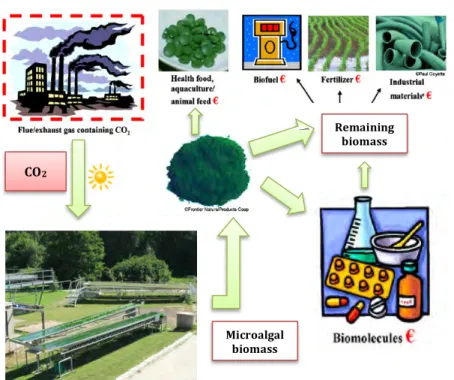
lipid production. The rest of supplied inputs are used in the synthesis of other essential compounds, mainly proteins and carbohydrates, which are discarded during the lipid extraction process. For this reason, the idea of a biorefinery process in which all microalgal products are used has become the main strategy for the production of biodiesel from microalgae. The biorefinery is an integrated facility, analogous to modern petroleum refineries, that combines various processes to produce biofuels, energy and high-value compounds from microalgal biomass aiming to maximize biomass value in a sustainable process. Integrated biorefineries are already being operated in Canada, the US and Germany for producing biofuels and other products from crops such as corn and soybean (Chisti 2007).
In a general biorefinery process (Fig. 1.1), CO2 would be provided by
For example, proteins and other value biomolecules can be extracted for pharmaceutical and industrial purposes and high-value omega-3 fatty acids, such as docosahexaenoic acid (DHA) and eicosapentaenoic acid (EPA) could be separated to be used for food applications. This approach would allow a cost-effective production of microalgal biodiesel.
To be able to exploit the complete produced biomass, the different cell fractions i.e. proteins, lipids and carbohydrates should remain available and undamaged after cell disruption, what seems to be the main bottleneck of the biorefinery approach. Common used methods to extract any of these fractions (heating, high pressure, osmotic shock…) usually entail damaging of the other cell components. Therefore, in a biorefinery process it is required a first step in which cells are disrupted by using mild techniques. These techniques comprehend pulsed electric field, supersonic flow fluid processing and ultrasound, which are quite new and consequently their application is being widely studied (Vanthoor-Koopmans et al. 2013). After mild cell disruption, separation of cell fractions without losing any product should be
Remaining biomass
CO2
Microalgal biomass
guarantied. For this aim, new methods such as the use of ionic liquids and surfactants have been proposed. Finally, further separation of the different fractions would be needed to obtain specific products.
Cultivation systems: open versus closed
Several types of cultivation systems have been used since the late 1950s, although their design and engineering is still a very active field of research. Nowadays, large-scale commercial production of microalgae includes open systems such as ponds, raceways and thin-layer cascades and closed systems, mainly tubular and serpentine photobioreactors.
Closed systems imply that there is no direct contact between the culture and the atmosphere and thus, light does not impinge directly on the culture surface but on the transparent walls of the reactor and exchange of gases, liquid and particles is avoided (Tredici 2010). This confinement of the culture is the main advantage of closed systems, since it allows for the cultivation of certain species that present contamination problems in open systems. However, closed systems are more expensive than open systems. Therefore, only the cultivation of species unable to be cultured in open systems but which produce high-value compounds is recommended at commercial large-scale since the high market price of these compounds allows a cost-effective production process. Besides this, taking advantage of their low contamination risks, the use of closed systems to produce biomass to be used as inocula for large-scale production in open systems is a common practice. At the Arizona State University (USA), a small plant made of 32-column type PBRs, 40 L volume each, is in operation to provide the inoculum for a feedstock production in raceway ponds. A pilot-scale plant consisting of ten 2.8 m3
vertical serpentine units was operated under a greenhouse at the Estación Experimental de Cajamar “Las Palmerillas” (Almería, Spain) for the production of Scenedesmus almeriensis, which is rich in lutein (Fernández-Sevilla et al. 2010). The company Fitoplancton Marino (Cádiz, Spain) produces
produce the green stage of Haematococcus pluvialis to later inoculate raceway ponds in which astaxanthin and oil accumulation is induced (Huntley and Redalje 2007). Vertical flat panel reactors represent very promising culture devices and several prototypes have been used during the last decade to evaluate the productivity of different species (Aflalo et al. 2007; Hu et al. 2008; Rodolfi et al. 2009). Among these prototypes, the Green Wall Panel reactor (GWP) was scaled-up and is currently being used by Archimede Ricerche Srl (Imperia, Italy) in a plant made operated under a greenhouse covering 1000 m2 to produce Nannochloropsis, Tetraselmis and Isochrysis to
be used in cosmetic, aquaculture and pharmaceutical sectors (Zittelli et al. 2013).
Despite the advantages of closed systems, the low construction and operation costs of open systems make them the main type of cultivation system currently used at commercial scale (Borowitzka 1999; Zittelli et al. 2013). Open systems take advantage of the high growth rate or the selective growth medium of certain species and in consequence commercial production is limited only to a few species mainly of the genera Arthrospira,
Dunaliella and Chlorella. Betatene Ltd (Whyalla, South Australia) produces
Dunaliella salina in unmixed very large ponds (up to 250 ha) (Tredici 2004; Borowitzka 2005). Raceway ponds are the most common system in use. DIC LIFETEC Co. Ltd. (Japan) produces more than 700 t annually of Arthrospira in California (USA) and China. Cyanotech Co. (Hawaii, USA) produces about 300 t of Haematococcus pluvialis as a source of astaxanthin. Small production plants are located in Australia also for the production of Arthrospira and in Israel for the production of Dunaliella. Chlorella is produced in big circular ponds of about 10 000 m2 by different companies in Japan and Taiwan.
Yaemama Shokusan Co., Ltd (Japan) produces Chlorella in pools with a total area of 27 000 m3 and a production capacity of 35 t per month. Tawian
Thin-‐Layer Cascade systems (TLCs)
Chlorella has also been used by the Institute of Microbiology of the Academy of Sciences of the Czech Republic in the development and later scaling-up of the thin-layer cascade system (Šetlík et al. 1970; Doucha and Lívanský, 1999). In the TLC, the microalgal suspension flows in a thin layer (6-8 mm) over a sloping surface exposed southwards to solar irradiance (Masojídek et al. 2011). This short optical path allows an efficient light utilization that leads to high biomass densities (40-50 g L-1). Circulation of the suspension takes place during the day, and at night the algal culture is kept in an aerated tank. In relation to the cultivation area, the suspension volume is significantly lower and the culture density at harvest is much higher compared with raceway ponds, what enables higher yields and cheaper cultivation and harvesting technology reducing the costs of biomass production to about 15–20% of that associated with ponds (Doucha and Lívanský 2009).
The building costs at initial stages of development was higher than that of raceways but a new prototype made of cheaper materials is being under evaluation (Masojídek, personal communication, 2013). However, biomass productivity is much higher than in raceways (<1 g L-1, Borowitzka 2005) and
similar to that of closed systems, which still have higher production costs. In addition, the culture can be quickly stored in the retention tank in case of accidents or unfavorable weather conditions. Table 1.1 shows the differences among open (ponds and thin-layer cascades) and closed systems.
Photosynthesis in microalgae
Photosynthesis is a process of sunlight energy conversion in which inorganic compounds and light energy are converted to organic matter in the chloroplast of photoautotrophic cells (Masojídek et al. 2013). It is a redox reaction in which light absorption by the chlorophyll molecule results in the conversion of water into carbon dioxide and carbohydrates and synthesis of ATP and NADPH and O2 release. The process comprehends a first stage
Table 1.1 Main characteristics of open (ponds and thin-layer cascades) and closed systems (adapted from Grobbelaar 2009; Gouveia 2011).
Feature Open systems Closed systems Ponds Thin-Layer Cascades
Algal species Restricted Flexible
Species selection Growth competition Shear-resistance
Contamination Possible Unlikely
Evaporation High Low
Control of growth Not optimized Optimized
Maintenance Easy Difficult
Construction costs Low High
Light utilization efficiency
Low High High
Gas transfer Poor Fair/higha Fair/high
Overheating problems
Low Low High
Cleaning None Moderateb Required
Biomass productivity Low High High
Mixing efficiency Poor Higha High
CO2 transfer rate Poor Highb High
Land required High Medium Low
Periodical maintenance
Low Medium High
Capital investment Small Medium High
Operating cost Low Medium High
Scale up Easy Medium Low
aTurbulent regime in the cascade (Masojídek et al. 2011)
bInjected directly in the pipe
photons are required for the production of each O2. For each carbon fixed,
two molecules of NADPH (four electrons) are required. Thus, the minimum quantum requirement for the fixation of one carbon atom is also eight photons.
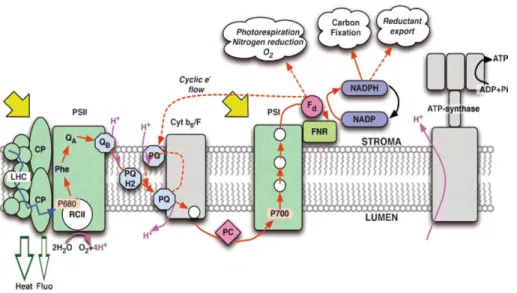
Figure 1.2 Schematic representation of the light reactions of photosynthesis. From left to right are represented four protein complexes: photosystem II (PSII), cytochromes b6/f (Cyt b6/F), photosystem I (PSI) and ATP synthase. The continuous red
arrows indicate the linear electron flow while the dashed red arrows represent alternative paths. The energy absorbed in the light-harvesting antenna of PSII (LHC) is funneled to the chlorophyll complex P680, which transfer the electron to the pheaophytin (Phe) in a process
commonly known as charge separation. The electron hole in P680+ is filled by an electron
from tyrosine, which obtains an electron from water via the manganese cluster. Phe reduces
the first quinone acceptor, QA, which needs two electrons to reduce the secondary acceptor,
QB. Electrons are transferred from QB to the reaction center of PSI, the chlorophyll P700, by
the subsequent reduction of the plastoquinone pool (PQ), Cyt b6/F and plastocyanin (PC).
For this transfer to occur, the P700 is previously oxidized through a second light reaction where the absorbed energy is transferred through a series of carriers to ferredoxin (Fd),
which finally reduces NADP to NADPH. Alternative sinks for the electrons from Fd and
Linearity between PSII electron transport and oxygen evolution is usually found (Suggett et al. 2010), but non-linear behavior has also been observed (Masojidek 2001; Kromkamp et al. 2009), especially under conditions when, due to high irradiance, photosynthesis was over-saturated (Ralph et al. 2010). Several explanations have been suggested for these alternative electron pathways but the most accepted are cyclic electron flow around PSII (Prasil et al. 1996; Lavaud et al. 2002) or PSI (Bendall and Manasse 1995) or presence of alternative electron acceptors, especially the Mehler reaction, which entails the formation of hydrogen peroxide by donation of electrons to O2 from PSI
via ferredoxin (Asada 2000).
Measuring the photosynthetic activity
The photosynthetic activity can be measured by following changes in the rate of production or consumption of any of the involved inputs or resulting outputs of the process. Traditionally, gas measurements of either O2 evolution
or CO2 fixation have been the most accepted methods to estimate
photosynthetic activity. O2 production has been measured by estimating the
concentration of dissolved O2 in water samples using colorimetric methods
such as the Winkler method or electrochemically by using Clark-type electrodes. The later commercialization of oxygen optodes sensors allowed for the optical estimation of oxygen evolution based on a luminescence reaction that is quenched in the presence of oxygen. Carbon dioxide fixation has been widely measured by infrared gas analyzers (IRGA) and more recently by following the incorporation of inorganic radio-labelled 14CO
2 or NaH13CO3.
processes in PSII since in microalgae the contribution of PSI is usually so small at ambient temperature that for practical purposes can be neglected.
On the other hand, photoacustics methods are being developed during the last years, based on the conversion of light energy emitted from a laser pulse absorbed by photosynthetic pigments into heat, what rises the temperature and thus, the pressure increases (Grinblat and Dubinsky 2010).
In vivo chlorophyll a fluorescence -‐ The saturation pulse method
Pulse-amplitude modulated fluorometers (PAM) are extensively used to measure chlorophyll a fluorescence of PSII by the saturation pulse method. In these instruments the measuring light is modulated, it is switched on and off at high frequency, and the detector only detects the fluorescence excited by this measuring light.
Figure 1.3 Overview of the photosynthetic processes. The absorbed light energy
is used in photochemistry during the light reactions. The excess energy not entering this process is re-emitted as heat or fluorescence. The light energy converted into ATP and
NADPH is used in the Calvin cycle to fix CO2 and synthetize glyceraldehyde 3-phosphate
(G3P), which is the precursor of glucose and is involved in the synthesis of starch, amino acids and fatty acids. The methods by which the different processes involved in
The saturation pulse method involves the analysis of the photochemical and non-photochemical quenching components. It is based on the redox state of the reaction centers before and after giving a saturating flash of light sufficiently intense as to maximally reduce QA. In the dark, the reaction
centers are “open”, indicating that QA is oxidized, and thus, the reaction
centers are capable of performing photochemical reduction of QA. Exposure
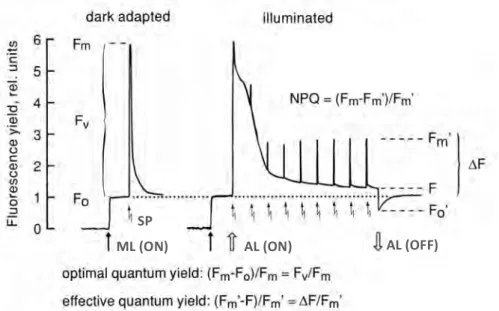
of a dark-adapted cell to the measuring light, which is non-actinic to ensure that QA remains fully oxidized, results in the minimal level of fluorescence, F0.
After applying a saturating pulse of light, QA will be maximally reduced so
that photochemistry is reduced to zero, non-photochemical quenching will be negligible and thus, the maximal level of fluorescence, Fm, is reached. The
difference between the minimum and maximum fluorescence level is called variable fluorescence, Fv.
AL (OFF) AL (ON)
ML (ON) SP
Figure 1.4 The saturation pulse method. Under dim measuring light (ML) the
minimum fluorescence level (F0) is measured. After applying a saturating light pulse (SP),
the maximum fluorescence is achieved (Fm). Next, the sample is illuminated with actinic
light (AL) and a series of saturating pulses in order to reach the steady state (F’) and the maximum fluorescence (Fm’). Finally, the actinic light is switched off to measure the
The reaction centers of light-adapted cells have reduced QA and are
referred to as “closed”. Under light conditions non-photochemical quenching (NPQ) is induced. It is inversely related to photochemistry and is considered a safety valve protecting PSII reaction centers from damage by excess irradiance (Masojídek et al. 2013). In this state there is a minimum level of fluorescence termed F’ (the ‘ is indicative of parameters measured in light-adapted cells) and NPQ will reduce the fluorescence yield. Therefore, after a saturating light pulse, the achieved maximum fluorescence value will be lower, Fm’.
The saturation pulse analysis can be used to estimate the quantum yield of PSII, which be understand as the efficiency by which absorbed light is used in photochemistry. In the dark, it can be estimated by normalizing the variable fluorescence to the maximum fluorescence yield, Fv/Fm (Cosgrove and
Borowitzka 2010). In light conditions maximum efficiency is not achieved but the effective quantum yield can be calculated as ΔF/Fm’.
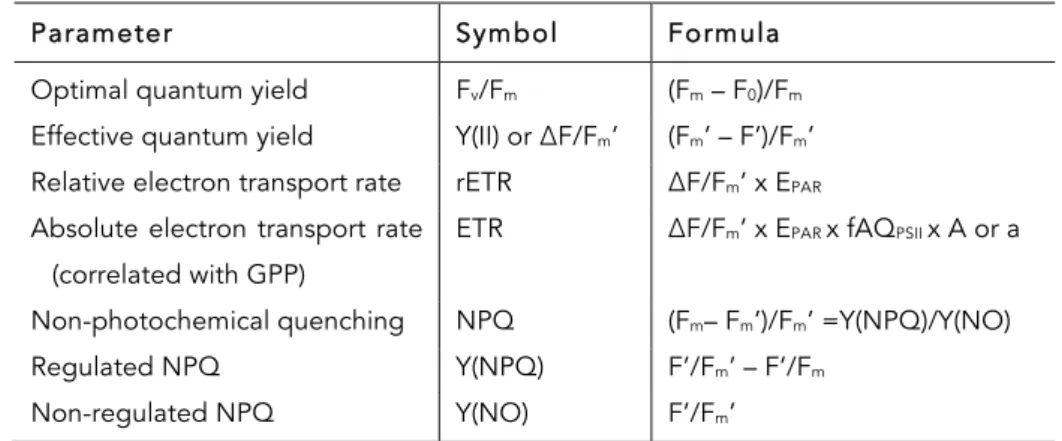
Table 1.2 Parameters calculated from chlorophyll fluorescence measurements. F0, Fv, Fm –
minimum variable and maximum fluorescence in dark-adapted state; F0’, F’, Fv’, Fm’ – minimum,
steady-state, variable and maximum fluorescence in light-adapted state; EPAR – photosynthetic
active radiation; fAQPSII – fraction of absorbed quanta to PSII, A – absorptance and a – light
absorption coefficient
Parameter Symbol Formula
Optimal quantum yield Fv/Fm (Fm – F0)/Fm
Effective quantum yield Y(II) or ΔF/Fm’ (Fm’ – F’)/Fm’
Relative electron transport rate rETR ΔF/Fm’ x EPAR
Absolute electron transport rate (correlated with GPP)
ETR ΔF/Fm’ x EPAR x fAQPSII x A or a
Non-photochemical quenching NPQ (Fm– Fm’)/Fm’ =Y(NPQ)/Y(NO)
Regulated NPQ Y(NPQ) F’/Fm’ – F’/Fm
Non-regulated NPQ Y(NO) F’/Fm’
aGPP gross photosynthetic productivity (net photosynthetic productivity plus respiration)
Electron transport rate as estimator of productivity
The relative electron transport rate (rETR) through PSII can be calculated as the product of the photosynthetic quantum yield ΔF/Fm’ and the incident
photosynthetically active radiation (PAR). The electron transport rate can be used as a proxy of photosynthetic capacity or productivity (Kromkamp et al. 2008; Figueroa et al. 2013). However, photosynthetic activity is directly related to the absorbed light and not to the incident irradiance. ETR values calculated using the incident (relative ETR, rETR) instead of the absorbed irradiance would correspond to relative conditions in which all the incident light is absorbed by PSII, what in fact is not common in most of microalgal cultures. Moreover, changes in environmental conditions can lead to variations in morphology, pigmentation and cell size that influence the pigment packaging effect and may entail changes in the optical properties of the cells, what would result in differences among cells with different optical properties when the absorbed light is not considered. Thus, the determination of absolute ETR values rely on independent measurements of light absorption that will allow for the comparison between different species or species under different environmental conditions.
under field conditions and on the other hand, the need of measuring the light absorption of discrete water samples constraints the scales at which fluorometric measurements can be made (Suggett et al. 2004). Moreover, in microalgal biotechnology light absorption is not usually considered when determining ETR values and relative approaches are common. Therefore, the consideration of light absorption in ETR determinations is a need if we aim to have real values of the photosynthetic activity but the lack of a reliable and easy methodology to measure light absorption should be undertaken.
ETR has been extensively used to estimate photosynthetic productivity since a linear relationship between fluorescence-based measures of photochemical efficiency of PSII and independent measures of the quantum yield of CO2 fixation in maize were first described by Genty et al. (1989). This
study was followed by others that confirmed the same linearity in microalgae (Gilbert et al. 2000; Kromkamp and Forster 2003; Wagner et al. 2012). However, a linear relationship between ETR, O2 evolution and CO2 fixation is
not always found (Flameling and Kromkamp 1998; Kromkamp et al. 2008). Cyclic electron flow around PSII (Prasil et al. 1996) can uncouple ETR from the rate of O2 production by PSII whereas alternative electron pathways related to
the water-water cycle, donation of electrons from PSI to O2 with the formation
of hydrogen peroxide (Asada 2000), or to nitrate assimilation (Holmes et al. 1989), can lead to uncoupling with CO2 fixation.
Application of chlorophyll a fluorescence to microalgal biotechnology
made by simply pointing a fluorometer fiber-optics at a photobioreactor or by submerging it into the suspension using ambient irradiance as actinic light (Masojídek et al. 2010) and as a result, the effective quantum yield would be obtained. In this way, monitoring of chlorophyll a fluorescence allows the evaluation of the effect of changing environmental conditions such as CO2
supply, pH, temperature, mixing, nutrients, etc. on the physiology of the culture. The acquisition of photosynthetic data with high-temporal resolution and its relation to changes in culture conditions would make possible to optimize the photosynthetic performance of the culture.
In addition, if a PAR sensor is coupled to the chlorophyll fluorescence sensor so that the irradiance is measured simultaneously, rETR values could also be monitored. When light absorption data is available, the determination of absolute ETR might lead to the estimation of productivity in terms of oxygen evolution, carbon fixation or even biomass productivity if the carbon content is known. Such approach would provide valuable information to better understand the process involved in photosynthesis and consequently affecting the productivity of the culture.
Photosynthetic efficiency of microalgae
It is a common belief that microalgae are more efficient in terms of photosynthesis than higher plants, what would mean that microalgae are more efficient in converting light energy into chemical energy of carbohydrate or biomass. Nevertheless, this is still a matter of debate and several authors state that the advantages of microalgae over terrestrial plants do not rely on higher photosynthetic efficiencies (Tredici 2010; Wilhelm and Jakob 2011) but on their higher versatility, lower ecological impact, lower respiration losses, higher content in storage compounds and higher diversity in fatty acid composition (Williams and Laurens 2010).
considered, this maximal value decrease to the commonly accepted 4.6% (Tredici 2007; Walker 2009; Williams and Laurens 2010). In the practice, the yields achieved in outdoor microalgal cultures decrease to one third to one tenth of this theoretical maximum since several factors such as temperature, carbon dioxide concentration, turbulence or nutrient availability are many times far from the optimal conditions. To date, long-term efficiencies of 4-5% are rarely reached with algal cultures under natural conditions (Tredici 2010). In the case of plant crops, the measured photosynthetic efficiency in the field is also lower than the theoretical 4.6% mainly because the growing season is reduced and only during a fraction of this period the canopy cover is maximum, among other stressing factors such as nutrients and temperature (Zhu et al. 2010).
The maximal photosynthetic efficiency is limited by stoichiometry thermodynamics reasons and therefore it is considered unbeatable but, as Williams and Laurens (2010) pointed out, there is no fundamental barrier to achieve it. According to this, some strategies such as light dilution, rapid mixing or genetic modification have been proposed to achieve photosynthetic efficiencies closer to the theoretical maximum.
Commercial production of
Chlorella
The genus Chlorella (Chlorophyta, Trebouxiohyceae) comprehend species from wide variety of habitats, from marine to freshwater environments, with high temperature tolerance ranging from 15ºC to even 35-40ºC. Cells are globular or ellipsoidal with variable diameter, from 3 to 9 µm. It grows autotrophically in an inorganic medium although it also can grow in mixotrophic or heterotrophic conditions.
At present, Chlorella is being commercially cultivated by more than 70 companies all over the world (Spolaore et al. 2006). Its high growth rate prevents contamination and thus, it is widely produced photoautrophically in open systems such as ponds or thin-layer cascades. The largest Chlorella
in closed systems such as the tubular photobioreactors located in Klötze (Germany), which produces about 100 t dry biomass per year for the health food market (Pulz et al. 2013).
Chlorella is widely produced to be used as health food or feed supplement in Germany, Japan, China and other Asian countries because of its high content in proteins with a balanced amino acid composition (Becker 2007), fatty acids ,including oleic and linoleic acids (Petkov and Garcia 2007), carotenoids, vitamins and minerals (Masojídek et al. 2010). Chlorella extract have proven to prevent against tumors and cancers, enhance hypoglycemic effects, attenuate cognitive decline of age-dependent dementia and lower blood pressure (Liu and Hu 2013). High-value products can be also obtained from Chlorella biomass like some immunostimulators such as β-1,3-glucan, which can also act as a free-radical scavenger and a reducer of blood lipids (Iwamoto 2003). It also has different applications in the nutraceutical and cosmetics industry due to the high accumulation of lutein and astaxanthin of some species (Liu and Hu 2013) or as food additive owing to the taste and flavor of its coloring agent (Yamaguchi 1996). Some other applications have been proposed such as the production of recombinant proteins, but the production of Chlorella for high-value products is still limited due to high costs associated to production systems and processes. New advances in the cultivation technology and in the knowledge of the metabolism and physiology of this genus would lead to a future expansion of the market. Besides, Chlorella is among the microalgae that has arisen more interest for biofuel production since under certain stress conditions some strains can accumulate large amounts of lipids or starch.
Among Chlorella species, C. fusca has been widely used in the past decades in physiological studies that evaluated the effect of CO2 on
potassium transport (Tromballa 1983), the cell wall lytic activity (Loos and Meindl 1984) or the non-hydrolysable macromolecular constituents from outer walls (Derenne et al. 1992). In addition to the interesting characteristics already known of species of the genus Chlorella such as high growth rate, large size compared to other microalgae and high nutritional content, C. fusca
high carotenoid content, specifically lutein (Becker 2013); it has been proposed as a source of sporopollenin, a UV screening compound (Priyadarshani and Rath 2012) and it can accumulate high content of essential fatty acids such as the omega-3 α-linolenic acid (ALA) or linoleic and oleic acids (Pohl et al. 1971). Moreover, it has been proven its efficiency in the biosorption of cadmium and copper (Wehrheim and Wettern 1994). Therefore, C. fusca represents a good candidate for to evaluate the accumulation of high-value compounds for possible biotechnological applications.
Thesis outline
Researchers have not yet acquire the necessary physiological knowledge nor developed the required technology to take advantage of the potential of microalgae to produce energy, novel foodstuffs and renewable non-food commodities in a sustainable way. Therefore, the present thesis aimed to contribute the overcoming of the problems that obstacle the scaling-up of microalgal cultures by filling some of these gaps related to the photosynthetic performance and biochemistry of outdoors cultures. To that end, the present study addressed the following questions:
Figure 1.5. Chlorella fusca #UTEX 343. Taken from The Culture Collection of Algae (UTEX,
1. Could the absorptance method currently used in macroalgae be adapted for its application for the measurement of light absorption in microalgal cultures?
Hypothesis: by using an appropriate measuring system and optimal cell density, the absorptance of a thin layer of cell suspension could be well correlated to the absorption coefficient determined by the quantitative filter technique.
2. Could in vivo chlorophyll a fluorescence be used to monitor the photosynthetic performance of microalgal cultures in a new thin-layer cascade system? How can it be applied to evaluate the spatial-temporal variation of the photosynthetic activity in this system?
Hypothesis: in vivo chlorophyll a fluorescence can be monitored in situ (solar radiation) in thin-layer cascades but the hydrodynamics of the system should be previously studied to optimize the measuring set-up.
3. Is Chlorella fusca able to grow in outdoor thin-layer cascades? How does its photosynthetic performance and biomass composition change in systems with different surface to volume ratio?
Hypothesis: higher S/V ratio of the cultivation system is related to higher photosynthetic production.
4. Does the biomass productivity estimated from monitoring of in vivo
chlorophyll a fluorescence correlates with the measured productivity determined by difference in dry weight?
Hypothesis: biomass productivity can be estimated from daily-integrated electron transport determined in situ and correlated to measured biomass productivity. Discrete measurements of electron transport rate measured under artificial actinic light (different to solar radiation) are lower correlated to measured biomass productivity compared to the electron transport rate determined under solar radiation
5. Does the combination of nutrient and light stress have any effect on the accumulation and productivity of storage compounds in Chlorella fusca
cultivated under controlled conditions?
Hypothesis: nutrient depletion or starvation and light stress (high PAR irradiance and UV radiation, λ=280-400 nm) are related to higher content of
Relation between light absorption
measured by the quantitative filter
technique and the attenuation of
Chlorella fusca
cultures of different cell
densities: application to estimate the
absolute electron transport rate (ETR)
Celia G. Jerez, Carolina B. García, Agustín Rearte and Félix L. Figueroa
Submitted to Journal of Applied Phycology (February 2015)
Y
CM
MY
CY
CMY
Abstract
In order to estimate microalgal carbon assimilation or production of Chlorella fusca cultures based on electron transport rate (ETR) as in vivo chlorophyll a
fluorescence, it is necessary to determine the photosynthetic yield and the absorbed quanta by measuring the incident irradiance and the fraction of absorbed light, i.e. absorptance or absorption coefficient of photosynthetic active radiation (PAR). Due to difficulties associated to the determination of light absorption, ETR is commonly expressed as relative units (rETR) although this it is not a good estimator of the photosynthetic production since photobiological responses depend on the absorbed light. The Quantitative Filter Technique (QFT) is commonly used to measure the absorbed quanta of cells retained on a filter (AbQf) as estimator of the absorbed quanta of cell
suspensions (AbQs) by using integrating spheres. In this study, light
attenuation of a thin layer of cell suspensions is was determined by using a measuring system designed to reduce the scattering. Light attenuation was related to the absorptance of both in-door and out-door C. fusca cultures of C. fusca of different cell densities. A linear relation between AbQf and AbQs
(R2=0.99, p<0.01) was obtained, AbQ
f=1.98⋅AbQs, which can be used to
convert AbQs values into AbQf ones. On the other hand, it was discussed the
use of the absorptance, light absorption or specific light absorption coefficients to calculate ETR values expressed per area (thin layer cascade or flat panel cultivators), volume (cylindrical and tubular photobioreactors) or chlorophyll units (any type of cultivation system) depending on the culture system. Simplification of the measurement of the light absorption coefficient presented in this study for C. fusca can be tested in other phytoplankton species and would promote the determination of absolute ETR, which provide
Chlorella fusca
grown outdoors
in Thin-Layer Cascades
YCM
MY
CY
CMY
Hydrodynamics and photosynthesis
performance of
Chlorella fusca
grown in a
Thin-Layer Cascade (TLC) system
Celia G. Jerez, Enrique Navarro, Irene Malpartida, Rosa M. Rico, Jíri
Masojídek, Roberto Abdala and Félix L. Figueroa
Aquatic Biology 22:111–122 (2014)
Y
CM
MY
CY
CMY
Abstract
Chlorella fusca
(Chlorophyta) grown in outdoor
thin-layer cascades: growth, photosynthetic
performance and biomass composition
To be submitted to Algal Research (Companion Paper-A)
Y
CM
MY
CY
CMY
Abstract
The photosynthetic performance, biomass composition and productivity of three cultures of Chlorella fusca BEA1005B grown in thin-layer cascades (TLCs) were studied in two locations with the aim to test this microalga as a production strain. The first (E1) and second (E2) experiments were conducted in the south of-Spain in July and October 2012, respectively in a TLC with exposed surface to total volume ratio (S/V) of 20-27 m-1. The third experiment
(E3) was conducted in the Czech Republic in July 2013 in a TLC with S/V ratio of 105-140 m-1. Growth was higher in E3, in which C. fusca achieved a
biomass density of 11.4 g DW L-1 whereas it was 1.22 and 0.94 g DW L-1 in E1
and E2 (summer and autumn, respectively). Photosynthetic activity increased in all experiments although it was higher in E3 (rETRmax=345 µmol e- m-2 s-1).
Final biomass composition was similar in E1 and E3, showing high lipid and protein content (~35-37% and 30-34%, respectively) and lower starch content (16-19% DW). Lower accumulation was found in E2, ~23, 28 and 13% DW for lipid, protein and starch content, respectively. Biomass productivity was higher in E3 (3.65 g L-1 d-1). In E1 and E3, lipid productivity (0.09 and 0.66 g -1
L -1 d-1, respectively) was higher than that of starch and protein (~0.03-0.04
and 0.43-0.47 g L -1 d-1). On the contrary, in E2 the three productivities were
similar (0.02-0.03 g L-1 d-1). The S/V ratio of the system was a key factor to
Chlorella fusca
(Chlorophyta) grown in
thin-layer cascades: estimation of biomass
productivity by continuous monitoring of in
vivo chlorophyll a fluorescence
To be submitted to Algal Research (Companion Paper-B)
Y
CM
MY
CY
CMY
Abstract
In vivo chlorophyll a fluorescence was used to monitor the photosynthetic performance of three cultures of Chlorella fusca BEA1005B grown in thin-layer cascades (TLCs) in different locations and time of the year. The first (E1) and second (E2) experiments were conducted in South-Spain in July and October 2012, respectively in a TLC with S/V ratio of 20-27 m-1. The third experiment
(E3) was conducted in the Republic in July 2013 in a TLC with S/V ratio of 105-140 m-1. Instantaneous and simultaneous measurements of incident PAR
irradiance and effective quantum yield of PSII (ΔF/Fm’) were recorded every 5
minutes using Junior-PAM fluorometer. From these data, daily-integrated electron transport rate (ETR) was calculated and transformed into biomass productivity according to several assumptions. Oxygen evolution rate was estimated from daily-integrated ETR assuming that the quantum requirement (QR) was 8 or 10 absorbed photons to produce a molecule of oxygen. From these, carbon assimilation rate was calculated assuming the number of mol of C produced per mol of O2 evolved, the so-called photosynthetic quotient
(PQ), which considering that nitrate was the N source ranged from 1.2 to 1.4 mol O2/mol CO2. Since in microalgal biotechnology the measurement of
biomass productivity is usually carried out through the assay of dry weight in time, biomass productivity estimated from ETR records was compared with biomass productivity measured by differences in dry weight. The best correlation was found when QR=1/8 mol O2 (mol photons)-1 and PQ=1.2 mol
O2 (mol CO2)-1. It was found that low dense cultures (<0.15 g DW L-1, s=0.90)
showed lower slope (s=0.42) than high dense cultures (0.15-11.4 g DW L-1),
Chlorella fusca
under stress conditions
YCM
MY
CY
CMY