Optimisation of sample treatment for arsenic speciation in alga
samples by focussed sonication and ultrafiltration
S. García Salgado, M.A. Quijano Nieto, M.M. Bonilla Simón
Departamento de Ingeniería Civil, Tecnología Hidráulica y Energética, Escuela Universitaria de Ingenieros Técnicos de Obras Públicas, Universidad Politécnica de Madrid, Alfonso XII3 y 5, 28014 Madrid, Spain
Abstract
A procedure for arsenic species fractionation in alga samples (Sargassum fulvellum, Chlorella vulgaris, Hizikia fusiformis and Laminaria digitata) by extraction is described. Several parameters were tested in order to evaluate the extraction efficiency of the process: extraction medium, nature and concentration (tris(hydroxymethyl)aminomethane, phosphoric acid, deionised water and water/methanol mixtures), extraction time and physical treatment (magnetic stirring, ultrasonic bath and ultrasonic focussed probe). The extraction yield of arsenic under the different conditions was evaluated by determining the total arsenic content in the extracts by ICP-AES. Arsenic compounds were extracted in 5 mL of water by focussed sonication for 30 s and subsequent centrifugation at 14,000 x g for lOmin. The process was repeated three times. Extraction studies show that soluble arsenic compounds account for about 65% of total arsenic.
An ultrafiltration process was used as a clean-up method for chromatographic analysis, and also allowed us to determine the extracted arsenic fraction with a molecular weight lower than 10 kDa, which accounts for about 100% for all samples analysed.
Speciation studies were carried out by HPLC-ICP-AES. Arsenic species were separated on a Hamilton PRP-X100 column with 17 mM phosphate buffer at pH 5.5 and l.OmLmin-1 flow rate. The chromatographic method allowed us to separate the species As(III), As(V), MMA and DMA
in less than 13 min, with detection limits of about 20 ng of arsenic per species, for a sample injection volume of 100 JJLL. The chromatographic analysis allowed us to identify As(V) in Hizikia (46 ± 2 (jigg-1), Sargassum (38 ± 2 (jigg-1) and Chlorella (9 ± 1 (jigg-1) samples. The species
DMA was also found in Chlorella alga (13 =b 1 jxg g_1). However, in Laminaria alga only an unknown arsenic species was detected, which eluted
in the dead volume.
Keywords: Arsenic speciation; Extraction by focussed sonication; Ultrafiltration; Algae; HPLC-ICP-AES
1. Introduction
Marine organisms can accumulate high arsenic concentra-tions, which may be harmful to humans. Hence, arsenic species need to be measured in seafood to establish the potential threat to consumers [1-3]. It is very well known that arsenic toxic-ity depends not only on the total concentration but also on the chemical species in which this element is present. Inorganic arsenic species (arsenite (As(III)) and arsenate (As(V))) are more toxic than the methylated arsenicals (monomethylarsonic acid (MMA) and dimethylarsinic acid (DMA)), followed by more complex organic arsenicals (arsenobetaine (AsB),
arseno-choline (AsC), tetramethylarsonium ion (TMAs+),
arsenoribo-sides), which are considered to be non-toxic to living organisms [4,5].
yet to be substantiated [10], further investigation on the fate of arsenoribosides within marine organisms is needed to fill this knowledge gap.
Algae are very popular in the Chinese and Japanese cuisine [11], and nowadays their use is widespread in Occidental coun-tries, due to their high mineral content and their recognized therapeutic properties. The high arsenic levels (about several milligrams per kilogram) present in some kinds of algae make necessary the determination of total arsenic concentration, as well as the evaluation of the arsenic species present in commer-cial brands of algae.
Detailed information concerning analytical methods for arsenic speciation can be found in several reviews [3,12,13]. Most of studies were focussed on the development of hyphen-ated techniques [14-17]. The main difficulty for arsenic spe-ciation in solid samples is to achieve a quantitative extrac-tion and the absence of species transformaextrac-tion. No systematic study of arsenic species extraction from algae has been so far reported in the literature. Many studies about arsenic in algae have used mixtures of water/methanol to extract arsenic species [3,7,12,17-22]. Even performing several extraction steps (3 or 4), arsenic recoveries are often low and variable (6-98%). Son-ication is commonly used in order to improve the characteris-tics of solid-liquid extraction methods [3,4,16-23]. However, few studies have used accelerated solvent extraction [3,26] or microwave-assisted extraction [17,24], which have shown to give better recoveries than sonication in ultrasonic bath. Ultra-sonic probe provides 100 times higher energy than the ultraUltra-sonic bath [25], and thus its use generally allows us to reduce the extraction time. Few studies have applied an ultrasonic focussed probe for species extraction, but there are not any comparative studies that state clearly the achieved advantages.
This paper has three objectives to: (1) develop an ultrasonic focussed probe assisted extraction procedure for the isolation of arsenic species from alga samples; (2) characterise and quantify the soluble arsenic fraction by ultrafiltration with 10 kDa cut-off filters; and (3) identify and quantify the toxic arsenic species present in alga samples by high performance liquid chromatog-raphy coupled to ICP-AES.
2. Experimental
2.1. Instrumentation
Alga samples were digested for total arsenic determina-tion using a MARS five microwave oven (CEM Corporadetermina-tion, Matthews, NC, USA).
The ICP-AES instrument used was a Liberty Series II Axial Sequential ICP-AES (Varían Australia Pty Ltd., Mulgrave, Vic, Australia). Before coupling the chromatographic system, the ICP-AES working conditions were optimised using a standard solution containing 1.0 m g L- 1 of manganese. The arsenic
sig-nal was then optimised using a 1.0mgL- 1 arsenic standard
solution.
The chromatographic system consisted of a Jasco PU-980 HPLC pump (Jasco, Tokyo, Japan) with a Rheodyne 7725 six-port sample injection valve fitted with a 100 (xL sample loop
(Rheodyne, CA, USA). Separations were carried out in a Hamil-ton PRP-X100 (250 mm x 4. lmm, 10 (xm, Phenomenex, Tor-rance, CA, USA) anionic exchange column.
The chromatographic system was then coupled to the ICP-AES instrument by a polytetrafluoroethylene capillary tube (20 cm, 0.5 mm, i.d.), which connected the column outlet to the Meinhard nebuliser inlet.
Chromatographic signals were registered using a Star 800 Module Interface Box and processed using a Star software (Var-ian). Signal quantification was carried out in the peak area mode.
For molecular weight fractionation and algae extracts clean-ing, 10 kDa cut-off filters (Millipore, Bedford, MA, USA) and an Eppendorf centrifuge 5804 R (Hamburg, Germany) were used.
The 0.45 (xm Millipore nylon filters were used to filter all the HPLC solutions.
A sonopuls ultrasonic homogenizer (Bandelin, Fungilab S.A., USA) fitted with a HF-generator HD 2200 was used to extract the samples. The homogenizer was equipped with a tita-nium microtip of 3 mm diameter and the power was set to 20 W. The frequency was fixed at 20 kHz.
A rotavapour R-200, with a waterbath B-490 and a vacuum system V-500 (Büchi Labortechnik AG, Flawil, Switzerland) was used to evaporate the solvent.
2.2. Reagents and standard solutions
Stock solutions of 1000 m g L- 1 arsenic were prepared by
dissolving the respective amount of the pure compound in deionised water (Milli-Q system, Millipore, USA). As(III) and As(V) standards solutions were prepared from NaAs02 and
Na2HAsÜ4, respectively (Panreac, Barcelona, Spain), MMA
from CH3As03Na2 (Supelco Park, Bellefonte, PA, USA) and
DMA from (CH3)2 AsNa02• 3H20 (Fluka, Neu Ulm, Germany).
The stock solutions were kept at 4 °C in the dark. Working solu-tions were prepared daily and then diluted with deionised water to the final concentration.
The eluent used for the separations was phosphate buffer (pH 5.5) at a concentration of 17mmolL_1. It was prepared
by mixing independent solutions of Na2HPÜ4 and NaH2P04
(Sigma Chemicals, St. Louis, MO, USA) until the desired pH was reached.
All HPLC solutions were filtered and degassed before use. HNO3 (70%), from Scharlau (Barcelona, Spain), was used to digest the samples.
The extractant mixtures were prepared from deionised water and HPLC-grade methanol (Scharlau). Other reagents were obtained from Merck (Darmstadt, Germany).
2.3. Alga samples
The reference material NIES no. 9, certified for total arsenic (115 ± 9 (xgg-1), was a lyophilised Sargasso material,
(Lam-Table 1
ICP-AES and chromatographic operating conditions
ICP-AES Forward power
Photomultiplier tube voltage Coolant argon flow rate Auxiliary argon flow rate Nebulisation argon pressure Nebuliser type
Chromatographic system Analytical column Mobile phase Flow rate Injection volume
1200 W 650 V 15.0 Lmin-1
1.50 Lmin-1
180kPa
Meinhard concentric glass
Hamilton PRP-X100
Phosphate buffer 17mM at pH 5.5 l.OmLmin-1
100 [xL
inaria digitata), acquired in Spanish markets. Commercial
prod-ucts were kept in their packages until their use. Hijiki and Laminaria were provided as dry material and capsules, respec-tively. Hijiki was triturated in a mill to a particle size of 125 (xm and Laminaria capsules were opened and placed in a polyethy-lene bottle before the analytical treatment.
2.4. Mineralization for total arsenic determination
Total arsenic concentrations were determined, after digestion of the samples, by direct nebulisation into ICP-AES. Digestion was carried out placing approximately 250 mg of the sample in a polytetrafluoroethylene reactor together with lOmL of nitric acid (70%, v/v) and then treated in a microwave oven for 30min, applying 225 psi of pressure and 210 °C of tem-perature. The digests were diluted with deionised water up to 25 mL. The total arsenic concentration was determined under the conditions summarised in Table 1 by external calibration (in the range 0.25-2.5 mgL"1 of arsenic) at 188.979, 193.696 and
228.812 nm lines.
2.5. Arsenic species determination
2.5.1. Leaching
Approximately 200 mg of alga sample were accurately weighed into a 25 mL centrifuge tube and 5 mL of deionised water were added. The tube was sonicated with the homoge-nizer for 30 s, then centrifuged for 10 min at 14,000 x g and the supernatant was replaced into a 50 mL round bottom flask. The extraction process was repeated two or three times, depending on total arsenic content of alga sample. Supernatants were mixed and evaporated in a rotavapour at a bath temperature of 60 °C. The residue obtained was dissolved in 4 mL of deionised water.
2.5.2. Ultrafiltration
Every final extract was processed through a lOkDa cut-off filter by centrifugationat 14,000 x g and 20 °Cuntilthe solution had passed through it. Finally, the filtrate was diluted to 10 mL with deionised water.
2.5.3. Chromatographic separation
Separation of arsenic species studied (As(III), As(V), MMA and DMA) was carried out on a Hamilton PRP-X100 column, with 17 mM phosphate buffer at pH 5.5 and 1.0 mL min- 1 flow
rate as mobile phase.
The dead volume of the system was determined by passing 1.0 m g L- 1 lithium solution through the column. The Li+ ion,
which should not be retained on the column, was monitored by ICP-AES at 670.784 nm line. The dead volume of the system was calculated to be 2.19 ± 0.01 mL.
2.5.4. Detection
Arsenic species were detected by HPLC-ICP-AES, using the operating conditions given in Table 1. The analytical peaks obtained were evaluated in terms of peak area by the standard addition method at 193.696 nm line.
3. Results and discussion
3.1. Total arsenic determination
The total arsenic content in alga samples was determined in order to evaluate the efficiency of the different procedures tested for arsenic species extraction. The results obtained are shown in Table 2. To check the accuracy, NIES no. 9 Sar-gasso reference material was also analysed. The results obtained (106 ± 6 (xgg-1) shows that, at the 95% confidence level, there
were no significant differences between the concentration found and the certified value. Therefore, the digestion method used has proven to be suitable for total arsenic determination in alga sam-ples analysed.
3.2. Arsenic speciation
3.2.1. Optimisation of arsenic compounds extraction
Several experiments were carried out to extract the solu-ble arsenic compounds, and several parameters affecting the extraction from Sargasso material, such as solvent composi-tion, extraction time, extractant volume and the specific method applied were tested.
The effect of extraction time was studied by varying this parameter for deionised water extraction (5 mL) applying mag-netic stirring for 15 min up to 12 h. The extraction process was repeated three times. The results show a slight improvement of arsenic extraction efficiency from 15 to 30 min of magnetic stir-ring. However, the use of longer extraction times did not lead to better extraction efficiencies, in the range studied. For that
Table 2
Total arsenic concentrations ([xgg-1) found in alga samples after microwave
digestion and determination by ICP-AES (n = 5)
Alga Total As ([xgg )
NIES no. 9 (Sargasso) (115 ± 9 [xgg-1) Hizikia
Laminaria Chlorella
Table 3
Total arsenic extracted, expressed as percentage ± standard deviation (n = 3), found in CRM NIES no. 9 (Sargasso) depending on extractant nature and con-centration (5 mL) and applying magnetic stirring for 30 min (three consecutive extractions)
Table 5
Total arsenic extracted, expressed as percentage ± standard deviation (n = 3), found in the different kinds of algae studied
Extractant Concentration (mol L ) Total As extracted (%)
Water Phosphoric acid
Tris
Methanol
Water/methanol (1:1 v/v) Water/methanol (1:9 v/v)
0.1 0.3 1.5 0.1 0.3
64 ± 3 63 ± 3 59 ± 2 64 ± 3 58 ± 3 49 ± 3 34 ± 2 63 ± 3 36 ± 2
reason, an extraction time of 30 min was selected as optimum when magnetic stirring was used for arsenic extraction.
In order to choose the best extractant solution for arsenic species, different solvents were tested: deionised water, phosphoric acid (0.1, 0.3 and 1.5molL_1),
tris(hydroxy-methyl)aminomethane (Tris) at pH 7.0 (0.1 and 0.3molL_ 1),
methanol and water/methanol mixtures (1:1 and l:9v/v). The results (Table 3) show the absence of significant improvements for arsenic extraction in Sargasso material for all concentration levels tested when using phosphoric acid or Tris solutions, as well as for water/methanol mixture (1:1 v/v). Nevertheless, the extraction efficiency was about 50% lower when using methanol or water/methanol mixture (1:9 v/v). Therefore, itwas concluded that Sargasso material analysed contains basically water-soluble arsenic compounds (about 65% of total arsenic present), which are extracted in water or water/methanol mixture (1:1 v/v). In this material, methanol does not seem to improve the extraction of arsenic compounds.
The increase in the extractant volume from 5 to lOmL (for water and water/methanol mixture (1:1 v/v)) did not improve the extraction efficiencies for Sargasso material. Therefore, a volume of 5 mL was selected for further experiments.
The effect of ultrasonic liquid extraction (USLE) was eval-uated by using an ultrasonic bath and an ultrasonic focussed probe. The experiments were carried out on Sargasso material and three consecutive extractions with 5 mL of water were per-formed. The results (Table 4) show the absence of significant differences between arsenic extraction efficiency (about 65% of the total arsenic content) for 30 min by magnetic stirring and 30 s by focussed probe sonication. However, slightly lower results were obtained by conventional sonication for 30 min.
Table 4
Total arsenic extracted, expressed as percentage ± standard deviation (n = 3), found in CRM NIES no. 9 (Sargasso) depending on the extraction method used (three consecutive extractions with 5 mL of water)
Extraction method Extraction time (s) Total As extracted (%) Magnetic stirring 1800
Ultrasonic bath 1800 Ultrasonic focussed probe 30
64 ± 3 60 ± 2 65 ± 3
Alga
NIES no. 9 (Sargassof
Hizikia Laminaria Chlorella
Total As extracted
Magnetic stirring
64 ± 3 62 ± 3 61 ± 3 59 ± 3
(%)
Ultrasonic focussed probe
65 ± 3 69 ± 4 67 ± 4 64 ± 3
The extraction was carried out with 5 mL of deionised water and magnetic stir-ring for 30 min or ultrasonic focussed probe for 30 s (three or two consecutive extractions).
a Certified value: 115 ± 9 [xg g~'.
Two consecutives extractions.
From results, several parameters were evaluated in order to optimise the extraction method by ultrasonic focussed probe. The effect of focussed sonication time was evaluated in the range from 30 to 300 s. The influence of the extractant vol-ume (5, 8 and 10 mL) was studied by using deionised water and water/methanol mixture (1:1 v/v). The above mentioned studies were carried out on Sargasso material.
Neither medium composition nor longer sonication times led to better extraction efficiencies. No effect of extractant volume was observed for three consecutive extractions.
In order to evaluate the influence of alga nature, we pro-ceeded to apply the extraction method by ultrasonic focussed probe developed to the other above mentioned algae. Table 5 shows the extraction efficiencies achieved for the four kinds of algae studied by using 5 mL of water and 30 s of focussed sonication (three consecutive extractions). The results also include those obtained by 30 min of magnetic stirring, in order to compare both extraction methods for all kinds of algae studied.
Arsenic concentrations found for the third extraction step in Chlorella and Laminaria algae were lower than the detection limit. Therefore, further extraction experiments were carried out by two consecutive extraction steps for these algae, which also present a lower total arsenic content.
All types of algae analysed present a similar behaviour than Sargasso material, with about 65% of total arsenic extracted. In all cases, the rest of arsenic content was found in the solid fraction.
The same results were obtained when water/methanol mix-ture (1:1 v/v) was used as extractant medium. According to the results obtained, the extraction method by ultrasonic focussed probe developed was considered more adequate for arsenic extraction in the different kinds of algae under research, because of the considerable reduction in the extraction time, even though samples had to be processed one by one.
3.2.2. Clean-up of extracts from alga samples
meth--1.5
-2.0-
£-2.5--3.0
-3.5
As(III)
MMA
y ^ ^
2.5 5.0 7.5 10.0 Minutes
Fig. 1. HPLC-ICP-AES chromatogram obtained for a standard solution con-taining 1.0 m g L- 1 of arsenic per species.
ods. In order to process the samples, the syringe filters were inadequate because the filtration of 1 mL of a sample extract blocked the filters. The ultrafiltration process produced clean extracts and also allowed us to know the fraction of extracted arsenic compounds with a molecular weight lower than 10 kDa. The fraction passed through the cut-off filters was analysed by ICP-AES for determination of total arsenic content. The results show that about 100% of extracted arsenic compounds for all algae studied had a molecular weight lower than 10 kDa. There-fore, ultrafiltration process only was used as clean-up method for further experiments.
3.2.3. Chromatographic separation
Fig. 1 shows a HPLC-ICP-AES chromatogram obtained for a standard solution containing 1.0 mg L_ 1 of arsenic per species
(As(III), DMA, MMA and As(V)). Separation of arsenic species is resolved to baseline in less than 13 min.
Analytical characteristics were evaluated for the four arsenic compounds. The precision of the method was tested using a stan-dard solution containing 0.50 mg L_ 1 of arsenic per species. The
respective relative standard deviation was calculated from five replicate measurements under the conditions listed in Table 1. They were better than 5% in all cases.
The detection limit is defined as three times the standard devi-ation obtained from 10 replicate blank determindevi-ations. In this method, the signal from the blank was negligible. Therefore, detection limits were calculated using a 0.25mgL- 1 arsenic
standard solution. Detection limits, using a 100 |JLL sample injec-tion volume, were 22 ng of arsenic for As(III) and MMA and
16 ng for As(V) and DMA.
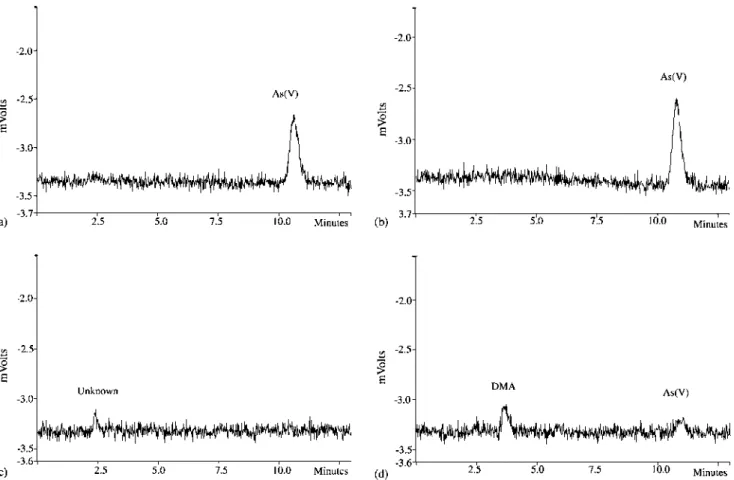
The chromatographic method was applied to the algae stud-ied. The chromatograms obtained for Sargassum, Hizikia,
Lam-inaria and Chlorella algae are shown in Fig. 2. Two peaks can
be distinguished in Chlorella sample (Fig. 2(d)) and one peak in the rest of algae analysed. The arsenic species were identified because of the increase in their area when arsenic species stan-dard solutions were added. The species As(V) was identified in
Sargassum, Hizikia and Chlorella samples (Fig. 2(a), (b) and
(d)), with a retention time of 10.9 =b 0.1 min. The species DMA
B
-2.0-
-2.5-
-3.0-(a)
-3.5-
-3.7-As(V)
2.5 5.0 7.5 10.0 Minutes
B
(b)
-2.0-
-2.5-
-3.0--3.5"
3.7-As(V)
2.5 5.0 7.5 10.0 Minutes
(c)
•2.0
-2.5-
-3.0--3.5 -3.6
Unknown
% ^ H ^ ^
2.5 5.0 7.5 10.0 Minutes £
-2.0H
-2.5--3.0
(d)
-3.5--3.6
As(V)
H | 4 w V ^ ^
2.5 5.0 7.5 10.0 Minutes
Table 6
Quantitative results for arsenic species found in alga samples, expressed as [xg g of arsenic (mean ± standard deviation, n = 3)
Sample
NIES no. 9 (Sargasso)b Hizikia
Chlorella
As(V)
38 ± 2 46 ± 2 9 ± 1
DMA
13 ± 1
Total As extracted
75 ± 3 61 ± 3 25 ± 1
Ka (%)
51 ± 3 75 ± 3 88 ± 6
a Calculated by the comparison between the sum of arsenic species concen-trations and total arsenic extracted.
Total arsenic certified material.
was also found in Chlorella alga (3.6 ± 0.1 min). However, no presence of the arsenic species studied was detected in
Lami-naria alga. The chromatogram (Fig. 2(c)) shows the presence of
an unknown arsenic species, which eluted in the dead volume. We did not find any presence of As(III) and MMA species in the algae analysed. Therefore, if these arsenic species are present, they cannot be detected with the method used.
Species quantification was carried out by HPLC standard addition method and the results are shown in Table 6. Recoveries were calculated by the comparison between the sum of arsenic species concentrations and total arsenic extracted. The arsenic recovery for Sargasso material was lower than those found for
Hizikia and Chlorella algae. Therefore, sample matrix seems
to be an important point to consider, because it may cause the retention of arsenic extracted on the HPLC column [26]. Another explanation for this might be that arsenic species are present at concentration levels lower than detection limits of the method.
4. Conclusions
In this paper, a versatile method for arsenic extraction assisted by ultrasonic focussed probe applied to speciation analysis is presented. The extraction efficiencies obtained with 30 s were comparable to those obtained for 30 min of magnetic stirring.
The algae analysed shows the presence of water-soluble arsenic compounds (about 65% of total arsenic present). Methanol or water/methanol mixture (l:9v/v) provided lower extraction efficiencies than water.
The use of cut-off filters is an adequate clean-up method for algae extracts, which provides more information on the arsenic compounds present in the samples. The fraction of arsenic com-pounds extracted with a molecular weight lower than lOkDa was about 100% for all samples studied.
The species As(V) was identified in Hizikia (46 ± 2 (xgg-1),
Sargassum (38 ± 2 (xgg-1) and Chlorella (9 ± 1 (xgg-1) algae.
The species DMA was also detected in Chlorella alga (13 ± 1 (xgg-1). However, for Laminaria alga only an unknown
arsenic species was detected, which eluted in the dead volume. From these results, it can be concluded that the use of HPLC coupled to ICP-AES is adequate for arsenic speciation in algae containing relative high arsenic levels. However, future research will focus on the coupling of hydride generation in order to enhance the sensitivity.
Acknowledgements
The authors would like to thank the "Secretaría de Estado de Política Científica y Tecnológica—Ministerio de Ciencia y Tecnología" for financial support (project FEDER UNPM00-33015). Thanks to Varian Spain for providing the argon used in this research and to Ph.D. Christian Dietz for revising the manuscript.
References
[9
[io; [ i i
[12;
[13 [14;
[is [le; [17
[18;
[19;
[20
[21
[22
[23
[24
[25
[26
D.J.H. Phillips, Aquat. Toxicol. 16 (1990) 151.
P. Fodor, in: L. Ebdon, L. Pitts, R. Cornelis, H. Crews, O.F.X. Donard, Ph. Quevauviller (Eds.), Trace Element Speciation for Environment, Food and Health, The Royal Society of Chemistry, Cambridge, UK, 2001 (Chapter 11).
Z. Gong, X. Lu, M. Ma, C. Watt, X.C. Le, Talanta 58 (2002) 77. R. Eisler, Handbook of Chemical Risk Assessment Health Hazards to Humans, Plants and Animals, Metalloids, Radiation, Cumulative Index to Chemicals and Species, vol. 3, CRC Press, Boca Raton, FL, 2000 (Chapter 28).
V.M. Dembitsky, T. Rezanka, Plant Sci. 165 (2003) 1177.
E. Schmeisser, W. Goessler, N. Kienzl, A. Francesconi, Anal. Chem. 76 (2004) 418.
G. Raber, K.A. Francesconi, K.J. Irgolic, W. Goessler, Fresen. J. Anal. Chem. 367 (2000) 181.
K.A. Francesconi, J.S. Edmonds, in: J.O. Nriagu (Ed.), Arsenic in the environment. Part 1. Cycling and Characterization, John Wiley & Sons, New York, 1994, pp. 221-263.
K.A. Francesconi, D.A. Hunter, B. Bachmann, G. Raber, W. Goessler, Appl. Organomet. Chem. 13 (1999) 669.
J.S. Edmonds, Bioinorg. Med. Chem. Lett. 10 (2000) 1105.
C. Wei, W. Li, C. Zhang, M. Van Hulle, R. Cornelis, X. Zhang, J. Agrie. Food Chem. 51 (2003) 5176.
S. McSheehy, J. Szpunar, R. Morabito, P. Quevauviller, Trends Anal. Chem. 22 (2003) 191.
J. Szpunar, Analyst 125 (2000) 963.
S. McSheehy, P. Pohl, D. Vélez, J. Szpunar, Anal. Bioanal. Chem. 372 (2002) 457.
K.A. Francesconi, Appl. Organomet. Chem. 16 (2002) 437. S. Karthikeyan, S. Hirata, Appl. Organomet. Chem. 18 (2004) 323. R. Tukai, W.A. Maher, I.J. McNaught, M.J. Ellwood, Anal. Chim. Acta 457 (2002) 173.
D. Kuehnelt, K.J. Irgolic, W. Goessler, Appl. Organomet. Chem. 15 (2001) 445.
V.W.-M. Lai, W.R. Cullen, C.F. Harrington, K.J. Reimer, Appl. Organomet. Chem. 11 (1997) 797.
C.F. Harrington, A.A. Ojo, V.W.-M. Lai, K.J. Reimer, W.R. Cullen, Appl. Organomet. Chem. 11 (1997) 931.
V.W.-M. Lai, W.R. Cullen, C.F. Harrington, K.J. Reimer, Appl. Organomet. Chem. 12 (1998) 243.
S. McSheehy, P. Pohl, R. Lobinski, J. Szpunar, Anal. Chim. Acta 440 (2001) 3.
S. McSheehy, M. Marcinek, H. Chassaigne, J. Szpunar, Anal. Chim. Acta 410 (2000) 71.
T. Dagnac, A. Padró, R. Rubio, G. Rauret, Anal. Chim. Acta 364 (1998) 19.
T.J. Mason, in: R.G. Compton, S.G. Davies, J. Evans, L.F. Gladden (Eds.), Sonochemistry, Oxford University Press, Oxford, 1999 (Chapter 3).