The significance of bent mountain belts
Abstract: Mountain systems, or orogens, result from collisional processes and are commonly curved in plan view. Two main models have been proposed explaining bends of orogens. Thomas (1977, 2006) explained curved mountain systems as reflecting the primary shape of the pre-collisional continental rifted margin. The alternative is that the bends result from deformation of previously more linear oro-gens, and hence reflect continental and perhaps lithosphere-scale strain. Identifying the processes that might result in the development of such large-scale structures, commonly referred to as oroclines is, however, difficult. Nonetheless, primary explanations of curved mountain belts, including the Cordillera and Appalachians of western and eastern North America, respectively, and the Variscan of Europe, fail to account for much paleomagnetic and paleo-stress data. Resolution of the debate is fun-damental to understanding the paleogeographic and tectonic evolution of the Earth.
Keywords:orogens, lithosphere, mountain belts, oroclines.
1School of Earth & Ocean Sciences, University of Victoria, PO Box 3055 STN CSC, Victoria, British Columbia, V8W 3P6,
Canada.
2Departamento de Geología, Universidad de Salamanca, 37008, Salamanca, Spain.
3Department of Geology, Bryn Mawr College, 101 North Merion Avenue, Bryn Mawr, Pennsylvania, 19010-2899, USA.
*e-mail: [email protected]
S. T. J
OHNSTON1*, A. M. M
ONAHAN1, G. G
UTIÉRREZ-A
LONSO2ANDA. B. W
EIL3There is perhaps no more significant continental geo-logical feature than mountains. Mountain systems, or orogens, and their eroded materials are the factories in which stable continental crust is manufactured; they exert a first order control on local and global climate; and they are host to the bulk of Earth’s economic resources, agricultural and mineral deposits. Much of human history, including the development of distinct populations and the related construction of political boundaries, revolves around our interactions with and migrations along and across mountain belts. Understanding the origin and evolution of mountain systems is, therefore, of great geological, economic and social significance. Our goal is, through the study of map- or plan-view bends of mountain belts, to develop an improved understanding of the litho-sphere-scale plate tectonic interactions that initially
give rise to and which subsequently modify great mountain systems.
Oroclines
system formed at 300 Ma, coincident with the Carboniferous-Permian boundary, is temporally asso-ciated with a massive thermal and magmatic event present in much of the crust central Pangea, and may be the single largest structure ever mapped on Earth (Gutiérrez-Alonso et al., 2004). Subsequent erosion has resulted in significant local relief, providing us with the opportunity to observe the three dimension-al geometry of the orocline. Other equdimension-ally impressive bends, like the Vrancea region in the Carpathians or the Kohistan arc in the Himalaya, are dynamic, youth-ful features whose formation is ongoing. Geophysical monitoring of these deforming regions, particularly the Carpathians, provides us with an opportunity to understand the role played by the lithospheric mantle in bending mountain belts. Some of the greatest topo-graphic relief on Earth is to be found associated with the still evolving tight bends. For instance, the tight bends (commonly referred to as syntaxes) that adorn the eastern and western ends of the Himalaya, are characterized by tremendous topographic relief, elevat-ed heat flow, and are the sites of exhumation of large tracts of highly metamorphosed lower crustal rocks (Zeitler et al., 2001). Earth’s second largest and high-est plateau, the Altiplano of South America, sits astride and arose during formation of the great Bolivian bend of the Andes (Isacks, 1988).
Despite the scale of these structures, and their spatial and genetic association with crustal-scale
exhuma-tion, magmatic, thermal and mineralizing events, there remains little consensus regarding the processes responsible for producing bends of orogens. Hence the question remains, are they tectonically significant? Thomas, in his groundbreaking papers on the Appalachians (Thomas, 1977, 2006) established as a basic assumption in the interpretation of bent moun-tain belts that the map-view geometry of an orogen is a reflection of the primary shape of the pre-collision-al continentpre-collision-al rifted margin. Hence the spre-collision-alients and recesses that characterize the Appalachian Mountains are commonly interpreted to reflect the geometry of the reentrants and promontories that characterized the Iapetan passive margins of Laurentia. However, a number of observations are inconsistent with such an endogenic interpretation of the bends of the Appalachians. For example, paleomagnetic data, while hotly debated, require that at least parts of the orogen began as more linear features that were subse-quently bent (Stamatakos et al., 1996).
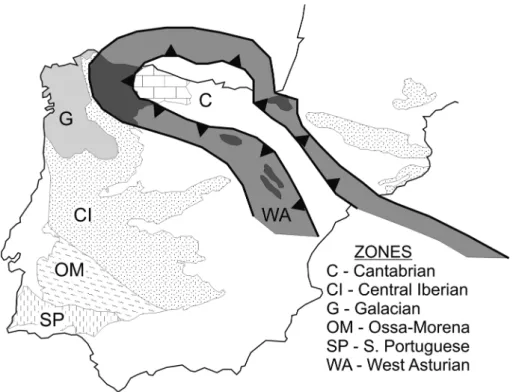
Turning again to the Iberian bend of the Variscan Orocline provides further insight into this debate. In most published interpretations, the Variscan moun-tain system, which is inferred to have developed in response to the collision of Gondwana with Laurasia forming Pangea, is depicted as simply wrapping around an intact paleogeographic promontory that characterized the northern margin of Gondwana (see Martínez-Catalán et al., 2002 and references therein).
Interpretation of the Iberian bend as a primary paleo-geographic feature cannot, however, be reconciled with paleomagnetic data showing that the bend resulted from buckling of an originally much more linear mountain system (Weil, 2006). This latter, sec-ondary or exogenic tectonic interpretation of the Iberian bend requires that the Variscan belt of north-ern Iberia formed a linear “ribbon continent” that buckled, probably during the collision between Laurentia and Gondwana. Such an interpretation requires that the Iberian ribbon continent was a tec-tonic element distinct from either Gondwana or Laurentia, which seems in conflict with geological data that ties Iberia to Gondwana. Alternatively, the ribbon continent may have formed an elongate archi-pelago that rooted into Gondwana to the SE, consis-tent with the strong stratigraphic ties to Gondwana, and extended north across the Rheic ocean that sepa-rated Gondwana and Laurentia. Resolution of this debate is central to determining the causes of the Carboniferous-Permian boundary magmatic and thermal event that affected much of Iberia, and is therefore of significant local interest; exploration strategies remain dependent upon having a broad understanding of the processes responsible for ther-mally driven fluid flow. The more fundamental issue is that understanding the paleogeographic and tecton-ic evolution that led to the formation of Pangea is dependent upon our successfully resolving the origin of, and determining how to palinspastically undo the Iberian bend.
The association of bent mountain systems and problem-atic paleogeographic reconstructions is common. For instance, there is little agreement concerning the Late Cretaceous to Early Tertiary paleogeographic evolution of the Cordillera of western North America. This endur-ing discrepancy is rooted in conflictendur-ing interpretations of geological and paleomagnetic data sets. Paleomagnetic data for Cretaceous strata imply that much of the orogen lay far (2000 to 3000 km) to the south during deposi-tion, and requires significant Late Cretaceous dextral translation to bring the terranes to their current position. Mapping has, however, failed to reveal the strike-slip faults along which such displacements are inferred to have occurred. Either the paleomagnetic data are being interpreted incorrectly, or structures accommodating thousands of kilometers of margin-parallel displacement are being systematically overlooked (Johnston, 1999). Intriguingly, the northern end of the Cordilleran orogen is characterized by a number of large bends that may hold the key to solve of this enigma. Box (1985), and subsequently Dover (1994), demonstrated that in Alaska the mountain system was characterized by a series of sig-nificant ‘bends’ that described a Z pattern, with an E-W-trending belt that extends west from Yukon across south-ern Alaska that turns to the NE across central Alaska before turning west across Arctic Alaska. Although orig-inally interpreted as reflecting the primary geometry of the continental margin, Johnston (2001) subsequently suggested that the bends were oroclines and demonstrat-ed that palinspastic restoration of the bends to a linear geometry restored the more southerly portions of the
orogen to the latitudes suggested by the paleomagnetic data (Fig. 2).
Discussion
Understanding how bends of mountain systems develop is, therefore, a fundamental first order Earth System problem whose resolution is central to under-standing the paleogeographic and tectonic evolution of the Earth. Major unresolved questions include:
1. Are bends lithosphere-scale features, involving bending and buckling of entire tectonic plates, or are they thin-skinned, ending down against crustal detachments?
2. Is the stress field responsible for bend development orogen-normal or orogen-parallel?
3. Are bends of orogenic belts the result of the defor-mation in response to the same stress field responsible for orogen formation in the first place?
4. Are small-scale bends, for instance those affecting individual thrust faults and local portions of orogenic belts, attributable to the same processes responsible for whole-scale buckling of complete orogenic belts?
5. What drives the formation of large-scale bends of orogenic belts, and how are such bends accommodat-ed within the surrounding crust and lithosphere?
6. Do bends of orogenic belts play a role in focusing and localizing crustal-scale fluid flow, and hence in
the distribution and character of orogenic mineral deposits?
7. How do we palinspastically restore bends of moun-tain belts? Such restorations are crucial to understand-ing the paleogeographic implications of bend devel-opment.
8. Are there multiple different processes that result in similar looking bends, or can we identify some plate tectonic setting or process common to all bends of orogenic belts?
9. Can bends of orogenic belts develop at any time, or do they follow closely in time after the crustal-thick-ening events responsible for orogen development in the first place?
10. Has bending of orogenic belts been an important process throughout Earth’s history, or are orogens of certain ages more likely to be characterized by map-view bends?
11. Is bending restricted to orogenic belts, or can we identify pre-collisional bends that were antecedent to subsequent collisional orogenesis?
Acknowledgements
G.G.-A. funding comes from Spanish Education and Science Ministry Project Grant CGL2006-00902 (O.D.R.E.). Johnston and Monahan were funded by Discovery Grants pro-vided by the National Science and Engineering Research Council of Canada.
References
BOX, S. E. (1985): Early Cretaceous orogenic belt in northwestern
Alaska: internal organization, lateral extent, and tectonic interpre-tation. In: D. G. HOWELL(ed): Tectonostratigraphic terranes of the Circum-Pacific region. Circum-Pacific Council for Energy and Mineral Resources, Houston. Earth Sc. Ser., 1: 137-145.
DOVER, J. H. (1994): Geology of part of east-central Alaska. In:
G. PLAFKERand H. C. BERG(eds): The geology of Alaska. Geol. Soc.
Am., Boulder, Colorado, G-1: 153-204.
GUTIÉRREZ-ALONSO, G., FERNÁNDEZ-SUÁREZ, J. and WEIL, A. B. (2004): Orocline triggered lithospheric delamination. In: A. J. SUSSMANand A. B. WEIL (eds): Orogenic curvature: Integrating
paleomagnetic and structural analyses. Geol. Soc. Am. Spec. Pap, Boulder, Colorado, 383: 121-130.
ISACKS, B. L. (1988): Uplift of the central Andean plateau and bending of the Bolivian orocline. J. Geophys. Res., 93: 3211-3231.
JOHNSTON, S. T. (1999): Large scale coast-parallel displacements
in the Cordillera: a granitic resolution to a paleomagnetic dilem-ma? J. Struct. Geol., 21: 1103-1108.
JOHNSTON, S. T. (2001): The Great Alaskan Terrane Wreck: rec-onciliation of paleomagnetic and geological data in the northern Cordillera. Earth Planet. Sc. Lett., 193: 259-272.
MARTÍNEZ-CATALÁN, J. R., HATCHERJR, R. D., ARENAS, R. and
DÍAZ-GARCÍA, F. (2002): Variscan-Appalachian dynamics: the building of the Late Paleozoic basement. Geol. Soc. Am. Spec. Pap., Denver, Colorado, 364: 37-56.
MARTÍNEZ-CATALÁN, J. R., ARENAS, R., DÍAZ-GARCÍA, F.,
GÓMEZ-BARREIRO, J., GONZÁLEZ-CUADRA, P., ABATI, J.,
HATCHER JR., M. P. CARLSON, J. H. MCBRIDE, and J. R.
MARTÍNEZ-CATALÁN (eds): 4D framework in continental crust.
Geol. Soc. Am. Memoir, 200: 403-423.
STAMATAKOS, J., HIRT, A. M. and LOWRIE, W. (1996): The age and timing of folding in the central Appalachians from paleomag-netic results. Geol. Soc. Am. Bull., 108: 815-829.
THOMAS, W. A. (1977): Evolution of Appalachian-Ouachita
salients and recesses from reentrants and promontories in the con-tinental margin. Am. J. Sci., 277: 1233-1278.
THOMAS, W. A. (2006): Tectonic inheritance at a continental mar-gin. GSA Today, 16: 4-11.
WEIL, A. B. (2006): Kinematics of orocline tightening in the core
of an arc: Paleomagnetic analysis of the Ponga Unit, Cantabrian Arc, northern Spain. Tectonics, 25: TC3012.
ZEITLER, P. K., MELTZER, A. S., KOONS, P. O., CRAW, D., HALLET, B., CHAMBERLAIN, C. P., KIDD, W. S. F., PARK, S. K., SEEBER, L., BISHOP, M. and SHRODER, J. (2001): Erosion, Himalayan