Numerous studies have examined the determining factors of academic achievement in maths. Thus, the roles of both cognitive and affective-motivational (Miñano & Castejón, 2011; Miñano, Gilar, & Castejón, 2012) and contextual variables (Rosário, Lourenço, Paiva, Rodrigues, Valle, & Tuero-Herrero, 2012) have been studied.
Regardless of cognitive ability or previous knowledge, affective-motivational beliefs and strategic resources that students use to learn maths impact on their achievement. In addition to recognizing the role of parents in promoting the intellectual skills that children need in order to succeed at school, it is critically
important to shed light on the multiple subtle ways in which parents affect achievement-beliefs and behaviors in their children. Parents’ achievement-related beliefs and behaviors can have a profound infl uence on how children come to perceive their own abilities and the value of learning (Eccles, Roeser, Vida, Fredricks, & Wigfi eld, 2006).
The Expectancy-value Theory (EVT) also distinguishes between multiple components of value. Although four types of values for tasks have been defi ned, our study focused on mathematics utility value. Utility value, or usefulness, refers to how a task relates to current or future goals (Eccles & Wigfi eld 2002).
In addition to evaluating mathematics expectancy-value, we resort to the achievement goal theoretical framework to assess the purposes or reasons why an individual pursues an academic task and the meaning of achievement to the individual (Anderman & Wolters 2006). In this context, we were interested in discovering how parents’ beliefs infl uence student’s intention to focus on learning and understanding in mathematics classrooms
ISSN 0214 - 9915 CODEN PSOTEG Copyright © 2017 Psicothema www.psicothema.com
An explanatory model of maths achievement:
Perceived parental involvement and academic motivation
Susana Rodríguez, Isabel Piñeiro, Mª Luisa Gómez-Taibo, Bibiana Regueiro, Iris Estévez and Antonio Valle
Universidade da CoruñaAbstract
Resumen
Background: Although numerous studies have tried to explain performance in maths very few have deeply explored the relationship between different variables and how they jointly explain mathematical performance. Method: With a sample of 897 students in 5th and 6th grade in Primary Education and using structural equation modeling (SEM), this study analyzes how the perception of parents’ beliefs is related to children´s beliefs, their involvement in mathematical tasks and their performance.
Results: Perceived parental involvement contributes to the motivation of their children in mathematics. Direct supervision of students’ academic work by parents may increase students’ concerns about the image and rating of their children, but not their academic performance. In fact, maths achievement depends directly and positively on the parents’ expectations and children’s maths self-effi cacy and negatively on the parents’ help in tasks and performance goal orientation. Conclusions: Perceived parental involvement contributes to children’s motivation in maths essentially conveying confi dence in their abilities and showing interest in their progress and schoolwork.
Keywords: Parental involvement, self-efficacy, utility value, goal orientation, maths achievement.
Un modelo explicativo del rendimiento en matemáticas: percepción de la implicación parental y motivación académica. Antecedentes:
aunque numerosos estudios han tratado de explicar el rendimiento en matemáticas muy pocos han profundizado en la relación existente entre las diferentes variables que pueden explicar el rendimiento matemático, tomadas conjuntamente. Método: 897 estudiantes de 5º y 6º de Primaria y empleando análisis de ecuaciones estructurales se analizó cómo la percepción de las creencias de los padres se relaciona con las creencias de los hijos, su implicación en las tareas matemáticas y su rendimiento.
Resultados: la percepción de la implicación parental contribuye a la motivación de sus hijos. La supervisión directa del trabajo académico de los estudiantes por parte los padres podría aumentar la preocupación de estos por la imagen y las califi caciones de sus hijos, pero esto no incrementa el rendimiento académico de los estudiantes. El rendimiento dependería directa y positivamente de las expectativas de los padres y la autoefi cacia matemática de los estudiantes y negativamente de la ayuda de los padres en las tareas y de la orientación hacia metas de rendimiento.
Conclusiones: la percepción de implicación parental percibida contribuye a la motivación de los niños en matemáticas, transmitiendo confi anza en sus habilidades y mostrando interés en su progreso y trabajo escolar.
Palabras clave: implicación de los padres, autoefi cacia, valor de utilidad, orientación de meta, rendimiento matemático.
Psicothema 2017, Vol. 29, No. 2, 184-190
doi: 10.7334/psicothema2017.32
Received: January 24, 2017 • Accepted: March 21, 2017 Corresponding author: Susana Rodríguez
–mastery goal orientation–. Students with higher mastery goals are theoretically expected to be more academically successful and empirical evidence for mathematics students has been found (Peklaj, Podlesek, & Pečjak, 2015).
Eccles’ model posits that children’s subjective appraisal of parents’ beliefs plays a critical role in mediating the relationship between parents’ beliefs and children’s self-perception of competence in achievement-related domains. Thus parents provide social-emotional infl uences on children’s motivation beliefs, which in turn infl uence children’s educational performance.
In line with the predictions of Expectancy-value Theory (EVT), the positive association between parents’ evaluation of their children’s academic skills and children’s perception of such abilities has received empirical support (e.g., Simpkins, Fredricks, & Eccles, 2015). Importantly, it has been suggested that the association between children’s self-perception of ability and their performance could be mediated by these parents’ evaluations (Tiedemann, 2000).
As a social cognitive theory, achievement goal theory asserts that both school and family contexts contribute to the goal orientations that students adopt (Maehr, 2001). Relatively little research has examined the association between parental variables and classroom goal orientations (Chan & Chan, 2007; Kim, Schallert, & Kim, 2010). However, Friedel, Cortina, Turner, and Midgley (2007) argue that parental goal orientations could be better predictors of middle school students’ goal orientation than teacher goal orientations.
Gutman (2006) conducted a mixed methods study and found that children from mastery-oriented parents were more likely to report mastery-oriented goals themselves. The research seems to support a positive relationship between parental mastery goal orientation and support, and student mastery goal orientation and self-effi cacy. Parental performance goal orientation and parental control were also related to student performance goal orientation –approach and avoidance–, lowered mastery goals and reduced academic effi cacy (Friedel et al., 2007).
In this study we assume that parental support is essential to students’ academic success (Simpkins et al., 2015). However, additional work is needed to provide a more comprehensive understanding of how parents’ maths support –parents’ interest in children’s progress, parents’ expectations and parents’ help in academic tasks– predicts children’s motivational beliefs –maths self-effi cacy and utility value–and classroom goal orientations (Chan & Chan, 2007; Kim et al., 2010) in elementary school. As both expectancy-value theory and achievement goal perspectives suggest, we expect a positive relationship between these children’s motivational beliefs and approach goal orientations with academic achievement in maths (Peklaj et al., 2015).
Method
Participants
The sample consisted of 897 Spanish students from 13 public schools. Of the total, 50.2% were boys and 49.8% were girls, the ages ranged between 9 and 13 years old (M = 10.77); 437 of the participants were enrolled in the 5th grade of elementary school (223 boys and 213 girls) and 460 were enrolled in 6th grade of elementary school (227 boys and 233 girls).
Instruments
Parental involvement
Parental involvement was evaluated using the Family Involvement Questionnaire (González-Pienda & Núñez, 1994).
– Interest in the progress of children. This variable consists of nine items adapted from the Family Involvement Questionnaire, it is intended to measure the degree of involvement and interest of parents in what their children do at school (Cronbach α= .79).
– Parents help with academic tasks. Four items were used to measure the degree of supervision and help of parents in academic tasks performed by their children at home (Cronbach α = .64).
– Parents’ expectations (Cronbach α = .73). The four items making up this dimension measure what parents think about the skills their children have for dealing with academic and non-academic situations.
Items in each of the dimensions have a Likert format with fi ve response options ranging from 1 (totally false) to 5 (completely true).
Attitude toward mathematics
The IAM (Inventory of Attitudes toward Mathematics) was used to measure student attitudes toward mathematics.
− Maths self-effi cacy (Cronbach’s α= .75): assesses the degree of self-confi dence to learn and do well at maths.
− Maths utility value (Cronbach’s α = .60): assesses the extent to which students perceive the usefulness of the knowledge acquired in mathematics, especially for the future.
− Performance goal orientation in maths (Cronbach’s α = .78): evaluates the motivation aimed at achieving top grades and being the best at mathematics.
− Mastery goal orientation in maths (Cronbach’s α= .72): evaluates the motivation to learn and understand mathematical content for pleasure and personal satisfaction.
Items in each of the dimensions have a Likert format with fi ve-response options ranging from 1 (totally false) to 5 (completely true).
Mathematics achievement
Academic achievement in mathematics was obtained from the scores achieved in this course: Poor, Fair, Good, Very Good and Excellent.
Procedure
The target variable data were collected during regular school hours by external staff, after obtaining the consent of the school directors and the students’ teachers.
Data analysis
likelihood procedure (see Table 1), a structural equation analysis, using the computer program AMOS 18 was employed to contrast a hypothesized model predicting the incidence of perceived parental involvement on mathematics motivation and achievement. In addition to chi-square (χ2) and its associated probability (p), the information provided by the goodness-of-fi t index (GFI), the comparative fi t index (CFI) and the root mean square error of approximation (RMSEA) were used. The model fi ts well when GFI > .90, CFI > .95, and RMSEA ≤ .05.
Results
Preliminary analysis
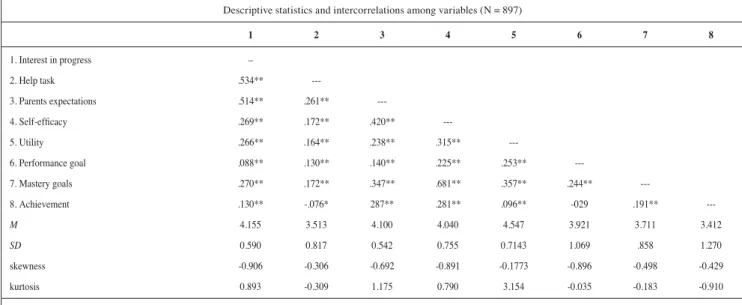
Table 1 details the means, standard deviations, skewness, kurtosis, and bivariate correlations between the measures. All three aspects of the students’ perceptions of parental involvement, parents’ interest in children’s progress, parents’ help with academic tasks and parents’ expectations, were associated with maths self-effi cacy (r = .26, r = .17 and r = .42, p<.01, respectively) and maths utility value (r = .26, r = .16 and r = .23, p<.01, respectively). Both maths self-effi cacy and utility value correlated with performance (r = .22 and r = .25, p<.01, respectively) and mastery goals orientation in maths (r = .68, and r = .35, p<.01, respectively). Maths achievement was positively correlated with parents’ expectations, parents’ interest in progress, maths self-effi cacy, maths utility value and mastery goal orientation (r = .28, r = .13, r = .28, r = .09 and r = .19, p<.01, respectively).
The correlation between maths achievement and parents’ help with academic tasks was less important and negative (r = -.07, p<.05). Performance goal orientation was the only motivational construct that did not seem to correlate with maths achievement (see Table 1).
Testing a hypothesized structural model
Based on the literature reviewed, we hypothesized a positive infl uence of perceived parental involvement –parents’ interest
in children progress, parents’ expectations and parents help in academic tasks– on students’ motivational beliefs –maths self-effi cacy and utility value–. In addition, we expected to fi nd a positive relationship between these student’s motivational beliefs and mastery and performance goal orientation. Consistent with the predictions of the EVT, we initially hypothesized a direct positive relationship between perceived parental involvement and maths academic achievement. As both expectancy-value theory and achievement goal perspectives suggest, we assume a positive relationship between these children’s motivational beliefs and approach goal orientations with maths academic achievement. In Figure 1 the relationships expressed in the formulation of the hypothesis producing the model to be contrasted are made explicit.
The evaluation of the proposed model was performed at two different times. First, the analysis of the degree of global fi t of the model in order to verify the extent to which it correctly reproduces the relations in the matrix of empirical data. Second, once the model fi t, we proceeded to analyze the hypothesized relationships between the variables that made up the model.
The extent to which a hypothesized model fi ts or adequately describes the sample data is of primary interest in structural equation modeling. In general, the results obtained from the contrast of the hypothesized model (Figure 1) revealed a lack of fi t of this model. Specifi cally, the data showed a χ2
(8) value of 69.583 and probability value (0.000) which indicates that the data matrix generated by the hypothesized model is signifi cantly different from the empirical data. In general, the data provided by AMOS seem to indicate that the model shows some lack of fi t, despite the fact that some of the statistics indicate accepting the model as it was formulated (CFI = .903; GFI = .981).
Consequently, the following step was to analyze the sources of poor fi t and re-specify the model in an attempt to eliminate these problems. As some expert researchers in this type of methodology advise, modifi cations in the original model should be justifi ed not only at a statistical level (the change signifi cantly improves the fi t of the model), but also for theoretical and practical reasons (Byrne, 2001). First we omitted the relationship between parents’
Table 1
Descriptive statistics and intercorrelations among variables (N = 897)
1 2 3 4 5 6 7 8
1. Interest in progress –
2. Help task .534**
---3. Parents expectations .514** .261**
---4. Self-effi cacy .269** .172** .420**
---5. Utility .266** .164** .238** .315**
---6. Performance goal .088** .130** .140** .225** .253**
---7. Mastery goals .270** .172** .347** .681** .357** .244**
---8. Achievement .130** -.076* 287** .281** .096** -029 .191**
---M 4.155 3.513 4.100 4.040 4.547 3.921 3.711 3.412
SD 0.590 0.817 0.542 0.755 0.7143 1.069 .858 1.270
skewness -0.906 -0.306 -0.692 -0.891 -0.1773 -0.896 -0.498 -0.429
kurtosis 0.893 -0.309 1.175 0.790 3.154 -0.035 -0.183 -0.910
interest in children’s progress and maths self-effi cacy and between parents’ help in task and maths utility value because hypothesized effects did not reach a minimum level of statistical signifi cance. For the same reason, we omitted the relationships between parents’ interest in children’s progress, maths utility value and mastery goal with maths achievement.
Second, we included three suggested relationships in the model. First we included an important positive relation between self-effi cacy and maths utility value. Estimating this parameter made us skip the direct relationship between parents’ expectations and maths utility value because it did not reach a minimum level of statistical signifi cance. We also included a positive suggested relationship between parents’ help with task and performance goals. Finally, we include a third suggested relationship between parents’ interest in children’s progress and mastery goal orientation.
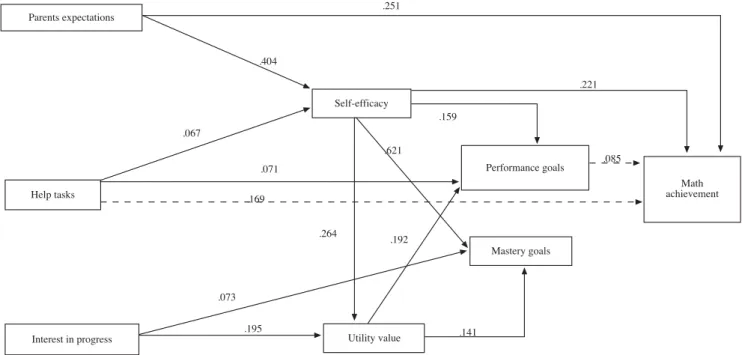
With this procedure of re-specifi cation, we obtained a model that captures the important relationships and, at the same time, was as parsimonious as possible. The fi nal model, following those modifi cation, can be seen in Figure 2. Comparing this with Figure 1, the modifi cations made to the initially hypothesized model can be seen.
The data obtained about the degree of fi t of the fi nal model were better. All the statistics analyzed clearly indicate that the fi nal model is plausible to correctly explain the relationships between the variables measured. Thus, ÷2 = 17.46; with 11 degrees of freedom, is not signifi cant (p = .095), which indicates that there are no statistically signifi cant differences between our model and the empirical data, and consequently, that we should accept the model. Furthermore, GFI and CFI indices reached optimal levels (.90 and >) at .995 and .990, respectively and the RMSEA value for the present model was .026, falling within optimal levels (<.05). Parents expectations
Interest in progress
Utility value
Mastery goals Self-efficacy
Performance goals
Math achievement Help tasks
Figure 1. Initial hypothesized model
Interest in progress Utility value
Mastery goals
Math achievement Performance goals
Self-efficacy
Help tasks Parents expectations
.251
.404
.067
.071
.221
.159
.621
.192
.141 .195
.073
.264 .169
.085
Figura 2. Re-specifi ed model
As our initial proposal suggested that parents’ expectations explain maths self-effi cacy (b = .40, p<.001). Parents’ help can also have a positive impact on maths self-effi cacy in their children (b = .06, p<.05), although to a lesser extent. However, neither parents’ expectations nor parents’ help in task seem to directly infl uence the maths utility value. The infl uence of this parameter is possibly indirect and may be affected by the estimated relationship between maths self-effi cacy and maths utility value (b = .26, p<.001) In fact, only parents’ interest in children’s progress maintains a positive direct effect on utility value assigned to mathematics (b = .19, p<.001).
Moreover, while parents’ expectations had a positive impact on children’s maths achievement(b = .25, p<.001), parents’ help in academic task had a negative direct relationship with maths achievement (b = -.16, p<.001). The correlations obtained suggest the direct negative effect found leads us to assume that parents help with academic task may be more important as the performance of the children suffers.
The mastery as performance goal orientation is fi nally positively explained by the maths perceived self-effi cacy (b = .62, p<.001 and b = .15, p<.001, respectively) and maths utility value (b = .14, p<.001 and b = .19, p<.001, respectively). However, neither maths utility value nor mastery goal orientation seem to sustain meaningful relationships with maths achievement. The structural equation analysis allowed us to also suggest some positive impact of parents’ interest in children progress on mastery goal orientation in maths (b = .07, p<.050) and of parents help with task on performance goals (b = .07, p<.050). In summary, maths achievement depends directly and positively on the parents expectations (b = .25, p<.001) and children maths self-effi cacy (b = .22, p<.001); while parent’s help in tasks (b = -.19, p<.001) and performance goal orientation in maths (b = -.08, p<.05) explain achievement negatively. Predictors explain 15% of maths achievement variance.
Discussion
The results of this study support previous fi ndings that seem to suggest that the family mainly infl uences the personal circumstances of the student (self-effi cacy and utility value, in this case), which are the variables most directly linked to academic performance (Álvarez, Suárez, Tuero, Núñez, Valle, & Regueiro, 2015; Valle et al., 2015). Although there is a consensus about the importance of parental involvement in students’ academic success (Eccles, 2007), there are still some ambiguities in the literature about the type of parental behaviors that contribute to school success (Fan & Williams, 2010). This study using multivariate causal modeling techniques supports the prediction that children are more confi dent in their chances of doing well when they believe their parents trust their abilities and that the utility value attributed to mathematics may depend on the interest parents show in what their children do at school, their diffi culties and academic progress.
Parents’ child-specifi c beliefs such as perceptions of the child’s abilities or expectations for the child’s achievement have been acknowledged as primary determinants of children’s own ability perceptions and performance (see e.g., Eccles, 2007). Besides the indirect infl uence of parents’ expectations on children’s maths achievement also found in previous research (e.g., Tiedemann, 2000), our results allow us to affi rm a major signifi cant direct
relationship between perceived parents’ expectations and maths achievement.
According to the expectancy-value model, achievement is directly infl uenced by the individual’s self-effi cacy expectations and the inherent value of the academic task (Wang & Tsai, 2016). However, our results do not allow us to confi rm this direct link between the utility value and achievement in maths; which leads us to suggest that effective expectancy beliefs have a strong infl uence on achievement, while value beliefs may have stronger infl uence on other performance variables such as choice, effort, and persistence in achievement tasks (Trautwein, Marsh, Nagengast, Lüdtke, Nagy, & Jonkmann, 2012). In this regard, it should be remembered that, whereas the utility value has been associated with multiple aspects of academic success, relationships between utility value and maths achievement are mixed (see e.g., Gilbert, Musu-Gillette, Woolley, Karabenick, Strutchens, & Martin, 2014). As recently suggested for mathematics, it seems likely that any effect of utility on test performance will become nonsignifi cant when ability beliefs are included in the analysis (Gilbert et al., 2014).
On the other hand, results from path analysis suggest that self-effi cacy is related directly to task value. Students with high self-effi cacy fi nd mathematics classes more useful, important and valuables. As Marsh and Craven (2006) suggested interventions aimed at improving mathematics skills alone would not be as effective as those that simultaneously aim to improve mathematics skills and perceptions of mathematics ability, and our results support this view. In response to this set of relationships it seems appropriate to recommend that educators encourage students and provide them with a basis to form and express positive self-effi cacy expectations.
Clearly, both self-effi cacy in mathematics and the utility value positively explain the adoption of student achievement goals. Results support the hierarchical model of achievement motivation of Elliot (1997) which suggested that individuals with high perceived competence are inclined to adopt mastery and performance-approach goals. Wigfi eld and his colleagues discussed ways in which children´s values might relate to their goal orientation suggesting students’ values are related signifi cantly to both mastery and performance goals (Wigfi eld, Anderman, & Eccles, 2000). An academic task perceived to be instrumental to the pursuit of personally-valued future goals would have a consequence on the following achievement goals that students adopt (Miller & Brickman, 2004).
As for the relationship between performance approach goals and academic success, our fi nding is not consistent with previous longitudinal research that has shown that a prior performance approach goal orientation is a positive predictor of subsequent academic success (Durik, Lovejoy, & Johnson, 2009). The negative link between performance goal orientation and rating assigned by the maths teacher coincides however with other work carried out in samples of elementary school such as Paulick, Watermann and Nücklesc (2013) who showed a negative reciprocal relationship between performance approach goals and subsequent achievement. As the authors suggested, it is possible that the changes associated with the transition to secondary school may have a particularly strong impact on performance approach goals.
studies, which have shown that mastery approach goals did not predict subsequent achievement (Durik et al., 2009).
Considering the results, parents contribute to the motivation of the children in mathematics essentially conveying confi dence in their abilities and showing interest in their progress and schoolwork. Specifi cally, we found that trust in the ability of children to cope with homework, to learn from their mistakes or to achieve what is proposed could explain the perceived self-effi cacy in mathematics. At this point, our results suggest that showing interest in children’s progress can also contribute to the adoption of mastery goals in mathematics. These types of feedback and parental attitude could make a more effective contribution to the motivation of their children than most direct help with academic tasks in terms of supervision of homework or study time at home (Regueiro, Suárez, Valle, Núñez, & Rosário, 2014).
In fact, besides being negatively related to academic performance, direct supervision of children’s academic work by parents could infl uence the promotion of a performance goal orientation. Parents
monitoring a child’s homework and study may make children more concerned about being judged by their parents.
The primary limitation of this study is our measure of self-reported motivational beliefs. We nevertheless feel that these survey responses provide valuable information regarding student motivation. Another important limitation is that the study does not address previous academic achievement and that the study was conducted as a cross-sectional survey. Longitudinal studies involving parents and children with the same and additional constructs are called for.
Acknowledgements
This work was carried out through funding from the research project EDU2013-44062-P, of the State Plan of Scientifi c and Technical Research and Innovation 2013-2016 (MINECO) and thanks to the fi nancing received by one of the authors in the FPU program (MECD).
References
Álvarez, A., Suárez, N., Tuero, E., Núñez, J.C., Valle, A., & Regueiro, B. (2015). Implicación familiar, autoconcepto del adolescente y rendimiento académico [Family involvement, adolescent self-concept and academic achievement]. European Journal of Investigation in Health, Psychology and Education, 3(5), 293-311. doi: 10.1989/ejihpe.v5i3.133
Anderman, E.M., & Wolters, C.A. (2006). Goals, values, and affect: Infl uences on student motivation. In P. A. Alexander & P. H. Winne (Eds.), Handbook of Educational Psychology (2nd ed., pp. 369-389). Mahwah, NJ: Lawrence Erlbaum.
Byrne, B.M. (2001). Structural equation modeling with AMOS: Basic concepts, applications, and programming. Mahwah, NJ: Lawrence Erlbaum.
Chan, W., & Chan, S. (2007). Hong Kong Teacher Education Students’ Goal Orientations and their relationship to perceived parenting
styles. Educational Psychology: An International Journal of
Experimental Educational Psychology, 27(2), 157-172. doi: 10.1080/01443410601066636
Durik, A.M., Lovejoy, C.M., & Johnson, S.J. (2009). A longitudinal study of achievement goals for college in general: Predicting cumulative GPA and diversity in course selection. Contemporary Educational Psychology, 34(2), 113-119. doi: 10.1016/j.cedpsych.2008.11.002 Eccles, J.S. (2007). Families, schools, and developing achievement related
motivations and engagement. In J.E. Grusec & P.D. Hastings (Eds.),
Handbook of socialization (pp. 665-691). New York: Guilford Press. Eccles, J.S., & Wigfi eld, A. (2002). Motivational beliefs, values, and goals.
Annual Review of Psychology, 53(1), 109-132. doi:10.1146/annurev. psych.53.100901.135153
Eccles, J., Roeser, R., Vida, M., Fredricks, J.A., & Wigfi eld, A. (2006). Motivational and achievement pathways through middle childhood. In L. Balter & C.S. Tamis-LeMonda (Eds.), Child psychology: A handbook of contemporary issues (2nd ed., pp. 325-355). New York: Psychology Press.
Elliot, A.J. (1997). Integrating the “classic” and “contemporary” approaches to achievement motivation: A hierarchical model of
approach and avoidance achievement motivation. Advances in
Motivation and Achievement, 10(7), 143-179.
Fan, W., & Williams, C.M. (2010). The effects of parental involvement on students’ academic self-efficacy, engagement and intrinsic motivation. Educational Psychology: An International Journal of Experimental Educational Psychology, 30(1), 53-74. doi: 10.1080/01443410903353302
Friedel, J., Cortina, K.S., Turner, J.C., & Midgley, C. (2007). Achievement goals, efficacy beliefs and coping strategies in mathematics: The
roles of perceived parent and teacher goal emphases. Contemporary Educational Psychology, 32, 434-458. doi: 10.1016/j.cedpsych. 2006.10.009
Gilbert, M.C., Musu-Gillette, L.E., Woolley, M.E., Karabenick, S.A., Strutchens, M.E., & Martin, W.G. (2014). Student perceptions of the classroom environment: Relations to motivation and achievement in mathematics. Learning Environments Research, 17, 287-304. doi: 10.1007/s10984-013-9151-9
González-Pienda, J.A., & Núñez, J.C. (1994). Cuestionario para la evaluación de la implicación de la familia en el proceso de escolarización de los hijos [Questionnaire for the evaluation of the involvement of the family in the process of education of children]. Department of Psychology. University of Oviedo.
Gutman, L.M. (2006). How student and parent goal orientations and classroom goal structures infl uence the math achievement of African Americans during the high school transition. Contemporary Educational Psychology, 31(1), 44-63. doi: 10.1016/j.cedpsych.2005.01.004 Kim, J., Schallert, D.L., & Kim, M. (2010). An integrative cultural view
of achievement motivation: Parental and classroom predictors of children’s goal orientations when learning mathematics in Korea.
Journal of Educational Psychology, 102(2), 418-437. doi: 10.1037/ a0018676
Maehr, M.L. (2001). Goal theory is not dead-Not yet, anyway: A refl ection on the special issue. Educational Psychology Review, 13(2), 177-185. Marsh, H.W., & Craven, R.G. (2006). Reciprocal effects of self-concept
and performance from a multidimensional perspective: Beyond seductive pleasure and unidimensional perspectives. Perspectives on Psychological Science, 1(2),133-163. doi: 10.1111/j.1745-6916.2006. 00010.x
Miller, R.B., & Brickman, S.J. (2004). A model of future-oriented motivation and self-regulation. Educational Psychology Review, 16(1), 9-33. doi: 10.1023/B:EDPR.0000012343.96370.39
Miñano, P., & Castejón, J.L. (2011). Cognitive and motivational variables in the Academic achievement in language and mathematics subjects: A structural model. Revista de Psicodidáctica, 16(2), 203-230. Miñano, P., Gilar, R., & Castejón, J.L. (2012). A structural model of
cognitive-motivational variables as explanatory factors of academic
achievement in Spanish Language and Mathemathics. Anales de
Psicología, 28(1), 45-54.
Peklaj, C., Podlesek, A., & Pečjak, S. (2015). Gender, previous knowledge, personality traits and subject-specifi c motivation as predictors of students’ math grade in upper-secondary school. European Journal of Psychology of Education 30(3), 313-330. doi:10.1007/s10212-014-0239-0
Regueiro, B., Suárez, N., Valle, A., Núñez, J., & Rosário, P. (2014). Homework motivation and engagement throughout compulsory education. Revista de Psicodidáctica, 20(1), 47-63. doi: 10.1387/ RevPsicodidact.12641
Rosário, P., Lourenço, A., Paiva, O., Rodrigues, A., Valle, A., & Tuero-Herrero, E. (2012). Predicción del rendimiento en matemáticas: efecto de variables personales, socioeducativas y del contexto escolar [Prediction of Mathematics achievement: Effect of personal, socioeducational and contextual variables]. Psicothema, 24(2), 289-295.
Simpkins, S.D., Fredricks, J.A., & Eccles, J.S. (2012). Charting the Eccles’ expectancy-value model from mothers’ beliefs in childhood to youths’ activities in adolescence. Developmental Psychology, 48, 1019-1032. doi: 10.1037/a0027468
Simpkins, S.D., Fredricks, J.A., & Eccles, J.S. (2015). Families, schools, and developing achievement related motivations and achievement. In J. E. Grusec & P. H. Hasting (Eds.). Handbook of socialization: Theory and research (pp. 614-636). New York: Guilford Press.
Tiedemann, J. (2000). Parents’ gender stereotypes and teachers’ beliefs as predictors of children’s concept of their mathematical ability in elementary school. Journal of Educational Psychology, 92(1), 144-151. doi: 10.1037/0022-0663.92.1.144
Trautwein, U., Marsh, H.W., Nagengast, B., Lüdtke, O., Nagy, G., & Jonkmann, K. (2012). Probing for the multiplicative term in modern expectancy-value theory: A latent interaction modeling study.
Journal of Educational Psychology, 104, 763-777. doi: 10.1037/ a0027470
Valle, A., Regueiro, B., Rodríguez, S., Piñeiro, I., Freire, C., Ferradás, M., & Suárez, N. (2015). Motivational profi les as a combination of expectations of self-effi cacy and academic goals in college students.
European Journal of Education and Psychology, 8(1), 1-8. doi: 10.1016/j.ejeps.2015.10.001
Wang, Y.L., & Tsai, C.C. (2016). Taiwanese students’ science learning self-effi cacy and teacher and student science hardiness: A multilevel model approach. European Journal of Psychology of Education, 31(4), 537-555. doi:10.1007/s10212-015-0285-2