FACULTAD DE EDUCACIÓN Y TRABAJO SOCIAL
FACULTAD DE FILOSOFÍA Y LETRAS
Máster de Profesor de educación secundaria obligatoria y bachillerato,
formación profesional y enseñanza de idiomas
TRABAJO FIN DE MÁSTER
The Use of Songs to Improve the
Communicative Skills
Presentado por María Sobrino
Tutelado por Dra. Marta Gutiérrez Rodríguez
Note: with the goal of facilitating the fluidity’s
2
TABLE OF CONTENTS
AbstractResumen
Introduction 1
1. Theoretical foundations. 5
1.1 Linguistic skills. 5
1.1.1 Oral production. 9
1.1.1.1 Communicative approach. 12
2. The use of songs to teach foreign languages. 15
2.1 The influence of music in the cognitive development. 14
2.2 Music and the brain. 15
2.3 Why should we use songs and music for teaching purposes? 17
2.3.1 The importance of motivation. 19
2.3.2 Second language acquisition. 20
2.3.3 Pronunciation, grammar and vocabulary. 21
2.3.4 Cultural and social aspect. 23
2.4 Music selection criteria. 24
3. Case study. 27
3.1 Framework 29
3.2 Activities proposal. 32
3.2.1 First session. 37
3.2.2 Second session. 42
3.2.3 Third session. 48
3.2.4 Last session. 56
2.3 Assessment of the results. 61
3.4 Survey results. 66
4. Final conclusions. 71
5. References 73
Abstract
The education of languages in our country has become a challenge both for
teachers and learners, either by its difficulty or by the increasing lack of interest among
students. Nonetheless, this perspective does not seem surprising if we observe the
development of an English class in which students remain in silence conducting
different tasks of the grammar book while the teacher explains in his mother tongue.
The learning of a foreign language should be the contrary, being the students who
speak, participate and play with English, laying aside fear and shame. For this reason,
the present paper has the goal of encouraging students to become the protagonist of
their own learning process and to participate using the foreign language, through an
innovative tool that will attract them to engage in this process and that will rekindle
their interest: the music.
Key words: music, learn, foreign language, motivation and interest.
Resumen
La enseñanza de idiomas en nuestro país se ha convertido en un auténtico reto
tanto para profesores como para alumnos, ya sea por su dificultad o por la creciente falta
de interés entre los estudiantes. Sin embargo, esta visión no resulta sorprendente si nos
fijamos en el desarrollo de una clase de inglés en la que los alumnos permanecen
callados llevando a cabo diferentes tareas del libro de texto, mientras el profesor les
explica y corrige en su lengua materna. El aprendizaje de una lengua debería ser todo lo
contrario, siendo los alumnos los que hablen, participen y jueguen con el inglés,
dejando a un lado los miedos y la vergüenza. Por ello, el presente trabajo tiene como
objetivo animar a los alumnos a convertirse en los protagonistas de su propio
aprendizaje y a intervenir utilizando la lengua extranjera, a través de una herramienta
innovadora que les atraerá para formar parte de este proceso al igual que reavivará su
interés: la música.
1
Introduction
The 26th article of the Universal Declaration of Human Rights states that
everyone has the right to a free education and although, unfortunately, it is considered a
privilege by a great deal of teenagers around the world, the vast majority of Spanish
students can accede to it. Nevertheless, they do not see it as a right which will assist
them in their full development, but they consider it an obligation that has been imposed
to them. Learners cannot be blamed, neither teachers, by this conception, since it is the
result of many factors that comprise the educational process.
This paper is not intended to criticize nor to change the functioning of the
education system, as it is a complicated issue that does not concern us. Notwithstanding,
we, as teachers, can contribute with little gestures to start changing that disregard from
the beginning. It is for that reason that the present study has been performed, trying to
encourage students to find their forgotten interest for learning, specifically of languages.
The election of the topic, The Use of Songs to Improve the Communicative
Skilsl, derives from different reasons. In the first place, my passion for music and my
steady contact with this art have led me to link my two devotions, trying to innovate in
the field of education as well as I would like to make a contribution to it. Likewise, my
educative experience referring to languages has not fulfilled my personal interests;
therefore I would like to make an attempt to introduce a new methodology or activities
to change the way in which languages are taught, in order to transmit the students both
knowledge and enthusiasm. Thirdly, I consider that the combination of these two
current issues, which are English and music, could result in a splendid formula that
would motivate, stimulate and help students to learn in a better way.
Likewise, the accomplishment of the present study has been possible thanks to
the preparation received in the Master’s degree of “Teacher Training Program for Secondary School”, since it has instructed and provided me the necessary acquaintance to establish the theoretical framework and the present objective. Concretely, it was the
subject of “Foreign language I” which encouraged me to start investigating in this field, as we were presented with several materials that could be used to create class activities
amongst which, music should be highlighted. Here, we discovered how foreign songs
can be introduced into the classrooms, besides they can play a key role in the
2 innovative ideas, I decided to continue this path, both in the practicum and in the
present dissertation. In this sense, through the period of internship, I was able to
implement the knowledge that the Master’s degree has instilled on me, at the same time that I had the opportunity to conduct a great number of activities related to the already
mentioned issue of music.
In that event, two parts can be perfectly differentiated in this paper. The first one
alludes to the theoretical foundations, starting with an overview of the different
linguistic skills to subsequently focus on the one which concerns us: the oral
production. Consecutively, it concentrates on music per se as well as on its effects on
the brain and its rapport with education. The second part deals with a study case in
which the theoretical principles are implemented, trying to use music to improve the
linguistic skills of students, the oral ones in particular. Additionally, the activities
proposed, the performance of the students and the consequent results are exposed,
reaching the conclusions.
In terms of the first section, a thorough research has been conducted on the
present subject to establish the theoretical underpinnings, considering various research
works and authors. At the same time, it has been drawing on the different subjects and
the knowledge that I acquired during this year. In respect of the study case, its
implementation has been possible due to the internship that I accomplished in the Nuñez
de Arce High School. During its execution, I had the opportunity to complete different
tasks related to music to encourage students to lay aside their fears and insecurities in
order to participate, speak and share their opinions through English. These activities
were proposed for the course of 4 ESO. Two were the main reasons that led me to
choose them for this academic course; firstly, I had the chance to work with two groups
of this year, thus, I could obtain a greater number of results to compare and support my
ideas. Besides that, according to the Real Decreto 1105/104, in this course, students
should have reached the sufficient level to use the foreign language, both orally and
writing, which enables them to have rich vocabulary and fundamental concepts of
grammar to maintain a conversation and express their thoughts. Likewise, as it will be
explained in further detail hereinafter, the oral practice tasks require a certain level of
maturity, because they will have to discuss and reflect about current issues that concern
them as citizens. On this basis, students of this year are supposed to be mature enough
3 Apart from that and, according to an study carried out by the University of
Pennsylvania in 2009, not every individual learn in the same way; consequently three
main groups have been established to organize the students depending on their learning
nature and style: visual, kinesthetic and auditory. The first group learns better through
images or videos, while the second one does it considering movement and, the third
one, by listening. In this way, teachers should propose a wide range of activities that
meet all the requirements of the students, to pursuit making the most of them.
With regards to the aforementioned, the objective of the present paper can be
enacted as the use of music and Anglophone songs to stimulate students to engage in the
lesson and start using the language orally. Although it may seem an easy task, students
are reticent to participate in class, being more reluctant when it comes to speak. This
fact worsens as they get older, since the oldest ones avoid any opportunity to improve
their oral skills. Besides that, the adolescence is a really complicated stage in which the
fear of ridicule and embarrassment conquer the students; consequently a good ambiance
in the classroom and the respect of all the learners is crucial to enhance the
teaching-learning process. Furthermore, another aspect that contributes to this reluctance is the
lack of interest to accomplish the different English tasks as they are repetitive and
monotonous; hence the importance of varying the kind of activities and innovating with
works that motivate them.
For all that, the present study is intended to provide room to music in foreign
language sessions at the same time to contribute with some ideas for the improvement
of English lessons and the oral participation of students, in such a way that they can
5
1.
Theoretical foundations
In this chapter, the four essential language skills are going to be described as
well as their importance in the acquisition of a second language. These are the
foundations of language proficiency, being the four equally important for the integral
development of the student. Nonetheless, the oral capacity seems to be forgotten in
foreign language lessons as it is rejected both from teachers and students, in spite of
being the most used in terms of communication. This is the reason why this paper is
focused on the improvement of such ability, besides a chapter has been dedicated to
detail the wherefore of its importance in education. Finally and, linked to the idea of
enhancing this expertise, one appropriate and innovative way to favor communication
and students interactions is going to be presented.
1.1
Language skills
Language is considered the tool of reflection and learning, since through its
skills people are able to receive information, process it and express their pansies.
Therefore, it can be asserted that these linguistic abilities influence in a determinant
manner the quality and excellence of the received messages, which constitute the raw
material in the elaboration of people’s thoughts. It is to say that clear thinking will never be possible emanated from diffuse information. In this sense, there is no doubt in
establishing that the analysis and adequate development of the language skills are
essential in the learning process.
Over the years, they have received different denominations such as abilities,
skills or competences. Nonetheless, controversy arises among linguistics when it comes
to decide which the main competences are, since a group of them consider that the use
of grammar should be included. Eventually, according to Cassany (1999), four have
been designed as the greatest ones, from which the rest of expertise draws: reading
comprehension, writing, oral production and the listening competence.
The use of language can be executed in four different ways, depending on the
role of the individual in the conversation, namely if he is the sender or the receiver of
the message, and on the transmission medium, which can be oral or written. Therefore,
here can be seen the four language competences and their importance in
6 In the first instance, reading literacy enables the student to identify vocabulary
words, besides decoding and understanding the meaning of the text. When talking about
reading it has to be clarified that is not about turning pages, but it is about
comprehension. If there is no understanding there is no reading, since the student has to
be able to fathom and reflect about the text in issue. Furthermore, it is necessary that the
individual performs it fluently, so that the mind can retain the information the sufficient
time to interpret it. In terms of education, this competence allows the student to acquire
knowledge and to review it. Likewise, the importance of reading is fundamental to
engage the student and motivate him to continue learning, as well as it helps to develop
different strategies that are crucial in learning, like concentration and reflection.
Apart from that, writing has possessed an excellent prestige over the years due to
the fact that, formerly, it was the only way to communicate with individuals who were
in the distance. However, as nowadays we count on various means of communication
and uncountable ways of maintaining contact; the interest of this competence has been
slightly downsized. Although these days society does not need letters to transmit
messages or communicate, the benefits of this skill go beyond the simple transmission
of information, since writing contributes, to a large extent, to the integral development
of the child. Particularly, it helps to reflect and to express them in a better way because
this process involves, unconsciously, a consideration of the language as well as it
“enforces” the student to think about what he is going to say before producing the message. This makes the student contemplate the different ways to express and to
transform his ideas and thoughts in words and expressions, enhancing his expression
capacity.
Furthermore, both reading and writing are activities that favor imagination and
creativity besides they help to relax. Likewise, there are a great deal of learners who
present difficulties while speaking out and prefer doing it by writing as it is less
“embarrassing”.
Besides that, another competence mentioned is oral production which is one of
the first skills that children start developing as they listen to their parents. Since they are
born, individuals are surrounded by sounds, because their parents talk to them trying to
communicate. As they are growing, both their brain and vocal cords start to develop and
7 ensemble of sounds is organized in a determined way and contains a meaning.
Progressively, they learn that, by making combinations of these words, they can express
different ideas; therefore, they deepen and improve this ability naturally by listening to
other people. Added to this idea, a great number of researches have been conducted to
prove the efficiency of talking to their children. They resulted that the individuals who
had conversed with their parents in their early ages enjoyed from a better capacity to
understand and to learn, enabling them to develop their learning abilities.
The last, but not the least, linguistic skill mentioned is listening. In this point it is
worth clarifying the, not very well-known, but crucial difference between hearing and
listening. The first one refers to the human sense that enables him to perceive the
vibrations of the song, while the second one involves understanding, comprehension
and giving meaning to the sounds. In this matter, students need to be active in order to
produce a significant listen. This active listening pertains to perceive not only the direct
message produced by the speaker and understand it but also to identify the feelings,
ideas and intentions that are underlined in the communication.
Listening is entirely linked to the speaking ability since, as it has been stated
above, humans start communicating after perceiving sounds and messages from their
environment. For that reason, it can be alleged that it cannot be communication or oral
production without listening first. Furthermore, the main technique to learn how to
pronounce perfectly foreign words is by hearing native speakers or, at least, teachers
whose pronunciation is adequate. Inasmuch as this is not always possible and not
everybody possesses the opportunity to travel abroad, students have the current
advantage of being able to listen to natives’ speakers or real communications by merely pressing a button, thanks to internet and the television. This fact makes possible that
students can hear the correct pronunciations of words as much as they need in order to
pronounce them perfectly. Nowadays there are even some programs that allow people to
register their voices and, then, listening to them conducive to be aware of their faults.
Likewise, the more students hear English the more natural will sound to them. In
other words, it is unquestionable that the acquisition of grammar is crucial to the correct
use of a language. However, trying to retain grammatical structures by learning them by
heart it is not worth it in the long run, as individuals have not internalized them, so,
8 conversations in the foreign language, they finish by getting used to these structures and
embody them naturally, just as if their mother tongue was.
Once the four capacities have been regarded, it cannot be denied the key role
that all of them play in the acquisition of a second language, as one triggers the other
one, complementing them and developing the students’ skills. Nonetheless, in educational terms, they are not equally considered since they are not exploited in the
same way. During an English lesson in a Spanish high school, grammar seems to be the
principal character of the session, followed by reading and replenishment exercises. In
respect of writing, there is not a general pattern followed by teachers, but students are
widely asked to write one or two essays per trimester, due to the fact that a part or the
exam involves writing a composition. Listening, conversely, suffers a better fate in its
implementation in the lesson, because text books include various listening exercises in
each chapter. Although these recordings have nothing to do with the real life, it is, at
least, a way to develop this prowess. Notwithstanding, the oral skill tends to be a
forgotten capacity among English lessons, despite its acknowledgement, both on the
part of teachers and text books, since they do not include these kind of exercises. It is
true that, as long as education and technologies are evolving, publishing houses are
completely modifying the structure and methodologies of their books, giving them a
modern approach, at the same time that they are paying more attention to this
overlooked skill. This adaptation provides an enhancement in the lessons and the
learning of the students because, as the topics are current and appealing to students, they
feel more motivated to participate and learn about it. The approach to students is
essential in order to make them feel involved in the process of learning, because there is
no point in reading, for instances, an article or a biography about a singer that died
before they were born, while it could revolve around a popular artist of their generation.
It is everything about motivation and rekindling the interest of the students. However,
although the modernization of educational methodologies goes in the right direction, it
is still a lot to be done.
Again on the question of oral production, teachers tend to blame time constraints
and the abundance of schoolchildren per classroom, impeding the practice of this
competence. It is true that both aspects encumber its training, but there are different
ways to squeeze the existing possibilities, in order to form integrally the students, as it
9
1.1.1 Oral production
As it has been mentioned, the lack of time and excess of students are the excuses
on the part of teachers and embarrassment and fear the ones on the part of students in
order not to speak in English during the lessons. This combination has as consequence
that neither the instructors nor the learners want to practice it, laying aside its
importance and development.
Nevertheless, it cannot be ignored because it enables humans to communicate.
As we cannot imagine the idea of people walking on the streets communicating with
notes or with mimics, the necessity of executing and improving oral skills is real. Oral
communication is fundamental in every single language and English is not the
exception and, as Hymes (1972) defined it, this skill is the ability to use grammatical
competence in a variety of communicative situations. This means, for instance, that
although an individual knows perfectly English grammar and performs in an excellent
way all the exercises, he might not be able to express in a foreign country with natives
speakers. So, here, it can be seen once again the importance of developing this skill.
Apart from that, the problem arises when students are asked to speak or to
engage in an activity, appearing reluctant to perform it. Curiously, this disdain worsens
as students become older, being the oldest ones the most recalcitrant to talk, although
they possess the vocabulary and the maturity enough to conduct it, while the littlest ones
are always willing to show their ideas. The explication to this phenomenon might be the
mundanely awkward age known as “puberty” in which teenagers feel an utmost embarrassment while speaking in public and the idea of looking ridiculous terrorizes
them, so instead of trying and improve, they prefer to rest in silence. Conversely,
preteens do not have this sense of ridiculous so developed and the idea of speaking and
showing their ideas motivates them. In this sense, teachers should try to make students
feel comfortable and make them aware that failure is an important aspect involved in
learning. Moreover, added to this matter, English exams do not include an oral
examination, consequently students do not find any interest in practicing this skill.
Disgracefully, the mentality that predominates among teenagers is not studying for a
10 Furthermore, although it is a habit that it is being modified, a great number of
English lessons are actually performed in the mother tongue, Spanish in this case, so
asking the students to talk in English when even the teacher does not do it, it is
pointless. This is why teachers should be seen as a role model by students since they
will try to conduct the same practice as them. Another appreciation in this sense is the
existing lack of habit in using the target language during the lesson on the part of
students. This implies that if they have not got used to talk in English during the first
years, it is going to be very difficult to make them participate in the different oral tasks.
Accordingly, teachers should come to an agreement regarding the development of
English lessons in order to establish some basic foundations from which each instructor
could handle their own activities. By this way, at least, the fact that the students are
asked to talk every year in the target language would be guaranteed.
Classroom environment plays a key role in the development of a lesson and the
relationship among the students causes a great influence in the learning of the same.
That is to say that a relaxed climate and cooperation among the students benefit the
entire class because they work as one, helping and learning from each other. On the
other hand, a separated classroom with conflicts and apathy leads to defeat, as none of
them will like to be the centre of mockeries. In this case, a good idea to prevent it could
be making them working in groups formed from varied students, in such a way that the
laziest ones can work with the most well-behaved. Another important issue in these
terms is making all the students speak. Generally, there are one or two students who
contribute in the lesson with their ideas and who enjoy participating in the discussions,
but teachers should try to ask for their opinions to the rest of the class, encouraging
them to talk. It is essential that all the students feel valued and that their opinions are as
valid as the ones of their classmates; therefore, teachers should show interest for every
point of view it might be made.
Additionally, the different topics of the discussion accomplish a vital figure,
since they must be interesting and appealing to them in order to motivate them and
make them engage in voluntarily. Teachers should think about their students’ interest as well as they should organize the lesson regarding them because, in the end, they are the
main characters in the learning process. There is no point in asking them to talk about
issues that are far away from their interest or which involve vocabulary that they ignore;
11 expressions they would like to use. In this way, teachers should propose different
discussions or debates about music, sports or leisure, which are the main interesting
topics among students.
Apart from that, challenging the students with different activities motivates them
the most, as they like competition. The proposed discussion or activities are based on
challenging tasks conducted by groups of students in which they have to cooperate to
obtain the best results. For example, as it will be shown in the study case, a debate was
proposed to make them participate, feel interest and, obviously, develop their oral skills.
In addition, each group of students had to represent a country to discuss and give their
arguments about various current and interesting topics. For its execution, they were free
to form the groups and the idea of talking on behalf a country encouraged them to work
and prepare the best arguments to refute and counter the ideas of their objectors.
Moreover, the role of the teacher was confined to assist them in case of necessity as
well as guiding the debate and mediating, giving all the limelight to the students. In this
way, they did not feel obliged to work, as they could organize themselves, achieving a
very relaxed and comfortable environment to work in. Although it will be explained in
further detail in the chapter dedicated to the results of the study case, it is worth
mentioning that it was not necessary to ask them to use the target language neither to
strive to the debate, because they were already doing it and, what it is more important,
they were enjoying at the same time they were learning.
Ultimately, until the moment we do not know a magic formula to encourage
students to participate and talk in English during the lessons since, as it has been stated,
there are multiple factors to consider, such as the teaching methodology. Although each
approach presents its advantages and disadvantages, some of them buoy students up to
speak and be more active while others limit the role of the students to be passive.
Analyzing and considering each methodology, the ones that adjusts better to the
improvement of the oral skills is the communicative approach, as it will be described in
the following chapter.
12
1.1.1.1 Communicative Approach
According to Bérard (1995) the communicative approach emerged in contrast to
other methodologies, it did not eliminate the preceding ones but it is a retrofit of the
principles of the same. This methodology is developed from a critic to the audio and
visual approaches in teaching languages. It has the fundamental objective of
establishing communication, considering the students and using real materials of the
daily life for a better and quicker acquisition of the language.
In this way, students become the protagonist of their schooling; learning how to
learn by means of communicative strategies in order to facilitate sociability, build an
adequate climate of teaching and to learn, enabling motivation and communication
between the student and the teacher.
This approach is based on the following aspects:
- Studying the language in its social use and the linguistic and extra linguistic
factors that are involved in the communication process.
- The student becomes the protagonist of their own learning as well as he becomes
more autonomous and liable in the decision-making about his development and
learning process.
- Diversification of the teachers functions, he is no longer a model to teach a
foreign language but he becomes an intermediary who creates adequate
conditions for favoring each student’s potentialities besides his opening to language learning and cultures.
- Interest for each student’s concerns.
Relating all the points mentioned above, this approach is based on the
foundation that learning a new language supposes enrichment as well as it lets the
student acquire a new personality since, as a well-known Czech proverb says, “You live a new life for every new language you speak. If you know only one language, you live
only once.”
13
2.
The use of songs to teach foreign languages
As it is widely known, the traditional English lessons are far away from
motivating students to learn this language, what makes this subject one of the most
fearsome among them. One of the problems that triggers this disregard could be the
great amount of students per class, as it makes impossible that the teacher could focus
on the weaknesses of every single student or that they could participate frequently to
improve their skills. Notwithstanding, this is not an issue that depends on the teaching
body; therefore, they need to find different ways to make the subject attractive to the
students and make the most of it.
To this effect, teachers should withdraw from the traditional language teaching
methods and forget the routine of teaching a grammar point and ask the students to do
three pages of exercises from their workbook. Following this approach, high schools are
mass-producing students who are not able to speak a language or do not even
understand a conversation, they just know how to fill gaps with vocabulary or to
organize different parts of a sentence. It might be slightly exaggerated, but the fact that
although teenagers have studied English for five years and cannot communicate cannot
be denied.
However, it is not only a problem of students but also of teachers and the whole
educative system. This is why, teachers should innovate and implement new strategies
and activities that cease the monotony and that revive the motivation of students
through languages. There are many ways to achieve it, since there exist some kinds of
procedures which are focused on animation and expression, making students to engage
in the activities and to feel the protagonists of the learning process. Music is one of
them and this paper is going to concentrate on it, as it is essential due to its current
importance and the benefits it provides.
Traditionally, music has been associated with fun or leisure, being completely
removed from the educational framework. Nonetheless, as it is going to be shown
throughout the following pages, it can be one of the most complete learning techniques
to learn a language, since it empowers every linguistic competence. On the one hand, it
helps to leave the sameness of the classroom and, consequently, motivate the student to
14 development of the students, making them enjoy their learning process at the same time
they acquire knowledge in an unconscious way.
Looking around, it can be observed that music is present in practically every
aspect of everyday life, so it can be asserted that, like it or not, it takes part in the life of
each human being. Since children are born, they start listening to lullabies to fall asleep;
then, they learn the alphabet with a simple melody as well as they memorize numbers
with the help of rhymes. Children start learning by the use of songs or ditties since they
contribute to facilitate their apprenticeship so, at this point, that begs the question of
why music is disregarded of secondary education frameworks despite its gains. The
intention of the following chapters is trying to give an answer to that question, stating
the benefits and the influence music exert on the process of learning.
2.1
The influence of music in the cognitive development
Music provokes physiological and physiologic benefits on people, as it has
shown that it lowers anxiety, heart rate, pain and blood pressure. Furthermore, music
can be used as a tool to treat people who have lived through difficult moments or who
present post-traumatic implications, according to the research performed by Bradt, J.,
Dileo C. and Potvin N. in 2013 about music interventions.
Nonetheless, setting its psychological advantages aside, music produces a huge
impact on people’s brain. In accordance with a research conducted by Frances Raucher, Professor at the University of Wisconsin Oshkosh, music arouses concentration and
efficiency (1998). In this study, Raucher observed two groups of rats performing the
same tasks; some of them were executing the activities with Mozart’s songs in the background, while the others performed them in complete silence. The experiment
demonstrated that the ones which worked with music completed the assignments in less
time, obtaining better results. This is not an isolated experiment, since it is just an
example of a great number of researches which proves that music increases intelligence.
Apart from that, Dr. Eduardo R. González, specialist and therapist of childhood
15 regain the motor, cognitive and social development of children. Likewise, the author
added that music therapy accomplishes satisfactory results in practically every problem
that children present in their first years of life, especially the ones related to learning and
language acquisition.
Even though this paper focuses on teenagers, it is crucial to allude to the
importance of music at an early age and how the correct use of it can affect the
intelligence, besides the cognitive development of children, determining, in this way,
their learning process as teenagers. Therefore, the use of music in educative centers is as
important as necessary, in the way that the main aim of education is to form fully
developed citizens, emphasizing their intelligence.
2.2
Music and the brain
This chapter should start mentioning Richard Gardner (1985) who declared that
everyone presents some musical intelligence, regardless the proportion. In this sense,
teachers should take benefit from this fact and implement it in their classroom, because
the combination of music with a normal session enhances every kind of intelligence.
Furthermore, foreign language instructors could work with this musical sense besides
students’ interests and likings to motivate and persuade them to study languages.
What is more, and returning to cognitive development, it is widely known that
the human brain is divided into two hemispheres, the right and the left one, having each
of them different functions and purposes. However, in agreement with Claudia Smith’s dissertation about the effects of songs (2002), they do not work independently since
they are connected with millions of nerve fibers and they both complement each other.
In a general way, it can be summarized that the left side of the brain handles the
linguistic functions as it expresses thoughts with words; while the right hemisphere
corresponds to the control of actions, creativity, memory, problem resolution and
emotions, among which musical emotion can be highlighted.
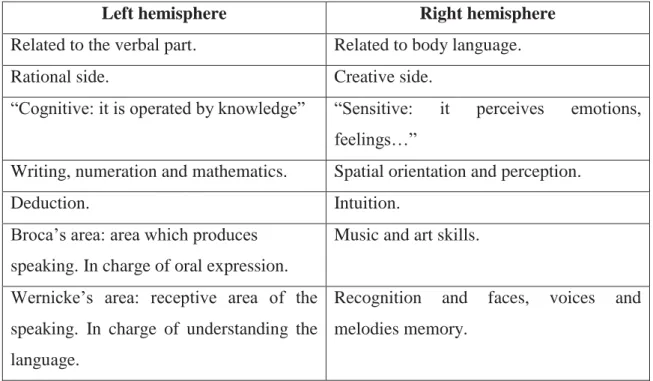
Itziar Jurío Jusué (2014) performed a research about the use of songs in primary
education in which she designed a table examining the different functions of each side
16
Left hemisphere Right hemisphere
Related to the verbal part. Related to body language.
Rational side. Creative side.
“Cognitive: it is operated by knowledge” “Sensitive: it perceives emotions, feelings…”
Writing, numeration and mathematics. Spatial orientation and perception.
Deduction. Intuition.
Broca’s area: area which produces speaking. In charge of oral expression.
Music and art skills.
Wernicke’s area: receptive area of the speaking. In charge of understanding the
language.
Recognition and faces, voices and
melodies memory.
Table 1.Functions of brain hemispheres in relation to music (Jurío Jusué. 2014, p.199)
As it can be shown in the table above, each hemisphere of the brain is put into
operation while listening to music, since the right hemisphere undertakes the functions
related to music and its abilities whilst the left one enables the oral production. Thusly,
it has been proven that music stimulates both sides of the brain making them cooperate
and work simultaneously.
“When a learning activity combines both left and right hemispheres simultaneously engaged in a particular activity, an ideal learning situation is established
and the most productive learning occurs,” according to Anton (1990, p.770). This process generates diverse benefits in the cognitive development since the brain operates
more nimbly and efficiently, favoring the development of a great deal of cognitive
skills, such as memory and mathematical perception. The implementation of this
approach vital due to the fact that memory is considered one of the most important
capacities in language learning and it is really difficult to develop it.
As it has already been mentioned, children learn and memorize the alphabet or
the multiplication tables with songs or easy rhymes because music is an effective
memory aid in the learning process. This is possible thanks to the efficiency with which
information is retained and recall when it is needed. Moreover the melody of songs
17 fact that people remember better the lyrics of a song than a text they have read
numerous times.
In this sense, music is an extraordinary technique that not only helps in the
acquisition of knowledge but also benefits the cognitive development as well as
different cognitive skills; accordingly, it can be considered a teaching tool as valuable as
audiovisual materials or new technologies.
2.3
Why should we use songs and music for teaching purposes?
As previously noted, music is a powerful tool that teachers should take more
benefit from. This is the reason why the different advantages of its use in a foreign
language classroom should be taken into consideration, as well as its various ways of
employment.
On the one hand, students learn languages through music in a natural manner
because of the real situations that songs render; in other words, a traditional lesson of
English will reproduce a recorded audio from their books in order to enhance students’ listening skills. However, these listenings have been recorded for a specific purpose,
recreating forced and unreal situations and, in the majority of the cases, both the voice
and the speed of speaking have been manipulated. Even though it is thought that these
audios help students to acquire the appropriate listening competence; they affect them,
in fact, adversely inasmuch as any native speaker will converse in such a way.
Furthermore, in a real conversation there are peripheral sounds that the speakers have to
circumvent to be able to follow their partner’s speech. In this manner, and according to Dr. Poch (2001), students will need an adequate training that makes them used to
listening and, consequently, to understand a message in a foreign language. Only in this
way, they will be capable of developing perceptive strategies that will enable their
listening skills to understand the foreign language as if it their mother tongue was.
Apart from that, songs count on an emotion melody component, an aspect that
other learning tools fall short of, as the lyrics and the music can influence people’s mood and behavior. In the same way, songs cause a great influence in emotions,
sensibility and imagination, performing a crucial role in the process of learning. The
research conducted by Gatbonton and Segalowitz (1998) illustrated that this fact is
18 grammar, repetition or vocabulary can be developed in the lessons without a rejected
perception from students.
By the same token, as reported by the multiple intelligence theory of Howard
Gardner (1983, 1993, 2004), teachers should operate with tools that encourage every
type of intelligence in such a way that all the students can succeed in an activity,
making the best of them. Some learners need more visual stimulus to learn, while others
require different types of stimulation such as touch, movement or listening. In this
sense, thanks to music and teacher’s desire to innovate, practically each kind of intelligence can be developed, favoring the entire classroom.
Likewise, the implementation of songs in English lessons accomplishes a
worthwhile apprenticeship, making the student feel more comfortable, participating and
interacting in the activity. As a consequence, students are no longer passive receptors of
learning but they are the ones who “play” with it, assimilating and understanding it in a better way. This point is essential in the present paper, due to the fact that one of the
principal purposes of it is to encourage students to participate and speak in English.
Another interesting issue related to songs that has been exploited in this research
was the powerful messages that songs can transmit as well as the values they instill on
people. A great deal of songs possesses meaningful values that can be inculcated on
teenagers, such as respect, humility and esteem.
Furthermore, thanks to music, the four essential skills in language learning
(writing, speaking, listening and reading) are developed, achieving an integral training
on students. Comparatively, grammar and vocabulary can be practiced if selecting the
appropriate songs’ repertoire. Teachers can benefit from songs to review and reinforce a grammar point that has not been very well understood. Besides, they can teach a
countless number of vocabulary words, avoiding giving students endless lists of
vocabulary. Phonetics is also a particular strength that can be broadened while listening
to songs, since learners can hear native speakers and they would try to imitate them
singing their songs.
Following the empowerment of these abilities, the speaking one might be a
19 English. Nonetheless, with the adequate songs and suitable activities they will get
involved in the lesson performing and cooperating with the teacher.
Another interesting aspect that has reached at this point is motivation. It is,
probably one of the most important factors in the success of a lesson, as it encourages
students to pay attention and learn in a better way. The following chapter will focus on
its importance and relation to music.
2.3.1 The importance of motivation
As discussed earlier, the use of songs in classrooms is not a very conventional
method, so this is why their implementation breaks with the traditional progress,
capturing students’ attention. In this way, teachers manage to have their attention, making them feel intrigue to see how the lesson is going to be conducted. That is to say,
they feel motivated to continue working.
Songs tend to present short and simple texts, so the duration and complexity of
the activity is perfectly accessible to avoid being repetitive as well as to maintain their
interest during the task. Moreover, students will feel involved in it according to the
importance that music presents in their lives and, if the selected songs are chosen
regarding the teenagers’ age and interest, they would not only learn but also enjoy the lesson.
Once the students are attracted by the innovating proposal, instructors should
take the maximum benefit from it and raise activities that challenge and persuade
students to perform them. In this sense, songs offer a great deal of possibilities to
exploit them, much more lively and attractive for students than grammar exercises.
Likewise, music contains a relaxation and original factor which revive the interest of the
students to learn languages at the same time that they see its utility.
There is a great number of authors who insist on the importance of motivation in
the teaching and learning process. According to Gardner (1993), motivation is a set of
factors including the pursuit of achieving an objective, the effort involved and the
reinforcement associated to learning. Similarly, Vigotsky (1998) suggested that
motivation is what encourages a person to perform an activity; that is to say that it
stimulates the desire of learning. In this sense, the more motivated the student feels
20 These are only two examples among the countless arguments which uphold the
use of motivational methodologies and techniques to assist students to learn better,
before and more.
This chapter could be concluded by stating that the grade of motivation of the
student will condition his performance in the learning process, so teachers should be
aware of this fact in order to implement activities that awake their interest for the study
of languages.
2.3.2 Second language acquisition
A great deal of researches has been accomplished in order to find a relationship
between language acquisition and the influence of music. They discovered that there
seems to be a symbiotic connection regarding the mental processing while assimilating
them.
It goes without saying that children acquire their mother tongue in a natural way
by listening and making use of their aural senses and neuronal connections. Even
though the process of learning a second language differs from the first case, the same
auditory senses are involved. Thence, as listening to music sets these capacities in
motion at the same time that it stimulates them, the gain that music exert in this process
cannot be ignored, as Jackendoff (1994) suggested.
In consonance with it, Lowe (1995) conducted a study in his doctoral
dissertation in which he wanted to demonstrate the effect of the incorporation of music
into the second-language classroom. The experiment was performed in Canadian second
grade French classes, in some of which music and language learning were combined. It
spanned eighteen weeks and it was based on a 15-minute daily music instruction
integrated in French learning. After analyzing the results, Lowe came to the conclusion
that the students who were taught with the aid of tonal-rhythmic patterns and music
obtained better results in French and mathematics tests than the ones following
conventional lessons. Furthermore, the study revealed that these students improved their
grammar, oral and reading comprehension.
In the same way, Medina (1990) accomplished an investigation about the
effectiveness of music and story illustrations on children to acquire English vocabulary.
21 into four groups. One group listened to the sung version as well as the story telling
while the second one only heard the lyrics. A third group was shown pictures of the
vocabulary at issue and the last group listened to the vocabulary words. The results
revealed that the students who worked with music and illustrations had internalized the
vocabulary words in a better form.
These investigations bring to light the efficiency and benefits of music in
learning a second language. Although it is not a determinant factor, the aid and
influence that it exerts in its acquisition is unquestionable.
2.3.3 Pronunciation, grammar and vocabulary
The vision of music as fun and entertainment should be laid aside both by
teachers and students, and start viewing the use of songs as a strategy to learn, to teach
vocabulary and grammar and to improve pronunciation.
The effects in the brain and its relationship with learning acquisition have
already been stated, but music counts on more benefits, such as the reinforcement of the
different aspects involved in the management of a language.
Regarding grammar dexterity, songs are written with a specific purpose, since
they discuss experiences or recount a series of events in a sequential way. They are
normally based on the past, present or future, as well as they can reflect hypothetical
situation. As a result, standard grammatical structures are needed to express them
coherently. In this sense, teachers can select a song to make their students practice a
specific grammatical issue, instead of giving them a stack of little motivating drills. For
example, while listening to a song, students can observe the real use of a particular verb
tense and, what is more, they do not realize this process because of their enjoyment.
When students learn in an unconscious manner they tend to assimilate better the
structures, as if they were using their mother tongue, in such a way that when they
speak, the grammatical form of the language comes automatically and naturally. This is
exactly the appropriate form in which everyone should learn, due to the fact that when a
person needs to express something, he should not have to think about the correct form
of the verb which goes with that conditional or the preposition that accompany that
verb, for example. Language should emerge instinctively if it has been correctly
22 In addition, songs tend to follow a timeline; consequently, a number of
connectors and linking words are needed to make the song meaningful. In this way, a
great deal of activities can be conducted to learn how to use them as well as to order
chronologically a series of events. This kind of activities shares the same purposes and
level, in terms of education, than conventional exercises focused on the same aim.
However, by using songs students feel more motivated and present a greater interest,
obtaining better outcomes.
The same arises when dealing with vocabulary. Unlike trivial conversation,
songs lean on pitches, melodies, rhymes and beats which make their memorization
easier than a conventional text. This is the reason why the implementation of songs to
teach vocabulary helps students to memorize it and, consequently, to bring the words
back to mind in an easy manner. When looking back to the first years of English
learning, children retain the vocabulary words related to body parts with the song “head,
shoulders, knees and toes” as it occurs when learning the letters of the alphabet. The
complication besides the proficiency of a language fall on the linguistic baggage the
person knows, being one of the most difficult aspects of language acquisition. Memory,
consistency and repetition are the three key ingredients while gaining vocabulary words,
since it is necessary that the student devotes each day some minutes to review and try to
use them as much as possible to avoid forgetting them. At this point, it could be
mentioned that the main drawback of learning a language is that if it is not used
frequently it can be gradually forgotten, so students should capitalize every single
opportunity they might have to speak in English as well as listening to it.
Notwhidstanding, thanks to rhythm and rhymes the memorizing process
becomes easier and more effective. Who does not remember the different parts of the
body thanks to the song? It is inevitable to think of them without humming the song,
since they imply each other. In this sense, songs become one of the most powerful
strategies to remember vocabulary.
Likewise, pronunciation and fluency are also practiced while teaching through
songs. As already mentioned, the idea of making students repeat a monotonous voice
that comes from a tape does not appeal to them. For this reason, real situations or
contexts should be implemented conducive to make them aware of the importance of a
23 their voice and his intonation and pronunciation without thinking that they are going to
be evaluated or assessed, just because they find it enjoyable.
This point is extremely important because of Spanish people’s strong accent while speaking a foreign language. It is generally thought that Spanish natives present
more difficulties in speaking rather than other subjects. The first reason that should be
mentioned is that it is not a problem of genetics or Spanish roots, but it is a matter of the
educational system. English teaching methods focus on grammar or reading, leaving
aside speaking and pronunciation; consequently, Spanish students present a lack in
these skills. It is true that the best way to improve this element is by teaching phonetics,
listening and repeating. Nonetheless, while teaching phonetics, the instructor must pay
attention to each student to correct any mistake or misunderstanding, being an
impossible task to be performed in big groups. Balancing the different possibilities and
downsides, the best option is to decide on music to enhance all the aspects of
pronunciation and oral production. In fact, “there is probably not a better nor quicker way to teach phonetics than with songs” (Leith, 1979, p.540).
It can be concluded that practically all grammar points are covered working with
songs, regardless the style the students or the teacher would like to manage.
Accordingly, teachers should profit from the great variety of possibilities that songs
bring to improve the work environment as well as assist learners to learn more and
better, being this last one the main objective of education.
2.3.4 Cultural and social aspect
Songs are written with a specific purpose and to transmit a certain message. The
most popular ones among teenagers normally revolve about love stories and
disenchantment anecdotes. However, there are many others that convey momentous
topics that are less known than the first ones but which are worth listening. Teachers
can select songs focusing on the content to deal with different cultural aspects that have
been presented in class, such as historical moments, social situations or debates, among
others.
On the one hand, music can be used to express values or show cultural
backgrounds, so students can learn a great deal of aspects about different countries or
24 in such a way that their voice can be heard making people aware of their existence.
Additionally, there are songs that cover interesting topics on which a debate can be
based, so students can discuss them and give their points of view. Everybody likes
music, independently which style, hence it can be stated that it is the connection point
among the whole world at the same time that it is the only way in which everyone
agrees. In this sense, there are many songs that have been composed with humanitarian
purposes such as fund raising for the neediest ones or making a warning call. This was
exactly one of the purposes of the present study. Students were shown different songs
that transmitted powerful meanings to make them reflect and meditate about different
situations and human actions. As it will be explained in more detail in the following
pages, one of the selected songs was “Where is the love” from the Black Eyed Peas which was launched to make people aware of the gruesome situation in which a great
number of people have to live. Another song that was proposed was the well-known
anthem “We are the world”, although it was originally written by Africa in 1985, in which various artists participated to collect funds for the heavy damages caused by an
earthquake in Haiti. For all that, songs can be a good idea to introduce different topics
or to give an innovating approach in the classroom.
2.4 Music selection criteria
Although, the use of music to teach English might have attracted the attention of
teachers, its implementation is not as simple as downloading a song or buying a CD and
playing it during the lesson, since the selection of songs requires really specific criteria.
According to Santos Asensi (1997), the selection parameters to consider can be
summarized as follows:
a) Adequacy to the teachers’ situation (students’ interests besides real levels of communicative, linguistic and cultural skills).
b) Ease to operate with songs’ lyrics. c) Clarity of listening.
The first point it is not always very evident, since classrooms are the perfect
reflection of heterogeneity and each student has different music preferences. For this
reason, a test or a survey can be performed to ascertain their favorite artists and music
styles or, simply, the teacher can ask the students what kind of songs they prefer. In this
25 consequently, they will succeed with the proposed songs among the students. There is
no point in selecting the song according to the teacher’s preferences since, probably, they will differ from the students’ ones. Moreover, the lesson is intended to move and motivate learners to participate and engage in, so they will need to feel identified with
the material.
Regarding the lyrics, it is of fundamental importance that they are significant
enough to operate with them. It is to say that the aim of using songs lies in the great
variety of possibilities they offer to work with; so, teachers should pay attention to their
election in order to select songs that enable them to design activities to improve and
reinforce the students’ linguistic background, because it is not just about listening to a song and enjoy it.
Similarly, a good listening is crucial in music selection, as the aim is that students
can listen to the song and try to understand it; namely, the intention is not to challenge
them with an incomprehensible song since they will feel frustrated. Teachers should be
careful when choosing them as the great majority comes from American singers and,
normally, students are taught British English. In this case, students should be informed
before or shown the new vocabulary words, in order to make them aware of the varieties
of English.
Finally, as Marta Gutiérrez proposes (2017) there are three negative aspects that
teachers should consider and avoid electing the material, which will reduce the range of
possibilities. The first one is bypassing songs that contain offensive vocabulary or slang,
although the vast majority of them display some kind of vulgar language. Secondly, as
artists normally sing with a young jargon, they tend to commit grammatical mistakes
either by rhythmic purposes or to emphasize an aspect. Although they are English
native speakers and everyone understands the meaning of their songs, it is not a good
idea to get students used to any kind of grammatical error, since teachers are committed
to teach flawless grammar. The third one has to do with the marginal teaching of
grammatical points, which means that teachers should consider that music can be used
in an English lesson as a complementary task, whether it is to reinforce a grammatical
point or to lighten the course of the session. That is to say that a song cannot be the
centre of subject or the main topic of the same, but it can help to complete it.
26 with academic purposes in order to motivate students, make them participate and
27
3.
Case study
The main aim of this paper, as it has already been stated, is to improve the
communicative skills of students by means of the use of songs. It has been necessary to
combine the basis of the communicative proficiency as well as the potential of songs to
attain that objective.
As it is widely known, a standard class of English among Spanish high schools
focuses on grammar or vocabulary, leaving behind the rest of competences, although
they count on the same importance. In addition to this, the attention to oral skills seems
to have no place in the classrooms, even though it is the most relevant element in
learning a language, while it allows us to communicate to others. Due to this learning
imbalance, there is a deficit with regard to students when they have to speak in other
language, making them avoid any opportunity to give their opinions or to express
themselves. However, this is not the only consequence of just strengthening one or two
abilities; it also leads to a demotivation and a lack of interest of foreign languages
among teenagers. Nonetheless, this demoralization is hardly surprising since they might
wonder why they should study a new language if they are not going to be able to use it.
This is the kind of negative thoughts that invades the youngest minds and that
positions Spain as one of the weakest countries in speaking foreign languages. At this
point, it is vital to take a sit and start considering what is not working in an adequate
way and what should be improved to change the current situation.
This is exactly the objective of this research. It might be said that the 21st
century is dominated by English. It is uncommon to see a product that does not come
from an English-speaking country or that has been, at least, translated into English.
Furthermore, the majority of film productions and television shows are originally in this
language and, it goes without saying, the popularity that English and American singers
have among young people, as well as the influence they exert on them. Even though
they sometimes do not pay attention to the lyrics or they only watch dubbed movies, the
fact that they are constantly surrounded and bombarded by its expressions and jargon is
real. In consequence, as teachers we should benefit from this influence and make the
28 This is the reason why I decided to employ songs to try to motivate students and
encourage them to use the language orally, thus and so that they cease seeing English as
a compulsory useless subject and they start valuing it.
In the following chapters, the different ways and methods I have carried out
during the practical implementation are going to be presented, as well as its consequent
29
3.1 Framework
First of all, the idea of conducting a research about a teaching method and base
the results on hypothetical and imaginary situations did not attract me, since those
effects do not reflect all the reality. Moreover, while dealing with people, there is
always an element of surprise and it is also important to consider the unpredictability
bound to human responses.
For this reason, I wanted to implement the study that I performed in a real
classroom to consider authentic findings and, therefore, be able to value the veracity of
it. For that purpose, I put it into practice during the internship, offered by the university,
in which we were given the opportunity to attend different classes and learn, from
personal experience, all the aspects involved in teaching.
In my case, I was assigned the Núñez de Arce High School, an educational
public centre situated in the centre of the city, in which I had the opportunity to teach
the students and learnt a great deal of aspects both from my teacher and students.
To contextualize the framework in which I performed, it is worth mentioning
that the majority of students that attend this high school have a high level of culture and
a good economic one. Equally important, their behavior in the classroom is appropriate
and they show a great desire of learning, specially, languages, making the centre one of
the best in the city.
In addition, it is a big high school as it counts on seven different groups in each
level and an average of thirty students in each one. It goes without saying that making
students speak in another language in such numerous groups suppose an authentic
challenge to the teacher. In this way, the execution of my didactic unit was really
adequate to see if the use of songs would encourage them to speak and participate.
After having regarded the different courses and analyzed which one would be
more suitable to carry out the activities, I concluded by deciding that both groups of 4 of
ESO were the best option. In the first place, they are 15-16 years old, so they are mature
enough to be able to reflect, defend arguments and maintain a conversation, as well as
their English skills should be quite good to perform them. Likewise, the possibility of
acting in two different groups of the same level would provide a greater collection of
30 Despite the fact that both groups pertain to the same course and have the same
English teacher, they present a great amount of differences. On the one hand, 4th D
counts on only eighteen students, which make it easier to work with, interact and
propose more dynamic activities. Moreover, the work environment is really pleasant,
which encourages students to participate and express themselves. They seem to have
created a bond of friendship that crosses the classroom. Feeling comfortable and free is
a determining issue to feel more confident and, as a result, to grow as a person and
succeed. Generally, the English classes are conducted properly, where every student
work and the grades are very high. The students of this group are characterized for
being curious, hardworking, interesting and vibrant; in that way, the lessons are really
enjoyable and every student feels confident to raise questions, correct exercises or
simply comment on something.
Conversely, group 4thA presents features completely different from the other
one. For a start, the group is bigger, as it has 30 students, showing diverse profiles
among them. There is a great variety of interests, levels and aspirations; thus, it is
highly difficult to establish a pattern that encompasses their characteristics. Some of
them do not show any interest in the subject and they normally spend the session
carrying out other activities or disturbing their classmates; as a consequence, the teacher
needs to stop the development of the class to demand silence. A second group, the less
numerous, presents a great will to work and participate in extracurricular projects, but
its impeccable marks are inevitable conditioned by its shyness and lack of confidence.
Similarly, there are some particular cases of students that possess special talents in
music, arts, ballet and sports; this makes them to devote a great deal of time to their
personal interest instead of their educational careers. In the centre of this mishmash,
three students stand out on account of being bilingual, since one of their parents is an
English native speaker or because they have been abroad during their childhood.
However, instead of demonstrating or benefiting from this advantage, they hide it and
only bring it to light to pass the exam.
Due to the dominance of the lurking group, the rest of the students show apathy
as well as embarrassment when it comes to speak. Predictably, they avoid participating
in case they are wrong or make a mistake; thus, they prevent being criticized or
ridiculed. This is one of the most shared feelings when asking students what blocks