A Research Project Presented to
The program of B.A. in Teaching English as a Foreign Language School of Education
Universidad Nacional Abierta y a Distancia Colombia
In partial fulfillment
of the requirements for the degree of Licenciado en Inglés como Lengua Extranjera
by
Marco tulio ospina villabona
December 2019
ABSTRACT
A PLE is originally conceived as an online system that any person can create to respond to their own learning needs and those of other learners when properly integrated into a Personal learning network. In this occasion, a very customizable PLE was created through a blog and a padlet which were used as the interface to advance the listening skills of a small group of selected participants who could not otherwise have made much sense of the vast amount of information people are constantly bombarded with on the internet if they were to embark on honing their language skills from a purely individual perspective without the expertise of a guiding tutor. In this way, upon having manifested that it was the listening skill the one they needed the most help with, this group of learners was able to periodically download and upload via the interface created a series of personalized tasks specially designed to tackle that particular need, as well as receive proper feedback on their performance for four consecutive months marked by initial and final exams to demonstrate their progress while making part of this project. Put simply, through full engagement in the formation of an online collection of resources to advance listening comprehension skills, significant improvements were obtained when these students gradually developed intrinsic motivation through the autonomous exploration of materials.
DEDICATION
Although it was an unusually long journey for me to get to my graduation day, you patiently supported me all along the way you simply sacrificed your life to see me succeed Thanks a lot dear mother of mine, Chiquinquira Villabona
ACKNOWLEDGMENTS
The author would like to thank each and every UNAD professor that took part in one way or another of this project specially professor Liliana Isabel Moreno Cervera for her valuable orientation and feedback on earlier and final drafts of this paper.
TABLE OF CONTENTS
ABSTRACT ... ii
DEDICATION ... iii
ACKNOWLEDGMENTS ... iv
LIST OF TABLES ... vii
LIST OF FIGURES ... viii
INTRODUCTION ...1
Significance of the Study ... 2
Statement of the Problem ... 3
Objectives ... 5
General Objective ... 5
Specific Objectives ... 5
LITERATURE REVIEW ...7
Listening as the most critical means for acquiring an L2 ... 7
Focusing on language rather than on form ... 8
From VLEs to PLEs ... 10
METHODOLOGY ...13
RESULTS ...28
DISCUSSION ...34
CONCLUSION ...36
LIST OF TABLES
Table 1. Distribution of initial exam ...18
Table 2. Registration process. ...19
Table 3. Overall classification. ...20
Table 4. Weekly blog content. ...26
Table 5. Distribution of exit exam. ...27
Table 6. Initial and Final scores contrast. ...28
Table 7. Differential score variation. ...29
Table 8. Negative and positive variations. ...30
Table 9. Increase & decrease percentages. ...31
Table 10. Data set of percentage increase. ...32
Table 11. Calculation of the SD. ...33
LIST OF FIGURES
Figure 1. Generational gap among the survey respondents. ...14
Figure 2. Type of English Language interaction ...15
Figure 3. English language learning experience among survey respondents. ...15
Figure 4. Language skill posing the greatest weakness among survey respondents. ...16
Figure 5. Project engagement willingness. ...16
Figure 6. Online testing platform. ...17
Figure 7. 40-item online test. ...18
Figure 8. Structure of a digital PLE proposed by Loertscher, D. (2011) ...21
Figure 9. Our virtual learning space. ...22
Figure 10. Personal Learning Network or PLN. ...22
Figure 11. Our online portfolio. ...23
Figure 12. Project Calendar. ...24
Figure 13. Task-based learning framework by Willis (1996, 2012) ...25
CHAPTER 1
INTRODUCTION
The proliferation of Web 2.0 tools has made it easier for modern language teachers to seize the opportunity to engage their students in PLEs or Personal Learning Environments in order to maximize online language learning beyond the classroom in a more effective and integrated way. Then, in understanding the potential posed by technology-enhanced learning in general, PLEs are seen as an excellent strategy to promote autonomy and 21st century skills or the 4C´s (Collaboration, communication, critical thinking and creativity) when used as a complement of formal subjects or a part of any particular course.
Throughout this project, we will be working with the concept of Personal Learning Environments which entails the use of critical strategies to build the capacity for self-regulated learning. A PLE is basically an online content repository or system that we can create from a personal perspective to respond to our own learning needs and the needs of others when shared with a community of learners to help them make sense of the vast amount of information found on the internet. It is said that whenever we engage in learning something, we have to create our own PLE which is in accordance with what Loertscher (2011) has stated “We all have a personal learning environment, whether we have consciously constructed it or not” (p. 22).
Put simply, a PLE is an online collection of resources to advance lifelong learning
key survey to identify a widely-felt need among 35 randomly chosen English language learners at Centro Colombo Americano, Bucaramanga, I set out to build the PLE displayed on this paper and proceeded to test it as a powerful catalyst for boosting listening comprehension skills due to the fact that among the 35 survey respondents, listening was perceived as one of the hardest skills to develop for most of them.
Therefore, this present action research attempts to document how PLEs can be implemented in English Language Teaching to accelerate the development of listening skills through the integration of a series of asynchronous learning tools, especially web 2.0 tools, thus, giving students the opportunity to learn from anywhere, at any time and at their own pace.
Significance of the Study
In today´s world, it is very easy for any teacher in any field to set up his own PLE to access relevant content that can be shared via the internet with a given community of learners, and for this reason, the data produced from this study will be used to promote the
implementation of personal learning environments or PLEs in order to support traditional
language courses with out-of-class activities in that, if developed on the web, a PLE could easily be used to reach out to a wide number of users from home while favoring the inclusion of marginalized students with poor academic performance as it should be our purpose as educators and the main objective of an inclusive society.
Besides, by using a PLE, a whole lot of good habits can be fostered in our students, for example, the habit of creating inner motivation and curiosity, the habit of careful observation and perseverance, the habit of having empathy for others, but above all, the habit of building
autonomy, which is key to using a PLE successfully.
Therefore, through this particular PLE and for a period of 18 consecutive weeks, a group of 18 learners will engage in exploring new and more practical alternatives to advance their listening comprehension skills than those currently offered through conventional classroom interaction.
Statement of the Problem
Since ICTs have allowed the deinstitutionalization or the gradual relocation of different types of services that previously demanded in-situ support and assistance, there´s also been an educational change driven by these rapidly changing technologies that can help build and promote networked communities of learners as a key feature of today´s trend in education. Brown, S. (2010).
On the one hand, PLEs pose an extraordinary new approach that is not intended to
substitute or complement the existing traditional systems. PLEs show us how we can incorporate ICT-based strategies into the learning process whether at the beginning or all along the lifespan of a given individual. Adell Segura, J. & Castañeda Quintero, L. (2010).
So, as a response to this, PLEs come as a combination of tools and resources chosen by the learners to support their own learning experience in conjunction with the social elements of participating in an ecosystem that fosters collaboration, autonomy and lifelong learning.
Reinders, H. (2015).
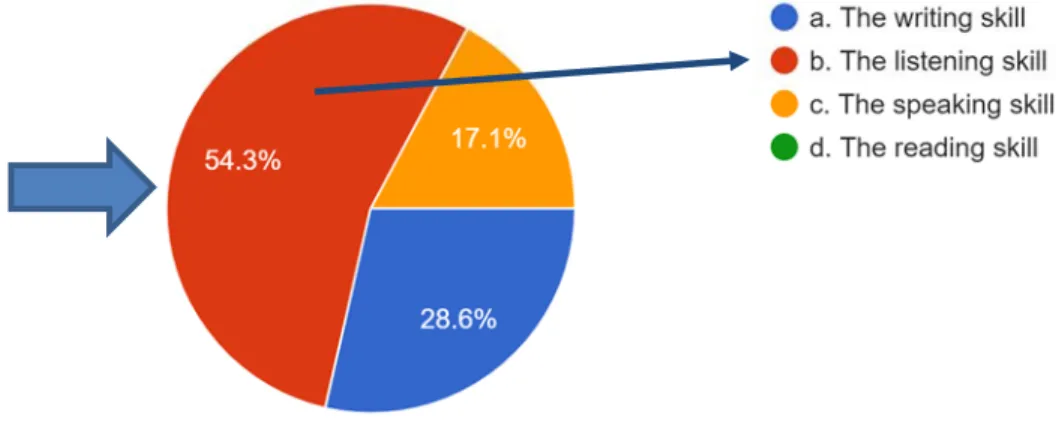
In our particular context, even though English and most of the romance languages share the common linguistic influence of Latin to one extent or another, listening is still one of the hardest skills to develop for most Spanish-speaking learners of English as foreign language. This particular weakness was confirmed when it was actually found at the local level through an online google survey conducted among 35 randomly chosen adult learners of English who were taking evening classes at Centro Colombo Americano de Bucaramanga (survey
available on the link provided in the references) that a large number of them (54.3%) express having difficulties with their aural comprehension of spoken English.
This is partly due to the fact that they don´t usually get enough exposure to authentic aural contexts just by using the educational aids offered during a regular course besides the fact that English in and of itself contains sounds that are new for them and not commonly produced in Spanish, not to mention other factors such as pitch, rhythm, accent, intonation patterns and stress, so in this order of ideas, it was considered that finding strategies to boost listening
Consequently, according to the OECD (2015), the number of today´s students with access to the internet in Latin America, especially in Colombia, has lately increased, thus producing a large number of home-based learners who need to be guided into creating their own digital identities in their own learning environments where they can access, organize, filter and reuse contents according to their own needs and in control of their language-learning process through different tools for synchronous and asynchronous learning.
It is for the aforementioned situation that I would like to find out if there is a correlation between self-regulated access to online practice materials and the improvement of listening skills among adult learners of English as a second language through the use of a PLE since PLEs can easily become that source of high motivation behind the compilation of material of personal interest.
Finally, it is expected that a small group of learners chosen as participants of this research project can develop enough autonomy to work from a distance in the development of their
listening comprehension skills and to this end, the participants are supposed to learn to manage their own time and study environment, set their own intrinsic and extrinsic goals and effectively self-regulate the influx of information they want to receive over a time span of 18 weeks.
Objectives General Objective
To identify the effectiveness of using PLEs in the ELT field to enhance listening
comprehension skills through the implementation of a 17-week online strategy in a pilot group of students from Centro Colombo-Americano Bucaramanga.
Specific Objectives
platform as measuring instruments to determine the effectiveness of PLEs.
To generate a functional user interface for a PLE in order to compile different online resources to advance listening comprehension skills at different levels.
CHAPTER 2
LITERATURE REVIEW
The following literature review will refresh basic concepts and principles behind the implementation of this project. For example, the evolution of e-learning, the relevance of listening in the language acquisition process, and task-based learning as a learner-centered methodology quite related to the use of PLEs.
Listening as the most critical means for acquiring an L2
For quite a long time in the evolution of ELT much attention was given to the written and spoken aspects of language basically ignoring the active role that listening plays in language learning. So, long ago, Language professionals used to pay more attention to reading and grammar, and therefore, teaching listening was left behind and barely accepted as a significant feature of language teaching (Richards & Rodgers, 2001). For instance, according to Larsen-Freeman (2000), in the early Grammar-translation method, teaching listening wasn´t even considered.
Lately, with the rise of communicative approach, the importance of teaching listening has increased and Language educators know that the development of the listening skill is the result of a complex process of decoding spoken language that is intricately intertwined with the other 3 language skills. Rost, M. (2001). For this reason, despite being the most critical means for acquiring a second language, and for the sake of this project, listening comprehension is going to be assessed through the integration of listening with writing in a series of follow-up tasks meant to be reported weekly on Padlet. These active learning strategy will encourage learners to stay not only active but focused in order to respond to Yes/No questions, “Wh” questions, True/False questions, choose the correct answer type questions, or any other questions, especially those meant for critical thinking such as How, What if, and Why.
Focusing on language rather than on form
Assigning tasks is currently considered to be the most effective means of promoting second language acquisition (SLA) in traditional classroom settings and it is my purpose to take the benefits of Task-based language teaching beyond the classroom through my PLE worksheets because according to Richards and Rodgers (2004), “engaging learners in task work provides a better context for the activation of learning processes” (p. 223).
On the other hand, In spite of the fact that a task is generally described as something unpleasant because according to the Cambridge Online dictionary a task is “a piece of especially hard work; a duty that must be done”, in academic contexts, it is meant to generate engagement.
My own definition is that a pedagogical task is a piece of classroom work that involves learners in comprehending, manipulating, producing or interacting in the target language while their attention is focused on mobilizing their grammatical knowledge in order to express meaning, and in which the attention is to convey meaning rather than to
manipulate form. The task should also have a sense of completeness, being able to stand alone as a communicative act in its own right with a beginning, a middle and an end. (p.4)
In this order of ideas, Task-based language teaching is an approach to teaching that is typically based on three stages, the first of these is the pre-task stage, during which the teacher introduces and defines the topic and the learners engage in activities that either help them to recall words and phrases that will be useful during the performance of the main task or to learn new words and phrases that are essential to the task. This stage is followed by what Willis (1996) calls the "task cycle". Here the learners perform the task (typically a reading, a listening exercise or a problem-solving exercise) in pairs or small groups.
They then prepare a report for the whole class on how they did the task and what conclusions they reached. After that, Students present their findings to the class in spoken or written form while the teacher might take notes by categories on a clipboard or a piece of paper.
The final stage is the language focus stage, It is during this stage when feedback on the learners’ performance at the reporting stage is given, so it is when language features from the task are highlighted.
teacher may ask learners to reflect upon the language they have used while completing the tasks, but the main focus for learners should be, in and of itself, the completion of the tasks.
From VLEs to PLEs
It has been more than 4 decades since computers made their first foray into the field of education technology, and since then computers have been there in a constant quest for
improving the way we learn, and especially during the last 20 years there´s been rapid development and integration of ICTs in ELT through smartphones, tablets, and all sorts of multimedia devices causing a dramatic turn in the role of English Educators and learners, but despite this whole lot of isolated achievements, ICT-supported instruction hasn´t been able to fully revolutionize education and the learning processes partly due to the fact that most of
today´s language management systems are initiatives that still take a very centralized perspective at the service of educational institutions rather than individuals and their particular needs.
Panagiotidis, P. (2012)
In this order of ideas, it is clearly seen that computers were key in the creation of virtual learning environments or VLEs, which with the advent of the internet have paved the way for more personalized models of learning that currently employ technology to enable people to study anywhere and at any time. Palmer, S. R., and Bray, S. L. (2001).
With that being said, we have seen the emergence of a new approach to the use of online technologies for learning or Personal Learning Environments also referred to as PLE´s, which have come to bend the reality posed by the dominant curricula of traditional educational systems that are basically disconnected from today´s global ecosystem of Internet services that make it possible for anyone to create content and provide PLE users with a service specially tailored to their individual needs. Wilson, S., Liber, O., Johnson, M., Beauvoir, P., Sharples, P. & Milligan, C. (2007).
In defining PLEs, as the result of the advent of the Web 2.0 and its whole range of applications and social networks, Alharbi, Talal & Platt, Amelia & Al-Bayatti, Ali. (2013) remind us of the following:
PLEs are considered to be an evolved form of VLE, providing a student-centric approach to learning and supporting lifelong learning. It is argued that a PLE has a wider scope in that it can be used to provide the platform with a diverse range of user activities,
including formal learning support. (p. 287)
These PLE´s can be used to assist all kinds of informal learning processes. Consequently, they are commonly used as a learner-controlled or self-regulated environment for language learning through a combination of digital tools and materials chosen by the learners to support different aspects of their language skills. Reinders, H. (2015).
Besides, it is said that whenever we engage in learning, we need to create a personal learning system loaded with strategies to respond to our own needs. Therefore, being able to search for and manage autonomously the vast amount of information found on the web has become a fundamental factor of Personal Learning Environments or PLEs which are the result of informally created learning systems mostly originated from the way each person can use the technology at hand. Chatti, M.A., Agustiawan, M.R., Jarke, M., & Specht, M. (2012).
CHAPTER 3
METHODOLOGY
The following study will empirically examine the causal relationship between two variables as to how the implementation of PLE management can predict the improvement of the listening comprehension skills of a selected group of 18 EFL learners whose language skills originally range from A1 to B1 and it is due to the aforementioned reasons that the
methodological paradigm that sustains this study is basically quantitative as it seeks to interpret the measurement of data gathered through quite structured research instruments, in this case, the administration of initial and final examinations. (See Appendix B)
Since PLEs offer their users the valuable opportunity to learn to learn in the digital age, our PLE will be particularly used to support the independent practice of listening skills in English through one of the 3 forms of lifelong learning, informal learning, which is mostly driven by and for, the learners’
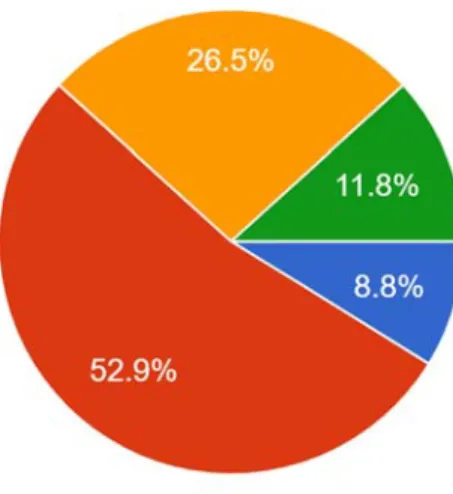
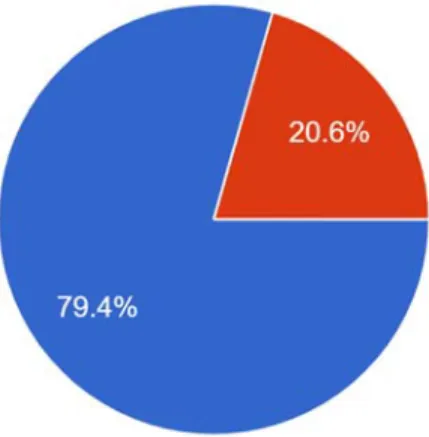
To this end, on February 23rd, 2019, a Google forms survey (See figures 1 to 5) was conducted that would provide key information to limit the scope of this research project to the development of listening skills.
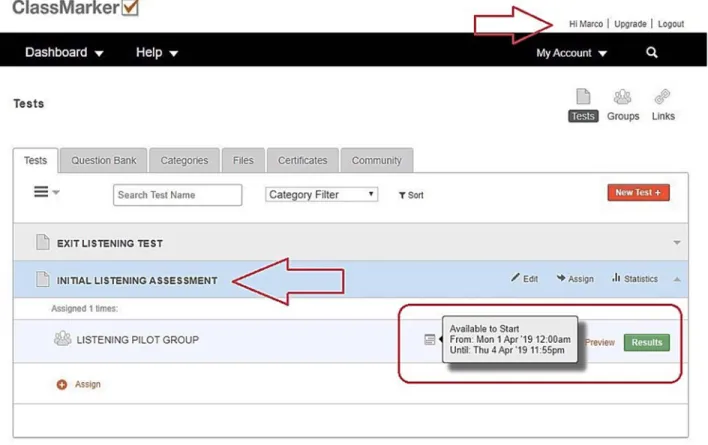
As a result of this survey, out of the 4 language skills, Question 4 indicated that it was the listening skill the one that the respondents considered needed the most attention. After that, an initial listening web-based test was created and launched on the online testing platform called CLASSMARKER (See figure 6), which was key to add reliability to this study as Classmarker features a strict authentication process for test takers to follow.
Figure 2. Type of English Language interaction
Figure 4. Language skill posing the greatest weakness among survey respondents.
Figure 6. Online testing platform.
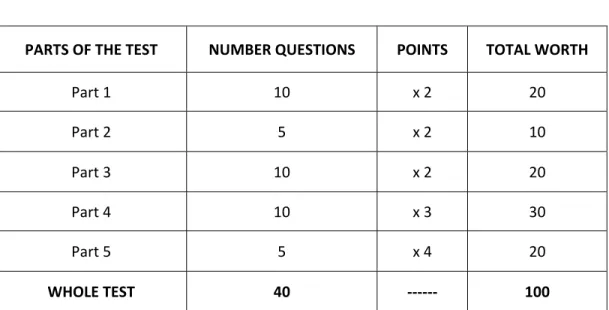
The audio material was carefully selected before the design and creation of the initial listening test took place. This initial exam was made up of 5 parts. (See table 1). Then, it was assigned to a pilot group of 18 research participants who manifested being interested in this project. The test was finally launched on April 1st, 2019, and available online for 4 days.
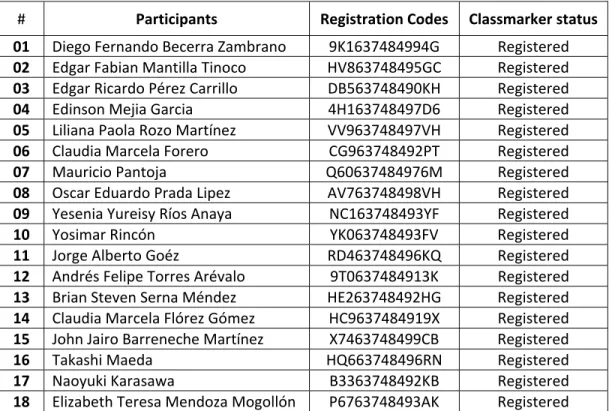
Classmarker was chosen as the online testing platform to generate the initial and exit listening examinations because it allowed the participants to register and log in by creating their own user Ids and passwords in order to authenticate access to the platform. (See table 2)
Figure 7. 40-item online test.
Table 1. Distribution of initial exam
PARTS OF THE TEST NUMBER QUESTIONS POINTS TOTAL WORTH
Part 1 10 x 2 20
Part 2 5 x 2 10
Part 3 10 x 2 20
Part 4 10 x 3 30
Part 5 5 x 4 20
Table 2. Registration process.
# Participants Registration Codes Classmarker status 01 Diego Fernando Becerra Zambrano 9K1637484994G Registered 02 Edgar Fabian Mantilla Tinoco HV863748495GC Registered 03 Edgar Ricardo Pérez Carrillo DB563748490KH Registered 04 Edinson Mejia Garcia 4H163748497D6 Registered 05 Liliana Paola Rozo Martínez VV963748497VH Registered 06 Claudia Marcela Forero CG963748492PT Registered 07 Mauricio Pantoja Q60637484976M Registered 08 Oscar Eduardo Prada Lipez AV763748498VH Registered 09 Yesenia Yureisy Ríos Anaya NC163748493YF Registered
10 Yosimar Rincón YK063748493FV Registered
11 Jorge Alberto Goéz RD463748496KQ Registered 12 Andrés Felipe Torres Arévalo 9T0637484913K Registered 13 Brian Steven Serna Méndez HE263748492HG Registered 14 Claudia Marcela Flórez Gómez HC9637484919X Registered 15 John Jairo Barreneche Martínez X7463748499CB Registered
16 Takashi Maeda HQ663748496RN Registered
17 Naoyuki Karasawa B3363748492KB Registered 18 Elizabeth Teresa Mendoza Mogollón P6763748493AK Registered
The exam results obtained in Classmarker allowed for the classification of the project participants in 4 categories or tiers of academic performance (see table 3).
At the low tier A1 were placed those participants who can barely recognise familiar words and very basic phrases concerning themselves, their family and immediate concrete surroundings when people speak to them slowly and clearly.
Table 3. Overall classification.
# Participants Initial Score
TOP TIER ‐ B1+
01 Mauricio Pantoja 89%
02 Edinson Mejia Garcia 83%
03 Andrés Felipe Torres Arévalo 82% 04 Diego Fernando Becerra Zambrano 81%
HIGH TIER ‐ B1
05 Yosimar Rincón 74%
06 Brian Steven Serna Méndez 74% 07 Elizabeth Teresa Mendoza Mogollón 72% 08 Edgar Ricardo Pérez Carrillo 63%
MIDDLE TIER ‐ A2
09 Oscar Eduardo Prada Lipez 48% 10 Yesenia Yureisy Ríos Anaya 48%
11 Takashi Maeda 46%
12 Naoyuki Karasawa 45%
13 John Jairo Barreneche Martínez 45% 14 Liliana Paola Rozo Martínez 41%
LOW TIER ‐ A1
15 Claudia Marcela Forero 35%
16 Edgar Fabian Mantilla Tinoco 29%
17 Jorge Alberto Goéz 28%
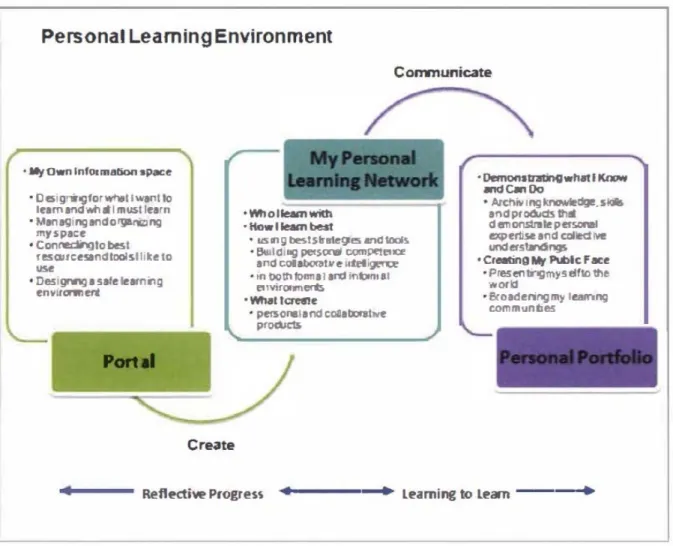
Subsequent to the classification, came the construction of a digital PLE, for which, I followed a structure based on the 3 basic elements of a digital PLE. Figure 8.
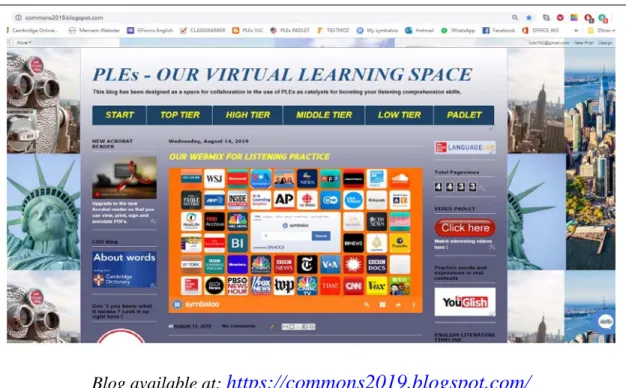
- The building of the Portal – In our case, the blog. Figure 9.
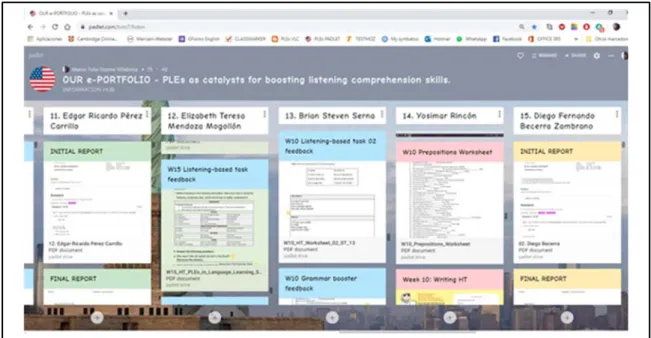
- The construction of a Personal Learning Network. – The Blog subscribers. Figure 10. - The creation of a private online portfolio – In our case, the padlet. Figure 11.
It was through the blog and the padlet that a functional interface to virtually communicate from anywhere with the project participants was created and it was used for as long as the project was implemented and it is still available to anyone on the web.
Figure 9. Our virtual learning space.
Figure 10. Personal Learning Network or PLN.
Figure 11. Our online portfolio.
The project participants in each and every tier were instructed to find their corresponding activities within their given tier tab on the blog. The blog was continuously fed on a weekly basis for 17 weeks according to the calendar for this project. (See figure 12). Participants were offered different types of listening activities from specially designed PDF worksheets to periodical simulations tests for them to practice and assess themselves.
On top of that, they were given a webmix with links to the most prominent news websites for them to explore freely while working on different controlled activities based on podcasts, video clips, RSS feeds, movie segments, songs, news reports, fables, folk tale stories and short documentaries, all of which were adapted to their particular levels, LOW TIER, MIDDLE TIER, HIGH TIER and TOP TIER on customized PDF worksheets that I created bearing in mind the benefits found in the principles of Task-Based Language Learning where
key vocabulary is introduced first, followed by the assignment of meaningful tasks to do before making the learners reflect on key language features such as grammar, more vocabulary, pronunciation, culture, etc.). Figure 13.
Figure 13. Task-based learning framework by Willis (1996, 2012)
Finally, Just to keep track of their participation throughout the 4 months, they were asked to download some controlled activities, complete them and upload them on padlet, which would become their online portfolio (See Figure 14) where they would constantly receive feedback through commentaries, corrections and appraisals mostly left on sticky notes right on the documents they submitted in response to the content posted on the blog. See table 4
Table 4. Weekly blog content.
TOP TIER HIGH TIER MIDDLE TIER LOW TIER
WEEK 1 TOEFL‐based practice listening test Aptis‐based practice listening test KET‐based practice listening test FLYERS‐based practice Listening test WEEK 2 Phrasal verbs Worksheet 1 Second conditional Worksheet 1 Gerunds & Infinitives Worksheet 1 Basic prepositions Worksheet 1 WEEK 3 Technology Jason Silva Critical thinking task New smartphones trends documentary Microplastics Worksheet 2 Beauty & the beast movie segment
WEEK 4 The story of stuff Conditionals The power of Grit Truly madly deeply
WEEK 5 Communism origins Planes Boing 737 Autonomous cars Too/enough ‐ Home
WEEK 6 The dangers posed by Nuclear radiation and Critical thinking task Inside the telecom behemoth, Huawei Critical thinking task A Cashless society report and Critical thinking task ESL FAST listening practice worksheets 1,2,3 – 4 & 5
WEEK 7 Toefl ibt listening Jack & the beanstalk Cinderella fable Hansel & Gretel fable
WEEK 8 Phrasal verbs plus past perfect TOEFL‐based test on https://testmoz.com/215 1445 Indefinite pronouns and quantifiers plus Listening‐based task on poison frogs. Elementary listening tasks 1, 2, 3 & 4 Verb combinations. Worksheet 3 The simple present Vs the present progress. Listening worksheets 6.7.8 & 9
WEEK 9 CAE simulation test FCE simulation test PET simulation test KET simulation test WEEK 10 Phrasal verbs B1 level listening‐ based tasks Prepositional phrases More verb combinations Elementary listening tasks 5, 6, 7 & 8 Present simple Vs present continuous WEEK 11 Video‐based task: The history of the USA Video‐based task: How mentally strong people achieve success. Video‐based task: Wagyu Beef Video‐based task: History through the eyes of the potato. WEEK 12 Video‐based task: Analyzing patterns in the Savanna Landscape. Grammar booster: Complete the phrasal verbs with the correct preposition. Conditional Mix Cambridge learning English ‐ CEFR Level B1‐B2 Grammar booster: Review on the first, second and third conditionals Verb combinations Cambridge learning English ‐ CEFR Level A1‐A2 Grammar booster: Gerunds & Infinitives: Gerunds after prepositions. Simple Vs progressive Cambridge learning English ‐ CEFR Level A1‐A2 Grammar booster: Final review Simple present vs Present progressive. WEEK 13 VOA: Highly processed foods. Grammar booster: Provide the correct form of the phrasal verbs given. VOA: Indian Army Tweets Of ‘Yeti’ Evidence. Grammar booster: Fill in the correct prepositions VOA: Mandarin Duck Excites New Yorkers. Grammar booster:
Prepositions (for, to, about, on, of) followed by gerunds. VOA: Pigcasso plus The history of chocolate. Grammar booster: non‐progressive verbs WEEK 14 VOA: What´s the U.S. Senate? VOA: American stories: Paul Bunyan
VOA: US Census Decides How Many Lawmakers to Send to Congress VOA: American stories: Pecos Bill, An American Folk tale WEEK 15 VOA: HongKongers flee to Taiwan seeking Democracy
VOA: Washington DC VOA: As it is: Apple set to move some production outside China
VOA: As it is: Californians Clean Up After Strongest quake in 20 Years. WEEK 16 VOA: Rocky mountain National Park VOA: The Grand Canyon VOA: A Barbecue festival in DC. VOA: Come over to my place WEEK 17
At the end of the 17-week process, the pilot group was requested to take an exit examination on the Classmarker platform. This exit exam was made up of 5 parts as well, just like the initial test and it contained 40 questions for a maximum score of 100 points. However, the points were distributed slightly differently. (See table 5). The test was available from August 1st to August 4th for the participants to be able to take it at their best convenience. The reports on these findings will be depicted in the following section.
Table 5. Distribution of exit exam.
PARTS OF THE TEST NUMBER QUESTIONS POINTS TOTAL WORTH
Part 1 5 x 2 10
Part 2 6 x 2 12
Part 3 9 x 2 18
Part 4 10 x 2 20
Part 5 10 x 4 40
CHAPTER 4
RESULTS
After 4 months of intense weekly training with the pilot group, we were able to collect the information necessary to report the following results via the research instruments used, in this case, the initial and exit examinations which were applied by the beginning and the culmination of this project. These results are depicted on table 6.
Table 6. Initial and Final scores contrast.
PLEs as catalysts for boosting listening comprehension skills
# Participants Initial Score Final Score
TOP TIER ‐ B1 +
01 Mauricio Pantoja 89 92
02 Edinson Mejia Garcia 83 ‐‐‐‐‐
03 Andrés Felipe Torres Arévalo 82 86
04 Diego Fernando Becerra Zambrano 81 86
HIGH TIER ‐ B1
05 Yosimar Rincón 74 70
06 Brian Steven Serna Méndez 74 84
07 Elizabeth Teresa Mendoza Mogollón 72 86
08 Edgar Ricardo Pérez Carrillo 63 44
MIDDLE TIER ‐ A2
09 Oscar Eduardo Prada Lipez 48 64
10 Yesenia Yureisy Ríos Anaya 48 68
11 Takashi Maeda 46 84
12 Naoyuki Karasawa 45 60
13 John Jairo Barreneche Martínez 45 66
On the following table, we can observe the variation between the two measurements made by the beginning of April and the beginning of August, 2019. See table 7.
Table 7. Differential score variation.
LOW TIER ‐ A1
15 Claudia Marcela Forero 35 62
16 Edgar Fabian Mantilla Tinoco 29 52
17 Jorge Alberto Góez 28 ‐‐‐‐‐
18 Claudia Marcela Flórez Gómez 20 56
PLEs as catalysts for boosting listening comprehension skills
# Participants Differential
variation TOP TIER ‐ B1 +
01 Mauricio Pantoja 3
02 Edinson Mejia Garcia ‐‐‐‐‐‐
03 Andrés Felipe Torres Arévalo 4
04 Diego Fernando Becerra Zambrano 5
HIGH TIER ‐ B1
05 Yosimar Rincón ‐4
06 Brian Steven Serna Méndez 10
07 Elizabeth Teresa Mendoza Mogollón
14
08 Edgar Ricardo Pérez Carrillo ‐19
MIDDLE TIER ‐ A2
09 Oscar Eduardo Prada Lipez 16
10 Yesenia Yureisy Ríos Anaya 20
11 Takashi Maeda 38
12 Naoyuki Karasawa 15
13 John Jairo Barreneche Martínez 21
LOW TIER ‐ A1
15 Claudia Marcela Forero 27
16 Edgar Fabian Mantilla Tinoco 23
17 Jorge Alberto Góez ‐‐‐‐‐‐‐
18 Claudia Marcela Flórez Gómez 36
The following are the most outstanding variations observed between the initial and final scores by the end of the process. (see table 8)
Table 8. Negative and positive variations.
Participants with a negative variation
Origin Exit score Initial score variation
Yosimar Rincón High 70 74 - 4
Edgar Ricardo Pérez Carrillo High 44 63 -19
Participants with a positive variation
Origin Exit score Initial score variation
Takashi Maeda Middle 84 46 38
Claudia Marcela Flórez Gómez Low 56 20 36
Claudia Marcela Forero Low 62 35 27
Edgar Fabian Mantilla Tinoco Low 52 29 23
John Jairo Barreneche Martínez Middle 66 45 21
Yesenia Yureisy Ríos Anaya Middle 68 48 20
Oscar Eduardo Prada Lipez Middle 64 48 16
Naoyuki Karasawa Middle 60 45 15
Elizabeth Teresa Mendoza Mogollón High 86 72 14
Liliana Paola Rozo Martínez Middle 52 41 11
Brian Steven Serna Méndez High 84 74 10
Diego Fernando Becerra Z. Top 86 81 5
Andrés Felipe Torres A. Top 86 82 4
Next, to calculate the percentage variation, we will proceed with the following
calculation: Increase = New Measurement - Original Measurement, then, divide the Increase by the original number and multiply the answer by 100. By following this formula, Positive values indicate a percentage increase while negative values indicate a percentage decrease. See table 9.
Table 9. Increase & decrease percentages.
Participants with a negative variation
Origin Exit score Initial score Percentage decrease
Yosimar Rincón High - 4 74 -5.4%
Edgar Ricardo Pérez Carrillo High -19 63 -30.2%
Participants with a positive variation
Origin Variation Initial score Percentage increase
Takashi Maeda Middle 38 46 82.6 %
Claudia Marcela Flórez Gómez Low 36 20 180.0%
Claudia Marcela Forero Low 27 35 77.1 %
Edgar Fabian Mantilla Tinoco Low 23 29 79.3 %
John Jairo Barreneche Martínez Middle 21 45 46.7 %
Yesenia Yureisy Ríos Anaya Middle 20 48 41.7%
Oscar Eduardo Prada Lipez Middle 16 48 33.3 %
Naoyuki Karasawa Middle 15 45 33.3 %
Elizabeth Teresa Mendoza M. High 14 72 19.4 %
Liliana Paola Rozo Martínez Middle 11 41 26.8%
Brian Steven Serna Méndez High 10 74 13.5%
Diego Fernando Becerra Z. Top 5 81 6.2%
Andrés Felipe Torres A. Top 4 82 4.9%
Now, let´s calculate the different measures of center and spread of the ordered data set based on the percentage increase found. The measures of central tendency are: The mode, the median and the mean while the measure of spread are: The standard deviation or SD and the range.
Table 10. Data set of percentage increase.
The mode refers to the data value that is most frequently observed.
The median refers to the data value that is positioned in the middle of an ordered data set.
The mean is just the arithmetic average whose formula is:
Therefore,
The mode of this data set is
33.3
The median whose position is (n + 1) / 2 is30.05
The mean is
38.29
1 2 3 4 5 6 7 8
180 82.6 79.3 77.1 46.7 41.7 33.3 33.3
9 10 11 12 13 14 15 16
26.8 19.4 13.5 6.2 4.9 3.4 -5.4 -30.2
As for the measures of spread, we have the range and the standard deviation. Table 10.
The range is the Max value - the minimum value. The range is [180 - (-30.2)] =
210
The standard deviation is a statistic that measures the dispersion of a data set relative to its mean and its formula is:
Table 11. Calculation of the SD.
STANDARD DEVIATION
180 180 – 38.29 141.71 20081.72
Square root
of 2428.69
for a SD of
49.28
82.6 82.6 ‐ 38.29 44.31 1963.38 79.3 79.3 ‐ 38.29 41.01 1681.82 77.1 77.1 ‐ 38.29 38.81 1506.22 46.7 46.7 ‐ 38.29 8.41 70.73 41.7 41.7 ‐ 38.29 3.41 11.63 33.3 33.3 ‐ 38.29 ‐4.99 24.90 33.3 33.3 ‐ 38.29 ‐4.99 24.90 26.8 26.8 ‐ 38.29 ‐11.49 132.02 19.4 19.4 ‐ 38.29 ‐18.89 356.83 13.5 13.5 ‐ 38.29 ‐24.79 614.54 6.2 6.2 ‐ 38.29 ‐32.09 1029.77 4.9 4.9 ‐ 38.29 ‐33.39 1114.89 3.4 3.4 ‐ 38.29 ‐34.89 1217.31 ‐5.4 ‐5.4 ‐ 38.29 ‐43.69 1908.82 ‐30.2 ‐30.2 ‐ 38.29 ‐68.49 4690.88
36430.36
CHAPTER 5
DISCUSSION
Based on the results obtained from the pilot group involved in this study, it is clearly seen that their individual achievements, though quite differentiated among the different tiers, were consistent to the expectations in that 87.5% of the 16 remaining participants certainly evidenced considerable improvements reflected in an increase of 13.8% in the group average (see appendix A) after having learned to self-regulate in the management of the web-based activities supplied throughout this project. On the other hand, the fact that we have a standard deviation higher than the mean (SD = 49.28 > mean of 38.29) indicates the presence of a couple of atypical cases that certainly deviate from the average achievements made in that one student went from an initial score of 20 to 56 and another student whose initial score was 63 and went down to 44.
However, the full completion of the activities is not a determining factor because there were others who were successful without completing a 100% of the controlled activities. Thus, it is quite probable that they may have explored some of the resources offered in an uncontrolled way. Interestingly, if we analyze the results by tiers as they were initially organized, we can see that those participants in the lower tiers (Low and middle tier) were the ones with the most outstanding improvements mostly due to their commitment to overcome their weaknesses, but it doesn´t mean that the upper tier participants haven´t signaled any significant improvements, on the contrary, they worked pretty hard to solve the most demanding activities in this project.
Finally, it was found, based on conversations held with the upper tier participants, that the exit test was even more rigorous than the initial one, and it seems to be partly true, due to the fact that the distribution of points per section was slightly different between the two exams which may have affected the final scores bearing in mind that the hardest questions were placed in parts 4 & 5 equivalent in the exit exam to 60 points out of 100. (See table 12)
Table 12. Point allotment contrast between initial and exit tests.
PARTS OF THE TEST INITIAL TEST QUESTIONS & POINTS EXIT TEST QUESTIONS & POINTS INITIAL EXAM TOTAL WORTH EXIT EXAM TOTAL WORTH
Part 1 10 x 2 5 x 2 20 10
Part 2 5 x 2 6 x 2 10 12
Part 3 10 x 2 9 x 2 20 18
Part 4 10 x 3 10 x 2 30 20
Part 5 5 x 4 10 x 4 20 40
CHAPTER 6
CONCLUSION
The benefits of using a PLE to advance learning in any area of knowledge are undeniable if there is commitment, motivation and autonomy. Even though PLEs are a relatively new concept that still lacks more robust research and documentation, I strongly support their use because after completing the implementation of a PLE to boost listening comprehension skills with my pilot group, most of the participants in the project manifested their intention to keep learning more about English by doing independent research which materializes one of the main goals of a PLE, The development of lifelong learning skills.
The previous research project has demonstrated the potential of personal learning environments in ELT. It was evidenced that most participants in this project were able to make significant progress with their basic listening skills after having trained by themselves for a period of 4 months with a series of tools that encompass different types of online content and the assignment of controlled activities that they had to report to their tutor on a weekly basis via the interface associated with the particular PLE developed for this study.
need assistance to develop the capacity to learn to learn on their own through the free exploration of more significant resources usually available online.
Chances are that PLEs may become more and more popular in the near future to engage students who idly browse the web in academic plans more connected with the global ecology of web 2.0 services. Consequently, PLEs offer teachers a great opportunity to improve current course designs in an attempt to challenge the dominant role played by institutional Learning management systems allowing for a more personalized approach to teaching.
REFERENCES
Adell, J. & Castañeda, L. (2010). Los Entornos Personales de Aprendizaje (PLEs): una nueva manera de entender el aprendizaje. Claves para la investigación en innovación y calidad educativas, la integración de las tecnologías de la información y la comunicación y la
interculturalidad en las aulas. Alcoy: Marfil. 19 – 30. Recuperado de:
https://dialnet.unirioja.es/servlet/articulo?codigo=3404668
Alharbi, Talal & Platt, Amelia & Al-Bayatti, Ali. (2013). Personal Learning Environment.
International Journal for e-Learning Security (IJeLS). 3. 280 - 288.
Baralt, M., & Morcillo Gómez, J. (2017). Task-based language teaching online: A guide for teachers. Language Learning & Technology, 21(3), 28–43. Retrieved from
https://www.lltjournal.org/item/3008
British Council (2015) Education Intelligence, English in Colombia: An examination of policy, perceptions and influencing factors. Available at:
Brown, J.S. (2000). Growing up digital: How the web changes work, education, and the ways people learn. Change Magazine, March/April, pp. 11-20.
Brown, S. (2010). From VLEs to learning webs: the implications of Web 2.0 for learning and teaching. Interactive Learning Environments. 18 (1), 1-10. Available at
https://www.researchgate.net/publication/220095357_From_VLEs_to_learning_Webs_th
e_implications_of_Web_20_for_learning_and_teaching
Castañeda, L & Soto, J. (2010). Building Personal Learning Environments by using and mixing ICT tools in a professional way. Digital Education Review. 18, 9-25. Recuperado de
https://dialnet.unirioja.es/servlet/articulo?codigo=3633729
Castañeda, L. y Adell, J. (Eds.). (2013). Entornos Personales de Aprendizaje: claves para el ecosistema educativo en red. Alcoy: Marfil. Disponible en:
https://www.um.es/ple/libro/
Chatti, M.A., Agustiawan, M.R., Jarke, M., & Specht, M. (2010). Toward a Personal Learning Environment Framework. IJVPLE, 1, 66-85.
Del Barrio-Garcia, S., Arquero, J., & Romero-Frías, E. (2015). Personal Learning Environments Acceptance Model: The Role of Need for Cognition, e-learning Satisfaction and
Students´perceptions. Journal of Educational Technology & Society, 18 (3), 129-141.
García-Martínez, J.A. y González-Sanmamed, M. (2017). Entornos personales de aprendizaje de estudiantes universitarios costarricenses de educación: análisis de las herramientas de búsqueda de información. Revista de Investigación Educativa, 35(2), 389-407 DOI:
http://dx.doi.org/10.6018/rie.35.2.253101
Hurst, B., Wallace, R., & Nixon, S. B. (2013). The Impact of Social Interaction on Student Learning. Reading Horizons, 52 (4). Retrieved from
https://scholarworks.wmich.edu/reading_horizons/vol52/iss4/5
Loertscher, D. (2011). Personal Learning Environments and Personal Learning Networks, An Introduction. Teacher Librarian, the journal for school library professionals, 39 (2), 22.
Available at
https://drive.google.com/file/d/1dI0DvTFxpUIoAz8EsJktuQsN0fk0m-6S/view?usp=sharing
Johnson, L., Adams, S., and Haywood, K. (2011). Personal Learning Environments, Time-to- Adoption Horizon. The NMC Horizon Report: 2011 K-12 Edition, 30 - 33. Available at
https://library.educause.edu/resources/2012/1/horizon-report-2011-k12-edition
Meza, J., Morales, M., y Flórez, R. (2016). Variables individuales relacionadas con la instrucción en el uso de entornos personales de aprendizaje. Educación [online]. 25 (48), pp.87-106.
Meskill, C. (1996). Listening Skills Development Through Multimedia. Journal of Educational Multimedia and Hypermedia, 5(2), 179-201. Charlottesville, VA: Association for the
Advancement of Computing in Education (AACE). Retrieved January 16, 2019. Available at:
file:///F:/Users/TULIO/Downloads/Listening_Skills_Development_Through_Multimedia
Nunan, D. (2004). What is task-based language teaching?. Task-Based Language Teaching
(Cambridge Language Teaching Library, pp. 1-18). Cambridge: Cambridge University Press.
OECD (2015), Students, Computers and Learning: Making the Connection, PISA, OECD Publishing. http://dx.doi.org/10.1787/9789264239555-en
Panagiotidis, P. (2012). Personal Learning Environments for Language Learning. Social Technologies, 2. (2), 420–440. Available at
https://www3.mruni.eu/ojs/social-technologies/article/viewFile/207/198
Reinders, H. (2015). Personal learning environments for supporting out-of-class language learning. Learning. English Teaching Forum, 52(4), pp.14-19.
Richards, C. (2005). The design of effective ict-supported learning activities: Exemplary models, changing requirements, and new possibilities. Language Learning & Technology, 9(1),
60–79. Available at https://www.lltjournal.org/item/2496
Rost, M. (2001). Listening. In R. Carter & D. Nunan (Eds.), The Cambridge Guide to Teaching English to Speakers of Other Languages (The Cambridge Guides, pp. 7-13). Cambridge: Cambridge University Press.
van Harmelen, M. (2006). Personal Learning Environments. Proceedings - Sixth International Conference on Advanced Learning Technologies, ICALT 2006. Available at:
https://pdfs.semanticscholar.org/3a80/0f41a3431cd05b37e882c34dc434aa27bbf3.pdf
Willis, J., & Willis, D. (2007). Doing task-based teaching: A practical guide to task-based teaching for ELT training courses and practicing teachers. Oxford, UK: Oxford University Press.
Wilson, S., Liber, O., Johnson, M., Beauvoir, P., Sharples, P. & Milligan, C. (2007). Personal Learning Environments: Challenging the dominant design of educational systems. Journal of e-Learning and Knowledge Society, 3(2), 27-38. Available at
APPENDIX A: GROUP AVERAGE TEST SCORES
Group average test results available for online viewing at:
APPENDIX B: RESEARCH INSTRUMENTS
All individual exams available for online viewing at: