
Restrictions, problems and dilemmas of social provision in Latin America: facing challenges from aging and income inequality
24
0
0
Texto completo
(2)
(3) WELL-BEING AND SOCIAL POLICY VOL 1, NUM. 1, pp.33-54. RESTRICTIONS, PROBLEMS AND DILEMMAS OF SOCIAL PROVISION IN LATIN AMERICA: FACING CHALLENGES FROM AGING AND INCOME INEQUALITY Fabio M. Bertranou International Labour Office, Chile [email protected]. Abstract. T. his paper discusses the main restrictions, problems and dilemmas that social provision faces in Latin America in a context of demographic changes and low achievements in the economic performance, particularly in the labor market. It is proposed the need to adapt the general social provision matrix as function of priorities and restrictions set by financing access. Due to the limited labor performance, labor income represents an insufficient source of financing and, in some cases, is inadequate to finance the basic social provision, which should be based of noncontributing criteria. Nevertheless, labor market together with pensions, will continue constituting one of the main pillars of income sources and socioeconomic security for the older adults in Latin America. Thus, a higher labor participation of this age group is expected, which leads to reflections on the soundness of labor. Key words: social provision, pensions, aging, labor market and Latin America. Classification JEL: H55, N36.. Introduction1. T. he extension of social provision2 access to all sociodemographic strata is the main challenge for social protection systems in Latin America. This region is worldwide the most unequal regarding income distribution. This is reflected in the socioeconomic dimensions where demographic changes and social provision systems are not apart to this reality. Also, social provision should, in theory, adapt itself not only to the aging changing structure, but also to labor market modifications and to the economy as a whole. On the other hand, the institutionalism and its changes, play a significant role in the final performance of the systems and in its adaptation capacity to new realities. 1. This paper is partially based on those considerations presented in Bertranou (2005a) and Bertranou and Jiménez (2005). Expressions are exclusive author’s responsibility and do not necessary represent International Labor Office thought. 2 A short definition of social provision concept and its relation with other social policies concepts are summarized in the annex.. 33.
(4) RESTRICTIONS, PROBLEMS AND DILEMMAS OF SOCIAL PROVISION IN LATIN AMERICA. Socioeconomic insecurity is one of the most worrisome daily living faces to Latin American population. All social strata face such circumstance, but mainly those in informality and poverty. The low social protection coverage is particularly severe in the first deciles of the income distribution; this refers to the workers and their relatives covered by the provision schemes, as well as to the risks spectrum and the quality of provision itself. This simple phenomenon apparently conceals, nevertheless, to multiple and closely interrelated causes. Approximately two of each three citizens in the region do not have access to basic and quality coverage of insurance for the most common social risks such as: health, loss of income by old age, disability, survivor, or unemployment. Generally, coverage access to some benefits during the oldness - retirements and pensions- is larger. At least one of each two elderly has access to old age benefits, nevertheless, this result is only explained by the performance of a small group of countries. If a simple average for all countries of the region were considered, one of each three elderly would have access to old age benefits. This larger coverage to elderly, contrasts with this age group is also exposed to some hardly difficult risks to be covered in financial terms and that concern to health services and long-term care requirements. Also, who access to old age benefits are usually those collective workers who had been better positioned in labor market, due to pensions systems have had a strong contributing type direction for their access. Demographic changes have been crucial to establishing new restrictions in financing and traditional protection pillars redefinition: family, market and State. The growth rate of the 60 years old and over population will speed up during the next decades producing an increase in the older and the elderly dependency indexes. This raises important questions about the social provision matrix that each country must model and the way they finances themselves. Simultaneously, the youngest population will not have entered at all to the labor force with education and productive capacity enough to take advantage of the “demographic dividend”, which allows driving economic growth. This will affect as well social protection finances possibilities, and public, and private saving accumulation for consumption financing during the oldness. This work tries to summarize some of the main trends observed in mentioned factors set in the Latin American region, emphasizing the interactions and their possible effects as well as the main challenges in public policy matter for coming years. Social provision systems have been generally adapted with socio-labor changes delay. This way, reducing adaptation delay turns out crucial to optimize social resources use assigned to risk protection, and increasing in this way social welfare, particularly to face demographic changes expected during the next decades. The article is organized as follows. Firstly characteristics and problems of social provision systems in region are summarized, without keeping in mind that important differences between groups of countries due to their different socioeconomic development exist. Then, a brief summary of the main demographic trends in Latin America is made, to focus the discussion in one of most relevant aspects in social reform topics: retirements and pensions systems changes. Finally, main challenges are discussed to the light of demographic trends and current social provision systems context: the need to restructure the social provision matrix considering financing and noncontributing programs growing role aspects; oldness feminization and gender dimension in pension systems; and the old in the labor market.. 34.
(5) WELL-BEING AND SOCIAL POLICY VOL 1, NUM. 1, pp.33-54. 1. Social Protection Systems: Restrictions, Problems and Challenges Elderly social provision is provided trough schemes and programs that are inserted in a kind of integrated way within a social protection system. Generally, almost all the countries lack a “provision system” as such, but they have schemes and programs weakly structured and related. This way it is relevant to briefly analyze the main characteristics and problems that social provision usually displays, to focus the discussion then, on what is happening in the income protection programs to older and, particularly, in retirement and pensions systems. Actually, social provision systems in different countries of region, whatever the income per capita level, consist in a “noncontributing” and “contributing” nature “mix” program. The social provision matrix and its performance are product of the existence of a determined historic development of its components as well as current effective institutionalism dominated by own political-organizational factors of each country. Next, most relevant general problems and restrictions are summarized. The main problem and challenge of social protection systems, and particularly in the Latin America region, is a low coverage (ILO, 2002; Mesa-Lago, 2004). This is not an isolated characteristic but it is associated to other problems series that lead to a multicausal phenomenon. This means that of all these problems, low coverage becomes the common aspect, in the sense that other problems causes or affect directly on the amount and quality of it, as much of economic active population as other population groups directly or completely non participating in labor market, such as children and elderly. This way, the six main general restrictions and problems (Figure 1), as well as their biggest challenges, are: Low coverage. Usually, there is a low coverage and low quality of diverse social provision programs. It can be said that a “provision paradox” emerges in the sense that less vulnerable population groups are those acceding to more and better protection. This is product of diverse factors but an important one is labor market where the best positioned workers (in larger companies and public sector wage-earnings) are those most favored in coverage terms. Inappropriate definition of priorities. There is a deficient process of definition of priorities regarding targeting population and of those risks to be included. An important challenge is a costeffective social provision instrument definition as well as generating/adapting instruments considering labor market heterogeneity and diverse employment modalities, and also demographic structure. A specific example of this problem in Latin America at priorities definition level in pension public policy matter is the excessive concern in the “second pillar” (income substitution) programs related aspects reform and redesign in decline of “first pillar” (lightening of poverty) programs design and implementation. On the other hand, at more specific resources allocation level to high social profits programs with a strong impact in exclusion from an inter-temporary view, there is a low intervention priorization aimed to eliminate children work3 Insufficient, unstable and procyclical financing. A financial dependency of social protection system macroeconomic cycle exists. The challenge consists in generating anti-cyclical financing complementary mechanism and global resources volume assigned to protection improvement trough prudent fiscal policy. These way two routes to increase financing exist. First one has to do with employment growth and its structure towards an increasing easy employment coverage proportion 3. During the last years, a new generation of programs looking for ameliorating this problem has arisen in numerous countries of the region, among them are, for example, some conditional transfers programs (Rawlings 2005).. 35.
(6) RESTRICTIONS, PROBLEMS AND DILEMMAS OF SOCIAL PROVISION IN LATIN AMERICA Figure 1. Social Provision Problems and Restriction in Latin America Public Policy. Inapropiate priorities definition. Limited institutional performance. Managment. Low social provision coverage Macro. Micro Unstable and procyclical financing. Inequalities and Inequities. Demography Age structure Aging. Inapropiate and regresive financing. Labor market Employment structure Income and wages. Source: Bertranou (2005a). composition (big and medium companies’ wage-earnings). Second one is in relation to product growth and increasing tax revenues, mainly through income tax, and in its defect through consumption taxes minimizing price distortion impact, for example, through added value tax. Inappropriate and regressive financing. An inappropriate social provision financing matrix to socio-labor reality exits and deepens regressive income distribution aspects. The challenge is to modify matrix’s key financing parameters in the sense that allows promoting, or at least avoiding inhibiting, employment creation. These parameters definition is not neutral in employment generating incentives terms, nevertheless, links between employment and quotations incidence, and their consequences in efficiency and fairness are not identified at all. This also, could improve social security resources quantity by attracting new contributors, although this impact would be limited since most of excluded ones are low contributing capacity. The improvement should have to privilege those groups with contributing capacity that avoid, or they simply are not forced to quote. Limited institutional performance. There are organizational deficiencies in the bureaucracy structure and its management. The challenge consists of institutions’ strengthening to optimize social protection management. It is also required to identify institutional improvement cost-effective actions. For this it is needed, for example, to fortify political and management capacity to eliminate low impact programs and to strengthen those of higher social profitability. Institutional performance concept must be considered in ample form, even the actions leading to recover probity and ethos of public administration that also allow to isolate programs from corporative pressures and political cycle effects.. 36.
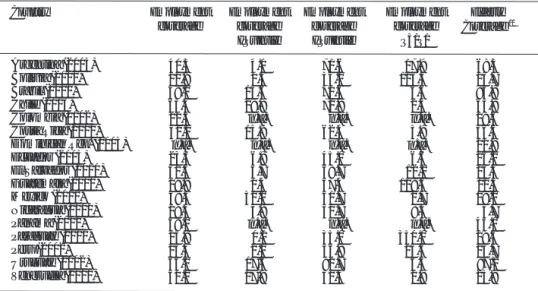
(7) WELL-BEING AND SOCIAL POLICY VOL 1, NUM. 1, pp.33-54 Table 1. Latin America: Pension Coverage Country. Argentina (2003) Bolivia (2002) Brazil (2001) Chile (2003) Colombia (2002) Costa Rica (2002) Dominican Rep. (2003) Ecuador (2003) El Salvador (2000) Guatemala (2000) Mexico (2000) Nicaragua (2001) Panama (2000) Paraguay (2001) Peru (2002) Uruguay (2002) Venezuela (2000). Employment coverage. Employment coverage I Quintile. Employment coverage I Quintile. Employment coverage Q5/Q1. Elderly Coverage 1/. 40.3 10.9 49.0 63.4 22.3 52.1 n.a. 23.3 31.6 19.9 39.3 19.4 59.0 14.8 14.4 65.0 40.0. 4.0 0.3 15.6 29.9 n.a. 15.9 n.a. 6.8 5.7 0.4 30.2 3.8 n.a. 0.1 2.0 17.3 17.9. 71.6 34.0 71.6 72.8 n.a. 62.4 n.a. 45.0 68.7 47.4 51.7 31.7 n.a. 35.0 46.8 92.7 51.4. 17.9 113.3 4.6 2.4 n.a. 3.9 n.a. 6.6 12.1 118.5 1.7 8.3 n.a. 350.0 23.4 5.4 2.9. 68.3 14.7 85.9 63.8 18.6 36.6 10.9 15.2 14.5 11.3 19.2 4.7 45.0 19.6 23.7 87.1 23.9. Note: 1/ 65 years and over. Source: Elaboration based on Rofman (2005) and sources compiled by the author.. High inequalities and inequities. The result of labor performance and social protection access differences generate important inequalities and inequities. As well, problems mentioned above are also generating and perpetuating these situations. The challenge is to reduce systems inequalities and the inequities through coverage extension of the cover and programs unification/ standardization, reform dialogues promotion and cooperation, and eliminations of financing regressive mechanism. Table 1 shows the magnitude of the problem, by indicating a worker’s proportion of social security coverage and the older population receiving benefits from an important social security area: old age benefits. As an example, this table shows important regional heterogeneity product of countries’ different socio-labor realities. Coverage observed breaches “hide”, as well, important problematic consisting in access dissimilar conditions to benefits together with resulting inequalities and inequities. Population in the first and fifth quintile differs significantly in employment coverage, besides, showing that these differences are extraordinary high within some countries. These important differences are reflected in different provision access for the older. In some countries, some noncontributing programs look for compensating slants that contributing regimes deepen. The result is that limited compensation and access and depth coverage differences can be partially remedied only. This aspect will be discussed below.. 2. Retirement and Pensions in Latin America: Reforms and Implications Latin America retirement and pensions systems have a long history, having a higher diversity in organization types, financing, and performance (Mesa-Lago, 1978). Demographic changes and. 37.
(8) RESTRICTIONS, PROBLEMS AND DILEMMAS OF SOCIAL PROVISION IN LATIN AMERICA. precarious fiscal situation were important issues in such programs in the countries in the region for the implementation of changes and probably constituted probably one of most intense and controversial reforming areas in social public policies of last the two decades.. 2.1 Trends towards a heterogeneous aging According to ECLAC’s (2004) Latin American population trends estimations, the region is passing through a reduction of birth rates together with a mortality rate reduction. Birth rates fell strongly in the seventies while mortality has reduced since the first half of the twentieth century. Since the sixties, the population had a reduction in the younger and in the total population growth rate, generating a number of young per working age people (between 15 and 64 years old) ratio diminution. The region is currently experiencing important falls in the working age population growth rates and a relatively increase in the fifteen years old and over population. In this way young people per working age people reduction continues and the number of elderly per working age population increases, first slowly but very fast later. The population of 60 years old and over will increase in 2000-2025 from 40 to 96 millions. This increase will deepen between 2025 and 2050 when an increase of 85 million people is expected, this means, elderly population will reach 180 million. Thus, this group’s quinquennial growth rate will pass from 2.9% in 1995-2000 to 3.7% in 2020-2025, while total population growth rate for such periods will be 1.6% and 0.9%, respectively. Elderly, therefore, will represent 7.9% of the Figure 2. Latin America Population Growth Rate 4.0. 3.7. 3.5. Percentage. 3.0 2.5. 2.9. 2.8 2.5. 2.0. 1.8. 1.6. 1.5. 0.9. 1.0. 0.4. 0.5 0.0. 1970-1975. 1995-2000. 2020-2025 Years. Total population. 2045-2050. 60 years and over. Source: ECLAC (2004). 38.
(9) WELL-BEING AND SOCIAL POLICY VOL 1, NUM. 1, pp.33-54. total population in 2000 to 14% in 2025 and 22.6% in 2050. This means that one of each four people is expected to be an elderly in 2050. Consequently, population medium age will increase 15 years between 2000 and 2050, being for this last year half of 40 years old and over population (Figure 2). The most well-known aspect of this global change process in age structure and regional population aging acceleration has to do with high heterogeneity across countries. According to current aging profile, ECLAC (2004) has classified the countries in four categories. This allows to approximate demographic issues to socio-institutional variables affecting social provision systems performance. The first group includes countries with advanced aging and among them are Argentina, Cuba and Uruguay. These countries have an elderly people percentage over 10%. The second group consists of those with moderate advanced aging, meaning they currently have an elderly people percentage between 8% and 10% and will experience a fast increase of these percentage during the next years (25% to 30%). Countries in this group are Brazil and Chile. The third group is composed by those with moderate aging. In this countries it is observed people of 60 years and over represent between 6% and 8% and they will surpass 20% in the 2050. Countries in this group are Colombia, Costa Rica, Ecuador, El Salvador, Mexico, Peru, Dominican Republic and Venezuela. Finally, the group of incipient aging embraces Bolivia, Guatemala, Haiti, Honduras, Nicaragua and Paraguay. These countries have relatively low elderly people proportion percentage. They Figure 3. Elderly Dependency Index Latin America Selected Countries, 1975-2050 45 40. Percentage. 35. Argentina Brazil Chile Colombia Paraguay Mexico. 30 25 20 15 10 5 0. 1975. 2000. Year. Elderly dependency index =. 2025. 2050. 65 years and over population * 100 Population 15 - 64. Source: Own elaboration based on ECLAC (2004) data.. 39.
(10) RESTRICTIONS, PROBLEMS AND DILEMMAS OF SOCIAL PROVISION IN LATIN AMERICA. reach levels between 5% and 7% and will only represent between 15% and 18% in the 2050. For this group there is the possibility that in the next years the aging process will accelerate if changes in low birth rates occur. Which are most important implications for Latin American countries of these demographic changes? Without trying to do an exhaustive revision, it must stand out that in the scope of public policies definition, in special the public sources allocation, social policy priorities and objectives will have to be reframed. This is particularly relevant if it is considered that other population groups such as children and adolescent have higher vulnerability in poverty and sever poverty terms. Another aspect to emphasize has to do with the way social insurance is made, that means, facing social risks “pooling”, and how intra and intergenerational transferences act, in special those causing pensions and retirement systems. Also, the aging process will be accompanied of other socio-demographic changes that have to do with larger female labor participation and different household organization, and also adjustments trends due to higher separations and divorces incidence throughout the life cycle. Finally, an implication to have in mind is the speed in which the aging process is happening. As mentioned above, population of 60 years old and over constitutes the faster growing population group in the region, but more important is the speed at which this is taking place. While in developed countries the process has taken between six and ten decades, in Latin America it is happening in two to three decades (Bravo, 2000). This make us to reflect on the necessity to adapt social provision systems at a still greater speed than developed countries did. Figure 3 shows elderly dependency index evolution, indicating speed changes as well as regional heterogeneity. Countries, like Paraguay for example, still in 2050 will have a substantially smaller elderly dependency index to neighbors like Argentina, Brazil and Chile.. 2.2. Pension systems reform Since 1981, at least ten countries in Latin America, have introduced structural reforms, that means, those not only changing financing regime when introducing total or partially defined contributions, but also including private pensions funds. All these reforms also included (or “nested”) reforms considered as parametric, that means, those improving system financial viability through changes in benefits acquisition conditions (like retirement ages and contribution years) or in financial parameters (like contributions rates). In other countries, according to previous criterion, reforms are characterized as non-structural; nevertheless, they introduced important changes requiring of political economy processes and negotiation between social actors as important as the structural reforms itself. Countries with structural reforms have been Chile (1981), Peru (1992), Colombia (1993), Argentina (1994), Uruguay (1996), Mexico and El Salvador (1997), Bolivia (1998), Costa Rica (2000), and the Dominican Republic (2003). Nicaragua (2000) and Ecuador (2001) introduced structural changes in legislation but by diverse legal and administrative reasons the reforms have not been implemented. Regarding countries with structural reforms, the most visible case due to its regional representative has been Brazil, with its reform to the private sector system in 1999 and for public sector, in 2003-2004. Between the other countries with this type of reforms it is Panama, which in 2005 introduced nonstructural character changes, Colombia that deepened certain reform aspects in 2003 and Peru that made some additional changes in 2004. Therefore, during the last. 40.
(11) WELL-BEING AND SOCIAL POLICY VOL 1, NUM. 1, pp.33-54. years, the trend is they have not continued deepening in structural reforms in regard to countries adding to ten reformers previously mentioned, but parametric type reform process has been continued and in some cases these also have reached those countries that introduced private component in the Nineties. These are Colombia and Peru the mentioned examples. Structural reforms experience are followed by numerous aspects of reform produced in Chile in 1981 and have had as common denominator the nineties reform dominant paradigm, fostered by the World Bank (1994) with its multi-pillars systems proposal. In spite of it, reforms characteristics have been evidently different in countries within the region. Structural reforms, it is to say, those systems that in one hand made changes in financing fundamental parameters when introducing capitalization schemes, (advanced funding) followed different ways. According to Mesa-Lago (2004) characterization mentioned in several studies, it could be said three models have been configured: substitute, parallel and mixed. In the first, individual capitalization component replaced completely the defined benefit scheme financed in distribution form. That means the workers who enter to labor market assign their contributions in their totality to the new capitalization regime. In the second case, that means, parallel schemes, workers can choose between contributing to a capitalization scheme or to another one of distribution with defined benefits publicly administered. Finally, mixed ones combine both schemes. A World Bank evaluation (Gill et al, 2005) referred to reforms in the region, shows in stylized form, the way in which individual capitalization component has been combined with public schemes, particularly for second pillar. These last ones were also already reformed in their financing parameters and benefits. In Figure 4 this characterization is shown and agrees with the one made by Mesa-Lago, nevertheless, within mixed models distinguishes the case in which worker possibility to maintain its quotation in a defined benefit scheme exits such as the Argentina case. How could Latin America pensions systems be characterized after this reform process? An important aspect to emphasize is that although reforms have changed radically, numerous provisional systems aspects in financing and organization, they conserve in majority a mixed nature. That means, while in numerous cases a strategy called “substitutive” was chosen like for example in Chile, the system morphology shows an important state participation. This participation in not only limited to the old system management during the transition, and regulation and supervision Figure 4. Pension Reform Type According to Reformed System Contributions’ Destiny Mandatory contributions. Capitalization. -Bolivia -Chile -El Salvador -Mexico -Dominican Rep.. Distribution. Capitali zation. -Colombia -Peru. Source: Gill et al (2005).. 41. Distribution. Capitali zation. Capitalization. Distribution. Distribution. -Argentina. -Costa Rica -Uruguay.
(12) RESTRICTIONS, PROBLEMS AND DILEMMAS OF SOCIAL PROVISION IN LATIN AMERICA. of privately managed component , but the State continues having a strong presence in diverse components, particularly in noncontributing benefits provision and in basic or minimum benefits guarantees. In front of a labor market with an employment structure dominated by informality and a strong presence of workers without wage-earning benefits, social security system founded in contributing nature basis generates important coverage breaches. In the countries with greater social security development, as a result of their economic development and history of social institutions, breaches have been partially closed by contributing nature programs. The countries that better illustrate this case are the pioneering of social security in Latin America denominated Table 2. Latin America: Socio-Demographic and Provisional Characteristics Aging process stage. Country. Advanced. Argentina Cuba Uruguay. High High High. Mixed Public (social sec.) Mixed. 6055 3965 4946. 8.67. Moderateadvanced. Brazil. High. 4340. 10.33. Chile. High. Public (social sec. + noncontributing) Mixed-Private. 5952. 7.89. Moderate. Colombia Costa Rica Ecuador El Salvador Mexico Panama Peru Dominican Rep. Venezuela. Low Medium Low Low Low Medium Low Very Low Low. Mixed-Parallel Mixed 5/ Public Mixed-Private Mixed-Private Public (social. sec.) Mixed-Parallel Mixed-Private Public (social sec.). 2277 3762 1776 1761 4690 3123 2376 2133 2796. 29.20 * 30.38* 38.39 * 30.35 30.50 * 21.71 18.32 38.09 * 20.85*. Incipient. Bolivia Guatemala Haiti Honduras Nicaragua Paraguay. Very Low Low Very Low Very Low Very Low Low. Mixed-Private Public (social sec.) Public (social sec.) Public (social sec.) 5/ Public Public (social sec.). 938 1554 n.a. 713 484 1477. 36.59 * 45.90 4/ N.a. 24.27 18.25 24.35. Characteristics Per capita Pension system Income US$ 2/ type. Elderly pension coverage 1/. 60 year old and over poverty % 3/ 9.48. Notes: 1/ Coverage: High: more than 50%; Medium: between 30-50%; Low: between 15-30%; Very Low: lower than 15%. 2/ ECLAC, Panorama Social, 2002. 3/ Oldness poverty corresponds to 60 years old and over population with per capita income lower than 50% of median income. Equivalences use the ones used in OCDE that corresponds to 0.5 + (0.5 x adults’ number) + (0.3 x 16 years old and lower children). Source: Gill et al. (2005, page 202-203). * Means 60 years old and over adults poverty is higher than for all population 4/ Guatemala poverty data belongs to 65 years old and over. 5/ Structural reform laws exits but they have no been implemented; Source: Own elaboration with data from cited sources.. 42.
(13) WELL-BEING AND SOCIAL POLICY VOL 1, NUM. 1, pp.33-54. ones (Mesa-Lago and Bertranou, 1998), that means, Argentina, Brazil, Chile and Uruguay, together with Costa Rica. Other countries have recently introduced this type of regimes, as Colombia, while Bolivia has generated a universal elderly benefits innovating scheme called (World Bank, 2004). Table 2 summarizes some aspects of characteristics shown by countries in the region related to their aging process stage, their level of coverage, the pension system characteristics and the situation in terms of older than 60 years old poverty. In this way, it is tried to emphasize that in spite of the strong social security “privatization”, the dominant model has an important public presence reason why the systems have been characterized in the following four categories: Mixed, Mixed-Private, Mixed-Parallel and Public.. 3. Main challenges in view of demographic changes and labor market restrictions This section briefly presents a discussion of some of the main social provision systems challenges facing demographic changes. In first instance the need to rebuild the social provision matrix is approached, then the feminization topic and the pension systems gender dimension are approached and, finally, aspects related to elderly.. 3.1 The need of restructuring the social provision matrix The redefinitions of the social provision matrix has two important dimensions that intercross themselves, financing in one hand and in the other hand definitions belonged to coverage and benefits access conditions. In the financing side it is important a financing sources mix, basically wage contributions, taxes or a combination of both. In the case pensions systems that have changed towards a capitalization regime, also it takes big importance the accumulated founds profitability, nevertheless, this one takes place mainly on the base of wage contributions being important not only the contribution amount but also the labor life cycle stage in which they are produced. The other substantial aspect has to do with the system contributing/noncontributing character, that is to say, if for benefits access a determined time of contributions to social security or a time on employment services covered by social security is required, even though contribution level does not assure the program’s complete financing. Financing The general question in this context is related to which are the contributing financing limits in a context that presents certain particularities. In the short term, wage-earning employment does not have many margins to grow in the region. In addition, the opening and globalization have imposed limitations to the possibility of increasing the wage contributions that are perceived generally as a labor cost that attempts against the producing internationally interchangeable goods companies’ competitiveness. Also, in an important number of countries, wages as proportion of gross domestic product, has stayed relatively constant or decreased. In this way, restrictions to have a totally “genuine” organized social security financing with contributing criteria are limited. Due to restrictions to face all benefits expenses with contribution resources, gradually, not only by the. 43.
(14) RESTRICTIONS, PROBLEMS AND DILEMMAS OF SOCIAL PROVISION IN LATIN AMERICA. internal and external labor market limitations but also by acquisition condition relaxation problems and bad reserve management, provisional systems were incorporating tax financing gradually. Provisional systems morphology in the region shows that currently they are dominated by a strong contributing slant, that means, financing and/or acquisition conditions to have right to a benefit are based on the quotations made by the insured. Nevertheless, this financing composition is different in each country and also depends on the system maturity and the implemented provisional reform type. The most mature systems in countries with an advanced stage in aging process have an important financing source based on general rents taxes. This it is the case of Argentina and Uruguay where, in addition, other types of employers’ contributions reduction policy were deepened, requiring of replacing those taxes income. It is difficult, this way, to make international comparisons for the region under this context. Also, for those countries that decided on structural reforms, different ways for the way transition concerning to contributions to the system previous to the reform have. This is not a trivial aspect due to financial implications and the way form in which rights to contributions made in the past are recognized. Therefore, the coverage of this “recognition” can vary substantially by country and by insured characteristic. In some countries, like Chile and Peru, it was chosen to instrument a recognition bond that is paid at legal insured retirement age. In other countries, like Argentina, the recognition is made in the form of a defined benefit defined subject to certain acquisition conditions. Finally, desired provision level, as much in coverage extension (amount of reached people) as in the quality (amount of the benefits) is, finally, the parameter to consider in views to define a quotation level that allows balancing expenses obligations commitments necessary resources for its financing. Theoretical contributions rates of equilibrium would be untenable as much as political as economically, particularly in the countries with mature systems and relative high coverage. This way, mixed financing is the option that faces the countries that must reorganize their systems. Conditions of access to old age benefits and other social provision benefits All the provisional reforms, as much the structural ones as those only parametric, required to fit access conditions to old age benefits with the intention to make the systems financially viable and adapting them to the new demographic reality with longer life expectancies. The bad side of this policy has been an increase of oldness unprovision, since it is more difficult to access to these benefits. This raises an important challenge in a context where there is a strong campaign and interest in extending the provision. Thus, like in the past, social security extension was made making acquisition conditions flexible resulting the coverage extension model untenable in time for a relatively fixed level or given the resources, the solutions from the fiscal point of view consisted of system reparametrization demanding more contribution years, doing effective its fulfillment4 and elevating legal retirement ages.. 4. In several countries, given the lack of adapted and strict register mechanisms of employers and workers contributions, it was allowed to credit contribution periods through the use of sworn declarations. This mechanism relaxed some restrictions so that numerous workers acceded to their benefits since legally those belonged to them, but simultaneously facilitated an excessive fraud. The improvement of register and control mechanisms has allowed to eliminate or to reduce substantially these deficiencies.. 44.
(15) WELL-BEING AND SOCIAL POLICY VOL 1, NUM. 1, pp.33-54. The problem derived from larger restrictions in provisional benefits has been also the other social security system benefits access deterioration, for example, health insurances coverage. This situation is in some cases more relevant perhaps than cash transferences to the potential catastrophic risk that adverse events in elderly health imply. The coverage expansion dilemma also implies to consider, therefore, the access to a set of benefits that go beyond welfare pension or minimum pension that grants provisional systems. The elderly basic benefit package that allows covering the most important catastrophic risks is definitively, the factor that could jeopardize financially provision system as aging process advance. Topic is particularly important in the context of life expectancy increase and the limited development of a long-term system for elderly over 75-80 years old. The role of “noncontributing” and tax financed pensions One of the main justifications for structural reforms was the argument to introduce a narrower link between contributions and benefits. Individual accounts would origin an increasing coverage, because people would experience a bigger responsibility and incentives to contribute continuously to the system. However, for several reasons, reformed systems have not brought as result coverage increases. In fact, in some countries contributing pensions’ obligatory regimes coverage - as well as social insurance in general- have declined. One of the main reasons of the stagnation or coverage declination is the strong labor market’s deterioration. Provisional reforms had supposed implicitly that workers would have long and stable employment and retirement process was normal and irreversible. Nevertheless, informal labor market currently employs about half of the labor force of the region, and as a result of labor deregulation, an increasing number of formal sector workers has been employed with precarious contracts. Therefore, it has been considered that pensions financed with general rents resources represent an instrument to supplement contributing pensions coverage and to increase social security global protection (Bertranou, van Ginneken and Solorio, 2004; Gill, et al, 2005; and Holzman and Hinz, 2005). Pension programs financed with taxes grant modest and relatively uniform benefits in money, with the purpose of covering old age, disability and death risks. In some countries these programs also cover diseases risks and constitute an access way to other benefits like, for example, familiar allocations. Generally this is about programs with social attendance character, since they go to poor who have little contributing capacity or absolutely lack of it. In Argentina, Brazil, Chile, Costa Rica and Uruguay programs subject to tax financing protect to a significant proportion of age and disability people. Also, in some countries, for example Brazil and Costa Rica, part of social attendance pension benefits is financed by contributing programs’ crossed subventions. In 2001-2002, noncontributing pensions programs in the five countries with most advanced social security, that is to say, Argentina, Brazil, Chile, Costa Rica and Uruguay, counted with about 8,8 million beneficiaries (including rural pensions in Brazil who in fact are a semi-contributing scheme). A 56% of mentioned beneficiaries corresponded to benefits by old age. From different evaluations on these programs impact on poverty and indigence, pensions financed by fiscal way have demonstrated to be a powerful media to diminish these flagella, as well as a convincing social reintegration instrument for people traditionally excluded from social security and subject to vulnerability and economic insecurity. This conclusion is valid in spite of diverse problems related to programs design and management, as well as the possible negative impact of these on work incentives and social security contributions.. 45.
(16) RESTRICTIONS, PROBLEMS AND DILEMMAS OF SOCIAL PROVISION IN LATIN AMERICA. In the five mentioned countries some focalization criterion of fiscal subsidy for these benefits exists and with different effectiveness levels have reached dissimilar but relatively satisfactory results. The programs scope is still limited and they only allow closing a small part of the coverage breach that leave contributing nature programs. Nevertheless, this effort to cover to those elderly with a high vulnerability situation does not stop being smaller in some countries. In the case of Chile, during the nineties, the benefit coverage growth for 65 five years and over people was explained basically by the attendance pension’s program PASIS expansion while contributing systems benefits coverage was reduced slightly. In 1992 the contributing benefits coverage reached to 67.1% of 65 year and over people, descending to 64.4% in 2000. On the other hand, coverage pension coverage was increased from 8.3% to 14.7%, in the same time period. Another case is Brazil, where rural pensions explain a substantial part of coverage increase in the last decade, but in recent years they have been being increased to over 60 years old population growth rate. While total population grew between 2000-2004 5.7%, Over 60 years old population did it in 11.8%. Rural pensions by old age grew in this four years period 11.2%, nevertheless, the welfare benefits did 36.6%.5 A special case that follows the noncontributing pension’s logic, that have a non wage contributions linked financing and that look for universal coverage, refers to Bolivia with the Bonosol program. Although this program suffers from design and financial viability problems (World Bank, 2004), is in its origin the only universal program implemented in the region at national level to cover elderly transfers needs. In 1996 a collective capitalization fund was created this received from the government a transference corresponding to 50% of capitalized companies’ actions belonged to the State before. The fund was valued in a 22% of the GDP and an annuity payment by life was settled down to all the 65 years old and over Bolivians whenever they had been born before 1975. Benefit was established in US$ 250, that means, at a level approximated to 10% of wages or a 50% of poorest people per capita income. From demographic estimations it was originally considered that the number of benefits would reach to 300 thousand beneficiaries, nevertheless, in 1997 it reached to 364 thousands and in 2004 to 434 thousands. 6 It is calculated that part of this misalignment is due to age fraudulent declarations. The program annual total cost reaches to US$ 100 million. Although there are questions respect to program viability because of the financing fund liquidity problems that finances and the administrative problems to avoid the benefit grating fraud, it is important to emphasize this universal benefits policy case. Bolivian experience also shows how a program that normally is reflected in literature like advantageous by its relative easy administration can be nonviable without a suitable institutionalism.. 3.2 Aging feminization and the gender dimension in pension systems7 Life expectancy increase is turning aging towards a more female face. Figure 5 shows the important increase (at 60 years) of this variable for several regions’ countries, and their consequent contribution to increase the gap between men and women.. 5. I thank for the information provided by Brazil Ministry of Social Provision. For this last year, 55.9% belonged to benefits paid to men and women and 8.3% to benefits in urba areas. Source belongs to Bonosol Statistics, Benefits Direction FCC, to July 31, 2005. 7 This section is based on Bertranou (2005b), Arenas de Mesa and Gana (2003) and Rofman and Grushka (2003). 6. 46.
(17) WELL-BEING AND SOCIAL POLICY VOL 1, NUM. 1, pp.33-54. Currently female elderly provision depends mainly on widowhood benefits and noncontributing benefits due to in their majority, women did not have the past an active participation in labor market. Nevertheless, this is changing fastly. Woman has been incorporated herself to the market in increasing way, reason why in the future women will receive more and more benefits by own right and not in a derived from their husbands way. Nevertheless, work access conditions and inequality problems and occupational segregation that harm women generate an important income breach if compared with men. These income differences explained by different labor history and insertion are translated in pension systems coverage breaches. As well, changes in provisional systems have generated new inequities but also have partially solved others. There are also other important socio-demographic changes to emphasize with a gender significant implication. The familiar organization has noticeable changed. Partners and conjugal life have become to be more unstable. Social provision systems for the older were in their majority found during the XX century, especially at the beginning of the same one, when men and women’s familiar and labor functions responded to cultural patterns significantly different from currently ones. In the last three or four decades fast divorces and partners link ruptures rates increase has taken place, situations that cause deep repercussions in divorced and separated women’s oldness income security, especially if these have not personally contributed pension programs through his work. For example, if the ex husband get marriage again, she can lose totality or a partially her right to receive a survivor pension. Figure 5. Life Expectancy Changes at 60 Years Old Between 1995/2000 and 2020/2025 Bolivia. 4.3. 3.3. Guatemala. 3.7. 2.6. Brazil. 3.6. 2.4. Peru. 3.3. 2.1. Paraguay. 3.0. 2.5. Costa Rica. 2.8. 1.8. Argentina. 2.4 2.5. Uruguay El Salvador. 1.7. Chile. 1.7. Mexico. 2.3 2.3. 1.8. 0.4. Panama. 0.9. 0.0. 0.5. Men. 2.2. 1.6. Colombia. 2.7. 2.5. 1.5. Honduras. 2.7. 1.0. Women. 1.4. 1.5. 2.0 2.5 Years. Source: Author’s elaboration on ECLAC (2004) data base.. 47. 3.0. 3.5. 4.0. 4.5.
(18) RESTRICTIONS, PROBLEMS AND DILEMMAS OF SOCIAL PROVISION IN LATIN AMERICA. The paradigm that characterized pension systems reform during the nineties, as mentioned above, consisted of promoting “multi-pillarism”. The same one impelled principles linked to private insurance logic introduction, where the benefits are adapted to individual or familiar risks. This principle is the one that accompanied defined contributions based systems and saving individuals accounts introduction. The benefits are determined in relation to individual/familiar surviving risk, identified by beneficiary sex and familiar composition (spouse and dependent children). In defined benefit regimes, as traditionally distribution public systems were structured, benefits depend on a formula establishing a labor income replacement rate subject to previous retirement contribution (for example, last ten years average). This benefit normally adjusts also according to contribution years. There were no parameters in the formula explicitly considering gender condition. Differences in benefits between men and women arose from different retirement ages or simply by differences experienced in individual labor market career. Thus, evidently, an important implicit redistribution existed from men to women, since generally these last ones survive first ones and was benefited for higher effective replacement rates because, in addition, minimum benefits rules existed. An evaluation way of this factor would consist of comparing the estimation of made quotations’ present value with the benefits perceived throughout the life cycle. Most noticeable change in provisional regimes refers to benefits based on individual saving introduction, which impose a desacumulation of themselves through a formula that explicitly uses gender related parameters. Annuities obtained from retirement are directly related to age and gender. This is particular to all Latin America pensions structural reforms. An important characteristic in new Latin America provisional legislations is the “joint annuities” establishment, where benefits are not only calculate on direct beneficiary sex and age basis but also dependents. This concept of joint annuity does not mean that a spouses’ saving “pool” is settled to determine the benefit, but to affect benefits according to risk parameters associated to assured individual, that means, if he or she has potential survivors. This way of benefits calculation produces some redistribution towards the interior of the family due to possible discrimination against the woman, by its longer life expectancy, is compensated by the smaller benefit obtained by a man with a wife. In this way, the most noticeable differences come from the benefits comparison that single man or woman with a similar labor career would obtain. In the case of spouses, table’s effects by sex tend to be compensated by the legal requirement to consider to the spouse for benefit calculation (assuming that man is, generally, older than his woman partner).8 As mentioned above, capitalization regime includes two particular aspects in the way benefits are determines. For annuities insured sex and rightful dependent relatives’ existence is incorporated. When reducing benefits for those who longer survive is expected (the women) or generate death pensions (the married ones and/or with underage children), a clear disadvantage for these population groups was generated. Another aspect to emphasize is the important contribution period required to obtain public benefits or minimum pension guarantees, which in general, was increased in all countries. This restriction affects in differentiated way to men and women due to, in the case of these last ones, their contributions density is probably inferior to men’s one, limiting this way acceding to the these benefits coverage possibility. 8. An exception is the case of Chile were men do not have the right to claim a survivor pension, unless if disabled or spouse dependant.. 48.
(19) WELL-BEING AND SOCIAL POLICY VOL 1, NUM. 1, pp.33-54. As a result of systems history and the most recent changes, Latin America social provision during oldness, measurement through old age received pensions, is generally smaller for women than for men. This is the result of the eminently social security systems’ contributing characteristic, already commented in previous sections, where labor careers are differentiated. Women have had, and still have, less participation rates and lower income profiles, and therefore, less provisional savings and rights to public benefits and guarantees. An aspect to mention in opposition to this trend is about the opportunity offered by capitalization systems so that people with short contribution time. In this case, they can recover their contributions and their profits. In the old distribution systems of distribution, these contributions were lost at individual level and most of them belonged to women with short and unstable in formal labor market participation. Then, the “individual profitability” from those contributions has substantially increased since they can be completely recovered, favoring people with very low contribution density.. 3.3 Labor market and the elderly For several households with elderly, older’s labor incomes constitute the only one or an important income complement. This is reinforced by the limited social security coverage scope or by the modest level of pension systems benefits generosity. On the base of home surveys, Rofman (2005) reports that homes with over 65 years old adults provisional income participation in total income reaches in average from 38.4% for Peru to 70.6% in Argentina, while in homes made up just by over 65 years old adults, pension and retirement benefits reach as a percentage of total income form 52% in Peru to 89% in Brazil. Elderly’s (60 years and over) labor activity trends and its relation with the social provision, particularly retirement and pensions programs, has concentrated an important attention during the last decade in developed countries, while it is lack in Latin America. The observed stylized facts in numerous OECD countries show that early labor force retirement trends (Auer and Fortuny, 2002) has been reduced or suspended. Also it seemed that elderly activity level reduction has stopped. These aspects, accompanied by a new paradigm in relation to aging, emphasizes an “active aging” need, have generated a discussion about if there is a reversion in mentioned trends and which would be the appropriate public policies to accompany this process in a strong pressures context to extend labor life and to restrict early access to social security benefits due to the financing problems. In Latin America, the elderly labor situation studies are scarce because other demographic groups, like the young, monopolize efforts made in the public policies scope. Economics and social problems that accompany population aging process make it necessary to also begin having a center of attention in elderly labor situation, particularly in those countries that aged or they are doing it in accelerated way in the next two decades. In other countries the discussion is even more incipient because they are just experiencing the demographic transition. Figure 6 shows the important relation that exists between elderly coverage and labor participation with observations from 12 countries in the region. Provisional coverage is not the only labor participation determinant but it seems to have an important explanation. The amount of the benefits would explain an important part of intra-regional differences, for example, between Brazil and Uruguay; besides to socio-cultural and labor regulation factors regarding over 60 years old people labor participation.. 49.
(20) RESTRICTIONS, PROBLEMS AND DILEMMAS OF SOCIAL PROVISION IN LATIN AMERICA Figure 6. Labor Participation and Pension Coverage 60 Years Old and Over (percentage) 50.0. Ecuador. Participation in labor force. 45.0. Paraguay Honduras. 40.0. Venezuela. 35.0. Colombia. 30.0 25.0. Brazil. Panama. Mexico. Chile Costa Rica. Argentina. 20.0 15.0. Uruguay 0. 10. 20. 30. 40. 50. 60. 70. 80. 90. 100. Pension converage Source: Bertranou (2005a).. General trends in labor and the elderly social provision indicators from the beginnings of the nineties in twelve Latin American countries show the following stylized facts (Bertranou and Velasco, 2005): 1) Participation rates tend to increase; 2) over 60 years old adults have low unemployment rates, but it is in increase; 3) over 60 years old adults mainly find a labor exit through informal employment; 4) wage-earning employment is relatively reduced among elderly and tends to decrease; and 5) over 60 years old adults labor day is reduced slightly as they advance in age. Another important aspect has to do with how retirement employment transition is made since there are institutional factors that allow encouraging or discouraging elderly labor participation. In this way, the most important stylized facts are the following: 1) a larger elderly labor force growth takes place among women; 2) informality increases among elderly, mainly because of men behavior; 3) wage-earning proportion is smaller every time; 4) elderly with social security benefits coverage tend to receive them more delayed. Like all regional socioeconomic dimensions, these trends hide a big labor insertion and employment retirement trends’ heterogeneity patterns. Most remarkable facts for over 50 years old population different countries in the region are the following: 1) usually all analyzed countries9 show female participation increases and only some of them present male participation increases (these are Argentina, Chile, Colombia and Panama); 2) men participation in some countries is reduced strongly when advancing in the age from 90% at 50 years old to the 50 years to 10% when arriving at over 70 years old ones (for example Argentina and Uruguay) while in others reduction is only partial up to 40-50% (for example Honduras and Paraguay); 3) women participation is higher in most developed countries in the region, also experiences a strong fall when advancing in ages (for example, in Uruguay from 70% to 10%), while in other cases female participation is. 50.
(21) WELL-BEING AND SOCIAL POLICY VOL 1, NUM. 1, pp.33-54. smaller and falls slowly (for example, in Honduras from 45% to 15%); 4) does not exist important men participation changes between early ninety and 2003. Finally, it is worth mentioning there is not enough empirical evidence that allows explaining elderly labor supply behavior in countries of the region, nor either the effect that regulation changes to encourage or discourage this population group labor participation could have. Traditionally the idea of elderly exit from labor market would allow to generate spaces for a larger young employment has been lying in labor policies scope, nevertheless, evidence is not conclusive on the matter, particularly in a so segmented labor market as the one presented by most countries of the region. There is an important work space in study and design of articulated and consistent policies for labor scopes and elderly social provision.. 4. Final Comments and a Critical Question: Is Retirement Age Modification an Effective and Viable Solution? An important social provision part that workers and their families receive in Latin America comes from contributing nature schemes. This means acquisitions benefits conditions are closely related contributions history to social security programs, implying this way that access depends on employment conditions throughout the life cycle. In this way a “social provision paradox” is crystallized for the region: best positioned workers in labor market are those receiving more and better provision. Elderly provision panorama reflects this characteristic: those with better provision are those who had better opportunities and performance in labor market during his active life. On the other hand, existence and extension of noncontributing and welfare nature social provision programs are more limited, reason why coverage breaches of contributing programs do not reach to being eliminated by this type of schemes. The best examples for this are old age benefits, disability and survivor. In the case of health provision a higher equilibrium between the contributing and noncontributing component exists, given to an important amount of benefits are financed with general rents resources and they do not have acquisition conditions linked with the employment labor history covered social security. In this way, formal labor does not guarantee provision, although it increases significantly the probability of counting with a set of labor and social benefits. Therefore, old age social provision system configuration will continue with some no desirable effects like fragmentation and lack of standardization. Nevertheless, criteria like universality can be reinforced, that is to say, all workers have at least access to basic social provision level, as well as solidarity and fairness, criteria where workers do a financing effort according to their contribution capacity. In order to change this situation in the medium term, a way that allows structuring a uniform first pillar and of universal scope should be taken. In some countries this is a viable alternative, since, on one hand, provision breaches are small, and on the other hand, structure and scope of minimum and welfare pensions could be conceptually redefined. In countries with small fiscal capacity to expand social expenses destined to elderly, and where there are simultaneously other social policy priorities, first pillar to relieve poverty it would be surely more delimited and better focused. Since in these countries aging has still not reached considerable dimensions, this first pillar coverage expansion can be obtained more easily and in gradual way. A more important reflection linked to the general conception on social policy and the new retirement and pension’s structure, definitively talks about, the resulting balance between the. 51.
(22) RESTRICTIONS, PROBLEMS AND DILEMMAS OF SOCIAL PROVISION IN LATIN AMERICA. individual responsibility and collective responsibility that actors will have to assume to face old age, disability and death risks. Strictly contributing nature schemes, based on individual contributions, are based in individual responsibility. Thus, the “premiums” and/or “benefits” are adjusted according to labor histories and individual risks. These new characteristics also have a significant gender impact. The alternatives that move away of this extreme contributive/individual scheme transfer part of the responsibility to a more collective level (firms, government). In the last years it seemed there would be an interest in recovering part of the balance towards collective responsibility, or at least not to deepen in reforms reinforcing contributing/individual character. Another reflection talks about how social provision system would have to be conceived as a whole, in contrast to the social risks fragmented conception that a person face throughout the life cycle. Life expectancy increase has taken to, for elderly, longevity risk is seen more and more threatened by health attention requirements than by the incapacity to generate or to replace income. In the near future the social provision system design would not have to fragment in health, disability and old age insurance. Oldness is part of life cycle where health and disabilities risks increase fastly (Shiller, 2003). Therefore, it is important to take care not only of oldness risk, in its traditional conception, but the contingent oldness to risk varieties that are increased at the end of the life. This way, it is necessary to contemplate the new needs emerging from long term care, their financing and the necessary adjustment of the caregiver services system. Finally, it is worth mentioning that the retirement legal age in pensions system is a key variable from the point of view of financial viability at added level and the impact in provision personal dimension levels, particularly in the case in which benefits are derived from the individual saving. Regarding to public financing the increase of retirement legal age can be the technically less complex variable to manage in a reform, nevertheless, the one that can have politically more resistance. In addition, differentials retirement legal ages for men and women in the systems that have introduced individual capitalization schemes negatively affect these last ones, nevertheless, socially is not an important topic in future reforms agenda. In summary, a retirement age increase seems to be an effective but politically nonviable measure. Social consensuses are required to realize the advantages that allow this crucial pension systems parameter modification. Jointly with the discussion of retirement legal age, as far as their important potential as retirements and pensions system adaptation instrument to the new demographic reality, the elderly labor market aspects must be considered. The labor supply of those over sixty years has a trend towards the increase by diverse reasons and the need of labor and social security policies’ comprehensive and coherent approach would have to be considered to fortify the protection role of the income and the labor force’s productive potentiality in the last stage of the life cycle.. 52.
(23) WELL-BEING AND SOCIAL POLICY VOL 1, NUM. 1, pp.33-54. References Arenas de Mesa, Alberto, and Pamela Gana Cornejo. “Protección Social, Pensiones y Género en Chile”. In Protección Social, Pensiones y Género en Argentina, Brasil y Chile. Edited by Fabio Bertranou and Alberto Arenas de Mesa. Santiago, Chile: International Labor Office (ILO), 2003. Auer, Peter, and Mariangels Fortuny. “Ageing of the Labour Force”. In OECD Countries: Economic and Social Consequences. Geneva: International Labor Office (ILO), 2002. Bertranou, Fabio M. “Envejecimiento de la Población y los Sistemas de Protección Social en América Latina”. Working paper presented in expert Meeting “Implicancias Sociales y Económicas de los Cambios en la Estructura por Edad de la Población”, Population Division (United Nations) and CONAPO, Mexico City, from August 31 to September 2, 2005a. Bertranou, Fabio M. “Pensions and Gender in Latin American Social Protection Systems: Where Do We Stand in the Southern Cone?”. In Gender And Social Security Reform: What’s Fair for Women?. Edited by Neil Gilbert. New Brunswick, New Jersey: Transaction Publishers, 2005b. Bertranou, Fabio M., and Octavio Jiménez-Durán. “Social Protection in Latin America: The Challenges of Heterogeneity and Inequity”. International Social Security Review 58, no. 2-3 (2005): 3-14. Bertranou Fabio M., and Jacobo Velasco. “Tendencias Indicadores de Empleo y Protección Social de Adultos Mayores en América Latina”. Preliminary draft. Santiago, Chile: International Labor Office (ILO), 2005. Bertranou, Fabio M., Wouter van Ginneken, and Carmen Solorio. “The Impact of Tax-Financed Pensions on Poverty Reduction in Latin Ameria: Evidence from Argentina, Brazil, Chile, Costa Rica and Uruguay”. International Social Security Review 57, no. 4 (2004): 3-18. Bravo, Jorge. “Envejecimiento de la Población y Sistemas de Pensiones en América Latina”. Revista de la CEPAL No. 72 (December). Santiago, Chile: Economic Comission for Latin America and the Caribbean (ECLAC), 2000. Cichon, Michael et al. Financing Social Protection. Geneva: International Labor Office (ILO) and International Social Security Association (ISSA), 2004. ECLAC. “Población, Envejecimiento y Desarrollo”. Document prepared for Economic Comission for Latin America and the Caribbean’s (ECLAC) Thirtieth Period. of Sessions, San Juan, Puerto Rico, from June 28 to July 2, 2004. ECLAC. Panorama Social de América Latina y el Caribe 2001-2002. Santiago, Chile: Economic Comission for Latin America and the Caribbean (ECLAC), 2002. Gill, Indermit, Packard Truman, and Juan Yermo. Keeping the Promise of Social Security. Washington, D.C.: World Bank, 2005. Holzmann, Robert, and Richard Hinz. Old-Age Income Support in the 21st Century. An Internacional Perspective on Pension Systems and Reform. Washington, D.C.: World Bank, 2005. Mesa-Lago, Carmelo. “Las Reformas de Pensiones en América Latina y su Impacto en los Principios de la Seguridad Social”, ECLAC/GTZ Project “Desarrollo y Equidad Social en América Latina y el Caribe”. Serie Financiamiento del Desarrollo No.144. Santiago, Chile: Economic Comission for Latin America and the Caribbean (ECLAC), 2004. Mesa-Lago, Carmelo. Social Security in Latin America: Pressure Groups, Stratification, and Inequality. Pittsburgh: University of Pittsburgh Press, 1978. Mesa-Lago, Carmelo, and Fabio M. Bertranou. Manual de Economía de la Seguridad Social. Uruguay: Latin American Center of Human Economic (CLAEH), 1998. ILO. Seguridad Social. Un Nuevo Consenso. Geneva: International Labor Office (ILO), 2002. Rofman, Rafael. “Social Security Coverage in Latin America. Social Protection”. Discussion Paper Series No. 0523 (May). Washington, D.C.: World Bank, 2005. Rofman, Rafael, and Carlos Grushka. “Protección Social, Jubilaciones, Pensiones y Género en Argentina”. In Protección Social Pensiones y Género. Edited by Fabio M. Bertranou and Alberto Arenas de Mesa. Santiago, Chile: International Labor Office (ILO), 2003. Shiller, Robert. “Social Security and Individual Accounts as Elements of Overall Risk-sharing”. American Economic Review 93, no. 2 (2003): 343-347. World Bank. “Informe del Gasto Público para Lograr Sostenibilidad Fiscal y Servicios Públicos Eficientes y Equitativos”. Bolivia: World Bank, Inter-American Development Bank, Ministry of Finance. Available online at www.bancomundial.org.bo, 2004. World Bank. Envejecimiento Sin Crisis. Washington, D.C.: Oxford University Press, 1994.. 53.
(24) RESTRICTIONS, PROBLEMS AND DILEMMAS OF SOCIAL PROVISION IN LATIN AMERICA. Annexe About the concept of social provision The concept of social security and, more recently, the one of social provision, has been subject to a permanent evolution that can lead to diverse interpretations. Traditionally, the concept of social security considers a whole regime or program established by law, or any other mandatory disposition, that guarantees a provision, through cash or species benefits, in case labor accidents, professional diseases, unemployment, maternity, common disease, disability, old age, retirement, survivor or death, and includes, among others, benefits by children and other members of the family, health benefits, prevention, rehabilitation and long term care. The term can include social insurance, social welfare, mutual benefits regimes, contingency funds, and other special regimes. The concept of social protection looks for a still more comprehensive notion, when interpreting themselves as the set of public and private entities interventions that look for lighten homes and individuals from the charge that risks and needs series means (Cichon et al, 2004). This definition involves, therefore, the modern vision of social provision founded on the integration of three pillars: 1) access to essential basic goods and services; 2) provision and prevention; and 3) opportunities promotion.. 54.
(25)
Figure

Documento similar
An employee who sleeps 8 hours per night may still have poor sleep quality, preventing the individual from showing up for work at peak performance.. Additionally, sleep hygiene
For a short explanation of why the committee made these recommendations and how they might affect practice, see the rationale and impact section on identifying children and young
If the concept of the first digital divide was particularly linked to access to Internet, and the second digital divide to the operational capacity of the ICT‟s, the
In this regard, Álvarez & Vega (2009) argue that environmental education should continue moving towards sustainable development, but must focus on people, the
In light of economic and social threats and challenges such as globalization, economic crises, child labor, climate change and technological transformation, this paper
Linked data, enterprise data, data models, big data streams, neural networks, data infrastructures, deep learning, data mining, web of data, signal processing, smart cities,
DCAT application profile for data portals in Europe (DCAT-AP) is a specification for describing catalogs and datasets from public sector data portals, using metadata, in a way
The objective of this study is to carry out a descriptive analysis in order to define and understand the concept of corporate social impact and analyze different methodologies
