
Implementation of multi sensory input activities as an engaging supportive tool to promote the development of vocabulary in english as a foreign language in young learners
139
0
0
Texto completo
(2) IMPLEMENTATION OF MULTI-SENSORY INPUT ACTIVITIES AS AN ENGAGING SUPPORTIVE TOOL TO PROMOTE THE DEVELOPMENT OF VOCABULARY IN ENGLISH AS A FOREIGN LANGUAGE IN YOUNG LEARNERS. SEBASTIAN ECHEVERRI ECHEVERRY. Trabajo de grado presentado como requisito para obtener el título de Licenciado en Lengua Inglesa Asesor: CLARA INÉS GONZÁLEZ MARÍN. UNIVERSIDAD TECNOLÓGICA DE PEREIRA FACULTAD DE BELLAS ARTES Y HUMANIDADES LICENCIATURA EN LENGUA INGLESA PEREIRA 2016. 2.
(3) RESUMEN. Implementation of multi-sensory input activities as an engaging supportive tool to promote the development of vocabulary in English as a foreign language in young learners is a project that was conducted with 10th graders in a public secondary school located in Pereira, Colombia; influenced by the French author Tomatis´ (2002) idea, who proposed that student’s senses must be stimulated since this can be a considerable benefit at the time of learning a second language. In other words , implementing multi-sensory techniques offers benefits that other methods do not, like updated classroom procedures and activities, more inclusive activities for all the different learning styles and more overall engaging material, this last one being quite important as this project was conducted on secondary students, as this specific group being one not that ¨proficient¨ or ¨well behaved¨ because of the student´s background, this material really had to motivate them enough for they to work in the class. So motivation was decisive to engage the students into the class itself to accomplish properly all of the sessions, this ¨motivation¨ was achieved through the implementation of different classes that differed from regular-classes students get used to take. That way, it could be observed and analyzed if this multi-sensory procedures generated a positive impact on students English as a foreign language learning process.. 3.
(4) Implementación de actividades multi-sensoriales como herramienta de enganche y apoyo para promover el desarrollo de vocabulario del inglés como lengua extranjera en jovenes aprendices (Implementation of multi-sensory input activities as an engaging supportive tool to promote the development of vocabulary in English as a foreign language in young learners, nombre original en inglés ) es un proyecto que fue realizado con estudiantes de 10mo (décimo) grado en un colegio ubicaco en Pereira, Colombia; influenciado por la idea del autor Francés Tomatis (2002), quien propuso que los sentidos del estudiante deben ser estimulados por que allí puede haber un beneficio considerable cuando se está aprendiendo una segundo lengua. En otras palabras, cuando se implementa con actividades multi-sensoriales se ofrecen ciertos beneficios que otro tipo de implementaciones no proveen, como actividades y procedimientos de aula actualizadas, más actividades inclusorias para todos los diferentes estilos de aprendizaje y más material de enganche, este último siendo realmente importante porque este proyecto se realizó con estudiantes de secundaria, como este era un grupo sin un buen nivel, ni buen comportamiento por su entorno como tal dentro y fuera del colegio, este material realmente debía motivarlos lo suficiente para que ellos trabajasen en el aula. Entonces la motivación fue algo decisiva para enganchar los estudiantes en la clase misma para cumplir a cabalidad todas las clases; esta ¨motivación¨ fue alcanzada a través la implementación de clases diferentes que en cierta medida difirieron de las clases regulares que los estudiantes estaban acostumbrados a ver. De esa manera se pudo observar y analizar si estos procedimientos multi-sensoriales generaron un impacto positivo en el proceso de. aprendizaje del inglés como lengua extranjera en los. estudiantes.. 4.
(5) TABLE OF CONTENTS 1 JUSTIFICATION ………………………………………………………………………… 8 1.1 Objectives……………………………………………………………………… 14 2 CONCEPTUAL FRAMEWORK………………………………………………………… 16 2.1 Introduction……………………………………………………………………. 16 2.2Multi-sensory…………………………………………………………………… 16 2.2.1 Human sensory organs……………………………………………. 17 2.2.1.1 Hearing……………………………………………………… 18 2.2.1.2 Taste………………………………………………………… 18 2.2.1.3 Smell………………………………………………………… 18 2.2.1.4 Touch……………………………………………………….. 18 2.2.1.5 Sight …………………………………………………………19 2.2.2 The roles of Senses when learning………………………………19 2.2.2.1 Sight………………………………………………………… 20 2.2.2.2 Hearing……………………………………………………... 20 2.2.2.3 Taste………………………………………………………… 20 2.2.2.4 Smell………………………………………………………… 21 2.2.2.5 Touch……………………………………………………….. 21 2.2.3 Multi-sensory Stimuli ……………………………………………… 21 2.2.4 Orthon-Gillingham Methodology ………………………………... 23 2.3Vocabulary ……………………………………………………………………... 25 2.3.1 Repetition ……………………………………………………………. 27 2.3.2 Types of Words……………………………………………………… 28 2.4 Experiential Learning………………………………………………………….29. 5.
(6) 2.5 Motivation……………………………………………………………………….31 2.5.1 Intrinsic and Extrinsic motivation ………………………………..31 2.5.2 Aspects to consider.....................................................................32 2.5.3 Motivational strategies………………………………………………33 2.5.4 Grades …………………………………………………………………34 3. RELATED STUDIES - LIT REVIEW…………………………………………………….36 3.1 Multi-Sensory Delivery in EFL 'Smart' Classrooms: Students' Perceptions of Benefits, Limitations and Challenges………………..36 3.2 The impact of Using Multi-Sensory Approach for Teaching Students with learning Disabilities………………………………………38 4. METHODOLOGY …………………………………………………………………………41 4.1 Context……………………………………………………………………………41 4.2Participants ………………………………………………………………………43 4.2.1 Learners ……………………………………………………………….43 4.2.2 Instructor / pre-service teacher……………………………………44 4.2.3 Collaborators …………………………………………………………44 4.3 Implementation and design.………………………………………………….45 4.3.1 Development and implementation...………………………………45 4.3.2 Design…………………………………………………………………..46 4.3.3 Assessment and procedures...……………………………………..47 4.4 Reflection…………………………………………………………………………49 5. RESULTS…………………………………………………………………………………..51 5.1 Professional Development…………………………………………………….51 5.1.1 Lesson planning………………………………………………………53 5.1.2 Classroom management, Discipline………………………………58. 6.
(7) 5.1.3 Material design………………………………………………………..60 5.1.4 Institutional limitations………………………………………………63 5.1.5 Learning Strategies…………………………………………………..64 5.1.6 Afterthoughts - Personal Growth (personal traits)……………..69 5.2 Students Responses……………………………………………………………72 5.2.1 Students´ affective factors towards the implementation of multi-sensory activities………………………………………….73 5.2.2. Considerations taken effectively towards multi-sensory -.----------------activities……………………………………………………………….78 5.3 Linguistic Outcomes……………………………………………………………82 5.3.1.1. Strengths in terms of language development …………………83. 5.3.1.2. Challenges in terms of language development………………... 6. List of References ………………………………………………………………………..93 7. Appendixes ………………………………………………………………………………..98. 7.
(8) 1. JUSTIFICATION. Learning a second or even a third language has become a popular endeavor in recent years given that it has an academic and a cultural significance in today’s society; it has been estimated by UNESCO (2005) that around 50% of people around the world are bilingual inasmuch as bilingualism is promoted by several countries. Based on this, it is perceived that language instruction is evidenced worldwide and all nations, without exception, have procured policies for teaching foreign languages. UNESCO (2005) proposes that primary education must foster multilingualism since young learners are still in early development of their cognitive abilities.. Having a proficient level in English has become a social and professional necessity as it plays a major role in the country’s development by providing opportunities for its citizens to connect with foreign businesses, to expand markets and more importantly integrate them as a culture in different academic contexts. Having high language proficiency can provide future opportunities for people on a smaller scale; for example, by bettering their prospects in terms of employment which can then lead to an improved financial situation. Accordingly, McKay (2002) is quite correct when she notes that “One major factor that has impeded and will continue to impede the spread of English is that there is often little incentive for individuals, to acquire more than a superficial familiarity with the language.” (p. 19), she also agrees that each country has special needs in order to keep up in the edge of technological, scientific advances, as well as international business plus general translations requirements, so 2, knowing a second language might not only foment language users’ mobility around the world, seeing as how they are able to communicate in foreign contexts, but encourage more and more people to visit the 8.
(9) country. Currently the Colombian government is aware of this, for that reason the Ministry of education (MEN) is attempting to create structural changes in the Colombian society, and education plays such an important role to accomplish this ¨change¨, that they want to get the best education in South America. For this reason MEN is bidding in 5 crucial aspects that will allow our country to reach this educational system commitment, which are: 1. An extended scholar journey, outstanding and excellent teaching, Colombia´s lack of analphabetism, high quality higher education, and a bilingual Colombia, this last one being our target concern.. Becoming a bilingual country entails a process that evidentially has a starting point, student´s English language proficiency level will be considered as the reference point; English language proficiency level according to the ¨Ministerio de Educacion Nacional¨ (MEN) (2016) has been measured in the previous year (2015), showing as a result that 2% of the students from the last scholar year (11th grade) in Colombia had a preintermediate B1 level, and 7% Basic A1 level. Consequently, MEN has attempted to increase this numbers in the students of the last scholar year by 2018 from 2% of B1 English language users´ to 8%, and from 7% of A1 language users to 35%, reaching this will conduct that the students communicate in a better way and can get better laboring and professional opportunities. To achieve this, MEN has established an educational program to stimulate the use and development of the English language and English language teaching, The Colombia Bilingüe program, which is one plan out that is being promoted by the Colombian government over a 25 year period to support educational processes, specifically in EFL, all over the country. This plan includes computer modules and mobile applications such as “Bunny Bonita”, “English for Colombia”, “My ABC English. 9.
(10) Kit” and new books, such as “English please!” These tools were developed to support language learning and increase student’s engagement during lessons. This program looks for implementing actions in a huge amount of institutions over the country. For the first stage, strategies will be focused to get more than 1050 teachers and more than 98000 students benefited with the program itself.. Based on the numbers provided by the MEN about student´s English language proficiency level, where they (MEN) highly remark the improvement of in-service teachers conducting English classes to reach the expected outcomes by 2018; one could think student´s English language proficiency level is because of the in-service teachers´ English language proficiency level. Paradoxically, an issue seemed to arise from learners´ understanding of classroom language instruction and not teachers´ English proficiency. In order to illustrate this, in our local department, a study in public schools in which 27 teachers were assessed in Dosquebradas-Colombia, showed that more than half of the teachers were above the B2 level, which means, according to the common European framework (p.24) that they are independent users of the language since they “can understand the main ideas of complex text on both concrete and abstract topics”, “can produce clear, detailed text on a wide range of subjects and explain a viewpoint’’ and “can use language flexibly and effectively for social, academic and professional purposes”. On the other hand, students’ language proficiency was not that comparable with the one from the teachers on the grounds that just the 0,53% of the students assessed in the same locality reached a language mastery, Rendon (2014); which means that the issue is not about the teachers’ language level, but teachers’ language delivery to learners. For that reason and keeping in mind that our project deals with multisensory instruction, those kind. 10.
(11) of supports provided by the Colombia Bilingüe program can be ¨aided and completed¨ with this implementation to reach the wished English level of our students in public schools , seeing as how they include pedagogical games and activities in which students have to use all their senses in real situations; thus meaning that students can develop listening skills as well as writing and oral skills, pronunciation, grammar and reading skills in simulated situations of real contexts. Tomatis, cited by Gomez (2012) proposed that student’s senses must be stimulated since this can provoke beneficial outcomes at the time of learning a second language. By applying these techniques to all the learning styles (visual, auditory, and tactile/kinesthetic) tremendous results can be achieved, not just by learners but also by teachers, since they will be able to help students incorporate knowledge in the style they are most comfortable with and will be able to create more engaging, wholesome classes. The purpose of attempting to connect all senses to language instruction in this classroom project is to assure a more realistic approach to language instruction engaging students´ perception. The project was implemented with young learners, a 10th grade from the Institución Educativa Sur Oriental Pereira, and was based on a number of classroom activities designed to build a series of “memory triggers” that enhance the learning process in long term (Pitts, 2012) through the engagement of as many senses as possible. These “triggers” aided with specific word recall, as the project was based on mainly building and expanding vocabulary in the involved group. For instance, it would not be the same to teach a set of fruits bringing to the class flashcards of those fruits than bringing actually the fruits to watch them, smell them, touch them, taste them, feel them, etc.. However, it goes beyond of that, the interaction is always meaningful and there is when this cite by. 11.
(12) Benjamin Franklin (1750) illustrates in the most appropriate way what this project is intending to accomplish ¨Tell me and I will forget,, show me and I may remember, involve me and I will learn¨ so students were involved in certain activities where they were explained and given with information using multisensory aids and then challenged to use the information already provided. Initially, the learners were given a few tests to determine what learning styles were more evident within the context and the overall language proficiency; then, they were instructed on the classroom procedures and these new activities. Following this, they were part of regular classes where most of the material being presented and practiced included these “multi-sensory techniques”. Finally, learners were evaluated during the final stages of the project and the scholar period as well so as to gather data and determine if there was a meaningful impact on the learners.. It can be stated that this project is innovative as it considers the fact that multisensory techniques have not been widely applied in the Colombian context, research regarding this type of implementation in our country was accomplished, having as a result a lack of knowledge, interest, etc… in the fields of educational purposes. However, it has been implemented in other countries such as the United States and has had a definite success in the long run. This country has specialized learning centers like the Institute for Multi-Sensory Education, where teacher training programs are focused on using a wide array of multisensory techniques in the classroom, mainly focusing on the OrtonGillingham method, which will be explored beyond later. This, of course, means that they could easily be modified and applied in our context to share the same success. To sum up, implementing multi-sensory techniques offers benefits such as updated classroom procedures and activities, inclusive activities for all the different learning styles and more. 12.
(13) overall engaging material; this last one being quite important as our project was conducted on secondary students in order to observe and analyze if this generates a positive impact on their learning process. We believe this since according to Azmi (2013) who stated that: “Incorporating multi-sensory delivery in language teaching will give students a large number of benefits and broadens their opportunities in successfully acquiring a foreign language. These advantages range from enhancing motivation to promoting autonomous learning, fostering critical thinking skills, encouraging innovation, establishing interaction, boosting communication, promoting research and maximizing cooperative learning (p.1)”.. So this multisensory activities not only aimed to teach certain range of vocabulary, but provided also an experiential learning boosted by motivation which will allow students to remember better in long term the specific information, the same way we remember better the moments and not the exact dates of those moments.. 13.
(14) 1.1 Objectives. There are specific and general objectives this project expected to fulfill by the end of the implementations stage; some are for language teaching and learning aims.. Teaching aims General ➢. Implement and carry out multi-sensory activities as experiential learning in public. secondary school. Specifics ➢. Identify the impact of multi-sensory activities as experiential learning on students’. performance involving the four skills. ➢. Demonstrate how an appropriate environment and appropriate materials enable. students to increase their interest on learning English as a second language with multisensory activities as experiential learning.. 14.
(15) Learning aims General ➢. Identify students’ second language learning progress with the implantation of. multi-sensory activities as experiential learning in a public secondary school. Specifics ➢. Explore new ways to engage students applying multi-sensory activities as. experiential learning when learning English as a foreign language within a public school. ➢. Find out and describe students’ strengthens and weaknesses in their. performance towards multi-sensory activities as experiential learning.. 15.
(16) 2. CONCEPTUAL FRAMEWORK. 2.1 Introduction Traditionally, vocabulary instruction has been related to teaching word meanings through lists of words, synonyms, and other methods with the belief that vocabulary is properly attained. The reality is that students need to see words in context to know how they are used in real-life situations. This means, according to Ooi and Lee Kim- Seoh, (1996) vocabulary instruction should go beyond just helping the learner to internalize dictionary meaning. For instance, immediately after explaining what a word means, the teacher might want to talk about the context in which the word can be used (pragmatic value). So it is argued that the teaching of vocabulary depends on the integration of lexis, grammar & discourse, and this can be achieved if lexis is taught through reading. If we take into consideration the information previously mentioned, we can even extrapolate that the vocabulary learning process aided by multi-sensory learning strategies will enhance students vocabulary, since the more experiences a student has with a piece of information, the more effective his/her ability to remember it will be .. 2.2 Multi-sensory The external world is filled with objects of interest and importance, many of which can be experienced though several sensory channels. For example, objects generally have a specific shape and color, make a distinctive noise under certain conditions, have a particular texture and weight, and in some cases have characteristic such as smell and. 16.
(17) taste so, Checa et al. cited by Gomez (2012, stipulated that world perception is developed in our cognitive system through sensorial stimuli; thus, multisensory integration will tackle how information from the different sensory receptors, such as: sight, sound, touch, smell, self-motion and taste, may be integrated by the nervous system having as a result, meaningful perceptual experiences. In order to define what “multisensory” means, defining what "sensory" is, is crucial. Each of the 5 senses (which are: sight, smell, touch, taste and auditory sense) consist of organs with specialized cellular structures that have receptors for specific stimuli. These cells have links to the nervous system and thus to the brain, allowing all of the senses do their work as they are responsible for perceiving, interacting and interpreting the real world itself. Concerning all the five senses, Zamora (2015) offers some definitions which will allow a best understanding about how they work.. 2.2.1 Human sensory organs 2.2.1.1 Hearing: The ear is the organ in charge of receiving auditory stimuli. The outer ear is shaped like a cup to direct sounds toward the tympanic membrane, which transmits vibrations to the inner ear through a series of small bones in the middle ear called the malleus, incus and stapes. The inner ear is a spiral-shaped chamber covered internally by nerve fibers that react to the vibrations and transmit impulses to the brain via the auditory nerve. The brain combines the input of our ears to determine the direction and distance of sounds. The inner ear has a vestibular system formed by three. 17.
(18) semicircular canals that are approximately at right angles to each other and which are responsible for the sense of balance and spatial orientation.. 2.2.1.2 Taste: The receptors for taste, called taste buds, are situated chiefly in the tongue, but they are also located in the roof of the mouth and near the pharynx. They are able to detect four basic tastes: salty, sweet, bitter, and sour. Generally, the taste buds close to the top of the tongue are sensitive to sweet tastes, whereas those in the back of the tongue are sensitive to bitter tastes. The taste buds on top and on the side of the tongue are sensitive to salty and sour tastes. At the base of each taste bud there is a nerve that sends the sensations to the brain. The sense of taste functions in coordination with the sense of smell. The number of taste buds varies substantially from individual to individual, but greater numbers increase sensitivity.. 2.2.1.3 Smell: The nose is the organ responsible for the sense of smell. The cavity of the nose is lined with mucous membranes that have smell receptors connected to the olfactory nerve. The smells themselves consist of vapors of various substances. The smell receptors interact with the molecules of these vapors and transmit the sensations to the brain.. 2.2.1.4 Touch: The sense of touch is distributed throughout the body. Nerve endings in the skin and other parts of the body transmit sensations to the brain. Some. 18.
(19) parts of the body have a larger number of nerve endings and, therefore, are more sensitive. Four kinds of touch sensations can be identified: cold, heat, contact, and pain. Hairs on the skin magnify the sensitivity and act as an early warning system for the body. The fingertips and the sexual organs have the greatest concentration of nerve endings.. 2.2.1.5 Sight: The eye is the organ of vision. It has a complex structure consisting of a transparent lens that focuses light on the retina. The retina is covered with two basic types of light-sensitive cells-rods and cones. The cone cells are sensitive to color and are located in the part of the retina called the fovea, where the light is focused by the lens. The rod cells are not sensitive to color, but have greater sensitivity to light than the cone cells. These cells are located around the fovea and are responsible for peripheral vision and night vision. The eye is connected to the brain through the optic nerve. Experiments have shown that the back of the brain maps the visual input from the eyes. The brain combines the input of our two eyes into a single three-dimensional image.. 2.2.2 The role of the senses when learning After considering all the human organ senses’ definition and how they work, it is time to know their role and which benefits they have, Pitts (2012) states the following: Studies have shown that we rely heavily on our senses to process information when learning, and engaging more than one sense when teaching can help information processing. Using multiple senses allows more cognitive connections and. 19.
(20) associations to be made with a concept. This means it is more easily accessible to students as there are more ways the information can be triggered and retrieved from their cognitive learning center. So engaging all the senses will maximize the retention of information, each of the senses has a role and provide different information from different stimuli received. Pitts also points out the roles of the organ senses when learning and teaching:. 2.2.2.1 Sight: Sight is crucial in the learning process, especially for visual learners, making lessons more memorable; entails providing interesting but not distracting support material, for example black and white work sheets do not motivate children.. 2.2.2.2 Hearing: Sound plays a really important role in the learning process but particularly is more effective for auditory learners. It helps the learner understand the world around them better and provides another level of comprehension that sight alone can’t offer.. 2.2.2.3 Taste: Food can be educational, for example in history and geography. Tasting and making dishes from around the world is a fun activity for students and will certainly make for a memorable certain lesson. If you can associate a fact with fun, the memory will help you to retain more information.. 20.
(21) 2.2.2.4 Smell: The sense of smell is a very powerful tool, children subconsciously associate smells with different things, for example family members, happy memories or places. This can be used in the classroom by building associations with different smells and linking them to the lesson, this strong sense can easily be overlooked and under used.. 2.2.2.5 Touch: Children learn better if they have something in front of them that they can feel and physically touch, and even better if they made it themselves. Students can express themselves using, putty, paint, etc. This allows students to channel their creativity in a physical medium and lets them experiment with the world by themselves through making and touching. Textures are an important tool and creativity needs to be developed at school. Lessons incorporating touch and movement will be particularly beneficial to kinesthetic learners.. 2.2.3 Multi-sensory Stimuli Similarly, according to Tomatis, cited by Gomez (2012) multisensory stimulation provokes a sensitive receptivity condition that implies repercussions in a higher order, which have as a result a boost in cognitive receptivity. Given that, the purpose behind multi-sensory instruction is to apply the concept of learning ‘’better’’ using two, three or more senses simultaneously to any subject area. As mentioned previously the more. 21.
(22) experiences a student has with a piece of information, be it spelling word, a process in mathematics or a concept in science; the stronger their ability will be to remember it over a longer period of time, as could be evidenced in the following scenario: Let us suppose there is a music library stored in just one folder within a computer, and that the folder has been filled with a great number of audio tracks without any organization format. Now, when a specific audio track is needed, the chance of being able to find this specific audio track will probably be rather small, because of the size in terms of the amount of items inside of the said folder. The more organized the file system is, the better the chance of finding the specific piece of information. In a well-organized music library, the tracks might be grouped by their respective author. Then, the albums could be arranged with the respective songs and so on, genre, compositor, etc… Each step we take to organize the system further improves our ability to find a specific song; the same happens when learning. The opportunities we have to retrieve information are linked and influenced by the number of pathways (the modes of learning) we have created to find it. Let us consider a new word we want to learn as an example. If we just look at the word and we analyze how it is spelled, we are creating one visual pathway to the information. If we say the word aloud, we are creating two more paths to the information, one auditory since we are now hearing the word, and one sensory motor as the muscles in our mouth form the sounds of the word. If we write the word as well, we create two more pathways: a second visual one and a tactile one as we “feel” the word when we write. The more ways we experience the word, the more pathways we create and thus we improve our likelihood of remembering that word when we need to Pitts (2012).. 22.
(23) Prussian (now Russia) philosopher Immanuel Kant (1760’s) proposed that our knowledge of the outside world depends on our channels of perception. What was stated by Tomatis, cited by Gomez (2012), was that the cognitive development is the result of the efforts to comprehend and interact within the world. There are some stages, and in each stage a new way of operation or perception is achieved; so perception is the mental process that the brain undergoes with which allows the organism to receive, elaborate and interpret information from the environment through the senses, then transmitting this information towards the brain and then, after being sent to their respective areas of the brain, it becomes stimuli. Given that, the stimuli are the physical, chemical and mechanical agents that create a functional reaction in the organism. There is a big school which is based on the multi-sensory instruction supported on the well development of the cognitive development. It has some basic principles in which world perception can be maximized when accomplishing their activities; and this is the Orton-Gillingham methodology.. 2.2.4 Orton-Gillingham methodology This methodology according to Kohler (2015) dates back to 1935 when neurologist Dr. Samuel T. Orton and educator Anna Gillingham developed this approach at the New York Neurological Institute originally used to teach children with dyslexia (learning disability characterized by difficulty in reading and writing) how to read, but nowadays many educators now realize that this approach is applicable to all learners. This method relies on directly teaching the fundamental structure of the language. Instruction begins with simple sound/symbol relationships and progresses logically to more complex. 23.
(24) concepts. This multi-sensory approach enables learners to capitalize on their strengths while remediating deficits. The Institute for Multi-sensory Education (IMSE), where Kohler is the professional development director, implements this method at an early age to prevent problems in reading further down the road. Their approach combines a strong literature program that includes a rich mixture of written and oral language with organized, direct instruction to meet the needs of the emergent reader. Their particular Orton-Gillingham methodology involves five parts:. 1. The three part drill: This is a review of prior learned concepts. The three parts focus on visual using a card pack, auditory/kinesthetic where it is incorporated another medium such as sand and another materials, and blending where letters are blended into syllables. 2. Teaching a new concept: This is where a new concept is taught directly (sound or spelling rule) using a multi-sensory approach. An object that represents the new concept along is incorporated with literature and multi-sensory activities. The new concept is applied into writing words and sentences using “fingertapping” and “pounding” which are tactile methods. 3. Decoding and learning centers: This provides practice in decoding multi-syllabic words using a very specific equation. 4. Red words: This is a specific multi-sensory strategy to teach non-phonetic or high frequency words.. 24.
(25) 5. Comprehension: Reciprocal reading is focused to help the student shift from learning to read to reading to learn. This school also add tactile techniques such as writing with crayons and screens to create bumps, arm tapping, pounding syllables, finger-tapping sounds, and spelling in sand among other strategies expand this approach. All of the 5 previous parts to OrtonGillingham are copyrighted; hence, not too much clarification was provided.. 2.3 Vocabulary Language is comprehended according to the on-line Oxford Dictionary as the method of human communication, either spoken or written, consisting of the use of words in a structured and conventional way , where according to Cameron (2001), the words are language units whose role begins with the early use of nouns for naming objects in first language acquisition, for that reason it is proper to say the words play such an important role in the language development, that on them depend the understanding of the language itself, as is evidenced in this cite, “while without grammar very little can be conveyed, without vocabulary nothing can be conveyed” (Wilkins, 1972, pp. 111-112). For that reason, guaranteeing an outstanding vocabulary teaching, language learning will be a satisfactory outcome. Cameron (2001) labels that: “Vocabulary development is about learning words, but is about much more than that, is about learning more about those words” and also that “there is an interesting. 25.
(26) coincidence in timing between infants learning to point, and a well- documented sudden increase in the rate of acquisition of nouns for naming objects, as if the two reinforce each other by enabling to get helpful adults to label the world for them” (p.73).. Acquiring a range of word meanings takes a little bit more than the acquisition of the spoken form of the words, Cameron (2001). This author insists that learning words is not something that you acquire once you have used the word itself, but it is a cyclical procedure in which you use those new words meeting them again and again making them familiar words, so you get used to them. it is to say, that internalizing a word is not like using it once, but using it in as much times as possible recycling it with its variations or word families, where too many words can derive from just one, for instance the word “work’’ , where work, works, working, worked, worker are part of the same word. Thus, Cameron states learning new words is not like filling out a ¨to do list¨ when you see a new word, you check the word and then you have learnt that word. Conversely, in order to successfully acquire new words, it must be like cleaning a house every week to maintain it clean. This idea is highly remarked by the Byki (2015) program, which is an abbreviation of ¨Before You Know It¨ an application developed by Transparent Language which is an application developers organization that works and makes applications that change the way how people learn languages. Byki is based on certain key aspects to learn new words from a foreign language, one of them through repetition.. 26.
(27) 2.3.1 Repetition. The Byki program from ¨Transparent Language¨ was based on the concept of building a solid foundation of vocabulary before getting into. other aspects of the language,. Transparent Language agrees with the fact that the popular methodology for learning a second language has been concentrated on grammar and sentence structure firstly, and then on vocabulary, but there has been a shift where the vocabulary instruction must go first to make sentence structuring easier, Byki is based on Barcroft´s work, Barcroft (2013) says that there are 5 principles to have an effective second language vocabulary instruction, some of them imply that there must be a comprehensible manner in which you teach the new word from a foreign language and its meaning, so for example Byki takes advantage of the senses to present the new vocabulary, the words are presented in a way that foreign language vocabulary is memorable, For example, they state that ¨Every foreign language term is presented not only as text, but also as audio, so that language learners can hear the correct pronunciation as many times as they need to fix it in their mind. The pronunciation can even be slowed down to help language learners focus on the smaller nuances (Byki, 2015)¨ Barcroft also highlights the idea the more a foreign language learner is exposed to the foreign vocabulary, the more likely s/he is to remember it, most of the learners need among 5-16 ¨meetings¨ with certain word in order to add it to the repertoire, so mastering the new vocabulary terms entails the fact of working with them not only in one session or two, it requires recycling the information from previous experiences and use this. 27.
(28) information, in this case vocabulary in the new experiences. So after considering the previous information, there is a point where the vocabulary to be taught must be taken into consideration, Cameron proposes two types of words, and how do they work.. 2.3.2 Types of words Cameron (2001) states there are two types of words; function and content words according to how they are used to construct sentences. Content words are those that carry a lexical meaning, whereas function words seem to be mainly used to carry grammatical meaning. In the next sentence, the content words are underlined, and all the others are function words: The old car in the backyard was driven when my grandfather was young. So content words are nouns, lexical verbs (every verb that is not an auxiliary verb), adjectives; function words are modal and auxiliary verbs, articles and prepositions. Then this classroom project attempted to acquire in the learners content words and increase their set of content words by using the experience through multisensory activities, that way the student can create meaningful messages from the content words, repeating them in different scenarios and keep improving the language while mastering the words, then the language proficiency level will be polished with function words that are learnt through the use of language itself.. 28.
(29) 2.4.. Experiential Learning. One of the most important issues a teacher has to deal with is to plan opportunities for learners to learn and catch vocabulary, and there is when multi-sensory activities can be applied to have an experiential learning, that According to Kolb (1984), is a four-stage cyclical theory of learning which happens implicitly and implies the fact of combining experience, perception, cognition and behavior, where “learning” is the process from which knowledge is created through the transformation of experiences. Concrete experience (do), reflective observation (observe), abstract conceptualization (think), and active experimentation (plan) are the four stages whereby experience is translated through reflection into concepts. The first stage, concrete experience, is where the learner actively experiences an activity, the second stage, reflective observation, is when the learner consciously reflects back on that experience. The third stage, abstract conceptualization, is where the learner attempts to conceptualize a theory or model of what is observed. The fourth stage, active experimentation, is where the learner is trying to plan how to test a model or theory or plan for coming experiences. The experiential learning then states that a direct experience allows participants to acquire knowledge and skills, Wurdinger, and Carlson, (2010) cited a list of experiential learning principles from the Association for Experiential Education: -Experiences are structured to require the student to take initiative, make decisions, and be accountable for results. - Throughout the experiential learning process, the student is actively engaged in posing questions, investigating, experimenting, being curious, solving problems, assuming responsibility, being creative and constructing meaning. 29.
(30) -The results of the learning are personal and form the basis for future experience and learning. - Relationships are developed and natured: Student to self, student to others and student to the world at large. - The instructor and student may experience success, failure, adventure, risk-taking and uncertainty, because the outcomes of the experience cannot totally be predicted. - The instructor’s primary roles include setting suitable experiences, posing problems, setting boundaries, supporting students, insuring physical and emotional safety, and facilitating the learning process. - The instructor recognizes and encourages spontaneous opportunities for learning. Boud et al (1993) stipule that experience is the foundation of, and the stimulus for, learning, ¨learning can only occur if the experience of the learner is engaged, at least at some level¨(p.8), so the external influences can act only by transforming the experience of the learner, every experience is potentially an opportunity for learning they agreed. Boud et al (1993) expressed experiential learning in this basic example: We have all had the experience of being exposed to countless hours of teaching which had no discernible effect on us, but from time to time we are engaged by something which the teacher says or does which touches our experience, it has meaning for us and moves us on to further work. The teacher creates an event which the learner experiences and may learn from (p.9).. 30.
(31) They also made emphasis in the aspect that experiences allow us to learn, not only in the sense they create something memorable with not too much effort to remember but also it implies the fact of learning from mistakes, so those mistakes are less likely to happen in the future, so when the learner understand tacitly or not tacitly, another important aspect of the learning process will arise, which is the motivation.. 2.5 Motivation Motivation has been one of the biggest concerns when facing students and any subejct of matter to be taught, it is said if you get motivation from students you have done more than the half of the entirely work. Beckman (2010) proposes 2 definitions of this term one from the National encyklopedin “Summarizing psychological term for the processes which ignite, maintain and aim behavior”, or “factors within a human being or other animal that arouse and direct goal oriented behavior” from Encyclopedia Britannica, but she also mentions 2 different kinds of motivation when it comes to learn a second language which are intrinsic and extrinsic motivation.. 2.5.1 Intrinsic and Extrinsic motivation This two types of motivation are vital aspects to learn a second language, according to Gardner and Lambert cited by Beckman (2010), Intrinsic motivation can be described as ¨a person doing something because really he/she really wants to for his/ her own sake¨ (p.4), so there is a genuine interest, a wish and desire to learn something from the. 31.
(32) ¨interest¨. The second sort of motivation is the extrinsic motivation and it implies a person doing something because is a requirement to be able to reach a determined goal, could be extra points, a good grade for example.. 2.5.2 Aspects to consider Motivation is one of the most important facts when attempting to teach certain set of knowledge to a determined target audience, if motivation is encouraged during the learning process, this process will be taken smoothly and effortless; that way, the expected outcomes can be achieved faster and better. Beckman 2010 agreed with this notion and highlights the important role teachers have in any learning process, ¨Being a teacher does not solely mean teaching someone something, teachers today also have a nurturing role, they have to be role models and see to it that students is doing well¨(p.1). So even if the subject itself is not an interesting subject for students, the teacher must find a way to get engaged the students so having this challenge clear it will be useful to reflect upon later on when facing the students. Dornyei and Otto (1998) proposed a taxonomy which is based on a process-oriented model, this taxonomy is explained in 4 stages; which are, 1: Creating the basic motivational conditions, 2: Generating the student motivation, 3: Maintaining and protecting motivation and finally, 4: Encouraging positive selfevaluation. To reach this stages smoothly 2 basics concepts must be taken into consideration:. 32.
(33) a). Appropriate teacher behavior and good teacher-student rapport:. The teacher is the powerful ¨motivational tool¨ inasmuch as the teacher influences the whole the teaching atmosphere, as Alison Cited by Dornyei and Otto (1998), states the key element is to establish relationship of mutual trust and respect with learners, teachers impart sense of commitment not only verbally but also non-verbally, then students can take cues for that behavior about how to behave.. b). A pleasant and supportive classroom atmosphere:. Learning occur within a relaxed and comfortable atmosphere and the teacher must lead to get those aspects, if it is a chaotic classroom in terms of behavior or judgments towards those that want to participate, chaotic outcomes will arise and absolutely will demotivate the students.. 2.5.3 Motivational strategies There are several motivational strategies a teacher may use when delivering L2 instruction in the classroom. Dörnyei and Guilloteaux cited by Beckman (2010) define the term motivational strategies as “Instructional interventions applied by the teacher to elicit and stimulate student motivation” (p.8). In that sense Dörnyei and Csizér´s contribution, also cited by Beckman (2010)allows us to have in mind key aspects when enriching student´s motivation, they performed an extensive survey interviewing 200 Hungarian. 33.
(34) teachers of English and how they did work to motivate the students within the class, they came up with some aspects such as: -Present tasks properly: If you do so, students are less likely to find the tasks confusing, so the will not demotivate when developing the assignments. - Increase the learners´ linguistic self-confidence: If the student feel they are learning they will realize the process is worthy, without self-confidence, students will think it does not matter if the study or not, they will fail anyways. -Make the language classes interesting: If the content is perceived as interesting, they will be willing to learn it. - Promote learner autonomy: If the students learn how to work by themselves, they can see this as an accomplished commitment, and thereby this will motivate them to continue learning. -Personalize the learning process: If the second language learning process is personalized in terms of personalized instruction and relevant material taking advantage of students’ personalities, students will be more likely to learn. 2.5.4 Grades One of the most important motivators is when the students satisfy that necessity they need to measure ¨knowledge¨ and boast about it with their families, friends, partners and most important themselves encouraging them to be proud of their work through celebrating success be it with an individual or group competition, a quiz, a test or simply by a participation. ¨Grades focus on performance outcomes, rather than on the process. 34.
(35) of learning itself, so although they can give a vague notion of their knowledge, they do not completely measure students’ knowledge or understanding but grades will definitely motivate or demotivate students, so the teacher must be really coherent and fair with the grades. If students have worked hard on certain task and did properly the things they will feel satisfy, but in some cases they worked hard but things were not developed as they must be, in that cases is needed a meaningful feedback to make sure they will not demotivate. There is a quote said by Maya Angelou which can illustrate better this situation ¨People will forget what you said, people will forget what you did, but people will never forget how you made them feel¨ so no matter how students fail, teacher must be there always to motivate students and encourage them to get the best from them.. 35.
(36) 3. RELATED STUDIES - LIT REVIEWS. The related studies will give a further understanding of how this type of methodology (multi-sensory activities) enhance the development in the learning process. First we have Azmi´s work, Multi-Sensory Delivery in EFL 'Smart' Classrooms: Students' Perceptions of Benefits, Limitations and Challenges and second Obaid´s study, The impact of Using Multi-Sensory Approach for Teaching Students with learning Disabilities, this second being highlighted since it showed an improvement in this type of population, then regular students can boost their second language learning process considerably. 3.1 Multi-Sensory Delivery in EFL 'Smart' Classrooms: Students' Perceptions …..Of Benefits, Limitations and Challenges In the field of English language teaching ELT, there are many ways to present new language items such as vocabulary, grammar; even cultural nuances, but a majority of them have a component that cannot be ignored when attempting to discern which one is the most effective at reaching younger learners. According to the findings in Azmi´s work, Multi-Sensory Delivery in EFL 'Smart' Classrooms: Students' Perceptions of Benefits, Limitations and Challenges, multi-sensory delivery in the English language classroom has mostly generated improvement in student’s linguistic skills, increased their interest in learning and ensured a more interactive and varied learning in the classroom. The regular instruction was accompanied by interactive videos, images and sounds which were gathered from the internet, enhancing the use of the visual-auditory sense through the multimedia environment of the internet “which, as many researchers and ELT trainers. 36.
(37) argue, can help learners acquire linguistic skills, establish contact and interaction with other language users and broaden their minds about other values and contemporary practices in countries where English is used as a mother tongue or as a second language” Azmi (2013). The study was applied in a small Moroccan population of 10 young adults students, which age ranged among 19 and 24. This was an experimental focus group in the EFL learning community from a local university which had to write about experiences in teaching in general, design digital teaching material and model experiences in teaching in foreign languages in particular. The students were asked a series of questions to find: teachers’ roles in the classroom, usefulness of and access to the material, the content’s relevance to the context, the perceived utility and the impact the ICTs (Information and Communication Technology) had on their learning process. They were asked, after a cycle of instruction, to present their beliefs and perceptions of each construct and these were tallied together to show a series of “popular beliefs”. First that the teacher played an important role in their learning process. Second that the internet provided a tool with which the students could greatly improve their vocabulary memory creating bridges between images and sound while using technology to stimulate (in this case) sight and hearing senses. This study showed why the multi-sensory delivery is an advantage when using ICT in the English language classroom, an appropriate content in a variety of media formatscan always provide sound, text, graphics and video, allowing students to use their own individual learning styles, Reksten, cited by Azmi (2013). So the learners can always take advantage of their senses to lift their own learning style, so if the student is a visual or. 37.
(38) auditory learner, multimedia is one very good answer for teachers since it is a combination of text, video, sound, and graphic animation updated with the world of today, and not that ¨boring¨ flashcard or ¨repeat after me¨ instruction. In addition, the teacher can get an interactive video and alleviate the burden of bringing realia into the classroom, in that sense the teacher can assure the use of interesting material to engage and motivate students while using two or more senses at the same time. To sum up, using ICTs boosted with the use of multisensory techniques in the language learning process, can help to catch students´ attention after a series of morning classes of Math and Physics students are more likely to be tired, which makes their engagement hard to ensure, Azmi (2013). Nevertheless, in his research, Azmi found that implementing this technique could bring some limitations in terms of cultural phenomena, for instance, when the teacher presents a video (authentic material), which contains slang or other expressions that are used in a specific context, it would be somewhat challenging for learners to understand, that is why, teachers must be aware of this issue while preparing any lesson plan and choosing the right class material.. 3.2 The impact of Using Multi-Sensory Approach for Teaching Students with ……learning Disabilities The purpose of this study was to investigate the effect of using the Multi-Sensory approach for teaching students with learning disabilities on the 6 th grade at a Jordanian public school. In order to measure the students´ achievements a pre/post-test was build up. The sample (117 female 6th graders) was divided into 4 groups (2 experimental groups. 38.
(39) [62 learners] and 2 control groups [55 learners]), Obaid implemented and suggested a multi-sensory learning strategy based on the idea that learning experienced through all the senses is helpful in reinforcing memory, and it has a long history in pedagogy, making the learning richer and more motivating for learners, she also states this kind of approach ¨has been particularly valuable in literacy and language learning, for example, in relations between sound and symbol, word recognition, and the use of tactile methods such as tracing on rough or soft surfaces¨(p75). The Department for Education and Skills (Dfes9 cited by Obaid (2013) defines multi-sensory as: using visual, auditory and kinesthetic (perceiving through touch and awareness of body movements) modalities. She adds ¨Teachers working with dyslexic learners have found multi-sensory approaches particularly valuable, as they help learners to make sense of information in a range of ways¨ and ¨ this activities are also an excellent way to include learners with disabilities¨. Obaid highlights teaching methods must relate to each child´s own learning preference, so the participants of the experimental group were selected according to their learning style, they were taught mathematics using multi-sensory approach for eight weeks, while the control groups were taught in the traditional way, both were administered the pre-test, to see whether the using of multi-sensory approach for teaching mathematics had any influence on the experimental groups. Obaid concludes that the findings of the study indicated that there were statically significant differences in the post-test among the experimental and control group in favor of the experimental group, she labels that: This study sought to discover if sixth grade students taught mathematical concepts such as addition through a multi-sensory approach would show higher mathematical achievement than those who were not. After analyzing the data, it. 39.
(40) was discovered that there was a significant difference between the pre-test and post-test scores of subjects who had participated in the multi-sensory approach to learn addition and other mathematical concepts than those who had not participated. The Multi-Sensory approach to teaching mathematics to sixth graders showed a significant level of mathematical achievement gained. ¨Teachers of mathematics have the important job of presenting curriculum material in many different modalities so all students are capable of learning. The Multi-Sensory approach appeals to children through auditory, visual, and tactile senses. The importance of this research study will give classroom teachers one more instructional strategy to use. It will assist them to be prepared to meet the diverse needs of all students learning the concept of mathematics such as addition (p.81)¨. In other words, the implementation of multi-sensory activities can boost, enhance and enrich the learning of ¨it can be said¨ any topic on the grounds that through the use of senses, reality is perceived and the learner will create those channels needed to acquire the new information, be it mathematics, biology or a second language.. 40.
(41) 4. METHODOLOGY This part of the project is concerned with the directly relatable data such as context, participants and approaches that were implemented in this classroom project.. 4.1Context There were three institutions which were designated for the Licenciatura en Lengua Inglesa’s students to conduct their classroom projects. One important common characteristic is that all of them are public schools from Pereira, these institutions are: Intitución Educativa Técnico Superior, Institutción Educativa Surorienal Pereira and Colegio Jorge Eliecer Gaitán. The schedule for the practical sessions were assigned by the school. The lessons plan were prepared according with the parameters of “Estándares Básicos de Competencia en Lenguas Extranjeras, (Guía 22)” and the school’s own curriculum. This current classroom project was conducted at the the “Institución Educativa Suroriental” whose location is situated in Pereira (Risaralda, Colombia), in Boston Neighborhood. Students population in this institution is around 1200 students (2015) according to data provided from secretary office in the institution, this population are studying from preschool to secondary school, this official public school offers basic primary grades, from preschool to fifth; basic secondary, from sixth to ninth grades; and mid secondary, from tenth to eleventh grade.. 41.
(42) This institution (as many others) works with “Malla curricular” that is a general pan that supports the well development of all subjects along the scholar year. As this classroom project is merely related to English teaching, It is important to highlight that In English, the “Malla curricular” is divided into 4 periods, all of them designed as previously mentioned with the Guia Nº22 (Estándares Básicos de Competencias en Lenguas Extrajeras:. Inglés) and. school´s own. curriculum, for this classroom project. implementation, the student’s regular English class did include an extra set of multisensory activities. This Classroom project took advantage of the 4th and final period from the first week of October 2015 to the first week of December 2015.. It was estimated that, in total, the students were going to take 24 hours of English as a foreign language classes (considered to have the half of classes implementing) over the course of 8 - 9 weeks. For 1 hour a day, three days a week. English classes were conducted on Tuesdays from 8:00 am to 9:00 am, Wednesdays from 11:15 am to 12:15 pm, and Thursdays from 6:00 am to 7:00 am. Regarding the facility itself, the classroom assigned to conduct the English Classes was the classroom 23, third floor. It is a huge classroom enough for the 29 students where everyone has a comfortable chair to sit in. Also, there are two big windows which allow having a fresh environment in the classroom. The classroom itself is a proper one to teach English since it counts with a 42´´ TV screen that is connected with a lap-top that at the same time has internet connection. Also a visible white- board is there and finally, to. 42.
(43) highlight there is a locker that contains English teaching books and dictionaries for every single student.. 4.2 Participants 4.2.1Learners The learners were 29 secondary students from the institución Educativa Suroriental Pereira. This was the 10-A group, a group created with those students that got laid back, it means students who did not approve the previous scholar year, and also those problematic students from another courses; doing this as an strategy to improve those other courses excluding problematic students, and only have one difficult group. This was such a challenging group to work with based on their performance on the whole different subjects given in the institution, they were remarkable bad. They had/have drug consuming issues that for directly order from the in service teacher, they could not be allowed go to restroom, and the vast majority had problems with attention deficit disorder as well as social behavior on the grounds they are in that age where everything is an issue and school is not the exception. Regarding personal characteristics of the learners, they were 10th graders, 17 male and 12 female students whose ages ranged from 15 to 19 years old. With Spanish as their mother tongue/ native language. Their English level was A1 according to the Common European Framework (CEF) and since they were public school students they belonged to a medium-low socioeconomic status.. 43.
(44) 4.2.2Pre-service teachers The pre service teacher who conducted this project was a 23 years old English teacher in development from 9th semester with previous teaching experience with children and adolescents whose English proficiency is C1 according to the Common European Framework (CEF) and the Oxford Online Proficiency Test (OOPT), was coursing the Introduction to Investigation course, and the Autonomous practicum course within an English teaching program at a local public university (Universidad Tecnológica de Pereira) who guided multi-sensory activities to conduct English classes.. 4.2.3 Collaborators Equally important, there were 2 other collaborators from the same program and same institution (Licenciatura en Lengua Inglesa, Universidad Tecnológica de Pereira) who supported the process to accomplish this classroom project; one of them was a 23 year-old woman, who was a pre-service English teacher, whose English proficiency was C1 who was also conducting the autonomous practicum course and helped as an assistant when implementing the classroom project; and the other one was the observer , a 24 year-old man, who was an English teacher in training, with C2 English level proficiency. The three participants (Implementer, assistant and Observer) were in charge of designing the lessons and creating the proper materials to develop the project.. 44.
(45) 4.3 Implementation and design This point of the classroom project implies the fact of describing how the project itself was carried out, which phases were included and how the implementation, design and assessment modeled the way in which the classroom project was developed.. 4.3.1 Development and implementation. The purpose of this project was to implement multi-sensory activities to engage students in a secondary school as an approach to foster English as a foreign language education. According to Tomatis, cited by Gomez (2012) multisensory stimulation provokes a sensitive receptivity condition that implies repercussions in higher attention that has as a result the booster of the conscience. Given that, the purpose behind multisensory instruction is to apply the concept of learning ‘’better’’ using two, three or more senses simultaneously to any subject area. The more experiences a student has with a piece of information, the stronger their ability will be to remember it over a longer period of time. In addition, Marsh (2001) proposes Content and Language Integrated Learning (CLIL), which is the integration of a specific subject and language where the language is used as a means of instruction, in that sense, both the content and the language are learned at the same time. Furthermore, this author states that the use of content and language in a lesson provides the opportunity to learn by using the language rather than knowing the language itself so students were exposed to real language of daily situation through multi-sensory activities.. 45.
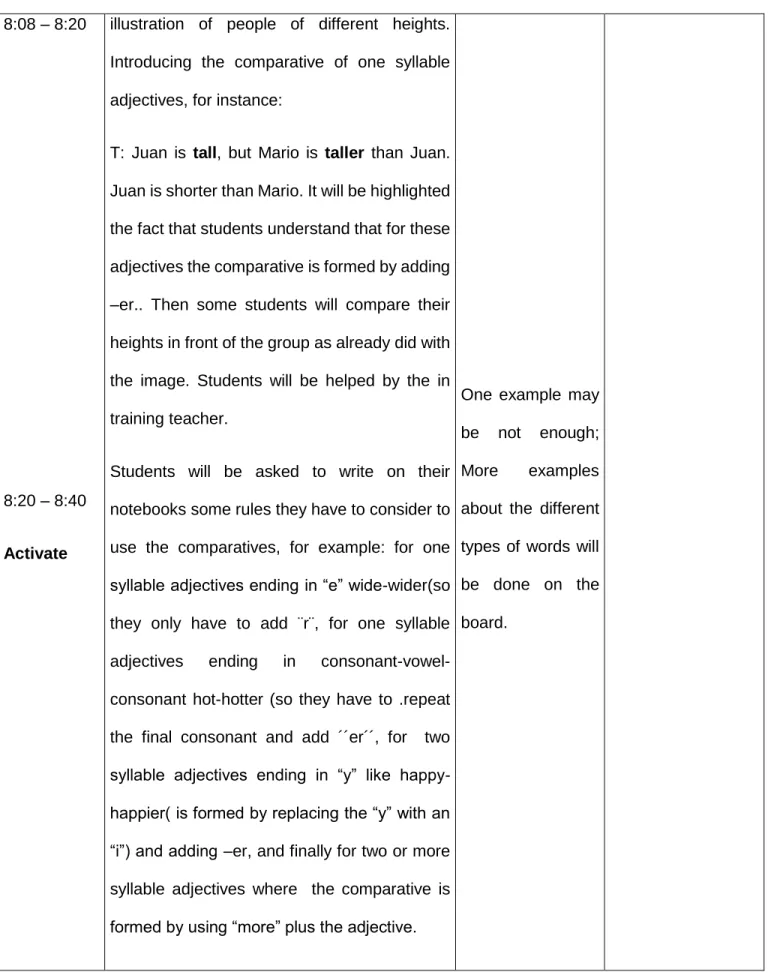
(46) Concerning the students´ English language proficiency level (see appendix 1), implemented topics searched to fulfill the basic necessities of a truly basic English language user, in this case a topic like fruits was of tremendous effectiveness because of its regular use in real life situations and they could provide a huge set of multi-sensory activities to work with; not to mention how engaging they were, but it is important to highlight that the order or usage of each item (be it multisensory or real language communication) varied according to the finality of each class/ lesson; for that reason, each session implied different materials usage to accomplished in the most appropriate way the objective of the class, realia was one of the most effective ways to create in the students the feeling of dealing with the real word, as was previously mentioned, it is not the same to show a flashcard of a fruit than handling the fruit and take advantage of what the real world has to offer to learn from it. Nonetheless, pictures were also helpful to illustrate different aspects and facts that wanted to be explained. In addition, the use of technological gadgets provided by the institution really played an useful aid when dealing with visual materials (T.V) like videos, pictures, presentations, etc… and recordings, since there was a sound system that allowed to play sounds from the video clips and the records in high definition, worksheets, paints (see appendix 4), games, competitions, and kinesthetic activities (see appendix 5) were performed in the execution of this classroom project. 4.3.2 Design The lessons were structured and framed into the procedural technique Engage, study, activate format (ESA), suggested by Harmer (2001). Initiating with a Warm up activity in most of the cases and continuing with the engage stages that involved elicitation. 46.
Figure
Documento similar
Shares Mastery uses the information collected by the interaction domains, with this information generates new data that is sent through the Interaction Domain of
In this dissertation we have examined the development of foreign accent and comprehensibility in the oral productions of 25 adolescent Spanish learners of English before
Thus, the main objective of this Master’s Dissertation is to make people aware of the importance of respecting different varieties and to propose a didactic unit based on
The study was designed to investigate the usage and its frequency of language learning memory strategies by those students who are learning English as a
The aim of this paper is to demonstrate that reading authentic literary material in the English as a Foreign Language (EFL) classroom can improve students’ language learning skills as
In the case of speaking, researcher shows that a rich variety of activities might be done to promote this particular language skill in the language
Table 5 includes some features of the training/development and test term lists such as the number of in-language and foreign terms, the number of single-word and multi-word terms,
languages of study: Spanish, Catalan and English as a foreign language. Learners’
