I
PENINSULA OF SANTA ELENA STATE UNIVERSITY
FACULTATY OF EDUCATION AND LANGUAGES ENGLISH TEACHING CAREER
TITLE:
“WARMERS AND FILLERS IN THE DEVELOPMENT OF ENGLISH SPEAKING SKILLS FOR STUDENTS OF SECOND BASIC YEAR AT UNIDAD EDUCATIVA SANTA TERESITA, LA LIBERTAD, PROVINCE OF SANTA ELENA, SCHOOL YEAR 2014 – 2015”.
RESEARCH PAPER
AS A PREREQUISITE TO OBTAIN A:
BACHELOR’S DEGREE IN ENGLISH
AUTHOR: DENISSE ADRIANA BURGOS RINCONES
ADVISOR: MSC. LUIS IZA ESPINOZA
LA LIBERTAD- ECUADOR
II
UNIVERSIDAD ESTATAL
PENÍNSULA DE SANTA ELENA
FACULTAD DE CIENCIAS DE LA EDUCACIÓN E IDIOMAS CARRERA DE LICENCIATURA EN INGLÉS
MODALIDAD PRESENCIAL
TEMA:
“WARMERS AND FILLERS IN THE DEVELOPMENT OF ENGLISH SPEAKING SKILLS FOR STUDENTS OF SECOND BASIC YEAR AT UNIDAD EDUCATIVA SANTA TERESITA, LA LIBERTAD, PROVINCE OF SANTA ELENA, SCHOOL YEAR 2014 – 2015”.
TRABAJO DE TITULACIÓN
Previo a la obtención del Título de:
LICENCIADA EN INGLÉSAUTOR:
Denisse Adriana Burgos Rincones
TUTOR:
Luis Iza Espinoza. MSc.
III La Libertad, July 31st 2015
ADVISOR´S APPROVAL
In my role as Advisor of the research paper under the title “WARMERS AND
FILLERS IN THE DEVELOPMENT OF ENGLISH SPEAKING SKILLS
FOR STUDENTS OF SECOND BASIC YEAR AT UNIDAD EDUCATIVA
SANTA TERESITA, LA LIBERTAD, PROVINCE OF SANTA ELENA,
SCHOOL YEAR 2014 – 2015”,prepared by Denisse Adriana Burgos Rincones,
undergraduate student of the English teaching Career, Faculty of Education and Languages at Peninsula of Santa Elena State University, I declare that after having oriented, studied and reviewed the project, I approve it in its entirety, because it meets the requirements and is sufficient for its submission to the evaluation of the board of examiners.
Sincerely
………. MSc. Luis Iza Espinoza.
IV
STATEMENT OF AUTHORSHIP
I, DENISSE ADRIANA BURGOS RINCONES with ID number, 092726459-8 undergraduate student from the Peninsula of Santa Elena State University, Faculty of Education and Languages, as a prerequisite to obtain a Bachelor´s degree in English, in my role as author of the research paper, certify that this work
“WARMERS AND FILLERS IN THE DEVELOPMENT OF ENGLISH
SPEAKING SKILLS FOR STUDENTS OF SECOND BASIC YEAR AT
UNIDAD EDUCATIVA SANTA TERESITA, LA LIBERTAD, PROVINCE
OF SANTA ELENA, SCHOOL YEAR 2014 – 2015” is of my authorship,
except for the quotes and reflections used in this research paper.
____________________________ Denisse Adriana Burgos Rincones ID: 092726459-8
V BOARD OF EXAMINERS
____________________________ _______________________________ Dra. Nelly Panchana Rodríguez, MA. Ed. Lcda. Glenda Pinoargote Parra M.A. Ed. FACULTY OF EDUCATION LANGUAGES SCHOOL DIRECTOR CAREER AND LANGUAGES
MSc. Luis Iza Espinoza MSc. Jorge Cevallos Salazar ADVISOR SPECIALIST PROFESSOR
VI
DEDICATION
I dedicate this work to my family, specially my son who inspires me every day to struggle to achieve my personal goals.
To my parents who guided me in all my educational process with their patience and support.
To my siblings who were always willing to help me when it was needed.
To my dear friends and cousins who encouraged me to continue studying despite the exhausting days of work and studies.
To my dear students who were always willing to be part of this research process with enthusiasm and joy.
To all the people who contributed positively in all this long process to finish my college education in order to get my degree
VII
ACKNOWLEDGMENT
I really thank to my family that always supported me in all this long process, with their messages of encouragement.
Thanks to my parents who dedicated me long years of their lives in order to educate me
Thanks to all the professors that motivated and prepared me. Everyone was indisputably very important to achieve the final goal.
Thanks to my tutor who has guided me in the elaboration of this research work.
Thanks to my college friends who after hard working days were always willing to share with me and collaborate with my education.
Finally, thanks to my son who always received me with a big hug and a great smile despite my job and my studies kept me away from him during several hours daily.
VIII
DECLARATORIA
“El contenido del presente Trabajo de Titulación es de mi responsabilidad, el
patrimonio intelectual del mismo pertenece a la Universidad Estatal Península de Santa Elena.”
DECLARATION
“The content of the following graduation work is my responsibility; the intellectual property belongs to the Península of Santa Elena University.”
IX
TABLE OF CONTENTS
FRONTAL PAGE ... I POST COVER OR TITLE ... II ADVISOR´S APPROVAL AND SIGNATURE ... III STATEMENT OF AUTHORSHIP ... IV BOARD OF EXAMINERS ... V DEDICATION ... VI ACKNOWLEDGEMENT ... VII DECLARATION ...VIII TABLE OF CONTENTS ... IX TABLES ...XII GRAPHICS... XIV ILLLUSTRATIONS ...XV ABSTRACT... XVI
INTRODUCTION ... 1
CHAPTER I: THE PROBLEM... 3
1.1 TITLE OF PROPOSAL ... 3
1.2 STATEMENT OF PROBLEM... 3
1.2.1 CONTEXTUALIZATION ... 5
1.2.2 CRITICAL ANALYSIS... 7
1.2.3 FORMULATION OF THE PROBLEM ... 8
1.2.4 GUIDELINE QUESTIONS... 8
1.2.5 DELIMITATION OF RESEARCH OBJECT ... 8
1.3 SIGNIFICANCE OF THE RESEARCH ... 8
1.4 OBJECTIVES OF THE RESEARCH ... 9
1.4.1 GENERAL OBJECTIVES ... 9
1.4.2 SPECIFIC OBJECTIVES ... 10
2.1 CHAPTER II: THEORETICAL FRAME ... 11
2.1.1 SPEAKING ... 11
2.1.1.1 GENERAL OUTLINE OF A SPEAKING LESSON ... 12
2.1.1.2 CATEGORIES OF THE SPEAKING TASKS ... 14
2.1.2 LEARNING ... 14
2.1.2.1 MEANINGFUL LEARNING ... 15
2.1.3 BENEFITS OF LEARNING A LANGUAGE AT EARLY AGE ... 16
2.1.4 COMMUNICATIVE APPROACH... 16
2.1.4.1 COMMUNICATIVE COMPETENCE ... 17
2.1.5 LANGUAGE INPUT ... 18
2.1.5.1 TPR: A TOOL TO PROVIDE YOUNG LEARNERS WITH INPUT ... 19
2.1.6 STRUCTURED OUTPUT ACTIVITIES ... 20
2.1.7 COMMUNICATIVE OUTPUT ACTIVITIES... 20
X
2.1.9 HOW TO DEVELOP SPEAKING FLUENCY AT EARLY STAGES. ... 22
2.2 PHILOSOPHICAL BASIS ... 23
2.3 FUNDAMENT AL CATEGORIES... 25
2.3.1 SPEAKING TASK ROLE IN LANGUAGE TEACHING ... 25
2.3.2 TYPES OF SPEAKING TASK ... 26
2.3.2.1 FORM -FOCUSED SPEAKING... 26
2.3.2.2 MEANING - FOCUSED SPEAKING ... 26
2.3.3 WARMERS ... 26
2.3.4 TIME FILLERS ... 27
2.3.5 THE INFORMATION GAP PRINCIPLE ... 28
2.3.6 DIDACTIC STRATEGIES FOR DEVELOPING SPEAKING SKILLS ... 28
2.3.6.1 DRAMA AS A TOOL TO DEVELOP SPEAKING SKILLS... 29
2.3.6.2 GAMES: A STRATEGY TO CREATE TALKING CLASSES... 29
2.3.6.3 ROLE PLAYS AS SPEAKING TASK... 30
2.3.6.4 SONGS AND CHANTS IN THE DEVELOPMENT OF SPEAKING ... 30
2.3.6.5 VIDEOS ... 31
2.3.6.6 STORYTELLING ... 31
2.3.6.7 REALIA ... 32
2.3.6.8 FLASHCARDS AND POSTERS... 32
2.4 LEGAL BASIS ... 32
2.5 HYPOTHESIS ... 34
2.6 VARABLES OF STUDY ... 34
2.6.1 INDEPENDENT VARIABLE... 34
2.6.2 DEPENDENT VARIABLE... 34
CHAPTER III: METHODOLOGY ... 35
3.1 RESEARCH APPROACH... 35
3.2 LEVEL OR TYPE OF RESEARCH ... 36
3.2.1 FIELD RESEARCH ... 36
3.2.2 BIBLIOGRAPHIC RESEARCH ... 36
3.2.3 APPLIED RESEARCH ... 36
3.2.4 DESCRIPTIVE RESEARCH ... 36
3.2.5 EXPERIMENTAL RESEARCH ... 37
3.3 POPULATION AND SAMPLE ... 37
3.3.1 POPULATION... 37
3.3.2 SAMPLE ... 38
3.3.2.1 SIMPLE SAMPLING ... 38
3.4 TECHNIQUES AND INSTRUMENTS ... 38
3.4.1 SURVEY - QUESTIONNAIRE ... 38
3.4.2 INTERVIEW ... 38
3.4.3 INFORMATION CHECKLIST ... 38
3.4.4 LIKERT' SCALE ... 39
3.5 VARIABLES OPERATION ... 40
XI
3.5.1 ANALYSIS OF TEACHER´S SURVEY ... 42
3.5.2 ANALYSIS OF PARENT´S SURVEY ... 52
3.5.3 ANALYSIS OF STUDENT´S SURVEY ... 62
3.6 CONCLUSIONS AND RECOMMENDATIONS... 73
3.6.1 CONCLUSIONS ... 73
3.6.2 RECOMMENDATIONS ... 74
CHAPTER IV : PROPOSAL ... 75
4.1 INFORMATIVE DATA ... 75
4.2 PROPOSAL BACKGROUND ... 75
4.3SIGNIFICANCE ... 77
4.4 OBJECTIVES ... 78
4.4.1 GENERAL OBJECTIVE ... 78
4.4.2 SPECIFIC OBJECTIVES ... 78
4.5DESIGN AND DEVELOPMENT OF PROPOSAL... 79
4.6 PROPOSAL WORKFLOW ... 80
4.7 METHODOLOGY, ACTION PLAN... 81
4.7.1 PROPOSAL'S FIRST ACTION ... 82
4.7.2 PROPOSAL'S SECOND ACTION ... 83
4.7.2.1MY FIRST ENGLISH LEARNING SITE ... 83
4.7.2.2 USE OF MY FIRST ENGLISH LEARNING SITE... 84
4.8 USE OF TECHNOLOGY ... 86
4.9 THE INFORMATION GAP PRINCIPLE ... 86
4.10 DIDACTIC GUIDE... 87
CHAPTER V: ADMINISTRATIVE FRAME ... 102
5.1 RESOURCES ... 102
5.1.1 INSTITUTIONAL... 102
5.1.2 HUMAN ... 102
5.1.3 MATERIAL... 102
5.2 MATERIAL ... 102
5.3TECHNOLOGICAL ... 102
5.4 GENERAL BUDGET ... 102
5.1.4 ECONOMICAL RESOURCES: BUDGET ... 102
5.5 TIMETABLE... 103
5.6 BIBLIOGRAPHY ... 104
5.7 APPENDIX ... 109
5.7.1 SURVEYS INSTRUMENTS ... 110
5.7.2 INTERVIEW ... 114
5.7.3 LIST OF STUDENTS... 117
5.7.4 LESSON PLANS EXAMPLES ... 118
XII
TABLES
Table Nº 1: Population and sample ... 37 Table Nº 2: Independent variable operation ... 40 Table Nº 3: Dependent variable operation ... 41 Table Nº 4: Do you employ the correct methodological strategies for teaching speaking
XIII Table Nº 19: Is it important to develop classroom activities that motivate and promote the
improvement of Speaking skills?... 57
Table Nº 20: Can warm up activities and time fillers be high motivating for young learners as well as beneficial for their language learning process? ... 58
Table Nº 21: Is it necessary to start working in the development of language skills, especially Speaking skills at early stages of education? ... 59
Table Nº 22: Will the use of funny activities such as games, songs, dynamics and stories be beneficial for the development of language fluency in young learners? .. 60
Table Nº 23: Will the creation of a booklet containing a variety of warmers and time fillers designed to develop speaking skills be a great contribution in the language learning process of your child? ... 61
Table Nº 24: Do you think it is important to learn English? ... 62
Table Nº 25: How much do you like ESL lessons? ... 63
Table Nº 26: Does your teacher employ games or dynamics in the classroom when he/ she begins or ends the lesson? ... 64
Table Nº 27: Would you like your teacher includes in your lesson fun activities such as warm ups and time fillers? ... 65
Table Nº 28: Rate the skills from the most difficult to the easiest for you to execute in ESL lessons. ... 66
Table Nº 29: How often does your teacher encourage you to speak in English in the classroom?... 68
Table Nº 30: Do you feel comfortable and self- confident when your teacher asks you to do a speaking task? ... 69
Table Nº 31: Would you like your teacher use fun activities such as games, stories, dynamics or videos to improve your Speaking? ... 70
Table Nº 32: Mark with a tick in the list below four activities you wish your teacher used in ESL lessons in order to improve your Speaking. ... 71
Table Nº 33: Do you do further work at home to improve your Speaking? ... 72
Table Nº 34: Proposal Workflow ... 80
XIV
GRAPHICS
Graphic Nº 1: Teachers use the correct strategies for teaching speaking... 42
Graphic Nº 2: Teachers use high motivating warm up and fillers... 43
Graphic Nº 3: Teachers promote comfortable classroom environment ... 44
Graphic Nº 4: Teachers use a full range of warmers and fillers ... 45
Graphic Nº 5: Teachers Know about techniques to develop Speaking ... 46
Graphic Nº 6: It is important to include warmers and fillers in ESL lessons to develop Speaking. ... 47
Graphic Nº 7: Warmers and fillers can be high motivating for children ... 48
Graphic Nº 8: It is important to develop speaking skills at ealy stages of life... 49
Graphic Nº 9: Fun activities have beneficial effects on Speaking development ... 50
Graphic Nº 10: The creation of a booklet with warmers and fillers will be very useful for ESL teachers ... 51
Graphic Nº 11: Teachers use the correct strategies for teaching speaking. ... 52
Graphic Nº 12: Children show improvement in their speaking skills... 53
Graphic Nº 13: Teachers promote comfortable classroom environment ... 54
Graphic Nº 14: Teachers provide further work to improve speaking ... 55
Graphic Nº 15: Children show enthusiams in Speaking tasks ... 56
Graphic Nº 16: It is important to develop motivational activities to improve Speaking 57 Graphic Nº 17: Warmers and fillers are hig motivating activities in the language learning process ... 58
Graphic Nº 18: The development of speaking skills should start at early stages of life education... 59
Graphic Nº 19: Fun activities such as games and songs are beneficial to develop language fluency... 60
Graphic Nº 20: A booklet with a variety of warmers and fillers will be very useful for the language learning process ... 61
Graphic Nº 21: It is important to learn English... 62
Graphic Nº 22: How much children like English lessons ... 63
Graphic Nº 23: Teachers use games or dynamic in their lessons ... 64
Graphic Nº 24: Students expect theirs teacher do fun activities in their ESL lessons ... 65
Graphic Nº 25: Listening ... 66
Graphic Nº 26: Speaking ... 66
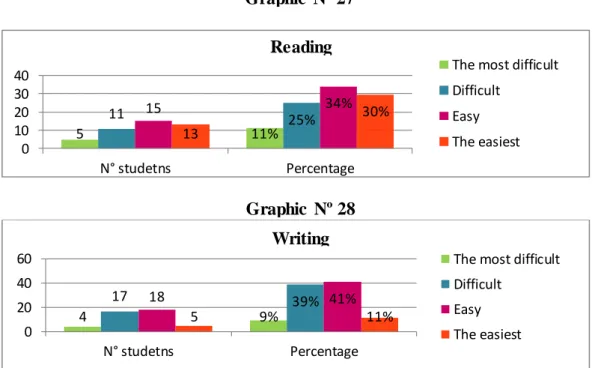
Graphic Nº 27: Reading ... 67
Graphic Nº 28: Writing ... 67
Graphic Nº 29: Teachers encourage students to speak English in the classroom ... 68
Graphic Nº 30: Students feel comfortable doing speaking tasks ... 69
Graphic Nº 31: Students would like their ESL teachers use fun activities such as games, stories or videos ... 70
Graphic Nº 32: Activities students expect their ESL teachers use in their lessons ... 71
XV
ILLUSTRATIONS
Illustration 1: My first English Learning Site ...83
Illustration 2: Elements in the website ...84
Illustration 3: Lessons Section ...84
Illustration 4: Games Section ...85
Illustration 5: Games in suggested link ...85
Illustration 6: Resources for warmer 1 ...88
Illustration 7: The hopscotch’s resources ...89
Illustration 8: The hopscotch with students...89
Illustration 9: Resources for Ten questions ...90
Illustration 10: Resources for Nice Family ...91
Illustration 11: Nice family filler with students ...91
Illustration 12: Resources for warmer 3 ...92
Illustration 13: The toy box warmer ...92
Illustration 14: Resources for filler 3 ...93
Illustration 15: “Missing pets” with students ...93
Illustration 16: Resources for warmer 4 ...94
Illustration 17: Application of warmer 4 ...94
Illustration 18: Resources for filler 4 ...95
Illustration 19: Application of filler 4 in class ...95
Illustration 20: “Find Someone” Resources ...96
Illustration 21: Resources for filler 5 ...97
Illustration 22: Resources for warmer 6 ...98
Illustration 23: The story puzzle with students ...98
Illustration 24: Digital board game ...99
Illustration 25: Board game with students...99
Illustration 26: Resources for filler 7 ...100
XVI
PENINSULA OF SANTA ELENA STATE UNIVERSITY FACULTATY OF EDUCATION AND LANGUAGES
SCHOOL OF LANGUAGES
“WARMERS AND FILLERS IN THE DEVELOPMENT OF ENGLISH SPEAKING SKILLS FOR STUDENTS OF SECOND BASIC YEAR AT UNIDAD EDUCATIVA SANTA TERESITA, LA LIBERTAD, PROVINCE OF SANTA ELENA, SCHOOL YEAR 2014 – 2015”
Autor: Denisse Adriana Burgos Rincones
Advisor: MSc. Luiz Iza Espinoza
ABSTRACT
The Ministry of Education in Ecuador demands the acquisition of English as a second language. Most of the students do not come into direct contact with the language in their daily lives, the only opportunities they have to do it occurs in the classroom and the occasional exposition to TV programs, music, videos or web sites. This fact implies a big challenge for ESL teachers concerning the use of appropriate strategies and techniques to teach English. Teachers need to find ways to motivate their students to learn and engage them to the lessons. This research proposes the use of warmers and fillers as a way to motivate students, and engage them to lessons as well as a tool for propitiating the development of speaking skills. Furthermore, it involves the creation of a website that facilitates learners all the information they need to develop their speaking skills, followed by a didactic guide with entertaining activities to improve Speaking will have a positive effect in the development of students’ productive skills.
1
INTRODUCTION
Nowadays the relevance of learning English as a second language is recognized in different fields. Education in Ecuador is fostering the teaching of this language and it is considering including the study of English in elementary school as well as high school education.
This research is aimed to improve speaking skills in children through the creation of a website and a guide as a resource for ESL teachers. Just like people will not feel secure to get on a plane whose pilot learnt to fly with worksheet, the situation is the same with students; there is no purpose of teaching English just with worksheets.
The main purpose of ESL teachers is to motivate learners to use the language in genuine communication, and provoke enough security and confidence in students so that they feel comfortable while speaking.
Speaking is maybe the most challenging skill for instructors to teach. Teaching speaking is demanding and sometimes frustrating when learners are reluctant to speak English.
It has been noticed at Santa Teresita School that teachers are not making efforts to improve speaking skills in children; learners are not used to do it and feel reluctant and really uncomfortable when they are asked to do it.
For this reason the role of teachers is to find the correct strategies and activities to motivate their students to speak. Warmers and time fillers can be considered as a tool to get students achieve the optimum development of their speaking skill.
2 This proposal has been developed in five chapters.
The first chapter consists of the statement and significance of the problem as well as the objectives, hypothesis and objectives.
The second chapter considers the theoretical and legal base. It compiles all the information required to develop the proposal of research and their respective variables.
The third chapter comprehends the methodology of the research and the explanation of the instruments that were used to carry out the research with their respective analysis, interpretation, conclusion and recommendations.
The fourth chapter contains the proposal and its description, justification, objectives of the proposal, methodology and the action plan with its respective time table.
3
CHAPTER I
THE PROBLEM
1.1
Title of proposal
“WARMERS AND FILLERS IN THE DEVELOPMENT OF ENGLISH
SPEAKING SKILLS FOR STUDENTS OF SECOND BASIC YEAR AT UNIDAD EDUCATIVA SANTA TERESITA, LA LIBERTAD, PROVINCE OF SANTA ELENA, SCHOOL YEAR 2014 – 2015”.
1.2 Statement of problem
Nowadays English has become an important tool in this world, most of the job opportunities need English domain as a tool. In Ecuador the Ministry of Education is going to strengthen English Teaching process in the next years because of the increasing demand of this language in the professional campus. The process of English Learning can start at any stage of the life, but obviously it would be much better if this process started at the early stages of life when learners are children. Children are little machines that can acquire a lot of information in their brains; on the other hand, sometimes it results really hard for English teachers to catch children attention. Pupils require a lot motivation to do it; every lesson must be creative, dynamic, funny and resourceful.
4 not engaged in class, followed by a little interest on the subject, and as a consequence the process becomes tedious for students, especially for pupils at elementary levels who need a lot of resources and activities to make an attractive class.
The use of warm – up activities as songs, short games or TPR activities at starting a new lesson it is absolutely necessary, it can change the mood of our students; moreover, the children can express themselves and the teacher make a nice interaction with them. The pupils are involved in the process since the beginning of the class with motivation, and as a result they can find English Learning as a funny activity.
As an English teacher at Santa Teresita Primary School it is notorious students are not really interested about learning English, and one of the reason is the scarce use of warm up activities that motivate students at the beginning of each lesson
5
1.2.1 Contextualization
The goal of ESL teachers is to help their pupils to develop their English skills in a comfortable classroom environment of confidence in which students are able to communicate by using the second language. They are learning as much as possible.
To reach this goal it is essential to mix meaningful focused input activities (listening and reading), meaning focus output tasks (speaking and writing), language focus learning activities (grammar, spelling, sounds, use of English), and fluency development, all of them focused in a communicative purpose, which means learners use and speak English to express their needs, ideas and even interchange information among them.
It is true most of the time ESL teachers speak too much in class, and they do not give their learners the opportunity to develop their fluency and accuracy. As a consequence, students are not used to speaking English, so when they are asked to perform a speaking task they do not feel confident enough.
6 ESL teachers tend to believe children at first stages of life just learn isolated words and some grammar structures; on the contrary, this is the right moment to work on developing speaking fluency.
Children need classroom environments of confidence and creativity to be sure about starting speaking English, creating this atmosphere with all the resources learners need is the ESL teacher´s aim. Warmer and fillers can be certainly one of these resources. Children love entertainment, and these surely full fill their expectations about having fun while they are learning a second language. Some of the causes and effects that warmers and fillers have on developing speaking are:
Causes:
- The development of a sense of confidence in young students.
- Enough time for students to get used to speaking English instead of Spanish.
- A resourceful and creative class. - An expectation of the lesson topic.
Effects:
- Students feel comfortable and less inhibited during the class. - A good development of language fluency.
- Enjoyment that engage students into it without getting bored easily.
7
1.2.2 CRITICAL ANALYSIS
Education, through dynamics like warmers and fillers, allows students to respond positively to an active didactics that privileges students´ experience, respecting their interests and needs in an educative context of fun, confidence, freedom and spontaneity. They have a great motivational contribution on learners, which involves an optimal development of the class topic, appropriated for the meaningful learning.
At early stages of students’ life, pupils are just starting to read and write. That is why ESL teachers should focus on Learning by Meaning Focused Output (production and understanding of meaningful communication) or the communicative approach (developments of skills for a communicative purpose).
In ESL teaching, warmers and fillers are considered to be a creative tool to develop learners’ skills, specially speaking. Students feel a lot of enthusiasm
when they are in these activities, feeling so comfortable and less inhibited that they dare to speak English when they are asked.
8
1.2.3 Formulation of the problem
How does the use of warm - up activities influence on the development of speaking skills?
1.2.4 Guideline questions
How often do ESL teachers use warmers at the beginning of each lesson?
How often do ESL teachers employ fillers to finish a lesson?
Why ESL teachers do not take the use of warmers and fillers into account in their lessons?
How will the use of warmers and fillers help to develop English speaking skills at elementary levels?
1.2.5 Delimitation of research object
Spatial delimitation: The present research will take place at Santa Teresita elementary school
Time delimitation: The present research will be done from June 2014 until March 2015, and will be applied to students of Second Basic Year and teachers of elementary school.
1.3 Significance of the research
9 teach this subject, the minimal use of some motivational tools as warmers and fillers during a lesson cause a poor development of English speaking skills in the Learning Process.
This research tries to demonstrate that the scarce use of warm up activities in Santa Teresita primary school at the beginning of a new lesson influences in the motivation of students; as a result it has a negative effect in the development of English skills.
Warmers motivate students by giving them more opportunities to learn creatively, so it is mandatory that teachers use warmers in the Learning process to provide educational environment of fun, creativity, and confidence for pupils and their
English speaking skills development. For the benefit of pupils and teachers, the purpose of this investigation is to create
an educative material of support for English Teachers that is a guide that contains a series of warm up activities, the same that might be very useful to enhance students in class and develop English speaking skills in learners of elementary School.
1.4 Objectives of the research
1.4.1 General objectives
10
1.4.2 Specific objectives
To analyze the frequency of the use of warm up activities in English Learning Process as a tool for the development of skills.
To determine how warm up activities and time fillers have a positive effect on the development of Speaking Skills.
To apply a wide variety of classroom strategies and techniques as warmers and time fillers with second grade students at Santa Teresita.
To design a booklet that presents different ways of using classroom strategies and techniques as warm up activities and time fillers for ESL teachers as a tool for the development of English Speaking skill.
11
CHAPTER II
THEORETICAL FRAME
2.1.1 Speaking
Speaking is an interactive process that involves words meaning construction for the language production and the reception of it through information processing (Burns Anne, & Joyce Henry, 1997).
Speaking is the production of sounds that are delivered in form of language through the mouth. It is the second language skill that humans learn, after listening that is the first, and essential to learn how to speak. It requires at least one listener. When two or more people take part in the production of speech talking each other, it turns into a "dialogue", in which speech flows in a spontaneous and natural way. Form and meaning of spoken language depend on the context where it is happening, considering the environment and the speaking purpose.
12 learners, so that students participate as whole. These activities must have been set correctly for pupils would be able to give the comprehensive regeneration and feel satisfied about it (Harmer, 2007, p.123). Some of these good activities can be dramas, videos, role – plays, information gap, jigsaw, even chants and songs at lower levels. In order to achieve meaningful learning, speaking skills must be acquired as natural as possible. Learners do not need to acquire only linguistic habits they need to acquire the linguistic, sociolinguistic and pragmatic competence as a whole.
Fluency comprehends not only knowledge of language items, but also the ability to process information and language ‘on the spot’ (Harmer 2007).
2.1.1.1 General outline of a speaking lesson
The most important characteristic of meaningful learning occurs when relevant aspects in the cognitive structure are linked to the new knowledge, and it depends on whether this process has five conditions:
Sequence and organization of contents.
Psychological organization of contents.
Motivation.
Good classroom environment.
Meaningful learning activities that make sense on student´s lives (Ausubel 2005)
13
Preparation.- The teacher gives a general idea of the class topic. It raises the context for the speaking task. It is usual to warm up or brainstorm students at this stage of the class. Due to the fact that preparation is the part of the class that sets up the context of the speaking activity it must be highly motivating so that students’ attention might be attracted - otherwise the rest of the class will not
appeal to them. It is then when warmers play an important role in the whole development of the class. If teachers motivate learners with warmers that make use of some target structures related to the class topic, the general idea of the speaking task for the rest of the class will be clearer and easier to be understood.
Presentation.- Learners are provided with models, aims and target structures for the speaking task.
Practice.- It implies the reproductions of target structures carried out by students, under teacher´s guidance.
Evaluation.- It refers to the assessment of the class topic considering the progress and improvement of speaking skills. At this stage fillers might be a good tool to assess student´s knowledge. Learners feel less intimidated whether they are evaluated in a relaxed atmosphere.
14
2.1.1.2 Categories of the speaking task
When teachers carry out speaking tasks, they mostly end up with short dialogues focused on target structures that have been studied previously in class. ESL teachers should include a wide variety of speaking tasks in their classrooms involving genuine communication.
Brown (2005) suggested six categories for speaking tasks that can be used individually or integrated.
Imitative.- Learners reproduce chunks or simple structures such as commands or specific questions and answer them briefly.
Intensive.- Learners reproduce target vocabulary or grammar as structured imperative sentences.
Responsive.- Students are able to respond teacher´s questions using complete sentences.
Transactional.- Learners get into more complex speaking task guided for the teacher with the purpose of interchanging information.
Interpersonal.- Casual dialogues with the purpose of developing social linguistic competence such as personal interviews or conversations.
Extensive.- Spoken monologues as oral reports or conclusions.
2.1.2 Learning
15 involves performing actions in real situations. The second phase is reflection in which the learner thinks about the actions performed in the first phase. Then, the learner researches for extra information. At the phase of abstract conceptualization; the knowledge is shared and applied to a situation. Finally, the application of knowledge in new situations occurs in the active experimentation.
2.1.2.1 Meaningful Learning
It is focused on the student as the center of teaching. Meaningful learning is based on concrete experiences or activities that make sense on students’ needs and lives,
providing them the tools to develop their social, cognitive and motor skills. (Ausubel, 2005).
Learners acquire new knowledge by establishing a relationship with their previous knowledge or experiences that will allow the best comprehension of new contents. Therefore, it makes sense on students` lives at the very moment they apply the knowledge they have acquired previously in real life situations for problem solving.
Pedagogical models must carry out three conditions:
First: All the information must be potentially meaningful and makes sense on student´s lives.
16 linked with this.
Third: A positive student´s attitude is essential in favor of learning and bias towards the relationship between learning material and structure. (Subiría 2006)
2.1.3 Benefits of learning a language at early age.
To learn a new language at early stages of life help children to develop language conscience. The earlier learners start to study a new language, the more opportunities they have to develop their language skills.
Children have neutral attitude as regards a new language and culture, they are open minded to learn a second language (Pinter 2011). They are more willing and enthusiastic to learn new knowledge, they can adapt easily to new sounds, which facilitates the acquisition of the language sound system. Furthermore, pupils are spontaneous and natural, they don´t feel afraid about making mistakes which contributes to develop language fluency.
2.1.4 Communicative Approach
Nunam (2011) claims: “There is no doubt that the most relevant changes in
language teaching practice over the last two decades are those that might be described as communicative language teaching”.
17 students understand and produce the language in a frame of communicative purpose activities.
“The functions in a language such as: arguing, persuading, asking, or promising
do not happen in isolated situations; instead, they occur in a social context, a real one” (Larsen- Freeman, 2001). To teach learners isolated words, forms, and
language functions do not imply genuine communication, interaction between learners is necessary to bring communication along. The ‘what to teach’ aspect of Communicative approach stressed the significance of language functions rather than focusing solely on grammar and vocabulary. (Harmer, 2007, p.99)
2.1.4.1 Communicative Competence
This linguistic term was developed by Hymes. It involves the correct use of language considering grammar, lexicology, phonics; and even the social context in which the language should be employed. Canale & Swain (1980) defined communicative competence in terms of four components:
1. Grammatical competence: It involves lexis and grammar rules.
2. Sociolinguistic competence: This refers to the appropriate use of language such as expectations for rate of speech, respecting turn- taking, making the correct pauses while talking and other social aspects related to the use of language.
3. Strategic competence: The ability to use language structures in order to ask for clarification and correct misunderstandings.
18 A speaker is not only competent when knowing the code of a language, but also when he has the ability to use and adapt it in a variety of communicative situations. (Pons, 2005).
To help learners to develop their communicative competence teacher must use a wide variety of approaches as well as combining diverse activities to come up with a better outcome in student’s language acquisition. These activities should
include a balance among language input activities, structure output activities and communicative output activities.
2.1.5 Language input
It includes the information students get from listening activities, reading passages, teacher talk and the language learners read or listen from different sources outside the classroom (news, TV programs, web sites among others.
Peñate (2012) claims: “Teachers must take into account that the level of language input must be higher than the level of language production expected of the pupils. Speaking tasks in the first levels must be directed to enable pupils having a minimal verbal participation. However in the last levels, pupils are encouraged to begin to manipulate the language and express themselves in a much more personal way”.
19 The input strand only exists if certain conditions are present:
1. Input activities are familiar to them.
2. Learners are motivated and interested in understanding it.
3. Only a small proportion of the language features are unknown for learners. 4. Learners link their prior knowledge to the unknown language items and
store new vocabulary through context cues and previous knowledge. 5. There is plenty of input. (Nation & Newton, 2009)
In this case teachers should take into account that the input they give to their students must fit their interests and level proficiency, balancing their previous knowledge with the new lexis and structure items. The input information must be comprehensible, significant and engaging. The more input activities are executed in classroom, the more benefits students get for their productive skills.
2.1.5.1 TPR: a tool to provide young learners with input.
“The input or information that students deal with must be comprehensible,
meaningful and interesting for learners. In children, it is achieved by exposing them to songs, rhymes, stories and tales which include drillings of target language, through games, class routines and activities that involve physi cal movement and objects manipulation: for example: TPR methodology (Nunan, 2011)
20 language immediately. It contributes to the language production in a more natural and spontaneous form, in which learners have fun through lively lessons with lots of movements. It is known that learners apprehend best the knowledge when they are exposed to concrete experiences; in TPR learners are exposed to physical movements while learning, which is memorable for their language acquisition. This strategy can be used in classroom as daily routines, at the beginning learners model actions their teacher says and perform, then pupils move on doing themselves just by listening the commands, and finally learners will be able to say the commands, so that children start producing the second language.
2.1.6 Structured output activities
It is focused on the correct use of language forms. Teachers introduce to the students specific structures in order to be used in language production, combined with structures that have been learnt before. Structured output activities allow learners to use all the target vocabulary they know with specific language structures in short texts production. These activities help learners to progress considerably so that they might be able to move to extended communicative output activities.
2.1.7 Communicative output activities
21 succeed when they eliminate or reduce the information gap through genuine communication.
Swain (1985) suggests three functions for output: (1) “The noticing/triggering
function, (2) the hypothesis testing function and (3) the metalinguistic function”.
The first one occurs when learners notice the gap in their language production and find communicative strategies to fill it, the second one involves the learner clarifying the meaning and confirming whether the reached information is correct or not and the third one is the use of the new information in the language production.
2.1.8 Pronunciation correction
For some learners to achieve the goal in a speaking task could be hard, in that case teachers should be sympathetic to learners’ difficulties in pronunciation or
sentence construction. Giving a lot of attention to students’ errors and correct them very frequently can cause learners feel reluctant to speak.
Sanborn (2010) manifests: “Teachers should not rush into error correction, but should consider whether the error is worth the interruption and, if it is, the teacher should consider possible causes and then think of appropriate ways of dealing with the error”. The best thing to do is finding out why these errors are happening.
22 chance to observe the language forms and structures correctly, at this instance teachers should provide learners more opportunities to observe how the structures are formed and how they sound. Sometimes an explanation of how to place the tongue it is necessary so that learners reproduce the correct pronunciation. As a tennis player must work their muscle, similarly, a language learner must practice the new motor skills involved in producing the sounds of the target language" (Gordon 2007).
Other factor that affects learners’ oral production is nervousness, for those
students speaking task should not be intimidating, instructors have to make them light up and if it is possible make jokes to set the tone of the activity.
Finally, it is necessary to take into account the students’ needs and their level; the speaking task should be set according to it. If the class has students with special needs the activity must be less challenging and even can be repeated several times.
2.1.9 How to develop speaking fluency at early stages
23 The communicative approach establishes the philosophy of creating classroom environments in which genuine communication takes place. Genuine activities can take place from the very first day of language class (Harmer 2007). Students are able to realize how to respond to greetings, and some specific questions such as What´s your name? and How are you?. The instructions to execute an oral practice tasks have to be clear or previously modeled so that students understand how to perform the activity.
At early stages fluency started to be developed under controlled practice of the language. Communicative techniques for beginners involve appropriate use of small chunks of language and build in some repetition of patterns for establishing fluency (Brown, 2007, p.181). Learners are not only asked to use specific language functions or grammar items, but also they are encouraged to reproduce them in classroom by interacting with their teacher and classmates.
Songs, chants rhymes and communicative games are the types of speaking that are mainly used to star developing fluency in children. They help learners to master sounds of language models they are given, as well as improve pronunciation and intonation, whereas communicative games encourage students to reproduce language models in a more independent use of language and fun.
2.2 PHILOSOPHICAL BASIS
24 English language teaching at Unidad Educativa Santa Teresita which implies the minimal attention drawn to the development of language speaking skill, and it is purposeful because this is aimed to propose a solution in benefit of young learners who are studying English.
Harmer (2007) says “Language acquisition seems to be almost guaranteed for
children up to about the age of six. They seem to be able to learn languages with incredible facility”. As children acquire a language easier than adolescents, is
needed teachers consider this advantage and be aware of the strategies children require to develop their language competences. Similarly Curtain and Dahlberg (2010) conclude that: “The time students have been exposed to the study of a language is one of the most important factors to domain it.” In that case young
learners are exposed to more time for practicing the language, which leads to best fluency and accuracy development.
At this early stage it is known that teachers should focus on providing the right amount of input (listening and reading) to consequently develop speaking skills of learners. “Creating a classroom culture of speaking is essential in teaching
speaking, so that learners are encouraged to use the language in a talking classroom” (Glass, 2014). For this reason the role of teachers is important and
their use of target language really matters, if they expect their students to produce English.
25 produce their first bits of the target language. Warmers and time fillers are very useful to create positive classroom environment, raise student´s energy and engage learners to the class.
Warmers and fillers can include games, songs, videos, TPR and even role plays. As well as being fun and enjoyable they offer the opportunity to practice and experiment with the second language.
2.3 Fundamental categories
2.3.1 Speaking task role in language teaching
According to Harmer (2007): “There are three main reasons to get students
talking in the classroom: real –life speaking, feedback and opportunities to develop fluency”.
Firstly, speaking tasks allow students to practice real-life speaking situations in the comfort of the classroom.
Secondly, speaking tasks provide feedback and encourage students to use any or all of the ‘language items’ they know.
26
2.3.2 Types of speaking tasks
2.3.2.1 Form-Focused Speaking
It is aimed to the reproduction of prefabricated structures such as greeting, commands, simple personal information or short sentences that are generally acquired by drillings and substitution exercises. Sanborn (2010) expresses “When learners first begin to speak in another language their speaking will need to be based on some form-focused learning. An effective way to begin is to base speaking on some useful, simple memorized phrases and sentences”. Form –
focused speaking is guided and controlled. It is very useful at the first stages of language learning or with young learners. As it´s known children get bored easily, so it is very important to include a wide variety of repetition activities that tend to be challenging and smooth to catch their attention.
2.3.2.2 Meaning-Focused Speaking
These activities give learner the opportunity to comprehend and produce the language in oral interactions. The listeners’ and speaker´s attention is centered on
the message. Games involving oral interaction, videos and authentic listening are very useful for these activities due to learners must listen to respond and produce the language.
27 acquisition and new knowledge practice. Each part of the lesson plays a vital role in ESL development (LeBlanc, 2011). Warmers set the tone of the class, they maintain students focus on the task, and prepare learners’ minds to learn and acquire new knowledge. They get students into the English mode; even they are a good source of input to get learners used to the English language.
Furthermore, warmers are engaging and high motivating, a well-planned, warm up activity propitiates more than just a bit of fun towards a lesson. (Méndez , 2011). Students like to participate in this kind of activities because they consider them a low – risk task, and they feel less inhibited than taking part in a usual language practice task.
2.3.4 Time fillers
Language learning is a process that sometimes can be too challenging and even frustrating for learners and teachers. “Relaxed classroom where children feel
secure and content encourage them to become more independent and
adventurous in the language learning process” (Scott 1990). Time-fillers,
28
2.3.5 The information gap principle
“Any classroom activity is communicative if it does not comply with three
factors: an information gap between learners, free for student to choose from different language items and previous feedback” (López 2010). To carry out a speaking task in the classroom with communicative purpose, the activity must be aimed to fill up an information gap.
The information gap is the lack of information between learners, the communicative purpose is achieved when each other cooperate and contribute to end up the task, so that the information gap between them is filled.
2.3.6 Didactic strategies for developing speaking skills
A strategy is the equivalent to a potential sequence of proceeding guided by one or more principles of the didactic that is designed to optimize the language – learning process.
“In speaking classes students must be exposed to three key items: (1) form-focused instruction, that is, attention to details of pronunciation, grammar, vocabulary, and so forth; (2) meaning-focused instruction, that is, opportunities to produce meaningful spoken messages with real communicative purposes; and (3) opportunities to improve fluency” (Nation 2007).
29 developing speaking skill in class are: dramas, role plays, games, song among others.
2.3.6.1 Drama as a tool to develop speaking skills
Dramas are theatrical representations which are aimed to develop speaking skills through short or extended dialogues and the use of specific target vocabulary. Drama is a useful way to bridge the gap between guided practice and free activities (Scott, 1990, p.89).Dramas have the potential to get learners into real life situations, improving their speaking skill and helping children to achieve the goal of ESL teaching: to produce real communication in English.
Furthermore, drama teaches cooperation as well as sociolinguistic competences. Pupils develop their empathy, confidence, self- esteem, leadership, teamwork and decision making skills when they get into drama speaking activities.
2.3.6.2 Games: a strategy to create talking classes
Games have a great motivational contribution in learning due to the fact that they gather favorable conditions for the optimal development of skills in a comfortable and appropriated environment to carry out the language acquisition. “Games are
funny and challenging activities in which players must interact with others most of the time” (Wright, 2006).
30 speaking plausible, even to reluctant children (Lewis, 1999). As well as giving the opportunity to entertain and stimulate creativity; they constitute an excellent bridge between content - based learning and learning trough real experiences.
2.3.6.3 Role plays as speaking task
Role plays are theatrical representations in which each student assumes a role to be performed. They constitute an excellent tool for the development of communicative competences, especially linguistic and sociolinguistic competences. “The pragmatic level overcomes the theoretical levels when language items such as the situation and the context in which communication is being developed are analyzed in the act” (Martínez, 2008).
Role plays contribute to language fluency through a fun and enjoyable activity, enhance motivation and promote such interaction in the classroom so that students are prepared to real - life communication. Role plays involves learners in simulated situations where students thinks of themselves as real participants in genuine communication (Scott 1990, p.91). In addition to all these positive aspects, imagination is widely developed with role - plays, young learners are so creative that they can create a lot of situations based on the initial task they are given.
2.3.6.4 Songs and chants in the development of Speaking
31 twice as much than the amounts of language production we expect from our students.
Songs help to acquire pronunciation and the language rhythm it is expected from students to learn. Furthermore it is easy to remember songs’ melody; they can provoke lasting emotional effect and foster students’ participation with body
movements (Weatherford 2005). Songs and chants are a great way of encouraging student to do both sing and talk realizing unconsciously grammar features and target vocabulary.
2.3.6.5 Videos
Stoller (2008) claims: “Videos and films bring variety, entertainment, authenticity, reality and flexibility to classrooms”. Videos are a helpful tool to
expose learners to authentic communication situations and foster student´s participation. They constitute a great resource to get students into language production through pools or interviews between students and their instructor, or even better among students interacting each other.
2.3.6.6 Storytelling
“Storytelling has affective benefits: it engages learners, reduces affective
filters, and allows learning to take place more readily and more naturally in a
meaningful, interactive communication context” (Richards, 2008).
32 Stories catch learners’ attention, strength vocabulary construction and stimulate
creativity. As a resource to improve speaking skills stories give practice in decision – making, students can make their own comments on the story and even debate for problem - solving.
2.3.6.7 Realia
According to Scott (1990) “The use of real objects can make a dialogue come alive”. Real objects make activities turn out to be more meaningful because their
use in oral works simulates real – life situations.
2.3.6.8 Flashcards and posters
They are practical visual aids to engage student to class through games. These resources can be used in many forms, some of them include pictures descriptions, spot the differences, telling a story´s sequence and questions and answer activities. Flashcards are excellent resources for students with visual learning style (May, 2015) due to the fact they contain large amount of pictures for learners to acquire new vocabulary.
2.4 Legal basis
The Project: “Warmers and fillers in the development of English speaking skills
33
LEY ORGÁNICA DE EDUCACIÓN INTERCULTURAL CAPÍTULO SEGUNDO
De las obligaciones del Estado respecto del Derecho a la Educación
La educación es una obligación del Estado, una excelente formación académica educará ciudadanos con cualidades, virtudes, destrezas y habilidades diferentes que garantizarán el progreso y desarrollo del país.
Los docentes deben ser motivados a capacitarse continuamente y estar actualizados con el avance tecnológico.
Segundo Suplemento
Se debe propiciar la enseñanza con actividades productivas haciendo uso de las TICS acompañadas de las técnicas y estrategias adecuadas que satisfagan a los educandos.
According to the Ministry of Education of Ecuador in its document Estándares de calidad educativa - The English Language Standards (pag 8) manifests: “The English Language Learning Standards (ELLS) are outcomes students are expected to achieve at the end of a proficiency level in terms of knowledge and skills gained throughout the process.
It means that they will show “what students must know and be able to do as they
34
2.5 Hypothesis
The use of warmers and fillers has a positive effect in the development of speaking skills of pupils at Second Basic Year in Santa Teresita School, province of Santa Elena.
2.6 Variables of the study
2.6.1 Independent Variable: “Warm ups and time fillers”
Children have a lot of enthusiasm and show high motivation for learning. Young learners are very active, and they are really willing to learn a new language. While learning, children need to incorporate new knowledge to their prior learning by executing entertaining, challenging and fun activities. Warmers and fillers can easily be adapted to these needs. They are engaging, interesting and contribute positively to meaningful learning, as well as they are a good choice to draw learner´s attention and encourage students to produce genuine communication
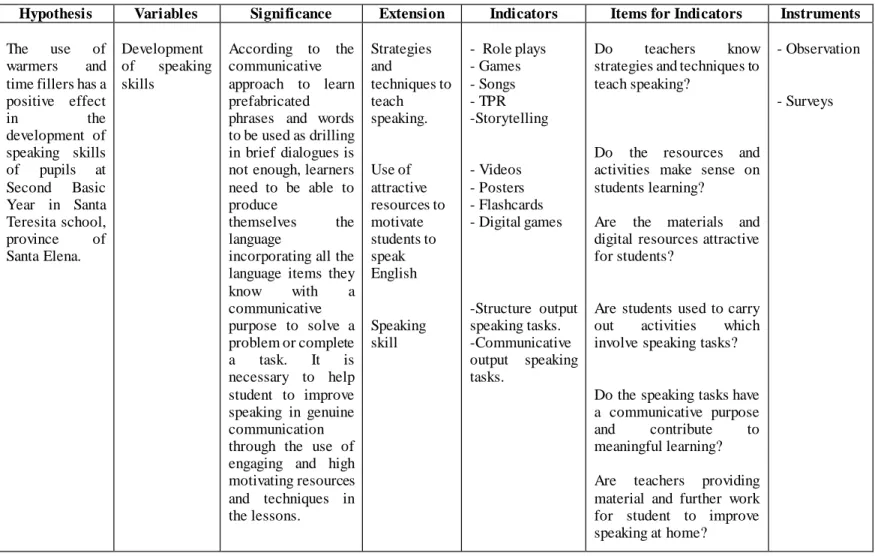
2.6.2 Dependent Variable: “Development of speaking skills”
The most challenging skill to be developed in language teaching is the speaking skill. Different factors such as students’ nervousness, lack of confidence, boring
35
CHAPTER III
METHODOLOGY
3.1 Research approach
The research approach includes both methods, qualitative and quantitative approach, so that the approach that has been adopted to carry out this research is the mixed method approach under the pragmatism paradigm due to the fact that this research is problem – centered and real - world practice oriented.
It researches into the effect of skipping warmers and fillers in the development of language speaking skills. After analyzing the consequences of actions, it is looking for a practical solution that will be considered in English language teaching to improve speaking skills in students of second basic year at Santa Teresita elementary school starting from a basic investigation.
36
3.2 Level or type of the research
3.2.1 Field research
It is considered a field research because of the facts have been tested in the very research setting where the different events related to the problem take place. First – hand information was collected through different techniques and instruments of
data collection in the institution in which the research object was being studied.
3.2.2 Bibliographic research
It was bibliographic due to the fact that the purpose of this research was to analyze different theories and teaching approaches, compare them to emit opinions and find possible solutions to the research problem.
3.2.3 Applied research
This research was aimed to find a solution to a concrete problem such as the little attention that teachers pay in early stages of language learning to the development of speaking skills in children. It pretended to determine the consequences of this problem and suggest the application of warmers and fillers as a solution to it.
3.2.4 Descriptive research
37 between both variables and determine the validity of the hypothesis.
3.2.5 Experimental research
After describing events and establishing correlation between variables, the research was centered in giving explanations of what effects the independent variable had on the dependent variable. A group of students were taken as the experimental group and evaluated to prove the hypothesis of the research.
3.3 Population and sample
3.3.1 Population
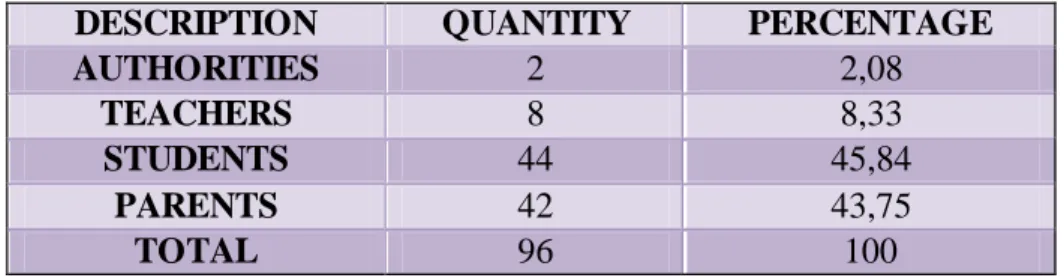
It is the totality of units or elements from a particular group that will be analyzed and have similar characteristics. The population that has been employed in this research was selected from Santa Teresita elementary school in the city of La Libertad, and it is made up by 96 people among parents, teachers, and authorities.
Table 1: Overall Population from “Santa Teresita” Elementary School
DESCRIPTION QUANTITY PERCENTAGE
AUTHORITIES 2 2,08
TEACHERS 8 8,33
STUDENTS 44 45,84
PARENTS 42 43,75
TOTAL 96 100
38
3.3.2 Sample
It is a representative part from the population that gathers all the characteristics from the population. In this research the population was small, so the population has also been considered as the sample.
3.3.2.1 Simple sampling
It is the most common way to select analysis units in which every population’s
element has the opportunity to be selected through random procedures.
3.4 Techniques and instruments
3.4.1 Survey – Questionnaire
It was applied to school parents and employed to collect information about the variables of the research and determine the relationship between them. Furthermore, the survey was useful for measuring individuals’ opinions and their
attitude as regards the research problem.
3.4.2. Interview
It was used for getting information about teaching experiences of the school principal and the English Area tutor, and their personal opinion on the effect of warming students and using time fillers in lessons, what are their benefits and how they can be a positive influence in the improvement of speaking skills.
3.4.3 Information checklist
39 on the dependent variable to draw conclusions about the studied object in the research.
Moreover, this instrument was applied to make comparisons between the experimental group and other groups of students in order to support the validity of the research.
3.4.4 Likert’s scale
40
3.5 Variables operation
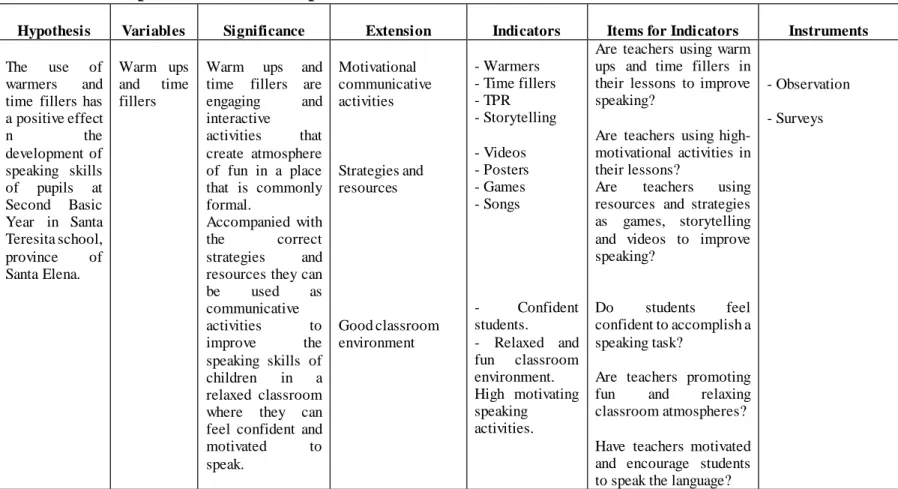
Table 2: Independent Variable operation
Hypothesis Variables Significance Extension Indicators Items for Indicators Instruments
The use of warmers and time fillers has a positive effect
n the
development of speaking skills of pupils at Second Basic Year in Santa Teresita school, province of Santa Elena.
Warm ups and time fillers
Warm ups and time fillers are engaging and interactive
activities that create atmosphere of fun in a place that is commonly formal.
Accompanied with the correct strategies and resources they can be used as communicative activities to improve the speaking skills of children in a relaxed classroom where they can feel confident and motivated to speak. Motivational communicative activities Strategies and resources Good classroom environment - Warmers - Time fillers - TPR - Storytelling - Videos - Posters - Games - Songs
- Confident students.
- Relaxed and fun classroom environment. High motivating speaking
activities.
Are teachers using warm ups and time fillers in their lessons to improve speaking?
Are teachers using high- motivational activities in their lessons?
Are teachers using resources and strategies as games, storytelling and videos to improve speaking?
Do students feel confident to accomplish a speaking task?
Are teachers promoting fun and relaxing classroom atmospheres?
Have teachers motivated and encourage students to speak the language?
- Observation
- Surveys