
Dinoflagellate abundance in the Laguna Botos, Poás Volcano, Costa Rica
8
0
0
Texto completo
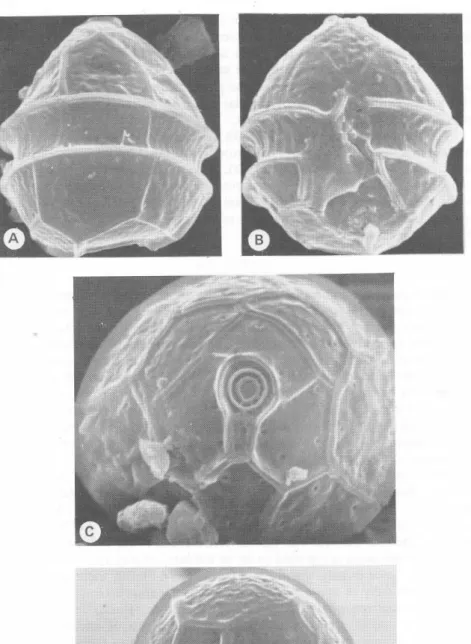
(2) 258. REVISTA DE BIOLOGIA TROPICAL. (accurate to about 0.5 pH) with PANPEHA hydrion paper. Subsequent cherrúcal analysis of the water for pH , alkalinity, chloride , and sulfate was made with a Delta Model 50 Portable Laboratory instrument. Because of the lirrúts of accuracy of this instrument, and because two days passed between collection and analysis, the values must be considered only as approxirnations. Photomicrographs were made with a Cambridge S4 Scañning Electron Microscope using Polaroid 55 P/N film, and Kodak Ektamatic SC paper. Cell counts were made on unconcentrated subsamples with a Sedgewick-Rafter counting chamber and a Zeiss Photomicroscope 11. RE SU LTS Chemical Characteristics: Because of the lirrúted availability of analytical instruments, only general information can be given on water chemistry. The pH of the water at time of collection was about 6. 5 . This remained stable when measured with a more accurate instrument two days later. Calcium carbonate alkalinity was less than 20 ppm; chloride , 8 ppm ; and sulfate, 5.5 ppm. Water temperature at the surface was 1 6 C in March 1 979 and 1 3.5 C in March 1980. Nutrients and dissolved gases were not' measured because of the time between collection and analysis (for the 1980 samples). Phytoplankton : The range in phytoplankton numbers at four locations along the NE and SE shore of Laguna Botos was 3 . 1 -3.8x10⁴ cells/liter. The dominant organism, in bloom proportions, was Peridinium incon spicuum Lemm., which made up 2 .7-3.3 x 1 04 cells/liter . Second in abundance was Peridinium volzii Lemm., which amounted to 3 . 1 -3 .5 x 1 0 3 cells/liter . P. incon spicuum represented 86% of the total phytoplankton cells, and P. volzii mac,ie up 1 0% of the total . The remaining species consisted primarily of benthic species whose presence iñ the plankton was fortuitous. These inc1uded the diatoms Eunotia monodon, Fru stulia rhomboides, Navicula spp ., Pinn ularia bicep s, P. maior, and Surirella linearis ; and the green algae Co smarium cf. moniliforme and Oedogon ium sp . Occasional cells of Cryptomona s sp. and Ozlamydomon as sp . were also seen . Because of their abundance , the two dinofla�ellate s are treated in more detail. P. inconspicuum is shown in Figure 1. The cells are broadly oval with a conical apex , and measure 20-26 11m in the apical axis (height) and 1 3-22 11m in the transapical axis (width). Cells are somewhat flattened dorso-ventrally . The epitheca (Fig. l -A , B , C) composed of four apical, two anterior intercalary, and seven precingular plates (4', 2a, 7") . A prominent feature of the epitheca is a complex pore with a distinctly raised rim (Fig. l -A, B). The cingulum is median, straight, and has six cingular plates: The hypotheca (Fig. l -A, B, D) is composed of five postcingular , no posterior intercalary, and two antapical plates (5'" Op 2""). The sulcus is quite wide at the antapex, narrow toward the cingulum, and is made up of an indeterllÚnate number of plates. The right sulcal plate is well developed and partly occ1udes the sulcal area (Fig. l -B). The junctures of the post cingular and antapical plate s often are extended to form short spines (Fig. I -A, D). P. inconspicuum is photosynthetic, and possesses numerous trichocysts, the pores of which are particularly visible in Fig. l -C . There are many chloroplasts which are parietal and red-brown in color.. Peridinium volzii is shown in Figures 2 and 3. The cells are broadly oval and dorso-ventrally flattened . The apical axis (height) is 4 1 -48 11m, the transapical axis.
(3) HARGRA VES & VIQUEZ: Dinoflagellates from Poás Lagoon, Costa Rica. A. Dorsal side 4000x B . Ventral si de 4000x. Fig. 1.. Peridinium incosvicuum. 25 9. C. Apex , 6 500x D . Antapex, 4 3 00x.
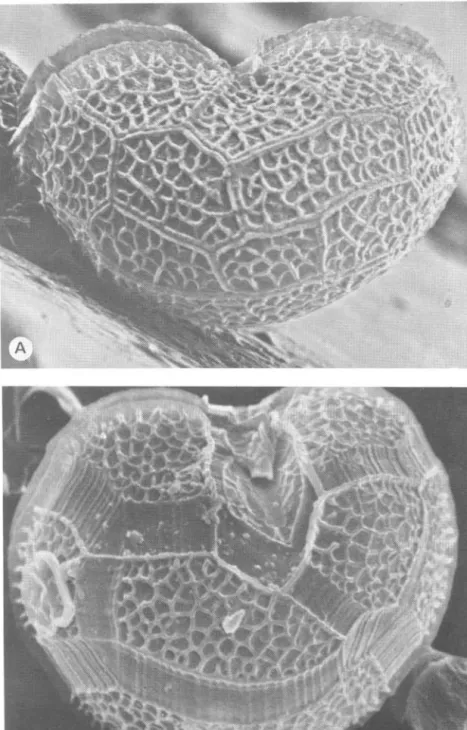
(4) 260. REVISTA DE BIOLOGIA TROPICAL. (width) is 3441 11m, and the thickness of the cell is about 30-32 11m. The epitheca (Fig. 2 and 3A) is composed of four apical, three anterior intercalary , and seven precingular plates (4' , 3a, 7"). The girdle is median , and offset on the ventral side by about one girdle width (Fig. 2-B). The sulcus extends partway into the epitheca, and becomes wider in the hypotheca. The plates of the cingulum appear to be five, which agrees with the number of cingular plates in relate d species. Sulcal plates appear to be five or six (Fig. 2-B and 3-B). The thecal plates are quite thick with a strongly reticulate surface . Trichocyst pores were rarely seen. Vegetative cell growth without cytokinesis was observed in several cells (e.g. Fig. 2-A and 3-B); a common event in many thecate dinoflagellates. This species has several brown chIoroplasts distributed throughout the cell, also a stigma located on the ventral side near the flagellar origino The stigma is usually not mentioned in descíiptions of this species; only Pfiester and Skvarla (1 979) have reported it previously. DISCUSSiON Although large numbers of dinoflagellates are common in marine waters (red tides) they are rarely reported in fresh water. Even though the population in Laguna Botos was not high enough to discolor the water, the cells were higher in number than norrnally seen in most lakes. The cause of such concentrations may be physical processes such as wind (causing surface accumulation) and sunlight (causing phototaxis of the cells) rather than a high reproductive rate of the dinoflagellates. Such processes were believed to cause a "red tide" in Clear Lake, California (Home et al., 1 97 1 ) . Except for these two dinoflagellates, there were alrnost no other true planktonic species, except for Cryptomon as sp. and Chlamydomonas sp ., which were very rareo The remaining microalgae were characteristic of the benthos; most1y diatoms. Peridinium inconspicuum and P. volzii are both common cosmopolitan species. P. inconspicuum is well known from Europe (Huber-Pestalozzi, 1 968), Canada (Yan, 1979) , and the Unite d States (Thompson, 1 947 ; Pfiester and Skvarla, 1 979). It has been reported from Cuba by Popovsky (1970) and from Panama by Prescott ( 1 9 5 1 ). The repo rt from Canada (Yan, 1 979) is noteworthy because P. incospicuum is reported to be an indicator of very acid lakes (pH 5 or less). Laguna Botos is onIy slightly acid (pH about 6.5): but there is no accurate inforrnation on daily or seasonal changes in pH , or any other parameter which might influence the occurrence of dinoflagellates. P. volzii has a similar distribution to P. inconspicuum, and is often found in the same locations . It has been found in Central America previously by Prescott ( 1 95 1) in the Panama Canal (Gatun Lake) and by Loffler (1 972) in Mexico (and also Colombia). P. volzii is morphologically very similar to P. gatunense Nygaard and also to several other species found only in ' fresh water. The presence of these two dinoflagellates does not inrucate their preference for tropical conditions. As pointed out previously by several authors, high mountain lake s in the tropics can function as refuges, or "islands" in a biogeographic sense, for species that have their maximum centers of distribution and abundance in cooler climates. The initial rnigration of such species to high altitude tropical lakes and ponds may have taken place at the time ofPleistocene glaciation in the Cordillera Talamanca and Cordillera Central (Weyl, 1956). Therefore , one might expect to fmd these species in "montano pluvial" or "páramo" conditions throughout Costa Rica. =.
(5) HARGRA VES & VIQUEZ: Dinoflagellates from Poás Lagoon, Costa Rica. Fig. 2.. Peridinium volzii A. Dorsal sidc, 2800x. B . Vcntral �dc, 3 000x. 26 1.
(6) 262. Fig. 3.. REVISTA DE BIOLOGIA TROPICAL. Peridinium volzii. A. Apex, 3 1 00x B. An tapex, 2800x.
(7) HARGRAVES & VIQUEZ: Dinoflagellates from Poás Lagoon, Costa Rica. 263. There is little published information on the chemistry of Laguna Botos which can be related to the organisms found there. Loffler ( 1 972) reports a depth of 8 m, high transparency, and a Forel-Ule water color of 6 (blue/green) for Laguna Botos, and says that the páramo lakes of Costa Rica and Guatemala are similar in algal flora and low electrolyte content, but dissimilar in copepod fauna. There are apparently many differences between Laguna Botos and volcanic lakes of El Salvador (Cole , 1 963) but the data is very sparse . Becaij,Se the biology and chemistry of Laguna Botos (and other Costa Rican mountain ponds, lakes, and streams) is poorly known, we suggest a thorough limnological survey be done. Results of such a study would have several benefits: a) to further defme the environment of the dinoflagellates and other plankton ; b) to provide valuable data on the composition of volcano crater lakes ; c) to provide information on the suitability of such lakes for stocking with fish for recreational purposes. RESUMEN Los dinoflagelados dominan el fitoplancton de la Laguna Botos del Volcán Poás. Las dos e specie s con mayor abundancia en Marzo ue 1979 fueron Peridinium inco spicuum Lemm. y P. volzii Lemm. y representaron 96% de las células totales. Las identidades de estas especies fueron confirmadas con el microscopio electrónico. Ambas especies son cosmopolitas. Sin investigaciones adicionales es prematuro comparar la Laguna Botos con lagos similares de América Central.. LITERATURE CITED Cole, G. A. 1 96 3 .. The American Southwest and Middle America. In D . G . Frey, (ed .). Limnology in North America. U. Wisconsin Press ., p. 3934 34.. Horne, AJ., P. Javornicky, & C.R. Goldrnan 1 97 1 .. A freshwater "red tide" on Oear Lake, California. Limno!. Oceanogr., 1 6 : 6 84 -689.. Huber-Pestalozzi, H. 1 96 8 .. Das Phytoplankton des Süsswassers, Teil 3 : Cryptophyceae, nadophyceae, Dinophyceae. Die Binnengewiisser, 1 6 : 1 -322.. Chloromo. Loffler, H. 1 972.. Contrlbution to the Jimnology o f high mountain lakes in Central America. Int. Rev. ges. Hydrobio!., 5 7 : 3 97-408.. Macey, A. 1975.. The vegetation o f Volcán Poás National Park, Costa Rica. Rev. B io!. Trop . , 2 3 ' 239-25 5 :. Pfiester, L., & J. J. Skvarla 1 979.. Heterothallism and thecal development in the sexual Jife history of Peridinium. volzii (Dinophyceae). Phycologia, 1 8 : 1 3-1 8 . Popovsky, J. 1 970.. Sorne thecate dinoflagellates from Cuba. Arch. Protistenk., 1 1 2 : 2 5 2-25 8 .. Prescott, G. W . 1 95 1 .. Ecology of Panama Canal algae. Trans. Amer. Micr. Soc., 70 : 1 -24..
(8) 264. REVISTA DE BIOLOGIA TROPICAL. Thompson, R. H. 1 974.. Fresh-water dinoflagellates of Maryland. Ches. Biol. Lab. Publ. 67 : 1 -24.. Weyl, R. 1 95 6 .. Yan, N . D. 1 9 7 9.. Eiszeitliche Gletscherspuren in Costa Rica (Mittelamerika). Z. Gletscherkde., 3 : 3 1 7 -3 2 5 .. Phytoplankton community of an acidified, heavy metal contaminated lake near Sudbury, Ontario: 1 973-1977. Water, Air , Soil, Poli., 1 1 : 4 3-5 5 ..
(9)
Figure
Documento similar
In the preparation of this report, the Venice Commission has relied on the comments of its rapporteurs; its recently adopted Report on Respect for Democracy, Human Rights and the Rule
The draft amendments do not operate any more a distinction between different states of emergency; they repeal articles 120, 121and 122 and make it possible for the President to
Global agricultural green and blue water Global agricultural green and blue water consumptive uses and virtual water trade consumptive uses and virtual water trade.. in the
• How does the global consumption of rice relate to the use of different kinds of water at production regions?. • What is the role of the blue (surface and ground) and green water
Water footprint (WF) means the amount of water (blue and green) that a human being or a collective group requires for all her/his needs (about 90% for food and fiber)..
Since such powers frequently exist outside the institutional framework, and/or exercise their influence through channels exempt (or simply out of reach) from any political
In the previous sections we have shown how astronomical alignments and solar hierophanies – with a common interest in the solstices − were substantiated in the
In this regard, tourist profile (origin, age), and trip characteristics (organization of travel, purpose of visit, type of accommodation) appear to be very
