
Catalan schoolchildren's language use and attitudes towards trilingualism
98
0
0
Texto completo
(2) ACKNOWLEDGMENTS I am deeply thankful to Dr. Maria Pilar Safont Jordà, my supervisor, for her guidance, suggestions and encouragement, as well as to the rest of the MELACOM professors for their immense knowledge and preparation for conducting my master’s thesis. Without them, this master’s thesis would not have been possible. Thanks to Núria Hernández for introducing me to Multilingualism four years ago and for her endless support and advise in helping me to improve my research as well as my English communication and teaching skills. Also I am grateful to my mum for her valuable support when conducting the study and for giving me so much time to sit at the computer. Finally, thanks to the three schools that participated in this study for agreeing to collaborate.. 2.
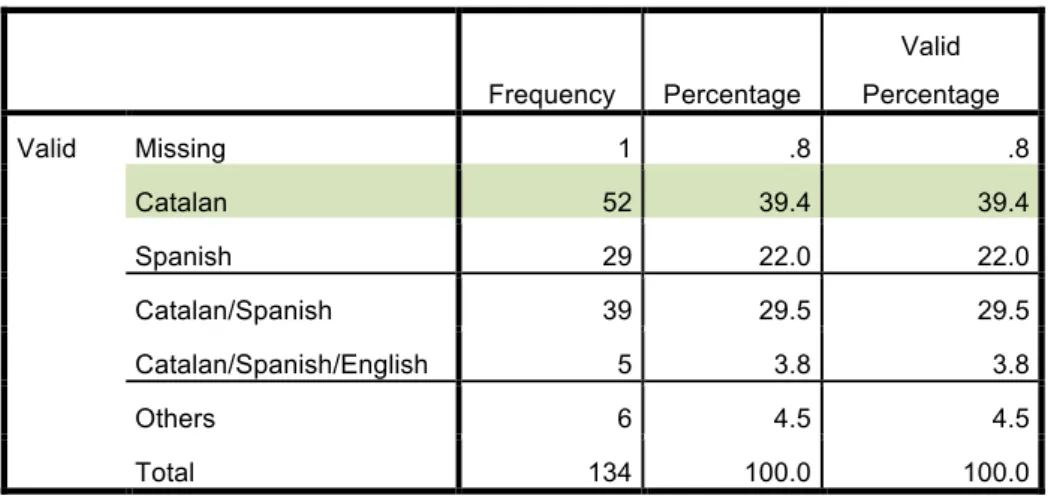
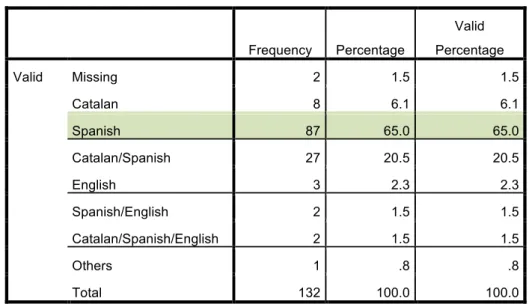
(3) TABLE OF CONTENTS Acknowledgments ............................................................................................................. 2 Table of contents ............................................................................................................... 3 List of figures .................................................................................................................... 5 List of tables ...................................................................................................................... 6 Introduction ..................................................................................................................... 8 Part 1 Theoretical Framework .................................................................................... 10 1. Foundations of Multilingualism ............................................................................... 11 1.1. The emergence of multilingualism ...................................................................... 11 1.2. Definitions of multilingualism ............................................................................ 14 1.3. Types of multilingualism..................................................................................... 15 2. Multilingualism and Education ............................................................................... 19 2.1. Multilingual education: general overview ........................................................... 19 2.1.1. Educational language policies in Europe .................................................. 19 2.1.2. Linguistic models in multilingual education ............................................. 21 2.2. Multilingual education: the case of Catalonia ..................................................... 25 2.2.1. Educational language policies in Catalonia............................................... 25 2.2.2. Linguistic models in multilingual education in Catalonia......................... 27 3. Language attitudes and multilingualism ................................................................. 28 3.1. Language attitudes: general overview ................................................................. 28 3.1.1. Defining language attitudes ....................................................................... 29 3.1.2. Measurement techniques ........................................................................... 31 3.1.3. Studies on attitudes towards multilingualism ............................................ 32 3.1.3.1 Studies using a holistic approach ................................................ 36. 3.
(4) Part 2 Empirical Study ................................................................................................. 38 4. Objectives and hypotheses ........................................................................................ 39 5. Research Design ........................................................................................................ 40 5.1. Paradigm .............................................................................................................. 40 5.2. Method................................................................................................................. 41 5.2.1 Variables ..................................................................................................... 41 5.3. Instruments .......................................................................................................... 42 5.4. Participants .......................................................................................................... 44 5.5. Procedure ............................................................................................................. 45 5.6. Data analysis........................................................................................................ 46 6. Results and discussion............................................................................................... 47 6.1. Speakers’ profile.................................................................................................. 47 6.1.1. Frequencies of the three independent variables ........................................ 48 6.2. Speakers’ language use........................................................................................ 52 6.2.1. Frequency of language use within their closest relations .......................... 52 6.2.2. Frequency of language use for the media and ICT ................................... 54 6.2.3. Frequency of language use for reading ..................................................... 57 6.2.4. Summary of language use ......................................................................... 60 6.3. Speakers’ attitudes towards trilingualism............................................................ 62 6.3.1. Summary of speakers’ attitudes towards triilngualism ............................. 65 6.4. Speakers’ attitudes towards trilingualism: comparison between subgroups ....... 66 6.4.1. Comparison between gender ..................................................................... 66 6.4.2. Comparison between type of L1 ............................................................... 70 6.4.3. Comparison between perception of number of languages spoken ............ 75 6.4.4. Summary of speakers’ attitudes towards trilingualism: comparison between subgroups .............................................................................................. 79 7. Conclusions ................................................................................................................ 81 7.1. Limitations of the study ....................................................................................... 83 7.2. Further research ................................................................................................... 84 8. Bibliography .............................................................................................................. 85 9. Appendices ................................................................................................................. 95. 4.
(5) LIST OF FIGURES Figure 1. Continua of multilingual education. Figure 2. Spread of Catalan. 5.
(6) LIST OF TABLES Table 1. Years of schooling in a Primary Education School from Catalonia. Table 2. Participants distribution by gender. Table 3. Participants distribution by perception of number of languages spoken. Table 4. Participants distribution by perception of number and types of languages spoken (combination)). Table 5. Speakers’ L1. Table 6. Languages used with your classmates at school. Table 7. Languages used with your friends from outside school. Table 8. Languages used with your coaches (e.g. sport, music…) from outside school. Table 9. Languages used to watch TV. Table 10. Languages used to listen to music. Table 11. Languages used to listen to the radio. Table 12. Languages used to surf the Internet. Table 13. Languages used to read books. Table 14. Languages used to read magazines. Table 15. Languages used to read newspapers. Table 16. Summary of languages used by domains. Table 17. Attitudes towards trilingualism in %. Table 18.1. Comparison between genders in speakers’ attitudes towards trilingualism in % (frequencies). Table 18.2. Comparison between genders in speakers’ attitudes towards trilingualism in % (Fisher’s Exact Test). Table 19.1. Comparison between type of L1 in speakers’ attitudes towards trilingualism in % (frequencies). Table 19.2. Comparison between type of L1 in speakers’ attitudes towards trilingualism in % (Fisher’s Exact Test). 6.
(7) Table 20.1. Comparison between perceptions of number of languages spoken in speakers’ attitudes towards trilingualism in % (frequencies). Table 20.2. Comparison between perceptions of number of languages spoken in speakers’ attitudes towards trilingualism in % (Fisher’s Exact Test). 7.
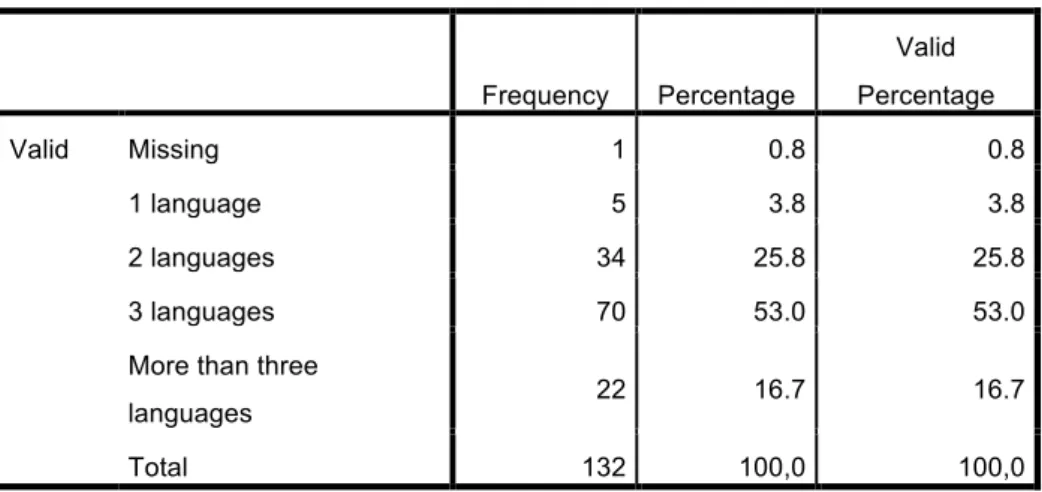
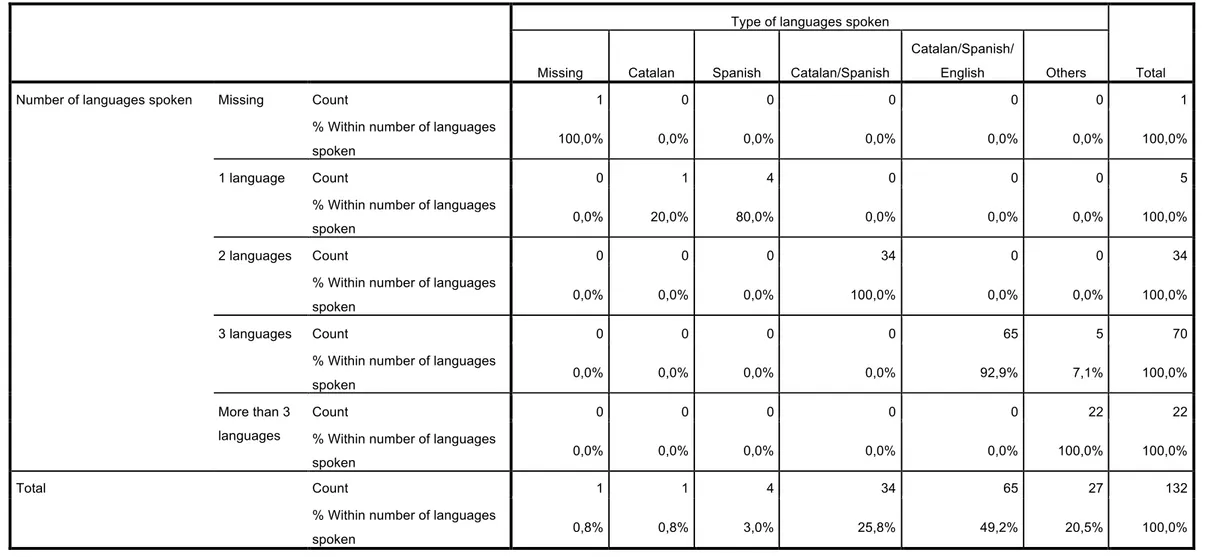
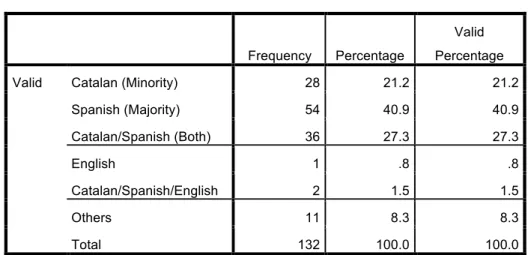
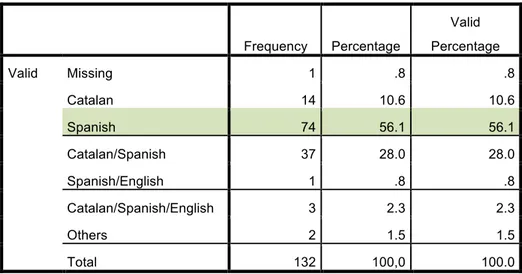
(8) INTRODUCTION The term multilingualism is being increasingly used at present. Yet, not all people refer to this term the same way. For a great deal of people multilingualism refers to the use of multiple languages within a same context, for which reason they often only relate this concept to those schools where there is a high percentage of immigrant students. This is a stereotypical view on multilingualism, which could actually be synonym of multiculturalism. For others, nonetheless, multilingualism is not necessary and only connected with schools where there are an important proportion of immigrant students; instead it is related to individuals that speak two or more languages, regardless of their place of origin. In this respect, through this second view, linguistic repertoires are not treated linear and independently, instated they are holistically considered. The view conceived in this project is the second one. Research on multilingualism, furthermore, has also been approached from different disciplines. This is aligned to what Garcia-Mayo (2012), Aronin and Hufeissen (2009) as well as Cenoz and Hoffmann (2003) point out in that it can embrace diverse branches, which in turn, may also overlap in some aspects. Examples of these fields of research are phsycolinguistics (Cenoz, Hufeisen, Jessner, 2003; Sharwood-Smith and Kellerman, 1986, cited in Cenoz, Hufeisen and Jessner, 2003; Dijkstra, 2003), neurolinguistics (Franceschini, Zappatore & Nitsch, 2003; De Groot’s, 2011, cited in Cenoz, 2013), sociolinguistics (Cenoz & Gorter, 2011; Aiestaran, 2003; Lasagabaster, 2009), pragmatics (Safont, 2011, 2013), or education (Cenoz, 2009; Cenoz & Gorter, 2015; Garcia and Sylvan, 2011; Creese & Blackledge, 2010; García & Flores, 2012), among others. The present study is embraced within a sociological perspective, since the main focus is on analysing the language use of trilingual speakers and their language attitudes. In accordance with the lines above, the main aim of this master’s thesis is to cover some research gaps identified in the literature, namely Catalan schoolchildren’s attitudes towards trilingualism and their linguistic habits in different contexts. To that end, the impact of the number of languages spoken, gender, and type of L1 will be explored. In relation to the latter variables, furthermore, three hypotheses have been proposed. These are: there is significant difference between speakers’ attitudes depending on the number of languages they perceive they speak; there is not significant difference between boys and girls' attitudes towards trilingualism, and 8.
(9) there is significant difference between speakers’ attitudes depending on their L1 in terms of being this a minority language, a majority language, or both, a minority and a majority language. In order to cover the research gaps mentioned before and verify the hypotheses the project has been arranged in two parts as well as in different sections, which are commented on below. The first part of the project refers to the theoretical framework and it comprises three thematic areas or sections. During the first one, some foundations of multilingualism are set out. In this respect, attention is given on reviewing the origins of multilingualism and on describing some terminology related to multilingualism (section 1). After, some general background concerning with multilingual education in Europe is presented, focusing later on the case of Catalonia (section 2). The last thematic section discusses the role that language attitudes play on multilingualism. Additionally, some of the most common measurements techniques used to investigate language attitudes as well as some relevant studies on attitudes towards multilingualism are reviewed too (section 3). Last but not least, the theoretical framework concludes with a presentation of the objectives and hypotheses of this project (section 4). The second part of this dissertation is the empirical study, which is divided into two sections. The first one describes the research design underlying this project and includes a presentation of the research paradigms and methods selected, also the instruments used for collecting data, which in this case is a questionnaire, and the main characteristics of the research participants. Furthermore, this section ends with an explanation of how data was collected and analysed (section 5). Then, the results and main findings obtained after carrying out the study are displayed in the form of tables and discussed (section 6). Finally, this project ends with a conclusions section, in which the focus is on checking the extent to which the objectives and hypotheses have been reached, on reporting some of the limitations found while conducting the study and on providing some suggestions and recommendations for further research (section 7).. 9.
(10) PART 1. THEORETICAL FRAMEWORK. 10.
(11) 1. FOUNDATIONS OF MULTILINGUALISM 1.1. The emergence of multilingualism Multilingualism is currently considered as a common widespread phenomenon of modern societies. However, it seems that multilingual practices were already manifested in ancient times (Aronin, 2015; Adams, James & Swain, 2002; Franceschini, 2009, 2011; Schadev and Cartwright, 2016; Stavan & Hoffmann, 2015). In other words, as Franceschini (2009, 2011) interestingly pointed out, multilingualism has existed for centuries and in various degrees, albeit without having generated as much interest as at present. On that account, there is major consensus among sociolinguists that multilingualism is a result of societies seeking contact with others and that in order to establish the roots and foundations of such phenomenon one would need to jump forward in ancient times, hence, when the first societies and imperialisms arose (Wright, 2004; Wiley, 1996; Wee, 2011). In this sense, it is believed that the first prints of multilingualism are found in clay tablets, around 2600 BC (Franceschini, 2013, cited in Lasagabaster, 2015) and with the first urban civilization, that is, the Sumerians, who are thought to have developed the earliest writing system (Deutscher, 2000) and who settled on the southern Mesopotamia (Franceschini, 2009, 2011; Schadev and Cartwright, 2016). It is almost certain that Sumerian citizens went from being monolingual speakers of the Sumerian language, which is a language isolated (Deutscher, 2000) (i.e. a language that has never been linguistically related to any other language, therefore, which is not included within any language family and branch) (Campbell, 2010); to being bilingual speakers of both, the Sumerian and the Akkadian language. In fact, it is worldwide claimed that such shift was due to Sargon of Akkad’s invasion (Deutscher, 2000). This implied that the southern territory of Mesopotamia ceased to be independent and, consequently, became part of the so-called Akkadian Empire. In this respect, since Akkadian was the language used by their conqueror, Sumerians resulted in learning and using both their native or L1 language, which is Sumerian, and Akkadian, that is, the official language of the empire. In spite of using both languages, as it has occurred in most colonies (Antonin, 2015; Ricento, 2000; Mansour, 1993; Wright, 2004; Wiley, 1996; Wee, 2011), it should be clarified that each language was employed for different purposes and in different domains. In this. 11.
(12) sense, whereas Sumerian was greatly used in informal contexts, Akkadian was significantly applied in formal, economical and administrative settings (Galter, 1995). In relation to the preceding paragraph, it also needs to be emphasised the fact that as years went by and the Akkadian dynasty and empire came to gain power and territory, Akkadian resulted in being the lingua franca, thus, in replacing Sumerian on an oral and, ultimately, on a written basis (Galter, 1995). This is aligned with Deutscher’s (2000:21) publication in that, although “Sumerian ceased to be spoken, it continued to be used as a literary and scholarly language”, since, as he stated, “Sumerian was taught in scribal schools” (i.e. the schools located in Sumerian) and “literary compositions were copied and learnt by Akkadians scribes”. One possible explanation for this (i.e. that the Sumerian writing remained present for a longer period than its spoken form) might be that it was the first writing system to be developed and it was used to create the Akkadian writing system. In other words, the Sumarian influenced on the Akkadian’ writing system (Hasselbach, 2005). Quite similarly, during the Roman Empire, which lasted from 330 BC to 70 AC approximately, citizens from the Mediterranean as well as Britain started to use more than one language, although in a greater extent those belonging to elite societies (MacMullen, 1966; Schadev and Cartwright, 2016). These were Greek, which was widely spoken in the eastern part of the empire; Latin, which was the language of the Roman Emperor, hence, which became a “unifying link” (Rochette, 2011:562) throughout the Roman Empire; and in some cases, some citizens from the western and north Mediterranean also used other languages different to Greek, such as Gaulish, Brittonic, Celtic or Germanic, but to mention a few, in informal settings (Rochette, 2011; Sachdev and Cartwright, 2016). Regarding the recognized and official languages, despite having Latin an official status and being this the language of the Roman Emperor, it is interesting to observe that Greek was also used in formal domains and in administration (Rochette, 2011). Indeed, since Greek already had a powerful position by the time the Roman Empire was created, it continued to be spoken during the Roman period. All this could probably explain the reason for which different official documents that have been found across history have been written and translated into Greek and Latin.. 12.
(13) As seen earlier, multilingualism has reflected our societies for more than millennia. Indeed, as Lasagabaster (2015) and Frenceschini (2011) noted, it could be safely claimed that, ever since antiquity, multilingual practices have become the norm and an utmost feature of an important number of societies. Yet, from the fourteenth to the seventieth century, when the Renaissance period took place, common criticism to this multilingual focus was given by a great deal of authorities (Lasagabaster, 2015). In fact, as Lasagabaster (2015) asserted, the multilingual mindset of most governors changed towards a monolingual one due to the misconception that cultural and linguistic diversity could threaten “national cohesion” (Ferguson, 2006; Franceschini, 2009, 2011; Lasagabaster, 2015; Ricento, 2000). To put it differently, since many politicians were concerned with unifying national identities, the multilingual practices were not longer as positive accepted as in the past. This, furthermore, explains the reason for which individuals ceased to be trained in multilingual skills; instead, they were educated in monolingual ideologies. The wrong assumption of having to homogenize nations through a same culture and a same standardized language seems to have expanded in a greater extent during the following centuries. In fact, in her recent publication, Franceschini (2011:345) interestingly exposed that a great deal of the linguistic theories that have blossomed since then have followed the “unnatural premises” of eluding the use of different languages and cultures. Although this belief has persisted for ages, nevertheless, it should be positively acknowledged that some scholars have lately expressed their unconformity with this ideology claiming that nationalizing states by imposing one culture and language may cause the opposite effects to those expected. In other words, rather than fostering a shared identity, it could possibly generate “separateness” (Blackledge, 2000; Francheschini, 2011:345; Lasagabaster, 2015). Furthermore, it could result in language loss; especially when it comes to those regional languages that do not hold a recognized or legal status, and that are used by minority groups. Finally, it could be doubtless to say that it may endanger the cultural and linguistic diversity of societies (Cenoz, 2009; Cenoz & Gorter, 2015; Jessner, 2008). During the twentieth century, in addition to the notion that individuals should identify themselves with one nation, different scholars unfortunately also underlined that minority and indigenous languages could impede a state to further develop. 13.
(14) (Ricento, 2000) as well as negatively affect individuals’ learning achievements (Lasagabaster, 2015), which implied a substantial loss of an important number of minority languages. Despite all attempts of destructing the multilingual landscape of our society in this last century, it is certain that, as some researchers asserted and as previously said, the world has lasted multilingual (Cenoz, 2009; Cenoz & Gorter, 2015; Jessner, 2008; Lasagabaster & Huguet, 2007). In other words, multilingual practices have prevailed alive amongst societies (Lasagabaster, 2015). This is also aligned with Francheschini’s (2011:345) ideas in that multilingualism has not disappeared since it has been necessary for “cultural transfer and the development of trade”; also since some communities have maintained their native languages by using them in a private level. Last but not least, it could be stated as well that societies have even turned into more multilingual over the past decades due to people’ awareness of preserving minority and immigrant languages and due to globalization, which has encouraged people to learn and speak additional languages (Cenoz & Gorter, 2015). 1.2. Definitions of multilingualism As discussed in the previous section, even though multilingualism is not a recent phenomenon, it seems that nowadays it has become more common. In fact, this multilingual reality is visible considering that “there are almost 7000 languages in the world, and 200 independent countries” (Cenoz, 2013:3), also that “in most societies there are speakers that speak more than one language” (Aiestaran, 2003:19; European Comission, 2008), and finally that “there are hundreds of millions of people that speak three or four languages in their daily lives”. Among these languages, the most common, that is, those that are spoken by a significant part of the current population, are Mandarin, Hindi, Spanish, English, Bengali, Portuguese, Arabic and Russian (Gordon, 2005). Before moving on it would be first necessary to have a clear understanding of what multilingualism consists of. On that account, as Edwards (1994), Cenoz (2009; 2013), Aiestaran (2003) or Kemp (2009) agreed and explained in their publications, multilingualism is a complex term that is constantly undergoing a process of refinement as well as supervision (Kemp, 2009), and that can be described through different perspectives or typologies. Regardless of the various viewpoints through which multilingualism can be understood, as shall be seen in the following paragraph, some conceptualizations of this target term that have been provided by different scholars and that can be found in 14.
(15) the current literature are reviewed next. The European Commission (2008:6), for instance, defined this term as “the ability of societies, institutions, groups and individuals to engage, on a regular basis, with more than one language in their dayto-day lives”. Another definition is offered by Edwards (1994:25) that, alike the European Commission, described multilingualism as both “a simple description of global linguistic diversity and, at the same time, a representation of the individual and group abilities that have developed because of that very diversity”. Similarly, Cenoz (2009:2) explained that “multilingualism is at the same time an individual and a social phenomenon” and that it can “include different levels of proficiency in the different languages”. 1.3. Types of multilingualism In order to gain a deeper understanding of what multilingualism is, in the subsequent lines a review of the different models or types of multilingualism will be offered. One of the most controversial distinctions is between bilingualism and multilingualism. Indeed, there is lack of agreement in the number of languages that need to be involved in multilingualism (Cenoz, 2013; Kemp, 2009). For this reason, Cenoz (2013:7) strategically distinguished “bilingualism as the generic term”, “multilingualism as the generic term” and “bilingualism and multilingualism as different terms”. Broadly speaking, as she noted, the first bilingualism has traditionally been employed to study the use of two languages; also it refers to the use of two languages, even though it can include more. “Multilingualism as the generic term” implies the use of two or more languages, for which reason bilingualism or trilingualism are some examples of multilingualism. Finally, as she well asserts, whereas some researchers have adopted the term bilingualism just to study the use of two languages, others have selected the word multilingualism to investigate the use of three or more languages. In this project, the word multilingualism will refer to the latter type of multilingualism (i.e. multilingualism related to three or more languages). Another. frequent. distinction. is. between. societal. multilingualism. and. plurilingualism or individual multilingualism. As Aiestaran (2003), Cenoz (2009:2; 2013), the Council of Europe (n.d.) and Cenoz and Genesee (1998) pointed out, multilingualism can refer to the ability of an individual to use or have more than one language. in. their. linguistic. repertoire. (i.e.. plurilingualism. or. individual 15.
(16) multilingualism) or it can indicate the use of more than one language in a society or in a community of a “specific geographical area” (i.e. societal multilingualism). With regard to the former type of multilingualism, it has been shown that there are more multilingual individuals in those areas where minority or regional languages, such as Basque, Catalan, Gaelic, Breton or Irish, are spoken. In fact, it could be carefully claimed that these individuals frequently use a minority language, a dominant one, such as Spanish or French, as well as another additional language, which in most cases becomes English. With regard to this latter language, it occurs due to the spread of this language as a lingua franca (Canagarajah, 2007; Crystal, 1997; Seidlhofer, 2003). In other words, since English is worldwide used for functional purposes, such trade, technology and entertainment (Crystal, 1997), most schools and speakers have been trained in this target language. Finally, in terms of societal multilingualism, the most multilingual continents are Africa and Asia. In fact, according to the Ethnologue, whereas in Africa there are 2,139 living languages, in Asia there are 2,295. Within the individual dimension, multilingual speakers can also be labeled in different typologies. Some possible classifications are related to the degree of competence or proficiency in the languages involved, to the way languages are added or subtracted in speakers’ linguistic repertoire, to the place in which languages have been learnt or acquired, finally, to the manner in which languages are actively or passively used. Regarding the degree of competence speakers have in their languages, different stances are often provided. Some think that in order to be considered legitimate multilinguals (Block, 2007) speakers need to have a native-like proficiency or a fully developed competence (Herdina & Jessner, 2002) in all the languages involved. Advocates of this assumption are often called maximalists (Aiestaran, 2003; Block, 2007; Cenoz, 2013; Cenoz and Gorter, 2011). On the other hand, other researchers believe that it is not necessary to reach a high command in the different languages in order to be treated as valid multilinguals, rather they think that incipient speakers (Herdina & Jessner, 2002) of different languages already need to considered as legitimate multilinguals. On the light of these stances, it would be suitable that researchers avoid taking extreme postures. This means that multilingual speakers should be considered as such provided that they have not reached a nativelike level. On the other hand, speakers should not be considered as such provided that. 16.
(17) they only knew one or two words in that target language. On that account, all multilingual speakers that have developed at least a minimum basis to understand and communicate daily expressions as well as to give personal details or that are within the A1 level from the Common European Framework of Reference for Languages should, therefore, be regarded as legitimate multilinguals. The previous distinction is parallel to the well known balanced and semilingual or unbalanced multilingualism. When speakers have the same control or proficiency over all the languages involved, then it is said that they are balanced multilinguals (Edwards, 1994; Herdina & Jessner, 2002). On the contrary, semilingual or unbalanced multilinguals are those individuals that are not fluent to the same extent in all the languages (Edwards, 1994; Herdina & Jessner, 2002). This second distinction, however, could be criticized on the grounds that behind the term semi there is the notion that they are not complete speakers, instead they are half or partial speakers. As previously said, regardless of speakers’ proficiency in different languages, all multilingual speakers that can effectively communicate in a greater or lesser degree in different languages should be regarded as legitimate multilinguals. This is somehow related to Cenoz’s (2013) idea that a balanced multilingualism is not a “requirement” to be considered multilingual speakers, also to the conception that multilingual speakers do not need to be as “two monolinguals” (Grosjean, 1989) or “two solitudes” in one mind (Cummins, 2008). In fact, as Aiestaran (2003) well pointed out, “a bilingual often uses the two languages in different contexts, with different people and for different purposes. As a consequence it is difficult for the bilingual person to have complete fluency in both languages in all domains”. As seen earlier, languages can be added or subtracted from speakers’ linguistic repertoire. In other words, learning or acquiring second, third, Ln languages can be done with two objectives. Provided that the goal is to remove speakers’ languages, which has often occurred to speakers of minority languages also to speakers of immigrant languages (i.e. students whose home languages are different to those of the school), then the type of multilingualism is subtractive (Lambert, 1974; Garcia & Flores, 2012). On the other hand, supposing individuals acquire other languages different to their home languages and with the purpose of adding it to their linguistic repertoire, without subtracting any language, then the type of multilingualism promoted is additive (Lambert, 1974; Garcia & Flores, 2012). In addition to these. 17.
(18) two types of multilingualism, a third type of multilingualism has been recently included (De Bot, Lowie and Verspoor, 2007; Larsen-Freeman, 2002; Garcia and Sylvan, 2011; Herdina and Jessner, 2002). This is known as dynamic multilingualism and is described in the following terms: This dynamic conceptualization goes beyond the notion of two autonomous languages, of an L1 and an L2, and of additive or subtractive bilingualism. Instead, dynamic bilingualism suggests that the language practices of all bilinguals are complex and interrelated; they do not emerge in a linear way (Garcia and Sylvan, 2011:388). In this regard, dynamic multilingualism implies not only the addition of other languages, but also the constant use and reflection upon speakers’ linguistic repertoire. Based on this definition, it could be concluded as well that the focus of this dynamic multilingualism is on the relationships between speakers’ languages and on the influences they have in each other. In relation to the context in which languages are learnt or acquired, there are two types of multilingualism: natural or primary and secondary multilingualism. In comparison with the other distinctions made thus far, it seems that in the current literature researchers have not shown as much interest in this distinction as in the other typologies. In fact, the number of publications in which scholars have included this distinction is significantly low. In spite of this, Aiestaran (2003) represented a detailed description of both primary and secondary multilingualism. According to him, children that have received more than one language from their parents and family are considered natural multilinguals. On the other hand, secondary multilingualism occurs when the language has been only acquired through formal instruction. Considering this differentiation, it could also be questionable whether speakers who have learnt or acquired an additional language during adulthood but without being explicitly instructed are natural or secondary multilinguals. Last but not least, depending on speakers’ ability in the four basic skills of reading, listening, speaking and writing, individuals can be classified as receptive or passive multilinguals as well as productive or active multilinguals. When speakers are able to understand and read an additional language, but they cannot write or speak, it means that they are receptive or passive multilinguals (Aronin and Hufessen,. 18.
(19) 2009; Aiestaran, 2003). Ten Thije and Zeevaert (2007) developed an extensive notion of passive multilingualism. They explained that individuals with this type of multilingualism use their L1 when speaking with each other (e.g. a speaker using Catalan and another using Spanish while interacting), since they can understand each other’s messages in their respective languages. Provided that individuals can use all four basic skills, then they are labeled as productive multilinguals (Aiestaran, 2003). Given the fact that when learning additional languages individuals experience a silent period, that is, “a period of time before the acquirer actually starts to speak” (Kraschen, 1985) and in which the receptive skills are first developed (Spöttl & Mccarthy, 2003), it could be pointed out that probably there are more receptive multilinguals than productive ones. This statement, however, cannot be strongly affirmed since it would be impossible to describe today’s reality in terms of passive or active multilingualism. 2. MULTILINGUALISM AND EDUCATION 2.1. Multilingual education: general overview 2.1.1. Educational language policies in Europe Education plays a paramount role in the growth of learners’ awareness of language diversity, also in the development of positive attitudes towards multilingualism, and definitely, in the promotion of multilingual speakers. In the same vein, SkutnabbKangas (2000) and Cenoz (2009) also claimed that the value and status of languages in societies may increase or decrease depending on the amount of time educational settings devote in each language, also on the way languages are presented and used as medium of instruction or as subjects. On that account, that is, considering the function of education in training multilingual speakers, also in increasing or decreasing the prestige of languages, today there are a great number of institutions (e.g. European Union, the Council of Europe or UNESCO) that have conceived a series of educational language policies, which are involved in the promotion of multilingualism. Since the broader context of this study is Europe, it is necessary to first review some of the European educational language policies. Before doing so, it is worth reporting and acknowledging that, as shall be seen, in all these policies the linguistic diversity of Europe is considered as an opportunity rather than as an obstacle. 19.
(20) (Breslin, 2014). In other words, these policies do not contemplate this linguistic diversity as a language problem; instead they consider it as a right and as a valuable resource for the globe as well as for the citizens. In terms of macro institutions in the European setting, the Council of Europe, which is an organization that is in charge of protecting human rights on different levels, has developed and implemented different common language education policies that are embodied in five dimensions. These are plurilingualism, within which they assure speakers the right to “develop a degree of communicative ability in a number of languages”; linguistic diversity, within which they are committed to guarantee that all languages from Europe are “equally valuable modes of communication and expressions of identity”; mutual understanding, meaning that all speakers need to have a opportunity to develop “intercultural communication” by learning and using languages; democratic citizenship, within which speakers are encouraged to “participate in democratic and social processes”; and finally, social cohesion, within which it is stated that speakers need to have equally of opportunities for “personal development, education, employment, mobility, access to information and cultural enrichment” (http://www.coe.int). As observed in these lines, all these policies positively promote multilingualism on an individual and societal level. However, it is also certain that, as Portolés (2015) interestingly exposes and as one could witness in the documents written by the Council of Europe, although holding such positive posture towards multilingualism, this organization only uses two official languages in their documents. These are French and English, which in turn, are two elite or prestigious languages. In addition to the Council of Europe, the European Commission of Languages has also devised some regulations to deal with multilingualism. In this respect, their policies are planned with the purpose of pursuing three objectives, which are “to encourage language learning and promoting linguistic diversity in society, to promote a healthy multilingual economy, and to give citizens access to European Union legislation,. procedures. and. information. in. their. own. languages.”. (http://ec.europa.eu/languages/policy). Considering these goals, it could be underlined that this commission gives more importance to multilingualism related to economy and general society than to multilingualism related to individuals’ rights. In other words, whereas the Council of Europe puts emphasis on the speakers and. 20.
(21) languages, the European Commission of Languages looks at the benefits multilingualism brings to society. Last but not least, it should also be pointed out another difference between both institutions. Whereas, in the Council of Europe only 2 languages are used in their documents, in the European Commission 24 languages are employed, although not all of them are equally used. 2.1.2. Linguistic models in multilingual education Before analysing the different typologies of bilingual or multilingual education, one first needs to comprehend what multilingual education consists of. In this sense, the current literature offers a wide array of definitions, among which those proposed by Garcia (2009) and Cenoz (2009) need to be highlighted. Garcia (2009), for instance, considered bilingual or multilingual education when two or more languages are used as medium of instruction rather than as mere subjects. Furthermore, in their views, speakers’ home languages are not rejected; instead they are also used as a medium of acquiring knowledge. Aligned to this notion of multilingualism, Cenoz (2009) underscored that in order to understand what is meant by multilingual one needs to look at the aims of the schools, therefore, at “whether the school aims at bilingualism or multilingualism or whether the school is called bilingual or multilingual because students speak different home languages” (Cenoz; 2009:26). According to her interpretations, multilingual education needs to refer to those schools that aim at bilingualism or multilingualism, since most students whose home languages are different to the ones used in the school rarely get the chance to develop literacy skills in their home languages. Although both notions are quite similarly, in this paper multilingual education will be used to refer to Cenoz’s conceptualization of multilingualism (i.e. schools aiming at bilingualism and multilingualism). Within bilingual education, furthermore, as Cenoz (2009:25) pointed out, it would be unfeasible and almost impossible to analyse all the typologies for different reasons. As she stated, it would be unpractical due to the fact that there are at least 250 typologies of bilingual education programs; also because the analysis of such schools can be carried out using different focuses –as seen previously-, or because “the sociolinguistic context in which each bilingual school is located also has specific characteristics”. However, when it comes to schools where three or more languages are taught and where the foremost goal is promoting multilingualism and multiliteracy, as she explains, it seems that very few scholars, such as Darquennes 21.
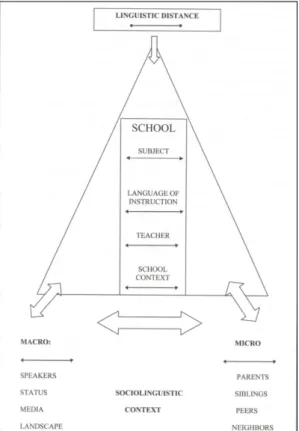
(22) (2013), Baetens Beardsmore (1993), or Ytsma (2001) have tried to establish a typology of trilingual and multilingual education. Finally, as an alternative to a typology based on dichotomies or trichotomies, in 2009 Cenoz suggested the Continua of Multilingual Education. In the subsequent lines, some insights into the typologies of multilingual education that aim at multilingualism and multiliteracy of three or more languages will be given. Darquennes (2013), for instance, proposed four models of multilingual education in Europe. These are multilingual education aimed primarily at the majority population, multilingual education aimed primarily at the indigenous-minority language population, multilingual education aimed primarily at the immigrant population within a state, and multilingual education aimed at an affluent international or elite audience. In terms of multilingual education addressed to the majority population, he explains that one of the most common trends across Europe is to teach a foreign language through content, also known as content and language integrated to language (CLIL). When it comes to the second type, emphasis is put on the fact that in some settings the minority language is compulsory used as the only medium of instruction (e.g. Catalan in Catalonia), in others both languages the minority and the majority serve as medium of instruction (e.g. Basque and Spanish in the Basque Country), and finally, in numerous locations the minority languages are taught as subject. As far as multilingual education aimed at the immigrant population is concerned, it embraces all complementary schools, which are voluntary schools where children attend in out-of-school hours and where they are trained in their home languages (Creese & Blackledge, 2010). Finally, in the last group of schools, also known as European schools, “most pupils at the level of primary education have their first language as a language of instruction. A first foreign language (English, German, or French) is introduced in the first year of primary education and used as a language of instruction toward the end of primary and increasingly so in secondary education. And in some cases, a third or even a fourth language of instruction comes into play in secondary education, depending on the optional subjects that are chosen” (Darquennes, 2013:5). Since in Catalonia speakers’ are not segregated according to their languages, in this project multilingual education will be categorized within the one aimed at the majority of population.. 22.
(23) Instead of labeling all multilingual educational programmes, Baetens Beardsmore (1993) proposed nine variables to categorize five typologies of multilingual education, which are Canadian immersion, Luxemburg, European schools, Foyer project, and Catalan/Basque bilingual education. In this respect, the variables that need to be considered when analysing a multilingual educational program are: nature of program, whether it aims at an additive or subtractive multilingualism; languages involved, such as home languages or other ones; outcome, meaning whether it aims at full multilingualism or not; population, whether it is a specific group or not; target language in environment; target language used by peers; final exams in more than one language; target language as a subject; and native-speakers teachers. Despite proposing five models of multilingual education, it is worth pointing out that, as said earlier, since not all contexts are the same, that is, since it can happen that not all educational systems may be enclosed within these five typologies, it would be more suitable to focus on the variables. Provided that attention is given to these variables, more typologies of multilingual education could probably arise. Another way of classifying multilingual education is offered by Ytsma (2001), who suggested three criteria to describe trilingual education models. These criteria are the linguistic context in which the school is located, the linguistic distance between the three languages concerned, and the program or organizational design of the teaching and learning of the three languages. According to Ytsma (2001), the linguistic context refers to whether all the three languages in the trilingual (i.e. where the three languages are spoken), bilingual (i.e. where two of the languages are spoken) or monolingual area (i.e. where just one language is spoken) are regularly used. The linguistic distance between the three languages implies whether they are typological close or not. Finally, the way languages are learnt, which means whether all the three languages are studied at the same time (i.e. simultaneous program) or whether the third language is learnt once the speaker has obtained certain fluency in the other two languages (i.e. consecutive program), refers to the program design. As occurred with Baetens Beardsmore’s (1993) proposal, and as Cenoz (2009) suggested, Ytsma’s criteria is practical provided that one wishes to compare different models. Nonetheless, these criteria could receive criticism since it only embraces three variables. In this sense, other criteria should also be included.. 23.
(24) Last but not least, in an attempt to propose an alternative to the existing taxonomies of multilingual education, Cenoz (2009:33) developed the continua of multilingual education (see Figure 1). As she stated, this continua is “more appropriate to represent the different variables than polar opposites also in the case of characterizing different types of multilingual education”. In other words, through these continua a wide array of different models and typologies can arise without having to be identical. It includes three variables, which are educational, linguistic and sociolinguistic, both at a macro and micro level. Within the educational, furthermore, four continua, which means that they can be less or more multilingual, are included. These are as follows: subject, in which emphasis is given on the languages taught as subjects, the integration of the different languages within the syllabus, as well as the intensity of instruction and the age of introduction. Language of instruction, which refers to the number and type of languages used as instruction and to the integration and coordination between teachers as well as syllabus of different languages. Teachers, in which teachers’ education in terms of language proficiency in different languages and specific training in multilingual education are considered. The last educational continuum is school context and it refers to the use of languages within the school setting, also to the linguistic landscape.. Figure 1 Continua of multilingual education Source: Cenoz (2009). 24.
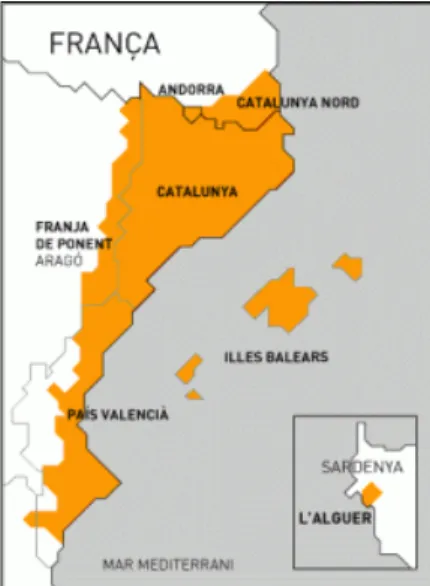
(25) In terms of linguistic variables, it involves the typological distance between languages. In this sense, the closer they are, the more relationships one will probably establish. However, it is also certain that languages can also share some linguistic features (e.g. in terms of phonology or lexicon), even if not being typologically or historically closed. Finally, the last variable included in this continua model is the sociolinguistic one. As Cenoz (2009:37) well reported, schools are part of society, for which reason the sociolinguistic features need to be included too in both in a macro and micro level. On that account, the aspects that need to be taken into consideration in a micro level are the “vitality of languages, number of speakers of the different languages, their status on a national and international level, and their use in the media or in the linguistic landscape”. When accounting for the sociolinguistic features in a micro dimension, attention is given to the students and the languages used in their social networks (e.g. family, peers, community). 2.2. Multilingual education: the case of Catalonia 2.2.1. Educational language policies in Catalonia As Huguet (2007) stated, Catalonia is one of the three autonomous communities of Spain, alongside the Valencian Community and the Balearic Islands, where two Romance languages (i.e. the majority of which is Spanish and the minority is Catalan) hold an official and co-official status respectively (Article 6 - Parlament de Catalunya, 2016). In addition to these autonomous communities, it is worth highlighting that, albeit not being officially recognized, Catalan is also spoken by few inhabitants of other regions and countries, such as the narrow strip in Aragon (i.e. the Franja de Ponent), Andorra, the southeast of France (i.e. North Catalonia) or in the city of Alguer, which is located in the Italian island of Sardinia (See Figure 2).. Figure 2 Spread of Catalan Source: http://www.llull.cat/espanyol/cultura/llengua_catala.cfm. 25.
(26) In terms of educational language policies, after the end of the second Spanish dictatorship, that is, after 1975 and since the return of democracy, Catalonia has undergone a series of changes. Indeed, during the two dictatorships (i.e. Primo de Rivera –from 1923 to 1930- and Franco –from 19839 to 1975-), the use of Catalan and other minority languages from the country was forbidden because it was believed that the use of other languages and cultures different to the Spanish one would endanger the national cohesion. In other words, the well-known motto “one nation, one language” (Blackledge, 2000) was applied across the Spanish peninsula, for which reason the Catalan language and culture was harshly repressed. However, in 1983, that is, years later after the death of the second dictator Franco, the use and status of Catalan appeared to be strengthened with the earlier linguistic normalization law, also known as Llei de Nomalització Lingüística, which was also supervised and modified in 1998 (Rodà-Bencells, 2009). In this respect, one of the measures implemented in order to restore the use of Catalan was the integration of that language in the public domain. This implied that Catalan was used as the vernacular language during students’ compulsory education (i.e. Primary and Secondary Education). Although these measures were implemented, it seems that Spanish remained being little used within some non-obligatory education settings (i.e. Pre-Infant and Infant Education). According to the article 21.2, children until the age of 7 had the possibility to be instructed in one of their usual languages, which were Catalan or Spanish. In spite of that, as Rodà-Bencells (2009) reported, the option of enrolling Infant students in Spanish-based schools did not succeed as thought, as in most cases families brought their children in Catalan speaking schools. Regardless of the language selected, it is important to note as well that this law assured students to obtain a balanced bilingualism in both Spanish and Catalan by the end of their compulsory education. Finally, it is worth highlighting, as Huguet (2007:20) reported, that an “important part of the Spanish-speaking population has hold positive attitudes towards this education system” and has considered it as a “successful model”. Two significant phenomena that have catheterized the 21st century, thus, that the Catalan educational language policies have faced is the international immigration and the promotion of teaching and learning foreign languages (Rodà-Bencells, 2009). As. 26.
(27) for the international immigration, the sociolinguistic situation of Catalonia has become more linguistically diverse due to the flux of immigrations that started to arrive during the beginning of this century. In order to face such challenge, in 2004 the Catalan government developed a language and social cohesion plan, which was named as Pla per a la Llengua i la Cohesió Social. Broadly speaking, this plan was aimed at giving foreign students personalized assistance during their first years of schooling and at mediating all students in terms of intercultural communication and social cohesion. Indeed, a linguistic coordinator or mediator role was generated with the purpose of tackling such issues. Another measure that was included within this plan is the so-called Plans Individualitzats. These are curricular adaptations that are addressed to all the students, regardless of their linguistic background, that are attentive to the their individual needs, and that are later removed depending on these students’ adaptations in their target schools. Last but not least, in 2008 both the Spanish and Catalan government initiated a movement through which to reinforce the teaching and learning of English as a foreign or additional language. In spite of all the educational language policies devised to promote multilingualism, it would be worth to further investigate whether Catalan schools really aim at multilingualism in terms of giving international students the chance to develop literacy skills in their home languages. 2.2.2. Linguistic models in multilingual education in Catalonia Although different linguistic models in multilingual education have been proposed by few scholars, it is difficult to categorize Catalan schools within a typology of multilingual education since in each one there are different contextual variables. In this respect, since schools cannot be labeled within one typology, in this section an overview of the different ways schools from Catalonia deal with languages will be provided. Even though during the linguistic normalization law students were allowed to receive their Infant Education in their home language, today it seems that most children follow education programmes that are immersed in the Catalan language. With the purpose of giving a detail perspective of the current linguistic situation, two sources will be considered. These are Huguet’s (2007) work, in which he analysed all the linguistic models present in Catalonia, and the last curricular decree issued, which. 27.
(28) is the DECRET 119/2015. In this sense, in terms of Nursery or Infant and Primary education, Huguet (2007) stated that: […] 73% of schools carry out all teaching in Catalan (58 % of private schools), 25% are in the process of implementing new courses totally in Catalan (29% of private schools) and the remaining 2% can be considered as a standstill, as a number of subjects are regularly taught in Catalan (13% of private schools) (Huguet, 2007:21). As for Secondary Education, he reported that “30% of schools carry out all teaching in Catalan (66% of private schools), and 70% in both languages, with different levels of presence of each language in them (34% among private schools)” (Huguet 2007:21). Last but not least, considering the DECRET 119/2015, during Primary Education, students need to do at least 1.050 hours of Catalan and Spanish as subjects, as well as 420 hours of a first foreign language, which in most cases is English. When it comes to Secondary Education, teachers need to give 315 hours of Catalan as a subject, 315 hours of Spanish as a subject too and 350 hours of a foreign language. 3. LANGUAGE ATTITUDES AND MULTILINGUALISM 3.1. Language attitudes: general overview One area of research within the sociolinguistic paradigm that has widely drawn scholars’ attention is concerned with attitudes to language. In fact, Adelina (2014) suggested that attitudes are important since they are reflected in all situations. For instance, they influence people’s decisions and actions when choosing the goods to buy, also when selecting the political candidates to vote, when applying for jobs, when selecting the schools for the children, or when interacting with others. In the same vein, when it comes to the specific domain of language, Portolés (2015) accounted that such research in language attitudes is necessary as it can indicate the growth or decline of languages in contact within multilingual societies, also speakers’ language choice and use. Finally, similarly, Cenoz (2009) also stated that language attitudes within multilingual education can be useful as well, as through them one can indirectly observe the way speakers’ perceive the status of different languages (e.g. minority, majority and foreign languages; prestigious vs. non prestigious languages), also because one can understand the dynamics of society. In other words, how 28.
(29) individuals relate to each other within societies. Considering the crucial role of attitudes, in the next subsection some definitions provided by different authors will be offered. 3.1.1. Defining language attitudes Given the crucial role attitudes play in multilingualism, it may be helpful to first look at the way different well-known scholars have conceptualized the term attitudes, and then, to focus on the commonalties that exist across all the definitions. In this respect, since definitions can vary in a lesser or greater extent between them, some of the most influential authors, such as Allport (1954), Sarnoff (1970), Oppenheim (1982), Gardner (1985), Baker (1992) or Garrett (2010), will be offered. If comparing all definitions, as shall be seen, it is worth pointing out that cognitive, evaluative and behavioural elements (Wenden, 1991) are almost always present. On that account, Allport (1954), who has been one of the pioneers in defining attitudes, described such term as “a learned disposition to think, feel and behave towards a person (or object) in a particular way”. Furthermore, interestingly, he also explained that such attitudes cannot be directly observed, for which reason they need to be inferred through human’s behaviour and actions. In this definition, therefore, the terms think and behave implies cognitive and behavioural elements respectively. Sarnoff (1970) extended Allport’s definition by stating that attitudes are “dispositions to react favorably or unfavorably to a class of objects”. In his definition, two important aspects need to be highlighted. Firstly, Sarnoff acknowledged that attitudes are expressed through behavioral elements (i.e. by reacting). Secondly, he introduced the evaluative nature of attitudes by claiming that individuals can react favorably or positively as well as unfavorably or negatively. Oppenheim (1982, cited in Garrett, 2010) also gave another definition that is similar to the one provided by Allport in that attitudes cannot be directly seen or caught and in that they are cognitively related, but it differ in that Oppenheim’s definition was more elaborated. In this regard, this latter author saw attitudes as: A construct, an abstraction which cannot be directly apprehended. It is an inner component of mental life which express itself, directly or indirectly, through much more obvious process as stereotypes, beliefs, verbal statements or reactions, ideas and opinions, selective recall, anger or. 29.
(30) satisfaction or some other emotion and in various other aspects of behavior (Oppenheim, 1982, cited in Garrett, 2010:19). Following Sarnoff’s definition, Gardner (1985:9) also emphasized the behavioral and evaluative dimension of attitudes and the fact that they need to be deduced through different individual manifestations, such as beliefs or opinions. In this sense, he claimed that attitudes are “an evaluative reaction to some referent or attitude object, inferred on the basis of the individual‘s belief or opinions about the referent”. Complementary to Gardner’s conceptualization, Baker (1992:10) included the cognitive nature of attitudes and continued emphasizing the role of behavior in manifesting such attitudes. In this sense, he defined them as “an hypothetical construct used to explain the direction and persistence of human behavior”. In addition to this definition, the author also characterized attitudes as not being inherited, as being learnt, as having the tendency of persisting over time, although they may also be modified according to individuals’ experiences, finally, as varying in a continuum from more favorable to less unfavorable. Finally, Garrett (2010:20) underscored that attitudes are “an evaluative orientation to a social object of some sort, whether it is a language, or a new government policy, etc.”. Taking into account this last definition, it could be claimed that attitudes do not merely need to be seen or related to a cognitive perspective (i.e. something that occurs in individuals’ mind), but also to a social dimension. Last but not least, considering all the definitions given thus far, also in an attempt to offer a definition that embraces all them, it could be safely stated that attitudes are cognitive constructs that are expressed in the form of evaluative feelings, opinions or behaviours (e.g. liking something or not) towards different social objects, such as languages, or situations that are created according to individuals’ experiences and in relation to the environment. In the previous paragraphs, an effort to describe the nature and main features of attitudes has been made. Now, however, the term will be narrowed down and the focus will be on attitudes related to languages. In this sense, since the term language is too broad, Baker (1992) distinguished different types of attitudes, which are towards languages (e.g. Spanish, Cantonese or French), language varieties or dialects (e.g. English spoken in Wales, Scotland, Spain, or Italy), speakers of a specific language or variety (e.g. people from Wales speaking English, people from Spain 30.
(31) speaking English, or people from Italy speaking English), language learning (e.g. the process of learning English), the learning situation (e.g. the hours spent learning English, the teacher of English), and the language related behaviour (e.g. language use or language maintenance). The attitudes that will be analysed within this study could be classified within the first typologies of attitudes, which are towards languages. In spite of that, it needs to be highlighted that the attitudes towards the languages will not be analysed separately, instead it will be approached holistically. In other words, rather than focusing on each of the languages (i.e. Catalan as the minority language, Spanish as the majority language, and English as the foreign or additional language), in this study the focus will be on all the languages together; that is, on multilingualism. Among the studies published, two main approaches, one of which has extensively been used, have been generally employed to analyse such speakers’ attitudes. Regarding the first approach, known as traditional, languages have been examined as separated units and later compared. That is, researchers have analysed students’ attitudes “towards each of the languages one by one” (Cenoz, 2009: 182) and later they have compared them. Huguet (2007), Lasagabaster (2005), Huguet, Lapresa and Madariaga (2008), for instance, are some scholars that have used this discrete approach to analyse speakers’ attitudes towards a majority, a minority, and a foreign language. On the contrary, few authors have decided to examine attitudes towards multilingualism holistically, whereby languages are combined instead of being separated. Among the scarce research, that is, among those studies in which this latter perspective has been adopted, one can find Aiestaran, (2003), Lasagabaster (2009) or Portolés (2015). In this respect, as most authors agree, the results obtained through the traditional approach, in which languages are treated separately, significantly differed from those results obtained through a holistic approach. As most authors report in their studies, through this holistic perspective individuals are more capable to understand that different languages can coexist within a same space, for which reason their attitudes towards multilingualism are usually more positive. 3.1.2. Measurement techniques As Garrett (2010) reports, language attitudes can be examined using direct or indirect measures. When it comes to direct measures, questions related to languages are straightly asked to the participants. In this sense, as he explained, “they are 31.
(32) invited to articulate explicitly what their various attitudes are to various language phenomena” (Garrett, 2010:29). Within this measure, furthermore, the most common techniques employed are questionnaires, such as the Thurstone’s scaling (1931), the Likert’s scaling (1932), or self-reports. In terms of indirect methods, as Garrett (2010) described, the study of language attitudes takes place using more subtle, even deceptive techniques, instead of asking directly questions. Some of the techniques employed are the matched guise technique, in which students hear an audio and respond according to this stimulus, or simply observations. Since providing a detailed analysis of each of the techniques used is not within the scope of this project, during chapter 2 some insights into the measures and techniques actually employed for this investigation will be given. 3.1.3. Studies on attitudes towards multilingualism Over the past years, attitudes towards languages in bilingual and multilingual communities, where a majority, a minority, and sometimes, a foreign language coexist, have been a central topic in the field of multilingualism (Lasagabaster, 2009; Sharp et al. 1973; Lasagabaster, 2003; Lasagabster, 2005; Huguet, 2006; Huguet, Lapresa and Madariaga, 2008; Dewaele, 2005; Aiestaran, 2003; Bilaniuk, 2002). In most cases, furthermore, the way different variables (e.g. gender, age, students’ L1 or the sociolinguistic context of the participants) influence on shaping speakers’ attitudes has been analysed. In this regard, some studies concerned with examining the impact of gender and students’ L1 on their attitudes towards multilingualism will be provided below and following a chronological order. Last but not least, before doing so, it also needs to be noted that all the studies introduced below have followed a discrete approach; hence, all the languages have not been considered holistically. In accordance with the lines above, Sharp et al. (1973) examined students’ attitudes towards the majority language English and the minority language Welsh, as well as the influence of different variables (i.e. linguistic background, age, length of residence and gender) on shaping speakers’ attitudes towards each of the language. In this sense, 12000 participants that were living in Wales and ranging from 10 to 14 years old were asked to fill a Thurstone scale. Through the results, they found out that the attitudes towards English influenced their attitudes towards Welsh. Furthermore, it seems that the age impacted on their attitudes in that the older the students were the less positive attitudes towards the minority language and vice 32.
(33) versa, that is, the more negative attitudes towards English. In terms of gender, girls usually expressed more favorable attitudes than boys when it comes to the minority language, but not when it comes to the majority language. As for the linguistic background, students that attended bilingual schools where the two languages were used had more positive attitudes towards Welsh. Bilaniuk (2002) based his investigation in Ukraine and used a matched-guise technique to analyse participants’ attitudes towards two foreign languages, which are English and Russian, as well as the language of the country, that is, Ukrainian. The findings demonstrated that women generally rated more positive attitudes towards the foreign languages. On the other hand, it seems that men expressed more favourable attitudes towards Ukrainian. In 2003, Lasagabaster distributed a questionnaire based on Baker’s questionnaire to university trainees with the objective of analysing whether students’ L1 impacted on their attitudes. These speakers had Spanish, Basque or both languages as their L1. The findings obtained showed that speakers whose L1 was the majority language (i.e. Spanish) expressed more positive attitudes towards this language than towards the minority one (i.e. Basque). On the other hand, those students whose L1 was Basque showed more favorable attitudes towards this minority language than towards Spanish. Dewaele (2005) examined 100 Flemish high-school students’ attitudes towards French and English, both of which were foreign languages, and linked these attitudes to different variables, such as students’ degree of introversion and extroversion, level of anxiety and self-perceived competence in each of the languages, social class, gender, frequency of using each of the languages, and policultural identity. When it comes to gender, it seems that it significantly influenced because girls’ attitudes towards French were more positive than boys’ attitudes. Nonetheless, as for the foreign language English, gender did not influence at all. During this same year, Lasagabaster (2005) also conducted a study in the Basque Country and analysed the attitudes of 1087 undergraduate students towards Basque, Spanish and English. He used an adaptation of Baker’s (1992) instrument and took into account different variables, among which there was students’ L1. Interestingly, his findings demonstrated that, when it comes to minority languages, participants’ L1. 33.
(34) did not influence on their attitudes. Indeed, out of 14 variables, the L1 was not among the first four variables that affected participants’ favorable attitudes towards this minority language. Instead, degree of competence in this target language, sociolinguistic context, age and gender were the factors that affected students’ positive attitudes towards this minority language. Regarding the majority language, participants’ sociolinguistic context and L1 were the independent variables that most influenced their positive attitudes towards Spanish. Finally, in terms of English, students’ language proficiency in that target language was the element that most shaped their attitudes. Similarly to the previous research conducted by Lasagabaster, in a study carried out in Asturias and Aragon and with secondary school students, Huguet (2006) also found that those speakers that had Asturian and Catalan as their home languages held more favorable attitudes towards these languages than towards Spanish. In the same vain, speakers whose L1 was Spanish showed more positive attitudes towards this majority language than towards the other minority languages (i.e. Asturian and Catalan). Finally, they also compared students’ attitudes in terms of attending Catalan or Asturian lessons. On that account, students that had been trained or that had had one of these languages as a subject had more positive attitudes towards these minority languages than those who had not been taught in these target language subjects. A year later, Huguet (2007) presented similar results. That time, however, Huguet based his study on Catalonia and examined tertiary education students’ attitudes towards Catalan, Spanish and English as well as the variables that could influence speakers’ attitudes towards each language. In this respect, students had to complete a questionnaire that was based on Baker (1992) and modified by Huguet and Lasagabaster (2007). Regarding the section of the questionnaire dealing with attitudes, participants had to complete a five-point Likert-scale for each language. The results demonstrated that the minority language, that is Catalan, was the most favorable language and that the majority language Spanish as well as the foreign language English had more neutral attitudes. Furthermore, the author pointed out that the independent variable that most influenced participants’ decision regarding the majority and minority language was their L1. This means that speakers whose L1 was Catalan demonstrated more positive attitudes towards this language than bilingual 34.
(35) speakers of Spanish and Catalan as well as than monolinguals speakers of Spanish. In the same vein, bilingual speakers’ attitudes to Catalan were more favorable oriented than those of speakers whose L1 was Spanish. On the contrary, speakers whose L1 was Spanish showed more favorable attitudes towards this international language than monolinguals of Catalan as well as than bilingual speakers. With regard to English, the factor that seemed to higher influence speakers’ attitudes is the fact of having visited an English speaking country. Finally, he also demonstrated that other variables, such as gender or professional status, did not significantly influenced speakers’ attitudes. In 2007, in Friesland, Ytsma examined university trainees’ attitudes towards Frisian, Dutch and English, also the way different variables (i.e. gender, L1, socioprofessional status, age at which began to learnt English, and ever visited an English-speaking country) impacted on participants’ attitudes. When it comes to gender, Ytsma reported that it did not significantly influence students‘ attitudes towards Frisian and English. Nevertheless, as she interestingly explained, male students showed more positive oriented attitudes towards Dutch than females did. As for participants’ L1, it substantially impacted on speakers’ attitudes. Specifically, monolingual speakers of Frisian had more favorable attitudes towards this language than bilingual speakers of Dutch and Frisian and monolingual speakers of Dutch. At the same time, these bilingual speakers demonstrated more positive attitudes towards Frisian than Dutch participants did. Something similar occurred with Dutch. Speakers’ whose L1 was Dutch or both, Dutch and Frisian, hold more favorable attitudes than speakers with Frisian as their L1. Last but not least, in terms of English, the attitudes of those speakers’ whose L1 was Dutch were more positive oriented than the attitudes of speakers’ whose L1 was Frisian. In 2008, Huguet, Lapresa and Madariaga carried out a study in the autonomous community of Aragon and examined participants’ attitudes towards the minority languages Aragonese and Catalan, also towards the majority one (i.e. Spanish), and towards the foreign languages French and English. They used a questionnaire created by the Teaching Department of Catalan of the Generalitat de Catalunya, which was delivered to secondary school students from all areas of Aragon. The findings showed that the minority language Catalan obtained the most unfavourable results from all the languages. On the other hand, students demonstrated more positive. 35.
Figure
+7
Documento similar
They already known enough Valencian It isn’t necessary, as Valencian is not used in their job They use Spanish, the other official language Other languages are more necessary
language gains in English according to the type of program they
In this block of questions we try to investigate the collective imaginary of both planners and members of the creative team, to see if they perceive the profession as in the
As expected, in average, the students of the first experiment who used Atenea answered less questions and they felt that the questions were more difficult than those who used Willow
b)Which are the factors that may influence different learning experiences?(e.g, students´ attitudes towards the programs, students´ learning style, appropriateness and level of
In the UNA-CR population, some self-efficacy variables stand out for having averages bigger than 5 and percentages of teachers in training who perceive they have those
languages of study: Spanish, Catalan and English as a foreign language. Learners’
attitudes with respect to the price they pay and would be willing to pay for irrigation water, as well as the marginal product value of the water they use and the potential for
