
Electrocomposite developed with chitosan and ionic liquids using screen printed carbon electrodes useful to detect rutin in tropical fruits
14
0
0
Texto completo
(2) Sensors 2018, 18, 2934. 2 of 14. such as dopamine and uric acid [7–9], organic substances such as hydroquinone [10], fephol [11], and hydrazine [12], fumigants such as imidacloprid [13,14], toxic metal ions such as Pb and Cd [15,16], and for microextraction of pesticides [17]. The combination of CS with ILs was studied by Chen et al., who reported that the imidazolium cation is dissolved more effectively with chitosan through hydrogen bonds [18]. Moreover, this combination has been used for CO2 capture [19]. Therefore, this composite has been used in the electroanalytical detection of formaldehyde and nitrite with 1-octyl-3-methylimidazolium hexafluorophosphate, [OMIM]PF6 [20,21], cholesterol with 1-butyl-3-methylimidazolium chloride, [BMIM]Cl [22], theophylline with 1-(3-Aminopropyl)-3-methylimidazolium bromide [AMIM]Br [23], glucose [24], hydrogen peroxide and luteolin with 1-butyl-3-methyl-imidazolium hexafluorophosphate [BMIM]PF6 [25,26], and ssDNA with N-hexylpyridinium hexafluorophosphate [HPP]F6 , and 1-butylpyridinium hexafluorophosphate [BPP]F6 [27,28]. Additionally, this composite has been used as a catalyst in the Heck reaction of aryl bromides [29] and in the development of the membranes for the fabrication of dye-sensitized solar cells [30]. In particular, the composite formed between CS and [BMIM]PB4 is one of the most reported in the development of electroanalytical sensors. It has been used to detect trichloroacetic acid [31], hydrogen peroxide [32–34], glucose [35], NADH [36], cholesterol [37], guanine and adenine [38], and bisphenol [39]. In these studies, glassy carbon, carbon paste, and gold were the most commonly used electrodes. On the other hand, the CS and IL properties were mainly controlled by casting, deposition, and the substrate, and less often by electrodepositing at a controlled potential. Interest in detecting rutin (RT) or vitamin P in natural products such as fruits, coffee, and tea is motivated mainly by their potential activity, such as antioxidant, anti-inflammatory, blood-vessel-protecting and anticancer-agent activities [40,41]. The detection of RT using CS in electrode modification has been reported with multiwalled carbon nanotubes [42,43], graphene [44] and graphene with poly (amido amine) [45]. Moreover, the use of ionic liquids to detect rutin has also been reported using pyridinium and imidazolium ionic liquid on a modified carbon paste and glassy carbon electrodes with detection limits between 0.6 nmol L−1 and 0.09 µmol L−1 [33,46–53]. On the other hand, CS and IL composites with rutin have been recently reported to act as an immunosensor with multiwalled carbon nanotubes and [BMIM]BF4 [54]. Most of these reports use other substances such as graphene, carbon nanotubes, nanoparticles, and conductive polymers. By contrast, there have been no reports of the use of screen-printed carbon electrodes that are very versatile for this type of study. The previous studies described above demonstrate the importance of detecting RT and the versatility of chitosan and ionic liquids for modifying the electrodes. In this study, we evaluated the electrochemical oxidation of rutin using a screen-printed carbon (SPC) electrode coated with a CS-IL composite. The development of a simple method that allows the detection of RT in tropical fruits is the aim of this work. 2. Materials and Methods 2.1. Apparatus Cyclic voltammograms (CVs) and square wave-stripping voltammograms (SWAdVs) were obtained using a DropSens µStat400 potentiostat (Oviedo, Spain). Electrochemical impedance spectroscopy (EIS) was carried using a VersaSTAT 3 Potentiostat/galvanostat from Princeton Applied Research (Oak Ridge, TN, USA) Scanning electron microscopy (SEM) was performed using a JEOL, model JSM 6490-LV (Tokyo, Japan) with a secondary electron detector. Raman spectroscopy was performed with a RIBA Yovin-Ivon spectrometer (Kyoto, Japan) using various laser wavelengths (532, 638 and 786 nm). The electrochemical cell consisted of a screen-printed carbon electrode (DRP C110. DropSens, Oviedo, Spain) with carbon as the working electrode (4 mm), Ag as the reference electrode, and carbon as the counter electrode. The pH measurements were carried out using an Orion-430 digital pH/mV meter equipped with a combined pH glass electrode..
(3) Sensors 2018, 18, 2934. 3 of 14. 2.2. Chemicals and Reagents Ultrapure water was obtained using a Wasselab Purifier System. Methanol, phosphoric acid, NaH2 PO4 , and Na2 HPO4 were obtained from Merck (Darmstadt, Germany). Chitosan (low molecular weight), 1-butil-3-metilimidazolio tetrafluoroborate, and K4 Fe(CN)6 were obtained from Sigma–Aldrich (Milwaukee, WI, USA). The stock solutions, rutin, morin, quercetin, dopamine, ascorbic acid, uric acid, hydroquinone, tartrazine, and sunset yellow (Sigma–Aldrich) were prepared only once for the entire study (0.6 mmol L−1 ) in methanol. The phosphate buffer solutions (PBS) as electrolyte were prepared in the pH range between 2.0 and 7.0 range using 0.010 mol L−1 phosphoric acid, sodium phosphate, and disodium phosphate solutions. 2.3. Preparation of Electromodified SPC Electrode with Chitosan and Ionic Liquids (IL-CS/SPC) The SPC electrode surface was washed with ultra-pure water. The electromodified IL-CS/SPC electrode was prepared as follows: first, the composite of CS and ILs was prepared using 100.0 µL of CS optimal solution (between 2.5 and 13.5 mg of CS in 10.0 mL acetic acid 1.0%) and 100.0 µL of pure ILs. Then, 20 µL of the freshly prepared solution was added on the surface of the SPC electrode. Then, the IL-CS/SPC-modified electrode was subjected to 10 cycles between –0.3 and 1.0 V at a rate of 0.05 Vs−1 and was washed with ultrapure water to remove the excess solvent. 2.4. Samples Preparation The orange, lemon, and agraz tropical fruits were obtained from a supermarket in Ibague, Colombia. The extraction was carried with a juice extractor via a conventional method. Agraz (Vaccinium meridionale Swartz) was dried at room temperature and crushed in a disc mill. A total of 500 g was extracted diligently in methanol in a 5 L vessel for 15 days and shaken daily. The obtained extract was concentrated under reduced pressure in a vacuum brand system. No pretreatment was necessary before each analysis. 2.5. Measurement Procedure 2.5.1. Cyclic Voltammetry In the electrochemical cell, ultrapure water (9.5 mL), PBS (0.5 mL, 0.01 mol L−1 ), and RT (250.0 µL, 0.6 mmol L−1 ) were added sequentially. Then, after an equilibration time of 3 s, cyclic voltammograms (scan rate of 50 mV s−1 ) were recorded while the potential was scanned from −0.3 to 0.6 V. Each voltammogram was repeated 3 times. 2.5.2. Square Wave-Stripping Voltammetry In the electrochemical cell, ultrapure water (9.5 mL), PBS (0.2 mL, 0.01 mol L−1 ), and RT (10.0–100.0 µL, 0.30 mmol L−1 ) were added sequentially, and the mixture was deposited for 30 s at 0.0 V. After an equilibration time of 3.0 s, the potential was scanned from −0.3 to 0.5 V using a square wave with a frequency of 15 Hz and pulse amplitude of 500 mV. Each voltammogram was repeated 3 times. The calibration curves for RT were developed between 0.60 and 30.0 µmol L−1 . The detection limits were calculated using the standard error (3σ) and the slope of the calibration curve. In the real sample, the standard addition method was used to eliminate matrix effects. All data were obtained at room temperature (~25 ◦ C). 2.5.3. EIS EIS measurements were carried out at the open-circuit potential using a perturbation amplitude of 10 mV and a frequency range between 10.0 kHz and 0.10 Hz. The working electrodes were an SPC electrode, CS/SPC, and IL-CS/SPC. The tested electrolyte was K4 Fe(CN)6 10.0 mmol L−1 in KCl 10.0 mmol L−1 ..
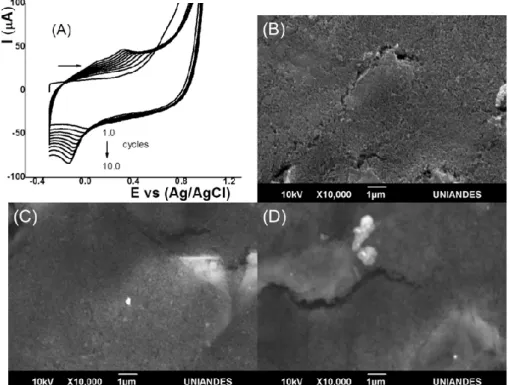
(4) Sensors 2018, 18, 2934 Sensors 2017, 17, x FOR PEER REVIEW. 3. Results and Discussion. 4 of 14 4 of 14. 3. Results and Discussion. 3.1. Characterization of CS/SPC Electrode Surface with SEM 3.1. of CS/SPC Electrode Surface with SEM −0.3 and 1.0 V at a scan rate of 0.05 V s−1 TheCharacterization IL-SC composite was electrodeposited between. for 10 cycles. Figure 1A shows voltammograms. An anodic peak andofa0.05 cathodic peak The IL‐SC composite was the electrodeposited between −0.3 and 1.0 V atcurrent a scan rate V s−1 for 10 cycles. Figure 1A shows between the voltammograms. anodic a cathodic assigned peak current were clearly observed 0.2 and 0.4 An V and −0.1peak andcurrent −0.2 V,and respectively, were clearly observed between 0.2 and 0.4 V and −0.2 V, respectively, to awas to a current quasireversible system of the imidazolium group of−0.1 the and ionic liquid [55]. Whenassigned the study quasireversible system of the imidazolium group of the ionic liquid [55]. When the study was done done only with CS and in the absence of ILs, this redox pair was not observed. This increase in only with and in the absencethe of presence ILs, this redox pair was not observed. This increasefilm in the the current in CS each cycle indicated of an IL-CS composite electrodeposited on the current in each cycle indicated the presence of an IL‐CS composite electrodeposited film on the electrode surface. Moreover, after more than 10 cycles, the current was not increased. The changes on electrode surface. Moreover, after more than 10 cycles, the current was not increased. The changes the modified electrodes surfaces were investigated by SEM. Figure 1B shows the surface of the SPC on the modified electrodes surfaces were investigated by SEM. Figure 1B shows the surface of the electrode without CS, and IL-CS composite where a nonuniform and porous surface was observed. SPC electrode without CS, and IL‐CS composite where a nonuniform and porous surface was Meanwhile, the CS/SPC (Figure 1C),(Figure a more1C), homogeneous and smooth observed.for Meanwhile, for electrode the CS/SPC electrode a more homogeneous andsurface smoothwas observed. On the other hand, the surface with the IL-CS composite (Figure 1D) showed few changes, surface was observed. On the other hand, the surface with the IL‐CS composite (Figure 1D) showed indicating a goodindicating interaction between CS and ILs. CS and ILs. few changes, a good interaction between. Figure 1. (A) Preparation of electromodified screen‐printed carbon (SPC) electrode by cyclic. Figure 1. (A) Preparation of electromodified screen-printed carbon (SPC) electrode by cyclic voltammogram (CV) (10 cycles) and scanning electron microscopy (SEM) images of the (B) SPC, voltammogram (CV) (10electrodes, cycles) and electron microscopy (SEM) images of the (B) SPC, (C) chitosan (CS)/SPC andscanning (D) ionic liquid (IL)‐CS/SPC. (C) chitosan (CS)/SPC electrodes, and (D) ionic liquid (IL)-CS/SPC.. 3.2. Raman Spectroscopy. 3.2. Raman Spectroscopy. Raman analysis showed that the experiment conducted at 638 nm provided the best Raman −1) dispersion information. For the SPC electrode, only the D band (1350 cm−1nm ) and the G band Raman analysis showed that the experiment conducted at 638 provided the(1591 bestcm Raman − 1 were observed, bothForofthe which are the characteristic bands ofcm materials with carbonaceous dispersion information. SPC electrode, only the D band (1350 ) and the G band (1591 cm−1 ) 2 The band are is related to the energybands of sp of bonding andwith is assigned to normal graphitic[56]. werestructures observed,[56]. both ofG which the characteristic materials carbonaceous structures structures. In addition, when CS was deposited on the electrode, two bands were observed at 1341 In 2 The G band is related to the energy of sp bonding and is assigned to normal graphitic structures. and 1589 cm−1, corresponding to the amino and acetamido groups, respectively [57]. In the electrode −1 addition, when CS was deposited on the electrode, two bands were observed at 1341 and 1589 cm , containing the IL‐CS electrocomposite, the CS bands were observed to shift to higher wavenumbers, corresponding to the amino and acetamido groups, respectively [57]. In the electrode containing the indicating that there was an interaction between the CS and ILs. The figures are shown as IL-CS electrocomposite, the CS bands were observed to shift to higher wavenumbers, indicating that supporting information (Figures S1–S3). there was an interaction between the CS and ILs. The figures are shown as supporting information (Figures S1–S3).
(5) Sensors 2018, 18, 2934. Sensors 2017, 17, x FOR PEER REVIEW. 5 of 14. 5 of 14. 3.3. Characterization of SPC, CS/SPC and IL-CS/SPC Electrodes by CV and EIS 3.3. Characterization of SPC, CS/SPC and IL-CS/SPC Electrodes by CV and EIS SPC-modified electrodes were studied with K4 Fe(CN)6 10.0 mmol L−1 in KCl 10.0 mmol L−1 6 10.0 SPC‐modified studied properties with K4Fe(CN) mmol L−1 CV in KCl L−1 as as test solutions to electrodes identify thewere conductive of the surface using and10.0 EIS.mmol The results test solutions identify the conductive properties the surface using CV EIS. The plot results are shown in to Figure 2. Electrochemical impedanceofanalysis is reported in and the Nyquist forare an shown in Figure 2. Electrochemical impedance analysis is reported in the Nyquist plot for an electrical circuit at high and low frequencies. The results of the EIS analysis for K4 Fe(CN)6 using SPC, 6 using electrical at high and low frequencies. The the EISelectrochemical analysis for K4Fe(CN) CS/SPC, circuit and IL-CS/SPC electrodes are shown in results Figure of 2A. The impedance forSPC, the ◦ CS/SPC, and IL‐CS/SPC electrodes are shown in Figure 2A. The electrochemical impedance for the SPC electrode exhibits a straight line with a slope to 90 at low frequencies that is associated with a SPC electrode a straight line with a[58]. slope toimpedance 90° at low frequencies that is associated with a porous surfaceexhibits and semi-infinite diffusion The of a simple faradic reaction without porous surface semi‐infinite diffusion [58]. The impedance of a simple diffusion can beand calculated in terms of a CPE, CS/CPE, and IL-CS/CPE as faradic reaction without diffusion can be calculated in terms of a CPE, CS/CPE, and IL‐CS/CPE as Rs Z(ω ) = Rs + (1) 1 + ( jω ) a Q Rct = + (1) (w) 1 + ( w) were Q thethe CPE parameters, ω isωtheisangular frequency. Q represents the differential capacity were Qand anda aare are CPE parameters, the angular frequency. Q represents the differential of the interface in the case where a = 1 [59]. capacity of the interface in the case where a = 1 [59]. The charge charge transfer transfer resistance resistance (Rct) (Rct) value value is is 35,500 These results results indicate indicate aa limitation limitation of of The 35,500 Ohm. Ohm. These the faradaic process for the SPC electrode. Similar results for Rct were reported for a system with the faradaic process for the SPC electrode. Similar results for Rct were reported for a system with unmodified SPC SPC electrodes electrodes [6]. [6]. The The SPC SPC electrode electrode coated coated with with CS CS and and the the IL‐CS IL-CS composite composite showed showed unmodified ◦ very different different response responseresults, results,first firstexhibiting exhibitinga line a line with a slope close to 45 at low frequencies very with a slope close to 45° at low frequencies that that can be associated with diffusion on a homogenous film. On the other hand, the charge transfer can be associated with diffusion on a homogenous film. On the other hand, the charge transfer resistance (Rct) it resistance (Rct) values values were were 4500 4500and and1800 1800Ohm. Ohm.These Theseresults resultsare arerelated relatedtotothe theSEM SEMresults, results,where where was observed thatthat the surfaces were were more homogenous for the electrodes with CS and composite. it was observed the surfaces more homogenous for the electrodes withIL-CS CS and IL‐CS These results imply that IL-CS/SPC electrocomposite film facilitated the electron transfer. composite. These results imply that IL‐CS/SPC electrocomposite film facilitated the electron transfer. Cyclic voltammograms Cyclic voltammograms for forthe theKK44Fe(CN) Fe(CN)66 solution solution with with KCl KCl using usingSPC, SPC,CS/SPC, CS/SPC, and and IL-CS/SPC IL‐CS/SPC electrodes are shown in Figure 2B. For the SPC electrode, the anodic and cathodic peak currents were electrodes are shown in Figure 2B. For the SPC electrode, the anodic and cathodic peak currents 63.8 and − 35.8 µA with ∆V of 0.22 V for a quasireversible reaction. When SPC electrode was coated were 63.8 and −35.8 μA with ∆V of 0.22 V for a quasireversible reaction. When SPC electrode was with CSwith and IL-CS electrocomposite, anodic andanodic cathodicand peak currentspeak werecurrents ±70.0 µA, indicating that coated CS and IL‐CS electrocomposite, cathodic were ±70.0 μA, 2+ is the same as the amount of Fe3+ , allowing a reversible redox reaction. the amount of oxidized Fe 2+ 3+ indicating that the amount of oxidized Fe is the same as the amount of Fe , allowing a reversible On thereaction. other hand, charges for SPC, CS/SPC, and IL-CS/SPC were 0.132, 0.140 redox On the the observed other hand, the observed charges for SPC, CS/SPC,electrodes and IL‐CS/SPC electrodes and 0.167 mC, respectively. results are similar those observed by to EIS, where the presence of were 0.132, 0.140 and 0.167These mC, respectively. Thesetoresults are similar those observed by EIS, CS and ILs improves the conductivity of the surface of the SPC electrode. Moreover, the background where the presence of CS and ILs improves the conductivity of the surface of the SPC electrode. current of the electrode higher than that ofelectrode the large surface area of the composite film. Moreover, theIL-CS/SPC background currentisof the IL‐CS/SPC is higher than that of the large For the electrodes modified with CS, ILs, and nanoparticles, a more considerable increase in the values surface area of the composite film. For the electrodes modified with CS, ILs, and nanoparticles, a of theconsiderable anodic and cathodic was not more increasecurrent in the values of observed the anodic[54]. and cathodic current was not observed [54].. Figure 2. (A) Nyquist plot for Fe(CN)63−/4− 10.0 mmol L−1 in KCl 10 mmol L−1 using SPC (black curve), Figure 2. (A) Nyquist plot for Fe(CN)6 3−/4− 10.0 mmol L−1 in KCl 10 mmol L−1 using SPC (black 3−/4− CS/SPC (blue curve) and IL‐CS/SPC (red curve). (B) Cyclic voltammograms of Fe(CN) curve), CS/SPC (blue curve) and IL-CS/SPC (red curve). (B) Cyclic voltammograms of Fe(CN) 3−/4− −1 −1 10.0 mmol L−1in KCl 10 mmol L −1using SPC (dash curve), CS/SPC (dash‐dot curves) and IL‐CS/SPC 10.0 mmol L in KCl 10 mmol L using SPC (dash curve), CS/SPC (dash-dot curves) and IL-CS/SPC (solid curve). Scan rate (v) 0.1 V s−1 . (solid curve). Scan rate (v) 0.1 V s−1 .. 3.4. Activity of RT Using SPC, CS/SPC and IL-CS/SPC Electrodes Electroactivity properties for RT are related to the ortho‐dihydroxy‐phenol group in the chemical structure where two proton–electron pairs can be oxidized between 0.0 and 0.5 V [60]..
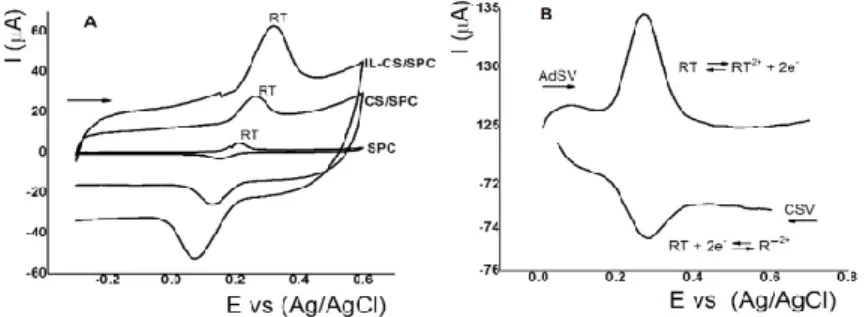
(6) Sensors 2018, 18, 2934. 6 of 14. 3.4. Activity of RT Using SPC, CS/SPC and IL-CS/SPC Electrodes Electroactivity properties for RT are related to the ortho-dihydroxy-phenol group in the chemical Sensors 2017, 17, x FOR PEER REVIEW 6 of 14 structure where two proton–electron pairs can be oxidized between 0.0 and 0.5 V [60]. Figure 3A shows the cyclic voltammograms for RT (35.0 µmol L−1 ) at 0.10 V–1 s−1 in pH 2.5 with PBS, using SPC, Figure 3A shows the cyclic voltammograms for RT (35.0 μmol L ) at 0.10 V s−1 in pH 2.5 with PBS, CS/SPC, and IL-CS/SPC electrodes. The results clearly show that RT shows activity the surface using SPC, CS/SPC, and IL‐CS/SPC electrodes. The results clearly show that RT showson activity on of the the surface three electrodes through a quasireversible reaction. The ∆E values for RT using SPC, of the three electrodes through a quasireversible reaction. The ∆E values for RTCS/SPC, using and IL-CS/SPC wereIL‐CS/SPC 0.06, 0.14,were and 0.23 respectively. results indicate that more energy SPC, CS/SPC, and 0.06, V, 0.14, and 0.23 V,These respectively. These results indicate that is required to oxidize RT with the modified electrode. This may be due to the width of the film. On more energy is required to oxidize RT with the modified electrode. This may be due to the width ofthe other the the anodic peak currents for RTpeak withcurrents SPC, CS/SPC, electrodes were 3.95, the hand, film. On other hand, the anodic for RT and withIL-CS/SPC SPC, CS/SPC, and IL‐CS/SPC 11.0, and 29.1were µA, respectively. These showed that These the current more 100% electrodes 3.95, 11.0, and 29.1results μA, respectively. resultsincreased showed by that the than current with IL-CS/SPC, indicating that theIL‐CS/SPC, concentration of RT that on the of the of IL-CS/SPC electrode increased by more than 100% with indicating the surface concentration RT on the surface 3+ in charge of the IL‐CS/SPC electrode is higher. is possible that positive of the CSinteracts as NH3+ with in is higher. It is possible that the positiveItcharge of the CSthe as NH acidic medium medium anion. interacts with the the imidazolium anion. Therefore, CS–IL composite as an theacidic imidazolium Therefore, CS–IL composite acts as anthe extraction agent for acts RT through agent for RT through an results affinity have interaction Similar beensuch reported forthe anextraction affinity interaction [47]. Similar been [47]. reported forresults other have analytes as for other analytes such as for the interaction of dopamine with ILs [61]. With respect to the potential interaction of dopamine with ILs [61]. With respect to the potential peak for RT, it was reported at more peak for RT, itwith wasILs reported at more positive values with ILs on carbon paste [33] and on sensitive glassy positive values on carbon paste [33] and CS on glassy carbon [42]. To select theCS most carbon [42]. To select the most sensitive technique, cathodic stripping voltammetry (CSV), the most technique, cathodic stripping voltammetry (CSV), the most popular stripping voltammetric technique popular voltammetric technique suitable forand the adsorptive determination of organic substances,(AdSV) and suitable forstripping the determination of organic substances, stripping voltammetry adsorptive stripping voltammetry (AdSV) that shows higher sensitivity due to the adequate that shows higher sensitivity due to the adequate accumulation potential value, were evaluated for RT accumulation potential value, were evaluated for RT oxidation. In CSV and AdSV (Figure 3B) using oxidation. In CSV and AdSV (Figure 3B) using square wave, the anodic and cathodic peak potentials square wave, the anodic and cathodic peak potentials of RT (3.5 μmol L−1) are observed at 0.28 V of RT (3.5 µmol L−1 ) are observed at 0.28 V with the cathodic and anodic peak currents of −2.36 and with the cathodic and anodic peak currents of −2.36 and 3.98 μA, respectively. These results showed 3.98 µA, respectively. These results showed that AdSV exhibit a higher response. Therefore, it has that AdSV exhibit a higher response. Therefore, it has higher sensitivity for RT analysis. AdSV is higher sensitivity for RTtechnique analysis. for AdSV is chosen as the optimal technique for subsequent studies. chosen as the optimal subsequent studies.. Figure 3. (A) Cyclic voltammograms of rutin (RT) (35.0 mmol L−1) pH 2.5 (PBS) using SPC, CS/SPC, Figure 3. (A) Cyclic voltammograms of rutin (RT) (35.0 mmol L−1 ) pH 2.5 (PBS) using SPC, CS/SPC, and IL‐CS/SPC electrodes. 0.1 V s−−11. (B) cathodic and adsorptive stripping voltammograms of RT and IL-CS/SPC electrodes. 0.1 V s . (B) cathodic and adsorptive stripping voltammograms of RT (3.5 μmol−L1−1). Conditions: pH 2.5 (PBS); cathodic stripping voltammetry (CSV): Eads 0.6 V; tads 60 s; (3.5 µmol L ). Conditions: pH 2.5 (PBS); cathodic stripping voltammetry (CSV): Eads 0.6 V; tads 60 s; adsorptive stripping voltammetry (AdSV): Eads 0.1 V; tads 60 s. Other conditions: Step amplitude adsorptive stripping voltammetry (AdSV): Eads 0.1 V; tads 60 s. Other conditions: Step amplitude 0.01 V; pulse amplitude 0.05 mV; and frequency 15 Hz. 0.01 V; pulse amplitude 0.05 mV; and frequency 15 Hz.. 3.5. Influence of the Scan Rate of RT on the IL-CS/SPC Electrode. 3.5. Influence of the Scan Rate of RT on the IL-CS/SPC Electrode. The mass‐transfer process for RT on the IL‐CS/SPC electrode was studied to elucidate the The mass-transfer process for anodic RT on peak the IL-CS/SPC was studied elucidate influence of the scan rate (ʋ) on the current at pHelectrode 2.5 (Figure 4A). Anodicto peak currentsthe influence of the at scan on the 0.02 anodic pH 2.5 (Figure 4A). Anodic peak were studied therate rates(ν) between andpeak 0.10 current V s−1. A at linear trend was observed at low andcurrents high −1 . A linear trend was observed at low were studied at the rates between 0.02 and high scan rates. The regression equation was ipa 0.10 (μA)V= s−4.549 + 0.439ν (correlation coefficient R2 =and 0.995). 2 This result indicates thatequation the process onipthe IL‐CS/SPC electrode is adsorption‐controlled. scan rates. The regression was = −4.549 + 0.439ν (correlation coefficientMoreover, R = 0.995). a (µA) theresult plotsindicates of the dependence of the peak potentials vs.islnadsorption-controlled. ν for RT are fitted with the This that the process onanodic the IL-CS/SPC electrode Moreover, equation of Epaof(V) −0.033 peak + 0.069 ln ν (correlation coefficient R2 = 0.990). This slope theregression plots of the dependence the= anodic potentials vs. ln ν for RT are fitted with the regression value isofclose value Nernst equation. This linear relationship indicates thatisthe equation Epa to (V)the =− 0.033of+0.059 0.069inlnthe ν (correlation coefficient R2 = 0.990). This slope value close +:2e−. Similar results were reported for RT using electro‐oxidation of RT shows a stoichiometry of 2H to the value of 0.059 in the Nernst equation. This linear relationship indicates that the electro-oxidation − . and carbon nanotubes [42] ionicresults liquid‐modified carbon‐paste electrodes [33]. of Cu–CS/MWCNT RT shows a stoichiometry of 2H+ :2e Similar were reported for RT using Cu–CS/MWCNT. carbon nanotubes [42] and ionic liquid-modified carbon-paste electrodes [33]..
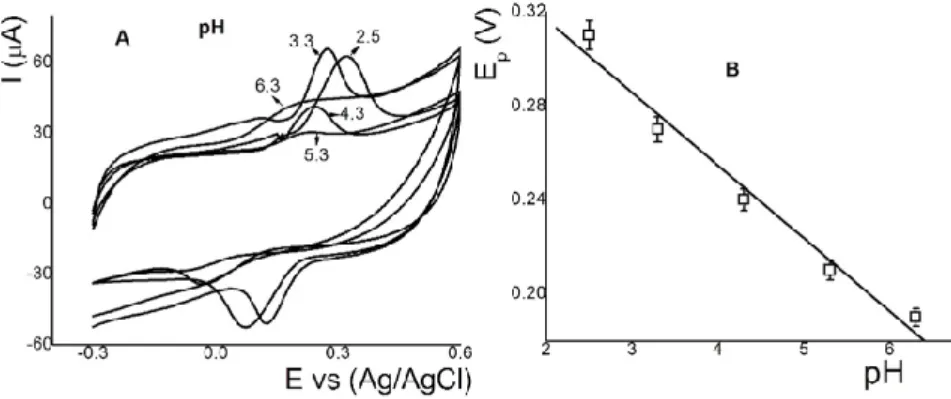
(7) Sensors 2018, 18, 2934. Sensors 2017, 17, x FOR PEER REVIEW Sensors 2017, 17, x FOR PEER REVIEW. 7 of 14. 7 of 14 7 of 14. Figure 4. 4. (A) Voltammograms and (B)(B) plots ofof the dependence ofof anodic peak potentials vs.vs. ln ln ν for Figure (A) Voltammograms and plots the dependence anodic peak potentials ν for –1)−using RTRT (35.0 μmol L IL‐CS/SPC electrode. 1 (35.0 µmol ) using IL-CS/SPC electrode. Figure 4. (A)LVoltammograms and (B) plots of the dependence of anodic peak potentials vs. ln ν for RT (35.0 μmol L–1) using IL‐CS/SPC electrode.. 3.6. Effect of pH on the Anodic Peak Current of RT on the IL-CS/SPC Electrode 3.6. Effect of pH on the Anodic Peak Current of RT on the IL-CS/SPC Electrode 3.6. Effect of pH on the Anodic Peak Current RTthe on the Adsorptive properties depend largely ofon pHIL-CS/SPC value inElectrode the electrochemical cell. The pH Adsorptive properties depend largely on the pH value in the electrochemical cell. The pH influenceAdsorptive on anodic peak current for RT was studied pH range using PBS (0.001 mol pH L–1) properties depend the at pH value in 2.5–6.3 the electrochemical cell. The influence on anodic peak current for largely RT wason studied at pH range 2.5–6.3 using PBS (0.001 mol L−1 ) –1 −1 withinfluence 35.0 μmol of RTpeak (0.1current V s ) (Figure 5A). studied Anodicatpeak forusing RT were slightly onLanodic for RT was pH potentials range 2.5–6.3 PBS shifted (0.001 mol L–1) with 35.0 µmol L−1 of RT (0.1 V s−1 ) (Figure 5A). Anodic peak potentials for RT were shifted slightly −1) (Figure 5A). withmore 35.0 μmol L–1 of RT (0.1 V sincreasing Anodic peakthat potentials RT were shifted slightly toward negative values with pH, suggesting protonsforparticipate directly in the toward more negative values with increasing pH, suggesting that protons participate directly in the toward negative values increasing pH, was suggesting that participate in the oxidation ofmore RT. The anodic peakwith current maximum obtained at protons pH 2.5 and this pHdirectly was used for oxidation of RT. The anodic peak current maximum was obtained at pH 2.5 and this pH was used for oxidation of RT. The anodic peak current was obtained pH 2.5peak and potentials this pH wasonused further experiments. Moreover, the plots ofmaximum the dependence of the at anodic pH for for further experiments. Moreover, the plots of the dependence of the anodic peak potentials on pH for RT furtherfitted experiments. Moreover, the equation plots of the dependence of the peak potentials on pH for RT were with the regression Epa (V) = 0.368 + anodic 0.049pH (correlation coefficient were fitted with the regression equation Epa (V) = 0.368 + 0.049pH (correlation coefficient R2 = 0.992). RT were fitted with the regression equation Epa (V) = 0.368 + 0.049pH (correlation coefficient 2 R = 0.992). This value of the slope value is close to the value of 0.059 in the Nernst equation. This This value of the slope value is close tovalue the value of 0.059 the Nernst equation. This linear relationship R2relationship = 0.992). This value of that the slope is close to for theinavalue of 0.059 in the Nernst linear indicates the electro‐oxidation quasireversible reaction of equation. RT showsThis the indicates that the electro-oxidation for a quasireversible reaction of RT shows theofstoichiometry of linear relationship indicates that the electro‐oxidation for a quasireversible reaction RT shows the + − stoichiometry of 2H :2e . These results are the same as those described in Section 3.3 and as previously + :2e− . These 2Hstoichiometry results are the same as those described in Section 3.3 and as previously reported + − of 2H :2e . These results are the same as those described in Section 3.3 and as previously in reported in the literature [62]. thereported literature [62]. in the literature [62].. −1 of RT, Figure 5 Voltammograms (A) Voltammograms of the effect of the pH (6.3, 5.3,4.3, 4.3,3.3, 3.3,and and2.5) 2.5)for for35.0 35.0 μmol μmol L−1 Figure 5 (A) of of the effect of of thethe pH (6.3, 5.3, Figure 5. (A) Voltammograms the effect pH (6.3, 5.3, 4.3, 3.3, and 2.5) for 35.0 µmol L−of1 RT, of RT, and (B) plots of the dependence anodicpeak peakpotentials potentialsvs. vs. pH for for RT using using IL‐CS/SPC. IL‐CS/SPC. and of the the dependence of of anodic and(B) (B)plots plots of dependence of anodic peak potentials vs. pH for pH RT usingRT IL-CS/SPC. Conditions: Conditions: scan −rate of 0.1 V. s−1. Conditions: scan V s−1 1 . 0.1 scan rate of 0.1 rate V s of. ADS) and SWV Parameters 3.7. Influence of Adsorption the Adsorption Time (tADS ), Adsorption Potential(E(E ADS) and SWV Parameters 3.7. Influence of the Time (tADS ), Adsorption Potential 3.7. Influence of the Adsorption Time (tADS ), Adsorption Potential (EADS ) and SWV Parameters To optimize adsorption of RT IL‐CS/CPEsurface, surface,tADS tADS, ,EEADS ADS, and SWV parameters were To optimize the the adsorption of RT onon thethe IL‐CS/CPE , and SWV parameters were To optimize the adsorption of RT on the IL-CS/CPE surface, t , EADS , and parameters −1 ADS studied with an RT concentration of 3.5 μmol L . The results showed that with an SWV increase in the studied with an RT concentration of 3.5 μmol L−1. The−results showed that with an increase in the 1 were studied with an RT concentration of 3.5 µmol L . The results showed that with an increase adsorption time, the anodic peak current increased to 60 s, with no increase observed for longer time. in adsorption time, the anodic peak current increased to 60 s, with no increase observed for longer time. theThis adsorption peakof current increased to 60 s, increase observed may be time, due tothe theanodic saturation the electrode surface. 60with s is no chosen as the optimal for tADSlonger for This may be due to the saturation of the electrode surface. 60 s is chosen as the optimal tADS for time. This maystudies. be dueEto of the electrode 60 results s is chosen as the optimal subsequent wassaturation studied between −0.2 and surface. 0.2 V. The showed that anodictpeak ADSthe ADS for subsequent studies. EADS was studied between −0.2 and 0.2 V. The results showed that anodic peak subsequent studied between −0.2 and 0.2 that anodic peak current forstudies. RT was Ehigher at the positive potential values. 0.1 V. V The was results chosen showed as the optimal potential ADS was current for RT was higher at the positive potential values. 0.1 V was chosen as the optimal potential value.for This value is positive not high potential enough tovalues. oxidize0.1 RT.VTherefore, RTaswas on the current RTpotential was higher at itthe was chosen theadsorbed optimal potential value. This potential value it is The not effects high enough to oxidize Therefore, RTaswas on the IL‐CS/SPC electrode surface. of the square waveRT. parameters, such the adsorbed pulse amplitude IL‐CS/SPC electrode surface. The effects of the square wave parameters, such as the pulse amplitude (V) and frequency (Hz), on the anodic peak current were also studied in the ranges of 0.01–0.1 V (V) and frequency (Hz), on the anodic peak current were also studied in the ranges of 0.01–0.1 V.
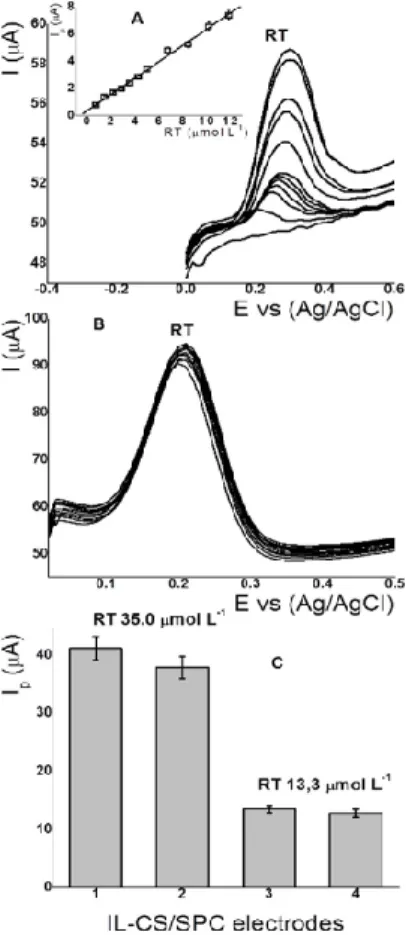
(8) Sensors 2018, 18, 2934. 8 of 14. value. This potential value it is not high enough to oxidize RT. Therefore, RT was adsorbed on the IL-CS/SPC electrode surface. The effects of the square wave parameters, such as the pulse amplitude Sensors 2017, 17, x FOR PEER 8 of V 14 and (V) and frequency (Hz), onREVIEW the anodic peak current were also studied in the ranges of 0.01–0.1 5.0–30.0 Hz, respectively. The anodic peak current for RT increased with the increase in the pulse and 5.0–30.0 Hz, respectively. The anodic peak current for RT increased with the increase in the amplitude and frequency to 0.09 V and 10.0 Hz, respectively. Therefore, these values were chosen as pulse amplitude and frequency to 0.09 V and 10.0 Hz, respectively. Therefore, these values were optimal for the subsequent studies. chosen as optimal for the subsequent studies.. 3.8. Analytical Parameters, Stability and Repeatability 3.8. Analytical Parameters, Stability and Repeatability. Figure 6 shows the voltammograms of the calibration curve (calibration-curve insert), stability, and Figure 6 shows the voltammograms of the calibration curve (calibration‐curve insert), stability, reproducibility of the IL-SC/SPC electrode. Detection limits waswas calculated from thethe calibration curve and reproducibility of the IL‐SC/SPC electrode. Detection limits calculated from calibration −1 of RT with the optimized conditions: pH 2.5 (0.01 mol L−1 obtained between 0.75 and 12.5 µmol L −1 curve obtained between 0.75 and 12.5 μmol L of RT with the optimized conditions: pH 2.5 PBS), EADS 0.1L–1V,PBS), and tEADS equation for the anodicfor peak (Figure 6A) was ADS 60 (0.01 mol 0.1 s.V,The andregression tADS 60 s. The regression equation the currents anodic peak currents 2 = 0.997). Ipa = 0.397 6A) ± 0.01 0.596 ± 0.09C (correlation coefficient R2coefficient = 0.997). R The DL obtained RT based (Figure was+Ipa = 0.397 ± 0.01RT + 0.596 ± 0.09CRT (correlation The DL for obtained −1 . The for values RT based values of the the slopes anderrors the random errors in x0.07 andµmol y wasL0.07 μmolstability L−1. The and on the of on thethe slopes and random in x and y was stability and durability of the sensor was evaluated by performing SWAdV after 10 consecutive durability of the sensor was evaluated by performing SWAdV after 10 consecutive measurements for a RT concentration 35.0 results μmol L−1are . The results shown Figure 6B. Anodic for ameasurements RT concentration of 35.0 µmol L−1of. The shown inare Figure 6B.inAnodic peak currents peak currents for RT increased by only approximately 5.0%. This corresponds to the increase of for RT increased by only approximately 5.0%. This corresponds to the increase of 0.5% in the current 0.5% in the current (μA) for each measurement. Moreover, the relative standard deviation (RSD) (µA) for each measurement. Moreover, the relative standard deviation (RSD) was 0.86% (n = 10). was 0.86% (n = 10). The reproducibility was 1.5% (n = 7) for RT (35.0 and 13 μmol L–1) using four The reproducibility was 1.5% (n = 7) for RT (35.0 and 13 µmol L−1 ) using four different electrodes different electrodes (Figure 6C). These results indicate that the performance of the sensor allows it (Figure 6C). These results indicate that the performance of the sensor allows it to be used for a long to be used for a long period of time without an appreciable reduction in its activity. The proposed period of time without an appreciable its activity. Thetoproposed method electrodes, using IL-CS/CPE method using IL‐CS/CPE for RT reduction detection in was compared other modified as for RT detection was compared to other modified electrodes, as summarized in Table 1. summarized in Table 1.. Figure 6. (A) Adsorptive voltammograms and calibration curve (insert) of RT between 0.75−12.5 −1 Figure 6. (A) Adsorptive voltammograms and calibration curve (insert) of RT between 0.75−12.5 µmol L ; μmol L−1; (B) adsorptive voltammograms (n = 10) for RT 35.0 μmol L−1; (C) and anodic peak current for (B) adsorptive voltammograms (n = 10) for RT 35.0 µmol L−1 ; (C) and anodic peak current for RT 35.0 and RT 35.0 and 13.3 μmol L−1 using four different CS/SPC electrodes. Conditions: pH 2.5; EADS 0.1 V; 13.3 µmol L−1 using four different CS/SPC electrodes. Conditions: pH 2.5; EADS 0.1 V; tADS 60 s. tADS 60 s..
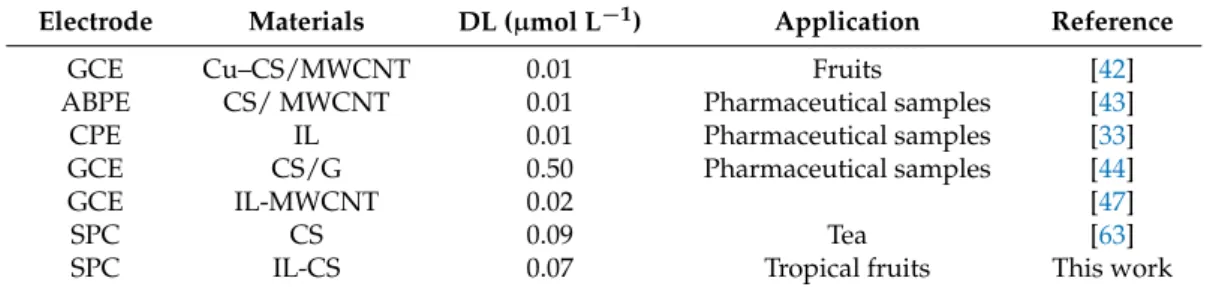
(9) Sensors 2018, 18, 2934. 9 of 14. Table 1. Modified electrodes for rutin determination. Sensors 2017, 17, x FOR PEER REVIEW. Electrode. Materials. DL (µmol L−1 ). 9 of 14. Application. Reference. Table 1. Modified electrodes for rutin determination. GCE Cu–CS/MWCNT 0.01 Fruits [42] ABPE Electrode CS/ MWCNT 0.01 Pharmaceutical samples [43] −1 Materials DL (µmol L ) Application Reference CPE IL 0.01 Pharmaceutical samples [42] [33] GCE Cu–CS/MWCNT 0.01 Fruits GCE CS/G 0.50 Pharmaceutical samples [44] ABPE CS/ MWCNT 0.01 Pharmaceutical samples [43] GCE IL-MWCNT 0.02 [47] CPE IL 0.01 Pharmaceutical samples [33] SPC CS 0.09 Tea [63] GCE CS/G 0.50 Pharmaceutical samples [44] SPC IL-CS 0.07 Tropical fruits This work GCE IL‐MWCNT 0.02 [47]. 3.9.. GCE: glassy carbon black paste electrode; Cu–CS/MWCNT: SPCelectrode; CPE: CScarbon paste electrode; 0.09 ABPE: acetyleneTea [63] copper-complexed carbon nanotubes; G-CS-polyAA: nanosheets, chitosan, and a SPCchitosan/multiwalled IL‐CS 0.07 Tropicalgraphene fruits This work poly (amido amine). GCE: glassy carbon electrode; CPE: carbon paste electrode; ABPE: acetylene black paste electrode; Cu–CS/MWCNT: copper‐complexed chitosan/multiwalled carbon nanotubes; G‐CS‐polyAA: Interference, Validation and Studyand a poly (amido amine). graphene nanosheets, chitosan,. The possible interfering substances in the detection of RT with the IL-CS/SPC electrode were 3.9. Interference, Validation and Study evaluated by the amperometric technique at 0.3 V with metal ions using an ICP multielement standard The possiblecontaining interfering As, substances the detection RTSe, with theTlIL‐CS/SPC were −1 , hydroquinone solution IX (Merck) Be, Cd,inCr(VI), Hg, Ni,ofPb, and 100 mg Lelectrode evaluated by the amperometric technique at 0.3 V with metal ions using an ICP multielement (HQ), catechol (CT), uric acid (UA), ascorbic acid (AA), dopamine (DP), dye colors such as tartrazine standard solution IX (Merck) containing As, Be, Cd, Cr(VI), Hg, Ni, Pb, Se, and Tl 100 mg L−1, (TZ) and sunset yellow (SY), and others flavonoids such as quercetin (QC) and morin (MR) in hydroquinone (HQ), catechol (CT), uric acid (UA), ascorbic acid (AA), dopamine (DP), dye colors concentrations ten times Theyellow results(SY), showed that only HQ and cause(QC) interference such as tartrazine (TZ)higher. and sunset and others flavonoids suchCT as can quercetin and with morin the signal RT. Figure 7Aten shows amperograms for RT that in the presence (MR)for in concentrations times the higher. The results showed only HQ andof CTthe cansubstances cause mentioned above. These resultsforsuggest that7A theshows IL-SC/SPC electrode for canRT beinused for the analysis interference with the signal RT. Figure the amperograms the presence of the of natural samplesmentioned and foods. substances above. These results suggest that the IL‐SC/SPC electrode can be used for the analysis of natural samples and foods. The accuracy for RT detection using the IL-CS/SPC electrode was evaluated with the standard The accuracy for RT detection IL‐CS/SPC evaluated with the control urine chemistry from Bio-Rad using spikedthe with knownelectrode amountswas of RT. The results are standard summarized control urine chemistry from Bio‐Rad spiked with known amounts of RT. The resultsaccuracy, are in Table 2. The relative error of the four samples were close to 10.0%, indicating acceptable summarized in Table 2. The relative error of the four − samples were close to 10.0%, indicating considering the concentration of smaller than 5.0 µmol L 1 . Moreover, the slopes of the calibration acceptable accuracy, considering the concentration of smaller than 5.0 μmol L−1. Moreover, the curves for RT were 1.18, 1.09, and 0.90. The small differences in the slope values indicate that the slopes of the calibration curves for RT were 1.18, 1.09, and 0.90. The small differences in the slope matrix of theindicate samplethat didthe notmatrix affect the activity of the Thethevoltammograms for sample values of the sample did sensor. not affect activity of the sensor. The 1 of Tablevoltammograms 2 are shown in for Figure 7A. sample 1 of Table 2 are shown in Figure 7A.. Figure 7. (A) Amperograms for RT with morin (MR), quercetin (QC), metal ions, hydroquinone. Figure 7. (A) Amperograms for RT with morin (MR), quercetin (QC), metal ions, hydroquinone (HQ), (HQ), catechol (CT), dopamine (DP), ascorbic acid (AA), uric acid (UA), tartrazine (TZ), sunset catechol (CT), dopamine (DP), ascorbic acid (AA), uric acid (UA), tartrazine sunset yellow yellow (SY) and (B) adsorptive voltammograms and calibration curves (inset) of(TZ), sample 1 * (Table 2). (SY) and (B) adsorptive voltammograms and curves (inset)6.of sample 1 * (Table 2). Using the Using the IL‐CS/SPC electrode under thecalibration same conditions as Figure IL-CS/SPC electrode under the same conditions as Figure 6..
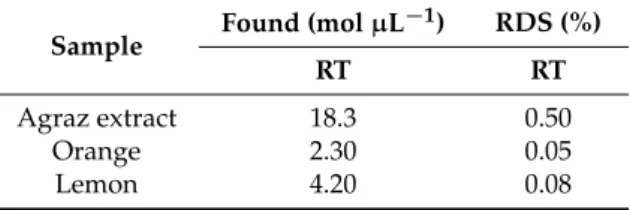
(10) Sensors 2018, 18, 2934. 10 of 14. Table 2. Results for RT in urine chemistry control standard. Sample. Added (µmol L−1 ). Found (µmol L−1 ). % Relative error. 1* 2 3 4. 1.74 1.74 3.50 3.50. 1.94 ± 0.01 1.95 ± 0.02 3.92 ± 0.05 3.72 ± 0.04. 11.5 12.1 12.0 6.3. * voltammograms are shown in Figure 7B (insert calibration curve).. 3.10. Analytical Application An IL-CS/SPC electrode was used in the detection and quantification of RT in tropical fruits such as orange, lemon, and agraz (Vaccinium meridionale Swartz) obtained at a supermarket in Ibagué, Colombia. The concentrations of RT were calculated by standard addition. Each sample was analyzed at pH 2.5 with PBS. The results are shown in Table 3. These results were similar to a previous report where the concentration of RT was found to be higher in lemon than in orange [42]. Moreover, the amount of RT detected in agraz was higher and was similar to the amount of RT detected in grapefruit by capillary electrophoresis [63] and electroanalytical method [64]. Table 3. Results for RT in tropical fruit samples.. Sample Agraz extract Orange Lemon. Found (mol µL−1 ). RDS (%). RT. RT. 18.3 2.30 4.20. 0.50 0.05 0.08. 4. Conclusions The IL-CS composite deposited onto SPC electrode showed high activity and selectivity towards RT oxidation. Moreover, it allowed the detection and quantification in natural samples without any pretreatment. Additionally, the sensor was shown to be stable, reproducible, sensitive, and easily developed. Supplementary Materials: The following are available online at http://www.mdpi.com/1424-8220/18/9/2934/ s1, Raman spectroscopy of SPC, CS/SPC and IL-CS/SPC. Were performed in a RIBA Yovin-Ivon spectrometer (Kyoto, Japan) using various laser wavelengths (532, 638, and 786 nm). Author Contributions: L.M. and O.G.-B. contributed to the sample agraz extraction. V.A. and E.N. contributed to the characterization, pH, detection limits, and validation study. J.J.H. contributed to the SEM and Raman spectroscopy study. Funding: The authors E.N. thank the financial support to the Universidad de Ibagué (projects 18-541-INT and 16-416-INT). Acknowledgments: The authors J.J.H. express their thanks to the Universidad de los Andes for financial support from the Interfaculty project and the Faculty of Sciences. Conflicts of Interest: The authors declare no conflict of interest.. References 1.. 2.. Yang, S.; Liu, X.; Zeng, X.; Xia, B.; Gu, J.; Luo, S.; Mai, N.; Wei, W. Fabrication of nano-copper/carbon nanotubes/chitosan film by one-step electrodeposition and its sensitive determination of nitrite. Sens. Actuators B-Chem. 2010, 145, 762–768. [CrossRef] Kang, X.; Wang, J.; Wu, H.; Aksay, I.A.; Liu, J.; Lin, Y. Glucose Oxidase-graphene-chitosan modified electrode for direct electrochemistry and glucose sensing. Biosens. Bioelectron. 2009, 25, 901–905. [CrossRef] [PubMed].
(11) Sensors 2018, 18, 2934. 3.. 4. 5. 6.. 7.. 8.. 9.. 10.. 11.. 12.. 13.. 14.. 15.. 16.. 17. 18. 19. 20. 21.. 11 of 14. Xu, C.; Cai, H.; He, P.; Fang, Y. Electrochemical detection of sequence-specific DNA using a DNA probe labeled with aminoferrocene and chitosan modified electrode immobilized with ssDNA. Analyst 2001, 126, 62–65. [CrossRef] [PubMed] Sun, P.; Armstrong, D.W. Ionic liquids in analytical chemistry. Anal. Chim. Acta 2010, 661, 1–16. [CrossRef] [PubMed] Opallo, M.; Lesniewski, A. A review on electrodes modified with ionic liquids. J. Electroanal. Chem. 2011, 656, 2–16. [CrossRef] Nagles, E.; García-Beltrán, O.; Calderon, J.A. Evaluation of the usefulness of a novel electrochemical sensor in detecting uric acid and dopamine in the presence of ascorbic acid using a screen-printed carbon electrode modified with single walled carbon nanotubes and ionic liquids. Electrochim. Acta 2017, 258, 512–523. [CrossRef] Ping, J.; Wu, J.; Wang, Y.; Ying, Y. Simultaneous determination of ascorbic acid, dopamine and uric acid using high performance screen-printed graphene electrode. Biosens. Bioelectron. 2010, 34, 70–76. [CrossRef] [PubMed] Niu, X.; Yang, W.; Guo, H.; Ren, J.; Yang, F.; Gao, J. A novel and simple strategy for simultaneous determination of dopamine, uric acid and ascorbic acid based on the stacked graphene platelet nanofibers/ionic liquids/chitosan modified electrode. Talanta 2012, 99, 984–988. [CrossRef] [PubMed] Pandurangachar, M.; Kumara Swamy, B.E.; Chandrashekar, B.N.; Gilbert, O.; Sherigara, B.S. Electrochemical deposition of 1-butyl-4-methyl-pyridinium tetrafluroborate ionic liquid on carbon paste electrode and its application for the simultaneous determination of dopamine, ascorbic acid and uric acid. J. Mol. Liq. 2011, 158, 13–17. [CrossRef] Hu, S.; Wang, Y.; Wang, X.; Xu, L.; Xiang, J.; Sun, W. Electrochemical detection of hydroquinone with a gold nanoparticle and graphene modified carbon ionic liquid electrode. Sens. Actuators B-Chem. 2012, 168, 27–33. [CrossRef] Beitollahi, H.; Tajik, S.; Biparva, P. Electrochemical determination of sulfite and phenol using a carbon paste electrode modified with ionic liquids and graphene nanosheets: Application to determination of sulfite and phenol in real samples. Measurement 2014, 56, 170–177. [CrossRef] Beitollahi, H.; Tajik, S.; Jahani, S. Electrocatalytic Determination of Hydrazine and Phenol Using a Carbon Paste Electrode Modified with Ionic Liquids and Magnetic Core-shell Fe3 O4 @SiO2 /MWCNT Nanocomposite. Electroanalysis 2016, 28, 1093–1099. [CrossRef] Majidi, M.R.; Baj, R.F.B.; Bamorowat, M. Ionic liquid modified carbon-ceramicelectrode with structure similar to Graphene nanoplatelets: Application to Imidacloprid determination in some agricultural products. Measurement 2016, 93, 29–35. [CrossRef] River-Guzman, K.; Franco, L.M.; García-Beltrán, O.; Calderon, J.A.; Nagles, E. Electochemical Detection of Imidacloprid Using a Screen Printed Single Walled Carbon Nanotubes Coated with and Ionic Liquids. Int. J. Electrochem. Sci. 2018, 13, 5775–5787. [CrossRef] Wang, Z.; Wang, H.; Zhang, Z.; Liu, G. Electrochemical determination of lead and cadmium in rice by a disposable bismuth/electrochemically reduced graphene/ionic liquid composite modified screen-printed electrode. Sens. Actuators B-Chem. 2014, 199, 7–14. [CrossRef] Chaiyo, S.; Mehmeti, E.; Žagar, K.; Siangproh, W.; Chailapakul, O.; Kalcher, K. Electrochemical sensors for the simultaneous determination of zinc, cadmium and lead using a Nafion/ionic liquid/graphene composite modified screen-printed carbon electrode. Anal. Chim. Acta 2016, 918, 26–34. [CrossRef] [PubMed] Ahmad, W.; Al-Sibaai, A.A.; Bashammakh, A.S.; Alwael, H.; El-Shahawi, M.S. Recent advances in dispersive liquid-liquid microextraction for pesticide analysis. TrAC-Trend Anal. Chem. 2015, 72, 181–192. [CrossRef] Chen, Q.; Xu, A.; Li, Z.; Wang, J.; Zhang, S. Influence of anionic structure on the dissolution of chitosan in 1-butyl-3-methylimidazolium-based ionic liquids. Green Chem. 2011, 13, 3446–3452. [CrossRef] Xie, H.; Zhang, S.; Li, S. Chitin and chitosan dissolved in ionic liquids as reversible sorbents of CO2 . Green Chem. 2006, 8, 630–633. [CrossRef] Wang, Q.; Zheng, J.; Zhang, H. A novel formaldehyde sensor containing AgPd alloy nanoparticles electrodeposited on an ionic liquid–chitosan composite film. J. Electroanal. Chem. 2012, 674, 1–6. [CrossRef] Xiao, F.; Liu, L.; Li, J.; Zeng, J.; Zeng, B. Electrocatalytic Oxidation and Voltammetric Determination of Nitrite on Hydrophobic Ionic Liquid-Carbon Nanotube Gel-Chitosan Composite Modified Electrodes. Electroanalysis 2008, 20, 2047–2054. [CrossRef].
(12) Sensors 2018, 18, 2934. 22.. 23.. 24.. 25.. 26.. 27.. 28.. 29. 30. 31.. 32. 33. 34. 35.. 36.. 37.. 38.. 39.. 40.. 12 of 14. Safavi, A.; Farjami, F. Electrodeposition of gold–platinum alloy nanoparticles on ionic liquid–chitosan composite film and its application in fabricating an amperometric cholesterol biosensor. Biosens. Bioelectron. 2011, 26, 2547–2552. [CrossRef] [PubMed] MansouriMajd, S.; Teymourian, H.; Salimi, A.; Hallaj, R. Fabrication of electrochemical theophylline sensor based on manganese oxide nanoparticles/ionic liquid/chitosannanocomposite modified glassy carbon electrode. Electrochim. Acta 2013, 108, 707–716. [CrossRef] Ragupathy, D.; Iyengar Gopalan, A.; Pill Lee, K. Synergistic contributions of multiwall carbon nanotubes and gold nanoparticles in a chitosan–ionic liquid matrix towards improved performance for a glucose sensor. Electrochem. Commun. 2009, 11, 397–401. [CrossRef] Yu, Q.; Shi, Z.; Liu, X.; Luo, S.; Wei, W. A nonenzymatic hydrogen peroxide sensor based on chitosan-copper complexes modified multi-wall carbon nanotubes ionic liquid electrode. J. Electroanal. Chem. 2011, 655, 92–95. [CrossRef] Franzoi, A.C.; Cruz Vieira, I.; Dupont, J.; Weber Scheeren, C.; de Oliveira, L.F. Biosensor for luteolin based on silver or gold nanoparticles in ionic liquid and laccase immobilized in chitosan modified with cyanuric chloride. Analyst 2009, 134, 2320–2328. [CrossRef] [PubMed] Sun, W.; Qin, P.; Gao, H.; Lic, G.; Jiao, K. Electrochemical DNA biosensor based on chitosan/nano-V2 O5 /MWCNTs composite film modified carbon ionic liquid electrode and its application to the LAMP product of Yersinia enterocolitica gene sequence. Biosens. Bioelectron. 2010, 25, 1264–1270. [CrossRef] [PubMed] Sun, W.; Qi, X.; Chen, Y.; Liu, S.; Gao, H. Application of chitosan/Fe3 O4 microsphere-graphene composite modified carbon ionic liquid electrode for the electrochemical detection of the PCR product of soybean Lectin gene sequence. Talanta 2011, 87, 106–112. [CrossRef] [PubMed] Caló, V.; Nacci, A.; Monopoli, A.; Fornaro, A.; Sabbatini, L.; Cioffi, N.; Ditaranto, N. Heck Reaction Catalyzed by Nanosized Palladium on Chitosan in Ionic Liquids. Organometallics 2004, 23, 5154–5158. [CrossRef] Singh, P.K.; Bhattacharya, B.; Nagarale, R.K.; Kim, K.; Rhee, H. Synthesis, characterization and application of biopolymer-ionic liquid composite membranes. Synth. Met. 2010, 160, 139–142. [CrossRef] Lu, X.; Hu, J.; Yao, X.; Wang, Z.; Li, J. Composite System Based on Chitosan and Room-TemperatureIonic Liquid: Direct Electrochemistry and Electrocatalysis of Hemoglobin. Biomacromolecules 2006, 7, 975–980. [CrossRef] [PubMed] Xi, F.; Liu, L.; Wu, Q.; Lin, X. One-step construction of biosensor based on chitosan-ionic liquid-horseradish peroxidase biocomposite formed by electrodeposition. Biosens. Bioelectron. 2008, 24, 29–34. [CrossRef] [PubMed] Zhang, Y.; Zheng, J. Direct electrochemistry and electrocatalysis of cytochrome c based on chitosan–room temperature ionic liquid-carbon nanotubes composite. Electrochim. Acta 2008, 54, 749–754. [CrossRef] Lu, X.; Zhang, Q.; Zhang, L.; Li, J. Direct electron transfer of horseradish peroxidase and its biosensor based on chitosan and room temperature ionic liquid. Electrochem. Commun. 2006, 8, 874–878. [CrossRef] Zeng, X.; Li, X.; Xing, L.; Liu, X.; Luo, S.; Wei, W.; Kong, B.; Li, Y. Electrodeposition of chitosan-ionic liquid-glucose oxidase biocomposite onto nano-gold electrode for amperometric glucose sensing. Biosens. Bioelectron. 2009, 24, 2898–2903. [CrossRef] [PubMed] Wang, Q.; Tang, H.; Xie, Q.; Tan, L.; Zhang, Y.; Li, B.; Yao, S. Room-temperature ionic liquids/multi-walled carbon nanotubes/chitosan composite electrode for electrochemical analysis of NADH. Electrochim. Acta 2007, 52, 6630–6637. [CrossRef] Gopalan, A.I.; Lee, K.; Ragupathy, D. Development of a stable cholesterol biosensor based on multi-walled carbon nanotubes–gold nanoparticles composite covered with a layer of chitosan–room-temperature ionic liquid network. Biosens. Bioelectron. 2009, 24, 2211–2217. [CrossRef] [PubMed] Niu, X.; Yang, W.; Ren, J.; Guo, H.; Long, S.; Chen, J.; Gao, J. Electrochemical behaviors and simultaneous determination of guanine and adenine based on graphene–ionic liquid–chitosan composite film modified glassy carbon electrode. Electrochim. Acta 2012, 80, 346–353. [CrossRef] Wang, Q.; Wang, Y.; Liu, S.; Wang, L.; Gao, F.; Gao, F.; Sun, W. Voltammetric detection of bisphenol a by a chitosan–graphene composite modified carbon ionic liquid electrode. Thin Solid Films 2012, 520, 4459–4464. [CrossRef] Roseghini, R.; Rocha, D.S.; Clarêncio, J.; Costa, S.L.; Costa, M.F.D.; Tardy, M.; Nascimento, R.; Schaer, R.; Velozo, E.; Meyer, R.; et al. Flavonoid Rutin Alters the Viability and Function of Mitogen-Stimulated Splenocytes and Thymocytes Compared with Non Stimulated Cells. Immunopharmacol. Immunotoxicol. 2007, 29, 275–281. [CrossRef] [PubMed].
(13) Sensors 2018, 18, 2934. 41.. 42.. 43.. 44. 45.. 46.. 47. 48.. 49. 50.. 51.. 52. 53.. 54.. 55.. 56. 57.. 58. 59.. 13 of 14. Sapozhnikova, Y. Development of liquid chromatography-tandem mass spectrometry method for analysis of polyphenolic compounds in liquid samples of grape juice, green tea and coffee. Food Chem. 2014, 150, 87–93. [CrossRef] [PubMed] Gholivand, M.B.; Mohammadi-Behzad, L.; Hosseinkhani, H. Application of a Cuechitosan/multiwalled carbon nanotube film-modified electrode for the sensitive determination of rutin. Anal. Biochem. 2016, 493, 35–43. [CrossRef] [PubMed] Deng, P.; Xu, Z.; Li, J. Simultaneous determination of ascorbic acid and rutin in pharmaceutical preparations with electrochemical method based on multi-walled carbon nanotubes-chitosan composite film modified electrode. J. Pharm. Biomed. 2013, 76, 234–242. [CrossRef] [PubMed] An, J.; Bi, Y.; Yang, C.; Hu, F.; Wang, C. Electrochemical study and application on rutin at chitosan/graphene films modified glassy carbon electrode. J. Pharm. Anal. 2013, 3, 102–108. [CrossRef] [PubMed] Yin, H.; Zhou, Y.; Cui, L.; Liu, T.; Ju, P.; Zhu, L.; Ai, S. Sensitive voltammetric determination of rutin in pharmaceuticals, human serum, and traditional Chinese medicines using a glassy carbon electrode coated with graphene nanosheets, chitosan, and a poly(amido amine) dendrimer. Microchim. Acta 2011, 173, 337–345. [CrossRef] Sun, W.; Yang, M.; Li, Y.; Jiang, Q.; Liu, S.; Jiao, K. Electrochemical behavior and determination of rutin on a pyridinium-based ionic liquid modified carbon paste electrode. J. Pharm. Anal. 2008, 48, 1326–1331. [CrossRef] [PubMed] Liu, X.; Li, L.; Zhao, X.; Lu, X. Electrochemical behavior of rutin on a multi-walled carbon nanotube and ionic liquid composite film modified electrode. Colloid Surf. B 2010, 81, 344–349. [CrossRef] [PubMed] Hu, S.; Zhu, H.; Liu, S.; Xiang, J.; Sun, W.; Zhang, L. Electrochemical detection of rutin with a carbon ionic liquid. electrode modified by Nafion, graphene oxide and ionic. liquid composite. Microchim. Acta 2012, 178, 211–219. [CrossRef] Zhan, T.; Sun, X.; Wang, X.; Sun, W.; Hou, W. Application of ionic liquid modified carbon ceramic electrode for the sensitive voltammetric detection of rutin. Talanta 2010, 82, 1853–1857. [CrossRef] [PubMed] Zhu, Z.; Sun, X.; Zhuang, X.; Zeng, Y.; Sun, W.; Huang, X. Single-walled carbon nanotubes modified carbon ionic liquid electrode for sensitive electrochemical detection of rutin. Thin Solid Films 2010, 519, 928–933. [CrossRef] Sun, W.; Wang, X.; Zhu, H.; Sun, X.; Shi, F.; Li, G.; Sun, Z. Graphene-MnO2 nanocomposite modified carbon ionic liquid electrode for the sensitive electrochemical detection of rutin. Sens. Actuators B-Chem. 2013, 178, 443–449. [CrossRef] Gao, F.; Qi, X.; Cai, X.; Wang, Q.; Gao, F.; Sun, W. Electrochemically reduced graphene modified carbon ionic liquid electrode for the sensitive sensing of rutin. Thin Solid Films 2012, 520, 5064–5069. [CrossRef] Sun, W.; Wang, Y.; Gong, S.; Cheng, Y.; Shi, F.; Sun, Z. Application of poly(acridine orange) and graphene modified carbon/ionic liquid paste electrode for the sensitive electrochemical detection of rutin. Electrochim. Acta 2013, 109, 298–304. [CrossRef] Roushani, M.; Valipour, A. Using electrochemical oxidation of Rutin in modeling a novel andsensitive immunosensor based on Pt nanoparticle and graphene–ionicliquid–chitosan nanocomposite to detect human chorionicgonadotropin. Sens. Actuators B-Chem. 2016, 222, 1103–1111. [CrossRef] Shkrob, I.A.; Marin, T.W.; Chemerisov, S.D.; Hatcher, J.L.; Wishart, J.F. Radiation Induced Redox Reactions and Fragmentation of Constituent Ions in Ionic Liquids. 2. Imidazolium Cations. J. Phys. Chem. B 2011, 115, 3889–3902. [CrossRef] [PubMed] Ferrari, A.C.; Robertson, J. Interpretation of Raman spectra of disordered and amorphous carbon. Phys. Rev. B 2000, 61, 14095–14107. [CrossRef] Takeda, M.; Iavazzo, R.E.S.; Garfinkel, D.; Scheinberg, I.H.; Edsall, J.T. Raman Spectra of Amino Acids and Related Compounds. IX. Ionization and Deuterium Substitution in Glycine, Alanine and β-Alanine1,2,3 . J. Am. Chem. Soc. 1958, 80, 3813–3818. [CrossRef] Bisquert, J.; Garcia-Belmonte, G.; Bueno, P.; Longo, E.; Bulhões, L.O.S. Impedance of constant phase element (CPE)-blocked diffusion in film electrodes. J. Electroanal. Chem. 1998, 452, 229–234. [CrossRef] Hirschorn, B.; Orazema, M.E.; Tribollet, B.; Vivier, V.; Frateur, I.; Musiani, M. Determination of effective capacitance and film thickness fromconstant-phase-element parameters. Electrochim. Acta 2010, 55, 6218–6227. [CrossRef].
(14) Sensors 2018, 18, 2934. 60.. 61.. 62.. 63. 64.. 14 of 14. Sasikumar, R.; Govindasamy, M.; Chen, S.M.; Chieh-Liu, Y.; Ranganathan, P.; Rwei, S.P.J. Electrochemical determination of morin in Kiwi and Strawberry fruit samples using vanadium pentoxide nano-flakes. J. Colloid Interface Sci. 2017, 504, 626–632. [CrossRef] [PubMed] Chang, J.L.; Wei, G.T.; Zen, J.M. Screen-printed ionic liquid/preanodized carbono electrode: Effective detection of dopamine in the presence of high concentration of ascorbic acid. Electrochem. Commun. 2011, 13, 174–177. [CrossRef] Hotta, H.; Ueda, M.; Nagano, S.; Tsujino, Y.; Koyama, J.; Osakai, T. Mechanistic study of the oxidation of caffeic acid by digital simulation of cyclic voltammograms. Anal. Biochem. 2002, 303, 66–72. [CrossRef] [PubMed] Wu, T.; Guan, Y.; Ye, J. Determination of flavonoids and ascorbic acid in grapefruit peel and juice by capillary electrophoresis with electrochemical detection. Food Chem. 2007, 100, 1573–1579. [CrossRef] Nagles, E.; García-Beltrán, O.; Hurtado, J. Speciation of morin and rutin in black tea, Cymbopogon citratus and fruit infusions by adsorption voltammetry using screen-printed carbon electrodes coated with chitosan: Effect of pH on speciation. Anal. Methods 2018, 10, 3680–3689. [CrossRef] © 2018 by the authors. Licensee MDPI, Basel, Switzerland. This article is an open access article distributed under the terms and conditions of the Creative Commons Attribution (CC BY) license (http://creativecommons.org/licenses/by/4.0/)..
(15)
Figure
+3
Documento similar
According to previous works, 11, 22 the final products obtained upon homogeneous Fenton oxidation 8. of [C 2 mim]Cl were mainly short-chain
Determination of phenols in environmental water samples by ionic liquid-based headspace liquid-phase microextraction coupled with high-performance liquid chromatography.
The determination of taurine based on ECL was investigated using different electrochemical platforms: bare screen-printed graphene (SPGrE) or gold (SPAuE) electrodes and ZnO NWs
It is well-known that the addition of salting-out species to aqueous media, like inorganic or organic salt ions, leads to a decrease on the solubility of hydrophobic ILs in water
Magnetic Ionic Liquids (MILs) are room temperature ionic liquids composed of a metal–containing anion and an organic cation, which present paramagnetic properties that make
In this work, a systematic experimental and theoretical analysis of the vapor-liquid equilibrium of {aromatic hydrocarbon (toluene) + ionic liquid} binary mixtures
A clean chemo-enzymatic synthesis of omega-3 monoacylglycerides was carried out by two consecutive catalytic steps, the enzymatic transesterification of raw fish or linseed oil
1) to describe the food webs using carbon and ni- trogen stable isotopes, with emphasis on tempo- ral and habitat variations in the diet of P. clarkii occupies the same trophic
