
Blended learning as a tool to enhance efl students’writing skills through blogging
99
0
0
Texto completo
(2) BLENDED LEARNING AS A TOOL TO ENHANCE EFL STUDENTS’ WRITING SKILLS THROUGH BLOGGING. JEISON CAMILO REINA LÓPEZ. STUDY SUBMITTED AS A REQUIREMENT FOR OBTAINING THE TITLE OF “LICENCIADO EN EDUCACIÓN BÁSICA CON ÉNFASIS EN HUMANIDADES: ESPAÑOL Y LENGUAS EXTRANJERAS”. NELSON MELLIZO GUAQUETÁ STUDY ADVISOR. UNIVERSIDAD PEDAGÓGICA NACIONAL FACULTY OF HUMANITIES LANGUAGES DEPARTMENT BOGOTÁ, 2019.
(3) Nota de Aceptación. Jurado. Jurado. Bogotá D.C June 2019.
(4) BLENDED LEARNING AS A TOOL TO ENHANCE EFL STUDENTS’ WRITING SKILLS THROUGH BLOGGING FORMATO RESUMEN ANALÍTICO EN EDUCACIÓN - RAE Código: FOR020GIB. Versión: 01. Fecha de Aprobación: 10-10-2012. Página 4 de 99. 1.. Información General. Tipo de documento. Trabajo de grado. Acceso al documento. Universidad Pedagógica Nacional. Biblioteca Central. Titulo del documento. Blended learning as a tool to enhance efl students’ writing skills through blogging (El aprendizaje combinado como herramienta para mejorar las habilidades de escritura de estudiantes de inglés como lengua extranjera a través del uso de blogs). Autor(es). Reina López, Jeison Camilo. Director. Mellizo, Nelson. Publicación. Bogotá. Universidad Pedagógica Nacional, 2019. 93p.. Unidad Patrocinante. Universidad Pedagógica Nacional.. Palabras Claves. BLOG; APRENDIZAJE COMBINADO; HABILIDADES DE LECTO-ESCRITURA.. 2. Descripción Tesis de grado en la que el autor propone implementar el uso de blogs como herramienta para potenciar las habilidades de lectura y, sobretodo, de escritura en inglés en estudiantes de nivel intermedio del Centro de Lenguas, en Bogotá. El uso de esta herramienta se lleva a cabo en el marco del aprendizaje combinado y se tienen en cuenta las facilidades con que cuentan los estudiantes para acceder a las tecnologías de la información y la comunicación, por lo cual las actividades e intervenciones se realizaron tanto dentro como fuera del aula de clases.. 3.. Fuentes.
(5) BLENDED LEARNING AS A TOOL TO ENHANCE EFL STUDENTS’ WRITING SKILLS THROUGH BLOGGING Adelman, C. (1993) Kurt Lewin and the Origins of Action Research, Educational Action Research, 1:1, 7-24, DOI: 10.1080/0965079930010102 Ajide & Chan, (2009), A study on the effectiveness of Blended learning, INTI University college of Malaysia. Retrieved from https://my.laureate.net Allan, B (2007) Blended Learning: Tools for Teaching and Training. Wilshire: Facet Publishing. Azizan, F (2010), Blended learning in higher education institution in Malaysia. Retrieved from http://library.oum.edu.my Barton, D & Hamilton, M (2000) Situated literacies. London: Routledge Bailey, C. (2007) A Guide to Qualitative Field Research. California: Pine Forge Press. Beard, C & Wilson, J. (2006) Experiential Learning: A best practice handbook for educators and trainers. London: Kogan Page Bonk, G. & Graham, R (2006). The handbook of blended learning. Pfeiffer: San Francisco. Bradbury, H. (2015). The sage handbook of Action Research. Oregon: Sage publishing. Bryman, A. Triangulation. In Lewis-Beck, M; Bryman, A and Futing, L (Eds), The Sage encyclopedia of Social Science Research methods. (1142). California: Sage publications. D’Aoust, C. (1996). Teaching writing as a process. In Carol, B. Olson (Ed.), Practical Ideas for Teaching Writing as a Process (7-9). California: Diane Publishing. Denzin, N & Lincoln, Y (1994) Handbook of Qualitative research. Sage publications. Michigan. Duke, N & Mallette, M. (2011). Literacy Research methodologies. New York: Guilford Press. Ferris, D. & Hedgcock, J. (2013) Teaching L2 Composition: Purpose, Process, and Practice: New York: Routledge. Ferdman B, Weber R, Ramirez. (1994) Literacy across Languages and Cultures. New York; Sunny Press. Harris, P (2004). Writing in the primary school years. Melbourne: Thomson. Social Science Press Harmer J. (1998). How to teach English. Harlow: Logman Healy, S. (2012). Beyond the Literary: Why creative Literacy matters. In Dianne Donnelly and Graeme Harper (Eds.), Key Issues in Creative Writing (52). Bristol: New Writing Viewpoints. Hesket, T. (2009). Blogging in the classroom. California: Teacher Created Resources. Hogan, G. (2012). Building better paragraphs. Boston: Wadsworth. Hudson, D. (2007). Blogging. New York: Chelsea House. Ivers, K. (2003). A teacher’s guide to using technology in the classroom. Connecticut: Greenwood publishing group. Johnson, A. (2016). Academic writing: Process and product. Maryland: Rowman and Littlefield. Kelsey, S. (2008). Handbook of Research on computer mediated communication. Hershey, New York: IGI Global. Kingten, E, Kroll, B, Rose, M. (1998). Perspectives on Literacy. Illinois: SIU Press. Lesaux N, Galloway E, Marietta E (2016). Teaching Advanced Literacy Skills: A Guide for Leaders in Linguistically Diverse Schools. New York: Guilford.
(6) BLENDED LEARNING AS A TOOL TO ENHANCE EFL STUDENTS’ WRITING SKILLS THROUGH BLOGGING Littlejohn, A. & Pegler, C. (2007). Preparing for blended e.learning. Wiltshire: Routledge. Lodico, M, Spaulding, D & Voegtle, K (2006). Methods in educational Research: From theory to practice. San Francisco: Josey-Bass. Means, B & Linder, L. (1998). Teaching writing in Middle school: Tips, tricks and techniques. USA: Teacher Ideas Press. Olson, D. (2009). Language, literacy and mind: The literacy hypothesis. In Grigorenko, E, Mambrino, E and Preiss, D. (Eds), Writing. A mosaic of new perspectives. (37). New York: Psychology Press. Pedersen, S. (2010). Why Blog: Motivations for Blogging. Oxford: Chandos Publishing. Rivers, W. (1987). Interactive Language Teaching. Cambridge: Cambridge University Press. Saldana, J. (2011). Fundamentals of Qualitative Research. New York: Oxford University Press. Sánchez, M, Sáez, J, Withnall, A, Juncos, O & da Graca, M. (2005). University programmes for Senior citizens. Porto: Facultade de Letras da Universidade do Porto. Snow, C. E., Burns, M. S., & Griffin, P. (Eds.). (1998). Preventing reading difficulties in young children. Washington, DC: National Academy Press. Standardized test. (2015). The glossary of education reform. Portland, EU: Recovered from https://www.edglossary.org Stevens, D. (2010). Cross-curricular teaching and learning in the secondary school. English: The centrality of Language in learning. New York: Routledge. Stoller, Paul. (2018). Adventures in Blogging: Public Anthropology and Popular Media. Toronto: University of Toronto Press. Strauss, V. (2017, April 19) 34 problems with standardized tests. The Washington post. Recuperated de https://www.washingtonpost.com. Townsend, A. (2013) Action Research. London: Open University Press. Valcarcel, D. (2009). Action Research Essentials. San Francisco: Jossey-Bass. Vera, E, Chapetón, C & Buitrago, Z. (2018) An informed and reflective approach to language teaching and material design. Bogotá: Universidad Pedagógica Nacional. Young, D. (2009). Writing from the core. A guide for writing. USA: Toolkit Publishing. Wan, Ng. (2015). New Digital Technology in Education. London: Springter. Wang, V. ( 2014). Handbook of Research on scholarly publishing and Research methods. Florida: IGI Global. Wassermann, S (2017). The Art of Interactive teaching. Listening, responding, questioning. New York: Routledge. Whitesmoke, Ink. (2014). Punctuation: The essential writing. USA: Lumen Deo.. 4. Contenidos El presente trabajo se compone de ocho capítulos. El primer capítulo presenta la descripción del contexto, tanto interno como externo, de la población en la que se llevó a cabo el trabajo.
(7) BLENDED LEARNING AS A TOOL TO ENHANCE EFL STUDENTS’ WRITING SKILLS THROUGH BLOGGING investigativo. A partir de dicha descripción, se realizó el diagnóstico social, cognitivo y cultural que permitieron formular la pregunta de investigación y los objetivos general y específicos. El segundo capítulo presenta los principales fundamentos teóricos que soportan el contenido de la investigación. Se definen, por ejemplo, los conceptos de aprendizaje combinado, que consiste en la unión de un ambiente tradicional de enseñanza (aulas físicas) con ambientes virtuales apoyados en el uso de herramientas tecnológicas; blogging, que trata del uso de los blogs como plataformas digitales para fomentar la interacción entre los participantes escritores y lectores; y, finalmente, se define el concepto de habilidades de lecto-escritura descritas como una herramienta para hacerse participe de la toma de decisiones en una sociedad y que permiten, además, el desarrollo de la creatividad y la imaginación. El tercer capítulo presenta el tipo de investigación en que se inscribe el presente documento: Investigación acción e investigación cualitativa. Se describe su naturaleza cíclica y reflexiva, así como la implicación total del investigador en el desarrollo de cada una de las fases investigativas. Adicionalmente, se describen los instrumentos empleados para la recolección de información y el método para analizar los resultados obtenidos. En el cuarto capítulo se presentan las fases de la intervención pedagógica y el cronograma con cada una de las actividades a desarrollar en determinadas fechas. Así mismo, se describen las visiones de lenguaje, aprendizaje y tecnología y se refuerza el concepto del blog como instrumento para fortalecer las habilidades de lecto-escritura. El quinto capítulo aborda el tratamiento de los datos y una descripción exhaustiva de las categorías e indicadores que orientan el desarrollo de las actividades, la recolección y el análisis de los datos..
(8) BLENDED LEARNING AS A TOOL TO ENHANCE EFL STUDENTS’ WRITING SKILLS THROUGH BLOGGING Para dar mayor veracidad a dichas categorías e indicadores, se presentan otros sustentos teóricos que soportan la elección de los indicadores desde diferentes vertientes. En el sexto capítulo se hace un análisis completo de los hallazgos y resultados obtenidos para cada uno de los indicadores anteriormente expuestos y las categorías a las que pertenecen. La presentación de dichos resultados se apoya en algunas fotografías que muestran el desarrollo de algunas actividades o los productos escritos que surgieron tras la implementación de las mismas. Finalmente, los capítulos siete y ocho refieren a las conclusiones y recomendaciones que se sugieren para estudios futuros sobre el mismo tema. Se hace una descripción de los alcances que tuvo el uso del blog para mejorar las habilidades de escritura a través de aprendizaje combinado, así como también se describen las dificultades que surgieron al momento de desarrollar la investigación.. 5. Metodología La metodología empleada en el desarrollo del presente estudio fue investigación-acción y se desarrolló en el Centro de lenguas de la Universidad Pedagógica Nacional, en su sede de Chapinero, calle 72, con un grupo de 25 estudiantes que cursaban el nivel intermedio. La investigación-acción supone la implementación de tres fases: pre-planeación, implementación/análisis y post-planeación, las cuales se llevaron a cabo cíclicamente mientras se llevaba a cabo el estudio. Para la recolección de datos se utilizaron varios instrumentos, tales como encuestas, diarios de campo y fragmentos de los textos escritos por los estudiantes..
(9) BLENDED LEARNING AS A TOOL TO ENHANCE EFL STUDENTS’ WRITING SKILLS THROUGH BLOGGING 6. Conclusiones Tras realizar la investigación se puede concluir que el uso de blogs mejora las habilidades de escritura de los estudiantes a través de la interacción constante de los participantes en cada publicación. Además, se logró determinar que el aprendizaje combinado es un enfoque valioso a la hora de lidiar con limitaciones de tiempo dentro del aula de clase que no permitan el total desarrollo de los conceptos y contenidos que se deben abordar según el plan de estudios. Finalmente, cabe también resaltar que las herramientas tecnológicas resultan siendo un gran aliado cuando se utilizan con fines educativos y el hecho de que las nuevas generaciones estén tan cercanas a su utilización, nos llama, a los docentes, a acercarnos también a ellas y promover una visión diferente de las mismas en los estudiantes. De este modo, las tecnologías de la información y la comunicación pueden jugar a nuestro favor durante el desarrollo de la actividad docente.. Elaborado por:. Jeison Camilo Reina López. Revisado por:. Nelson Mellizo. Fecha de elaboración del 08 Resumen:. 07. 2019.
(10) BLENDED LEARNING AS A TOOL TO ENHANCE EFL STUDENTS’ WRITING SKILLS THROUGH BLOGGING Table of contents Chapter I Introduction ................................................................................................................. 1 Context ........................................................................................................................ 1 Institutional context .....................................................................................................1 Participants ............................................................................................................... 2 Diagnosis..................................................................................................................... 3 Problem statement ...................................................................................................... 6 Justification ................................................................................................................. 7 Research question ....................................................................................................... 8 General objective ........................................................................................................ 8 Specific objectives ...................................................................................................... 9 Chapter II Theoretical framework and State of the art ............................................................. 10 State of the art ........................................................................................................... 11 Theoretical framework .............................................................................................. 14 Writing ...................................................................................................................... 15 Writing as a product… ............................................................................................. 16 Writing as creativity ................................................................................................. 16 Writing as a process… .............................................................................................. 17 Blended Learning ...................................................................................................... 17 Blogging .................................................................................................................... 19 Literacy ..................................................................................................................... 20 Chapter III Research design ........................................................................................................22 Type of study ............................................................................................................ 22 Qualitative Research… ............................................................................................. 22 Action Research ........................................................................................................ 23 Data analysis methodology ....................................................................................... 25 Data collection Instruments ...................................................................................... 25 Unit of analysis .......................................................................................................... 27. Chapter IV.
(11) BLENDED LEARNING AS A TOOL TO ENHANCE EFL STUDENTS’ WRITING SKILLS THROUGH BLOGGING Pedagogical intervention ......................................................................................... 29 Teaching approach ................................................................................................... 29 Intervention phases .................................................................................................. 29 First (introduction) ................................................................................................... 30 Second (Participation) .............................................................................................. 30 Third term (Revision and post) ................................................................................ 31 Implementation ........................................................................................................ 31 Vision of language ................................................................................................... 32 Vision of learning .....................................................................................................33 Vision of technology ................................................................................................ 33 Resources… ............................................................................................................. 34 Blog .......................................................................................................................... 34 Chronogram .............................................................................................................. 34 Unit planning ............................................................................................................37 Chapter V Data management......................................................................................................41 First category (Writing skills)… ............................................................................... 42 Second category (Blogging)......................................................................................52 Third category (Blended Learning) ..........................................................................56 Chapter VI Findings................................................................................................................... 63 Writing skills ........................................................................................................... 63 Blogging .................................................................................................................. 64 Blended Learning .................................................................................................... 65 Chapter VII Conclusions ............................................................................................................. 66 Chapter VIII Recommendations .................................................................................................. 69 References .............................................................................................................. 70 Figures, tables and annexes................................................................................... 75.
(12) BLENDED LEARNING AS A TOOL TO ENHANCE EFL STUDENTS’ WRITING SKILLS THROUGH BLOGGING ACKNOWLEGMENTS. This work is dedicated to my parents and my brothers in recognition for their constant display of love and support to help me achieve all the goals I have traced so far in my life. I also want to thank my friends, the old, the new and the perpetual ones, for their affection and unselfish company. To my former classmates and now colleagues as well as my teachers for their teachings and opportune advice; to my study advisor for his patience and guidance; to my students who have shaped my character and guided my path to be a better teacher every day.. I express my warmest thanks to you all..
(13) BLENDED LEARNING AS A TOOL TO ENHANCE EFL STUDENTS’ WRITING SKILLS THROUGH BLOGGING ABSTRACT This paper is a Qualitative Action-Research study whose main aim is to know how Blended Learning enhances EFL students’ writing skills through blogging and face-to-face interaction. It was carried out at the Language Center in Bogota with children aged 11 to 13 years old. The problem emerged after seeing the lack of motivation and interest that students showed with regard to writing. The use of technology was determined as a means that facilitated and enhanced both motivation and interaction among students. They expressed in a survey that they really enjoy using some technological devices and consider them very useful when learning a new language. The research was oriented to the creation of texts that permitted analyzing their improvement while interacting on an online blog. RESUMEN EJECUTIVO Este documento es un estudio de investigación de acción cualitativa cuyo objetivo principal es saber cómo el Aprendizaje Combinado (Blended Learning) mejora las habilidades de escritura de los estudiantes de inglés como Lengua extranjera a través de blogs y la interacción cara a cara. El estudio se realizó en el Centro de Lenguas de la Universidad Pedagógica Nacional en Bogotá con niños de 11 a 13 años. El problema de investigación surgió después de ver la falta de motivación e interés que los estudiantes mostraron con respecto a la escritura. El uso de la tecnología se determinó como un medio que facilitó y mejoró la motivación y la interacción entre los estudiantes, quienes expresaron en una encuesta que realmente disfrutan usando algunos dispositivos tecnológicos y los consideran muy útiles para el aprendizaje de un nuevo idioma. La investigación se orientó a la creación de textos que permitieron analizar su mejora mientras interactuaban en un blog en línea..
(14) BLENDED LEARNING AS A TOOL TO ENHANCE EFL STUDENTS’ WRITING SKILLS THROUGH BLOGGING Chapter I Introduction Contextualization This chapter presents the information about the place where the research took place as well as the description of the participants and the diagnosis carried out in order to set the problem statement, the justification and the main objectives. Institutional context To begin with, the Language Center (LC) has four branches, two of them located in Chapinero. One is the Universidad Pedagógica Nacional on the 72nd street, where the study was conducted with a group of 25 eleven to thirteen-year-old students who were in advanced level and took classes on Saturdays from 8:00 am. to 12:00 m. Students at the Language Center are taught through the Communicative Approach in which interaction is the most important means of learning. Besides, the lessons are mostly learnercentered in order to enhance their speaking on meaningful and real conversations. To guarantee this, every student has a textbook to work in the classes and in which there are some communicative situations covered in every session. The use of the book is mandatory since it is a requirement for students; therefore, it commits the teachers to work with it either in or out of the classroom. Besides the book, there are several devices such as T.V’s, CD or DVD players teachers can use to get ahead with the classes. However, these appliances are barely used since there are a few classrooms equipped with them.. 1.
(15) BLENDED LEARNING AS A TOOL TO ENHANCE EFL STUDENTS’ WRITING SKILLS THROUGH BLOGGING Participants The course where the research was carried out was composed of 7 boys and 18 girls. After applying the survey, the following information was gathered: from the total of students, 12% of them live in a monoparental family which includes their mother and siblings; 24% belongs to a monoparental family that also includes some of their extended relatives, like uncles, aunts and grandparents. The 64% remaining lives with their parents and siblings. Additionally, when they were asked about people that they pass most of their time with, the 20% of students said they often gather with their friends; 32% mentioned a specific member of their family, such as siblings, mother, father or an extended relative; the 48% remaining pass most of their time with their parents, siblings, grandparents and extended members of the family. This information allowed us to conclude that the family links that existed in the classroom were strong and it was an advantage since the kids were expected to work with their relatives’ assistance when developing some of the tasks to be done online. Besides that, it is also important since the accompanying of children’s relatives was determinant to succeed in the development of some activities that, within the framework of Blended Learning, needed to be done at home. Furthermore, most of the children were not allowed by their parents to surf the web or to use ICT’s on their own, so, they constantly had to demand some assistance from their parents. Finally, it could be seen that there were no students with any special cognitive condition that could rule them out of learning a foreign language or using ICT’s. They are friendly, kind and are keen to learn. In addition, what was remarkable was that girls and boys hardly ever gathered, although there was a visible sense of comradeship once that they had to team up to complete an. 2.
(16) BLENDED LEARNING AS A TOOL TO ENHANCE EFL STUDENTS’ WRITING SKILLS THROUGH BLOGGING exercise. This was an advantage if we take into account that they come to the Language Center only once a week. Diagnosis The diagnosis of the group was made taking into consideration the in-class performance, some interviews and the surveys that were administered to the students. Throughout this information, it was evidenced that most students took classes at the LC because they liked English and, some others because they wanted to improve their performance at school. It was evident, during the development of the classes, that students did not consider writing as a way to improve their skills at the target language. They were almost all the time willing to speak or even to read aloud, but, once that they were told to write, most of them seemed to have difficulties with concentration or with finding an accurate way to start a short text. Besides the observations done, and to determine properly the goal of this research, the researcher measured the performance that students had regarding reading, grammar, listening, speaking and writing. This evaluation was done taking into account the results that they got in the first term exam. Regarding the grammar component, none of the students got the maximum possible score that is 10. Only 16% of students got a score between 7.5 and 9.5; 33% was scored between 5.0 and 7.4; the remaining 41% was rated between 2.0 and 4.9. Nobody got a score lower than 2.0. In this section of the test, students were presented with some exercises to fulfil with the structure of simple past, past continuous and relative pronouns. Most of the mistakes were related to the use of the auxiliary verb was/were and the -ing ending in the past continuous statements as well as the conjugation of the regular and irregular verbs in the simple past.. 3.
(17) BLENDED LEARNING AS A TOOL TO ENHANCE EFL STUDENTS’ WRITING SKILLS THROUGH BLOGGING In regards to reading, students were given a text from which they had to answer some questions choosing true, false or no information. From the whole group, 16% of the students got the highest score (10); 58% got a score between 7.5 and 9.0; 8.3% of the students (2) got a 5, and only 1 student that is the 4.1% got a score lower than 4.0. This leads to say that most of the students had good reading comprehension skills since the 74% of the group obtained high scores. When it came to listening, 16% of the students got the highest score (10); another 79% scored between 7.5 and 9.0 and only 1 student that represents 4.1% got a score lower than 7.4. According to these scores, students’ best performance was regarding listening since 95% of them scored up to 7.5 points. The document they had to listen to was about holidays: there was an interview and some people talking about their favorite holidays. The audio was played three times and, based on what students listened, they had to answer 10 multiple-choice questions. In regards to speaking, none of the students scored the highest punctuation (10) nor reached a score up to 7.5 points. 87.5% of the group scored between 5.0 and 7.0; 8,3% which is 2 students, scored 7.2 and, 1 student, that is 4,1% scored lower than 5.0 points. This section consisted of a conversation that students had to create in groups of three people, in which they could show their accuracy when using the grammar that was already mentioned in a natural way. Shyness, insecurity and lack of vocabulary were the main aspects that affected the students’ performance. Finally, with respect to writing only one student that represents the 4.1% of the group scored 10. 41.6% of the students scored between 7.5 and 9.0, while another 41.6% scored between 5.0 and 7.4. Finally, two students, which are the 8.3% of the group scored under 4.9 points. The task they had to fulfil was to write an e-mail to a friend overseas telling them about life in Colombia and ask some questions about life in the other country. The texts were evaluated taking into account the task fulfillment, organization, grammar, and vocabulary. Most of the students had. 4.
(18) BLENDED LEARNING AS A TOOL TO ENHANCE EFL STUDENTS’ WRITING SKILLS THROUGH BLOGGING difficulties with the grammar and organization items. They seemed not to have completely understood the structure of the texts they were requested to write and some grammar structures to achieve such purpose. This led to think that students needed to improve their understanding in regards to writing structures and to the use of grammar in those texts. According to these results, there is no relation between the reading and writing performance and the notion that students had on grammar structures. This is the number of students who got high scores in reading and writing did not necessarily have high scores in the grammar section. On the other hand, what could be stated is that the productive skills (writing and speaking) were weaker than the receptive ones (reading and listening). In keeping with the previous idea, it is important to highlight that the exams administered at the LC are standardized. According to the Glossary of Education Reform, these kinds of exams: “(1) require all test takers to answer the same questions, or a selection of questions from common bank of questions, in the same way, and they are scored in a standard or consistent manner, which makes it possible to compare the relative performance of individual students or groups of students.” (The Glossary of education reform, 2015) Bearing this in mind, the skills of students can be measured in a standard rate, but without taking into consideration any external factors like motivation or willingness. Besides, according to Strauss (2017), these exams favor memory and secondhand information that students have in the moment of presenting the test, which does not necessarily leads to prove that that information they have in mind while presenting the exam was properly learned.. 5.
(19) BLENDED LEARNING AS A TOOL TO ENHANCE EFL STUDENTS’ WRITING SKILLS THROUGH BLOGGING Problem statement According to the Council of Europe, an independent user of English language is the one who is able to produce simple texts about topics that are familiar to them or related to personal interests. Equally, that user is expected to understand the main points of standard input, such as texts or speeches in the target language. From the class observations, I noticed that students did not have significant inconveniences recognizing standard input since they barely asked their interlocutor to repeat a speech, or a part of it, that was produced in English. Likewise, they showed their understanding when reading, and the only questions they had when reading a text had to do with some lack of vocabulary. Besides, bearing in mind the results of the exams, I perceived that the skill that the students specially needed to work on was writing since they did not show the fulfillment of the task previously mentioned: to produce simple texts related to their personal interests, which is against the principles stated by the CEFR. Taking into account that literacy has been portrayed “as a basic vehicle for social and economic advancement as well as a means of enhancing individual lives and fostering equal opportunity” (Ferdman, Weber and Ramirez, 1994. p, 3 ), the lack of writing and reading skills can lead people, especially children, to a loss of participation in society’s concerns, which is a problem if we consider that we are living in an interconnected society that almost forbids us to miss any situation from daily life. Although literacy is described as a whole, the skill that we focused on is writing. It is important to mention that these two components are not roughly separated since we understand that both are developed simultaneously. When it comes to the use of technology for educational purposes and, following Ng Wan (2015), we need to say that “the digital technology landscape in education has changed rapidly on the one hand, and stayed relatively constant on the other” (p,3) . This means that the use of. 6.
(20) BLENDED LEARNING AS A TOOL TO ENHANCE EFL STUDENTS’ WRITING SKILLS THROUGH BLOGGING technology in the field of education has been increasing in such astonishing way that putting it apart in the teaching practice may lead, not only the teacher but also, and mainly, the students to a lack of involvement in today’s world dynamics. Considering these factors, technology in the classroom is essential to improve students’ competence in the new world predicaments. This is possible through the use of literacy skills and also thanks to the technological ones that are enhanced both inside and outside the classroom. Taking the previous statement into account, students develop their perceptiveness to cope with today’s challenges that require being literate both in regards to social practices and technology use. This leads us to Blended Learning as a way to stand behind the achievement of both literacies: social and technological ones. Justification Writing skills have been proved as an essential means for individuals to participate in social life. As well, having knowledge and proficiency when writing leads individuals to be more skilled at using their language, since “to write and to learn from writing at the same time develop metacognitive and meta-communicative skills that are necessary to develop to become a proficient language user” (Rijlaarsdam, et al, 2005, p. 27). By the same token, to be literate in this time is important to the extent that nowadays, human beings are more connected than we have never been. Having the ability to make yourself understood by other people is crucial to guarantee useful interaction among a group. In addition, we have to assume that those (literacy) “skills and competences enable communication, spoken and written, in increasingly diverse ways and with increasingly diverse audiences” (Phillips & Lesaux, 2016, p. 3). Those diverse ways and audiences refer to the different means, and not only the skills, that we need to be literate in, and the people that we are spreading our message to. 7.
(21) BLENDED LEARNING AS A TOOL TO ENHANCE EFL STUDENTS’ WRITING SKILLS THROUGH BLOGGING Moreover, to be digitally literate implies that individuals are immersed in today-everyday activities and deal with them with ease; the interaction among peoples has become more and more necessary and evident through the use of technological devices and software that require persons who know how to deal with it. In order to guarantee that, schools are implementing some methodologies in which “educators are able to set up discussion forums on learning management systems or on blog sites, where learning becomes more transparent and can occur on a continual basis” (Wan, 2015, p.8). Being that stated, one can conclude that working through technology is a way to enhance the development of writing, being considered as a literacy skill, in young learners who are coping with social situations that require them to be prepared and concern about. Research question and Objectives How might EFL intermediate students’ writing skills be enhanced through Blogging and face to face interaction encouraged by the creation of a fictional story at the Language Center in Bogota? General Objective . To determine the effect of Blended Learning on the improvement of writing skills in EFL students through Blogging.. Specific Objectives . To evaluate the influence of blogging in the enhancement of using conjunctions as linkers to make a text coherent.. . To characterize the impact of blogging in the improvement of writing skills.. 8.
(22) BLENDED LEARNING AS A TOOL TO ENHANCE EFL STUDENTS’ WRITING SKILLS THROUGH BLOGGING . To define the pertinence of blended learning as an approach to encourage students’ interaction and blogging.. 9.
(23) BLENDED LEARNING AS A TOOL TO ENHANCE EFL STUDENTS’ WRITING SKILLS THROUGH BLOGGING. Chapter II Theoretical framework This chapter presents several studies and some research that has been done in regards to the study that was carried out at the Language Center. Besides that, it also portrays some definitions about the main constructs considered to develop the research, such as Blended Learning, Blogging and Writing. The following chart references the consulted studies. Title A study on the effectiveness of Blended learning Blended learning in higher education institution in Malaysia The Use of Blogs in English Language Learning: A Study of Student Perceptions Fostering reading and writing skills in EFL classroom through a social network site as a Blended learning tool The role of storytelling in fourth grade student's literacy process and its influence in student’s engagement in the English classes Blended learning as an instrument for explicit training on learning strategies for vocabulary. Literacy practices, texts, and talk around texts: English language teaching developments in Colombia. Blogging: A way to foster EFL writing Writing Using Blogs: A Way to Engage Colombian Adolescents in Meaningful Communication. Type of study, author & year International study, Educational Action Research, Ajide & Chan.2009 International study, Proceedings of Regional Conference on Knowledge Integration in ICT, Azizan. 2010 International study, Profile: Issues in Teachers` Professional Development, Ahluwalia, Gupta & Aggarwal UPN’S study Parrada & Quinín. 2010 UPN’S study Gil. 2009 UPN’S study García & Puentes. 2009 National study Giraldo, S. 2006 National study Quintero, Luz. 2008 National study Rojas, G. 2011. State of the Art After checking several sources among books, online articles and magazines, the following studies were chosen to support this research, since, in any way they are linked to it.. 10.
(24) BLENDED LEARNING AS A TOOL TO ENHANCE EFL STUDENTS’ WRITING SKILLS THROUGH BLOGGING The first research, A study on the effectiveness of Blended learning leads to know how effective Blended Learning is when it is used in business studies guided through learning management systems (LMS). This study implemented with University College students with the purpose of having a tool to make up the time that was not enough in the face-to-face classes to cover all the topics on the syllabus. The main conclusion was that Blended Learning is effective to cope with the lack of time in the classroom and motivation of students since they were interested in this new methodology to improve their language learning. This research has a link to mine in the sense that blended learning is seen as an approach to cope with the lack of time in the classroom and to enhance students to work on their own to reach the goals determined by the academic program. The second study, Blended Learning in higher education institution in Malaysia is aimed to portray the usefulness of blended learning as a mediator between traditional face-to-face classrooms in high education institutions in Malaysia and the ones who are fit to work as ICT’s experience centers. The latter tend to become useless to the extent that there is not any interaction with an instructor to guide an educational process. The researchers conclude that through blended learning students and teachers are more concerned to their learning/teaching process. However, there is also the necessity to keep constantly looking for new ways to use technology as an innovative tool. This research has to do with mine since it considers the use of blended learning as a way to come up against the lack of technology in traditional classrooms and concludes that this approach offers the chance to enhance interaction, communication and collaboration among the groups that it is used with. The following study, The Use of Blogs in English Language Learning: A Study of Student Perceptions aimed to the use of blogs in a language course of a college in India. It showed the. 11.
(25) BLENDED LEARNING AS A TOOL TO ENHANCE EFL STUDENTS’ WRITING SKILLS THROUGH BLOGGING efficiency that this online tool offers in order to foster autonomy and interaction outside the classroom when teaching a language. The main objective that this study pursues is to find out what the students’ perception of learning a language through blogs is. The main conclusion of this study is that 66% of the students who participated claimed that, thanks to the use of blogs, their writing skills were improved. Its contribution is that it incorporates the use of blogs as a way to improve writing skills through the enhancement of students’ creating and sharing some texts related to their in-class work. To continue with, the research Fostering reading and writing skills in EFL classroom through a social network site as a Blended-learning tool focused on the study of social networks to motivate students and foster them to write and interact online. The main objective of this research was to use those sites within a blended learning approach to enhance students’ writing and reading skills in a course at the Instituto Pedagógico Nacional (IPN). The conclusion is that online sites motivate students to learn a new language and use it when reading and writing. This also improved the students’ writing and reading skills but highlighted the importance of face-toface activities to guarantee better results. This project and mine are linked since they both appeal to the use of blended learning and web tools, such as blogs and social networks, as a strategy to enhance writing skills in students of a determined course. In keeping with the next research, The role of storytelling in fourth grade students’ literacy process and its influence in students’ engagement in the English classes, it is aimed to identify the influence that storytelling has on the improvement of literacy skills as a social practice. The study concludes that, through the implementation of narrative activities, students not only did improve their reading, but also their writing skills when they had to write summaries and reports of the work they were doing in the classroom. Although this research is not highly linked to mine,. 12.
(26) BLENDED LEARNING AS A TOOL TO ENHANCE EFL STUDENTS’ WRITING SKILLS THROUGH BLOGGING the conception of literacy is taken as a social practice, which means that both studies share the same connotation of literacy. Due to that, this research provides meaningful criteria to evaluate the possibilities to improve students’ literacy skills when producing texts. The next study, Blended learning as an instrument for explicit training on learning strategies for vocabulary, looks for implementing learning strategies through blended learning to support students’ vocabulary acquisition and, as a result of it, improve their communicative practice. The researchers concluded that blended learning is a significant approach since it makes students be aware of their own process and it also helps to foster their learning once they leave a classroom and go home to review and practice the topics that are previously seen in their class. The link between this study and mine is that students’ interaction is fostered thanks to the use of the same approach that enables students to be aware of their own process and to cope with both the lack of class time and the lack of technology-fit classrooms. To continue with, the next research, Literacy practices, texts, and talk around texts: English language teaching developments in Colombia was carried out in two public schools in Quindío and its main purpose was to look for the relation that might exist between teachers and students around and about texts and how they both made sense of those texts. They concluded that there was a pressing need in public schools to improve the interaction between students and teachers inside the classroom around a determined text that also required being closer to students’ contexts. This study is close to mine to the extent that it sought for the interaction that takes place in the classroom between teachers and students around texts, which is partially one of the interactions that this research seeks. The next study, Blogging: A way to foster EFL writing was carried out in Bogota in a group of first year university students and the main objective was to find out how the writing process. 13.
(27) BLENDED LEARNING AS A TOOL TO ENHANCE EFL STUDENTS’ WRITING SKILLS THROUGH BLOGGING could be improved through the use of online blogs. The results of the research were that the texts were done properly since students felt part of a community in which they could find people who shared their own interests. Additionally, it was highlighted that, besides sharing their texts, students found really motivating the fact of interacting online and during the classes at the university. This study is related to mine since it deals with the use of blogs in order to enhance writing skills, which is the main purpose that this research pursuits. The last research project, Writing Using Blogs: A Way to Engage Colombian Adolescents in Meaningful Communication executed in a public school in Bogota with 9th grade students. Its objective was to find the way to promote English communication and prompt the written production of the students both in the classroom and out of it. It was concluded that the use of blogs is an excellent tool to foster writing skill in students and to make up for the lack of time that they spend in the school to learn a second language. The relation between this study and mine is that both of them sought for an improvement of the writing skill in students by the use of technology, specifically a blog, while using this tool to make students have more time to be in contact with the second language. Theoretical framework This part of the document presents the different conceptions of the constructs that are the central axis of this research. To begin with, writing refers to the ability that students are expected to develop throughout this study. Then, we continue with Blended Learning, which is the framework that guides some of the methodological views in the research. Furthermore, we have Blogging, which is presented as the main tool that is used in the study to achieve the proposed results. To finish with, it is necessary to define literacy since it gives us a wider perspective of the importance of writing to enable individuals to participate in societies and to “exercise the 14.
(28) BLENDED LEARNING AS A TOOL TO ENHANCE EFL STUDENTS’ WRITING SKILLS THROUGH BLOGGING social practices which use writing” (as cited in Sanchez, M, Sáez, J, Withnall, A, Juncos, O and da Graca, M. 2005, p. 121). Writing Writing is one of the skills that we, as human beings, have to make communication possible and to guarantee the interaction among communities. Along history, ancient peoples left written messages carved or printed on stone to spread a little part of their perspectives or knowledge about the world; thanks to those representations we all know a bit more about our species. In fact, Powell (2009) claims that writing is a lens through which literate people abstract the world while they feel, hate, love or defy it, and imagine its changes. Besides, in the same book, the author provides a more structured definition of this skill, defined as “a system of markings with a conventional reference that communicates information” (p. 13). In conclusion, writing is, above all, a system understood by entire communities, which allows communication to be possible. However, this system is far to be only a series of symbols to be read. Following Richard Kern (2006), our writing also reveals some information about ourselves, and we may represent our own identity based on what we write, the grammatical choices that we do, the spelling, the use of punctuation or the handwriting itself. This is important to remark since the pursued idea through the use of Blogging is not only improving the structural matters when writing, such as punctuation or paragraph structure, but also to give students the opportunity to interact among them while forming their own judgement before their classmates. Now, in order to clarify what is writing assumed like, we need to have a look at some different approaches on the matter. According to Harris (2004), writing can be seen as a product, as creativity and as a process.. 15.
(29) BLENDED LEARNING AS A TOOL TO ENHANCE EFL STUDENTS’ WRITING SKILLS THROUGH BLOGGING Writing as a product Writing in seen as a product that arises from an activity previously carried out. As stated by Johnson “The writing product is a result of the writing process” (2016, p.12); it means that the stages of writing are essential to reach the purpose of having a final product which is the written text itself. In order to have students elaborate, present, evaluate and share their products, they must be aware of the instructions they need to follow. Such instructions are in regards to the kind of product they are expected to present: a poem, a letter, a tale, a summary, among others. The teacher tells those directions, so that the students write a text that fulfills the pursued purpose. The final product that students had to write for this research was a short fictional story; in addition, they wrote a letter and some drafts for the creation of the final text. Writing as creativity Writing is seen as an art that allows subjects to express their individuality in a creative way. According to Healey (2012), creative writing allows students to produce literary works which also encourage the creation of fictional characters, associative thinking and storytelling. The author claims that, besides the artistic abilities that those skills develop, they “are also increasingly used in a wide range of jobs and activities beyond the making of poetry, fiction and other kinds of literature” (P. 52). Those jobs and activities, which Healey refers to, are in the field of creative economy, social media and digital technology. It means that creative writing does not only serve to enhance and improve artistic abilities but also to get individuals to develop social tasks and to be participants in society.. 16.
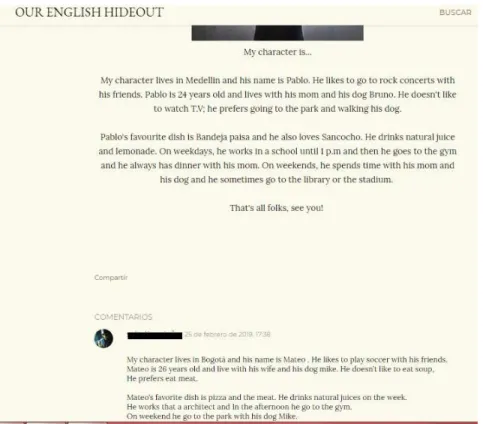
(30) BLENDED LEARNING AS A TOOL TO ENHANCE EFL STUDENTS’ WRITING SKILLS THROUGH BLOGGING Writing as a process From this perspective, writing is seen as a sequence of stages that take place when writing. D’Aoust (1996) argues that the process of writing follows these steps: Prewriting, writing, sharing, revising, editing and evaluating (P.9). Prewriting implies that students discover that they have something to say and then, in the writing step they develop and give form to that idea; next, they share their texts, which means that they seek an audience feedback that allows them to revise what they wanted to say. After that, an editing work takes place; in this step, the necessary corrections are done. The last step allows students to evaluate the final version of their texts and receive final feedback. These six steps are cyclic and to be repeated as many times as needed to get a final version that fulfils the requirements of the writing activity. To conclude, this Research is guided by the three conceptions previously described, since the main idea is not to provide the students with mere information about grammar structures or punctuation, but also to enhance their own creativity and make them reflect on their texts. In addition, they presented a written product in which they developed their creativity to create a fictional story entirely imagined by them. Blended Learning According to Bonk and Graham (2006), Blended Learning is the blend between two kinds of teaching environments. On the one hand the traditional face-to-face environments, where the interaction takes place inside the classroom. On the other hand the one in which the interaction can go beyond and is facilitated by the use of technologies that let students and teachers interact in different spaces apart from the classroom (p.5) which is crucial to the extent that it proposes educational scenarios to go beyond from what they have commonly been considered: fixed and established places to impart knowledge. 17.
(31) BLENDED LEARNING AS A TOOL TO ENHANCE EFL STUDENTS’ WRITING SKILLS THROUGH BLOGGING Throughout the years, other different approaches have been tested to improve results in teaching practices and students’ learning. With the arrival of technological devices to the field of education, teachers, in some cases, have been forced to use them to catch their students’ attention and to introduce new methodologies in the classroom. This is what has been called Blended Learning or Blended E-learning. As a consequence of this development, the technological devices we can find nowadays in society “are becoming ubiquitous and are very familiar to our students. The most recent innovations in social software are changing the ways we meet people and interact.” (Allison Littlejohn and Chris Pegler, 2007. p, 2).This notion cannot be more important since our students are coming to the classroom with some knowledge about technological tools that, if used in a creative way, can be useful to catch their attention and to enhance interaction with educational purposes. To conclude, Blended Learning, as an approach, is crucial in this research to the extent that Blogging and using computers inside and outside the classroom is the tool to interact with students and to evidence their writing performance during the research. In addition, Blended Learning is important in terms of motivation, and it provides a tool to make students work on their writing skills not only at school but also in the different environments where they are immerse. Besides, as it is seen in the surveys administered at the LC, students find motivating the fact of working with technology as a different way to get closer to language learning. Finally yet importantly, the fact of having only three and a half hours to meet in the classroom during the whole week poses a problem to achieve all the goals properly; with the aid of Blended Learning, this disadvantage can be tackled and the possibilities to improve students’ skills in the foreign language are higher.. 18.
(32) BLENDED LEARNING AS A TOOL TO ENHANCE EFL STUDENTS’ WRITING SKILLS THROUGH BLOGGING Blogging The interaction that takes place nowadays while using technology and media has changed the way people relate among them and the way in which the information is spread. As a result of that, several platforms are used as a means to express thoughts and to interact with others in virtual scenarios that allow people to be more connected. One of those platforms that have made this possible is blogs, which are defined like online pages that: “allow a group of people to communicate with each other on one or more specific topics. This format allows individuals to create their own publishing space with information, links, and ideas they want to keep for personal reference or to share with others” (Heskett, T. 2009, p 3) Considering this definition, we can focus on the fact that using blogs enables people to communicate with each other and to determine a specific topic to make that communication and interaction possible. It means that it is up to the participants to choose which scenario they would like to interact in and what people they would like to share their posts with. Considering this main aspect, Blogging is useful when trying to make interaction happen out of the classroom, especially when the time to share face to face is limited. On top of that, blogging is not only a tool to enhance interaction. Stoller (2018) states that “the most important ramification of public blogging is that it makes you a better writer” (p. 18), which supports the main purpose of this research: improving writing skills by means of using a blog. The topics that this author proposes as possible to post about vary from personal (family relationships, trips or birthdates), social (comments on social issues like health or education problems or social movements), professional (related to the day-to-day activities at work), and political (the development of policies or the government performance). As this study targeted. 19.
(33) BLENDED LEARNING AS A TOOL TO ENHANCE EFL STUDENTS’ WRITING SKILLS THROUGH BLOGGING children, the main suggested topics were related to their personal experiences. Additionally, they also made up a fictional story as a final product to post on the blog. Through those activities, the interaction with and on the blog was guaranteed. Literacy Literacy is assumed as a social practice and an important means to facilitate peoples’ inclusion in society. There have been minimal changes on the way it has been described “but, in general, historians did not give literacy a prominent place in their efforts to understand social relations or social change” (Kingten, E & Kroll, B & Rose, M. 1998, p. 95). The importance of literacy was especially regarding what people were able to do in real contexts: “literacy practices are more usefully understood as existing in the relations between people, within groups and communities, rather than as a set of properties residing in individuals.” (Barton & Hamilton. 2000, p.7). From this quote, it is concluded that literacy is defined as a social practice that allows individuals to interact among them within a social context. At the Language Center, through literacy, students strengthen their links while interacting thanks to the use of their writing and reading skills that also allow them to get to know each other. On the other hand, this conception differs from the one stated by Professor David Olson (2009) who claimed that literacy has nothing to do with social competence or individuals’ intelligence. (p. 4). However, Olson highlights “the fact that literacy has played distinctive roles in such a wide range of social practices has given rise to the suggestion that we think of literacy not as a single basic competence but rather as a variety of distinctive literacies” (Olson, 2009). The distinctive literacies that Olson mentions are related to the access and the use of technology, the participation in the State policies, or the development of certain daily activities within a. 20.
(34) BLENDED LEARNING AS A TOOL TO ENHANCE EFL STUDENTS’ WRITING SKILLS THROUGH BLOGGING determined context. It portrays the importance that lies on the proper acquisition of literacy skills to allow the individuals to live in society. Despite the two definitions mentioned, the one taken as guidance to support this research is the one stated by Barton and Hamilton. Hence, what is expected from students to achieve is a bond that is possible through the enhancement of their writing skills. This implies the use of technology and the sharing of some texts written by them that portray a bit their reality and their attitude towards what they learn inside the classroom.. 21.
(35) BLENDED LEARNING AS A TOOL TO ENHANCE EFL STUDENTS’ WRITING SKILLS THROUGH BLOGGING Chapter III Research design The type of study and the approach that led this research are presented through this chapter, as well as the data collection instruments, the procedures and the ethical issues. The study was tackled as a qualitative study framed in the approach of Action-Research. Next, the components that were chosen to develop the research are explained. Type of study Qualitative Research Qualitative Research has been mainly carried out in the field of the social sciences, which is very useful and important to study the human group life. As stated by Lapan, Quartaroli, & Riemer (2011), this kind of research, “as contrasted with quantitative studies, places more emphasis on the study of phenomena from the perspective of insiders” (p. 2). Since both the participants and the researcher are immerse in the research, the latter cannot become separated from what takes place in the research as she or he study things in their natural settings. The researcher needs to make sense of, or interpret, phenomena in terms of the meanings people bring to them. Therefore, this research was conducted under the parameters of qualitative research, since its main purpose is to determine the population’s writing performance while being guided by the researcher. In order to obtain enough information to analyze under the parameters of qualitative research, the collected data is primarily non-quantitative. This data mainly consists of “textual materials such as interview transcripts, field notes, and documents like artifacts, video recordings and internet sites that document human experiences about others and/or one’s self in social action and reflexive states.” (Saldana, J. 2011, p.4.) The collection of those materials is crucial since it allows measuring the achievement of the study based on the findings before, during and after the 22.
(36) BLENDED LEARNING AS A TOOL TO ENHANCE EFL STUDENTS’ WRITING SKILLS THROUGH BLOGGING activities that the researcher proposes. As well, and regarding the outcomes of this type of research, Saldana claims that it permits to document and/or evaluate how effective a program or a policy is after checking the results product of an analytic synthesis. (p.5). The effectiveness of blogging in the achievement of improving writing skills is what is planned to be evaluated in the light of Qualitative Research. Action Research Action Research is a well-known approach that involves both the observation and participation of the researcher with the aim of proposing a modification in the field where the study is conducted. Bradbury (2015) points out that this type of research “is oriented to the creation of new knowledge co–created with, but not about people” (p.3). Besides, Action Research brings together action and reflection, as well as theory and practice to reach solutions to problems. The issue that this study deals with is the lack of interaction that students at the Language Center have with technology as a means to learn a foreign language. Through Blended Learning, it is possible to blend both online and face-to-face interaction with the aim of enhancing students’ literacy skills. The objective of providing students with technological tools at the LC while learning a language implies that the researcher also knows how to use them efficiently to be able to blend online and face-to-face interaction and to bring the guarantees to make it possible. Following the previous quotes, Action Research implies active participation of the researcher and, at the same time, it requires collaborative work with the population in order to offer any kind of change to a problematic situation that had to be identified previously. Besides that, theory is required to guide the steps to follow during the implementation of the study. Additionally, reflection based on the obtained results is relevant since it guarantees that the 23.
(37) BLENDED LEARNING AS A TOOL TO ENHANCE EFL STUDENTS’ WRITING SKILLS THROUGH BLOGGING researcher also assumes the results as a significant source of information to guide the development of the study. This kind of research, from the perspective of Valcarcel (2009), is carried out following three phases: prestudy planning; implementation and analysis and, finally, postudy action planning (p, 14). During the first phase, the researcher makes observations to find out improvable aspects and identify the subjects in the studied population. During this phase, the researcher has to be aware of every detail that arises during the observation, since it makes possible to postulate plausible research questions. In addition, it is substantial to reflect on the importance of the intervention that wants to be done to solve a problem; both the environment and the participants must be taken into account in this proposal. To continue with the implementation phase, it is recommended to follow a data collection schedule that makes the collecting much more organized and trustworthy. This is so, to the extent that “a timeline illustrating activities from the beginning to end will keep the study on track” (Valcarcel, 2009). This stage demands the researcher to pay careful attention to every single action that occurs during the development of the activities, since it provides relevant and suitable information regarding the research problem. The third and last phase comprehends the analysis of the findings to draw conclusions and design an action plan that gathers the main results gotten during the implementation. This is due to the fact that the three phases are cyclical, which means that once one of them is covered, the researcher might work on that again if necessary. After reflecting on the results of the observations, there is likelihood to have to plan again if they are not as expected.. 24.
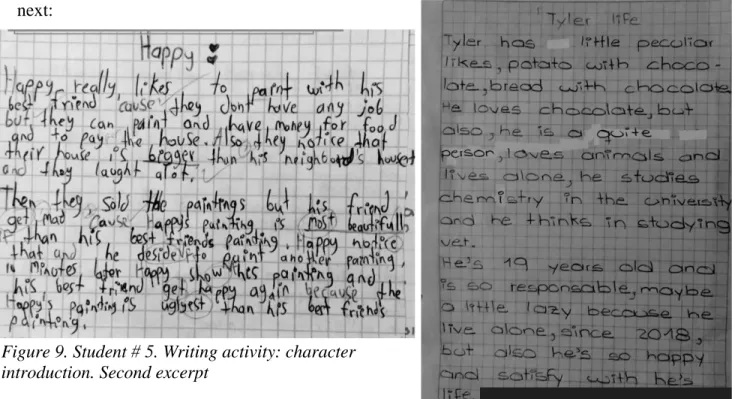
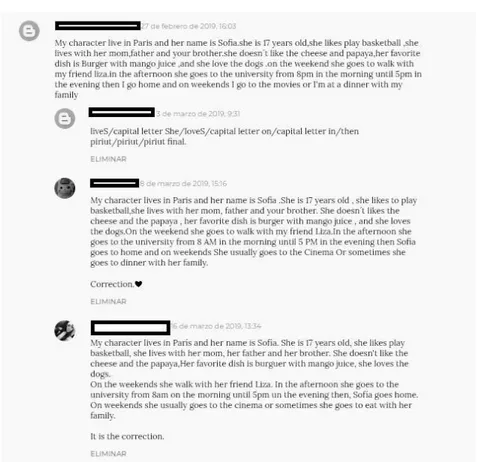
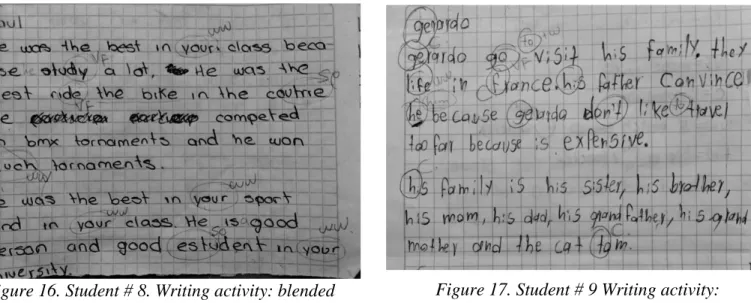
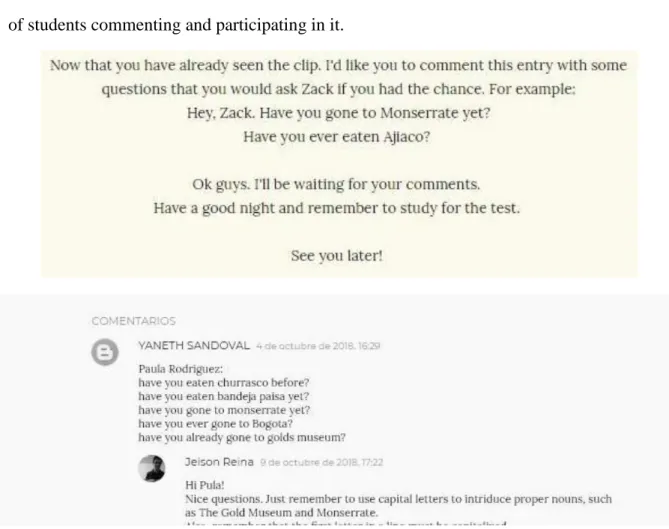
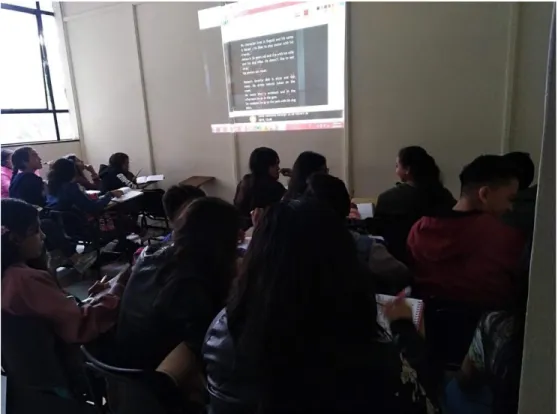
(38) BLENDED LEARNING AS A TOOL TO ENHANCE EFL STUDENTS’ WRITING SKILLS THROUGH BLOGGING Data analysis methodology In order to get sufficient information to diagnose and to tackle the research problem, some methods are considered to collect data: field notes, surveys and written texts. To analyze the results obtained with each one of those methods, we triangulated them with the purpose of getting a more objective view of the problem. Triangulation has been widely discussed as a useful mechanism to interpret data collected around a common topic; it is described by Bryman (2004) as “the use of more than one approach to the investigation of a research question in order to enhance confidence in the ensuing findings” (p, 1142). The key for using measurement is that, once a concept is widely discussed and analyzed from three different approaches or methods, the uncertainty of this concept lessens; additionally, “it includes researchers taking different perspectives on an issue under study, or more generally in answering research questions” (As cited in Wang, 2018, p. 355). Those perspectives serve to the production of new knowledge based on the results obtained in every instrument. This contributes, Flick says, “to promoting quality in research” (ibid) since the results might be presented in a more objective way. Data collection instruments The instruments for collecting information for this study were field notes, surveys and written texts. To start with, Bailey (2007) claims that field notes “serve as the repository for the important and even not-so-important data of field research” (p, 113). These instruments also help us decide on what we want to write and “methodological decisions are made when writing field notes and they help maintain a certain amount of emotional stability” (ibid). It is essential, when collecting observations, to record as much as possible in order to keep the information the most faithful to what happens inside the classroom. This recording was done through some photographs taken during the class development and its purpose was to identify how students 25.
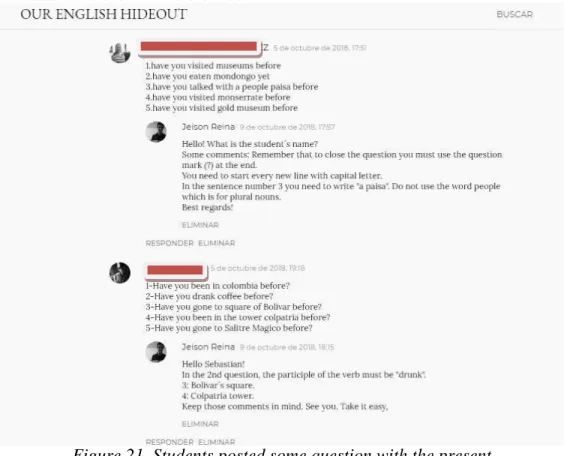
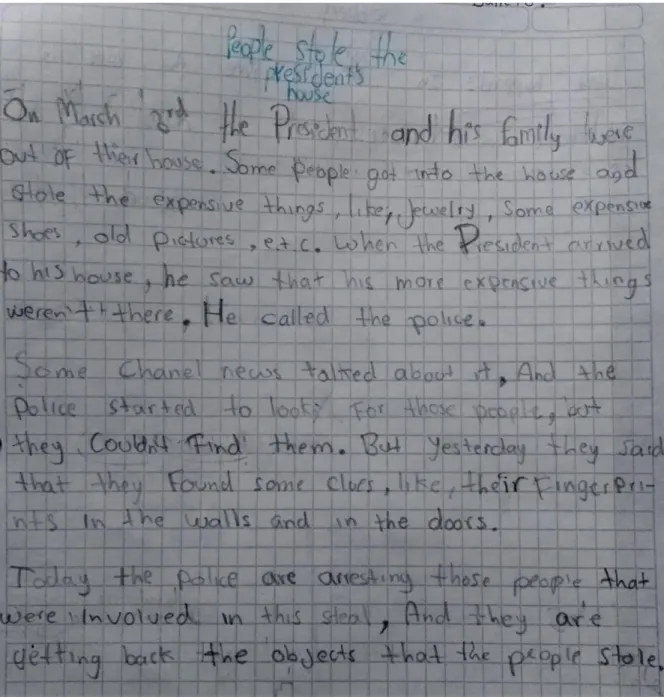
(39) BLENDED LEARNING AS A TOOL TO ENHANCE EFL STUDENTS’ WRITING SKILLS THROUGH BLOGGING performed during face-to-face interactions in the classroom when discussing their texts previously written and shared on the blog. In regards with the surveys, they allow the researcher to get sufficient information from the participants of a study in regards with the issue that is being researched. When they are administered in an educational context, in which the participants are minors, “one of the most important duties of the researcher is maintaining confidentiality.” (Lodico, Spaulding, and Voegtle, 2006, p.160) The shared information has to be kept and gathered only for research purposes, and it is recommended not to spread it; this is important to the extent that it gives confidence to the participants to answer honestly about what they are asked. In addition, surveys can be administered in several ways. The most traditional way to do it is by giving a paper to a group of people who fulfill the answer in person. They can be also sent by mail or email; it is essential for these two options that the researcher be aware of the reception of the answers following previous instructions given to the participants to assure a pertinent analysis with the gathered information. Regarding written texts, Duke and Mallette (2011) claim that they “are of concern to literacy researchers because the ability to read and understand them is definitional to literacy, at least in Western culture” (p, 104). The importance of analyzing the texts produced by students in the classroom was to find out how good their performance and understanding were in relation to content and form. This is to observe, for instance, if students would write following the structure of a paragraph, or if their texts were coherent and, therefore, easy to understand for the reader. In addition to the texts written in the classroom, some excerpts taken from the blog were also analyzed. Those texts needed to be taken into account since they are one of the central axis to interpret the results. About blog’s posts, Kelsey (2008) claims that since they were open to. 26.
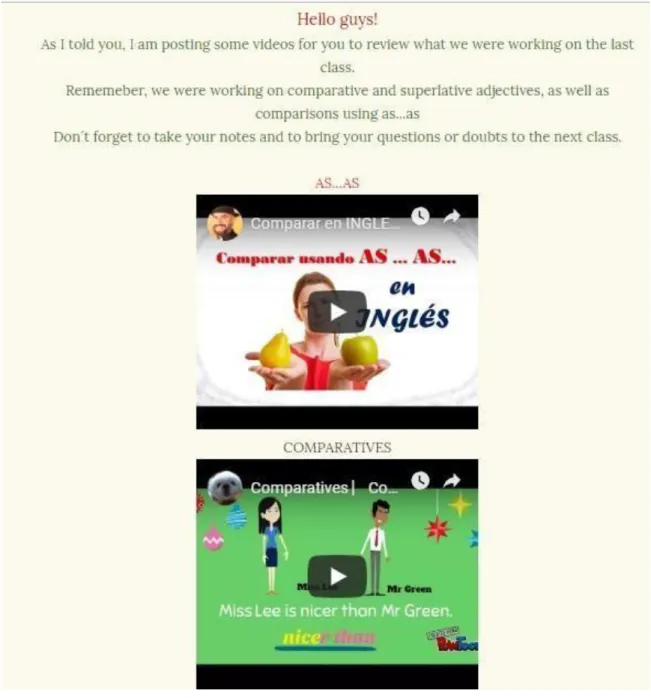
(40) BLENDED LEARNING AS A TOOL TO ENHANCE EFL STUDENTS’ WRITING SKILLS THROUGH BLOGGING anyone with an internet connection, “the general population was beginning to see the Web as a means for them to express themselves, and not simply something to read” (p, 847). This confirms that posting on a blog not only fosters interaction among students, but also increases their writing and reading skills; the latter is relevant in order to facilitate the evaluation phase of the written and posted texts. Unit of analysis With the purpose of illustrating the most relevant aspects to consider along this research, the next table was designed. Unit of analysis. Category. Writing skills. Indicator 1.1 Students write texts about their lives and express their feelings and likes. 1.2 Students organize their texts in paragraphs and use punctuation marks to structure them. 1.3 Students create a fictional story using conjunctions as linkers to join sentences and paragraphs. 2.1 Students post their texts on the blog following previous instructions and models on content and form.. Blogging Writing skills. Blended Learning. 2.2 Students interact with their classmates through the blog and suggest some corrections to be done in each other's texts. 3.1 Students write text in the classroom after being explained a determined topic to guide their writing. 3.2 Students check and correct their texts in the classroom as well as they clarify questions and doubts before or after posting them on the blog. 3.3 Students check and comment on the material posted on the blog to follow up the explanations previously seen in the classroom.. 27.
(41) BLENDED LEARNING AS A TOOL TO ENHANCE EFL STUDENTS’ WRITING SKILLS THROUGH BLOGGING Ethical issues As the participants of this study were underage children, it was necessary to have their parents sign a consent form in which they were explained about their children’s participation in some activities aimed to develop the research. However, neither the participants nor their texts or opinions are presented under their real names since they are named as “student 1, 2, 3, etc.” .The sample to carry out the analysis was chosen randomly and is composed of 14 students. This guarantees that the analysis contemplated varied results from the students’ production.. 28.
(42) BLENDED LEARNING AS A TOOL TO ENHANCE EFL STUDENTS’ WRITING SKILLS THROUGH BLOGGING Chapter IV Pedagogical intervention This chapter presents the visions of language, learning and technology in order to guide the reader to a better understanding of the principles that are followed in regards to these three main components. Next, the proposal of intervention is explained; it is linked to the visions of learning and language previously mentioned, and to the curriculum of the L.C. Teaching approach The teaching approach pursued the purpose of enhancing interaction between students. Therefore, the Interactive Teaching Approach was selected. According to Wilga Rivers (2000), interaction is important since it permits students to develop and increase their language store. Besides, she claims that “Interaction involves not just expression of one’s own ideas but comprehension of those of others” (p, 4). Achieving that level of comprehension is essential when it comes to interacting and recognizing other points of view that other people have. We could easily link this thought with the goal of interacting inside the classroom among students whose realities are different from each other, but not because of that, right or wrong. Additionally, Wassermann (2017) argues that this approach allows teachers to help students “gain in self-confidence and in heightened personal autonomy” (32). Bearing in mind the little time to work with students in the classroom, improving their autonomous learning is very helpful in order to carry out the activities and to achieve the objectives traced by the LC. That is another reason why this approach was selected to guide this study, not only because of its link to the Blended Learning framework but also because of its utility for blogging, since the same author states that "we have to allow that classroom discussions are not for giving students informationfor that is more easily acquired through multitudes of high- and low-tech sources" (Wassermann,. 29.
Figure
+6
Documento similar
The present research work has sought to present a proposal using the flipped learning methodology seeking to strengthen the investigative skills in the students of an
The objective of this FMP is to research the affordances of the online tool Flip to help Baccalaureate students cope with their speaking anxiety when delivering oral presentations in
On this basis, foreign language education must raise students’ awareness on how language and culture are closely interrelated and develop their linguistic
The aim of this paper is to demonstrate that reading authentic literary material in the English as a Foreign Language (EFL) classroom can improve students’ language learning skills as
As the chart illustrates, the majority of the class passed the poster’s task using the passive voice satisfactorily, thanks to the explanations and the exercises
This document contributes to enhance the overall interoperability per- spective in current e-learning management systems and on-line learning ob- ject repositories as well as each
population: also in order to monitor its effectiveness, this study aims to verify the validity of the IPAQ through the correlation with another energy expenditure measurement tool
which has been designed to stimulate interest and learning ability of students through the use of technologies that are familiar and particularly attractive
