
Implementing literature analytical strategies for the development of critical thinking cognitive micro skills
113
0
0
Texto completo
(2) IMPLEMENTING LITERATURE ANALYTICAL STRATEGIES FOR THE DEVELOPMENT OF CRITICAL THINKING COGNITIVE MICRO-SKILLS 2 Acknowledgements. I would like to express my special appreciation and thanks to my advisor, Professor Liliana Cuesta, for being an exceptional mentor for me. Her support and guidance have made me believe in this project, and the potential it had for my growth as a teacher and a researcher. I would also like to thank Professor Luz Dary Arias, and Professor Sonia Jiménez; for their time, advice and suggestions, thanks. My gratitude goes as well to Professor Carl Edlund Anderson, for his advice regarding the writing process of academic texts. A special thanks to my husband, without which this would not have been possible. His patience and faith in me sustained my efforts and made me endure the hardest moments in this process. And last, but not least, special thanks to my students, who went through this process with me and with the best of dispositions to learn and to read, even when they did not believe they could do it. In the end we all grew up because of this experience..
(3) IMPLEMENTING LITERATURE ANALYTICAL STRATEGIES FOR THE DEVELOPMENT OF CRITICAL THINKING COGNITIVE MICRO-SKILLS 3 Abstract. In Colombia, as well as in other world contexts, educators constantly question why young people fail to read regularly. Reasons vary from lack of interest to difficulties to read, as well as lack of efficient training to read texts in the native/foreign language. The 21st century academic world demands the use of students’ critical thinking skills to access and produce knowledge effectively. Given that critical thinking skills are seen as a necessary set of abilities to deal with complex and analytical tasks, schools need to structure their curriculum to cope up with such needs. This study aims at presenting alternatives to help students of 11th grade in a Colombian school to learn and apply Critical Thinking Cognitive Micro-Skills through a series of tasks in an English literature class. This study shows how students progressively attain a variety of personal tools to analyze and weigh situations, within a critical, as well as an ethical viewpoint. Keywords: Critical Thinking Cognitive micro-skills, literature, analytic strategies..
(4) IMPLEMENTING LITERATURE ANALYTICAL STRATEGIES FOR THE DEVELOPMENT OF CRITICAL THINKING COGNITIVE MICRO-SKILLS 4 Resumen En Colombia, así como en otros contextos a nivel mundial, los docentes cuestionan el por qué la gente joven no lee. Las razones por una parte, obedecen a la falta de interés, dificultades de lectura, así como a la falta de entrenamiento eficiente para leer textos en la lengua materna/extranjera. Actualmente, el mundo académico universitario del siglo 21 requiere que los estudiantes ejerciten habilidades de pensamiento crítico para poder acceder a producir conocimiento de manera efectiva. Teniendo en cuenta que las habilidades de pensamiento crítico se conciben como imprescindibles para poder interpretar textos y desarrollar actividades analíticas y complejas, es preciso que las instituciones de educación básica y media estructuren su currículo para poder satisfacer estas necesidades. El presente estudio presenta alternativas para apoyar a estudiantes de grado undécimo en un colegio de Colombia, para que puedan aprender y aplicar estrategias de pensamiento crítico cognitivo a través de una serie de tareas en la clase de literatura Inglesa.. Este estudio muestra cómo los estudiantes van adquiriendo. progresivamente una variedad de herramientas personales para analizar y ponderar situaciones, dentro de un marco crítico, analítico y ético. Palabras clave: estrategias de pensamiento crítico-cognitivo, Literatura, estrategias analíticas..
(5) IMPLEMENTING LITERATURE ANALYTICAL STRATEGIES FOR THE DEVELOPMENT OF CRITICAL THINKING COGNITIVE MICRO-SKILLS 5 Table of Contents Acknowledgements ............................................................................................................. ii Abstract .............................................................................................................................. iii Resumen ............................................................................................................................. iv Table of Figures ............................................................................................................... viii Table of Tables ................................................................................................................. viii Chapter One: Introduction................................................................................................... 9 1.1. Statement of the Problem ......................................................................................... 9 1.2. Research Question .................................................................................................. 13 1.3. Research Objectives ............................................................................................... 13 1.3.1. General Objective............................................................................................ 13 1.3.2. Specific Objectives.......................................................................................... 13 1.4. Rationale ................................................................................................................ 14 Chapter 2. Theoretical Framework ................................................................................... 16 2.1. Literature Based Instruction ................................................................................... 16 2.2. Critical Thinking .................................................................................................... 20 2.3. Motivation towards Reading .................................................................................. 24 Chapter 3. Research Design .............................................................................................. 26 3.2. Researcher Role ..................................................................................................... 28.
(6) IMPLEMENTING LITERATURE ANALYTICAL STRATEGIES FOR THE DEVELOPMENT OF CRITICAL THINKING COGNITIVE MICRO-SKILLS 6 3.3. Context and Participants ........................................................................................ 29 3.4. Data Collection Instruments................................................................................... 30 3.4.1. Surveys ............................................................................................................ 32 3.4.1. Documents ...................................................................................................... 33 3.5. Data Collection procedures .................................................................................... 33 Chapter 4. Pedagogical Intervention ................................................................................. 37 4.1. Micro Skill 1: Comparing and contrasting ideals with actual practice .................. 38 4.2. Micro Skill 2: Noting significant similarities and differences ............................... 39 4.3. Micro Skill 3: Distinguishing relevant from irrelevant facts ................................. 40 4.4. Micro Skill 4: Making plausible inferences, predictions, or interpretations .......... 41 4.5. Micro Skill 5: Exploring implications and consequences ...................................... 42 Chapter 5. Data Analysis and Findings ............................................................................. 44 5.1. Procedures for data analysis ................................................................................... 46 5.2. Data management ................................................................................................... 46 5.3. Data reduction ........................................................................................................ 49 5.4. Data display and verification ................................................................................. 51 5.5. Triangulation .......................................................................................................... 52 5.6. Categories ............................................................................................................... 53 5.7. Data analysis .......................................................................................................... 54.
(7) IMPLEMENTING LITERATURE ANALYTICAL STRATEGIES FOR THE DEVELOPMENT OF CRITICAL THINKING COGNITIVE MICRO-SKILLS 7 5.7.1. Category 1: Critical Thinking Cognitive Micro-skills enhance students’ capacity to analyze and extrapolate literary knowledge to other contexts............................ 54 5.7.2. Category 2: Motivation towards reading fosters a sense of self-empowerment and accomplishment in students. .......................................................................................... 79 Chapter Six: Conclusions, Pedagogical Implications and further Research ..................... 87 6.1. Conclusions ............................................................................................................ 87 6.2. Limitations ............................................................................................................. 91 6.3. Further Research .................................................................................................... 92 References ......................................................................................................................... 94 Appendices ...................................................................................................................... 100.
(8) IMPLEMENTING LITERATURE ANALYTICAL STRATEGIES FOR THE DEVELOPMENT OF CRITICAL THINKING COGNITIVE MICRO-SKILLS 8. Table of Figures Figure 1. Venn diagram sample for micro skill 2. ............................................................ 40 Figure 2. Perceptions of difficulties …………………………………………………….83 Figure 3: Most used strategies and skills in current university …………………………85. Table of Tables Table 1. Plan for the implementation of tools. ................................................................. 32 Table 2. Timeline of the implementation process - pre and while stage. ……………….35 Table 3. Timeline of implementation - while and after stages …………………………..36 Table 4. Chart of categories ……………………………………………………..………53.
(9) IMPLEMENTING LITERATURE ANALYTICAL STRATEGIES FOR THE DEVELOPMENT OF CRITICAL THINKING COGNITIVE MICRO-SKILLS Chapter One: Introduction 1.1. Statement of the Problem Educational institutes worldwide are concerned about the issue of the low reading levels and the lack of reading habits in different countries. Nations, including the USA, show in recent polls that the average American is reading 6,9 books a year. An article from the UNESCO on reading habits in 2013, shows that people are reading less books each year. While countries like Germany display an average of 12 books a year, and Spain 7.5 books a year, Colombia is a country where the average of books read by a common citizen is no more than two. Reasons for people to read or not to read vary according to their personal and professional motivations; issues related to age, genre, and literacy level are part of the variables in analyzing this data. According to a Colombian survey (El Heraldo, 2006) performed by the DANE (Departamento Administrativo Nacional de Estadística) about cultural consumption practices, it was established that 75,5 percent of surveyed people read for pleasure; 33,59 percent read as a requirement of studies, and 8,72% read for job requirement. Even though schools and universities place a great importance on this process, there is a low rate of reading for the average Colombian. Students of ages 15 to 20 fail to show in general an interest in reading. In his article, Villamil 2013) states how “among young people 12 – 17 years old, 30 percent said they don’t like reading academic texts or school-prescribed texts and 61 percent say they don’t have time.” At the school where this project took place, in Grades 10th and 11th, students have to read about 8 books a year. However, this task is not accomplished by most of them for various reasons. The first main reason is the lack of interest. The second relates to those difficulties to understand or follow the reading tasks proposed by schools..
(10) IMPLEMENTING LITERATURE ANALYTICAL STRATEGIES FOR THE DEVELOPMENT OF CRITICAL THINKING COGNITIVE MICRO-SKILLS 10 This percentage of reading habits (less than 2 books read per year) becomes a concern, for once at the university, students are not used to a rhythm of reading that implies positive comprehension skills, added to the specific and demanding tasks that professors need from them to accomplish in very little time. Reading is a skill necessary for further education, but especially for life, which makes this research project appropriate for our context, where students also struggle with the lack of interest in reading, as well as difficulties involved. Reading is also a concern for the Liceo Cambridge, a school of about 400 students near Cota, a small town on the outskirts of Bogota, Colombia. In a response to providing students with skills and habits appropriate for continuous reading, the school’s English program has gone through a process where the improvement and building of reading skills has been addressed by means of implementing extensive reading. As a result of this, students have acquired strategies in reading, such as identifying main ideas, or events in a text, labeling specific elements in a text, creating mind maps describing and comparing aspects in authors or in books, and other strategies that support their reading comprehension processes. The presentation of exams such as the Pruebas Saber 11, or admission tests to apply for universities demand from them higher order skills, rather than basic reading comprehension skills. These are some of the reasons why in the last two years of their school lives, students are exposed to more complex books and are demanded more complex thinking processes, as means of developing their thinking skills as highly as possible. However, this is not the only element related to reading that concerns the school. Throughout the process of analyzing needs, during a period of three months prior to the. 10.
(11) IMPLEMENTING LITERATURE ANALYTICAL STRATEGIES FOR THE DEVELOPMENT OF CRITICAL THINKING COGNITIVE MICRO-SKILLS 11 design and implementation of this research study, the team of English teachers, along with the psychology department at school, revised some of the situations and typical considerations when entering universities and when taking the ICFES exam (the Pruebas Saber 11).This research provided evidence that, even though students tried to address the challenges of reading comprehension presented in either of these cases, there were elements missing, in terms of how to understand the sense of a question, or how to connect ideas to authors, or in terms of presenting an argumentation with sound grounds. Analysis of students’ documents from the English class, samples of the Pruebas Saber, and the material from universities provided by the Psychology Department, led to the identification of a basic set of needs regarding the skills necessary to perform well at those common challenges students have to undergo ever since they reach 11th grade. The Psychology department of the school has provided the school with data of universities and their requirements for students to pursue a successful education process along their careers. For example, one of the requirements that the Universidad del Rosario, one of the most traditional universities in Colombia, demands in most of their BA programs is for students to be able to analyze a text in terms of the core and intention of a paragraph, which is specifically required for the Law School. Students should be able therefore to understand the intentions underneath a sentence and the possible implications of changing a law bill. There are other cases, in which universities require from their students’ fluent reading skills in English, for applicants to be able to enter Master’s program; this is the case of the Sabana University. Students from the Andes and the Javeriana University take compulsory placement tests, and are required to be certified B2 students in English, in order. 11.
(12) IMPLEMENTING LITERATURE ANALYTICAL STRATEGIES FOR THE DEVELOPMENT OF CRITICAL THINKING COGNITIVE MICRO-SKILLS 12 to complete their BA programs. Moreover, most of the students currently going there are required to read several textbooks for their BA programmes which can be currently found only in English. Such skills need specific training, guidance and practice to be learnt and applied, and the time and training availability in such situations is scarce. This is because students are meant to arrive at their BA programmes already knowing how to do all the necessary to address the university academic needs. Developing critical thinking skills is therefore the objective of this research project, as a complement to the program of extensive reading, and as a means of promoting life-long learning skills in students, and supporting students in the undertaking of personal and professional challenges (Ciascai & Haiduc, 2009, p.9). In terms of the background, the strategy presented in this study is well grounded. This project responds to the current needs of the Liceo Cambridge 11th grade students regarding their academic performance. This research aims at developing in students critical thinking cognitive micro-skills that might add to their educational goals by allowing them to compare and contrast ideals with actual practice, to note similarities and differences, to distinguish relevant from irrelevant facts, to make predictions and plausible inferences according to a context, and to explore implications and consequences of actions, to project ideas and foresee results, among others. In order to pursue this task, I chose to implement Literature Analytical Strategies to foster the development of the aforementioned skills as well as promoting in students an appealing way of approaching the reading process, by having students partly own their processes, and appeal to their personal values and drives in the creation of brief projects that took place based on two novels, thus possibly motivating them to read.. 12.
(13) IMPLEMENTING LITERATURE ANALYTICAL STRATEGIES FOR THE DEVELOPMENT OF CRITICAL THINKING COGNITIVE MICRO-SKILLS 13 This research, which may well be of value for other institutions and schools, given that it addresses two major issues regarding reading habits, skills and interests, in a time where reading is underestimated and critical thinking skills are necessary to undertake challenges of the Twenty First Century, posed the following research question and objectives:. 1.2. Research Question What is the effect of the implementation of Literature Analytic Strategies in the development of critical thinking cognitive micro skills in 11th graders in the literature class?. 1.3. Research Objectives 1.3.1. General Objective To analyze the development of critical thinking cognitive micro skills in 11th graders through literary analytic strategies. 1.3.2. Specific Objectives To determine learners’ development (in any) of Critical thinking Cognitive Micro-Skills. To determine the influence (if any) of Literature Analytic strategies in the motivation levels of students during the reading process.. 13.
(14) IMPLEMENTING LITERATURE ANALYTICAL STRATEGIES FOR THE DEVELOPMENT OF CRITICAL THINKING COGNITIVE MICRO-SKILLS 14 1.4. Rationale Critical thinking has become a major area of study. For this research project it is a response to a current need in professional and academic fields for any student from the Liceo Cambridge. Developing such skills is a demanding task to undertake for students in L1. Therefore, the implementation of this project supports the development of higher order thinking skills that can be applied both in L1 and L2, but which will be developed in L2. For 11th graders at Cambridge School, thinking critically is a set of necessary skills that can be applied and used in a diversity of scenarios, especially in attempts to build their own perspective of their local situation, their projection in their community, their possibilities to approach a text from a different point of view. Moreover, this allows literary works to have an impact in their beliefs, judgments of real-life situations and their cultural assets, since they may then be able to respond to the challenges, both academic and ethical, by building their own criteria and becoming analytical persons. A person who thinks critically might often be able to restate, describe, learn how to gather, and analyze, synthesize, assess information and interpret texts, situations, and problems themselves (Paul, 1989, p. 197). This is precisely the outcome that this study intends to provide for students’ learning processes. Literature learning has the quality of developing a multiplicity of skills, impressions, views of the world, and it even builds upon cultural views. In this project, literature is meant to trigger the scenarios for the development of Critical Thinking Cognitive Micro Skills such as noting similarities and differences, distinguishing relevant from irrelevant facts, making plausible inferences, and comparing and contrasting ideals. 14.
(15) IMPLEMENTING LITERATURE ANALYTICAL STRATEGIES FOR THE DEVELOPMENT OF CRITICAL THINKING COGNITIVE MICRO-SKILLS 15 with actual practice. These strategies may help to build students’ criteria in order to assess situations and make decisions or solve problems. This project might well become the beginning of a line of research to develop critical thinking through L2 in populations of students where English is learnt as a foreign language, with limited exposure to L2, but with an approach that allows effective critical thinking strategies to take place, especially through the implementation of literature classes.. 15.
(16) IMPLEMENTING LITERATURE ANALYTICAL STRATEGIES FOR THE DEVELOPMENT OF CRITICAL THINKING COGNITIVE MICRO-SKILLS 16 Chapter 2. Theoretical Framework For the purpose of this project, the topics revised are: literature reading, analytical strategies for reading, critical thinking, and motivation towards reading. These elements are the foundations to develop strategies used in order to try to develop critical thinking cognitive micro-skills, and which were worth examining given the level and needs of the target group. Throughout this chapter, each of the elements mentioned above are developed, considering their role in understanding how these critical thinking cognitive micro skills may have an impact on the way students read, understand literature, and understand themselves as readers.. For this reason, certain theories underlying the project are. considered core to the development, and others provide. support towards the. implementation of this research.. 2.1. Literature Based Instruction Harris and Hodges (1995) define Literature-Based Instruction as a learning scenario where high quality or rich-content books are used as core materials, and the use of such materials will in turn foster the development of literacy. Other authors, such as Cullinan (1987) argue that this approach fosters, in addition, meaning that is socially constructed, framed within the Constructivist pedagogical approach. Literature-Based Learning is characterized by the inclusion of a large variety of books as a vehicle for language learning. It is also characterized by consistent reading practice that may enhance fluency and reading comprehension, as well as vocabulary and. 16.
(17) IMPLEMENTING LITERATURE ANALYTICAL STRATEGIES FOR THE DEVELOPMENT OF CRITICAL THINKING COGNITIVE MICRO-SKILLS 17 finally, it may also promote discussion of literature among peers and teachers (Newman & Dickinson, 2003). In this sense, this approach is considered consistent with the context of the class, and with the pedagogical rationale of this project, since it promotes discussions and analysis that might be able to reinforce the implementation of critical thinking cognitive micro skills chosen for this research. Through this approach, students could well be better able to understand elements of a story, including title, author, setting, conflict, resolution, events and conclusions; as well as become acquainted with the notion that reading is a transaction between a reader and a text, where a live interaction is created (Khanbeigi and Yalsharzeh, 2012). Following such thread of thought, Long (1986, p.42) argue. that “Literature and. language teaching involve the development of a feeling for language”. Teenage students, especially young adults are not commonly interested or driven by activities such as reading, and traditional approaches to teaching have not changed that situation, for the lack of responses literature classes often fail to become interesting for either parts (teacher and learners). In a survey conducted by the National Reading Research Center in the 1990s, the University of Maryland and the University of Georgia), teachers expressed their concern about the lack of academic motivation where the reading achievement of students was to be addressed (Pressley, 2006). Long (1986, p.42) also considers that responses to literature, either positive or negative, show an underlying interest of students for reading. However, this is a difficult goal to achieve, since methodologies and approaches have traditionally followed the presentation for non-native speakers, and this issue augments the concern of students to interpret the text or try to translate it, other than respond to it. Long (1986). 17.
(18) IMPLEMENTING LITERATURE ANALYTICAL STRATEGIES FOR THE DEVELOPMENT OF CRITICAL THINKING COGNITIVE MICRO-SKILLS 18 believes that “teaching of Literature to non-native speakers should seek to develop responses,” (p.42). For a literature class to have an impact in students, it has become necessary to use a more communicative approach, in which students’ involvement can take place in the discussion, and presenting the text might well provide the beginning of an inquiry that prompts the elaboration based on world issues, or topics related to their personal interests and concerns. Using the text-as-object (Long, 1986) is an approach that might help transform the learning of literature into a richer experience in the eyes of the students, and an experience that could provide students with wider perspectives of the world. The idea behind using the text-as-object implies for this research, that students will not be centered on merely understanding the content presented in the text, but on how the text is a means to possibly understand their own perspectives of the world better, and in addition, a means of probably understanding themselves as subjects in that world they are constructing. Literary texts are argued to be rich in multiple levels of meaning, for which an active involvement is demanded from the student, in order to grasp the unstated implications and assumptions of the text (Lazar,1993. p. 19). The action of assuming from a text is part of making plausible inferences, predictions, or interpretations; one of the critical thinking cognitive micro-skills addressed in this project. The literature class may also provide the scenario and the excuse to prompt the development of these and other skills related to critical thinking; This process might well add to the personal formation of students in regard of two basic aspects: how they assume the reading of a book, and the. 18.
(19) IMPLEMENTING LITERATURE ANALYTICAL STRATEGIES FOR THE DEVELOPMENT OF CRITICAL THINKING COGNITIVE MICRO-SKILLS 19 way this book or text can modify their beliefs, or rectify their understanding of the world, as stated above. Literature may also become a scenario, where students could possibly improve their understanding of the L2, because it is a rich model of the language that provides specific contexts for use. According to Collie and Slater (1987), literature is a medium, through which students can access the new language (L2) and improve their critical thinking skills, and intercultural awareness, among other aspects.. In this sense, literature may well. improve their level of understanding, so that they can deal with more complex processes, other than reading comprehension. That is an advantage that is necessary to consider in this research, and these are some of the main reasons for which this approach is considered in this research project, for it implies efforts and critical thinking from students, and it will prompt the creation of links between what they read, and the current situations regarding world problems. This is precisely what might be considered critical reading; namely, a set of abilities that go beyond decoding, and that imply interpretive skills. And this, in turn, leads to the need of integrating reading and critical thinking skills, involving a single process that encompasses elements of both realms.. This is precisely what might be. considered critical reading, I.E., a set of abilities that go beyond decoding, and that imply interpretive skills, and this leads to the need of possibly integrating reading and critical thinking skills, as a means of a single process that encompasses elements of both realms. As for literature, it may become the provider of scenarios that allow them to learn about the world through the eyes of others, in a creative manner.. 19.
(20) IMPLEMENTING LITERATURE ANALYTICAL STRATEGIES FOR THE DEVELOPMENT OF CRITICAL THINKING COGNITIVE MICRO-SKILLS 20 2.2. Critical Thinking Elder and Paul (2008, p.58) define critical thinking as: The intellectually, disciplined process of actively and skillfully conceptualizing, applying, analyzing, synthesizing, and/or evaluating information gathered from, or generated by observation, experience, reflection, reasoning, or communication, as a guide to create beliefs and promote actions. In this sense, it has a purpose, and it is based on intellectual universal values that transcend subject matter divisions. It is also complex since it demands the interrelations of all gathered and observed knowledge in order to build such beliefs and in order to become the sound ground for decision making.. According to the Council for. Excellence in Critical Thinking, it is also understood as a self-guided, self-disciplined thinking, which attempts to reason at the highest level of quality in a fair-minded way (Elder and Paul, 2006). People who think critically are thought to be able to use concepts and principles within their knowledge to analyze, assess, and improve thinking. When thinking critically, you usually improve the quality of your thinking by organizing internally the structures inherent in thinking imposing an intellectual standard in it. Overall, critical thinking as described by Elder and Paul (2006) implies analytical skills; however, very few people are taught how to analyze (Elder and Paul, 2006, p. 2). What characterizes critical thinking is a judgment that is unbiased, impartial, objective, informed and without prejudice, and in order to become critical thinkers, it is necessary to understand the rudiments of thought, which implies taking thinking apart (Elder and Paul, 2006. p.3).. 20.
(21) IMPLEMENTING LITERATURE ANALYTICAL STRATEGIES FOR THE DEVELOPMENT OF CRITICAL THINKING COGNITIVE MICRO-SKILLS 21 These same authors established in their work “Critical Thinking Framework” (Paul and Elder, 2010) that critical thinking, as a mode of thinking involves three major components: a) Elements of thought or reasoning. b) Intellectual standards, and c) Intellectual traits. Together, they all generate an intertwined process where people develop traits of behavior, thinking and speaking that show fair-mindedness, questioning attitudes, and open mindedness. The first component aforementioned: Elements of Thought include inferences, assumptions, implications, concepts, purposes, questions, information, and points of view. These elements in turn, are capable of promoting the development of Intellectual traits (the third component), such as humility, autonomy, fair-mindedness, courage, perseverance, empathy, integrity, and confidence in reasoning. And such traits are usually embedded within Intellectual standards that imply accuracy, clarity, relevance, logical sufficiency, precision, depth, significance, fairness and breadth (Paul, and Elder. 2010). Given these specific elements of thought and especially the intellectual standards, the framework of the literature class can be integrated into the project, so as to grant the development of tasks that lead to the learning and practice of Critical Thinking strategies. The work of Paul and other authors in the Critical Thinking Organization have defined a list of 35 dimensions of Critical thinking which are classified in three mayor categories: Affective Strategies, Cognitive strategies – macro abilities, and Cognitive strategies – micro skills. The first category, Affective Strategies, is based on the intellectual traits discussed above, and implies developing in students’ intellectual good faith and integrity, humility,. 21.
(22) IMPLEMENTING LITERATURE ANALYTICAL STRATEGIES FOR THE DEVELOPMENT OF CRITICAL THINKING COGNITIVE MICRO-SKILLS 22 intellectual courage, confidence in reason, among others. (Paul et. al. 2011) In this sense, these dimensions aim at developing in students an intellectual responsibility regarding what they think and how they think about things. As a researcher and a teacher, although interested in this set of dimensions, within the time frame given, it would be difficult to devise classroom strategies that respond to this category, and it becomes even more complex measuring the development of features that seem to be embedded in people’s personality. As such it would require the support of researchers of other disciplines, including psychologists, among others and it would be beyond the reach of the literature classroom. The second category, known as Cognitive Strategies – macro abilities is based on the Universal Intellectual Standards mentioned above. These dimensions include about seventeen strategies that frame a variety of contexts, where specific questioning, clarification, and analysis is necessary, considering a variety of possible perspectives. In this case, the dimensions in this category rather than inclusive, seem exclusive for each case, and the purpose is to support students personal and intellectual growth, providing them with tools that might allow them to approach other more complex, and more specific dimensions on their own. The last category is known as Cognitive Strategies – Micro-Skill, and it is based on the elements of reasoning presented previously. These include nine micro skills, such as thinking precisely about thinking, giving reasons and evaluating evidence, exploring implications and consequences, recognizing contradictions, making plausible inferences,. 22.
(23) IMPLEMENTING LITERATURE ANALYTICAL STRATEGIES FOR THE DEVELOPMENT OF CRITICAL THINKING COGNITIVE MICRO-SKILLS 23 predictions or interpretations, and distinguishing relevant from irrelevant facts, among others. However, the possibility to develop all the 35 dimensions of Critical thinking (Critical Thinking Organization, 2011) within the time-frame of this project needs to be narrowed down to elements that can feasibly promote target critical thinking behaviors, but also that provide students with tools that may allow them to grow both intellectually and ethically. In that sense, the dimensions chosen correspond to the third category, because they can be amplified and they could promote the learning of skills in other categories of dimensions. In order to narrow them down to a handful of strategies and micro-skills approachable from the literature class, the chosen micro skills were thus (Critical Thinking Organization, 2011): . S-27 comparing and contrasting ideals with actual practice. . S-29 noting significant similarities and differences.. . S-31 distinguishing relevant from irrelevant facts.. . S-32 making plausible inferences, predictions, or interpretations.. . S-35 exploring implications and consequences. These Critical Thinking Cognitive Micro-skills (CTCMS) can be framed within the. analytical strategies of the literature lessons, and may allow students to develop further their thinking abilities, and their judgments about situations, contexts and standards of life. This could in turn, possibly engage students in reading, since the approach to the reading process is prompted from the possible connections that may result from their own experiences, their own judgments and standards of life.. 23.
(24) IMPLEMENTING LITERATURE ANALYTICAL STRATEGIES FOR THE DEVELOPMENT OF CRITICAL THINKING COGNITIVE MICRO-SKILLS 24 2.3. Motivation towards Reading Motivation altogether is an umbrella concept related to the drives that produce in people the desire and will to do something.. Dörnyei believes that motivation is the. responsible of defining human behavior by giving it direction and impulse (Dörnyei, 1998, p.117). In this article, the author explains how the focus to understand motivation should be placed on the individual’s thoughts and beliefs that are transformed into action. There are two subsidiary concepts that support the understanding of the dimensions of motivation: impulse towards and action and sustainability of the effort (Dörnyei and Ushioda, 2011) and these two components of motivation are thought to be deeply rooted on the idea that motivation, rather than goal oriented or emotion oriented, it is a process, and as such, involves an emotional dimension, an a dimension of accomplishment, and a dimension of consistency (Dörnyei, 1998). This is why it is necessary to consider elements and strategies that provoke changes on their motivation towards reading literature in English. It is believed by many educators nowadays, that to promote reading, it is necessary to consider material that addresses students’ personal interests.. Elements that affect. motivation towards reading vary from having an understanding of students’ personal interests, and also students’ learning styles and skills. Reading interests are however, not the only option in attempting to build motivation towards reading. It is also necessary to provide students with materials and activities that build a constructive environment, providing with models and using a variety of motivational techniques (Clary, 1991, p.342). In this sense, the strategies chosen and the pedagogical approach play central roles in the implementation of this project.. 24.
(25) IMPLEMENTING LITERATURE ANALYTICAL STRATEGIES FOR THE DEVELOPMENT OF CRITICAL THINKING COGNITIVE MICRO-SKILLS 25 Recent research has demonstrated how the motivation towards reading is determined by the proficiency levels that students have to read. Students with difficulties to read, or to comprehend words, or to grasp global meaning within texts show a low level of motivation towards the task, and prefer to avoid attempting to read altogether given the levels of frustration produced by the prospect of the task (Decker, 2000, p.4).. The tasks. that mainly affect students’ sense of self-efficacy are related to basic word comprehension skills. It is therefore necessary to provide students with tasks that build from within students reach and schemata or prior knowledge to topics proposed. In that sense the anxiety caused by the task can be diminished or even set aside, once the focus of the task changes. Tasks that foster discussion are probably ideal to promote the notion that others read differently, and to help them understand how interpretation is a subjective process (Decker, 2000) where opinions are valid within a specific context. In this sense, the critical thinking cognitive micro skills chosen might serve as a scenario to foster discussions that will challenge students’ perceptions, interpretations and assumptions, and will therefore modify as well their perceptions of their self-efficacy as readers.. 25.
(26) IMPLEMENTING LITERATURE ANALYTICAL STRATEGIES FOR THE DEVELOPMENT OF CRITICAL THINKING COGNITIVE MICRO-SKILLS 26 Chapter 3. Research Design The aim of this chapter is to describe the connection between the theoretical framework that provides support for this project and the elements that show evidence of this theory in action. Hence, the methodology and strategies that were used in this project are included in this chapter, together with the type of study and its main features. In the past, research was considered a field for professionals other than teachers. However, for over two decades it has become an effective way of practising a reflective and problem focused teaching, where the role of teachers has changed to become an active observer, a participant, and an inquirer through action research (Wallace, 1998, p. 17). This is a qualitative action research study. Qualitative research is an activity which, rather than proposing to measure exact data based on specific gauges, involves observation of behaviours to display and recognize changes in subjects. These changes are described in efforts to provide an insight of how certain elements affect people in certain circumstances. For educators, qualitative methods might provide us with tools that allow some degree of specificity, and tools to make observations worth the change in mind. Shank (2002) defines qualitative research as “a form of systematic empirical inquiry into meaning” (p.5). By systematic he means “planned, ordered and public”, following rules agreed upon by members of the qualitative research community. By empirical, he means that this type of inquiry is grounded in the world of experience. Inquiry into meaning infers that researchers try to understand how others make sense of their experience. Denzin and Lincoln (2000) claim that qualitative research involves an interpretive and naturalistic approach: “This means that qualitative researchers study things in their natural settings,. 26.
(27) IMPLEMENTING LITERATURE ANALYTICAL STRATEGIES FOR THE DEVELOPMENT OF CRITICAL THINKING COGNITIVE MICRO-SKILLS 27 attempting to make sense of, or to interpret, phenomena in terms of the meanings people bring to them” (Ospina, 2003, p. 3). Action research allows teachers to reflect, analyze and propose solutions for current classroom and learning problems, becoming, in addition an agent for educational change. Action research allows for systematic data collection, which will then work as a means of reflection, diagnosis, and planning for improvement, either in the field of teaching, as a personal development approach, or as an approach to deal with learning difficulties and approaches to improve. Action research is mainly characterized by its cyclical reflection; it is inquiry based (Wallace, 1998, p.14), and through this process, it considers problems or issues faced in the classroom. This process implies asking questions that lead to collect data, which, once analysed, will lead to an action plan to be applied in the classroom. Once this cycle is completed, the process begins again from the beginning. This way, the action plan will be analyzed and evaluated as well to continue with the development of the teaching practice, or with the implementation of classroom improved methodologies that are expected to support the target population of this action research project. The main benefit of action research is that, “rather than dealing with the theoretical dimension of a phenomenon, action research allows practitioners to address those concerns that are closest to them, ones over which they can exhibit some influence and make change” (Ferrance, 2000, p. 5). Therefore, the fundamental study basis for this project is action research. This implies an active role in teachers and provides them with tools to observe, analyze and take decisions that are expected to affect the learning process, or to improve specific areas that. 27.
(28) IMPLEMENTING LITERATURE ANALYTICAL STRATEGIES FOR THE DEVELOPMENT OF CRITICAL THINKING COGNITIVE MICRO-SKILLS 28 need further work. Because it is focused on current classroom problems, it allows the development of a reflective perspective and allows structuring the process of gathering data that might well provide a guideline to continue to improve teaching practices based on students’ current needs. This project follows a qualitative approach, since it takes into account human situations, experiences and behaviours, that allow for a potentially deeper. understanding. of the research context from the inside, possibly providing insightful data and implies a social and subjective interpretation of data.. Given that this research project is also. addressing motivational issues in reading literature, the process of observation takes a main role in the process.. 3.2. Researcher Role For this action research project, the roles of the researcher are diagnoser, observer, mediator, and advisor. These roles respond to the moments that this research proposes in the stages of implementation.. As a researcher, I played the roles of diagnoser, observer,. and monitor, according to the different stages of the process. For 11th graders of the Cambridge School, it is I, the teacher, who provide sources, and ideas for them to develop further their critical thinking skills. This group of students is currently beginning to focus on their possible future academic situations. This implies, in turn, certain efforts and results they might not be prepared to accomplish, unless advanced work is developed in reading, but especially in terms of how they approach what they read. To comply with these conditions, it is important to consider the possible scenarios in which the researcher will. 28.
(29) IMPLEMENTING LITERATURE ANALYTICAL STRATEGIES FOR THE DEVELOPMENT OF CRITICAL THINKING COGNITIVE MICRO-SKILLS 29 develop the implementation. In that sense, I might have a role as an advisor to students (Wallace, p.172), and also as material designer, among others. 11th grade students are aware of the demands of universities in Colombia, and they are also aware of the fact that many academic texts they will be requested to read are in English. This project aims to provide a response for those needs, as it promotes their involvement in creative tasks that help develop such skills, and that demand from them intellectual and critical efforts.. 3.3. Context and Participants This project took place at the Liceo Cambridge, which is a ten year-old school, in the process of becoming bilingual. The PEI (Proyecto Educativo Institucional) states that by the end of the process students will have a proficiency level B2. According to the CEFR (Common European Framework of Reference, 2001) a person of this level is able to read a variety of texts that include news, opinion articles, essays, and stories with a fairly good level of comprehension. They should, in addition, be able to express, explain and defend his or her claims through arguments and adequate comments, to present advantages or disadvantages of a situation, to offer fair reasoning, and to clarify perspectives, among other skills (CEFR, p.45). It is therefore important for the school to provide students with the tools necessary to comply with these characteristics. Throughout my time at this school, I have seen how much students struggle with the reading process, but as a student (both in the Master’s programme at the Sabana University, and throughout my BA studies, at the Universidad Nacional) I found it both challenging. 29.
(30) IMPLEMENTING LITERATURE ANALYTICAL STRATEGIES FOR THE DEVELOPMENT OF CRITICAL THINKING COGNITIVE MICRO-SKILLS 30 and useful to be able to read in English, since plenty of the textbooks that I needed to study were available exclusively in English. However, I also witnessed how reading in any language for my university tasks demanded more than decoding. The fact is that it demanded careful analysis, and it took me time to develop the skills I have currently for reading.. This is one of the ground reasons that motivated me to explore the issues. presented in this study further, as well as to support students in the development of these skills. The population of this project is a group of 11th graders, whose ages range between 16 and 18 years old. This group of twenty one students has been reading extensive texts for three years as part of the curriculum, and as a result of that, they are able to read original and unabridged novels achieving a global understanding of the content. They receive English lessons six hours per week, and three of those hours are mainly dedicated to the literature program. The reading process held in the English classes has provided evidence of the learners’ consistent difficulty to analyze and link situations to more local contexts, or even difficulties challenging beliefs based on a more critical approach of the reading process. This is why this project is shown as an alternative to respond to the current needs by proposing strategies to support the development of CTCMS along the reading process in the literature class.. 3.4. Data Collection Instruments Observational techniques are usually understood to provide a more suitable match for action research projects in general, given its nature, as well as the premise that Action. 30.
(31) IMPLEMENTING LITERATURE ANALYTICAL STRATEGIES FOR THE DEVELOPMENT OF CRITICAL THINKING COGNITIVE MICRO-SKILLS 31 research concerns the observation of teachers’ practices and how to improve them, by means of exploring the realities of their own classrooms (Burns, 2010. p.78). In this research, exploratory and interpretive methods are required, since they allow the teacher to observe and explore a wide variety of responses from the students within the implementation process. According to Burns (2003, p. 80), observation allows teachers to document and reflect systematically, based on classroom interactions and events. These, in turn, imply a constant exercise of analysis, reflection and observation that allow teachers to notice relevant actions that are necessary and useful to understand the changes and happenings of the classroom related to the subject of investigation (Burns, 2003, p. 78). However, it is also necessary to analyze the students’ texts, which may provide insightful evidence of the students’ current level regarding the development of critical thinking skills. Wallace (1998, p.14 -17 ) argues that in order to define an area of research and an appropriate approach, it is necessary to consider the current needs of the learners in the area of study. Those needs should also reflect the techniques to be used both in the initial or diagnostic process, as well as on the developmental stage. Therefore, this project data collection process uses both types of techniques. To keep an accurate account of the events of the classroom, Burns ( 2010, p.80) suggests to consistently consider the focus of the observation, to identify the specific location in which the observation is taking place, the group to be observed, to keep an observation journal with the events as they happen. The same author also argues for the need to be as objective as possible and to develop a system that fits in with other actions the teacher is compelled to respond to while doing the observation.. 31.
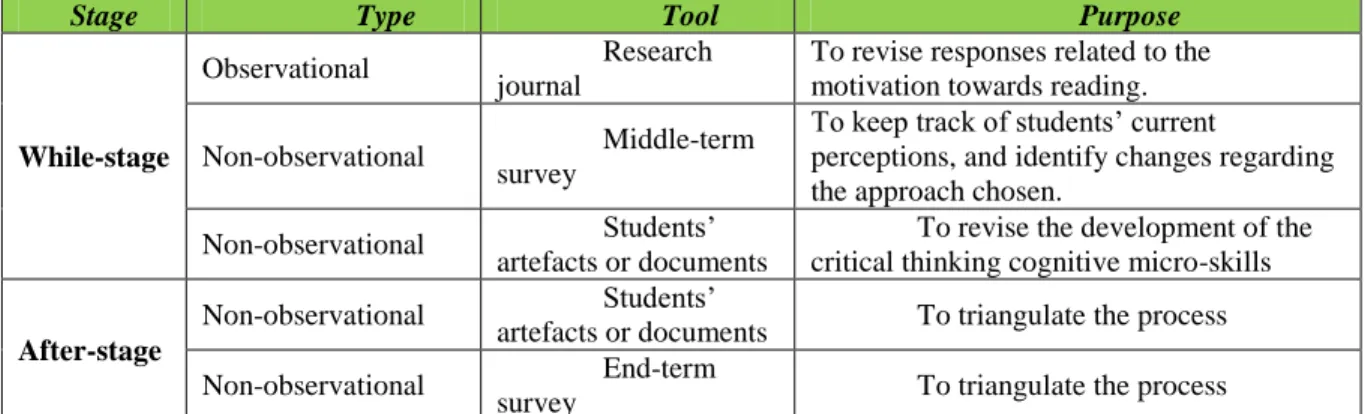
(32) IMPLEMENTING LITERATURE ANALYTICAL STRATEGIES FOR THE DEVELOPMENT OF CRITICAL THINKING COGNITIVE MICRO-SKILLS 32 In order to keep track of the most suitable data to be analysed in this project, the following data collection tools were chosen: Table 1. Plan for the implementation of tools. Stage. Type Observational. While-stage. Non-observational Non-observational Non-observational. After-stage Non-observational. Tool Research journal Middle-term survey Students’ artefacts or documents Students’ artefacts or documents End-term survey. Purpose To revise responses related to the motivation towards reading. To keep track of students’ current perceptions, and identify changes regarding the approach chosen. To revise the development of the critical thinking cognitive micro-skills To triangulate the process To triangulate the process. 3.4.1. Surveys Brown (2001, p. xi) argues that using surveys in a language program is the result of identifying an existing need in the classroom that needs to be addressed, and as such, a set of surveys will help the researcher identify emerging patterns in the perceptions students have towards reading in a foreign language. In the initial stage of the implementation, the students filled in a survey, in which they expressed the way they feel about reading in general, and the reading process in the English literature class. From this survey, certain ideas were taken in order to address issues related to difficulties that the participants had when reading in English. This technique is advantageous, since it is a tool of easy response for the pre-determined responses involved; however, the questions needed a specific preparation, for which some adjustments are necessary for the mid-term survey (Appendix C). Moreover, a follow-up survey would be considered an important data collection tool,. 32.
(33) IMPLEMENTING LITERATURE ANALYTICAL STRATEGIES FOR THE DEVELOPMENT OF CRITICAL THINKING COGNITIVE MICRO-SKILLS 33 since it would provide insight as to the usefulness of this study in students’ professional studies.. 3.4.1. Documents Documents are defined as overviews, lesson plans, students’ writing, classroom materials, and tests (Farrell, 2007, p. 24-26). These documents were collected, following specific criteria, in order to gather information regarding students’ specific performance in each of the micro-skills implemented. Documents also include the field notes or memos. From each of the micro skills proposed, three samples of students works were collected, as well as the tests developed along the term. These provided the researcher with sufficient information so as to triangulate and revise the validity of the process. A thorough analysis of the students’ documents provided an insightful idea of the state of development of each of the micro-skills proposed. Moreover, the field notes or memos written by the researcher provided information regarding students’ behaviours and responses to the tasks implemented, as well as insights regarding the overall performance shown by students throughout the research process. This allowed the researcher to analyze the progress of the implementation from different perspectives, thus responding to the principles of triangulation and validity (Burns, 2010 p. 95-97).. 3.5. Data Collection procedures As mentioned above, the data collection process was divided in three stages, each of which implied the design and piloting of the instruments proposed prior to the application. 33.
(34) IMPLEMENTING LITERATURE ANALYTICAL STRATEGIES FOR THE DEVELOPMENT OF CRITICAL THINKING COGNITIVE MICRO-SKILLS 34 Each of the instruments devised responded to the constructs and elements that were presented in Chapter 2, and were hence necessary to understand and measure the level of progress of students regarding the learning of the CTCMS and the levels of motivation associated to the reading process. During the pre-stage, students developed a test based on the five micro skills (namely, comparing and contrasting ideals with actual practice; noting significant similarities and differences; distinguishing relevant from irrelevant facts; making plausible inferences, predictions or interpretations; exploring implications and consequences) implemented, so as to measure the potential development of the aforementioned skills, but also to corroborate the pertinence of this process and the chosen skills. Students were informed about the objectives and nature of the project. Their parents also received a consent letter (Appendix A) that was returned within the week. Parents agreed to the have their children participate in the study proposed. Students also participated in the initial survey (Appendix C) that provided information regarding their perceptions as readers, and the perceptions towards reading in a foreign language. The implementation was calculated for 6 weeks, and the lesson plans corresponded to both the aims of this research project and the standards required by the school. The while-stage took more than the time defined in the beginning, and I took altogether twelve (12 weeks -two terms). One element I considered essential to examine was the need to see the skills in action throughout two books read in the literature program rather than a single publication. In this way, the validity and applicability of such skills in students throughout a longer process could be tested.. 34. As a result of this decision, more.
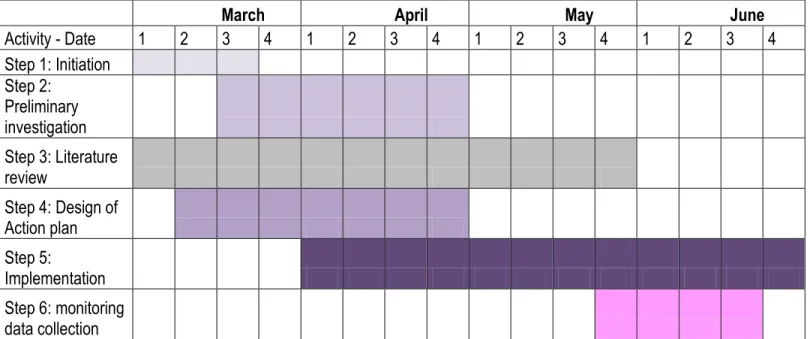
(35) IMPLEMENTING LITERATURE ANALYTICAL STRATEGIES FOR THE DEVELOPMENT OF CRITICAL THINKING COGNITIVE MICRO-SKILLS 35 lessons were planned to match the time devised for the implementation process. Throughout this process the teacher’s field notes were continuously recorded in order to complement the information provided by the documents of the students. The post stage of the project implied having students take a midterm survey to revise the potential changes in participants’ perceptions towards their reading skills and performance, and also towards their overall motivation to read. In addition to this, round table sessions were held upon completion of each of the books and also the implementation, so as to share preliminary observations with students.. The following time-lines display. the process I followed in detail:. Table 2. Timeline of the implementation process – pre and while stage. Activity - Date Step 1: Initiation Step 2: Preliminary investigation. 1. 2. March 3 4. 1. 2. April 3 4. 1. 2. May 3 4. 1. 2. June 3 4. Step 3: Literature review Step 4: Design of Action plan Step 5: Implementation Step 6: monitoring data collection. The while and after-stages focused on the end of the implementation, analysis of data and decision making.. 35.
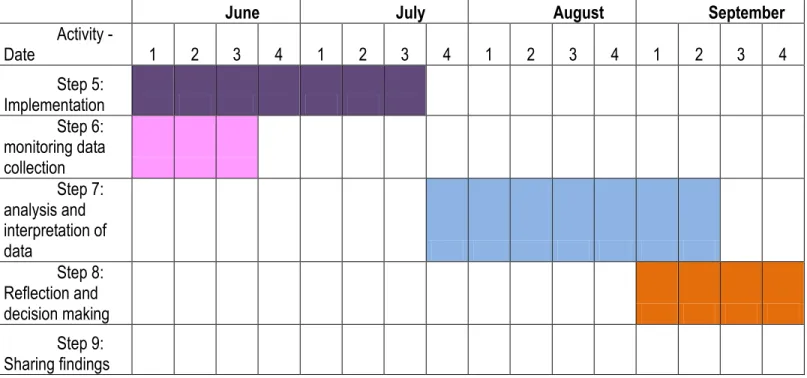
(36) IMPLEMENTING LITERATURE ANALYTICAL STRATEGIES FOR THE DEVELOPMENT OF CRITICAL THINKING COGNITIVE MICRO-SKILLS 36. Date. Table 3. While and after-stages of the implementation process June July August Activity W W W W W W W W W W W 1 2 3 4 1 2 3 4 1 2 3 4. W 1. September W W W 2 3 4. Step 5: Implementation Step 6: monitoring data collection Step 7: analysis and interpretation of data Step 8: Reflection and decision making Step 9: Sharing findings. As a result of this cycle, the curriculum of the Literature classes was revised and improved, thus, integrating the implementation of the CTCMS within the lessons, in order to continue to support students’ academic growth throughout the last years of their school life.. 36. W.
(37) IMPLEMENTING LITERATURE ANALYTICAL STRATEGIES FOR THE DEVELOPMENT OF CRITICAL THINKING COGNITIVE MICRO-SKILLS 37. Chapter 4. Pedagogical Intervention The previous chapter dealt with an overall description of the implementation process, and the data collection process. The purpose of this chapter is to provide a more insightful view of how each of the steps proposed in the implementation of this project were followed and how the methodology used responded to the initial intentions of this study. The initial stage of this pedagogical intervention started with a survey that aimed at understanding the perceptions and feelings students had towards the reading process. For the implementation of this project, it was necessary to begin and end the process with a diagnostic test, which would give insight into the level of the critical skills of the participants. By the end, the participants would present a similar test to prove whether there was an improvement in the application of the CTCMS (namely, comparing and contrasting ideals with actual practice; noting significant similarities and differences; distinguishing relevant from irrelevant facts; making plausible inferences, predictions or interpretations; exploring implications and consequences) chosen. This initial test was the cornerstone which enabled the design of sensible tasks that could promote the development of CTCMS in literature. The researcher designed a collection of tasks specifically focused on each of the micro skills to be developed.. Based on such tasks students developed artifacts that. provided further evidence of their development.. 37. Throughout this data collection.
(38) IMPLEMENTING LITERATURE ANALYTICAL STRATEGIES FOR THE DEVELOPMENT OF CRITICAL THINKING COGNITIVE MICRO-SKILLS 38 participants’ responses and reactions were annotated in the field notes, and documents were collected, collected and the participants given feedback. As a means to foster and promote activities to develop the CTCMS targeted, the books chosen were “The Beast” by Walter Dean Myers, and “The Picture of Dorian Gray”, by Oscar Wilde. One of the main reasons for my selection of the first book was because it portrayed people of the participants’ ages, and their social, ethical and moral dilemmas. This could certainly promote discussions upon several topics, such as how to choose a university, or what to ponder when facing drug addictions, or how to deal with fidelity in a relationship, or loyalty in a friendship. On the other hand, the book of Wilde is rich in moral and ethical ambiguities, but it also became a challenge in terms of the interpretive and analytic skills it demanded from the students when reading it.. 4.1. Micro Skill 1: Comparing and contrasting ideals with actual practice For the implementation of this micro skill, the main criteria to design the tasks were to choose specific issues raised by the books of the literature program. In this case issues such as friendship and loyalty were considered within the context of the literature book “The Beast” (Myers, 2002), and analyzed within it. However, the task needed to include students’ involvement in looking at the issue from their personal perspective. In order to do so, essay-questions were proposed.. 38.
(39) IMPLEMENTING LITERATURE ANALYTICAL STRATEGIES FOR THE DEVELOPMENT OF CRITICAL THINKING COGNITIVE MICRO-SKILLS 39 Essay question sample for Micro-skill 1: Explain in your own words the following assertions, and reflect upon them based on the characters of the book and on your own personal insight. Where do you stand regarding this assertion? a. Ordinary people waited till life disclosed to them its secrets, but to the few, to the elect, the mysteries of life were revealed before the curtains were drawn away.” p.34 b.. “No woman is a genius” p. 28.. In that sense, students could begin by discussing the meaning in pairs, and then writing their personal reflection individually in the form of an essay, where they could explain their views, and compare them with those of the characters of the book, and also in terms of their own realities.. 4.2. Micro Skill 2: Noting significant similarities and differences At this point of the implementation process, it was rather evident that this and the previous micro skill were similar in nature. However, the approach for this micro skill was to use tools that promoted plain and descriptive comparisons, in order to help students understand that to establish a comparison, it is necessary first to define specific elements to compare, so as to provide responses possible to analyze in a parallel form. As such, the initial tools explained and implemented were Venn diagrams, which fostered later discussion in groups. Venn diagrams are used as a complement of reading strategies since with them people can ponder the most relevant elements to consider from a variety of cases.. 39.
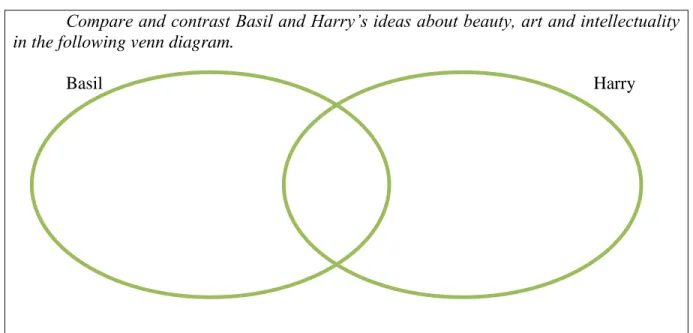
(40) IMPLEMENTING LITERATURE ANALYTICAL STRATEGIES FOR THE DEVELOPMENT OF CRITICAL THINKING COGNITIVE MICRO-SKILLS 40 Figure 1 - Venn diagram sample for micro-skill 2. Compare and contrast Basil and Harry’s ideas about beauty, art and intellectuality in the following venn diagram. Basil. Harry. One of the advantages of Venn diagrams as a tool is that it can become a versatile tool to display significant commonalities and differences not only between two elements. For this, this micro skill was merged with the first and they could be included in the analysis of moral traits of the characters and their own set of values.. 4.3. Micro Skill 3: Distinguishing relevant from irrelevant facts This micro skill could be developed from a variety of tasks that graded from the least to the most complex process of identification of information. The following samples correspond to different stages of the implementation process, thus depicting the development of the strategy further. Micro-Skill 3 - Task sample 1: 1. Make a list of the main events of chapter 2 (no more than 5).. 40.
(41) IMPLEMENTING LITERATURE ANALYTICAL STRATEGIES FOR THE DEVELOPMENT OF CRITICAL THINKING COGNITIVE MICRO-SKILLS 41. Micro-Skill 3 – Task sample 2: Considering that all answers are true, which ones respond to the questions better? Choose. III. Spoon feels it is very hard to love Gabi because: a. He doesn’t want to get married to her anymore. b. He had to leave Wallingford c. They were becoming strangers little by little. IV. When Spoon confronted Gabi about the needle in her dresser, she: a. Didn’t give it much importance. b. Felt embarrassed and cried. c. Made an excuse What each of the stages fostered in students was the construction of a set of criteria that could support decision making, as well as the consolidation of an overall judgment of issues, presented in the literature class.. 4.4. Micro Skill 4: Making plausible inferences, predictions, or interpretations As with the previous micro-skill, the tasks proposed to help students learn and apply this micro skill consisted in the careful choice of specific scenarios and moments in the book that had the quality of narrative “crossroads”. This means that a critical moment of the story was reached, and characters needed to make important decisions that would deeply affect their lives, and other people’s lives in the story. Such critical moments under the light of discussion is a scenario where students can think about possible predictions based on the information and tendencies of the characters of the book “The Picture of Dorian Gray”. They also promote possible interpretations as to the intentions and motivations of the characters or the authors, to take certain actions or to write certain ideas. 41.
(42) IMPLEMENTING LITERATURE ANALYTICAL STRATEGIES FOR THE DEVELOPMENT OF CRITICAL THINKING COGNITIVE MICRO-SKILLS 42 As with the previous micro-skill, the approach is to begin with simple and obvious tasks, and move on to more complex pertaining to this micro-skill.. Micro-Skill 4 – sample 1 Look at the title of the book and its cover. What do you think this book is about? Read the prologue of the book. What do you think about the author? What do you think this book is about? Are your predictions based on title and cover confirmed or not?. Micro-Skill 4 – sample 2 Read the following phrases made by Harry to either Basil or Dorian. a) What is the overall meaning of these aphorisms? b) What were Harry’s original intentions in telling Dorian or Basil this? How do you reach to this conclusion? Support your assumptions with specific elements in the book. Through these tasks, the researcher was able to obtain a clear panorama of the degree of development of the micro skill addressed here. In each of the cases the responses collected needed a careful development by students, because they imply pondering the intentions of people and supporting each of their assumptions with sound and concrete evidence from the book.. 4.5. Micro Skill 5: Exploring implications and consequences In this specific case, the tasks designed were largely connected to the previous task. Moreover, this is a micro-skill that implies understanding people’s motivation to do or say, or think about events, situations, contexts, among others. Through this micro skill. 42.
(43) IMPLEMENTING LITERATURE ANALYTICAL STRATEGIES FOR THE DEVELOPMENT OF CRITICAL THINKING COGNITIVE MICRO-SKILLS 43 participants tried to analyze specific situations from the book, and tried to place themselves in the shoes of the actors of the story, to try to understand their motivations, reasons, and responses to specific situations. This type of task fostered discussions along the process. Sessions Weeks 1 & 2 During the first two weeks of the implementation process, the focus was to review learned reading strategies, and their specific purposes in the process of reading texts. The second focus was to guide students through a process of becoming acquainted with the author and the historical context in which he was embedded, so as to understand specific elements found later on in the process of reading the book. Finally, the last focus of these weeks work was also to foster an initial reflection about the social prejudices of people of that time. The implementation process depicted above demonstrates a thorough use of the strategies chosen, and even though adjustments were necessary, both in the planning of the lessons, and for the tasks presented to students, they did not affect the overall plan designed. As a result of this process, the following chapter will describe the main findings of this research.. 43.
(44) IMPLEMENTING LITERATURE ANALYTICAL STRATEGIES FOR THE DEVELOPMENT OF CRITICAL THINKING COGNITIVE MICRO-SKILLS 44. Chapter 5. Data Analysis and Findings Data analysis allows researchers to understand and present a clear panorama of the phenomena studied through reflection, interpretation and close examination. This chapter will cover the procedures of interpreting data. Furthermore it will explain the steps of analyzing the data that emerged from the implementation process, the categories that resulted from the study and how they relate to one another. It will also present the findings of this action research project. In the context of this study, a qualitative analysis was the most appropriate approach, since it deals with responses and perceptions of participants, and especially the way in which the participants’ thoughts were being shaped under the light of critical thinking cognitive micro-skills. Within the range of qualitative approaches, the grounded theory by Corbin and Strauss (2008) was the method chosen.. Grounded theory is aimed at developing theory. based on the data analyzed. According to Creswell (2009), grounded theory is a “qualitative strategy of inquiry in which the researcher derives a general, abstract theory of process, action, or interaction grounded in the views of participants in a study.” (p.13). This analysis is built upon a series of steps that involve the careful coding of the data into categories that are intertwined with each other (Charmaz, 2006) and that explains the phenomenon studied. According to Corbin and Straus (2008, p.62) raw data is broken down into delineating concepts. Such concepts understood as categories will help researchers understand the issues under investigation.. 44.
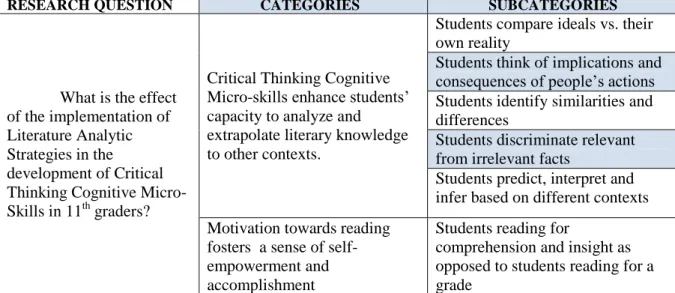
(45) IMPLEMENTING LITERATURE ANALYTICAL STRATEGIES FOR THE DEVELOPMENT OF CRITICAL THINKING COGNITIVE MICRO-SKILLS 45 In order to do so, Strauss and Corbin (2008) determined that those categories, along with the research question, should be compared and contrasted constantly throughout the analysis process to identify major categories that emerge from the phenomenon studied. Furthermore, Corbin (2008, page –location1119 of 8357 from Kindle version) states that in order to analyze data, the researcher should break apart its components in order to identify their properties and dimensions. The categories identified in that process will become the foundation of a theory that leads to answer the research question. With this in mind, the information gathered led me to define two different categories that allowed me to assess the effects of the implementation of critical thinking cognitive micro-skills in the study. In the current study, data was grouped into categories that aimed at narrowing the information considering common patterns, as suggested by Corbin and Strauss (2008, p. 47). However, the concepts that overall shaped the storyline in this work were also considered, since they reflect the essence of what was experienced along the study. The first steps involve classifying and organizing data according to the common patterns found. Such patterns become concepts that are the base to define the categories for the project. This process is understood as axial coding. Once the categories were found, the next step was to analyze relationships among categories that aim at responding the initial research question: What is the effect of the implementation of Literature Analytic Strategies on the development of critical thinking cognitive micro skills of 11th grader literature classes? Since analysis involves interpretation (Blumer, 1969) in order to “set forth the multiple meanings of an event, object, experience, or test” (Denzin,1998. p.48) the. 45.
Figure
+3
Documento similar
The objective of this subject is that the students should develop the analytical skills, rigour and intuition needed for using mathematical concepts and results
Availability, on the other hand, allows us to hold that ‘what is said’ can be captured by NL sentences, inasmuch as these are available, and, given that what is said corresponds to
In other words, if we can have a thought in a type-2 natural language sentence, then (inasmuch as we grasp the meaning that the speaker conventionally conveys) we must have ‘in
The data reveal (a) that literature on frameworks highlight case studies and teaching and learning strategies to develop 21st century skills; (b) the skills and knowledge
The Ecuadorian literature does not present research in the field of critical thinking to identify media bias in written press. Then, through an exploratory study of the two gaps
In the preparation of this report, the Venice Commission has relied on the comments of its rapporteurs; its recently adopted Report on Respect for Democracy, Human Rights and the Rule
This article presents the results of an intervention through educational robotics for the development of computational thinking (understanding it as part of the teaching
The article Proposal of a Single Critical Value for the Lenth Method analyzes the many analytical procedures that have been proposed for identifying significant effects in
