BENEMÉRITA UNIVERSIDAD
AUTÓNOMA DE PUEBLA
FACULTAD DE LENGUAS
Facultad de Lenguas
MEXICAN ENGLISH TEACHERS’ NARRATIVES ABOUT THE
TEACHING OF ENGLISH IN PUBLIC PRIMARY SCHOOLS.
A THESIS SUBMITED TO THE FACULTY OF LANGUAGES
FOR THE DEGREE OF:
LICENCIATURA EN LENGUAS MODERNAS
By:
MARÍA GUADALUPE MORENO BAUTISTA
JOSÉ SAMUEL CARRERA ECHEVERRÍA
MEXICAN ENGLISH TEACHERS’ NARRATIVES ABOUT THE TEACHING OF ENGLISH IN PUBLIC PRIMARY SCHOOLS.
This research has been read by the members of the committee of
María Guadalupe Moreno Bautista José Samuel Carrera Echeverría
And it is considered worthy of approval In partial fulfillment of the requirements
For the degree of
LICENCIATURA EN LENGUAS MODERNAS
Thesis Director
_______________________________ Mtra. María Teresa Fátima Encinas Prudencio
Committee Member Committee Member
________________________________ ________________________________
Mtro. Yonatan Puón Castro Mtra. Vicky Ariza Pinzón
Benemérita Universidad Autónoma de Puebla Puebla., Puebla.
iii
ACKNOWLEDGMENTS
This thesis project would not have been possible without the patience, motivation, help and
guidance of so many people. All of them have changed the course of our academic and
professional careers in a very different and special manner. Foremost, we would like to
express our sincere gratitude to our committee chair and advisor Professor Fátima Encinas
Prudencio, who has always encouraged us to accomplish our goals. She constantly and
persuasively expressed an excitement in regard to our professional and personal projects as
well as an enormous motivation to pursue our dreams. Without her guidance and persistent
support, this project would have never been conceivable.
We are greatly indebted and very grateful to our committee members Mtro. Yonatan Puón
Castro and Mtra. Vicky Ariza Pinzón, whose assiduous work and enthusiasm have
demonstrated to us your commitment to education. We would like to thank you for taking
the time to read this paper, for your valuable suggestions and the insightful comments you
made to improve our project. Our deepest appreciation is extended to Mtro. Jorge Luis
Mendoza Valladares and Mtro. Yonatan Puón Castro, who motivated us to pursue this
project. Thank you for allowing us to include some interviews and contribute to this
achievement. We would never finish our acknowledgments since all of you have
kindhearted introduced us to the world of teaching and changed our lives. Thanks for the
privilege of collaborating with you, for your friendship, deep trust and unconditional
iv
DEDICATIONS
All praise and glory to my almighty God, who gave me the knowledge, strength and
patience that he has bestowed upon me to accomplish this and so many other projects in my
life. Your blessed love and protective arms have guided me at all times. Thank you God,
for giving me the most precious gift: life, and for always being my “footprints in the sand.” “I hereby command you: be strong and courageous; do not be frightened or dismayed, for
the LORD your God is with you wherever you go.” (Joshua 1:9)
“Learning inspires humility, good nature, kindness and modesty.” Thus, I dedicate
this thesis to all the people who never stop believing in me: my beloved parents, my
cherished little brother, my precious family and my irreplaceable friends. It is indeed their
unconditional support and love that have greatly influenced and encouraged me to achieve
all my goals.
“In the midst of a land without silence you have to make a place for yourself. Those
who have worn out their shoes many times know where to step. It is not only their shoes you can wear, their footsteps you may follow if you let it happen.” – M. Cotter –
To my mother, Filiberta, who has taught me that the richness of learning implies
humbleness, patience and perseverance. You have always shown me everything is possible
when you have a keen desire to grow as a human being. Thank you for fighting for our
lives with all your strength and desire. Thanks a lot for giving me the opportunity to live an
v To my father, Raúl, who has motivated me to discover the world with a firm
conviction to pursue all my dreams. Thank you for constantly backing me up in all my
decisions, even the strangest ones. You are definitely one of my favourite educators.
Without your sacrifice, we could not have built our home. I love you!
To my brother, Jesús who has been with me for the past 15 years of my life. Having
someone I can rely on, has definitely changed my entire life. Every single day you make me
appreciate the fact that we have each other for the rest of our lives. Je t´aime mon chou!
To my dear family and exceptional friends, whom without his full love and support, I
would not have recognised my full potential. You have particularly inspired different parts of
my life as you arrived just in the right place at the right time. Thank you for encouraging
me to confront all challenges with effort, compromise and responsibility. All of you have a
very special place in my heart and my life.
vi
DEDICATIONS
Many years ago, there was a woman who was pregnant. She gave birth soon. In the
childbirth there were many problems and the woman and child´s life were at risk. That
woman was my mom and the child was me. Thus, thanks God for giving me life, for the
strength, the courage and the faith that was given to my mother Carolina.
To my mom Carolina, for being the support of my life. For teaching me how to be a
humble, hard-working and responsible person. For all those sleeplessness days while I was
working and studying. Thank you mom for absolutely everything you had done for me. I
love you mom.
Also I dedicate this work to my family; my dad and my sister that somehow they
were part of my inspiration to develop this project. To all my aunts, uncles and cousins that
are more than that, I´ve always considered you as my brothers. Thank you, for trusting in
me because I learnt so much from you.
Life teaches you to value and love people. Today I feel the happiest human being
because I have an unconditional support, and the huge love and affection from my
girlfriend Luz Elena. Thank you for trusting in me and for giving me the pleasure to share
life together. I love you.
I don’t want to miss anyone who has been an essential part of this, so that´s why I
want to say thanks to my dear friends. I will always remember all those great memories we
lived together.
To all my teachers and professors that I had had since I was in the kinder garden
until university. Thank you to each of you, for motivating me to achieve this goal and for
vii
2.1 Innovation in Language Teaching ………. 5
2.2 NEPBE framework ………... 7
2.3 Teacher´s Professional Development ………... 11
viii
CHAPTER 3: METHDOLOGY
3.0 Introduction ………. 16
3.1 Participants ……….. 16
3.2 Methodology ……… 16
3.3 Analyzing the data ………... 17
CHAPTER 4: RESULTS 4.0 Introduction ……….. 18
4.1 Contextualizing ELE innovation ……….. 18
4.1.1 Analyzing NEPBE contexts ………... 20
4.1.1.1 Level 1 ...……….………... 21
4.1.1.2 Level 2 ...……….……….... 21
4.1.1.3 Levels 1, 2 & 3 ...……….……….... 24
4.1.1.4 Levels 2, 4 & 5 ...……….………... 25
4.1.1.5 Level 4 ...……….………... 26
4.1.1.6 Level 5 ...……….………... 26
4.1.1.7 Level 6 ...……….………... 27
4.1.1.8 Level 1, 4 & 6 ...……….………... 27
CHAPTER 5: CONCLUSIONS 5.0 Introduction ………. 29
5.1 General results ………. 29
5.2 Review of the main outcomes ………. 30
5.3 Implications of the NEPBE implementation ………... 31
5.4 Conclusions ………. 32
5.5. Further research ………. 33
ix
Appendixes
Appendix A: Transcript I ………... 37
Appendix B: Transcript II ………. 49
Appendix C: Transcript III ……… 62
List of tables
5.1 Enhancing and hindering factors that are part of teaching in an innovation …. 31
List of figures
2.1 The hierarchy of interrelating sub-systems in which an innovation has ………. 7
to operate (Kennedy, 1988).
4.1 The hierarchy of interrelating sub-systems in which an innovation has ……… 19
to operate (Kennedy, 1988).
1
CHAPTER I
INTRODUCTION
1.0 Introduction
The implementation of English in public primary schools has increased significantly
in different countries around the world. In China, for instance, there were about 8 million
primary school children studying English in 1998, and that number has been increasingly
rapidly, with an increase of one million every year since 1994 (Liu & Gong 2001, p. 36).
Today´s globalized world requires competitive human beings. English represents for many
people their aspirations in quality of education, an economic status, and often a symbol of
power. Thus, some countries have developed and supported policies for maintaining
English in primary schools, as a strong and important language of communication.
Additionally, in the last decades English has become a necessary language of
communication in certain everyday activities. Therefore, English Language Teaching in
primary school aims at preparing students to communicate, not just in school, also in
different situations and purposes of their lives.
According to the UNESCO, education systems need to prepare students to face the
new challenges of a globalized world in which contact between multiple languages and
cultures is increasingly common. Therefore, the Mexican Government established new
policies to improve the quality of the education. And, in 2009 The National English
Program in Basic Education (Henceforth NEPBE) was implemented in the first piloting
2 One of the main objectives of Secretaria de Educación Publica (SEP) is to increase
the quality of education. Ornelas (1995) stated that Mexico has suffered a tremendous
transformation; it has jumped from being in a state of economical protectionism to an open
economy mostly dependant on its international relations and the demand of more well
prepared citizens that can fit the standards of a globalized Mexico. This creates more
demands from the Mexican education and consequently students have to improve their
levels of academic achievement to have enough tools to get a better life, and at the same
time to contribute to the national development.
During its piloting process, NEPBE has had a number of issues related to its
implementation; for instance, the success of the program, the numbers of hours of English
classes a week, the material, the space, relationship with classroom teachers, principal’s
expectations, beginner English teachers among other issues. However, all these issues are
part of this innovation, and this implies that some new ideas or practices were successful
while others were not.
English Language Teaching could be successful depending on the contexts in which
English teachers work. Nevertheless, it also depends on how teachers think, believe and
justify their teaching. Pratt (1998) stated the following:
A perspective on teaching is an inter-related set of beliefs and
intentions that gives direction and justification to our actions. It is
a lens through which we view teaching and learning. We may not
be aware of our perspective because it is something we look
3
Cooper (1989) claims that implementing an innovation is a socio-cultural, not a
geographical, issue. Hence, this research attempts to explore the factors that teachers
consider either support or maybe enhance the implementation of this innovation and the
aspects that hinder it.
1.1 Significance of the study
This study attempts to describe and analyze English Language Teachers’ narratives
about their teaching perspectives in the NEPBE and their professional development while
they work in the program. By doing this, future generations of EFL primary school teachers
would understand the circumstances that they might face.
1.2 Purpose of the study
The main purpose of this study is to explore English Language Teachers’ narratives
regarding their points of view about the implementation of the NEPBE and how they lived
this innovation experience. Also, the research aims at finding out how these teachers
overcome some drawbacks that hinder the success of the program.
1.3 Research Questions
This project addresses the following main research questions:
RQ1: How do novice English teachers narrate their experiences teaching at
NEPBE?
4
1.4 Research aims
This research attempts to collect data from 3 teachers’ perspectives about the
implementation of English in public primary schools. They joined NEPBE in different
years of the piloting stage in Puebla. As the purpose of this investigation is to analyze their
experiences, semi-structured interviews will help collecting the data in order to explore
5
CHAPTER II
LITERATURE REVIEW
2.0 Introduction
In order to carry out this study it is necessary to review other research in order to
support its content. Thus, this section provides a theoretical discussion on the
implementation of a new program and the teaching process involved.
2.1 Innovation in Language Teaching
Innovation has become a trendy topic in recent decades. In fact, many educational
systems around the globe have pledged their commitment to significant changes in
education through innovation as a complex processes. Educational systems do not merely
conceptualise innovation neither as a good nor a service. Innovations need to bring up to
date the organization of a specific educational system, their methods, their practices and the
manner their participants respond to the new changes. Those changes are expected to have
a positive impact on individuals that, in the near future, will be required to develop
competencies as critical citizens. This implies that innovation can shape education so that
future generations face their challenges differently.
Innovation in education is a process with a significant number of participants, such as
policy makers, principals, administrators and teachers who play a very important role in the
implementation of innovation. However, the role of the participants might vary according
to the context. The interaction among participants often shapes and may even redefine the
6 The implementation and adoption of any innovation is a very complex process, thus,
individuals or institutions need to carefully analyze and take decisions at different moments
of the implementation. Rogers (1983) suggested that there are five steps in this
decision-making process. This involves potential adopters 1) gaining knowledge about innovation,
2) being persuaded of its value, 3) making a preliminary decision to adopt the innovation,
4) implementing their decision to adopt, and 5) confirming their decision to continue with
the innovation. On the other hand, Fullan (1991) proposes four steps which he calls
initiation, implementation, continuation and outcome.
The implementation of any innovation also depends on the context where it will be
implemented and its real impact on society. It is important to take into account that this
impact might have positive or negative implications depending on the outcomes that are
accomplished with the new implementation. For example, Markee (1992) identifies
cultural, ideological, historical, political, economic, administrative, institutional and
sociolinguistics factors that might affect the implementation of a new project. Some factors
are mentioned as well in one of the most popular frameworks related to English Language
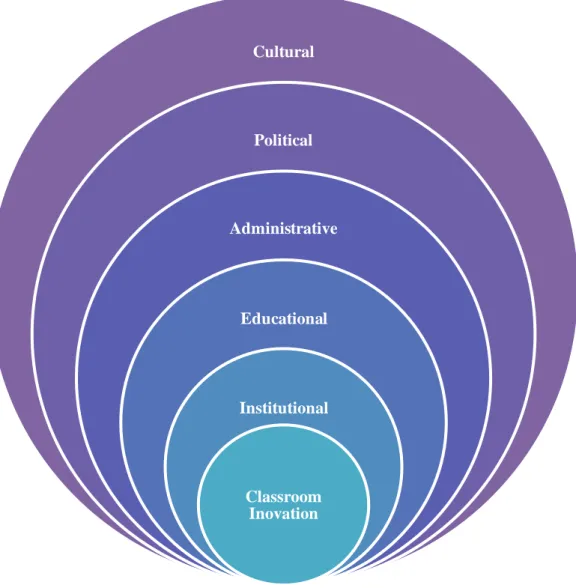
Education in which innovation contexts are described by Kennedy (1988) in figure 2.1
Indeed, successful innovation depends to high degree on the clear objectives and the way
educational systems develop the capacities to react to social, economic and political
7 Figure 2.1 The hierarchy of interrelating subsystems in which an innovation has to operate.
(Kennedy, 1988, p. 332)
2.2 NEPBE framework
There is a growing social demand for incorporating English as a subject from very
early years of formal education. Thus, major responsibility of the basic education system of
SEP is that providing students opportunities to gain such competencies, for which students
need to develop knowledge and skills in various key subject areas for the future, such as
information and communication technologies and foreign languages. This has called for the
design of the National English Program in Basic Education NEPBE, SEP in 2010.
Therefore; the need for a reform in the curricula was imperative. NEPBE was the result of
this demand.
Cultural
Political
Administrative
Educational
Institutional
8 The mission of NEPBE as stated in the National Development Plan 2007-2012 plan
points out that the main objective is to promote and guarantee integral education that
responds appropriately to the demands of contemporary society and therefore offers
equitable opportunities for all students to study and learn with the appreciation for ethical
values, good citizenship, history, art, culture and languages.
Likewise, as a strategy to reduce the inequality in the quality of education between
private and public schools, the 2007-2012 National Development Plan proposes that “the
latter should offer the possibility to study extracurricular subjects related to sports, arts, culture and languages” (p. 178).
Some of the greatest benefits the program in children´s education offers are:
Contributes to cognitive development: generates a more flexible and diversified
mental structure.
Strengthens reflection on the mother tongue: fosters a better use of L1.
Favours openness towards other cultures and otherness: raises awareness of own
cultural values and those that are different.
Provides a wider view of the world (with its diversity and plurality): raises
awareness of diverse social and political ways of organisation.
Therefore, in order to obtain effective results with the program, it is necessary to
establish a relationship among preschool, primary and secondary EFL programs as a
national program. The NEPBE has been divided into cycles that seek to develop the
different competencies children must develop and consequently prove that the need for
9
2.2.1 NEPBE cycles
The program is divided into four cycles which seek to fulfil the needs of students of
that age and provide them with the necessary conditions to participate in such conditions to
reach gradual autonomy in their intellectual work and be able to transfer what they have
learnt in the classroom out-of classroom communicative situations.
2.2.1.1 Cycle 1
The purpose of English Language Teaching for cycle 1 in basic education is (3rd.
grade of preschool, 1st. and 2nd. grade of elementary school) is for students to raise student´s
awareness about the existence of a language different from their own and to get them
acquainted with the foreign language by participating in routine social practices of the
language via specific activities with the language which promote interaction among the
students in spoken and written texts in different social environments. During this cycle the
essential focus is on making students be acquainted with the language, exposing them to the
most activities that will provide them with a broader vision in perceiving the language.
2.2.1.2 Cycle 2
The purpose of English Language Teaching for cycle 2 in basic education is (3rd.
and 4th. grade of elementary school) is for students to acquire the necessary knowledge to
understand and use the language to recognise, understand and use common expressions by
participating in routine social practices of the language via specific activities with the
language, related to production and interpretation of oral and written texts, in the context of
10
2.2.1.3 Cycle 3
The purpose of English Language Teaching for cycle 3 in basic education is (5th.
and 6th. grade of elementary school and 1st. grade of secondary school) is for students to participate in some social practices of the language. These allow them to interact with oral
and written texts, understand and use the language and to develop simple everyday
communicative actions on familiar topics or situations. Cycle 3 is aimed at students who
have had some contact with English as a foreign language since they have finished Cycle 2
and therefore, acquainted with some uses and linguistic aspects of the language.
2.2.1.4 Cycle 4
The purpose of English Language Teaching for cycle 4 in basic education is (2nd.
and 3rd. grade of secondary school) is for students to solidify their language domain in
English based on basic communicative situations. They must also be able to participate in
activities with the language. Proper of social practices with the language with varied
communicative situations in which they produce and understand, in a general way, oral and
written texts about different topics. By this stage, students must be competent to
communicate in different communicative situations and under different topics.
Conceiving the implementation of the NEPBE represents various challenging
demands for teachers who are crucial implementers of this innovation. Therefore, there is
an imperative need to understand their professional development to maximize and
strengthen the potential of the program. Diverse and important factors on teachers´
11
2.3 Teachers Professional Development
Teachers worldwide face different circumstances to grow personally and
professionally. They are constantly under pressure and are required to fulfill external and
internal expectations as professionals. Not being able or sufficiently prepared to overcome
those circumstances, or maybe the fact that they need to adapt themselves to diverse or new
standards might be the most difficult part of their professional development. In some cases
they need to satisfy students, parents or institutional needs and are likely to forget personal
growth.
Just like in any other profession, teachers have to face and react to everyday life
situations and need to discover the possible solutions, but at the same time they need to
improve not only as teachers but also as human beings. Huberman (1989) claimed that teachers’ progress in their development by facing and overcoming situations in their daily
lives. Thus, awareness plays a very important role when teachers need to make a decision
to change the way they work. Freeman (1989) observed that the key ingredient to teacher
change and long-term development is awareness. Head & Taylor (1997) also stated that
teacher development draws on the teachers´ own inner resource for change. It is centered
on personal awareness of the possibilities for change, and of what influence changes affect
the process.
As this process is continually changing, it is very important to notice that awareness
is an important factor in teachers´ development and somehow it is a key issue to understand
the process. Nevertheless, some other factors can also influence their development
12 well as self-reflection that play a key role in teachers´ personal and professional attitudes.
Pennington (1995) argues that teacher development can be seen as a metastable system of
context-interactive change involving a continual cycle of innovative behavior and
adjustment to circumstances. It is certain that teachers´ behavior and the control they have
over positive or negative circumstances have a great inner and outer impact, as teachers it is
vital to be able to recognise, confront and try to find different possible solutions to the
situations they face. This means that teachers must be able to adapt themselves to their
context in different moments of their lives and try to discover alternatives to their work.
2.3.1 Cycles in teachers´ careers
According to Huberman (1989) teachers’ progress along five distinct phases in their
careers and, in the following subsections, they will be described in detail.
2.3.1.1 Exploration and stabilization
The first phase teachers go through upon entering the profession is exploration and
stabilization. The theoretical knowledge gained during teacher education as well as more
informal knowledge gained through the apprenticeship of observation (Lortie 1975) is
confronted with the reality of the classroom. Professionals at this stage seek balance and
stability and tend to develop resources for teaching in order to confront the multitude of
problems arising from interaction with students, colleagues, administrators, and the wider
school community. Typical teacher thinking at this stage focuses mostly on getting the
teaching part right and sometimes overlooks student learning. However, once teachers have
found the resources that help them cope with classroom and school situations on a daily
13
2.3.1.2 Commitment
Once they know what to expect from the school environment, teachers begin to
focus on improving student learning. The crisis to be resolved at this stage is providing
quality teaching that will result in quality learning.
2.3.1.3 Diversification and crisis
During the third phase, teachers tend to question their role. It is at this stage when
most teachers begin considering career moves, for example, moving into administration or
possibly leaving teaching altogether. The crisis at this stage is an identity crisis. Teachers
ask themselves whether they want to keep doing what they are doing for the rest of their
lives. Hence, teacher support seems to be particularly important at this stage.
2.3.1.4 Serenity or distancing
The fourth career stage may come in one of two forms. If teachers are satisfied with
their career choice, they may become settled in the position of their choice and will
generally find renewed energy to pursue even better student learning. However, if for any
reason teachers fail to fulfil their dream, a distancing may occur. Professionals who
distance themselves from teaching are likely to comply with school regulations, but will not
really pursue improvement in their teaching. These teachers need incentives to help them
14
2.3.1.5 Conservatism or regret
Finally, and towards retirement, one of two crises may happen. Some teachers
become extremely conservative in their ways, thus perpetuating a model of teaching that is
comfortable for them but not necessarily effective for student learning. Other teachers
regret the fact that they will have to retire. This kind of teacher still feels the joy of teaching
and can be a powerful motivator within the educational community.
2.4 Novice Teachers
In the field of teacher education, a topic that has gained much attention with a
constant and an increasingly impact is the fact that novice teachers drive through a hard
process in which they need to adapt and adopt beliefs and practices to the classroom and the
educational environment. According to Huberman (1993), a novice teacher is defined as
one with less than 3 years of teaching experience and one whose teaching tends to focus on “survival” and establishing basic classroom routines (Sherin & Drake, 2000). It is to say
that at first, their teaching lives tend to be critical, especially for those who teach another
language different to their mother tongue. For teachers of English to speakers of other
languages (ESOL), this time has been characterized as a period of anxiety and a time of
critical development (Farrell, 2009).
Teacher attrition often occurs in the early years of teaching and is highest among
novice teachers within their first 5 years of teaching (Moon, 2007). During this process of
adaptation, novice teachers are more conscious of the reality of their profession and the
challenges they need to face and subsequently, they decide if teaching is the best and
15 transition from teacher education programs to the first years of teaching, due to the
unpredictable and dynamic nature of authentic educational contexts (Veenman, 1984, p.
143). For some teachers problems arise when they do not notice the connection between
schools and the purpose of the program they are working for, some others do not feel a
sense of belonging due to in some schools English as a second language is considered an
extra subject in the curriculum; consequently, they feel that they do not fit in the context.
Pennington and Richards (1997) and Urmston and Pennington (2008) found novice
teachers unable to implement practices promoted in their teacher education program as they
struggled to face local conditions such as large class size, numerous responsibilities,
unmotivated students, and pressure to prepare students for examinations—realities that
could have been anticipated in the preparation program.
Given the critical period novice teachers face, social support and positive attitudes
need to be developed within teachers´ context in order to develop feelings of security,
preparedness and self-efficacy so that novice teachers feel empowered to transform their
beliefs rather than feel overwhelmed and defeated by them. Teaching needs to be regarded
as an ongoing process in which teaching conditions such as stress, unfamiliar
environments, isolation and frustration change in novice teachers´ minds so that in the
future on they can be able to construct an environment that fosters positive attitudes
16
CHAPTER III
METODOLOGY
3.0 Introduction
The objective of this chapter is to provide a detailed description about the
methodology used to carry out this thesis. This chapter describes the participants of the
study, the instrument used, and the procedure followed.
3.1 Participants
In this research, the participants were three English Language teachers from Puebla.
At the time of the data collection, they have worked for one or two years in the program
and they had not been involved in English Language Education programs before. Their
ages were ranged from twenty to fifty years-old. They worked in different public primary
schools and grades of teaching. They had little experience and involvement in the NEBPE.
For this study, Andrea, Brenda and Carolina narrated their experiences and points of view
about the implementation of the NEPBE and the teaching process in the program
mentioned before. They agreed to participate as volunteers to contribute to this study.
3.2 Methodology
The main purpose of this research is to analyze these three teacher’s narratives
about the implementation of the NEPBE and how they lived their experience in the
17 how teachers lived the experience of integrating an innovation to their professional and
personal development.
Regarding this, the first stage was collecting the information by making three
different interviews to the participants. It is important to mention that the interviews were
not rigid as open conversation were held and the interviewers asked different open
questions related to the program to the volunteers. This research is a narrative inquiry based
on analyzing, classifying and interpreting the narratives of the participants in the National
English Program in Basic Education. Semi structured interviews have been chosen as the
main instrument in order to gather the information mentioned before.
Estenberg (2002) claims that semi structured interviews are much less rigid than
structured interviews. The goal is to explore a topic more openly and to allow interviewees
to express their opinions and ideas in their own words. Although the researcher typically
begins with some basic ideas about what the interview will cover, the interviewee’s
responses shape the order and the structured of the interview, (p.87). Thus, semi structured
interviews help to express and narrate ideas and stories into a more natural and relaxed
environment.
3.3 Analyzing the data
As mentioned above, the semi-structured-interviews were made and recorded.
During the second stage, they were transcribed to have a general overview of the narratives.
Finally the transcriptions were taken as a reference point to find innovation contexts
18
CHAPTER IV
RESULTS
4.0 Introduction
Analyzing these three teachers’ narratives about the NEPBE innovation process
using Kennedys’ theory (1988), discussed in Chapter 2, allowed us to understand this
process. This chapter provides the results as well as the analysis from the data gathered in
the interviews.
This section attempts to analyze the interviews from a critical perspective. This study’s data was collected using semi-structured interviews which allowed teachers to
reflect and express their insights by narrating their experiences and conceptualise different
issues involved in this English language program.
4.1 Contextualizing ELE innovation
One of the main objectives of any ELE innovation is to raise substantial changes in
the society and educational systems. The success of the implementation of a program may
vary according to the level of understanding of the innovation process and its real practice.
Considering the contexts in which the innovation took place, there are different
essential factors were considered to examine using different teachers´ perceptions. One of
the most popular frameworks related to ELE innovation contexts is the one described in
19 Cultural
Political
Administrative
Educational
Institutional
Classroom Inovation
central system with inner divisions. They are related to one another, but the external
divisions are the ones which have a great influence on the internal divisions.
Figure 4.1 The hierarchy of interrelating sub-systems in which an innovation has to
operate (Kennedy, 1988, p.332)
Kennedy´s framework considered six levels as the main factors that affect any
innovation process. The innovation contexts are the following: classroom innovation,
20
Cultural
Political
Educational Administrative
Social
Institutional
Classroom Inovation
4.1.1 Analyzing NEPBE Contexts
The hierarchy previously mentioned was taken as a base model to analyze the data
collected according to the situations involved in the process. They are the basis to describe
and analyze the results from teachers´ narratives obtained from three interviews containing
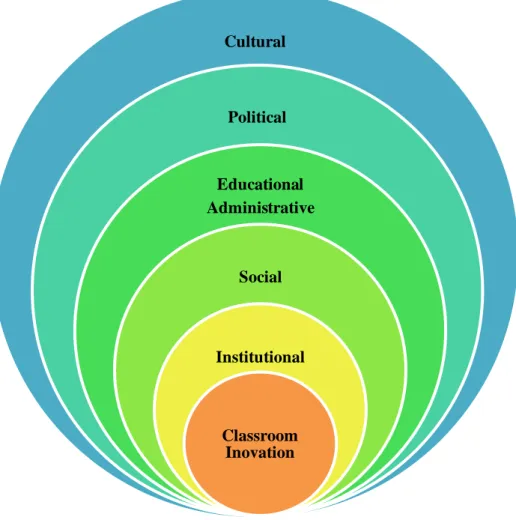
data and its influence affecting the implementation. However, we adapted Kennedy´s
hierarchy of interrelating sub-systems as we considered important to mention the essential
role of society since parents are a fundamental part of children´s education. (Figure 4.2)
21 bueno al menos creemos que vamos muy bien preparados.”
Our translation:
My expectations were to get a lot of experience, I think that's something I've been getting little by little because actually nobody… well at least I think, is very well prepared.
Some excerpts from the narratives were taken to better understand and contextualize
the main concerns that teachers lived and their attitude towards the way they interacted
within their environment during the process. The following sub sections will describe how Kennedy´s innovation hierarchy can be found within the teachers’ narratives.
4.1.1.1 Level 1
At the beginning of this implementation teachers faced difficult situations related to
teachers´ expectations considering classroom innovation as the very first level of the
sub-systems as the following extract shows:
4.1.1.2 Level 2
Institutional aspects affected the innovation and its implementation owing to the
resistance towards the program. Teachers mentioned that adapting themselves to the
institution was a hard process because most of their colleagues were not prepared to
22 hecho mejor hasta ahora y por otro lado también no creía que fuéramos a tener como que tantas dificultades en el camino.”
Our translation:
“Once you know the real working world, you realize different things. I don t know, maybe when I started with my job my goal was adapting myself to the work team. I think I've been improving that part. On the other hand, I did not guess that the beginning was meant to be so difficult.”
“En la primaria, bueno el maestro fue un poco más, el director fue un poco más renuente, habló de que le programa ya tenía tiempo que lo habían propuesto, que no sabía porque apenas había salido pero que no le daba mucho tiempo de vida y pues que ya que, que nos teníamos que quedar ahí, ya que.”
Our translation:
“In the primary school, well… the principal was a little bit more reluctant, he gave his opinions, he said it was a project that was proposed long time ago but he did not know because it was a recent implementation and also he commented that in his opinion it was not going to be successful but we (teachers) had to stay there and in that case, there was no option.”
23
“In my case, I was working with a principal in pre-school, she loved the idea and she was very friendly. Consequently I got the acceptance form my colleagues and I felt I was immersed in the school environment. I had no difficulties.”
“Lo que hice fue platicar con la directora y me dijo: “ no, es que, mira el programa esta así, así y así, yo sé cuáles son los objetivos”, entonces me dijo: “vamos a darlo como un taller si quieres y tú no te preocupes que mientras se te apoye aquí, tú tienes que seguir y los demás pueden decir misa y tú tienes que seguir con tu programa y mientras tu vengas tu trabajes y hagas lo que tengas lo que tengas que hacer, ya”.
Our translation:
“What I did, was talking to the principal and she told me “I know the program and its objectives.” Then, she mentioned: ”we can work and adapt it as a workshop. Don’t worry, your work will be supported and you have to continue, it doesn’t matter anyone else opinion, you have to come and work.”
On the other hand, there were people who were not reluctant towards the program.
There was also interest in empowering it, in order to benefit children´s education. Thus,
understanding the innovation increases the possibilities of its potential impact.
When the innovation faces institutionalization different changes emerge and
sometimes the stability of the institution is disturbed. Therefore, little communication and
24 ya tiene organizado su salón, ya tiene donde poner sus cosas, y tú llegas a ocupar un espacio que no es tuyo, no está diseñado para ti, o sea, nosotros como maestros de inglés, no tenemos, o sea, depende del maestro titular si te hace un espacio.”
Our translation:
“Acceptance is not easy, I even think everyone has organized its classroom, you come and invade the space that doesn’t belong to you. As English teachers we don’t have a specific place to work and it depends if head teachers want to share their classroom.”
Individuals’ attitudes define the innovation success. As we can observe below, three
different levels (1, 2 and 3) describe a wide variety of situations that teachers faced at the
same time. Firstly, at the classroom innovation and institutional level, we could notice
effective transitions when head teachers and children were enthusiastically involved in the
teaching and learning process inside the classroom. los mismos padres de familia porque ellas podían ver en el salón de clases que los niños lo estaban disfrutando y que estaban aprendiendo.”
Our translation:
25 nombramiento, teníamos que dirigirnos con el director bueno pues presentarnos y decirles que íbamos de parte de la SEP, que llevábamos este nuevo proyecto de Inglés y que le permitíamos ver el nombramiento y tenía que firmarlo y recibirlo y si tenía alguna duda pues comunicarse a las oficinas de SEP, ese era el proceso, obviamente muchos directores pues no, no se lo esperaron”.
Our translation:
“I arrived to the assigned school to talk to the principal; we arrived with a document to introduce ourselves and to tell him that we were SEP teachers. We talked about the new English project. Therefore, the principal had to read the document and to sign to prove he agreed. If he had a question, he could contact someone in our coordination. That was the process, and as it was expected there were many principals that were not prepared.”
4.1.1.4 Level 2, 4 & 5
As noticed below, financial issues were found when analyzing the narratives as well
as administrative aspects such as a lack of organization regarding the way teachers became
part of schools and started their work. Regarding the perspective from the SEP it is
essential to include English in basic education as part of the curriculum. Nevertheless, in
most cases, there was little communication and few discussions among the different
organizations involved in the education system. Consequently, when the new program was
implemented there was misleading information about the innovation and not only the
society and educational institutions were misinformed, but even regional governments were
26
“Yo creía que todo iba a ser como que más fácil, tanto los niños, como el ambiente incluso, el programa mismo, o sea el punto monetario también, todo este aspecto administrativo que si cambio de gobierno, que si no, que si pagan, que si no, entonces en cuanto al programa yo creo que si me, me está dejando un poquito que desear y en cuanto al aspecto de apoyo y al salario.”
Our translation:
“I thought everything was going to be easier, children, even the environment, the program itself, or the salary, that administrative aspect. Because when governments change, sometimes they pay teachers and some others they don’t have “enough” budget. In my personal opinion, the program is not covering my expectations because of the salary and support.”
“El director dice que de hecho desde la administración de Fox ya sabía que querían implementar este programa, pero que no se había hecho y pues que feo que apenas lo hubieran implementado tanto tiempo después pero que se le hacía algo que no iba a durar
Once an innovation has been set, it is very important to analyze the real needs of its
implementation and the strategies that will be used to foster it. Unfortunately, the
implementation of NEPBE is not regarded as a part of an on-going and continuous process.
4.1.1.6 Level 5
As presented below, head teachers perceive that the program was implemented as a
27 obviamente también saben no digo que no lo sepan, tienen experiencia, saben cómo hacer su trabajo, pero creo que en ese saber en el querer creerse de que ya llevo treinta años de servicio y a mí ya nadie me enseña nada, se cierran un poco, se vuelven un poco herméticas en cuanto a que lleguen nuevos modelos, nuevos métodos. A parte el hecho de que llegue una persona más joven y pues a lo mejor llegue y haga algo diferente que para ellas a lo mejor sea demasiado ruidoso o rompa con el esquema tradicional, yo creo que les genera molestia, es algo diferente que ellas no hacen. Entonces obviamente cuando vemos algo que no es lo que yo hago, pues a veces nos molesta”.
Our translation:
“I think it was lack of communication besides everything, I don t want to judge head teachers but they are old, they have enough experience and they know how to do their job. But I believe that they are really closed to accept new educational projects and methods. When a young teacher arrives and tries to do something new, head teachers are not satisfied because they are used to working in a traditional manner and they do not try something different as a consequence they get angry”.
4.1.1.7 Level 6
4.1.1.8 Levels 1, 4 & 6.
Finally, as we can notice the economic issues, lack of awareness from the
administration, head teachers and parents partially blocked teachers´ professional
development. For that reason, it is fundamental to raise consciousness among the different
28 The implementation of the NEPBE depended on the level of acceptance of
the different schools as potential adopters of the program. Schools are normally led
in a specific manner; they follow rules and patterns. Consequently, adapting to and
adopting new innovations and facing new challenges is a complicated process.
L
29
CHAPTER V
CONCLUSIONS
5.0 Introduction
This chapter presents the conclusions obtained from the analysis. First a general
conclusion will be presented as a summary of the main results of this research. After that,
the main outcomes will be presented by stating some issues and relevant points found in the
previous chapter. Then, some implications that can be drawn from this study will be
discussed, and as a final point some suggestions for further research will be mentioned.
5.1 General results
The main purpose of this research was to carry an analysis of the teachers´
narratives taken from the semi-structured interviews. The results obtained from this
research led us to the assumption that implementing an innovation must be a very
thoughtful and detailed process that will always have consequences and will impact on
society and education. Likewise, it made us reflect on the factors and contexts that need to
be taken into account to implement and monitor the innovation development such as
classroom innovation, institutional, social, educational administrative, political and cultural
environments.
In addition, this study allowed us to visualize a conceptualization of the main
reasons affecting or promoting professional development as well as positive or negative
impacts of the implementation on teachers who directly involved in the process as the main
30
5.2 Review of main outcomes
The previous chapter pursued to acutely analyze the narratives extracted from the
interviews of PNIEB teachers in order to get different outlooks of the circumstances in
which they were immersed and a comprehensive overview of the program.
The study was based on the research question mentioned in Chapter I and it
attempted to identify English teachers experiences dealing with some issues and situations
regarding the implementation of a new program. The findings showed that since the
beginning of the program, teachers faced different sort of situations considering that they
had positively as well as negatively affected or influenced by the innovation process.
In English Language Education contexts, especially in EFL which is the case of the
NEPBE program, the positive or negative impact of an innovation plays an essential role to
implement and approve successful practices. Consequently, the opportunities teachers have
to guide the program to a fruitful classroom stage are determined by the interconnected
contextual elements.
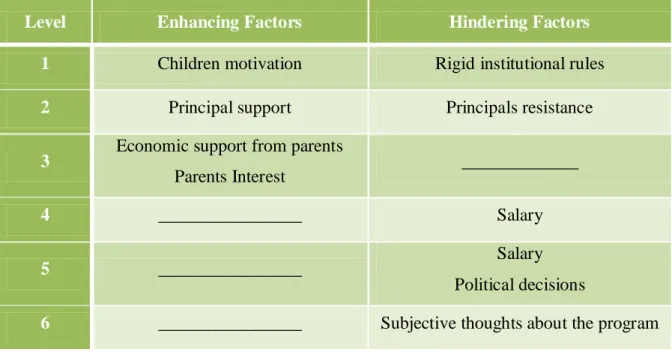
Factors that teachers considered affected or contributed to their teacher’s
31 Level Enhancing Factors Hindering Factors
1 Children motivation Rigid institutional rules
2 Principal support Principals resistance
3 Economic support from parents
Parents Interest _____________
4 ________________ Salary
5 ________________ Salary
Political decisions
6 ________________ Subjective thoughts about the program
Table 5.1 Enhancing and hindering factors that are part of teaching in an innovation.
5.3 Implications of the NEPBE implementation
As every innovation is a complex process, it can empower or disempower society
and the educational system itself. The results obtained from the narratives gave us a
perspective about the implications of the study. First of all, there was an inclination to
appraise and criticize the procedure of the implementation of the program rather than
evaluating the potential for adopting a new educational implementation which could benefit
children if its implementation were effectively organized.
On the other hand, if responsible individuals manage the innovation and pay no
attention to the contextual factors, problems within the organization and monitoring are
likely to arise, since contextual elements of the innovation will not be adequate to suit and
32 The findings of this research also suggest that teachers’ experiences allowed
teachers to improve their professional development based on the positive and negative
experiences they had during their teaching process. At the beginning teachers’ emotional
reactions were expressed as a part of teacher´s response towards the innovation and
constructed prejudices regarding the administration and the program.
Teachers directly involved in the NEPBE learned from the specific contexts in
which they taught. Their behavior, ideas and attitudes towards the implementation of the
program changed once they are aware of the complexity of the educational system.
5.4 Conclusions
Experiences and perceptions towards an innovation are part of the implementation.
They draw a general perspective of the efficacy of the NEPBE implementation and their
effectiveness to accomplish the expected learning outcomes not only inside the classroom
but outside the classroom as well as to build positive impact on society.
This study focused on the implementation of NEPBE, its education practices and the
way teachers perceive the innovation when they are immersed in the program. Teachers
confronted the classroom and outdoor realities by adapting themselves to the context.
Teachers appeared to have had an impact on the perspectives and expectations regarding
NEPBE since their experiences will allow shaping their professional development.
Likewise, the research aimed to understand process of the implementation of a new
33 and society in order to monitor and develop a better organization that provides the teacher
the appropriate tools to ensure better practices in new English education programs.
5.5 Further research
Even though the narratives helped us to develop this study, there are different
aspects to explore when it comes to the implementation of NEPBE in the state. Further
research is required to have a global position towards this implementation. It is essential to
have a broader perspective about this implementation including different participants such
as parents, principals, head teachers, coordinators and evaluators in Puebla. In order to
establish specific criteria that could help present and future English teachers to understand
the constraints they might face in the implementation process and how they could get
34
REFERENCES:
Cooper, R. L. (1989). Language Planning and Social Change. Canbridge: Canbridge
University Press.
Estenberg, K. G. (2002) Qualitative Methods in Social Research. University of
Massachusetts- Lowell.
Farrell, T. S. C. (2009). Teaching reading to English language learners: A Reflective guide. Thousand Oaks, CA: Corwin Press.
Freeman, D. (1989). Teacher training development and decision making: a model of
teaching and related strategies for language teacher education. TESOL Quarterly, 23(1), 14-26.
Fullan, M. 1991. The New Meaning of Educational Change. London: Cassell.
Head K. & Taylor P. (1997). Readings in Teacher Development. London: Heinemann
Huberman, M. (1989). The professional life cycle of teachers. Teachers College Record, Vol. 91(1), 31-57.
Huberman, M. (1993). The Lives of Teachers. New York: Teachers College Press.
Kennedy, C. (1988). Evaluation of the management of change in ELT projects. Applied
Linguistics 9.4, 329–342.
Liu, D. & Gong, Y. (2001). English language teaching development in schools in China..
Retrospect and Prospect – Memoirs for the 20th Anniversary of the National
Foreign Language Teaching and Research Association, China Education Society.
35
Lortie, D. (1975). Schoolteacher: A Sociological Study. London: University of Chicago
Press.
Markee, N. (1992). The Diffusion of Innovation in Language Teaching. Annual Review of
Applied Linguistics, 13, pp 229-243.
Moon, B. (2007). Research analysis: Attracting, developing and retaining effective
teachers: A global overview of current policies and practices. Paris, France: United
Nations Educational, Scientific, and Cultural Organization.
Ornelas, C. (1995). El Sistema Educativo Mexicano: La Transición de Fin de Siglo. Fondo de Cultura Económica, Mexico City.
Pennington M.C & Richards J. C. (1997). Reorienting the teaching universe: the
experience of the first five-year English teachers in Hong-Kong. Language
Teaching Research, 1 (2), 149-178.
Pratt, D.D. (1998). Five Perspectives on Teaching in Adult & Higher Education. Malabar, FL: Krieger Publishing.
Rogers, E.M. (1983). Diffusion of innovations (3rd. ed). New York: The Free Press.
SEP, Programa Nacional de Desarrollo 2007-2012. Mexico.
Sherin, M. G., & Drake, C. (2000). Contrasting models of curriculum use for novice and veteran teachers. Manuscript submitted for publication.
Urmston, A. & Pennington, M. C. (2008). The beliefs and practices of novice teachers in
Hong Kong: change and resistance to change in an Asian teaching context. In
36
Veenman, S. (1984). Perceived problems of beginning teachers. Review of Educational
37
APPENDIX A
Transcript 1
Entrevistador: ¿En dónde das clases?
Andrea: en San Francisco Teotimihuacán, en una primaria federal que se llama (inaudible).
Entrevistador: ¿Qué grado estas enseñando?
Andrea: Primero y segundo.
Entrevistador: ¿Cuántos grupos tienes?
Andrea: Tengo seis grupos, tres de primero y tres de segundo.
Entrevistador: Cuándo empezaste a trabajar con el programa de inglés.
Andrea: El veintitrés de agosto cuando inició el ciclo escolar, bueno de hecho el veintitrés, no di clases porque andaban en el rollo este de (inaudible) hasta el día veinticuatro, el día veinticuatro ya empecé formalmente con mis clases.
Entrevistador: Desde el momento en que tú te enteraste del programa y que te interesaste en el programa, tenías expectativas supongo, ya algún tipo de expectativas ¿no? Ya que iniciaste el programa tus expectativas cambiaron, las confirmaste, algunas si, algunas no, como fue este proceso de (inaudible) realmente (inaudible)
38 no, entonces en cuanto al programa yo creo que si me, me está dejando un poquito que desear y en cuanto al aspecto de apoyo y al salario, y en cuanto a lo académico creo que si nos están dando de alguna manera apoyo pero en material que nos han brindado por los cursos y ora sí que por la beca que nos están dando en a…
Entrevistador: Hace unos segundos mencionaste que tenías yo lo puedo ver como dos expectativas ¿no? La primera vez que tu pensaste estas, no sé si pensabas (inaudible) estabas preparada ya hasta para impartir clases a niños y no sé si esa expectativa ha cambiado respecto al mes de agosto hasta ahorita que estamos en abril, y ¿cómo te ves?, ¿si estabas preparada?
Andrea: No, no la verdad es que lo que nos daban era pura teoría y yo mis prácticas profesionales las hice con adolescentes y mi servicio social lo hice con adolescentes y por más que hacíamos simulaciones de clases con niños, pues no era lo miso. Yo tenía la teoría y de alguna manera tenía el temor de decir “pues voy a trabajar con niños, nunca he trabajado con niños y a lo mejor es difícil ¿no?”, pero nunca me imaginé que fuera tan difícil. Pero ahorita creo que sí, ya me siento, obviamente sé que me faltan muchas cosas que mejorar pero si ya me siento como, con mucha más seguridad, ya sé qué hacer, que decir en determinado momento, no solo en el área didáctica, si no, también a veces en los aspectos psicológicos o físico porque nunca pasa que el niño se accidenta y todo, tienes que reaccionar en el momento entonces creo que son cosas la experiencia es la única que te puede ayudar a través de la experiencia y en estos meses creo que ya me desarrollo mejor en el área.
Entrevistador: Muy bien, la otra parte que, te pedía en tu traducción anterior, fue que, decías que querías, adecuarte o ajustarte a las dinámicas de la escuela en sí, ¿por qué querías tú, porque ya tenías esa idea, de que tenías que, ajustarte o incorporarte de una manera no tan dolorosa, digámoslo de otra manera? ¿Qué pensabas tú, que iba a pasar?
39 venían de la Normal y tenían como que todo, toda la teoría, que ellos querían que tuvieran y la que teníamos nosotros, ¿no?, entonces, era un proceso difícil, porque era llegar a una escuela nueva, a un trabajo nuevo, donde se esperaba , que tuvieras, que tú plantearas o trabajaras en base a una norma o programa o teoría que ellos manejan que tú debes tener.
Entrevistador: Y, ya cuando llegaste a la escuela, si tuviste problemas en cuanto a, las teorías, en cuanto a los programas, en cuanto a los maestros, en cuanto a ajustarte a las, prácticas que se daban ahí, ¿Qué fue pasando, velo viendo desde el principio y en el camino como te ha ido?
40 adaptación, yo estaba para mí, yo estaba dando mi cien o lo mejor que yo podía, y si hubo el caso de una de mis compañeras que me dijo que no, que quería platicar conmigo y que entre todos ya habían hablado y sentían que no estaba dando ningún fruto mi trabajo, o sea que los niños no estaban aprendiendo nada y que se les hacía que realmente el tiempo que “perdían” ellos conmigo, ellos lo podían utilizar para cubrir su programa de español porque realmente era poco el tiempo con todas las intenciones que tenían para cubrir su programa y como apenas están como aprendiendo a leer y todo, este querían ocupar más tiempo, no y yo les estaba quitando mucho de ese tiempo, entonces, este, incluso me hicieron comentarios así de que las maestrías y que los de la normal, y que si los mandaron a la sierra y que ustedes están aquí cerca, que si esto, que si lo otro, y yo lo único que he dicho es que el programa estaba así, que yo había entrado así y que si había algún inconveniente que se hablara directamente con las personas encargadas del programa ¿no?, y que realmente no era una materia en sí , que yo iba a pedirles un nivel a primer grado o a segundo, que realmente el objetivo del programa en este ciclo, era que los niños se familiarizaran con el idioma no, que le agarraran el amor a una lengua extranjera, que tuvieran consciencia de que existe una lengua extranjera, incluso yo le ofrecía a esa persona que si quería le podía enviar el programa y todo, la verdad eso si me desmotivo mucho porque no fue solamente que me lo haya dicho esa persona, si no que pensar que a lo mejor todos pensaban lo mismo de mí y que a lo mejor si yo no sabía enseñar y que realmente nada más les estaba haciendo perder el tiempo, entonces lo que hice fue platicar con la directora y me dijo: “ no es que mira el programa está así, así y así, yo sé cuáles son los objetivos”, entonces me dijo: “vamos a darlo como un taller si quieres y tú no te preocupes que mientras se te apoye aquí, tú tienes que seguir y los demás pueden decir misa y tú tienes que seguir con tu programa y mientras tu vengas tu trabajes y hagas lo que tengas lo que tengas que hacer, ya”. Creo que poco a poco, como que uno mismo se va buscando su lugar y ahorita pues ya te puedo decir que ya como que ese proceso de aceptación ya está como que mucho más avanzado, a lo mejor también medio (inaudible) que rápido deje de ser la nueva porque se cambiaron dos maestras, llegaron otras dos, luego entro otro maestro.
41
Andrea: No, titulares; de inglés yo soy la única ahí pero pues sí, de alguna manera creo que ya soy un poquito más aceptada, ya no me siento tan bicho raro, tan excluida
Entrevistador: ¿Cuándo estabas hablando de esta cuestión de adaptarse y de empezar a conocer el sistema, hablabas de gente así como ver cosas, como de los pizarrones, etc. ¿te paso alguna vez que sin saber hiciste algo que molesto a los maestros, o sea que tu trataste algo mal y que por desconocer las reglas de ese lugar, notaste alguna molestia o algún conflicto dentro del salón, que los maestros te hayan dicho específicamente: “mira no lo hagas así, o hazlo así”?
42
Entrevistador: Perfecto, en cuanto a la etapa de que tú de momento veías en la escuela, ¿hubo algún proceso de que el director se hiciera cargo de presentarte con los titulares y de que tu hayas podido establecer algún tipo de dialogo con los titulares? ¿Cómo fue este proceso? Llegaste con el director (inaudible) y luego ¿qué pasó?
Andrea: Yo conocí al director porque me citaron en una primaria para que me presentaran al supervisor, entonces el supervisor me dijo que yo tenía que llegar al curso, ese que daban a los maestros titulares de los tres días, entonces me dijo: “yo estoy allá en Xilotzingo y te vas a ir conmigo al curso, yo te voy a meter”, porque ves que dan proceso a maestros designados y son pocos, como ahí era (inaudible) me dijo: “tú vas “ ya me dio mis hojitas y todo, entonces me dijo que me iba a presentar al director, entonces fui el primer día y estuve todo el día en Xilotzingo, ya cuando me iba, pues le dije que ya me iba y todo. Llegue al otro día y que ya estaba ahí de nuevo y me dijo:” hoy le voy a hablar al director a ver si viene”, entonces llego el director como a medio día y el director estaba dando también curso pero aquí en San Baltasar, entonces me dijo el supervisor: “¿te vas con el director o te quedas acá? Y como yo vivo por San Baltasar pues se me hacía más cómodo ir ahí, le digo: “no pues mejor me voy a San Baltasar” entonces como el director no tenía quien le ayudara ahí con lo del curso pues me puso a mí que a pasarle cosas, que a sacar copias y eso, entonces ahí conocía yo al director, entonces ya cuando… y tuve la oportunidad de hablar con él y de preguntarle más o menos como ¿cuántos niños eran?, que más o menos ¿por dónde estaba la escuela?, incluso hasta la ropa, que si tengo que ir muy formal o ¿cómo tengo que ir? Y todo y ya me explicó. Y ya a otro día que llegué yo ya conocía al director, entonces ya entre y me dijo que me esperara tantito, fue la ceremonia del homenaje y ya este, no el primer día me llevo a, estaban los maestras titulares de cuatro grupo juntas y ya este me las presento, estaban así como sorprendidas porque nadie sabía que iban a poner inglés, las salude y todo, así como que medio platicamos tantito, ya me regresé a mi casa y ya al otro día como se forman para hacer rutina ya fue ahí cuando me presento en la ceremonia.
Entrevistador: Y ¿cómo fue el proceso de negociar los horarios? O ¿ya te los dieron?