MÁSTER DE PROFESORADO DE EDUCACIÓN SECUNDARIA OBLIGATORIA
Y BACHILLERATO, FORMACIÓN PROFESIONAL Y ENSEÑANZA DE
IDIOMAS
ESPECIALIDAD EN LENGUAS EXTRANJERAS: INGLÉS
TRABAJO DE FIN DE MÁSTER:
L2 ENGLISH ADULT LEARNERS AND CLT: AN EMPIRICAL STUDY ABOUT LEARNERS´ ASSESSMENTS REGARDING THIS METHODOLOGY
AND THE AFFECTIVE FILTER.
AUTORA: Brenda Herrería Gil
TUTORA: Elena González-Cascos
ABSTRACT
This present dissertation provides empirical data on the implementation of the
communicative language teaching (CLT) inside the English classroom. The analysis of
empirical data carried out in this dissertation shows personal assessments from a
specific group of adult learners who are native speakers of Spanish (L1) and non-native
speakers of English (L2), about the development of this communicative method
regarding its main features and its effect on participants´ affective filter.
Key words: CLT approach, affective filter, adult learners, English, the communicative
classroom.
RESUMEN
El presente trabajo aporta datos empíricos sobre la aplicación en el aula de un método
comunicativo de la enseñanza del inglés. El análisis de los datos empíricos llevado a
cabo en este trabajo muestra las evaluaciones personales de un grupo de adultos nativos
españoles que tienen como segunda lengua el inglés, sobre el desarrollo de este método
comunicativo en relación con sus principales características y con el efecto que tiene
sobre el filtro afectivo de los participantes.
Palabras clave: método comunicativo de la enseñanza de lenguas, filtro afectivo, adultos
INDEX
FOREWORD: CONTEXTUALIZATION OF THIS DISSERTATION ... 1
1. INTRODUCTION ... 4
2. THEORETICAL FRAMEWORK ... 7
2.1. AN HISTORICAL OVERVIEW OF TEACHING LANGUAGE METHODS 7 2.2. THE COMMUNICATIVE LANGUAGE TEACHING (CLT) ... 11
2.2.1. ORIGINS OF CLT ... 12
2.2.2. CLT AND ACQUISITION ... 14
2.2.3. CLT AND EMOTIONAL INTELLIGENCE ... 16
2.2.3.1. THE AFFECTIVE FILTER IN CLT ... 18
2.2.4. CLT IN PRACTICE: TYPES OF CLT ACTIVITIES ... 19
2.2.5. CLT IN PRACTICE: THE ROLE OF THE TEACHER ... 21
2.2.6. CLT IN PRACTICE: THE ROLE OF THE LEARNER ... 22
2.3. TEFL FOR ADULTS ... 23
2.3.1. CHARACTERISTICS OF ADULTS AS L2 ENGLISH LEARNERS ... 23
2.3.2. THEORIES OF ADULTS L2 LEARNING ... 25
2.3.3. CURRENT SITUATION ABOUT L2 ADULTS LEARNING AND CLT PRACTICES ... 29
3. OBJECTIVES OF THE STUDY ... 31
4. THE STUDY ... 32
4.1. METHODOLOGY ... 33
4.1.1. STAGE 1: PARTICIPANTS ... 33
4.1.2. STAGE 2: DATA COLLECTION INSTRUMENTS ... 34
4.1.2.1. CLOSED QUESTIONNAIRE ... 35
4.1.2.2. OPENED SURVEY ... 36
4.1.4. STAGE 4: DATA CLASSIFICATION PROCEDURE ... 37
4.2. DATA DESCRIPTION ... 39
4.2.1. QUESTIONNAIRE DATA DESCRIPTION ... 39
4.3. DATA ANALYSIS ... 45
4.3.1. QUESTIONNAIRE AND SURVEY DATA ANALYSIS ... 45
5. CONCLUSIONS ... 50
6. CONTRIBUTIONS OF THE STUDY ... 51
7. BIBLIOGRAPHY ... 53
AFTERWORD: OBJECTIVES REACHED ... 57
APPENDIX ... 58
APPENDIX I ... 58
APPENDIX II ... 59
1
FOREWORD: CONTEXTUALIZATION OF THIS DISSERTATION
The present postgraduate dissertation is the final requirement to complete the
Master´s degree in Education at the Universidad of Valladolid. Along this Master, I
have been able to learn new contents from different subjects that were covered
throughout the whole academic year. The Master was divided into different modules;
the general module and the specific module. Thus, this dissertation is related to contents
from the following subjects undertaken in both modules:
- Methodology and assessment.
- Foreign language I and II.
- Didactics of foreign languages.
- Introduction to educational research in teaching English as a second language.
- Language teaching innovation.
- Oral and written academic expression in English I and II.
This dissertation is focused on the effect of performing the Communicative
Language Teaching approach with a group of adult learners who have never been taught
by language communicative methods. Specifically, this effect will be tested by eliciting
data from learners who will assess this new approach regarding its main features and
their affective filter. I decided to carry out a study about this issue because it would
provide me with information in these three respects: (1) as a reflective teacher of
English, carrying out an action research process on this area as it would help me to
know the effect of this specific method on learners emotions and feelings according to
their personal assessments to reflect on learners´ opinions with the aim of improving;
(2) as a researcher, this study will help me to be more familiar with the procedure to
carry it out analyzing previous studies and works, creating my own research questions,
designing my own tests and finally collecting and interpreting data that were elicited
from participants in order to reach some conclusions; (3) as a Future English teacher
knowing how useful is the Communicative Language Teaching (CLT) approach for
2
assessments and being aware of the difficulties they could find regarding the approach
in order to improve and overcome them.
Elaborating this final dissertation I have been able to carry out an action research
process on a specific educational issue that needed to be considered implementing an
innovative methodology with a group of adults inside a language classroom. I
considered necessary to do research on my own teaching practice as I appreciated that
this group of adult learners were very familiar with the traditional method of teaching
and learning a second language (L2) and unfortunately they were not involve in the
language classroom. Especially, when dealing with any type of activities, they did not
feel interested or motivated and they showed a lack of self-confidence. Besides, they did
not dare to externalize their emotions and sometimes they felt inhibited. The only way
of releasing themselves seemed to be through the coursebook which they used as the
major reference and as an essential tool in the English classroom. This real situation
awakened my interest in changing the way of teaching in order to motivate adult
learners and engage them to participate and interact avoiding any condition that would
not enable them to have their own attitude in the language classroom. Therefore, I began
to explore this issue in more depth in order to point out how the teaching of English as a
L2 could be benefited from the analysis of data elicited from learners´ personal
assessments on a specific teaching approach.
Since the Master on education is principally addressed to professional fields related
to teaching and research, in this dissertation I have connected both in order to guide my
future career. The competences acquired along this master are also integrated and
applied in this dissertation. Especially, through the elaboration of this dissertation I used
the following specific and general competences described below as while working on it
I had to do previous bibliographical search using available resources both off-line and
on-line from the university library. This helped me to develop some specific and general
competences like the following according to the Spanish Law La Ley Orgánica de Educación 2/2006 en la Resolución del 17 de Diciembre de 2007:
- To know theoretical and practical developments of teaching and learning
3
- To foster an environment that facilitates learning and values students´
contributions.
- To analyze critically the teaching performance, good teaching practices and the
guidance using quality indicators.
- To identify problems related to language teaching and learning and propose
alternatives and solutions.
- To know and apply methodologies, basic research and assessment techniques
and to be able to design and develop research, innovation and assessment
projects.
Working on this dissertation, I have been able to carry out my own research project
by obtained some real data from participants. The analysis of these data, including the
description, the classification and the interpretation are presented in this work.
Therefore, this way of working reflects my own development on general competences
like the next: (1) to be creative, critical and to have a constructive character; (2) to
develop and demonstrate self-learning skills; (3) to be able to find solutions for specific
4
1. INTRODUCTION
Globalization is a matter of relevance in all current societies and countries are
becoming more integrated into this process, thus the English language, considered as
the first most spoken language worldwide, is increasingly becoming essential in
people´s lives. It is widely known that a high percentage of today´s world people are
either bilingual or multilingual as the process of globalization is a reality and people
become to identify themselves as citizens of a worldwide society. As this process
involves international integration and besides the interchange of ideas, cultural aspects,
products and world views, people notice the necessity of communicating in other
languages. Due to this fact, in our contemporary Spanish society the knowledge of
languages is no longer seen as a norm or rule but as a necessity.
New job opportunities have appeared as working abroad is becoming a way of
improving people´s professional careers and new technologies are an essential part of
people´s daily lives. Also, in education some progress has been done in terms of new
methodological and pedagogical approaches that have needed to be included by teachers
in their language lessons with the aim of transforming the way of teaching into a
functional practice based on communication using the target language as the main goal
in order to train learners to face this demanding world. In Spain, referring to education,
new models of bilingual schools and high schools commenced to appear eight years ago
including English in their curricula as the major language of communication inside the
classroom for some specific subjects like science, mathematics, physical education, etc.
But this expansion of the English language in our society has not become only relevant
among young people inside the formal educational environments, also among adults, the
learning of English is being highly demanded concerning the establishment of new
requirements to apply for job positions.
However, the acquisition of a second language is a difficult task for non-native
speakers because it involves the development of several skills and competences. The
ability of managing a second language requires the command of a wide range of
linguistic and extra linguistic elements that form the complexity of a language. The
knowledge of these linguistic elements, especially the good command of these elements
5
language. The process of acquiring a second language involves two different questions;
how will this process be developed and what is the main aim of acquiring an L2? In
response to the first question, it is necessary to remark that the basis of language
processes of acquisition lies on the importance of choosing a communicative
methodology inside the classroom in order to foster the use of the target language as a
mean for achieving a goal. Regarding the second question, it is also important to
consider each individual purpose when acquiring a second language, this means the
reason why people aim to learn a second language. The knowledge of each individual
purpose allows teachers to know better their students and what is more relevant to know
how to encourage them fulfilling their needs.
Concerning this current situation in our country and specifically in our language
classrooms, this present dissertation has focused on the particular aspect of
implementing an innovative methodology with a group of adults in order to provide
with a solution to the situation presented in the contextualization of this work.
Therefore, this dissertation is based on an empirical study about how Spanish speakers
who are learning English as their second language (L2) in a non-formal educational
institution assess a specific teaching approach, the Communicative Language Teaching
regarding some features of this approach and also their affective filter which means,
what is the effect of the development a CLT approach on learners´ affective variables.
The analysis of the data carried out in this dissertation will help to know the impact of
implementing an innovative language teaching approach into a classroom where
students are familiar with traditional ways of teaching and learning. Besides, the
conclusions reached in this dissertation will help to improve language teaching practices
with adult learners changing the way it has been doing in the majority of non-formal
environments lately.
This dissertation is divided into the following sections: firstly, this section 1 is
dealing with the introduction; secondly, section 2 describes an historical overview of the
most relevant teaching language methods; section 2.2 presents in detail the
Communicative Language teaching approach and other dimensions that must be tackled
when dealing with this approach inside the language classroom; section 2.3 gives
information about how the teaching English practices for adults have been throughout
6
study; fourthly, in section 4 the study is presented and section 4.1 focuses on the
methodology carried out in the study which involves: the description of participants,
data collection instruments, data collection procedure, and data classification procedure;
the description of data appears in section 4.2; the analysis of data is presented in 4.3;
fifthly, the conclusions reached in this study are presented in section 5; and finally
7
2. THEORETICAL FRAMEWORK
2.1. AN HISTORICAL OVERVIEW OF TEACHING LANGUAGE
METHODS
Historically, languages have been taught from very traditional perspectives in which
theoretical approaches of a foreign language were the basis for the teaching process. In
the XVIII century, the only procedures that were followed when teaching were the same
that were used for teaching classical languages (Latin and Greek). These procedures
were mainly focused on the teaching of grammar rules, translations and lists of
vocabulary. Clearly, the goal was not language communication and the oral competence
was limited to the learning of repetitive uses of the language with the absence of
language functionality. This method of teaching was called the traditional method and
its goal was mainly as Stern states:
“(…) to learn a language in order to read its literature or in order to benefit from the mental discipline and intellectual development that result from foreign-language study. Grammar Translation is a way of studying a language that approaches the language first through detailed analysis of its grammar rules, followed by application of this knowledge to the task of translating sentences and texts into and out of the target language. It hence views language learning as consisting of little more than memorizing rules and facts in order to understand and manipulate the morphology and syntax of the foreign language. The first language is maintained as the reference system in the acquisition of the second language”. (455).
In the mid-nineteenth century experts started to wonder whether this traditional
approach was appropriate to teach a foreign language or not due to the birth of several
factors that contributed to the questionable effectiveness of it. Some European authors
like Gouin (cited in Richards and Rodgers 9) introduced new teaching innovations into
the language classroom establishing that language teaching should be focused on
meaning instead of on form and grammar. Therefore, he emphasized on the use of
language in a specific context in order to understand meaning as well as highlighted
teaching as a process of observing how children learn a language. Along with these
European authors, other linguistic experts such as Sweet (cited in Richards and Rodgers
8, 14) introduced new improvements in the way of teaching modern languages and
8
to the sounds and phonetics rather than the written word. This new perspective about
language teaching generated a whole new conception of what had been understood
about the process of learning a second language up to that time and as a result a new
method emerged.
An approach focused on naturalistic principles of language learning that was
called either the natural or direct method. Gouin (cited in Richards and Rodgers 9) was
one of the pioneers in realizing that a new approach for teaching language was being
needed and as a consequence became a reformer of that reality. Therefore, the direct
method dealt with the use of the target language avoiding the use of the native language
when teaching and its major aim was to build a direct relation between language and
experience, emphasizing the use of vocabulary, communicative situations, dialogues
and oral interaction (Richards and Rodgers 9). Language is taught throughout real
experiences so students experience a kinesthetic way of learning from authentic
materials such as real objects, mimics, visuals… Besides, grammar is put aside on a
second level and it is taught in an inductive way allowing learners to infer general rules
from examples in the target language.
In the mid XX century with the World War II there was an important necessity
of communicating in other languages especially in the United States as the government
was needed to be supplied by people who knew other languages such as German,
Italian, French, Chinese to work as interpreters, translators… Therefore, following a
new current called linguistic structuralism a new approach focused on descriptive and
inductive procedures of teaching languages emerged in America. 1 First, it emerged as a
fast and efficient method to train and teach soldiers and military personnel with the aim
of acquiring a new language by the learning of its own structural theories according to
1
9
Bloomfield´s linguistic structuralism theories. It was developed and used during the
World War II with the purpose of learning a language quickly and effectively but it was
not until the linguistic contributions from some linguistic experts like Fries that this
method became practical (21-57). Fries (as cited in Richards and Rodgers 21) was one
of the linguist experts who first established the process of acquiring a language by
students as the learning of language structural theories reciting basic grammar and
sentence patterns. Later, these linguistic claims were projected towards a more
psychological vision of the acquisition of a language and were joined with Skinner´s
behaviorist psychology theories about learning which mainly explain that language as
any other type of behavior is learnt through positive stimuli observing, repeating
(repetitive patterns and oral drills), describing language patterns and inducing
generalizations for these occurrences (32, 33).2 Simultaneously, in Europe a new
approach based on the linguistic structuralism arose. It was called the situational
language teaching or the oral approach, it emerged in England and its major aim was the
learning of structures (drills) in a situation or in a context.
Several critiques arose as a consequence of these traditional methods. Martín
Sánchez affirms in his study that “the result of all these significant methodological
contributions was not successful due to the fact that they did not achieve the goal of
bilingualism in non-native speakers” (64). These methods did not take into account the
diversity in the learning styles of learners and so these were not able to communicate
fluently and authentically. Up to the 60s, language was understood as a set of rules that
language learners needed to internalize with the aim of approaching the norms of the
target language to have a good command of it. It was a focus on the master of the
language form without considering meaning as the basis of language understanding.
2
10
During the 70s, as a response to the lacks and gaps of previous methods and to
the questionable effect they had on meeting the goal of bilingualism in the right way,
there was a change in the historical perspective and this period began to be known as
Martín Sánchez states in his study, “the cognitive revolution” (65). Thus, he affirms that
a new conceptualization of language commenced to arise as it was started to be
analyzed like a system that expresses meaning rather than a system of rules (65). This
new perspective came up as an opposition to the previous conception of knowledge and
learning with the aim of proposing new methods that would be able to solve the
problem of meaning when teaching and learning a language. Therefore, the next
significant methods were established as a response to this problem: the silent method,
the community language learning, the total physical response approach, the
suggestopedia method, the natural approach and finally the communicative learning
approach.
Stevik mentioned in his article that the silent method was originated by Gattegno
and as its denomination indicates, it is completely focused on the use of silent as a
teaching technique (1, 2). Teacher adopts the role of a facilitator of not the information
but the materials used in the learning process that need to be as real, interactive and
motivational as possible for learners. Teacher should be in silent during a lesson and
learners who should adopt an independent and autonomy role are the responsible of
developing their own learning through the use of real and authentic objects as well as
through the use of activities related to problem-solving always using the target
language. In 1976, the community language learning approach created by Curran arose
focusing on the process of learning as an interaction and social process among learners
and between the teacher and the learner (90). Curran highlighted the importance of the
affective filter of learners when learning a new language which he emphasized as “the
main focus of acquisition” (90).
The following method was the total physical response approach that was
originated by Asher (2003), an expert on foreign language methodologies. This method
is based on the constructivist theory from Piaget and it relies onpsychological theories
related to the concept of memory as an essential element in the process of learning. 3
3
11
Memory will increase if it is stimulated through associations of motor activities that
decrease learners´ anxiety. This method prioritizes oral comprehension and meaning
still giving a high relevance to grammar which is taught in an inductive way. The
suggestopedia method was developed by Lozanov in the 80s who also emphasized on
the affective filter indicating that the problems with teaching languages came from
difficulties and anxieties presented by learners (cited in Bancroft 55-87). Then, for
Lozanov (cited in Bancroft 55-87) relaxation and concentration techniques and the
creation of a comfortable environment were essential in the teaching practice in order to
achieve the successful condition of bilingualism when learning a language. This method
was focused on the practical use of the target language not on the form of a language,
therefore active teaching strategies such as games, songs, dialogues and music using the
target language would be helpful to engage learners and to relieve anxieties with the aim
of creating a comfortable learning environment. The basic idea of this approach was to
engage and encourage learners making the learning process enjoyable and avoiding the
traditional view of learning both as a theoretical and mechanical process.
As well as methodologies have been progressing historically, so have been doing the
roles of teachers. These figures started being the major characters in all approved
educational centres leaving aside the relevance of the learner in the process of being
educated. But as time has been evolving, teachers have become more dynamic, active,
communicative and have been adapting new roles inside the language classroom as
facilitators and communicators.
2.2. THE COMMUNICATIVE LANGUAGE TEACHING (CLT)
This section deals with the communicative language teaching as the best approach
to teach a second language. But, there are several factors that need to be addressed when
implementing this approach inside the educational environment. Factors that play an
12
essential role in CLT and that mainly focused on knowing why learners attending a
communicative practice are more involved and encouraged in learning a second
language.
2.2.1. ORIGINS OF CLT
The Communicative Language Teaching approach has its origins in various
impetus for finding effective methodologies to language teaching. Up to late 60s and
70s, methodologies focused on linguistic theories such as linguistic structuralism as
well as theoretical approaches centered on the form and the structure of a language were
dominated the foreign language teaching field (see section 2.1). But several applied
linguistics began to question whether these past assumptions about learning languages
were adequate for foreign teaching or not. One of the first applied linguistics in
criticizing structuralism methods was Chomsky who in his book Syntactic Structures stated that structural theories were not able to describe every single element or
characteristic of a language. This means, their incapability to explain some specific
characteristics and exceptions which make a sentence unique (13-34). Scholars such as
Candlin or Widdowson contributed to the opposition of structuralism presenting their
view of language as a linguistic system that cannot be analyzed by its remote elements
but by the context, thus meaning is understood by the whole sentence, paragraph or
discourse not by the particular elements (cited in Richards and Rodgers 64,). They made
critics when noticing the need of projecting the vision of teaching a language regarding
language functionality as a tool of communication instead of language form. These
contributions helped to awaken new attitudes towards the need of researching on the
issue and consequently the British linguist Wilkins (cited in Richards and Rodgers 65)
proposed conceptions on how learners should understand a language and how it should
be taught focusing on the development of syllabuses. But, Hurst criticizes the following
in his study about Wilkins´ conceptions on syllabuses from his book Notional Syllabuses:
13
Wilkins observes a need for a planned approach to the explicit learning/teaching of communicative conventions, to include elements like situational relevance, interpersonal appropriacy and distributional information about structure in relation to use. He seeks to include such pragmatic elements in notional syllabuses where they have been absent in grammatical syllabuses.” (490).
The work of all these applied linguistics on their unconditional involvement in
the searching for convenient communicative and functional approaches that fulfill the
needs of both language learners and teachers was rapidly well-recognized by language
teaching specialists. It rapidly became expanded as a very innovative movement whose
aims were as Richards and Rodgers stated, “(a) to make communicative competence the
goal of language teaching and (b) to develop procedures for the teaching of the four
language skills that acknowledge the interdependence of language and communication”
(66). Therefore, the term communicative approach was first coined and used by Robert
Lungs and later on it was applied to the educational context as a method for learning
languages. Richards who was, together with Langs, another pioneer in founding this
concept, proposed his own understanding to what is the Communicative Language
Teaching (CLT):
“Communicative language teaching can be understood as a set of principles about the goals of language teaching, how learners learn a language, the kinds of classroom activities that best facilitate learning, and the roles of teachers and learners in the classroom”. (2).
Regarding the communicative language teaching as an approach whose focus is
on language as the tool of communication, learners need to develop several skills that
allow them to acquire a communicative competence. This concept was first introduced
by Hymes (cited in Richards and Rodgers 69) in 1972 as a critical reaction to
Chomsky´s model of competence against performance. He stated that Chomsky´s model
could not be used as a component of real-life communication since it is centered on the
form of a language which is absolutely not related to functionality (cited in Richards
70). What is necessary though according to Hymes would be to focus on the whole
understanding of a language including these language aspects: psycholinguistic, context
and situation, and performance to be able to communicate effectively whether the
communicative process is psycholinguistically feasible, contextually appropriate and
14
language requires more than the understanding of its form which is the development of
a communicative competence that provides the learner with the ability to communicate
in a foreign language taking into account not only linguistic elements but also and, in
many cases more important extra-linguistic elements to understand and master a
language pragmatically. In the process of communication, (as cited in Lansen-Freeman
121-137) every speaker needs to adjust to a series of factors such as the communicative
situation, the purpose the speaker aims to achieve with the speech and the listener.
Certain ways of speaking can be conveyed as impolite or rude, others can be understood
as polite, some meanings can be misunderstood during the communicative process,
sometimes the speaker needs to adjust to the listener whether he/she is an intimate
person or non-intimate…All of these factors influence on the way the speaker will
communicate in order to avoid problematic situations and misunderstandings. For this
reason, foreign learners need to develop this communicative competence rather than
achieving a formal linguistic correctness.
2.2.2. CLT AND ACQUISITION
Every human being has the ability of communicating in at least one language or
the language acquired innately. However, the problem arises when dealing with the
acquisition of a second language. Nowadays, as globalization is an issue in our societies
as explained in the introduction people (children, teenagers and adults) aim to learn
another language. But, this matter is not as simple as it seems and although they have an
urge for learning another language quickly and like a native speaker, they must realize
about their internal characteristics as language learners as well as the external factors
which mainly are adverse conditions that influence on learners´ progress. Here, a
question could be raised regarding the degree of learning in each learner which is the
distinction between acquiring a language or learning a language. Actually, do people
acquire a second language or learn a second language? This is a very controversial topic
that emerged as a consequence of the cognitive revolution period when some linguists
commenced to think about the possibility of becoming bilingual developing skills
focused on understanding meaning as the basis of a second language learning. Thus,
15
the difference established by Krashen between learning and acquisition which are two
different concepts to take into account in the process of second language teaching. 4
Krashen´s first hypothesis deals with the acquisition-learning distinction and he
basically states that there are two different ways to develop competence in a second
language: “(1) through acquisition which is the same process as children develop when
actually they acquire their native language subconsciously using the language only for a
communicative purpose and (2) through learning as a process that involves conscious
knowledge of a second language hence to know the grammar rules of a language and
being able to know how to use them” (10). When dealing with adults learning language,
Krashen´s theory about acquisition also claimed that adults are able to acquire a second
language through the same natural language acquisition technique that children
opposing to some second language theorists who believed in the non-capability of
adults to acquire a second language like children as they have left far behind their
critical period (11).
Then, considering the next three assumptions: (1) language acquisition as one of
the key elements for an effective language learning according to Krashen; (2) the
communicative approach as a functional method focused on language comprehension
with its basis on language meaning; and (3) the communicative competence as the
major skill proposed by Hymes to be developed during this language learning process,
the combination of these three elements and their subsequent implementation inside the
educational environment would constitute the major objective when developing a
communicative language lesson. As Larsen-Freeman states in her book Techniques and Principles in Language Teaching:
“Communicative Language teaching aims broadly to apply the theoretical perspective of the communicative approach by making communicative competence the goal of language teaching and by acknowledging the interdependence of language and communication” (121)
4Krashen is an applied linguistic specialized in language acquisition. His theory about second language
16
Diane Larsen-Freeman mentions the communicative competence as the goal of
the communicative language teaching regarding the existing correlation between
language and communication inside the language classroom as both depend on each
other. CLT then will be a teaching practice focuses on developing learners´
communicative competence while fostering natural brain processes of acquisition using
communication as the tool of these practices (121).
2.2.3. CLT AND EMOTIONAL INTELLIGENCE
Among so many factors contribute to both communicative language teaching
and learning success including interest and attitude, motivation and personal
characteristics such as self-confidence and self-esteem. And also another important
factor that seems to be considered in language acquisition is each individual´s degree of
intelligence. Intelligence varies from one individual to another and at the beginning of
the XX century, IQ (intelligence quotient) tests were designed to measure intelligence.
At that time, society established as a general assumption that those individuals with
higher scores in IQ tests that only tested academic intelligence, were more likely to be
successful in their professional lives. Traditionally, intelligence was seen as a
one-dimensional concept measured by tests that only tested problem-solving and memory
abilities. Nevertheless, later on, Gardner was the pioneer of a new theory about the
concept of intelligence. He rejected the idea of the academic intelligence as a traditional
concept and introduced a new perspective into the psychology field establishing that
each individual possesses multiple intelligences specifically eight different types of
intelligence including musical, intrapersonal, interpersonal, spatial,
logical-mathematical, linguistic, naturalistic and kinesthetic (1983). Thus, he proposed his
theory of “multiple intelligences” remarking that interpersonal (social) and intrapersonal
(emotional) intelligences must also be considered as intelligences that notably affect on
the acquisition of knowledge and influence on the success in life (Gardner 1983).
Bar-On (as cited in Pishghadam 32) like Gardner argued that academic intelligence only
involved theoretical knowledge and was not the best predictor of succeeding in life.
Then, he remarked emotional and social intelligences as the best indicators of being
17
as the measurement of social and emotional abilities to cope with daily issues ( as cited
in Pishghadam 32). Salovey and Mayer also introduced their contributions of emotional
intelligence, but they understood this concept as the ability that an individual possess to
control his/her own feelings and others´ emotions or feelings with the aim of giving
response to these emotions (cited in Pishghadam 33). For them, an individual possess
aptitudes (knowledge) that allows him/her to identify and know how to monitor
emotions with the aim of being beneficial for him/her and for others. In 1995, David
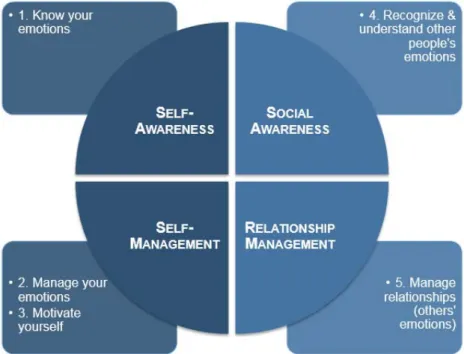
Goleman in his book Emotional Intelligence (cited in Understanding Emotional Intelligence 9) deals with five components of Emotional Intelligence and indeed they
belong to different domains depending on whether they refer to personal competence or
social competence (figure 2 shows these five components in their correspondent
domain). For D. Goleman, personal and social competences such as empathy,
motivation, self-control, management of relationship and emotions are the key elements
to overcome life issues.
Figure 1: Daniel Goleman´s EQ model.
Source: Understanding Emotional Intelligence. People Skills. Team FME, 2014. 9. Web.
All of these previously mentioned contributions to psychology were very relevant
and they caused an interest in the educational field. Professional experts commenced to
18
implement the conception of both multiple intelligences and emotional intelligence
theories into the language classroom. To understand the role of emotional factors inside
the second language classroom, empirical studies are necessary and unfortunately there
are not many works on this topic. In 2009, Pishghadam researched on the issue with the
aim of eliciting data that describes how EQ influences on second language
achievements and also to propose appropriate and efficient methodologies that covered
the issue of EQ in language classrooms. And indeed this study results affirm that
learners´ success at acquiring a second language is highly connected with several
components of emotional intelligence such as anxieties, fears, stress, motivation,
empathy, interest. Throughout history, excluding suggestopedia, and the communicative
approach there has not been any other methodology focused on the development of
emotional intelligence inside the language classroom which has been demonstrated as a
basis of learners´ second language acquisition.5 For this reason the focus of this paper is
to do further research on the communicative language teaching as a practice that takes
into account the forgotten world of feelings and emotions inside the language
classroom.
2.2.3.1. THE AFFECTIVE FILTER IN CLT
Concerning the communicative language teaching there are two necessary
conditions according to Krashen that influence learners´ acquisition processes. These
are: “(1) comprehensible input or comprehended input and (2) a low learners´ affective
filter to allow this input” (31). Besides, Krashen states that “other possible conditions or
variables (age and residence) can also affect second language success but there is only
direct correlation between the acquisition of language input and the affective filter
level” (31). The following figure 1 shows this direct correlation:
5 The suggestopedia approach as it has been previously mentioned in section 2.1 is focused on the
learners´ motivation using music, games and other ludic strategies with the aim of lowering the affective filter and therefore fostering language acquisition.
19
Figure 2: Operation of the “affective filter”. ( extracted from Krashen, 1982 32)
Source: Krashen, Stephen. Principles and Practice in Second Language Acquisition.California: Pergman Press, 1982. Internet Edition. 32.
Therefore, as Figure 1 shows, the affective filter needs to be low in order to
allow the input becomes comprehended and henceforth processed and acquired as
knowledge. However, apart from this direct correlation existing between both
conditions showed if the affective filter is not taken into account inside the language
classroom, during the process of acquiring the comprehended input the affective filter
can act as a barrier impeding acquisition and henceforth the development of the
acquired competence which in the case of dealing with a language classroom would be
the communicative competence. The key point inside the communicative language
classroom then is to create a comfortable environment where teacher has a specific role,
activities are adjusted to the communicative approach and learners are engaged in the
process of acquisition being their affective filter low (no fears, no anxiety, high
motivation and high interest) to achieve the aim of communication while using the
target language. This will allow them to acquire the input and to process this input with
the aim of acquiring effectively the communicative competence.
2.2.4. CLT IN PRACTICE: TYPES OF CLT ACTIVITIES
As stated in section 2.2.1, according to Richards (4, 5) the principles about the
goals of language teaching are: firstly, how learners learn a language (see sections 2.2.2
20
activities that best facilitate learning, the roles of teachers and finally the roles of
learners in the communicative classroom.
In every lesson, whether it is a science lesson, a mathematics lesson or an English
one, they all concur on the necessary key elements to manage them which are clearly
the activities. The activities developed in a second language classroom are essential to
foster the specific method the teacher aims to use; consequently activities also need to
be specific and adjusted to the classroom method. Inside the communicative language
classroom activities are characterized by their major and single shared aim which is to
be truly communicative using the L2 (English) in order to achieve a goal. This
fundamentally means the use of the target language (English) as a tool of
communication inside the classroom to represent real situations learners may encounter
in their daily lives simulating those in an English-speaking country. Therefore,
according to Johnson and Morrow (as cited in Nunan 9-17) an activity to be truly
communicative needs to develop these three basic tenets:
- Information gap: when performing the activity there is some missing
information the listener did not catch and the speaker helps him/her to fill it.
- Choice: avoiding repetitive patterns and controlled activities, the speaker feels
free to communicate spontaneously and naturally in accordance with the teacher
and activity instructions.
- Feedback: the speaker receives information from the listener that provides
him/her with feedback whether this person has understood or not the message.
Activities that promote these three tenets when are being performed by learners
reached the major aim of being communicative. Also, there are other remarkable aspects
considering activities to be communicative that deal with:
- Authenticity and topics of interest: the use of authentic and real materials that
approach learners to real situations while using the L2 in order for learners to
detect the usefulness of the second language and therefore engage in the
acquisition process. The more similar to reality is the activity, the materials
used, and the content of the activities, the more learners will engage in its
21
learners will motivate when developing the task (i.e. role-playing,
problem-solving situations, giving instructions or directions…).
- Collaboration: tasks must be carried out whether in pairs or small groups to
foster collaborative work and learning. When activities promote collaboration
and cooperation, the purpose of communication is achieved successfully as
learners interact with each other and henceforth use their L2 in order to
overcome a task. They also perform tasks negotiating meaning which is one of
the principles of the communicative approach (i.e. debates, interviews,
games…).
2.2.5. CLT IN PRACTICE: THE ROLE OF THE TEACHER
The role of the teacher has improved notably along years. It has evolved from a very
authoritarian figure in the language classroom to the currently role which is as the main
character of the lesson along with learners. Teachers in CLT have to be approachable to
their students to keep an interactive and reciprocal, student-teacher relationship while
developing the English lesson. In this manner, learners will feel more confident,
comfortable, and indeed they will be more communicative in the lesson engaging in the
process of language acquisition. Communicative language teaching is not a
teacher-centered method where the teacher stays in front of a group of learners and gives a
speech about a topic. It is, however, a method where the teacher takes the role of
different but interrelated characters to develop a communicative lesson with the aim of
using L2 as a tool of communication. Then, which are the main roles of a
communicative teacher?
- This teacher needs to be involved in the lesson being active and dynamic and transmitting his/her interest in teaching.
- His/her role as a communicator establishing situations to foster communication
among learners and engaging communication processes using L2. Also
encouraging them to interact among each other and to negotiate meaning when
22
- He/she also needs to be a facilitator of information as a person who provides
learners with the necessary input learners need to acquire with the aim of
developing the communicative competence.
- A teacher is an adviser considering not only his/her didactic knowledge but
his/her pedagogical knowledge and therefore taking the role of an educator who
supports learners concerns with the aim of obtaining the best results of each
learner.
- His/her role as a monitor who manages learner´s performances when developing
tasks inside the communicative classroom and who involves learners to
participate, interact and to do collaborative work.
It is also important to mention the classroom environment where the language
practice will be developed as mainly the teacher is the responsible for creating it. The
context that best fosters an effective communicative process would be that where
learners do not feel under pressure but feel comfortable and relaxed to do their best
performance on classroom activities using their L2.
2.2.6. CLT IN PRACTICE: THE ROLE OF THE LEARNER
The role of learners as well as the role of teachers has improved notably throughout
history because in the past learners used to present a very passive character inside the
language classroom. However, nowadays, while teachers are adapting new roles
learners are doing exactly the same and are becoming more active when dealing with
the process of acquisition a second language. In CLT, learners are seen as
communicators who are able to negotiate meaning when needing to understand their
classmates with their knowledge about the target language. Besides they have to take
the role of managers of their own learning which provides them with responsibility and
23
2.3. TEFL FOR ADULTS
Learning a second language is not only a matter of concern for parents that aim for
the best in their children´s education but for adults who also are interested in learning a
second language or are required to possess a certain command of a second language.
Regarding this current fact in our society, adults are increasingly becoming another
profile in second language classrooms and for this reason, these profiles characteristics
need to be known in order to develop language practices that fulfill these learners´
profiles and cover all their necessities inside the educational environment.
2.3.1. CHARACTERISTICS OF ADULTS AS L2 ENGLISH LEARNERS
Adult learners highly differ from children, teenager and college learners since
they deal with the disadvantage of an important biological change, the age. Several
adults´ psychology research studies affirm that over time, age becomes a potential factor
that decreases learners´ mental agility and also their ability to acquire concepts, to make
long-term memories and to think flexibly. Besides, age especially affects memory
reducing learner´s capacity to link concepts that have been already acquired and stored
in long-term memory with those recently acquired and stored in short-term memory.
These studies also demonstrate that certain brain operations such as connections and the
ones previously mentioned ( mental ability, memory, brain flexibility…) become harder
to develop due to the shrinking or atrophy that neurons (nerve cells) suffer from as an
individual grows older. It is remarkable to mention that age throughout history has been
also another indicator of second language mastery. Krashen, however, reject this
conception and affirm that adults´ language proficiency like children´s depends on their
exposure to external conditions (time and residence) and to their perseverance and
constancy (10). He states that “younger learners are only better at language acquisition
in the long run and when they have been acquiring a second language from a natural
24
However, differences between adult learners and younger learners do not only
deal with intrinsic psychological aspects. It is important to remark also differences
related to the characteristics of the life stage throughout adults´ learning processes are
being developed (external conditions). Adults unlike younger learners have to face
responsibilities (e.g. Jobs, family…) and difficult situations (e.g. their need to earn an
income, family care, household duties, multitask…) which, although could be
considered as external factors that do not affect the learning process, in fact they do.
Besides, nowadays adult learners need to face new challenges in their lives as society is
constantly evolving and the past can be no longer used as a guide to live their current
lives. Therefore, all of these external factors are straightaway related to the learning
process as they interfere to the motivation adults present for learning. All of them are
external factors that enhance motivation but actually the most important motivators for
adults are intrinsic, it means those that truly satisfy them such as their aim to achieve a
better job and in turn a better income, their self-esteem, their desire to improve their life
quality, etc… (i.e. a worker will be rewarded with a higher position in his/her company
if he/she knows how to speak fluently in English. Actually this worker has extrinsic
motivation to engage in the process of learning English as he/she will be rewarded with
a better job position. But, at the same time this motivation can be considered as intrinsic
due to the fact that this worker aspires to achieve a better job in order to feel satisfied
with him/herself as he/she realizes his/her job has been recognized).
Adults possess several characteristics that help them in the learning process in
comparison with younger learners due to their mature personality and intelligence, their
years of educational training, their determined character about their goals in life and
clear aims, but above all their strong motivation to achieve what they aim with a rapid
progress. Besides another characteristic that is highly remarkable is learners´
independency to learn. As they are grownups they do not depend on their parents and
they are responsible and autonomous of their own learning, thus the teaching practice
will be mainly influenced by factors happening inside the classroom environment.
Another aspect to take into account when regarding adults´ learning is their way of
learning which is not only related to the difference among learners´ styles but to the
teaching methodology developed in a lesson. Doubtlessly, the major problem with
25
happens to any other group of individuals who begin learning a second language
without any knowledge. Here, classroom management plays an important role involving
the teacher, learners and the teaching method that is being applied: (1) the teacher as the
responsible of facing this difficulty detecting problems in the learners´ language
acquisition and finding solutions to these problems (2) learners as second language
acquirers who engage in the process of acquisition and are constant and (3) the teaching
method as the way of introducing new input adapted to learners´ learning styles.
Therefore, the teacher needs to know their students with the aim of approaching his/her
teaching strategies to their different learning styles and finding the best well-adapted
methodology possible. The teacher´s challenge with these adult learners is his/her
ability to engage them in a communicative approach for learning English as the best
method for reaching, covering and fulfill each individual learning necessity. But the
development of a communicative lesson with adults in our Spanish settings is not an
easy task regarding their learning habits since their schooling years as traditional
learners who have only been familiarized with traditional ways of teaching. Therefore,
the teacher´s challenge will be even harder to overcome.
2.3.2. THEORIES OF ADULTS L2 LEARNING
Traditionally, when dealing with the issue of adults learning, many scholars have
tackled the problem by simply modifying theories about child learning and adapting
them to the differences in degree of the learning process complexity among adult
learners. Fortunately, later on, other scholars such as McClusky (cited in Knowles 34)
began to point out the difference between adults´ psychological potential and child
psychological potential in the process of learning. Thus, he established some central
concepts that for him were considered as essential concepts to take into account
regarding this difference: margin, commitment, time perception, critical periods, and
self-concept. Other studies, however, focused on what was called as experiential
learning (term established by Rogers as a type of learning) analyzing empirical data
26
learning process.6 This study was carried out by Cyril O. Houle (1961) whose primary
aim was to discover why adults engage in continuing learning and to understand their
learning process. He obtained three different types of learners according to their
purposes and values for continuing learning:
- The goal-oriented learners or those learners who aimed of continuing education
due to their sudden identification of an interest. These type of learners go
through episodes in their lives whether this interest or need of learning
something new appears they enroll in a new course.
- The activity-oriented learners or those learners who continue education not for
improving their knowledge but for circumstances that sometimes have no
connections with the learning process in itself. These learners engage in
continuing education to solve pressure or stress in their lives.
- The learning-oriented learners those whose aim is to learn and seek for
knowledge as their intrinsic motivation.
Altough Houle´s aims (cited in Knowles 35-37) were: “(1) to discover the reason
why adults engaged in learning and (2) to understand their learning processes”. His
results were only helpful to answer the first objective because he did not obtained any
data about how learning processes happen in adults.
Also during this time, other scholars such as Tough did further research on
motivation and interest focusing on adults´ performance on projects and especially on
their engagement when developing them (cited in Knowles 37-39). As a result of this
data compilation from all these studies, the term andragogy which was first coined by a German pedagogue in 1833 was recovered by Knowles as stated in Crawford (1) to
apply it to the field of adults learning as an opposition to what is widely known by
pedagogy and as the theory not to teach adults but to help adults learn. This term which
is the basis of Knowles theory, is related to the competences that a man should have in
order to be his own leader in life which indirectly involves how adults are able to learn
6
27
and how can be helped in their learning processes (cited in Crawford 1). The major
assumptions established by Knowles were the following:
- From self-concept to self-direction: as individuals grow up, they move from the
self-concept they are forming to their self-directness conception when they truly
become adults. At this point, individuals feel the need of being considered as
adults who depend on themselves and on their own directed ways of developing
tasks thus they take the initiative and develop their own autonomous learning.
As cited in M. Knowles´ book The adult learner: a neglected species:
“It is my own observation that those students who have entered a professional school or a job have made a big step toward seeing themselves as essentially self-directing. They have largely resolved their identity-formation issues; they are identified with an adult role. Any experience that they perceive as putting them in the position of being treated as children bound to interfere with their learning” (45).
- Experience as a major role: this assumption causes the adult learner to possess a very rich resource for learning new concepts as this individual has a wider base
to which to relate this new input. This also allows adult learners to analyze new
input making brain connections with their stored knowledge in order to facilitate
acquisition. Another implicit reason for remarking experience is due to the
obvious fact that experience defines who an individual is, which means that
adult as opposed to young learners are their own definers. Young learners have
external definers (parents, sisters, brothers…) who actually identify and know
them, nevertheless adults define themselves as they are identified by their life
experience.
- Their preparedness to learn: this assumption deals with adults´ readiness to learn in their mature lives. Adult learners are ready to learn provided that they are
approaching in a life phase as their need to learn new things becomes essential
because of a job or marriage request, a personal decision…
- Their learning orientation: this assumption tackles the issue of orientation comparing young and adult learners as a response to the difference in the
learning future perspective of both groups. Young learners´ time perspective is
28
achieved some learning aims when finishing school in order to attend high
school and in order to attend college again they have needed to accomplish
specific learning objectives. Their learning perspective then is completely
focused on being applied to the real world in a future while adults´ perspective is
immediate, they need to learn as they are required as soon as possible to apply
their learning to their reality.
But as every theory, Knowles´ theory of andragogy did not escape from criticism
and Brookfield dealt in his book with some critics both positive and negative about
andragogy since this theory had proposed concepts as self-directed learning which was
very innovative in the sense of adult learners as responsible for their own learning
process and progress. Nevertheless, it lacked when dealing with cultural aspects and
especially when dealing with the role of the teacher who is not valued as the major
source of knowledge and direction.
Later on, more modern models on adults learning evolved to give a response to the
issue. The self-directed learning (SDL) first proposed Knowles as one of his assumptions in andragogy (45), was emerged as a comfortable way for adults to learn
through an informal process that can be perfectly adjusted to their daily and busy
routines. In essence, it takes place outside any formal learning environment and allows
adult learners to set their goals and develop a plan to achieve these goals for later on
self-assessing their outcomes. Another model is transformational learning (TL) which
mainly is defined as a metamorphic way of learning through which adult learners
change their conception about themselves and the world (Adult Learning Theories 1-2).
This TL causes a big impact on learners as it involves a big change in their perception
and consciousness, as King states:
29
2.3.3. CURRENT SITUATION ABOUT L2 ADULTS LEARNING AND CLT PRACTICES
Learning a second language by trying methods focused on fostering acquisition
instead of learning is not an easy task, besides this task increases in difficulty taking
into account that learners are adults. As stated in section 2.3.2, there has been several
theories on adults learning mainly focused on affective factors such as motivation and
interest which establish them as a potential significance being the main basis of adults
learning. Also, as stated in section 2.3.2, modern models like transformational learning
focus on giving a different perspective to the way in which adults learn towards a more
metamorphic experience and thus they become the main characters to realize about new
conceptions of the world and themselves. Therefore, if several theories and models
emerged in the past already dealt with the necessity of a change and with the importance
of performing a teaching practice involving learners and motivating them, why in our
Spanish society methods that focus on learners L2 linguistic correctness rather than on
the acquisition of the communicative competence mentioned in Hymes´ have always
been used throughout history and more important are still being used nowadays? The
reason why adult learners are obsessed with learning from books or papers is not
because they feel more secure of themselves in front of a real clue as many teaching
experts have established but because they were taught by traditional methods at school
and henceforth this did not allow them to know different ways of learning. Due to this
real fact, it is important to change this current situation improving language teaching
practices with adults.
Some improvement need to be done considering that adult learners do not achieve
the goal of acquiring a language effectively which means that language practices are not
likely to fulfill learners´ needs and to be correctly focused. Other type of practices
should be developed in order to achieve the purpose of a second language classroom
being the major focus of these practices to encourage adult learners making them aware
of their capacity to learn a second language and allowing learners´ emotions into the
language classroom. This way, another methodology should be carried out, a
methodology that breaks away from traditional strategies and techniques, a pragmatic
methodology that focuses on acquisition and on learner´s feelings and therefore that
30
needs to be effective at lowering adult learners´ affective filter to turn their in many
times misconceptions into appreciations during the process of acquiring their L2 and let
them know that making mistakes is the only way to learn. This lead to the development
of CLT practices with adult learners that help as it will be shown later with this study to
keep a balance between their affective variables and their learning processes. Therefore,
due to the lack of previous research on this issue, this dissertation aimed to study this
31
3. OBJECTIVES OF THE STUDY
Concerning the issue of language teaching with adult learners it has been done some
research finding that Der Jager (2004) in his study deals with current communicative
approaches to develop with adults who are learning English as a second language and
Alexander (2011) focuses her study on the communicative teaching for adult language
learners but there are gaps on these studies on how to include the affective aspects
inside the language practices with adults. Therefore, Pishghadan in 2009 studies the
relationship between emotional intelligence and foreign language learning carrying out
a quantitative analysis with adult learners but there is still lack of further research on the
issue of demonstrating that the development of a CLT approach is an effective way to
enhances adult learners´ feelings and emotions inside the language classroom.
Then, it has been decided that the major aim of this study is to examine a particular
teaching practice developed throughout the last term of the academic year of 2015-2016
with the analysis of adult learners´ personal assessments regarding the main features of
the CLT approach (communicative activities, the role of the teacher, classroom
atmosphere and interaction with classmates) and adult learners´ affective filter, in
particular the following variables: motivation, interest, self-confidence, anxieties and
fears. Also, according to the results obtained, my purpose is to contribute to the
improvement of language teaching practices addressing to adult learners since the
relationship between the learners´ affective filter and the development of
communicative practices in L2 within a non-formal educational environment.
In the formulation of the research questions, it has been considered on the one hand,
adult learners´ assessment on the effect that the CLT approach has over their affective
variables (motivation interest, self-confidence, anxieties or fears) as these variables have
always been dismissed when dealing with L2 English practices for adult learners. On
the other hand, adult learners´ personal assessments on some of the main features of the
CLT approach as they are not familiarized with communicative lessons to learn a L2.
The research questions deals with the following aspects:
The effect of CLT approach on affective variables: do adult learners feel
32
classroom? Do they feel confident when dealing with communicative activities
in which they need to use the target language all the time? Do adult learners
show fears or anxieties when using the target language inside the communicative
classroom? Does the CLT approach help adult learners to externalize their
emotions and feelings inside the language classroom?
The CLT approach: do adult learners engage to interact among each other inside
the language classroom using the target language? Does the teacher encourage
adult learners and play the role of a facilitator and communicator? Do they
engage learning from doing communicative activities rather that from the
coursebook? Does the class atmosphere foster communicative processes and
indeed acquisition processes? Do they feel comfortable learning from the CLT
approach?
With the aim of reaching some conclusions about this matter, an empirical study has
been carried out. It has been based on the analysis of empirical data elicited from a
group of participants whose L1 is Spanish and are L2 English speakers. The whole
study appearing in section 4 has been divided in the following parts; the methodology is
presented in section 4.1; the data description and analysis are developed in sections 4.2
and 4.3 respectively where several hypothesis corresponding to the previous research
questions will be provided; and the conclusions are presented in section 5.
4. THE STUDY
This section will be dealing with the empirical study which involves the whole
process conducted to elaborate this dissertation. It is a cross-sectional and descriptive
study as it involves the analysis of descriptive data that has been collected from a
sample of participants at one specific point in time. In particular, the CLT approach has
been applied to a language classroom over the last term ( April – middle of June) of this
academic year 2015-2016 and the sample of participants have been tested using two
different data collection instruments in order to analyze data elicited from them about