PENÍNSULA OF SANTA ELENA STATE UNIVERSITY FACULTY OF SCIENCES OF EDUCATION AND LANGUAGES
ENGLISH LANGUAGE TEACHING CAREER
TOPIC:
“MUSICAL ACTIVITIES TO DEVELOP ENGLISH LISTENING SKILLS TO STUDENTS OF BGU AT UNIDAD EDUCATIVA FISCOMISIONAL EXPERIMENTAL ‘’JOSÉ MARÍA VÉLAZ. S. J.’’ IN SANTA ELENA, SANTA ELENA PROVINCE 2015 – 2016”
RESEARCH PAPER
AS A PREREQUISITE TO OBTAIN A: BACHELOR’ S DEGREE IN ENGLISH
AUTHOR:
GLORIA MARÍA VIVERO ROCA
ADVISOR:
ECON. ALEXANDRA JARA ESCOBAR, MSc.
PENÍNSULA OF SANTA ELENA STATE UNIVERSITY FACULTY OF SCIENCES OF EDUCATION AND LANGUAGES
ENGLISH LANGUAGE TEACHING CAREER
TOPIC:
“MUSICAL ACTIVITIES TO DEVELOP ENGLISH LISTENING SKILLS TO STUDENTS OF BGU AT UNIDAD EDUCATIVA FISCOMISIONAL EXPERIMENTAL ‘’JOSÉ MARÍA VÉLAZ. S. J.’’ IN SANTA ELENA, SANTA ELENA PROVINCE 2015 – 2016”
RESEARCH PAPER
AS A PREREQUISITE TO OBTAIN A: BACHELOR’ S DEGREE IN ENGLISH
AUTHOR:
GLORIA MARÍA VIVERO ROCA
ADVISOR:
ECON. ALEXANDRA JARA ESCOBAR, MSc.
LA LIBERTAD – ECUADOR
iii La Libertad, August 19th 2016
ADVISOR’ S APPROVAL
In my role as advisor of the research paper under the title “MUSICAL ACTIVITIES TO DEVELOP ENGLISH LISTENING SKILLS TO STUDENTS OF BGU AT UNIDAD EDUCATIVA FISCOMISIONAL EXPERIMENTAL ‘’JOSÉ MARÍA VÉLAZ. S. J.’’ IN SANTA ELENA, SANTA ELENA PROVINCE 2015 – 2016” prepared by GLORIA MARÍA VIVERO ROCA, student of the English Teaching Career, Faculty of Education and Languages at Península of Santa Elena State University, I declare that after having guided, studied and reviewed the project, I approve it in its entirety, because it meets the requirements and is sufficient for its submission to the evaluation of the academic tribunal.
Sincerely,
_____________________________________________ ECON. ALEXANDRA JARA ESCOBAR, MSc.
iv La Libertad, August 19th 2016
STATEMENT OF AUTHORSHIP
I, GLORIA MARÍA VIVERO ROCA, with ID number 091462794-8, undergraduate student from the Península of Santa Elena State University, Faculty of Sciences of Education and Languages, as a prerequisite to obtain a Bachelor’s degree in English, in my role as author of the research paper “MUSICAL ACTIVITIES TO DEVELOP ENGLISH LISTENING SKILLS TO STUDENTS OF BGU AT UNIDAD EDUCATIVA FISCOMISIONAL EXPERIMENTAL ‘’JOSÉ MARÍA VÉLAZ. S. J.’’ IN SANTA ELENA, SANTA ELENA PROVINCE 2015 – 2016” certify that this research is of my authorship, except for the quotes and reflections used in this research paper.
Sincerely,
_____________________________________ GLORIA MARÍA VIVERO ROCA
v BOARD OF EXAMINERS
__________________ ____________________
Dra. Nelly Panchana Rodríguez, MSc. Lcda. Glenda Pinoargote Parra, M.A. Ed. FACULTY OF EDUCATION AND ENGLISH TEACHINGLANGUAGES DEAN CAREER DIRECTOR
________________________________ _______________________________ Econ. Alexandra Jara Escobar, MSc. Lcda. Tatiana García Villao, MSc. ADVISOR SPECIALIST
______________________________ Abg. Brenda Reyes Tomalá, MSc.
vi DEDICATION
I dedicate this work to my children who have been the mainstay in my life and an impulse throughout my career. To my advisor, thanks to her teachings and good guidance, I could develop this work. And finally, this investigative paper is dedicated to my teachers throughout all my academic life, who have been the responsible of forming me as a professional sharing their experiences and advices in order to be prepared for the challenges on life.
vii ACKNOWLEDGMENT
First of all, I thank God who has guided me throughout this arduous process and has been the main source of strength and dedication in order to achieve this significant achievement; to my advisor, Econ. Alexandra Jara Escobar, MSc. who would have never accepted anything less than my best efforts during the development of this investigative work; to Península of Santa Elena State University for all the support during these 5 years and to all my professors for their dedication and patience.
A special recognition to the Director of the English Teaching Career Miss Glenda Pinoargote Parra MSc. for her excellent guidance and expertise managing of the English Teaching Career.
viii DECLARATION
The content of the following graduation work is my responsibility; the intellectual property belongs to Peninsula of Santa Elena State University.
DECLARATORIA
El contenido del siguiente trabajo de grado es de mi responsabilidad; la propiedad intelectual pertenece a la Universidad Estatal Península de Santa Elena.
_____________________________________ GLORIA MARÍA VIVERO ROCA
ix TABLE OF CONTENTS
ADVISOR’ S APPROVAL ... iii
STATEMENT OF AUTHORSHIP... iv
BOARD OF EXAMINERS ... v
DEDICATION ... vi
ACKNOWLEDGMENT ... vii
DECLARATION ... viii
TABLE OF CONTENTS ... ix
CHARTS ... xv
GRAPHICS ... xvi
ILLUSTRATIONS ... xvii
APPENDIX ... xviii
ABSTRACT ... xx
INTRODUCTION... 1
CHAPTER I ... 3
STATEMENT OF THE PROBLEM ... 3
1.1 Title ... 3
1.2 Statement of the Problem ... 3
1.3 Context ... 4
1.4 Critical Analysis ... 5
1.5 Formulation of the problem ... 6
1.6 Guideline questions ... 7
x
1.8 Significance of the Problem ... 8
1.9 Objectives of the Research ... 9
1.9.1 General Objective... 9
1.9.2 Specific Objectives... 9
CHAPTER II ... 11
THEORETICAL FRAMEWORK ... 11
2.1 Previous research ... 11
2.2 Philosophical basis ... 12
2.3 Pedagogical basis ... 14
2.3.1 Listening skills ... 15
2.3.2 Teaching listening skills ... 17
2.3.3 Types of listening ... 18
2.3.4 Activities to develop listening skills ... 19
2.3.4.1Story telling ... 20
2.3.4.2Drama ... 20
2.3.4.3Dialogues... 21
2.3.4.4Listening to music ... 22
2.3.4.5Listening to the radio ... 22
2.3.4.6Watching films ... 23
2.3.4.7Telephone calls... 23
2.3.5 Music and languages ... 24
2.3.6 Musical activities in education ... 25
xi
2.4.1 English language acquisition... 27
2.5 Legal basis ... 29
2.6 Hypothesis ... 30
2.6.1 Variables of the study... 30
CHAPTER III... 31
METHODOLOGY ... 31
3.1 Research approach ... 31
3.1.1 Scientific method ... 31
3.1.2 Qualitative method ... 31
3.1.3 Quantitative method ... 32
3.1.4 Deductive – Inductive method ... 32
3.1.5 Observation method ... 33
3.2 Level or type of research ... 33
3.2.1 Field research ... 33
3.2.2 Bibliographic research ... 33
3.2.3 Applied research... 33
3.3 Population and sample ... 34
3.3.1 Population ... 34
3.3.2 Sample ... 35
3.4 Variable operationalization ... 36
3.4.1 Dependent variable operationalization: Listening Skill ... 36
3.4.2 Independent variable operationalization: Musical activities ... 37
xii
3.5.1 Techniques ... 38
3.5.1.1 Survey ... 38
3.5.1.2 Interview ... 38
3.5.1.3 Observation ... 38
3.5.2 Instruments ... 39
3.5.2.1 Camera ... 39
3.5.2.2 Questionnaire ... 39
3.5.2.3 Observation guide ... 39
3.6 Data collection plan... 40
3.7 Data processing plan ... 41
3.8 Analysis and Interpretation of results ... 42
3.8.1 Interview to the specialist... 42
3.8.2 Interview to the principal ... 44
3.8.3 Interview to English teacher... 46
3.8.4 Survey applied to BGU students ... 49
3.9 Observation session results ... 59
3.10 Conclusions ... 60
3.11 Recommendations ... 60
CHAPTER IV ... 61
THE PROPOSAL... 61
4.1 Informative data ... 61
4.1.1 Title proposal ... 61
xiii
4.1.3 Beneficiaries ... 61
4.1.4 Location... 61
4.1.5 Estimated time for execution ... 61
4.1.6 Responsibles ... 61
4.1.7 Budget ... 62
4.2 Feasibility ... 62
4.3 Characteristic of the proposal... 62
4.4 Proposal background ... 62
4.5 Significance ... 63
4.6 OBJECTIVES ... 64
4.6.1 General objective ... 64
4.6.2 Specific objectives ... 64
4.7 Design and development of the proposal ... 65
4.7.1 Content of the proposal ... 66
4.8 Listening activities ... 68
Activity Nº 1: Simple Present Tense and Verbs ... 68
Activity Nº 2: Simple Past Tense and Verbs... 70
Activity Nº 3: Negative Statement of Simple Present Tense ... 72
Activity Nº 4: Positive and Negative Statements of Simple Present Tense ... 74
Activity Nº 5: Adjectives ... 76
Activity Nº 6: Conjugation of the Verb to Be ... 78
Activity Nº 7: Verb to Be ... 80
xiv
Activity Nº 9: Practice with Nouns, Adjectives, and Verbs... 84
Activity Nº 10: Simple Present Continuous ... 86
Activity Nº 11: Simple Present and Simple Present Continuous Tense ... 88
Activity Nº 12: Practice of Simple Present Tense... 91
4.9 Results of Implementation ... 93
4.10 Conclusions ... 98
4.11 Recommendations ... 99
CHAPTER V ... 100
ADMINISTRATIVE FRAMEWORK... 100
5.1 Budget ... 100
5.2 Timetable... 101
5.3 Bibliography ... 102
5.4 UPSE bibliography... 105
xv CHARTS
Chart Nº 1: Population description ... 34
Chart Nº 2: Sample description ... 35
Chart Nº 3: Dependent Variable Operationalization ... 36
Chart Nº 4: Independent variable operationalization ... 37
Chart Nº 5: Data processing plan description ... 41
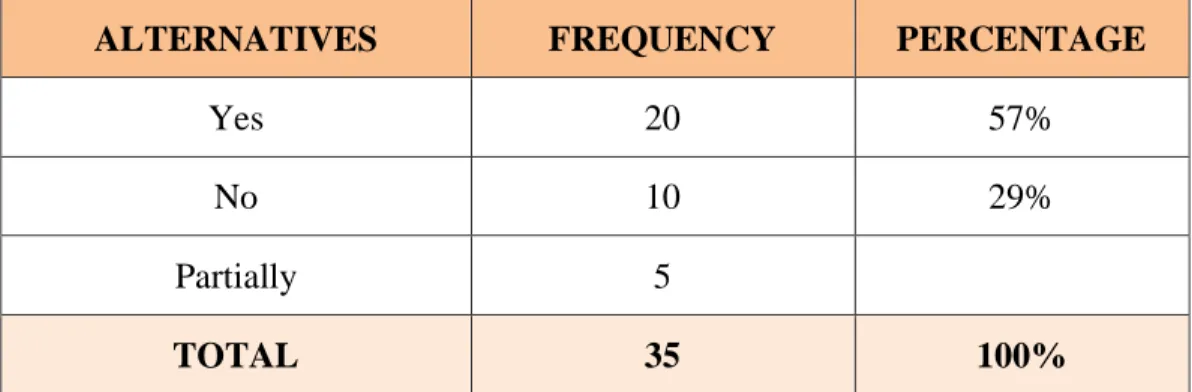
Chart Nº 6: English language ... 49
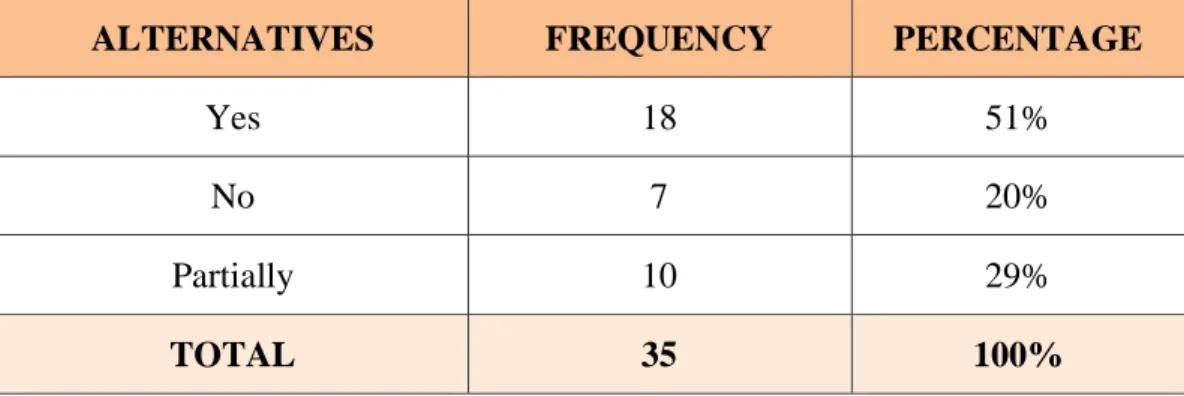
Chart Nº 7: Participation of students during English classes ... 50
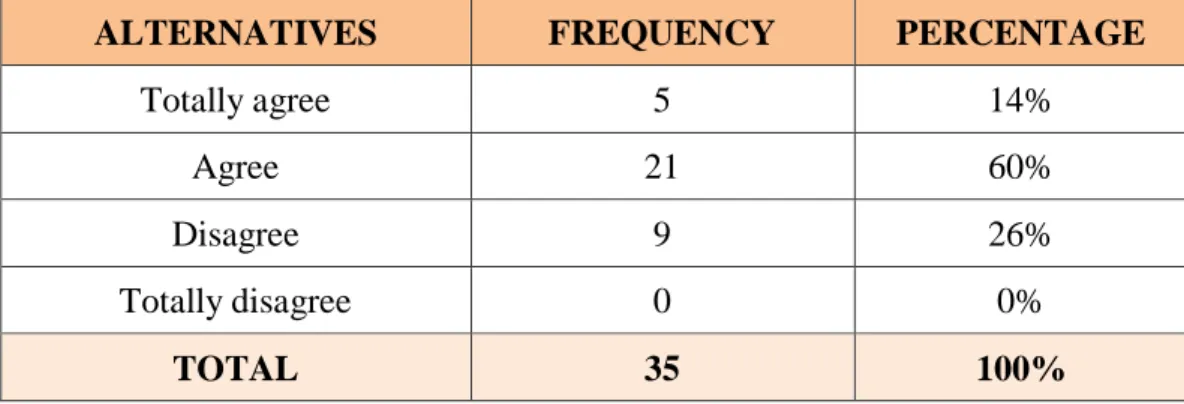
Chart Nº 8: Students' opinion about English lessons ... 51
Chart Nº 9: Application of listening activities ... 52
Chart Nº 10: Difficultness of listening activities ... 53
Chart Nº 11: Development of students' listening skill ... 54
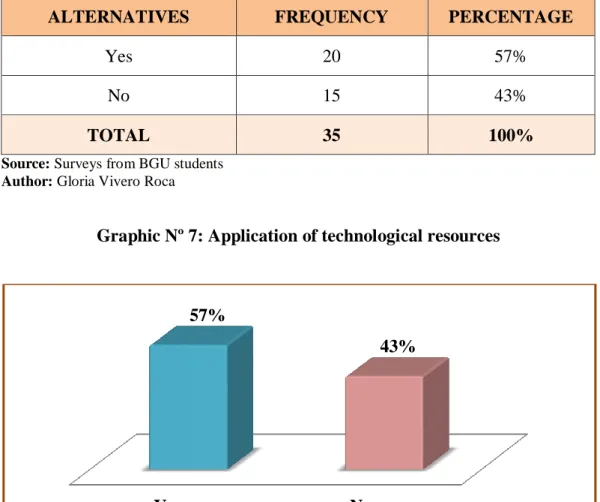
Chart Nº 12: Application of technological resources ... 55
Chart Nº 13: Application of musical activities... 56
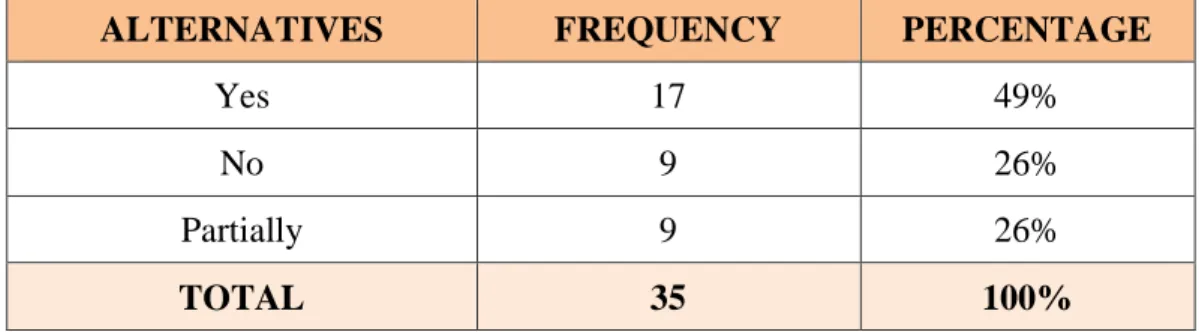
Chart Nº 14: Musical activities application for the listening skill practice ... 57
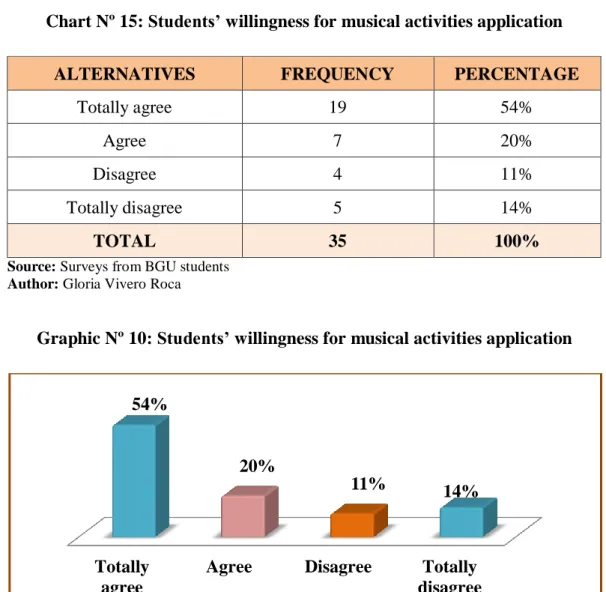
Chart Nº 15: Students’ willingness for musical activities application ... 58
Chart Nº 16: Observation Guide ... 59
Chart Nº 17: Content of the proposal ... 66
Chart Nº 18: Results of implementation-First BGU students ... 93
Chart Nº 19: Results of implementation-Second BGU students ... 95
Chart Nº 20: Results of implementation-Third BGU students ... 96
xvi GRAPHICS
Graphic Nº 1: English language ... 49
Graphic Nº 2: Participation of students during English classes ... 50
Graphic Nº 3: Students' opinion about English lessons ... 51
Graphic Nº 4: Application of listening activities ... 52
Graphic Nº 5: Difficultness of listening activities ... 53
Graphic Nº 6: Development of students' listening skill ... 54
Graphic Nº 7: Application of technological resources ... 55
Graphic Nº 8: Application of musical activities... 56
Graphic Nº 9: Musical activities application for the listening skill practice ... 57
Graphic Nº 10: Students’ willingness for musical activities application ... 58
Graphic Nº 11: Results of implementation-First BGU students ... 94
Graphic Nº 12: Results of implementation-Second BGU students ... 95
xvii ILLUSTRATIONS
Illustration Nº 1: Students filling in the gaps with verbs ... 68
Illustration Nº 2: Students recognizing Simple Past Tense ... 70
Illustration Nº 3: Students identifying Negative Simple Present Tense ... 72
Illustration Nº 4: Positive and Negative Statement-Simple Present Tense ... 74
Illustration Nº 5: Filling in the blanks with adjectives ... 76
Illustration Nº 6: Students identifying Verb to Be Conjugation ... 78
Illustration Nº 7: Students recognizing the verb to be ... 80
Illustration Nº 8: Students using Simple Past Tense ... 82
Illustration Nº 9: Students recognizing adjectives, nouns, and verbs ... 84
Illustration Nº 10: Students practicing Simple Present Continuous ... 86
Illustration Nº 11: Students working on the listening activity ... 88
xviii APPENDIX
Appendix Nº 1: Interview applied to specialist ... 107
Appendix Nº 2: Interview applied to principal ... 108
Appendix Nº 3: Interview applied to English teacher ... 109
Appendix Nº 4: Survey applied to BGU students ... 110
Appendix Nº 5: Observation guide ... 113
Appendix Nº 6: First BGU students’ names ... 114
Appendix Nº 7: Second BGU Students’ names ... 114
Appendix Nº 8: Third BGU Students' names ... 115
Appendix Nº 9: Articles from the Legal Basis ... 115
Appendix Nº 10: Interview to the specialist ... 116
Appendix Nº 11: Interview to the principal ... 117
Appendix Nº 12: Interview to English teacher ... 117
Appendix Nº 13: First BGU students ... 118
Appendix Nº 14: Second BGU students ... 118
Appendix Nº 15: Third BGU students ... 119
Appendix Nº 16: The investigator during the proposal application ... 119
Appendix Nº 17: Implementation of the proposal ... 120
Appendix Nº 18: BGU students working on the proposal ... 120
Appendix Nº 19: BGU students filling in the gaps ... 121
Appendix Nº 20: BGU students during musical activities application ... 121
Appendix Nº 21: Approval letter for the proposal implementation ... 122
xx PENÍNSULA OF SANTA ELENA STATE UNIVERSITY
FACULTY OF SCIENCES OF EDUCATION AND LANGUAGES ENGLISH LANGUAGE TEACHING CAREER
TOPIC:
“MUSICAL ACTIVITIES TO DEVELOP ENGLISH LISTENING SKILLS TO STUDENTS OF BGU AT UNIDAD EDUCATIVA FISCOMISIONAL EXPERIMENTAL ‘’JOSÉ MARÍA VÉLAZ. S. J.’’ IN SANTA ELENA, SANTA ELENA PROVINCE 2015 – 2016”
Author: Gloria María Vivero Roca Advisor: Econ. Alexandra Jara Escobar, MSc.
ABSTRACT
In the English learning process the use of musical activities to improve listening skills is well-known because students enjoy listening to music and most of the singers perform their songs in English language. Thus, taking this into account, it is significant to apply this strategy in order to motivate students to learn English and develop their listening skill. At Unidad Educativa Fiscomisional Experimental “José Maria Vélaz S. J.” located in the province of Santa Elena, students are mostly adults and their learning process is more complex than children; therefore, it was important to find out an engaging way to teach students. The main objective of implementing this project is to contribute in the improvement of listening skills through musical activities in students of BGU at the educational institution previously mentioned. The design of this research was based on quantitative and qualitative methods; they allowed to obtain specific results about the implementation of musical exercises through the application of surveys of thirty-five students of BGU, interviews to the principal, Tnlg. Eliana Reyes, English teacher, Lcdo. Leonardo Marcillo Pino, and one English language expert, MSc. Luis Iza. Furthermore, an observation session was carried in one English language lesson which allowed to realize that students were being instructed using methods and strategies that are not motivational for BGU students. Once the proposal was fully implemented, it was determine a relevant enhancement of students’ listening skill.
1 INTRODUCTION
Teaching English involves various areas of the language that students need to acquire and develop appropriately. English as any other language has skills and sub-skills that need to be mastered during the acquisition process. The main skills of this language are; listening, speaking, reading and writing. Listening is a skill that is necessary for the comprehension of oral messages.
It is evident that oral communication is a mutual relationship between the speaker and the hearer; this means that one must understand what he/she listens to in the target language. Learners with a good proficiency in the English language listening skill are likely to comprehend the information they receive orally even if the speaker makes errors in other areas, such as, grammar.
Music has been a permanent part in people’s lives; it is in our houses, on our television, in the movies, at a store, at the work site, at a dancing club, and others. Furthermore, music has performed an important role in every known civilization; there are birth songs, birthday songs, anniversary songs, holiday songs, and others. The implementation of music has influenced on the social development of people and it has been included in the education process since it represents a way to engage students to the teaching process improving, at the same time, the learning process.
2 Chapter I-The Problem: This chapter describes the statement of the problem, context, critical analysis, formulation of the problem, guideline questions, limitation, research project, significance and objectives of the research (general and specifics).
Chapter II-Theoretical Framework: This chapter it contains previous researches, philosophical basis, fundamental categories, legal basis, hypothesis and variables of the study.
Chapter III-Methodology: It explains the research approach, level or type of the research, population and sample, techniques and instruments, analysis and interpretation of the results and finally conclusions and recommendations.
Chapter IV-The Proposal: It contains informative data, proposal background, significance, objectives, design and development of the proposal. This chapter describes the solution to the problem and it analyses the outcomes of this investigative work.
3 CHAPTER I
STATEMENT OF THE PROBLEM
1.1 Title
“MUSICAL ACTIVITIES TO DEVELOP ENGLISH LISTENING SKILLS TO STUDENTS OF BGU AT UNIDAD EDUCATIVA FISCOMISIONAL EXPERIMENTAL ‘’JOSÉ MARÍA VÉLAZ. S. J.’’ IN SANTA ELENA, SANTA ELENA PROVINCE 2015 – 2016”
1.2 Statement of the Problem
The English language has become a universal language due to the importance of knowing an additional language from people’s mother tongue. English is the main tool of international communication becoming in the bridge language around the world today. This language is mainly used for international lectures, or work conferences; it is necessary to know English in order to acquire information which is some cases is in English language. For this and many other reasons it is necessary to learn English.
4 Nowadays, learning English language in Ecuador is a very important factor of success in Ecuadorians’ life because this language is involved in the labor, cultural, social, political, and economic progress of the country; thus, learning English has turned from a privilege into a necessity. As a consequence of that, authorities have paid more attention to the improvement of the English language teaching process in order to encourage students to attend to diverse universities from English-speaking countries, acquire new information and knowledge, and thus, contribute to the development of Ecuador.
In some educational institutions from different provinces of Ecuador, students have difficulties in learning English as a foreign language. In Santa Elena province, students have faced some difficulties in learning English especially in listening comprehension skill because some of them do not have a special place to train this skill like a laboratory with appropriate equipment that allow the application of audios or videos that are useful for developing listening skill.
Students of BGU at Unidad Educativa Fiscomisional Experimental “José María Vélaz S. J.” have flaws in the learning of English as a foreign language mainly in listening skill, because of this, it arises the need to find and implement new strategies in order to stimulate the development of listening comprehension.
1.3 Context
5 Moreover, the implementation of musical exercises also involves the use of technological tools in order to improve the listening skill practice and thus motivate students to develop such an important skill.
Finally, it is important to mention that teachers in educational institutions should apply and ask students to practice more listening skill in different ways; applying technological tools in order to listen to English conversations or audios in class and thus students can progress in English language.
1.4 Critical Analysis
As it has been established previously, the development of listening skill is necessary in order to understand messages and process information transmitted by the speaker. BGU students from Unidad Educativa Fiscomisional Experimental “José María Vélaz S. J.” have presented problems in the acquisition of this skill due to diverse reasons.
The possible reasons why BGU students have deficiency in English listening skill subject would be the shortage of technological resources, very little class time, limited development of activities with new technologies, lack of motivation, incomprehension of English words, personal and emotional problems.
6 and talents already and the way they have been instructed previously is different from strategies that are applied nowadays.
The low motivation that BGU students presents during the development of lessons is an additional reason for the listening skill problem. Activities that are applied do not engage students during the teaching and learning process. Under-motivated students do not allow the development of an enjoyable lesson.
Furthermore, embarrassment is often a big obstacle to overcome the development of listening skill and the other English language skills as well. BGU students do not feel comfortable at the moment of working on class exercises. Therefore, encouragement may help cultivate a positive attitude toward the English language practice.
Students of BGU at Unidad Educativa Fiscomisional Experimental “José María Vélaz S. J.” have problems mainly in their listening skills for this reason it has implemented the program of musical activities in which students could develop the listening skills including technological tools during this process. Using technological tools increased the motivation of students and they were more interested in the English subject in order to ensure achievements in their listening skills.
1.5 Formulation of the problem
7 1.6 Guideline questions
• What are musical activities?
• Is it necessary to implement the new technologies for the practice of listening comprehension skill?
• How would the program of musical activities influence in the teaching of listening skill?
• Do musical activities contribute to the comprehension improvement of oral texts?
1.7 Problem Limitation
• FIELD: Education
• AREA: English language
• ASPECT: Listening skill development through the implementation of musical activities.
8 • PROBLEM: Deficiency in the English language listening skill of BGU students at Unidad Educativa Fiscomisional Experimental “José María Vélaz. S. J.”.
• TIME LIMITATION: The implementation of musical activities will be held during the school year 2015-2016.
• POPULATION LIMITATION: BGU students at Unidad Educativa Fiscomisional Experimental “José María Vélaz. S. J.”.
• SPACE LIMITATION: Unidad Educativa Fiscomisional Experimental “José María Vélaz. S. J.”.
• CONTEXT LIMITATION: This work will be focused on the development of listening skill through the application of musical exercises in BGU students from Unidad Educativa Fiscomisional Experimental “José María Vélaz. S. J.”.
1.8 Significance of the Problem
Ecuador lacks in the learning of English abilities specifically with the listening skills. In many institutions, students have problems when these skills at the time that they receive some listening activities. For this reason, it is important to focus on the development of musical activities.
9 Experimental “José María Vélaz S. J.” for the necessity of students to improve the development of their listening skills with the application of different activities that promote the interest in the learning process of English language.
Musical activities are listening strategies, techniques or activities that contribute directly to the comprehension and this work pretends to show that it is a technique to understand better and we could achieve positive results in BGU students. Furthermore, songs are a fundamental tool in the teaching and learning process; musical exercises contribute to the practical development of auditory skills, such as, pronunciation and acquisition of new words. Education, at present, constitutes the main engine of social transformation and, through this project; teachers will be able to support the students’ enhancement of English language learning.
1.9 Objectives of the Research
1.9.1 General Objective
To contribute to the development of listening skill through the implementation of musical activities on BGU students at Unidad Educativa Fiscomisional Experimental “José María Vélaz. S. J.”, Santa Elena, Santa Elena province, 2015 – 2016.
1.9.2 Specific Objectives
10 • To propose different musical activities of listening comprehension to the students of BGU at Unidad Educativa Fiscomisional Experimental “José María Vélaz. S. J.”.
11 CHAPTER II
THEORETICAL FRAMEWORK
2.1 Previous research
“Music has a power of forming the character and should therefore be introduced into the education of the young”. (Aristotle)
In England, the Department for Education in 2011 carried out an investigation about the influence of music during the academic training of students. The value of music as part of any academic subject lies in its contribution to enjoyment and enrichment, for its social benefits, for those who engage in music seriously as well as for fun. High quality education with music enables lifelong participation in, and enjoyment of, music, as well as underpinning excellence and professionalism.
12 Sharma (2011) mentions that there are a lot of courses in listening and speaking skills because teachers and experts have realized in the recent years the importance to develop these two skills, and the roll of the usage of the English languages in many aspects of people’s life, such as, in their workplaces, businesses, in the educational field, and others. Sharma (2011) also establishes that teachers have to be prepared and apply different strategies in order to improve the English language teaching process.
2.2 Philosophical basis
In the English language learning process, there are some theories like Piaget’s theory about behaviorism. Piaget (1977) makes the point that the learning process depends on memorization, students just drill the words and repeat and memorize the information. However, Piaget (1977) mentions that students are able to speak because they remember the pronunciation.
According to Vygotsky (1980), the learning process is an active process where students have to participate in class. They have to learn information, new words and vocabulary but in an active form with exercises in class. In the case of learning English, both methodologies are required because students have to memorize vocabulary but they also have to learn real situations and they have to practice in class the speaking, listening, writing and reading skills.
13 in some cases, obligation to learn a new language since it is a requirement in their jobs or education.
Chomsky (2006) describes different ways of developing students’ skills: he proposes the implementation of games for the practice of different topics during the English classes. The implementation of active strategies allows students to participate and have fun because they are active in class and practicing the speaking and listening in English class. In adults, the impact of games is positive because they are active in class.
Sharma (2011) describes that it is fundamental teachers encourages students to develop their listening skill and mentions that in order to communicate correctly, students have to know listening, speaking, reading and writing because they need to acquire excellent English language proficiency. It is fundamental to manage the listening skills. Not just the writing test that is the reason some institution in this present year empathize and prepare students in speaking and listening skills.
Grau (2013) states that “music and language share various characteristics. On the one hand, both come from the processing of sounds; on the other hand, they are used together by authors/speakers to express a message, although language is much more accurate than music, whose effect is principally emotional” (p. 7).
14 input, in the case of sign language), and in a similar fashion we acquire our notions of music from what we hear around us.
2.3 Pedagogical basis
Rosová (2007) states that “English, music, as well as teaching create a substantial part of people’s lives and have been its necessary components for many years” (p. 7). Furthermore, in the history and the present of mankind, English, music and teaching represent important areas of human activity and effort. Their importance, content, character, our attitude to them likewise their use have developed for centuries and they are still regarded as a bottomless well of new knowledge, ideas and information.
Listening skill is a very important ability in the English language proficiency because it is required to understand the speakers and transmit the messages and information correctly. Teachers, nowadays, apply different strategies in order to improve listening skill; the use of a CD with listening exercises, DVDs with movies or listening to music are used in order to engage students in the English language learning process.
15 Other teachers use tasks based on language learning because they provide specific situations with the objective of developing a conversation in class, but these teachers try to provide activities where students can apply the vocabulary, grammar rules and a real world situation with a target situation.
2.3.1 Listening skills
Wei (2013) mentions that listening comprehension is a complex process in which listeners play an active role in discriminating between sounds, understanding vocabulary and grammatical structures, interpreting intonation and stress, and finally, making use of all the skills mentioned above, interpreting the utterance within the socio-cultural context.
For many ESL/EFL learners, listening is the skill they feel most frustrated with because of some reasons. One the one hand, learners cannot control the speed of speaker’s speech and they tend to have difficulties decoding sounds that do not exist in their mother tongue. Reduced English sounds (also known as lazy speech) or contractions are two examples. On the other hand, even when learners hear sounds correctly, oftentimes they have problems with the interpretation due to a lack of vocabulary.
16 different and interesting activities influence in the acquisition of a second language.
Clearly, those factors, motivation and exposure, seem to play a more important role in the learning process than the age factor and therefore it is extremely important to implement motivation and provide sufficient language exposure to the learner right from the start of the learning journey regardless of how old the learner is.
The National Capital Language Resource Center (NCLRC), an American journal, in 2014 publishes an investigation about teaching listening. This research was about the common mistakes when people develop their listening skills. This article refers to the differences between hearing something or listening something, if we hear something, sometimes, we do not pay attention or we do not remember the information. In the case of listening, people pay attention and remember the objectives of the words. Listening is an active process in the English languages acquisition. Before listening, it is necessary that students learn vocabulary and know the contexts of the speaker.
17 students. Cantero (2010)emphasizes on how the knowledge of linguistic skills on his/her mother tongue can help them in the process of learning a second language.
2.3.2 Teaching listening skills
The NCLRC journal (2014) states that the acquisition of English language listening skill is necessary because the oral communication requires a speaker and a listener and the information that is transmitted have to be understood. In education, teachers give instruction and information to students using words and students have to understand the information to accomplish the assignment.
The listener has to be able to understand the message, it is necessary to know enough vocabulary, grammar and syntax. In the English language acquisition, it is a requirement to develop the listening skill satisfactorily because the information and message will be misunderstood by students. Teachers are involved in supporting the listening skill development of students of English language. Furthermore, it is very important to focus on the practice, both in the classroom and outside the classrooms with the main objective of improving and developing listening for a more effective communication. There are many ways to practice this skill that are fun and relaxing.
18 Liubiniene (2009) emphasizes on the importance of developing listening skills in the process of communication because through this skill the listener obtains new information and knowledge. In this study the author indicates different methods to improve listening skills in order to be able to understand the message with more facility, and author remarks the impact of the practice in listening skills.
In the learning process of listening skills, it is necessary that teachers apply different methods to involve students not just in the translation of words. Students have to know the application of these words and the context of this application. Teachers have to use some resources like conversation or songs to develop the listening skills in students. And then they verify the English proficiency
2.3.3 Types of listening
According to the situation there are different types of listening in this other: informative listening, social listening, appreciative musical listening, critical listening, and relationship listening. Informative listening refers to the kind of listening that gives information about a specific situation or orders for example teachers speak to the students and give indications to do an activity in class or at home or when we listen to news in TV.
19 The appreciative listening is applied in musical activities and musical instruments. When the sound of the musical instrument and the meaning of lyrics of the songs are important for the listener, in this case, some teachers use music and sound for developing the listening skill in class.
Critical listening is applied in discussion sessions, in an academic interviews. In this case the context of the information is relevant, the credibility is important because the speaker explains a situation to others for a specific purpose.
Relationship listening is another form; it is a relation with the personal problem and the background of the person, in this case the supporting idea of the listening. Where the listener does not interrupt the speakers and let to him/her talk with freedom.
2.3.4 Activities to develop listening skills
Payan (2009) explains the impact of games and activities in the learning process of listening in students and how the different teaching methodologies improve the motivation in students. Games help to develop listening because students are active and participate in class. Teachers may use video recording, DVDs, TV and other technological resources to get the attention of the students.
20 equipment, such as, CD players, DVD players, computers, speakers, and others contribute to the appropriate practice of students’ listening ability.
There are different activities to improve the listening skills: story –telling, drama, dialogues, and listen to music, listen to the radio, watching films and listening to telephone calls.
2.3.4.1 Story telling
De Vos (2003) claims that listening to stories is an extremely painless way to develop listening skills. Students should have the opportunity to hear many stories and many story-tellers in order to develop the keen perception and alertness that is necessary to utilize their listening skill completely. Furthermore, storytelling preserves traditional materials and methods of imparting information and knowledge.
The story telling is an activity to develop the listening skills in students, with specific questions to verify the level of their comprehension. There are stories about real or fiction facts that are interesting to the listeners to get the attention of the people. Teachers have to choose a good story according to students. The speaker or teller has to talk clear, and loud and sometimes slow to help to students understand the information during the class time.
2.3.4.2 Drama
21 situations where students have to perform different roles. Other group of students may ask some question in order to be sure of the understanding level of this exercise. This is a way to encourage students to speak and learn vocabulary, acquire grammar structures, and others. Students are acting using costumes and the other group is watching the presentation. Students use their imagination and feel interested in the play.
2.3.4.3 Dialogues
Brown (2011) points out that students reading dialogues to each other is another example of the connection between reading and listening skill. Dialogues from listening scripts offer teacher and students a great deal of extra practicing material. Dialogues are conversations in most of case teachers provide a particularly situation a student has to write a conversation and then they have to speak in the class.
22 2.3.4.4 Listening to music
Vinyets (2013) stipulates that music is used by teachers in order to help second/foreign language learners acquire a second or foreign language. It has been reported to contribute ESL or EFL learners to acquire vocabulary and grammar, improve their spelling and develop the linguistic skills of reading, writing, speaking and listening. Thus, music may be applied in order to enhance any skill of English language.
Music is accessible to everybody around the world because people of different nationalities learn songs in English language; music helps to develop the culture in students. People use music to learn an accurate pronunciation and vocabulary. Teachers use songs to involve students in the listening exercises, in the case of adults, songs have to be modern. For beginner and adult learners the song has to be slow and clear because they need to listen to the lyrics clearly. In a song, students can learn new vocabulary, grammar, pronunciation and intonation.
Through the music is described different situations from the life of people. Some people sing songs because of the message of the letter of the writer. Students believe that using music is an important form to learn English language. Moreover, music motivates students; they feel encouraged and interested in class.
2.3.4.5 Listening to the radio
23 programs. In the case of listening to a radio, students sometimes do not know the context of the speakers because they do not have visual aids. If teachers use a radio transmission there is no repetition of the information but if teacher records the transmission of the radio, students can repeat the recording to understand the words and information.
2.3.4.6 Watching films
Watching films takes much time in the English class but it is a great activity for the motivation of students because they have visual aids and they may know the context of the situation. While they are watching a film sometimes students do not know the words or vocabulary, in this case, it is necessary that teachers apply methodology to verify the level of comprehension of the students like: questions about the whole movie, or asking for specific information. Students feel interested in the movie and they have to tell the plot of the movie. They have to develop listening, writing and speaking. It depends how the teachers apply the exercise in class.
2.3.4.7 Telephone calls
24 2.3.5 Music and languages
There are many studies about the relation between music and languages. Saville-Troike (2006) focuses on the analysis of a group of students in order to have evidences about the impact of music in the English learning process, giving as a result that, in the cases of adults, the impact of musical activities is more relevant than teenagers because the application of the language is more formal and have different objectives. Furthermore, there is evidence that musical activities have a close relationship with the cognitive process of learning a new language in students.
Patel (2010) states that “like language, music is a human universal involving perceptually discrete elements organized into hierarchically structured sequences. Music and language can thus serve as foils for each other in the study of brain mechanisms underlying complex sound processing, and comparative research can provide novel insights into the functional and neural architecture of both domains” (p. 674). Moreover, Patel (2010) explains the framework about the application of musical activities in the students’ acquisition process of new languages and how students learn new vocabulary with the use of music, but there is evidence that the age and the interest of the song or including the rhythm of the songs can affect in the learning process of a new language through musical activities.
25 improvement of vocabulary and pronunciaion. Teachers do not have to forget the selection of music according the target langauge and the necessities of studnets; this means that the song applied in the class need to have a specific purpose.
Burnard and Murphy (2013) claims that in this digital age, exposure to music is everywhere. Thus, everybody may download music from the Internet, watch and hear music videos online, attends to concerts, overhear music in shopping centres, and others. They even participate in musical events within their wider socio-cultural environment. For people, music manifests itself in their lives and significantly enhances and enriches understanding about different topics. Burnard and Murphy (2013) establish that implementing music is important to build a rapport with shy students, so they feel more comfortable in the learning environment.
2.3.6 Musical activities in education
Burnard and Murphy (2013) argue convincingly that music is a vital part of childhood, adolescence, and adulthood; everybody has a favorite singer or favorite singers. Therefore, Burnard and Murphy (2013) make emphasis on including musical activities into the teaching curriculum. These investigators also mention that the implementation of musical activities provides a broad and balanced education that involves the academic and social development of students.
26 different subjects. In the case of English language as a second or foreign language, it is used to get information or communicate with people around the world because they speak their native tongue and also the English language. The listener has to understand the message that is the reason why students have to learn how to identify sounds and words in English.
Rogers (2010) mentions that there are diverse kinds of musical activities to practice in class. These activities are used to teach vocabulary in an active way. Because the brain remembers the information that students practice more than the activities or information that just repeat in class. However, implementing music in class not only contributes to learn vocabulary words but to improve grammar, pronunciation, intonation, and others.
The implementation of ICTs in education has the capacity to increment the life quality of people by upgrading the teaching and learning process. The use of technological resources provides a variety of exercises for the students’ practice. People of all ages love singing because it is a good form to relax and feel better.
2.4 Sociological basis
27 knowledge that they need to acquire. In the case of English language, it is necessary for business or to get a good job.
Posada (2001) mentions that people have an inherent characteristic; they are social beings. Likewise, Posada (2001) asserts that is difficult to learn all the information received in the classroom and out of it. That is the reason why people need to get formal education of specific subjects or for a career in the university. In our society, education changes faster every time, there are new inventions and progress in the technology or in business.
Rumbo (2003) points out that the objective of teaching adult learners is to prepare them for the demands that the society we are living now is demanding to everybody. Rumbo (2003) also refers that the learning process in adults depends on the application and practice of the subject content. Students remember the information when they practice in class. Students build their learning process of a subject.
2.4.1 English language acquisition
28 Krashen (2013) stipulates that the language acquisition is an unconscious process which happens without students or people realize that they have to learn something. It is common with the contact with other person or the routines in the daily life. But the learning process of a second language takes place when people receive formal instruction and education to learn a new language.
Some studies around the world focus on the natural ability of the humans to learn a new language, and how people do not know specific grammatical rules but with the contact with other people they develop the ability to communicate and speak their native tongue and this ability is applied to new languages as English. That is the reason why the English learning process begins in the childhood and continues during people’s life. In the adulthood the students have to realize the importance and the impact of the English language in their life.
29 2.5 Legal basis
Constitution of Ecuador
Article 26: According to the Constitution of Ecuador, the education is a right of all Ecuadorian, in the case of English language. It is a requirement to get a good job or can be develop different activities at workplaces, education or in the region. It is necessary to learn English language. It has relationship with a good quality of life to the citizen of this country.
Article 27: In the regime of good living, specify the Ecuadorian have the right to
have a free education until third level of education, the government gives the
opportunity to people. In the case of English language at the university students
have to know English languages. It is a requirement to obtain their bachelor degree in all careers.
Organic Law of Intercultural Education
Article 6: This article refers to the necessity that students have to be trained using technological equipment that facilitate the teaching and learning process.
30 2.6 Hypothesis
The implementation of musical activities will improve the listening skill in students of BGU at Unidad Educativa Fiscomisional Experimental “José María Vélaz S. J.” from Santa Elena.
2.6.1 Variables of the study
Independent variable: Musical activities
31 CHAPTER III
METHODOLOGY
3.1 Research approach
The design of this research was based on the implementation of diverse methods, such as, scientific method, quantitative and qualitative methods, and others which were described below; they allowed to obtain specific results about the implementation of musical activities in order to develop English listening skills of BGU students at Unidad Educativa Fiscomisional Experimental “José María Vélaz. S. J.” in Santa Elena, Santa Elena Province 2015 – 2016”.
3.1.1 Scientific method
The scientific method was applied in order to recognize the different benefits of developing this research and implementing musical activities for the improvement of BGU listening skill at Unidad Educativa Fiscomisional Experimental “José María Vélaz S. J.”.
3.1.2 Qualitative method
32 one English language expert; then, this information was interpreted, contrasted and included in this research paper.
3.1.3 Quantitative method
The quantitative method mainly refers to the systematic research of a social phenomenon through statistical, mathematical, numerical data, and other techniques. This method was used in order to collect data related to the implementation of musical activities for the development of listening through the application of surveys, which were directed to BGU students from Unidad Educativa Fiscomisional Experimental “José María Vélaz S. J.”. The collected information was included in this research paper by using charts and statistical graphics.
3.1.4 Deductive – Inductive method
33 3.1.5 Observation method
This method allowed the researcher to find out specific information about the causes related to the listening skill problem that BGU students from Unidad Educativa Fiscomisional Experimental “José María Vélaz S. J.” have presented by observing the phenomena directly.
3.2 Level or type of research
3.2.1 Field research
It was important to get information about reports and grades of the students to demonstrate the low level in the English listening skills to obtain evidence of the actual methodology and resources implemented by teachers in the institution.
3.2.2 Bibliographic research
It was used to search and select scientific-theoretical foundation on the subject of investigation such as researches, books, web pages to obtain the necessary information related with the listening skills.
3.2.3 Applied research
34 listening skills. Moreover, this type of research allowed the implementation of listening skills of BGU students from the educational institution previously mentioned.
3.3 Population and sample
3.3.1 Population
The population for this research was taken from three classes with a total of 35 BGU students from Unidad Educativa Fiscomisional Experimental “José María Vélaz S. J.”; its principal, English teacher and one English language expert.
Chart Nº 1: Population description
DESCRIPTION QUANTITY PERCENTAGE
Principal of Unidad Educativa Fiscomisional Experimental “José
María Vélaz S. J.”
1 2,63%
English teacher of Unidad Educativa Fiscomisional Experimental “José
María Vélaz S. J.”
1 2,63%
BGU students of Unidad Educativa Fiscomisional Experimental “José
María Vélaz S. J.”
35 92,10%
English language expert 1 2,63%
35
Source: Secretary Department from U. E. F. E. “José María Vélaz S. J.” Author: Gloria Vivero Roca
3.3.2 Sample
Since the population size is manageable (35 students), the 100% of the population was included in this research. It means that no sample size formula was applied.
Chart Nº 2: Sample description
BGU CLASSROOMS NUMBER OF STUDENTS
First year of BGU 14 students
Second year of BGU 9 students
Third year of BGU 12 students
TOTAL 35 STUDENTS
36 3.4 Variable operationalization
3.4.1 Dependent variable operationalization: Listening Skill
Chart Nº 3: Dependent Variable Operationalization
CONCEPTUALIZATION DIMENSIONS INDICATORS ITEMS
TECHNIQUES AND INSTRUMENTS
Listening skill: It is the ability to identify and understand words in English language when a speaker talks. Learning process Importance of listening skill Teaching techniques Musical activities Methodological strategies Receptive skill Activities Tests
❖ Do you consider that listening is fundamental for the English language acquisition?
❖ What kind of exercises do you apply to improve listening skill?
❖ Do you consider that students from this educational institution need to develop their listening skill?
❖ Does your English teacher apply listening activities in class?
Lesson plans
Interviews
Surveys
Observation
Tests
37 3.4.2 Independent variable operationalization: Musical activities
Chart Nº 4: Independent variable operationalization
CONCEPTUALIZATION DIMENSIONS INDICATORS ITEMS
TECHNIQUES AND INSTRUMENTS
Musical activities: They are activities that involve the implementation of music or songs in order to increase students’ motivation. Learning process Didactic tools Technological resources Musical activities Methodological strategies Receptive skill Motivational activities Lyrics of diverse songs
❖ What are the benefits of using musical activities in the learning process of a new language? ❖ What is the frequency you apply
listening activities in your English lessons?
❖ What is your opinion about the musical activities application? ❖ Are you willing to us musical
activities in order to develop your listening skill?
Lesson plans
Interviews
Surveys
Observation
Tests
38 3.5 Techniques and instruments for collecting information
3.5.1 Techniques
Techniques that were applied for the collection of information were: survey, interview and observation.
3.5.1.1 Survey
The survey was directed to BGU students from Unidad Educativa Fiscomisionl Experimental “José María Vélaz S. J.” in order to get information about the implementation of musical activities for the improvement of listening skill.
3.5.1.2 Interview
The interview was applied to the principal (Tnlg. Eliana Reyes Borbor) and English teacher (Lcdo. Leonardo Marcillo Pino) from Unidad Educativa Fiscomisional Experimental “José María Vélaz S. J.”. Moreover, an English language expert (Lcdo. Luiz Iza, MSc.) was interviewed in order to know his opinion about the application of musical exercises during the listening skill practice.
3.5.1.3 Observation
39 3.5.2 Instruments
I n order to collect important information for the development of this research paper, it was necessary to implement different instruments, such as, camera, questionnaires, and observation guide.
3.5.2.1 Camera
The camera was used in order to have evidences about the methodologies that have been applied during the English language lessons at Unidad Educativa Fiscomisional Experimental “José María Vélaz S. J.”.
3.5.2.2 Questionnaire
A questionnaire was applied during the survey and interview in order to recognize the level and perception of students, principal, English teacher and English language expert about the importance of listening skill and the application of musical activities to improve this skill.
3.5.2.3 Observation guide
40 3.6 Data collection plan
Nº BASIC QUESTIONS EXPLANATION
1 What for? For the development of listening skill
2 From which people or
objects? BGU students
3 About what aspects? The implementation of musical activities
4 Who? Gloria María Vivero Roca
(UPSE-English Language Teaching Career)
5 To whom? Principal, English teacher, and BGU students
6 When? 2015-2016 school year
7 Where? At Unidad Educativa Fiscomisional Experimental “José María Vélaz S. J.”
8 How many times? Once a week during six months
9 How? Individually and by groups
10 What data collection
techniques? Interviews, surveys, observation
11 Whit what? Camera, computer, speakers, questionnaires, observation guide
Source: Unidad Educativa Fiscomisional Experimental “José María Vélaz S. J.”
41 3.7 Data processing plan
Chart Nº 5: Data processing plan description
DETERMINATION
OF SITUTION DATA SEARCH
DATA RESULTS AND ANALYSIS
DEFINITION AND FORMULATION
STATEMENT OF SOLUTIONS BGU students at
Unidad Educativa Fiscomisional
Experimental “José María Vélaz S. J.” have presented a low level in their listening skill.
Once the problem was identified, the researcher began looking for useful information from books, journals, and online publications. All this information from different investigations and significant theories was analyzed, interpreted and finally, summarized in the theoretical framework.
Once the listening skill problem in BGU students was ratified, the researcher interviewed different people and surveyed BGU students in order to determine their opinion about the implementation of musical activities. Then, this information was analyzed and included in this research paper.
Using all the collected information about the difficulty that BGU students have during the listening skill practice, it was very important to start developing listening activities that contribute to the improvement of such fundamental skill.
The
implementation of musical activities will contribute to the development of BGU students’ listening skill.
42 3.8 Analysis and Interpretation of results
3.8.1 Interview to the specialist
Question Nº 1: Why do you consider English language is important in these days?
Interpretation: Lcdo. Luis Iza, MSc. considered that English language is important because people use it in order to communicate around the world with different objectives: for businesses, education, or when they visit a foreign country.
Question Nº 2: Do you consider that listening is fundamental for the English language acquisition?
Interpretation: MSc. Iza mentioned that listening skill is fundamental because through listening people can get new information or message from speaker and people can communicate correctly.
Question Nº 3: Have you ever used musical activities to develop the listening skill of your students?
Interpretation: The interviewee responded that he applies musical activities in order to develop listening skill of his students; musical activities are good tools for the development of listening skill.
43 Interpretation: The specialist said that the use of technological resources to improve education is well-known. He also said that there some special software for teaching and practicing the class contents; and in the case of English teachers, they can use TV, DVD, CD players, computers, and others.
Question Nº 5: What kind of exercises do you apply to improve listening skill?
Interpretation: The interviewee mentioned that he usually uses CD players; students listen to a conversation and then answer some questions about the conversation.
Question Nº 6: What is your opinion about the musical activities application?
Interpretation: The specialist said that the use of musical activities in the English language instruction is a good strategy because students can learn new vocabulary and pronunciation.
Question Nº 7: What are the benefits of using musical activities in the learning process of a new language?
Interpretation: Master Iza mentioned that the benefits of musical exercises implementation are: improvement of pronunciation, they contribute to the acquisition of new vocabulary, and they contribute to learn the application of different grammar rules, and others.
44 Interpretation: The specialist recommended the implementation of slow songs because they are easy for students to understand.
Question Nº 9: Do you consider that students would enjoy with the application of musical activities in class?
Interpretation: The interviewee said that teenagers love music and they will not feel bored during the English language lessons.
Question Nº 10: Do you consider that the use of musical activities contributes to develop the listening skill of students? In which aspects?
Interpretation: Finally, the specialist said that musical activities contribute to motivate students; they are more participative and active during the practice of any topic; they can learn grammar, vocabulary, pronunciation and recognize different words.
3.8.2 Interview to the principal
Question Nº 1: Do you consider that English is an important factor for the life of people?
45 Question Nº 2: Why do you consider that listening skill is necessary for the English language acquisition?
Interpretation: The principal mentioned that listening skill is important because students have to understand the speaker and get information or follow orders and instructions. Moreover, the principal said that if students do not understand, they cannot communicate correctly.
Question Nº 3: What kind of activities does English teacher of this educational institution apply for the development of listening skill?
Interpretation: The principal answered that English teacher plays audios with conversations in a CD player and students listen to them.
Question Nº 4: Do you consider that students from this educational institution need to develop their listening skill?
Interpretation: The principal argued convincingly that students need to develop their listening skill because they have to understand what others say in order to communicate appropriately in English language.
Question Nº 5: Do teachers from this educational institution use technological resources for the development of their classes?
46 Question Nº 6: Do you consider that musical activities contribute to develop listening skill of students?
Interpretation: Tnlg. Eliana Reyes considered that musical activities promotes the students’ interest for learning the lyrics of the songs and they usually like to understand the meaning of the song.
Question Nº 7: What kind of musical activities does English teacher apply in order to develop students’ listening skill?
Interpretation: The principal mentioned that English teacher does not apply musical activities in the development of his lessons.
Question Nº 8: Are you willing students from this educational institution develop their listening skill through the implementation of musical activities?
Interpretation: The interviewee expressed her desire of the musical exercises implementation. She mentioned that this is an excellent idea for encouraging students to improve their listening skill in class.
3.8.3 Interview to English teacher
Question Nº 1: How do you consider your English classes?
47 Question Nº 2: Do your students enjoy listening activities you apply in class?
Interpretation: The English teacher responded that his students enjoy when they have to sing a song in English because they feel relaxed in class.
Question Nº 3: What kind of didactic resources do you apply to teach listening skill?
Interpretation: The English teacher said that he uses the English textbook, students’ notebooks, flashcards and sometimes a CD player.
Question Nº 4: What is the frequency you apply listening activities in your English lessons?
Interpretation: Mister Marcillo mentioned that he applies listening activities just once a week.
Question Nº 5: Do you consider that your students have developed their listening skill?
Interpretation: Mister Marcillo responded that some students have developed their listening skill satisfactorily, but others still have to improve more this skill.
Question Nº 6: Do you apply musical activities for the development of you English lessons?