
Exploring the use of mobile communications in a sample of older people: Preliminary results of a case study in Los Angeles
26
0
0
Texto completo
(2) Internet Interdisciplinary Institute (IN3) http://www.in3.uoc.edu Edifici MediaTIC c/ Roc Boronat, 117 08018 Barcelona Espanya Tel. 93 4505200 Universitat Oberta de Catalunya (UOC) http://www.uoc.edu/ Av. Tibidabo, 39-43 08035 Barcelona Espanya Tel. 93 253 23 00. The texts published in this publication are – unless indicated otherwise – covered by the Creative Commons Spain Attribution-Non commercial-No derivative works 3.0 licence. You may copy, distribute, transmit and broadcast provided that you attribute it (authorship, publication name, publisher) in the manner specified by the author(s) or licensor(s). The full text of the licence can be consulted here: http://creativecommons.org/licenses/by-nc-nd/3.0/es/deed.en..
(3) Exploring the use of mobile communications in a sample of older people Mireia Fernández-Ardèvol. Table of contents Abstract ...................................................................................................................5 Introduction..............................................................................................................6 1. Some demographics: US elder population ........................................................7 2. Access and use of mobile technologies and other ICT......................................8 2.1. Ownership ........................................................................................................8 2.2. Mobile telephony ..............................................................................................9 2.2.1. Use and activities ..................................................................................10 2.3. Internet ...........................................................................................................11 2.3.1. Internet connection: broadband and wireless........................................12 3. Methodology.....................................................................................................14 4. Fieldwork..........................................................................................................15 5. Preliminary results............................................................................................16 6. Discussion and conclusion...............................................................................19 Acknowledgments .................................................................................................20 Bibliographic references........................................................................................20 Annex 1 .................................................................................................................22. 3 IN3 Working Paper Series is a monograph series promoted by the Internet Interdisciplinary Institute (IN3) of the UOC IN3 Working Paper Series (2012) | ISSN 2013-8644 | http://in3wps.uoc.edu.
(4) Exploring the use of mobile communications in a sample of older people Mireia Fernández-Ardèvol. Exploring the use of mobile communications in a sample of older people Preliminary results of a case study in Los Angeles Mireia Fernández-Ardèvol ([email protected]) IN3 – Open University of Catalonia. Recommended citation: FERNÁNDEZ-ARDÈVOL, Mireia (2012). “Exploring the use of mobile communications in a sample of older people: Preliminary results of a case study in Los Angeles” [online working paper]. (Working Paper Series; WP12-001). IN3 Working Paper Series. IN3 (UOC). [Accessed: dd/mm/yy]. < http://in3wps.uoc.edu/ojs/index.php/in3-working-paper-series/article/view/n12fernandez/n12-fernandez>. 4 IN3 Working Paper Series is a monograph series promoted by the Internet Interdisciplinary Institute (IN3) of the UOC IN3 Working Paper Series (2012) | ISSN 2013-8644 | http://in3wps.uoc.edu.
(5) Exploring the use of mobile communications in a sample of older people Mireia Fernández-Ardèvol. Abstract This paper introduces a qualitative case study on mobile communication among the older population (60+ years old) conducted in Great Los Angeles (CA, USA) in autumn 2011. Methodology, fieldwork and preliminary results are discussed. Before, country-level data is presented to better understand the specific characteristics of the studied individuals. The section focus is on demographics and on acceptance and use of information and communication technologies (ICT). Preliminary results show that within the sample under study (20 individuals) there is a high number of mobile phone users (15) while among non-mobile users (5), three of them decide to stop using this technology. A majority of mobile phone adopters describe a very limited use of the device for everyday life communications. Finally, while Internet is really popular within the sample (14 users), just 3 individuals go online through their mobile telephone.. Keywords Older population; mobile telephony; case study; Los Angeles (CA); Personal System of Communication Channels (PSCC). 5 IN3 Working Paper Series is a monograph series promoted by the Internet Interdisciplinary Institute (IN3) of the UOC IN3 Working Paper Series (2012) | ISSN 2013-8644 | http://in3wps.uoc.edu.
(6) Exploring the use of mobile communications in a sample of older people Mireia Fernández-Ardèvol. Introduction The age factor plays differently regarding adoption and uses of mobile telephony, an evidence discussed since the first stages of popularization of this technology (see for instance, Ling, 2002; or Castells et al., 2006). The elderly, indeed, are “catching up to the levels of mainstream innovation, but largely lag behind in the use of new services integrated into the technology” (Karnowski et al., 2008; p.191). Being them accepted or rejected, the incorporation of mobile phones in everyday life should be studied by taking into account the personal system of communication channels (PSCC) of every person. PSCC can be defined as the set of media –devices or services, as fixed and mobile telephony, computer, or Internet–; that each person would identify as being part of their everyday life (see Fernández-Ardèvol 2011a). This analytical approach raises research questions related to the exploration of the ways this age cohort incorporates, or rejects, mobile communication in everyday life: How do older people use their mobiles? Who do they communicate with by mobile and why? Which combination of communication channels can be found? What are the motivations to reject the use of mobile telephony? Which is the position that mobile telephony occupies in the PSCC of the elders? This paper discusses the design and preliminary results of a qualitative case study conducted in Great Los Angeles in autumn 2011. The aim is to contribute on increasing the evidence and research regarding the elder population by exploring distinctive characteristics of mobile telephone use among seniors. Besides, a review of secondary data is included to better contextualize obtained results. This is a work-inprogress report so further analysis is needed to have a complete picture of the studied processes. The text is organized as follows: section 1 describes the demographic situation of older population in the US while section 2 focuses on the diffusion and adoption of information and communication technologies (ICT) among different generations in the country. Section 3 describes the research design, including the goals of the case study and the methodology. Section 4 discusses the fieldwork. In section 5 preliminary results are presented while last section (6) summarizes and discusses main findings.. 6 IN3 Working Paper Series is a monograph series promoted by the Internet Interdisciplinary Institute (IN3) of the UOC IN3 Working Paper Series (2012) | ISSN 2013-8644 | http://in3wps.uoc.edu.
(7) Exploring the use of mobile communications in a sample of older people Mireia Fernández-Ardèvol. 1. Some demographics: US elder population In 2010, 55.8 million people in the US were aged 60 years old or over, representing 18% of the country population. Proportion of seniors is higher among women, as their life expectancy is higher as well (see Table 1). 26% of this age group holds a University degree while more than 80% of 60+ years old have graduated from High School (see Table 2). Education attainment is higher among men, with higher differences among genders in the case of University degrees. The level of education has risen steadily in America over the last 70 years (Julian and Kominski, 2011) and, consequently, educational level of older generations is below younger age cohorts. Among those 60 years old and over, up to 29% [still] participate in the labor market (see Table 3). Participation is higher among men (34%) than among women (25%). The normal pensionable age in the US is 66, while the effective retirement age is slightly below (65.6 years old for men, and 64.8 years old for women; source: OECD, 2011 chapter 2). Table 1. Distribution of US Population, by age (2010) % Total Male Female Under 60 years 82.0 83.6 80.4 60 years and over 18.0 16.4 19.6 Source: U.S. Census Bureau, Current Population Survey, Annual Social and Economic Supplement, 2010. http://www.census.gov/population/www/socdemo/age/older_2010.html (downloaded 28/09/2011) Table 2. Educational attainment US, population 60 years old and over, by sex (2010) % Total Males Females 60 years and over (all levels) 100 100 100 Less than high school graduate High school graduate or more. 17. 6 82.4. 17.1 82.9. 17.9 82.1. Less than bachelor's degree 74.4 69.0 78.7 Bachelor's degree or more 25.6 31.0 21.3 Source: Own elaboration based on U.S. Census Bureau, Current Population Survey, Annual Social and Economic Supplement, 2010. http://www.census.gov/population/www/socdemo/age/older_2010.html (downloaded 28/09/2011). 7 IN3 Working Paper Series is a monograph series promoted by the Internet Interdisciplinary Institute (IN3) of the UOC IN3 Working Paper Series (2012) | ISSN 2013-8644 | http://in3wps.uoc.edu.
(8) Exploring the use of mobile communications in a sample of older people Mireia Fernández-Ardèvol. Table 3. Labor force status and employment status. US, population 60 years old and over, by sex (2010) % Total Males Females TOTAL 100 100 100 In civilian labor force 28.9 34.3 24.5 Employed 26.9 31.8 23.0 Unemployed 2.0 2.6 1.5 Not in civilian labor force 71.1 65.7 75.5 Source: Own elaboration based on U.S. Census Bureau, Current Population Survey, Annual Social and Economic Supplement, 2010. http://www.census.gov/population/www/socdemo/age/older_2010.html (downloaded 28/09/2011). 2. Access and use of mobile technologies and other ICT The most important source of representative US data with regards to ICT access and use is the Pew Internet & American Life Project (PIP). In what follows I focus on last available information, mainly referred to 2010, and look at evolution when necessary.. 2.1. Ownership The most popular ICT device among all adult generations in the US is the mobile phone (85%, see Table 4), followed by the computer (59% desktop and 52% laptop).1 Elder cohorts show lower taxes of ownership for all the considered technologies. In the specific case of mobile phones, the percentage of ownership decreases from 85% (average adults) to 68% (66-74 years old) and 48% (75+ years old). Since they are pretty new, tablets and e-books are the less popular devices among all the generations, while among the elder generations, iPod/MP3 players and game consoles show, as well, low levels of popularity. In addition, 9% of the adult population does not own any of the devices considered by PIP. Among older cohorts this percentage is more than doubled, equaling 20% in the 66-74 years old generation and skyrocketing to 43% among those 75+.. 1. No data published on the percentage of adults having either a desktop computer or a laptop.. 8 IN3 Working Paper Series is a monograph series promoted by the Internet Interdisciplinary Institute (IN3) of the UOC IN3 Working Paper Series (2012) | ISSN 2013-8644 | http://in3wps.uoc.edu.
(9) Exploring the use of mobile communications in a sample of older people Mireia Fernández-Ardèvol. Table 4. Owned devices, percentage of US adult population by age. Year 2010 All Age cohort adults 18-34 35-46 47-56 57-65 66-74 75+ 18+ % 95 92 86 84 68 48 85 Cell phone 57 69 65 64 48 28 59 Desktop computer 70 61 49 43 30 10 52 Laptop computer 74 56 42 26 16 3 47 iPod or MP3 player 63 63 38 19 8 3 42 Game console 5 5 7 3 6 2 5 e-Book reader 5 5 4 3 1 1 4 Tablet, like iPad 1 3 8 8 20 43 9 None of these Source: Pew Research Center's Internet & American Life Project, August 9September 13, 2010. N=3,001 adults 18 and older, including 1,000 reached via cell phone. Interviews were conducted in English (n=2,804) and Spanish (n=197). http://pewinternet.org/Reports/2010/Generations-2010.aspx (27/09/2011).. 2.2. Mobile telephony Table 5 gathers industry data on the diffusion of mobile telephony. Mobile penetration in the US equals 90% in 2010. Prepaid subscriptions, however, only represent the 10% of the market. Mobile penetration surpasses adult ownership percentage (85%, see Table 4 above)2: This is a common trend when mobile markets are mature because, by construction, penetration des not have an upper bound whereas ownership, by definition, will never go beyond 100%. Table 5. Mobile subscriptions in US, 2010 89.86 mobile subscriptions per 100 inhab. Mobile penetration 278.90 million active subscriptions Mobile subscriptions Of them, prepaid 9.84% subscriptions1 Source: ITU (2011). 1 data referred to 2009. Furthermore, in terms of consumer expenditures, 2% are devoted to telephone service in the US: 44% of this amount goes to mobile telephony, 36% to landline, and Internet represents the remaining 21% (FCC, 2010).3. 2 3. This figure (85%) refers to adult population (18+). Due to rounding, total does not equal 100.. 9 IN3 Working Paper Series is a monograph series promoted by the Internet Interdisciplinary Institute (IN3) of the UOC IN3 Working Paper Series (2012) | ISSN 2013-8644 | http://in3wps.uoc.edu.
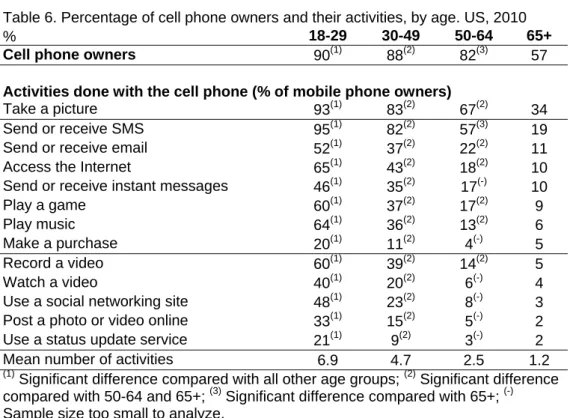
(10) Exploring the use of mobile communications in a sample of older people Mireia Fernández-Ardèvol. 2.2.1. Use and activities The most recent available data from the point of view of final consumers refers to 2010 and show that “cell phone ownership has remained stable over the last year, but users are taking advantage of a much wider range of their phones capabilities compared with a similar point in 2009” (Smith, 2010b; p. 2). There is a clear growth in the use of mobile non-voice data applications but there are differences by age: younger generations tend to use more non-voice services and are more prone to incorporate them into their communication practices, given the average number of activities developed by age (see Table 6).4 Table 6. Percentage of cell phone owners and their activities, by age. US, 2010 18-29 30-49 50-64 65+ % (1) (2) (3) Cell phone owners 88 82 57 90 Activities done with the cell phone (% of mobile phone owners) Take a picture 83(2) 67(2) 34 93(1) Send or receive SMS 82(2) 57(3) 19 95(1) Send or receive email 37(2) 22(2) 11 52(1) Access the Internet 43(2) 18(2) 10 65(1) Send or receive instant messages 35(2) 17(-) 10 46(1) Play a game 37(2) 17(2) 9 60(1) Play music 36(2) 13(2) 6 64(1) Make a purchase 11(2) 4(-) 5 20(1) Record a video 39(2) 14(2) 5 60(1) (1) (2) (-) Watch a video 20 6 4 40 Use a social networking site 23(2) 8(-) 3 48(1) Post a photo or video online 15(2) 5(-) 2 33(1) Use a status update service 9(2) 3(-) 2 21(1) Mean number of activities 6.9 4.7 2.5 1.2 (1) Significant difference compared with all other age groups; (2) Significant difference compared with 50-64 and 65+; (3) Significant difference compared with 65+; (-) Sample size too small to analyze. Source: Pew Research Center’s Internet & American Life Project, reproduced from Smith (2010b:14). There are important differences among generations in the activities performed with the mobile phone. Thus, while in the 18-29 age group, SMS is the most popular nonvoice service with a use rate of 95%; for older population, on the other hand, taking pictures is more popular than texting, with the use of SMS decreasing to 57% in the 50-64 years old cohort and lowering to 19% for those 65+.. 4. No information available on voice services.. 10 IN3 Working Paper Series is a monograph series promoted by the Internet Interdisciplinary Institute (IN3) of the UOC IN3 Working Paper Series (2012) | ISSN 2013-8644 | http://in3wps.uoc.edu.
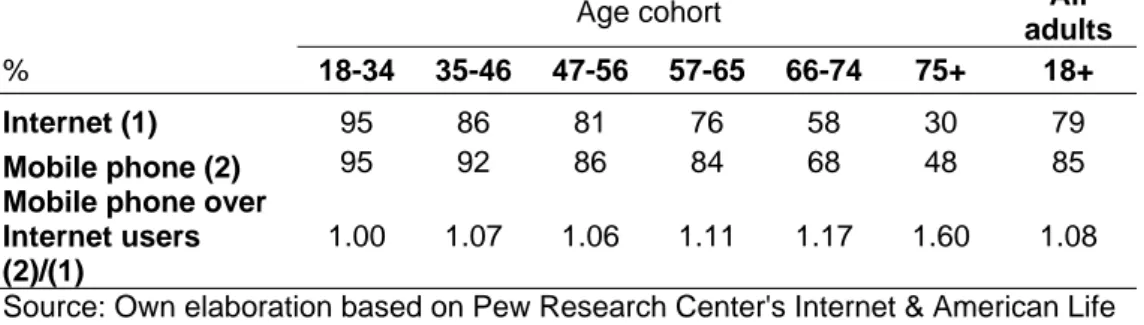
(11) Exploring the use of mobile communications in a sample of older people Mireia Fernández-Ardèvol. Indeed, for those 65+ the most popular non-voice services are taking pictures (34%), sending or receiving SMS (19%), sending or receiving email (11%), accessing the Internet (10%) and sending or receiving instant messages (10%). The 50-64 years old cohort shows a similar pattern, with higher percentages of adoption of each service. However, among the 18-29 years old generation the most popular activities are different: SMS (95%), taking pictures (93%), Access the internet (65%), play music (64%), play games (60%) and record videos (60%).. 2.3. Internet A great majority of US adults are Internet users in 2010 (79%), “a number that has remained relatively steady since early 2006” (Zickuhr, 2010:5). Again, only the older generations are below the average: 58% Internet users in the 66-74 generation and 30% for those 75+ years old (see Table 7). Mobile phones are personal, portable communication devices (Ito el al. eds., 2005) in developed countries. Therefore it is correct to identify ownership and use in the case of cell phones in the US. This assumption enables a comparison between Internet and mobile phone users. First evidence is that in all adult generations there are more mobile users than Internet users with the exception of 18-34 years old age cohort, where figures are strictly equal (95%). Besides, the difference increases with age, and for elder generations cell phones are comparatively much more popular than the Internet: among those 75+, there a 60% more mobile users than Internet users. Table 7. Comparison of Mobile phone and Internet users (%), US adult population by age. Year 2010 All Age cohort adults % 18-34 35-46 47-56 57-65 66-74 75+ 18+ 95 86 81 76 58 30 79 Internet (1) 95 92 86 84 68 48 85 Mobile phone (2) Mobile phone over 1.00 1.07 1.06 1.11 1.17 1.60 1.08 Internet users (2)/(1) Source: Own elaboration based on Pew Research Center's Internet & American Life Project. Survey date: May 2010. Ages are as for 2011. http://pewinternet.org/Reports/2010/Generations-2010.aspx (05/10/2011). Online activities change with time; and while there are notable differences by generations certain key activities are becoming more uniformly popular across all age groups. Cross-generational activities include using e-mail, search engine use, seeking health information, getting news, buying products, or making travel reservations. 11 IN3 Working Paper Series is a monograph series promoted by the Internet Interdisciplinary Institute (IN3) of the UOC IN3 Working Paper Series (2012) | ISSN 2013-8644 | http://in3wps.uoc.edu.
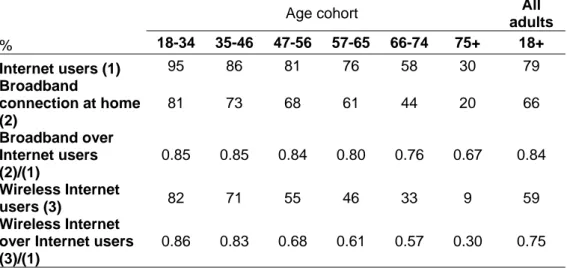
(12) Exploring the use of mobile communications in a sample of older people Mireia Fernández-Ardèvol. (Zickurh, 2010, see Table 8). On the other hand, social networking shows the highest differences among generations, followed by video watching and online banking. Table 8. Internet users and their activities, by age. US, 2010. 18-34. 35-46. 47-56. 57-65. 66-74. 75+. All adults 18+. 95. 86. 81. 76. 58. 30. 79. Age cohort % Internet users. Online activities (% of internet users) Send or read e-mail 96 94 91 93 90 88 94 Use a search engine 92 87 86 87 82 72 87 (1) Look for health info 85 84 84 85 76 59 83 Get news 76 79 76 76 67 54 75 Visit a government 61 75 73 69 56 41 67 website Watch a video 80 66 62 55 44 20 66 Buy a product 68 66 64 69 59 57 66 Make travel 64 67 70 67 61 53 66 reservations Use social networking 83 62 50 43 34 16 61 sites Bank online 62 62 58 56 44 35 58 Use online classifieds 64 58 49 42 30 17 53 Listen to music 65 58 48 38 25 12 51 online(2) Selected activities: only included those with al least 50% of all online adults declaring doing it. (1) Data referred to 2008, (2) Data referred to 2009. Source: Pew Internet surveys, http://pewinternet.org/Reports/2010/Generations2010.aspx (27/09/2011).. 2.3.1. Internet connection: broadband and wireless Broadband connection is [only] available in the 66% of the US adult population homes. Again, its presence decreases with age (see Table 9). Elders are not only less likely to be Internet users but the connection they have tends to be comparatively of worst quality. In this sense, the ratio of broadband connections over total Internet users markedly decreases for older generations: the ratio equals 0.84 for the adult average, decreasing to 0.76 among 66-47 years old cohort and to 0.67 for those 75+. Wireless Internet users, following PIP definition, are those who access the Internet both from their mobile phone and from a laptop computer with wireless access. These. 12 IN3 Working Paper Series is a monograph series promoted by the Internet Interdisciplinary Institute (IN3) of the UOC IN3 Working Paper Series (2012) | ISSN 2013-8644 | http://in3wps.uoc.edu.
(13) Exploring the use of mobile communications in a sample of older people Mireia Fernández-Ardèvol. wireless connections are becoming more and more popular, with 59% of US adults using it in 2010 (see Table 9). Again, among older generations this connection technology has comparatively lower importance: the ratio of wireless Internet users over total Internet users decreases with age, taking the value of 0.75 for the adult US population and lowering to 0.30 for population 75+. Table 9. Internet users and broadband connection at home (%), US adult population by age. Year 2010 All Age cohort adults 18-34 35-46 47-56 57-65 66-74 75+ 18+ % 95 86 81 76 58 30 79 Internet users (1) Broadband 81 73 68 61 44 20 66 connection at home (2) Broadband over 0.85 0.85 0.84 0.80 0.76 0.67 0.84 Internet users (2)/(1) Wireless Internet 82 71 55 46 33 9 59 users (3) Wireless Internet 0.86 0.83 0.68 0.61 0.57 0.30 0.75 over Internet users (3)/(1) Source: Pew Research Center's Internet & American Life Project. Survey date: May 2010. Ages are as for 2011. http://pewinternet.org/Reports/2010/Generations2010.aspx (05/10/2011). Regarding the specific device used for wireless connection, 47% of wireless Internet users go online both by using a cell phone and by using a laptop, while the rest exclusively use one of the devices (20% only mobile phones and 33% only laptops). Besides, 70% of wireless Internet users own a desktop computer (Smith, 2010a). Summing up, for all the considered ICT it is confirmed the existence of differentiated patterns of adoption and different patterns of use among generations. US older generations tend to show lower adoption rates and a more selective use of the analyzed technologies and their embedded services. Therefore, it is still valid the statement made in 2006 as there exist a trend “toward the general diffusion of mobile communication within the whole population, with age continuing to specify the type of use rather than the use itself” (Castells et al., 2006, p. 41).. 13 IN3 Working Paper Series is a monograph series promoted by the Internet Interdisciplinary Institute (IN3) of the UOC IN3 Working Paper Series (2012) | ISSN 2013-8644 | http://in3wps.uoc.edu.
(14) Exploring the use of mobile communications in a sample of older people Mireia Fernández-Ardèvol. 3. Methodology The goal of this case study is to understand the processes and motivations for using (or reject to use) mobile telephony among population of 60+ years old in Great Los Angeles (California). To achieve this goal a qualitative approach to the object of study was defined. A flexible, interactive research design is taken to incorporate the specific circumstances in which the research is carried out (Maxwell, 2005:7). Specifically, some elements of the research design took into account the foreign condition of the researcher. This case study shares goals and methodology with a previous case study conducted in the Metropolitan Area of Barcelona (Catalonia, Spain; see FernándezArdèvol, 2011b, 2011c); therefore further comparison of results is allowed. The case study is based in semi-structured interviews. However, fieldwork is composed by four different elements: the semi-structured interview, a short questionnaire, the observation of the mobile telephone –whenever possible and relevant–; and the notes that are taken after each interview. First of all, every semistructured interview follows a flexible outline and is guided as a relaxed conversation. No correct or wrong answers are expected. Interviews are voice recorded for transcription and further text analysis. The place of the interview can be both the interviewee home and a public premise (like a library). Expected length of interviews is around one hour. However, in general, global interactions tended to be longer in inhome interviews. Secondly, the short questionnaire is administered at the beginning of the meeting (see Annex 1). It is focused on individual socioeconomic characteristics and would allow a first approach to the personal network of the interviewed. It is designed to act as an ice-breaker before the voice recorder is turned on and to introduce main points of the conversations. Thirdly, handset observation, when pertinent, is allowed by asking permission to take a picture of the device. This facilitates the observation of how the interviewee handles the cell phone. While handsets tend to appear in the table when the conversation revolves around mobile telephony, the explicit question regarding the possibility of taking a picture of the handset helps in the case of those individuals who use the cell phone in a limited, restricted way and do not usually carry it with them. Finally, notes are taken after the interview. The goal of these notes is to incorporate non oral information of the whole interaction, relevant pieces of information raised when the voice recorder was off and, in general, researcher reflections before, during and after the interview.. 14 IN3 Working Paper Series is a monograph series promoted by the Internet Interdisciplinary Institute (IN3) of the UOC IN3 Working Paper Series (2012) | ISSN 2013-8644 | http://in3wps.uoc.edu.
(15) Exploring the use of mobile communications in a sample of older people Mireia Fernández-Ardèvol. 4. Fieldwork Sample size was targeted to be between 15 and 20 individuals. The selection axes defined were two: age (60 or more years old) and place of residence (Great Los Angeles). Mobile ownership was not defined as a selection criterion. This should bring relevant information for a better understanding of the processes of rejection and acceptance of that technology and the relationship of the elderly person with mobile telephony. Furthermore, special attention should be given to the different devices that are in the PSCC of each individual to gain a better understanding of the specific role of mobile telephony. The fieldwork was developed during a visiting period made at the Annenberg School for Communication (University of Southern California) and it benefited particularly from the help of the Annenberg School for Communication and the USC Davis School of Gerontology. The final studied sample is formed by 20 individuals, who were interviewed between October 10th and November 15th 2011. Interviews average length is 46 minutes. Interviews were carried out in the USC Campus (9 individuals) and in interviewee’s home (11 individuals). A symbolic reward was delivered at the end of the interview, a piece of information not usually given in advance to interviewees. Recruitment of individuals to participate in the research followed a snow ball approach. Main part of the sample consisted of volunteers of a university organization. It was possible to access other seniors that joined the study through them. Other ways of access were staff of the university, their friends and relatives. This means that a significant part of the sample had a direct relationship with a University. This characteristic must be taken into account in the analysis and the interpretation of the results. Cooperation of informants and the specific help of some interviewees was crucial in achieving the maximum sample size. This is particularly relevant as the first institution I approached, a senior center, did not authorize the research after a significant period of conversations.5 Due to the characteristics of the fieldwork the results reported here can not be generalized to the whole senior population in Los Angeles and/or in the US. However, it brings preliminary results and interesting data description that should be understood within the scope of an exploratory qualitative approach.. 5. Conversations started at the end of September with a very good reception and expectations of starting the fieldwork in the coming week. After a standby period, November the 7th I was informed that the study was not authorized in the senior center.. 15 IN3 Working Paper Series is a monograph series promoted by the Internet Interdisciplinary Institute (IN3) of the UOC IN3 Working Paper Series (2012) | ISSN 2013-8644 | http://in3wps.uoc.edu.
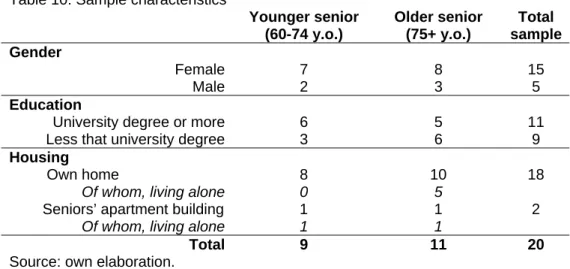
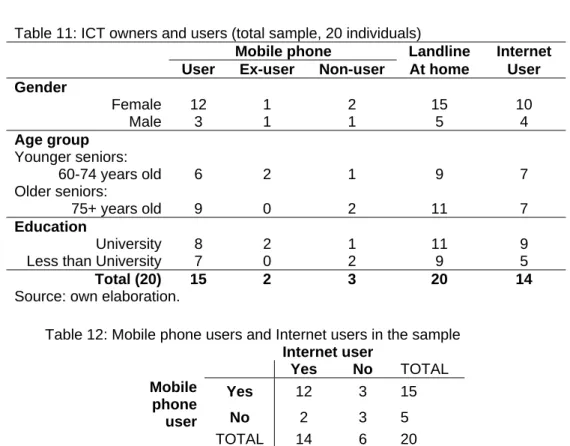
(16) Exploring the use of mobile communications in a sample of older people Mireia Fernández-Ardèvol. 5. Preliminary results Preliminary results reported here correspond to the information gathered during the fieldwork with no posterior analysis of transcribed text. Only basic information will be discussed in what follows, while more detailed and in depth analysis will be developed in the future. The studied sample consists on 15 females and 5 males (see Table 10). There are slightly more older-seniors (11) than younger-seniors (9) with ages ranging from 61 to 92 years old. The educational attainment is relatively high in the sample, with 11 individuals with at least a university degree. In addition, level of studies is higher among younger seniors. In terms of housing characteristics, older seniors in the sample do live alone in most cases than younger seniors, while those who have moved to a senior’s apartment building always live on their own. Table 10: Sample characteristics Younger senior (60-74 y.o.). Older senior (75+ y.o.). Total sample. 7 2. 8 3. 15 5. 6 3. 5 6. 11 9. 8 0 1 1 9. 10 5 1 1 11. 18. Gender Female Male Education University degree or more Less that university degree Housing Own home Of whom, living alone Seniors’ apartment building Of whom, living alone Total Source: own elaboration.. 2 20. With respect to use and ownership of different ICT (see Table 11), the majority of the individuals in the sample are mobile phone users (15). There are 2 individuals that gave up using the cell phone, while 3 have never had a mobile phone. All the individuals in the sample have a fixed line at home (20) while a majority of 14 individuals are Internet users. Almost all the Internet users are mobile phone users (12 individuals) (see Table 12), while the other two Internet users once had a cell phone but do not have it anymore. Finally, there are three individuals who neither have mobile phone nor are Internet users. The analysis of the characteristics and motivations of mobile non-users and mobile ex-users are left for a subsequent paper.. 16 IN3 Working Paper Series is a monograph series promoted by the Internet Interdisciplinary Institute (IN3) of the UOC IN3 Working Paper Series (2012) | ISSN 2013-8644 | http://in3wps.uoc.edu.
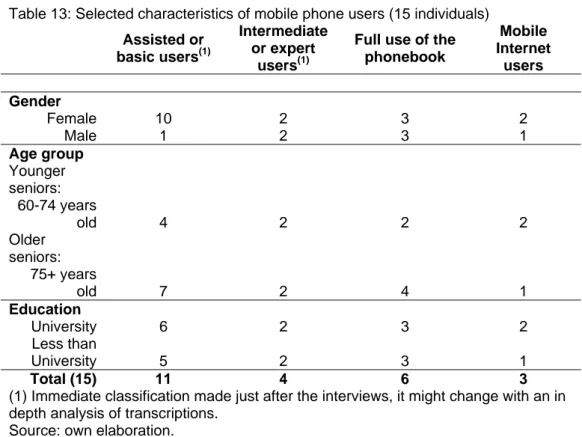
(17) Exploring the use of mobile communications in a sample of older people Mireia Fernández-Ardèvol. Table 11: ICT owners and users (total sample, 20 individuals) Mobile phone Landline User Ex-user Non-user At home Gender Female 12 1 2 15 Male 3 1 1 5 Age group Younger seniors: 60-74 years old 6 2 1 9 Older seniors: 75+ years old 9 0 2 11 Education University 8 2 1 11 Less than University 7 0 2 9 Total (20) 15 2 3 20 Source: own elaboration.. Internet User 10 4. 7 7 9 5 14. Table 12: Mobile phone users and Internet users in the sample Internet user TOTAL Yes No Mobile 12 3 15 Yes phone 2 3 5 No user TOTAL 14 6 20 Source: Own elaboration. Mobile users can be classified by taking into account autonomy of use and specific mobile services incorporated in their communication practices. As discussed elsewhere, we identify four categories: assisted users, basic users, intermediate users and expert users (Fernández-Ardèvol and Arroyo, forthcoming). “Assisted users” are those individuals who show at least two of these characteristics: they are only able to identify and use the green button (to answer calls) and the red button (to hang up) of the device; they dial numbers directly, as the phonebook is empty or they are not able to use it; alternatively, they only call numbers in the phonebook because they are not able to dial a number directly; any service beyond voice communication is not used or even not understood (alarm clock, SMS, missed calls,…); they leave the handset permanently in a fixed place to keep it safe; they have the handset permanently plugged in; or they do not know how to turn the phone off or how to set it to silent. The other three categories are “basic users”, who use a few basic applications and need help from time to time to manage the device; “intermediate users”, who are effective, adaptable and autonomous in their relationship with the mobile phone; and “experts”, corresponding to innovative users who share contents and are able to give support to other users. Although based only on preliminary evidence, at this point I am able to classify users in two rough categories: assisted/basic users and intermediate/expert users. Most part of the studied individuals are assisted/basic mobile users (11) while only 4. 17 IN3 Working Paper Series is a monograph series promoted by the Internet Interdisciplinary Institute (IN3) of the UOC IN3 Working Paper Series (2012) | ISSN 2013-8644 | http://in3wps.uoc.edu.
(18) Exploring the use of mobile communications in a sample of older people Mireia Fernández-Ardèvol. are intermediate/expert mobile users (see Table 13). All the assisted/basic users have clamshell devices, that can be considered basic handsets, and declare using them exclusively for voice communications. Three intermediate/expert users have touch-screen, smart phones and use in a daily basis both voice and data services (including mobile Internet and e-mail). The remaining individual in this category has a clamshell and rejects SMS and other nonvoice services, even though she shows a creative and rich use of the cell phone. She is a 66 years old and is among the few persons in the sample who considers the mobile phone more important than the landline. Table 13: Selected characteristics of mobile phone users (15 individuals) Mobile Intermediate Assisted or Full use of the Internet or expert (1) basic users phonebook users users(1) Gender Female 10 2 3 2 Male 1 2 3 1 Age group Younger seniors: 60-74 years old 4 2 2 2 Older seniors: 75+ years old 7 2 4 1 Education University 6 2 3 2 Less than University 5 2 3 1 Total (15) 11 4 6 3 (1) Immediate classification made just after the interviews, it might change with an in depth analysis of transcriptions. Source: own elaboration. There is a limited use of the phonebook among individuals in the sample. In this sense, only 6 individuals (2 assisted/basic and all intermediate/expert users) declare doing a full use of the phonebook; that is, having the capacity of introducing new contact data and being able to use these data to start a communication. In general, cell phone owners report a combined use of mobile and landline telephony. Among assisted/basic users the trend is towards a more intense use of the land phone. In some cases the handset is usually kept in a specific place as the owners only expect to use it in particular situations. For instance, a 92 years old woman keeps the cell phone always connected to mail supply in her bedroom. She. 18 IN3 Working Paper Series is a monograph series promoted by the Internet Interdisciplinary Institute (IN3) of the UOC IN3 Working Paper Series (2012) | ISSN 2013-8644 | http://in3wps.uoc.edu.
(19) Exploring the use of mobile communications in a sample of older people Mireia Fernández-Ardèvol. used to bring it with her when leaving home whereas currently she is using it even from home to make long distance calls in the US as they turned out to be cheaper than a landline call. In the same line, two individuals always keep the mobile phone in the glove compartment of their car.6 A man (87 years old) and a woman (86 years old) only expect to use the mobile phone for emergencies while in the car and rely on the landline for the rest of communications. The woman reports making a total of three calls in seven years, while the man declares an evolution on the use of the mobile phone as he is using it once a week for micro-coordination when away of his home.. 6. Discussion and conclusion This paper discusses the methodology, the fieldwork and preliminary results of a case study on the use of mobile telephony among seniors in Los Angeles (California). Secondary data on demographics and ICT are used to contextualize the study. The sample under study seems to be above the average of senior population in the US both in terms of educational attainment and in terms of possession and use of information and communication technologies. Higher educational level is associated with higher income level (for a recent analysis of the US see Kominski, 2011). This, in turn, would suggest higher levels of adoption and use of mobile telephony and other information and communication technologies. In this sense, in the sample under study with 15 out of 20 mobile phone users, it is confirmed that adoption is higher than the senior US average. However, it seems somehow surprising that most part of the studied users have basic, clamshell mobile phones (12 out of 15) and can be classified as assisted/basic users (11). On the other hand up to 4 individuals are intermediate/expert users, with 3 of them going online with their smart-phone. Country-level data presents a picture in which older cohorts use a limited number of non-voice services. The sample under study follows this trend, with most part of the individuals being assisted/basic users and exclusively using voice communication capabilities. Nevertheless, users that go online with their mobile phone are in the sample as well. The selection process of studied seniors did not include any condition on ownership of a cell phone, neither on the kind of device nor the activities individuals performed with their mobile phone. Therefore, being able to find non users (5) and different kind of users owning technically different devices is, as well, an interesting result of the fieldwork that should be further analyzed.. 6. One mobile phone ex-user reports the same behavior (woman, 63 years old).. 19 IN3 Working Paper Series is a monograph series promoted by the Internet Interdisciplinary Institute (IN3) of the UOC IN3 Working Paper Series (2012) | ISSN 2013-8644 | http://in3wps.uoc.edu.
(20) Exploring the use of mobile communications in a sample of older people Mireia Fernández-Ardèvol. Finally, all the individuals in the sample do have a landline, while most part of them are Internet users. In both cases, they report a daily use of these technologies. Furthermore, they declare a combined use of mobile and fixed telephony (and Internet, when it applies), with a general trend that points to a higher importance of the landline in their communicative practices. Therefore, a preliminary conclusion is that mobile phones occupy a peripheral position in the Personal System of Communication Channels of the majority of the studied seniors. In this sense, landline is more central and, in consequence, comparatively more essential to them. Mobile telephony is, in general, an extra layer among the channels they usually incorporate in mediated communication. In addition, limited used of mobile telephony tends to be a conscious decision of the user, as in general they show enough ability to communicate through more sophisticated channels, such as computers. Finally, in order to validate –or redefine– these preliminary conclusions, further analysis is needed to identify the processes that are in operation among studied individuals when deciding whether to use mobile telephony or not, and the way this technology is used among those who incorporate it in their everyday life communication practices.. Acknowledgments This research was developed during a visiting fellow period at the Annenberg School for Communication, University of Southern California (USC). The author would like to acknowledge all the interviewed individuals. Main facilitators were F. Bar, L. Broder, A. Cardenas, A. Luck, and M. Rothenberg. Paper took profit from S Sayago and D. Blanche feedback. The usual disclaimer applies.. Bibliographic references Castells, M.; Fernández-Ardèvol, M.; Qiu, J. L.; Sey, A. (2006): Mobile Communication and Society: A Global Perspective. Cambridge, MA: MIT Press. FCC (2010): Trends in Telephone Service, Industry analysis and technology division Wireline competition bureau, Federal Communications Commission (FCC), September. 192 p. http://hraunfoss.fcc.gov/edocs_public/attachmatch/DOC301823A1.pdf (27/09/2011).. 20 IN3 Working Paper Series is a monograph series promoted by the Internet Interdisciplinary Institute (IN3) of the UOC IN3 Working Paper Series (2012) | ISSN 2013-8644 | http://in3wps.uoc.edu.
(21) Exploring the use of mobile communications in a sample of older people Mireia Fernández-Ardèvol. Fernández-Ardèvol, M. (2011a): ‘Interactions with and through Mobile Phones: What about the Elderly Population?’, Wi: Journal of Mobile Media, Num. Spring 2011. http://wi.hexagram.ca/?p=66. Accessed 27 July 2011. Fernández-Ardèvol, M. (2011b): Mobile Phones in a Retirement Home: Strategic Tools for Mediated Communication. In: El-Qawasmeh, E., Zain, J., Cherifi, H. DICTAP 2011, Part I, Communications in Computer and Information Science series: 395406., Dijon. Fernández-Ardèvol, M. (2011c): Mobile Telephony among the Elders: first results of a qualitative approach. In: Isaías, P., Kommers, P. Proceedings of the IADIS International Conference e-Society 2011: 435-438., Lisbon: IADIS (International Association for Development of the Information Society). Fernández-Ardèvol, M.; Arroyo, L. (forthcoming): Mobile phone use among elderly people: An exploration of adoption processes, Interactions: Studies in Communication & Culture. Ito, M.; Okabe, D.; Matsuda, M. (2005): Personal, Portable, Pedestrian. Mobile Phones in Japanese Life. Cambridge, MA: MIT Press. ITU (2011): World Telecommunication/ICT Indicators Database 2010, Geneva, Switzerland: International Telecommunication Union. Julian, T.; Kominski, R. (2011): Education and Synthetic Work-Life Earnings Estimates, American Community Survey Reports. US Census Bureau, http://www.census.gov/prod/2011pubs/acs-14.pdf (02/12/2011). Karnowski, V; von Pape, T; Wirth, W (2008): After the digital divide? An appropriationperspective on the generational mobile phone divide. In: Hartmann, M; Rössler, P; Höflich, J. After the Mobile Phone? Social Changes and the Development of Mobile Communication. Berlin: 185-202. Ling, R. (2002): Adolescent girls and young adult men: two sub-cultures of the mobile telephone. Revista de Estudios de Juventud, 52: 33-46. Maxwell, J. A. (2005): Qualitative research design: an interactive approach, 2nd ed. Thousand Oaks, CA: SAGE Publications. OECD (2011): Pensions at a Glance 2011: Retirement-Income Systems (in OECD and G20 Countries, www.oecd.org/els/social/pensions/PAG (04/10/2011) Smith, A. (2010a): Americans and their gadgets, Pew Internet & American Life Project, 15 pages. http://pewinternet.org/Reports/2010/Gadgets.aspx (27/09/2011) Smith, A. (2010b): Mobile Access 2010. Pew Internet & American Life Project, 32 pages. http://pewinternet.org/Reports/2010/Mobile-Access-2010.aspx (27/09/2011). Zickuhr, K. (2010): Generations 2010. Pew Internet and American Life Project, 29 p. http://pewinternet.org/Reports/2010/Generations-2010.aspx (27/09/2011).. 21 IN3 Working Paper Series is a monograph series promoted by the Internet Interdisciplinary Institute (IN3) of the UOC IN3 Working Paper Series (2012) | ISSN 2013-8644 | http://in3wps.uoc.edu.
(22) Exploring the use of mobile communications in a sample of older people Mireia Fernández-Ardèvol. Annex 1 Questionnaire7 Age Birth place When did you move to Los Angeles? (If pertinent) Where is your home located? (Not the exact address, but the area/neighborhood) Do you live by your own? Yes No With whom do you live? Educational attainment (studies level) No chance to go to school Less that 9th grade 9th to 12th grade (no diploma) High school graduate Some college or associate degree Bachelor degree Advanced degree. Where are located… family and friends? (Important persons in your life). 7. Questions were not compulsory. This, in general, was not explicated. Flexibility allowed for different ways of delivering the questionnaire. Therefore, even though it was designed to be an oral questionnaire, in one interview the circumstances guided to a written by one of the interviewees.. 22 IN3 Working Paper Series is a monograph series promoted by the Internet Interdisciplinary Institute (IN3) of the UOC IN3 Working Paper Series (2012) | ISSN 2013-8644 | http://in3wps.uoc.edu.
(23) Exploring the use of mobile communications in a sample of older people Mireia Fernández-Ardèvol. Are you retired? Yes For how long have you been retired? What did you used to do before retirement? No Which is your (main) occupation? Which is, aprox., you monthly household income?8 < 1,000 USD per month 1,000 – 2,500 USD per month 2,500 – 4,000 USD per month 4,000 – 6,500 USD per month > 6,500 USD per month Don’t know __________. 8. When necessary, annual income was recorded instead of monthly income.. 23 IN3 Working Paper Series is a monograph series promoted by the Internet Interdisciplinary Institute (IN3) of the UOC IN3 Working Paper Series (2012) | ISSN 2013-8644 | http://in3wps.uoc.edu.
(24) Exploring the use of mobile communications in a sample of older people Mireia Fernández-Ardèvol. Resumen Este artículo presenta un estudio de caso cualitativo sobre el uso de comunicaciones móviles entre personas mayores (60 años o más) del área metropolitana de Los Ángeles (CA, EE.UU.). El trabajo de campo se desarrolló durante el otoño de 2011. Se discuten la metodología, el trabajo de campo y los resultados preliminares. Previamente se analizan datos de ámbito nacional para contextualizar y comprender mejor las características específicas de los individuos objeto de estudio. En este sentido, el interés se centra en los rasgos demográficos y en la aceptación y el uso de tecnologías de la información y la comunicación (TIC). Los resultados preliminares muestran que dentro de la muestra estudiada (20 personas) hay una elevada presencia de usuarios de teléfono móvil (15), mientras que entre los no usuarios de móviles (5), tres de ellos decidieron dejar de usar esta tecnología en el pasado. La mayoría de las personas que han adoptado la telefonía móvil describen un uso muy limitado del dispositivo en sus prácticas comunicativas cotidianas. Por último, mientras que Internet es muy popular en la muestra (14 usuarios), sólo 3 personas se conectan a Internet con el móvil.. Palabras clave Tercera edad; telefonía móvil; caso de estudio; Los Ángeles (CA); Sistema Personal de Canales de Comunicación (PSCC).. 24 IN3 Working Paper Series is a monograph series promoted by the Internet Interdisciplinary Institute (IN3) of the UOC IN3 Working Paper Series (2012) | ISSN 2013-8644 | http://in3wps.uoc.edu.
(25) Exploring the use of mobile communications in a sample of older people Mireia Fernández-Ardèvol. Resum Aquest article presenta un estudi de cas qualitatiu sobre l'ús de les comunicacions mòbils entre persones grans (60 anys o més) de l'àrea metropolitana de Los Angeles (CA, EUA). El treball de camp es va desenvolupar durant la tardor de 2011. Es discuteixen la metodologia, el treball de camp i els resultats preliminars. Prèviament s'analitzen dades d'àmbit nacional per contextualitzar i comprendre millor les característiques específiques dels individus objecte d'estudi. En aquest sentit, l’interès se centra en els trets demogràfics i en l'acceptació i l'ús de tecnologies de la informació i la comunicació (TIC). Els resultats preliminars mostren que a la mostra estudiada (20 persones) hi ha una elevada presència d'usuaris de telèfon mòbil (15); mentre que entre els no usuaris de mòbils (5), tres d'ells van decidir deixar d'usar aquesta tecnologia en el passat. La majoria de les persones que han adoptat la telefonia mòbil descriuen un ús molt limitat del dispositiu en les seves pràctiques comunicatives quotidianes. Finalment, mentre que Internet és molt popular dins de la mostra (14 usuaris), només 3 persones es connecten a Internet amb el mòbil.. Paraules clau Gent gran; telefonia mòbil, estudi de cas; Los Angeles (CA); Sistema Personal de Canals de Comunicació (PSCC). 25 IN3 Working Paper Series is a monograph series promoted by the Internet Interdisciplinary Institute (IN3) of the UOC IN3 Working Paper Series (2012) | ISSN 2013-8644 | http://in3wps.uoc.edu.
(26) Exploring the use of mobile communications in a sample of older people Mireia Fernández-Ardèvol. Mireia Fernández-Ardèvol [email protected] Research prgram Mobile Communication, Economy and Society IN3 – Universitat Oberta de Catalunya Mireia Fernández-Ardèvol holds a PhD in Economics (University of Barcelona, UB) and a degree in Economics (UB) and in Business Administration (UB). She is the co-director of the Research Program “Mobile Communication, Economy & Society” at the Internet Interdisciplinary Institute IN3 (UOC, Open University of Catalonia). Mobile communication has been one of her main areas of study since 2003, , with a combined sociological and economic focus. Her interests are set both in developed and in developing countries. More info: <http://www.femrecerca.cat/mireia>.. Mireia Fernández-Ardèvol [email protected] Research prgram Mobile Communication, Economy and Society IN3 – Universitat Oberta de Catalunya Mireia Fernández-Ardèvol és Doctora en Economia (Universitat de Barcelona, UB) i llicenciada en Economia (UB) i en Administració i Direcció d’Empreses (UB). Codirigeix el programa de recerca “Mobile Communication, Economy and Society” al Internet Interdisciplinary Institute IN3 (UOC). La comunicació mòbil és una de les seves principals àrees d’estudi des del 2003. Combina la perspectiva sociològica i econòmica, i els seus interessos se centren tant en contextos desenvolupats com en contextos en desenvolupament. Més informació: <http://www.femrecerca.cat/mireia>.. 26 IN3 Working Paper Series is a monograph series promoted by the Internet Interdisciplinary Institute (IN3) of the UOC IN3 Working Paper Series (2012) | ISSN 2013-8644 | http://in3wps.uoc.edu.
(27)
Figure
+3
Documento similar
