
TítuloClinical experience with the integrase inhibitors Dolutegravir and Elvitegravir in HIV infected patients: efficacy, safety and tolerance
9
0
0
Texto completo
(2) The great advances in antiretroviral therapy (ART) have dramatically changed the prognosis of HIV infection with significant decrease in morbidities and mortalities related to AIDS. Nowadays, national and international HIV guidelines recommend treating all HIV-infected patients regardless of their immunological status [1-3]. Antiretroviral regimen for initial ART generally consists of two nucleoside reverse-transcriptase inhibitors (NRTIs) in combination with a third drug from one of three drug classes: an integrase strand transfer inhibitor (INSTI), a non-nucleoside reversetranscriptase inhibitor (NNRTI) or a boosted protease inhibitor (PI). Based on the high efficacy and safety profile demonstrated in clinical trials, INSTIs (raltegravir, elvitegravir and dolutegravir) are positioned as preferred options [1-3]. They inhibit the catalytic activity of the HIV integrase and prevent the insertion of the HIV genome into the host cell genome, avoiding HIV replication. Elvitegravir (EVG) and dolutegravir (DTG) have been licensed the latest being available in fixed-dose combinations with a NRTI backbone in one tablet given once daily. EVG is currently available in two fixed-dose coformulated pills in combination with the pharmacokinetic enhancer cobicistat (COBI). The first licensed was coformulated with tenofovir disoproxil fumarate and emtricitabine (TDF/FTC) and the latest with FTC in combination with the new tenofovir alafenamide fumarate (TAF), a targeted tenofovir pro-drug with a 90% reduction in plasma tenofovir concentrations that significantly improves renal and bone safety compared with TDF. DTG, a second-generation integrase inhibitor, has a high genetic barrier for the development of resistance mutations, with no need for pharmacological enhancement, in combination with either TDF/FTC or abacavir/lamivudine (ABC/3TC) (the last, coformulated in one pill with DTG). As we encountered many patients who stopped DTG and EVG/COBI because of adverse events (AE), we analysed the experience with these INSTIs in our whole patient population. Therefore, this study evaluates the real-life effectiveness and safety of DTG and EVG/COBI among a large cohort of naïve and treatment-experienced patients.. Materials and Methods This is an observational study in adult HIV-1-infected patients who started ART with DTG or EVG/COBI from 1 January 2015 to 31 January 2017 at a reference hospital in north-western Spain. Only those patients who had signed the informed consent and with at least one follow-up visit were included. Those patients participating in clinical trials were excluded of the study. Epidemiological, clinical, immunovirological data and information regarding ART were retrospectively recorded. A per-protocol snapshot analysis (HIV-1 RNA < 50 copies/mL at Week 48) for assessment of the efficacy was done (we excluded patients without viral load assessments in the week 48 analysis window for reasons other than discontinuation because of poor efficacy). The time of follow-up was defined since the day of DTG or EVG/COBI initiation until the day of discontinuation or the last visit to the pharmacy. A statistical analysis was performed with SPSS v.19. software. Group differences were compared using the Pearson chi-square or Fisher's exact test and Student's t-test or the Mann– Whitney U-test, respectively, for categorical and continuous variables. Repeated measurements were compared using paired Student's t-test or Wilcoxon signed-rank test. The incidence rate and 95% confidence interval [IR (95% CI)] of discontinuations due to AE were estimated as the ratio of the number of discontinuations by 100 patients/year of follow-up. We estimated time to treatment discontinuation of DTG and EVG/COBI for AE by Kaplan–Meier method. Univariate analyses were performed with all the covariates. Multivariate Cox regression analysis, among the statistically significant univariate covariates plus those clinically relevant, was performed to identify risk factors for discontinuation because of AE. p-Values of 0.05 or less were considered statistically significant..
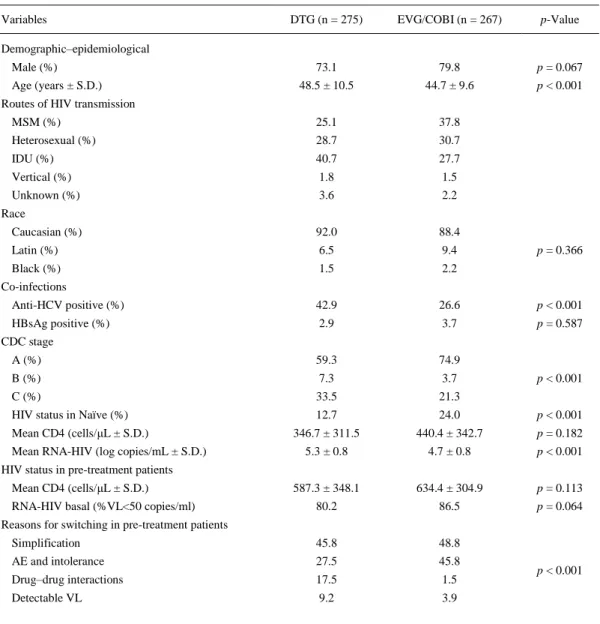
(3) Results Baseline characteristics of the study population A total of 542 DTG- or EVG/COBI-based therapies were initiated within the observation period: 275 patients started DTG and 267 EVG/COBI. The combination ABC/3TC/DTG in a single pill was chosen for 195 patients, TDF/FTC/EVG/COBI for 151 patients, TAF/FTC/EVG/COBI for 116 patients and DTG combined with other antiretrovirals (i.e. NRTIs and NNRTIs) for 80 patients. The majority of patients were Caucasian (90.0%) and men (77.1%) with a median age of 46.4 years (range 21–83), and pre-treated (83.2%). Subjects treated with DTG were significantly older, more frequently co-infected with HCV, in late-stage disease of HIV (C stage of CDC classification) and with higher viral load compared to EVG/COBI group. Epidemiological, clinical, immunological and other baseline characteristics of each group are depicted in table 1. The median time of follow-up was 287.5 ± 186.3 days. The reasons for switching ART were simplification (45.3%), to avoid intolerance or AE (39.2%), drug–drug interactions (9.2%) and detectable viral load (6.3%). In most patients, the previous NRTIs were TDF/FTC (73.7%), with a PI/r (31.7%), NNRTI (29.5%) or an INSTI (26.5%)..
(4) Table 1. Baseline characteristics of the study population Variables. DTG (n = 275). EVG/COBI (n = 267). p-Value. Demographic–epidemiological Male (%). 73.1. 79.8. p = 0.067. 48.5 ± 10.5. 44.7 ± 9.6. p < 0.001. MSM (%). 25.1. 37.8. Heterosexual (%). 28.7. 30.7. IDU (%). 40.7. 27.7. Vertical (%). 1.8. 1.5. Unknown (%). 3.6. 2.2. Caucasian (%). 92.0. 88.4. Latin (%). 6.5. 9.4. Black (%). 1.5. 2.2. Anti-HCV positive (%). 42.9. 26.6. p < 0.001. HBsAg positive (%). 2.9. 3.7. p = 0.587. A (%). 59.3. 74.9. B (%). 7.3. 3.7. C (%). 33.5. 21.3. Age (years ± S.D.) Routes of HIV transmission. Race p = 0.366. Co-infections. CDC stage. HIV status in Naïve (%). p < 0.001. 12.7. 24.0. p < 0.001. 346.7 ± 311.5. 440.4 ± 342.7. p = 0.182. 5.3 ± 0.8. 4.7 ± 0.8. p < 0.001. 587.3 ± 348.1. 634.4 ± 304.9. p = 0.113. 80.2. 86.5. p = 0.064. Simplification. 45.8. 48.8. AE and intolerance. 27.5. 45.8. Drug–drug interactions. 17.5. 1.5. Detectable VL. 9.2. 3.9. Mean CD4 (cells/μL ± S.D.) Mean RNA-HIV (log copies/mL ± S.D.) HIV status in pre-treatment patients Mean CD4 (cells/μL ± S.D.) RNA-HIV basal (%VL<50 copies/ml) Reasons for switching in pre-treatment patients. p < 0.001. MSM, men who have sex with men; IDU, intravenous drug use; CDC, Centers for Disease Control; VL, viral load; AE, adverse event. Efficacy Among pre-treated patients, 80.2% of patients who started DTG and 86.5% of patients who started EVG/COBI had HIV-RNA < 50 copies/mL at baseline. In both treatment groups, the proportion of patients with virological suppression (<50 copies/mL) increased from baseline to week 48 in 125 from 135 (92.6%) of patients who started DTG and in 71 from 74 (95.9%) of patients receiving EVG/COBI; p = 0.3893. Within naïve patients, at 48 weeks, 20 from 22 patients (90.9%) in the DTG group and 10 from 11 (90.9%) in the EVG/COBI group achieved HIV-RNA < 50 copies/mL (p = 0.999)..
(5) Safety and tolerability During follow-up, the global incidence of discontinuations was 8.5%, and 6.6% were due to side effects [IR 8.4 per 100 patients/year (6.2–10.6)]. The neuropsychiatric disorders were the main AE of discontinuation [59%, IR 4.9 by 100 patients/year (3.2–6.7)]. Overall, 11.6% patients discontinued DTG and 7.1% EVG/COBI during the study period (p = 0.070). In the case of DTG, 87.5% [i.e. 10.2% of overall patients treated with DTG and IR 13.9 per 100 patients/year (9.2– 20.2)] were due to AE: 70.4% related to neuropsychiatric disturbances [IR 9.8 per 100 patients/year (5.9–15.3)], 22.2% gastrointestinal discomfort [IR 3.1 per 100 patients/year (1.1– 6.7)], 3.7% alterations of renal function [IR 0.5 per 100 patients/year (0.0–2.9)] and 3.7% haematology toxicity [IR 0.5 per 100 patients/year (0.0–2.9)]. Most patients reported more than one neuropsychiatric toxicity including abnormal dreams, insomnia, headache, dizziness, nervousness, irascibility, anxiety, depressive symptoms and suicidal ideation. Among the remaining patients who discontinued DTG, 9.4% were deaths (n = 3, not related with DTG) and 3.1% due to virological failure. In the case of EVG/COBI, 63.1% [i.e. 4.5% of overall patients treated with EVG/COBI and IR 4.4 per 100 patients/year (2.3–7.8)] treatment discontinuations were due to AE: 50% gastrointestinal discomfort [IR 2.2 per 100 patients/year (0.8–4.8)], 33.3% related to neuropsychiatric disorders [IR 1.5 per 100 patients/year (0.4–3.8)] or 16.7% alterations of renal function [IR 0.7 per 100 patients/year (0.1–2.7)]. The rest of discontinuations in EVG/COBI were 21.1% by pharmacological interactions and 15.8% due to virological failure. Statistically significant differences have been found between the percentage of patients who discontinue DTG and EVG/COBI due to adverse events [10.2% versus 4.5%, respectively, p = 0.015; HR 2.747 (95%CI 1.382–5.461), p = 0.004] and neuropsychiatric AEs (6.9% versus 1.5%, p = 0.001). In most cases, all reported side effects disappeared quickly once these drugs were stopped. The time between the start of DTG and EVG/COBI and its suspension by AEs was 175.7 ± 137.3 and 83.6 ± 68.5 days, respectively (p = 0.030) (fig. 1).. Figure 1. Relationship between discontinuations due to adverse events after EVG/COBIversusDTG initiation. Kaplan– Meier curves for EVG/COBI and DTG exposure and discontinuations because of adverse events. DTG, dolutegravir; EVG/COBI, elvitegravir/cobicistat..
(6) A univariate analysis of risk factors for discontinuations due to AE was performed considering age, gender, race, routes of HIV transmission, CDC stage, HBV and HCV co-infection, treatment experience (naive versus pre-treated), ART (DTG versus EVG/COBI) and the NRTI combination. Age [HR 1.033 for every one year (95%CI 1.002–1.065), p = 0.035] was associated with a higher risk of interruptions for AE in patients treated with both EVG/COBI and DTG. Females were at higher risk of discontinuations than men [HR 2.389 (95%CI 1.196–4.772), p = 0.014] in patients treated with both EVG/COBI and DTG. Among those treated with DTG, patients receiving ABC/3TC/DTG were more likely to interrupt treatment due to side effects compared with those on DTG associated with other antiretrovirals [HR 5.183 (95%CI 1.960–13.701), p = 0.001]. In the multivariate Cox regression model, female gender [HR 2.255 (95%CI 1.121–4.535), p = 0.023] and treatment with DTG [HR 2.453 (95%CI 1.221–4.931) p = 0.012] were significantly associated with discontinuations due to AE. Neither age nor the female gender was associated with an increased risk of discontinuations due to neuropsychiatric adverse events in the multivariate analyses. However, in a multivariate analysis comparing DTG- versus EVG/COBI-based therapies, without considering the concomitant antiretrovirals used, the use of DTG was identified as a predictor factor for having higher risk of discontinuation due to neuropsychiatric adverse events [HR 5.906 (95%CI 1.954– 17.846), p = 0.002]. More specifically, in the multivariate analysis including the specific ART combination DTG/abacavir/lamivudine, EVG/COBI/FTC/TDF, EVG/COBI/FTC/TAF, or DTG combined with other NRTI or NNRTI, the use of DTG/abacavir/lamivudine was associated with higher rates of discontinuations because of neuropsychiatric adverse events [HR 4.380 (95%CI 1.348–14.233), p = 0.014]. There were no significant associations between any of the study variables and an increased risk of gastrointestinal and renal function disturbances.. Discussion In this cohort of 542 HIV-infected patients who initiated DTG- or EVG/COBI-based therapies, the high efficacy of these INSTIs both for naïve and for treatment-experienced patients has been confirmed, as already demonstrated by clinical trials [4-13]. More than 90% of patients achieved or maintained virological suppression within the 48 weeks after DTG or EVG/COBI initiation among treatment-experienced patients, and about 91% of naïve patients achieved virological suppression through the first 48 weeks, as obtained by per-protocol analysis. However, an unexpected high rate of discontinuations due to adverse events, previously not described in clinical trials, was recognized. The overall rates were 10.2% and 4.5% for patients under DTG and EVG/COBI, respectively. The discontinuations due to neuropsychiatric AEs were significantly higher among patients receiving DTG compared with those on EVG/COBI (6.9% versus 1.5%). Thus, a patient under a DTG-based regimen had 5.9 times more risk of discontinuation due to a neuropsychiatric disorder than a patient receiving EVG/COBI, especially if DTG was administered in combination with ABC/3TC. The most frequent patterns of neuropsychiatric AE were abnormal dreams, mood changes, sleep disturbances, anxiety, depression and suicidal ideation. All of them quickly disappeared after discontinuation of DTG. Similarly, the occurrence of unexpected discontinuations due to side effects of DTG was reported in three recent observational real-life studies [14-16]. In one of them, the commonest reason leading to DTG discontinuation was neuropsychiatric adverse events (5.6%), particularly among women and older patients. In the other, the rates of discontinuations due to neuropsychiatric events were 9.9%, and in this case, DTG was stopped more frequently if the regimen included the NRTI abacavir. All these figures are unexpectedly higher than those previously reported in DTG clinical trials related to neuropsychiatric disorders leading to discontinuations that remained below 1% [8-13]. Similarly, in EVG/COBI register studies, the rate of discontinuations due to gastrointestinal or neuropsychiatric disorders was also below 1.1% [4-7]..
(7) Herein, age and female gender were associated with a higher risk of treatment interruption for any adverse event in patients treated with both EVG/COBI and DTG. Moreover, patients under DTG treatment and specially those receiving ABC/3TC/DTG were at higher risk of discontinuations due to adverse events. However, only female gender and the use of DTG were finally identified as independent risk factors for treatment discontinuation due to any adverse event. Therefore, women on treatment with EVG/COBI were at higher risk of discontinuations due to adverse events. This is a new finding for EVG/COBI not previously described in real-life studies. The median time to interruption treatment due to an adverse event was significantly different between DTG and EVG (about 6 versus 3 months, respectively). These times are in accordance with times reported in other real-life studies [14, 17] for DTG and clinical trials for EVG [7]. Regarding discontinuations due to neuropsychiatric adverse events, we did not find any association with older age or female gender in the multivariate analysis, conversely to what has recently been published in an observational study [14]. Similar to our results, the ARIA study – which evaluated the efficacy of ABC/3TC/DTG compared to TDF/FTC in combination with atazanavir/r only in women – did not observe higher rates of discontinuations due to neuropsychiatric events related to DTG in women [18]. In our cohort, only the use of DTG, especially in combination with ABC/3TC, was identified as an independent risk factor for discontinuations due to neuropsychiatric events. These findings are in agreement with the results reported by Boer et al., who found that DTG was switched more frequently in those regimens that include abacavir [15]. However, these findings have not been confirmed in a recent study presented by Llibre et al. [19]. Conversely, we did not find significant associations between any of the study variables and an increased risk of discontinuations due to gastrointestinal and renal function disturbances, more frequently observed in patients receiving EVG/COBI compared with DTG. These observations might be explained in part by the concomitant use of cobicistat and TDF in patients receiving EVG/COBI-based therapies. The reasons for the conflicting results observed between trials and some cohorts such as our data remain unclear and probably several factors including the heterogeneity of the studies populations, time of follow-up and the observational research design might partially explain these findings. For the present study, the main limitations were small sample size, single-centre study and the retrospective observational design that might have introduced uncontrolled bias. In conclusion, DTG and EVG/COBI demonstrated high efficacy in both treatment-naïve and pre-treated patients. However, an unexpectedly higher rate of discontinuation due to adverse events than that described in clinical trials, especially by neuropsychiatric AEs, was observed. Particularly, DTG especially in concomitant use with abacavir is identified as a predictor for discontinuations due to neuropsychiatric adverse events. The reason underlying the potential interaction between abacavir and dolutegravir in real clinical practice deserves further research, as several real-life studies have concluded an increased risk of neuropsychiatric adverse events that lead to treatment withdrawal. Differences between patients treated with DTG and EVG/COBI should be cautiously interpreted, as this is an observational retrospective study, and therefore, both populations were not comparable. These findings should be considered in the real-life setting when using EVG/COBI and DTG.. Acknowledgements We would like to thank Biobank of A Coruña (SERGAS) for providing us the technical, ethical and legal advice necessary for the development of our research.. Source of Funding This work was supported in part by grants from Fondo de Investigación Sanitaria (CPII14/00014, PI10/02166, PI13/02266, CM13/00328, CM15/00233, PI16/02159), and Fundación Profesor Novoa Santos, A Coruña..
(8) Disclosure Statement Dr. CID-SILVA reports grants from Fondo de Investigación Sanitaria, grants from Fundación Professor Novoa Santos, during the conduct of the study. Dr. LLIBRE reports grants and personal fees from ViiV Healthcare, personal fees from Gilead Sciences, personal fees from Bristol-Myers Squibb, personal fees from Merck Sharp & Dohme, outside the submitted work. Dr. FERNANDEZ-BARGIELA has nothing to disclose. Dr. MARGUSINO-FRAMIÑÁN has nothing to disclose. Dr. Balboa-Barreiro has nothing to disclose. Dr. Pernas has nothing to disclose. Dr. Martín-Herranz has nothing to disclose. Dr. Castro Iglesias has nothing to disclose. Dr. POVEDA reports grants from Fondo de Investigación Sanitaria, grants from Fundación Profesor Novoa Santos, during the conduct of the study; grants, personal fees and non-financial support from JANSSEN CILAG, grants and non-financial support from GILEAD SCIENCES, personal fees and non-financial support from MERCK SHARP &DOHME, non-financial support from ViiV Healthcare, outside the submitted work.. References 1.. 2.. 3.. 4.. 5.. 6.. 7.. 8.. 9.. 10.. Panel on Antiretroviral Guidelines for Adults and Adolescents. Guidelines for the use of antiretroviral agents in HIV-1-infected adults and adolescents. Department of Health and Human Services, July 14, 2016. http://www.aidsinfo.nih.gov/ContentFiles/AdultandAdolescentGL.pdf (last accessed on 18 April 2017). Panel Members of European AIDS Clinical Society (EACS). European Guidelines for treatment of HIV-positive adults in Europe version 8.0. EACS, October 2015. http://www.eacsociety.org/files/guidelines_8.0-english.pdf (last accessed on 18 April 2017). Panel de expertos de GeSIDA y Plan Nacional sobre el Sida. Documento de consenso de GesiDa/Plan nacional sobre el sida respecto al tratamiento antirretroviral en adultos infectados por el virus de la inmunodeficiencia humana (Actualización enero 2017). SEIMC, January 2017. http://gesida-seimc.org/contenidos/guiasclinicas/2017/gesidaguiasclinicas-2017-TAR.pdf. Sax PE, DeJesus E, Mills A, Zolopa A, Cohen C, Wohl D et al. Co-formulated elvitegravir, cobicistat, emtricitabine, and tenofovir versus co-formulated efavirenz, emtricitabine, and tenofovir for initial treatment of HIV-1 infection: a randomised, double-blind, phase 3 trial, analysis of results after 48 weeks. Lancet 2012;379:2439– 48. DeJesus E, Rockstroh JK, Henry K, Molina JM, Gathe J, Ramanathan S et al. Coformulated elvitegravir, cobicistat, emtricitabine, and tenofovir disoproxil fumarate versus ritonavir-boosted atazanavir plus co-formulated emtricitabine and tenofovir disoproxil fumarate for initial treatment of HIV-1 infection: a randomised, doubleblind, phase 3, non-inferiority trial. Lancet 2012;379:2429–38. Mills A, Arribas JR, Andrade-Villanueva J, DiPerri G, Van Lunzen J, Koenig E et al. Switching from tenofovir disoproxil fumarate to tenofovir alafenamide in antiretroviral regimens for virologically suppressed adults with HIV-1 infection: a randomised, active-controlled, multicentre, open-label, phase 3, non-inferiority study. Lancet Infect Dis 2016;16:43–52. Cohen C, Elion R, Ruane P, Shamblaw D, DeJesus E, Rashbaum B et al. Randomized, phase 2 evaluation of two single-tablet regimens elvitegravir/cobicistat/emtricitabine/tenofovir disoproxil fumarate versus efavirenz/emtricitabine/tenofovir disoproxil fumarate for the initial treatment of HIV infection. AIDS 2011;25:F7–F12. Ra F, Jaeger H, Quiros-Roldan E, Albrecht H, Belonosova E, Gatell JM et al. Oncedaily dolutegravir versus twice-daily raltegravir in antiretroviral-naive adults with HIV-1 infection (SPRING-2 study): 96 week results from a randomised, double-blind, non-inferiority trial. Lancet Infect Dis 2013;13:927–35. Pappa K, Baumgarten A, Felizarta F, Florence E, Portilla J, Walmsley S et al. Dolutegravir + abacavir/lamivudine once daily superior to tenofovir/emtricitabine/efavirenz in treatment naive HIV subjects: 144-week results from SINGLE (ING114467). ICAAC 2014. September 5–9, 2014. Washington, DC. Abstract H-647a. Molina JM, Clotet B, van Lunzen J, Lazzarin A, Cavassini Matthias, Henry K et al. Once-daily dolutegravir versus darunavir plus ritonavir for treatment-naive adults.
(9) 11.. 12.. 13.. 14.. 15.. 16.. 17.. 18.. 19.. with HIV-1 infection (FLAMINGO): 96 week results from a randomised, open-label, phase 3b study. Lancet HIV 2015;2:e127–e136. Cahn P, Pozniak AL, Mingrone H, Shuldyakov A, Brites C, Andrade-Villanueva JF et al. Dolutegravir versus raltegravir in antiretroviral-experienced, integrase-inhibitornaive adults with HIV: week 48 results from the randomised, double-blind, noninferiority SAILING study. Lancet 2013;382:700–08. Castagna A, Maggiolo F, Penco G, Wright D, Mills A, Grossberg R et al. Dolutegravir in antiretroviral-experienced patients with raltegravir- and/or elvitegravir resistant HIV-1: 24-week results of the phase III VIKING-3 study. JID 2014;210:354–362. Lake J, Trottier B, Garcia-Diaz J, Edelstein H, Kumar P, Bredeek UF et al. STRIIVING: switching to abacavir/dolutegravir/lamivudine fixed dose combination (ABC/DTG/3TC FDC) from a PI, NNRTI or INI-based regimen maintains HIV suppression at Week 48. Presented at the 21st International AIDS Conference; July 18-22, 2016; Durban, South Africa. Abstract 720. Hoffmann C, Welz T, Sabranski M, Kolb M, Word E, Stellbrink HJ et al. Higher rates of neuropsychiatric adverse events leading to dolutegravir discontinuation in women and older patients. HIV Med 2017;18:56–63. de Boer MG, van den Berk GE, van Holten N, Oryszcyn JE, Dorama W, Moha DA et al. Intolerance of dolutegravir-containing combination antiretroviral therapy regimens in real-life clinical practice. AIDS 2016;30:2831–2834. Borghetti A, Baldin G, Capetti A, Sterrantino G, Rusconi S, Latini A et al. Efficacy and tolerability of dolutegravir and two nucleos(t)ide reverse transcriptase inhibitors in HIV-1-positive, virologically suppressed patients. AIDS 2017;31:457–459. Bonfanti P, Madeddu G, Gulminetti R, Squillace N, Orofino G, Vitiello P et al. Discontinuation of treatment and adverse events in an Italian cohort of patients on dolutegravir. AIDS 2017;31(455):460. Orrell C, Hagins D, Belonosova E, Porteiro N, Walmsley S, Falcó V et al. Superior efficacy of dolutegravir/abacavir/lamivudine (DTG/ABC/3TC) fixed dose combination (FDC) compared with ritonavir (RTV) boosted atazanavir (ATV) plus tenofovir disoproxil fumarate/emtricitabine (TDF/FTC) in treatment-naïve women with HIV-1 infection (ARIA study). Presented at the 21st International AIDS Conference; July 18–22, 2016, Durban, South Africa. Abstract 10215. Llibre JM, Esteve A, Miro JM, Mateo G, Curran A, Podzamczer D et al. Discontinuation of dtg, evg/c, and ral due to toxicity in a prospective cohort. Presented at the Conference on Retroviruses and Opportunistic Infections (CROI); February 13–16, 2017, Seattle, Washington. Abstract 651..
(10)
Figure

Documento similar
The expansionary monetary policy measures have had a negative impact on net interest margins both via the reduction in interest rates and –less powerfully- the flattening of the
Jointly estimate this entry game with several outcome equations (fees/rates, credit limits) for bank accounts, credit cards and lines of credit. Use simulation methods to
In our sample, 2890 deals were issued by less reputable underwriters (i.e. a weighted syndication underwriting reputation share below the share of the 7 th largest underwriter
The aim of this study is to analyze bone healing rates, functional results and complications in patients with dis- placed mid-diaphyseal fractures of clavicle treated with
This study sought to analyze tumor CXCL5 gene expression in six patients with different efficacy of BVZ-containing CT in terms of the tumor response to treatment..
The Dwellers in the Garden of Allah 109... The Dwellers in the Garden of Allah
Central adjudication of serious adverse events did not affect trial’s safety results: Data from the Efficacy of Nitric Oxide in Stroke (ENOS) trial..
High quality of life, treatment tolerability, safety and efficacy in HIV patients switching from triple therapy to lopinavir/ritonavir monotherapy: A randomized clinical trial..
