
Internationalisation at Home in a Global Perspective: A Critical Survey of the 3rd Global Survey Report of IAU
16
0
0
Texto completo
(2) http://rusc.uoc.edu. Internationalisation at Home in a Global Perspective…. obstacles include the lack of engagement and limited expertise of academic staff in relation to the internationalisation process. The response items for this question do not connect these obstacles to internationalisation of the curriculum explicitly, but it is argued here that a relationship indeed exists. The same is true for issues around foreign language proficiency, which may have a strong impact on internationalisation of the home curriculum. In the conclusion, several additional questions are raised that could serve to get a clearer picture of the development of internationalisation of the curriculum in a global perspective.. Keywords. Internationalisation at Home, internationalisation of the curriculum, Global Survey, obstacles to internationalisation. La internacionalización en casa en una perspectiva global: un estudio crítico del Informe del 3.er Estudio Global de la AIU Resumen. Este artículo toma como punto de partida el Informe del 3.er Estudio Global de la Asociación Internacional de Universidades (AIU). Los resultados de este estudio a escala mundial se publicaron en septiembre del 2010. El artículo trata cuatro cuestiones del estudio que incluyen la internacionalización en casa (IeC) y la internacionalización del plan de estudios como ítems de respuesta. Se comentan los resultados de estas cuatro cuestiones y, cuando es relevante y posible, se comparan con los resultados del estudio previo, que se llevó a cabo en el 2005 y se publicó en el 2006. Se comenta que las secciones del Estudio Global que mencionan la internacionalización del plan de estudios y la IeC utilizan una terminología que no siempre es adecuada para el propósito y a veces incluso parece contradictoria. El Estudio Global incluye una cuestión sobre obstáculos internos a la internacionalización, que también se tratarán aquí. Estos obstáculos incluyen la falta de compromiso y la pericia limitada del personal académico en relación con el proceso de internacionalización. Los ítems de respuesta para esta cuestión no conectan estos obstáculos a la internacionalización del plan de estudios explícitamente, pero se admite que esta relación existe realmente. Lo mismo ocurre para cuestiones sobre la competencia en lengua extranjera, que podrían tener un fuerte impacto en la internacionalización del plan de estudios doméstico. En conclusión, se exponen varias cuestiones adicionales que podrían servir para obtener una imagen del desarrollo de la internacionalización del plan de estudios en una perspectiva global.. Palabras clave. internacionalización en casa, internacionalización del plan de estudios, Estudio Global, obstáculos a la internacionalización. RUSC vol. 8 No 2 | Universitat Oberta de Catalunya | Barcelona, July 2011 | ISSN 1698-580X 250 CC. Jos Beelen.
(3) http://rusc.uoc.edu. Internationalisation at Home in a Global Perspective…. Internationalisation at Home and Internationalisation of the Curriculum Internationalisation at Home (IaH) was introduced as a concept in 1999. In the particular setting in which it was introduced, IaH aimed to make students interculturally and internationally competent without leaving their own city for study-related purposes (Crowther et. al., 2001). In the original setting in Malmö (Sweden), there was a marked emphasis on intercultural aspects of the teaching and learning process. This was facilitated through strong links with local cultural/ethnic groups. Knight (2008: 23) elaborates the concept of IaH and describes a wider focus, in which liaisons with local cultural and ethnic groups are but one of the elements. She distinguishes “a diversity of activities” and mentions a number of them in addition to cultural liaisons: curriculum and programmes, teaching/learning processes, extra-curricular activities, and research and scholarly activity. In Knight’s view, internationalisation of the curriculum is one of the aspects constituting IaH. Knight maintains the term ‘concept’ for IaH. It should be noted here that, while IaH may use existing educational concepts such as comparative and collaborative learning, it is not in itself a didactic or educational concept. In the same publication, Knight also uses the terms ‘pillar’ and ‘stream’ to distinguish between IaH and internationalisation abroad. These terms seem appropriate since they convey the image that internationalisation and IaH are both means for acquiring intercultural and international competences. Knight therefore stresses the interdependence of the two ‘streams’ (at home and abroad) rather than their independence. How successful universities are in making the two streams meet to enhance the learning experience of students depends to a large extent on which learning experiences are assessed and how this is done (De Wit, 2009). The 2005 survey, of which Knight is the author, does include “international/intercultural dimension of curriculum” but not IaH. The 2009 survey includes both, a choice that the authors do not comment on. IaH has shared characteristics with other concepts that focus on internationalisation of the home curriculum. Among these are internationalisation of the curriculum in Australia and internationalisation of the campus in the United States. There are also differences. In the Australian context, internationalisation of the curriculum can include outgoing mobility such as international study trips or study or placement abroad (Leask, 2007). Internationalisation of the campus or comprehensive education in the United States also includes a range of activities, which may include a study abroad experience. Dutschke (2009) mentions a number of definitions and concepts. The difference between practices in Australia and the United States on the one hand, and in Europe on the other, seems to lie in the approach to student mobility. Whereas in Australia and the United States the academic setting is used to encourage students to become mobile in the first place, the European practice assumes that students are mobile, but not for studyrelated purposes. This difference in focus may be explained by geographical and language-related matters. In Europe, it is relatively easy to travel to a country with a different culture and language. Distances are small and the cost is low. Most European students do indeed travel abroad, but do RUSC vol. 8 No 2 | Universitat Oberta de Catalunya | Barcelona, July 2011 | ISSN 1698-580X 251 CC. Jos Beelen.
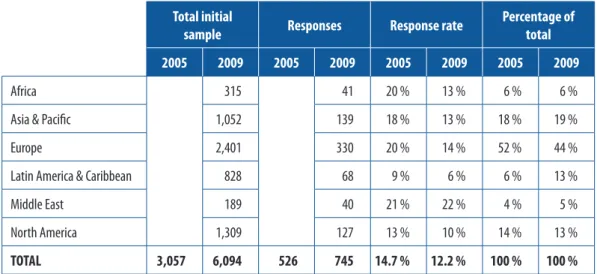
(4) http://rusc.uoc.edu. Internationalisation at Home in a Global Perspective…. so mainly for leisure purposes. In Australia and the United States, it takes considerably more effort to travel to a country with a different culture and language. The relative ease with which European students can travel does not particularly encourage them to become mobile for study-related purposes. Many of them feel that they have an international focus already through their travel to European countries. When they choose to study or do a placement abroad, many of them prefer to go beyond Europe. The 2005 survey already distinguished IaH as an alternative to internationalisation abroad. The 2009 survey uses the same distinction and therefore identifies activities “which focus on actions that entail or require the movement across boundaries (‘internationalization abroad’) and activities that focus on what takes place on campus (‘internationalization at home’)”. At the same time, the authors acknowledge that these distinctions are not watertight (Egron-Polak & Hudson, 2010: 34). An example may be short-term curricular activities abroad, such as study or field trips. The authors point to the increase of short-term mobility in the United States and attribute this to the fact that students have jobs from which they would lose income if they went abroad for an extended period of time. The question here is which concept of internationalisation of the curriculum the people selected to fill out the questionnaire for the Global Survey had in the back of their minds when they did so. Australians might well have included study and placement abroad as part of the curriculum, whereas the authors apparently only thought of short-term international experiences. A clarification of terms is called for if the Global Survey is to provide insight into what Higher Educations Institutions (HEIs) are doing to internationalise curricula and what their motivation is. In particular, it will be relevant to explore whether a distinction between the terms ‘Internationalisation at Home’ and ‘internationalisation of the curriculum’ can and should be made.. Methodology and Respondents to the Survey The Global Survey involves two categories of respondents from six different regions: Africa, Asia & Pacific, Europe, Latin America & Caribbean, Middle East and North America. The first category of respondents is HEIs. Europe is dominant here, with 44% (330 of 745 in absolute numbers). The second category is national rectors’ conferences or university associations (NUAs). Results from the survey are given at an aggregate (global) level and at regional level. HEIs and NUAs are identified as respondents. In the case of the 2005 survey, it is not mentioned to whom the HEI questionnaire was sent. In the section on the methodology of the 2009 survey, it is mentioned that the questionnaire was sent to Heads of Institution and/or Heads of International Affairs. Who actually filled it out within the universities remains unknown. Figure 1 shows a regional breakdown of the number of questionnaires sent out in relation to both the number of responses and the response rate. It also includes a breakdown of the responses per region as percentages of the total sample. This shows that European universities constitute nearly half the sample.. RUSC vol. 8 No 2 | Universitat Oberta de Catalunya | Barcelona, July 2011 | ISSN 1698-580X 252 CC. Jos Beelen.
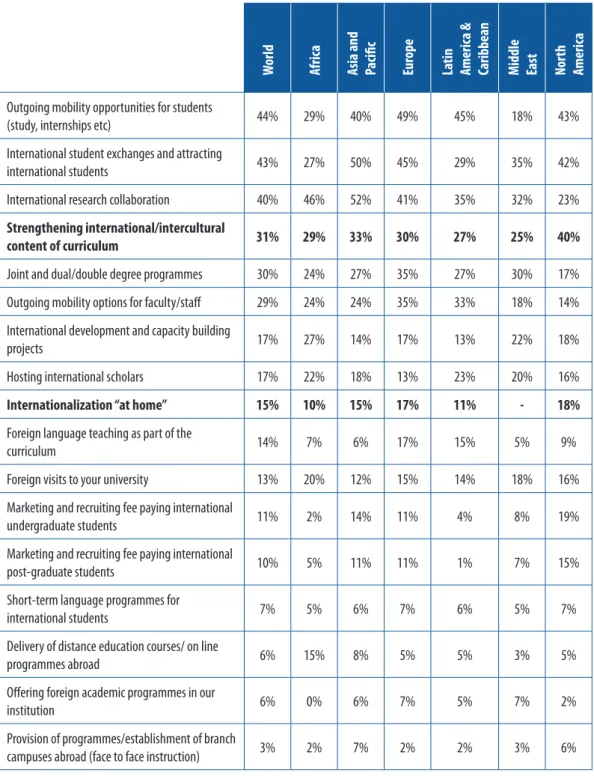
(5) http://rusc.uoc.edu. Internationalisation at Home in a Global Perspective…. Figure 1: Sample size and respondents of the 2nd and 3rd Global Survey. Total initial sample 2005. Percentage of total. 2005. 2009. 2005. 2009. 315. 41. 20 %. 13 %. 6%. 6%. Asia & Pacific. 1,052. 139. 18 %. 13 %. 18 %. 19 %. Europe. 2,401. 330. 20 %. 14 %. 52 %. 44 %. Latin America & Caribbean. 828. 68. 9%. 6%. 6%. 13 %. Middle East. 189. 40. 21 %. 22 %. 4%. 5%. 1,309. 127. 13 %. 10 %. 14 %. 13 %. 745. 14.7 %. 12.2 %. 100 %. 100 %. North America TOTAL. 3,057. 6,094. 2005. Response rate. 2009. Africa. 2009. Responses. 526. Source: Knight (2006: 36-37); Egron Polak & Hudson (2010: 42-43).. IaH/Internationalisation of the Curriculum in the 3rd Global Survey The institutional questionnaire mentions IaH as a response item twice, both times alongside internationalisation of the curriculum (questions 19 and 29, see Figures 2 and 3 below). Internationalisation of the curriculum is an item in two further questions (9 and 10, see Figures 4 and 5 below). The association questionnaire shows the same picture, with one extra question that lists both IaH and internationalisation of the curriculum among the response items. The scope of this article is limited to the institutional questionnaire, since there is a greater likelihood of it giving a more accurate impression of the state of affairs in the responding universities. Below, we will first give the outcomes to these four questions (both those that mention IaH and those that mention internationalisation of the curriculum), followed by a discussion. We will also look at a fifth question, that of the internal obstacles to the internationalisation process, as perceived by the institutional respondents (question 14, see Figure 6 below). Some of the questions are identical to those of the 2005 survey, but since the results of that survey are rendered differently and in less detail, it is not possible to compare the results of the two surveys. The response items in the figures below are those from the original questionnaire rather than the more concise response items in the figures of the survey report.. RUSC vol. 8 No 2 | Universitat Oberta de Catalunya | Barcelona, July 2011 | ISSN 1698-580X 253 CC. Jos Beelen.
(6) http://rusc.uoc.edu. Internationalisation at Home in a Global Perspective…. Policies for IaH Question 19. World. Africa. Asia and Pacific. Europe. Latin America & Caribbean. Middle East. North America. Figure 2: In your internationalization policy/strategy, which of the following are given the highest priority? (please select up to five responses).. Outgoing mobility opportunities for students (study, internships etc). 44%. 29%. 40%. 49%. 45%. 18%. 43%. International student exchanges and attracting international students. 43%. 27%. 50%. 45%. 29%. 35%. 42%. International research collaboration. 40%. 46%. 52%. 41%. 35%. 32%. 23%. Strengthening international/intercultural content of curriculum. 31%. 29%. 33%. 30%. 27%. 25%. 40%. Joint and dual/double degree programmes. 30%. 24%. 27%. 35%. 27%. 30%. 17%. Outgoing mobility options for faculty/staff. 29%. 24%. 24%. 35%. 33%. 18%. 14%. International development and capacity building projects. 17%. 27%. 14%. 17%. 13%. 22%. 18%. Hosting international scholars. 17%. 22%. 18%. 13%. 23%. 20%. 16%. Internationalization “at home”. 15%. 10%. 15%. 17%. 11%. -. 18%. Foreign language teaching as part of the curriculum. 14%. 7%. 6%. 17%. 15%. 5%. 9%. Foreign visits to your university. 13%. 20%. 12%. 15%. 14%. 18%. 16%. Marketing and recruiting fee paying international undergraduate students. 11%. 2%. 14%. 11%. 4%. 8%. 19%. Marketing and recruiting fee paying international post-graduate students. 10%. 5%. 11%. 11%. 1%. 7%. 15%. Short-term language programmes for international students. 7%. 5%. 6%. 7%. 6%. 5%. 7%. Delivery of distance education courses/ on line programmes abroad. 6%. 15%. 8%. 5%. 5%. 3%. 5%. Offering foreign academic programmes in our institution. 6%. 0%. 6%. 7%. 5%. 7%. 2%. Provision of programmes/establishment of branch campuses abroad (face to face instruction). 3%. 2%. 7%. 2%. 2%. 3%. 6%. Source: Egron-Polak & Hudson (2010: 91-92; Fig. I.D.7: 214).. RUSC vol. 8 No 2 | Universitat Oberta de Catalunya | Barcelona, July 2011 | ISSN 1698-580X 254 CC. Jos Beelen.
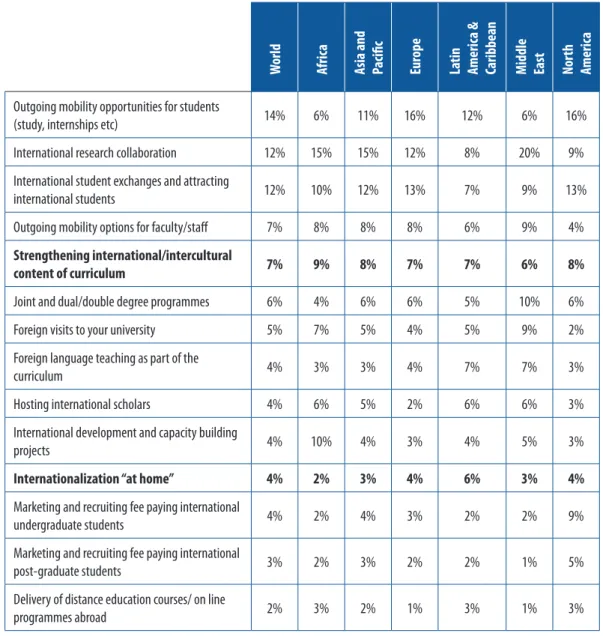
(7) http://rusc.uoc.edu. Internationalisation at Home in a Global Perspective…. Discussion Figure 2 shows that this question has both international/intercultural content of the curriculum and IaH as response items. It is unclear what the connection is and on what basis the two different items have been distinguished. Both items score considerably higher (31% and 15% worldwide) as aspects of policy than as aspects of practice (7% and 4% worldwide, see Figure 3 below).. Activities for IaH Question 29. World. Africa. Asia and Pacific. Europe. Latin America & Caribbean. Middle East. North America. Figure 3: Amongst the following internationalization activities, which five receive the most attention and resources at your institution?. Outgoing mobility opportunities for students (study, internships etc). 14%. 6%. 11%. 16%. 12%. 6%. 16%. International research collaboration. 12%. 15%. 15%. 12%. 8%. 20%. 9%. International student exchanges and attracting international students. 12%. 10%. 12%. 13%. 7%. 9%. 13%. Outgoing mobility options for faculty/staff. 7%. 8%. 8%. 8%. 6%. 9%. 4%. Strengthening international/intercultural content of curriculum. 7%. 9%. 8%. 7%. 7%. 6%. 8%. Joint and dual/double degree programmes. 6%. 4%. 6%. 6%. 5%. 10%. 6%. Foreign visits to your university. 5%. 7%. 5%. 4%. 5%. 9%. 2%. Foreign language teaching as part of the curriculum. 4%. 3%. 3%. 4%. 7%. 7%. 3%. Hosting international scholars. 4%. 6%. 5%. 2%. 6%. 6%. 3%. International development and capacity building projects. 4%. 10%. 4%. 3%. 4%. 5%. 3%. Internationalization “at home”. 4%. 2%. 3%. 4%. 6%. 3%. 4%. Marketing and recruiting fee paying international undergraduate students. 4%. 2%. 4%. 3%. 2%. 2%. 9%. Marketing and recruiting fee paying international post-graduate students. 3%. 2%. 3%. 2%. 2%. 1%. 5%. Delivery of distance education courses/ on line programmes abroad. 2%. 3%. 2%. 1%. 3%. 1%. 3%. RUSC vol. 8 No 2 | Universitat Oberta de Catalunya | Barcelona, July 2011 | ISSN 1698-580X 255 CC. Jos Beelen.
(8) Africa. Asia and Pacific. Europe. Latin America & Caribbean. Middle East. North America. Internationalisation at Home in a Global Perspective…. World. http://rusc.uoc.edu. Offering foreign academic programmes in our institution. 2%. 1%. 2%. 2%. 3%. 2%. -. Short-term language programmes for international students. 2%. 2%. 2%. 1%. 3%. 2%. 2%. Provision of programmes/establishment of branch campuses abroad (face to face instruction). 1%. -. 1%. 1%. -. 2%. 2%. Source: Egron-Polak & Hudson (2010: 97-98; Fig. I.D.11: 217).. Discussion At world level, activities that receive institutional attention and resources include strengthening the international/intercultural content of the curriculum and IaH, both of which rank fairly low (7% and 4%, respectively). International/intercultural content of the curriculum comes in third place worldwide, scoring even lower in North America (fourth) and Europe (fifth). The authors see the desire to strengthen the international content of the curriculum as “an especially positive sign, since internationalisation at home was ranked at about the mid-point in the list of activities receiving attention and resources”. They notice “contradictory results” which they attribute to the “relative novelty of the terminology, or concept, of ‘internationalisation at home’ at many HEIs, where related activities are actually taking place” (Egron-Polak & Hudson, 2010: 96). In the regional overview of activities with the highest priority, HEIs in Africa assign third place to “strengthening the international/intercultural content of the curriculum”. North American HEIs give fourth place to this item. In the other regions, this item comes in third or fourth. The authors of the survey explain this low position on the European priority list by commenting on the fact that many European universities have already embarked on activities to internationalise their curricula and therefore assign less importance to it. At the same time, other universities would assign less importance to internationalisation of the curriculum because they are not yet ready to embark on the process (Egron-Polak & Hudson, 2010: 175). The former statement fails to explain why European universities would assign a low importance to their own policies once they have started to implement them. After all, European universities have been developing activities for student mobility for a considerable number of years and still assign a high importance to them. The latter statement contains considerable truth. The Global Survey does not distinguish sub regions within Europe. It is, however, clear from other sources that a focus on internationalisation of the curriculum is strong in counties in north-western Europe: The Netherlands, Denmark, Finland, Norway and Sweden. Whereas interest in international aspects seems to be growing in the United Kingdom, many universities in eastern-central Europe and southern Europe are not particularly active when it comes to internationalising their home curricula. RUSC vol. 8 No 2 | Universitat Oberta de Catalunya | Barcelona, July 2011 | ISSN 1698-580X 256 CC. Jos Beelen.
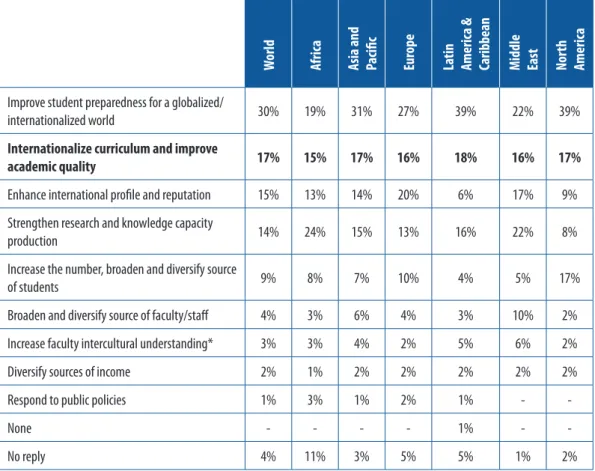
(9) http://rusc.uoc.edu. Internationalisation at Home in a Global Perspective…. This raises the question about the usefulness of distinguishing between IaH and internationalisation of the curriculum when the activities are clearly related. A further table in the survey report sheds light on the situation in Australia and New Zealand. The focus on internationalisation of the curriculum is quite strong, with 67% of HEIs including it among their priority activities, along with 22% that include IaH (Egron-Polak & Hudson, 2010: 167). The authors of the survey do not explain the relationship between these categories. It is therefore not clear if the 67% referring to internationalisation of the curriculum includes aspects of outgoing mobility, whereas the 22% refers to activities that take place exclusively at the home institution.. Rationales for Internationalisation (of the Curriculum) Question 9. World. Africa. Asia and Pacific. Europe. Latin America & Caribbean. Middle East. North America. Figure 4: What are the three most important rationales for internationalization at your institution?. Improve student preparedness for a globalized/ internationalized world. 30%. 19%. 31%. 27%. 39%. 22%. 39%. Internationalize curriculum and improve academic quality. 17%. 15%. 17%. 16%. 18%. 16%. 17%. Enhance international profile and reputation. 15%. 13%. 14%. 20%. 6%. 17%. 9%. Strengthen research and knowledge capacity production. 14%. 24%. 15%. 13%. 16%. 22%. 8%. Increase the number, broaden and diversify source of students. 9%. 8%. 7%. 10%. 4%. 5%. 17%. Broaden and diversify source of faculty/staff. 4%. 3%. 6%. 4%. 3%. 10%. 2%. Increase faculty intercultural understanding*. 3%. 3%. 4%. 2%. 5%. 6%. 2%. Diversify sources of income. 2%. 1%. 2%. 2%. 2%. 2%. 2%. Respond to public policies. 1%. 3%. 1%. 2%. 1%. -. -. -. -. -. -. 1%. -. -. 4%. 11%. 3%. 5%. 5%. 1%. 2%. None No reply. Source: Egron-Polak & Hudson (2010: 64; Fig. I.B.7: 210). * This is the response item found in the original questionnaire (p. 210, question 9). The response item in figure I.B.7 reads: “Increase faculty international knowledge”.. RUSC vol. 8 No 2 | Universitat Oberta de Catalunya | Barcelona, July 2011 | ISSN 1698-580X 257 CC. Jos Beelen.
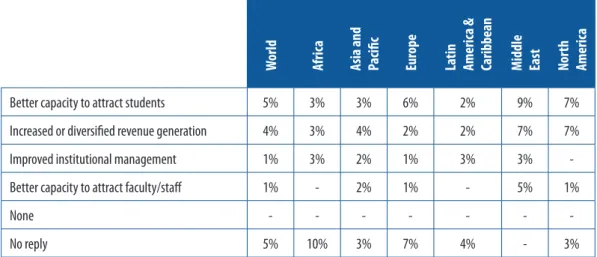
(10) http://rusc.uoc.edu. Internationalisation at Home in a Global Perspective…. Discussion At a global level, improving student preparedness (the full item in the questionnaire reads: “Improve student preparedness for a globalized/internationalized world”) is identified as the most important rationale for internationalisation. Thirty per cent of HEIs rate it among their main rationales. It is also the first rationale in the regions, except in Africa. Internationalisation of the curriculum occupies second place in the overview of rationales worldwide, with 17% of HEIs identifying it as a main rationale. In the breakdown by region, it also comes in second place in Asia & Pacific, Latin America & Caribbean and North America, whereas it comes in third place in Africa, Europe and the Middle East. The authors do not comment on a relationship between student preparedness and the curriculum. It therefore remains unclear if they consider internationalisation of the curriculum as a tool for improving student preparedness. They apparently associate traditional means such as outgoing mobility with preparing students, since they remark that “an international experience as part of a study programme is perhaps one of the best ways to become ‘prepared’ for a globalized world”. NUAs perceive that student preparation is the main rationale for their members’ pursuing internationalisation (26%) and that internationalisation of the curriculum belongs to the top four rationales (15%) (Egron-Polak & Hudson, 2010: 64, Fig. I.B.7). The mention of internationalisation of the curriculum in this context may therefore primarily be made in relation to the quality of the curriculum and not in relation to the extent to which it contributes to the development of students’ international and intercultural competences.. Benefits of Internationalisation Question 10. World. Africa. Asia and Pacific. Europe. Latin America & Caribbean. Middle East. North America. Figure 5: What are the most significant benefits of internationalization to your institution (please rank top three, where 1 = most significant)?. Increased international awareness of students. 24%. 15%. 20%. 23%. 30%. 18%. 33%. Strengthened research and knowledge production. 16%. 24%. 20%. 14%. 18%. 21%. 9%. Enhanced international cooperation and solidarity. 12%. 15%. 11%. 14%. 10%. 15%. 8%. Enhanced internationalization of curriculum. 11%. 7%. 12%. 11%. 9%. 7%. 17%. Enhanced prestige/profile for the institution. 10%. 11%. 11%. 12%. 10%. 9%. 7%. Increased international orientation of faculty/staff. 10%. 9%. 12%. 9%. 10%. 7%. 9%. RUSC vol. 8 No 2 | Universitat Oberta de Catalunya | Barcelona, July 2011 | ISSN 1698-580X 258 CC. Jos Beelen.
(11) Africa. Asia and Pacific. Europe. Latin America & Caribbean. Middle East. North America. Internationalisation at Home in a Global Perspective…. World. http://rusc.uoc.edu. Better capacity to attract students. 5%. 3%. 3%. 6%. 2%. 9%. 7%. Increased or diversified revenue generation. 4%. 3%. 4%. 2%. 2%. 7%. 7%. Improved institutional management. 1%. 3%. 2%. 1%. 3%. 3%. -. Better capacity to attract faculty/staff. 1%. -. 2%. 1%. -. 5%. 1%. -. -. -. -. -. -. -. 5%. 10%. 3%. 7%. 4%. -. 3%. None No reply. Source: Egron-Polak & Hudson (2010: 67; Fig. I.B.10: 211).. Discussion Students’ increased international awareness comes out as the overall main benefit of internationalisation. This is reflected by the scores in the individual regions, with the exception of Africa and the Middle East. “Enhanced internationalization of the curriculum” is an item in the same table and comes in second place in Asia & Pacific and North America. The connection between the two items is not explained nor is it clear how awareness relates to measurable or assessable competences or professional behaviour. The scores for North America are remarkable in the sense that the region scores highest both on increased international awareness (33%) and enhanced internationalisation of the curriculum (17%). The respondents might have seen a connection between the two items that can become apparent when additional questions will be asked.. Global and Regional Barriers and Obstacles to Internationalisation Question 14. World. Africa. Asia and Pacific. Europe. Latin America & Caribbean. Middle East. North America. Figure 6: Which of the following are the three most important internal obstacles to advancing internationalization at your institution?. Insufficient financial resources. 27%. 29%. 24%. 25%. 29%. 31%. 32%. Limited faculty interest and involvement. 11%. 11%. 11%. 13%. 9%. 10%. 8%. Limited expertise of staff and/or lack of foreign language proficiency. 11%. 11%. 12%. 11%. 12%. 11%. 6%. RUSC vol. 8 No 2 | Universitat Oberta de Catalunya | Barcelona, July 2011 | ISSN 1698-580X 259 CC. Jos Beelen.
(12) Africa. Asia and Pacific. Europe. Latin America & Caribbean. Middle East. North America. Internationalisation at Home in a Global Perspective…. World. http://rusc.uoc.edu. Administrative inertia, bureaucratic difficulties and/ or lack of institutional policies and procedures. 8%. 8%. 6%. 10%. 8%. 9%. 8%. Too rigorous/inflexible curriculum to participate in internationally focused programmes, including mobility.. 8%. 7%. 9%. 9%. 9%. 4%. 6%. Absence of strategy/plan to guide the process. 7%. 12%. 9%. 4%. 8%. 8%. 9%. Limited student interest. 6%. 4%. 6%. 6%. 5%. 12%. 13%. International engagement nor recognized for promotion or tenure. 5%. 2%. 4%. 6%. 3%. 4%. 11%. Lack of organizational structure/office responsible for internationalization. 5%. 3%. 8%. 3%. 7%. 12%. 3%. Limited institutional leadership/vision. 2%. 3%. 3%. 1%. 2%. -. 4%. No reply. 10%. 10%. 7%. 12%. 9%. 1%. 11%. Source: Egron-Polak & Hudson (2010: 81; Fig. I.BC.6: 212).. Discussion Insufficient financial resources come out as the main internal obstacle on a global level, as well as in all the regions. This contrasts with the results of the 2005 survey. It does not become clear to what extent the lack of financial resources is connected with internationalisation of the curriculum. The authors do not mention this aspect and limit their analysis to funding for travel, scholarships, research partnerships and development of new services. On an aggregate level “limited faculty interest” and “limited experience and expertise of staff and/or lack of foreign language proficiency” rank “fairly high” among the internal obstacles to internationalisation in the opinion of HEIs (Egron-Polak & Hudson, 2010: 23). They share second and third place with 11% each. This seems to support the view that the involvement of academic staff in the internationalisation process leaves much to be desired. However, it should be remembered that the invitations to fill out the questionnaires were sent to Heads of Institution and/or Heads of International Affairs (Egron-Polak & Hudson, 2010: 42). The results therefore represent the views of these people and not those of academic staff themselves. It would be interesting to pursue this question with academic staff as respondents. From the survey, it is not clear to what this experience or expertise refers exactly. Outgoing mobility requires little expertise from teaching staff. After all, the students’ learning takes place outside the institution and it is mostly the staff of the international office that arranges study abroad. It must therefore be assumed that lacking experience and expertise is in some way connected with internationalisation of the home curriculum and the implementation of an international dimension into the teaching and learning process. RUSC vol. 8 No 2 | Universitat Oberta de Catalunya | Barcelona, July 2011 | ISSN 1698-580X 260 CC. Jos Beelen.
(13) http://rusc.uoc.edu. Internationalisation at Home in a Global Perspective…. The authors of the survey consider the lack of interest of academic staff “worrisome” and mention that institutions “need to focus far more on mobilizing, training and providing support to faculty members and staff to build up ‘internationalization knowledge and readiness’ if they are to reach their internationalization goals” (Egron-Polak & Hudson, 2010: 77-78). It would seem useful to look further into the issue of how ‘internationalisation knowledge’ can be defined and what support could be offered to increase it. The authors see a role for NUAs to mobilise and engage faculty members (p. 149). They do not comment on a relationship between the lack of engagement and limited experience of staff, but it would seem worthwhile to examine whether such a relationship could be made. Leask and Beelen (2010) discuss this relationship. Childress (2010) demonstrates in her case studies that successful engagement of academic staff is the result of a longterm and well supported institutional policy. The Global Survey distinguishes the lack of foreign language proficiency of teaching staff as both an external and an internal obstacle to advancing internationalisation, in combination with the staff’s experience and expertise (Egron-Polak & Hudson, 2010: 225, questions 12 and 13). This combined obstacle scores second/third place worldwide as an internal obstacle, at the same level as “limited faculty interest”. It comes in second place in Asia & Pacific and Latin America & Caribbean, and third place in Africa, Europe and the Middle-East. In North America, it ranks quite low (see Figure 6). In the overview of external obstacles, this element is apparently not considered relevant, since it does not appear in it. It does not become clear what the perceived lack of foreign language proficiency really means. This is firstly because it is combined with another issue. Secondly, it remains unclear where the lack of proficiency is mostly felt. Is it in research or in the teaching and learning process? Foreign language proficiency is a relevant issue in situations where teaching staff or students – or both – use their second language in a learning environment. Even if both students and teaching staff have the required proficiency, this does not mean that an international classroom will be effective. Teaching staff will also need skills in teaching methodology in a second language. In other words, they will need to apply their second language in content-related contexts. At the same time, they will need to focus on the role of language in the learning process of the students. It would seem useful to distinguish between foreign language proficiency on the one hand, and the skills to teach in a foreign language on the other.. Conclusions The Global Survey confirms the relevance of internationalisation of the curriculum as one of the two ‘pillars’ of internationalisation. This is a worldwide phenomenon, although there are some significant regional differences. However, the Global Survey does not enable us to form a clear picture of the state of internationalisation of the curriculum. This is because terminology is not always clear and several issues are combined in one response item. In order to focus more clearly on the trends in internationalising curricula, terminology needs to be clarified. The overwhelming focus of HEIs is on preparing students for a globalised world. At the same time, it has become apparent that this RUSC vol. 8 No 2 | Universitat Oberta de Catalunya | Barcelona, July 2011 | ISSN 1698-580X 261 CC. Jos Beelen.
(14) http://rusc.uoc.edu. Internationalisation at Home in a Global Perspective…. aim will not be achieved through traditional outgoing mobility, which will continue to be a tool for a small minority of students. When every graduate needs to have intercultural and international competences, only the home curriculum can provide these. It therefore needs to be clarified what the role of the curriculum is as a tool for achieving this. In order to do this, a more detailed look at the relevant issues from the Global Survey is necessary from the perspective of internationalisation of the curriculum. The following issues can be distinguished: 1. The terms ‘Internationalisation at Home’ and ‘internationalisation of the curriculum’ seem to overlap. In order to adequately distinguish trends, the terminology needs to be clarified and the relationship between the two concepts explained to enable focused questions. 2. When an internationalised curriculum is seen as proof of quality rather than as a tool for teaching and learning, the image becomes blurred. These two aspects should therefore be separated in future questionnaires. 3. Further light also needs to be shed on the exact nature of the lack of involvement of academic staff and how this may relate to the perceived lack of experience and expertise. Does this lack of expertise relate to the inclusion of an international dimension into learning environments for students? If so, what kind of support would academic staff need to facilitate this process for them? What expertise do academic staff lack when it comes to implementing an international/ intercultural dimension into the home curriculum? What do academic staff define as their needs for training and support? In order to get a clearer image of the possible causes of the lack of involvement of academic staff, it is necessary to link this to a number of underlying issues. These include the required skills for building an international dimension into the home curriculum, general foreign language proficiency, skills for teaching in a second language and/or teaching learners who use their second language. Each of these issues calls for specific questions in relation to the involvement of academic staff. 4. More specific questions need to be asked about foreign language proficiency to determine how exactly the lack of language proficiency hampers the internationalisation process. Is this lack related to research and is it about accessing literature in a foreign language? Or is it related to communication with colleagues and students from abroad or – again – to teaching in a second language? 5. The 2005 survey assigned a far more important place to the lack of expertise than the 2009 survey, which shows a lack of financial resources as the main obstacle. It seems unlikely that the expertise of academic staff has increased considerably over the last five years. So how can this shift be explained? Another question is if the perceived lack of financial resources is as relevant to internationalisation of the curriculum as it is for setting up other forms of internationalisation. After all, internationalisation of the curriculum is a fairly cost effective form of internationalisation because it focuses on the restructuring and development of learning environments at the home institute. Academic staff tend to indicate that considerable funding is essential for internationalisation of the curriculum since it requires many hours of dedication. But academic staff did not fill out the questionnaires. The question is if those RUSC vol. 8 No 2 | Universitat Oberta de Catalunya | Barcelona, July 2011 | ISSN 1698-580X 262 CC. Jos Beelen.
(15) http://rusc.uoc.edu. Internationalisation at Home in a Global Perspective…. who did so indicated the lack of finance on the basis of what teaching staff told them, or on the basis of their own roles in the internationalisation process, which tend to focus more on traditional forms of internationalisation. Questions linking the lack of financial resources to curriculum development may provide relevant insights into this issue.. References BEELEN, J. (ed.). (2007). Implementing Internationalisation at Home. Amsterdam: EAIE. CHILDRESS, L.K. (2010). The Twenty-First Century University: Developing Faculty Engagement in Internationalization. New York: Peter Lang Publishing Group. CROWTHER, P. et al. (2001). Internationalisation at Home: A Position Paper. Amsterdam: EAIE. DE WIT, H. (ed.). (2009). Measuring Success in the Internationalisation of Higher Education (EAIE Occasional Paper 22). Amsterdam: EAIE. DUTSCHKE, D. (2009). “Campus Internationalization Initiatives and Study Abroad”. AACRAO-College & University. Vol. 84, No 3, pages 67-73. EGRON-POLAK, E.; HUDSON, R. (2010). Internationalization of Higher Education: Global trends, regional perspectives (IAU 3rd Global Survey report). Paris: IAU. KNIGHT, J. (2006). Internationalization of higher education: New directions, new challenges (IAU 2nd Global Survey report). Paris: IAU. KNIGHT, J. (2008). Higher Education in Turmoil: The Changing World of Internationalization. Rotterdam: Sense. LEASK, B. (2007). “Internationalisation of the Curriculum in Australia”. In: J. BEELEN (ed.), Implementing Internationalisation at Home. Amsterdam: EAIE. Pages 6-7. LEASK, B.; BEELEN, J. (2010). “Enhancing the Engagement of Academic Staff in International Education”. In: Proceedings of a Joint IEAA-EAIE Symposium. Melbourne: International Education Association of Australia. Pages 28-40.. RUSC vol. 8 No 2 | Universitat Oberta de Catalunya | Barcelona, July 2011 | ISSN 1698-580X 263 CC. Jos Beelen.
(16) http://rusc.uoc.edu. Internationalisation at Home in a Global Perspective…. About the Author Jos Beelen [email protected] Researcher and Consultant on Internationalisation of the Curriculum, School of Economics and Management, Hogeschool van Amsterdam, University of Applied Sciences Jos Beelen is a researcher and consultant on internationalisation of the curriculum at the School of Economics and Management at Hogeschool van Amsterdam, University of Applied Sciences. He is the chair of the Special Interest Group ‘Internationalisation at Home’ of the European Association for International Education (EAIE) and visiting fellow at the Centre for Academic Practice and Research in Internationalisation (CAPRI) at Leeds Metropolitan University. He has delivered lectures and facilitated training courses on internationalisation of higher education curricula in Europe, South Africa, Hong Kong, Australia and the United States. School of Economics and Management Hogeschool van Amsterdam University of Applied Sciences PO Box 1025 1000 BA The Netherlands. The texts published in this journal are – unless indicated otherwise – covered by the Creative Commons Spain Attribution 3.0 licence. You may copy, distribute, transmit and adapt the work, provided you attribute it (authorship, journal name, publisher) in the manner specified by the author(s) or licensor(s). The full text of the licence can be consulted here: http://creativecommons.org/licenses/by/3.0/es/deed.en.. RUSC vol. 8 No 2 | Universitat Oberta de Catalunya | Barcelona, July 2011 | ISSN 1698-580X 264 CC. Jos Beelen.
(17)
Figure
+3

Documento similar
The very large European Language Proficiency Survey (Coleman, 1996a) found that patterns varied according to the L2 of 4,200 UK students who had completed a period of compulsory
In the preparation of this report, the Venice Commission has relied on the comments of its rapporteurs; its recently adopted Report on Respect for Democracy, Human Rights and the Rule
The assessment of the value of the filtration process was assayed for the nanoformulation and, although the results showed no significant changes in the particle size when using
Enlargement of the Demand Management notion to all kind of water uses including the water requirements for food demand. Optimization of all water uses including
In the European Community Respiratory Health Survey (ECRHS), in a previous analysis the assessment of the association between home outdoor NO2 (as a surrogate of traffic) and
the lack of support and guidance for professional and work development is the one issue on the working conditions of the staff where there is more room for improvement,
In the “big picture” perspective of the recent years that we have described in Brazil, Spain, Portugal and Puerto Rico there are some similarities and important differences,
Distribution of the Answers in the Pre-MOOC survey regarding Participants Perspective if the challenges for Sustainable Development are of Ecological Nature.. Distribution
