
N, N Dimethyl Amine Linked To Triphenylamine (TPA): A Promising Co Donor Moiety In Organic Dyes And Their Push Pull Behavior
9
0
0
Texto completo
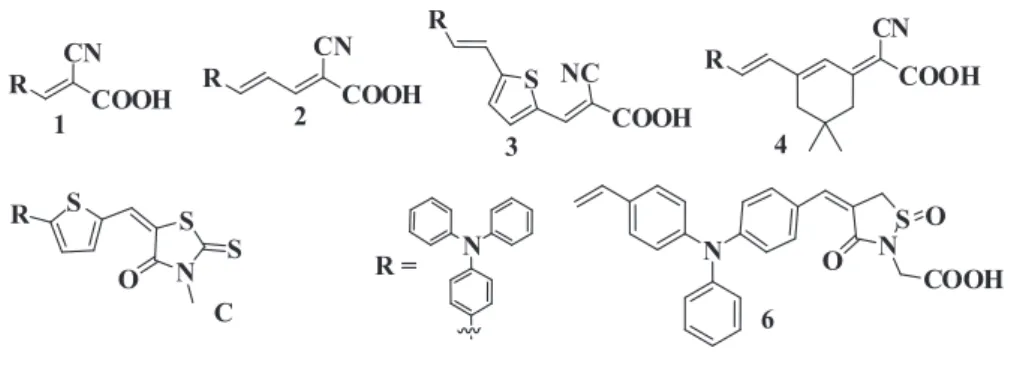
(2) Revista Revista de de Ciencias Ciencias. A. Ortiz, W. A. Arcos and B.yInsuasty E. Vallejo L. Cruz. Figure 1. Chemical Structure of several organic dyes based in TPA (1-6).. Fullerene C60 and their derivatives, however, exhibit a number of diverse electronic and photophysical properties, which have been investigated for application in new molecular electronic devices. Fullerenes are good acceptors in the excited state, various electron-donor units attached to this molecule, are expected to photoinduced intramolecular charge transfer [9]. 2. Methodology and experimental procedure. Commercially available starting materials, reagents and solvents were used as supplied. Solvents used in photochemical measurements were of spectroscopic grade. TLC analysis were performed on Merck TLC plates silica gel 60 F254, melting points were determined in a Buchi Melting Point Apparatus and were uncorrected. The 1H and 13C NMR spectra were run on a Bruker AVANCE 400 spectrometer operating at 400 MHz and 100 MHz respectively, using chloroform-d as solvent and tetramethylsilane as internal standard. The mass spectra were scanned on a Shimadzu MS-QP 2010 spectrometer operating at 70 eV. UV-vis spectra were recorded in a Shimadzu 1700 spectrometer. Electrochemical measurements were performed on an auto-lab PGStat 30 equipment using a threeelectrode configuration system. The measurements were carried out using a CH2Cl2 solution of 0.1 M in tetra-butyl ammonium perchlorate as supporting electrolyte. A glassy carbon electrode (3 mm diameter) was used as the working electrode, and a platinum wire and an Ag/AgNO3 electrode were employed as the counter and the reference electrodes, respectively. The surface of the working electrode was polished with commercial alumina prior to use. Solutions were deaerated by bubbling argon for a few minutes prior to each voltammetry measurement. Unless otherwise specified the scan rate was 100 mVs-1, the Fc/Fc+ system was used as internal standard.. 58.
(3) Comportamiento agresivo entre polluelos de Pelecanus occidentales murphyi (aves: pelecanidae) New Co of TPA.... 2.1 Preparation of (E)-4-((4-(4-(dimethyl amine)styryl)phenyl)(phenyl)amino) benzaldehyd (9). In a 25 mL two-necked flask, 248 mg (0.82 mmol) of 4,4´-di-formyl tri-phenyl amine 8 and 308 mg of t-BuOK were weighed and then, were dissolved in dry THF (5.0 mL), the reaction mixture was heated at 81 oC under argon atmosphere for 10 minutes. After that, 149 mg (0.55 mmol) of phosphonate of N,N-dimethyl amine benzyl 7 were dissolved in dry THF and were added to the reaction mixture via syringe dropwise over a period of 30 min. The reaction was allowed to warm for 8 hours, After removal of the solvents under reduced pressure, the residue was purified by column chromatography (silica gel, dichloromethane) to afford 9 as a yellow oil, 57% yield. H -NMR (400 MHz, CDCl3) δ: 9.85 (s, 1H), 7.72 (d, Jo=8.0 Hz, 2H), 7.46 (m, 4H), 7.38 (d, J=8.0 Hz, 2H), 7.22 (m, 3H), 7.15 (d, J=8.0 Hz, 2H), 7.09 (d, J=8.0 Hz, 2H), 7.05 (d, J=16.0 Hz, 1H), 6.92 (d, J=16.0 Hz, 1H), 6.76 (d, J=8.0 Hz, 2H), 3.03 (s, 6H) ppm; 13 C -NMR (100 MHz, CDCl3) δ: 190.5, 153.3, 150.2, 146.1, 144.6, 135.2, 131.4, 129.8, 129.1, 128.8, 127.6, 127.2, 126.3, 125.7, 125.1, 123.4, 119.6, 112.5, 77.4, 77.1, 76.8, 40.5, 29.8 ppm; FT-IR (KBr). υ(cm-1) = 3418, 2922, 2852, 1726, 1690, 1602, 1586, 1522, 1503, 1488, 1356, 1325, 1283, 1219, 1189, 1160, 1056,. MS-EI: m/z 418 [M]+. 1. 2.2 Preparation of Dye Co-D-Ac In a 10 mL round bottom flask, 53 mg (0.127 mmol) of 9 with 21.6 mg (0.253 mmol) of cyano-acetic acid 10, were dissolved in 5.0 mL of acetonitrile and allowed to reflux by addition drop to drop 1.0 mL of pyridine, the reaction mixture was heated for 5h. When the reaction finished, the reactants were filtered and the precipitate was washed with hexane and ethyl ether to obtain an orange solid, 98% of yield. 1H -NMR (400 MHz, DMSO-d6) δ: 7.85 (s, 1H), 7.78 (d, J = 8.0 Hz, 2H), 7.52 (d, J = 8.0 Hz, 2H), 7.40 (m, 4H), 7.19-7.13 (m, 3H), 7.09-7.05 (m, 3H), 6.97-6.93 (m, 3H), 6.72 (d, J = 8.0 Hz, 2H), 2.93 (s, 6H) ppm; 13C -NMR (100 MHz, DMSO-d6) δ: 130.9, 129.8, 127.4, 127.1, 125.4, 125.3, 112.3, 54.9, 40.1, 39.9, 39.7, 39.5, 39.3, 39.0, 38.8, 24.7 ppm; FTIR (KBr). υ(cm-1) = 3449, 2922, 2851, 2212, 1602, 1584, 1524, 1504, 1488, 1415, 1387, 1359, 1326, 1286, 1220, 1178, 1059, 1021,. MS-EI: m/z 485 [M]+. 2.3 Preparation of Dye Co-D-C60 In a 50 mL two-necked flask, 138 mg (0.19 mmol) of fullerene C60 in 10.0 mL of chloro-benzene was dissolved by sonication. Then 54 mg (0.29 mmol) of N-octylglycine and 40 mg (0.10 mmol) of 9 were added. The reaction mixture was heated to reflux with a Dean-Stark tramp for 8 h. After the solvent was evaporated under reduced pressure, the reaction crude was purified by column chromatography (silica gel, hexane:CS2, 2:1), to afford a brown solid, 25% yield. 1H -NMR (400 MHz, CDCl3) δ: 7.73-7.41(m, 2H), 7.29 (d, J = 12.0 Hz, 2H), 7.24 (d, J = 8.0 Hz, 2H), 7.16- 7.09 (m, 3H), 7.04 (d, J = 8.0 Hz, 2H), 6.96-6.93 (m, 2H), 6.91-6.88 (m, 2H), 6.85 (d, J = 16.0 Hz, 1H), 6.76 (d, J = 16.0 Hz, 1H), 6.63 (d, J = 12.0 Hz, 2H), 5.01 (d, J = 8.0 Hz, 1H), 4.95 (s, 1H), 4.04 (d, J = 8.0 Hz, 1H),. Volumen 17 - Especial Química, 2013. 59.
(4) Revista de Ciencias. A. Ortiz, W. A. Arcos E. Vallejo and B.yInsuasty L. Cruz. 2.89 (s, 6H), 1.49-1.18 (m, 14H), 0.84 (t, J = 16.0 Hz, 3H) ppm; 13C -NMR (100 MHz, CDCl3) δ: 154.3, 154.0, 153.7, 147.8, 147.5, 147.4, 147.0, 146.6, 146.5, 146.3, 146.2, 146.1, 146.0, 145.8, 145.6, 145.5, 145.4, 145.3, 145.2, 144.8, 144.4, 143.2, 143.0, 142.7, 142.6, 142.4, 142.3, 142.2, 142.1, 141.8, 141.7, 141.6, 140.2, 140.1, 139.2, 139.2, 136.8, 136.7, 136.5, 136.4, 135.9, 135.8, 132.9, 131.7, 129.3, 128.3, 127.6, 127.4, 126.9, 126.1, 124.2, 123.9, 122.9, 112.6, 82.1, 77.4, 77.1, 76.7, 68.9, 66.9, 40.6, 32.0, 29.8, 29.4, 28.5, 27.7, 22.8, 14.3 ppm; FTIR (KBr). υ(cm-1) = 3423, 2920, 2850, 2791, 1603, 1519, 1503, 1459, 1353, 1314, 1275, 1216, 1167, 1114, 1066, 1021, 952, 819, 798, 752, 694, 616, 597, 576, 545, 524, 453, 423, 402. 3.. Results and discussion. We first explored the synthesis of compounds Co-D-Ac and Co-D-C60 by a routine procedure in a multistep methodology (Scheme 1).. N. Scheme 1. Synthesis of compounds Co-D-Ac and Co-D-C60.. Initially, we synthesized the codonor-donor unit by a Horner-Wadsworth-Emmons reaction, using phosphonate of N,N-dimethylaminebenzyl 7 and t-BuOK as base to generate the nucleophile specie, which subsequently reacted under stoichiometric control with 4,4’-diformyltriphenylamine 8 in a ratio of 1:1.5 respectively; the yellow oil obtained 9 was fully characterized by spectroscopy methods. The 1H NMR of 9 showed the characteristic signals of the vinyl protons at δ = 7.38 and 6.92 ppm as doublets and J = 16.0 Hz, which is distinctive for E configuration around the double ´ bond and the signal ´ of the formyl proton at 9.85 ppm; the other signals of this experiment, the 13C NMR data and mass spectrometry confirmed the molecular structure of 9. Our next target became the preparation of the electroactive dyes Co-D-Ac and Co-D-C60; for this purpose we used the (E)-4-((4-(4-(dimethyl amine) styryl)phenyl)(phenyl)amino)benzaldehyde 9 as starting material.. 60.
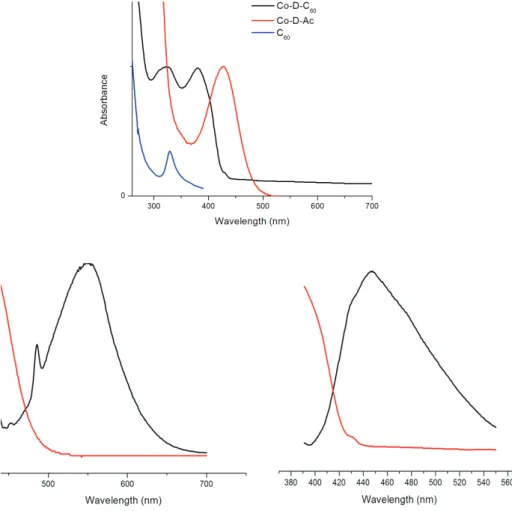
(5) Comportamiento agresivo entre polluelos de Pelecanus occidentales murphyi (aves: pelecanidae) New Co of TPA.... In the subsequent step, the dye Co-D-Ac was prepared by a Knoevenagel condensation reaction using 9 and cyanoacetic acid 10 in acetonitrile as solvent and pyridine as catalyst, to obtain an orange solid in good yield, this solid showed a band at 2212 cm-1 in the IR spectrum due to stretching vibration of de cyano group, in the 1H NMR can be observed the vinyl protons with E configuration at δ = 7.52 and 6.72 ppm, additionally the signal of the vinyl proton formed in the reaction is observed at δ = 7.85 ppm. With the aim to prepared the Co-D-C60 dye we underwent a 1,3-dipolar cyclic addition reaction with N-octylglycine and fullerene C60 using 9 with the purpose of forming a fulleropyrrolidine group over de buckyball, the reaction was made by heating to reflux in chlorobenzene for a 8h period. Then, a brown solid was obtained from the purification which was characterized. The 1H NMR spectrum of compound Co-D-C60 shows the characteristic pyrrolidine signature between δ = 4.04 and 4.95 ppm as two doublets (AB system) and one singlet at δ = 5.01 ppm; the other spectroscopy measures confirm the molecular structure of the desired dye.. Figure 2. a) absorption spectrum of Co-D-Ac, Co-D-C60 and C60, b) Interception of the absorption and emission spectrum of Co-D-Ac, c) Interception of the absorption and emission spectrum of Co-D-C60.. Volumen 17 - Especial Química, 2013. 61.
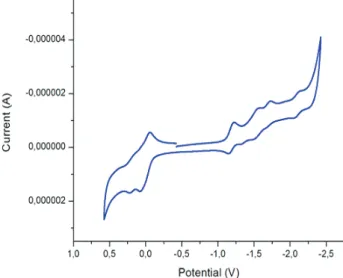
(6) Revista de Ciencias. A. Ortiz, W. A. Arcos and B. Insuasty. UV-vis and emission spectra for compounds Co-D-Ac, Co-D-C60 and C60 were measured in CH2Cl2 as solvent. Interestingly, the absorption bands of Co-D-C60, are a linear combination of the spectra of compound 9 and C60, which indicates that there is not significant electronic communication between both units in the ground-state. Both, absorption and emission spectrum were observed. The intra-molecular charge transfer band at the wavelength red-shifted and the ground-state energy can be calculated by the wavelength of interception of the absorption and emission spectrum (λInt). These experiments demonstrated favors for push-pull behavior (figure 2). The absorption and emission data are listed in table 1. Table 1. Electronic properties data of Co-D-Ac and Co-D-C60 measured by absorption and emission spectrum. λint (nm) Co-D-C60 Co-D-Ac. λmax (nm). λf (nm). E0-0/eV. HOMO (eV). LUMO (eV). 415. 447. 449. 2.99. 1.04. -1.95. 471. 549. 549. 2.64. 1.38. -1.26. The electrochemical features of the electro-active compounds Co-D-Ac and Co-D-C60 were studied by cyclic voltammetry using glassy carbon as working electrode; Ag/Ag+ as reference electrode; Pt as counter-electrode; 0.1 M Bu4NClO4, at scan rate of 100 mV/s at room temperature and Fc/Fc+ as internal reference. Compound Co-D-C60 shows the reduction profile of three quasi reversible C60 reduction waves at potential values for the first reduction wave at -1.18 V, the second and the third waves are appearing at -1.44 V and -1.62 V, respectively (figure 3). As expected, the reduction potential values for Co-D-C60 are cathodically shifted in comparison with those of pristine C60, which has been accounted for in the saturation of a double bond of the C60 sphere which raises the LUMO energy level.. Figure 3. cyclic voltammogram of the Co-D-C60 with Fc/Fc+ as internal reference.. 62.
(7) New Co of TPA Table 2. Redox potentials (V) in CH2Cl2 of Co-D-Ac and Co-D-C60. Eox1 (V). Eox2 (V). E1 1/2red (V). E2 1/2red (V). E3 1/2red (V). E4 1/2red (V). Co-D-C60. 0.77. 1.28. -1.18. -1.44. -1.62. -2.10. Co-D-Ac. 0.75. --. -1.89. --. --. --. Theoretical calculations at DFT/B3LYP level were carried out in order to gain a better understanding of the electronic structure for dyes Co-D-Ac and Co-D-C60; and underpinning their experimentally observed push-pull character. The geometry of these dyes was optimized using a 6-21G basis set in the Gaussian 0.9 program [10]. Through the optimized structures calculated of dyes, it can the quasi-planar geometry around of π-conjugated core (figure 4). In frontier orbital analysis, it is evident that the HOMO is mainly localized in the electron–donor moiety mainly in Co-D-Ac. As expected, the LUMO is fully localized in the electron–acceptor unit of both dyes (figure 5). The last finding shows a good push-pull behavior for the obtained electroactive systems.. Figure 4. Minimum-energy conformation calculated for Co-D-Ac and Co-D-C60 with energy in eV at the B3LYP/3-21G level.. Figure 5. Electron density contours (0.03 eBohr-3) calculated for the HOMO (Bottom) and LUMO (up) of Co-D-Ac and Co-D-C60.. Volumen 17 - Especial Química, 2013. 63.
(8) Revista de Ciencias. 4. A. Ortiz, W. A. Arcos and B. Insuasty. Conclusions. In summary, two novel derivative dyes Co-D-Ac and Co-D-C60, were synthesized using Knoevenagel reactions between (E)-4-((4-(4-(dimethyl amine)styryl)phenyl) (phenyl)amino) benzaldehyde 9 and cyanoacetic acid, also using a 1,3-dipolar cycloaddition reaction with N-octylglycine and fullerene C60 using 9 respectively. The absorption spectra of dyes Co-D-Ac and Co-D-C60 exhibit an intra-molecular charge transfer (ICT) band; showed by a broad band in the visible region of the Uv-vis spectra. The emission spectra for Co-D-Ac and Co-D-C60 recorded under the same conditions confirmed the ICT band character. The new “push-pull” compounds display a clear electrochemically amphoteric behavior. These findings reveals that there is a significant electronic communication between the electron-codonor-donor units and the electronacceptor fragment through the π-conjugated core. Finally, a theoretical study performed, confirmed the experimental evidences now reported for the dyes obtained. Acknowledgements This work has been supported by COLCIENCIAS (Colombia) and the Universidad del Valle (Colombia). References [1]. Special issue on organic photovoltaics. Acc. Chem. Res.(2009), 42, 1689.. [2]. T. Kitamura, M. Ikeda, K. Shigaki, T. Inoue, N. A. Anderson, X. Ai, T. Lian and S. Yanagida, (2004). Phenyl-Conjugated Oligoene Sensitizers for TiO2 Solar Cells. Chem. Mater, 16, 1806.. [3]. D. P. Hagberg, T. Edvinsson, T. Marinado, G. Boschloo, A. Hagfeldt and L. Sun, (2006). A Novel Organic Chromophore For Dye-Sensitized Nanostructured Solar Cells. Chem. Commun, 21, 2245.. [4]. (a) Z. Ning, Q. Zhang, W. Wu, H. Pei, B. Liu, H. Tian, (2008). Starburst Triarylamine Based Dyes for Efficient Dye-Sensitized Solar Cells. J. Org. Chem, 73, 3791; (b) B. Liu, W. Zhu, Q. Zhang, W. Wu, M. Xu, Z. Ning, Y. Xie, H. Tian,(2009). Conveniently synthesized isophorone dyes for high efficiency dyesensitized solar cells: tuning photovoltaic performance by structural modification of donor group in donor–π–acceptor system. Chem. Commun, 1766.. [5]. T. Marinado, D. P. Hagberg, M. Hedlund, T. Edvinsson, E. M. J. Johansson, G. Boschloo, H. Rensmo, T. Brinck, L. Sun, A. Hagfeldt, (2009). Rhodanine dyes for dye-sensitized solar cells : spectroscopy, energy levels and photovoltaic performance. Phys. Chem. Chem. Phys, 11, 133.. 64.
(9) New Co of TPA. [6]. (a) M. Liang, W. Xu, F. Cai, P. Chen, B. Peng, J. Chen and Z. Li, (2007). New Triphenylamine-Based Organic Dyes for Efficient Dye-Sensitized Solar Cells. J. Phys. Chem. C, 111, 4465; (b) W. Xu, B. Peng, J. Chen, M. Liang, F. Cai, (2008). New Triphenylamine-Based Dyes for Dye-Sensitized Solar Cells. J. Phys. Chem. C, 112, 874.. [7]. S. Kim, J. K. Lee, S. O. Kang, J. Ko, J. H. Yum, S. Fantacci, F. De Angelis, D. Di Censo, M. K. Nazeeruddin and M. Grätzel, (2006). Molecular Engineering of Organic Sensitizers for Solar Cell Applications. J. Am. Chem. Soc, 128, 16701.. [8]. H. Qin, S. Wenger, M. Xu, F. Gao, X. Jing, P. Wang, S. M. Zakeeruddin and M. Grätzel, (2008). An Organic Sensitizer with a Fused Dithienothiophene Unit for Efficient and Stable Dye-Sensitized Solar Cells. J. Am. Chem. Soc, 130, 9202.. [9]. (a) S. Komamine, M. Fujitsuka, O. Ito, K. Moriwaki, T. Miyata, T. Ohno, (2000). Photoinduced Charge Separation and Recombination in a Novel Methanofullerene− Triarylamine Dyad Molecule. J. Phys. Chem. A. 104, 11497. (b) F. Gialcone, J. L. Segura, N. Martin, D. M. Guldi, (2004). Exceptionally Small Attenuation Factors in Molecular Wires J. Am.Chem. Soc, 126, 5340. (c) W. Mateusz, J. Santos, B. M. Illescas, A. Ortiz, B. Insuasty, T. Bauer, T. Clark, D. M. Guldi, N. Martin, (2011). Vinyl Spacers—Tuning Electron Transfer Through Fluorene-Based Molecular Wires. Energy Environ. Sci., 4, 765.. [10]. Frisch MJ, Trucks GW, Schlegel HB, Scuseria GE, Robb MA, Cheeseman Jr JR, et ál. Gaussian 09, Wallingford CT: Gaussian, Inc.; (2010).. Author’s address Alejandro Ortiz G. Departamento de Química, Universidad del Valle, Cali - Colombia [email protected] Wilmmer Alexander Arcos Rosero Departamento de Química, Universidad del Valle, Cali - Colombia [email protected] Braulio Insuasty Obando Departamento de Química, Universidad del Valle, Cali - Colombia [email protected]. Volumen 17 - Especial Química, 2013. 65.
(10)
Figure

Documento similar