
Utilising social network analysis to identify the estructural features of teachers´knowledge and resource sharing networks within schools
27
0
0
Texto completo
(2) Utilising social network analysis to identify the structural features of teachers’ knowledge and resource-sharing networks within schools teaching and learning practices. There were also key differences observed when comparing the resource-sharing and knowledge-sharing networks, with collaborative resource-sharing for teaching and learning occurring much more within closed groups participating in reciprocated exchange, compared to a more open, though less reciprocated approach to knowledge-sharing collaboration. Finally, the potential use of metrics at the level of individual teachers to identify key actors in each network is considered.. Key Words: teacher collaboration, social network analysis, educational networks, educational research. 1.2. Resumen El artículo presenta el análisis de redes sociales (ARS) acometido para identificar las características presentes en redes de intercambio de recursos y conocimiento entre docentes. Se ha llevado a cabo una encuesta dirigida a docentes como parte de un estudio de casos asociado a un proyecto de investigación en dos escuelas de alto rendimiento, una de Educación Primaria y otra de Educación Secundaria. Se ha comprobado que los docentes de estas escuelas operan dentro de estructuras organizativas, como son los Equipos Anuales y los Departamentos de Asignaturas. Mediante el uso de técnicas de ARS en esta investigación se ha pretendido comparar hasta qué punto la estructura de las redes de colaboración docente puede vincularse con la afiliación de los docentes a dichos equipos. En cada escuela se solicitó al profesorado que mencionara a aquellos colegas a los que habían acudido durante el último mes con la intención de pedir recursos para sus prácticas de enseñanza y aprendizaje. En el análisis de la información se utilizó un rango de métricas de red completa. Se hallaron diferencias de colaboración entre redes de profesores a la hora de compartir materiales y conocimientos. El análisis arrojó la existencia de grupos cerrados de intercambio recíproco y grupos más abiertos con un enfoque menos recíproco en el mismo tipo de colaboración. Finalmente, puede concluirse que el uso de métricas a nivel de docentes individuales ha permitido identificar a los actores clave en cada red.. Palabras clave: Colaboración del profesorado, análisis de redes sociales, redes educativas, investigación educativa.. 1. Introduction 1.1. Typical organisational structures observed within English schools Schools are relatively structured organisations with a framing based, at least in part, around teachers’ affiliation to specific teams. The majority of schools in the state-funded English education system are divided into two main phases; primary schools for children aged 4-11, and secondary schools for children aged 11-16 with some providing education for children up to 18-19. There are a number of other models adopted, especially in the private school sector and even in the English state maintained school system, but the single transition between school phases at age 11 is the most typical. In larger, multi-form entry primary schools the dominant organisational frame for teaching and practice is likely to be the Year Team, which constitutes the group of teachers responsible for the learning of children within the same age band (known as. 134.
(3) Utilising social network analysis to identify the structural features of teachers’ knowledge and resource-sharing networks within schools. a year group and broadly equivalent to a grade group in other systems). Teachers within these teams, especially those working with younger children, are largely generalists; teaching the whole curriculum to children in their class and taking responsibility for the pastoral care of the children that they teach. Pastoral care responsibilities in UK state-funded schools are usually undertaken by teachers. These responsibilities are separate from, but related to the curriculum teaching responsibilities of teachers (Best, 2014). Pastoral care involves a range of duties including support for personal development, assisting children with educational choices, supporting them through transitions and liaison with their families. Children normally stay together in the same class and with the same teacher for up to a year. Typically one teacher in each year team would be designated as a Team Leader, working as a leading practitioner with the responsibility of co-ordinating the work of the other teachers in the Year Team. Teachers working with children aged 5-11 share a common National Curriculum divided into two stages (Key Stage 1 from 5-7 and Key Stage 2 from 7-11). Some schools may mix children across ages in each key stage but this is usually due to practical constraints such as class size and teacher-student ratios in small, rural primary schools. In secondary schools the dominant structural frame is more likely to be based around the subject-specialism of the teachers, with teacher teams referred to as subject departments. The allocation of teaching time and teaching resources are largely aligned to the work of these subject departments, and many secondary school teachers will teach almost exclusively within the confines of their subject department. Thus most teachers see themselves as teachers of a particular subject, and not as generalist teachers. Children are usually taught each subject in age-based groups, retaining the Year Group structure that is common to the primary school phase. In secondary schools teachers can also be members of other teams, some of which provide sub-divisions within the departmental structure, while other teams cut across the departmental structure. An example of the former would be teachers of science who may subdivide into teams focusing on discipline-based teaching, typically biology, chemistry and physics, or foreign language teachers dividing into languagebased groups such as Spanish, German and French. An organisational example that cuts across the departmental structure would be teams of teachers involved in the pastoral care of students. Some schools choose to organise children into mixed-age pastoral groups, but the majority retain children in age-based Year Groups for pastoral care. Schools may also set up professional learning groups that cut across Year Team and Subject Department boundaries. More rarely, multidisciplinary teams of teachers in secondary schools may be involved in teaching broader curricula, such as a competency-based curriculum, to some children in the school (Downey et al, 2013a). 1.2. Overview of literature focusing on school structures and teacher collaboration In the preface to his influential work, The Sociology of Teaching Waller (1932) began his account of the life of teachers with an intriguing perspective:. 135.
(4) Utilising social network analysis to identify the structural features of teachers’ knowledge and resource-sharing networks within schools. “…every teacher knows, that the world of the school is a social world. Those human beings who live together in the school, though deeply severed in one sense, nevertheless spin a tangled web of relationships; that web and the people in it make up the social word of the school. It is not a wide world, but, for those who know it, it is a world compact with meaning. It is a unique world.” (Waller, 1932, 1) Waller captures something of the contradictory environment teachers find themselves in a school, a community fractured by the workspace of the classroom, where teachers spend the majority of their time, usually working in isolation from one another, while at the same time recognising that they are engaged in a collective endeavour which leads to the development of social ties that can facilitate collaboration through exchange of knowledge and resources. A number of studies show that in large schools and especially in secondary schools there are sub communities within the school which form what Siskin referred to as “boundaries and barriers” (Siskin, 1994, 69) around elements of practice and professional exchange. As Siskin notes in her description of the schools in her study, the architecture of schools can further exacerbate the “departmentalization” of teachers (Siskin, 1994, 50), with buildings focused on the teaching work and resource requirements of teams of specialist teachers, with shared space, such as staff rooms, rarely being large enough to accommodate all staff at key moments for socialisation such as lunch breaks. “Departments are thus quite distant from each other literally and metaphorically” (ibid). One of the teachers in Siskin’s study described the science department at his school in the following terms: “There are major interactions here in the department… we coordinate, we collaborate…we share materials and curricula. Not much at all outside the department… I have the materials I need here. I’m comfortable here.” (Siskin, 1994, 69). Burn et al (2007) report a similar, strong allegiance to the subject team in secondary school teachers, but have pointed out the positive influence, especially for novice and pre-service teachers, of “team rooms” as an environment to foster communication and collaboration between teachers. This was especially when combined with a view that practice knowledge is distributed between teachers with differing levels of experience. Siskin refers to this as the “institutionalized pull of academic orientation” (Siskin, 1994, 70). Bennett et al (2007) have referred to this effect as “cultural fragmentation”. McGregor (2004, 362) refers to the department as a “practicerelevant actor-network” in which both teachers and the artefacts of their professional practice which include tangible elements such as classroom equipment, curriculum documents, assessment, text books and wall displays, as well as intangibles such as rituals, beliefs and agreed expectations. Nevertheless, despite such fragmentation, year teams and subject departments remain strong organising frameworks for knowledge exchange and development. There is a clear body of evidence, gathered over time, which indicates that effective subject departments are associated with measures of the overall effectiveness of secondary schools (Harris et al, 1995; Sammons et al, 1997; Harris, 2001; Reynolds, 2010; Ko et al, 2015; Strand, 2016). In a. 136.
(5) Utilising social network analysis to identify the structural features of teachers’ knowledge and resource-sharing networks within schools. large-scale study of mathematics teachers in over 100 Dutch secondary schools, Lomos et al (2011) determined that departmental teams of teachers which report a high degree of focus on collaborative activity and shared reflective practice are significantly associated with improved student achievement. Such distinctions also relate to year teams in primary schools, which share a common curriculum between classes, teaching similar topics in parallel and negotiating the sharing of tangible resources while doings so. In primary school students usually remain in the same physical space for much of the teaching day but in secondary schools hundreds of students will transition from classroom to classroom at regular intervals. Metcalfe and Russell (1997) described the secondary school as a production line in which students move along a conveyor belt between workstations as they travel around various classrooms and subject focused lessons. The physical space of the classroom cannot be underestimated in terms of the constraint it can place on teacher collaboration and exchange. There is also the professional autonomy that prevails among teachers which develops from specialisation on a particular phase of the curriculum or a subject discipline. Studies have shown that initiatives that cut across these traditional structural framings in the life of the school can face challenges from the established organisational structures. The commitment of teachers to their subject team may be called into question, and teacher activity in teams with a wider remit may be discouraged by the teacher’s subject or year team leaders as a distraction from the main task at hand (e.g. Downey, Byrne and Souza, 2013a; 2013b). 1.3. 2.. Justification of the research problem. This article discusses how social network analysis (SNA) might be used to identify teachers who occupy key positions within informal resource-sharing, collaborative networks in their school. Social capital theory (Coleman, 1990) describes the relational ties between actors as a form of professional capital that can facilitate access to the material resources and knowledge required by teachers to undertake various aspects of their professional practice. These ties often exhibit a network structure (Burt, 2000) derived from a mix of formal and informal interactions that occur as part of the day to day experience in the social learning setting of a school. This is very important as studies have emphasised that structural teams are particularly strong influences on the way teachers, particularly student and novice teachers, develop their professional knowledge and also their identity as teachers (Burn et al, 2007; Childs et al, 2013; McNicholl et al, 2013; Puttick, 2017; 2018). Teachers, as actors within the professional network of their school, will occupy different positions within the network and access resources through the existing social structures (Lin 2001). These structures may be visualised using sociometric techniques such as SNA (Wassermann & Faust, 1994). In recent years SNA has seen growing application within research in educational contexts (Carolan, 2013; Daly, 2010).. 137.
(6) Utilising social network analysis to identify the structural features of teachers’ knowledge and resource-sharing networks within schools. Maton (2014, 11) has described knowledge as an “inescapably social” construct “produced by socially situated actors”, emphasizing the importance of ‘knowers’ in organisations, as well as knowledge. Taking a social realist stance, Maton goes on (2014, 70) to categorise knower structures as either ‘hierarchical’, or ‘horizontal’. In hierarchical knower-structures actors are privileged according to the subjective perceptions of their peers as to the actor’s capacity toward, or disposition for privileged knowledge (e.g. ‘teacher x is just good with data’), while in horizontal knower-structures the requisite forms of knowledge are more accessible to all relevant actors. Thus, a key question in this study is the extent to which the informal networks of professional interaction around learning and teaching, and around the use of data to inform teaching, are constrained by the more formal structural framing of the school such as year teams and departments, or centralised around specific teachers in a hierarchical way. If schools are to disseminate elements of effective practice and to incorporate the findings of research into decision-making and classroom practice, then the collaborative networks of teachers will need to demonstrate a capacity to cut across structural frames like Year/Grade Teams and Subject Departments. SNA enables us to determine the extent to which this happens via a variety of whole-network-level metrics. A further aim is to compare structural features of the networks developed around different aspects of collaboration in teaching and learning and data use in the case study schools. Learning and teaching and data use have been selected as examples of practice that are likely to be compartmentalised to different extents. Learning and teaching is clearly focused around the strong structural frames referred to above, since these are in place largely to support the day to day work of teachers in the classroom, implementing the curriculum for student learning. Data use on the other hand is a more detached and reflective process, distinct from but related to learning and teaching. The sharing of both material resources and knowledge are considered in order to compare and contrast the networks that facilitate the dissemination of both tangible resources (lesson plans, schemes of work, lesson artefacts etc) with the dissemination of intangible know-how about that element of practice. In this study know-how is focused on the development of one’s personal practice as a teacher and ability to interpret data to evaluate the progress of children in the teacher’s class. In the English school system the strong accountability context results in a view of data as being focused predominantly on the academic attainment and progress of students in the school (Kelly & Downey, 2011) and pupil attainment and progress data is the focus here in this study.. 3.. Aims and Research Questions. Through use of SNA techniques, this research aims to compare the extent to which the structure of networks of teacher collaboration around particular aspects of teacher practice may be associated with teachers’ affiliation to such teams.. 138.
(7) Utilising social network analysis to identify the structural features of teachers’ knowledge and resource-sharing networks within schools. Research Question 1 What are some of the structural features of resource and knowledge-sharing networks observed in the case study schools? Research Question 2 To what extent does affiliation to core organisational structures (year teams or subject departments) explain the pattern of ties observed in each of the networks in the case study schools? Research Question 3 To what extent do social capital related attributes of teachers such as interpersonal trust and network intentionality explain the pattern of ties observed in each of the networks in the case study schools? 4.. Methodology. 4.1. Selection of case study schools In this study the focus is on eliciting the resource sharing networks of teachers in two case study schools; one primary and one secondary school. Each case study school was invited to participate in the study on the basis of their track record. Both schools had recently been judged as “outstanding” by Ofsted inspectors in terms of their overall effectiveness (within 3 years of the period of data collection). This overall “outstanding” judgment placed each case study school within or very close to the top 15% of schools in England at the time of inspection. In addition, each school was judged as “outstanding” in terms of student achievement, the quality of teaching, the quality of pastoral care, and leadership and management. The reports are not cited here in order to maintain the anonymity of the case study schools. Each school had experienced an improving trajectory (though from a position of relative strength) based on previous inspections for which at least some elements of the practice of the school had been judged as “good”. Ofsted reports in each school refer to effective systems for assessing and monitoring the progress of all students across the full range of abilities, and for setting appropriate targets for learning. They also report demonstrable competence of school leaders, teachers and school governors in evaluating the impact of learning initiatives and interventions. The headteachers in each school were singled out for comment on their passion and clear vision for school improvement. The Ofsted inspection reports also specifically highlight the strengths of the curriculum offered by each school. In the primary school specific mention was made of the way different subject areas were extremely well linked and for excellent development of core literacy and numeracy skills. In the secondary school there was praise for the development of literacy and communication skills across subjects and the way the curriculum prepared all students for transitions within and beyond school. Table 1. 139.
(8) Utilising social network analysis to identify the structural features of teachers’ knowledge and resource-sharing networks within schools. Demographic characteristics of teachers in the case study schools Demographic characteristics Overall response rate Female. Primary case study school. Secondary case study school. 96.4% (N=28). 75.2% (N=117). 82.0%. 63.2%. Years in current school - 0-2yrs - 3-5yrs - 6-10yrs - 11-15yrs - >15yrs - missing. mean = 7.15 st. dev. = 5.27 25.0% 17.9% 17.9% 28.6% 3.6% 7.1%. mean = 6.88 st. dev. = 5.22 18.8% 12.0% 25.6% 10.3% 4.3% 29.1%. Years as a teacher - 0-2yrs - 3-5yrs - 6-10yrs - 11-15yrs - >15yrs - missing. mean = 10.48 st. dev. = 7.96 14.3% 17.9% 14.3% 25.0% 21.4% 7.1%. mean = 11.88 st. dev. = 7.81 7.7% 6.0% 24.8% 15.4% 19.7% 26.5%. Table 2 Demographic characteristics of students in the case study schools (national level figures in brackets) Demographic characteristics. Primary case study school. Secondary case study school. Number of students Female. approx. 600 49% (49.0%). approx. 1,600 47% (49.6%). Gender of entry Age range Proportion low SES English as an Additional Language. mixed 4-11 5% (19.2%). mixed 11-19 7% (16.3%). 2% (17%). 2% (13.6%). Tables 1 and 2 shows some characteristics of teachers and students in the case study schools. From Table 2 it is clear that both of the schools are somewhat atypical in aspects of the student demographic with low levels of socioeconomic disadvantage (as measured by entitlement to free school meals) and also low levels of students with English as an additional language. Each school also takes the lead role in their local Teaching School Alliance which means they are involved in leading coordinating provision for effective continuing professional development of teachers in a wider partnership of schools, and both schools lead local partnerships organised to provide initial teacher education and training for those aspiring to become teachers. Each school has a track record of teachers engaging in practitioner research projects and disseminating their findings within the school and in other schools. They are considered to exemplify effective. 140.
(9) Utilising social network analysis to identify the structural features of teachers’ knowledge and resource-sharing networks within schools. teaching learning, across a wide range of professional practice acting as a source of knowledge and resources to support the learning of both students and teachers alike. Each case study school therefore provides an opportunity to glean an insight into the nature of teachers’ social interaction around some key areas of practice that facilitates the work of effective schools. The specific references in the Ofsted reports to the outstanding curricula, quality of teaching, student achievement and strong praise for assessment and monitoring of student progress support the rationale for selection of the schools as case studies of teacher networks in the areas of learning and teaching and the use of attainment and progress data. 4.2. Data collection instruments This article focuses on one element of the data collected from the case study schools, namely a cross-sectional network survey to elicit professional interactions between teachers in the school. The core of the survey consisted of four network questions with a common stem. During the last month, with whom did you … • • • •. exchange teaching materials/resources (e.g. assessments lesson plans etc.)? collaborate on how to improve the effectiveness of your teaching? exchange data on students taught by you or your colleague? collaborate using data to evaluate student performance?. These questions were used to elicit collaborative networks around two areas of practice, namely learning and teaching, and use of data on students’ academic performance. Each area of practice was divided into resource-sharing activity and knowledge sharing activity. All teachers in the case study schools were invited to participate in the survey and so the data represents the population for each school, rather than a sample. This helps with establishing whole-school networks on teacher interaction. The boundary for each network was considered to be the teaching staff working for the school and teachers were able to nominate their colleagues from a pre-prepared list of all the teaching staff working in their school. Friendship network data was also collected from the participating teachers. The network question posed in the survey was as follows: •. With whom do you have a close friendship? (By close friendship we mean a person with whom you spend time in informal activities or sharing personal information.). The friendship network data collected from the teachers helps adjust for the effects of teachers considering that they don't just have colleagues within the teaching team, but also friends. This helps to determine if the effects of other variables are strong, especially if they help to explain significant levels of variance in collaboration networks after adjusting for friendships.. 141.
(10) Utilising social network analysis to identify the structural features of teachers’ knowledge and resource-sharing networks within schools. Participating teachers were also asked to confirm the Year Team (Primary) or Subject Department (Secondary) to which they were affiliated as well as completing some demographic items (gender, years in current school, years worked as a teacher). In addition to the demographic questions and the nomination of fellow teachers in the network element of the survey, teachers were asked concurrently to respond to a number of scale items associated with factors related to aspects of teacher collaboration and network behaviour. Data on perceived interpersonal trust (TRUST) was collected via a scale consisting of six items. This scale was a modified from that used in previous studies by Daly and Chrispeels (2008) and Hoy and Tschannen-Moran (2003). Each items is scored on a 9-point Likert-type response scale (1 = very strongly disagree, 9 = very strongly agree). A further scale measuring network intentionality (NETWORK) was utilised, consisting of twenty-two items covering the extent to which each participant is proactive about developing their professional network(s). The scale includes items such as “I actively search out new relationships with people who can help me improve my teaching” and “I actively seek out professional relationships beyond the school”. The items have been used in previous studies and further details and a list of items can be found in Bokhove and Downey (2018). Each item was scored on a 5-point Likert response scale (1 = strongly disagree, 5 = strongly agree). 4.3. Data Analysis Research Question 1 What are some of the structural features of resource-sharing and knowledgesharing networks observed in the case study schools? In order to establish the structural features of the collaborative networks in the case study primary and secondary school a range of whole network metrics were calculated using the UCINET software v6.491 (Borgatti, Everett and Freeman, 2002). Network visualisations, in the form of network graphs, were produced using NetDraw software v2.135 (Borgatti, 2002). These include: • • • •. network network network network. density and mean ties per node; reciprocity; fragmentation and node isolates; closure.. Network density is the number of ties as a proportion of the maximum possible number of ties, indicating the proportion of potential ties that are actualised in the school. It is a measure of the dyadic connections within each case study school and therefore is a general measure of how connected teachers are. Professional networks tend to be relatively sparse. This is also in part due to the subjective nature of determining what constitutes a meaningful tie through self-report responses to the. 142.
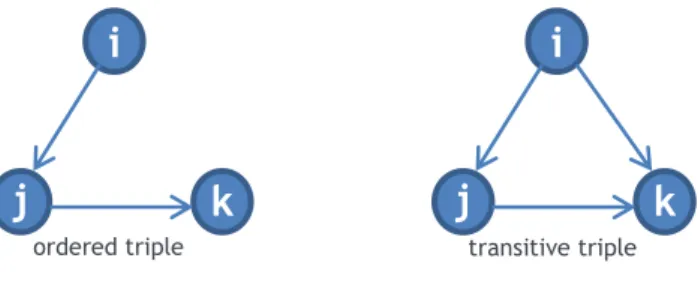
(11) Utilising social network analysis to identify the structural features of teachers’ knowledge and resource-sharing networks within schools. network questions in the survey. Teachers will tend to be naturally selective in nominating colleagues when given a complete list of all staff in the school, and all network metrics are suppressed by non-response in network surveys. The ties in these networks are directed, indicating who is nominated by whom. This allows reciprocity to be determined. Dyadic ties can be null (no tie present), asymmetric (the tie is in a single direction) or symmetric (a reciprocated nomination between two teachers). A reciprocal tie indicates potential for exchange of resources or knowledge to occur between the two teachers, as opposed to resource or knowledge seeking behaviour indicated by an asymmetric tie. Network reciprocity is the proportion of the existing (non-null) dyadic ties that are reciprocal. Network fragmentation is the proportion of pairs of nodes that cannot reach each other as they are not connected by a path (of any length). It is a measure of (dis)connectedness across the network and measures and, and its value will be higher in a network consisting of a number of separate connected components indicating teams of teachers connected to one another but isolated from other sections of the network. Clearly isolated nodes, indicating teachers who are not integrated in the network, will also contribute to fragmentation. For this reason the number of node isolates is reported. Network closure is the proportion of ordered triples in which i→j and j→k that are transitive. An example of this is illustrated in Figure 1 below. These closed triads can contain symmetric (reciprocal) as well as asymmetric ties. Closure occurs via the principle that “a friend of a friend is my friend” and in collaborative terms indicates a tight-knit group of colleagues with a pattern of close working, in which resource or information can flow to nearby members directly without the need of a bridging actor.. i. j. i. k ordered triple. j. k. transitive triple. Figure 1. Illustrating ordered and transitive triples. Research Question 2 To what extent does affiliation to core organisational structures (year teams or subject departments) explain the pattern of ties observed in each of the networks in the case study schools? Research Question 3 To what extent do social capital related attributes of teachers such as interpersonal trust and network intentionality explain the pattern of ties observed in each of the networks in the case study schools?. 143.
(12) Utilising social network analysis to identify the structural features of teachers’ knowledge and resource-sharing networks within schools. In order to answer these research questions hypotheses of association between networks and node attributes can be tested using correlation and regression analyses. It is inappropriate to utilise standard correlation and regression analyses with social network data, as a basic assumption of the generalised linear model on which these procedures are based is that cases are independent of one another. In a network context the cases are clearly interdependent. The quadratic assignment procedure (QAP) uses a permutation test in order to appropriately control for this interdependence (Krackhardt, 1988). In QAP regression two networks are regressed on one another. In the case of multiple QAP regression (or MRQAP) more than two networks may be regressed on one another. The usual dependent or independent designations are given to each matrix and model fit is assessed via adjusted R-square values in the usual way. To capture the affiliations of each teacher to core structures in their school a matrix based on the node attributes was generated (using the “Attribute to matrix” command in UCINET) from the subject or year-team designations on the staff list provided by each case study school. If the dyadic tie between two nodes was between two members of the same subject team/year-group, then the value for the tie in the matrix is set to 1. If the tie existed between teachers who were members of different subject teams/year-groups then the tie was assigned a value of 0 in the matrix. Other node attributes were also matricised in a similar way. The total scores derived from responses to items on the interpersonal trust (TRUST) scale were added to together for each dyadic pair and this was turned into a matrix indicating summed trust. Likewise, total scores for responses to the network intentionality (NETWORK) scale were summed for each dyadic pair in matrix form. These matricised attributes were then used as independent variables in multiple regression models, with each resource- and knowledge-sharing network selected as the dependent variable for the regression models. This subject/year-group affiliation match matrix was then regressed as the independent variable against each learning and teaching and data use networks as the dependent matrix using the double Dekker semi-partialling MRQAP (Dekker, Krackhardt and Snijders, 2007).. 5.. Results. Research Question 1 What are some of the structural features of resource-sharing and knowledgesharing networks observed in the case study schools?. 144.
(13) Utilising social network analysis to identify the structural features of teachers’ knowledge and resource-sharing networks within schools. Table 3 Network metrics indicating structural features for the case study primary school Network metric. Response rate (N=28) Network density Average ties per node Reciprocity Fragmentation Node isolates Closure. Learning and teaching networks. Data use networks. Resource sharing. Knowledge sharing. Resource sharing. Knowledge sharing. 96.4% 0.155 4.2 0.345 0.107 0 0.359. 96.4% 0.171 4.6 0.194 0.208 1 0.439. 96.4% 0.187 5.0 0.382 0.107 0 0.337. 96.4% 0.170 4.4 0.363 0.071 0 0.380. Table 4 Network metrics indicating structural features for the case study secondary school Network metric. Response rate (N=117) Network density Average ties per node Reciprocity Fragmentation Node isolates Closure. Learning and teaching networks. Data use networks. Resource sharing. Knowledge sharing. Resource sharing. Knowledge sharing. 75.2% 0.025 2.9 0.296 0.750 7 0.489. 75.2% 0.020 2.3 0.138 0.742 13 0.223. 75.2% 0.025 2.9 0.194 0.537 9 0.299. 75.2% 0.024 2.8 0.193 0.547 8 0.282. Research Question 2 To what extent does affiliation to core organisational structures (year teams or subject departments) explain the pattern of ties observed in each of the networks in the case study schools? Research Question 3 To what extent do social capital related attributes of teachers such as interpersonal trust and network intentionality explain the pattern of ties observed in each of the networks in the case study schools?. 145.
(14) Utilising social network analysis to identify the structural features of teachers’ knowledge and resource-sharing networks within schools. Table 5 MRQAP model-building analysis of the resource-sharing and knowledge-sharing networks in the case study primary school. Dependent variable Learning & teaching resourcesharing network. Independent variable. model number 1. 2. 3. 4. Intercept. 0.10979***. 0.06723***. 0.09711***. -0.03681***. sameYearTeam. 0.64983***. 0.54404***. 0.60105***. 0.60201***. 0.22491***. 0.21244 ***. 0.21549***. (-0.00029). (-0.00274). friendship sumTRUST sumNETWORK adj R-square. Learning & teaching knowledgesharing network. 0.00258* 0.228**. 0.286**. 0.306**. 0.316**. Intercept. 0.13413***. 0.10529***. 0.31854***. 0.04828***. same Year Team. 0.53829***. 0.46489***. 0.50480***. 0.50672***. 0.15603***. 0.14574**. 0.15190***. (-0.00224). (-0.00718). friendship sumTRUST sumNETWORK adj R-square. Data use resourcesharing network. 0.00522*** 0.145**. 0.170**. 0.177**. 0.217**. Intercept. 0.15648***. 0.13543***. 0.36748***. 0.06441***. same Year Team. 0.46421***. 0.41062***. 0.44162***. 0.44377***. 0.11393*. 0. 09594*. 0.10285*. (-0.00236). (-0.00790). friendship sumTRUST sumNETWORK adj R-square. Data use knowledgesharing network. 0.00585* 0.100**. 0.112**. 0.110**. 0.156**. Intercept. 0.12817***. 0.10679***. 0.13258***. -0.23277***. same Year Team. 0.52701***. 0.47259***. 0.51044***. 0.51303***. 0.11569**. 0.09482*. 0.10315**. (-0.00010). (-0.00679). friendship sumTRUST sumNETWORK adj R-square. 0.00705*** 0.143**. 0.157**. 0.195**. 0.227**. * p < 0.05; ** p<0.01; *** p<0.001. 146.
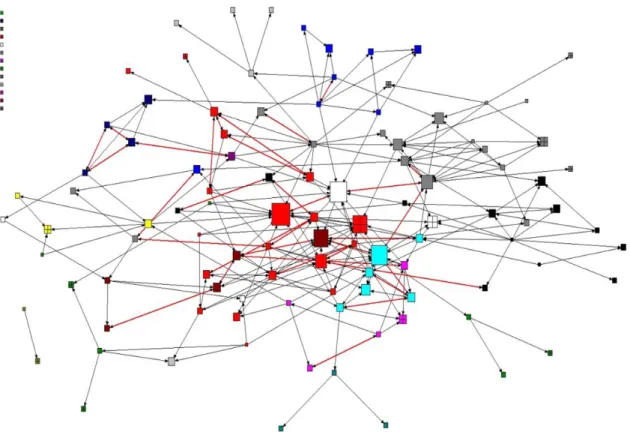
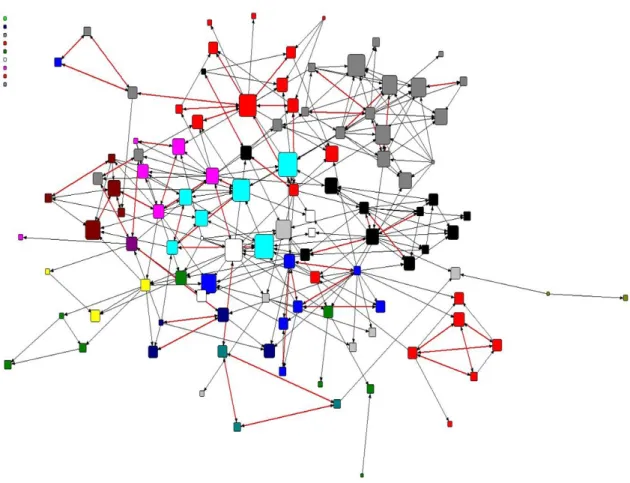
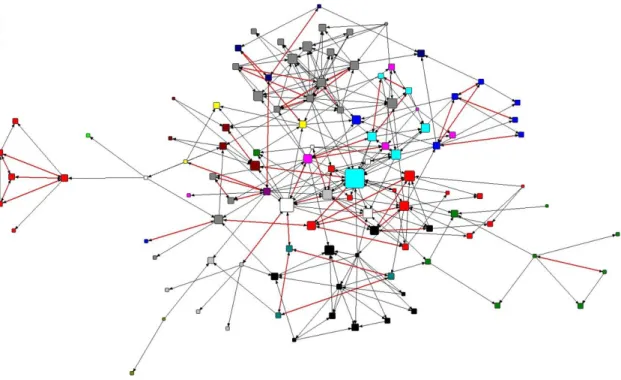
(15) Utilising social network analysis to identify the structural features of teachers’ knowledge and resource-sharing networks within schools. Table 6 MRQAP model-building analysis of the resource-sharing and knowledge-sharing networks in the case study secondary school. Dependent variable. Independent variable. Learning & teaching resourcesharing network. Intercept sameYearTeam friendship sumTRUST sumNETWORK adj R-square. Learning & teaching knowledgesharing network. Intercept same Year Team friendship sumTRUST sumNETWORK adj R-square. Data use resourcesharing network. Intercept same Year Team friendship sumTRUST sumNETWORK adj R-square. Data use knowledgesharing network. Intercept same Year Team friendship sumTRUST sumNETWORK adj R-square. model number 1. 2. 3. 4. 0.00625*** 0.43983***. 0.00116*** 0.38185*** 0.17156***. 0.02324*** 0.43558*** 0.16362*** (-0.00023). 0.04481*** 0.44482*** 0.16220*** (-0.00021) (-0.00017). 0.345**. 0.384**. 0.416**. 0.420**. 0.01230*** 0.23934***. 0.00713*** 0.18053*** 0.17401***. 0.01531*** 0.19879*** 0.18156*** (-0.00006). -0.00170*** 0.26684*** 0.23256*** (-0.00559) (0.00906). 0.124**. 0.172**. 0.175**. 0.174**. 0.01313*** 0.33391***. 0.00824*** 0.27927*** 0.16463***. -0.02968 0.29313*** 0.18649*** (0.00046). -0.05052*** 0.29314*** 0.17780*** (0.00044) (0.00017). 0.197**. 0.231**. 0.240**. 0.231**. 0.01365*** 0.30824***. 0.009778*** 0.26412*** 0.13057***. -0.08154*** 0.25471*** 0.15678*** 0.00105*. -0.15605*** 0.25628*** 0.18631*** 0.04541* (0.03436). 0.172**. 0.195**. 0.195**. 0.186**. * p < 0.05; ** p<0.01; *** p<0.001. 6. Discussion and Conclusions In this section of the article the discussion of network structures will be illustrated with sociogram graphs that visualize the networks. These have been produced using NetDraw v2.135 software (Borgatti, 2002). In each network graph the teacher nodes are represented by squares and the directed dyadic ties between nodes are represented by arrows. A double-headed arrow highlighted red designates a reciprocated tie.. 147.
(16) Utilising social network analysis to identify the structural features of teachers’ knowledge and resource-sharing networks within schools. The square nodes representing each teacher are sized by in-degree which indicates the extent to which they are nominated as a source of the resource or knowledge which is the focus of the network. The nodes are also colour-coded by the teacher’s affiliation to a Year Team (Primary) or Subject Department (Secondary), although the limited colour set means that some Subject Departments in the network graphs from the Secondary school share a common colour. Any network node isolates that are present are found in the top left corner of the graph. While the isolates are likely to be teachers who did not participate in the survey, and therefore did not make any nominations of colleagues, they were also not drawn into the network through ties to any of the other teachers who did participate. 6.1. Primary School Networks The primary school collaboration networks have a higher network density and ties per node than those observed in the case study secondary school. This may in part be a factor of the smaller size of the primary school. As the primary school networks also have much lower fragmentation measures than those in the secondary schools (0.07 to 0.21 compared to 0.54 to 0.75 respectively), these results suggest that the structural framing of year teams is less of a constraint on collaboration across teams in the primary school than is subject department in the case study secondary school. This is confirmed by the generally smaller proportion of the variance explained in the primary school networks by the matrix denoting teacher dyadic pairs in the same year team via the MRQAP analyses (Tables 5). Reciprocity is also higher in the primary networks especially when comparing the networks focused on data use, which also consistently exhibit higher measures of network closure than in data use networks of the case study secondary school. The highest proportion of variance explained by variables in the MRQAP models (Table 5) is for the resource-sharing network focused on learning and teaching, with nearly 32% of the variance explained by year team affiliation, friendship and network intentionality. After adjusting for close friendships between teachers, the matrix summing dyadic levels of interpersonal trust does not explain significant variance in any of the networks. By contrast, the matrix summing dyadic network intentionality does explain significant proportions of the variance in each of the networks, suggesting teachers who are taking more strategic decisions in developing their collaborative relationships in the school are more likely to be engaged in resource- and knowledgeseeking interactions. Network intentionality explains higher proportions of the variance in network ties in a) the knowledge-sharing networks compared to the resource-sharing networks, and b) in the data use networks compared to the learning and teaching networks.. 148.
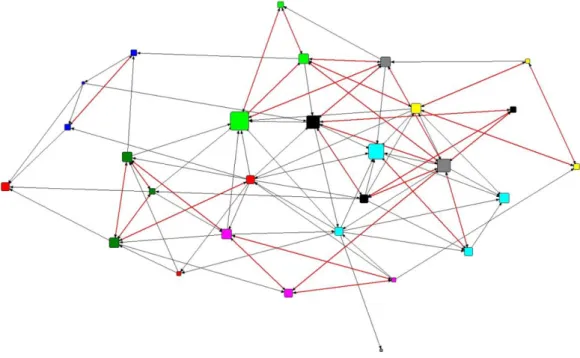
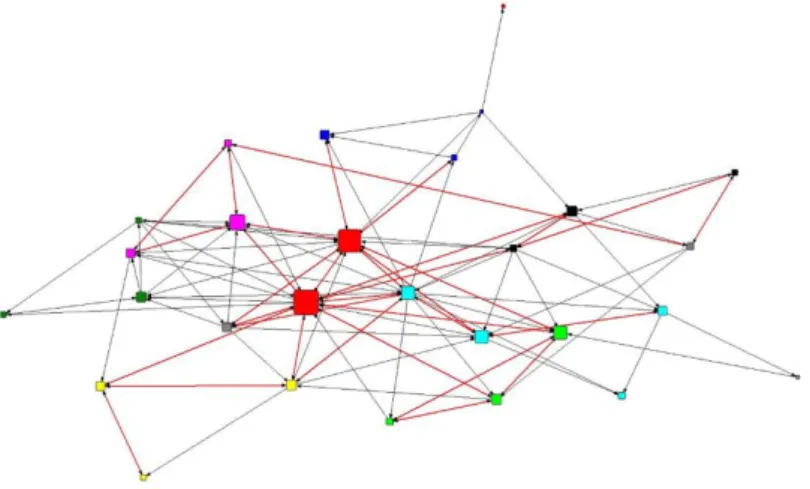
(17) Utilising social network analysis to identify the structural features of teachers’ knowledge and resource-sharing networks within schools. Figure 2. Learning and teaching resource-sharing network for the primary school. Figure 2 above shows how many of the year teams act as fully reciprocated triads indicating the tight-knit nature of the year team as a core structure for collaboration. This is not the case for the year teams teaching the youngest (Foundation Stage/ages 4-5 – dark blue) and the oldest children (Year 6/ages 10-11 – light blue) in the school. Despite this close working pattern within many of the year teams, the network metrics indicate there is still a high degree of bridging activity across to teachers in other year teams. Some of the school leaders (in red and grey) tend to play more peripheral roles in the resource-sharing network for learning teaching which is perhaps understandable as a number did not have overall responsibility for a class on a daily basis, while other school leaders teach in multiple year teams or provide specialist teaching to targeted groups of children through the week. By contrast, in the knowledge-sharing network focused on learning and teaching (see also Fig 3) there was the lowest observed reciprocity (0.194), suggesting that there is more knowledge seeking behavior than knowledge exchange going on in this aspect of teacher practice, and so knowledge-sharing in this domain within the school is possibly served by a hierarchical than horizontal structure of “knowers” (Maton, 2014). Despite this, the network has the highest level of closure than any of the primary school networks suggesting that knowledge sharing ties to teachers outside the year team lead to triadic closure, a principle known as transitivity.. 149.
(18) Utilising social network analysis to identify the structural features of teachers’ knowledge and resource-sharing networks within schools. Figure 3. Learning and teaching knowledge-sharing network for the primary school. In Figure 3 it is possible to observe that some members of each year team occupy a more central role in the knowledge sharing network than others. Further analysis of both network and interview data from purposively selected teachers is proposed to determine if these central actors in the knowledge-sharing network, especially those with high in-degree and therefore viewed as sources of knowledge, are Year Team Leaders or those with some other responsibility for the development of Learning and Teaching in the school. Likewise, the most central teacher in the knowledge-sharing network has a large number of outgoing ties, suggesting they turn to a wide range of other teachers for knowledge. The motivation for such seeking behavior could be clarified through a follow-up interview, by utilising out-degree centrality as the node-level network metric to identify the teachers who most exhibit resource- and knowledge-seeking behaviour. The data use networks in the primary school see some of those in a leadership role move to much more central positions in the network (Figs 4 & 5), suggesting that access and provision of data resources, as well as the knowledge to interpret such data, is viewed as an important part of the leadership role (Kelly & Downey, 2011). These networks also have the highest levels of reciprocity.. 150.
(19) Utilising social network analysis to identify the structural features of teachers’ knowledge and resource-sharing networks within schools. Figure 4. Data use resource-sharing network for the primary school. Figure 5 also shows that much of the knowledge-seeking activity in data use, as demonstrated by the size of the teacher nodes by in-degree, is focused around a few key teachers in leadership roles who also occupy central positions. Having identified these key actors in both data use networks via node level metrics, such as in-degree centrality, it would be possible to conduct follow-up interviews would as a useful additional research strand. This would allow researcher sand practitioners to determine the extent to which this more hierarchical knower-structure (Maton, 2014), compared to the learning and teaching networks, is desired (or problematic) for data informed decision-making in the school.. Figure 5. Data use knowledge-sharing network for the primary school. In conclusion, there are some key questions and applications for leaders and teachers in the primary school.. 151.
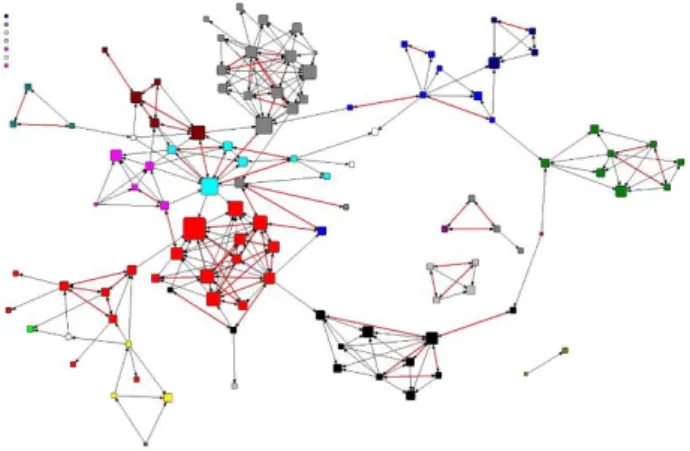
(20) Utilising social network analysis to identify the structural features of teachers’ knowledge and resource-sharing networks within schools. Fragmentation and closure of the network is highest for the knowledge-sharing network linked to learning and teaching, while reciprocity is also lower than in any of the other networks. Attention may need to be given to encouraging teachers to establish and maintain ties outside of year-teams and other working groups, in order to stimulate innovation, transfer of practice and fresh thinking. This is especially where the curriculum approach differs (for example, the separate curriculum for Foundation Stage children/ages 4-5). The school might consider how to exploit the finding that network intentionality is significantly associated with the presence of ties between teachers in all four of the networks. Would specific training/mentoring in developing collaborative networks within school be particularly advantageous for knowledge-sharing in general and data use in particular? There is a more centralised approach to data use in the school, both in terms of resource-sharing and knowledge-sharing, constraining, around a limited number of key individuals. The low levels of fragmentation suggest there is still a good degree of exchange between teachers, but it would be useful to consider whether such centralisation through and the hierarchy of ‘knowers’, especially in terms of the knowledge-sharing network, may limit further collaborative opportunities for datainformed practice? 6.2. Secondary School Networks In the secondary school departmental affiliation (based on subject taught) was most strongly associated with the learning and teaching resource sharing network. The matrix for subject department affiliation alone explained 34.5% of the variance in the network. This is as might be expected since teachers will most likely share material resources associated with their teaching with colleagues in their subject departments. The network is highly fragmented (fragmentation=0.75) with a number of separate connected components that can be observed in Fig 6 below. The network also has the highest closure indicating the tight-knit practices of working by groups of teachers within subject departments within closed triads which can be observed in Fig 6.. Figure 6. Learning and teaching resource-sharing network for the secondary school. 152.
(21) Utilising social network analysis to identify the structural features of teachers’ knowledge and resource-sharing networks within schools. What is less expected is that departmental affiliation was most weakly associated with the knowledge-sharing network for learning and teaching, explaining just over 12% of the variance in the network. Thus, while teachers are more likely to turn to a colleague in the same subject department for a specific teaching resource or idea, they are less likely to turn only to department colleagues when seeking knowledge to develop their practice as a teacher. This is confirmed by the lowest network closure and reciprocity of any of the four secondary school networks, indicating that teachers are bridging out beyond the tight-knit groups observed in the resource sharing network. Despite this, the fragmentation of the network is similar to that observed in the resource sharing network for learning and teaching, suggesting that not all these bridging ties allow paths to span across the network.. Figure 7. Learning and teaching knowledge-sharing network for the secondary school. In Figure 7 above it is possible to observe how much of the bridging activity occurs between a limited number of departments clustered in the centre of the network. These subjects are English (central red) and the humanities subjects (historyblue; geography-magenta; religious education-brown). In the case study secondary school the senior leadership had intentionally set up a number of Learning and Teaching groups that met regularly to discuss common issues such as technology enhanced learning, developing written argumentation skills, providing feedback. These Professional Learning Communities (see Stoll et al, 2006) were set up to be deliberately multidisciplinary in terms of the subject specialisms of the participating teachers and are likely to have facilitated ties between teachers 153.
(22) Utilising social network analysis to identify the structural features of teachers’ knowledge and resource-sharing networks within schools. outside of the usual subject-based silos of working. This was particularly the case with English and the Humanities based subjects which had been collaborating over the past 2-3 years on developing the written argumentation skills of their students particularly to extend potentially more able writers out of their comfort zones in order to make higher progress in writing. In contrast to the learning and teaching networks, the data use networks in the secondary school are less fragmented (approx. 0.55 as opposed to 0.75 for the learning and teaching networks – Table 4). They each have similar levels of reciprocity and closure, positioning them between the extremes of reciprocity and closure discussed above for the two learning and teaching networks. This suggests that some aspects of data use in the case study school takes teachers out of their subject department silos. These bridging ties across departmental boundaries can be observed in Figures 8 & 9 below. This is confirmed by the MRQAP results (Table 6) where there is a lower proportion of variance explained by the subject department affiliation dyadic matrix than was observed for resource-sharing interactions focused on learning and teaching.. Figure 8 Data use resource-sharing network for the secondary school. 154.
(23) Utilising social network analysis to identify the structural features of teachers’ knowledge and resource-sharing networks within schools. Figure 9 Data use knowledge-sharing network for the secondary school. Figure 7 & 9 show that fewer teachers play the main knowledge-sourcing roles (as indicated by the larger nodes sized by in-degree) than observed in the resourceseeking networks (Figs 6&8). This might be expected to be the case, but Fig 9 shows that knowledge-sharing for data use is particularly focused around a small number of highly sought after teachers, with one teacher being highly central (the large blue node in Fig 9). As in the primary school, this suggests that data use is viewed as a facilitated by a more hierarchical arrangement of ‘knowers’. The MRQAP results (Table 6) show that the data use knowledge-sharing network was the only one of the four secondary school networks for which interpersonal trust was significant, though it is important to note that addition of this factor brought about no improvement in model fit (as measured by the value of adjusted R square), so this finding needs to be treated with caution. Once again, identification of highly central teachers in the networks, especially around knowledge-sharing, would facilitate purposive sampling of teachers for further research, using interviews to determine how these central actors view their roles and how they support the development and distribution of knowledge across teams of colleagues and more widely across the school. In conclusion, there are some key questions and applications for leaders and teachers in the secondary school. These conclusions need to be somewhat more tentative in nature, due to the lower response rate (75.2%) affecting the reliability of the whole-network level metrics determined in the analysis. Establishment of cross-disciplinary teams around key themes in learning and teaching seems to have helped to increase collaboration across teachers’ subject. 155.
(24) Utilising social network analysis to identify the structural features of teachers’ knowledge and resource-sharing networks within schools. specialisms, especially for knowledge-sharing in this area. Does it make sense to refresh the allocation of teachers to these teams in order to develop even more collaborative ties across traditional subject boundaries? Careful consideration would need to be given as to an optimum moment to refresh personnel in the teams, which allows time for ties to develop and flourish so that they may last such ‘active disruption’ of ties through a reformation of the teams. The initiative to group English and Humanities subjects together has created a central collaborative hub between teachers across these disciplines focusing on a common teaching practice. Could this be extended to teachers in other subjects? Consideration to other such cross-disciplinary hubs might usefully follow this model (e.g. science and mathematics around data handing and presentation). Could discussion of student data in such cross-disciplinary groups bring about increased collaboration in this aspect of school practice? It may also help teachers in the school to identify other colleagues who already have this practice knowledge, and so facilitate a move beyond the few highly central teachers in the knowledge-sharing network for data use. It may also serve to develop and distribute key knowledge in this domain within a wider set of teachers helping with consistency of practice and succession-planning in key data use roles. References Bennett, N., Newton, W, Wise, C., Woods, P.A. and Economou, A. (2003). The Role and Purpose of Middle Leaders in Schools. London: National College for School Leadership (NCSL). Bennett, N., Woods, P., Wise, C. and Newton, W (2007). Understandings of middle leadership in secondary schools: a review of empirical research, School Leadership and Management, 27(5), 453-470. Best, R. (2014). Forty years of Pastoral Care: an appraisal of Michael Marland’s seminal book and its significance for pastoral care in schools, Pastoral Care in Education, 32(3), 173-185. Bokhove, C and Downey, C. (2018). Mapping changes in support: a longitudinal analysis of networks of pre-service mathematics and science teachers. Oxford Review of Education. https://doi.org/10.1080/03054985.2017.1400427 Borgatti, S.P. (2002). NetDraw: Graph Visualization Software. Harvard: Analytic Technologies Borgatti, S.P., Everett, M.G. & Freeman, L.C. (2002). UCINET 6 for Windows: Software for Social Network Analysis. Harvard: Analytic Technologies. Burn, K., Childs, A. & McNicholl, J. (2007). The potential and challenges for student teachers' learning of subject-specific pedagogical knowledge within secondary school subject departments, The Curriculum Journal, 18(4), 429-445.. 156.
(25) Utilising social network analysis to identify the structural features of teachers’ knowledge and resource-sharing networks within schools. Burt, R. S. (2000). The network structure of social capital. Research in Organizational Behavior, 22, 345–423. Carolan B. V. (2013). Social network analysis and education: Theory, methods, and applications. Thousand Oaks, CA: SAGE Publications. Childs, A., Burn, K. & McNicholl, J. (2013). What influences the learning cultures of subject departments in secondary schools? A study of four subject departments in England, Teacher Development, 17(1), 35–54. Coleman, J. S. (1990). Foundations of social theory. Cambridge, MA: Harvard University Press. Daly, A. (Ed.). (2010). Social network theory and educational change. Cambridge, MA: Harvard Education Press. Daly, A. J., & Chrispeels, J. (2008). A question of trust: Predictive conditions for adaptive and technical leadership in educational contexts, Leadership and Policy in Schools, 7(1), 30–63. Dekker D., Krackhardt D., and Snijders T.A.B.(2007). Sensitivity of MRQAP tests to collinearity and autocorrelation conditions, Pschometrika, 72, 563-581. Downey, C., Byrne, J. and Souza, A. (2013a). Researching the competence-based curriculum: preface to a case study of four urban secondary schools, Curriculum Journal, 24(3), 321-334. Downey, C., Byrne, J. and Souza, A. (2013b). Leading and managing the competencebased curriculum: conscripts, volunteers and champions at work within the departmentalised environment of the secondary school, Curriculum Journal, 24(3), 369-388. Downey, C. and Kelly, A. (2012). Professional attitudes to the use of data in England. In, Schildkamp, K, Lai, M.K. and Earl, L.M. (eds.) Data-based decision making in education: challenges and opportunities. London, SAGE. Freeman, L.C. (1979). Centrality in social networks: conceptual clarification. Social Networks, 1, 215-239. Glover, D., Miller, D., Gambling, M. Gough, G and Johnson, M. (1999). As others see us: senior management and subject staff perceptions of the work effectiveness of subject leaders in secondary schools, School Leadership and Management, 19(3), 331-344. Harris, A. (2001). Department improvement and school improvement: A missing link?, British Educational Research Journal, 27(4), 477–486. Harris, A., Jamieson, I. and Russ, J. (1995). A study of effective departments in secondary schools, School Organisation, 15(3), 283-299.. 157.
(26) Utilising social network analysis to identify the structural features of teachers’ knowledge and resource-sharing networks within schools. Hoy, W. K. & Tschannen-Moran, M. (2003). The conceptualization and measurement of faculty trust in schools: The omnibus T-Scale”, in W.K. Hoy & C.G. Miskel (Eds.) Studies in leading and organizing schools (Greenwich, Information Age Publishing). James, C. and Aubrey-Hopkins, J. (2003). The leadership authority of educational middle managers: the case of subject leaders in secondary schools in Wales, International Studies in Educational Administration, 31(1), 50-64. Kelly, A. & Downey, C. (2011). Professional attitudes to the use of pupil performance data in English secondary schools, School Effectiveness and School Improvement, 22(4), 415-437. Ko, J., Hallinger, P. & Walker, A. (2015). Exploring whole school versus subject department improvement in Hong Kong secondary schools, School Effectiveness and School Improvement, 26(2), 215–239. Krackhardt, D. (1988). Predicting with networks: Nonparametric multiple regression analysis of dyadic data, Social Networks, 10(4), 359‐381. Lin, N. (2001). Social capital: A theory of social structure and action. New York: Cambridge University Press. Lomos, C., Hofman, R.H. & Bosker, R.J. (2011). The relationship between departments as professional communities and student achievement in secondary schools, Teaching and Teacher Education, 27(4), 722-731. Maton, K. (2014). Knowledge and knowers: Towards a realist sociology of education. London: Routledge. McGregor, J. (2004). Spatiality and the Place of the Material in Schools, Pedagogy, Culture and Society, 12(3), 347-372. McNicholl, J., Childs. A., & Burn, K. (2013). School Subject Departments as Sites for Science Teachers Learning Pedagogical Content Knowledge, Teacher Development, 17(2), 155–175. Metcalfe, C. & Russell, S. (1997). The role of subject leaders in monitoring the work of teachers in secondary schools: the quest for consistency? Presented at the Annual Conference of the British Education Research Association, York, 11-14 September, cited in Bennett, N., Woods, P., Wise, C. and Newton, W (2007) Understandings of middle leadership in secondary schools: a review of empirical research, School Leadership and Management, 27(5), 453-470. Puttick, S. (2017). ‘You’ll see that everywhere’: institutional isomorphism in secondary school subject departments, School Leadership & Management, 37(1-2), 61-79. Puttick, S. (2018). Student teachers’ positionalities as knowers in school subject departments, British Educational Research Journal, 44(1), 25-42.. 158.
(27) Utilising social network analysis to identify the structural features of teachers’ knowledge and resource-sharing networks within schools. Reynolds, D. (2010). Failure Free Education. London: Routledge. Sammons, P., Thomas, S & Mortimore, P. (1997). Forging links: effective schools and effective departments. London: Paul Chapman. Siskin, L.S. (1994). Realms of Knowledge: Academic Departments in Secondary Schools. London: Routledge. Stoll, L., Bolam, R., McMahon, A., Wallace. M & Thomas, S. (2006) Professional Learning Communities: a review of the literature. Journal of Educational Change, 7, 221-258. Strand, S. (2016). Do some schools narrow the gap? Differential school effectiveness revisited, Review of Education, 4(2), 107–144. Wasserman, S. and Faust, K. (1994). Social Network Analysis: methods and applications. Cambridge: Cambridge University Press.. Cómo citar este artículo: Downey, C. (2018). Utilising social network analysis to identify the structural features of teachers’ knowledge and resource-sharing networks within schools. Profesorado. Revista de Currículum y Formación de Profesorado, 22(2), 133159.. 159.
(28)
Figure
+4
Documento similar
