
Peer tutoring in language learning in higher education: The impact at a bis University
131
0
0
Texto completo
(2)
(3) ABSTRACT. This study explored the impact of peer tutoring among university students learning English as a foreign language in which more proficient students acted as tutors for less proficient immersion students. I explored the impact of peer tutoring on students’ language learning and on students’ affective functioning and social skills development. The study focuses on tutors’ and tutees’ behavior and attitude during the tutoring sessions and on tutors and tutees’ perceptions about English Language peer tutoring. Following a three-stage qualitative research methodology, the study employed a variety of data collection methods such as questionnaire, peer tutoring observations, peer assessments and semi structured interviews. Twelve students from Universidad Tecnológica Bilingüe, Internacional y Sustentable, two trios and three dyads, were the participants in this study. The results from this research revealed that tutees and tutors asked questions and had a positive attitude towards error correction in almost all the sessions. Also, they showed that participants clarified doubts, seemed motivated, motivated their peers, had a positive attitude towards peer tutoring and were familiar with the session content and activities as well as showed interest in the activity in most of the interactions. Furthermore, results indicated that participants were positive about the experience, the sessions, the materials and their peers. Both, tutors and tutees mostly perceived improvement in tutees’ pronunciation and understanding of grammar topics. In the case of tutors, they perceived they strengthened their English skills by teaching their peers and reviewing topics. The findings also indicated nonacademic outcomes for tutees and tutors; the peer tutoring experience helped tutees to build self-confidence while for tutors it helped them to improve their communication skills. i.
(4) ACKNOWLEDGEMENTS. I would first like to express my sincere gratitude to my advisor, Dr. Eliphelet Rivera Cuayahuitl for the continuous support and guidance all the time of research and writing of this thesis. Besides my thesis director, I would like to thank the members of the reading committee: Dr. Celso Pérez Carranza, Mtra. Amelia Hernández Grande and Mtra. Melinda Sayavedra, for their insightful reading, comments and suggestions. Moreover, my sincere gratitude goes to Dr. Rebeca Elena Tapia Carlín, for her encouragement and motivation during the Research Seminars. I would also like to acknowledge Universidad Tecnológica Bilingüe, Internacional y Sustentable de Puebla for allowing me access and facilities to do the research for this study. I would also like to thank the participants whose engagement, opinions and participation provided valuable data for this research. Thank you for being part of this project, without your participation the completion of this paper would not have been possible. To Carlos, friends and family, for your support, love and encouragement during these two years.. ii.
(5) TABLE OF CONTENTS Abstract ...............................................................................................................................i Acknowledgements .............................................................................................................ii Chapter I. Introduction ....................................................................................................1 1.1 Introduction ..................................................................................................................1 1.2 Research context ...........................................................................................................2 1.3 Statement of the problem ..............................................................................................3 1.4 Purpose of the study .....................................................................................................3 1.5 Research questions .......................................................................................................4 1.6 Methodological framework ..........................................................................................4 1.7 Significance of the study ..............................................................................................5 1.8 Research organization ...................................................................................................6 Chapter II. Literature review ...........................................................................................7 Introduction .........................................................................................................................7 2.1 Peer tutoring .................................................................................................................7 2.1.1 The definition of peer tutoring ...............................................................................8 2.1.2 Types and models of peer tutoring ........................................................................9 2.1.2.1 Cross- Age Tutoring ........................................................................................10 2.1.2.2 Peer Assisted Learning (PAL) ........................................................................10 2.1.2.3 Cooperative Learning (CP) .............................................................................11 2.1.2.4 Reciprocal Peer Tutoring (RPT) .....................................................................11 2.1.2.5 Organizational variables of peer tutoring .......................................................12 2.1.3 Academic, social, and affective benefits of peer tutoring ......................................13 2.1.3.1 Academic benefits ..........................................................................................13 2.1.3.2 Social and affective benefits ...........................................................................14 2.1.4 The impact of peer tutoring in higher education in Mexico and Latin America ...15 2.2 English teaching and learning in higher education in Mexico ......................................18 2.2.1 Challenges of teaching and learning English in higher education in Mexico .......19 2.2.2 A state of knowledge of English language teaching and learning in Mexico .......20 2.2.3 Research on ELT peer tutoring ...............................................................................21 2.3 BIS Universities.............................................................................................................27 2.3.1 BIS Universities main features ...............................................................................28 2.3.2 Educational model of BIS Universities .................................................................32 2.3.3 BIS learners’ profile ...............................................................................................33 2.3.4 Importance of English at BIS Universities ............................................................33 2.3.4.1 Internationalization .........................................................................................33 2.3.4.2 Certifications .................................................................................................34 2.3.4.3 Perspectives to the future ................................................................................35 Chapter conclusion ..............................................................................................................36. iii.
(6) Chapter III. Methodology ............................................................................................. 37 Introduction ..................................................................................................................... 37 3.1 Research design ......................................................................................................... 37 3.2 Research setting ......................................................................................................... 39 3.3 Participants/ Sampling ................................................................................................ 40 3.4 Procedure .................................................................................................................... 41 3.5 Instruments ................................................................................................................. 44 3.5.1 Questionnaire ....................................................................................................... 44 3.5.1.1 Design ......................................................................................................... 44 3.5.1.2 Piloting stage ............................................................................................... 45 3.5.1.3 Data collection ............................................................................................ 45 3.5.1.4 Data analysis ............................................................................................... 46 3.5.2 Observation and participants’ assessment .......................................................... 46 3.5.2.1 Design .......................................................................................................... 46 3.5.2.2 Data collection ............................................................................................ 47 3.5.2.3. Data analysis .............................................................................................. 48 3.5.3 Interviews ............................................................................................................ 49 3.5.3.1 Data collection ............................................................................................ 49 3.5.3.2 Data analysis ............................................................................................... 50 Chapter conclusion ........................................................................................................... 50 Chapter IV. Discussion and results .............................................................................. 51 Introduction ..................................................................................................................... 51 4.1 Results from the questionnaire ................................................................................... 51 4.2 Results from observations ......................................................................................... 56 4.3 Results from peer assessment ..................................................................................... 62 4.4 Results from interviews .............................................................................................. 65 4.4.1 Tutees’ perceptions ............................................................................................. 65 Topic 1. The concept of peer tutoring after the experience ................................. 65 Topic 2. The experience of EFL peer tutoring ...................................................... 66 Topic 3. Feelings during the sessions ................................................................... 67 Topic 4. Being helped by a peer ........................................................................... 68 Topic 5. The influence of peer tutoring in their learning ..................................... 69 Topic 6. Affective and Social gains....................................................................... 70 Topic 7. Opinions about the tutors ....................................................................... 71 4.4.2 Tutors’ perception.................................................................................................... 73 Topic 1. The concept of peer tutoring after the experience ................................... 73 Topic 2. The experience of EFL peer tutoring....................................................... 74 Topic 3. Feelings during the sessions .................................................................... 75 Topic 4. Feelings about helping others ................................................................ 76 Topic 5. The influence of PT in their peers’ leaning ............................................ 77 Topic 6. Gains for tutors ....................................................................................... 77 Topic 7. Opinions about the tutees ...................................................................... 78 4.4.3 Participants’ suggestions ......................................................................................... 80 Chapter conclusion ........................................................................................................... 82 iv.
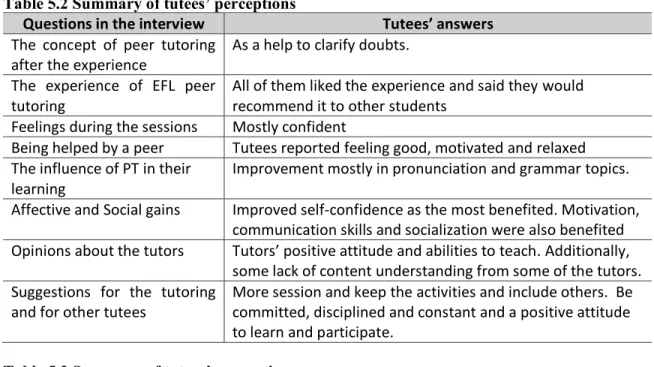
(7) Chapter V. Conclusions ................................................................................................. 83 Introduction ...................................................................................................................... 83 5.1 Findings and significance of the study ....................................................................... 83 5.1.1 Behaviors and attitudes ........................................................................................ 83 5.1.2 Participants’ assessment ...................................................................................... 85 5.1.3 Participants’ perceptions...................................................................................... 86 5.2 Answer to research questions ..................................................................................... 87 5.2.1 Specific research question 1 ................................................................................ 87 5.2.2 Specific research question 2 ................................................................................ 88 5.3 Pedagogical implications ............................................................................................ 88 5.4 Limitations of the study .............................................................................................. 89 5.5 Suggestions for further research ................................................................................. 89 5.6 Final conclusions ....................................................................................................... 90 References........................................................................................................................ 92 Appendices Appendix 1. Syllabus “asignatura de introducción a la lengua inglesa” .......................... 98 Appendix 2. Activities for tutoring sessions .....................................................................99 Appendix 3. Questionnaire instrument .............................................................................103 Appendix 4. Consent form................................................................................................105 Appendix 5. Observation instrument ................................................................................106 Appendix 6. Peer assessment instrument .........................................................................110 Appendix 7. Interview guide ...........................................................................................111 Appendix 8. Tutors’ transcript interview sample .............................................................112 Appendix 9. Tutees’ transcript interview sample .............................................................118. List of tables Table 1. Common Reference Levels ................................................................................ 30 Table 2. BIS Universities distribution ............................................................................. 31 Table 3. iTEP scores and equivalencies .......................................................................... 35 Table 4.1 The concept of peer tutoring ............................................................................ 51 Table 4.2 The role of peer tutoring in ELT ...................................................................... 52 Table 4.3 The role of the tutor in peer tutoring ................................................................ 53 Table 4.4 The expectations for academic aspect .............................................................. 53 Table 4.5 Elements of ideal peer tutoring......................................................................... 54 Table 4.6 Behavior and attitudes ..................................................................................... 57 Table 4.7 Summary of field notes for tutors ..................................................................... 57 Table 4.8. Summary of field notes for tutees ................................................................... 59 Table 4.9 Evaluation of tutors .......................................................................................... 63 Table 4.10 Evaluation of tutees ........................................................................................ 63 Table 4.11 Summary of tutees’ suggestions .................................................................... 80 Table 4.12 Summary of tutors’ suggestions .................................................................... 81 v.
(8) Table 5.1 Summary of tutors and tutees’ assessment ....................................................... 85 Table 5.2 Summary of tutees’ perceptions ...................................................................... 86 Table 5.3 Summary of tutors’ perceptions ...................................................................... 86. vi.
(9) CHAPTER I: INTRODUCTION 1.1 Introduction One of the objectives of higher education in Mexico is that students reach favorable academic levels, based on learning and integral development (Cruz Nieto & Perusquia de Carlos 2016). The language education field has taken a significant change to a more learnercentered approach in order to better promote the varied dimensions of learning. (Matukhin, 2015). Teaching and learning a second language is not linear from teacher to student. LoCastro (2003) highlights other leaners as one of the main sources of information that language learners are exposed to. Vygotsky claims that learning is socially and culturally promoted and constructed among students, and between teacher and students (Razia, 2012). Learning in a collaborative way is not a new idea; the concept of tutoring is probably as old as civilization itself, yet it wasn’t until the 1700s when it began to be used academically (Topping in Kalkowski, 1995). In the 19th century Joseph Lancaster empowered the initiative of developing children’s tutoring skills by allowing them to be involved in his “Monitorial System”. A controversial and revolutionary, yet cost-cutting system, that helped many poor children learn to read and write, and be able to monitor other kids after that. (Aldrich, 1998). Peer tutoring now is one way of cooperative learning used in the education field since it is recommended by UNESCO as a highly effective practice for inclusive teaching (Duran, 2006) The use of peer-tutoring programs as an extracurricular strategy in higher education has grown globally (Chen & Liu, 2011) as young people and teachers seem to value collaborative learning processes, either because of the low levels of school performance and the derived need to address the problem or because of the effectiveness of this teachinglearning strategy (Topping, 1996). According to Falchivok (2001) peer-tutoring techniques 1.
(10) in higher education are quite successful not only at helping students with their academic performance, but are also beneficial in terms of skills development. Sharif et al. (2012), Viáfara (2014) and Huerta, Garcia, & Velasco, (2010) conclude that involvement in peertutoring programs in language learning have a positive effect on student motivation, autonomy and self-esteem. In general, during peer tutoring, peer tutors help other students either on a one-to-one basis or in small groups in face-to-face environments. The complexity of peer tutoring has led to new models of collaborative learning in the classroom. For instance, the increasing synchronous and asynchronous technologies and collaborative learning have directed exploration of the dimensions of this teaching and learning strategy within an online context and blended models. In his compilation of online peer tutoring behavior in higher education, De Smet (2008) states that one of the contributions of online peer tutors was to provide peer facilitation and support for students. From their study, Saeed & Ghazali (2017) conclude that EFL learners engaged in seeking and providing advice in online environments. 1.2 Research context The research took place at Universidad Tecnológica Bilingüe, Internacional y Sustentable (UTBIS). This institution belongs to the Bilingual, International and Sustainable model (BIS) in higher education. The Ministry of Public Education in Mexico describes the BIS as a cutting-edge model in higher education in Mexico since it responds to international trends and is unique in Latin America. BIS Universities run under a bilingual pedagogical scheme where the courses are mostly offered in the second language. This implies for the new students to be immersed in an intensive English program, referred to as ‘curso de inmersión’ (immersion course) in which students have five-hours of English classes daily for about 4 months during their first semester and continue reinforcing their language training 2.
(11) throughout their entire career. Students in this university are trained to be Advanced Technicians in Industrial processes, Mechatronics and Information Technology. This study was developed with the help of participants from the immersion course of this university. 1.3 Statement of the problem Learning English has become a key component of higher education in Mexico. It is important as it provides the necessary tools to get in touch on an international level and gives access to information and research. Students from UTBIS are believed to struggle to obtain an A2 level at the end of the immersion course, which is crucial for an adequate performance in the subsequent courses. According to the Common European Framework of References for Languages (CEFR, 2018) and as found in Council of Europe, based on the CEFR Levels, an A2 level learner: Can understand sentences and frequently used expressions related to areas of most immediate relevance (e.g. very basic personal and family information, shopping, local geography, employment). Can communicate in simple and routine tasks requiring a simple and direct exchange of information on familiar and routine matters. Can describe in simple terms aspects of his/her background, immediate environment and matters in areas of immediate need.. Therefore, there is a need to search for and implement instructional strategies that are likely to promote students’ academic achievement in UTBIS English language. 1.4 Purpose of the study The purpose of this research is to know the impact of peer tutoring on students’ language learning and on students’ affective and social skills development. The study aims to investigate the impact of peer tutoring among BIS university students of English having the proficient learners tutoring the less proficient peers. More specifically, the study will implement peer tutoring as a strategy for improving language learning among students from a Bilingual International and Sustainable University (BIS) in the state of Puebla.. 3.
(12) 1.5 Research questions This research addresses the following research questions: General research question What is the impact of ELT peer tutoring on tutees and tutors at a BIS university in Puebla? The specific research questions to guide this investigation are: What are the tutors’ and tutees’ behavior and attitude during the tutoring sessions? What are the tutors and tutees’ perceptions about ELT peer tutoring? 1.6 Methodological framework This research falls within the category of qualitative research. According to Creswell (1998, p. 15) qualitative research is “an inquiry process of understanding based on distinct methodological traditions of inquiry that explore a social or human problem. The researcher builds a complex, holistic picture, analyzes words, reports detailed views of informants, and conducts the study in a natural setting”. Likewise, Merriam (1998, p. 6) refers to qualitative research as “an umbrella concept covering several forms of inquiry that help us understand and explain the meaning of social phenomena with as little disruption of the natural setting as possible”. To carry out the research, three stages were followed. In the first stage the participants’ perceptions about the concept of peer tutoring, the role of peer tutoring in English language learning, the role of tutors and the ideal tutoring sessions were explored to obtain information to plan a tutorial model and to incorporate the approaches and materials. During this stage, tutors underwent a peer tutoring training. The tutoring sessions were held during the immersion course, which is dedicated mostly to English classes.. 4.
(13) Secondly, the tutor-tutee teams were formed; tutees were low performance students from the immersion course while tutors were proficient English language learners from higher courses. In this stage, the peer tutoring schedules were established, and observations proceeded for information gathering. Observation focused on participants’ behavior and attitude while they worked and socialized. In the final stage, students’ perceptions towards peer tutoring for language learning were investigated. Participants were interviewed after the implementation of all the sessions. 1.7 Significance of the study The significance of this study is to contribute to the theory and practice of EFL peer tutoring in higher education in Mexico, the results are intended to provide valuable information for English language teachers thinking of employing cooperative learning in their classrooms. It may also help learners to become aware of the implications on academic performance and social skills development. The research is important as it seeks to investigate the impact of peer tutoring on learning a second language as a measure against poor academic achievement in English language, specifically at BIS universities in Mexico. Within this study, it is hoped to contribute to the field by encouraging the inclusion of this strategy to support the language teaching and learning process. Despite the spreading interventions of peer tutoring in language learning, few have been oriented towards the implications of this strategy in public higher education in Mexico. This study attempts to address this gap in research. This study also has personal significance. The research on peer tutoring was motivated by the importance of providing EFL students with more opportunities to use the language and stimulate cognitive development. The proposal derives from a preliminary view about what occurred inside a BIS university offering teacher-. 5.
(14) tutoring English language sessions, in which students often neglected their participation despite the highlighted importance of extra instruction and practice to reach the demanded level of English. It derives also from noticing the demand and assistance to learner- learner tutoring in Chemistry and Physics in the same institution. 1.8 Research organization The study first, in Chapter One, stated the problem in question for this research, the context where it was carried out, the questions that helped determine the impact of ELT tutoring in higher education, and the significance of the study. Chapter Two reviews the relevant literature on peer tutoring. Then, Chapter Three details the methodology and instruments applied to obtain the data and how it is analyzed. Subsequently, in Chapter Four, the findings emerging from the data are presented. Finally, Chapter Five discusses how the results address the research questions.. 6.
(15) CHAPTER II: LITERATURE REVIEW Introduction This chapter aims to introduce the reader to the literature associated with the main areas of interest in this study. These areas are peer tutoring, English language teaching and learning in higher education in Mexico, and Bilingual International and Sustainable (BIS) universities. The first part of the chapter gives a brief description of peer tutoring; its background, definition, models and types as well as its academic and affective benefits and the impact in higher education. Next, it overviews the characteristics of university language learners in Mexico, the challenges of teaching and learning English in higher education in Mexico and the research done in the field. Finally, the chapter describes BIS universities: their main characteristic, origin, educational model and the importance of English language learning at these institutions. 2.1 Peer tutoring Peer tutoring has a long history in civilization; it is a very old instructional practice that is said to be traceable as far as hunter-gatherer times as probably the first pedagogy among primitive societies (Jenkins and Jenkins, 1987). For others, such as Wagner (as cited in Kalkowski, 1995) and Topping (1996), peer tutoring is rooted in ancient Greece. According to Hornby, Atkinson & Howard (1997) and Deming (1986), Aristotle used student leaders to help him and the Romans to teach and test younger students. On the other hand, Aldrich, (1998) and Deming (1986) refer to “The Monitorial System” of Joseph Lancaster in the 19th century as the first academic use of peer tutoring. Having briefly described the history of peer tutoring, some definitions of this concept are discussed.. 7.
(16) 2.1.1 Definition of peer tutoring The definition of peer tutoring has evolved as more approaches and perspectives have emerged. According to Topping (1996, p. 322) “Archaic definitions of peer tutoring perceived the tutor as a surrogate teacher, in a linear model of the transmission of knowledge, from teacher to tutor to tutee.” Kalkowski (1995) claims that the most succinct definition of peer tutoring comes from Damon and Phelps in which an expert child instructs another novice child. However, the notion of experts has been discussed in today’s educational contexts. Thus, more recent studies relate peer tutoring to mutual help. Topping (1996) enlightens that peer tutoring interaction was different from teacher-student interaction and defines peer tutoring as “more able students helping less able students to learn in co-operative working pairs or small groups carefully organized by a teacher” (p. 322). Falchikov (2001), in this regard, says that in peer tutoring “students learn with and from each other, normally within the same class or cohort” (p.3). In his notion of “learning by teaching”, Topping highlights that peer tutoring “involves people from similar social groupings who are not professional teachers helping each other to learn and learning themselves by doing so” (2005, p. 631). Likewise, Duran (2006) defines peer tutoring and cooperative learning as “una forma mas sofisticada de trabajo en grupo donde, sobre todo, se promueve la interdependencia positiva entre los miembros del equipo y la necesidad de la aportación de cada miembro para lograr el objetivo” (a more sophisticated way of group working, where, above all, positive interdependence is promoted among the team members and the need for the contribution of each member to achieve the goal), (p.7). From the point of view of Chen and Liu (2011), peer tutoring as a kind of peer-mediated, peer-assisted learning, employs problem solving and systematic teaching strategies to help at-risk students to motivate them to learn. According to Nguyen (2013), peer tutoring is “an instructional method that uses pairings of 8.
(17) high-performing students to tutor lower-performing student in a class-wide setting or in a common venue outside of school under the supervision of a teacher” (p. 2). For Duran, Flores, Mosca and Santivago (2014, p. 31) peer tutoring is “una forma de aprendizaje entre estudiantes, organizada generalmente entre parejas, en la que uno de ellos adopta el rol de tutor (y aprende ofreciendo ayuda pedagógica a su compañero) y el otro, de tutorado (y aprende por la ayuda ajustada y permanente que le ofrece el tutor)” (a learning strategy among students generally organized in pairs in which one of them adopts the role of the tutor (and learns offering pedagogic help to his or her peer) and the other adopts the role of tutee (and learns through the adjusted and continuous help that the tutor provides him or her). Having discussed the evolution of the concept of peer tutoring, the types or models and organizational variables of peer tutoring are described. 2.1.2 Types and models of peer tutoring Vincent (1999) distinguishes two types of peer tutoring: a) incidental and b) structured. He describes them as follows: •. Incidental tutoring occurs when the tutoring, often when teaching two or more different grades in a single classroom, is not generally a systematically planned activity but rather is rather spontaneous when students work, cooperate and play.. •. Structured tutoring refers to organized, planned and prepared by the teacher, usually implemented for specific subjects or cases.. Peer tutoring encompasses a variety of instructional approaches or models including Cross-Age tutoring, Peer Assisted Learning, Cooperative Learning and Reciprocal Peer Tutoring which are described below.. 9.
(18) 2.1.2.1 Cross-Age tutoring Cross-Age tutoring is an approach characterized by joining students of different ages. Robinson and Schofield say that this form of peer tutoring “involves students at different grade level, with the older student acting as a tutor for the younger student(s)” (2005, p. 3). Similarly, Topping (1996) refers to cross-year small-group tutoring-understood as Cross-Age tutoring- as a form of peer tutoring where upper year undergraduates tutor lower year undergraduates, having each tutor deal with a small group of tutees. Cross Age tutoring often involves dyads where tutors are entitled and expected to organize work, ask questions, encourage interactions, and facilitate better study habits. (Hott and Walker, 2012). During Cross-Age tutoring the position of tutor and tutee do not change, with the tutor usually having higher skill levels. 2.1.2.2 Peer Assisted Learning (PAL) According to the University of the West of England Bristol (2018), Peer Assisted Learning (PAL) is “an academic support scheme where students, trained in mentoring, facilitation and coaching techniques, plan and deliver study support sessions for other students”. The University of West of England also claims that this scheme provides opportunities for lower year students to consolidate their own understanding of the discipline within a collaborative environment and that also supports students with their transition to University. For Rohrbeck, Ginsburg-Block, and Fantuzzo PAL is “an umbrella term, that includes dyadic peer tutoring and small-group cooperative learning interventions” (2003, p. 732). For these researchers, PAL interventions incorporate mediated systematic strategies among peers. Green (2011) refers to PAL as a considered and evaluated method of studentto-student support. A main characteristic of PAL is that learners can function as tutors or. 10.
(19) tutees at different times and that the pairs or teams typically work at the same skill level, without a large discrepancy between abilities. (Hott and Walker, 2012) 2.1.2.3 Cooperative Learning (CL) Another model of peer tutoring is Cooperative Learning (CL). Topping (2005) refers to this model as a working together activity that “is likely to involve the specification of goals, tasks, resources, roles and rewards by the teacher, who facilitates or more firmly guides the interactive process” (p. 632). Topping also points out that CL is typically operated in small groups of heterogenous learners and that it often requires training to ensure equal participation and simultaneous interaction. According to Yusnani, (2018, p. 976) CP is “is a study approach aimed to manage classrooms activities into academic and social learning experiences.” CP aims to manage classroom activities into academic and social learning experiences to dissolve students’ diversities into cognitive, behavioral and social interdependence (Ibid). 2.1.2.4 Reciprocal Peer Tutoring (RPT) In describing Reciprocal Peer Tutoring (RPT), Falchikov (2001), says that in “this form of peer tutoring, randomly selected pairs of students test each other in preparation for a class test. RPT enables each student to play the role of the tutor and tutee, and thus reap the benefits derived from teaching, and being taught by another student” (p. 20). For Hott and Walker (2012), RPT utilizes a format that encourages teaching materials and evaluation of peers. Variations exist among instructional approaches. However, the underlying theory is consistent: support and cooperation among learners. Thus, for the purposes of this study, the terms Cross-Age tutoring, Peer Assisted Learning, Reciprocal Peer Tutoring and Cooperative Learning will be used as synonyms for Peer tutoring. 11.
(20) 2.1.2.5 Organizational variables of peer tutoring For Topping (2005) the methods of peer tutoring or peer learning can vary on organizational dimensions, including the following: •. Curriculum content: the knowledge or skills or both to be covered.. •. Contact constellation: one helper working with a group of peers, sometimes two helpers with a group together.. •. Within or between institutions: peer tutoring can take place within the same institution or between institutions in the neighborhood.. •. Ability: the helper might have superior mastery of a portion of the curriculum.. •. Role Continuity: permanent roles are required, especially for same-ability tasks.. •. Characteristics of the helped: a targeted group, such as those with disabilities, considered at risk of under achievement, failure or dropout, or those from a minority such as ethnic, religious or linguistic.. •. Objectives: to target cognitive, formal academic, affective and attitudinal, social and emotional, self-image and self-concept gains or any combination. The objectives may also be organizational which include reducing dropout and increasing access.. •. Voluntary or compulsory: it might require participation or selection.. Similarly, Falchikov refers to three key variables in the organization of peer tutoring: •. The status of participants: same-level or cross-level peer tutoring. •. The location of the activity: it can be related to cross-institutional peer tutoring. •. The roles undertaken: it might be fixed-role or reciprocal peer tutoring. After analyzing the types, models and some of the organizational variables of peer tutoring, the academic and social and affective benefits and outcomes of peer tutoring are described.. 12.
(21) 2.1.3 Academic, social and affective benefits of peer tutoring 2.1.3.1 Academic benefits Research on peer tutoring using Peer Assisted Leaning (PAL) and Cooperative Learning (CP) suggests significant improvements in academic achievement in the targeted area and cognitive gains for both, tutors and tutees (Kalkowski, 1995; Topping, 2005; Falchikov, 2001; Duran, 2016; Nguyen, 2013). Similarly, Green (2011) refers to improved performance and increase in student retention- successful completion of tasks and/or students’ engagement in their studies- as pedagogical advantages of PAL. Regarding peer and Cross-Age tutoring, Kalkowski (1995) in her descriptive analysis of research findings suggests that tutors and tutees have reported benefitting from tutoring in mathematics, language arts, reading and sciences. Falchikov (2001) in her survey of studies of peer tutoring techniques in higher education has identified academic outcomes such as better performance and metacognitive outcomes such as learning how to learn. Studies involving Reciprocal Peer Tutoring have resulted in better examination outcomes and higher satisfaction rating from participants in comparison with a more traditional type of learning (Fantuzzo, Dimeff, & Fox in Falchikov, 2001). Likewise, Nguyen (2013) claims that peer tutoring as supplement to traditional instruction promotes higher-order thinking since it encompasses explaining concepts in detail, high level questioning, and the use of supportive communication skills. Comfort and McMahon (2014) in their study on the effect of peer tutoring on academic achievement, state that their results and analysis demonstrated that the peer-tutored group, for both tutees and tutors, achieved significantly higher grades in comparison to those who were not peer tutored.. 13.
(22) 2.1.3.2 Social and affective benefits. The benefits of peer tutoring in the education field are not limited to the academic aspect. Many positive outcomes have been documented on the social and affective sides. Kalkowski (1995) highlights improvements in self-esteem, social skills, attitude towards school, and school attendance as significant affective outcomes. Compiling some studies and their sources, Vincent (1999) lists common effects found in peer tutoring programs on the tutor and the learner including improved academic achievement, improved motivation, improved use of instructional time, improved self-direction and independence, improved attitude toward tutored subject area, and improved self-confidence. In this regard, Topping (2005) indicates that affective changes in attitude to school, the teachers, the subject, the peer, and the self might be found in peer tutoring programs. According to Falchikov (2001), the different peer tutoring techniques appear to have non-academic benefits in terms of affect, motivation as well as cooperation and confidence. Examining the benefits of peer tutoring based on existing research, Nguyen (2013) suggests that the gains of peer tutoring strategies are also reflected in positive effects on social, self-control, and behavioral outcomes. Also, that training students in peer tutoring strategies can help students take responsibility for their learning and academic failures. According to a manual for the implementation of peer tutoring by the Secretariat of Public Education in Mexico (2014), peer tutoring improves attitude and readiness toward learning, fosters the tutor and tutee personal development, and helps to build-up identity among the learners. As some of the academic and non-academic benefits of peer tutoring techniques have been presented, the impact in higher education in Latin America is now discussed.. 14.
(23) 2.1.4 The impact of peer tutoring in higher education in Mexico and Latin America Cooperative work plays an important role in our society, so it is one of the most important competencies in most university programs. The use of peer tutoring programs has been popular in Europe and English-speaking countries. In Latin America, its implementation is still limited (Duran & Flores, 2015). However, the relevance that tutoring is gaining in Latin American universities is significant due to the fact that it is a key component in providing personalized attention and in guiding students to personal, academic and professional development (Lobato & Guerra, 2016). With the purpose of identifying evidence-based practices in Spanish and Latin American university contexts published in peer-reviewed journals, Duran and Flores (2015) compile and describe some peer tutoring practices in Spanish-speaking countries. They classified the collected practices into two categories: “Proctoring” which they define as those related to tutorial towards orientation generally involving students from the last courses as tutors to the new students, and “Tutoring”, understood as academic tutorial. Their findings suggest that orientation tutoring or Proctoring is more common in Spanish-speaking countries: University of Granada, Laguna, Cádiz, Deusto, Sevilla, and Salamaca, and Polytechnic of Barcelona, Madrid, and Complutense in Spain. In Latin America, the Proctoring practices were located at Universidad de la Republica (Uruguay), Universidad Autónoma de Guanajuato, Universidad Autónoma Nacional de Mexico, Universidad Juárez Autónoma de Tabasco, Universidad Autónoma de San Luis Potosí, and Universidad Autónoma de Yucatán. On the other hand, the academic tutorials or Tutoring were reported to be found in Universidad Autónoma de Barcelona, Universidad Autónoma Benito Juárez, Oaxaca, and Pontificia Universidad Javeriana in Colombia. Duran and Flores conclude that the combination of these two peer tutoring practices can offer a very powerful source of 15.
(24) teaching improvement in university contexts. Moreover, they suggest that peer tutoring techniques are excellent for providing learning opportunities for both, tutees and tutors as they allow students to practice and develop their pedagogical skills. Similarly, Lobato and Guerra (2016) explore the implementation of tutoring practices in Latin-American and Spanish universities. By revising the educational university reforms that shape the practices in those countries, they say that the adoption of tutoring modalities in Ibero-American universities indicated gradual construction processes through the definition of policies or tutoring programs. Afterwards, based on a bibliographic selection with evaluations about the impact, the conception and practice of the different peer tutoring modalities in the different institutions were analyzed. They reported peer tutoring practices in Spain, Mexico, Colombia, Brazil, Argentina and Peru concluding that despite the different rhythm achievements in those countries, the implementation of tutoring practices has been a quality indicator, a change in higher education culture, a professional development for teachers, an organizational change in the university framework, and an improvement of guidance services. In order to address the need to develop peer tutoring experiences in our university reality, Duran and Huerta (2008) carried out research in Oaxaca, Mexico with three purposes: 1. Promote reflection about the relevance of peer support as a teaching strategy. 2. Offer students the opportunity to practice effective teaching. 3. Act as tutor and tutee offering and receiving pedagogical aid that adjusts both the learning of the content and reflection on educational practices. The reciprocal peer tutoring practice results involving 43 teacher students and 12 sessions reported good grades for all the learners and with no failing grades for the first time in the course. The experience offered the participants emotional advantages and they reported 16.
(25) positive feelings such as recognition, generosity, security, commitment and responsibility as well. (Ibid) Regarding Mexican contexts, a peer tutoring program was implemented at Universidad Pedagógica Nacional to approach and face the academic insertion, the transition of levels, the filiation to the university and the development of academic skills. Having 60 students of the last semesters tutoring new students in academic, administrative and sports and cultural aspects, Rubio (2009) states that peer tutoring developed basic academic and performance skills, strategies for learning and social communication skills. But above all, she points out that the tutor-tutee relationship developed a link that helped the newly enrolled student improve their self-esteem and increase their personal satisfaction, aspects that contribute significantly to the insertion into the university context. Another study in higher education was carried out at Instituto Tecnológico de Sonora. The quantitative study had the general objective of determining the impact of face-to-face and virtual tutoring programs on students’ academic achievement during the semesters they participated in the program and in the subsequent courses (Salazar, García, Vales & Cruz, 2017). Two thousand nine hundred ninety-five students from different areas in the institution participated in the study which was done with a quasi-experimental design. In order to evaluate the impact of both programs on the academic achievement of students during the semester in which they took the tutoring course and during the subsequent semesters, the researchers used and analyzed the students’ points on verbal and reasoning and average grades for the semesters under study. The researchers conclude that “The tutoring program showed a favorable impact on the index of students’ failing classes, during the semester they are having tutoring, but not during the subsequent semesters, during which they did not participate in the tutoring program” (p. 179). They found that the grade point averages 17.
(26) obtained by the students from all the semesters analyzed in face-to-face tutoring were statistically different from those who did not participate in the program. Similarly, the students who participated in the virtual tutoring obtained statistically different grade point averages in comparison to students who did not have tutoring in the first, third and four semesters. In the second semester the two groups were statistically equal (Ibid). Given that some studies regarding the impact of peer tutoring in a university context in Mexico and Latin America have been explored, the second part of this chapter is now presented. 2.2 English language teaching and learning in higher education in Mexico Learning a second language has become an important part of higher education in Mexico given its relation to competitiveness, economic development and growth, and global trade and employability and access to knowledge and information (Inglés para la competitividad y la movilidad social, 2015 and British Council, 2015). Linguistic competence and the learning of a foreign language by Mexican university students is influenced by multiple factors including previous experience with the language, linguistic competence in Spanish, students’ cultural identities and the contextualization of the target language within students’ own cultural framework (Ramírez-Romero and Pamplón, 2012). According to Excelsior (2017), in Mexico, three out of ten young people between 18 and 22 years of age have the possibility to attend a higher education institution. In the school year of 2015 and 2016, the university student population was 3.64 million concentrated in the main cities. Many universities in Mexico do not have an institutional English program nor a centralized process of assessing the students’ levels (British Council, 2015). It is, however, a common practice for higher education institutions to require a minimum score on an institutional test such as TOEFL (around 450 points) to graduate. To undertake study. 18.
(27) programs abroad, either language learning or content learning, students must obtain a certain level of English (Ibid). 2.2.1 Challenges of teaching and learning English in higher education in Mexico In Borjian’s (2015) study, which attempted to help US-based teachers understand their Mexican students’ English-language training, the major obstacles that Mexican teachers see for students learning English in Mexico and the teachers’ recommendations for improving instruction in Mexico were explored. In this research, Borjian invited 76 teachers of English from a public university in central Mexico to discuss how they became interested in learning English and how the language had affected their lives. The English teachers were also asked to provide recommendations for others interested in learning English. Thirty-five of the participants reported students’ attitudes and motivation played the most important role in English language learning expressing that their students’ lack of interest and their perceptions on the difficulty and utility of English has limited their progress. Another important obstacle that Borjian found, reported by 16 respondents as having the most important role in language learning, was the Mexican educational system, stating that the focus on grammar rather than emphasis on communicative competence has been detrimental to students’ long-term learning. Other obstacles mentioned by seven and six participants were the limited access to the language outside the classroom and the students’ limited economic resources -less access to English classes- accordingly. Regarding the teachers’ recommendations for improving instruction, Borjian found that the most common suggestion provided by the teachers focused on initiating students to learning strategies. The teachers emphasized the need for students to take responsibility for their own learning and the need to practice and be immersed in the language to enhance their proficiency. Significantly, another group of teachers empathized motivation and attitude 19.
(28) toward learning to improve instruction. Another recommendation suggested by the respondents, although less frequently mentioned, was the need for students to know the importance of English for mobility. After describing the challenges of learning English in Mexico from the teachers’ perspectives, an insight on foreign language teaching and learning research in Mexico is now presented. 2.2.2 A state of knowledge of English language teaching and learning in Mexico With the aim to establish a state of knowledge, -a systematic analysis and review of research- on foreign language teaching and learning in Mexico, Ramirez and Pamplón (2012) identified and invited a group of 70 academics from 21 Mexican universities around the country to collaborate in their study. The researchers collected and analyzed research obtained in 26 states in the country for three years. They based the geographical area to cover in each state on the size of the state, the location of the institutions and with language programs, and the number of teachers and students in each area. Each institution was requested information on reports, books, articles, theses and dissertations. Ramirez and Pamplón selected 548 out of the 1375 products for the final state knowledge report. The concentration and analysis of the data was carried out on two levels; at an institutional, or state level, and at a national level. They describe their findings in relation to students, teachers and learning activities, strategies and teaching methods among others. According to Ramirez and Pamplón, the studies regarding students found that learners achieving higher linguistic competence in the language had received more hours of instruction in elementary, secondary and high school. Other factors identified as influencing language learning were their education background, exposure to the language in and outside the classroom, their socio-family setting, and students’ cultural identities. Regarding the teachers’ category, the most important findings were the teachers’ working conditions and 20.
(29) the level of preparation and educational background. According to Ramirez and Pamplón, the findings in some of the institutions reviewed indicate poor professionalization of language teachers, frequent rotation of the personnel and lack of academic criteria for hiring. Studies also revealed the need for greater training and professional development and that there are not very adequate working conditions for Mexican teachers, not only language teachers. The academics also indicate that there is still research needed about English teachers in Mexico. In regard to learning activities, strategies and teaching methods, the results suggest that the use of a variety of learning strategies and teaching techniques improves integral learning and that the use of collaborative methods enhance learning (Ibid). After describing some studies on English language teaching and learning in Mexico, it is time to describe the research done on peer tutoring for English learning. 2.2.3 Research on ELT peer tutoring While the literature on learning through peer tutoring in the classroom is quite broad, research on this strategy in the field of a second language in higher education is not very extensive. In a program conducted at a university in Japan and using peer tutoring in English as Foreign Language, Bradford-Watts (2011) concluded that despite the obstacles encountered, students were able to learn and share what they learned with their peers. She also pointed out that the students could develop interesting and interactive classes for their peers. In the study, conducted the four previous years of its publication, students took compulsory English classes during the second semester of the first school year having 14 weekly 90-minute lessons and one exam in the 15th week. The groups were between 30 and 40 students with different levels of competence in the language and with a mandatory use of an established text. During the first class, students were assigned to eight groups at random. The members of the group decided on the unit of the text to be taught, the relevant sections 21.
(30) and included non-textbook activities for the selected material. Students were recommended to limit the time to the textbook to 20 minutes and dedicate the remaining minutes for activities that they constructed themselves. During the planning stages, the teacher circulated among the groups supporting with ideas, answering questions and approving the final plans (Ibid). Bradford-Watts found that the peer-teaching sessions were mostly dedicated to grammar or vocabulary exercise from the book, although some groups chose reading or listening activities. There were three evaluations for the peer teaching lessons: teacher, peer and self-evaluation. For the peer evaluation, the researcher indicates that it was the class teacher who was in charge of collecting the grades from the learning groups at the end of the teaching lessons. In their final self-evaluation reports, almost all learners suggested that they could easily understand the content lesson taught by their peers. Given that most of the learners reported having enjoyed peer teaching and learning and that they reported benefits related to the experience, Bradford-Watts argues that peer teaching “is an effective means of student-centered, socially-constructed instruction for the foreign language classroom”. (Bradford-Watts, 2011, p. 34) Alrajhi and Said (2015) carried out a study at Sultan Qaboos University to investigate the influence of a peer tutoring program on students’ English self-concept- feelings about the self. One hundred twenty-five participants from different colleges in the university enrolled voluntarily for a one-to- one tutoring program where senior students studying English as their major tutored peers from the English foundation course through a year. To measure the levels of participants’ self-concept, the researchers developed two Likert scales; one to examine students’ feelings and one to examine perceptions about factors related to the tutorial center and the tutors. The study results after attending the sessions indicated that participants had high levels of English self-concept and perceived the tutorial program factors (TPFs) of 22.
(31) sharing similar experiences in learning English, small age gap between the tutor and tutee, and encouraging the tutee to try to use English even if he/she made mistakes as having a positive impact. Similarly, after attending the tutorial sessions, “participants felt that their English language levels improved, they also became more confident, and more willing to learn” (p. 198). Their findings indicated that peer tutoring facilitated English learning and that participants showed improvement in their levels of English self-concept in learning the language. In a case study conducted in a peer tutoring program for English as a Second Language at a university in Malaysia, Sharif et al (2012) suggest that the nature of the activities used in this strategy which are not threatening and are less intimidating compared to the more rigid class environment, encouraged students to put the language into practice. In addition, they also highlight that this approach also provided plenty of opportunities to tutees for language use. Strong support system, small age gap difference, good rapport and sensitivity to the tutees’ language problems seemed to lead tutees to use English more (Ibid). The eight-week program set up to promote English language usage among university students to enhance their English proficiency was based on the students' life experiences. The tutors; more proficient students in English than the tutees, were carefully selected and appointed by the institution, while the tutees were first-year to fourth-year students who enrolled themselves in the program. The maximum number of tutees per tutor was five. During the program tutors were responsible for providing opportunities for the tutees to use the language in a maximum way based on their own study program. Although there was not a syllabus, there were several rules to be followed by the tutors to maximize the use of the language; the activities were based on games to stimulate student interest and motivation in learning. Three approaches. 23.
(32) were used in the activities: game, personal experience and speaking in action. From the data obtained through participant observation and interviews, the researchers claim that peer tutoring led tutor and tutees to positive language development as tutees seemed to use the language better and improved their proficiency. Also, that the program seemed to equip the participants with social and communication skills. Another case study peer tutoring research that focused on English as a Foreign Language was carried out at Universidad Pedagógica y Tecnológica de Colombia, in the Modern Languages program (Viàfara, 2014). In this program, the tutors who were 15 student teachers of English as a Foreign Language from sixth to ninth semesters, tutored their first semester peers for three consecutive semesters with meetings once a week for two hours. Because student teachers, in addition to tutoring, were expected to develop research skills, they collaborated and reflected to learn the theory and practice regarding tutoring and research. Information from the tutors was obtained to explore the academic and personal influence to belong to the group. The collection of data was through research journals, surveys and documents, and interviews. From the findings, Viàfara (2014, p.206) states that: Firstly, student teachers’ knowledge of their discipline was affected since their developed proficiency in the foreign language. Secondly, data evidences that they strengthened their pedagogical practices as a result of their group affiliation. Likewise, in regards to their general and content pedagogical content knowledge, prospective teachers opened to positive attitudes and formative actions in employing research. (sic). Viáfara also concluded that study groups are powerful tools to create scenarios for language use. In the same way, he claims that practice and reflection on research seemed to favor the pedagogical skills of mentors as they became better at planning and using research tools to solve problems. Viáfara and Ariza (2008) diagnosed, planned and implemented a tutoring model to support autonomous learning in language students at a public university in Colombia. In the 24.
(33) diagnostic stage of the action-research study, the researchers explored Modern Language students and teachers’ perceptions about tutoring and autonomous learning using a questionnaire, reflections regarding past tutoring experiences and analysis of existing documents produced from the faculty and the institution about the foundation and implementation of tutoring and autonomous learning. During this stage, it was found that the roles of tutoring for the participants were to diagnose aspects to address, to strengthen study habits and learning strategies, to facilitate the development of communicative skills of tutees and evaluation of progress (Ibid). In the planning stage, tutoring sessions were carried out before the construction of the tutoring model in which tutors were selected by being interested in the project and in which tutees voluntarily accepted to participate. After four weeks of tutoring, tutors and tutees were interviewed. By considering the tutors, tutees and teachers as well as the theory regarding autonomous learning and tutoring in higher level, Viáfara and Ariza established three fundamental objectives to work in the implementation of peer tutoring sessions: 1. Support the development of skills and knowledge in the learning of the foreign language. 2. Guide the tutees in aspects of their integral performance and development. 3. Provide basic tools for learning to learn Huerta, García and Velasco (2010) investigated a peer tutoring program applied at Universidad Autónoma “Benito Juárez” in the state of Oaxaca. Such program offered as an optional subject was designed with the main purpose of improving the level of English in the program belonging to Lenguas Extranjeras en el Área de Inglés (LLEAI). The LLEAI program, in addition to the teacher training in the area of English, aims for students to develop skills to express themselves clearly and fluently orally and in writing (Ibid). To be tutors, the 25.
(34) students had to receive an initial training of six sessions focused on the fundamentals of peer learning. Also, they needed to be students from 5th to 7th semester and have an advanced level of English or a good command of it. The tutees were students who showed serious deficiencies in the language through a diagnostic test at the beginning of the course and with averages of six or seven out of ten. Tutors and tutees received a 10-hour training focused on the development of communication skills as part of the initial training. After the initial formation, the tutor-tutee couples were formed looking for the tutor to be more skillful than the tutees and that the functions could be maintained throughout the course. The teacher in charge of the group was responsible for the organization and development of the sessions to ensure that the tutors knew what to do, how to act and have support if required. The program became more autonomous as the tutors acquired experience and confidence. They could make decisions regarding the material and activities to be used with the tutees, in addition to the planning time (Ibid). Before concluding the sessions, the couples and the teacher reflected on how it had gone: the functioning of the planning, the efficiency of the materials used and the problems that arose. The tutors and tutees were evaluated by the teacher in charge of the group. The evaluation of the tutors was based on their performance in three moments: the preparation of the planning, the development of the tutoring session, and the reflection of the experience. Regarding the tutees, they were evaluated with respect to the completion of the exercises and participation, as well as the ability to request clarifications and express doubts. From the results obtained through observations, evidence in portfolios and reflections on the experience of being tutors and tutees, Huerta, García and Velasco highlight the encouragement of students' participation in their learning, the increase of tutors’ teaching skills, and more opportunities for the tutees to improve their level of English. In the same way, they concluded that the self-esteem of 26.
(35) participants as well as the teachers improved: students since they had more confidence and experienced success, and teachers since they reinforced the idea that education is not bilateral and that students can benefit from mutual support. After analyzing some research on ELT peer tutoring, the third and last part of this chapter is now presented. 2.3 BIS Universities According. to. SEP’s. platform. (Retrieved. August. 2018. from. http://cgutyp.sep.gob.mx/), La Coordinación General de Universidades Tecnológicas y Politécnicas (The General Coordination of Technological and Polytechnic Universities) is the sub-area of higher education in Mexico responsible for promoting a quality education that allows the training of competitive professionals committed to regional and national development as well as contributing to a fairer society. The general purpose of this Subsystem of Higher Education (Programa Anual 2013) is to “Contribuir a la mejora de la calidad de la educación superior, como un medio estratégico para acrecentar el capital humano y la competitividad requerida por una economía sustentada en el conocimiento, mediante el desarrollo de políticas, estrategias y procesos que aseguren el fortalecimiento y consolidación del Sistema de Universidades Tecnológicas.” (to contribute to the improvement of the quality of higher education as a strategic means to increase human capital and the competitiveness required by an economy based on knowledge, through the development of policies, strategies and processes that ensure the strengthening and consolidation of the Technological University System). In order to increase the competitivity and social mobility of the country, the Secretariat of Public Education (SEP) promotes actions and programs that increase the percentage of the population that masters a second language, particularly English. To. 27.
(36) respond to the imperative of new models of vocational training and internationalization of higher education, a new model of Bilingual, International and Sustainable (BIS) Technological and Polytechnic Universities has been promoted. (Secretaría de Educación Pública, 2018) 2.3.1 BIS Universities main features Universidad Tecnológica el Retoño (2019) describes the BIS model as a cutting-edge model of higher education in Mexico that responds to international trends and is unique in Latin-America. The Secretariat of Public Education defines the BIS Technological and Polytechnic Universities as innovative institutions; whose educational model accepts the challenge of increasing the country’s competitiveness and social mobility and whose goal is to contribute to the productive needs of the national and international economy. (Secretaría de Educación Pública, 2018). As in the rest of the Technological Universities, the BIS modality offers careers based on the real needs of the state’s business activities allowing the students to reach their academic training and professional development expectations (Lineamientos de la modalidad Bilingüe, International y Sustentable de la Coordinación General de universidades Tecnológicas y Politécnicas, 2018). BIS Technological students graduate as “Técnico Superior Universitario Bilingüe” (Bilingual University Technicians) in 2 years and 4 months. Some institutions offer the option for students to continue their studies as Bilingual Engineers after satisfactorily completing their Technological courses (Ibid). The BIS model preserves the pedagogy of training advanced university technicians and engineers under professional competencies with a practical training, but where new students must attend a first semester of intensive English language referred to as “Curso de. 28.
(37) Inmersión” (Immersion Course) since courses throughout their career are offered mostly in the second language (Secretaría de Educación Pública, 2018). The immersion course encompasses 525 hours of English along with Mathematics and orientation tutoring, offered by teachers. For the English classes, students are grouped according to their language level. At the end of this course, the expected minimum result of the English language proficiency is an A2 level according to the Common European Framework of References for Languages (CEFR), accredited through an official language certification (Lineamientos de la modalidad Bilingüe, International y Sustentable de la Coordinación General de universidades Tecnológicas y Politécnicas, 2018). The teaching and learning practices during the course focus on the four skills: listening, writing, reading and speaking. For that reason, the students also attend speaking, listening, reading and writing communicative-based workshops to provide more opportunities to reach the A2 level and contribute to better performance and communication in the subsequent courses (Ibid). The content of the workshops is expected to be related to the main course. Once students reach the A2 level at the end of the immersion course, they can enroll in the first semester or Quarter 1, in which content classes start. Throughout their career the number of courses offered in English will increase until most or all courses are taught in the second language. There is not an established English level of command to enroll in a BIS University, although English level is one of the three aspects used to evaluate on the admission test (Ibid). According to Lineamientos de la modalidad Bilingüe, International y Sustentable de la Coordinación General de universidades Tecnológicas y Politécnicas, 2018 (Guidelines for the Bilingual, International and Sustainable modality of the General Coordination of Technological and Polytechnic Universities, 2018), 97% of the applicants do not possess basic knowledge of the language; only 3% of them are considered to have a 29.
(38) B1-B1+ level. Students from BIS Technological universities are expected to graduate with a B2 level. Likewise, students from BIS Polytechnic Universities are expected to graduate with a B2 level as minimum, a C1 being more desirable. Table 1. Common Reference Levels. Source: Common European Framework of References for Languages. International mobility plays an important role as part of the training of students of the BIS Model. For that reason, some exchange programs have been made with Community Colleges of the United States and Canada (Secretaría de Educación Pública, 2018). The Sustainable element of BIS universities is incorporated in the architectural design of the facilities and the use of construction materials to save energy. Some BIS institutions incorporate water treatment, waste recycling and capture of rainwater practices as well as use of solar and/ or wind energy and recover and plant green areas as important CO2 emission. 30.
(39) mitigators (Secretaría de Educación Pública, 2018; Universidad Tecnológica el Retoño, 2019). Emerging from the foreign economic investment and the derived particular needs in Aguascalientes, Universidad Tecnológica El Retoño was the first public university to run under the BIS pedagogy in 2012. To date there are 26 BIS universities distributed along the Mexican territory. Now that the main features of BIS universities have been described, the educational model of BIS universities is presented. Table 2. BIS Universities distribution. Source: SEP México, 2018.. 31.
Figure



+7


Documento similar
Imparte docencia en el Grado en Historia del Arte (Universidad de Málaga) en las asignaturas: Poéticas del arte español de los siglos XX y XXI, Picasso y el arte español del
Que en la reumon de la Comisión de Gestión Interna, Delegada del Consejo Social, celebrada el día 17 de marzo de 2011 , con quórum bastante para deliberar y
De esta manera, ocupar, resistir y subvertir puede oponerse al afrojuvenicidio, que impregna, sobre todo, los barrios más vulnerables, co-construir afrojuvenicidio, la apuesta
scheme with correction has been proven as accurate as the second order scheme, a double simulation with the standard anisotropic model with
Then, only two possibilities are available for the transitions on the peer node: the peer remains in Operational state until it receives the Probe Exploring message, or, only in
The inclusion criteria were: 1) articles published in peer- reviewed journals; 2) articles that included adults diag- nosed with schizophrenia in their sample; 3) articles that
On the other hand, Falk and Ichinio’s findings do agree with our FP and L conditions in experiments 1 and 2, where familiar peer effects seem to increase honest behavior compared to
Lo más característico es la aparición de feldespatos alcalinos y alcalino térreos de tamaño centimétrico y cristales alotriomorfos de cuarzo, a menudo en agregados policristalinos,
