
The Connections between Spanish, Catalan, and English: The Teaching of Greco Latin Prefixes and Suffixes in EFL through Educational Games
68
0
0
Texto completo
(2)
(3) Abstract: Vocabulary development is thought to be one of the most essential aspects when learning a language. However, the current Spanish educational system seems to be more focused on the teaching of grammar than on the teaching of vocabulary. This is clearly reflected in the students’ language performance, which is proved to be one of the poorest across Europe. A possible measure aimed at helping EFL students increase their vocabulary would be the teaching of Greco-Latin prefixes and suffixes. Taking into account that in the Balearic Islands Spanish and Catalan are spoken, it is imperative to analyse the benefits that teaching this grammar strategy in these two languages would have for EFL learners. This paper reveals the lack of coordination that exists in the three language curricula of the Obligatory Secondary Education, which is mirrored in the lack of coordination among the departments of the IES Son Ferrer, a high school on the island of Mallorca in Spain. Teaching Greco-Latin prefixes and suffixes may draw a lukewarm response from students. For this reason, the best approach to the teaching of this grammar strategy is to introduce educational games in the classroom. The main aim of this paper, therefore, is to present a didactic proposal aimed at teaching Greco-Latin affixes to EFL students through educational games in order to increase their motivation and help them expand their vocabulary in a dynamic way. Keywords: Greco-Latin prefixes and suffixes, educational games, coordination, language curricula, vocabulary development.
(4) Table of contents: 1. Introduction ...........................................................................................1-2 2. Literature review ..................................................................................2-18 2.1. Similarities between Spanish and Catalan .....................................2-4 2.2. Analysis of the Spanish, Catalan and English curricula of ESO of the Balearic Islands ..........................................................................................4-9 2.3. Importance and benefits of teaching Greco-Latin prefixes and suffixes to EFL students from the Balearic Islands .................................................9-11 2.4. The Greco-Latin prefixes and suffixes that should be taught.......11-13 2.5. Reasons to use educational games to teach Greco-Latin prefixes and suffixes to EFL students ..........................................................................13-17 3. Putting the theory into practice ............................................................18-49 3.1. Educational context ....................................................................18-19 3.2. Survey one ..................................................................................19-20 3.2.1. Results and discussion ..................................................20-27 3.2.2. Proposal for the creation of a coordinated section regarding the teaching of Greco-Latin affixes in the three language curricula ..............27-33 3.3. Survey two ..................................................................................33-34 3.3.1. Results and discussion ..................................................34-35 3.4. Didactic Proposal: Adaptation of the TV quiz show Pasapalabra through the use of educational games ...............................................................35 3.4.1. Teaching context ...........................................................35-37 3.4.2. Password Game ............................................................37-50 4. Conclusion .........................................................................................50-51 5. References ........................................................................................51-57 6. Bibliography .......................................................................................56-57 7. Annexes ............................................................................................58-64.
(5) 1. Introduction Vocabulary plays a pivotal role when it comes to learning any language. Such is its importance that it has been asserted that “while without grammar very little can be conveyed, without vocabulary nothing can be conveyed” (Wilkins, 1972, pp. 110-111). Learning the rules of grammar is essential to construct a cohesive and coherent either written or oral text. However, if one does not have an active and extensive vocabulary, effective communication between the interlocutors is unlikely to take place. It is thought that the capacity to identify the components of words such as prefixes and suffixes is probably the most useful vocabulary skill that an English as a foreign language (EFL) learner can have (Kruse, 1979, p. 209). For this reason, secondary school teachers need to teach their students how to recognize these constituents and how to use them correctly in order to enlarge their vocabulary record. In the Balearic Islands, students take Spanish, Catalan, and a first foreign language, which is in most cases English. With regard to the fourth and final year of Obligatory Secondary Education (ESO in Spanish), in the curricula of both Spanish and Catalan, there is a section entitled Bloc. 3 Coneixement de la Llengua: La paraula. One of the contents that are stated in this section deals with the use of Greco-Latin prefixes and suffixes and their application to the creation of new words (Govern de les Illes Balears, 2015). In contrast to the curricula of the official languages, in the curriculum of the first foreign language (English), the topic of prefixes and suffixes is not regarded as a specific content to be dealt with in the fourth year of ESO. This disparity can be problematic for EFL students because they do not benefit from their previous knowledge of Spanish and Catalan. After thoroughly looking at the three curricula, it can be corroborated that EFL students lack the necessary tools to create new words in order to expand their vocabulary. As a result of this fact, students present a poor and limited vocabulary, which is directly reflected in their speaking and writing tasks. Teaching Greco-Latin prefixes and suffixes may draw a lukewarm response from teenage students. Thus, the most effective approach to teaching this vocabulary point to them is gamification. This new perspective moves away from the traditional teaching methodology and it has been proved to motivate 1.
(6) students and help them become active learners (Sevy-Biloon, 2017). If students are taught this specific content in an interactive and dynamic environment, which can be facilitated by the use of games such as Scrabble or Password, they may be more likely to acquire better this piece of knowledge and to put it into practice with the aim of enlarging their vocabulary. The main aim of this study, therefore, is to show that the teaching of Greco-Latin prefixes and suffixes through games can expand the vocabulary record of fourth year ESO students by a huge extent. In order to conduct this study, a distinct division of the contents will be made. In part one, the literature review, which is divided into five sections, will be presented. In the first section, the similarities between Spanish and Catalan will be explored. Secondly, an analysis of the Spanish, Catalan, and English curricula of ESO of the Balearic Islands with regard to the teaching of Greco-Latin affixes will be carried out. The third section will be devoted to highlighting the importance and the potential benefits of teaching this grammar strategy to EFL students. In the fourth section, a list of possible prefixes and suffixes that should be taught is provided. The final part of the literature review will be devoted to stating some reasons why educational games should be used to teach Greco-Latin prefixes and suffixes to EFL students. In part two, the practical component of this dissertation will be presented. This will consist of four different sections. In the first one, the educational context of Son Ferrer, a high school on the island of Mallorca in Spain, will be provided. This is the high school for which the didactic proposal has been designed. Secondly, one survey regarding the teaching of Greco-Latin affixes in the IES Son Ferrer will be discussed. In this section, the results of the survey will be analysed, and a proposal will be put forward. In the third section, the second survey, which is about the use of educational games in the IES Son Ferrer, and its results will be discussed. Finally, the didactic proposal that would be applied in this high school will be developed. 2. Literature Review 2.1. Similarities between Spanish and Catalan Learning two or more languages that belong to the same family is thought to aid students to transfer specific knowledge from one language to the other (Council 2.
(7) of Europe, 2001, p.170). This means that students who learn sister languages, which are related languages that derive from the same mother language (Rowe & Levine, 2005, p.342), are generally able to understand words, decode simple sentences, or extract the essential information from more complex texts in both languages (Council of Europe, 2001, p.170). In the Balearic Islands, students need to learn Spanish, Catalan, and English. The first two, which are the official languages of this autonomous community, derive from Latin, whereas English comes from West Germanic (Rowe & Levine, 2005, p.341). It is a salient fact, therefore, that Spanish and Catalan share more similarities with each other than with English. Colón i Domènech, a renowned Spanish linguist specialised in Romance languages, made a comparison between the Spanish and Catalan lexicon by analysing chapter 231 from the Catalan version of Tirant lo Blanch (1490) and its Spanish translation (1511). The first two hundred lexemes from this chapter were extracted in both languages and it was revealed that there was a 62% of affinity between Spanish and Catalan and a 38% of dissimilarity (Colón i Domènech, 2004). The basic premise of his study was that similarities between the lexicon of sister languages such as Spanish and Catalan are very frequent (2004), which is a factor that facilitates the learning of both languages. Students who are proficient in two or more languages seem to take advantage of their multilingual condition when it comes to learning a foreign language (Maluch, Neumann, & Kempert, 2016, p.111). Bilingualism raises metalinguistic awareness, which is defined as “an individual’s ability to focus attention on language as an object in and of itself, to reflect upon language, and to evaluate it” (Harris, R.J., 1992, p.531). This metalinguistic ability allows learners to apply “morphological rules to unfamiliar forms” (Maluch, et al., 2016, p.112) without being aware of it. Based on this premise, EFL learners from the Balearic Islands could benefit from their knowledge of Spanish and Catalan in order to improve their command of the English language. The Spanish sentence Conducir a gran velocidad es ilegal and its Catalan translation Conduir a gran velocitat és il·legal are analogous because all the words in both sentences come. 3.
(8) from Latin1. This example illustrates the fact that “learning one Romance language makes learning a second one easier” (Blaz, 2013, n.p.). The same sentence in English, Driving at great speed is illegal, shows a minimal degree of similarity to Spanish and Catalan because only the word ‘illegal’ derives from Latin. A Spanish or Catalan-speaking person whose English level is elementary may not grasp the exact meaning of this sentence, but he or she may understand what ‘illegal’ means since it is very similar to its Spanish (‘ilegal’) and Catalan (‘il·legal’) counterparts. EFL learners can take advantage of their knowledge of Spanish and Catalan, but in order for them to transfer this knowledge across the three languages successfully, greater coordination between the three curricula in Obligatory Secondary Education is needed. 2.2. Analysis of the Spanish, Catalan and English curricula of ESO of the Balearic Islands The Common European Framework of Reference for Languages is in charge of providing the guidelines for the development of language syllabi, language curricula, exams, coursebooks, etc. to the countries of the European Union (Council of Europe, 2001, p.1). One of its main aims is to assist teachers in the process of designing a language curriculum (p.3), which is usually designed to be developed through a whole academic year. With regard to the rules by which language curriculum design is governed, the Common European Framework states as one of its fundamental principles the need to “avoid unnecessary repetition and to promote the economies of scale and the transfer of skills which linguistic diversity facilitates” (p.169). Based on this premise, language lessons would be more cost-effective if common grammar and vocabulary aspects could be taught in one language and then transferred to the others. A language course should provide students with strategies that facilitate their learning, so that they. 1. Spanish ‘conducir’ and Catalan ‘conduir’ come from the Latin verb ‘conducĕre’. Spanish and Catalan ‘a’ comes from the Latin preposition ‘ad’. Spanish and Catalan ‘gran’ derives from the Latin adjective ‘grandis’. Spanish ‘velocidad’ and Catalan ‘velocitat’ derive from the Latin noun ‘velocĭtas, -ātis’. Spanish ‘es’ and Catalan ‘és’ come from the Latin verb ‘sum’. Spanish ‘ilegal’ and Catalan ‘il·legal’ derive from the Latin prefix ‘in-’ and the Latin noun ‘legālis’ (DIRAE, n.d.).. 4.
(9) become fully aware of the mechanisms by which a given language works (Nation & Macalister, 2010, p.42). One of the strategies that could be taught in Spanish, Catalan, and English in a coordinated way is the teaching of morphemes, more particularly Greco-Latin prefixes and suffixes. It is estimated that around 60% of the new words that a learner may read in a text have easily recognizable morphemes (Ismail Jarad, 2015, p.33). This means that if they were taught the meaning of various morphemes such as Greco-Latin prefixes and suffixes, they would be able to infer the meaning of other unfamiliar words that may contain the learned morphemes. It is thought that the most effective approach to learning new words is by means of studying their etymology (Hashemi & Aziznezhad, 2011, p.103). Providing students with the opportunity to study the etymological origin of words would help them decipher the meaning of other terms in a way that will increase their metalinguistic awareness to a huge extent (Yurtbasi, 2015, p.46). However, for EFL students to gain considerable advantages from learning the origin of words, etymology should be taught in the three languages. The Spanish and Catalan curriculum state the following: Per aconseguir que els alumnes siguin competents en les dues llengües oficials, es fa necessària una coordinació dels criteris didàctics de les dues matèries basada en la coherencia. És a dir, s’ha de tendir a un vertader currículum integrat de llengües, que eviti les repeticions innecessàries de continguts i que, alhora, faci que els alumnes siguin conscients que poden aprofitar el que saben d’una llengua per l’altra. (Govern de les Illes Balears, 2015, p.9). Both curricula focus on the need for a greater coordination between Spanish and Catalan, but no mention is made with respect to the need for coordination between these two languages and English. The Spanish and Catalan curricula support the notion that it is not necessary to repeat certain grammar points in the two languages (Govern de les Illes Balears, 2015, p.5). This implies that a given grammar aspect could be taught either in Catalan or Spanish and then put into practice in the two languages simultaneously. It is proved that bilingual learners 5.
(10) have a decisive advantage in learning a foreign language (Maluch, Neumann, & Kempert, 2016, p.111). Based on this assertion, and with greater coordination between the three languages, EFL students from the Balearic Islands could practise certain grammar points directly without having to devote so much time to explaining them. In other words, proper coordination between Spanish, Catalan, and English would economize on linguistic resources, mainly grammar explanations. Analysing the bound morphemes of a word, chiefly prefixes and suffixes, is thought to facilitate vocabulary learning (Ismail Jarad, 2015, p.33). In the Balearic Islands, the Spanish and Catalan curricula treat the topic of prefixes and suffixes as a morphological content to be taught throughout the four years of Secondary Obligatory Education (ESO). Both documents are divided into different sections, the third of which, entitled Bloc 3: Coneixement de la Llengua, is devoted to highlighting the contents that students are expected to learn with regard to “la paraula”, “les relacions gramaticals”, “el discurs”, “les varietats de la llengua”, and, in the case of Catalan, “llengua i societat” (Govern de les Illes Balears, 2015). In the first three years of ESO, one of the contents stated in the Spanish and Catalan curricula is related to the identification, use, and explanation of word constituents and the procedures involved in the creation of new words, mainly derivation and composition (Govern de les Illes Balears, 2015). The reasoning behind teaching this specific content is to raise students’ morphological awareness, which is defined as “children’s conscious awareness of the morphemic structure of words and their ability to reflect on and manipulate that structure” (Carlisle, 1995, p.194). The words “zapatero”, “zapatería”, and “zapatilla” derive from the same word; “zapato”. These terms are illustrative of the process of word derivation, by which new words are created through the addition of affixes (Bentin and Frost, 1995, p.276). If meticulous attention is paid to the suffixes of these words, it can be observed that they have a specific meaning2. It can be proved, therefore, that learning the meaning of various sets. 2. The suffix “-ero” in the word “zapatero” means “oficio, ocupación, profesión o cargo”. The suffix “-ería” in the word “zapatería” means “oficio o local donde se ejerce”. The suffix “-illa” in the word “zapatilla” means “valor diminutivo o afectivo” (dle.rae.es, n.d.).. 6.
(11) of affixes in Spanish and Catalan can help learners enlarge the number of words that they already know within various semantic fields. The Spanish and Catalan curricula deal with the topic of prefixes and suffixes throughout the four years of ESO, but only in the fourth year are students explicitly taught the relevance of Greco-Latin prefixes and suffixes when it comes to creating new words (Govern de les Illes Balears, 2015, p.36). It is estimated that about 56% of Spanish words come from Latin (Alvar Ezquerra, 1993, p.10), which is regarded as the backbone of the Spanish language (Rodríguez Estrada, 1999, p.13). Someone who has learnt Latin is thought to learn other languages such as French, Italian, or even English with remarkable ease (p.13). It seems eminently reasonable, therefore, to teach Latin roots and affixes not only in Spanish, but also in Catalan, which, as aforementioned, shows a high degree of similarity to Spanish (Colón i Domènech, 2004). Although the vast majority of Spanish words have a Latin origin, Greek also plays a fundamental role in the Spanish lexicon. Around 5% of the borrowings that can be found in the Spanish vocabulary come from Greek (Álvarez Ezquerra, 1993, p.10). Various branches of mathematics such as algebra and trigonometry use certain Greek letters (a, p, W, etc.) as essential constituents of the calculations that maths students do (Rodríguez Estrada, 1999, p.12). This illustrates the considerable significance of Greek in scientific disciplines. In addition to this, Greek is also of paramount importance at a philological level since a great number of technical terms (e.g. “helicóptero”, “aeronáutica”, “fotografía”, “teléfono”, etc.) come from Greek (p.12). Teaching students about the influence of Greek and Latin on Spanish and Catalan along the four years of ESO would increase their knowledge regarding the lexicon of these languages and the mechanisms by which new forms are created. After carefully examining the first foreign language (English) curriculum, it can be concluded that no mention of teaching Greco-Latin prefixes and suffixes along the four years of ESO is made. Research by Short and Echevarría (2004) suggests that “those whose native language is Latin-based can recognize English words with the same Latin derivations” (p.10). A survey carried out in the Balearic Islands in 2004 disclosed that 37.9% of the survey correspondents declared 7.
(12) Catalan to be their first language, as opposed to 48.6% of the ones polled, who declared Spanish to be their mother tongue (Govern de les Illes Balears & Generalitat de Catalunya, 2018, p.61). This indicates that the first language of 86.5% of the survey correspondents is Latin-based, which, as stated above, is thought to help them learn a language such as English. Although in the curriculum for first foreign language of ESO, the topic of Greco-Latin roots and affixes is not treated as a specific content to be taught, Italian and French include this topic in their list of syntactic contents. In the case of Italian, the “prefisso ri-V; di nuovo” (Govern de les Illes Balears, 2015, p.25) is taught to students as a linguistic strategy that they can use in order to form iterative verbs. Morphology, which is the “study of forms of words” (Matthews, 1991, p.1), is crucial when learning any language. However, only French makes an explicit reference to the study of this discipline (p.41). One of the syntactic contents of this language is the teaching of the suffixes “-ette” and “-elle”, and the prefixes “anti-“ and ”híper-” (p.41), which are also found in Spanish words such as “antidepresivos” or “hipertensión”. It is undeniable, therefore, that there is a discrepancy regarding the teaching of Greco-Latin prefixes and suffixes between those languages that have a Latin origin and those that do not, which is, for instance, the case of English and German. The curriculum of first foreign language (English) of the Balearic Islands underlines the utmost importance of students having a proficient level of English due to the touristic nature of the archipelago (Govern de les Illes Balears, 2015, p.1). However, the actual level of students from the Balearic Islands and from Spain in general is not the one to which the Spanish educational system should aspire. The EF EPI report published in 2018 ranked 88 countries around the world according to the English proficiency of their inhabitants and it revealed that Spain came 32nd (p.6). This result may not be considered cause for concern, but if one bears in mind that in 2017 the Spanish tourist industry produced 11.7% of the Gross Domestic Product (INE, 2018, p.1), more scrupulous attention should be paid to Spain’s position in this ranking. Based on the premise that the Spanish economy is mostly based on tourism, it is inevitable that students have to learn English. Scott Thornbury, who is a renowned linguist in the field of English 8.
(13) Language Teaching (ELT), claimed that excessive importance is given to the teaching of grammar in EFL (Sánchez, 2019). With regard to the approach followed in Spain when it comes to teaching English as a foreign language, Thornbury mentions the following: La noción de la gramática está arraigada en la conciencia de la gente. Y en países como España, donde se enseña castellano a alumnos que hablan español, precisamente se empieza por enseñar la gramática. Pero cuando los niños aprenden la gramática del castellano, ellos ya pueden hablar en ese idioma. Deberíamos seguir el mismo proceso cuando se aprende una segunda lengua. Hay que comenzar intentando hablar en ese idioma; después viene la gramática para ordenarlo todo. […] Enseñamos más gramática de la que hace falta. […] Ese es otro error que cometen las autoridades educativas al elaborar el currículo: intentan incluirlo todo y no todo es realmente importante. (Sánchez, 2019). If the ultimate goal of the Spanish educational system is to improve the English level of its students, more emphasis should be placed on the strategies that can help learners build up their vocabulary. One of these strategies is the teaching of Greco-Latin roots and affixes, which, as it has been observed in the curriculum, is not treated as a specific content to be taught in English along the four years of ESO. Teaching Greco-Latin prefixes and suffixes should not be regarded as a grammar point per se, but rather as a grammar strategy aimed at enlarging the students’ vocabulary record. 2.3. Importance and benefits of teaching Greco-Latin prefixes and suffixes to EFL students from the Balearic Islands Latin is regarded as a dead language, but its presence is still alive in several languages, among which English is included (Algeo, 1993, p.52). Such is its impact that over 60% of English words have Latin and Greek roots (Green, 2008, p.xi). This figure reveals the overriding importance that should be given to the teaching of Greco-Latin prefixes and suffixes in EFL. Although English comes from West Germanic (Algeo, 1993, p.62), the influence of Latin on the English 9.
(14) language cannot be denied and, therefore, should be taught with the aim of helping students enlarge their vocabulary and improve both their oral and written production. A study has proved that providing students with a set of 82 GrecoLatin roots and affixes (27 roots, 32 prefixes and 23 suffixes) and explaining to students how to use them to create new words is sure to help them decipher the meaning of 100,000 words (Yurtbasi, 2015, p.50). This piece of research shows that teaching a moderate number of roots and affixes can lead students to a gradual and massive vocabulary build-up in English. Teaching morphemic analysis to students does not imply providing them with long lists of prefixes and suffixes to be learnt by heart. It is rather a strategy aimed at “help[ing] advanced learners in learning unfamiliar words by relating them to known words or known prefixes and suffixes” (Ismail Jarad, 2015, p.33). Teaching Greco-Latin roots and affixes in EFL should have a practical approach and it should emphasise the previous knowledge of students, which has already been acquired in Spanish and Catalan, in order to apply it to the creation of new words in English. A single Greek or Latin prefix or suffix can be spotted in about 20 English words (Rasinsky et al., 2011, p.134). This means that only by learning a limited number of Greco-Latin roots and affixes, one can unlock the meaning of hundreds of English words. Teaching this grammar strategy to ESO students may appear time-consuming for both teachers and learners, and particularly tiresome for the latter. For this reason, it is advisable to provide them with appealing sources and materials that attract their attention. Harry Potter is one of the most acclaimed sagas of all time, but it is also well-known for its Latin-based words, particularly spells (Nilsen & Nilsen, 2006, p.128). The linguistic power of the Harry Potter books is such that they have been used as the source for vocabulary lessons in EFL. Two of the most famous spells that are found in the books are ‘Lumos’ and ‘Expecto Patronum’. The first one is used by wizards to generate light (Nilsen & Nilsen, 2006, p.128), whereas the second spell is cast to call for a protector (p.133). An EFL student whose mother tongue is Latin-based, which is the case of Catalan and Spanish-speaking learners, would be able to decipher the meaning behind these charms because they are in Latin. In addition to this, learners would also be able to create new words based on the roots ‘lum-’ (e.g. 10.
(15) ‘luminiscence’), ‘expect-’ (e.g. ‘expectation’), and ‘patron-’ (e.g. ‘patronymic’). Implementing authentic texts such as Harry Potter fragments in the EFL classroom is believed to facilitate students’ learning because they are provided with “words and expressions used in real-life contexts” (Ciornei & Dina, 2015, p.177). When students are presented with the topic of Greco-Latin roots and affixes, they may lack motivation, which is likely to prevent them from learning this grammar strategy. Students should not be given long lists of Greco-Latin prefixes and suffixes, but meaningful texts and materials in which they find these. Therefore, the best approach to teaching Greco-Latin roots and affixes in EFL is to provide students with prefixes and suffixes by means of engaging materials and meaningful texts. 2.4. The Greco-Latin prefixes and suffixes that should be taught According to a compilation published by the Center for Development and Learning (n.d.), the 20 most common prefixes in academic texts are the following: {un-} (no; opposite) uncover, unlock; {re-} (again; back) rewrite, reread; {in-}, {im-}, {ir-}, {i-} (not) incorrect, immoral, irregular, illegal; {dis-} (not; away; apart; negative) disagree, discomfort; {en-} (cause to) enjoy, enlighten; {non-} (not) nonsense, nonspecific; {in-}{im-} (in, into) invade, implant; {over-} (too much) overload, overdose; {mis-} (wrongly) misinterpret, misjudge; {sub} (under) submarine, subtext; {pre-} (before) preview, pretest; {inter-} (between; among) international, interface; {fore-} (before) foresight, foreseeable; {de-}, {dis-} (opposite of; not) dehydrated, disengage; {trans-} (across; move between) transatlantic, transact; {super-} (above) superstar, supernatural; {semi-} (half) semicircle, semifinal; {anti-} (against) antifreeze, antisocial; {mid-} (middle) midterm, midnight: {under-} (too little; not enough) underage, underestimate. (p.1). Out of these 20 prefixes, 12 have a Latin origin and 2 derive from Greek3 (etymonline, n.d.). This indicates that 70% of the most frequent prefixes to be found in academic texts have a Greco-Latin etymology. It is undeniable, 3. The Latin prefixes are:{re} (again; back); {im}, {ir}, {i} (not); {dis} (not; away; apart; negative); {non} (not); {in}{im} (in, into); {sub} (under); {pre} (before); {inter} (between; among); {de}, {dis} (opposite of; not); {trans} (across; move between); {super} (above); {semi} (half) The Greek prefixes are: {en} (cause to); {anti} (against) (etymonline, n.d.). 11.
(16) therefore, that the presence of Greek and mainly Latin in English prefixes is particularly prominent. Due to the overwhelming influence of these ancient languages on Romance languages such as Spanish and Catalan (Rodríguez Estrada, 1999, p.22), it is also expected to find Spanish and Catalan words containing the same Greco-Latin prefixes listed above. Some examples would be the terms ‘reconstruir’, ‘irregular’, ‘supermercado, ‘transexual’ or ‘antídoto’. The English equivalents ‘rebuild’, ‘irregular’, ‘supermarket’, ‘transsexual’, and ‘antidote’ resemble strongly their Spanish counterparts, which is partially due to the fact that the prefixes remain unchanged in both languages. Ensuring the connection between the Greco-Latin influence on Spanish and its influence on English would result in an acceleration in EFL students’ vocabulary development (Rasinski et al., 2011, p.134). Taking into account this linguistic link and based on the foregoing list of prefixes, EFL students from the Balearic Islands should be taught those prefixes that have a Greco-Latin origin, which would help them activate their previous knowledge of the topic. Learning suffixes at an early stage can also be beneficial for students in that it improves their oral and written production due to the vocabulary growth that they experience (Yurtbasi, 2015, p.49). According to the compilation aforementioned, which was published by the Center for Development and Learning (n.d.), the 20 most common suffixes are the following: {-s}, {-es} (plural: more than one) hotels, suffixes; {-ed} (past tense: in the past) walked, helped; {-ing} (present tense: in the present) walking, helping; {-ate} (verb: to become) complicate, eradicate; {-en} (to become or make) enlighten, frighten; {ify}, {-fy} (to make or become) verify, classify; {-ize}, {-ise} (to make or become) hypnotize, criticize; {-ly} (adverb: how something is) quickly, happily; {-acy} (noun: state or quality) democracy, literacy; {-ance}, {-ence} (noun: state or quality) dominance, coincidence; {-dom} (noun: place or state of being) freedom, kingdom; {-er}, {-or}, {-ist}, {-ian}, {-eer} (noun: one who; what/that/which) teacher, survivor, dentist, magician, engineer; {-ism} (noun: doctrine or belief) communism, capitalism; {-ist} (one who) chemist, biologist; {-ity}, {-ty} (noun: quality of) honesty, clarity; {ment} (noun: condition of) judgment, resentment; {-ness} (noun: state of being) happiness, openness; {-ion}, {-sion}, {-tion} (noun: state of being; quality; act) action. 12.
(17) conclusion; {-logy} (study of) biology, philology; {-age} (result of an action) marriage, pilgrimage. (p.4). Out of the suffixes shown in this sample, 12 have a Latin origin and only 1 derives from Greek4 (etymonline, n.d.). This reveals that 65% of the 20 most frequent suffixes in the English language, according to this compilation, have a GrecoLatin etymology. By comparing the number of Latin prefixes and suffixes with the number of Greek ones, one can observe that Greek affixes are a minority. The reasons why there are more English words of Latin origin than of Greek are twofold. In the first place, a substantial number of French words were introduced into the English language after the Norman conquest in 1066 (Algeo, 1993, p.41). French derives directly from Latin (Rowe & Levine, 2005, p.341), so it is expected to find several Latin-based words in English from this period onwards. Secondly, Latin was regarded as the language of science and education through the Renaissance and the eighteenth century (Yurtbasi, 2015, p.46). Its supremacy over the centuries was the trigger for the implementation of Latin roots and affixes into the English language. With regard to Greek prefixes and suffixes, they are mainly used within the field of biology and medicine (p.47). Their usage is more restricted than the use of Latin affixes, which is the reason why the number of Latin prefixes and suffixes outweigh the number of Greek ones. Bearing this in mind, students should be primarily taught Latin suffixes and the Greek suffixes related to the topics of biology or chemistry, which would help them understand better those concepts that are Greek-based. 2.5. Reasons to use educational games to teach Greco-Latin prefixes and suffixes to EFL students Teaching Greco-Latin prefixes and suffixes may draw a lukewarm response from teenage students, which is likely to hamper their learning and vocabulary growth.. 4. The Latin suffixes are: {-ate} (verb: to become); {-ify}, {-fy} (to make or become); {-ize}, {-ise} (to make or become); {-acy} (noun: state or quality); {-ance}, {-ence} (noun: state or quality; {-er}, {or}, {-ist}, {-ian}, {-eer} (noun: one who; what/that/which); {-ism} (noun: doctrine or belief); {-ist} (one who); {-ity}, {-ty} (noun: quality of); {-ment} (noun: condition of); {-ion}, {-sion}, {-tion} (noun: state of being; quality; act); {-age} (result of an action) The Greek suffix is: {-logy} (study of) (etymonline, n.d.).. 13.
(18) According to Krashen’s ‘Affective Filter Hypothesis’ (1985), students are more prone to convert linguistic input into practical knowledge when they are motivated and self-confident (p.3). Therefore, the most appealing approach to teaching this grammar strategy is gamification, which is defined as “the use of games in nongame contexts” (Deterding, Dixon, Khaled, & Nacke, 2011, p.9). Objectors to this methodology may think that introducing educational games in the EFL classroom is a waste of time, but games are proved to motivate students and reduce their stress levels (Mubaslat, 2012, p.5). Although it may appear contradictory, stress is complementary to motivation and the combination of both factors can enhance the learning process (Lucero-Ulrich, 2104, p.2). A moderate amount of stress can actually help students be more focused on the task that they are performing and be deeply engaged in their language learning (p.2). Nevertheless, stress can turn out to be problematic for learners since high levels of stress have damaging effects for their memory (Lindau, Almkvist, & Mohammed, 2016, p.154). Providing students with extensive lists of Greco-Latin prefixes and suffixes is sure to be tedious and challenging for them. Due to the difficulty of this grammar strategy, it is probable that English learners feel overwhelmed by the huge number of affixes that they are expected to learn. As a result of this anxiety, they can end up forgetting in the short run most of the prefixes and suffixes that they have learnt. It is believed that the ideas and concepts that people remember best are usually associated with a particular emotion (Morgan, 2005, p.v). If students were taught this grammar strategy by means of appealing games that motivate them and reduce their stress levels, their knowledge about this topic would be stored in their long-term memory. When it comes to students’ motivation in learning a foreign language, it is crucial to bear in mind that three main types can be distinguished: amotivation, intrinsic motivation, and extrinsic motivation (Dincer & Yesilyurt, 2017, p.4). The first concept, amotivation, is defined as “non-self-determination in actions and [...] the state of lacking the intention to act” (p.4). EFL students are likely to be prevented from learning word-formation through Greco-Latin affixes because, at first sight, the topic looks monotonous. Additionally, they could also feel that learning this grammar strategy is pointless or that it is extremely difficult for them, 14.
(19) which is sure to undermine their motivation and hamper their learning. In order to prevent this, the ultimate goal of EFL secondary school teachers should be to strengthen both the intrinsic and extrinsic motivation of their students. Intrinsic motivation refers to the inherent willingness of students to “extend and exercise one’s capacity, to explore, and to learn” (Dincer & Yesilyurt, 2017, p.5). This is expected to come from the individual, but with a grammar point such as the one presented in this paper, it may not occur. One of the strategies to increase students’ intrinsic motivation is the implementation of games in the classroom. Teenagers play games outside the school context, which means that they have and inner motivation to play games (Ninaus, Moeller, McMullen, & Kiili, 2017, p.17). Therefore, teachers should use games to teach this grammar strategy with the aim of encouraging students to learn and have fun at the same time, which would strengthen their intrinsic motivation. Extrinsic motivation, however, is “controlled by external factors and regulated by the factors apart from the activity itself” (Dincer & Yesilyurt, 2017, p.5). This could be improved by providing students with a reward, which would capture their attention and interest (Bear, Slaughter, Mantz, & Farley-Ripple, 2017, p.11). Games can increase student’s intrinsic and extrinsic motivation, both of which are crucial for them because they need to find their own motivation and also to be motivated by the teacher and the task. Providing learners with a reward or prize can also lead to appropriate behaviour and facilitate the creation of a relaxed atmosphere in the classroom (Bear et al., 2017, p.10). Teaching a seemingly difficult grammar strategy such as Greco-Latin prefixes and suffixes can make students get distracted and disturb their classmates. Nevertheless, if they knew that they have to perform a task with the aim of winning a given award, they would be so focused on their objective that they would behave themselves more than usually. When playing games, teenagers intend to beat their opponents and get an award (Mubaslat, 2012, p.5). This is the main aim of any game, regardless of whether they are played in or outside the classroom. Gamification has also been used in other fields, such as the business industry, to attract the attention of the audience and to increase their productivity or consumption (Schoech, 2013, p.198). For instance, regular 15.
(20) customers can benefit from discounts, gift vouchers, or special offers just for buying items repeatedly in a shop. This is a marketing strategy developed by small and large businesses aimed at rewarding their customers for purchasing their products on a regular basis (Caminal, 2012, p.339). This technique is not only restricted to this sector and it could also be applied to the teaching of GrecoLatin prefixes and suffixes to EFL students. Some rewards that students could get are extra marks in the exam, which is sure to motivate them since all of them will intend to pass the subject. Introducing awards in the EFL classroom makes learners realise that they can use the new grammar strategy by means of fun, rewarding, and challenging activities (Sevy-Biloon, 2017, p.86). Rewards would not only motivate students to learn Greco-Latin affixes, but also to control their own behaviour, which would improve the learning environment. Educational games can also be used to create an authentic learning environment in the EFL classroom (Sevy-Biloon, 2017, p.85). This type of environment should be based on experimentation and action, which can be ensured by the provision of authentic materials such as visual aids, electronic devices, or games (Lombardi, 2007, p.2). Games that are played in real-life situations can help students establish connections with the real world and get aware of the fact that learning through games can be fun and useful for their linguistic competence (Sevy-Biloon, 2017, p.86). Due to the powerful influence of TV on teenagers, it would be a creative idea to reproduce TV programmes such as Pasapalabra in the EFL classroom to practise Greco-Latin affixes. In this TV show, contestants have to guess various words based on the meanings that they are given by the presenter. This is good practice for expanding one’s vocabulary, which is one of the main objectives when learning a foreign language (Council of Europe, 2001, p.136). Students who happen to be acquainted with this type of TV programmes know that they are real and that anyone could participate. Although it is inconceivable that teachers provide students with such an amount of money as the one in Pasapalabra, for instance, the format of this quiz show could be adapted, and another kind of reward could be provided. Using games or adapting TV programmes for educational purposes is likely to be motivating for students because they can feel a real connection to what they are learning 16.
(21) (Sevy-Biloon, 2017, p.86). This is of paramount importance for students because only if the learning context simulates a real-life situation and the contents are presented though authentic and engaging materials, will they be encouraged to learn. As aforementioned in this paper, vocabulary is the “soul” of any language (Ismail Jarad, 2015, p.31). Without a proper vocabulary record, students would not only struggle with the receptive skills (reading and listening), but also with the productive ones (speaking and writing). This implies that owing to a lack of proficient vocabulary, learners’ performance in all the skills is likely to be poor. It can be observed, therefore, that vocabulary is not only important on its own, but also for the other skills. For English students to learn this language in a successful way, reading, listening, writing, and speaking need to be integrated effectively (Manaj, 2015, p.29). One methodology to achieve this goal is gamification, which is a “useful strategy to promote students’ language proficiency (Mubaslat, 2012, p.4). When playing games, students will have to read or listen to the instructions provided by the teacher, discuss with their classmates and answer orally, and even write the answer for a given question. Thus, it is undeniable that all the skills can be integrated and practised in a single game. Some EFL teachers may be reluctant to use games to integrate the four skills and to teach grammar and vocabulary due to the lack of resources, the students’ apathy, the suitability for the subject, and the classroom dynamics (Sánchez-Mena & Martí-Parreño, 2017, p.438). However, they should not forget about the engaging and motivating component of games. With regard to the connection between learning and having fun, Scott Thornbury, a renowned linguist in the field of English Language Teaching (ELT), states that “La diversión puede ser un motor positivo si contribuye a involucrar a los estudiantes, a que mantengan su atención y su interés en el idioma y en aprender” (Sánchez, 2019). It would be beneficial for both EFL teachers and students to use games in the classroom because the latter would practise the various English skills in a dynamic and engaging way that, ideally, would keep them motivated during the lesson.. 17.
(22) 3. Putting the theory into practice As it has been discussed in section 2.5., teaching Greco-Latin prefixes and suffixes to EFL students has been proved to be extremely beneficial for them. In the case of the Balearic Islands, this benefit is two-fold because learners can expand their English vocabulary and take advantage of their previous knowledge of Spanish and Catalan to do so. Although introducing this grammar strategy in the EFL classroom is sure to be useful for both teachers and students, teaching Greco-Latin prefixes and suffixes may draw a lukewarm response from learners. This is the reason why it is essential to use educational games in EFL lessons. Not only would students be more motivated to learn, but also more focused on the task that they are performing. This third section of the paper will first present the results of two different surveys that have been distributed to the Spanish, Catalan, and English teachers of the IES Son Ferrer. These surveys are aimed at providing a detailed insight into their viewpoints on the teaching of Greco-Latin prefixes and suffixes and the use of educational games in the classroom. Secondly, a proposal for the creation of a coordinated section regarding the teaching of Greco-Latin affixes in the three language curricula will be put forward. Finally, a didactic proposal that consists in the use of educational games will be presented. 3.1. Educational context The surveys regarding the teaching of Greco-Latin affixes and the use of educational games have been answered by teachers of the Spanish, Catalan, and English departments of the IES Son Ferrer. This is also the high school in which the didactic proposal regarding the use of games would be applied. The main reasons why this high school has been selected as one of the most appropriate sources to retrieve information are two-fold. In the first place, Son Ferrer belongs to the municipality of Calviá, which in 2018 had a population of 49.333 inhabitants, with 69.4% (34,257) of them being Spanish and 30.5% (15,076) of the inhabitants having a foreign nationality (IBESTAT, 2018). Although the Spanish population outnumbers the foreign one, it is undeniable that the presence of people from different countries in Calviá is particularly strong. 18.
(23) This has a tremendous impact on the economy of this municipality, which is based mainly on tourism. Such is its influence that this sector represents the 80% of the Gross Domestic Product (PEC IES Son Ferrer, n.d., p.5). In the second place, the massive influx of tourists into the municipality and the strong presence of foreign residents affect the language use among the population. According to a survey carried out by the high school in 2006, 4.31% of the parents said that Catalan was their first language, 81.55% of them chose Spanish, and 11.16% of the ones polled declared that their mother tongue was neither Spanish nor Catalan (PEC IES Son Ferrer, n.d., p.8). It can be observed that in this high school, the usage of other languages is more powerful than the usage of Catalan, which reveals the importance of foreign languages and the coexistence of these among the students. 3.2. Survey one After thoroughly looking at the Spanish, Catalan and first foreign language (English) curricula, it can be corroborated that there is a lack of coordination regarding the teaching of Greco-Latin prefixes and suffixes. With the aim of providing a deeper insight into the views that the teachers of each department have with respect to the teaching of this grammar strategy, a survey containing different type of questions has been distributed. The survey, which is made up of seven questions (See Annex 15), has been designed with the help of Google Forms, which is a tool that allows creators to pose questions following different formats (multiple choice, rating scales, short answers, etc.) and respondents to answer them online. Two of the questions needed to be answered by means of a rating scale in which teachers were asked to rank a given set of items according to the importance that they give to each of them. With these types of questions, teachers reflect on the relevance that different aspects of the language have for them. In the case of two other questions, teachers were asked to write short answers, which provided them with the opportunity to express their point of view openly. The last three questions can only be answered with ‘Yes’ or ‘No’, which 5. See Annexes 2, 3, and 4, which correspond to the answers of the Spanish, Catalan, and English department, respectively. 19.
(24) restricts the range of answers to a huge extent. The main aim of these questions is to present a concise and very specific perspective concerning the teaching of Greco-Latin affixes in the Spanish, Catalan, and English classrooms. As it can be noticed, the questions that made up this survey are diverse in format, which has been intentionally done with the aim of making teachers reflect on different aspects and issues. With regard to the respondents and due to the enormous workload that they have, not all the teachers have been able to answer the survey. As for the Catalan and Spanish departments, four and three teachers have answered respectively. After discussing about the topic of Greco-Latin affixes, the members of the English department reached a consensus and only the head of the department answered the survey. Even though the answers are not numerous, they are still representative of the approach that each department follows when it comes to teaching Greco-Latin prefixes and suffixes. 3.2.1 Results and discussion In the first question of the survey, teachers were asked to rank five items (vocabulary development, reading comprehension strategies, pronunciation, use of complex grammar structures, and spelling) according to the importance that they give to each of them in their lessons, being 1 the least significant and 5 the most important one. The members of the three departments that answered the survey agree that vocabulary development is one of the most important aspects to bear in mind when teaching a language. As it has already been mentioned in this paper, vocabulary influences all the skills to a huge extent (reading, writing, listening, and speaking). Without mastering the complex structures of a language, one can still understand the main idea of a conversation or a text if he or she understands the content words. However, if one does not have an appropriate vocabulary record, his or her performance in the various skills is likely to be hampered. One of the strategies that could improve students’ reading comprehension is the teaching of Greco-Latin prefixes and suffixes. By teaching this grammar strategy, not only would students learn a technique that helps them unlock the meaning of unfamiliar words, but also a way of increasing their vocabulary. Whereas regarding the importance of vocabulary development 20.
(25) teachers reached a general consensus, concerning the use of reading comprehension strategies, the teachers of the Spanish department show different opinions. Out of the three teachers that answered the survey, one gave three points to this aspect, one gave four, and only one considered this aspect to be of paramount importance. This fact reveals that even within the same department, discrepancies arise. This can be detrimental to students because the disagreements among teachers belonging to the same department may affect negatively their teaching. For instance, there may be some learners that are taught by teachers who give considerable importance to reading comprehension strategies and to the teaching of Greco-Latin affixes. On the contrary, some other students may be taught by teachers who do not consider these aspects important. As a result, the learning process of the latter is likely to be hampered in comparison to their classmates’. In the Balearic Islands, the official languages are Spanish and Catalan. It is reasonable to assume, therefore, that the students’ pronunciation in these two languages is already correct and that it is an aspect that does not need to be taught and practised in the classroom. Contrary to belief, the teachers of the three departments give four points to pronunciation issues. Regarding this aspect, the Spanish department shows discrepancies in the same way that it did concerning the reading comprehension strategies. Out of the three teachers that answered, one of them considers that pronunciation is not important at all, which is an idea that may be based on the fact that Spanish is the first language of the majority of the students. Although this is true, teachers should not take it for granted that students whose mother tongue is Spanish pronounce all the words they know correctly. Despite the disagreements that can be found within the Spanish department, it is remarkable that the Catalan and English department give four points to pronunciation issues. In the case of English, it seems reasonable to teach pronunciation due to the low degree of phonological correspondence between English and Spanish or English and Catalan (Calvo Benzies, 2013, p.41). After analysing how the English lessons are taught in the IES Son Ferrer, it can be stated that, despite the importance that teachers seem to give to it, pronunciation is not dealt with as a major issue to be considered when learning 21.
(26) a language. Another aspect that is in some way connected to pronunciation is spelling. In the case of English, there is an “irregular correspondence between spelling and pronunciation” (p.41). This means that words are not pronounced in the same way as they are written. The English and Catalan departments give five points, which is the maximum score, to spelling issues and agree that it is one of the most significant aspects when learning a language. Due to the lack of correspondence between spelling and pronunciation in the English language, one may think that it is necessary to teach spelling to students. However, one may believe that teaching spelling in Catalan and Spanish is not necessary at all. The Spanish department shows again discrepancies regarding this issue, which reveals a significant degree of disagreement among its members. Although there is a higher degree of correspondence between pronunciation and spelling in Catalan and Spanish, it would be beneficial to teach spelling in the two languages since important differences can be spotted. Regarding the usage of complex grammar structures, the three departments show considerable disparities. The members of the English department agree that it is essential to teach various grammar structures to students, so that they can increase their language proficiency. By providing learners with more complex sentences and grammar points, they would be able to improve the quality of their speech. For example, students who are only acquainted with the present or the past simple have a limited linguistic competence and can solely construct sentences based on these grammar structures. This is sure to hamper their communication, which would result in a dramatic decrease of motivation and self-confidence. Nevertheless, if a learner is taught complex grammar structures such as the conditionals or the modal verbs, he or she is more likely to be able to express a wider range of feelings or opinions, such as regrets, wishes, doubts, guesses, etc. The teachers of the Catalan department that answered the survey do not seem to have a clearly defined position with respect to the importance that should be given to the use of complex grammar structures. Two of them give four points to this aspect, but one gives three points and the other, five. This reveals the reality that this high school and several others have to face, which is the fact that many discrepancies can 22.
(27) arise within members of the same department. The case of the Spanish department is particularly remarkable because out of the three respondents, there is one teacher that considers the teaching of complex grammar structures of lesser importance. The criteria of each teacher when it comes to organising the contents are clearly reflected in this first question of the survey and one can easily observe that what is extremely important for a teacher is not for another. The three departments share the common view about the importance of working on the students’ vocabulary development. However, they differ as to the weight that other aspects such as reading comprehension strategies, pronunciation, spelling, or use of complex grammar structures should have in the classroom. Based on the observation of Spanish, Catalan, and English lessons of the IES Son Ferrer, it can be concluded that the time devoted to grammar issues exceeds the time devoted to vocabulary. Teachers may think that by providing students with a wide range of grammar structures, they will be able to master the language, but this can be counterproductive. Learners may have a proper set of grammatical constructions, but if they do not acquire a proper vocabulary record, they will not be able to convey the message effectively. It is crucial to bear in mind that vocabulary development is not only an effective strategy per se, but also a useful technique for improving the reading, writing, listening and speaking skills. In the second question of the survey, teachers were asked to highlight some activities that they frequently use when teaching vocabulary. According to the members of the Catalan department, the most common exercises that students do are: Emplenar i escriure frases amb el nou vocabulari, jocs de memòria, activitats d’indentificació de vocabulari desconegut, activitats de deducció de significat a partir dels coneixements previs dels alumnes, associació d’idees, lectura i jocs amb imatges per cercar el significat. (Catalan department of IES Son Ferrer, 2019). These activities focus on the students’ processes of deduction, by which they figure out the possible meanings of unfamiliar words based on their previous knowledge. This type of activities emphasises the learners’ ability to work with the input that they receive, but scant attention is paid to the students’ ability to 23.
(28) produce output. As for the Spanish department, the teachers that answered the survey declared that they use “expresión escrita, sinónimos contextualizados, antónimos, campos semánticos y familias léxicas” (Spanish department of IES Son Ferrer, 2019) to teach vocabulary to their students. In this case, more attention is paid to the relation between words. Teaching students how to use synonyms, antonyms, and word families can help them expand their vocabulary record. The English department, on the contrary, opts for other activities such as “fill in the gaps, sentence completion, matching exercises, and multiple-choice questions” (English department of IES Son Ferrer, 2019). These activities may be useful to raise the students’ grammatical awareness, but they may not be the most appropriate option to help learners build up their vocabulary. After analysing the answers provided by each department, it can be observed that teachers do not mention word formation as a strategy to help students develop their vocabulary. Teachers of the Spanish, Catalan, and English departments do not highlight word formation as one of the main activities to be used when teaching vocabulary. However, 75% of all the teachers that answered this survey affirm that they teach Greco-Latin prefixes and suffixes as a strategy to help students increase their vocabulary record. The question that these teachers should ask themselves is whether they teach Greco-Latin affixes as a grammar point per se or whether they teach them as a way to help learners expand their vocabulary and improve their language proficiency. There seems to be a contradiction between what teachers state and what they actually do in their lessons. Teaching Greco-Latin affixes does not mean providing students with lists of prefixes and suffixes just to achieve the objectives of the curriculum. Nevertheless, it seems that this is the approach that many teachers follow when they deal with the topic of affixes. The lack of coordination between teachers of the same subject is again evident in the Catalan department. One of the teachers does not introduce the topic of Greco-Latin prefixes and suffixes in her lessons, which reveals the different approaches that are followed by teachers belonging to the same department. The only question in which the three departments have reached a general consensus is the one that asks teachers if they think that it would be 24.
(29) appropriate and beneficial to teach Greco-Latin prefixes and suffixes to EFL students in Secondary Education. Whereas in other questions, teachers showed some discrepancies, they seem to agree with regard to the potential benefits that the teaching of Greco-Latin affixes could have for EFL students. The Catalan and Spanish departments state the following reasons for teaching this grammar strategy in the English classroom: 1. Els pot ajudar amb les altres llengües 2. Augmenta el seu vocabulari 3. Els ajuda a entendre el signficat del lèxic 4. Conèixer certs prefixoes i sufixo els permet saber de manera més fácil el significat de paraules que en un principi no coneixien 5. Augmenta la seva capacitat de comprensió (Spanish and Catalan departments of IES Son Ferrer, 2019). Based on these answers, it can be concluded that the Spanish and Catalan teachers are fully aware of the potential benefits of teaching Greco-Latin prefixes and suffixes to EFL learners. For this reason, it is imperative that they also teach this grammar strategy to their students. In this way, these would be able to take advantage of their previous knowledge of Spanish and Catalan to use it in English. According to the English department, the main reasons for teaching Greco-Latin affixes are two-fold: 1. They are part of the language and can help students identify words (nouns, adjectives...) 2. As they are Greco-Latin, they might be able to recognize their meaning from their knowledge of Spanish (English department of IES Son Ferrer, 2019). It is undeniable, therefore, that teaching Greco-Latin prefixes and suffixes would help students increase their vocabulary in the three languages that they learn at the high school. The last two questions of the survey are aimed at highlighting the lack of coordination among the departments and at providing an insight into the importance that the language teachers give to the teaching of Greco-Latin 25.
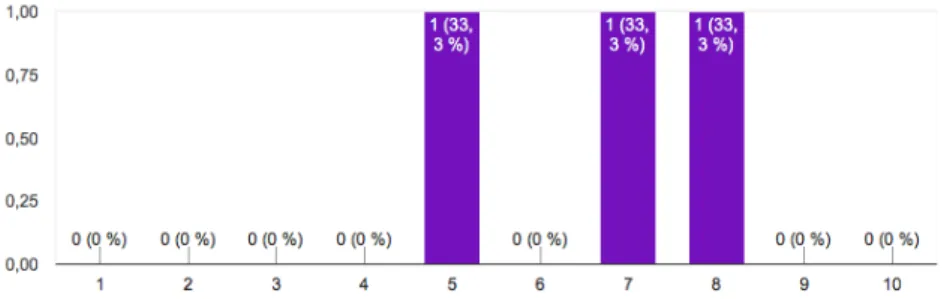
(30) prefixes and suffixes. The teachers of each department were asked if they know whether the other language departments deal with the topic of Greco-Latin affixes or not. It is revealed that there is a general and notable lack of coordination and awareness among the three departments, with special attention to the Catalan department, in which the lack of coordination seems to be greater among the teachers. Out of the four Catalan teachers that answered the survey, one claims to be aware of what the other language departments do with regard to the teaching of Greco-Latin prefixes and suffixes. It can be observed that the members of each department do not share information with their counterparts in the most appropriate way. As a result, there are teachers within the same department that have complete different views on the methodologies that are followed or the contents that are to be taught in the lessons. This is sure to affect negatively the students’ learning process because not all students are taught following the same approach or even the same contents and grammar strategies. It is fundamental to bear in mind that greater coordination is needed, not only to facilitate the teaching practice but also to ensure that all students, regardless of their group, are provided with the same tools that can help them improve their language proficiency. The lack of coordination among the three language departments is also reflected in the importance that each teacher gives to the topic of Greco-Latin affixes. This survey has been answered by eight teachers: three from the Spanish department, four from the Catalan one, and the head of the English department on behalf of all the members that constitute it. Out of 10 points, the English department considers that teaching Greco-Latin prefixes and suffixes is worth 8 points. All the teachers within this department seem to agree with this decision, but the teachers of the Spanish (Figure 1, See Annex 2 for more information) and Catalan (Figure 2, See Annex 3 for more information) departments show some discrepancies. Again, this divergence of opinion reveals the lack of coordination that exists in the language departments, which is an obstacle that needs to be overcome.. 26.
(31) Figure 1. Importance given to the teaching of Greco-Latin affixes in the Spanish subject. Figure 2. Importance given to the teaching of Greco-Latin affixes in the Catalan subject. 3.2.2 Proposal for the creation of a coordinated section regarding the teaching of Greco-Latin affixes in the three language curricula This disagreement regarding the criteria that have to be followed when teaching Greco-Latin affixes and the importance that this issue should be given makes the need for greater coordination among the three departments imperative. Based on the results of this survey, one can reach the conclusion that this can be achieved in the first place by the creation of coordinated language curricula. The following proposal is aimed at providing some general guidelines as to how to coordinate the Spanish, Catalan, and first foreign language (English) curricula with respect to the teaching of Greco-Latin prefixes and suffixes. By having a careful look at the three documents, one can observe that there are other aspects that could be integrated and taught simultaneously in the three languages. However, this proposal only focuses on the teaching of Greco-Latin affixes. The 27.
(32) design of completely coordinated language curricula in Secondary Education would require more time and the strong collaboration of the teachers of each department and the Conselleria d’Educació i Universitat. The main objectives of this proposal are three-fold. In the first place, it intends to economise on linguistic resources and grammar explanations. For instance, if students learn Greco-Latin prefixes and suffixes in the Spanish and Catalan lessons, they will not need to learn them again in the English subject. As a result, EFL students would be able to transfer their previous knowledge from Spanish and Catalan to English and practise this grammar strategy directly. This would allow teachers and students more time to practise instead of devoting so much time and effort to theoretical explanations. In the second place, greater coordination is aimed at facilitating the teaching practice. Teachers would be aware of what their counterparts do in their subjects, which would help them adapt the contents that they intend to teach to the needs of their students in the other languages. Additionally, they would have the opportunity to share materials with teachers of other departments, which would promote cooperation between teachers. The third and final objective is to provide teachers with common and shared guidelines regarding the teaching of Greco-Latin prefixes and suffixes. It is crucial to bear in mind that teachers need to work as a team and in a coordinated way. The results of the survey that haven discussed above reveal that there is an alarming lack of coordination and awareness with regard to what the other language departments do. One can deduce from this fact that the language teachers of the IES Son Ferrer do not follow concise and specific guidelines when it comes to teaching affixes. It seems that they teach Greco-Latin prefixes and suffixes when it fits into their units, without paying attention to the students’ needs or to the convenience of teaching this grammar strategy at a given point in the course. In order to reach a greater degree of coordination between the three departments, some changes need to be made to each curriculum. As it has been analysed in this paper, the Spanish and Catalan curricula deal with the topic of affixes, but the topic of Greco-Latin prefixes and suffixes is only explicitly mentioned in the contents corresponding to the fourth year of ESO. First of all, it would be beneficial for students if they were taught Greco-Latin affixes 28.
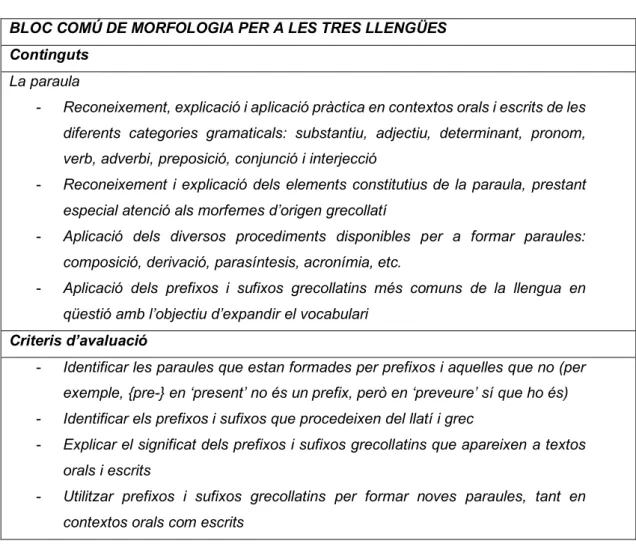
(33) throughout the four years of ESO. The sooner they start to get acquainted with this grammar strategy, the more Greco-Latin prefixes and suffixes they will have learnt by the end of the Obligatory Secondary Education. It seems pointless to delay the introduction of Greco-Latin affixes in the Spanish and Catalan subjects because, as it has been previously discussed, students would be able to transfer this knowledge to other languages such as English. Teaching this grammar strategy solely in the last year of ESO is sure to be detrimental to students because their chances of increasing their vocabulary are restricted to a few months. The first measure that could be implemented to deal with this issue would be to apply the teaching of Greco-Latin prefixes and suffixes to the four years of ESO. The Spanish and Catalan curricula are already provided with a section entitled Bloc 3: Coneixement de la Llengua, in which the contents regarding the word as a unit and word relations are stated. Within this block of contents, it would be advisable to include a section of morphology that, in a more thorough way, provided a more exhaustive list of the contents that students are expected to learn with regard to word formation. In the same way that the first foreign language (English) curriculum lists a set of grammatical contents, the Spanish and Catalan curricula should provide a similar list, with special mention to the mechanisms used in word-formation such as prefixes and suffixes. One of the possible criteria to choose the prefixes and suffixes that need to be taught would be to select those that are most common in Spanish, which are the following: {a-} (que no es) amoral; {des-} (negación, inversión) desventaja; {il-} (que no es) ilegal; {in-} (que no es) inmediato; {ir-} (que no es) irreal; {re-} (volver a hacer, repetir) reinventar; {sub-} (inferior o por debajo de) subterráneo; {-able} (capacidad o posibilidad) potable; {-ción} (efecto de dicha acción) elección: {-dad} (cualidad de) artificiosidad; {-ía, ia} (cualidad y condición de) valentía; {-ismo} (doctrina, sistema, modo o partido) fascismo; {-m(i)ento} (acción proceso resultado) aparcamiento. (Zollo, 2011, n.p.). Out of these seven prefixes, six have a Latin origin and one has a Greek etymology. As for the six suffixes that are believed to be the most frequent ones in Spanish, four come from Latin and two derive from Greek 29.
(34) (dle.rae.es). It can be observed that the vast majority of prefixes and suffixes are Latin-based, which emphasises the fact that Latin has an overwhelming influence on Spanish. Although these are thought to be the most frequent affixes in Spanish, they could also be introduced in the Catalan subject due to its high degree of similarity to Spanish. As far as the assessment criteria are concerned, two aspects need to be highlighted. In the first place, the Spanish and Catalan curricula state these as two of the main criteria to be taken into account when assessing the students’ word-formation skills in the first three years of ESO: 2.1.. Reconeix i explica els elements constitutius de la paraula: arrel i afixos, aplica aquest coneixement a la millora de la comprensió de textos escrits i a l’enriquiment del seu vocabulari actiu.. 2.2.. Explica els diferents procediments de formació de paraules, distingeix les compostes, les derivades, les sigles i els acrònims. (Govern de les Illes Balears, 2015, p.25). It is noticeable that these criteria focus excessively on the students’ ability to work with input. Students are asked to recognise the affixes, to identify the word constituents and explain their meaning, and to use this knowledge as a reading comprehension strategy. However, they are not required to form new words by means of prefixes and suffixes. It can be stated, therefore, that excessive importance is given to the input and little attention is paid to the output. In the fourth year of ESO, as it has been previously mentioned, reference to the teaching of Greco-Latin prefixes and suffixes is made, but there is no mention regarding the practice of this grammar strategy in the classroom. Again, the only criterion that teachers adopt to assess the students’ performance in activities related to the topic of GrecoLatin affixes is the following: 3. Reconèixer i explicar el significat dels principals prefixos i sufixos i les seves possibilitats de combinació per crear noves paraules, i identifica aquells que procedeixen del llatí i grec. (Govern de les Illes Balears, 2015, p.36). 30.
Figure

Documento similar
In this respect, a comparison with The Shadow of the Glen is very useful, since the text finished by Synge in 1904 can be considered a complex development of the opposition
The Dwellers in the Garden of Allah 109... The Dwellers in the Garden of Allah
1. S., III, 52, 1-3: Examinadas estas cosas por nosotros, sería apropiado a los lugares antes citados tratar lo contado en la historia sobre las Amazonas que había antiguamente
In the previous sections we have shown how astronomical alignments and solar hierophanies – with a common interest in the solstices − were substantiated in the
Nevertheless, the ratio of corporations using patents of introduction is higher than that obtained from the analysis of the entire patent system as a whole (around 8.5% from 1820
While Russian nostalgia for the late-socialism of the Brezhnev era began only after the clear-cut rupture of 1991, nostalgia for the 1970s seems to have emerged in Algeria
The answers gathered in the questionnaire describe the lived experience of LGBTphobia in the educational context, the experiences of and interventions made by teachers in the
languages of study: Spanish, Catalan and English as a foreign language. Learners’
