
This is an Accepted Manuscript, which has been through the
Royal Society of Chemistry peer review process and has been
accepted for publication.
Accepted Manuscripts are published online shortly after
acceptance, before technical editing, formatting and proof reading.
Using this free service, authors can make their results available
to the community, in citable form, before we publish the edited
article. We will replace this Accepted Manuscript with the edited
and formatted Advance Article as soon as it is available.
You can find more information about Accepted Manuscripts in the
author guidelines
.
Please note that technical editing may introduce minor changes
to the text and/or graphics, which may alter content. The journal’s
standard
Terms & Conditions
and the ethical guidelines, outlined
in our
author and reviewer resource centre
, still apply. In no
event shall the Royal Society of Chemistry be held responsible
for any errors or omissions in this Accepted Manuscript or any
consequences arising from the use of any information it contains.
Accepted Manuscript
Green
Chemistry
Cutting-edge research for a greener sustainable futurewww.rsc.org/greenchem
ISSN 1463-9262 CRITICAL REVIEW G. Chatel et al.
Heterogeneous catalytic oxidation for lignin valorization into valuable chemicals: what results? What limitations? What trends?
Volume 18 Number 7 7 April 2016 Pages 1821–2242
Green
Chemistry
Cutting-edge research for a greener sustainable future
Green Chemistry
COMMUNICATION
Área de Química Orgánica, Departamento de Química, Facultad de Ciencias, Universidad de Burgos, Pza. Misael Bañuelos s/n, 09001-Burgos, Spain. E-mail: [email protected]; Fax: (+34) 947258831
† Electronic Supplementary Information (ESI) available: Experimenal procedures and NMR spectra of all the experiments. See DOI: 10.1039/x0xx00000x
Received 00th January 20xx, Accepted 00th January 20xx
DOI: 10.1039/x0xx00000x
www.rsc.org/
Ethyl lactate as a renewable carbonyl source for the synthesis of
diynones
Marta Solas, Samuel Suárez-Pantiga and Roberto Sanz*
Ethyl lactate, a sustainable feedstock, serves as a highly attractive building block for the synthesis of value-added chemicals such as skipped diynones and, after gold-catalyzed transposition, conjugated diynones. Green solvents are involved in all steps and high yields are obtained for the final diynones which, in several cases, are isolated in pure form without any purification.
One of the main goals of Green Chemistry is to switch from depleting raw materials to renewable sources, which is described in the 7th principle. Therefore, the concept of renewability1 could be considered crucial nowadays and the development of sustainable processes that employ eco-friendly and readily available biomass-derived feedstocks for the synthesis of value-enhanced chemicals constitutes one of the major challenges in chemical research.2 In this context, lactic acid and lactates are highly functionalized biobased feedstocks that can be catalytically produced from renewable carbohydrates.3 Hence, ethyl lactate (EL) is a biomass-derived platform molecule that is unexpensive and completely biodegradable within very short times and does not show any potential health risks.4 It has been described as a sustainable and green solvent with adequate properties for the replacement of organic solvents.5 Therefore, EL possesses a promising and appealing potential, from the Green Chemistry point of view, to be used as a sustainable feedstock for the preparation of value-added chemicals.6
On the other hand, the oxidative cleavage of glycols and related functional groups is a key transformation in organic synthesis widely used for the preparation and transformation of natural products and, more recently, in biomass valorization for the production of renewable feedstoks.7 Classical procedures for this reaction involve the use of periodic acid or its salts (Malaprade reaction),8 and lead tetraacetate (Criegee oxidation).9 These methods suffer from important drawbacks,
such as the generation of stoichiometric amounts of waste, and so, catalytic and greener alternatives have been recently developed in order to avoid the environmental concerns of the classical reagents, mainly by introducing alternative oxidants and improving the atom-economy.10 However, none of the reported cleaner procedures solve all the chemoselectivity and reactivity issues. Another approach to minimize the environmental impact caused by the use of classical reagents, like sodium metaperiodate, is their replacement by silica gel-supported NaIO4 as a reagent for the oxidative cleavage of glycols.11 This procedure, reported by Shing and Zhong,11a has several advantages such as the low cost of both the oxidant and the support, and a simple workup by filtration that affords pure carbonyl compounds in very high yields. However, the required use of a nonpolar solvent like CH2Cl2 that solves the solubility problems, instead of aqueous alcohols or THF, also presents obvious environmental concerns.
Diynones are highly electrophilic substrates and possess multiple reaction sites, which make them useful starting materials for the preparation of a variety of interesting carbo and heterocycles.12 The general method for their preparation is based on the oxidation of a secondary 1,4-diyn-3-ol, generated from the double addition of lithium or magnesium acetylides to alkyl formates (Scheme 1a).13 Although well-established and with good overall yields around 70%, this two-step sequence employs a high excess (up to 15 equiv) of oxidants such as manganese dioxide, barium manganate, or PCC, in CH2Cl2, that leads to a considerable amount of waste with severe environmental as well as human health issues. Following with our interest in the development of cleaner synthetic methodologies, mainly involving oxygen-atom-transfer reactions under dioxomolybdenum(VI)-catalysis,14 and considering our recently reported method for the oxidative cleavage of glycols with DMSO,15 we envisaged that a new approach for synthesizing symmetrical skipped diynones could involve the oxidative cleavage of the corresponding 1,1,-dialkynyl-1,2-diols, which are easily available from biomass-derived EL (Scheme 1b).
Green
Chemistry
Accepted
Manuscript
Published on 06 December 2018. Downloaded by Universidad de Burgos on 12/10/2018 12:11:34 PM.
COMMUNICATION
Journal Name
General method for the synthesis of diynones:
Our approach using ethyl lactate as carbonyl source:
+
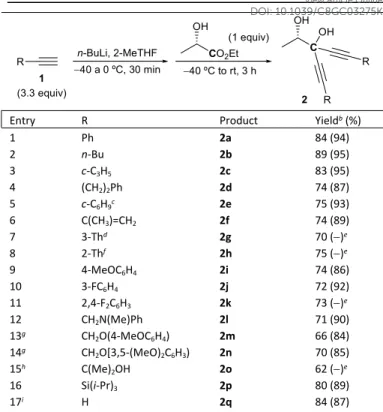
Although the preparation of 1,1,-dialkynyl-1,2-diols 2 from EL has already been reported by its treatment with lithium acetylides (3 equiv),16 the moderate to good yields obtained, as well as the use of THF as solvent and LiBr as additive, make this procedure susceptible of improvement from the Green Chemistry point of view. We tried to solve these drawbacks by using 2-MeTHF as solvent, which is a renewable alternative to THF, can be produced from lignocellulosic biomass, and presents additional advantages such as lower water miscibility, higher stability, lower volatility, easiness to degrade, and lower toxicity.17 Gratifyingly, the employment of 2-MeTHF and a slight excess of the corresponding lithium acetylide (3.3 equiv) gave rise to high yields of the expected dialkynyl glycols 2
without the addition of LiBr (Table 1).18 This general method was successfully performed on a wide variety of alkynes 1, including aromatic substituted with both electron-withdrawing
and electron-donating groups (entries 1, 911),
heteroaromatic (entries 78), (cyclo)alkyl (entries 24), alkenyl (entries 56), as well as those derived from propargyl alcohols, ethers or amines (entries 1215). Moreover, silyl-protected alkyne 1p also allowed the preparation of the corresponding glycol 2p in high yield (entry 16) and, significantly, 1,2-diol 2q
bearing terminal alkynes could be efficiently accessed from the reaction of EL with commercially available ethynylmagnesium bromide (entry 17). In addition, similar results were obtained for the preparation of 2b and 2f using methyl lactate instead of EL. It is worth noting that when starting alkyne 1 possesses a low boiling point, the corresponding crude glycol 2 is obtained pure enough for the next step in an almost quantitative yield.19
With an efficient procedure for accessing 1,1-dialkynyl-1,2-diols 2 in our hands, and considering the second step of our initial proposal, we needed to develop a method for the oxidative cleavage of glycols 2. We selected diol 2a as model substrate and tested our recently developed method for this type of oxidations that uses DMSO as stoichiometric oxidant under dioxomolybdenum(VI)-catalysis (Scheme 2).15 However, under the reported conditions, a low yield of the desired diynone 3a was obtained, which could not be improved by
Table 1 Synthesis of bispropargyl diols 2 from ethyl lactatea
R chromatography, in brackets crude yields of almost pure compounds (see ESI). c 1-Cyclohexenyl. d 3-Thienyl. e Not determined. f 2-Thienyl. g EtMgBr (4 mmol) was used instead of n-BuLi. hn-BuLi (6.6 mmol) was used. i Commercially available ethynyl magnesium bromide in THF (5 equiv) was used and the reaction was refluxed overnight.
varying the temperature or reaction time,20 likely due to competitive decomposition of the final product. Following this methodology, slightly better yields could be obtained for the oxidative cleavage of diols 2b and 2e, which afforded the corresponding diynones 3b and 3e in only moderate yields (45-50%). We next thought about the use of NaIO4SiO2 as potential reagent for the oxidative cleavage of model glycol 2a. Gratifyingly, under the reported conditions,11a with CH2Cl2 as solvent and 1.6 equiv of supported NaIO4, diynone 3a was isolated in almost quantitative yield and in pure form by simple filtration of the supported reagent (Scheme 2).
Although this last procedure seems highly appropriate for our proposed synthesis of skipped diynones, the employment of a chlorinated solvent led us to try to re-optimize the
2a
Scheme 2 Oxidative cleavage of glycol 2a.
Green
Chemistry
Accepted
Manuscript
Published on 06 December 2018. Downloaded by Universidad de Burgos on 12/10/2018 12:11:34 PM.
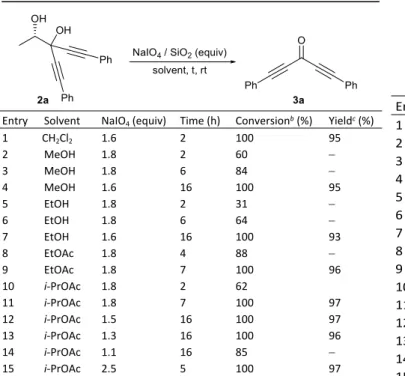
Table 2 Optimization of the reaction conditions for the oxidative cleavage of 2a with crude for not complete conversion examples. c Isolated yield.
reaction conditions in order to look for an eco-friendly alternative to the previously established use of CH2Cl2 (Table 2, entry 1). Accordingly, we started this study by testing different and greener solvents and also by adjusting the reaction time and the amount of the oxidant for each one. MeOH and EtOH were tried out as they are typically used in homogeneous oxidations with NaIO4. Both of them proved to be compatible with this reaction, although longer reaction times and/or higher amounts of the oxidant were required to reach complete conversion (Table 2, entries 27). In addition, in these solvents some leaching of the supported reagent seemed to take place. Then, we turned our attention to more environmental-friendly carboxylic esters as solvents and we checked that AcOEt was also an efficient reaction media for this transformation (entries 8 and 9). Looking for an even more eco-friendly solvent we decided to use i-PrOAc, which is recognized as one of the greenest solvents and,21 gratifyingly, we found that the oxidative cleavage also took efficiently place (entries 1015). We could determine the optimum conditions for complete cleavage of 2a leading to an almost quantitative yield of 3a (entry 13), although the reaction time could be shortened by using a higher amount of the oxidant (entries 11 and 15). Interestingly, treatment of 2a with NaIO4 in i-PrOAc did not led to any transformation after 24 h showing that the supported oxidant presents significant advantages over the non-supported one besides its easy removal. It is also worthy to note that in all the cases diynone 3a was isolated in pure form after simple filtration of the supported reagent, as the only byproduct of the process, acetaldehyde, is easily removed along with the solvent by evaporation under reduced pressure.
Table 3 Synthesis of skipped diynones 3a
2
Entry Starting diol R Product Yieldb (%)
1 2a Ph 3a 95 collected adding further value to this valorization of EL.
Having established the optimized conditions for the oxidative cleavage of glycols 2 with NaIO4SiO2, we decided to evaluate the substrate scope (Table 3). Gratifyingly, starting diols 2 bearing (functionalized)aryl and heteroaryl groups as substituents of the alkyne, efficiently underwent the oxidative cleavage (entries 1 and 711), as well as those with (cyclo)alkyl and alkenyl groups (entries 26), leading to the symmetrical skipped diynones 3a-k in almost quantitative yields. In the same way, functionalized starting diols 2l-n also led to the corresponding diynones 3l-o without any side product (entries 1215). Finally, silyl-substituted diynone 3p and terminal interesting to note that in all the cases the final diynone 3 was obtained in pure form after a simple filtration and removal of the solvent.
Green
Chemistry
Accepted
Manuscript
Published on 06 December 2018. Downloaded by Universidad de Burgos on 12/10/2018 12:11:34 PM.
COMMUNICATION
Journal Name
Scheme 3 Gram-scale preparation of selected skipped diynones 3 from EL.
Moreover, this methodology is amenable for scale up and can be applied to the preparation of diynones such as 3a,b,c,f
in gram scale. Interestingly, the corresponding intermediate glycol 2a,b,c,f does not need to be purified and, after a simple extraction with EtOAc or i-PrOAc, it could be used for the subsequent oxidative cleavage with the NaIO4SiO2 reagent. Moreover, in these gram-scale experiments the amount of the supported oxidant could be reduced up to 1.1 equiv further improving the greenness of the overall procedure (Scheme 3). For instance, starting from 0,709 g of ethyl lactate, 1,036 g (75%) of diynone 3a, 1,027 g (90%) of diynone 3b, 0,873 g (91%) of diynone 3c and 0,806 g (85%) of diynone 3f could be obtained, respectively. Moreover, it is worthy to note that these skipped diynones 3 were isolated in pure form without the need of any purification process (only 3a was purified by column chromatography due to its partial decomposition under the reaction conditions).
Taking advantage from this efficient method for the synthesis of skipped diynones 3, and inspired by the work of Gevorgyan and co-workers about the gold-catalyzed 1,3-transposition of ynones,22 we decided to combine both processes to achieve a new valorization of EL. In their original report, the authors used a cationic gold(I) complex bearing a triarylphosphite ligand as catalytic system, in DCE as solvent, for the transformation of skipped diynones 3 into their conjugated isomers 4. After a brief experimentation with diynone 3a as model, we obtained better results with the cationic gold(I) complex IPrAuNTf223 (Table 4, entries 14). To further improve this protocol, and also considering that the availability of DCE is now severely limited in the European Union due to regulatory controls,24 we thought about replacing this chlorinated solvent by a greener alternative. Whereas toluene and trifluorotoluene resulted to be successful alternatives to DCE (entries 5 and 6), gratifyingly, we found that environmentally-friendly i-PrOAc was again a convenient solvent for this Au-catalyzed transformation, although no complete conversion was observed at room temperature (entry 7). Upon increasing the reaction temperature the starting material was consumed (entry 8). Finally, we have also found that under microwave irradiation the reaction time can be dramatically shortened from several hours to 10 minutes (entry 9). The use of i-PrOAc as green solvent for this reaction is highly remarkable as few examples of gold-catalyzed processes carried out in safe, non-toxic, biorenewable and cheap solvents have been reported.25 Under these optimized conditions conjugated diynone 4a was obtained in high yield from 3a (entry 9). In an analogous way conjugated diynones 4b
Table 4 Optimization study with greener solvents for the Au-catalyzed 1,3-transposition of 3aa
Entry Au catalyst Solvent Temp (°C)b Time (h) Conversionc (%)
1d (ArO)3PAuCl/AgBF4 DCE rt 4 10 crude for not complete conversion examples. Isolated yields of crude mixtures were >90% in all the cases. In brackets isolated yield. d Ar = (2,4-di-tertbutylphenyl). e The gold catalyst was added in two portions (2.5 mol% at the beginning of the reaction and 2.5 mol% after 10 h).
and 4c could be also obtained from the corresponding skipped diynones 3b and 3c in high isolated yields (8085%).
After this study, a selection of conjugated diynones 4a-c,g
could be prepared in good to high isolated yields (referred to EL) without any intermediate purification, following the sequence shown in Scheme 4.26 It is important to note that all the reactions, acetylide addition to EL, oxidative cleavage, and Au-catalyzed transposition, yield the corresponding products in almost pure form allowing the next step to be performed with the crudes. Only final diynones 4 needed purification in order to remove impurities coming from the gold catalyst. In addition, the solvents employed in these processes (2-MeTHF and i-PrOAc) are ecofriendly alternatives to the ones typically used (THF and CH2Cl2 or DCE).
EL
RC C(Li)
[2]
not purified i-PrOAc16 h, rt
NaIO4SiO2
Scheme 4 Further valorization of EL: synthesis of conjugated diynones 4.
Green
Chemistry
Accepted
Manuscript
Published on 06 December 2018. Downloaded by Universidad de Burgos on 12/10/2018 12:11:34 PM.
Conclusions
We have demonstrated how a biomass-derived platform molecule, ethyl lactate, serves as a highly efficient, sustainable and environmentally benign C1 building block for the synthesis of high-added-value chemicals such as symmetrical skipped diynones. To meet the sustainability criteria, THF and halogenated solvents, typically used in the involved reactions, have been replaced by greener alternatives such as 2-MeTHF and i-PrOAc, respectively. In addition, the gold-catalyzed transposition of skipped diynones to conjugated ones, but employing environmentally-friendly i-PrOAc instead of chlorinated solvents, has been also merged with this valorization of EL.
Conflicts of interest
There are no conflicts to declare.Acknowledgements
Financial support from Junta de Castilla y León and FEDER (BU076U16) and Ministerio de Economía y Competitividad (MINECO) and FEDER (CTQ2016-75023-C2-1-P) is gratefully acknowledged. M. S. and S. S.-P. thank Junta de Castilla y León and FEDER for predoctoral and postdoctoral contracts, respectively. J. Hirayama, K. Motokura A. Fukuoka and K. Nakajima, ACS
Sustainable Chem. Eng., 2018, 6, 81138117. 16011612. For representative examples, see: (d) Y. Liu, H. Wang, C. Wang, J.-P. Wan and C. Wen, RSC Adv., 2013, 3,
6 For recent examples of valorization of renewable alkyl lactates, see: (a) W. Zhang, G. Innocenti, P. Oulego, V. Gitis, H. Wu, B. Ensing, F. Cavani, G. Rothenberg and N. R. Shiju,
ACS Catal., 2018, 8, 23652374; (b) R. De Clercq, M.
Dusselier, E. Makshina and B. F. Sels, Angew. Chem. Int. Ed., 2018, 57, 30743078; (c) W. Zhang, G. Innocenti, M. Ferbinteanu, E. V. Ramos-Fernández, A. Sepulveda-Escribano, H. Wu, F. Cavani, G. Rothenberg and N. R. Shiju,
Catal. Sci. Technol., 2018, 8, 37373747. For a review, see:
A. G. Wee and J. Slobodian, in Handbook of Reagents for
Organic Synthesis: Oxidizing and Reducing Agents, ed. S. D.
Burke and R. L. Danheiser, John Wiley & Sons, New York, 1999, pp. 420423.
9 (a) R. Criegee, Ber. Dtsch. Chem. Ges., 1931, 64, 260266; (b) M. L. Mihailovic and Z. Cekovic, in Handbook of Reagents for
Organic Synthesis: Oxidizing and Reducing Agents, ed. S. D.
Burke and R. L. Danheiser, John Wiley & Sons, New York, 1999, pp. 190195.
10 For selected recent examples, see: (a) N. Obara, S. Hirasawa, M. Tamura, Y. Nakawaga and K. Tomishige, ChemCatChem,
2016, 8, 17321738; (b) V. Escande, C. H. Lam, C. Grison and 26222624. For previous reports about the use of related NaIO4SiO2 reagents, see: (b) D. N. Gupta, P. Hodge and J. E. Davies, J. Chem. Soc., Perkin Trans. 1, 1981, 29702973; (c) M. Daumas, Y. Vo-Quang, L. Vo-Quang and F. Le Gaffic,
Synthesis 1989, 6465.
14 (a) N. García, P. García-García, M. A. Fernández-Rodríguez, R. Rubio, M. R. Pedrosa, F. J. Arnáiz and R. Sanz, Adv. Synth.
Catal., 2012, 354, 321327; (b) N. García, P. García-García,
M. A. Fernández-Rodríguez, D. García, M. R. Pedrosa, F. J.
Green
Chemistry
Accepted
Manuscript
Published on 06 December 2018. Downloaded by Universidad de Burgos on 12/10/2018 12:11:34 PM.
COMMUNICATION
Journal Name
Arnáiz and R. Sanz, Green Chem., 2013, 15, 9991005; (c) R. Rubio-Presa, M. A. Fernández-Rodríguez, M. R. Pedrosa, F. J. Arnáiz and R. Sanz, Adv. Synht. Catal., 2017, 359, 17521757; (d) R. Rubio-Presa, M. R. Pedrosa, M. A.
Fernández-Rodríguez, F. J. Arnáiz and R. Sanz, Org. Lett., 2017, 19, 54705473; (e) R. Rubio-Presa, S. Suárez-Pantiga, M. R. Pedrosa and R. Sanz, Adv. Synth. Catal., 2018, 360, 22162220. For a recent review, see: (f) R. Hernández-Ruiz and R. Sanz, Synthesis, 2018, 50, 40194036.
15 N. García, R. Rubio-Presa, P. García-García, M. A. Fernández-Rodríguez, M. R. Pedrosa, F. J. Arnáiz and R. Sanz, Green
Chem., 2016, 18, 23352340.
16 (a) B. Gabriele, R. Mancuso, V. Maltese, L. Veltri and G. Salerno, J. Org. Chem., 2012, 77, 86578668; (b) B. Gabriele, L. Veltri, P. Plastina, R. Mancuso, M. V. Vetere and V. Maltese, J. Org. Chem., 2013, 78, 49194928; (c) B. Zhang, T. Wang and Z. Zhang, J. Org. Chem., 2017, 82, 1164411654 17 (a) V. Pace, P. Hoyos, L. Castoldi, P. Domínguez de María and
A. R. Alcántara, ChemSusChem, 2012, 5, 13691379; (b) C. J. Clarke, W.-C. Tu, O. Levers, A. Bröhl and J. P. Hallett, Chem. Rev., 2018, 118, 747800; (c) E. Bisz and M. Szostak,
ChemSusChem, 2018, 11, 12901294.
18 Moreover, the use of a slight defect of n-BuLi with respect to the alkyne avoids the competitive addition of n-BuLi to the lactate also improving the yield of 2.
19 See ESI for the NMR of crude glycols 2a,b,c,e,f,j,q. As expected, an attempt to synthesize a non-symmetrical bispropargyldiol, starting from two different alkynes, provided a mixture of the three possible glycols.
20 At lower temperature the reaction time increased leading to even lower yields.
21 C. M. Alder, J. D. Hayler, R. K. Henderson, A. M. Redman, L. Shukla, L. E. Shuster and H. F. Sneddon, Green Chem., 2016,
18, 38793890.
22 R. K. Shiroodi, M. Soltani and V. Gevorgyan, J. Am. Chem.
Soc., 2014, 136, 98829885.
23 L. Ricard and F. Gagosz, Organometallics, 2007, 26, 47044707.
24 J. Sherwood, Angew. Chem., Int. Ed., 2018, 57, 1428614290. 25 For selected examples, see: (a) E. Feng, Y. Zhou, F. Zhao, X.
Chen, L. Zhang, H. Jiang and H. Liu, Green Chem., 2012, 14, 18881895; (b) M. J. Rodríguez-Álvarez, C. Vidal, J. Díez and J. García-Álvarez, Chem. Commun., 2014, 50, 1292712929; (c) C. Vidal, L. Merz and J. García-Álvarez, Green Chem., 2015,
17, 38703878; (d) M. J. Rodríguez-Álvarez, C. Vidal, S. Schumacher, J. Borge and J. García-Álvarez, Chem. Eur. J., 2017, 23, 34253431.
26 It has been recently demonstrated that when aliphatic aldehydes are present the reaction rate of the Au-catalyzed 1,3-O-transposition decreases, see: S. Aikonen, M.
Muuronen, T. Wirtanen, S. Heikkinen, J. Musgreave, J. Burés and J. Helaja, ACS Catal., 2018, 8, 960967. So, before the Au-catalyzed reaction, the i-PrOAc solution from the oxidative cleavage step, containing both the corresponding skipped diynone and acetaldehyde, was partially evaporated under reduced pressure to remove the aldehyde (see ESI for
further details).
Green
Chemistry
Accepted
Manuscript
Published on 06 December 2018. Downloaded by Universidad de Burgos on 12/10/2018 12:11:34 PM.
![Table 4 Optimization study with greener solvents for the Au-catalyzed 1,3-transposition of 3a a 3aO PhPh 4a[LAu]+(5 mol%)solvent, T, tPh O Ph](https://thumb-us.123doks.com/thumbv2/123dok_es/3934337.668596/5.893.71.437.105.237/table-optimization-study-greener-solvents-catalyzed-transposition-solvent.webp)
