Youth and the Third Sector Media in
Spain: Communication and Social Change
Training
Jóvenes y tercer sector de medios en España: Formación en comunicación y
cambio social
Isabel Lema-Blanco is Researcher in the People-Environment Research Group, Faculty of Educational Sciences at the University of A Coruña (Spain) ([email protected]) (http://orcid.org/0000- 0003-2965-8052) Eduardo-Francisco Rodríguez-Gómez is Researcher in the Department of Journalism and Audiovisual Communication at the University Carlos III of Madrid (Spain) ([email protected])
(http://orcid.org/0000-0002-1788-2412)
Dr. Alejandro Barranquero-Carretero is Professor in the Department of Journalism and Audiovisual Communication at the University Carlos III of Madrid (Spain) ([email protected]) (http://orcid.org/0000-0002-9264-9389)
ABSTRACT
The aim of this paper is to examine the role of community, free and university media in Spain as tools for media literacy and as instruments for creating a more critical and communicative citizenry. After a conceptual section, we analyse training processes in this area with regard to the general population and their reference communities, devoting particular emphasis to the involvement of young people. The triangulation research method was based on quantitative (a survey) and qualitative (focus groups) techni-ques. The results show that the third sector media in Spain act as invaluable tools for the acquisition of skills and competences that are transferable into young people’s professional and experiential sphere, given the ability of these media outlets to identify with their interests, aspirations and difficulties. In a broad sense, these initiatives contribute to expanding the right of communica-tion in two different ways: on the one hand, because they are open to citizen participacommunica-tion in both management responsibilities and content programming; and, on the other, because their decentralized practices provide a laboratory for creative journalism which, in turn, is linked to social movements and other means of expression for citizens (NGOs, associations, etc.).
RESUMEN
El siguiente trabajo tiene por objeto acercarse al papel de los medios comunitarios, libres y universitarios del Estado español como instrumentos para la alfabetización mediática y en tanto que espacios para la conformación de ciudadanía crítica y comunicativa. Tras el apartado conceptual, se analizan los procesos de aprendizaje que se implementan con respecto a la ciudadanía en general y a las comunidades de referencia en particular, prestando especial atención al rol y a la participación de la juventud. A partir de la triangulación de técnicas cuantitativas (encuesta) y cualitativas (grupos de discusión), los resultados demuestran que los medios del tercer sector actúan como valiosas herramientas para la adquisición de habilidades y competencias críticas que pueden trans-ferirse a la esfera profesional y vivencial de los jóvenes, dada la identificación de estos medios con los intereses, problemáticas y aspiraciones juveniles. En un sentido amplio, estas iniciativas contribuyen a la expansión del derecho a la comunicación en dos direcciones: por un lado, porque están abiertas a la participación ciudadana en las tareas de gestión y programación de los con-tenidos; y, por otro, porque sus prácticas descentralizadas constituyen un laboratorio de creatividad periodística que, a su vez, está vinculado al devenir de los movimientos sociales y otras formaciones de la ciudadanía organizada (ONG, asociaciones, etc.). KEYWORDS | PALABRAS CLAVE
Community media, community radio stations, third sector, media literacy, media training, nonformal education, social learn -ing, long-lasting learning.
Medios comunitarios, radios comunitarias, tercer sector, alfabetización mediática, educomunicación, educación no formal, apren-dizaje social, aprenapren-dizaje permanente.
Received: 2015-10-29 | Reviewed: 2015-12-15 | Accepted: 2016-02-22 | Preprint: 2016-05-15 | Published: 2016-07-01 DOI http://dx.doi.org/10.3916/C48-2016-09 | Pages: 91-99
Comunicar,
48,
XXIV,
2016 1. Introduction and state of affairsThe aim of this paper is to examine the role that
community, free and university media1 play as
tea-ching and learning entities for citizens in general and youth in particular. This role seems to have been rein-forced recently by the shaping of new synergies with organized civil society, which encounters in third sector communication a vital ally for its struggles. Further -more, these initiatives grow, to a large extent, with the progressive and innovative use of low-cost digital tech-nologies (webs, social networks, blogs, etc.), which make information, participation and organization on the web easier, as seen in the anti-globalization move-ments in the early years of the twenty-first century or the so-called «take the square movements» arising in 2011 –15M, Arab Spring, «Occupy», etc.– (Cammaerts, Mattoni, & McCurdy, 2013; Gerbaudo, 2012). A correlate to this latest wave of social outbursts, the communication third sector is a booming media system compared to the public and private/commercial media pairing (Barranquero & Meda, 2014). Unlike the above, its management is in the hands of non-profit-making organizations, associations and social move-ments which appropriate technologies and media wit-hin their reach (Rodríguez, 2009) in order to make their voice heard (Couldry, 2010) and obtain symbolic recognition in the public sphere (Fraser, 2003). Its ulti-mate aim is to effectively achieve the «right to communication» (Hamelink & Hoffmann, 2008), which in -volves active participation by citizens in the various sta-ges in the life of a communication project (both in pro-gramming content and day-to-day running or decision-making about editorial aims and values), and which is aimed at providing a public service in a predominantly local context (Brevini, 2014: 991).
Third sector media have a bearing on the achieve-ment of social justice, participatory democracy and the promotion of pluralism and in this sense they have the recognition of the UN (La-Rue, 2010), the European Parliament (2008) and the Council of Europe (2009). Likewise, these projects are instances of media literacy (Lewis & Mitchell, 2014) and lifelong learning about what being a citizen means (Kejval, 2006), becoming genuine «communication schools», given that they contribute to the acquisition of a critical conscience on the communication system and they develop abilities to «be in a position to broadcast messages and operate in the media» (Kaplún, 1983: 43). However, and des-pite its long experience of more than sixty years in the North –Europe, USA, Canada, etc.– and in the South –South America, Asia, Africa– (Gumucio & Tufte, 2006), community media have had to wait until the
beginning of the new millennium to break free from academic exclusion and become a legitimate object of study. Approaches to the subject have focused on the conceptualization and description of classic and con-temporary experiences (Atton, 2015; Gumucio, & Tufte, 2006; Downing, 2010) and the study of the regulatory context (Atton, 2015; Meda, 2015, Milan, 2010). From a social educational perspective, its va lues for social cohesion (Lewis, 2008; Lewis & Mit -chell, 2015), the inclusion of minorities and vulnerable groups (Correa, 2010; Contreras, González-Mairena, & Aguaded, 2014) and educommunication (Aguaded & Contreras, 2011; Contreras & al, 2014; Fedorov & Levitskaya, 2015) have been tackled.
In Spain, there is a long tradition of community media since the beginning of the transition to demo-cracy, especially in the Autonomous Communities with a strong partnership tradition such as in Catalo -nia, Andalusia or the Basque Country (Meda, 2013). Since the early 80s there have also been media which define themselves as «free» and try to ensure their independence by rejecting any form of public or priva-te funding (Pérez, 2012), whilst, in the first decade of the millennium, university broadcasting burst on to the scene which had as referents the third sector media, rather than public or commercial ones (Aguaded & Martín-Pena, 2013). The evolution of all these initiati-ves has been held back by a plethora of obstacles which have been to the detriment of their consolida-tion, especially in matters such as «frequencies, fun-ding, public demand and political will» (Lewis, 2015: 6). In this sense, the General Law on Audiovisual Communication (LGCA, 2010) for the first time re -cognizes the existence of non-profit-making audiovi-sual and community services, but ignores university media and, to date, has not evolved specific regula-tions for the concession of licences and State promo-tion of the third sector. The absence of a regulatory framework for audiovisual media (radio and television) –digital ones act, for the time being, without such res-trictions– goes against their economic and political sus-tainability and leaves them in an extraordinarily weak position compared to many of their European counter-parts (Meda, 2013; Meda, 2015).
In an adverse and conflictive framework like the one described, the third sector has not ceased in its efforts to shape educommunicational spaces in which the hegemonic senses of social communication are being thrashed out (Kejval, 2006; Lucas, 2014; Scifo, 2009). If media literacy is understood as the learning obtained in, with and from the media and for the acquisition of media skills (Ferrés & Piscitelli, 2012),
Comunicar,
48,
XXIV,
2016
the third sector fulfils an educational role, at least, on three levels. Firstly, it extends the right to communica-tion by giving priority to citizen sources, agendas and approaches, a fact that flies in the face of the trend towards commercial exploitation of the news agenda which predominates in the corporate media2
(DíazNosty 2013; Nichols & McChesney, 2010). Second -ly, these projects educate for participation in public life and contribute towards the
extension of the right to citi-zenship, this latter understood, not as «a status that is granted or denied», but as a kind of political identity that is built when citizens set in motion «communication processes which contribute to shaping their local communities» (Ro dríguez, 2009: 1819). Third -ly, the alternative media pre-suppose a source of abilities and skills for both the critical reception of media messages and the creation of audiovisual products by communities them selves (Kaplún, 1983; Prieto & van de Pol, 2006). In turn, they provide technical, communication and social skills that boost confidence and
motivation in the participants (Lewis & Mitchell, 2015) and raise the level of awareness about the power of the media as shapers of social reality. In all cases, it is essentially learning by doing, a long-lasting learning that is respectful of the subject’s prior know-ledge, that goes beyond the limits of traditional educa-tional institutions and is based on cooperative and sup-portive processes of knowledge building.
In the field of educommunication in Spain, a collection of recent research has explored the integra-tion of media skills in the curriculum of communicaintegra-tion professionals (Buitrago, Ferrés, & García-Matilla, 2015; Tucho & al., 2015) or in the teaching sphere of disci-plines such as communication and education (López-Romero & Aguaded, 2015), besides systematizing a set of dimensions and indicators for analysis (Ferrés & Piscitelli, 2012). However, and for the time being, progress towards configuring educational curricula within community media has been scant, something which is seen both in the European context (Lucas, 2014) and in the Spanish one. Nevertheless, the histo-ric course of community media shows its educational
capacity as informal areas of media training, besides being instigators of social learning via interest commu-nities such as the case of networks around which the third sector is organized in Spain: the Network of Community Media-ReMC; the Association of University Radio Stations-ARU, the Association of Municipal and Citizen Radio and Television Stations of Andalusia-EMA-RTV, etc.
2. Material and methods
The study has combined quantitative and qualita-tive research methods (Denzin, 1978). In the first place, based on information on websites and previous listings (García-García, 2013), a census of 345 com-munity, free and university media was drawn up for the whole of Spain, except La Rioja, Ceuta and Meli -lla, where no initiatives were found. Sub se quently, the sample was compiled using an exploratory sample by quotas on the basis of strata of heterogeneity depen-ding on the format of the medium (table 1), the Autonomous Community (table 2) and typology (uni-versity, community, free, etc.). Between February and May 2015 a digital survey was sent containing 35 questions divided into three blocks (identification of projects; organization, content and participation; and relationship to young people), from which 94 valid questionnaires were obtained. For a confidence level of 95% and assuming pq=50, a sample error of 8.6% was achieved. The results, which are shown in per-centages, were analysed using «LibreOffice Calc» and «SPSS statistical software».
The definition of people’s media skills ought to have wide
participation not just from the academic community,
professionals and experts, but also from social organizations
(NGOs, movements, etc.) and, in particular, from the
communication third sector itself. This study shows the
enormous educational possibilities of these media which, as
yet at their consolidation stage, appear to be gaining ground
on both academic agendas and communication policies of
several European and Latin American states.
Comunicar,
48,
XXIV,
2016 (Murillo & Mena, 2006) which looked into motiva-As a qualitative method, a focus group was used
tion, experience and perceived learning by young peo-ple in these media. A total of 28 peopeo-ple between 18 and 35 years of age –in accordance with the delimita-tion of youth by the Spanish Centre for Sociological Research (CIS)– took part in four discussion groups held in Andalusia (FG01: 7 persons), Madrid (FG02: 7 persons), the Basque Country (FG03: 10 persons) and Catalonia (FG04: 4 persons). By sector, the groups represented thirteen radio stations (two of them uni-versity ones), four press projects (print and digital) and two audiovisual production associations. All were audio and video recorded and transcribed literally.
The analysis of the data content was carried out manually following a descriptive coding method (given the exploratory nature of the focus groups) and an interpretative one (Miles & Huberman, 1994) focu-sing on the interactions between participants and their agreements/disagreements about the various topics. Besides the random procedure, the reliability criteria (Valles, 1997: 103-104) were reinforced by data trian-gulation (arising from the focus groups and the ques-tionnaire) and peer review (the discussion groups were classified by at least two researchers).
3. Analysis and results
3.1. Motivation of youth sectors for taking part in the third sector
The participants in the focus groups clearly diffe-rentiated two reasons for taking part in a citizens’ com-munication project: on the one hand, the desire to acquire professional skills and practical experience with regard to academic training and, on the other, their aspirations relating to voluntary work and social com-mitment. In the first case, they were young students and graduates in journalism, audiovisual communica-tion and similar (e.g. Vocacommunica-tional Training), seeking an opportunity to acquire experience and freely develop their profession, without the usual restrictions found in commercial media: «I wanted to do things outside
uni-versity because I didn’t get enough personal develop-ment there. When you see that you can do something more than what they have taught you and that it isn’t complicated, you are keen to stay» (FG02_free radio Madrid).
In the second case, comprising a more numerous group, young people approach the media motivated by their interest in communicating content that reflects their interests and identities, not always represented in the agenda of conventional media: «My motivation is threefold: one, to make radio programmes, I don’t care what they are about; two, to make radio pro-grammes on specific topics, cinema, literature, etc.; and three, to belong to a group and make its informa-tion known» (FG01_community radio in Andalusia). An example of it are the fre-quent allusions to the new currents of opinion and demands to participate and the deliberative de -mocracy that emer-ged after the mobi-lizations of 15M and neighbouring m o v e m e n t s : Mareas, Platform for those Affected by Mortgages, etc.
However, the influence of these movements is not similar throughout the whole country nor constant over time, since the study shows a greater impact in areas such as Madrid and Catalonia. Despite the fact that its contribution to the revitalization of the third sector has not been uniform –only exceptionally such as the emergence of new radio stations (e.g. Ágora Sol) and digital media linked to 15M itself (Barran -quero y Meda, 2014)–, the message has got through to young people, who highlight their role as sounding boards for social movements. In any event, the prior link is frequent (even before 15M) among youth and social groups of different kinds: «I took part in social movements in my neighbourhood and that’s how I got to know about the radio station. I joined in 2007, I did a project on mental health, linked to my job (I’m a psy-chologist) and now it’s my eighth year. Militancy in radio is across the board» (FG02_community radio in Madrid).
3.2. Training processes and acquisition of abilities and skills in communication
If earlier mention was made of the link between community media and young graduates in the commu-nication field, it must be pointed out that this sector represents a minority of participants. The
questionnai-Comunicar,
48,
XXIV,
2016
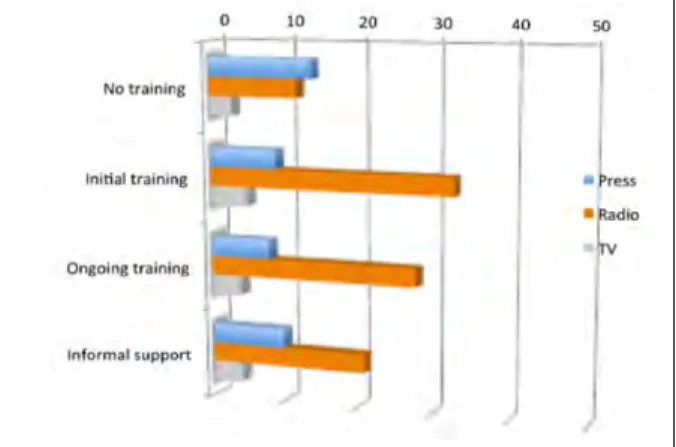
re shows that the majority of people who are invol-ved in the sector do so without having prior profes-sional training or experience, consequently their learning, almost always self-taught, arises from daily practice, knowledge exchange with more senior colleagues, and the training workshops themselves driven by some of these media. It must be stated that it is in the radio sector where a gre-ater effort to set up formal media education can be seen, compared to sectors such as the press or tele-vision (figure 1).
The studio shows three basic types of training activities: workshops that teach how to produce, design and undertake a radio programme, both from a creative and a technical point of view; gui-dance for new members and programmes; and, to a lesser extent, external training actions which, besides making the medium known in its environment, offer a didactic or ludic service to the surrounding commu-nity. In larger community media and/or in ones with a longer history, and in particular in university broadcas-ters, training seems to be more systematic and there is a series of training programmes throughout the year. Media with fewer resources usually compensate the lack of standardized training with guidance processes, tutoring and peer to peer knowledge transfer. However, young people agree that practice itself in -volves the most effective learning, since, in their own words, it is best «to jump in at the deep end» and learn by your own mistakes: «We are completely self-taught. You join and you go to other people’s program-mes, you see how it is done, you learn and then you do it on your own» (FG03_community radio in the Basque Country). As far as training content is concer-ned (figure 1), those that stand out are teaching to do with the handling of technical equipment, ahead of production, voice and audiovisual content
develop-ment, and, to a lesser extent, theory teaching about the philosophy of the third sector, legal matters or the right to communication.
A small percentage of media also offers training to people from outside, aimed at attracting new members or promoting participation in the nearby community: «At our workshops we teach understanding of how media works and how to cope in social networks. In fact, they are workshops for citizens in general» (FG -04_digital media in Catalonia). On the other hand, the study shows growing collaboration between the third sector and various public entities, in particular the edu-cation sector (figure 2) and usually secondary schools and universities. However, only 5% of the media polled have set up formal agreements with other insti-tutions such as NGOs, civic associations or public administrations.
In general, young people highlight the acquisition of cooperative values and a sense of community: «Radio has given me a lot on all levels: personal, pro-fessional, cultural, etc. Although I would highlight the professional level, because I have discovered a way of doing journalism that I thought didn’t exist and that was the one I was looking for» (FG02_community radio Madrid). It may be concluded that the trai-ning offered and the abilities acquired through taking part in community media give rise to three kinds of learning: a) cognitive or conceptual, linked to the acquisition of new knowledge about social communication and audiovisual production; b) atti-tudinal: perception of new values and attitudes ari-sing from taking part in a social group; and c) pro-cedural: relating to the development of social skills, the assumption of responsibilities and the acquisi-tion of participatory methodologies such as team working methods, group dynamics, conflict mana-gement or decision-making in an organization.
Figure 1. Type of training offered by the media.
Comunicar,
48,
XXIV,
2016
3.3. From developing specialized content to com-munication for social change
The study showed that young people mainly become involved in content development (including presenting programmes) and, to a lesser extent, in pro-duction tasks, editing and computing, participation in management and administration being scant (figure 3). Likewise, young people assign an important role to those actions that put them in contact with their refe-rence community, «with people in the street», a hete-rogeneous context in which social movements and organized civic groups are permanently present as content creators in which they can «develop across the board their skills in management, dynamic agents for social groups or local development itself» (FG02_com-munity radio in Madrid).
According to those interviewed, young people do not only work on content aimed specifically at youth, although it is common for them to address very specific interest groups (minority or specialist ones), to look at issues not usually present in the commercial media (alternative music, social and cultural issues, etc.) and to analyse the social and political context from a critical perspective and using innovative and cre-ative formats. In this way, there are frequent allu-sions to the role of spokesperson that the media assume in relation to groups that are discriminated against in the media sector: «I’ve only been doing this three months and I can choose the topic I want, although the radio station encourages us to report about the neighbourhood, which is highly stigmatized. So we try to take people from around here, neighbourhood associations, small retailers, mainly lots of life stories» (FG01_community radio in Andalusia). Recognition by the community of the work that the media do reinforces the percep-tion of their usefulness and effectiveness, feeding
back, at the same time, their social commitment to the group that manages the media: «In the cover of the last general strike, the unions and the pickets approached our microphones before they did those of SER radio station, because they knew that SER did not broadcast live. For us feedback is very encouraging, to know that people want to tell you their stories and that what we do has some worth, despite our not appearing in the General Study of the Media» (FG01_community radio in Galicia).
At the same time, young people have learnt to use social networks and Internet as means of boos-ting their communication activities, so they usually take on jobs like web enhancement, streaming and podcast production: «This year there are ten of us in the news office and we are still growing, a cou-ple of weeks ago we started broadcasting on Saturdays. We also use social networks and we are extending a lot into Ivoox, Twitter and Facebook» (FG01_community radio in Andalusia).
As far as the responsibility for coordinating, trai-ning or sourcing funding, the associates and volunteers with most experience in the media –or people on secondment who are hired on a temporary basis– are the ones who take on these jobs. This is because of the low level of professionalism in the third sector in Spain, which has very few remunerated staff (figure 4) and low participation rates among young people (bet-ween 18 and 25 years of age).
Some of the most senior interviewees regret the fact that not all young people are interested in this type of project. In fact, in the Madrid and Vitoria groups there was evidence of the existence of consolidated, and sometimes endogamic, circles that distrusted the arrival of novice collaborators, regardless of the fact that in the philosophy of these media figures its
open-Figure 3. Activities undertaken by young people
Figure 4. Percentage of media according to number of salaried young peo-ple and volunteers.
Comunicar,
48,
XXIV,
2016
ness without barriers to citizen participation: «We veterans and administrators believe that our experien-ce is valid for everyone and we tend to demand more or underrate the work of the people that come to make their programmes, pay the fee and go. But the truth is that it enables the rest of us to go on working. The involvement of others is achieved by time and expe-rience» (FG04_ community radio in the Basque Country). Despite this, all the media show a clear dis-position to favour horizontal decision-making proces-ses via assemblies or working groups, differing from the hierarchical structures that characterize the public and commercial media: «That takes a lot, participation sometimes is a bit low because out of twenty people, only two turn up, although we are slowly making progress and are still in the runningin period» (FG01_ -community radio in Andalusia).
4. Discussion and conclusions
This research has enabled progress to be made in the empirical understanding of the involvement of young people between 18 and 35 years of age in free, community and university media in Spain. The study analyses the motivation and the roles played by youth, as well as the teaching/learning processes that take place among them. It has been seen that young people take part in these projects driven by a desire to com-municate alternative content in an environment of fre-edom and creativity, which contrasts with the disaffec-tion they show towards the convendisaffec-tional media, as this and other studies reveal (Centro Reina sobre Ado -lescencia y Juventud, 2014). Likewise, young people approach these media not just because they find in them somewhere where they can direct their interests and demands, but also because they consider them to be an essential instrument for taking part in public life. In spite of the scant financial resources, the lack of legal and institutional support and the situation of legal insecurity (Meda, 2015), third sector media (and very especially, radio and television stations) have managed to implement training schemes which transfer the skills required for active exercise of the right to communica-tion and, in particular, for the acquisicommunica-tion of theoretical knowledge, technical skills (production, presenting, technical broadcasting) and the management of infor-mation technologies: social networks, websites, on-line broadcasts, etc. However, this study provides evi-dence of differences in the formulae with which diffe-rent media undertake this educommunicative work: from those who have formal workshops for implemen-ting various skills –the case of university radio stations and some community broadcasters (for example:
Unión de Radios Libres y Comunitarias de Madrid (The Free and Community Media Union)-URCM, Onda Merlín Comunitaria (OMC community radio) and Radio Vallekas in Madrid, CUAC FM in Cor -unna, etc.)-, to those who have no training program-mes at all. These limitations may be made up for, in part, by strengthening the synergies with an educatio-nal community (primary, secondary, occupatioeducatio-nal trai-ning, universities) which, for the time being, have not been fully involved in the development of the sector.
Along with previous studies (Lewis, 2008), the results show that active participation in community media promotes the development of interpersonal, social and civic skills. However, Spanish alternative media must be more ambitious in instrumenting and planning their training programmes, as their European colleagues (Lucas, 2014; Scifo, 2009) and Latin Ame -rican colleagues (Kevjal, 2006; Prieto & Van-de-Pool, 2006) have been doing. Likewise, it is advisable to tar-get these plans at the acquisition of the knowledge and skills required to guarantee the social, political and financial sustainability of projects and, especially, skills for creating audiovisual content, coordinating and managing the media, and technological skills (Lema-Blanco, 2015). It is equally advisable that this learning should evolve from the current pragmatic approach to more holistic knowledge and one which relates to the role of the media as facilitators of empowerment and social change (Kaplún, 1983; Gumucio & Tufte, 2006) and theoretical issues concerning philosophy, mission and media values in the third sector. Further more, all this will contribute to the construction of a solid dis-course for change, as a factor that contributes to the strengthening and institutional recognition of the sector (Lewis, 2014).
Finally, we agree with Fedorov and Levitskaya (2015) in that the definition of people’s media skills ought to have wide participation not just from the aca-demic community, professionals and experts, but also from social organizations (NGOs, movements, etc.) and, in particular, from the communication third sector itself. This study shows the enormous educational possibilities of these media which, as yet at their con-solidation stage, appear to be gaining ground on both academic agendas (Barranquero & Rosique, 2014) and communication policies of several European and Latin American states (Meda, 2015).
Notes
1 For reasons of style they have also been defined as community
media or media belonging to the third sector, although the meaning of «third sector communication» implies a much wider variety of experiences, such as, for example, those related to the media
prac-Comunicar,
48,
XXIV,
2016
tices of NGOs or the cyberactivism of many social movements.
2 We define corporate media as those which belong to a large
national or international media corporation and which, as profit making institutions, diversify their content and services in order to offer mainly news and entertainment.
Financial support
This article presents the results of the research project, «Youth and third sector communication in Spain» (http://jovenesytercersector. -com) in which fourteen researchers from all over the country have taken part and which is funded by the 2014 round of research grant of the Queen Sofia Centre for Adolescents and Young People.
References
Aguaded, I., & Contreras, P. (Coords.) (2011). La radio universi-taria como servicio público para una ciudadanía democrática. A Coruña: Netbiblo.
Aguaded, I., & Martín-Pena, D. (2013). Educomunicación y radios universitarias: panorama internacional y perspectivas futuras. Chasqui, 124, 6370. doi: http://dx.doi.org/10.16921/chasqui.v0i -124.20
Atton, C. (2015). The Routledge Companion to Alternative and Community Media.New York: Routledge.
Atton, C. (2007). Current Issues in Alternative Media Research. So -ciology Compass, 1(1), 1727. doi: http://dx.doi.org/10.1111/j.1 -751-9020.2007.00005.x
Barranquero, A., & Meda, M. (2014). Los medios comunitarios y alternativos en el ciclo de protestas ciudadanas desde el 15M. Athenea Digital,15(1), 139170. doi: http://dx.doi.org/10.5565/ -rev/athenea.1385
Barranquero, A., & Rosique, G. (2014). La formación en comuni-cación/educación para el cambio social en la universidad española. Rutas para un diálogo interdisciplinar. Cuadernos.info, 35, 83-102. doi: http://dx.doi.org/10.7764/cdi.35.656
Brevini, B. (2014). Public Service and Community Media. Inter -national Encyclopaedia of Digital Communication and Society, 1-9. doi: http://dx.doi.org/10.1002/9781118767771.wbiedcs045 Buitrago, A., Ferrés, J., & García-Matilla, A. (2015). La educación en competencia mediática en el CV de los periodistas. Index.comu-nicación,5(2), 101-120.
Cammaerts, B., Mattoni, A., & McCurdy, P. (Eds.) (2013). Me -diation and Protest Movements.Bristol, UK: Intellect.
Centro Reina Sofía sobre Adolescencia y Juventud (Ed.) (2014). Jóvenes y medios de comunicación. El desafío de tener que enten-derse. Madrid: CRS-FAD. (goo.gl/UQJhGM ) (2016-03-14). Cheval, J.J. (2015). Vigencia del modelo asociativo de la radio y la televisión en Francia. In M. Chaparro (Ed.), Medios de proximidad: participación social y políticas públicas (pp. 309-326). Girona: Luces de Gábilo.
Contreras, P., GonzálezMairena, M., & Aguaded, I. (2014). Pro -gramar una radio social en la universidad: el ‘Propósito Pené lope’ de UniRadio. Edmetic, 3(1), 112-130. (goo.gl/TBK5pV) (2016-03-14). Council of Europe (2009). Declaration of the Committee of Mi -nisters on the Role of Community Media in Promoting Social Cohesion and Intercultural Dialogue. (https://goo.gl/PU61OY) (2016-03-14).
Correa, M. (2010). Radio Nikosia: La rebelión de los saberes pro-fanos (otras prácticas, otros territorios para la locura.Tesis docto-ral. Universitat Rovira i Virgili, Tarragona. (http://goo.gl/YlyHKK) (2016-03-14).
Couldry, N. (2010). Why Voice Matters: Culture and Politics after
Neoliberalism.London, UK: Sage Publications.
Denzin, N.K. (1978). Sociological Methods. New York: McGraw-Hill.
Díaz-Nosty, B. (2013). La prensa en el nuevo ecosistema informa-tivo. ¡Que paren las rotativas!Madrid/Barcelona: Fundación Tele -fónica y Ariel.
Downing, J.D. (Ed.) (2010). Encyclopaedia of Social Movement Media. Thousand Oaks, CA: Sage.
European Parliament (2008). European Parliament Resolution of 25 September 2008 on Community Media in Europe (2008/2011 (INI)). (http://goo.gl/clmvHh) (2016-03-14).
Fedorov, A., & Levitskaya, A. (2015). Situación de la educación en medios y la competencia crítica en el mundo actual: opinión de expertos internacionales [The Framework of Media Education and Media Criticism in the Contemporary World: The Opinion of In ternational Experts]. Comunicar, 22(45), 107116. doi: http://dx. -doi.org/10.3916/C45-2015-11
Ferrés, J., & Piscitelli, A. (2012). La competencia mediática: propuesta articulada de dimensiones e indicadores [Media Competen -ce. Articulated Proposal of Dimensions and Indicators]. Comunicar, 19(38), 75-82. doi: http://dx.doi.org/10.3916/C38-2011-02-08 Fraser, N., & Honneth, A. (Eds.) (2003). Redistribution or Re -cognition? A Political-philosophical Exchange. London, UK: Verso. García-García, J. (2013). Transformaciones en el tercer sector: el caso de las radios comunitarias en España. AdComunica, 5, 111-131. doi: http://dx.doi.org/10.6035/2174-0992.2013.5.8 Gerbaudo, P. (2012). Tweets and the Streets. Social Media and Contemporary Activism. London, UK: Pluto.
Gumucio, A., & Tufte, T. (Eds.). (2006). Communication for Social Change Anthology: Historical and Contemporary Readings. New Jersey: Communication for Social Change Consortium.
Hamelink, C. & Hoffmann, J. (2008). The State of the Right to Communicate. Global Media Journal, 7(13), 116. doi: http://dx. -doi.org/10.3916/C44-2015-11
Kaplún, M. (1983). La comunicación popular ¿alternativa válida? Chasqui,7, 4043. doi: http://dx.doi.org/10.16921/chasqui.v0i7. -1736
Kejval, L. (2006). Un río son miles de gotas. La capacitación en las radios comunitarias.Buenos Aires: AMARC-ALC y UNESCO. (http://goo.gl/ZvN328) (2016-03-14).
La-Rue, F. (2010). Report of the Special Rapporteur for Freedom of Expression of the United Nations, Mr. Frank La-Rue. Human Rights Council. General Assembly United Nations. (http://goo.gl/ -HMxoFW) (2016-03-14).
Lema-Blanco, I. (2015). Procesos de educación formal e informal en los medios del tercer sector. In A. Barranquero (Coord.), La ju -ventud española y los medios del Tercer Sector de la Comu nicación (pp. 4652). Madrid: Centro Reina Sofía sobre Adolescencia y Ju -ventud. (goo.gl/blVu5n) (2016-03-14).
Lewis P.M. (2015). Ausencia de discurso: el caso de la radio comunitaria. Quaderns del CAC, 41, XVIII, 511. (https://goo.gl/67 dO -Yx) (2016-03-14).
Lewis, P.M. (2008). Promoting Social Cohesion: The Role of Commu -nity Media. Strasbourg: Council of Europe. (goo.gl/r17EmF) (2016-03-14).
Lewis, P.M., & Mitchell, C. (2015). Fomento de la cohesión social: el papel de los medios comunitarios. In M. Chaparro (Ed.), Medios de proximidad: participación social y políticas públicas (pp. 249-269). Girona: Luces de Gálibo.
López-Romero, L., & Aguaded, M. (2015). La docencia sobre alfabetización mediática en las facultades de Educación y Comuni -cación [Teaching Media Literacy in Colleges of Education and
Comunicar,
48,
XXIV,
2016
Communication]. Comunicar, 22(44), 187195. doi: http://dx.doi. -org/10.3916/C44-2015-20
Lucas, E. (2014). Livret Européen de Compétences: Bénévolat dans les radios associatives et communautaires en Europe.Sillé Le Guillaume, France: Radio Fréquence Sillé. (http://goo.gl/B3lu6C) (2016-03-14).
Meda, M. (2015). El tratamiento de los medios comunitarios en el marco de la Ley General de la Comunicación Audiovisual. Tesis Doctoral. Universidad Complutense de Madrid. (http://goo.gl/aEL -NGX) (2016-03-14).
Meda, M. (2013). Del arte de cambiar para que todo siga igual: el Tercer Sector de la Comunicación y la Ley General Audiovisual en España. Commons, 1(1), 58-84. (http://goo.gl/vcJ845) (2016-03-14).
Milan, S. (2010). Medios comunitarios y regulación. Una perspecti-va de comunicación para el desarrollo. Investigación & Desarrollo, 14(2), 268-291. (goo.gl/L5TgTB) (2016-03-14).
Miles, M.B., & Huberman, A.M. (1994). Qualitative Data Analysis. Thousand Oaks, CA: Sage Publications.
Murillo, S., & Mena, L. (2006). Detectives y camaleones: el grupo de discusión: una propuesta para la investigación cualitativa. Madrid: Talasa.
Nichols, J., & McChesney, R. (2010). The Death and Life of Ame
-rican Journalism: The Media Revolution that will Begin the World Again.Philadelphia, MS: Nation Books.
Pérez, J.E. (2012). Libertad en las ondas. La radio libre madrileña. In C. Navajas & D. Iturriaga (Eds.), Coetánea: III Congreso Inter -nacional de Historia de Nuestro Tiempo(pp. 333-342). Logroño: Universidad de La Rioja. (goo.gl/z01ctC) (2016-03-14). Prieto, D., & Van-de-Pol, P. (2006). E-Learning, comunicación y educación: El diálogo continúa en el ciberespacio.San José, Costa Rica: Radio Nederland Training Centre.
Rodríguez, C. (2009). De medios alternativos a medios ciudadanos: trayectoria teórica de un término. Folios, 2122, 1325. (http:// -goo.gl/ADUHs) (2016-03-14).
Scifo, S. (2009). Developing Critical Citizenship: Proposals for a Postgraduate Module on Community Media. Investigations in Uni -versity Teaching and Learning, 5(2), 145-152. (http://goo.gl/0j61Du) (2016-03-14).
Tucho, F., Fernández-Planells, A., Lozano, M., & Figueras-Maz, M. (2015). La educación mediática, una asignatura pendiente en la formación de periodistas, publicitarios y comunicadores audiovisua-les. Revista Latina de Comunicación Social, 70, 689-702. doi: http://dx.doi.org/10.4185/RLCS-2015-1066
Valles, M.S. (1997). Técnicas cualitativas de investigación social. Reflexión metodológica y práctica profesional.Madrid: Síntesis.