UNIVERSIDAD TÉCNICA DE AMBATO
DIRECCIÓN DE POSGRADO
MAESTRÍA EN LA ENSEÑANZA DEL IDIOMA INGLÉS
COMO LENGUA EXTRANJERA
TEMA: THE USE OF MOBILE DEVICES FOR ENGLISH LEXICAL IMPROVEMENT BY STUDENTS AT 1ST, 2ND, AND 3RD YEARS
OF BACHILLERATO GENERAL UNIFICADO SAN
GERARDO UNIT.
Trabajo de Investigación, previo la obtención del Grado Académico de Magíster en la Enseñanza del Idioma Inglés como Lengua Extranjera.
Autor: Licenciado Wilson Gonzalo Rojas Yumisaca Director: Magister Oye Rotimi Peter
Ambato – Ecuador 2019
II
A LA UNIDAD DE TITULACIÓN DE LA UNIVERSIDAD TÉCNICA DE AMBATO
El Tribunal receptor del Trabajo de Investigación presidido por el Doctor Héctor Fernando Gómez Alvarado, Presidente del Tribunal e integrado por las señoras: Licenciada Cristina del Rocío Jordán Buenaño Magíster, Licenciada Enith Jessenia Mejía Sánchez Magíster, Licenciada Judith Alexandra Silva Chávez Magíster Miembros del Tribunal designados por la Unidad de Titulación de la Universidad Técnica de Ambato, para receptar el Trabajo de Investigación con el tema: “THE USE OF MOBILE DEVICES FOR ENGLISH LEXICAL
IMPROVEMENT BY STUDENTS AT 1ST, 2ND, AND 3RD YEARS OF BACHILLERATO GENERAL UNIFICADO SAN GERARDO UNIT”,
elaborado y presentado por el señor Licenciado Wilson Gonzalo Rojas Yumisaca, para optar por el Grado Académico de Magíster en la Enseñanza del Idioma Inglés como Lengua Extranjera; una vez escuchada la defensa oral del Trabajo de Investigación el Tribunal aprueba y remite el trabajo para uso y custodia en las bibliotecas de la UTA.
III
AUTORÍA DEL TRABAJO DE INVESTIGACIÓN
La responsabilidad de las opiniones, comentarios y críticas emitidas en el Trabajo de Investigación presentado con el tema: “THE USE OF MOBILE DEVICES
FOR ENGLISH LEXICAL IMPROVEMENT BY STUDENTS AT 1ST, 2ND, AND 3RD YEARS OF BACHILLERATO GENERAL UNIFICADO SAN GERARDO UNIT”, le corresponde exclusivamente a: Licenciado, Wilson
Gonzalo Rojas Yumisaca, Autor bajo la Dirección del Magister, Peter Oye, Director del Trabajo de Investigación; y el patrimonio intelectual a la Universidad Técnica de Ambato.
IV
DERECHOS DE AUTOR
Autorizo a la Universidad Técnica de Ambato, para que el Trabajo de Investigación sirva como un documento disponible para su lectura, consulta y proceso de investigación, según las normas de la Institución.
Cedo los derechos de mi trabajo, con fines de difusión pública, además apruebo la reproducción de éste, dentro de las regulaciones de la Universidad.
V
TABLE OF CONTENTS
PORTADA ... i
A LA UNIDAD DE TITULACIÓN DE LA UNIVERSIDAD TÉCNICA DE AMBATO ... ii
AUTORÍA DEL TRABAJO DE INVESTIGACIÓN... iii
DERECHOS DE AUTOR... iv
TABLE OF CONTENTS ... v
AGRADECIMIENTO... xiii
DEDICATORIA ... xiv
RESUMEN EJECUTIVO ... xv
EXECUTIVE SUMMARY ... xvii
INTRODUCTION... 1
CHAPTER I ... 3
PROBLEM STATEMENT ... 3
1.1 Theme of the problem ... 3
1.2 Problem Statement... 3
1.2.1. Contextualization of the problem. ... 3
1.2.2. Critical Analysis ... 7
1.2.3. Prognosis ... 9
1.2.4. Setting of the problem ... 10
1.2.5. Research questions ... 11 1.2.6. Research delimitation ... 11 1.3. Justification... 12 1.4. Objectives. ... 13 1.4.1. General Objective... 13 1.4.2. Specific Objectives... 13 CHAPTER II ... 14 THEORICAL FRAMEWORK... 14 2.1. Research Background ... 14 2.2. Philosophical Foundation ... 15
VI
2.3. Legal basis ... 17
2.4. Key Categories. ... 20
2.4.1. Independent Variable Interrelated Graphics. ... 21
2.4.2. Dependent Variable Interrelated Graphics. ... 22
2.4.3. Dialectical View of Conceptualizing Variables. ... 23
2.4.3.1. Independent Variable Framework. ... 23
2.4.3.2. Dependent Variable Framework... 32
CHAPTER III... 41
RESEARCH METHODOLOGY ... 41
3.1. Research Approach ... 41
3.2 Basic Method of Research. ... 42
3.2.1 Methods ... 42
3.2.2 Research Design ... 43
3.2.3 Type of Research... 43
3.3 Level or Type of Research. ... 44
3.4 Population and Sample. ... 45
3.4.1 Population ... 45
3.4.2 Sample ... 46
3.5 Operationalization of Variables. ... 48
3.5.1 Operationalization of Independent Variable. ... 48
3.6 Method of data collection. ... 48
3.6.1 Techniques and Data collection ... 48
3.6.2 Process and Analysis Plan. ... 49
3.6.3 Plan of analysis and interpretation of results ... 49
CHAPTER IV ... 51
ANALYSIS AND INTERPRETATION ... 51
4.1. Analysis of results. ... 51
4.2. Hypothesis Verification. ... 78
4.2.1. Hypothesis Approach ... 85
4.2.2. Selection of significant level ... 85
4.2.3. Statistic specifications ... 85
VII
4.2.5. Bell curve ... 87
4.2.6. Data collection ... 88
4.2.7. Decision... 88
CHAPTER V ... 89
CONCLUSIONS AND RECOMMENDATIONS ... 89
5.1. Conclusions. ... 89 5.2. Recommendations. ... 90 CHAPTER VI ... 91 THE PROPOSAL... 91 6.1. Informative Data. ... 91 6.2. Proposal Background... 92 6.3. Justification... 93 6.4. Objectives. ... 93 6.4.1. General objective. ... 93 6.4.2. Specific Objectives... 93 6.5. Feasibility Analysis. ... 94 6.6. Foundation. ... 94
6.7. Methodology (Operational Model)... 97
6.8. Administration of the Proposal ... 154
6.9. Evaluation of the Proposal... 154
REFERENCES ... 155
VIII
LIST OF TABLES
Table Nº 1: Population ... 46
Table Nº 2: Sample ... 46
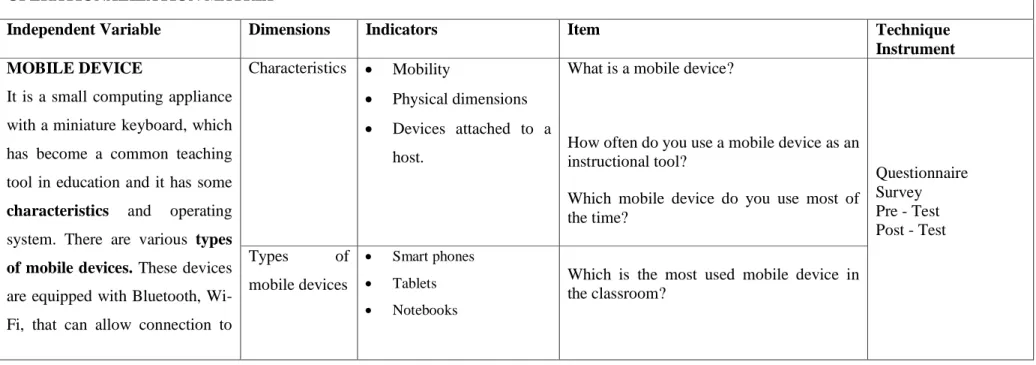
Table Nº 3: Operationalization of Independent Variable. ... 48
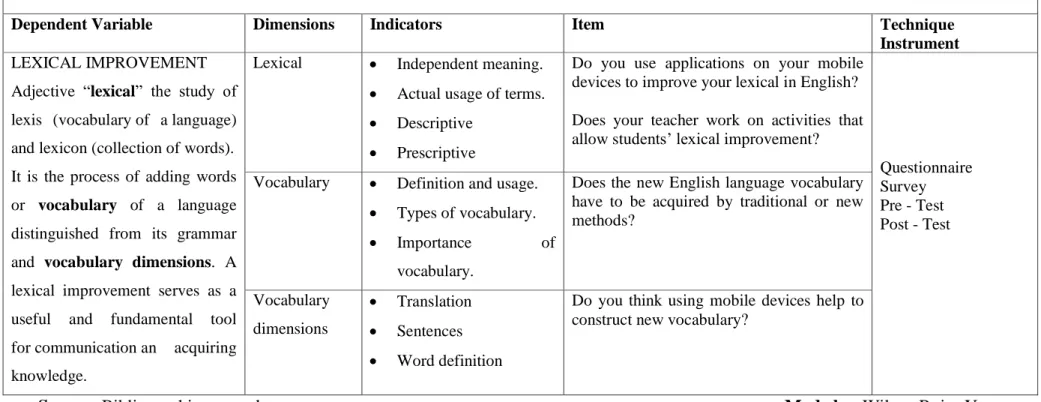
Table Nº 4: Operationalization of Dependent Variable. ... 50
Table Nº 5: Information Collection Procedure ... 48
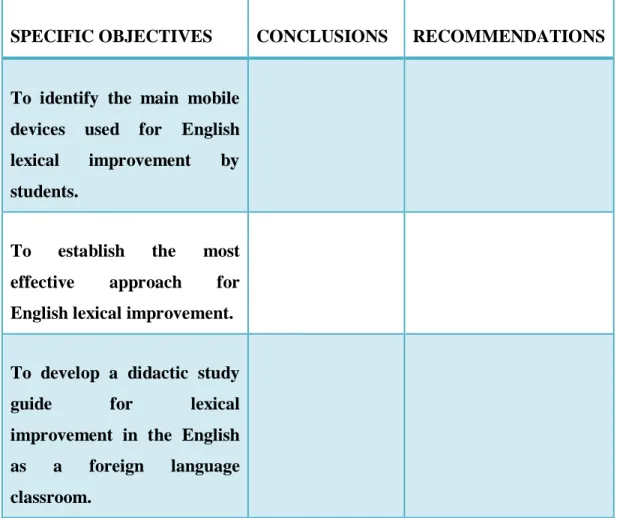
Table Nº 6: Specific Objectives, Conclusions and Recommendations ... 50
Table Nº 7: Access to mobile devices ... 51
Table Nº 8: 0wn a mobile device ... 52
Table Nº 9: Use most of the time ... 53
Table Nº 10: Activity with your mobile device ... 54
Table Nº 11: Use your mobile device in a day ... 55
Table Nº 12: Application for academic purposes... 56
Table Nº 13: Application to study English... 57
Table Nº 14: Application to improve your vocabulary in English ... 58
Table Nº 15: Use mobile devices for English teaching-learning process ... 59
Table Nº 16: Applications to expand and find meaning of new vocabulary... 60
Table Nº 17: How long Teaching English? ... 61
Table Nº 18: Own a mobile device ... 62
Table Nº 19: Use most of the time ... 63
Table Nº 20: Activity with your mobile device ... 64
Table Nº 21: Use of your mobile device in a day ... 65
Table Nº 22: Application for academic purposes... 66
Table Nº 23: Use of Application to study English ... 67
Table Nº 24: Application to improve your vocabulary in English ... 68
Table Nº 25: Use mobile devices for the English teaching-learning process ... 69
Table Nº 26: Applications to expand and find meaning of new vocabulary... 70
Table Nº 27: Summary of each question ... 71
Table Nº 28: Summary of each question ... 72
IX
Table Nº 30: Post-Test Average ... 75
Table Nº 31: Chart of Average Comparison ... 79
Table Nº 32: Average Comparison of School Years... 81
Table Nº 33: T- Test Table Average Comparison 1st Year Pre and Post Test. ... 81
Table Nº 34: T- Test Table Average Comparison 2nd Year Pre and Post Test. ... 82
Table Nº 35: T- Test Table Average Comparison 3rd Year Pre and Post Test. ... 83
Table Nº 36: T- Test Table Average Comparison Average Comparison 1st, 2nd and 3rd Years Pre and Post Test. ... 84
Table Nº 37: T- Test Tables for paired samples of Pre and Post-Tests. ... 87
Table Nº 38: Operational Model ... 152
Table Nº 39: Administration of Proposal ... 154
X
LIST OF GRAPHS
Graph Nº 1: Critical Analysis ... 7
Graph Nº 2: Key Categories ... 20
Graph Nº 3: Graphics Independent ... 21
Graph Nº 4: Graphics Dependent ... 22
Graph Nº 5: Access to mobile devices ... 51
Graph Nº 6: Own a mobile device ... 52
Graph Nº 7: Use most of the time... 53
Graph Nº 8: Activity with your mobile device ... 54
Graph Nº 9: Use your mobile device ... 55
Graph Nº 10: Application for academic purposes ... 56
Graph Nº 11: Application to study English ... 57
Graph Nº 12: Application to improve your vocabulary in English ... 58
Graph Nº 13: Use mobile devices for the English teaching-learning process ... 59
Graph Nº 14: Applications to expand and find meaning of new vocabulary ... 60
Graph Nº 15: Experience in teaching English ... 61
Graph Nº 16: Own a mobile device ... 62
Graph Nº 17: Use most of the time... 63
Graph Nº 18: Activity with your mobile device ... 64
Graph Nº 19: Use your mobile device ... 65
Graph Nº 20: Use of application for academic purposes... 66
Graph Nº 21: Use of application to study English... 67
Graph Nº 22: Application to improve your vocabulary in English ... 68
Graph Nº 23: Use mobile devices for the English teaching-learning process ... 69
Graph Nº 24: Applications to expand and find meaning of new vocabulary ... 70
XI
Graph Nº 26: Sentence results from Pre and Post Test. ... 77 Graph Nº 27: Word Definition results from Pre and Post Test. ... 78 Graph Nº 28: Average Comparison from Pre and Post Test. ... 80 Graph Nº 29: T-Test Graphic Average Comparison 1st Year Pre and
Post Test. ... 81
Graph Nº 30: T-Test Graphic Average Comparison 2nd Year Pre and
Post Test. ... 82
Graph Nº 31: T-Test Graphic Average Comparison 3rd Year Pre and
Post Test. ... 83
Graph Nº 32: T-Test Graphic Average Comparison 1st, 2nd and 3rd
Years Pre and Post Test... 84
XII
LIST OF FIGURES
XIII
AGRADECIMIENTO
A todos quienes de una u otra forma aportaron para la realización de este trabajo de investigación. En especial a las autoridades, maestros y estudiantes de la Unidad Educativa “San Gerardo” por toda la apertura brindada para la aplicación de la propuesta. Agradecer de manera especial al Mg. Peter Oye quien con su guía y acertada orientación brindaron un soporte al desarrollo del presente trabajo, logrando de esta manera alcanzar los objetivos propuestos.
XIV
DEDICATORIA
Este trabajo fruto de mi esfuerzo y constancia; dedico a mi familia y en especial a mi ABUELITA y MADRE, quienes son los seres más sublimes que están en mi vida; al estar pendiente de mí en los momentos más difíciles de mi vida; lo cual fue el estímulo que me impulso a la culminación de un objetivo más en mi carrera profesional.
A mis HIJOS, a quienes con mi esfuerzo y trabajo les demuestro día a día lo mucho que los amo y que son la razón de mi vivir a pesar de no estar junto a mí.
Dedico también este trabajo, a todos quienes con su amor y confianza lograron que crea en mí mismo y a saber que soy un hombre lleno de valores, virtudes y aptitudes; las cuales han sido base fundamental para alcanzar una meta más de las que me esperan por alcanzar.
XV
UNIVERSIDAD TÉCNICA DE AMBATO DIRECCIÓN DE POSGRADO
MAESTRÍA EN LA ENSEÑANZA DEL IDIOMA INGLÉS COMO LENGUA EXTRANJERA
TEMA:
THE USE OF MOBILE DEVICES FOR ENGLISH LEXICAL IMPROVEMENT BY STUDENTS AT 1ST, 2ND, AND 3RD YEARS OF BACHILLERATO GENERAL UNIFICADO SAN GERARDO UNIT.
AUTOR: Licenciado Wilson Gonzalo Rojas Yumisaca DIRECTOR: Licenciado Rotini Peter Oye Magíster FECHA: 23 de octubre de 2017
RESUMEN EJECUTIVO
La presente investigación tiene como objetivo determinar si el uso de los dispositivos móviles ayuda el mejoramiento del léxico en los estudiantes de primero, segundo y tercer año de bachillerato en la Unidad Educativa “San Gerardo”, provincia de Chimborazo, Cantón San Gerardo de la ciudad de Riobamba, para lo cual se realizó una investigación de campo con la aplicación de encuestas a 69 estudiantes, 5 autoridades y profesores de la unidad educativa.
Los resultados de esta encuesta demostraron que tanto profesores como estudiantes tienen acceso y son propietarios de dispositivos móviles, pero teniendo como preferencias el uso de celulares inteligentes y aplicaciones móviles en un promedio de 2 a 3 horas por día, lo cual facilita interactuar libremente utilizando este dispositivo móvil como herramienta para el proceso de enseñanza aprendizaje del léxico en el idioma Ingles. Además, las encuestas permitieron conocer que es importante hacer uso de la tecnología y dejar de lado las actividades monótonas en las aulas sin la participación activa de los estudiantes.
Por tal motivo se aplica un pre y post test con la finalidad de medir el conocimiento de los estudiantes antes de y después de aplicar estrategias
XVI
metodológicas viables dentro del aula a través de aplicaciones libres de pago y el uso de celulares para el mejoramiento del léxico.
Es necesario también mencionar que para la obtención de los datos y análisis de los resultados del pre y post test se utilizó la prueba T de estudiante con el programa estadístico SPSS (Estadística para las Ciencias Sociales) la misma que permitió obtener resultados debidamente comprobados.
Finalmente, los resultados de la investigación demostraron el impacto académico que tuvo en los estudiantes y profesores de la unidad educativa “San Gerardo”, luego de la adecuada aplicación de la “Guía del Estudiante” propuesta con sus diferentes actividades; las misma que permitió obtener el mejoramiento del léxico y cumplir con los objetivos planteados.
DESCRIPTORES: Aplicaciones móviles, celulares inteligentes, dispositivos
móviles, estrategias metodológicas, herramienta, idioma inglés, investigación de campo, mejoramiento del léxico, proceso enseñanza aprendizaje, tecnología.
XVII
UNIVERSIDAD TÉCNICA DE AMBATO DIRECCIÓN DE POSGRADO
MAESTRÍA EN LA ENSEÑANZA DEL IDIOMA INGLÉS COMO LENGUA EXTRANJERA
THEME:
THE USE OF MOBILE DEVICES FOR ENGLISH LEXICAL IMPROVEMENT BY STUDENTS AT 1ST, 2ND, AND 3RD YEARS OF BACHILLERATO GENERAL UNIFICADO SAN GERARDO UNIT.
AUTHOR: Licenciado Wilson Gonzalo Rojas Yumisaca DIRECTED BY: Licenciado Rotini Peter Oye Magíster DATE: October 23rd, 2017
EXECUTIVE SUMMARY
The objective of this research is to determine if the use of mobile devices helps the lexical improvement in the first, second and third school years of the Educational Unit "San Gerardo", Chimborazo province, San Gerardo Parish in Riobamba, on which a field investigation was conducted with the application of surveys on 69 students, 5 authorities and teachers of the education unit.
The results of this survey showed that both teachers and students have access to and are owners of mobile devices, but they prefer to use smartphones and mobile applications in an average of 2 to 3 hours per day, which facilitates free interaction using this device mobile as a tool for lexicon teaching-learning process in English language. In addition, the surveys allowed to know that it is important to use technology and put aside monotonous activities in the classroom without the active participation of students.
For this reason, a Pre – Post Test was applied in order to measure students' knowledge before and after applying viable methodological strategies in the classroom through free applications and the use of cell phones for lexical improvement.
XVIII
It is also necessary to mention that in order to obtain the data and analysis of the results of the pre and post test, the student's T test was used with the statistical program SPSS (Statistics for Social Sciences), which allowed obtaining the proven results.
Finally, the results of the research showed the academic impact it had on the students and teachers at the educational unit "San Gerardo", after the adequate application of the "Student Guide" proposed with its different activities; the same allowed to obtain the lexical improvement and to accomplish the proposed objectives.
KEY WORDS: English language, field research, lexical improvement, methodological strategies, mobile applications, mobile devices, smartphones, technology, tools, teaching-learning process.
1
INTRODUCTION
Teaching activity has been characterized by following the traditional educational model, where the main and only actor of the learning process has been the teacher but the high increase in technology with new tools has opened new learning options through the use of mobile devices in the classroom considering the needs of an educational model to guide the academic process.
Considering, the statement mentioned above, this research work refers to topics related to methodology, methods and techniques, which have been applied with the use of mobile devices and applications for the lexical improvement in English language and which are currently in full development. In addition, this study has been conducted in order to determine whether the use of mobile devices and applications, helps to improve the vocabulary of students at “San Gerardo” education unit.
This research work titled: “The use of mobile devices for English lexical improvement by students at 1st, 2nd, and 3rd years of Bachillerato General Unificado San Gerardo unit”, 2016-2017 school year in Riobamba, Guano canton; San Gerardo parish”, plans to solve the problem encountered in the institution, following the next steps:
In Chapter I: It talks about the problem of the research, and its contextualization
from a macro, mezzo and micro viewpoint that the educational institution and its environment present. It is analyzed critically, in order to develop the objectives that we want to achieve; and indicate the reasons why the current research is justified.
In Chapter II: It present the theorical framework, which is composed by the
research background, the philosophical and legal foundation of the theme; besides the hypothesis and key categories which orientate the problem of the research from a scientific and bibliography viewpoint.
2
In Chapter III: It addresses the basic method and the level of the research shows
the design this research follows. The sample states the number of people involved and the operationalization of variables displays the development of the instruments for this work; and finally, the description of the instruments that are going to be used for collecting information and data.
In Chapter IV: It presents the analysis and interpretation of results with the
findings displayed in figures and charts. The hypothesis verification is also stablished along with the bell curve.
In Chapter V: It covers the conclusions and recommendations of the research,
which help to determine assumptions from all the results obtained with the different instruments of the collecting data; besides it allows to give suggestions about the current problem.
In Chapter VI: It talks about the proposal, which is focused in the research and
design of activities that are going to be applied. The proposal contains a study guide based on MALL approach in order to enhance English lexical. It also details the process of how the proposal is going to be applied.
3
CHAPTER I
PROBLEM STATEMENT
1.1 Theme of the problem
“The Use of Mobile Devices for English Lexical Improvement”
1.2 Problem Statement
“The use of mobile devices for English lexical improvement by students at 1st, 2nd, and 3rd years of Bachillerato General Unificado San Gerardo unit”, 2016-2017 school Year in Riobamba, Guano Canton; San Gerardo Parish.
1.2.1. Contextualization of the problem.
The high increase in the use of technology around the world has created controversial points of view between believers and doubters. Nowadays, technology offers variety of benefits and improves access to education while maintaining a high quality of education by facilitating alternatives in the learning process as well as instructional methods and skills. (Johnson, 2018)
Hooft J. (2006) says that, “Mobile devices are important instruments that make teaching relevant and meaningful thereby the students improve their lexical and numeracy abilities”. Nevertheless, English as Foreign Language students not necessarily use these devices for educational purposes, which presents a constraint while developing activities to improve vocabulary in the classroom. In the same way, J. Attwell (2005) reports. “Mobile devices use encourages in an independent and collaborative way and also increases the learners’ esteem and self-confidence.” This affirmation emphasises the importance of implementing technology-based activities in the classroom on the condition that students understand how positive and productive it could be since the majority of youngster spend a considerable amount of time only on social networks. (West, 2013)
4
The use of devices in English classes has not only presented positive benefits, but also negative ones, which must be taken into account. The first one is that students have not received the proper guide or training to choose educational activities to increase their vocabulary or improve their lexical and of course, teachers play a relevant role in this aspect. Due to teachers’ lack of knowledge and skill regarding the latest and updated, applications, which can be taken advantage of in the English classroom, students feel unmotivated to try new things or learn new words. Moreover, some teachers prohibit the use of cell phones in the classroom because they consider it only as a distractor and not as a very useful tool, which can highly contribute in vocabulary learning; teachers prefer learners not to use these devices because there are certain doubts that students are surfing on social networks instead of paying attention in classes. In other words, teachers are used to the traditional tools for developing classes. (Lynch, 2015)
On the other hand, some teachers agree because, they perceive that the mobile learning have their benefits in English classes, but at the same time, they want to prevent students from such use by integrating mobile teaching-learning in order to integrate mobile activities in English classes. (Sung, 2016)
Additionally, it is necessary to mention that majority of students use cellphones in the classroom because of low-cost of internet access, in some high schools, students even have free Wi-Fi access, which increases the possibility of surfing the web whenever and wherever they want. According to a study developed by “The way forward for Education”, 94% of students want to use their cell phones in the classroom, but it is the teacher’s responsibility to direct this interest for academic purposes. (Harper, 2009)
In a great number of classrooms across Ecuador, learners bring and use their mobile devices. Incidentally, some learners may use this kind of technology for purposes related to classroom activities such as taking notes, looking up meanings of new words and vocabulary or may be surfing on the net. Others
5
through WhatsApp, Messenger, Facebook or any other social networking site using various applications. The concern is in knowing and understanding what incidence this behavior has on English lexical learning. Specifically, there is a need to examine if using mobile devices in English classrooms helps or harms in the teaching process. (Trinder, 2017)
According to Hooft J. (2006), even though mobile devices have become more popular, their use has been met with resistance by both teachers and students in the learning environment based on the concept that they produce irritability in the classrooms. In the same way, James E. Katz (2008) declares that the mobile devices are a strongly inappropriate tool for learning or teaching due to the fact that students only use them for chatting and texting and not for studying or carrying out classroom activities. (Kartz, 2008)
Nowadays, teachers and students in the Education Unit “San Gerardo” in Chimborazo Province face many challenges in the English classrooms and one of them is the use of mobile devices. The rapid spread and use of smart phones, tablets, laptops, iPhones, iPads; etcetera has produced distraction and taken over the attention of students using these devices. It is common to see that while the teacher is busy helping other students or writing on the board, students are sending instant messages to friends, listening to music, or watching videos on the internet; despite the fact that the teacher has already set up the rules about use of phones in the classroom. Some teachers have decided to confiscate the cell phones, others just prohibit their use but students are always looking for the opportunity to take their mobiles out ignoring the rules or instructions given by the teacher. All these situations cause discomfort in the classroom and thus reluctance in using them during a lesson. (Earl, 2012)
The students in 1st, 2nd, and 3rd grades of Bachillerato General Unificado; who are engaged most of the time in using these mobile devices in texting messages, playing video games, checking applications and social networks are
6
developing a kind of addiction to these digital devices. Then, there is a controversy among teachers and students if it is legal or illegal to use mobile devices in classes; because many teachers believe that students spend most of their time in and outside the classrooms using these devices hence do not pay attention in classes as this interrupts the teaching-learning process.
This concern has potential merit because recent statistics from the Pew Foundation show that “the median number of daily texts for older teens rose from 60 in 2009 to 100 in 2011”. Moreover, “64% of teens who have smart phones have messaged in class and also in educational institutions where mobile phones are banned.” (Cooper, 2005)
For all the mentioned above, it can be noticed that modern mobile devices create a great temptation to surf the internet, check social media, contact friends, play video games, explore new applications or take other mobile devices. Some students in class find it difficult to resist the idea to remain focused on academic activities and students at 1st, 2nd, and 3rd years of Bachillerato General Unificado are not the exception. Many teachers and students support the idea of using mobile devices in the classrooms, because they present a variety of activities to be used and they believe that these devices are not only used for social and entertainment activities but also for academic and educative purposes and they provide striking options for teaching-learning process.
7 1.2.2. Critical Analysis
Graph Nº 1: Critical Analysis
Made by: Wilson Rojas Y.
The lack of knowledge in using adequately Mobile Devices in English classes reduce the potential for the development of English lexical improvement.
Students do not use mobile device for educational
purposes
Increasing use of mobile devices in the life of
students
Students are permanently using mobile devices in
social networks
Uncontrolled use of mobile devices and access to
networking sites not adequate
Teachers lack of training limits the use of educational activities (apps) in the classroom.
Dependence on the use of mobile devices by learners.
Easy access totechnology
Lower technology cost
Inability of Teachers to use mobile devices Waste of valuable time
Students focus their attention on chatting and texting more than
in classroom activities.
Students spend lots of time using internet due to its low cost and easy access. Inadequate Lexical learning
8
The current investigation is about the use of mobile devices in the English as a Foreign Language classroom in order to improve English Lexical in the teaching–learning process at 1st, 2nd, and 3rd years of Bachillerato General Unificado, 2016-2017 school year in Riobamba, Guano Canton; San Gerardo Parish. This study has generated positive and negative results, which must be taken into considerations considering that majority of students has at least a mobile device and they prefer to use them in classes. This has become a problem in English classes during the teaching – learning process.
As a result, the lack of knowledge in using Mobile Devices appropriately in English classes reduces the potential for the development of English Lexical Improvement at 1st, 2nd, and 3rd years of Bachillerato General Unificado San Gerardo because of the increasing use of mobile devices in the life of students has produced many effects which have been interrupting the process of acquiring new vocabulary and one of these effects is that the students do not use mobile devices for educational purposes; they use them for chatting and surfing on social networks. Besides, the bad use of mobile devices in classrooms produces an inadequate lexical learning because students chat all the time and when they do it, they prefer use expressions, short words, acronyms and emojis.
On the other hand, the dependence that learners have on the use of mobile devices produces that students are permanently surfing on social networks and at the same time it becomes a waste of time. These effects lead to students to focus their attention on chatting and texting in class more than paying attention to the English class. So, students have created a dependence on the use of mobile devices.
Furthermore, the easy access to the technology and the lower technology cost have produced an uncontrolled use of mobile devices in classrooms and access to inadequate networking sites by student which reduced the potential for the development of English lexical. As a consequence, with the easy access students spend a lot of time on their mobile devices without academic production.
9
Finally, the inability of some teachers for using mobile devices in order to take advantage of them, it does not allow using many educative applications with academic purposes. So, the lack of knowledge about mobile devices limits teachers for developing lexical activities in classroom using mobile devices.
Consequently, all these causes produce many effects that also have to be considered for example most of the students do not use mobile device for educational purposes, hence they are permanently uncontrolled using their devices, surfing on inadequate networking sites, means while teachers do not allow the use of mobile devices due to unfamiliarity on their use.
As conclusion, all these causes and effects do not allow active development in English classes and therefore there is no lexical improvement which is a fundamental part for the learning process of another language.
1.2.3. Prognosis
English has a remarkable status around the world, it is a global language called Lingua Franca. For these and other reasons, it is important create students’ consciousness about the importance of the development of English lexical. If the current research based on English Lexical Improvement at 1st, 2nd, and 3rd years of “San Gerardo” Unified General Baccalaureate Education Unit, in Riobamba, is not carried out, the interaction between classmates and teacher will be affected.
In addition, if the current research project based English Lexical Improvement is effectively carried out and implemented in the institution, learners will have the opportunity to use English language meaningfully. Consequently, students’ participation will enhance and increase due to the use of mobile devices in an appropriate way allow them to enhance their vocabulary in authentic situations, as well as to be focused on the English lexical improvement.
On the other hand, If mobile devices and application in English classes are not used adequately for the development of English lexical improvement, the learning results will not properly be very valuable since the students need to develop a
10
significant learning performance which will be useful in classrooms as a foreign language for a proper lexical learning process in the Baccalaureate students at San Gerardo Education Unit, then, it negatively affects their English learning performance.
First, Teachers will not have a structural change, which will not be integrated to reach significant lexical teaching and at the same time will not achieve students’ engagements, motivation and accelerate the learning of lexical in English classes.
Secondly, if the problem of poor lexical improvement persists, students will not have sufficient vocabulary to understand others or express their own ideas. Teaching vocabulary has always been one of the most difficult challenges facing EFL teachers in a context where the exposure to the language is minimum and thus it makes more difficult for students to memorize and remember words.
Furthermore, if the problem persists, students will not be focused on learning since they will be engaged in using these devices in social network activities and not in classroom lessons, which creates or motivates a waste of time. Similarly, the classrooms will have the common classes or the traditional ones, whereby the results will show lack of interest and demotivation and consequently both teacher and students will have productive classroom activities.
Therefore, if mobile and applications are used incorrectly, they will think that these tools are not useful and they will not have an effective lexical improvement in the new education systems for the teaching learning process. What it means is that they will not have control in classes with the use of the new technological devices because of their unfamiliarity and inadequate use.
1.2.4. Setting of the problem
How does the use of mobile devices influence English lexical improvement by students at 1st, 2nd, and 3rd years of Bachillerato General Unificado San
11
Gerardo Unit, 2016-2017 School Year in Riobamba, Guano Canton; San Gerardo Parish?
1.2.5. Research questions
What mobile applications do students use in classroom for improving vocabulary in English classes at 1st, 2nd, and 3rd years of Bachillerato General Unificado San Gerardo Unit, 2016-2017 School Year in Riobamba, Guano Canton; San Gerardo Parish?
What mobile devices do students use to improve vocabulary in English at 1st, 2nd, and 3rd years of Bachillerato General Unificado San Gerardo Unit, 2016-2017 School Year in Riobamba, Guano Canton; San Gerardo Parish?
What is the most effective approach for English lexical improvement at 1st, 2nd, and 3rd years of Bachillerato General Unificado San Gerardo Unit, 2016-2017 School Year in Riobamba, Guano Canton; San Gerardo Parish?
What didactic resource can be implemented for English lexical improvement at 1st, 2nd, and 3rd years of Bachillerato General Unificado San Gerardo Unit, 2016-2017 School Year in Riobamba, Guano Canton; San Gerardo Parish?
1.2.6. Research delimitation
Content Delimitation
Field: Education.
Area: Technological Teaching.
Aspect: Use of Mobile Devices for English Lexical Improvement.
Temporal delimitation
2017 - 2018 School Year.
12
The research project will be developed at 1st, 2nd, and 3rd years of Bachillerato General Unificado San Gerardo Unit, 2017-2018 School Year in Riobamba, Guano Canton, and San Gerardo Parish.
1.3. Justification
The importance of the study aims to establish what the incidence of using mobile devices is in English lexical improvement with Baccalaureate students in “San Gerardo” Educative Unit. Consequently, with the correct use of mobile devices, this research ferments to get better English lexical improvement in classrooms and that teachers take advantage of the technology by using more resources since in the daily classrooms activities students easily get frustrated and demotivated because they cannot use their mobile devices as a tool for their academic activities. So, they don’t pay attention in classes and/or are distracted because they prefer having on hands their mobile devices producing at the same time developing a negative attitude.
Furthermore, the interest of developing is to contribute to the contextualization of methodological strategies in classrooms according to the population of “San Gerardo” students and also considering what kind of available mobile devices and applications the students have.
The originality of this study is based on that the mobile devices and applications are implemented in the process of the lexical improvement in the L2 classrooms. In the same way, the development of this work has literature review about the project variables such as mobile devices and lexical improvement and after that will be applied a survey in order to collect data and then will be taken a Pre and Post Test to establish the level of English lexical that students possess.
Moreover, this study has a high great of feasibility due to the fact, that not only having technology and resources but also the support of the “San Gerardo” authority and lecturers from Technical University, Ambato, who are an essential part in the development of this research. Additional to this, it is necessary to
13
develop this work because the problem is happening. Therefore, they don’t have control of using technology, mobile devices, network sites and hence create pedagogical problems.
Finally, the beneficiaries of this study are baccalaureate students at “San Gerardo”, a public institution located in Riobamba in the Chimborazo province. As a matter of fact, students are evidenced that they will improve their lexical because mobile devices and applications will reinforce meaningful learning.
1.4. Objectives.
1.4.1. General Objective.
To incorporate the use of mobile device applications for lexical improvement in English by Students at 1st, 2nd, and 3rd years of Bachillerato General Unificado San Gerardo Unit, 2016-2017 School Year in Riobamba, Guano Canton; San Gerardo Parish.
1.4.2. Specific Objectives.
To identify the main mobile devices used for English lexical improvement by Studentsat 1st, 2nd, and 3rd years of Bachillerato General Unificado San Gerardo Unit, 2016-2017 School Year in Riobamba, Guano Canton; San Gerardo Parish.
To establish the most effective approach for English lexical improvement at 1st, 2nd, and 3rd years of Bachillerato General Unificado San Gerardo Unit, 2016-2017 School Year in Riobamba, Guano Canton; San Gerardo Parish.
To develop a didactic study guide for lexical improvement in the English as a foreign language classroom at 1st, 2nd, and 3rd years of Bachillerato General Unificado San Gerardo Unit, 2016-2017 School Year in Riobamba, Guano Canton; San Gerardo Parish.
14
CHAPTER II
THEORICAL FRAMEWORK
2.1. Research Background
Some studies have previously been developed regarding the use of mobile devices and lexical improvement; nevertheless, all of them took place internationally. Among the most relevant ones are detailed below.
Ahmet Basal (2016) contributes with his study entitled “Effectiveness of Mobile Applications in Vocabulary Teaching” developed in Turkey with the objective to investigate the effectiveness of a mobile application on teaching idioms in the Michigan Corpus of Academic Spoken English corpus compared to traditional activities. The results of this experimental design indicate that the experimental group students who learned idioms through the use of mobile applications, achieved significantly better than their counterparts in the control group with traditional activities; thus, indicating that the use of the mobile application was more effective in teaching idioms than the traditional activities. (Basal, 2016)
Rahmani Khaoula (2016) presents the study “The importance of using mobile technology in improving students’ vocabulary”, the objectives of this paper were to encourage students in enhancing their vocabulary through using mobile technology, to improve language skills, to give the students the chance to learn new vocabulary, and to stimulate and facilitate vocabulary acquisition. After concluding the studies, the researcher concludes that mobile learning can be considered as a facilitating way for EFL leaners to be more interactive and then motivated, the use of mobile technology can be a very useful way for learners to improve their vocabulary acquisition. (Khaoula, 2016)
The investigation “Exploring the impact of Mobile-Assisted Language Learning on developing learner’s lexical competence,” conducted by Narimane
15
(2016) contributes significantly, since its main goal is to investigate the newly flourishing learning approach known as MALL. The focus is to find out how the EFL students of Biskra University update themselves to use mobile devices to assist their vocabulary learning, and how they learn new lexical items to discover how EFL teachers and EFL students use handled devices in their daily learning practices. At the end on the study, the following conclusion was drawn, EFL students use their mobile devices as teaching and learning tools in order to develop their lexical competence as well as EFL teachers perceiving MALL activities as an effective mean in enhancing vocabulary knowledge. (Gacem, 2016)
In the national scope, after reviewing the Repository of The Armed Forces University - (ESPE) in Quito and Technical University in Ambato. It is concluded that there are no identical or similar works concerning the topic: “The Use of Mobile Devices for English Lexical Improvement”. In the archive of The Armed Forces University – (ESPE) in Quito, a study titled “The incidence of using authentic material in teaching vocabulary to students who are attending 10th grade at Saint Patrick School in Quito-Ecuador from September to December 2012” was found, but it does not constitute a significant contribution to the current research.
2.2. Philosophical Foundation
The current study is based on the constructivist theory. The word constructivism comes from the word construction or structure. This theory emphasizes learning through information building; whereby students construct their knowledge by taking advantage of prior experiences. In addition, there are some relevant points, which explain constructivism.
Jean Piaget was a Philosopher from Switzerland who argues that people produce their knowledge and form meaning based upon their experiences. Piaget’s theory covered learning theories, teaching methods and education reform. Jean Piaget was a scientist very famous for his constructivism theory that he did studying cognitive development and learning theories.
16
Piaget concluded that two of the components which created the construction of an individual’s new knowledge are: Accommodation and Assimilation.
Piaget’s theory of constructivism addresses how learning actually occurs that is why the role of teacher is very important in this research work because they act as a guide and facilitator who helps students come to their own understanding.
The resources, mobile devices and techniques for this learning theory take a very different approach toward traditional learning. The teacher must be asking instead of answering questions to the students, so the students come to the conclusions on their own. (Aldoobie, 2015)
Knowledge is not transmitted to students by the teacher, but by implementing didactic applications, students can use their mobile devices to practice vocabulary at their own place.
Learners use their own experience or prior knowledge to explain new knowledge. A great advantage of using mobile devices in the English classroom is that they are accessible in all levels, which give students the possibility to discover and apply new knowledge in classroom activities guided by the teacher.
Learning is an active dynamic process. It is well known that students enjoy all kind of gadgets. Then, why not motivate them to use their cellphones in class, but for educational purposes?
The integration of mobile technology and constructivist learning theory is impacting educational environments because they are changing daily and we can see that constructivist learning theory and mobile technology are being utilized in increasing numbers and innovative ways.
Learning is social. Through social networks such as Messenger, Facebook, and WhatsApp, students can learn from others while enjoying all the benefits technology offers.
17
Furthermore, learning is evidentiary and contextual because human beings do not learn secluded facts or theories, but cause and consequence or relationships for what they want to learn. Besides, constructivism is not a new learning theory; it originates all the way from Socrates, Plato, and Aristotle. In addition, there are three top persons, who made real good impacts to demonstrate the pattern of constructivism theory: John Dewey, Lev Vigotsky, and Jean Piaget. (Aldoobie, 2015)
2.3. Legal basis
The legal statutes that support the current research work are the following:
Republic of Ecuador Constitution of 2008. Section Five – Education
“Article 26 Education is a right of the people throughout their lives, which is an
unavoidable and mandatory duty of the State. It constitutes an area of priority for public policy making and state investment, guarantee of equality, social inclusion and indispensable condition for good living. People, families and society have the right and responsibility to partake in education.” In fact, this article guaranty that all students have the same rights to be included in education and give them an authentic process of teaching learning.
“Article 27 Education will focus on human beings and shall guarantee holistic
human development, in the framework of respect for human rights, a sustainable environment, and democracy; it shall be participatory, compulsory, intercultural, democratic, inclusive and diverse, of high quality and humane; promote gender equity, justice, solidarity and peace; encourage critical faculties, arts, sports, individual and community initiatives, the development of competencies and capabilities to create and work. Education is indispensable for knowledge, exercise of rights, building a sovereign country and key strategy for national development.” Indeed, teacher have to give students an inclusive and participatory participation during classes and persuade them to go ahead in their studies.
18
“Article 28 Education shall be for general welfare of the public and not be at the
service of individuals and corporate interests, Universal access, permanence, mobility and graduation without any discrimination shall be guaranteed, as well as compulsory attendance of initial schooling, basic education and secondary education or their equivalents.” As this article says, all students have to receive an individual and a cooperative learning processes, consequently teachers have the obligation to guide students at the beginning, during and after classes.
Education is seen as the right of every citizen and community to interact among cultures as well as participate in a society that is ready to learn. The State shall promote intercultural dialogue in all her many dimensions.
“Article 29 The State shall guarantee the freedom to teach, academic freedom at
higher education level, and the right of the people to learn in their own language and cultural environment. Parents or their representatives shall be at liberty to choose for their daughters and sons an education that is in line with their principles, beliefs, and pedagogical options.” In fact, this article persuades students and teacher to have an integral education with many values without restrictions but getting an integral process of education into the classrooms. (ASSEMBLY, 2008)
Ecuadorian Ministry of Education, Mandatory Curriculum Levels of Education - English as a Foreign Language.
Introduction
This English Language curriculum is designed for students in Basic General Education (2nd to 10th) and Unified General Baccalaureate (1st to 3rd), whose mother tongue is not English. Since Ecuadorian population is comprised of groups of people from different cultural and linguistic backgrounds, this curriculum acknowledges that not all learners in Ecuador are L1 Spanish speakers and there are varying degrees of bilingualism across communities. In keeping with
19
the needs of a linguistically and culturally diverse population, this curriculum presents a rationale and framework for learning English while acknowledging authentic, culturally relevant production and practices in order to facilitate educational inclusion of learners regardless of their L1.
This curriculum is built with monolingual and multilingual learners in mind, including those who speak Spanish and those who have little or no knowledge of Spanish. It aims at supporting the policy of developing citizens in Ecuador to communicate effectively in today’s globalized world. The curriculum also supports general educational goals of justice, innovation, and solidarity, by developing thinking, social, and creative skills in the context of language learning. These are the skills Ecuadorian learners will need to engage successfully in the local and international communities in the 21st century. (Ecuador, 2014)
How English as a Foreign Language contributes to the existing profile of Ecuadorian high school students.
The Ecuadorian High School existing Profile aims to prepare Ecuadorian high school students for successful participation in a globalized, democratic society in the 21st century by focusing on the development of life skills, work skills, and entrepreneurship skills. Indeed, all the educational public institutions are engaged to increase their level of teaching learning.
The English as a Foreign Language (EFL) curriculum embraces the development of creative and critical thinking skills, as well as attitudes such as ethical conduct, through the values of academic honesty and integrity. These skills are integrated within the five curricular threads and encourage learners to act responsibly and respect themselves as well as others while participating in the communication process. In doing so, the curriculum endorses the values of solidarity and justice. In fact, English has become an important subject around the world and why not Ecuador. Then, based on these principles, English language has to be in the place that correspond and community, authorities, teachers, parents and students have the responsibility for receiving an education of quality.
20
The curriculum is designed to stimulate linguistic intelligence through language analysis and comprehension of oral and written texts, which require critical thinking skills such as inference, analysis, and synthesis. Recognizing that the competencies based on the four macro-skills are indispensable tools for verbal reasoning, the English as a Foreign Language curriculum guides learners towards the ability to communicate and learn through a foreign language, in this case; English, by placing importance on clear oral expression according to international standards The Common European Framework of Reference for Languages
(CEFR). A strong emphasis is placed on verbal communication through group work, and the development of problem-solving skills has the purpose of strengthening learners’ ability to interact socially in a variety of situations, fortifying principles such as tolerance and social inclusion. Foreign language learning harnesses the processes needed to establish logical relationships between different notions and concepts. Studies show that foreign language learning foments critical thinking skills, creativity, and flexibility of mind in young children. As such, the English as a Foreign Language curriculum contributes to the development of logical, critical, and creative thinking. (Council, 2015)
According to Michael Gordin (2015) English is considered the “Lingua Franca” of the science and technology community and being able to communicate in English opens up access not only to current and relevant information and primary sources, but also communication with people from around the world. (Gordin, 2015)
The Oral Communication, Reading, and Writing curricular threads comprise specific skills relate to the use of ICT to support and enhance the capacity for oral and written expressions, facilitating organization, autonomy, and independence, along with other 21st century skills. Consequently, learners will be equipped with learning strategies that will help them to become independent, self-motivated and lifelong learners. (Medel-Anonuevo, 2011)
21
The English as a Foreign Language (EFL) curriculum includes trend known as Communication and Cultural Awareness and another called Language through the Arts. Both contribute significantly to students’ approaching the socio-cultural reality of the country in thoughtful and inquisitive ways by exposing them to other cultures and languages, so as to better understand and strengthen their own sense of identity. The Language through the Arts and Communication and Cultural Awareness trends also encourage the use of Information and Communication Technology (ICT) to awaken intellectual curiosity and breed tolerance and inter-culturality through the use of an authentic language. Learners will be brought up to a B1 level as identified by the Common European Framework of References (CEFR). At this level, they will be able to communicate in everyday situations in English, solve basic problems, and communicate basic needs in situations such as travel, school, and work. Thus, the EFL curriculum has the purpose of develop activities related with the student’s identities in order to provide through English different opportunities for academic scholarship, work and the access to the universities after concluding the high schools. (Europe, Council of, 2018)
20 2.4. Key Categories.
Graph Nº 2: Key Categories
21 2.4.1. Independent Variable Interrelated Graphics.
Graph Nº 3: Graphics Independent Made by: Wilson Rojas Y.
MOBILE DEVICES TYPES CONCEPT Popular Hand-held Pocket-Sized Operating System Small Notebook /Laptops Tablets Cellphones Smartphones E-book readers Concept CHARACTERISTICS Physical Dimension Mobiles have mobility Devices are attached to a host The Devices are mobile APPLICATIONS WordBit WhatsApp Facebook
22 2.4.2. Dependent Variable Interrelated Graphics.
Changing usage of term Independent meaning LEXICAL IMPROVEMENT VOCABULARY LEXICAL Descriptive No Lexical Actual usage of term Prescriptive LEXIS Lexicon Lexicology Lexicalization Focal Vocabulary Types of Vocabulary Vocabulary Growth Definition and Usage Importance of Vocabulary Word List Translation Word definition VOCABULARY DIMENTIONS Sentences Lexical
More than one meaning
Graph Nº 4: Graphics Dependent Made by: Wilson Rojas Y.
23
2.4.3. Dialectical View of Conceptualizing Variables.
2.4.3.1. Independent Variable Framework.
Mobile Devices
A mobile device is a small appliance in order to be handheld, it has a display screen with a touch system and a keyboard and can weigh as less than 2 pounds. (Anderson, 2014). Besides, mobile devices in time have become very important tools in the teaching-learning process, specifically in the development of English language skills. (Kroski, 2008)
These mobile devices have a system that works very easily with applications that include software known as applications, most of these applications and devices can be adapted with Bluetooth and Wi-Fi. These features allow having connection to a network and other devices. Furthermore, they are equipped with a camera or media player to record videos or music files. (Kroski, 2008)
The mobile devices also contain sensors for example compasses, gyroscopes, magnetometers that permit the detection of orientation and motion. These appliances may provide biometric user authentication, such as a camera for face recognition or fingerprint recognition. Examples are Apple's Touch and Androids. (Bicen, 2013)
Early pocket devices were also joined in late 2000s and also similar to tablet. Input and output of modern mobile devices are often combined in a touch screen. (Bicen, 2013)
Smartphones and laptops are popular and very common among those who wish to use some conventional computer in environmental circumstances. Many enterprises can extend the available power and utility for business by means of offering integrated data and smart card readers. (Hanson, 2011). In short, mobile
24
devices are essential in the students’ everyday life activities, and due to their features and size, they can contribute as an effective learning tool.
There are many factories with few examples like Samsung, Sony, LG, Apple and Motorola Mobility which produce these types of mobile devices.
Characteristics of mobile devices
Mobile device can provide in context many dimensions such as:
Physical dimensions because of size, color, shape, etc.
Whether or not the device is mobile or some kind of host to which it is attached to is mobile
The kind of host devices can be bound to (Wi-Fi, cable, Ethernet)
How devices are attached to a host
When the mobility occurs
“There are three basic ways mobile devices can be physically bound to mobile hosts: accompanied, surface-mounted or embedded into the fabric of a host. Accompanied refers to an object being loosely bound and accompanying a mobile host. Hence, mobile hosts with embedded devices such as an autonomous vehicle can appear larger than pocket-sized”. (Wikipedia, 2016). These facilities offered by mobile devices are functional and give students the possibility to access texts, websites and applications everywhere and serve as a complementary resource in the English classroom.
The most common size of mobile device is pocket-sized that can be carried by hands. Mark Weiser, known as the father of ubiquitous computing, computing everywhere, referred to device sizes that are tab-sized, pad and board sized, where tabs are defined as centimeter-sized devices, for example: smartphones and smart cards, and pads are defined as hand-held decimeter-sized devices, example: laptops and tablet computers. If one changes the form of the mobile devices in terms of being non-planar, one also has skin devices and tiny dust-sized devices. Dust says that miniaturized devices without direct HCI interfaces, e.g.
25
micro electro-mechanical systems (MEMS), ranging from nanometers through micrometers to millimeters. Skin: fabrics based upon light emitting and conductive polymers and organic computer device. As Weiser points out, mobile devices applications, which can be synchronized and adapted so that, the users can have the same opportunities to use and take advantage of then when integrated in the classrooms. (Paspallis, 2006)
Some of the advantages of mobile devices are that they can be used without a cable, which means that the user has access to internet while travelling; besides, cellphones do not need many functions or applications and the user can have access to internet offline. For these reasons, these advices are unique and more flexible in the hardware and software compared to other technologies. (Wikipedia, Mobile devices, 2016).
Types of mobile devices
Nowadays, mobile devices are multifunctional and have the capacity to host a wide range of applications. Some of the benefits of these devices, such as smartphones and tablets, are e-mail access, instant messaging, text messages, games, applications, work documents and more. These mobile devices have become as an extension of the PC or laptop and today many of these devices are replacing PCs or computers, and most important to students can use any of these devices in the classroom since they have been designed to hold many applications and also have access to free internet.
The term mobile device refers to a wide range of electronic products. These mobile devices are usually identified as portable devices. Some of the characteristics that these mobile phones have are:
• Ability to connect to the Internet (or other data network) • Users access to data and interaction
• Multiple functionalities
26
The types of mobile devices that are generally used in the classrooms are:
• Smartphone (including "superphones", "world phones", and some feature phones)
• Tablets
• Netbooks and ultraportable laptop. • Cellphones
• E-book readers
In addition, there are other devices, such as connected digital cameras and standard MP3 players. (Mahon, 2014)
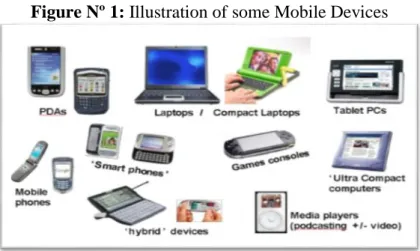
Figure Nº 1: Illustration of some Mobile Devices
Source: http://www.eportfolios.ac.uk/mobile
The figure above shows some portable devices which are used for educational purposes. Mobile devices are mainly used in the process of learning and teaching foreign languages.
Smartphones: These devices have many functions similar to a computer that work as telephones and can also run applications and software as well as record audio and video or send and receive e-mails and text messages -features that can easily be applied to research in the classroom.
Tablets: These mobile devices do everything that e-book readers do and even more. Downloadable applications make these machines almost comparable
27
to computers; one can surf the Internet, play games, watch, even make movies and take pictures. Many educational institutions have started buying tablets for their students, for example models such as: Apple iPad, Kindle Fire and Galaxy.
Netbooks and ultraportable laptop: This device is an extension of PC or laptop and, in some cases; newer and more powerful mobile devices that can even completely replace PCs. When devices are used together, work done remotely on a mobile device can be synchronized with PCs to reflect changes and new information while away from the computer.
Cellphone: This is a simplest device compared with all mobile devices, but it is still a pretty powerful tool. They can be used for group discussions through text messages and considering the fact that many cell phones have cameras, they are also useful for projects that require photographs. Students can also record themselves when they read stories aloud for writing workshops or practicing speeches.
E-book readers: They have a fundamental function which is to read books and store complete libraries. They also offer easy access to dictionaries. Many students also use their e-book readers daily to replace paper publications, since these devices can read several editions and magazines. (Carvalho, 2015)
Uses of mobile devices
In this age, life can no longer be understood without the use of mobile devices since in the last decade, they have been incorporated into people’s daily lives and have become indispensable.
According to the latest registered data, it is estimated that 35% of the population will have a Smartphone at the end of the year; this means 6% more than the previous year. The reception that these devices are having from the users around the world is very positive. (Lenhart, 2010)
28
Handheld devices have become recognized for use in mobile field management. Uses include digitizing notes, sending and receiving invoices, asset management, recording signatures, managing parts, and scanning barcodes. (Wikipedia, Mobile devices, 2016). But what is more important in these devices is now part of the education field which has originated the “Mobile learning” era which involves much more thus integrating new technologies into pedagogical strategies.
This means that mobile devices are connected to many fields of education and students are able to use them to take pictures, surf the Internet, access social networks, play video games etc. In the military field, mobile devices have created new opportunities for the Army to deliver training and educational materials to soldiers around the world. (Kukulska-Hulme, 2008).
Mobile devices are no longer used only to make calls or send messages, but these digital media have acquired multiple uses. Some of the most current uses of mobile devices are:
New ways of communication: Currently, millions of users prefer social networks and interactive platforms. Facebook, Twitter, YouTube, Skype and WhatsApp are some of the most consulted tools from mobile devices. It also happens with emails, a tool that until recently was exclusive to laptops or traditional computers.
Look up information: Through mobile devices, people look for information and perform all kinds of searches related to business, education, medicine, entertainment, among others, since it is the shortest route to obtain information.
Mobile interaction
Mobile interaction is the study of interaction between mobile users and computers. Besides, mobile interaction is an aspect of human - computer interaction that emerged when computers became small enough to enable mobile usage, this occurred around 1990. This explanation adopts the originality and