UNIVERSIDAD TÉCNICA DE AMBATO
DIRECCIÓN DE POSGRADOS
MAESTRÍA EN LA ENSEÑANZA DEL IDIOMA INGLÉS COMO
LENGUA EXTRANJERA
________________________________________________________________ Tema: “AUTHENTIC AUDIOVISUAL MATERIAL FOR ENGLISH ORAL EXPRESSION DEVELOPMENT”
________________________________________________________________
Trabajo de Titulación previo a la obtención del Grado Académico de Magíster en la Enseñanza del Idioma Inglés como Lengua Extranjera
Autor: Licenciado Rodrigo Javier Manzano Pérez
Directora: Licenciada Ana Vera de la Torre Magíster
Portada
Ambato - Ecuador 2019
ii
A la Unidad de Titulación de la Universidad Técnica de Ambato:
El Tribunal receptor de la defensa del Trabajo de Titulación presidido por el Doctor Héctor Fernando Gómez Alvarado e integrado por los señores: Lic. Miryan Consuelo Salazar Tobar. Mg y Lic. Wilber Orlando Romero Villacrés. Mg. Evaluadores del Trabajo de Titulación designadas por la Unidad de Titulación de la Universidad Técnica de Ambato, para receptar el Trabajo de Titulación con el tema: “AUTHENTIC AUDIOVISUAL MATERIAL FOR ENGLISH FOR ORAL EXPRESSION DEVELOPMENT” elaborado y presentado por el señor Licenciado Rodrigo Javier Manzano Pérez, para optar por el Grado Académico de Magíster en la Enseñanza del Idioma Inglés como Lengua Extranjera; una vez escuchada la defensa oral del Trabajo de Titulación el Tribunal aprueba y remite el trabajo para uso y custodia en las bibliotecas de la UTA.
Dr. Héctor Fernando Gómez Alvarado. Presidente del Tribunal
………..
Lic. Miryan Consuelo Salazar Tobar, Mg. Miembro de Tribunal
………...
Lic. Wilber Orlando RomeroVillacrés, Mg. Miembro de Tribunal
iii
AUTORÍA DEL TRABAJO DE TITULACIÓN
La responsabilidad de las opiniones, comentarios y críticas emitidas en el Trabajo de Titulación con el tema: “AUTHENTIC AUDIOVISUAL MATERIAL FOR ENGLISH FOR ORAL EXPRESSION DEVELOPMENT” le corresponde exclusivamente a: Licenciada Licenciado Rodrigo Javier Manzano Pérez, Autora bajo la Dirección del Licenciada Ana Jazmina Vera de la Torre Magíster, Director del Trabajo de Titulación; y el patrimonio intelectual a la Universidad Técnica de Ambato.
……….. Licenciado Rodrigo Javier Manzano Pérez.
C.C. 1804235214 AUTOR
C.C. 1801249341
iv
DERECHOS DE AUTOR
Autorizo a la Universidad Técnica de Ambato, para que el Trabajo de Titulación, sirva como un documento disponible para su lectura, consulta y procesos de investigación, según las normas de la institución.
Cedo los derechos de mi Trabajo de Titulación, con fines de difusión pública, además apruebo la reproducción de este, dentro de las regulaciones de la Universidad.
………. Lcdo. Rodrigo Javier Manzano Pérez.
CC.1804235214 AUTOR
v
ÍNDICE GENERAL DE CONTENIDOS
Portada ... i
A la Unidad de Titulación de la Universidad Técnica de Ambato:... ii
AUTORÍA DEL TRABAJO DE TITULACIÓN ... iii
DERECHOS DE AUTOR ... iv
ÍNDICE GENERAL DE CONTENIDOS ... v
LIST OF TABLES ... ix
LIST OF GRAPHICS ... x
LIST OF FIGURES ... xi
AGRADECIMIENTO ... xii
DEDICATORIA ... xiii
RESUMEN EJECUTIVO ... xiv
EXECUTIVE SUMMARY ... xv
INTRODUCTION ... 1
CHAPTER I ... 3
Problem ... 3
1.1 Theme of the problem ... 3
1.2 Problem Statement ... 3
1.2.1 Contextualization of the problem ... 3
1.2.2 Critical analysis ... 6
1.2.3 Prognosis ... 8
1.2.4 Problem Formulation ... 8
1.2.5 Research Questions ... 9
1.2.6 Delimitation of the Research Problem ... 9
1.3 Justification ... 10 1.4 Objectives ... 11 1.4.1 General ... 11 1.4.2 Specific ... 11 CHAPTER II ... 12 Theoretical Framework ... 12 2.1. Research background ... 12 2.3. Legal basis ... 16 2.4 Key categories ... 18 2.4.1 Methodology ... 19
vi
2.4.1 The theoretical basis of the Dependent Variable... 34
2.5 Hypothesis ... 49
2.6 Pointing of hypothesis variables ... 49
CHAPTER III ... 50
Methodology ... 50
3.1. Approach. ... 50
3.2 Basic method of research. ... 50
3.3 Level or type of research ... 51
3.4 Population and sample ... 52
3.5 Operation of variables ... 53
3.6 Data Collection Plan. ... 55
3.7. Data collection and analysis ... 57
DATA ANALYSIS AND INTERPRETATION ... 59
4.1 Analysis of results and data interpretation ... 59
4.1.1. Pre-test and post-test results ... 59
4.3 Hypothesis verification ... 68
4.3.1. Null hypothesis and alternative hypothesis statement ... 68
4.3.2 Mathematical model ... 68
4.3.3 Statistical model. ... 68
4.3.4 Significance level ... 69
4.3.5 Degrees of freedom ... 69
4.3.6 Bell curve or Gauss Curve ... 69
4.3.7 Decision making ... 70
CHAPTER V ... 71
CONCLUSIONS AND RECOMENDATIONS ... 71
5.1. Conclusions ... 71
5.2 Recommendations ... 73
CHAPTER VI ... 74
THE PROPOSAL ... 74
6.1. Informative Data... 74
6.2. Background of the Proposal ... 74
6.3. Justification ... 74
6.4. Objectives. ... 75
6.4.1. General. ... 75
6.4.2. Specific. ... 75
vii
6.6. Foundation ... 75
6.7. Methodology ... 76
Teacher’s Manual ... 77
INDEX. ... 78
Instructions for the teacher: ... 79
1. What’s the news? ... 80
1.1. Preparation ... 80
1.2. Presentation ... 81
1.3. Conversation ... 81
General Information ... 82
2. A new beginning… and a new end ... 84
2.1. Preparation ... 85
2.2. Presentation ... 85
2.3. Creation, rehearsal and role-play... 85
General Information ... 87
3. That’s quite interesting! ... 89
3.1. Preparation ... 90 3.2. Presentation ... 90 3.3. Debate ... 90 General Information ... 93 4. The Making Of ... 95 4.1. Preparation ... 95 4.2. Presentation ... 96 4.3. The Making Of ... 96 General Information ... 97 VII BIBLIOGRAPHY ... 100 ANNEXES Annex 1: Research Authorization………104
Annex 2: Research Authorization document………...105
Annex 3: Research Instrument Validation Pre-test………..106
Annex 4: Research Instrument Validation Post-test……….107
Annex 5:Pre-test instrument………108
Annex 6: Post-test instrument………. 109
Annex 7: Rubric validation………. 110
viii
Annex 9: Rubric Pre-test………. 112
Annex 10: Rubric Post-test………. 113
Annex 11: Photographs Pre-test……….. 114
Annex 12: Photographs Post-test……… 114
ix
LIST OF TABLES Contenido
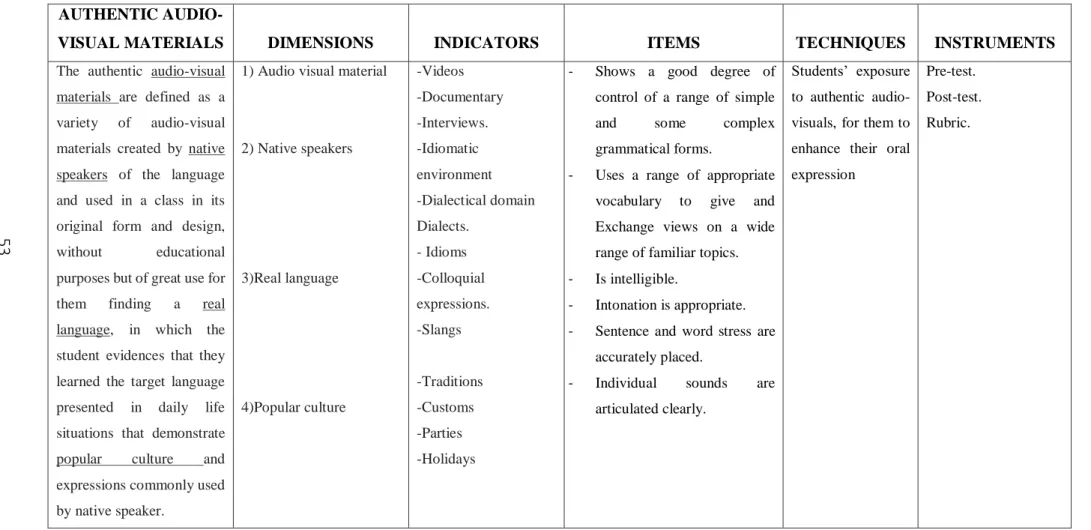
Table No. 1: Independent Variable Matrix ... 53
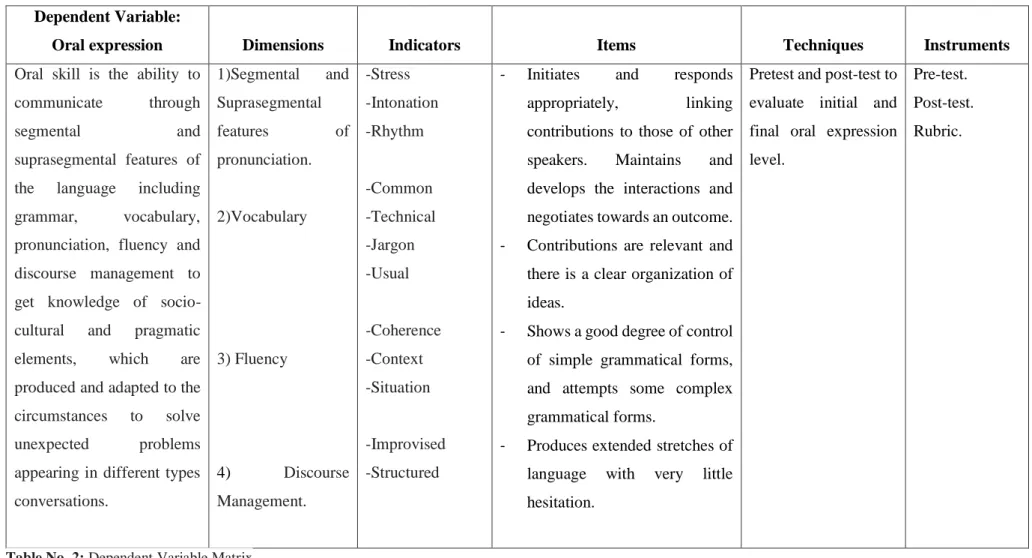
Table No. 2: Dependent Variable Matrix………..54
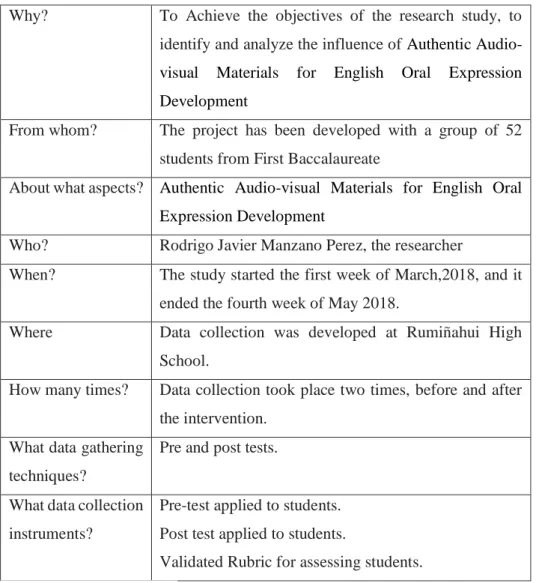
Table No. 3: Data collection... 57
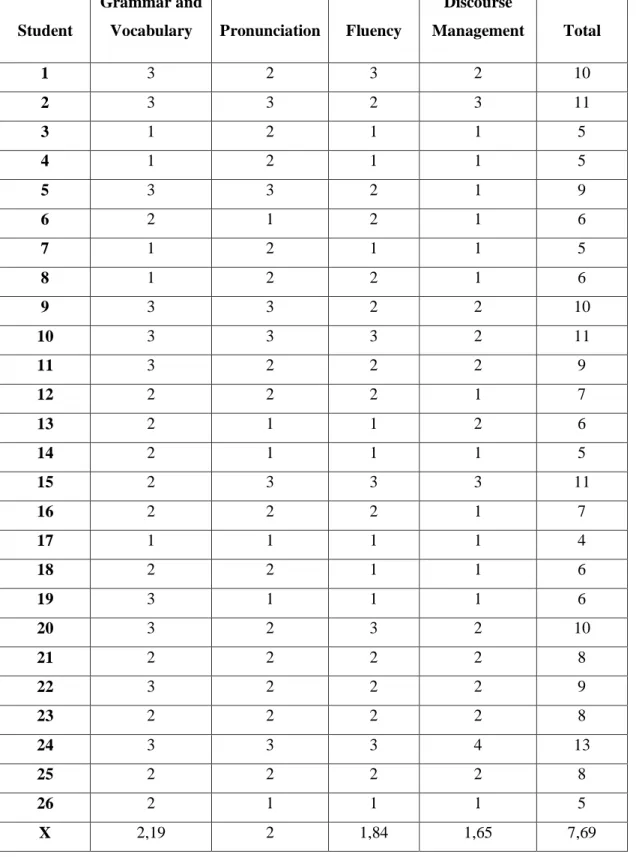
Table No. 4 : Pre-test control group………..60
Table No. 5: Pre-test experimental group………..61
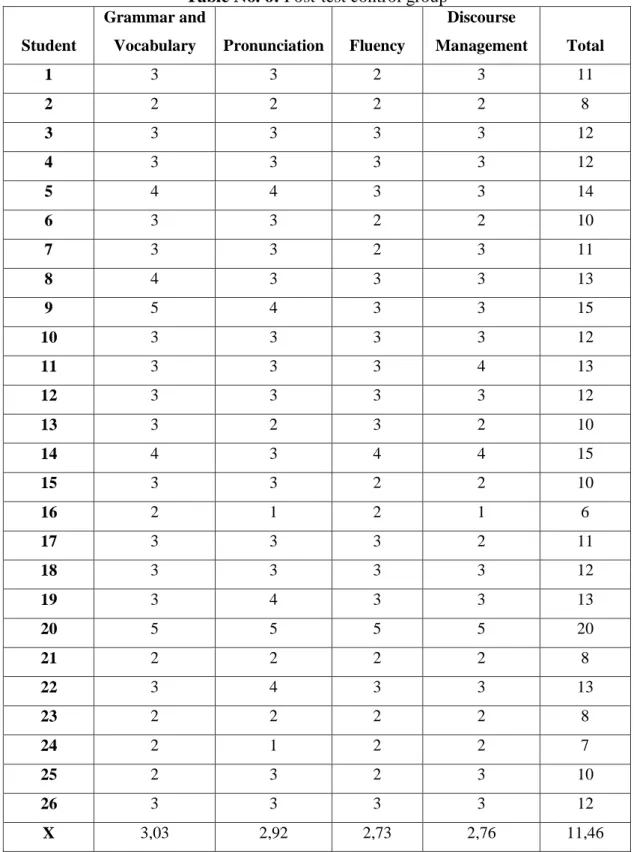
Table No. 6: Post-test control group………...………...62
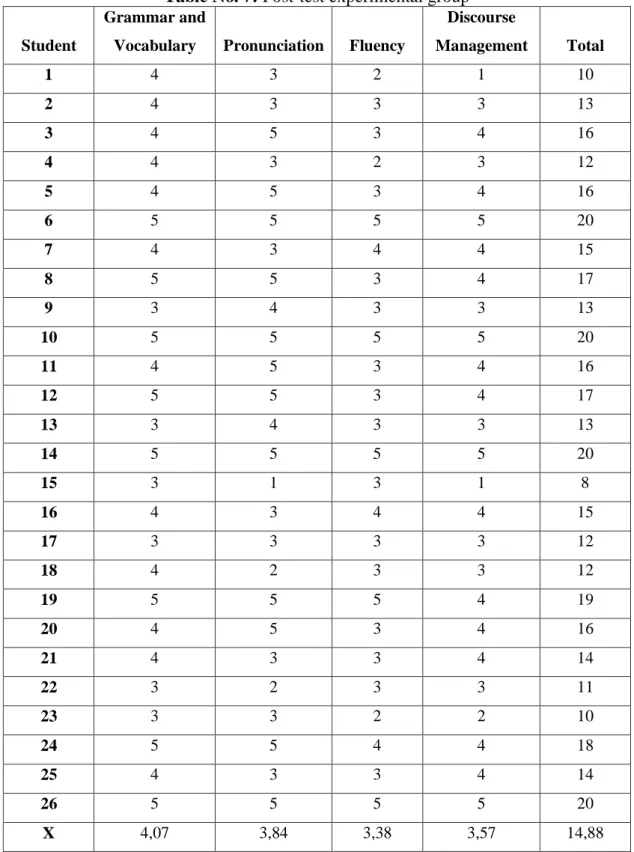
Table No. 7: Post-test experimental group………...….63
Table No. 8: Grammar and Vocabulary Results. ... 64
Table No. 9: Post-test experimental group ... 65
Table No. 10: Fluency Results………..66
x
LIST OF GRAPHICS Contenido
Graphic No. 1.: Grammar and Vocabulary……….. 64
Graphic No. 2. : Pronunciation Results……… 65
Graphic No. 3: Fluency Results. ... 66
Graphic No. 4: Discourse Management……….………. 67
xi
LIST OF FIGURES Contents
Figure No. 1: Problem scheme. ... 6 Figure No. 2: Fundamental categories……….18 Figure No 3: Population and sample……..……...………...………52
xii
AGRADECIMIENTO
A todos los establecimientos, entidades, registros de bibliotecas, que de algún modo favorecieron para el acceso a información requerida y alcanzar los objetivos trazados en este documento.
En especial, a mis amados padres y hermanos, de los cuáles siempre recibí su amor, soporte y consejo infinito.
En último lugar, a todas aquellas personas, colegas y amigos que me ofrecieron su tiempo e información necesaria para el logro de los objetivos de esta tésis.
Rodrigo.
xiii
DEDICATORIA:
Agradezco a Dios, mi amada familia, mis padres Julio Manzano y Mirian Pérez y a mis hermanos Sebastián y Danny, que con su soporte moral, amor, comprensión y confianza depositada en mí, a través de sus recomendaciones y modelos de vida recta y dedicada al progreso personal me brindaron la guía y el valor necesarios para alcanzar tan codiciada meta, además por su permanente e incondicional apoyo en todo momento de mi vida, por su sabiduría, interminables e inteligentes consejos, por su eterna paciencia y perdón ante mis constantes errores.
Rodrigo.
xiv
UNIVERSIDAD TÉCNICA DE AMBATO DIRECCIÓN DE POSGRADO
MAESTRÍA EN LA ENSEÑANZA DEL IDIOMA INGLÉS COMO LENGUA EXTRANJERA
TEMA: “AUTHENTIC AUDIO-VISUAL MATERIALS FOR ENGLISH ORAL EXPRESSION DEVELOPMENT”
AUTOR: Licenciado Rodrigo Javier Manzano Pérez.
DIRECTOR: Licenciada Ana Jazmina Vera de la Torre Magíster Mg. DATE: January 10th, 2018
RESUMEN EJECUTIVO
El trabajo presentado a continuación ha sido enfocado en evaluar la expresión oral como resultado de la exposición a material audiovisual autentico en los estudiantes de Primer Año de Bachillerato General Unificado de la Unidad Educativa “Rumiñahui” de la ciudad de Ambato, provincia de Tungurahua. Con la ayuda de un pre-test como instrumento de evaluación se realizó la recolección de datos y de esta manera evidenciar el poco uso de material audio-visual autentico dentro de las aulas de clase para promover el desarrollo de la expresión oral en los estudiantes. Los resultados fueron analizados con la prueba estadística T-estudiante para comprobar la validación de la hipótesis planteada. Se tomó en cuenta a una población de 52 estudiantes y se realizó la presente investigación demostrando que el material auténtico audiovisual brinda mejor práctica de la expresión oral fomentando el proceso comunicativo de los estudiantes en el idioma inglés. El resultado fue 3,75. Por lo tanto en este estudio se realizó la creación de una guía metodológica en el cual constan la aplicación de material audiovisual autentico dentro de la clase para mejorar la expresión oral. La guía metodológica, además, incluye una rúbrica de evaluación de las actividades y así constatar el avance de los estudiantes. Es por esto que en base a los resultados se sugiere el uso de material autentico audiovisual para reforzar la expresión oral.
DESCRIPTORES. Material auténtico audiovisual, expresión oral, competencia comunicativa oral, guía metodológica, Competencias lingüísticas, habilidades productivas, herramientas tecnológicas, grupo de control, grupo experimental, pre-test, post-test, fuentes de video.
xv
EXECUTIVE SUMMARY
The work presented below has been focused on evaluating oral expression as a result of exposure to authentic audiovisual material in the First-Year students of Unified General Baccalaureate of the Unidad Educativa "Rumiñahui" of Ambato, in Tungurahua province. With the help of a pre-test as an assessment instrument, the data collection was done and, in this way, it was evident the lack of use of authentic audio-visual material within classrooms to promote the development of oral expression in students. The results were analyzed with the T-student statistical test to check the validation of the hypothesis. A population of 52 students were considered and the present research was carried out demonstrating that authentic audiovisual material provides a better practice of oral expression, promoting the communicative process of students in the English language. The result was 3.75. Due to this very favorable result, this study concluded in the creation of a methodological guide that includes the application of authentic audiovisual material within the class to improve oral expression. The methodological guide, in addition, includes a rubric of evaluation of the activities and thus to verify the advance of the students. This is why, based on the results, the use of authentic audiovisual material is suggested to reinforce oral expression.
KEY WORDS: Authentic audiovisual material, oral expression, oral communicative competence, methodological guide, language skills, productive skills, technological tools, control group, experimental group, pre-test, post-test, video sources.
1
INTRODUCTION
In the English Language, there are four important skills: speaking, reading, writing and listening which are unquestionably interrelated. Nevertheless, it is important to develop the speaking skill in order to have a good and effective communication. Nowadays, the development of the speaking skill is one of the most necessary tools at the moment to learn the target language.
Unfortunately, speaking is the most difficult skill to develop because students practice inefficiently time as it requires due to its complexity. This project has the purpose to help students in their oral expression and how to develop it through authentic audiovisual materials. One of the best tools is the application of audiovisual material in the First-Year students of Unified General Baccalaureate of the Unidad Educativa "Rumiñahui" of Ambato, in Tungurahua province.
The study done has been stablished on assessing oral expression as a product of exposure to authentic audiovisual material in the First-Year students of Unified General Baccalaureate of the Unidad Educativa "Rumiñahui" of Ambato, in Tungurahua province. Using a pre-test as an evaluation instrument, the data collection was done and, in this way, it was shown the absence of use of authentic audio-visual material within schoolrooms to stimulate the growth of oral expression in learners. The outcomes were examined with the T-student arithmetic examination to validate the hypothesis. A populace of 52 students were carefully measured in the current research demonstrating that authentic audiovisual material provides an enhanced training of oral expression, stimulating the communicative process of students.
For instance, having has a result 3.75 resulting favorable, this study developed in the design of a methodological guide that includes the presentation and the application of authentic audiovisual material within the class to develop oral expression. In addition, the methodological guide, includes a rubric of evaluation of the activities to authenticate the improvement of the students. That is why, based on the outcomes, the use of authentic audiovisual material is recommended to strengthen oral expression.
2
Chapter I: In here, the problem statement is presented. Further, the problem is contextualized in an institutional, national, and international level. In addition, in this chapter a critical analysis, justification, general, and specific objectives are included.
Chapter II: The theoretical framework is presented in this chapter. The research background, philosophical and pedagogical foundations, legal basis, key categories, hypotheses and variables help in the development of this chapter. Also, the scientific and bibliographical support are important tools to create these elements.
Chapter III: This chapter has the methodology of the research. In here, the features approach, method, level and type of study, population, operationalization of variables, data collection plan, process and analysis are presented in an organized way.
Chapter IV: In this chapter, the Analysis and interpretation of results developed is carried out. In here, the results of the students’ examination are presented in a clear and organize way with all the requirements in order to verify each result. Moreover, the hypothesis is verified with the use of test.
Chapter V: In this chapter, the conclusions and recommendations are determined to work out with all the problematics due to it is important to look for some solutions.
Chapter VI: The proposal is presented in this chapter. It is a methodological guide in order to develop the oral communication. Therefore, some activities are developed for the students. In addition, there are procedures for assessment to notice in a better way the effectiveness of the project.
To conclude the process, this project contains a references list and annexes in order to give more specific details.
3
CHAPTER I
Problem 1.1 Theme of the problem
Authentic Audio-visual Materials for English Oral Expression Development
1.2 Problem Statement
1.2.1 Contextualization of the problem
The use of different types of materials for English language learning, and the selection of appropriate materials is, without a doubt, a process that teachers must carefully engage in. As a result, teachers could help their students to really benefit from a varied repertoire of audio-visual materials – such as readings in a textbook – or more authentic ones, like recordings of everyday conversations happening in a coffee shop or a chat among friends. Nevertheless, the use of the authentic audio-visual materials might not be an easy endeavor. In the Ecuadorian case, exposure to materials, which are not part of a chosen series, is (up to a point) an area of concern but, also, one, which could be exploited for the improvement of all four skills of the language, being oral expression of interest. As Barret and Liu (2016, p. 1228) claims:
“…there has been a shift toward teaching a more practical style of English… which can give nonnative speakers specific language tools that facilitate a presentation or help them discuss their academic work in English”.
It should then, be noted, that specific language tools, such as appropriate intonation and pronunciation, are related to more real, everyday language. Such type of language may not be touched upon at large by graded content, which usually results in nonnative speakers of English whose fluency is rather coarse. Furthermore, the use of authentic audio-visual materials in the English Foreign Language classroom should be considered given the fact that exposure to the language, in most cases, does not go beyond the four walls.
4
Ecuadorian education, for many years, has been a theme of discussion to different changes such as a new curriculum, objectives and new trends including both methodological strategies and learning techniques. One of those changes is in line with the new English Curriculum (2017, Ministry of Education), that emphasizes, among other important points, that teachers of English should possess a specific level of knowledge to be able to teach. Unfortunately, even with the standards set by educational authorities, education in our country does not meet expectations of reaching a better English level in students, which causes learning problems such as persistent use of first language, poor grammar acquisition and insufficient hours of practice in the speaking skill. Unawareness of participatory techniques can be a big problem at the time of teaching (Richards, 2008); this situation causes in students a deficit in the development of oral skills. In addition, training received by teachers is not enough for them to develop their classes in a suitable way, however, satisfactory results with students are not attained.
In Tungurahua, the problem lies within teachers because they use traditional teaching methodologies. According to an article published by El Comercio, some decades ago this language was taught in institutions only by amateurs while, today, there are specialized teachers in teaching the English language as a subject (Deficit of English teachers, 2014). This means that they are not interested in updating their knowledge with new methodologies and teaching techniques that they could apply for better teaching. This, then, causes students to become passive learners, which results in a lack of participation in classes and use of memorization. Therefore, application of participatory techniques is very scarce in the process of learning the English language. Even in this century, there are teachers who continue to teach their classes with the traditional model of education (Kumaravadivelu, 2006), because many of them do not seek for professional development opportunities, they get accustomed to work with a single teaching method, which makes students to memorize everything the teacher says in the classroom. Therefore, students are unable to engage in proper dialogue, or answer a question. In turn, the implementation of multimedia equipment in public and private institutions has allowed teachers to search, select and adapt material that helps the student to learn the language in an effective and dynamic way through the use of videos, dialogues and songs that allow the student to encounter the language in a meaningful way.
5
Unidad Educativa Rumiñahui is in the center of Ambato. The institution was considered since the students have many problems with the development of oral English language skills. In addition, teachers perform activities that are not linked to the topic of study or activities not interrelated with the objectives of the curriculum, causing confusion and disinterest in students because they use just the guided book. However, despite the advantage of having multimedia equipment in each classroom, there is no use of authentic audio-visual material, so the student works only with the book acquired at the beginning of the school period, which limits a real exposure to the language that allows students to develop oral skills in an easier and more meaningful way.
6
1.2.2 Critical analysis
Effects
Problem
Causes.
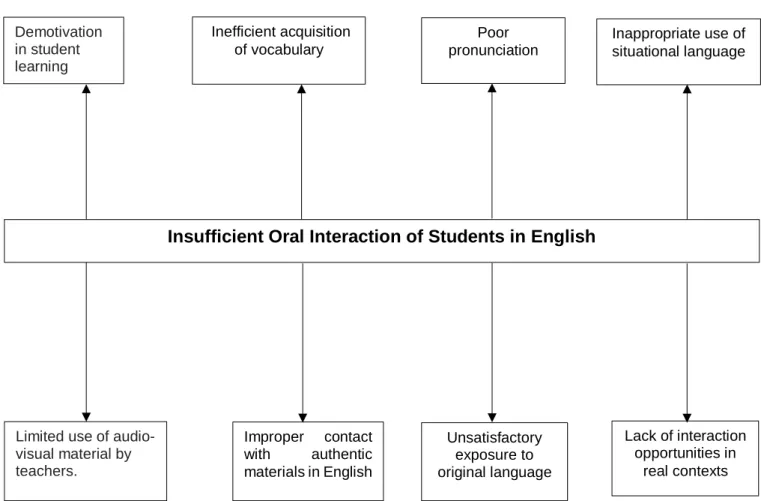
Figure No. 1: Problem scheme. Author: Manzano, R. (2018)
Insufficient Oral Interaction of Students in English
Improper contact with authentic materials in English Poor pronunciation Inappropriate use of situational language Inefficient acquisition of vocabulary Unsatisfactory exposure to original language Lack of interaction opportunities in real contexts Demotivation in student learning
Limited use of audio-visual material by teachers.
7
The insufficient oral interaction of students in English has had an influence on the development of oral skills in students of the first year of baccalaureate of the Rumiñahui High School of Ambato, which has affected the performance and learning outcomes having students with an inefficient oral production. As a result, students oral expression has a low level, and they find it nearly impossible to have a short dialogue or a small conversation in English.
One of the causes that originates this problem is the limited use of audio-visual material by the teacher, which creates demotivation in the students when learning the language since being immersed in an environment where only the student's book is used, they do not find any interest in understanding and practicing the language, since there is no audio and video materials that present situations that attract the student and motivate them to continue learning this new language. Robalino (2015)
In the same way, due to the absence of authentic material in the classroom, students have limited exposure to the real language used by native speakers of the English language, which causes students to be accustomed to a predesigned language and inadequate practice of the phrases and real expressions used in situations of daily life. Astarina (2014)
The oral skill is one of the most important skills to develop, since through this you can achieve a direct and easy communication with other people. Thus, since there is little importance in developing of this skill in students, they show difficulty at the moment of communicating because there is not enough practice to help them improve their suprasegmental features such as stress, tone and intonation.
According to Díaz (2007) the material selected to help students to improve their oral skill is very important because students get interested and involved in a class where they have a variety of options including audio visual materials in the teaching-learning process. Therefore, the minimum use of material that develops the speaking skill, causes a repetitive and reduced use of lexicon in the students when expressing themselves orally, the unsatisfactory exposure to original language does not allow them to develop this important skill in the learning of a new language.
8 1.2.3 Prognosis
This study aims at determining the development of students’ oral expression resulting from their exposure to authentic audio-visual materials. For such effort, the researcher will choose a range of audio-visuals, along with specific teaching strategies, that will hopefully be beneficial for the students. The anticipated – and most expected – result that comes to mind is that of making students become better users of English, who can maintain a conversation – or spoken exchange – with an idea of authenticity involved; students will not only understand a wider range of expressions in English but will also interact in a more natural way.
In addition, if there is no solution for this difficulty, there will be demotivation of the student since the students will not develop their adequate understanding. This fact will obstruct with their encouragement and their wish to learn, search and research to get experience talking in English. Furthermore, the demotivation, if the classes last to be based on the structural production and letting oral expression, it will cause a reduced production of the English language. Consequently, students will be ineffectual in expressing their ideas, thoughts and in their own feelings. For this reason, the oral expression of the English language in an effective and efficient way has now suited completely essential.
1.2.4 Problem Formulation
As discussed previously, there seems to be a disassociation between the level of oral expression students are expected to demonstrate after a certain time of exposure to English in their schools, and the materials that their teachers use to help them to succeed in the task of becoming independent users of this language. The evidence is clear because students study twelve years of English 6 in school 6 in high school and the level of proficiency is low.(Ecuador ranking 56 according to EF, 2014) Considering that fact, an important question arises: Which materials better aid teachers in the process of making their students become good, independent users of English? Most of the textbooks used in schools are designed from a communicative perspective. However, authenticity may not be found in such materials, as most of the time they are scripted or graded materials. This results in students being exposed to a type of language that may use good examples of real life communication patterns, but that do not fully present a range of vocabulary that is more
9
real, and even culturally richer. Therefore, the use of more authentic materials becomes an element to pay attention to. This study defends the premise that the more students are exposed to authentic audio-visual materials, the better their oral expression will be.
1.2.5 Research Questions
As this research evaluates students’ English oral expression resulting from their exposure to authentic audio-visual materials, the following research questions will guide it: 1. Does the use of authentic audio-visual materials help students to improve their
English oral expression?
2. Which suprasegmental speaking elements (such as fluency, accuracy, pronunciation…) are enhanced when exposing students to authentic audio-visual materials?
3. Which audio-visual materials result more beneficial for the development of the subjects’ oral expression?
The answers to these research questions will guide the study to more solid conclusions, and to a better idea when designing a proposal as a response to the initial research.
1.2.6 Delimitation of the Research Problem
Field: Education.
Area: Teaching English as a Foreign Language. Aspect: Teaching-learning methodologies.
Spatial scope: This research study was developed with students from First Baccalaureate at Rumiñahui High School., which is located in the Tungurahua province Ecuador.
10 1.3 Justification
From personal experience, helping students to attain a level of oral expression that makes them able to be engaged in conversations, where more real exchanges of language occur, represents a challenge. Usually, in public schools, the short time that is allocated for English teaching, adds to complications. However, the task should not be deemed impossible. The teacher’s creativity, added to an emerging interest in finding and using authentic materials for the benefit of students could change the landscape. English teachers should move beyond the constraints of textbook and papers to construct rich learning scenarios, as well as understand that any content become relevant for students so that meaningful input and output are presented in their oral expression.
The purpose of this research is to motivate and enhance the oral skills of the English language through the use of authentic audio-visual material. To learn a foreign language, it is vitally important to use authentic material that helps the student learn in an environment where the language used is real. The material has phrases and common expressions used by native speakers that can be recognized and used by students in everyday situations where this language is necessary.
At the same time this research work is of great importance since one of the main objectives of learning a foreign language is to communicate orally as naturally and confident as possible. However, how to interact with other people at the moment of expressing themselves they do not feel safe accent, phrases or vocabulary that you should use according to the situation? This is one of the most common problems seen in students of the first year of baccalaureate of Rumiñahui High School and this is where authentic audio-visual material plays an important role, since this can help the student to develop his oral production through an environment where the people present in videos, documentaries and conversations use the real and everyday language used by a native speaker that in one way or another simulates the environment to which the student may face.
In addition, this work is original since the interest to use the authentic material in the classroom for teaching of the English language has already been studied. However, no other research has been carried out regarding the problem posed in this investigation, which
11
contributes to the teaching-learning process of teachers and students of the first year of baccalaureate of Rumiñahui High School
Finally, this investigation is feasible since it has the necessary time to carry it out. In the same way, the support of the authorities, teachers and students of the Rumiñahui High School is presented as well as the availability of sufficient resources in the technological, economic and office areas so that the research work can be carried out
1.4 Objectives
1.4.1 General
To evaluate students’ English oral expression as a result of their exposure to authentic audio-visual materials.
1.4.2 Specific
1. To assess students’ conversational ability and application of discourse conventions 2. To identify the effect on students to the exposure of authentic audio-visual material
on students.
3. To determine the relationship between oral expression to authentic audio-visual materials.
12 CHAPTER II Theoretical Framework 2.1. Research background
A search on the digital repository of Universidad Técnica de Ambato did not present results that directly link some other research projects to the proposed topic,
Authentic audio-visual materials for English oral expression development.
Nevertheless, there are several examples that have considered the development of (the) speaking skill(s) under different conditions or criteria.
In his research Carmen Robalino (2015) entitled "Incidence of audiovisual didactic resources to improve the oral expression of English in basic education students of the Educational Unit 'Nueva Vida", within its methodology seeks to be a documentary research, and field; The research was conducted with a population of 91 students and 1 teacher, using the survey and the questionnaire as a tool. Its main objective was to determine the incidence of audiovisual resources to improve oral expression in English language learning, subsequently the following conclusions were obtained:
A little more than half say that they rarely use audio and video resources in the process of teaching English in the study texts. Students receive little visual and auditory stimulation.
Most students present problems in oral production, have difficulty reproducing sounds and words of the English language.
More than half of the students observed do not watch videos in English. It can be evidenced the probabilities of becoming familiar with the language are limited.
In. my opinion, this study guides students to promote and improve oral expression in English language learning. The analysis provides students: visual and auditory simulation, helping students with difficulty when pronouncing sounds and also provides opportunities to become familiar with the second language acquisition.
For his part, Clara Rodríguez (2017) in her research entitled "The use of visual material and its impact on the oral expression of the English language of students from first to fourth year of basic education of the "Alianza" Private Educational Center of the city of Ambato", part of its methodology is supported by a field and documentary research with
13
qualitative and quantitative paradigm, the author worked with a population of 76 students and 5 teachers using the technique of observation and as a tool a checklist. Its objective is to determine the incidence of visual material in the oral expression of the English language. The author concludes the following:
The visual material used is limited, which means that students only perform activities contained in the text, not communicative activities that increase their oral expression.
The visual material used is not adequate, which means that students do not participate in classes, since the teacher is the only one who develops the classes, this means that students do not feel identified with the language and much less that they develop it. they do not feel part of the teaching-learning process.
English classes are more focused on the grammatical structure which causes students to get tired and not pay attention to the classes.
Rodriguez (2017), did a job implying that the material is not adequate making students passive in class. This was the part that was considered and the creation of material was a tool that led students feel part of the teaching-learning process and avoid the previous stages and forms of the teaching that emphasize only on grammatical structures.
On the other hand, Victoria Parra (2015) in the work titled "The Auditory Didactic Material in English Speaking and Listening Skills in the Students of the" Ambato Adventist "School of the City of Ambato of the Province of Tungurahua of Cantón Ambato", applied a qualitative-quantitative approach, with a type of exploratory and descriptive research. The author had a population of 36 participants and made use of the survey as a technique and as an instrument the questionnaire, thus concludes that:
Students must learn to recognize the different types of accents depending on the auditory material in the English language so that they become more familiar with the language, because when they feel exposed to an English speaker they can function properly and safe with the English language.
14
Students with practice through better auditory didactic materials can improve the skill of speaking to have a better communication because by feeling in direct contact with the English language they will be able to perfect and thus communicate easily in any situation.
The job done by Parra (2015) has made students become more familiar with language making a message work properly in accordance to what is intended to achieve or to communicate. Having good results making the improvement of speaking and listening using auditory didactic materials a beneficiary tool in class.
In the same way, Astarina (2014) conducted an investigated in Indonesia with the theme "THE USE OF VIDEOS TO IMPROVE YOUNG LEARNERS 'SPEAKING ABILITY "(The use of videos and the development of oral skills of young people") in which he used a quasi-experimental methodology designed for the fifth grade of a public school having as sample two groups of 30 participants in each. This experiment was carried out in a period of four weeks, in which videos were used with one group and text of dialogues with the other group. The information collection instruments used were a pre-test, post-test, field notes and questionnaires. In conclusion, the author mentions the following:
The statistical results indicated that there is a significant difference between the two groups.
The use of videos was more effective in improving the oral skills of young students, especially in terms of vocabulary, pronunciation and fluency. The videos successfully attracted the attention of the students, promoting their
participation and improving their understanding.
This study done by Astarina showed that there was a substantial enhancement between the experimental and the control group using videos and making efficient advancements in young students. There was an upgrading in vocabulary, pronunciation and fluency because the videos used in the study helped in class involvement and fortification of knowledge.
15
Finally, Olivo (2015) in his investigación “Audiovisual resources for English learning in the students of the first year of Baccalaureate of the Bartolomé de las Casas educational unit of the of the indigenous community "Las Salasacas" of the province of Tungurahua” applied a quantitative research, with a descriptive research. The author had a population of 70 students and used a survey as a technique with and statistical analysis, ending that:
According to the results obtained, it has been concluded that the students of the first year of the Baccalaureate of the Fray Bartolomé Fisco-Misional Educational Unit.
It has been verified that the teachers of the English area are in agreement with the use of audio-visual resources for the learning of the English language in the students of the first year of the baccalaureate of the Educative Unit.
With this background it is concluded that it is necessary to implement the audio-visual resources for the learning of the English language in the students of the first year of the baccalaureate of the Educational Unit Fisco-missional Fray Bartolomé de las casas- Salasaca
Thus, with the use of different auditory materials in the classroom, students can be helped to recognize the language in terms of accent and pronunciation so that when they need to express themselves orally they can do so with more confidence. In the same way, it is mentioned that through continuity, the auditory material can help students to improve their language and express themselves more easily. Additionally, Parra (2015), also emphasizes the use of extra auditory material such as songs or films, since they can help the student become more familiar with the actual language used by native speakers and thus make their learning more productive. Astarina (2014) and Olivo (2015) recommend to adapt the content of the book to a real context so that students feel motivated to express themselves orally depending on the situation and thus avoid memorizing sentences when speaking.
2.2. Philosophical foundations
Interpretivism may well be considered as a philosophical research foundation for this work. As the study will deal with the development of a language skill, rather difficult to measure, it will become necessary to discuss and adopt a view that relates the social and contextual realities of the focal group, i.e., students of high school level who may not have
16
had a real chance, or appropriate guidance, to understand the value of being exposed to authentic audio-visual materials as a way to develop their oral expression.
As Feng and Byram (2002) assert “The issue of authenticity in language teaching materials is one with a substantial history and development” (p. 58). Ever since communicative language teaching (CLT) saw light, the use of authentic materials has been deemed as the best way to attain communicative competence by learners and match educational – learning – objectives. Although this last statement sounds pivotal, there seems to be evidence that not all textbooks used for teaching English meet the requirement of being authentic. Him Cham (2013) explains that the reality of the outside world (i.e. language and interactions outside the classroom) is not actually encountered in textbooks. As he goes on, he insists that those people in charge of writing English textbooks should pay closer attention to interactional authenticity in the classroom. Therefore, should textbooks be forgotten so that other materials are introduced instead? Bahrani, Shu Tam, and Zuraidah (2014) argue more towards to idea of appropriate input and second language acquisition (SLA). They, if anything, do not consider that textbooks are to be cluttered away. What should be more the case, is to determine if the contents of a series really offer such input that it really allows for oral skills that are inside a conceived idea of authenticity. And, as Israel (2007) claims, authenticity might also be constrained by multiple ontological definitions offered. Keeping this in mind, it is also important to consider that authenticity in oral expression should be – at least – clearly defined and described to students before any assessment takes place.
2.3. Legal basis
In its Art. 27, the Ecuadorian Constitution decrees that education in the country is to be human-centered. Additionally, Ecuadorian education should guarantee the holistic development of individuals. In this context, education in the country has to be participatory, mandatory, intercultural, democratic, inclusive, diverse, high quality, and warm. Moreover, Art. 343 overtly states that the Ecuadorian National Education System – which encompasses elementary, secondary, and higher education – will aim at the development of the individuals’ abilities and potentialities. As a result, the system will have the learner as its center, and it will operate in a flexible, dynamic, inclusive, effective, and efficient manner.
17
Complementarily, the National Plan for Good Living, in its Objective 4.8i, establishes the promotion of educational processes that support foreign language learning, under international accreditation parameters, throughout all the levels of the Ecuadorian Education System. Hence, the Ecuadorian EFL National Curriculum, which was developed in 2016, has organized and standardized EFL instruction in all the primary and secondary education levels. One fact that has particular significance for this project is that the EFL National Curriculum stems from five threads. Of these threads, the last one, Language through the Arts, directly links literary manifestations to EFL instruction.
Certainly, Education in Ecuador endorses the progression of people and groups educators and scholars needs to contribute in the ascendency and accomplish as considerable knowledge with their abilities and aptitudes. The present study emphasizes on the progress of oral expression for the benefited students.
Organic Law of Intercultural Education
Article 343: “The national education system will aim to develop individual capacities and potentialities.”
This investigation attempts to help teachers and students implement mobile applications in the teaching-learning process. As a result, they can develop their capacity for the language and increment their potentialities.
Article 347: “Guarantee the active participation of students and teachers in educational processes.”
The Ecuadorian Education promotes active participants and investigators. Operating a didactical guide is created a tool that links teachers and students as active participants of the educational setting to develop a real competence in oral expression.
18
2.4 Key categories
The following diagrams present the variables’ categorization, in their different levels of conception.
Figure No. 2: Fundamental categories. Author: Manzano, R. (2018)
19 2.4.1 Methodology
It is understood as such any instrument or object that can serve as a resource so that, through its manipulation, observation or reading, opportunities to learn something are offered; or with its use it intervenes in the development of some function of teaching. They are the physical means insofar as they convey a message for teaching purposes. (Morales, 2012, p. 62)
Educational resources, therefore, are those materials or tools that have utility in an educational process. Making use of these resources, an educator can teach a certain topic to their students. This means that educational resources help teachers to fulfill their educational function. At a general level, it can be said that these resources provide information, serve to put into practice what they have learned and, sometimes, they even become guides for the students.
Importance
Better methodologies provide students with a better assimilation of knowledge, because the information presented is better organized to be analyzed and understood. They make the students feel motivated by talking about the topics to be discussed and above all that they feel involved in the development of the class. They help improve the cognitive abilities of students and develop them. (Morales, 2012, page 73)
It is important to emphasize that educational resources not only facilitate the teacher's task, but also make the learning process more accessible for the student, since it allows the student to present the knowledge in a closer, less abstract way. They help to assess the level of learning that students have, because each of these resources is used with a clear objective in mind. They provide a better interaction between the teacher and the students.
20 AUTHENTIC AUDIO-VISUAL MATERIAL
Ramírez Rosa (2013) establishes that: They are audio visual materials created for native speakers of the language and used in a class in its original form and design, among which are: projection of films, television programs, documentaries, music videos, interviews. (Darwish, 2014, page 3)
This implies that for the development of the English class it is necessary to use different types of audio-visual material that help students to understand in an easier way. Through the correct use of authentic audio-visual material, the teacher can make their classes more entertaining by attracting the attention of the students, motivating them to learn and involving them in the development of the class.
Likewise, Morales (2012) defines the authentic audio-visual material as a set of material means that intervene and facilitate the teaching-learning process. The same author adds: These materials can be both physical and virtual, assume as a condition, arouse the interest of students, adapt to the physical and psychological characteristics of them, in addition to facilitating the teaching activity to serve as a guide; likewise, they have the great virtue of adapting to any type of content.
This means that the authentic audio-visual material is a great support both for the teacher and for the students because they help to understand what has been learned in a more real context and easy to be assimilated by the students. In addition, it helps to develop the four essential skills for the teaching-learning process of a new language.
Importance of authentic audio-visual materials
The main function of audio-visual material is to serve as a communication tool between the teacher and the students. The different types of visual material contribute to the knowledge of the students, because sometimes the words are not enough for the students to understand what the teacher is talking about and this is the use of visual material as a primary support in the development of class.
21
The motivation is achieved through materials that pose achievable challenges, that is, they must offer new information, always based on the previous experience and knowledge of the student (Latorre, 2014, p. 11)
Many teachers are beginning to realize the possibilities offered by materials that do not have the limitations of the format of the textbook and that can be applied to multiple tasks and learning objectives. The use of authentic materials especially audio-visual has gained strength, and more and more are teachers at basic school levels, university or extra-curricular courses that include them in their classes, alone or as a complement to the textbook. By offering a real context, students can prepare themselves for situations of everyday life where they can make use of phrases and expressions learned while using this material.
According to Gebhard (1996) authentic materials help us to contextualize the learning of a language. He explains it in the following way: when the lessons focus on understanding a menu or the weather report, for example, students tend to focus more on the content and meaning than in your own language. This offers them a great source of information and thus they are not only exposed to the language presented by the text or the teacher.
Another reason for using the different types of authentic audio-visual material in the evaluation of languages is because there are characteristics of the process or configuration of how language is being used that cannot be separated from its meaning (Gruba, 1997). It can help increase student enthusiasm, cultivate their listening interests and achieve the goals of learning English. Ockey (2007) stated that because the use of video could result in the evaluation of students' ability to use visual cues to understand the phonetic text, this would help students understand and have a better sense of what they have done. listened and therefore able to produce it.
Characteristics of authentic audio-visual materials
Álvarez (2009) mentions that some important characteristics that authentic audio-visual materials have, such as:
22
Colloquial use of real language with phrases that sometimes are not complete among those that we find idioms, gerunds, specific dialects and idiomatic expressions.
The speaker demonstrates an inheritance and idiomatic environment of the place of origin, as well as a dialectical domain. In addition, it is not always expressed clearly because it presents hesitation or paraphrasing on some occasions
Dialogs always have a purpose regardless of the circumstances in which they are There is always a visual and auditory stimulus, and, in some cases, there may be
subtitle help due to the complex language that may exist.
Different types of accents, real pronunciation of the words always reflecting the popular culture of the speakers of the language as they can be the traditions, customs, typical food, parties and typical clothes of the place
For this reason, authentic audio-visual material becomes an indispensable resource within the classroom because it not only provides a visual and auditory stimulus that helps to retain student attention, but also the language used by native speakers. It demonstrates the true accent, pronunciation, use of phrases and the different contexts where this language can be used.
Benefits of authentic audio-visual materials
According to Ramírez (2009) the use of authentic audio-visual material is important due to the following reasons:
Focus students' attention on the meaning, making the language real. They provide a context that helps infer the meaning.
They develop students' interest in the language. They can be applied to various learning situations.
Harmer (2007) adds that with audiovisual material students can also learn rules of non-spoken behavior in different social situations (they can see how the intonation matches the facial expression, they can see how they behave and what they do when they talk. easier to understand in a video than in a book.
23
It can be shown that the use of authentic audio-visual material allows students to listen to native speakers of the language, which reflects authentic reality and characteristics of the culture from which the language is used. The most important thing is the cognitive interest it generates in the students, the willingness to discuss issues and, therefore, improves your motivation to learn a foreign language.
Therefore, if students receive a speech in a foreign language, all their efforts dedicated to learning a language, were not in vain. Thus, the main task of the teacher in the stage of working with authentic material is to select audio and video material that is interesting, informative and meaningful, understandable, coherent with the modern reality of the foreign language and thus be able to create favorable conditions for acquisition. of new information about the culture and behavior of native speakers
Types of authenticity in audio-visual materials.
Ramírez (2009) believes that there are four types of authenticity that can be evidenced clearly in audio-visual materials that are in continuous interrelation, are the following:
• The authenticity of the texts that we can use as input data for our students. • The authenticity of the interpretation of this type of students' texts.
• Authenticity of conductive tasks for language learning.
• The authenticity of the current social situation of the language class.
Therefore, considering all these definitions, we could say that authentic audio- visual materials are produced by native speakers for natives, without any kind of pedagogical concern. It cannot be manipulated since we would not change their identity and they should be used in the classroom without any modification.
Classification of authentic audio-visual materials
24
Movies: Movies are a type of audio-visual material that contain clear and understandable dialogues which create the illusion of a real conversation. Since the dialogues intend to demonstrate a real conversation, this type of material can be called authentic.
Television: Television is an audio-visual medium that offers a variety of live or recorded programs that are undoubtedly made for speakers of the same language. Among the live programs we can highlight: interviews, weather reports, morning programs. As for the recorded programs we have: novels, television series, documentaries among others.
Videos: Videos are another type of audio-visual material that is considered authentic since they present a real language, provide an authentic look at the culture, motivate students and generate a reason to produce and practice the language.
It can be observed that there is a wide variety of authentic audio-visual material that can be used in class and that can help students to increase their level of attention and to feel motivated since motivation is a main component in the teaching-learning process because students must feel the desire to expand their knowledge.
Goodwin (2011) mentions that the use of films is intended to consider the culture of students and provide opportunities for them to be directly involved in their learning process.
This is achieved by designing film-based activities that encourage students to take advantage of his personal experiences, prior knowledge and cultural background. This author affirms that "if films are used in the classroom, the learning environment is altered and the potential to discover different social phenomena increases" (Goodwin 2011 p.123 free translation). The author also ensures that the students show more energy, enthusiasm and even show more interest and motivation in the class.
The media is an important part of learning since it is seen as a tool for language teaching media and has always been used to facilitate the task of language learning. These have been exploited in different ways according to the selected methodology. But whatever the focus, everyone agrees that they can do a lot to increase the daily practice of the language. (Chmielowiec 2009)
25
The use of this material can help students in the classroom in different ways. The use of authentic audio-visual material reaffirms to the student that what he is learning in the classroom is really used, actually used in the real world. In turn, students can gain confidence in the use of English when it comes to real-world situations because they have already been exposed to this language in the classroom.
There are many concepts that can be given to authentic material, whether physical or digital. According to Harmer (1983) "Authentic texts, whether oral or written, are those designed for native speakers. They are real texts not created for language students but for speakers of the language in question "(p.33). The use of authentic materials has gained strength and more and more teachers at basic school levels, university or extra-curricular courses that include them in their classes, alone or as a complement to the textbook. Authentic material is considered, any resource that can be used to facilitate the learning of a language; This can be linguistic, visual, auditory, kinesthetic, and can be presented in printed form, through CD-ROMS, DVD or even through the Internet.
Importance
Using authentic materials, the student performs tasks focused on the development of language skills, these can be positively perceived by virtue of the effectiveness they entail; when, somewhat later, we expose the student to instances of new and real language, it is the affective element that stimulates their acceptance. (Castillo, 2012, p. 1)
The materials allow the student to develop confidence through activities that strengthen and develop their four skills (listening, speaking, reading and writing) using real problems that lead him to be creative, imaginative and analytical. This is how, relating everything to his real life and his interests, they will be convinced that what they have learned is not an illusion; but something significant.
For Shomoosi (2007) authentic materials must meet the following conditions:
Teacher Skill: Although the use of resources that can offer a more real environment is not considered authentic, it is the ability of the teacher to
26
select, classify and apply the material what really gives the touch of authenticity to a resource.
Authenticity: It lies in the relevance of the selected material and in its capacity to generate situations that provoke communicative activities. Selecting materials to bring them to a high degree of authenticity is not simple, the teacher must take into account different advantages and disadvantages of its use and how you can get the most out of this material.
In accordance with the above criteria, we believe that the most suitable materials to introduce into the teaching-learning process a component of authenticity are those in electronic format, with audiovisual emphasis, which suppose a creative management of the information, and with an overall availability. These four factors determine that those materials that comply with them are easy to store and reproduce, combine visual and auditory stimuli, facilitating a natural understanding, offering real information that is not adapted, and eliminating geographical barriers that are accessible both in the learning context second language as a foreign language
Advantages.
For Shomoosi (2007) the authentic materials count as advantages the following:
Resources at hand and easy to get
Great variety of subjects for any type of apprentice Approach students to a more real use of the language Variety of skills that can be worked
Generate a more immediate sense of success in the foreign language.
The specific subjects of the mention of English, have approached the student to the culture and the roots of the English language, being one of the reasons on which it is based, that the use of authentic materials in the classroom work and improve the level of English, since he has experienced it first-hand.
27 Disadvantages
According to Shomoosi (2007) in the use of authentic materials the following disadvantages can be detected:
Extreme difficulty in reading or listening texts due to the amount of vocabulary not designed for students.
Some examples of this material may be obsolete and unattractive for the same group of students.
The fact that the material is not for teaching can inhibit and, in some cases, frustrate the student.
Mixed structures may seem more complex for trainees. Authentic texts are often of advanced level.
It is very possible to find words or expressions that are not in the dictionary.
It may be a burden for the teacher to have to select materials for the most basic levels. The communicative interaction in the foreign language classroom depends on the teacher, the student, the objectives, contents and procedures, and the classroom. These interactions may be between student-student or teacher-student, and may also be: verbal communication, either using the mother tongue or the foreign language; by non-verbal communication.
TECHNOLOGICAL TOOLS.
As established by Richards (2006) when integrating technology in education we must be aware that it is a gradual process and is related to various factors, ranging from the availability of resources to the correct use of the tools when applying them. In this paper you will find various technological resources aimed at teachers, who can support their classes in a practical way and discover the didactic use they can give them.
Characteristics of educational tools.
Inside the characteristics of curricular materials, we can mention some aspects. It is important to pay attention to the different learning rhythms of our students to know what resources are appropriate at the time of the teaching-learning process. The flexibility with which the various tools have to adapt to the environment and that can help for the expected educational development. Accessibility plays a fundamental role when choosing
28
complementary tools, since the main objective of using them is that they become a support and not a barrier. (Chmielowiec 2009)
Comparison between the traditional learning environment vs new learning environments.
Within education we are faced with different scenarios each day, as well as different updates in tools or applications that arise, within the whole range we must discern and be able to select the best options to achieve an assertive work with our students. Harmer (1983). Traditional learning environment. New learning environments
Individual work Collaborative work.
Linear information transmission. Information exchange.
A means of communication. Various media of communication. Direct teacher instruction. Student-focused learning.
Experience-based learning. Learning based on critical thinking. Let's see a comparison considering the teaching-learning methodology with the use of Technological Tools. By having a greater reference, we can decide the type of resources that we require and we can use as a complement. Harmer (1983).
Resources
a. Rubistar When we are doing some activity that we will ask our students we have to think about how to evaluate and a page that helps us to make rubrics in an easy and simple way is: http://rubistar.4teachers.org the page you can register or simply start working, has a list of different templates to evaluate projects, you can edit and adapt to our needs or create new rubrics. You have the option to work in English or Spanish. This page gives us the option to save or print the rubric directly from the page and share it with our students, thanks to this we will be ensuring that they know the points that are expected at the time of submitting their work and we as teachers gives us clarity at the time of the evaluation.
b. Voki Voki is a talking character that can be created with the tool of the same name. Plays in a visual and aural way the text that is indicated (with a maximum of
29
characters and / or time) http://www.voki.com/create.php This resource is a free service that allows you to create in very easy steps avatars (characters) to which we can add voice sound. It gives us the option of using microphone, keyboard, Traditional learning environment New learning environments Individual work Collaborative work. Linear information transmission Information exchange A means of communication. Various media of communication. Direct teacher instruction. Student-focused learning. Experience-based learning. Learning based on critical thinking.
recording or attaching audio file, so with these variants its use becomes very simple. When creating your avatars the same page shows you step by step the alternatives that you can add or modify in the characteristics of the "vokis", applications of the voice, diversity in the backgrounds and frames and finally publish your "voki" These We can use avatars in emails, blogs, web pages, etc. In educational matter this resource is used to improve the effectiveness of a language because it allows them to hear the pronunciation correctly. When you register if you have an account as a student or teacher you will find exclusive options.
MEDIA RESOURCES.
The didactic material is one that gathers means and resources that facilitate teaching and learning. They are usually used within the educational environment to facilitate the acquisition of concepts, skills, attitudes and skills. They are a great support for the teacher's work and generate in the student’s pedagogical situations that allow significant learning and projection in their context, encouraging their interests, their expectations, especially when they themselves are involved in the development and management of them. (Arranz & García, 2011, page 284)
Every teacher when facing a class must select the resources and teaching materials planned to use. Many thinks that the material or resources chosen are not important because the important thing is to explain the lesson daily, however, they are wrong, because it is fundamental to choose the resources and didactic materials properly because they are fundamental tools for the development and enrichment of the teaching-learning process of the students.