
Parents´involvement in their children English extra classes outside the school
85
0
0
Texto completo
(2) PARENTS‟ INVOLVEMENT IN THEIR CHILDREN ENGLISH EXTRA-CLASSES OUTSIDE THE SCHOOL. To our beloved family…. We thank our professors: Blanca Lucia Cely, Eliana Rubio and Ingrid Bello. Also people who helped us in the development of this project, all the support and encouraging voices which made it possible.. To future colleagues and students, you are our motivation.. 2.
(3) PARENTS‟ INVOLVEMENT IN THEIR CHILDREN ENGLISH EXTRA-CLASSES OUTSIDE THE SCHOOL Content Chapter 1 ..................................................................................................................................................... 11 Rationale of the study .................................................................................................................................. 11 Statement of the Problem ........................................................................................................................ 13 Research Questions ................................................................................................................................. 15 Main question: ..................................................................................................................................... 15 Sub question ........................................................................................................................................ 16 Objectives ................................................................................................................................................ 16 General objective ................................................................................................................................. 16 Specific objectives............................................................................................................................... 16 Justification ............................................................................................................................................. 16 Possible limitations of the study.............................................................................................................. 18 Chapter 2 ..................................................................................................................................................... 19 Theoretical reference ................................................................................................................................... 19 Previous research..................................................................................................................................... 20 Theoretical framework ........................................................................................................................ 24 Parent‟s involvement ........................................................................................................................... 24 Motivation ........................................................................................................................................... 25 Non-formal education.......................................................................................................................... 26 Chapter 3 ..................................................................................................................................................... 28 Research design ........................................................................................................................................... 28 Type of research ...................................................................................................................................... 28 Informal and Semi- structured interview ............................................................................................. 30 Data Collection Techniques .................................................................................................................... 32 Research process ................................................................................................................................. 32 Ethics ....................................................................................................................................................... 32 Context .................................................................................................................................................... 32 Participants‟ description .......................................................................................................................... 34 Chapter 4 ..................................................................................................................................................... 35 Data analysis ........................................................................................................................................... 36 Research questions .................................................................................................................................. 36. 3.
(4) PARENTS‟ INVOLVEMENT IN THEIR CHILDREN ENGLISH EXTRA-CLASSES OUTSIDE THE SCHOOL Category 1: Students‟ level improvement ........................................................................................... 36 Category 2: Parents and children relationship enhancement ............................................................... 37 Category 3: Parents and Children learn together and learn new knowledge. ..................................... 39 Which benefits children can get from their parents‟ involvement? ......................................................... 42 Category 4: students‟ behavior improvement and increase confidence .............................................. 42 Chapter 5 ..................................................................................................................................................... 45 Conclusions ................................................................................................................................................. 45 Implications ............................................................................................................................................. 48 Limitations .............................................................................................................................................. 49 Further research ....................................................................................................................................... 50 References ............................................................................................................................................... 52. 4.
(5) PARENTS‟ INVOLVEMENT IN THEIR CHILDREN ENGLISH EXTRA-CLASSES OUTSIDE THE SCHOOL List of tables Table 1: Data collection techniques ..................................................................................... 29 Table 2: Pilotage................................................................................................................... 30 Table 3: Categories of the study ........................................................................................... 35. 5.
(6) PARENTS‟ INVOLVEMENT IN THEIR CHILDREN ENGLISH EXTRA-CLASSES OUTSIDE THE SCHOOL List of appendices Appendix 1: Consent form ............................................................................................................. 54 Appendix 2: Format unstructured interview .................................................................................. 56 Appendix 3: Semi-structured Interview ......................................................................................... 57 Appendix 4: Filled interviews ........................................................................................................ 57 Appendix 5: Reflective journal session 1 ....................................................................................... 69 Appendix 6: Reflective Journal session 2 ...................................................................................... 71 Appendix 7: Reflective Journal session 3 ...................................................................................... 74. 6.
(7) PARENTS‟ INVOLVEMENT IN THEIR CHILDREN ENGLISH EXTRA-CLASSES OUTSIDE THE SCHOOL Abstract El propósito de este estudio es documentar una investigación acerca de la participación de los padres fuera del colegio. La población que ayudó al desarrollo de este proyecto fueron los padres de los niños que toman el curso extra de inglés en la biblioteca pública de Las Ferias. Tomamos esta decisión considerando nuestra experiencia en la biblioteca, durante el período donde realizamos nuestra práctica en responsabilidad social, teniendo en cuenta que esas clases extras de inglés (educación no formal) dan la oportunidad a los padres de que se involucren en el proceso de aprendizaje de inglés de sus hijos. Con el objetivo de analizar cuál es el efecto de la participación de los padres en el proceso de aprendizaje de inglés en las clases adicionales fuera del colegio, se empezó a investigar diferentes perspectivas de autores acerca de: educación no formal, participación y motivación de los padres y estudiantes para tomar las clases extras de inglés, siendo consientes acerca de las ventajas y desventajas de estos factores de los padres en la educación no formal, y el tipo de motivación que se tiene. Empezamos a observar las actitudes de los estudiantes y padres, comportamiento y otros aspectos durante el curso de inglés en la biblioteca. Con la ayuda de entrevistas no-estructuradas y semi-estructuradas, observaciones y diarios de campo, se pudo recolectar la información que nos permitió descubrir que más padres estaban interesados en el curso de inglés que antes.. 7.
(8) PARENTS‟ INVOLVEMENT IN THEIR CHILDREN ENGLISH EXTRA-CLASSES OUTSIDE THE SCHOOL Introduction The purpose of this study is to document a research on parents‟ involvement outside the school. The population was a group of parents whose children are taking English extra- classes in a public library in the city of Bogotá. This library offers courses of English, Mathematics and Spanish once a week. We had the opportunity to do our practicum in social responsibility, teaching English to children at a public library leading courses of non-formal education. It was a rewarding experience, and we decided to consider this in a research project because we realized that parents got involved in their children learning process and they showed motivation and interest in learning as their children did. According to our findings, parents‟ participation helps students to improve day by day and education is not just a question of teachers, but also parents have an important role in their children‟s educational life.. Las Ferias library is part of the group of public libraries in Bogotá Biblored, which is a program that involves a group of 36 libraries form Bogota. These libraries offers not just books, but also cultural programs for children such as: curses of subjects, paint, art expositions, musical recitals and plays. These kind of educational places allow parents to participate in these activities and programs given by them, where they educate children in a non-formal way. It called the attention because there are just few programs, which allow students and parents share time together in some educative activities, where both can learn. However, we could observe that most of parents at the beginning just went to the library to take their children there, and never participate in the activities, despite they had the opportunity to do it, soon parents were really interested and took part in the courses and got involved in their children‟s process.. 8.
(9) PARENTS‟ INVOLVEMENT IN THEIR CHILDREN ENGLISH EXTRA-CLASSES OUTSIDE THE SCHOOL With the objective to analyze what is the effect of parent‟s involvement on their children‟s English process in their additional classes outside the school; we started to read and find information from theoretical perspectives about non- formal education, parents‟ involvement and the motivation that parents and also students have to take English extra-classes outside the school, becoming aware of the advantages and disadvantages that parents‟ involvement have in students educational life in non- formal places, and also how motivation is getting, taking into account that parents and children took the decision of take this extra English classes. Our purpose was to investigate which implications and benefits could children obtain beyond the mere improvement of grades that is something easy to predict. Since that moment, parents and students attitudes, behavior and other aspects in the English course at the library were observed. With unstructured and semi structured interviews, observations and reflective journals, we collected the information that provided evidences that allowed us to discover why parents were interested in the English course. Parents not only took their children to the English course, some of them actually were in the English class, and they had the opportunity to learn English with their children, sharing time with them and it made that students felt comfortable and confident. Parents were aware of the reason their children understood some easier topics and grammar structures than others, and the causes of children‟s grades at school. If students feel that their parents understand them in terms of their learning process, they will be able to have a better relationship, getting confidence and also it helps to enhance in most of the aspects in their life, not only in the learning time. It is important to consider that English extraclasses support English classes at school, because the students‟ level improvement is reflected, they have the opportunity to focus and dedicate more time to challenging topics. However, the. 9.
(10) PARENTS‟ INVOLVEMENT IN THEIR CHILDREN ENGLISH EXTRA-CLASSES OUTSIDE THE SCHOOL most important thing that we could get from this study is that parents have the opportunity not only to learn with their children, but also to dedicate more time to them and to make that the relationship enhance. The reflection here is that main goal of education for children must be to prepare them for their life, with values, skills and abilities that they can apply and take advantage of those in the society, for this reason the teaching learning process is something in which parents, teachers and students must be involved. In this way students would have better progression in learning, which goes beyond the knowledge of new information of a determined subject learning. This knowledge has to be meaningful for them and in order to give students those tools; there must be a cooperative and collaborative work between parents, teachers and students. Process. 10.
(11) PARENTS‟ INVOLVEMENT IN THEIR CHILDREN ENGLISH EXTRA-CLASSES OUTSIDE THE SCHOOL. Chapter 1. Rationale of the study. Nowadays, the intercultural communication is an essential factor in the world, because countries need to have a common language, which allows them to get involved with the globalized world. During the last decade, in Colombia, there has been a strong tendency to emphasize on the teaching and learning of English as a foreign language. The Ministry of Education in association with the British Council is leading one of the most ambitious project in education, the strengthening of English as a foreign language in all educational levels: primary, secondary, college and language teaching education programs. Colombian‟s general education law set that one important aspect to take into account in education is identity and culture. For this reason, Colombian people have the opportunity to know, share and value important aspects of the both cultures the own and the foreign one. According to the ordinance 3870, article 2, created in November 2006 the Common European Framework was assumed as the reference system to regulate all the academic process in teaching English. In order to assess the students‟ improvement and learning of the second language, the CEF has established six different levels of English: A1, A2, B1, B2, C1 that in Colombia are regulated by the basic guidelines of competences in English as a foreign language in guide 22 published by the Ministry of Education.. 11.
(12) PARENTS‟ INVOLVEMENT IN THEIR CHILDREN ENGLISH EXTRA-CLASSES OUTSIDE THE SCHOOL According to the “curriculum guidelines” established by the Ministry of Education in 2006 students of fourth and fifth grade of primary school must accomplish the A2 level, according to the “Common European Framework”. Fourth and fifth grade students must reach specific competences in the four communicative skills. In listening, students must be able to understand and following teacher‟s instructions and also participate in the activities that teacher explain. Moreover, they must be able to recognize principal characters and events from the stories that teacher tells, identify how the characters feel according to the teacher tone of voice. Furthermore, they must be able to understand when a classmate or the teacher introduces himself or herself. Finally, they must be able to memorize some foreign songs. In reading, students must be able to identify the relationship between an image and a story, recognizing principal aspects and information about the places and characters from the story, following a sequence.. They must be able to use the dictionary in order to comprehend some unknown words from the text. Read authentic texts, with topics such as birthdays, New Year‟s Eve, Christmas, which allow them to know new cultural aspects from other countries. In writing, they must be able to write short descriptions about people and places form their environment, letters of congratulation and topics of their interest, likes and dislikes, using the appropriate grammatical factors, with good spelling. In speaking, they have to be able to introduce themselves, including basic information. Also, they are able to greet appropriately, according to the age of the person. They also must be able to apologize, ask for clarification and participate in class using short sentences. Bearing in mind these previous references, and even though the common European framework and the guideless of the Ministry of Education in the field of teaching English have. 12.
(13) PARENTS‟ INVOLVEMENT IN THEIR CHILDREN ENGLISH EXTRA-CLASSES OUTSIDE THE SCHOOL not known by parents, they are aware about the necessity their children have in learning English and achieve competences in this language to have a good performance.. It has been a constant concern of parents; most of them decide to book their children to extra English classes in language institutes, in order to help their children to achieve their goals in learning English. Recently, institutions devoted to promote and teach English, have appeared everywhere. Although each one offer different and innovative methods and strategies to teach and make children find the best way to learn English, all of them have the same purpose: promote English and make parents and community in general conscious about the importance that nowadays English have in Colombia. Statement of the Problem. When parents are conscious of the importance of learning English and the relevance of this language for their children learning process, they look for alternatives in order to help their children in this process. One common alternative is to take children to extra English classes, nowadays there are a lot of languages institutes that offer English courses for children. However, parents who take children to these courses, must have an active participation and get involved in their children‟ process. According to Lehr, Paulu and Walne (2005), “parents must be implicit in their children learning process because children tend to do what their parents do” (p.7) As students of Bachelor in English teaching education Program and future teachers, we wanted to analyze the effect of parents‟ motivation to take children to additional classes of English and impact that parents‟ involvement have in their children process. In the same line we wanted to analyze how parents get involved in their children‟ process and find the reasons parents. 13.
(14) PARENTS‟ INVOLVEMENT IN THEIR CHILDREN ENGLISH EXTRA-CLASSES OUTSIDE THE SCHOOL have to take their children to additional classes and what motivated them to do that. On the other hand, we wanted to know how parents felt with their children‟s English learning process, and what type of benefits children and parents received. To develop this research project we selected Las Ferias library, located in the northwest city of Bogota ( Engativa). This library develops different programs, which involves a cluster of strategies, actions and knowledge construction that promote an intercultural approach with social participation. The CED (Centro de Educación para el Desarrollo) of UNIMINUTO, is the entity in charge of the social responsibility practices in the university, this is a compulsory subject in all the undergraduate programs, during 4 years students from different programs at Uniminuto did their social responsibility practices in the library. Some of the projects are leaded and carried out by CED are: teaching English, mathematics and Spanish with the intercultural approach mentioned before. These projects with CED began 2 years ago and took place once a week. As students of Bachelor in ELT program focused on the EFL classes and choose this context because as we have mentioned, we did our social responsibilities practicum there. Many things were observed and reflected about it (taking into account the interaction between students and parents), specially the importance and the support that parents gave for their children, showed an important difference in the children‟s learning process and a as a result the idea of this project came up. The amount of students that took the extra classes were around 20 students, most of them live very near the library, their ages are from 5 to 10, and they study in primary public schools located in Las Ferias neighborhood, located in “Localidad de Engativa”, most people here come from low-income families.. 14.
(15) PARENTS‟ INVOLVEMENT IN THEIR CHILDREN ENGLISH EXTRA-CLASSES OUTSIDE THE SCHOOL Corporación universitaria Minuto de Dios students take in the fourth semester a practicum called practicum in social responsibility where they give social service to contribute with the society in educative processes. The line of research of this Project is learning environments, because we are focus on additional English classes outside the schools, which are also known as non-formal English learning. In a formal education students need to have a specific age to be in a particular grade, furthermore it is established by regulations of the Minister of Education, and also teachers have an established curriculum. On the other hand, non-formal education is created with the purpose to contribute with a complementary learning process giving to students the opportunity to improve and support the basic “education” that they have been learning at the formal school. According to Berardi, (2009) parents involvement in non-formal education activities give benefits not just for students in the learning space, it helps too in house environment because non-formal education allow not just acquiring knowledge in specific topics. Students and parents can also acquire behavior which could be practiced in their life and also this can be useful in the society, and it also helps to establish and develop mid-term and long-term goals. The idea is that parents have an active involvement in the learning spaces and in the house, helping their children to have a productive learning process. Research Questions. Main question: What is the effect of parents‟ involvement in their children English extra classes?. 15.
(16) PARENTS‟ INVOLVEMENT IN THEIR CHILDREN ENGLISH EXTRA-CLASSES OUTSIDE THE SCHOOL Sub question Which benefits children can get from their parents‟ involvement? Objectives General objective Analyze what is the effect of parent‟s involvement on their children‟s English process in their additional classes outside the school. Specific objectives . Recognize the improvement in students‟ level of English at school. . Analyze if students get more benefits than the improvement in their English level.. . Create for the library a tool that helps them to book parents „involvement.. Justification. This Project was pertinent because we had the opportunity to find the effects of parent‟s involvement in their children cognitive process, behavior, family relationship and academic performance. The study showed that the benefits of parent‟s involvement on their children English process in their additional classes outside the school has many benefits for children and parents as well. On one hand it improves the relationship between them and, on the other hand it makes parents aware of their children‟s learning process and their success in English classes and to contribute with their process, However, the participants not only get benefits, but also the library because their programs will be more recognized and the most important thing is that they will have material in. 16.
(17) PARENTS‟ INVOLVEMENT IN THEIR CHILDREN ENGLISH EXTRA-CLASSES OUTSIDE THE SCHOOL order to improve the management of the courses, including more the participants and giving to students a better education, been reflective about the English course process and results. It is important to mention that this research projects was also important to see how students from UNIMINUTO are recognized for promoting and giving special services and programs for the community. Finally This research provided us the opportunity to be aware of our role as teachers to be attentive to the responsibility we have in the students‟ learning process and to be familiar with a “ real context”, taking into account and be reflective about the students and parents experiences and opinions about their Foreign language learning. On the other hand, it provided us the opportunity to make parents, teachers and schools aware about the role and the responsibility they have in their children‟s process. However, the benefits are not just for the people involved directly with the research, because the opportunity to reflect about the social practice and the benefits it offers to the community. All people interested in read will know the advantages and the impact it had when parents and children are involved in the learning process, even if it is not formal education, people is going to know the importance of non-formal education as a complement of their formal studies at the school. This research project can also benefit other formal and non-formal institutions for children and schools because it is a great value to give reasons about the effect parents involvement has on their children process. In that way schools and institutions could propose new strategies to integrate parents in their children‟s learning process as a collaborative learning strategy, which could reach better results in their processes. Parents could understand that the responsibility in learning process is of both: parents and teachers, working together to help students in order facilitate processes for students.. 17.
(18) PARENTS‟ INVOLVEMENT IN THEIR CHILDREN ENGLISH EXTRA-CLASSES OUTSIDE THE SCHOOL Possible limitations of the study. One of the most common limitations in this type researches is that the participants would not continue working in the process. For example with our population, one of the problems we could have faced was that they would have moved to other neighborhood, because most of them rent the place to live, so if that situation would have occurred, we could have found another parent that could be able to help us. In terms of time we would have to modify the schedule of the lesson in the library, and also the time, because the Uniminuto`s students teach there just when they are studying at the university, so we have to work on that time. In that case, we would have to implement and finish our research in the second semester of the year. Fortunately, our research had no limitations, we could develop this in the time we had planned at the beginning, and we had the opportunity to have the same population. That was one of the advantages we had during the time we were doing our research.. 18.
(19) PARENTS‟ INVOLVEMENT IN THEIR CHILDREN ENGLISH EXTRA-CLASSES OUTSIDE THE SCHOOL Chapter 2. Theoretical reference. The theoretical reference is the analysis result of the tools founded for the research project, those can be from books, journals, articles, previous studies, etc. This part in a research is very important in terms of give support to the study. Furthermore, the researcher can learn from those tools and also complement them with his/her own research. According to Creswell,(2002) there are 5 steps that are important to take into account in the theoretical reference, these will be reflected in this chapter: •. Identify the main terms that conduct our research.. •. Locate literature tools that contains information about our constructs. •. Select carefully the information that we use in the theoretical reference.. •. Organize the information that we can found in order to include the most relevant.. •. Write the theoretical reference including the main information that you found and consider the most important in our research. This chapter contains information about the main constructs that ground the case study,. which we considered pertinent to conceptualize .The, concepts are: parents‟ involvement, motivation and non-formal education. Those concepts were chosen because they aim to give us the base information that we need in order to analyze parents‟ involvement in their children‟s English learning process in non-formal educational places.. 19.
(20) PARENTS‟ INVOLVEMENT IN THEIR CHILDREN ENGLISH EXTRA-CLASSES OUTSIDE THE SCHOOL Previous research To support and complement, it is pertinent to remark one study developed in related to reading comprehension. Mary Kate Berardi developed the research project in The Pennsylvania State University on December, 2009. She aims to evaluate the reasons why parents might, or might not, participate in their children‟s environmental education; furthermore show the parent‟s participation as an important role in their children's academic performance. It was made with the help of 41 parents of Shaver‟s Creek Summer Camp.. This. thesis is cases study and the data was collected by observation and interviews that were made to 41 parents about the following topics: •. Outdoor Education. •. Formal Education Programs at Zoos and/or Aquariums. •. Formal Education Programs at Nature Centers. •. Non-Formal Outdoor Education (i.e. hiking). •. Learning. •. Lesson Content Taught in School Classrooms. •. Non-Formal Education (out of school). •. Hands-on Learning. •. Informal Outdoor Play. 20.
(21) PARENTS‟ INVOLVEMENT IN THEIR CHILDREN ENGLISH EXTRA-CLASSES OUTSIDE THE SCHOOL This research seeks to determine the influence of parents‟ involvement in their children‟s learning process and what kind of benefits they can get form non-formal education activities not only to acquire a topic but also for their life and how they can use it in the society. Also it shows the principal factors which affects parent‟s participation, which can be a non- motivating factor for children, according to the research, non-formal education is an space where parents can participate better, however there are two main reasons for non- participation: because parents cannot affront extra classes. For this project, it was selected non-formal education context and studied how parents were involved in their children process. In this context, parents do not have to pay a fee for these extra classes, so it was thought parents could be more participative. During the study, it was realized that the benefits of extra- classes and parents involvement had mid and long term goals. Another important study was done in 2006, by UNESCO and published by the international institute for educational planning, in the section 3 of access and inclusion. The research problem is the context and challenges in non-formal education, and the main objective is to provide help outside the school to children, young people and adults with educational activities that meet their needs and interests, and as specific is to supplement formal schooling of some needs that children and youth have with subjects relevant to their protection, well-being and psychosocial needs because these people had suffered problems of violence in the society. The instruments of data collection of UNESCO‟s study were observation, taking into account the population affected by different problems in the society, which did not allow students with problems of displacement of their houses to complete the formal school year. For this reason, non-formal education helps them to improve and try to be in the same level as they have to. The. 21.
(22) PARENTS‟ INVOLVEMENT IN THEIR CHILDREN ENGLISH EXTRA-CLASSES OUTSIDE THE SCHOOL findings in this research are that the use of non-formal education can improved children‟s academic skills, but developing different fun activities such as music, dance, games, drama, sports, because in most of the cases non formal education do not necessarily follow ladder system and may have differing durations or may or may not confer certification of the learning achieved.. This research gave a specific clarification about non-formal education and the reasons children should take it despite they have or not have problems. They can take advantages of this kind of education because this classes could enrich in terms of expand their opportunities for learning, formal schooling with non-formal activities. Something to highlight is that children are always in contact and vulnerable with violence and bad things so non formal education therefore serves as a positive alternative and can often be a good strategy. In order to complement this study, we take into account Hoover, D. et al. (2001) study, which gives an important reflection about the importance of parents‟ involvement in their children homework and the benefits that they can get from this. It also shows the parents‟ beliefs about the importance of their involvement in their children life, which help teachers to make that students get improvement and advantages for their educational life. They also add that parents‟ involvement in homework make that students have a new perception about that and improve their attitude in terms of do it, and in this way, students will develop responsibility and self-evaluation and autonomous work. In addition, Gonzalez, Williams and Holbein (2005) study gave gives us the result that parents‟ involvement help students to enhance in their educational life, they improve their level, have a better attitude, get better grades, do more homework and have aspirations for their. 22.
(23) PARENTS‟ INVOLVEMENT IN THEIR CHILDREN ENGLISH EXTRA-CLASSES OUTSIDE THE SCHOOL professional life. All of these aspects of improvement are reflected in students‟ motivation that is transmitted by parents This information was very relevant because it is the reflection of the benefits parents‟ involvement has in their children‟s life in any situation. It is important to take into account the view that students have to take decisions of independent work because it tends to be hard and difficult for them. However, with English extra- classes and homework and demonstrates their interest in their learning process and something really helpful in this practice is that students be conscious about their needs and how they can improve those. If students are interested in their own learning, it demonstrates that they are motivated to learn, which is an attitude expected by parents and teachers since a long of time. This chapter demonstrated, the connection of the constructs chosen: parents‟ involvement, motivation and non-formal education. Furthermore, the author‟s view about those constructs and how it is useful in this research, moreover those books are complemented by previous studies. The first step was to talk about parents‟ involvement and how it affects their children‟s English learning process and in general in their life. Additionally, it is a motivational factor in their children‟s educational process, taking into account parents‟ interest in the English learning process, this research focused on non-formal places of education, topic which took place in this review too.. 23.
(24) PARENTS‟ INVOLVEMENT IN THEIR CHILDREN ENGLISH EXTRA-CLASSES OUTSIDE THE SCHOOL. Theoretical framework Parent’s involvement Roffey, S.(2006), focuses on determine the parents‟ role in their children life, starting their educational process. It is important to take into account that children want to imitate their parents because they are their first model to follow and one important skill that parents have to help to develop in their children is interpersonal, establishing behavior rules such as greetings, gestural communication etc. because this skill will be used by children during their whole life, it includes scholar life and learning process, moreover it studies some parents‟ involvement aspects such as if they do not have enough time because of job, relationship between family member‟s, possible problems, communication abilities between parents and children and how those aspects can be connected with learning process and also how parents be involved in that, establishing a relation with teacher too.. Roffey‟s theory helped to understand better parents‟ life and also to. find the communication skills that each researched family could have and how it can be useful in their children English extra- classes outside the school. Furthermore, Lehr, Paulu and Walne. (2005). Suggest the importance of parents‟ involvement in their children‟s learning process since the early grades and through their learning school life. Also what kind of things and steps they must follow to help their children to improve some skills without a lot of time of contribution, taking into account that the most important goal is their children education.. This theory contributed to this research study to show that the most. important thing in life is not to get a lot of money and that is not the best heritage that parents can leave their children, the best heritage that parents can leave is an excellent education, so if parents. 24.
(25) PARENTS‟ INVOLVEMENT IN THEIR CHILDREN ENGLISH EXTRA-CLASSES OUTSIDE THE SCHOOL give the time enough for helping in their children´s learning process they are contributing a lot. It is essential that all educative community: students, parents and also teachers are involved, establishing that the most important goal that all of them have in common is children‟s learning process, helping them to have a better education. Furthermore, Fullan, M.(2001) highlights the importance of the power of three that is the work between parents, students and teachers. The author is aware about the necessity that teacher have to do not work alone in their students‟ learning process, because it is also important to engage their parents and the community, because it will provide different kind of resources in the service of educating all the students. The author also high spot about the role of their parents in their children‟s learning process because well or badly parents are their children‟s very first educators and they have valuable knowledge of their children that anybody else know. This philosophy was useful for this study because it shows the relationship between parents, students and the also the community. As this research was developed in a public library and in that place the community contribute with programs in non-formal education that in most of the cases are tools of contribute to the children‟s learning process, and according to parents involvement this book include important information about the benefits and the positive influence in their children‟s progress and development.. Motivation On the other hand, Cranmer, D. (1996), aims to show the importance of the environment for students and how it can influence in their English learning process motivation. There are a lot of benefits that students can get from the environment such as: self- confidence, contact with the. 25.
(26) PARENTS‟ INVOLVEMENT IN THEIR CHILDREN ENGLISH EXTRA-CLASSES OUTSIDE THE SCHOOL real world, culture, imagination and creativity. Taking into account our research, which is focused on other kind of learning environments in practices outside the school as non-formal education in Las Ferias Library, it helped us to show the advantages that non-formal education environment has, furthermore the reasons that motivate parents and children to take this kind of English extra- classes. These aspects mentioned before are important for students because teachers have to take into account that education is not only teach a subject to students, the most important thing is to use this subject as a the rode to prepare students for the real life, solving situations in the real world and having self-confidence to do it. Moreover, Talbot, C.(2003) seeks to show the importance of set goals to provide a driving force, to the develop of self-motivation, to find this kind of motivation it is not always easy and it affect most of the times to the develop of the students during the lessons and their learning process.. This concept of motivation was very useful to this research because it shows. motivation as tool of help the students of set goals as well as knowing what they want to study, that it will give the opportunity for students to choose and select the things that they want to study because if they do the things that they like they will enjoy their learning process. Non-formal education Hill J & Flynn K.(2006) indicate the external factors in terms of education that contribute to a students‟ potential for their academic success , and the importance of involving parents and the community, but the book investigates immigrant parents, that are not very familiar with the culture, rights and academic concepts of their children‟s education. For this reason it is important to establish a relation with the community that will help them to be inherent in their learning process. Hill and Flynn advance in that idea base on Epstein (1997), who developed a leading model of parent and community involvement that include something about establish home.. 26.
(27) PARENTS‟ INVOLVEMENT IN THEIR CHILDREN ENGLISH EXTRA-CLASSES OUTSIDE THE SCHOOL Environment includes parent‟s decision and to identify and integrate resources from the community to develop schools programs. It showed us that parents can be involved even if they had not belonged to the community before and in this research context parents have the advantage to be part of the community and to participate of their children English learning process outside the school. As Sanchez, V. (2004) argues the reason to use English outside the classroom, because in most of the cases students only use English because of teacher‟s expectation, and not because there are not strong reasons or situations to speak and the book just mention the teacher‟s task as the creation an English atmosphere, that help and encourage students to use English language in another different space. It was helpful because it allowed identify new alternatives to encourage students to participate an explore new fun and different activities to use English language in real life situations, but the main thing is not just leave the work for the teacher and in this case we can take into account the importance of the parents in their children‟s learning process, because they are an implicit part in children‟s environment outside the school.. 27.
(28) PARENTS‟ INVOLVEMENT IN THEIR CHILDREN ENGLISH EXTRA-CLASSES OUTSIDE THE SCHOOL Chapter 3. Research design. In this chapter was included information to contextualize you about the research design and the process we followed to develop our project. First of all was included information about the research approach. Then information about the context, children, setting, teacher, students‟ parents and finally the project process was added. Type of research. The present research process is qualitative because a case study focus on the social context and real situations and it allows us to analyze parents‟ behavior in the real context. "Case study consists in the imagination of the case and the invention of the study" (Kemis, 1980). In other words, we as observers had the opportunity to discover the research problem and focus on that. According to Janesick (1994), qualitative research allows researchers understand the participants‟ behavior, in this case parents, and learn about their own life in order to understand what is really happening. Moreover, Gerson and Horowitz (2002), add that qualitative research adds to the investigation contact with the real life and world of the participants‟ group. Bearing in mind the previous theories, this research is a case study because according to our experiences as English teachers in "Biblioteca pública Las Ferias", we decided that the educational community is not just the students and the teachers. It is important to take into account that parents have an important role in children's educational process, and their. 28.
(29) PARENTS‟ INVOLVEMENT IN THEIR CHILDREN ENGLISH EXTRA-CLASSES OUTSIDE THE SCHOOL involvement help to student's improvement. According to (Fullan, 2001), Education involves "the work of three: children, parents and teachers". So this case study is focused on stand out the parent's role, what is something that sometimes is forgotten. Furthermore, this kind of research help teachers to go beyond, because it is more than analyze a class, it is be involved in children's life, taking into account the relation with parents, what could be useful for the improvement in the learning process. "Case study allows the researcher to have contact with the social situations" (Adelaman, 1980) This project is an exploratory case study because according to Yin (1993), “it is a description of a phenomenon within its context clearly evident", so taking into account observation and analysis, we will discover the effect and what kind of changes in terms of parent's involvement could happen in children's English acquisition in a non-formal educational place. Table 1: Data collection techniques Research Question. Data source 1. Data source 2. What kind of involvement. Informal interview. Semi structure interview. parents have to take their children in English extra classes?. What benefits children can Reflective Journals get from their parents’. 29. Reflective Journals.
(30) PARENTS‟ INVOLVEMENT IN THEIR CHILDREN ENGLISH EXTRA-CLASSES OUTSIDE THE SCHOOL involvement?. Informal and Semi- structured interview. The instruments that collected data were informal and semi structure interview. Those kinds of interviews were good tools that allow that this study got successful results. Informal interview was helpful in order to observe and analyze parent‟s behavior, because this kind of interview provided the opportunity to parents to feel free to say what they think, so with this source parents‟ behavior in the real context could be analyzed. Sagor (2000). Moreover, semi structure interview was a data tool that made parents feel confident at the moment of answering because there were open questions, where they were free to express their feelings and also they had the opportunity to express their opinion about their children educational process and according to that, step by step, we answered what kind of involvement parents have to take their children in English extra classes. Furthermore, how it can help to students to improve. Those interviews took place according to participants‟ schedule in the library and the time that they had to do it. It means that parents answered interviews in different dates. It was one of the library group charts in order to keep the context. Table 2: Pilotage Instruments. Piloting. Data collection. Observation. From August to November 2012.. From August to November. 30.
(31) PARENTS‟ INVOLVEMENT IN THEIR CHILDREN ENGLISH EXTRA-CLASSES OUTSIDE THE SCHOOL The observation was done during. 2013.. our social responsibility practices,. We organized and structured. where we had the opportunity to. the information gotten.. teach English. During this time, we discovered the research problem. Informal. March -2014.. April 15th - 2014. interview. The informal interview will be. Informal interview will help. organized during this month, in. us to collect data in order to go. order to get the most useful. get information that allows us. information.. to do the semi-structured interview.. Semi- structured. April 15th – 2014. May 2014. interview. The Semi- structured interview will. Semi- structured interview. be organized during this month, in. will help us have tools and. order to get the most useful. information to get the. information. conclusion of the research.. Reflective. We already started with the. We are going to reflect what. Journals. observation , From the first time. we observed in the English. that we visit the library. lesson. 31.
(32) PARENTS‟ INVOLVEMENT IN THEIR CHILDREN ENGLISH EXTRA-CLASSES OUTSIDE THE SCHOOL. Data Collection Techniques Research process This research was developed with the following instruments of data collection: Informal interview, semi-structure interview and journals using observation of some classes. The first instrument used was informal interview, where the five participants were invited to the library and they received the questions as a group, but they answered individually. The answers were recorded and also we took notes about their behavior and attitude during the interview. After that, in other visit we observed the English class where we could analyze and take notes about students and parents‟ behavior during the lesson and how they developed the activities with and without their parents‟ help. The next lesson, the semi-structured interview was done, where the five participants were in the library and they received the questions individually. The interview was recorded and we took notes about participant‟s behavior and attitudes as in the first one. After that, three journals were done through observation during the English classes, where it was possible to contrast students‟ behavior and participation when they are with their parents and where they are not. Ethics Parents whom participated from this study received a consent form, where they authorized us to make them some interviews and to observe them and their children in the English course. You can find the consent format mentioned before is in the appendix 1. Context. 32.
(33) PARENTS‟ INVOLVEMENT IN THEIR CHILDREN ENGLISH EXTRA-CLASSES OUTSIDE THE SCHOOL This is a case study, which took place in a Las Ferias library, where some students at Corporación Universitaria Minuto de Dios did their practicum mentioned previously. It is located in the north west of Bogota. It belongs to the red of Public Libraries, BibloRed, the Department of Culture, Recreation and Sport - SCRD its mission is to promote equitable access to reading and writing, contextualized and built with competition, quality and responsibility meanings, spaces and ways to ensure the right knowledge, information, art, welfare and recreation of all cultural sectors; studies and enrich the cultural heritage of Bogotá. This oriented education, training, social and cultural development of the city, citizenship and citizens. “The vision of BibloRed is to look at enhancing information services, documentation, and literacy programs and promote access to culture through research, creation, ICT and the new realities of the information society and knowledge to lead the transformations required libraries as a learning and training in permanent interaction with knowledge. It must be recognized locally, nationally and internationally for their services and educate citizens, always within the framework of the relevance, excellence, effectiveness and efficiency” retrieved from: http://www.biblored.gov.co/MISION-Y-VISION-DE-BIBLORED Some teachers of CED developed some projects that had as a main focus the development of thinking skills, and some students of Uniminuto had the opportunity to do their social responsibility practices. The place where this study took place was “Las ferias”, public library this It is a popular neighborhood of low income families and all the people that go there live near the library, specially kids, because they have the opportunity to take many different workshops, where they can spend in a very good way their free time an also to share time with other people, the workshops developed in the library are : English, Mathematics and Spanish lessons, also they have time to work in their creativity and imagination in the tale‟s time that is a space to share and. 33.
(34) PARENTS‟ INVOLVEMENT IN THEIR CHILDREN ENGLISH EXTRA-CLASSES OUTSIDE THE SCHOOL read interesting books, this activity is before the lessons. English lessons were focused on an intercultural approach, it means that the topics included in the syllabus are directed to learn more about the culture from a different way, including in the lessons and activities in the course the interaction between many different cultures all at the same level, working with respect and objectivity. Our role as researchers in this Project was non- participants observers, according to Sagor, (2000), this kind of researcher seeks just to observe and analyze what is happening in the context, with our main participants (parents) in the environment researched (Las Ferias library) in terms of their children English classes outside the school. It means that we will not have personal involvement in the problem. Participants’ description The population of this research was all the participants of the English course in the library: Parents, students and teachers. There were 5 parents, who participated in the research. All of them live in Las Ferias neighborhood and they are between 35 and 45 years old. All of the participants belong to low social stratums. They have different levels of scholarship; most of them have just finished the high school and some others have made technic courses. There were 13 students in the English course. They are between 6 and 10 years old. It is important to add that all of them study in public schools of the neighborhood. Teachers were students from Corporación Universitaria Minuto de Dios, two of them belong to the Education faculty and the other two from the business studies faculty. All of them are doing their social responsibility practices in “Las ferias library”, guiding by CED (Centro de education para el desarrollo) mentioned before.. 34.
(35) PARENTS‟ INVOLVEMENT IN THEIR CHILDREN ENGLISH EXTRA-CLASSES OUTSIDE THE SCHOOL Chapter 4 Table 3: Categories of the study Research question 1: What is the effect of parents’. Research question 2:. involvement in their children. What benefits children can get. English extra classes?. from their parents’ involvement?. Category 1: Students’ English level improvement . Complementing formal education. . Getting better grades. Category 4: students’ behavior improvement and increase confidence . Category 2: Parents and children relationship enhancement Taking part of their learning process Strengthening relationship: children-parents. Category 3: Parents and Children learn together and learn new knowledge Learning together Encouraging participation. 35. Paying attention Behaving better.
(36) PARENTS‟ INVOLVEMENT IN THEIR CHILDREN ENGLISH EXTRA-CLASSES OUTSIDE THE SCHOOL Data analysis Research questions What is the effect of parents‟ involvement in their children English extra classes? Category 1: Students’ level improvement. Parents‟ reports demonstrated that the first and the most important effect of the English classes had on their children been their English level improvement. Parents affirmed in the first interview that these extra classes were an important support because children could understand some topics and English structures that were already taught in their English classes at school. Parents stated that some topics in the school are taught in short periods of time and students always presented with weaknesses in their learning process. In their extra classes students have the opportunity to reinforce and clarify knowledge. This English non- formal course supports some topics that their children have already studied but this time they have the opportunity to devote more time and receive the explanation from other person in a funnier way. (Interview 1. April 11st, 2014) According to this, UNESCO. (2006) formal education has to acomplish specific goals in a short time, it doesn‟t allow students to focus so much in a topic, and so non-formal education dedicates more time to each topic and focus on students English learning problems. It means that students can understand better some topics in non-formal educational spaces and it complements formal education. Non-formal educational places are created for people who wanted to be and to learn there, it makes that the English classes become interesting and students find a complement. 36.
(37) PARENTS‟ INVOLVEMENT IN THEIR CHILDREN ENGLISH EXTRA-CLASSES OUTSIDE THE SCHOOL for some topics that they already know, but that need more time to learn and understand completely. Taking into account the answers in the interviews, most parents agreed that their children showed an important improvement in terms of English‟ grades at school, They also compared the grades their children had before and after their English extra classes and they concluded that their children got remarkable better grades. One of the most important aspects parents considered were that their children not just improve their grades; in addition they are more confident and motivated doing the English activities that teachers assigned as homework, developing those types of activities with less help. In question number 4, we asked to the participants what their children‟s grade was in the first term of the school. P2 answer 3,6. Then in the second terms report, P2 child got 4, 0. P2 said that she could observe an improvement not just in the grades, but also when her child does activities and homework. (P2, Interview 2) Category 2: Parents and children relationship enhancement. In formal education, parents and children do not have the opportunity to share time together inside the class. In most of the cases and that is the more complicated part in education (taking about parents feelings), when parents have to leave their children alone at the school because they were their first educators so they have to be with them, however they have to work and leave their learning by themselves. Nevertheless, with the implementation of extra classes, parents have the opportunity to be with their children during the lesson at the library, working,. 37.
(38) PARENTS‟ INVOLVEMENT IN THEIR CHILDREN ENGLISH EXTRA-CLASSES OUTSIDE THE SCHOOL and learning, sharing time together, something that has with positive outcomes not just in terms of learning but also in terms of relationship, because during that process they are strengthening relationships.. In order to develop this category with specific results of the interviews and observation in the classes, we will present what the parents said. For them, this kind of extra classes, not only complement their learning process, but also, provide the opportunity to spend their time together, learning too. Parents do not speak English and they never had the opportunity to have any contact with it. When their children ask for help, they cannot do it. These extra classes in this terms works as a tool for parents that do not have the sources or knowledge to help their children in the acquisition of foreign language. (Interview 1 and 2.). Taking into account, the observations in the extra classes, in terms of the relationship enhancement between parents and children, it was notable that there are many positive effects in student‟ actions and responses such as: participation, confidence and behavior. When they have the support of the parents, they worked better in class, also when the parents are in the class they are attentive to help their children, in whatever they need, they really enjoy helping their children, because that is something that is not possible in formal education. Something that parents wish, especially when their children have difficulties learning, but providing that support, it not just shows, academic results, it also demonstrated that the relationship between student and parents, becomes better, because they have to listen, help, support each other, highlighting the value of the family relationship that during the lesson were more closer.. 38.
(39) PARENTS‟ INVOLVEMENT IN THEIR CHILDREN ENGLISH EXTRA-CLASSES OUTSIDE THE SCHOOL (Observations). Category 3: Parents and Children learn together and learn new knowledge.. Taking into account that non- formal education allows parents to participate in the classes; it becomes an advantage in this educational way system, On one hand, students and parents can learn together and share more time and, on the other hand, children practice English in other spaces, not only in a formal education classroom, where they feel that it is a rule. It means that if students find other spaces to practice English, they are interested in learn English. Sanchez, V.(2004). Moreover, here is reflected the “power of three (parents, teacher and children)” and how they can work better together. Fullan, M.(2001). The use of journals made by observations during the English class in “Las Ferias” library allowed us to develop this category, which makes reference to students‟ behavior inside the English classroom when they are with their parents. At this point, some parents participate actively of their children‟s English class in the library and it helps us to observe students and parent‟s participation and also students‟ behavior when they are together and when they aren‟t.. Thought the research data collection, we had the opportunity to discover that parent‟ involvement help students to improve in some aspects of their learning process and that when students learn, parents can learn and take advantage of the English classes. One of the most important aspects to analyze is students‟ participation improvement.. In order to develop this category, we show some examples taken during the research process, using observation to collect this information and demonstrates that children feel. 39.
(40) PARENTS‟ INVOLVEMENT IN THEIR CHILDREN ENGLISH EXTRA-CLASSES OUTSIDE THE SCHOOL encourage to learn and participate when their parents demonstrate that they are interested too as we said before. According to Journal 1, P4 was sit down near her children, who participate so much in the activities, ask for clarification and pay attention during the whole lesson. Her mother was all the time paying attention to the class and to her child activities. Taking into account the first interview answered by the participants, P4 affirmed that at the beginning of the English course, she felt so curious, she said: “pensé, voy a mirar un ratico a ver que tal es eso, y cuando me di cuenta me habia quedado toda la clase. Me gusto y por eso sigo viniendo con mi niña”. (Interview 2. April 18th, 2014). According to the observations, parents who participated in the English course, ask for clarification and sometimes answer teacher questions, it makes that students tend to do the same at the beginning, because their parents ask for them to do that and then because they feel confidence and motivation to participate in each English lesson. They work with their children and learn at the same time. P5 said: “yo que iba a pensar que a estas alturas iba a aprender palabras en inglés. Ya sé decir: father, mother, son, daugther, wife etc y al mismo tiempo puedo estar pendiente de mi hijo y ver si esta aprendiendo o no” (observation, May 16th, 2014).. According to Journal 2, P5. Teacher was explaining some new vocabulary about prepositions and the participant asked for clarification, when he did that, his child started to ask to the teacher too as his father did and both share what they had learnt. (Journal by observation 2. May 2nd, 2014). 40.
(41) PARENTS‟ INVOLVEMENT IN THEIR CHILDREN ENGLISH EXTRA-CLASSES OUTSIDE THE SCHOOL. According to Journal 1, P1. We observed that during the class, students had to do a hand activity and at the beginning student did not want to start because she was confused about how to cut some paper. P1 tried to explain to her girl but she said: “No puedo cortarlo bien, lo voy a dañar” so, immediately P1 started to cut the paper and suddenly, her child started to cut the paper as her mom did and then they worked together. At the end, P1 said: “si ve que si podia, solo tenía que empezar a hacerlo”. (Journal by observation 1. April 25th, 2014). Taking into account the second interview answered by the participants, P2 said that in terms of help to her child to do homework from the school. It sometimes became difficult because she and her child didn‟t know so much about English, but she studied and investigated about the topic on some webpages. It demonstrates that although she does not know very well English, she was motivated to learn and help her child to improve, in this way she explained him what he had to do, but it just work when she gives some examples because her child imitate her and it makes easier the activity to do. (Interview 2. April 18th, 2014) Taking into account the last data, we can show the importance of the parents‟ role in their children life. Parents are educators too, despite if they do not know so much about English, their behavior and interest of learn make that children have the same feel and it confirms what Roffey, S.(2006) said: “children want to imitate what their parents do”. Parents are a model that their children follow and when they participate in the English class, students participate and learn too taking the model of their parents. Additionally, children practice English in other spaces, not only. 41.
(42) PARENTS‟ INVOLVEMENT IN THEIR CHILDREN ENGLISH EXTRA-CLASSES OUTSIDE THE SCHOOL in a formal education classroom, where they feel that it is a rule. It means that if students find other spaces to practice English, they are interested in learn English. Sanchez, V.(2004). Moreover, here is reflected the “power of three (parents, teacher and children)” and how they can work better together. Fullan, M.(2001). Moreover, it is not just that parents said: you have to learn because I want it and it is important for your life, it is also that parents demonstrate with actions that they really want it, in this way students feel the motivation that their parents have and they feel the same. Which benefits children can get from their parents’ involvement? Category 4: students’ behavior improvement and increase confidence. The use of journals made by observations during the English class in “Las Ferias” library allowed us to develop this category, which makes reference to students‟ behavior inside the English classroom when they are with their parents. At this point, some parents participate actively of their children‟s English class in the library and it helps us to observe students and parent‟s participation and also students‟ behavior when they are together and when they aren‟t. Moreover, the next examples demonstrate that parents‟ participation is an important role in their children‟s behavior inside the school, which helps students to pay attention to the lesson and learn more about the topics explained by the teacher. According to journal 2, P.5 was in the English class with her child, when P.5 tried to talk about other things and play with his classmates, his mom said: “preste atención a lo que la teacher está explicando, cuando termine la clase puede jugar” and he paid attention to the explanation.. 42.
(43) PARENTS‟ INVOLVEMENT IN THEIR CHILDREN ENGLISH EXTRA-CLASSES OUTSIDE THE SCHOOL According to journal 3, P.5 was not with her child in this lesson and in this opportunity he talked with his friends during the class and most of the time was outside the school playing. (Journal by observation 2. May 2nd, 2014) (Journal by observation 3. May 16th, 2014) According to journal 1, P.2 was not with his father and despite of teacher‟s special attention to him, P.2 was doing other things when teacher was not near, he walked around the classroom and outside. Obviously it was a terrible distraction for some classmates, who played with him and didn‟t pay attention. (Journal by observation 1. April 25th, 2014) Taking into account the last data, we can determine that students behaved better when their parents are in the classroom. A clear example of this is P5 child, who in one lesson was with his mother and despite of he wanted to talk and play during the class, he obeyed to her and pay attention to the lesson. However, we can observe that in other lesson, where his mother was not there, he talked, played and was outside the classroom and it was distractive for him and his friends and they couldn‟t learn, if they do not pay attention to the English class the main goal could not be achieved. Furthermore, we observed and analyze that parents are interested in the English classes too, and they took advantage of this class, because most of the times they asked for clarification and some of them ask to their children to ask to the teacher something that they didn‟t understand very well. In this way, English class became a class for students and parents when they can learn together.. 43.
(44) PARENTS‟ INVOLVEMENT IN THEIR CHILDREN ENGLISH EXTRA-CLASSES OUTSIDE THE SCHOOL. 44.
(45) PARENTS‟ INVOLVEMENT IN THEIR CHILDREN ENGLISH EXTRA-CLASSES OUTSIDE THE SCHOOL. Chapter 5. Conclusions. This study allowed us to conclude that students get a lot of advantages when their parents are involved in their English learning process. It is important to highlight the advantages mentioned before into two items, the first one and the most important is that parents‟ involvement make that parents and children‟s relationship enhance because students feel that their parents are more comprehensive with them and can help them not only in the learning process, but also in their life and it makes that their relationship become closer. The second item is that students have a notable improvement in terms of the English learning process and it is reflected in their behavior, grades at school and interesting terms of learning. In the next part we focus more in each aspect: 1. Students and parents‟ relationship enhance and confidence is reflected between them. Parents have the opportunity to be nearer their children and it makes that they feel that their parents‟ role is not an authority at all, otherwise, they become friends and help each other to improve and help the parents understand their students‟ learning process, what could be challenging and what is easier to learn. In this way, parents and children have the opportunity to share more things, to create a better atmosphere between them and to have more confidence not only for the school life, but also in the whole aspects of their life.. 45.
(46) PARENTS‟ INVOLVEMENT IN THEIR CHILDREN ENGLISH EXTRA-CLASSES OUTSIDE THE SCHOOL 2. According to Roffey, (2006). Parents participation encourage students‟ motivation to participate too for the reason that students imitate their parents because they are their first model to follow, and it is seen in the English extra- classes in the library because when parents have the opportunity to participate in some activities, students feel encouraged and they want to work with their parents, it does not mean that parents have to do their children‟ work, it means that they can help them to learn. Furthermore, students observe their parents‟ interest to learn and they feel that they can learn too, when parents don‟t understand something and then ask to the teacher, without fearless and shyness, so that can work as a model for the students to get active in the classroom.. 3. Parents increase interest in learning English too with their children English extra- classes. The idea that parents had at the beginning of the course was just leave their children in the classroom, wait until the class finished and then return to their houses with them. When they started to stay inside the classroom, they just observed the lesson, but then with the time, they discover that English classes were interesting and that in an unconscious way, they were trying to learn too. So, when they had the confidence and the opportunity, they help their children to do activities and then they were able to ask for clarification and in this way they became like students too. It demonstrates that parents want and learn with their children, getting an active role in their children English classes.. 4. Parents‟ involvement helps to improve students‟ behavior because they enforce discipline and power. When students are seen by teachers and parents, they feel the necessity to behave. 46.
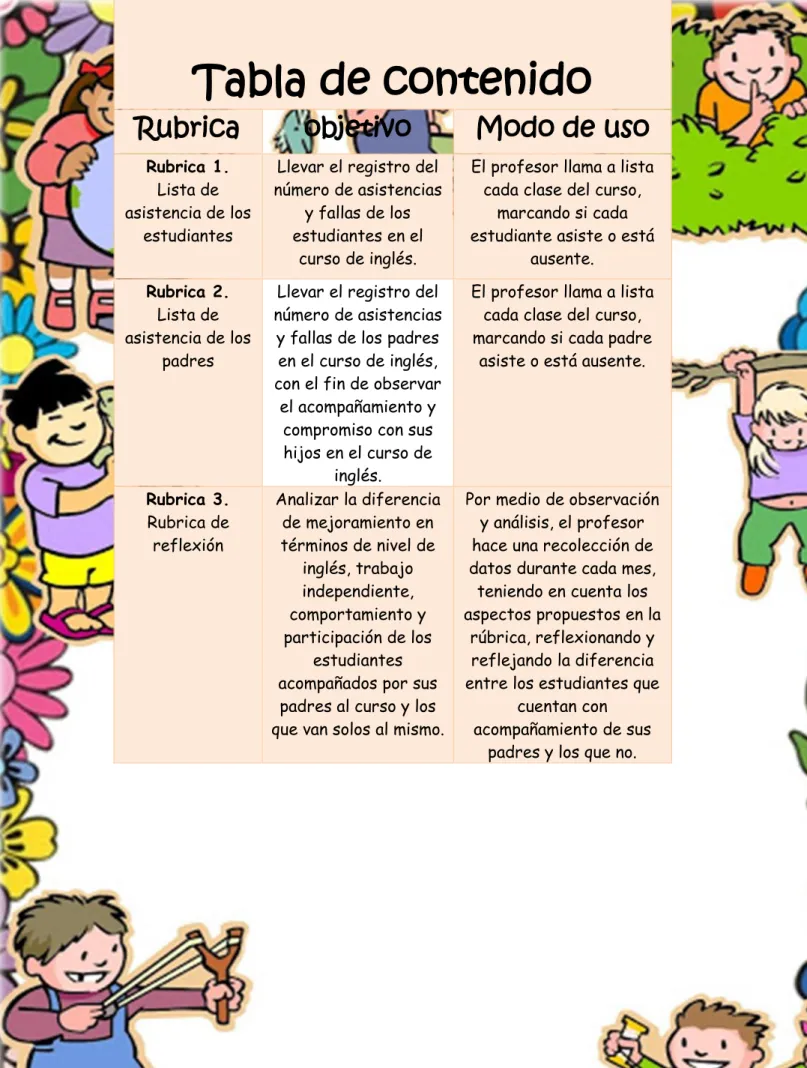
(47) PARENTS‟ INVOLVEMENT IN THEIR CHILDREN ENGLISH EXTRA-CLASSES OUTSIDE THE SCHOOL better because they know that it is important for the adults and they don‟t want that them called their attention for misbehavior, also because when children are working in class with their parents, they feel more encouraged to do the activities with them and to show the work that they do. It doesn‟t mean that parents always have to be inside the classroom in order to get better behavior, teacher also can manage it, however the parent‟s involvement become an excellent tool to have a better behaved class.. 5. English extra- classes support Formal education at school because in this kind of learning space, teachers dedicate more time to some topics that students did not understand very well at school. Also, students feel comfortable with the learning environment because, it is a place where they can learn in a more ludic way and this kind of methodology motivates students to participate and to go to these classes. Moreover, when students are enjoying the classes, they feel encourage and more flexible to learn demonstrating what they learn through the activities prepared by teachers.. 6. Taking into account the relationship between parents and teachers and the benefits for all of them, in order to improve the English practices at the library, we created a book with different formats to leave at the library for parents, teacher and students, with the objective to involve more parents in their children English learning process in this place and have a register of that. It also was created to take into account students‟ opinion about each English course and in this way, teacher can do a continue reflection in order to improve every course.. 47.
Figure

Documento similar
Participants in the survey were selected according to their previous experiences in the creation and management of community gardens, personal involvement in green
children. The project content includes policy consultation and education information on the education of employees’ children, helping families with difficulties with
For the states in the upper set, above the (2.7) curve, the wage of the low-skilled workers is suffciently high to induce the high-skilled parents to invest little in their
On the one hand, the greater freedom of movement enjoyed by adult children as a result of quasi-democratic relationships with their parents (i.e., the emergence of the
Thus, Thompson’s work on the formation of the English working class, on the antinomian identity in English Protestantism, on the “utopian” Socialism of William
We aim to describe the phenotypes of four children with mutations in the SLC19A3 gene, comparing their clinical, biochemical, radiological and genetic data with all of the
Attention deficit hyperactivity disorder (ADHD) is one of the most common neurodevelopmental disorders in childhood. Up to 5.3% of the school-age children are
Young children (0-8) and digital technology: a qualitative exploratory study. National report. Spain
• Parents do express concerns in relation to risks associated with digital technologies such as accessing content that is inappropriate for their children (primarily
