
Enhancing oral skill development through learning styles VAK
65
0
0
Texto completo
(2) ENHANCHIG ORAL SKILL THROUGH LEARNING STYLES VAK. Página de Aceptación. Nota de Aceptación ____________________________________________ ____________________________________________ ____________________________________________ ____________________________________________ ____________________________________________ ____________________________________________. Jurado I ____________________________________________. Jurado II ____________________________________________. Jurado III ____________________________________________. Bogotá, D.C. mayo de 2018. 2.
(3) ENHANCHIG ORAL SKILL THROUGH LEARNING STYLES VAK. FORMATO RESUMEN ANALÍTICO EN EDUCACIÓN - RAE Código: FOR020GIB. Versión: 01. Fecha de Aprobación: 10-10-2012. Página 3 de 65. 1. Información General Tipo de documento. Trabajo de grado. Acceso al documento. Autor(es). Universidad Pedagógica Nacional. Biblioteca Central Enhancing oral skill development through learning styles VAK (Mejora del desarrollo de la habilidad oral a través de los estilos de aprendizaje VAK) Ochoa Melo, Geraldine. Director. Rodríguez Cáceres, Mélany. Publicación. Bogotá. Universidad Pedagógica Nacional, 2018. 44p.. Unidad Patrocinante. Universidad Pedagógica Nacional HABILIDAD ORAL, ESTILOS DE APRENDIZAJE VAK (VISUAL, AUDITIVO, KINESTÉSICO).. Título del documento. Palabras Claves. 2. Descripción. Trabajo de grado donde la autora buscó analizar el impacto de la implementación de los estilos de aprendizaje visual, auditivo y kinestésico en la mejora del desarrollo de la habilidad oral en el idioma inglés como lengua extrajera de los estudiantes de tercer grado del colegio Prado Veraniego IED. 3. Fuentes. Para el planteamiento y desarrollo de esta investigación se utilizaron alrededor de 42 fuentes bibliográficas de información. ● Aguirre, E., Cancino, M., & Neira Loaiza (2005). Dinamización de los procesos de enseñanza y aprendizaje de las lenguas extranjeras a partir de los estilos de aprendizaje. ● Alharbi, A., Paul, D. Heskens, F. and Hannaford, M. (2011). “ An Investigation into the Learning Styles and Self Regulated Strategies for Computer Science Students. Hobart Tasmania Australia, 4-7 December ● Almutairi, M., & Shukri, N., (2016). Using Songs in Teaching Oral Skills to Young Learners: Teachers’ Views and Attitudes. Retrieved from https://www.researchgate.net/publication/311706500_Using_Songs_in_Teaching_Oral_S kills_to_Young_Learners_Teachers'_Views_and_Attitudes ● Annum, G. (2017). Research instruments for data collection. Retrieved from http://campus.educadium.com/newmediart/file.php/137/Thesis_Repository/recds/assets/T Ws/UgradResearch/ResMethgen/files/notes/resInstrsem1.pdf ● Ausubel, D.P. (1963). The psychology of meaningful verbal learning. New York, Grune and Stratton ● Bandler, R., y J. Grinder, Frogs into princess: Neuro linguistic programming. Royal Victorian Institute for the Blind Tertiary Resource Service, (1982). 3.
(4) ENHANCHIG ORAL SKILL THROUGH LEARNING STYLES VAK. ● Brown H. D. (2000). Teaching by Principles: An Interactive Approach to Language Pedagogy. Pearson Education. Second edition. ● Brown. T., Zogni. M., Williams, B., Sim, J. vd. (2009). Are learning preferences of health science students predictive of their attitudes towards e-learning?”. Australasian Journal of Educational Technology, 25(4), 524-543. ● Calhoun, E. F. (1994). How to use action research in the self renewing school. Alexandria, VA: ASCD. ● Chaney, A. L., & Burk, T. L. (1998). Teaching Oral Communication in Grades K-8. Boston: Allyn and Bacon. ● Council of Europe. (2001). Common European framework of reference for languages: Learning, teaching, assessment. Cambridge, U.K: Press Syndicate of the University of Cambridge. ● Denzin, N and Lincoln, Y (Eds) (1994) Handbook of Qualitative Research, Thousand Oaks (Calif), Sage. ● Detert J., Seashore L.K. and Schroeder R. (2001) A culture framework for education: defining quality values and their impact in US Schools. School Effectiveness and School Improvement. ● Fatt, J. P. (2000). Understanding the learning styles of students. International Journal of Sociology and Social Policy, ● Felder, R.M. & Silverman, L.K. (1987). Learning Styles and Teaching Styles in Engineering Education,” Presented at the 1987 Annual Meeting of the American Institute of Chemical Engineers, New York. ● Ferrance, E. (2000), Themes in Education: Action Research, The Education Alliance: Brown University, Providence, Rhode Island. ● Fleming, N. D. (2001). Teaching and learning styles: VARK strategies. Christchurch , New Zealand : N.D. Fleming ● Gardner, H. (1993). Frames of mind: The theory of learning styles. New York, NY: BasicBooks. ● Grundy, S. (1987), Curriculum, Product or Praxis?, London, The Falmer Press. ● Herrmann, N. (1996). The whole brain business book. New York: McGraw-Hill ● Heming, A. (2008). Learning styles in the Classroom Honors College Capstone Experience/Thesis Projects. Retrieved from http://digitalcommons.wku.edu/stu_hon_theses/138 ● Hensen, K. T. (1996). Teachers as researchers. In J. Sikula (Ed.), Handbook of research on teacher education (4th ed., pp. 53-66). New York: Macmillan Library Reference USA. ● James P. Key, 1997. Oklahoma State University, Research Design in Occupational Education. ● Johnson, A. P. (2012). (4th ed) Action research: methods of collecting data Ph.D. Minnesota State University, Mankato . ● Johnson, R. B., & Christensen, L. B. (2014). (5th edition). Educational research methods: Quantitative, qualitative, and mixed approaches. Los Angeles, CA: Sage. ● Kayi, H., (2006). Teaching Speaking: Activities to Promote Speaking in a Second Language. University of Nevada. ● Kolb, D. A. (1976). The Learning Style Inventory: Technical Manual. McBer & Co, Boston, MA. ● Korosidou E. & Griva E. (2016). "It's the same world through different eyes": a content and language integrated learning project for young EFL learners. Colomb.Appl.Linguist.J. 18(1), pp 116-132. ● Marks, H. M., & Louis, K. S. (1997). Does teacher empowerment affect the classroom? The implication of teacher empowerment for instruction, practice and student 4.
(5) ENHANCHIG ORAL SKILL THROUGH LEARNING STYLES VAK. ● ● ● ● ● ● ● ●. ●. ● ● ● ●. performance. Educational Evaluation and Policy Analysis, 19(3), 245-275. Retrieved from http://dx.doi.org/10.3102/01623737019003245 McTaggart, R. (1997). Reading the collection. In R. McTaggart (Ed.), Participatory action research (pp. 1-12). Albany, NY: SUNY Press Mills, J., Ayre, M., Hands, D., and Carden, P. (2010). Learning About Learning Styles: Can It İmprove Engineering Education? Mountain R. Ministry of National Education (2016). Serie Lieaniemto curriculares. Idiomas extranjeros. Retrieved from https://www.mineducacion.gov.co/1621/articles339975_recurso_7.pdf Naimie, Z., Siraj, S., Abuzaid, R. A., & Shagoholi, R. (2010, October). Hypothesized Learners' Technology Preferences Based on Learning Style Dimensions. The Turkish Online Journal of Educational Technology. Patton, MQ. (1999). Enhancing the quality and credibility of qualitative analysis. HSR: Health Services Research. 34 (5) Part II. pp. 1189-1208. Pike, K. L. (1990). Pike’s Reply to Harris. In T.N. Headland, K.L. Pike, & M. Harris (Eds.), Emics and etics : The insider/outsider debate (pp. 62-74). Newbury Park, CA : Sage. Robles, A., (2001). Las distintas teorías y como se relacionan entre sí. Taken from http://%20www.galeon.com/aprenderaaprender/general/indice.htm Rodríguez, A., & Chamorro, J., (2017). Diseño de estrategias de enseñanza del inglés y estilos de aprendizaje. Un estudio basado en los estudiantes de la Institución Educativa Olga González Arraut de la ciudad de Cartagena. Retrieved from http://hdl.handle.net/10819/5251 Samper O., & Tapuante L., (2014). La programación neurolingüística- Metáfora como estrategia para favorecer el desarrollo de la competencia comunicativa oral y la incentivación de los valores afectivos. Retreived from http://biblioteca.udenar.edu.co:8085/atenea/biblioteca/90278.pdf Sreenidhi, S., Tay Chinyi, H. (2017). Styles Of Learning Based On The Research Of Fernald, Keller, Orton, Gillingham, Stillman , Montessori And Neil D Fleming N. International Journal For Innovative Research In Multidisciplinary Field. Volume 3. Thornbury, S. (2005). How to teach speaking. Essex: Pearson Education Limited. Tudor, I. (2001) The Dynamics of the Language Classroom. Cambridge: Cambridge University Press. Urrutia, W., & Vega, E., (2006). Encouraging Teenagers to Improve Speaking Skills through Games in a Colombian Public School. PROFILE Vol. 12, No. 1, 2010. ISSN 1657-0790. Bogotá, Colombia. Pages 11-31. 4. Contenidos. En el primer capítulo, el documento inicia con la caracterización de la población desde el contexto personal, escolar y local. En esta sección se muestra el diagnóstico que se realizó al inicio de la investigación en el cual se describe el entorno de los estudiantes, las actividades que solían realizar en sus clases de inglés y la comprensión que tienen de este idioma. Así mismo, se muestra parte de las observaciones realizadas para conocer el nivel de inglés de la población e identificar el problema. El planteamiento del problema muestra que hay varias dificultades en este curso en cuanto a la. 5.
(6) ENHANCHIG ORAL SKILL THROUGH LEARNING STYLES VAK. clase de inglés. De las cuales se evidenció que los estudiantes no tenían nivel de lengua que deberían desarrollar para este grado escolar, especialmente la habilidad oral. Teniendo en cuenta esto, se formuló la pregunta y objetivos de investigación del siguiente modo: ¿Cómo podrían los estudiantes de 302 del colegio Prado Veraniego mejorar su habilidad oral utilizando un conjunto de actividades diseñadas en base a los estilos de aprendizaje visual, auditivo y kinestésico (VAK)? Objetivo general: Identificar el impacto de usar un conjunto de actividades basadas en los estilos de aprendizaje de VAK para mejorar la habilidad oral de los 302 alumnos de Prado Veraniego. Objetivos específicos: 1. Caracterizar los estilos de aprendizaje predominantes de los alumnos de 302. 2. Describir la utilidad del uso de la teoría de estilos de aprendizaje VAK en la mejora de la habilidad oral de los estudiantes de tercer grado En el segundo capítulo, se hace mención de todos los autores que fueron tomados como referentes de la investigación y que ayudaron a clarificar la definición de los conceptos de los estilos de aprendizaje visual, auditivo y kinestésico, así como la definición de habilidad oral. Adicionalmente, se realiza un estado del arte donde se evidencia el resultado de estudios previos relacionados al tema de investigación del presente trabajo y como ayudaron a esta investigación. En el tercer capítulo, se presentan los instrumentos que se usaron en la investigación. Para ello se hace referencia a las definiciones de los diarios de campo, grabaciones, entrevistas y un test de estilos de aprendizaje; así como los momentos en que dichos instrumentos fueron implementados para la recolección de datos y su análisis. En el cuarto capítulo, se hace referencia a dos visiones, una de aprendizaje y la otra de lengua, las cuales fueron tenidas en cuenta para la planeación de las sesiones y la aplicación de estas durante las fases de intervención. Adicionalmente, se describe cómo se realizó la intervención pedagógica, enfatizando que ésta se llevó a cabo en tres ciclos los cuales pretendían llevar a los estudiantes a explorar diferentes aspectos de sí mismos y de su contexto mientras desarrollaban de su habilidad oral en inglés. En el quinto capítulo, se describe los resultados de la investigación haciendo mención a las categorías de análisis que surgieron a partir de la triangulación de los datos tomados de los diferentes instrumentos. Allí se da cuenta de los procesos que se dieron en cuanto al uso de los estilos de aprendizaje VAK y su implicación en el desarrollo de la habilidad oral.. 5. Metodología. El tipo de investigación realizada fue acción participativa, dado que era el enfoque más apropiado para trabajar en el ámbito de la educación y hacer intervención con la población trabajada, describir en detalle los procesos que se dieron durante la implementación de los ciclos, así como tomar datos cualitativos que permitieran una mejor comprensión del fenómeno de estudio.. 6. Conclusiones. Los estudiantes desarrollaron su habilidad oral con un largo proceso, el cual se dio por tres fases: primero, la comprensión de la lengua extrajera, segundo, la participación en la clase usando inglés 6.
(7) ENHANCHIG ORAL SKILL THROUGH LEARNING STYLES VAK. y apoyados de su lengua materna y finalmente, la expresión de los sentimientos de los estudiantes a través de actividades de role play. Además, la implicación de los estilos de aprendizaje VAK para el desarrollo de la habilidad oral de los estudiantes fue efectiva, ya que los llevó a usar diferentes estrategias para procesar la información, recordar de mejor forma los temas trabajados durante las sesiones, y asimismo, mejorar su pronunciación. Por otro lado, las actividades significativas, las cuales fueron contextualizadas a partir del contexto de los estudiantes, despertaron su interés de los por aprender inglés y siempre se mostraron más motivados por tener la clase y participar de todas las actividades propuestas. Finalmente, se encontró que el uso del tema de los valores generó un cambio en el comportamiento de los estudiantes, dado que empezaron a ser conscientes de sus acciones y a comportarse de una manera más apropiada en el aula, respetando a sus compañeros, escuchándolos en cada intervención, colaborándose entre sí y, aún más significativo, forjaron mejores y fuertes relaciones entre ellos.. Elaborado por: Revisado por:. Ochoa Melo, Geraldine Rodríguez Cáceres, Mélany. Fecha de elaboración del Resumen:. 21. 11. 2018. 7.
(8) ENHANCHIG ORAL SKILL THROUGH LEARNING STYLES VAK. Table of contents CHAPTER I .......................................................................................................................... 10 CHARACTERIZATION OF CONTEXT ......................................................................................... 10 DIAGNOSIS............................................................................................................................. 10 STATEMENT OF THE PROBLEM ............................................................................................... 13 RESEARCH QUESTION ............................................................................................................ 13 RESEARCH OBJECTIVES .......................................................................................................... 14 RATIONALE OF THE STUDY .................................................................................................... 14 CHAPTER II .......................................................................................................................... 1 THEORETICAL FRAMEWORK .................................................................................................... 1 LEARNING STYLES ................................................................................................................... 1 VISUAL REPRESENTATION SYSTEM. ......................................................................................... 2 AUDITORY REPRESENTATION SYSTEM ..................................................................................... 2 KINESTHETIC REPRESENTATION SYSTEM. ................................................................................ 3 ORAL SKILL ............................................................................................................................. 3 STATE OF THE ART ................................................................................................................... 5 CHAPTER III ......................................................................................................................... 9 METHODOLOGY ....................................................................................................................... 9 TYPE OF STUDY ....................................................................................................................... 9 INSTRUMENTS .......................................................................................................................... 9 DATA ANALYSIS METHODOLOGY ........................................................................................... 10 DATA ANALYSIS .................................................................................................................... 11 ETHICAL ISSUES ..................................................................................................................... 11 CHAPTER IV ....................................................................................................................... 13 PEDAGOGICAL INTERVENTION ............................................................................................... 13 VISION OF LEARNING ............................................................................................................. 13 VISION OF LANGUAGE ............................................................................................................ 13 INSTRUCTIONAL DESIGN........................................................................................................ 14 CHAPTER V ........................................................................................................................ 17 DATA ANALYSIS AND FINDINGS ............................................................................................. 17 FINDINGS ............................................................................................................................... 17 CHAPTER VI ....................................................................................................................... 29 CONCLUSIONS ....................................................................................................................... 29 IMPLICATIONS........................................................................................................................ 31 LIMITATIONS ......................................................................................................................... 31 REFERENCES LIST ........................................................................................................... 33 APPENDICES ...................................................................................................................... 38. 8.
(9) ENHANCHIG ORAL SKILL THROUGH LEARNING STYLES VAK. ABSTRACT This qualitative action research study attempts to characterize the impact of the use of learning styles VAK may have on EFL students to enhance third graders’ oral skill. The study was developed with thirty-four 3rd grade students of an EFL classroom at Prado Veraniego School. Data were collected through questionnaires, field notes and audio recordings. The study promoted and implemented the use of different activities based on the learning styles VAK to let the students discover and explore all their capacities and to contribute with their personal development and their learning process of the foreign language. All the activities were contextualized and adapted to the level of the students to be meaningful for them, so they could enhance their oral skill and communicate effectively.. Key words: Learning styles VAK, oral skill, EFL classroom.. 9.
(10) ENHANCHIG ORAL SKILL THROUGH LEARNING STYLES VAK. CHAPTER I Characterization of context The current project was carried out with third-grader students at Prado Veraniego school. This school is located at the northern end of the city of Bogotá within Suba locality in the neighborhood, Prado Veraniego. It is characterized by having one of the largest extensions and population of Bogotá, corresponding to the strata two and three, of which stratum 3 takes precedence. Concerning the social public infrastructure and urban equipment, the neighborhood has a CAMI, the headquarter A and B of Prado Veraniego school, a Rapi-CADE, a CAI and a Police Station. Likewise, Prado Veraniego is considered a point of economic development due to the different companies in the commercial and industrial sector that have been created, however, the neighborhood has two associated problems: drug use and theft crimes. Regarding the PEI children grow up with an integral development based on values such as respect and solidarity, that is why, they develop different workshops and activities to foment inclusion, personal growing and so on. The population selected for this research were 34 students, between 22 boys and 12 girls, between 6 and 8 years old in third grade (302). According to some conversations made with the head teacher, many of these students lived in dysfunctional families, which were made up of mothers or fathers who worked in informal jobs and therefore, had to work all day. It showed that they did not have time to be aware of the education of their children, affecting their learning process in school. Diagnosis In this section, I will show the diagnosis obtained during the observations made to the group 302, during the first phase of this action research project. I found some relevant issues in terms of the attitude of the students, their interest and the use of the language.. 10.
(11) ENHANCHIG ORAL SKILL THROUGH LEARNING STYLES VAK. First, I observed during the classes that children were dispersed and they got distracted, especially, when they were asked to do individual work, since they stood up and started playing with their classmates. The teacher sometimes had to shout or just looked at them expecting the children to stay quiet and it caused the class time to be spent on getting the children to pay attention. Second, the time for the English class was reduced to less than two hours per week what causes not to have enough time to develop different activities in which they could learn the foreign language. Despite this fact, according to the field notes taken, children showed some interest when they had English class since they asked how to say other words and they wanted to use them with other classmates. Likewise, during the interview, the teacher affirmed that she knew children liked to learn English and she tried to teach them few things even it was not her subject (Annex 3). Also, she mentioned she would have liked to teach her students more things because she considered it was necessary for their future. Regarding to language, many relevant issues were found. One of them was that students were not learning much the English language, taking into account the field notes (Annex 1), this problem was due to all the classes assigned to learn the foreign language were given in Spanish and, English was just the latest resource, used when it was said an example, a word translated from Spanish or when a sentence was written on the board. Some parts of the class were spent on translating isolated words from Spanish to English, but they were not practiced within a context. Likewise, students were asked to answer some questions related to the activities they did in class, if they understood when the teacher spoke in English, the activities they did at home and, if someone helped them to do their homework (Annex 2). 11.
(12) ENHANCHIG ORAL SKILL THROUGH LEARNING STYLES VAK. Regarding the activities, most of the students answered that they did dictation during the class and the teacher left homework and checked it the next session. Also, some of them answered that the teacher made some exams. About their understanding when the teacher used English, they answered that they understood almost everything. Just some students answered they did not understand anything. In relation to the person who helped them to do their homework, many of the students said it was their mother, in second place, some students answered none helped them and, in third place, some students affirmed that another adult assisted them. In contrast, based on what I observed during the classes, the students sometimes understood some words when they were said in English, but they did not remember much if the teacher asked vocabulary of the previous classes. Also, they did not remember the basic patterns of greetings and farewells since the teacher never used them neither to start nor to finish the class. Another fact was that some children sometimes asked me how to ask a question as “¿cómo estás?”, or how to say “estoy bien”, although on the walls of the classroom there were some posters with greetings and expressions such as “Good morning”, “I have a question, teacher” “Can I go to the bathroom?” and some vocabulary of animals but the children did not use them and were not conscious of them. Furthermore, the students did not pronounce the words correctly since they read as if it was Spanish and sometimes the teacher did not know how to pronounce some words either, that implied, the children repeated what they listened to even if it was wrong. In the same way, they wrote the words they listened to as if it was Spanish, and the teacher did not correct them, reason why, they kept reading and pronouncing incorrectly. However, even when the teacher wrote on the board the corresponding words in English they kept writing wrong. 12.
(13) ENHANCHIG ORAL SKILL THROUGH LEARNING STYLES VAK. Statement of the problem In the last years, teachers have been looking for different methodologies and strategies to implement in their classrooms to help the students learn English and fulfill the objectives of the Basic Standards of Competence in Foreign Languages: English settled by the Ministry of National Education based on its National Program of Bilingualism in agreement with the British Council. They mention the main advantages of learning a foreign language, the opportunity for students' social, cultural and cognitive development and, the objective of getting A1 level of English according to the common European framework by the end of third grade. At his level the students should be able to understand simple stories, develop basic comprehension strategies and understand basic vocabulary and express basic ideas about them. In contrast, according to the diagnosis, students of 302 at Prado Veraniego, currently did not have the corresponding competences they should develop for that grade. They did not understand much of the basic vocabulary about family, friends, games and places known, when it is spoken slowly and with clear pronunciation. Unfortunately, they were not practicing the oral skill in English since they did not know how to respond to greetings and farewells, answer questions about how they felt, express and indicate personal needs related to the classroom, answer questions about people, objects and places of their environment, and ask for repetition if they did not understand, and they were not using English in the class either. Furthermore, if the students did not start practicing their oral skill from the beginning they will not be able to communicate in English that is one of the objectives of learning a new language. Also, they will not have many beneficial opportunities in their future as the possibility to know other cultures, complement their studies and have a better life quality. Research question Based on the problematic previously presented, the following question was 13.
(14) ENHANCHIG ORAL SKILL THROUGH LEARNING STYLES VAK. proposed to guide this research, how might students of 302 at Prado Veraniego school enhance their oral skill using a set of activities designed based on the Visual, Auditory and kinesthetic (VAK) learning styles? Research objectives General research objective To identify the impact of using a set of activities based on VAK learning styles to enhance the oral skill of the 302 graders at Prado Veraniego. Specific research objectives •. To characterize the predominant learning styles of the students of 302.. •. To describe the utility of using the VAK learning styles theory on the enhancement of the oral skill of third grader students.. Rationale of the study Based on the above, this project seeks to use learning styles VAK as a strategy to encourage the oral skill of third grade students. Given that communication in a foreign language is essential, not only in the academic environment but also in the professional and personal life of every person, it is necessary that students develop abilities to express themselves in different situations that are familiar to them. The Ministry of National Education (2016) mentions that “superiority is not in the one who lends his / her language to be understood, but on the side of one who knows the language of the other and he understands his way of being, of thinking, of feeling”. In this way, they stablish the importance of the National Program of Bilingualism, which is to have citizens capable of communicating in English, who insert the country in the processes of universal communication, in the global economy and in cultural openness.. Considering the necessity of learning English to access to knowledge and culture due to our competitive world, it is important to implement teaching strategies to 14.
(15) ENHANCHIG ORAL SKILL THROUGH LEARNING STYLES VAK. successfully fulfil this aim in the schools. Naimie, Siraj, Abuzaid, & Shagoholi (2010) mentioned that “many learning style specialists have confirmed the theory that students will learn more and enjoy the class experience and environment when they can use their preferred learning styles”. Considering that statement, it is fundamental, in this project, to implement the theory of VAK learning styles due to it allows the teacher to know the learning style of each student in order to motivate them to learn. Also, it will let the students to be aware of their own learning and what better way to do it than through the channel that they have more developed, which will allow them to have a base for understanding the English language and to be able to develop their oral skill through the expression of their ideas or feelings and interventions in class sessions.. Likewise, In the proposals that will be mentioned in the state of the art, for example, Samper & Tapuante's research (2014) is presented the development of themes related to values was proposed to improve the oral skill, was achieved since children felt part of a community and were more confident when talking. The use of a theme in values as part of the design of the methodological proposal becomes relevant to develop oral production processes since this topic has not been much handled for the teaching of English as a foreign language, so it is important to explore this field and determine the incidence that might have in the improvement of the oral skill, since it is the aspect that the third grade students need to strengthen.. On the other hand, the Univeridad Pedagógica Nacional, and especially, the Department of Languages of the Faculty of Humanities, will be able to make use of this research and carry out a greater analysis on the incidence of the use of visual, auditory and kinesthetic learning styles for incentivize the students’ participation and, therefore, the. 15.
(16) ENHANCHIG ORAL SKILL THROUGH LEARNING STYLES VAK. oral production of the students. In addition, this research will serve to build the state of the art of future projects whose object of study is similar to the one being developed.. 16.
(17) ENHANCHIG ORAL SKILL THROUGH LEARNING STYLES VAK. CHAPTER II Theoretical framework The aim of this section of the study is to build up the constructs that are the basis of my research study. These constructs are: Learning styles in the EFL classroom and oral skill development. I attempt to present not only theory but also previous research to sustain this construct to have a wider view about the topic I am looking into. Learning styles According to Brown (2009) and Mills (2010) learning styles are the framework of a learning process in which each person has different ways to acquire knowledge either through visual, auditory or kinesthetic way to do so in which they can develop their conceptual, cognitive and behavioral patterns. For this reason, the purpose of people using brain intelligences is to manage and adopt the conditions which result in different knowledge styles (Brown, 2009). Moreover, it is important to take into consideration that these styles are not stable since students might adopt different ones depending on their subject and their subject matter and current learning environment (Pritchard, 2009, as cited in Alharbi et al., 2011). This is also supported by Aguirre, Cancino and Loaiza, (2005) who mention that learning styles are relatively stable, and therefore can change. Students, as they progress in their learning process, discover better ways of learning; therefore, they will vary their style and it will depend on the circumstances, contexts and learning times they must face. Learning styles focus on strengths and not weaknesses. In that sense, there is no correct or incorrect learning style. On the other hand, students do typically have one learning style that is preferred over others and can be motivated by learning material compatible with this preference (Larkin & Budny, 2005, as cited in Alharbi et al., 2011). Knowledge of their preferred learning styles can be used to help guide students to choose the best learning strategies and allow teachers to 1.
(18) ENHANCHIG ORAL SKILL THROUGH LEARNING STYLES VAK. modify their instructional strategies to provide the greatest opportunity for all students to learn. Some models that classify the learning styles are the following: The model of the Brain Quadrants by Herrmann (1996); the model by Felder and Silvermann (1987), learning styles by Kolb (1976), multiple intelligences by Howard Gardner (1993) and the visualauditory-kinesthetic learning styles (VAK) proposed by John Grinder and Richard Bandler (1982). This last model was selected as the basis for this project due to its relevance to determine how learners process the information, depending on the learning channel they have more developed and how it helps the students to process the information and learn. According to this theory, three large systems represent mentally the information, the visual, the auditory and the kinesthetic. We all have the three elements, but in most of us, one of the three systems predominate, known as the access channel due to it facilitates the information processing, which allows the first phase of the communication in which the student interprets the information and gives it a meaning, to subsequently produce its own message. Visual representation system. According Sreenidhi & Tay Chinyi (2017) students who use the visual representation system easily absorb large amounts of information and, when they think of images, they can establish relationships between different ideas and concepts and recall previous information. Therefore, visual students learn best when they read or see the information in some way. For this reason, they suggest some activities to be developed in the classroom as write things down, sit near the front of the classroom to see instructor clearly, watch videos, use flashcards, use highlighters, underlining, etc. Auditory representation system Students who are more auditory tend to remember information better by following and remembering an oral explanation and when they need to recall it they listen to their mental recording step by step. This system does not allow to abstract or relate concepts with 2.
(19) ENHANCHIG ORAL SKILL THROUGH LEARNING STYLES VAK. the same ease as the visual one, but it is fundamental for the learning of things like music and languages. Fatt (2000) says that auditory students would prefer discussions, and tapes. By letting auditory learners to listen to tape recordings of material, they are more likely to ask questions about what they have learned and may not have understood. For this reason, auditory students learn better when they receive the explanations orally and when they can talk and explain that information to another person better than using a written form. They can benefit of listening to music or rhythmic patterns, such as a song or poem, or participating in class discussions and group activities. Kinesthetic representation system. When we process information by associating it with our sensations and movements, to our body, we are using the kinesthetic representation system. Kinesthetic learning is deep. Once we know something with our body, we have learned with muscle memory, it is very difficult to forget. The students who preferentially use the kinesthetic system therefore need more time than others. According to Fleming’s learning style theory (2001) kinesthetic students need to move and have activities where they make things through practical activities. They learn in real environments where they can be active. Some suggested activities are participating in simulations as roles plays, passing in front to the board, making them to be active or engaging them in hands-on activities. Oral skill To understand what oral skill means in this project, first, it is necessary to clarify what communicative competence is, due to it is the category that involves the oral skill. Communicative language competence in this study is considered as comprising several components: linguistic, sociolinguistic and pragmatic. Based on the Common European Framework of Reference (2001), the first component also known as language component refers to language competence or linguistic competence related to knowledge of and ability to use language resources to form well-structured messages. The subcomponents of language 3.
(20) ENHANCHIG ORAL SKILL THROUGH LEARNING STYLES VAK. competence are lexical, grammatical, semantic, phonological, orthographic and orthoepic competences. Sociolinguistic competence refers to possession of knowledge and skills for appropriate language use in a social context. The following aspects of this competence are highlighted: language elements that mark social relationships, rules of appropriate behavior, and expressions of peoples’ wisdom, differences in register and dialects and stress. Pragmatic competences are concerned with the functional use of linguistic resources (production of language functions, speech acts), drawing on scenarios or scripts of interactional exchanges. It also concerns the mastery of discourse, cohesion and coherence, the identification of text types and forms, irony, and parody. For this component even more than the linguistic component, it is hardly necessary to stress the major impact of interactions and cultural environments in which such abilities are constructed. On the other hand, oral skill is an interactive process of constructing meaning that involves receiving, processing and producing information which should be developed and enhanced as means of effective communication, In that way, Brown (2000) states that the oral skill is closely intertwined with the listening skill, specially when a conversation shows up, due to, first, the listener must understand and interpret the message to produce another one and communicate. Likewise, Chaney (cited in Kayi, 2006) specifies that oral skill involves the process of building and sharing meaning using verbal and non-verbal symbols, in a variety of contexts. One of the basic characteristics of the oral skill is that it needs to take place in real time. According to Thornbury theory (2005) oral production requires realtime processing due to time constraints provide the speakers just limited planning time. This author also describes speech as not only spontaneous but also as essentially linear, that is, the fact that speech is produced utterance-by-utterance, layering of phrase on phrase rather than forming sentence by sentence as in written texts.. 4.
(21) ENHANCHIG ORAL SKILL THROUGH LEARNING STYLES VAK. State of the art Motivated to improve the oral skill of students of 302 graders of the Prado Veraniego School, I consulted many studies which have sought to respond to the difficulties of oral skill of the students. In this sense, I considered the aspect of oral skill and the use of learning styles, as well as the thematic that was implemented to help those processes. In that sense, Urrutia & Vega (2006), were cognizant of the methodology based on games, and complemented with workshops, songs, role play to improve the speaking skills of the students who were not confident when using English. They had varied materials as library, audiovisual rooms, support texts, books, videos, cassettes, posters, flash cards, tape recorders, which helped them to develop the teaching-learning process inside the classroom. They used picture games, sound games, card and board games, word games, caring and sharing games, story games, memory games. In the results, they fo und that students enjoyed the activities and perceived speaking as a natural process when they were playing. Therefore, their fearing to speak was fading away and they got more confidence, even they learnt more vocabulary and pronunciation. Most of them could express and communicate orally without the pressure of time or constant evaluation. Regarding this research, I considered important to take some of the activities presented in it as games, as a tool to work on the students learning styles. My project classified those activities in terms of their effectivity and how they impact the learning of the students through their predominant learning channel either visual, auditory or kinesthetic, ahow, they improve the oral skill to express their feelings, share with their classmates and discover their strengths.. 5.
(22) ENHANCHIG ORAL SKILL THROUGH LEARNING STYLES VAK. Also, Korosidou & Griva (2016) had as the objective of their study to develop the students’ receptive and productive skills in EFL, focused on a Content and Language Integrated Learning (CLIL) project, which they could participate in physical activities as role plays, presentations, and dramatizations, where children were asked to use the target language in authentic environment for communication purposes. As a result, the students had the opportunity to work in a variety of teaching contexts and were engaged in several types of interaction during the learning process. They interacted verbally using the EFL, likewise, verbally and non-verbally during creative and physical activities. Also, students’ oral skill seemed to be enhanced by participating in a variety of inquiry-based, creative, and interactive-cooperative activities, as the students became more confident regarding communicating in the target language. This study contributed to my research since, as in the previous research, it showed the use of games as a tool to encourage students into different activities where they could enhance their oral skill, therefore, it was focused in its majority, on the use of role plays and physical activities that are considered in my project due to its influence in the kinesthetic learning style. In spite of that, they do not focus on developing visual or auditive activities. In that way, my project executed not only kinesthetic exercises but also visual and auditive activities to include all the students in the class.. Besides, Samper & Tapuante's research (2014) took into consideration the realities that children lived in the school context. Therefore, emphasis was placed on the development of oral communicative competence and the encouragement of affective values, evidencing difficulties such as inadequate pronunciation of words, insecurity when speaking to others or to an audience, and conflicts in coexistence. The project was developed with a pre-school group ranging from 5 to 6 years of age. In addition, the central idea was the application of. 6.
(23) ENHANCHIG ORAL SKILL THROUGH LEARNING STYLES VAK. poetry and songs to make understanding was given in a better way. Also, the development of themes related to values was proposed, to improve the oral skill, was achieved since children felt part of a community and were more confident when talking.. This research contributed to an important aspect to be developed in my research that is the implementation of the theme of values as part of the design of the methodological proposal to enhance students’ oral skill, since this topic has not been much handled in the teaching of English as a foreign language, so it is important to explore this field and determine the incidence that might have in the improvement of the oral skill, since it is the aspect that the third grade students need to strengthen.. On the other hand, Rodríguez & Chamorro (2017) presented the results of a descriptive investigation that sought to offer teaching strategies based on the learning styles. This project was drawn from the flaws found in the process of teaching English, since they realized some gaps due to teachers where not experts on this filed. Thus, they proposed some strategies and activities to teach English considering the predominant learning channel of the students to get the students’ attention. Although this research was focused on, a large extend, the teachers, it is useful due to it contributes with different teaching activities that can be developed since the students learning channel and their interests. Additionally, my project will use these strategies not mainly to improve my teaching but to accomplish oral skill goal on the third graders in order to allow them to enhance this aspect and use English in real contexts. Additionally, Almutairi & Shukri (2016) showed in a log extend the teacher opinions on using songs when teaching EFL. They found that songs are a valuable tool to teaching English oral skills (listening and speaking) specifically to young learners. Also, songs were. 7.
(24) ENHANCHIG ORAL SKILL THROUGH LEARNING STYLES VAK. considered a valuable technique because they helped to lower students’ anxiety and increase motivation. In this sense, like the previous research this one was focus on the teacher opinions about the use of songs to teach the foreign language. However, it was relevant to realize that by using songs the oral skill can be enhanced especially to students in primary because this is one of the focus of my research. To strengthen this aspect, my research will provide the students complemented was to accomplish this aspect while exploring the VAK learning channels of all the students. As a closure, and after making this journey through the different works that have been carried out to encourage and improve oral skill through different activities that involved the learning styles, it can be said that the researches and theory consulted contribute to construct the theoretical referents of this research. It is observed how students’ production is not good at first due to different factors as fear, resources, external issues, and even the preparation of the teachers, but then students start producing with confidence it proves that it can be done. VAK learning styles allow students to explore many ways of learning English and different aspects. Although in some investigations showed certain methodologies to enhance the oral skill they did not focus on knowing students learning styles; accordingly, my research project researched on this field combining different activities based on the VAK learning styles to demonstrate its impact on the enhancement of the oral skill in third graders.. 8.
(25) ENHANCHIG ORAL SKILL THROUGH LEARNING STYLES VAK. CHAPTER III Methodology This research is qualitative due to the pre-service teacher-researcher had the opportunity to analyze the data and understand the context where grade 302 shared along the experience that lasted one year. Along the process the pre-service teacher-researcher attempted to interpret how might students of 302 at Prado Veraniego school enhance their oral skill using a set of activities designed based on the Visual, Auditory and kinesthetic (VAK) learning styles? Paying special attention to the process students follow along the year the intervention lasted. Type of Study This is an action research that attempted to identify the impact of using a set of activities based on VAK learning styles to enhance the oral skill of the 302 graders at Prado Veraniego. This process started in the second semester of 2017, during this first cycle I collected data through a survey, field notes and interviews to get to know the population and the problematic to be worked. Secondly, during 2018 there were three cycles in which the following instruments were used to collect the corresponding information. Instruments Field notes. According to Johnson (2012), field notes are the written observations of what the researchers see taking place in the classroom. These help them notice details they might not otherwise have observed as well as interpretations and annotations the researcher has about the observation. In this way the researcher used this instrument from the first cycle that started on August 8th, 2017 to the third one that finished on September 18th. All the sessions observed during those cycles were filled in the field notes, due to sometimes the video recordings were not clear enough to be understood so it was a support that helped the 9.
(26) ENHANCHIG ORAL SKILL THROUGH LEARNING STYLES VAK. researched to confirm the veracity of the collected information (Annex 1).. VAK test. This test allowed me as the researcher to identify the students’ learning style: visual, auditory or kinesthetic based on the model of neurolinguistic programming of Bandler and Grinder. It was used the test adapted by Robles (2001) which provided a questionnaire of six items to determine the most developed learning channel of each student. This test was applied to determine the predominant learning channel of the third grader students to focus on the pedagogical intervention on preparing and developing activities that successfully work on the predominant learning channel of the students to help them to enhance their oral skill. Most of the students were auditory learners, followed by visual, and kinesthetic learners. It was relevant to take this into account due to the activities that were developed had to fulfill all the three learning channels to integrate all the students in the class. Data analysis methodology To begin with the data collection process, it was necessary to design some of the instruments which were used to collect the data. Data were collected during 3 semesters at the school in one of the groups of third grade, beginning on August 8, 2017 with the first field notes, and finishing on September 18th, 2018 with the final field notes. To collect data in a systematic and methodical way, it was necessary to follow some steps: The first stage in this process was to get the consent forms (see annex 4) signed; then, I did the observation during 50 minutes every session which corresponded to the class time. This process lasted the last semester of 2017, observing one session per week. Field notes were taken, and audio recordings were collected from the students during the first and second semester of 2018 in the classes, beginning on February 8 and ending on September 16. The field notes were taken during each of the classes as well as the recordings were taken when an oral activity was developed. In addition, two questionnaires were applied. 10.
(27) ENHANCHIG ORAL SKILL THROUGH LEARNING STYLES VAK. to the students, the first one at the beginning of the cycle one, and the second one at the end of the third cycle, both to get student’s interests and perceptions regarding the English class and their progress. Likewise, a VAK test was made to determine the learning style of each of the students (Annex 5). Finally, one interview was done to the teacher, at the beginning of the intervention and one questionnaire was applied at the end of the third cycle. Data analysis For the data analysis, it was considered the grounded approach. According to Johnson & Christensen (2014) it is a research tool for generating and developing a theory from data that the researcher collects, and there are not preestablished categories. In addition, the analysis was done from an emic perspective. According to the anthropologist Pike (1990), an emic view of culture is ultimately a perspective focus on the intrinsic cultural distinctions that are meaningful to the members of a given society, often considered to be an ‘insider’s’ perspective. Whilst this perspective stemmed from the concept of immersion in a specific culture, the emic participant isn’t always a member of that culture or society. On the other hand, an etic view of a culture is the perspective of a researcher who places outside the culture of intended study, the etic point of view produces more objective, more reliable descriptions than emic descriptions entangled in the subjectivity, values and judgments of the actors. Some anthropologists may take this approach to avoid altering the culture that they are studying by direct interaction. The etic perspective is data gathering by outsiders that yield questions posed by outsiders. Based on my role as an observer and participant of the research, I considered pertinent to use the emic perspective due to the facilities it offered to do research. It let me be deeper in the community of the research, consequently, I could show reliable data collection and give pertinent interpretations considering the participants perspective. Ethical issues To respect the ethical concepts and maintain the confidentiality an informed 11.
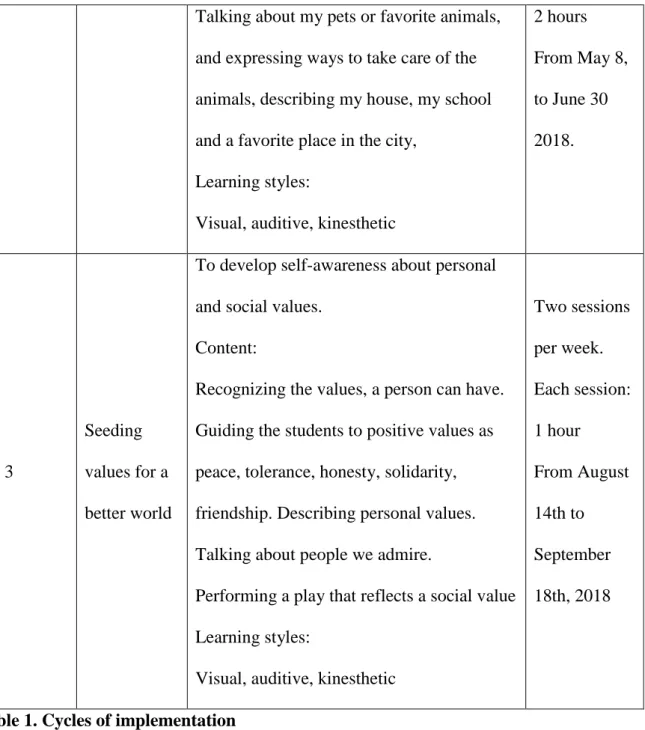
(28) ENHANCHIG ORAL SKILL THROUGH LEARNING STYLES VAK. consent was given to the students and their parents in which they had the option to participate in this research project and approved the use of certain data instruments to help the collection of data. Considering that the collected data was used with an academic purpose only the name of the students were not used, so as not to affect the integrity of the participants.. 12.
(29) ENHANCHIG ORAL SKILL THROUGH LEARNING STYLES VAK. CHAPTER IV Pedagogical intervention This chapter presents the visions of language and learning. Also, the reader will find out the instructional design and the schedule for the activities proposed to be developed in the next stage. Vision of learning Learning is the result of building a network of concepts and adding new ones to existing ones not because they are the same, but because they have to do with these in a way that creates a new meaning. According to the meaningful learning theory proposed by Ausbel (1963), we learn by true knowledge, it can only be born and significant when the contents are related with some existing aspect specifically relevant to the students’ cognitive structure, such as an image, a meaningful symbol, a concept or a proposition, the new contents have a meaning in the light of the knowledge that students already have, that means, the most crucial aspect influencing learning is what the learner already knows. In view of this fact, the material and the lesson plans designed are related among them to allow the students establish strong relations between what they already know and the new information. Also, it is important to consider the transcendence of the topics selected for the students since they were chosen according to the students’ contexts which will let them to learn with their long-term memory due to that learning will be meaningful for them. Vision of language Language is understood as communication. It is a system for the expression of meaning that supports the learning process of the learner. According to the proposal of Tudor (2001), the function of language is to allow interaction and communication. That is a medium by which members of a speech community express concepts, perceptions, expectations, and 13.
(30) ENHANCHIG ORAL SKILL THROUGH LEARNING STYLES VAK. values which have significance to them as social actors of a speech community. The activities were selected according to how well they engaged the student in meaningful and authentic language use related to the needs and likes of the students, which allowed all students to practice their oral skill in real situations not only inside but also outside the classroom. In this way, students could express themselves in a freeway, where they were able to enhance not only the oral skill but also their way of being and thinking. Instructional Design The instructional design proposes themes related to the use of learning styles to enhance the oral skill. Three cycles were developed, along the first and second semester of the year 2018, applying activities that were designed considering the visual, auditory and kinesthetic channel, regarding different topics based on the situations that students were exposed. All the activities designed were organized in different cycles according to the contents they should learn in third grade, based on the Standards and contextualized to the students’ reality. First, there was a cycle related to the students’ self- consciousness. This refers to the recognition of their place in the world and the role as people of a society. Within this cycle, students could talk about themselves expressing who they are and their likes. They were able to recognize and talk about their family and body. These topics were selected due to their relevance in the students’ life. They were pertinent to approach to the students’ context and let them talk about the people surrounding them, as well as create self-awareness of themselves. Then, the second cycle was related to students’ relationship with their environment. In this cycle, students were concerned about the places they usually went and described some of them by expressing the activities they could do in those places and recommend them. This topic was selected given that it let the students discover their city and incentive them to know. 14.
(31) ENHANCHIG ORAL SKILL THROUGH LEARNING STYLES VAK. other places they did not know. Also, this topic let them have tools to talk about their favorite places and the reason they liked them. The third cycle was approached to the reflection of student’s personal values. Because of this, the purpose was that each student reflected about their own values and the ones of the people surrounding them. They worked on different values where the students could realize about their behavior, how they contributed to the society and how people they admired promoted values. This topic was selected due to it had gave the students the opportunity to assess themselves and talk about their good qualities and what they had to improve to be a better person that contributes to the society. There is a panoramic view of the implementation in Table 1. ESTIMATED CYCLE. TOPICS. OBJECTIVE TIME To recognize themselves, as an individual. 1. and part of a society. One session. Content:. per week. describing myself, giving personal. Each session:. Discovering. information, recognizing body parts and. 2 hours. myself. clothes, performing a scene of going. From. shopping, describing my family, and. February 9 to. routines. April 24,. Learning styles:. 2018.. Visual, auditive, kinesthetic To communicate about the own. One session. environment by recognizing it. per week.. Content:. Each session:. Exploring 2 my world. 15.
(32) ENHANCHIG ORAL SKILL THROUGH LEARNING STYLES VAK. Talking about my pets or favorite animals,. 2 hours. and expressing ways to take care of the. From May 8,. animals, describing my house, my school. to June 30. and a favorite place in the city,. 2018.. Learning styles: Visual, auditive, kinesthetic To develop self-awareness about personal. 3. and social values.. Two sessions. Content:. per week.. Recognizing the values, a person can have.. Each session:. Seeding. Guiding the students to positive values as. 1 hour. values for a. peace, tolerance, honesty, solidarity,. From August. better world. friendship. Describing personal values.. 14th to. Talking about people we admire.. September. Performing a play that reflects a social value. 18th, 2018. Learning styles: Visual, auditive, kinesthetic Table 1. Cycles of implementation. 16.
(33) ENHANCHIG ORAL SKILL THROUGH LEARNING STYLES VAK. CHAPTER V Data analysis and findings Throughout this chapter, the data analysis done at the end of the research is presented. Here readers can see the categories and sub-categories of analysis with the support taken from the field notes, students’ speech recordings, video recordings, two surveys and two interviews and one VAK test. Additionally, it is important to consider that through the research process some changes were made to the theory that was supposed to be applied at the beginning of the application of the project due to some findings in the field notes in which the researcher noticed that the use of multiple intelligences in this context was not given effective results due to many limitations that did not allow to carry out the application of the theory effectively. For that reason, it was implemented the theory of visual, auditory and kinesthetic learning styles which fulfilled all the necessities seeing during the observation process. Also, the approach used to make the data analysis in this research was grounded theory due to its nature and convenience in the qualitative research. In this case, the aim of this research was to follow up the students’ process, describe and analyze it. From this perspective, the categories emerged from the collected data and its respective analysis. The results were compared to get validity and reliability. Findings In Table 2. The matrix of categories and sub-categories is presented. they are related to the research question and the information collected throughout the process after codification, contrasting and comparing the data gathered during the intervention.. 17.
(34) ENHANCHIG ORAL SKILL THROUGH LEARNING STYLES VAK. Research. Categories. Sub-categories. Students’ understanding of the foreign Enhancement of oral skill. language Students’ participation using English and Spanish Expressing real feelings through role plays. Impact of learning styles. Images and videos as a mean to relate the previous knowledge to the new one. kinesthetic (VAK) learning styles?. skill using a set of activities designed based on the Visual, Auditory and. How might students of 302 at Prado Veraniego school enhance their oral. question. Using the body as a mean to appropriate the new vocabulary Songs and videos as a mean to learn vocabulary and improve pronunciation Students behavior in the class. Meaningful activities to incentive students’ participation. Table 2. Matrix emergent categories Enhancement of oral skill This category reflects the process students had, from the beginning of the research until the end of it, related to their oral skill. At first, students did not know many words in English since they were accustomed to translating and did not have many opportunities either to use vocabulary in a context or to speak in English. Progressively, most of the students started to understand basic commands and the vocabulary worked during the classes and used it supported by their mother tongue. 18.
(35) ENHANCHIG ORAL SKILL THROUGH LEARNING STYLES VAK. Students’ understanding the foreign language This sub-category is about the process that students had along the research in terms of being exposed to listen to English almost all the time in the classroom and how they started to comprehend the foreign language, being conscious of the benefits of using English and developing strategies to communicate later. Additionally, it is important to consider that this category emerged from the implementation of different activities to a large extent related to the predominant learning style of the students, that according to the survey was the auditory channel, supported by the other two learning styles as well. According to the analysis of the field notes made through the research it was evident how the students did the transition from repeating all what the teacher said without being conscious of it to start understanding the meaning of what they listened to in English and try to answer properly in each class activity. A clear data sample was when the teacher greeted the students, given that they did not answer her but repeated all the same greeting instead. The teacher greets the students, she says “Good morning kids”. The students answer: “Good morning teacher. Then the teacher asks: “How are you today?”, the students repeat what the teacher asked, in that moment the teacher says, “you need to say <fine>”. The teacher asks again the question “How are you?” and some students say “fine” (Field notes). Progressively, they started being conscious of it after the teacher told them that they did not have to repeat all but should answer in a different way.. 19.
(36) ENHANCHIG ORAL SKILL THROUGH LEARNING STYLES VAK. The teacher greets the students, she says “Good morning kids”. The students answer: “Good morning teacher. Then the teacher asks: “How are you today?”, most of the students say, fine, others say fine thank you, and just one of the students says: and you? to which the teacher says: “Fine! Thanks for asking” (Field notes). It was also observed that students understood when the teacher asked them vocabulary related to the topic worked during the classes. Specifically, when the topic was studied in other assignments as the values, where many students tried to participate saying the words as they thought they were correct. After that, the teacher wrote the word “value” on the board and asked the students about the values the knew. Some students raised up their hands and answered: “Solidary”, “peace”, “love”, “respect”. When they said the words, “peace” and “love”, the teacher corrected their pronunciation since they were pronouncing the words as if they were read in Spanish (Field notes). Likewise, the activity proposed for the value of honesty, the students easily recognized the video they watched about the boy cried wolf to its Spanish version, in that way the students show more interest on because they had a previous knowledge. “The students understood the video of “the boy cried wolf” and related it with what they previously knew about the story and used the new vocabulary worked in the class to answer the proposed activity about selecting the ideas that were reflected in the video” (Field notes). Additionally, it can be confirmed with the last survey applied to the students in which the question was about their understanding when their teacher talked to them in English. The 54 % of the students answered that they understood some things, the 33 % answered they understood almost all, and the 13 % said that they understood everything the teacher said (Survey # 3). 20.
(37) ENHANCHIG ORAL SKILL THROUGH LEARNING STYLES VAK. In brief, the process of enhancing student oral skill started with a progress of getting rid of the translation from one language to the other one, and be aware of the fact that they did not have to repeat everything the teacher said without understanding what they repeated but to find the sense of the thigs they said and respond according to the questions the teacher asked them. Students’ participation using English and Spanish This sub-category evidences how the students started using the English language to communicate in a real context, given that they noticed the necessity of using it to do certain activities as asking for permission, answer the teacher’s questions or participate in the activities proposed. Nevertheless, it was evident that students used their mother tongue to confirm if what they were saying was correct or simply to demonstrate that they understood. Through different activities the students interacted with the teacher or with the counterparts where they communicated what they wanted to say in both Spanish and English. A clear example of it was in the activity where the students were playing a memory game about the routines. In this activity, they had to match the picture with the corresponding description of the routine. The use of both languages English and Spanish was evident. “Student 1 turns the card to see the description and reads. “I brush my teeth”. Then she looks at the teacher and says: “O sea, me cepillo los dientes” (Video recording # 4). Also, it can be said that the intention of the student to translate the sentence to Spanish was because she wanted to show that she knew what it meant and expected the teacher’s approval. Another situation that was repeated in several classes was when the students asked for permission to go to the bathroom. Previously, the teacher had told them how to say it in English. Despite that, some students did not remember well and asked it in Spanish. For that reason, the teacher encouraged them to ask permission in English. 21.
(38) ENHANCHIG ORAL SKILL THROUGH LEARNING STYLES VAK. Student 1: Profe, ¿puedo ir al baño? Teacher: ¡¡In English!! ¿Cómo es que se decía ir al baño? Most of the students: “May I go to the bathroom?!” Student 1: “May I go to the bathroom?” Teacher: Ok, go. (Students’ speech recording, N. 8) The field notes confirmed it due to after this situation two children stood up and asked the teacher for permission to go to the bathroom. “After the student asked the teacher to go to the bathroom two students stood up and asked the teacher to go to the bathroom too. Unlike the boy, the two girls asked it in English and said at the same time: “Teacher, may I go to the bathroom?” (Field notes, s. 24). The head teacher also pointed out the progress the students had in terms of the participation in the class using English and how they enhanced their oral skill. QUESTION: ¿Cómo fue el desarrollo de la habilidad oral de los estudiantes desde el inicio de la implementación de la propuesta hasta el final de esta? HEAD TEACHER: Fue un avance progresivo donde los niños en este momento tienen mejor pronunciación (Survey # 4). Another data sample that shows the interaction using the mother tongue was when the teacher asked the students about situations where friendship was reflected. After the children understood the instruction, they wanted to say what friendship meant for them even if they did not know all the words in English. In that moment the teacher helped them to say their ideas in English and then, they started saying them in English too. “The teacher said: “I want you to tell me what the meaning of friendship is for you”. A student told the teacher “compartir con un amigo”. The teacher answered: “It is!! you have to say: to share with a friend”, she wrote the sentence on the board and asked the student to say that sentence (Field. 22.
(39) ENHANCHIG ORAL SKILL THROUGH LEARNING STYLES VAK. note, s. 31). These examples show that students participation using English was long process that began from getting used to listen to in the foreign language and start understanding the foreign language without repeating with no sense. They realized that they could express their ideas in English, but they needed the teacher’s help to successfully say all they wanted to say. Therefore, the teacher’s support was an important factor that also guided the students to progress in their English oral skill and made them feel comfortable and confident when speaking even if they did not know all the vocabulary. Role plays as a mean to express real feelings The role-playing games allowed a very important interaction among the whole group, since the students tried not always to make the same group of people, it allowed them to know their other classmates and create better relations among them. In the video recordings taken during the classes, it was observed that the students, in addition to carrying out the activity, demonstrated through their non-verbal language their true feelings, whether of shyness, doubt or otherwise, of confidence and expressivity. Being with a partner, strengthen the good feelings as it provided more confidence to the partner with whom they executed the activity (Video 1,2,3,5). Also, they showed interest in using English to express what they really wanted to say. For instance, in the activity of the “hold hand heart” handicraft, where each student was a messenger of friendship and they had to send a message to a classmate, mentioning the values that person had and why he or she was a good friend. Most of the students stood up and asked the teacher the things they did not know how to say in English and to write the message for their friends in the classroom. Some students asked the teacher how to say different sentences such as: “teacher, how do you say, ¿Ella me escucha in English?”, “Él me acompaña al parque los fines de semana”, “ella hace tareas conmigo” (Field notes, s 28).. 23.
(40) ENHANCHIG ORAL SKILL THROUGH LEARNING STYLES VAK. In the same way, it was perceived by the head teacher, who was aware of the children's process during the whole research and, in relation to the meaningful activities for the children, she mentioned that the plays were the ones in which the children showed interest in choosing the value they wanted to work on and representing it. QUESTION: ¿Cuáles fueron las actividades más significativas para los niños? TEACHER: Obras de teatro, el tema fue los valores. Los niños y niñas demostraron sus sentimientos (Survey #4). The evidence suggests that after the students started participating using English, role plays were an excellent resource to enhance their oral skill due to they understood what they had to do, the activities were contextualized and adapted to the students level, and therefore they were motivated and they enjoyed the activities, which was a plus to encourage the students to use English in the classes Impact of learning styles This category refers to the effect of working on activities based on the visual, auditory and kinesthetic learning styles with third graders during the application of the pedagogical proposal. Students explored different resources as videos, flashcards, songs, handicrafts, performances and so on. All of it, helped them not only to create a trace in their memory but also to enhance their oral skill since it implied the processing of the information to start interacting and communicating with others Brown (2000). Images and videos as a mean to relate the previous knowledge to the new one The various visual aids such as images and videos that were as close as possible to the context of the students, allowed the student to progressively understand the meaning of the vocabulary that was learned and then use it in dialogues, short conversations or participation in the class.. 24.
Figure
Documento similar
I am starting to think about changing position during the observations Sometimes it's difficult to follow what a group of students are saying, whe~e they are looking at, whether
Considering that the main goal of a longitudinal study is to trace closely the movement of the cohort as they live their university experience in order to identify
After the construction of the different road sections, cores were taken at different periods of their service life (up to 63 months) and they were tested in the laboratory in order
The results of this study have relevant implications for pub- lic health because they draw attention to the fact that they evidence an association between low/high BMI and depres-
Government policy varies between nations and this guidance sets out the need for balanced decision-making about ways of working, and the ongoing safety considerations
Due to its many sources and to the fact that it involves researchers and individuals who preserve popular knowledge, ethnobotany plays an important role in local development issues,
The objectives of this study were, first, to develop a questionnaire allowing, first, to assess the kind of messages through which students self-regulate their learning on the
These tasks and rules are used at execution time to guide the students during their learning process, so that they will be presented with different HTML pages depending on
