
The task based learning method in the improvement of students´ english speaking skill in 3er año de bachillerato class “a” at unidad educativa “Tomas B Oleas”, parish of Cajabamba, province of Chimborazo, during the academic year 2014 – 2015
81
0
0
Texto completo
(2) ii.
(3) iii.
(4) iv.
(5) To the memory of my father, Manuel Daga. To my dear family, Esther, Doménica, and Elizabeth.. ii.
(6) GENERAL INDEX. List Of Tables…………………………………………………….. List Of The Graphics……………………………………………... Summary…………………………………………………………. Introduction……………………………………………………….. Pág i ii iii iv. CHAPTER I 1. REFERENTIAL FRAMEWORK. 1.1 1.2 1.3 1.4 1.5 1.6. The problem of the research…………………………………….... The problem statement………………………………………….... Formulation of the problem……………………………………..... Questions guidelines……………………………………………… Objectives………………………………………………………… Rationale and importance of the problem……………………….... 1 1 2 2 3 3. CHAPTER II 2. THEORETICAL FRAMEWORK. 2.1. Background of previous investigations regarding the problem to be investigated………………………………………………… Theoretical foundations…………………………………………... Task-Based Language Learning …………………………………. Techniques used in Task-Based Learning Method………………. Defining task……………………………………………………... Closed task……………………………………………………….. Open Task………………………………………………………... Task types………………………………………………………… Phases in a lesson with TBLL……………………………………. Speaking skill…………………………………………………….. Defining speaking………………………………………………… Techniques for developing speaking skill……………………….... 2.2 2.2.1 2.2.1.1 2.2.1.2 2.2.1.2.1 2.2.1.2.2 2.2.1.3 2.2.1.4 2.2.2 2.2.2.1 2.2.2.2. iii. 4 5 5 6 7 8 8 8 10 12 13 13.
(7) 2.2.2.3 2.3 2.4 2.4.1 2.4.2 2.5 2.6. Strategies for developing speaking skill………………………….. Hypotheses……………………………………………………….. Variables…………………………………………………………. Independent variable……………………………………………... Dependent variable………………………………………………. Operationalization of variables…………………………………... Definition of basic terms………………………………………….. 14 17 17 17 17 18 19. CHARTER III 3. METHODOLOGICAL FRAMEWORK. 3.1 3.2 3.3 3.4 3.5 3.6. Research design…………………………………………………... Types of research……………………….………………………… Level of research…………………………………………………. Population and sample…………………………………………… Techniques and data collection instruments……………………… Techniques for processing and interpreting data………………….. 20 20 20 20 22 24. CHARTER IV 4. DATA ANALYSIS. 4.1 4.2 4.3 4.4 4.5 4.6 4.7. Share their likes with their classmates…………………………… Use the language for expressing their needs……………………... Let others know about their preferences…………………………. Express freely their feelings……………………………………… Use language spontaneously……………………………………... Keep conversation fluently……………………………………….. Hypotheses test…..………………………………..………………. 25 27 29 31 33 35 37. CHARTER V 5. CONCLUSIONS AND SUGGESTIONS. 5.1 5.2. Conclusions………………………………………………………. Suggestions………………………………………………………... iv. 40 41.
(8) CHAPTER VI 6. ADMINISTRATIVE FRAMEWORK. 6.1 6.2 6.3 6.4 6.4.1 6.4.2 6.5. Human resource…………………………………………………... Materials………………………………………………………….. Technological resource…………………………………………… Estimation of cost……………………………………………….... Income……………………………………………………………. Expenses………………………………………………..………… Bibliography………………………………………………………. 42 42 42 43 43 43 43. APPENDICES Appendix A. Observation guides………………………………… Appendix B. Task-Based Learning Method activities……………. 46 46. v.
(9) TABLE INDEX TABLE N° 1 Example of recognizing scripts…………………………………………………. 16. TABLE N° 2 Guide chart under which students were graded.………………………………... 23. TABLE N° 3 Share their likes with their classmates………………………………………….. 25. TABLE N° 4 Use the language for expressing their needs……………………………………. 27. TABLE N° 5 Let others know about their preferences………………………………………... 29. TABLE N° 6 Express freely their feelings………………………………………………….... 31. TABLE N° 7 Use language spontaneously……………………………………………………. 33. TABLE N° 8 Keep conversation fluently……………………………………………………... 35. TABLE N° 9 Before applying Task-Based Learning Method……………………………….... 37. TABLE N° 10 After applying Task-Based Learning Method…………………………………... 37. TABLE N° 11 Estimation of costs…………………………………………………………….... 43. vi.
(10) GRAPHIC INDEX. GRAPHIC N° 1 Share their likes with their classmates …………………………………………. 25. GRAPHIC N° 2 Use the language for expressing their needs……………………………………. 27. GRAPHIC N° 3 Let others know about their preferences………………………………………... 29. GRAPHIC N° 4 Express freely their feelings………………………………………………….... 31. GRAPHIC N° 5 Use language spontaneously……………………………………………………. 33. GRAPHIC N° 6 Keep conversation fluently……………………………………………………... 35. GRAPHIC N° 7 Before applying Task-Based Learning Method……………………………….... 37. GRAPHIC N° 8 After applying Task-Based Learning Method…………………………………... 37. vii.
(11) viii.
(12) INTRODUCTION. The need for using English as a second language for communication has been increasing significantly in recent years. Most schools over the world has carried out the teaching process of English language without having good results, due to the use of methods that does not let students learn English as a second language in a good way. So this is the result of using traditional methods, through the use of these methods some English skills have been neglected in these English schools. The speaking skill is seemed best to taste how much have students learn English as a second language, and obviously this is neglected too, in most of the traditional methods. In order to solve this problem, TaskBased Learning Method for improving students´ English speaking skill project was proposed. It was developed as a predictive study, where field research was used. In that way new communicative activities based on Task-Based Learning Method were implemented, activities such as: brainstorming, fact finding, sequencing items, comparing, solving problems were applied to the class where this project was developed, highlighting in that way, the importance of use of Task-Based Learning Method as an alternative method that helps students to develop their English speaking skill. The results after applying Task-Based Learning Method for improving students´ English speaking skill were good and suggest to teachers interested in used this method consider to TaskBased Learning Method as an alternative method for improving communicative competence in English students.. 1.
(13) CHAPTER I. REFERENTIAL FRAMEWORK 1.1. THE PROBLEM OF THE RESERCH The Task-Based Learning Method in the improvement of students´ English speaking skill in 3er año de bachillerato class ―A‖ at Unidad Educativa ―Tomas B. Oleas‖, parish of Cajabamba, province of Chimborazo, during the academic year 2014 – 2015.. 1.2. THE PROBLEM STATEMENT English as a second language in education has been gaining more and more space among the principal subjects to be taught in schools and universities around the world. Because English is the main language for business, communications, education, travel, and so on. Many students have taken advantage of attending schools that teach English as a second language in a good way. However, some schools have failed when they teach English as a second language, so English classes are wasted time about five or more years, and students feel they know nothing about English and they cannot communicate effectively in it. Recent studies has shown that: the lack of motivation to learn other language, boring classes, and use of obsolete methods to teach English as a second language, are the most common problems that do not let students can learn and use English to communicate freely. Now, talking about communication, which skill taste better that students learn English as a second language for communication? All skills play an important role and all of them must be taught in the same way. However, the mastery of speaking skill is a priority for many second language learners. Obviously learners evaluate their success trying how much they can express their ideas in English. At Unidad Educativa ―Tomas B. Oleas‖ the author wants to apply a new method which has not been used by the English teacher in 3er año de bachillerato class ―A‖. This method lets students improve the way of learning of English as a second language. Task-. 2.
(14) Based Learning method seems to be the most appropriate method to apply and improve in English classes at Unidad Educativa ―Tomas B. Oleas‖, due to properly Task-Based Learning Method offers to English teachers and students the opportunity to avoid the common problems pointed out before. What Task-Based Learning Method makes different from others is the opportunity that students have by increasing their exposure to deal with target language, expanding and using the words and phrases they learn, in other words increasing their capacity to communicate in English effectively. Besides letting students to experiment language freely into an atmosphere where they feel comfortable without feeling threatened, and paying attention to the meaning rather than the form. These opportunities are fixed up through tasks that are similar to real life communicative situation.. 1.3. FORMULATION OF THE PROBLEM How effective is the method of Task Based Learning in the improvement of students´ English speaking skill in 3er año de bachillerato class ―a‖ at Unidad Educativa ―Tomas B. Oleas‖, parish of Cajabamba, province of Chimborazo, during the academic year 2014 – 2015?. 1.4. QUESTIONS GUIDELINES What are the students’ perceptions of using Task-Based Learning in English classes at Unidad Educativa ―Tomas B. Oleas‖? Does Task-Based Learning method help to improve students´ English speaking skill? How much did the students improve their speaking skill since the use of TaskBased Learning?. 3.
(15) 1.5. OBJECTIVES:. 1.5.1. GENERAL OBJECTIVE To analyze the effectiveness of the Task-Based Learning method in the improvement of students´ English speaking skill in 3er año de bachillerato class ―A‖ at Unidad Educativa ―Tomas B. Oleas‖, parish of Cajabamba, province of Chimborazo, during the academic year 2014 – 2015.. 1.5.2. SPECIFIC OBJECTIVES 1. To choose a variety of activities based on Task-Based Learning for students. 2. To apply the Task-Based Learning method to improve the speaking skill. 3. To evaluate, if students have improved their English speaking skill after using Task-Based Learning method.. 1.6. RATIONALE AND IMPORTANCE OF THE PROBLEM. Despite several reasons the author has considered two main reasons by which he thinks this projects will be useful: First, the author though this projects pretends to establish the effectiveness of TaskBased learning method by using in English classes so that, most of English teachers can use this method for getting better results by teaching English as second language. Besides contribute somehow with all the experiences acquired along four years that the author has been training as an English teacher. It means put in practice all ideas, beliefs, experiences about English as a second language with all students that want to learn English but, sometimes different circumstances do not let them learn it in a good way. Finally, this project is important for the author because trough this he expects to get his degree as an English teacher.. 4.
(16) CHAPTER II THEORETICAL FRAMEWORK. 2.1. BACKGROUND OF PREVIOUS INVESTIGATIONS REGARDING THE PROBLEM TO BE INVESTIGATED. By checking the archives of the library of Universidad Nacional de Chimborazo, the author verified that there are no identical or related works.. At local level the investigation founded is: TASK-BASED. LEARNING. WORKSHEETS. THAT. PROMOTE. THE. DEVELOPMENT OF MULTIPLE INTELLIGENCES. This investigation was developed by SUSANA XIMENA ORELLANA MORA who proposed the use of taskbased learning worksheets as a supplementary material for the Our World Through English Students’ book in order to develop students’ multiple intelligences to improve their language learning skills. Nineteen students in eight year of Basic Education at Corneliuo Crespo Toral School participated in this study. As conclusions the author revealed: students have improved their language learning skills in 24.04%. The participants developed a sense of motivation and awareness due to their language learning skills increased through the application of the Task-Based Leaning worksheets. At international level there are some identical investigations which are related with dependent variable and the independent variable not, in other cases the opposite. By looking for in detail there are two similar investigations which are explained in detail below.. THE. EFFECTIVENESS. OF. TASK-BASED. INSTRUCTION. IN. THE. IMPROVEMENT OF LEARNERS’ SPEAKING SKILLS. This work was developed by BARIŞ KASAP. The study was conducted in two groups of lower intermediate students in speaking courses at Anadolu University, School of Foreign Languages. One group was the experimental group and the other was the controlled group. Task-Based. 5.
(17) Learning was applied with the experimental group, the results showed that control group had improved their oral skill significantly when they were compared with the controlled group; even in the test at the beginning of the investigation the experimental group got lower scores than the controlled group. In this way BARIŞ KASAP points out TaskBased Learning is partially effective in improving students´ speaking skill and could be viewed as an alternative teaching method that can be integrated with current methods for all students and, perhaps, used more extensively with those students who respond to TBL most positively.. THE EFFECTIVENESS OF A TASK- BASED INSTRUCTION PROGRAM IN DEVELOPING THE ENGLISH LANGUAGE SPEAKING SKILLS OF SECONDARY STAGE STUDENT. This work was developed by SHIAMAA ABD EL FATTAH TORKY. In the same way this study was developed in two groups one of them was the controlled group and the other was the experimental group .The author of this investigations revealed some interesting points as: The communicative task used by developing the investigation were effective to improve the students’ speaking skill; the teaching strategy was also effective; students use more correct structures; students could use a greater variety of vocabulary which shows that they had a wider range of vocabulary items. Besides as a conclusion the author points out: Task can increase students’ motivation and positive attitudes towards learning to speak English as a second language.. 2.2. THEORETICAL FOUNDATIONS 2.2.1 TASK BASED LANGUAGE LEARNING Task-Based Language Teaching is defined as an approach in which the use of real communication or use of language for communication, and the use of meaningful task in target language play and essential role in the process of learning English as a second language, so the process of learning by using the language for communication carries. 6.
(18) more importance in meaning rather than in form. Besides TBLL uses task activities, designed for learning language into the classroom and outside of classroom, these tasks are called: Target Task and Pedagogical Task, activities into the classroom and activities outside of the classroom respectively. The activities developed in TBLL are connected to real life situations such as: hotel reservation, ordering food, asking for help in a hospital and so for. It is necessary invocate to Willis (1996) who says: ―Classroom time may be better spent in other ways: increasing exposure, (which will provide more examples of patterns that leaners may recognise), expanding their repertoire of useful words and phrases and getting them to use language themselves.‖ (p. 6). 2.2.1.1 TECHNIQUES USED IN TASK-BASED LEARNING METHOD. Nowadays have emerged techniques that let students participate and taking active roles in their process of English language learning, to avoid traditional teaching techniques. Recent techniques have made the learning an opportunity in which students can increase their abilities and improve in good way their performance about English. Despite, there are many kind of techniques for applying with Task-Based Learning. Brown (2001) points out several techniques. However the most important are: a. Role-play: This technique let us bring situations from real life into the classroom, in which students are asked to act out with specific roles and functions or freely, and students perform as other person in order to improve their oral production. b. Information gap: In this technique students are missing information necessary to complete a task or solve a problem and they must communicate with their classmates to achieve their objective and fill in the gaps. c. Games: Generally this technique is based on the principle of information gap technique, besides games provide students the opportunity to gather exchange and produce information. By doing games students play, fun and cooperate one another and acquiring language through natural use.. 7.
(19) d. Projects: This is a technique that could be applied in extended activities which involves working into and outside of classroom. Students have to work cooperatively, because it is a relative large scale of activities set up to collet, process and report authentic information from the world. It generally must be done in a period of time. e. Simulations: These are related with the information gap technique, but it changes the shape of the activity. In simulations students are asked to be themselves in an imaginary situation. (What do you do if you are millionaire? What do you do if a girl kiss you? What do you do if your parents are poor people?) f. Discussions: By using this technique students are asked to discuss about a free topic or a specific topic, by expressing their ideas, values, thoughts, feelings and emotions. It could be done by forming groups or individually. 2.2.1.2 DEFINING TASK The way that people define a task can depend on what it means by task or in which field you are talking about, so as Task-Based Language method is based on communication and as an approach to improve students´ English speaking skill the author will focus on communicative field, besides he will consider two important points in the definition of a task: It must be based on communicative task; it must have a linguistic outcome. There are many tasks that can be developed without the need of use of communication (i.e. painting a fence, writing a letter, taking notes, etc.) These are clear evidences about some kind of tasks are not communicative at all. Before planning a task could be important bear in main that task must have communicative and productive aspects.. TBLL is focused on meaning rather than the grammatical form, but it does not mean that grammatical form is not important, in this case meaning and grammatical form are highly related because the grammatical knowledge gives to language user different ways to express meanings.. 8.
(20) With this background, Nunan (2004) defines a task as: ―Pedagogical task is a piece of classroom work that involves learners in comprehending, manipulating, producing or interacting in the target language while their attention is focused on mobilizing their grammatical knowledge in order to express meaning, and in which the intention is to convey meaning rather than to manipulate form. The task should also have a sense of completeness, being able to stand alone as a communicative act in its own right with a beginning, middle and an end.‖. 2.2.1.2.1 CLOSED TASK Open tasks are those that are highly structured, have a specific goal and, they usually have just one possible outcome and one way to solve them. An example of this ―spot the differences‖ 2.2.1.2.2 OPEN TASK Open task are those that are freely structured and have a less specific goal. An example of this ―sharing personal experiences‖ 2.2.1.3 TASK TYPES There are a great variety of task types. However the criteria for selecting the most appropriate task types is based on the adaptability, students’ knowledge, students´ likes, students´ needs and task types that involve all skills.. Willis (1996) in his book points out six types of tasks: a. - Listing Listing may seem unimaginative, but in practice, listing task tend to generate a lot of talk as learners explain their ideas. The process involved is: . Brainstorming, in which learners draw on their own knowledge and experience either as a class or in pairs/groups.. 9.
(21) . Fact-finding, in which learners find things out by asking each other or other people and referring to books, etc.. The outcome could be the completed list, or possibly a draft mind map. b. - Ordering and sorting These tasks involve four main processes: . Sequencing items, actions or events in a logical or chronological order.. . Ranking items according to personal values or specified criteria.. . Categorizing items in given groups or grouping them under given headings.. . Classifying items in different ways, where the categories themselves are not given.. c. - Comparing Broadly, this task involves comparing information of a similar nature but from different sources or version in order to identify common points and/or differences. The process involved is: . Matching to identify specific points and relate them to each other.. . Finding similarities and things in common.. . Findings differences.. d. Problem solving Problem-solving tasks make demands upon people´s intellectual and reasoning powers, and, though challenging, they are engaging and often satisfying to solve. The process and time scale and vary enormously depending on the type and complexity of the problem. e. Sharing personal experiences These tasks encourage learners to talk more freely about themselves and share their experiences with others. The resulting interaction is closer to casual social conversation in that it is not so directly goal oriented as in other tasks. For that very reason, however, this open task may be more difficult to get going in the classroom. f. Creative tasks. 10.
(22) These are often called projects and involve pairs or groups of learners in some kind of freer creative work they also tend to have more stages than other tasks, and can involve combination of task types: listing, ordering and sorting, comparing and problem solving. Out-of-class research is sometimes needed. Organizational skills and team-work are important in getting the task done. The outcome can often be appreciated by a wide audience than the students who produce it.. 2.2.1.4 PHASES IN A LESSON WITH TBLL By using TBLL in class the teachers not decide what pre-determinate language students’ use. The lesson will be developed around the task and the linguistic part is determined according the students´ needs and students´ weakness by completing the task.. Willis (1996) suggests three stages for developing a class with TBLL: . Pre-task stage. Present the topic. - In this step teacher introduces and defines the topic in an easy and clearly way, besides teacher must emphasize what is the topic focus on. Students learn vocabulary. - Now the teacher recalls and activates useful words and phrases, moreover present a few key topic related words and phrases that will be useful or support for developing the task.. Give clear instructions. - Once students know the topic and they have practiced vocabulary it is very important let them know the instructions under which the task will be developed. First at all they need to know what the task involve, what are the outcomes of the task, what they have to do, what each person has to do, how many time they have and what they will do once they have finished. Give a clear model. - Sometimes, despite the instruction given by the teacher students need extra information for understanding what they do. In this case simulation about the task takes place. It means demonstration should guide to students about what the teacher hopes they do and clarify their doubts about it.. 11.
(23) . During-task stage. In this stage known as task cycle is when the students put in practice their skills due to they are involved in solving the task. Learner´s confidence grows when they realise they can do something without the teacher´s direct support. The task stage is therefore a vital opportunity for all learners to use whatever language they can muster, working simultaneously, in pairs or small groups, to achieve the goals of the task. (Willis, 1996, p. 53). Students do the task. - Now, students develop the task by their own, using all language resources they learnt or know. Teacher just monitors the class. Students prepare the report. - At this point the students prepare their report. Generally it is a small written or spoken report for the whole class on some aspects of their task. Aspects like how they solved the problem, what was the result, what aspects they found, and so on. Students report the task. - In this stage students present to whole class their report orally or reading their written report. Teacher highlights some problems. - Teacher spotlights important aspects from students´ reports and make them notice about language features. . Post-task stage. At the final stage specific features of language are worked out based on the reports of them.. Teacher works out on the needs of the students. - After the reports teachers analyses what aspects of language must work out putting special emphasis on the mistakes committed by them. Students improve their use of target language. - After teacher has worked out on mistakes, it is time to students practice language trying to avoid the committed mistakes.. 12.
(24) 2.2.2 SPEAKING SKILL. There are several reasons by which speaking skill seems to be the most difficult skill in English to teach, reasons as: students feel shy or insecure at the moment of transmitting their ideas, feelings, thoughts into and outside of classroom, the lack of communicative outcome that some course books have, and some teachers did not pay any emphasis in communicative lessons. ―Speaking is at the heart of second language learning, but has been somewhat ignored in teaching due to teacher did not use communicative approaches‖ (Egan, 1999, pág. 277). These among the principal problems that teachers have to face when they try to develop speaking skill in students. Moreover speaking skill could be considered as a priority due to learners and teachers often evaluate they success or how much they have learned in the spoken language proficiency through this.. Obsolete methods often just have put in practice grammar or just focus on it, they have forgotten that interaction in classroom is very important to develop aural skill. Nunan (2003) says: For many years, teaching speaking involved providing students with the components of the language, in hopes that they would eventually put them all together and speak. So, students might spend several semesters repeating after the teacher, studying grammar rules, reciting dialogues, and learning vocabulary. Unfortunately, actual conversations didn’t sound like the textbook dialogues, and if you really met someone like Maria, she was seldom going to the library. (p 50). This paragraph is a clear example of how communicative competence have been neglected or developed in wrongly way for many years, and the consequences of taught with obsoleted methods. Leading students to be incompetents and frustrated by learning English as second language.. 13.
(25) 2.2.2.1. DEFINING SPEAKING Speaking is an interactive process of constructing meaning that involves producing and receiving and processing information. Brown (cited by Florez, 1999) Furthermore a deeply interpretation of this general concept is given by Torky (2006) who says: ―the students' ability to express themselves orally, coherently, fluently and appropriately in a given meaningful context to serve both transactional and interactional purposed using correct pronunciation, grammar and vocabulary and adopting the pragmatic and discourse rules of the spoken language‖ (p. 30).. Based on the concepts given by experts. Speaking is the skill that lets human beings communicate one another bearing in mind that is a complex process which involves produce, exchange and interpret information in order to achieve a purpose. Speaking involves three areas of knowledge: a. Mechanics: It refers to the use of the right words in the right order and the correct pronunciation. b. Functions: It refers to know when the message needs to be clarified and when not. c. Social and cultural rules and norms: It refers to know how to take in account who is speaking to whom, in what circumstances, about what, and the reason.. 2.2.2.2 TECNIQUES FOR DEVELOPING SPEAKING SKILL In order to help students to develop their communicative efficiency in speaking, teachers can use a balanced activities approach that combines language input, structured output, and communicative output. Language input comes in the form of teacher talk, listening activities, reading passages, and the language heard and read outside of class. It gives learners the material they need to begin producing language themselves.. 14.
(26) a. Language input. It is related to the different kind of information that students receive. Generally it comes from the environment, example when a teacher talks, listening activities, reading passages, and the target language they heard and so on. These are useful material that students need to produce language by themselves.. Language input may have two variations: Content-oriented input. - It is focused on the content that language has. Form-oriented input. - It is focused on the competences of the language (linguistic, discourse, sociolinguistic and strategic competence). b. Structured output. It means that students have options for responses in a determined situation, but these options are specific forms or structures of the language. It is designed to make students feel comfortable with the specific language they are producing.. c. Communicative output. It means that students are free to use whatever language they want in order to solve a problem, complete a task, obtaining information, and so on.. 2.2.2.3. STRATEGIES FOR DEVELOPING SPEAKING SKILL Referring strategies it is important to know that there are many strategies. However each teacher can create, accommodate and vary depending on his/ her criteria, purpose, level of students and students´ needs. The most common strategies used in class for developing speaking in order to expand the student´s knowledge of language and increase their confidence by using it, are listed below: According NCLRC (2003, 2004) there are three strategies:. a. Using minimal responses. 15.
(27) This strategy generally helps shy or lack of confidence students to increase their ability to participate in oral interaction. Increasing their ability means giving them a stock of minimal responses, so de they can use it in different types of oral interaction. Minimal responses are: useful phrases, idiomatic expressions, and predictable phrases that speakers use in conversation to indicate agreement, doubts, feelings, and so on. This strategy was developed in this way: at the beginning of the class teacher introduces some phrases, words, and expressions which are minimal parts of language and let students communicate before. Teacher models and explains the use of each one of these. During the classes teacher fixes up task and conversations in which students interact and use the phrases, words, and expressions taught before, so that students can use in real conversations, and in same way students can internalize these phrases for the next time they need to use in order to establish a new conversation.. b. Recognizing scripts It is related to anticipate what the other is going to say and what they have to say in response.. Teachers during the class should create situations similar outside of classroom, such situations should contain some functions of the language for example apologies greetings, invitations, asking permission, and so on. So that students will know in what situation they are, and predict in what way they carry out this situation, and manage this oral participation effectively.. This strategy was developed in this way. Teacher generally gives students some functions of language, for example: asking for help, ordering food, traveling on a bus, visiting a touristic place, and so on. Students must to predict what language they will use if they would be situations and must use one of the functions mentioned before.. 16.
(28) TABLE N° 1: Recognizing scripts SITUATION. RECOGNIZING SCRIPTS I wonder if you could help me with this? I could do with some help, please.. Asking for help. Could you spare a moment? Lend me a hand with this, will you? Can I ask a favour?. Source: Geovanny Daga R. Done by: Geovanny Daga R. c. Using language to talk about language By referring to increase self-confidence students, the author is talking about creating many communicative activities in which students will gain confidence to talk and being exposed to target language.. Being exposed to target language means that students have to use language in whatever purpose they have, for example: clarifying doubts from others, making suggestions, giving instructions, giving ideas, giving opinions. Using all resources to communicate. This strategy is generally accomplished during the class. Encouraging students to use language for communicate, no matter the mistakes they commit, the times to do perfect, it is not appropriate, and so on. Students just have to use language to communicate, the more they use it, the better they will do it.. 17.
(29) 2.3. HYPOTHESES The effectiveness of Task-Based Learning method improve the English speaking´ skill in 3er año de bachillerato class ―A‖ at Unidad Educativa ―Tomas B. Oleas‖. 2.4. VARIABLES 2.4.1. Independent Variable Task-Based Learning method. 2.4.2. Dependent Variable Speaking skill. 18.
(30) 2.5. - Operationalization of Variables.. VARIABLES. CONCEPT. Task-Based Learning method. Speaking skill. CATEGORY. INDICATORS. TECHNIQUES AND INSTRUMENT. Task-Based Learning Open task method it is based in the use of real and authentic language by the students in order to achieve a purpose focusing in the task outcome rather than the meaning. Students are Closed task asked to do meaningful task such: giving information, apologizing, calling a friend, and so for.. Likes. Interview. Speaking is an interactive Communication process in which human beings produce, exchange and interpret information in order to achieve a purpose.. Fluency. Poll Needs Notebooks Preferences Test Wants. Done by: Geovanny Daga R. 19. Observation. Accuracy Observation guides.
(31) 2.6. DEFINITIONS OF BASIC TERMS.. IMPROVEMENT It is considered as the act of improve, something that is going wrong to a better state. In education it possible consider as the way to get better the performance from students that generally go wrong.. TASK Pedagogically task is defined as a piece of work in which students are exposed to comprehending, manipulating, creating and interacting in target language.. ACTIVITY According American Heritage (2015) it is an educational process or procedure intended to stimulate learning through actual experience. Despite activity and task are related to education there is great difference about each one covers.. SPEAKING It is the delivery of language through the mouth.. FLUENCY It is the ability that a speaker has to communicate with others spontaneously, clearly and easily.. 20.
(32) CHAPTER III. 3. METHODOLOGICAL FRAMEWORK. 3.1 RESEARCH DESIGN In this study is used the quantitative design due to it is the most appropriate design for this study. So that the author applied the Task-Based learning method as an alternative method for improving students speaking skill that let him collected data thought the observation, which was carried out through the use of open and closed task as strategies for letting students improve their speaking skilling in good way after using Task-Based learning method.. 3.2 TYPE OF RESEARCH This study gathers methodological conditions of predictive research, because this helps the author to prevent, identify and analyse possible situations, where information needs to be clarified. Besides it is field research due to this study is executed outside of a laboratory.. 3.3 LEVEL OF RESEARCH According to the characteristics of this thesis predictive study fits best, because it is focused on findings of this thesis, and the author proposed immediate for solving the existing problem.. 3.4. POPULATION AND SAMPLE POPULATION The area of study that covers up this work will be Unidad Educativa ―Tomas B. Oleas‖ located at Cajabamba parish. The units of observation will be: 28 students and one teacher.. SAMPLE The population is small, so the formula to determine the sample is not necessary.. 21.
(33) 22.
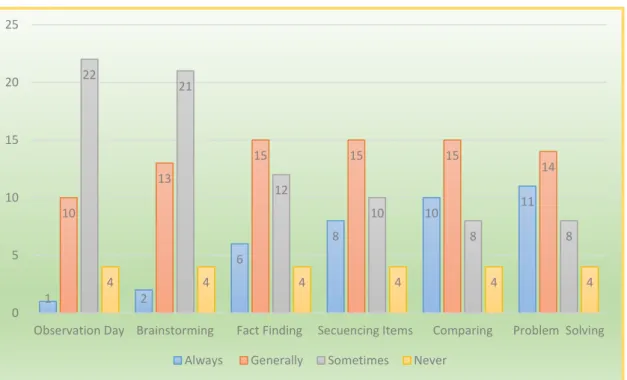
(34) 3.5. TECHNIQUES AND DATA COLLETING INTRUMENTS The major focus of this study is to investigate the effectiveness of Task-Based Learning Method on the development of learners’ speaking skill.. This study aims to address the following research questions: Research Questions What are the students’ perceptions of using Task-Based Learning in English classes at Unidad Educativa ―Tomas B. Oleas‖? Does Task-Based Learning method help to improve students´ English speaking skill? How much did the students improve their speaking skill since the use of TaskBased Learning?. This study was conducted with one group of students which belong to 3 er año de bachillerato Class ―A‖ at Unidad Educativa ―Tomas B. Oleas‖. Who were applied Task-Based Learning Method activities for improving their speaking skill to. They had two English classes of two hours per week based on Task-Based Learning Method with task-based activities created by the researcher. (See apx. 1).. The quantitative data of this study was gathered through observation guides, which taste the students´ speaking level, The parameters were establish according to the frequency that students use language for communicate during the English classes and according to the establish indicators made in the operationalization of variables. The next chart summarizes it.. 23.
(35) TABLE N° 2: Guide chart under which students were graded. SCALE FOR GRADING STUDENTS´. INDICATORS UNDER GRADED PERFORMANCE. PERFORMANCE. WHICH STUDENTS WERE GRADED Share their likes with their classmates.. Always. Use language for expressing their needs.. Generally. Students´ oral performance during. Let others know about their. the applied activities.. preferences. Express freely their feelings.. Sometimes. Use language spontaneously.. Never. Keep fluently conversation.. Done by: Geovanny Daga R. The investigator used observation guides in each class in order to collect all the possible data that let him know about the effectiveness of Task-Based Learning Method for improving students´ English speaking skill. The study was divided in parts, a pre-designed activity took place in two classes. The class one and two were designed for observation the students´ performance in English classes, the classes three and four, the investigator applied brainstorming activity, the classes five and six, the investigator applied fact finding activity, the classes seven and eight, the investigator applied sequencing items activity, the classes nine and ten, the investigator applied comparing activity, the classes eleven and twelve, the investigator applied problem solving activity. The analysis of the data was developed for each indicator. Into this indicator is analyzed each applied activity, and in the same way, the author analyzed the students´ perceptions about Task-Based Learning Method, and the designed activities for improving their speaking skill. As six indicators were developed, each of them have an analytical chart, at the end the author makes a comparison between two charts about the students’ performance before applying Task-Based Learning Method for improving students´ speaking skill and after applying it, showing how much useful Task-Based Learning Method is for developing English speaking skill.. 24.
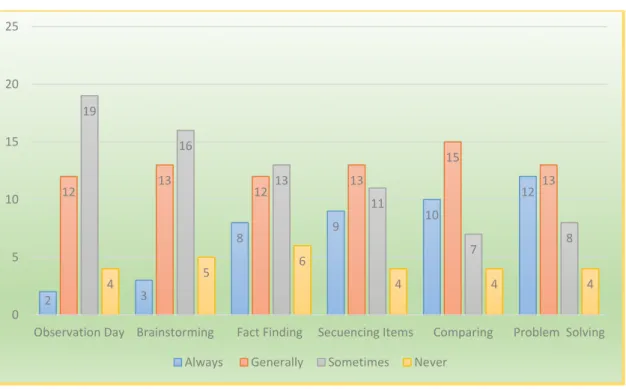
(36) 3.6. TECHNIQUES FOR PROCESSING AND INTERPRETATING DATA Review the collected information, to develop this analysis the following techniques will be used: Classification and recording of data by instruments used through analytical technique. Hypothesis testing, analysis of result and Get conclusions of the research.. 25.
(37) CHAPTER IV. 4. - DATA ANALYSIS CHARTS OF ANALYSIS AND INTERPRETATION OF VARIABLES´ INDICATORS 4.1. – SHARE THEIR LIKES WITH THEIR CLASSMATES. TABLE N° 3: Share their likes with their classmates. Observation Day. Brainstorming. Fact. Sequencing. Finding. Items. Comparing. Problem Solving. 1. 2. 6. 8. 10. 11. Generally. 10. 13. 15. 15. 15. 14. Sometimes. 22. 21. 12. 10. 8. 8. 4. 4. 4. 4. 4. 4. Always. Never. Source: Observation guides Done by: Geovanny Daga R. Graphic N° 1: Share their likes with their classmates. 25. 22. 20. 21. 15 15 13. 15. 15. 14. 12. 10 10. 10 8. 5. 11. 10 8. 8. 6 4 1. 4. 4. 4. 4. 4. 2. 0 Observation Day Brainstorming Always. Fact Finding Generally. Source: Table N° 3 Done by: Geovanny Daga R. Analysis: 26. Secuencing Items Sometimes. Comparing Never. Problem Solving.
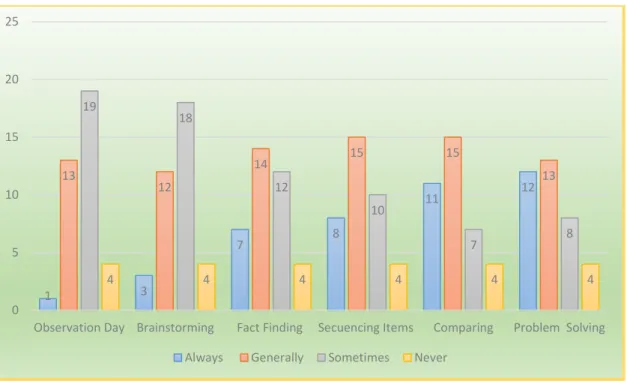
(38) Graphic 1 shows how the students’ perception increases as soon as Task-Based Learning Method and its activities are applied in English classes. As the graphic shows the difference among the students who shared their likes with their classmates grow gradually. The most important aspects to consider in this graphic are the increases of students who marked ―always‖, and the decrease of students who marked ―sometimes‖, besides it is important to point out that ―generally‖ and ―never‖ keep the same tendency. The implemented activities help students to share their likes with their classmates in a good way.. Interpretation: The results support in a good way the formulated hypotheses, showing in that way that Task-Based Learning Method develop students´ speaking skill. Thought the interpretation of these results it is very important point out some factors that could affected the normal development of the students and the results of this project. Factors such as: students´ grammar ability, students reading ability, and students listening ability. Besides, the result of this project is a little similar as the others mentioned at the beginning. The length of time that they were applied is principal reason by which results vary.. 27.
(39) 4.2. – USE THE LANGUAGE FOR EXPRESSING THEIR NEEDS. TABLE N° 4: Use the language for expressing their needs. Observation Day. Brainstorming. Fact Finding. Sequencing. Problem. Comparing. Items. Solving. 1. 3. 5. 9. 11. 11. Generally. 14. 12. 15. 15. 15. 14. Sometimes. 18. 17. 12. 9. 7. 8. 4. 5. 5. 4. 4. 4. Always. Never. Source: Observation guides Done by: Geovanny Daga R. Graphic N° 2: Use the language for expressing their needs. 25. 20 19 15. 16 13. 12. 10. 15 12. 13. 13 11. 4 2. 5. 8. 7. 6 4. 3. 13. 10. 9. 8 5. 12. 4. 4. 0 Observation Day Brainstorming Always. Fact Finding Generally. Secuencing Items Sometimes. Comparing. Problem Solving. Never. Source: Table N° 5 Done by: Geovanny Daga R. Analysis: Graphic 2 shows the increase of use of the language for expressing their needs, as you know many students are shy, it does not let them use language for communicate and their needs could be ignored. The use of Task-Based Learning Method and its activities evidence as the last graphic the increase of students who ―always‖ use the language for expressing their needs, and the decrease of students who ―sometimes‖. 28.
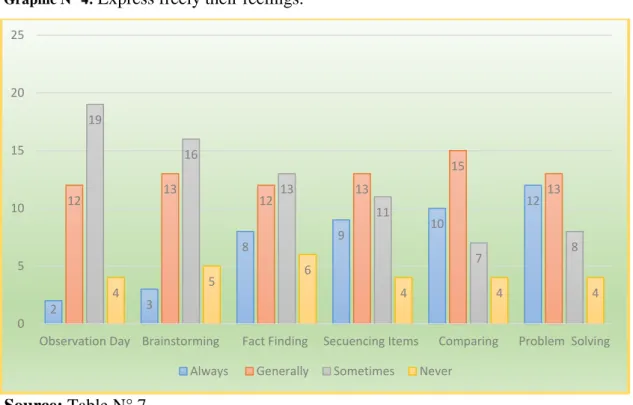
(40) used language for expressing their needs, and finally the tendency between ―generally‖ and ―never‖ keep. Finally, Task-Based Learning Method helps students to use language for expressing their needs.. Interpretation: The results support in a good way the formulated hypotheses, showing in that way that Task-Based Learning Method develop students´ speaking skill. Thought the interpretation of these results it is very important point out some factors that could affected the normal development of the students and the results of this project. Factors such as: students´ grammar ability, students reading ability, and students listening ability. Besides, the result of this project is a little similar as the others mentioned at the beginning. The length of time that they were applied is principal reason by which results vary.. 29.
(41) 4.3. – LET OTHERS KNOW ABOUT THEIR PREFERENCES. TABLE N° 5: Let others know about their preferences. Observation. Brainstorming. Day. Sequencing. Fact Finding. Problem. Comparing. Items. Solving. 1. 3. 7. 8. 11. 12. Generally. 13. 12. 14. 15. 15. 13. Sometimes. 19. 18. 12. 10. 7. 8. 4. 4. 4. 4. 4. 4. Always. Never. Source: Observation guides Done by: Geovanny Daga R. Graphic N° 3: Let others know about their preferences. 25. 20 19. 18. 15 15. 14. 13. 12. 10. 15. 12. 11. 10 8. 7. 5 4 1. 3. 4. 4. 12. 8. 7 4. 13. 4. 4. 0 Observation Day Brainstorming Always. Fact Finding Generally. Secuencing Items Sometimes. Comparing. Problem Solving. Never. Source: Table N° 6 Done by: Geovanny Daga R. Analysis: Graphic 3 shows how through the use of Task-Based Language Method students gain more confidence to use language, so in that way students let their partners know about their preferences, and they give them chance to exchange ideas about their preferences and likes. The important aspects to analyse in this graphic are the increases of the first indicator ―always‖ which growth gradually as in the other cases. In the same way students who. 30.
(42) mark ―sometimes‖ decreases due to the increase of the ―always‖ and ―generally‖ indicators. The implemented activities help students to let others know about their preferences while communication takes place.. Interpretation: The results support in a good way the formulated hypotheses, showing in that way that Task-Based Learning Method develop students´ speaking skill. Thought the interpretation of these results it is very important point out some factors that could affected the normal development of the students and the results of this project. Factors such as: students´ grammar ability, students reading ability, and students listening ability. Besides, the result of this project is a little similar as the others mentioned at the beginning. The length of time that they were applied is principal reason by which results vary.. 31.
(43) 4.4. – EXPRESS FREELY THEIR FEELINGS. TABLE N° 6: Express freely their feelings. Observation. Brainstorming. Day. Sequencing. Fact Finding. Problem. Comparing. Items. Solving. 2. 3. 8. 9. 10. 12. Generally. 12. 13. 12. 13. 15. 13. Sometimes. 19. 16. 13. 11. 7. 8. 4. 5. 6. 4. 4. 4. Always. Never. Source: Observation guides Done by: Geovanny Daga R. Graphic N° 4: Express. freely their feelings.. 25. 20 19 15. 16 13. 12. 10. 15 12. 13. 13. 4 2. 5. 13. 10. 9. 8 5. 12. 11. 8. 7. 6 4. 3. 4. 4. 0 Observation Day Brainstorming Always. Fact Finding Generally. Secuencing Items Sometimes. Comparing. Problem Solving. Never. Source: Table N° 7 Done by: Geovanny Daga R. Analysis: Graphic 4 shows how through the use of Task-Based Learning Method students´ feelings and emotions are more common in classes. There are not too difference among the last graphics in which the indicator pointed out as ―always‖ increases considerably, and the indicator pointed out as ―sometimes‖ decreases in the same way. Finally, indicators as ―generally‖ and ―never‖ keep the same tendency.. 32.
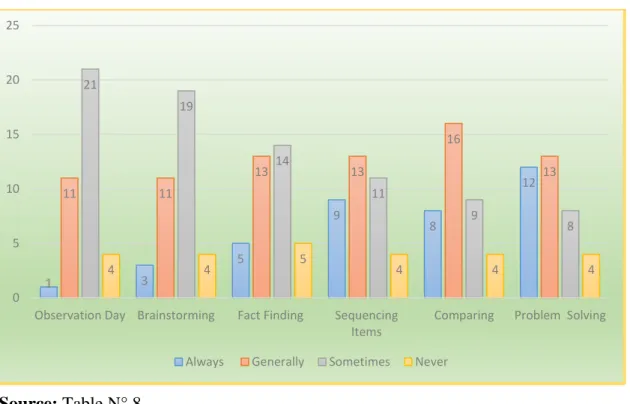
(44) The implemented activities help students to express their feelings freely during the English classes.. Interpretation: The results support in a good way the formulated hypotheses, showing in that way that Task-Based Learning Method develop students´ speaking skill. Thought the interpretation of these results it is very important point out some factors that could affected the normal development of the students and the results of this project. Factors such as: students´ grammar ability, students reading ability, and students listening ability. Besides, the result of this project is a little similar as the others mentioned at the beginning. The length of time that they were applied is principal reason by which results vary.. 33.
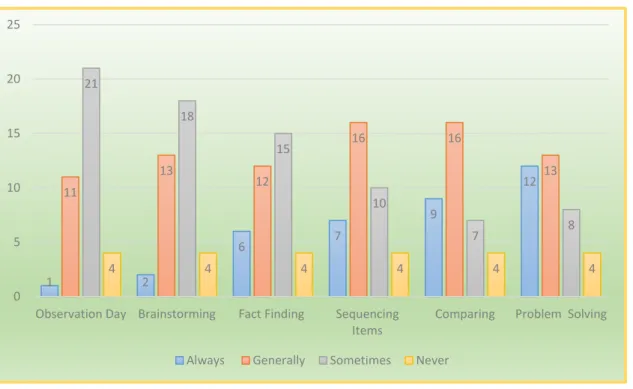
(45) 4.5. - USE LANGUAGE SPONTANEOUSLY. TABLE N° 7: Use language spontaneously. Observation. Brainstorming. Day. Sequencing. Fact Finding. Problem. Comparing. Items. Solving. 1. 2. 6. 7. 9. 12. Generally. 11. 13. 12. 16. 16. 13. Sometimes. 21. 18. 15. 10. 7. 8. 4. 4. 4. 4. 4. 4. Always. Never. Source: Observation guides Done by: Geovanny Daga R. Graphic N° 5: Use language spontaneously. 25. 20. 21 18. 15. 16. 15 13 10. 12. 11. 12 10. 5 4. 4. 9. 7. 6 1. 16. 4. 8. 7 4. 13. 4. 4. 2. 0 Observation Day Brainstorming Always. Fact Finding Generally. Sequencing Items Sometimes. Comparing. Problem Solving. Never. Source: Table N° 8 Done by: Geovanny Daga R. Analysis: Graphic 5 shows how students increase their speaking skill and the use of language spontaneously through the use of Task-Based Language Method. The indicator pointed out as ―always‖ shows growth from the first day until the last day, in the same way the indicator pointed out as ―sometimes‖ decreases significantly, while the indicators ―generally‖ and ―never‖ keep constantly.. 34.
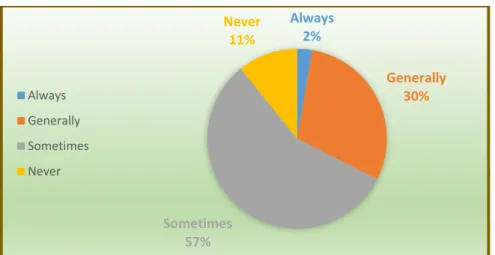
(46) The implemented activities help students use language spontaneously for communicating with other classmates.. Interpretation: The results support in a good way the formulated hypotheses, showing in that way that Task-Based Learning Method develop students´ speaking skill. Thought the interpretation of these results it is very important point out some factors that could affected the normal development of the students and the results of this project. Factors such as: students´ grammar ability, students reading ability, and students listening ability. Besides, the result of this project is a little similar as the others mentioned at the beginning. The length of time that they were applied is principal reason by which results vary.. 35.
(47) 4.6. – KEEP CONVERSATION FLUENTLY. TABLE N° 8: Keep conversation fluently. Observation. Brainstorming. Day. Sequencing. Fact Finding. Problem. Comparing. Items. Solving. 1. 3. 5. 9. 8. 12. Generally. 11. 11. 13. 13. 16. 13. Sometimes. 21. 19. 14. 11. 9. 8. 4. 4. 5. 4. 4. 4. Always. Never. Source: Observation guides Done by: Geovanny Daga R. Graphic N° 6:. Keep conversation fluently.. 25. 20. 21 19. 15. 16 13. 10. 11. 14. 13. 11. 12. 11 9. 8. 9. 13. 8. 5 4 1. 3. 4. 5. 5. 4. 4. 4. 0 Observation Day Brainstorming Always. Fact Finding Generally. Sequencing Items Sometimes. Comparing. Problem Solving. Never. Source: Table N° 8 Done by: Geovanny Daga R. Analysis: Graphic 6 shows how fluently are students at the moment of use language for shared their like with others, let others know about their preferences, express freely their feeling, use language for expressing their needs. This graphic shows the same performance as the others, the indicators pointed out as ―always‖ and ―sometimes‖ vary from the first day to the last day, the first one increases and the second one. 36.
(48) decreases. The other indicators pointed out as ―generally‖ and ―never‖ keep constantly. The implemented activities help students use language spontaneously for communicating with other classmates.. Interpretation: The results support in a good way the formulated hypotheses, showing in that way that Task-Based Learning Method develop students´ speaking skill. Thought the interpretation of these results it is very important point out some factors that could affected the normal development of the students and the results of this project. Factors such as: students´ grammar ability, students reading ability, and students listening ability. Besides, the result of this project is a little similar as the others mentioned at the beginning. The length of time that they were applied is principal reason by which results vary.. 37.
(49) 4.7. - HYPOTHESES TEST COMPARATIVE GRAPHIC BEFORE APPLYING TASK BASED LEARNING METHOD AND AFTER APPLICATIO TABLE N° 9: Before applying Task-Based Learning Method. TABLE N° 10: After applying Task-Based Learning Method. Observation Days. Task-Based Learning Method. 1. Always. 7. Always. Generally. 11. Generally. 14. Sometimes. 21. Sometimes. 12. Source: Observation guides Done by: Geovanny Daga R.. Source: Observation guides Done by: Geovanny Daga R.. Graphic N° 8: Task-Based Learning Method. Graphic N° 7: Observation days Never 11%. Never 11%. Always 2% Generally 30%. Always. 4. Never. 4. Never. Always. Generally. Generally. Sometimes. Sometimes. Never. Never. Sometimes 32%. Generally 38%. Sometimes 57%. Source: Table N° 9 Done by: Geovanny Daga R.. Always 19%. 38. Source: Table N° 10 Done by: Geovanny Daga R..
(50) Analysis: These final two chars show a comparison between the results of the first class and the last class when Task-Based Learning Method for improving students´ English speaking skill was applied. This is a summary about the helpfulness of the method and activities applied to the students of 3 er año de bachillerato Class ―A‖ at Unidad Educativa ―Tomas B. Oleas‖ in the development of their English speaking skill. The indicator always has increased gradually class by class, reaching from 2% until 19%. Showing the increase of students who always participate orally in classes in the different activities. It means at the beginning of the application of this project just one student was participating orally in English classes, at the end of the application of this project seven students were participating orally in English classes. The indicator generally shows a growth from 30% until 38%, in the same way this growth was carried out class by class. It seems does not have considerable growth, however it is the most important because some students keep their level of oral participation and others increases from sometimes to generally. It means, at the beginning of this project eleven students generally were participating orally in English classes, and at the end of the application of this project fourteen students were participating orally in English classes. The indicator sometimes shows a decrease from 57% until 32%, in the same way class by class. Even it decreases it is positive because this project have reduced the quantity of students who sometimes participate orally in English classes. It means at the beginning of the application of this project twenty one students were participating orally into the indicator sometimes, and at the end of the application of this project twelve students were participating orally into the indicator sometimes, the rest of them reached generally and always indicator. The indicator never keeps a constantly level. It refers to the students who are not interested about learning English, so Task-Based Learning Method and activities applied for improving their English speaking skill does not work with them.. 39.
(51) Interpretation: The results support in a good way the formulated hypotheses, showing in that way that Task-Based Learning Method develop students´ speaking skill. Thought the interpretation of these results it is very important point out some factors that could affected the normal development of the students and the results of this project. Factors such as: students´ grammar ability, students reading ability, and students listening ability. Besides, the result of this project is a little similar as the others mentioned at the beginning. The length of time that they were applied is principal reason by which results vary.. 40.
(52) CHAPTER V 5.1 – CONCLUSIONS. Based on the results of this study, the following conclusions were stablished: This study presents evidence about the good perceptions that students had when Task-Based Learning Method where applied, the applied activities can increase students´ attitudes learning to speak by taking risks when they have chances to talk in English. Task-Based Learning Method shows evidence that helps students to improve their English speaking skill quickly and in a good way, when it is applied with predesigned activities that bear in mind students´ needs, likes, wants and preferences. Task-Based Learning Method has improved students´ English speaking skill in the 20 % from the first time the author uses it in the class.. 41.
(53) 5.2. - SUGGESTIONS. Based on the results of this study, the following conclusions were established:. . Further time is needed for the implementation of Task-Based Learning Method in order to increase the students´ attitude toward Task-Based Learning Method and improve their speaking skill.. . Further research is needed to explore how Task-Based Learning Method can be adaptable to take account of individual students’ differences.. . Task-Based Learning Method could be applied in any class in which teacher is interested to increase students speaking skill.. 42.
(54) CHAPTER VI. 6. - ADMINISTRATIVE FRAMEWORK. 6.1. HUMAN RESOURCE Student researcher Students of the institution Teacher of the institution. 6.2. MATERIAS Surveys Worksheets Didactic Material Ringing Pasted. 6.3. TECHNOLOGICAL RESOURCE Audio-visual equipment Devices Computer Internet Digital camera. 43.
(55) 6.4. ESTIMATION OF COSTS. 6.4.1. INCOME. This work will not get income for the author, however this work will let the author get his degree as an English teacher.. 6.4.2. EXPENSES The author has invested the following materials:. TABLE N°11: Estimation of costs DETAIL. VALUE. Internet. 70.00. Projector. 20.00. Binding. 15.00. Transport. 100.00. Printed Materials. 50.00. Photocopies. 80.00. Others. 50.00. TOTAL. 415.00. Source: Geovanny Daga R. Done by: Geovanny Daga R.. 44.
(56) BIBLIOGRAPHY. American Heritage®. (2015, Marzo 11). Heritage Dictionary . Retrieved from Dictionary of the English Language: http://www.thefreedictionary.com/activity Brown, H. D. (2001). Teaching by Principles: An interactive Aproach to Language Pedagogy. Pearson-Longman. Egan, K. B. (1999). Speaking: A Critical Skill. Federal Language Learning Laboratory, 16(3), 277-293. Florez, M. C. (1999, June). CAELA. Retrieved from National Center for ESL Literacy Education: http://www.cal.org/caela/esl_resources/digests/Speak.html Izadpanah, S. (2010, Marzo). A study on Task-based Language Teaching: From theory to practice. US-China Foreign Language, 8(3), 47-56. Kasap, B. (2005, Julio ). The effectivennes of Task-Based Learning instruction in the improvement o learner´s speaking skills. Monica Rodriguez-Bonces, J. R.-B. (2010, Octubre). Task-Based Language Learning: Old Approach, New Style. A New Lesson to Learn. Profile Issues in Teachers´ Professional Development, 12(2), 165-178. NCLRC. (2003, 2004). THE ESSENTIALS OF LANGUAGE TEACHING National Capital Language Resource Center. Retrieved Marzo 3, 2015, from National Capital Language Resource Center: http://www.nclrc.org/essentials/speaking/stratspeak.htm. 45.
(57) Nunan, D. (1991). LANGUAGE TEACHING METHODOLOGY. Sydney: Prentice Hall. Nunan, D. (2003). Practical English Language Teaching, First Edition. New York: McGraw - Hill. Nunan, D. (2004). Task-based Language Teaching. Cambridge: Cambridge University Press. Philip Curran, S. D. (2000). Methodology in Language Learning T-kid. Strasbourg : Council of Europe publishing. Richards, J. C. (2008). Teaching Listening and Speaking. New York : Cambridge University Press. Sánchez, A. (2004). The Task-based Approach in Language Taeching. International Journal of English Studies, 4, 39-71. Torky, S. A. (2006). The Effectiveness of a Task- Based in Developing the English Language Speaking Skills of Secondary Stage Students. Thesis doctoral. Cairo: Ain Shams University. Torres C., M. (2010). Task-Based Learning. In M. Torres C., Basic Methodology for Teaching English (pp. 76-83). Riobamba, Ecuador: Rio Impresiones. Willis, J. (1996). A Framework for Task-Based Learning. Palatino: LONGMAN.. 46.
(58) APPENDICES. APPENDIX A. Task-Based Learning Method activities. APPENDIX B. Observation Guides. 47.
(59) GEOVANNY DAGA Mgs. MARÍA VALLEJO, Tutor. TASK-BASED LEARNING METHOD ACTIVITIES Author: Geovanny Daga Task-Based Learning Method handbook activities. INTRODUCTION Task-Based Learning Method has a great variety of activities that offer students get a meaningful learning from real exposure, tasks similar to real life into and outside of classroom, providing them richer experiences to acquire English as second language In this handbook activity there is a compilation of the most common activities which are typical in an English class. This article analyzes the criteria of each one; explain the each step when they are going to be applied. Besides, how to integrate with task based learning method and with different skills. Finally, the author gives some suggestions to the process, evaluation and points to bear in mind and a detailed process when you are going to apply these activities.. ix.
(60) TECHNIQUE: 1. - LISTING It is a creative activity in which students are geared to generate new ideas, in order to solve a problem or find a solution. Besides, students tend to generate a lot of talk when they explain their ideas. Activity: a) Brainstorming It is a group or individual activity. Brainstorming is a tool that uses a relaxed, informal atmosphere combined with lateral thinking, in which students make their best effort to find a conclusion for a specified problem by gathering information or a list of ideas spontaneously produced by the students in the classroom to solve problems. In spite of its importance in the generation of new ideas, many students do not have enough training to use it. This activity will teach students to brainstorm effectively. No materials are required apart from a pen or pencil and sheets of paper. Process: Pre teaching . Elicit from students different ways to generate new ideas.. . Tell the students that they are going to try an activity called brainstorming to generate ideas.. . Divide the class into two groups.. . Assign one student in each group to be a leader. Give the group leaders the following tips:. First group leader: Encourage other students to contribute ideas on how to improve this English class. But, you do not want to waste any time. If a student states an idea which seems useless, tell the student ―That’s no good‖ or ―Bad idea‖, then move on to another student.. x.
(61) Second group leader: Encourage the other students to contribute ideas on how to improve this English class. Ask one student in the group to write down all ideas. Praise students’ contributions and don’t criticize any of the ideas. Make sure all ideas are accepted and written down.. While teaching Give students ten minutes to do the brainstorming activity. Get feedback from students about the brainstorming. Ask which group produced more ideas and which group enjoyed the activity more. Group leaders read out their slips of paper. Students guess which group is brainstorming the right way. Write these rules of successful brainstorming on the board: . All ideas are accepted and written down.. . Generate as many ideas as possible.. . Unusual, even seemingly irrelevant ideas are welcome. . You may use other students’ idea and expand on it. . Criticism is banned at this stage.. Using these rules students brainstorm other topics. When they finish, groups choose their three best ideas and write them up on the board.. Post teaching Students write a summary about the topic they brainstormed.. xi.
(62) Activity: b) Fact-finding This is an activity in which learners find things out by asking each other or other people and referring to books, etc. Fact finding is an activity in which learners are involved to the process of collecting data and information by asking each other or other people and referring to books, based on techniques which contain sampling of existing documents, research, observation, questionnaires, interviews, prototyping and joint requirements planning. Generally students look for information and facts, they collect all of these and finally they report to the whole class their findings and conclusions. PROCESS: Pre teaching Let students know what fact-finding activity consist on. Establish the topic: Students who live out of the city. Set the rules under which students must develop their fact-finding activity. While teaching Ask students work out in the questions they will need to gather the required information. Students walk around the class gathering the information they need. Students tabulate the information they gathered. Students prepare their findings and their conclusions. Post teaching Students report their findings and conclusions in front of the class. 2. - ORDERING AND SORTING This is a technique in which students develop their creative skills by letting them generate new ideas to complete, accommodate and finish a story or report. Activity: a) Sequencing items. xii.
(63) This activity involves the ability to understand and talk about a story as an ordered series or events in a logical or chronological order. Process Pre teaching Tell students that they will learn about the beginning, middle, and end of a story. Ask students ―what do you think about little John story?‖ Give them at least two sentences for the beginning, two for the middle and two for the final. Let them analyse the relationship among the sentences. While teaching Ask students think about possible sentences that give more details for the story Complete the story asking students ―what happened after the beginning of the story‖? For a better guide draw a table like this: Beginning. Middle. End. Little John was born in. He felt lost in the forest.. Finally, he came back. USA.. home.. Ask students to continue generating ideas and sentences as many as possible in order to build a long and fantastic story. Using connection words join the sentences in order to give sense to the story. Post teaching Each student has to present his/ her story and read aloud in the front of the class. Stablish conclusion by which they created the story in that way.. xiii.
(64) b) Ranking This is an activity in which students have to sort the items according to personal values or specific criteria. Process Pre teaching Tell students they are going rank a list of words Stick on the board the list of words that students are going to rank. Ask students if the words on the board are familiar for them, if not explain them the meaning of the unknown words. Explain the students under which criteria they have to classify the words that are on the board. Make an example about the activity they develop. While teaching Students classify the words according established criteria. Teacher monitor the students´ work and offering help those who need. Discuss with students why they are classifying in that way. Post teaching Students report their work and explain the way they did.. xiv.
Figure

+6

Documento similar
Studies of the adoption of usability activities in the OSS development context have not addressed visual brainstorming (VB) as a usability method in the OSS context
The inductive method based on the notion of complexity built in the latter references, together with the fact that U (G) admits a faithful Sylvester matrix
For doing it, we use a new version of the TANGOW (Task-based Adaptive learNer Guidance On the Web) system that allows us to include and adapt collaborative activities in
intellectual disabilities in sports activities. Interviews were personalized based on their role of the swimming activity. For example, the questions toward the swimming
A new method was developed to position the tool in a micromachine system based on a camera-LCD screen positioning system that also provided information on the angular deviations of
Another notable work in the identification of Academic Rising Stars using machine learning came in Scientometric Indicators and Machine Learning-Based Models for Predict- ing
classON 3 (in-Class Live Analytics for aSSessment and orchestratiON) is a system aimed at supporting teachers in face-to-face activities in the computer lab. Based on learning
• Enables the scheduler to change the order (but not execute concurrently) the tasks within the inout chains built by the concurrent clause. • Dependences resulting form the
