
Spatially Resolved Spectroscopy of Submillimeter Galaxies at z ≃ 2
14
0
0
Texto completo
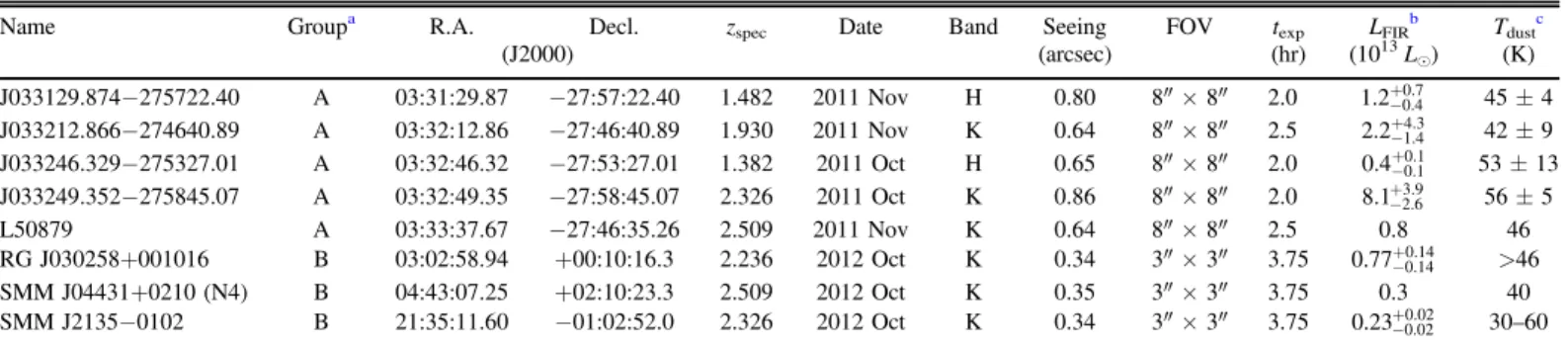
(2) The Astrophysical Journal, 827:57 (14pp), 2016 August 10. Olivares et al.. Simpson et al. 2014). This clearly points to a rapid evolution in the most extreme IR-luminous galaxies, which has been parameterized as (1+z)α with a 3.5 for the total energy output attributed to these systems out to z∼1 (Le Floc’h et al. 2005). Hence, while they are relatively unimportant in the local universe, (U)LIRGs can account for up to ∼50% of the total star formation density by z ~ 2 (e.g., Murphy et al. 2011; Casey et al. 2012; Gruppioni et al. 2013). The nature of the large energy output in SMGs is now commonly assumed to be associated with their vigorous star formation activity. Nuclear activity is also expected to provide a contribution to the energy emission in a fraction of the systems. Early studies (e.g., Alexander et al. 2005) claimed that a very high fraction, ∼75% of the radio-selected spectroscopically identified SMGs, can be associated with active galactic nuclei (AGNs). In contrast, a lower AGN fraction, ∼15%–30%, was reported for the general SMG population (Laird et al. 2010; Johnson et al. 2013; Wang et al. 2013), the vast majority of them subject to heavy obscuration (Bauer et al. 2010). A strong connection between AGN activity and strong starburst episodes has been proposed based onbothobservations (Sanders et al. 1988) and theory (Hopkins et al. 2008), in which these events are triggered by the major merger of gas-rich galaxies. Spatially resolved observations of SMGs using the Hubble Space Telescope (HST) have not been conclusive in this regard (Swinbank et al. 2010; Chen et al. 2015), finding that SMGs at z=0.7–3.4 are in general compact with spheroid/elliptical light profiles. Similarly, recent Atacama Large Millimeter Array (ALMA) observations (e.g., Simpson et al. 2015b) have also found that brighter SMGs are compact, ∼0 2, in the submillimeter as well. Integral Field Unit (IFU) spectrographs, in particular those assisted by adaptive optics (AO), have been critical in studying the morphologies and kinematics of SMGs at high spatial resolutions. The first comparison of the dynamical properties from Spectrograph for Integral Field Observations in the Near Infrared (SINFONI) installed at the Very Large Telescope (VLT) by Bouché et al. (2007) showed that bright SMGs have larger velocity widths and are much more compact than the UV- and optically selected z ~ 2 star-forming galaxies; they also have lower angular momenta and higher matter densities. This indicates that dissipative major mergers may dominate the SMG population. Early studies in the near-IR by Swinbank et al. (2006) of sixhigh-redshift SMGs show that they consist of more than one subcomponent with significant velocity offsets. Similar results were found by Alaghband-Zadeh et al. (2012) for eight SMGs, who interpreted them as evidence that SMGs are systems in the early stages of major mergers. More recently, Menéndez-Delmestre et al. (2013) found evidence for the presence of a compact region characterized by broad Hα emission thatcan be associated with an AGN together with clumps of narrow Hα emission due to star formation processes. At the same time, they do not see evidence for ordered motions, hence consistent with a connection between SMGs and galaxy mergers. Harrison et al. (2012) observed eight ULIRGs that host AGN activity and SMGs at high redshift with IFU, concluding that the AGN activity could be the dominant power source for driving all of the observed outflows, although star formation may also play a significant role in some of the sources. Unfortunately, given the relatively low spatial densities of SMGs and the required exposure times using 8 m. telescopes and state-of-the-art instrumentation, only relatively small samples of galaxies have been studied so far. In this paper, we present observations of eight SMGs between z=1.4 and 2.5 using the SINFONI near-IR IFU at the European Southern Observatory (ESO) VLT. The main goal of this work is to study the morphology and kinematics of the starforming regions in high-redshift SMGs using the Hα line as a tracer. In Section 2 we present the properties of the sample studied, the observations, data reduction,and analysis. The results of these observations are presented in Section 3, while the discussion and conclusions are presented in Sections 4 and 5, respectively. We assume a ΛCDM cosmology with h0=0.7, Ωm=0.27, and ΩΛ=0.73 (Hinshaw et al. 2009). 2. VLT/SINFONI NEAR-IR IFU OBSERVATIONS 2.1. Sample As described in the previous section, only relatively small samples of targeted SMGs at high-z have been studied so far using IFU spectroscopy. This paper focuses on follow-up IFU observations for eight z > 1 ULIRGs selected based on two different and complementary criteria. Hence, it will be possible to study how these selections are related to the properties of the observed sources. The basic properties of the sources studied in this work are presented in Table 1. We categorize our sources into two groups:Group A focuses on warm-dust ULIRGs, while in Group B we include only SMGs with a suitable reference star for the AO corrections to have high spatial resolution for kinematic measurements. 2.1.1. Group A—250 μm Selected. Group A consists of several warm-dust star-forming ULIRGs at z∼1–2. While SMGs are proposed to contribute to as much as half of the star formation density at early epochs (Gruppioni et al. 2013), SMG observations at 850 μm naturally select colder-dust ULIRGs with Td<45 K and thus potentially miss a whole subpopulation of high-z ULIRGs by virtue of their warmer dust temperatures. Recent work by Casey et al. (2009, 2011) shows that there is a population of ULIRGs that are fainter at 850μm and have higher dust temperatures, Td;50 K (e.g., Blain et al. 2004; Chapman et al. 2004). These so-called warm-dust ULIRGs may contribute significantly to the cosmic SFR density at its peak, similar to the SMG contribution. However, the warmer dust temperatures implied by the absence of 850 μm flux suggests that they might have inherently different evolutionary origins compared to the wellstudied cold-dust SMGs. It is possible that these higher temperatures are due to the effects of AGN heating. We have assembled a sample of warm-dust star-forming ULIRGs from spectroscopic samples of 250μm-selected BLAST galaxies from the observations described by Casey et al. (2011). All of them have existing redshift measurements from long-slit spectroscopy. In four of the five galaxies (J033246, J033249, J033129, and J033212) the redshift was determined based on the detection of the Hα emission line, while for L50879 the Lyα line was detected and identified. J033246 was first identified in spectroscopic surveys by Kriek et al. (2008) and Vanzella et al. (2008). It was later classified as a star-forming radio galaxy based on a significant submillimeter detection by Weißet al. (2009). The galaxy has a redshift of z=1.382, as indicated by the detection of an emission line using VLT/ISAAC identified as Hα by Casey 2.
(3) The Astrophysical Journal, 827:57 (14pp), 2016 August 10. Olivares et al. Table 1 Sample Properties. Name J033129.874−275722.40 J033212.866−274640.89 J033246.329−275327.01 J033249.352−275845.07 L50879 RGJ030258+001016 SMMJ04431+0210 (N4) SMMJ2135−0102. Groupa. R.A.. A A A A A B B B. 03:31:29.87 03:32:12.86 03:32:46.32 03:32:49.35 03:33:37.67 03:02:58.94 04:43:07.25 21:35:11.60. Decl.. zspec. Date. Band. Seeing (arcsec). FOV. texp (hr). LFIRb (1013 Le). Tdustc (K). −27:57:22.40 −27:46:40.89 −27:53:27.01 −27:58:45.07 −27:46:35.26 +00:10:16.3 +02:10:23.3 −01:02:52.0. 1.482 1.930 1.382 2.326 2.509 2.236 2.509 2.326. 2011 Nov 2011 Nov 2011 Oct 2011 Oct 2011 Nov 2012 Oct 2012 Oct 2012 Oct. H K H K K K K K. 0.80 0.64 0.65 0.86 0.64 0.34 0.35 0.34. 8″×8″ 8″×8″ 8″×8″ 8″×8″ 8″×8″ 3″×3″ 3″×3″ 3″×3″. 2.0 2.5 2.0 2.0 2.5 3.75 3.75 3.75. +0.7 1.20.4 +4.3 2.21.4 +0.1 0.40.1 +3.9 8.12.6 0.8 +0.14 0.770.14 0.3 +0.02 0.230.02. 45±4 42±9 53±13 56±5 46 >46 40 30–60. (J2000). Notes. a Group A corresponds to no-AO observations of warm-dust ULIRGs, while Group B consists ofAO observations focusing on SMGs. b FIR luminosity (8–1000 μm) of J033129, J033212, J033246,and J033249 from Casey et al. (2011), for RGJ0302+0010 from Swinbank et al. (2004), for SMMJ04331+0210 (N4) from Neri et al. (2003)—corrected for lensing magnification and obtained from 850 μm flux densities—and for SMM J2135–0120 from Ivison et al. (2010), also corrected for lensing magnification. c Tdust were obtained from Casey et al. (2011) for J033129, J033212, J033246, and J03329, for RGJ0302+0010 from Chapman et al. (2004), for SMM J04331+0210 (N4) from Neri et al. (2003), and for SMMJ2135–0120 from Ivison et al. (2010), with two components associated with the warm and cool dust.. et al. (2011). The measured rest-frame [N II]/Hα line flux ratio of 0.13 suggests that the emission in this galaxy is dominated by star formation activity. J033249 is a very similar source, also classified as a vigorous star-forming galaxy at z=2.326 (Casey et al. 2011). Two systems (J033212 and J033129) in our sample were not detected by our VLT/SINFONI observations and thus are not further discussed.. SMM J04431+0210 (N4)is an extremely red galaxy identified as the near-IR counterpart of the faint submillimeter source reported by Smail et al. (1999), which was undetected in deep optical images (Smail et al. 1998). It is located behind the z=0.18 cluster MS 0440+02, with an amplification factor for the background galaxy of μ=4.4 (Smail et al. 1999). A spectroscopic redshift of 2.5092±0.0008 was measured by Frayer et al. (2003) based on the detection of Hα, [N II]λλ6583,6548, and [O III]λ5007 emission lines using the NIRSPEC spectrograph at Keck. The rest-frame [N II]/Hα line flux ratio of 0.47±0.06 suggests that this emission can be explained by a narrow-line AGN/LINER nucleus surrounded by a resolved starburst. SMMJ2135−0102(also known as the “cosmic eyelash”) is a gas-rich starburst galaxy. The galaxy was identified in the field of the massive lensing cluster MACS J2135-010217 (zcl=0.325) via ground-based 870 μm imaging (Swinbank et al. 2010). They unambiguously identified the redshift of the source as z=2.3259±0.0001 thanks to the detection of carbon monoxide (CO) J=1−0 emission at 34.64 GHz and derive an amplification factor for the background galaxy of μ=32.5±4.5. Later, Swinbank et al. (2011) used the IRAM Plateau de Bure Interferometer and the EVLA to obtain maps of the CO(6–5) and CO(1–0) emission, finding that the molecular gas kinematics are well described by a rotationally supported disk with an inclination-corrected rotation speed vrot=320±25 km s−1, a ratio of rotational to dispersionsupport of v/Σ=3.5±0.2, and a dynamical mass of (6.0 ± 0.5)×1010 Me within a radius of 2.5 kpc. Follow-up submillimeter studies of both molecular and atomic transitions in this galaxy reported by Danielson et al. (2011) and Danielson et al. (2013) found evidence for a two-phase medium and physical properties such as interstellar mediumdensity and far-UV radiation fields similar to those observed in nearby ULIRGs and central regions of starburst galaxies.. 2.1.2. Group B—SMGs with Natural AO Observations. Sources in this group were selected roughly independently of the target physical properties. The main goal in this case is to achieve the highest possible spatial resolution for our kinematic measurements. Hence, the only SMG selection criteria were the availability of a suitable reference star for the AO corrections (which for VLT/SINFONI was an R<14 star closer than 30″), a measured spectroscopic redshift of z∼1.5 or z∼2.5, so that Hα would fall in either the H or K near-IR bands, and that the source is observable at high enough elevation by the VLT. This resulted in the selection of three sources for this group: SMM J2135−0102, RGJ0302+0010, and SMMJ04431 +0210 (N4). The mean redshift for these sources is z=2.189. SMMJ04431+0210 (N4) is one of the 15 original submillimeter sources found in the SCUBA Lens Survey (S850=7.2 mJy; Smail et al. 1997, 2002). SMMJ2135−0102 was identified by Swinbank et al. (2010) in anAPEX/ LABOCA 870 μm observation of the galaxy cluster MACS J2135-010217. The galaxy RG J0302+0010 was selected from the catalogs of SMGs of Chapman et al. (2004, 2005) andTakata et al. (2006). RGJ030258+001016was identified as a ULIRG by Chapman et al. (2004). Rest-frame UV spectroscopy shows strong [C IV] emission, whichtogether with a high [N II]/Hα suggests the presence of AGN activity and a redshift of 2.2404±0.0008 (Chapman et al. 2004; Swinbank et al. 2004). The [O III]λλ4959,5007 emission line doublet shows a narrow and redshifted broad component. This broad component is offset from the center by about 8 kpc and can be explained by an outflow with its nearside obscured by dust (Harrison et al. 2012).. 2.2. Observations and Data Reduction Near-IR IFU observations of the sample described above were performed using the SINFONI instrument (Eisenhauer et al. 2003), installed at the ESO VLT. These data were obtained as part of program 088.A-0452 in 2011 October and 3.
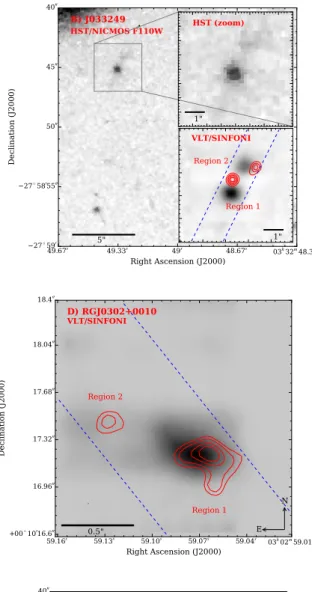
(4) The Astrophysical Journal, 827:57 (14pp), 2016 August 10. Olivares et al.. November for sample A and program 090.A-0464 observed from 2011 October to 2012 November for sample B. For the observations of the group A sources we used SINFONI in no-AO mode, with a 250 mas pixel scale and a field ofview (FOV) of 8″×8″. For Group B, sources were selected to have a suitable AO reference star, R<14 mag closer than 30″. Hence, observations were taken using the natural guide star AO mode, using the 100 mas pixel scale and a 3″×3″ FOV. Since the main goal of these observations was to map the Hα emission, we used either the H-band grating, which provides a wavelength coverage of 1.45–1.85 μm and a spectral resolution of 3000, or the K-band grating, with a spectral resolution of 4000 and wavelength coverage of 1.95–2.45 μm, depending on the redshift of the source. The K grating was used for all sources except for J033246. The total integration time per source ranged from 2 to 4 hr. Since each source occupied a small fraction of the FOV, the surrounding empty regions were used for skysubtraction, thus achieving a 100% on-source time. Each observation was broken into 1 hr observing blocks (OBs), which includes all overheads. For each OB, a corresponding telluric standard star was observed. The primary data reduction was performed using the ESO SINFONI pipeline version 2.5.2.12 This pipeline is organized as a set of six stand-alone recipes. The first step evaluates the detector linearity; this is produced by analyzing flat fields taken with increasing intensity in order to create a map of highly nonlinear bad pixels. Then, a master dark frame and a map of hot pixels are created from the median of a series of dark frames. Finally, flat-field frames with nearly constant intensity are combined to produce a master flat field and a third badpixels map (BPM). These three BPMs are then combined to produce a master BPM. The pipeline then computes the geometric distortions by placing a fiber at different positions on the detector. Each science frame is therefore corrected for dark current, bad pixels, andgeometric distortions and then flatfielded and wavelength-calibrated. We then performed sky estimation and subtraction, which is critical when dealing with faint sources, such as those in our sample, at near-IR wavelengths. Since our targets have relatively small spatial extents, the SINFONI FOV contains enough source-free area to provide a good sky estimation. The pipeline provides two methods to estimate and subtract the sky contribution. The first one, which computes the median of all images on a set as an estimation of the sky, is not very accurate, especially when the sky is not stable. The second method, which we chose for our data reduction, uses the closest frame in time as an estimation of the sky to be subtracted. All frames are then shifted and co-added. They contain both spectral and spatial informationand are therefore reconstructed to produce 3D cubes. The extraction of a 2D image from the data cube for each source was done by creating a pseudo-longslit using the QfitsView software13 and its ImRed analysis option. The size of the extraction aperture for each source is determined as a compromise between the maximum gathered flux and the minimum sky residual contribution. Then, the apall IRAF task was used to extract an integrated 1D spectrum for each source. Finally, additional sky correction, particularly useful to. eliminate residuals of sky emission lines, was carried out using the Skycorr package (Noll et al. 2014). Flux calibration and telluric corrections were performed using observations of standard stars closer than 2 hr in time and with a Dz < 1.2 in airmass. Specifically, we used the Fitting Utility for SINFONI (FUS) package developed by Dr. Krispian Lowe as part of his PhD thesis.14 In order to estimate the spatial resolution of our observations, for each target we fitted Gaussian profiles to the images of the corresponding standard stars. As presented in Table 1, the effective angular resolution for the non-AO targets ranges from 0 64 to 0 84, with a mean and median of 0.7 and 0.65, respectively (corresponding to ∼0.59and ∼0.55 kpc at z∼2). For the galaxies in Group B, which correspond to AO-assisted observations, these values are0 34 for mean and median (corresponding to ∼0.28 kpc at z∼2). We note that these estimates come from shorter exposures (∼10 s) of brighter sources than the science exposures and are therefore most likely lower limits to the spatial resolution in our targets. However, we expect this underestimation to be rather small, ∼0 1, and thus itdoes not affect any of our conclusions. 3. RESULTS With the SINFONI data described above, we were able to study both the galaxy-integrated and the spatially resolved properties of the Hα emission in our galaxy sample. In this section, we present images of the near-IR continuum and Hα emission, SFRs, and test for evidence of AGN activity. We further study the SFR surface density, velocity fields, and velocity dispersion maps. In Table 2, we present the spectroscopic properties for the sources in our sample derived from the VLT/SINFONI data, including Hα fluxes andHα luminosities, among others. The derived sourceproperties and associated SFRs, including those derived from IR observations obtained from the literature, are listed in Table 3. 3.1. Source Images Figure 1 shows the HST observed-frame near-IR images for J033246, J033249, SMM J04431+0210 (N4), and SMMJ2135−0102. In all of these images we also present a zoom-in around the region where the submillimeter emission is detected and a reconstructed 2D image obtained from the VLT/SINFONI data cube. For RGJ0302 and L50879 only the VLT/SINFONI image is presented, as these sources were not observed by HST. In all cases, the Hα emission is overlaid on the VLT/SINFONI image as red contours. J033246.—J033246 presents an extended morphology with an angular extension of 1 87, which corresponds to a physical size of 16 kpc. The Hα emission is marginally resolved spatially, with an angular diameter of 1 69±0 1, which corresponds to a physical size of 14.5±0.8 kpc. Interestingly, the region where the Hα emission originates from appears to be significantly displaced from the rest-frame optical continuum. This is further discussed in the next section. J033249.—J033249 also shows an extended morphology, with an angular extension of ∼1 47 and a size of 11.3 kpc for Region 1 and∼1 28 and10.7 kpc for Region 2, as can be seen in Figure 1(b). The spatial distribution of Hα emission is resolved and offset from the galaxy center, with an angular. 12. Available at www.eso.org/sci/software/pipelines/sinfoni/sinfoni-piperecipes.html. 13 Available at http://www.mpe.mpg.de/~ott/QFitsView/.. 14. Available at http://uhra.herts.ac.uk/bitstream/handle/2299/2449/Krispian% 20Lowe.pdf.. 4.
(5) The Astrophysical Journal, 827:57 (14pp), 2016 August 10. Olivares et al.. Table 2 Spectroscopic Measurements Derived from the VLT/SINFONI Data Name J033129c J033212c J033246 J033249 Region 1 Region 2 L50879 RGJ0302+0010 Region 1 Region 2 SMM J04431+0210 (N4) Region 1 Region 2 SMMJ2135–0120 Region 1 Region 2 Region 3. za. FluxHαb (10−17erg s−1 cm−2). EQW Ha (Årest). FWHMHα (km s−1). [N II]/Hα. 1.482 1.93 1.383 2.327 2.327 2.327 2.509 2.236 K K 2.509 K K 2.323 K K K. <45 <39 27±4 42±5 17±2 13±4 29±2 54±7 23±8 25±5 18±5 7±1 5±1 24±2 10±2 15±3 6±1. K K 45±8 56±9 20±2 29±3 42±5 41±9 42±10 47±8 46±2 112±15 30±4 62±4 62±4 76±11 24±2. K K 106±38 300±30 211±39 218±24 88±14 173±59 103±29 144±15 430±29 397±57 175±27 127±16 127±16 85±26 48±4.7. K K 0.128±0.01 0.144±0.02 K K K 0.80±0.40 0.71±0.13 0.13±0.03 0.47±0.06 0.76±0.3 0.06±0.10 0.15±0.02 0.15±0.02 0.18±0.10 0.13±0.10. Notes. a Typical redshift uncertainty for the sources detected by SINFONI is ∼0.001. b Observed (i.e., not corrected for extinction) Hα flux measured from the 1D spectra. c 3σ upper limits to the Hα fluxes were determined from the noise properties in the measured continuum around the expected positions of the lines based on the redshifts reported by Casey et al. (2011). Table 3 Inferred Physical Properties Derived from the VLT/SINFONI Data Name. SFR(Hα)a (Me yr−1). SFR(FIR)b (Me yr−1). rHα (kpc). SSFR (Ha) (Me yr−1 kpc−2)c. Kasym. J033246 J033249 Region 1 Region 2 RGJ0302+0010 Region 1 Region 2 L50879 SMM J04431+0210 (N4) Region 1 Region 2 SMMJ2135–0120 Region 1 Region 2 Region 3. 26±4 132±17 58±6 46±14 171±22 73±25 75±16 60±8 77±20 30±4 20±3 82±4 33±7 54±8 20±3. +174 692174 +6750 140844520 K K +244 1340244 K K K 520 K K +35 39835 K K K. 14.5 8.2 6.8 5.8 K 4.2 3.2 10 11.5 7.0 3.9 K 2.8 2.4 1.4. 0.5 7.9 5.0 5.5 K 17.0 5.7 2.4 2.3 2.4 7.9 K 16.8 37.5 40.8. 0.4926±0.0106 K K K 0.2380±0.0174 K K K 4.3257±0.4890 K K 0.2461±0.0018 K K K. Notes. a SFR(Hα) derived from the observed LHa using the relation SFR(Hα)=7.9×10−42 LHa [erg s−1] (Kennicutt 1998). SFR(Hα) values are not corrected for extinction. b Far-IR luminosities are converted to SFR(FIR) using the relation SFR(FIR)=4.5×10−44 LFIR [erg s−1] (Kennicutt 1998). The SFR(FIR) of SMM J2135–0120 and SMMJ04431+0210 (N4) are corrected for lensing magnification, assuming magnification factors of μ=32.5±4.5 (Swinbank et al. 2010) and μ=4.4 (Smail et al. 1999), respectively. c Surface densities within rHa , determined, for instance, asSSFR (Ha) = SFR (Ha) 0.5 ´ r Ha2 .. extension of ∼0 82± 0 1 or 6.8±0.9 kpc for Region 1 and ∼0 7±0 1 or 5.8±0.9 kpc for Region 2. The morphology of this system is consistent with that of an early-stage merger with a projected distance between the two components of 11.4 kpc. L50879.—L50879 presents a rather smooth morphology with a spatial extension of ∼2 32, which corresponds to ∼10.25 kpc at the redshift of the source. The spatial distribution. of the Hα line emission shows that most of it is offset from the center of the system as discussed in the following section. For the Hα emission we measured an angular size of ∼1 2±0 2 or ∼10±1.4 kpc. RG J0302+0010.—RGJ0302+0010 shows a disturbed morphology, as can be seen in Figure 1(d). The brighter region has a spatial extension of ∼1 15 or 9.8 kpc, while for the fainter one the size is ∼0 35 or 3 kpc. The Hα distribution 5.
(6) The Astrophysical Journal, 827:57 (14pp), 2016 August 10. Olivares et al.. Figure 1. Maps of the Hα distribution for six sources in our sample: J033246, J033249, L50879, RGJ0302+0010, SMM J04431+0210 (N4), and SMMJ2135–0102. The blue dashed lines show the position of the pseudo-long slits used in each of the targets. Where HST data are available, the top insets correspond to zoom-ins around the region of the submillimeter emission, while the bottom insets show the reconstructed 2D images obtained from the VLT/SINFONI data cubes. In each case, red contours on the SINFONI images correspond to the Hα emission. J033246: HST/NICMOS image in the F140W filter. Hα inner/outer contours correspond to 6σ to 2σ. J033249: HST/NICMOS F110W image. Hα inner/outer contours correspond to 6σ to 2σ. L50879 image in the K band;contours correspond to 5σ to 2σ. RG J0302+0010: SINFONI image in the K band;contours correspond to 4 to 2σ. SMM J04431+0210: HST/NICMOS image using the F160W filter. Contours correspond to 4σ to 2σ. SMMJ2135–0102: HST/WCF3 F140W image of the massive cluster MACS J2135-0102, including the region of the SMMJ2135–0102 (the “cosmic eyelash”). Contours correspondto 5σto 2σ.. 6.
(7) The Astrophysical Journal, 827:57 (14pp), 2016 August 10. Olivares et al.. is clumpy, presenting a larger central region (Region 1) of ∼0 5±0.2 in size, corresponding to ∼4.2±2.0 kpc. Another region can be identified (Region 2), with an angular size of ∼0 38±0.2 or 3.2±2.0 kpc. SMM J04431+0210 (N4).—For SMMJ04431+0210 (N4), the SINFONI/VLT K-band image of this region reconstructed from the data cube shows a rather clumpy morphology, with one strong and prominent source and at least one and possibly two other clumps. The Hα emission is strongly concentrated on the southern, brightest, region. The Hα emission is spatially resolved, showing a disturbed morphology. We can identify two marginally separated components. The brighter one (Region 1) has an angular size of ∼0 85 corresponding to 7.0 kpc, while the other one (Region 2) has a size of ∼0 48 (3.9 kpc). The overall Hα emission extends for ∼1 4±0 3, corresponding to 11.5±2.4 kpc, uncorrected for lensing amplification. Correcting for lensing magnification using a magnification factor of μ=4.4 (Smail et al. 1999), Region 1 has a size of ∼1.6±0.3 kpc and Region 2 of ∼0.9±0.3 kpc. SMMJ2135–0102.—Figure 1(f) presents the HST/WCF3 F140W image of the region around the source SMMJ2135 −0102 (the “cosmic eyelash”), located near the massive cluster MACS J2135-0102. The K-band image obtained from the VLT/SINFONI data cubes shows a clumpy morphology, in which at least two bright star-forming regions in the source plane can be clearly seen, corresponding to regions identified as Y1 and Y2 by Swinbank et al. (2011). These regions are separated by ∼2.8 kpc and have a spatial extension of ∼0 5, corresponding to 2.4 kpc. We can further distinguish a smaller unresolved star-forming region, labeled “Region 3.” FortheY1 region we measure an angular size of ∼0 6± 0 1 corresponding to a diameter of ∼2.8±0.5 kpc, while for the Y2 region the size is ∼0 5±0 1, corresponding to ∼2.4±0.5 kpc. For Region 3 we measure an angular size of ∼0 3 or 1.4 kpc, all of them uncorrected for lensing magnification. In order to correct for the distorsions of the size measurements caused by the lensing effects, we used the HST images. This is done by comparing the physical sizes of different images of the same source caused by lensing. From the HST data presented by Swinbank et al. (2011) we conclude that the spatial magnification corresponds to a factor of ∼2. Hence, applying this correction factor, we find that the Y1 region has an intrinsic size of ∼1.4 kpc, while for the Y2 region the size is ∼1.2 kpc and for Region 3 it is 0.7 kpc.. edge-on. Furthermore, the Hα offset could be explained by the effects of obscuration in the direction of the nucleus. Recently, Chen et al. (2015) also find significant displacements between the positions of the H160-band continuum and the 870 μm emission in SMGs. This suggests that the dusty starburst regions and the lessobscured stellar distributions are not colocated. 3.2. Extracted Integrated 1D Spectra Figure 2 shows the extracted 1D spectra for the six sources in our sample detected by our SINFONI observations. The spectra were obtained using the pseudo-longslits defined in the source images shown in Figure 1. The redshift of each source was confirmed by the detection of the Hα emission line. For the undetected sources, J033219 and J033212, we derived the 3σ Hα flux upper limits by measuring the noise properties of the continuum regions surrounding the expected wavelengths of the lines based on the redshift values provided by Casey et al. (2011). For the detected sources, we then used these spectra to classify each spatially resolved region as dominated by either AGN or star formation using the classification scheme based on emission-line ratios of Kewley et al. (2006). Ideally, this is done using a combination of line ratios such as [N II]/Hα and [O III]/Hβ. However, in this case only the Hα and [N II] emission lines are available in our SINFONI data. Hence, we adopt an [N II]/Hα>0.7 flux ratio for sources or regions classified as AGN dominated, based on the Kewley et al. (2006) classification scheme. J033246.—From the SINFONI H-band spectrum of J033246 we derive a redshift of z=1.383 based on the Hα and [N II]λ6583 lines, fully consistent with the value reported by Casey et al. (2011) of z=1.382 from VLT/ISAAC observations. The intrinsic Hα line width is 130±38 km s−1, in line with the value previously reported by Casey et al. (2011) of 150±70km s−1. The rest-frame [N II]/Hα line flux ratio is 0.13±0.01, also in accord with the value found by Casey et al. (2011), which suggests that J033246 is consistent with star-forming activity. Starting from the measured spatially integrated Hα line flux, and assuming that it is entirely due to star formation, we can estimate the SFR for J033246 using the relation reported by Kennicutt (1998): SFR [M yr-1] = 7.9 ´ 10-42L (Ha)[erg s-1] .. (1). We find an SFR of 26±4Me yr−1. Using the measured size and derived SFR, we compute an SFR surface of ΣSFR=0.5Me yr−1 kpc−2. J033249.—For J033249 we measure a redshift of z=2.327 based on the Hα and [N II]λ6583 lines. The rest-frame [N II]/ Hα line flux ratio is 0.144±0.02, fully consistent with the value reported by Casey et al. (2011) of 0.14±0.10, while for Hα we find an FWHM of 310±30 km s−1, consistent with the value of 360±50 km s−1 reported by Casey et al. (2011). From the observed Hα flux we derive an SFR of 132±17Me yr−1. Using these estimates, we compute an SFR surface density of ΣSFR=7.9Me yr−1 kpc−2. L50879.—In the case of L50879, we measure a redshift of 2.5097 from the Hα and [N II]λ6583 lines. The measured restframe [N II]/Hα line flux ratio is 0.3±0.7, suggesting that L50879 is dominated by star-forming activity. The intrinsic Hα line width is 42±5 km s−1. From the integrated Hα emission of the galaxy we derive an SFR of 60±8Me yr−1.. 3.1.1. Offset Hα Emission. Sources J033246, J033249, L50879, and Region 2 of SMMJ2135−0102 show a clear spatial displacement between the Hα and the continuum emission, as can be seen in Figure 1. These spatial offsets range from ∼0 13 to 0 50, corresponding to ∼1.2–4.2 kpc, relative to the center of the base continuum emission at nearby wavelengths. These offsets could be explained by off-nuclear star formation, perhaps as a consequence of a recent major merger similar to the one found in II Zw 096, where 80% of the total infrared luminosity comes from an extremely compact, redsource not associated with either nucleus of the merging galaxies (Inami et al. 2010). Alternately, the offset Hα distribution could result from a superwind blowing out of the galaxy, similar to the one detected in M82 (Lehnert et al. 1999). In the latter scenario, the asymmetry would be due to obscuration of the receding wind by the galaxy, as a consequence of a viewing angle thatis not 7.
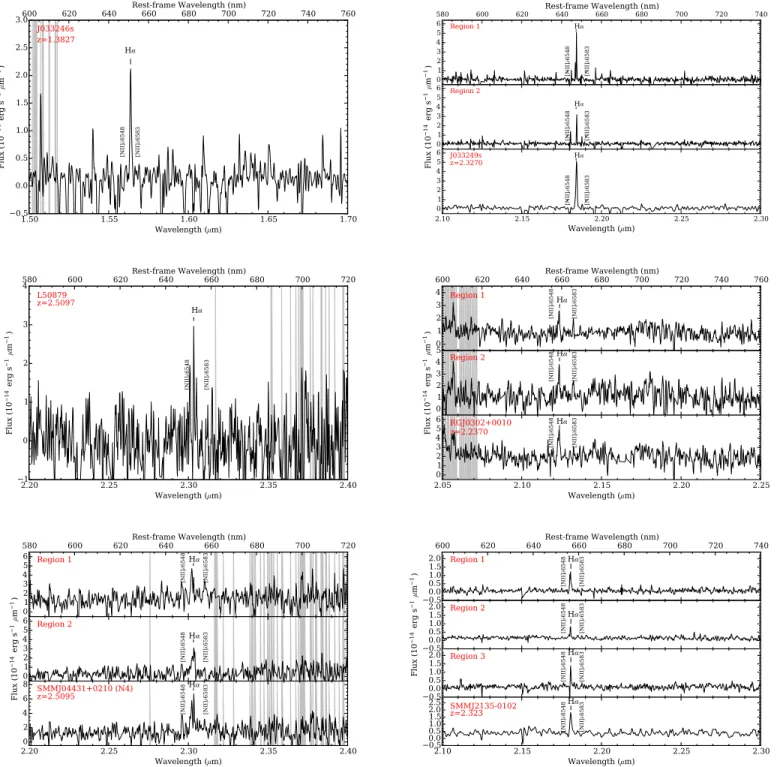
(8) The Astrophysical Journal, 827:57 (14pp), 2016 August 10. Olivares et al.. Figure 2. Extracted VLT SINFONI spectra for the SMGs in our sample. The gray zones represent the sky lines. The vertical solid lines indicate the Hα, [N II]λ6583, and [N II]λ6548 emission lines at redshifts of z=1.383 for J033246, z=2.327 for J03349, z=2.5097 for L50879, z=2.236 for RG J0302+0010, z=2.5095 for SMM J04431+0210 (N4), and z=2.3230 for SMMJ2135–0102.. Similarly, the value of log(O[III]/Hβ)=0.97±0.13 (O[III]/ Hβ=9.3 ± 1.3) previously found by Harrison et al. (2012)further confirms this conclusion regarding the AGN activity in this galaxy. From the galaxy-wide integrated Hα emission we derive an SFR of 136±20Me yr−1, assuming that the Hα is only due to star formation, which, as we discussed above, is unlikely to be the case. Region 1 has [N II]/ Hα=0.71±0.13 and a line ratio [O III]/Hβ=9±3, indicating that thisis the region where the AGN is located, while Region 2 has [N II]/Hα=0.13±0.03, likely suggesting that it is dominated by star-forming activity. The SFR. We then compute an SFR surface density of ΣSFR=2.4Me yr−1 kpc−2. RG J0302+0010.—For RGJ0302+0010 we derive a redshift of z=2.237 based on the Hα and N IIλ6583 lines. Similar results were reported previously using Keck/NIRSPEC and VLT/ISAAC (Swinbank et al. 2004) and NIFS at GeminiNorth (Harrison et al. 2012). The intrinsic FWHM of Hα is 188±59 km s−1. Therest-frame [N II]/Hα line flux ratio is measured to be 0.8±0.4, marginally suggesting the presence of AGN activity. This is consistent with the values found by Chapman et al. (2004) and Swinbank et al. (2004) of 1.1±0.4. 8.
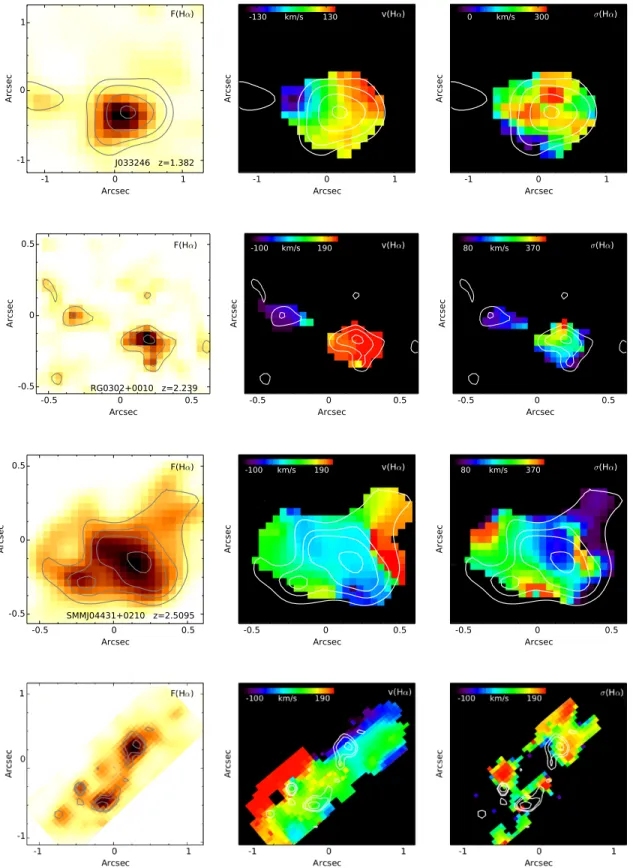
(9) The Astrophysical Journal, 827:57 (14pp), 2016 August 10. Olivares et al. −1. derived from the Hα line emission is 75±20Me yr for Region 1and 105±14Me yr−1 for Region 2. Using these estimates of the sizes of Hα and SFR derived from the Hα emission, we compute the SFR surface densities and find ΣSFR=17Me yr−1 kpc−2 for Region 1 and ΣSFR=5.7Me yr−1 kpc−2 for Region 2. SMM J04431+0210 (N4).—For SMMJ04431+0210 (N4) we derive a redshift of z=2.5095 based on the Hα and [N II]λ6583 lines, similar to the value found by Frayer et al. (2003) of z=2.5092 from Keck/NIRSPEC observations. The SINFONI K-band spectrum, presented in Figure 2(e), shows a strong Hα line with an FWHM of 437±29 kms−1, somewhat smaller than the value reported by Frayer et al. (2003) of 520±40 kms−1, and larger than the measurement by Neri et al. (2003) of 350±60 kms−1. The observed [N II]λ6583 line is narrower, having an intrinsic FWHM of 165±28 kms−1. The observed [N II]λ6583/Hα flux ratio is 0.47±0.06. We find an SFR of 77±20Me yr−1 (uncorrected for lensing magnification), and 17.5±4.8Me yr−1 corrected for lensing magnification, assuming an amplification factor of μ=4.4 as measured by Smail et al. (1999). We find that Region 1 is consistent with ionization due to an AGN, given the observed flux ratio of [N II]/Hα=0.76±0.3 and an SFR of 30±3.7Me yr−1, while Region 2 is probably dominated by star formation processes, as it has a flux ratio of [N II]/ Hα=0.06±0.1 and SFR of 20±2.9Me yr−1, all of them uncorrected for lensing magnification. Combining the Hα SFR with the observed sizes of each region, we can compute SFR surface densities of ΣSFR of 2.3Me yr−1 kpc−2 for the entire galaxy, ΣSFR=2.4Me yr−1 kpc−2 for Region 1, and ΣSFR=7.9Me yr−1 kpc−2 for Region 2. SMMJ2135−0102.—Figure 2(f) shows the extracted onedimensional K-band spectrum for each of the three regions in SMM J2135 and the galaxy-wide integrated spectrum. We confirm the redshift of the source at z=2.323 based on the Hα and [N II]λ6583 lines, consistent with the value found by Swinbank et al. (2010) of z=2.3259 based on GBT/ Zpectrometer observations of CO lines. The overall [N II]/Hα line flux ratio is found to be 0.15±0.02, suggesting that the observed emission lines are dominated by star formation activity. From the integrated Hα emission we derive an SFR of 82±4Me yr−1, uncorrected for lensing magnification and extinction. We measure SFRs of 33±7Me yr−1, 54±8Me yr−1,and 20±3Me yr−1 for Regions Y1, Y2, and 3,respectively.Using these estimates of the sizes of Hα present in the previous section and SFR from Hα emission for these regions,we derive SFR surface of ΣSFR=16.8Me yr−1 kpc−2 for Region Y1, ΣSFR=37.5Me yr−1 kpc−2 for Region Y2, and ΣSFR= 40.8Me yr−1 kpc−2 for Region 3.. For the two remaining sources, J033249 and L50879, the signal-to-noise ratio of the Hα line was not high enough to produce a velocity map. J033246 has the most symmetric velocity field, showing some evidence of rotation, with a gradient of ∼250 km s−1 from one side to the opposite. SMMJ04431+0210 (N4) is clearly irregular, inboththe flux distribution and velocity profile, with no evidence of ordered motions. Finally, both RGJ0302+0010 and SMMJ2135−0102 present a clumpy structure, with no signs of ordered motions. In about half of the targets in our sample, J033246, RGJ0302+0010, SMM J04431+0210 (N4), and SMMJ2135−0102, we find velocity offsets of ∼few ×100 kms−1 between distinct galactic-scale regions, with irregular kinematics. These velocity offsets could be explained by invoking a merger scenario, as presented by, e.g., Engel et al. (2010). This is also supported by the clearly disrupted morphologies shown by the deep HST images available for these sources. Evidence for a connection between highluminosity SMGs and major mergers has been previously and extensively reported in the literature (e.g., Smail et al. 1998, 2004; Ivison et al. 2010; Swinbank et al. 2010; Alaghband-Zadeh et al. 2012). 4. DISCUSSION 4.1. Hα Morphologies We have spatially mapped the Hα line emission for a sample of six high-redshift luminous SMGs. As presented in Section3.1, the Hα morphologies in our sample tend to be irregular and/or clumpy. We measure the Hα emission to be extended on scales >4 kpc, with an average Hα half-light radius of ár1 2ñ = 3.2 1.8 kpc. These sizes are in good agreement with previous, seeing-limited measurements of the extent of SMGs in Hα (4–16 kpc; Alaghband-Zadeh et al. 2012; MenéndezDelmestre et al. 2013) and nebular lines (4–11 kpc; Swinbank et al. 2006). Similarly, recent high-resolution measurements (0 3) using the ALMA 870 μm of 52 bright SMGs in the Ultra Deep Survey field reported by Simpson et al. (2015a) yielded a median physical half-light diameter of 2.4±0.2 kpc. However, using HST/WFC3, Chen et al. (2015) reported a median half+1.1 light radius of 4.40.5 kpc for a sample of 48 bright SMGs in the Extended Chandra Deep Field South. Our Hα size measurements are also consistent with the expectations based on theoretical simulations of mergers with high gas fractions (e.g., Mihos 1999; Narayanan et al. 2010). For three galaxies in our sample, we were able to resolve the Hα emission into two or more galactic-scale extensions/ components on ∼0.5–1 5 (3–11 kpc) scales. In two of these three systems we were able to identify possible signs of AGN activity based on the observed [N II]/Hα flux ratio. Previous IFU studies of SMGs have targeted galaxies showing AGN signatures in their Hα spectra (Menéndez-Delmestre et al. 2013), while just two systems in our sample display clear Hα AGN signatures. In the remaining sources in our sample we find undisturbed morphologies, with extended spatial extensions (size ∼8–11 kpc) of narrow-line Hα emission that contribute a significant fraction (∼40%–90%) of the galaxy-wide Hα emission. Furthermore, we also find a lower [N II]/Hα flux ratio, thus strongly suggesting that the Hα component in these. 3.3. Velocity Maps In addition to the identification and redshift measurements of the galaxy responsible for the submillimeter emission, the VLT/SINFONI data cubes can be also used to study their dynamical properties.Velocity fields and velocity dispersion maps are measured from the shift in observed wavelength and the width of the Hα line across each source. Figure 3 shows the Hα velocity maps for four of our targets: J033246, RG J0302 +0010, SMMJ04431+0210 (N4), and SMMJ2135−0102. 9.
(10) The Astrophysical Journal, 827:57 (14pp), 2016 August 10. Olivares et al.. Figure 3. Maps of the Hα properties for four of the sources in our sample. Top to bottom: J033246, RG J0302+0010, SMMJ04431+0210 (N4), andSMMJ2135–0102. Left panel: Hα intensity contours in gray overlapped on the VLT/SINFONI continuum maps. Middle panel: Hα velocity field, in km s−1. Right panel: Hα velocity dispersion field, in km s−1.. extends out to spatial scales in the range of ∼5–8 kpc. In highresolution observations of a range of CO transitions (e.g., Hainline et al. 2006; Tacconi et al. 2006, 2008; Engel et al. 2010; Ivison et al. 2011), the size measurements of SMGs from CO fluxes are in the range of ∼1–16 kpc.. systems is associated with star-forming activity. High-resolution radio continuum observations (Chapman et al. 2004; Biggs & Ivison 2008) found spatial extensions of ∼8–10 kpc in diameter, while a high-resolution far-IR (FIR)study by Younger et al. (2010) revealed that this emission typically 10.
(11) The Astrophysical Journal, 827:57 (14pp), 2016 August 10. Olivares et al.. Our results indicate that the SMG clumps in our sample have high star formation surface densities (Section 3.2), close to those found in local extreme environments, such as in circumnuclear starbursts and luminous infrared galaxies. In some of our targets, the Hα distribution appears to be offset from the observed-frame near-IR continuum emission traced by SINFONI and HST observations. Considering the much greater spatial extents found for these SMGs (∼3–11 kpc) in comparison to the ∼1 kpc sized nuclear starbursts (Kennicutt 1998) and the ∼100 pc starburst regions observed in local ULIRGs (e.g., Scoville et al. 2000), SMGs appear to be undergoing this intense activity over much larger spatial scales. This is well in line with similar conclusions reported by several studies in the past (Swinbank et al. 2006; Alaghband-Zadeh et al. 2012; Menéndez-Delmestre et al. 2013). 4.2. Kinemetry Analysis As described in Section 3.3, the SMGs studied in this work present a wide range of Hα kinematical properties. In order to establish whetherthe motions observed in these galaxies are dominated by ordered (e.g., rotation) or random (as caused by, e.g., a recent major galaxy merger) dynamics, we employ kinemetry analysis. This is done by measuring the level of symmetry in the mean of the velocity and the velocity dispersion fields. The kinemetry measurement procedure described by Shapiro et al. (2008) uses the method detailed in Krajnović et al. (2006) to analyze maps of kinematic moments based on the line-of-sight-velocity distribution. This can be considered as an extension of the surface photometry to the higher-order moments of the velocity distribution. This technique was developed to study stellar dynamics of local ellipticals (Copin et al. 2001), but has been extended to the dynamics of high-z galaxies (e.g., Förster Schreiber et al. 2009). More recently, Alaghband-Zadeh et al. (2012) used a technique based on measuring velocity and velocity dispersion asymmetries in order to establish whethergalaxies are dominated by rotation or random motions. They applied this technique to SMGs similar to the ones in our sample. Asymmetries in moment fields are measured by fitting ellipses, varying the position angle and ellipticity, to the velocity and dispersion fields. These coefficients, vasym and σasym, are used to establish the level of asymmetry. The two asymmetry measures are combined as Kasym= 2 2 vasym + s asym . Following the definition of Alaghband-Zadeh et al. (2012), systems with Kasym > 0.5 are classified as mergers. Any asymmetries in these fields represent deviations from the idealized model (a rotating thin disk), and as such the combined asymmetry of the two fields can fully describe how accurately a system is represented by this idealized disk. This model displays an ordered velocity field, peaking at the semimajor axis of the ellipse and reaching a value of zero at the semiminor axis, and a centrally peaked velocity dispersion field. In Figure 4 we compare the levels of asymmetry in the velocity and velocity dispersion for the four SMGs in our sample for which velocity maps were obtained. As can be seen in that figure, and perhaps surprisingly, three out of the fourgalaxies in the SMG sample (J033246, RGJ0302+0010, and SMMJ2135−0102) are found in the region where diskdominated sources are located. This is somewhat expected for J033246, since, as discussed above, this source appears to be dominated by rotation. The other two sources appear to be. Figure 4. Velocity asymmetry vs. velocity dispersion asymmetry values for four SMGs of our sample: J033246, RGJ0302+0010, SMMJ04431+0210, and SMMJ2135–0102. These measurements were carried out using the procedure described by Alaghband-Zadeh et al. (2012). Values for the sources in our sample are compared against other groups of active galaxies such as local spiral galaxies in the SINGS sample, low-redshift ULIRGs, and starforming galaxies at z∼2 in the SINGS sample. The background blue points are template disks, and red points are mergers, from the library of Shapiro et al. (2008). While threeout of the four sources, J033246, RGJ0302+0010, and SMM J2135–0102, are located in the “disk” region of the diagram, only in one of them (J033246) did we find evidence for ordered motions. In the other two cases, these are clearly clumpy galaxies in which each individual clump is spatially unresolved. SMM J04431+0210 (N4) is clearly in the “mergers” part of the diagram.. clumpy in their Hα morphologies, which might explain why their asymmetry values are lower than expected, as each individual clump is spatially unresolved and thus does not show significant asymmetries. Hence, their classifications based on the derived asymmetry values are probably explained by the limitations of the spatial resolution of our observations. Finally, SMM J04431+0210 (N4) clearly shows very high asymmetry levels, as can be seen in Figure 3. Therefore, it is not surprising that this source is also classified as “mergerdominated” in this diagram. Hence, the kinemetry analysis also suggests that most of these sources are dominated by random motions. This is in line with previous observations of similar high-luminosity IR and submillimeter galaxies at z∼2, such as those reported by Alaghband-Zadeh et al. (2012) and Menéndez-Delmestre et al. (2013), among others. A recent analysis presented by Hung et al. (2015), which takes a sample of local IR-luminous galaxies and artificially redshifts their Hα IFU data, shows that post-coalescence mergers may also display kinematics that can be wrongly classified as “disk-like,” as appears to be the case for some of our sources. 4.3. Hα SFRs We now compare the SFRs for the galaxies in our sample, previously derived from FIR observations, with those obtained from the Hα observations described here. The implied SFRs, including those derived from IR observations obtained from the literature, are presented in Table 3. Specifically, we use the values reported by Casey et al. (2011) for J033246 and 11.
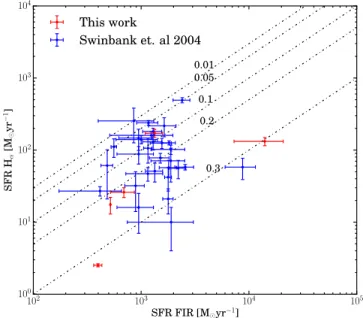
(12) The Astrophysical Journal, 827:57 (14pp), 2016 August 10. Olivares et al.. the wavelength coverage of our spectroscopic observations does not extend to the Hβ emission line, and thus the reddening in these galaxies cannot be estimated directly from the Balmer decrement, which would test this hypothesis. However, if we assume an average extinction value of Av=2.9±0.5, as previously used by Swinbank et al. (2004) and measured by Takata et al. (2006), we find that the extinction-corrected Hα SFRs are in good agreement with those derived from the IR. The scatter seen in Figure 5 could be explained by the fact that most of the star formation in these galaxies is not occurring in fully dust-obscured regions, as well asdue to the morphological diversity of submillimeter/ULIRG-selected galaxies. Estimates of the SFR from the Hα flux in SMGs retain the substantial caveat that in the presence of an AGN, the blended nuclear emission may result in the broadening and brightening of the Hα emission, potentially leading to overestimates of the SFR. The large gas and dust reservoirs of SMGs could potentially provide ample fuel to trigger an AGN, which might contaminate our estimates of SFR and ρSFR. However, we note that only two sources in our sample show some evidence for the presence of an AGN, viaeitherelevated [N II]/Hα ratios or a broad-line component. Previous IFU studies of SMGs have mainly targeted galaxies showing strong AGN signatures in their Hα spectra (Menéndez-Delmestre et al. 2013), whereas the majority of our sample does not display clear Hα AGN signatures. In SMGs, AGNs were found to only contribute at low levels (<20%) to the bolometric output (Alexander et al. 2008). However, even if an AGN is not dominating the bolometric output, it may still affect the Hα distribution and dynamics, being energetic enough to drive ionized gas over scales of a fewkiloparsecs (Nesvadba et al. 2008).. Figure 5. SFR(Hα) vs. SFR(FIR). The red points are measured values from the present work. SFR(Hα) values were derived from the Hα luminosities obtained from our SINFONI observations (not corrected for extinction). The FIR SFRs for J033246, J033249, RGJ0302+0010, SMM J04431+0210 (N4), and SMMJ2135–0210 were derived from FIR luminosities in the literature using the Kennicutt relations (Kennicutt 1998). For SMMJ04431+0210 (N4) the SFR values were corrected for lensing magnification assuming a μ=4.4 (Smail et al. 1999). The SFR values for SMMJ2135–0210 were corrected for lensing magnification using an amplification factor of μ=32.5±4.5 derived by Swinbank et al. (2010). The blue circles show measurements of highredshift FIR-luminous galaxies from Swinbank et al. (2004). The gray dashed lines correspond to ratios of SFR(Hα) to SFR(FIR) of 0.01, 0.05, 0.1, 0.2, and0.3.. J033249 from Spitzer-MIPS, BLAST, and LABOCA observations. For RG J0302+0010 the values were derived by Swinbank et al. (2004) fitting model SEDs to the observed 850 μm and 1.4 GHz fluxes assuming that the local FIR/radio correlation (Condon et al. 1991; Garrett 2002) holds at higher redshifts. For SMM J04331+0210 we used the values obtained by Neri et al. (2003) from observed 850 μm flux densities and assuming a modified graybody model (T=40 K) and a frequency-dependent emissivity. Finally, for SMMJ2135 −0120 values were derived by Ivison et al. (2010) from Herschel, SCUBA-2, VLA,and APEX observations. Both SFR measurements for SMM J2135−0120 were corrected for lensing magnification assuming a factor of μ=32.5±4.5 (Swinbank et al. 2010), while a magnification factor of ∼4.4 (Smail et al. 1999) was assumed for SMM J04431+0210 (N4). It should be noted that using the same lensing magnification for the Hα and FIR fluxes is not ideal, as these emissions might come from slightly different regions and thus might present small variations in their magnifications. In Figure 5, we compare the SFR derived from the Hα luminosity with the FIR SFRs for the galaxies in our sample, without correcting the Hα measurements for extinction. We also include in this comparison a sample of 30 high-redshift FIR-luminous galaxies from Swinbank et al. (2004). The Hα determined SFRs are significantly lower than the values determined from the IR luminosity, by factors of ∼3–5. This is most likely explained by both the presence of large amounts of dust obscuration in these systems and whetherthere are fully dust-obscured star-forming regions in the galaxy that do not contribute much to the Balmer emission lines. Unfortunately,. 4.4. Schmidt–Kennicutt Relation We now use the Hα-derived sizes for these SMGs to compare the SFR surface densities determined from Hα and FIR luminosities with the molecular gas surface density. Two of our sources have previously been observed in CO. Due to ¢ (1 - 0) and the the uncertainties in the conversion between L CO H2 mass (e.g., Bolatto et al. 2013), we consider both αCO values of 4.6 and 0.8 K km s−1 pc−2, corresponding to spiral galaxies (Solomon & Barrett 1991) and to ULIRGs and starforming galaxies at high redshift (Solomon & Vanden Bout 2005), respectively. For SMMJ04431+0210 (N4) we considered a line ¢ (1 - 0) of (1.0±0.2) ×1010 K km s−1 pc−2 luminosity L CO (corrected for the lensing magnification)and CO diameter of 1.8 kpc, as reported by Neri et al. (2003). With these measurements, we compute gas surface densities for αCO=0.8 and αCO=4.6 of 3.1×10³ Me pc−2 and 18 ×103 Me pc−2,respectively. For the galaxy SMMJ2135−0120 we use the line luminosities ¢ (1 - 0) reported by Swinbank et al. (2011) based on EVLA L CO observations, corrected for lensing magnification. The reported luminosities are (3.9±0.4)× 108 K km s−1 pc−2 for Region Y1 and (7.1 ± 0.8)×108 K km s−1 pc−2 for Region Y2. We use the Hα size measurements of 1.4 kpc for Region Y1 and 1.2 kpc for Region Y2. Then, we derive gas surface densities, assuming αCO=0.8 and αCO=4.6, of 6.3×10² Me pc−2 and 3.6×10³ Me pc−2 for Region Y1 and 1.5×10³ Me pc−2 and 9×10³ Me pc−2 for Region Y2, respectively, and corrected for lensing magnification. For the other four sources, J033246, 12.
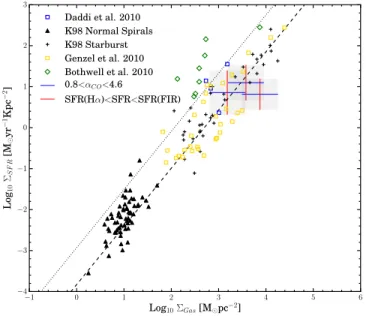
(13) The Astrophysical Journal, 827:57 (14pp), 2016 August 10. Olivares et al.. emission line as a tracer. These observations allow us to study the gas dynamics and morphologies for six sources in our sample for which the Hα line was detected at sufficient signalto-noise ratio. Overall, we find that these SMGs have highly irregular and/ or clumpy morphologies. The Hα emission has relatively large spatial extent, ∼2–12 kpc, with a mean value for our sample of árHañ = 6.4 kpc, in contrast to local ULIRGs, which tend to be more compact. We find that in three cases the Hα emission is significantly offset from the observed-frame near-IR continuum emission derived from the SINFONI and HST images. We then analyzed the velocity and velocity dispersion fields in this sample, finding that these SMGs in general show large velocity gradients across each system. The majority of the SMGs in our sample are not consistent with being disk-like systems dominated by rotation and instead present irregular and turbulent or clumpy velocity and velocity dispersion fields, which could be explained by a recent major merger. We find that of the six SMGs with resolved spectroscopy, at least three appear to becomposed of two or more dynamical subcomponents. The average velocity offsetbetween these components is ∼180 kms−1 across a projected spatial scale of ∼8 kpc. The obvious merging/interacting nature of these systems suggests that they are analogous to the typically less luminous and slightly more compact ULIRGs in the local universe. This is confirmed by a kinemetry analysis performed for the sources in our sample, which suggests that most of them do not show strong evidence for the presence of ordered motions. The SMGs in our sample display high SFR surface densities (ΣSFR), similar to those found in the most extreme local environments, such as circumnuclear starbursts and IRluminous galaxies but over larger spatial extents. Our IFU observations allow us to disentangle AGN and starburst-like components (from [N II]/Hα flux ratios). Two of our targets (RG J0302–0010 and SMM J04431+0210 (N4)) show possible signs of AGN activity surrounded by star-forming regions/ clumps. We then further confirm that these extreme SMGs at highz appear to follow the same star formation scaling relations as less luminous “normal” star-forming galaxies. SMGs in our Group B sample are the only ones thatpresent evidence for AGN activity. Therefore, the data do not support the hypothesis that the AGN leads to hotter dust, at least for the sources in our Group A, which contain the warm-dust ULIRGs. While still very expensive and limited in sample size, restframe optical IFU observations of high-z extreme star-forming galaxies are starting to reveal the details of the violent star formation episodes in the early universe. In the near future, such studies will be possible for much larger samples thanks to, e.g., the KMOS multi-object IFU spectrograph at the VLT. In addition, ALMA observations will allow studies of the molecular gas contents, fuel for both star formation andthe central supermassive black holes, for these galaxies.. Figure 6. SFR surface density vs. gas surface density, both in logarithmic scale. Blue lines show the values for our sources using CO luminosity/mass conversion between αCO=0.8 and αCO=4.6. Red lines show measurements for the SMGs in our sample but using SFR between SFR(FIR) and SFR(Hα) instead. The blue squares present the location of the BzK galaxies in the sample of Daddi et al. (2010a), assuming anα=3.2 value. Yellow squares show the SFGs and SMGs in the Genzel et al. (2010) sample, using αCO=3.2 for SFGs and 1 for z>1 SMGs. Green diamonds show the SMG sample of Bothwell et al. (2010), using αCO=0.8. Black triangles show normal spiral galaxies, while the black plus signs present the starburst galaxies from the Kennicutt (1997, p. 171) sample, which were used to derive the relation shown by the dashed black line, a power law with a slope of 1.4. The dotted black line indicates the relation found byDaddi et al. (2010b), a power law with a slope of 1.42 and a higher normalization by 0.9 dex.. J033249, RGJ0302+0010, and L50879, there are no observations of CO emission available so far. Figure 6 shows the gas surface density versus the SFR surface density for the sources in our sample, along with local and high-z sources from the literature. The values from the literature were taken directly from each publication. As can be seen in Figure 6, in all three sources for which we could measure Σgas and Σ(SFR), they appear to be slightly below (but consistentwith) the relation derived for local and highredshift star-forming galaxies (e.g., Kennicutt 1997, p. 171; Genzel et al. 2010). This is in contrast with previous results reported by Daddi et al. (2010a) and Genzel et al. (2010, 2015), who found a higher relation for both local and high-redshift ULIRGs and SMGs. While here we do not attempt to correct the values previously reported for different assumed αCO values, for our sources we assume a wide range of αCO, from 0.8 to 4.6, finding that our sources still fall below the ULIRG and SMG relation and appear to be consistent with that for normal SFGs. While this is certainly interesting, it is hard to reach stronger conclusions given the small sample studied here and the lack of high-resolution CO data. Work to increase the number of sources in our sample and to obtain ALMA observations for them is currently being carried out.. We thank the anonymous referee for very useful comments and suggestions. Support for this work was provided by the Center of Excellence in Astrophysics and Associated Technologies (PFB 06; E.T., V.O., F.E.B.);by the FONDECYT regular grants 1120061, 1130528,1160999 (E.T.), and 1141218 (F.E.B.);and by the “EMBIGGEN” CONICYT Anillo project ACT1101 (E.T., V.O., F.E.B., G.C.P.). We further acknowledge support from the FONDECYT Postdoctorado grant 3150361 (G.C.P.) and the Ministry of Economy,. 5. CONCLUSIONS In this paper we used the VLT/SINFONI integral-field spectrometer to study, at high resolution, the spatial distribution and kinematics of eight SMGs at 1.3<z<2.5 using the Hα 13.
Figure
+4

Documento similar
(c) Possible sources of Hα emission other than accretion are chromospheric activity, whose contribution is two orders of magnitude less than what we measure, Hα emission along the
Upper limits at 95% confidence level on the production cross section of dark matter are set in a type-II two Higgs doublet model extended by a Z 0 boson and in a baryonic Z 0
In the context of galaxy formation, two fundamental properties are given by the underlying dark matter structure: the distribution of their masses at a certain redshift as the halo
As a first step in our study, we characterized the mid-IR high-ionization emission lines produced by AGN and star-formation for a large sample of local galaxies, includ- ing
By measuring the two-point correlation function of galaxy populations that differ in redshift, color, luminosity, star-formation history and bias, and using high-resolution
In this work we use optical imaging and integral field spec- troscopy (IFS) to study the impact of the minor merger on the star formation properties of the individual galaxies of
Finally, the central event in our proposal is formed by the third channel of de-excitation of the biexciton, namely the emission into the cavity mode of two simultaneous
Each model saves the emissivities of two emission lines from the ion- ized region ([S II ] λλ6716 +6731 and Hα) and one emission line produced in the atomic layer (H 2 2.121 μm),
