
TítuloExample based learning: development of business applications witn Net technologies
22
0
0
Texto completo
(2) MARCOS GESTAL, JOSÉ VÁZQUEZ, ENRIQUE FERNÁNDEZ-BLANCO, DANIEL RIVERO, JUAN R. RABUÑAL, JULIAN DORADO AND ALEJANDRO PAZOS. 78. a la hora de su implementación. La irrupción de .NET Framework, en el ámbito empresarial, ha producido una fuerte demanda de implementación de aplicaciones bajo dicha arquitectura. Sin embargo, la cantidad o calidad de la documentación disponible dista considerablemente con respecto a la existente, su principal alternativa (J2EE). Esta laguna de documentación,. es especialmente visible y preocupante cuando se establece como objetivo dar a conocer los conceptos del framework, desde un punto de vista docente, a los futuros egresados del Grado en Ingeniería en Informática. Este trabajo describe el enfoque docente seguido, para alcanzar el citado objetivo de familiarizar a los alumnos con este framework alternativo y las prácticas. habituales de modelo dentro de éste. Para ello, se basa principalmente de un conjunto de. sencillos tutoriales con los que mostrar los fundamentos de la tecnología y dos aplicaciones completas (miniportal y minibank) en las que se muestra cómo aplicar patrones de diseño, a la hora de abordar una aplicación empresarial.. Palabras clave: ingeniería de sistemas, software, lenguaje de programación, patrones de diseño,. aplicaciones web, aprendizaje por proyectos, aprendizaje basado en problemas. INTRODUCTION “Development Framework” is a mandatory. This. research. not. only. shows. a. course in the 4th year of the Information. technological viewpoint, but also the most. These are divided into 3 credits for expository. common problems in the development of. Systems Engineering program. It is a four-. month course, and has a total of 6 ECTS credits. instruction (lectures), and 3 for interactive. instruction, which translates into 21 lecture. hours and 90 practice hours for students. This also includes the estimated work outside lab hours. Thus, this is a fundamentally practical course in the last year, which seeks to familiarize the future alumni of the. Information Systems Engineering program with the usual exercises they will encounter in the labor market.. The curriculum presents this course as. a complement to “Advanced Programming,”. where students see the J2EE framework. This research also improves the students’ training. by showing them the .NET technologies’ point of view (Grimes, 2002).. [RIDU]: Revista Digital de Investigación en Docencia Universitaria June 2015 - Volume 9 – Issue 1 | LIMA (PERU). relevant and appropriate project rules to. operate within this framework and solve web applications (Zeldman & Ethan, 2009).. Additionally, as it complements another course as mentioned above, it is possible. to emphasize the differences with the framework seen by the students previously.. Throughout the course, a series of tutorials on the necessary concepts to be used in their practical assignment are presented: design patterns, technology, developmental. environment, etc. Also, a series of web applications are developed and made available. to students in the way of tutorials, detailing. how to implement the concepts previously shown: user authentication, data validation, transaction management, etc.. This integrated approach, presenting. technology along with structuring methods, ISSN: 2223 - 2516.
(3) EXAMPLE-BASED LEARNING: DEVELOPMENT OF BUSINESS APPLICATIONS WITH .NET TECHNOLOGIES. is encouraged by the fact that it is impossible. to apply a technique appropriately if it is. not related to an engineering methodology. based on the correct application of samples. Additionally, some procedures are so difficult. to understand in an isolated manner that they need to be contextualized within the problems that trigger the appearance of a model for certain technological solutions.. This research is heir to the Systems. Integration. course,. from. the. former. Information Systems Engineering discipline (Gestal, Rivero, Rabuñal, Dorado & Pazos,. 2010). It is worth mentioning that the. contents have been modified to adjust to the new schedule and training scheme of the Information Systems Engineering program.. The evaluation consists on creating a. web application, but it is necessary to obtain a minimum grade in a test verifying that the. concepts required for the practical assignment have been acquired.. For this research, we first detail the. specific objectives of the course, and then describe the teaching methods. Moreover, we develop the concepts explained to students and the examples used for that purpose in. depth. Finally, we draw a series of conclusions based on students’ ratings.. Course Objectives. “Development Frameworks” focuses on the. presentation of design and structural patterns to create and implement web applications with .NET technologies (Zeldman & Ethan, 2009).. Throughout the course, we develop a. business-like web application with .NET. This assignment represents the regular operation. of a real application (obviously limited in terms of functionality due to time constraints). [RIDU]: Revista Digital de Investigación en Docencia Universitaria June 2015 - Volume 9 – Issue 1 | LIMA (PERU). 79. of the concepts developed during the course.. Carrying out their practical assignment. correctly will allow students to reach the following main objectives in the course:. ● Knowing programming fundamentals through .NET technologies. ● Mastering. the. basic. architectural. principles of business applications. ● Understanding design techniques to develop business applications (specially web applications) through a layered architecture. In order to reach these objectives, the. course provides 2 credits for lectures, which are focused on two fundamental aspects:. ● Design and implementation of the model layer. ● Design and implementation of the Web layer. These. developed. two. and. points. are. experimented. reflected,. throughout. the practical assignment of the course, in. order to obtain the 4 credits. As can be seen, these aspects detail the two main parts of the. Model-View-Controller (MVC) (Gamma, Helm,. Johnson & Vlissides, 1995). This archetype is presented in combination with the layer pattern (de la Torre, Zorrilla, Calvarro &. Ramos, 2011) and represents the architectural guidelines in current business applications. As support for the explanation of these and. other usual samples in the business field, we present two reference applications in the. way of examples thoroughly documented and. commented. These two examples, analyzed in the following sections, seek to explain. how to adjust prototypes during framework. implementation in an easy manner and to become the basis to develop the practical assignment further.. ISSN: 2223 - 2516.
(4) MARCOS GESTAL, JOSÉ VÁZQUEZ, ENRIQUE FERNÁNDEZ-BLANCO, DANIEL RIVERO, JUAN R. RABUÑAL, JULIAN DORADO AND ALEJANDRO PAZOS. 80. TEACHING METHODOLOGIES. EVALUATION METHODOLOGY. Instructor Methodology. The largest weight is on the practical. Despite the evidently practical approach of the. course, there are also lectures. These theoretical lectures present the basic concepts necessary. for the practical assignment, for example, dependency injection. The theoretical concepts are later materialized in the implementation of the framework. In this way, we put special emphasis. on data base access technologies and the software. patterns used in the creation of model, view and controller layers in business applications.. The practical assignment carried out. throughout the course is group work, in order to imitate the typical structure of developing teams. that are usually found in the advanced software. field. This also enables students to become familiar. with the design and with the good practices of software development in teams, such as keeping. a software version repository, responsibility allocation, task planning and allocation, and the application of work methodologies.. assignment. Therefore, more emphasis is put on the practical aspect when evaluating students.. As already commented on, the progress. of the practical assignment during the course is. divided in two submittal dates. In the first, which is not graded, the initial part is implemented.. The objective of the first submittal is to. try to ensure that students are focusing well on. the development, and that they are applying. concepts appropriately. For this purpose, the. instructor detects important mistakes and then guides students towards solutions. In the second, students correct the mistakes detected. in the first submittal and add the remaining. functions. During the evaluation of this second submittal, students must explain the functions. implemented, how the work was divided, etc. With this, they are assigned an individual grade,. which is the most important grade in the course.. In order to guarantee the complete. The practical assignment, in its turn, tries. correction of the practical assignment and for. business success (Betandwin, Amazon, etc.),. verification of a series of control points. This. to emulate the generic functioning of some of the most common web applications of renown although, evidently, with a smaller number of. functions due to time constraints. Imitating. applications is motivational for students as they. can try, first hand, how to create such solutions (Bugeja, 2007).. Due to the extension and complexity of the. practical assignment, its submittal in parts makes. it possible for a larger number of students to meet. it to be consistent in all the groups, the same. scheme is used, based on the appropriate correction is guided by a checklist in order to verify the completion of a series of aspects in the. assignment, although, evidently, it will depend on some aspects of the practical assignment. proposed each year. As an example, you can. review one of these checklists in Attachment I in a more detailed manner.. Additionally, upon correction of the. deadlines and to reduce dropouts. This follows. practical assignment, instructors will revise the. & Steece, 2000), which we also seek to make. the checklist notes, during the correction of the. the typical strategy of methodological evolution. for spiral software projects (Boehm, Madachy. students become familiar with, since it is one of the most popular in the labor market.. [RIDU]: Revista Digital de Investigación en Docencia Universitaria June 2015 - Volume 9 – Issue 1 | LIMA (PERU). quality of the report delivered or the remaining. documents in more detail. To do this, based on assignment, we will use a simplified document allowing for the final evaluation based on a. ISSN: 2223 - 2516.
(5) EXAMPLE-BASED LEARNING: DEVELOPMENT OF BUSINESS APPLICATIONS WITH .NET TECHNOLOGIES. 81. series of criteria that are easily measurable,. apply them in their practical assignment. These. corrected has the characteristics to be contained. aside aspects such as design efficiency and. both quantitatively and qualitatively. To avoid. subjectivity in the evaluation, each section in the assignment noted, in order to obtain a certain grade. This document can be read in Attachment II.. .NET as a Learning Means. tutorials are implemented under the philosophy of being a learning guide to technology, leaving. appropriateness. This approach derives from the fact that most technologies and prototypes explained are new to students, so we try to facilitate understanding as much as possible. Therefore,. students. are. provided. The framework, developed by Microsoft and. with a series of examples which show, first,. decade. It caught people’s attention from the. The tutorial includes examples of connection. known as .NET, was created in 2002 (Grimers, 2002), and was developed over more than a. beginning, being an alternative to the J2EE proposal, when implementing robust, reliable and durable business applications.. This frequent use of the framework. within business applications determines the fact that students, besides knowing and using. J2EE solutions, also have an array of work. possibilities through the proper training in the solutions offered by .NET. Thus,. our. course. objective. is. to. explain the architectural patterns of business applications, using the .NET framework as support. Therefore, we suggest an introduction starting from the general models (Gamma et. al.,. 1995), and then the implementation of general. concepts in real cases with this Microsoft’s framework architecture (Zeldman & Ethan,. 2009). It is worth mentioning that knowing the framework is not a primary objective, but. to understand it as a means for students to comprehend the global ideas explained when seeing a real application.. Along this line, to understand the concepts. of the archetypes explained, we propose a series of examples, which also serve as reference. material later on. Each one of these shows how usual functions and structures within web pages work and are implemented. Later, students must. [RIDU]: Revista Digital de Investigación en Docencia Universitaria June 2015 - Volume 9 – Issue 1 | LIMA (PERU). basic aspects of programming language C#. (structures, exception management, etc.).. to data bases through ADO.NET (connected and disconnected environment), as well as through ORM Entity Framework (Andrew & Schafer, 2006).. In the first part of the course, we seek. to make students become confident with and acquire a language and development. environment unknown to many before the. course, but that are currently widely developed. and implemented in the information systems field. That is why the complexity of the tutorials increases as the course advances.. This learning and adaptation stage, from. other languages previously known by students, happens usually fast and with no trouble, as. ours are last year students with a considerable. background in other languages and frameworks.. However, we have detected a lack of. training in web related issues in students. To this. regard, we provide them with a list of tutorials that may help them overcome said deficiency, such as web safety, ASP.NET, view, XML, etc. We provide a complete list of tutorials in Figure 1.. Upon completion of this stage, we. explain the architectural patterns on which most commercial web applications are based, emphasizing the benefits they present. All of ISSN: 2223 - 2516.
(6) MARCOS GESTAL, JOSÉ VÁZQUEZ, ENRIQUE FERNÁNDEZ-BLANCO, DANIEL RIVERO, JUAN R. RABUÑAL, JULIAN DORADO AND ALEJANDRO PAZOS. 82. this is always done when explaining how to. through specific frameworks, such as ORM. materialize in their practical assignment.. from lower levels. It is for that reason that the. implement these guidelines in the framework, so students experience firsthand how concepts. Thanks to this, we manage to lessen the students’ learning curve gradient since they. can verify, based on functional examples, the concepts required later on for the assignment.. The large number of examples also. facilitates carrying out their assignments since the codes can also be used. In this way, students finally elaborate a complex web application. (perfectly usable) without having to code it completely.. The examples provided focus on two small. complete web applications: MiniPortal and. MiniBank. They emphasize the fundamentals of business web applications. These applications. cover different aspects (layers, authentication,. transaction management, etc.), which students will later apply in carrying out their practical. assignment. Next, a brief description of each one of the contents.. Entity Framework. The problem we find is that the terms used are too conceptual and far. examples provided are implemented in ADO. NET, although the subject is focused on the use. of Entity Framework (Leman, 2010), as this. is the market trend. Therefore, the practical assignment starts with the implementation of the logical layer or model layer. This is the. basic layer of the final application. In this way, students will have to implement the whole. business logic and data persistence in one of their bases, following the layers paradigm. In other words, they will have to implement two. layers: one for persistence and the other for the business operation, so changes in one will. only affect the other minimally. Besides the architectural patterns mentioned, students use others, such as different structuring examples: facade, factory, template archetype, etc.. The persistence layer is implemented,. first, through one of the framework classic. Implementing Business Logics with ADO.NET. technologies to connect to a data base, as. Current application development is very much. mentioned before. This is a complete web. focused on the division of responsibilities that. allows the increase of the most robust and. easy maintenance apps. In order to achieve. such division of responsibilities, we use an architectural pattern known as Layers (de la. Torre Llorente et al., 2011). Such design argues that it is essential to group -under a same layer- all those functions belonging to one of. the aspects of the application. Concretely, this prototype is usually combined with Model-. View-Controller (MCV) (Gamma et al., 1995), which requires the separation of the business. activity proper logic from the one necessary to represent the information contained in the. business logic. These concepts are implemented. [RIDU]: Revista Digital de Investigación en Docencia Universitaria June 2015 - Volume 9 – Issue 1 | LIMA (PERU). the ADO.NET protocol. To do this, we use. the MiniPortal application as an example, as application that implements a portal allowing. user registry and authentication. Figure 2 shows the main business objects. This is one of the requirements that the students’ practical. assignment must meet, so the example provided should be reused with minimal changes. Image of DAO Architecture. This domain objects are made persistent, using. the ADO.NET architecture and the Factory and DAO patterns. ADO.NET provides access. to the information stored in a data base in. order to store the business object data, in this particular case, the UserProfileVO and the. UserProfileDetailsVO. Additionally, ADO.NET. ISSN: 2223 - 2516.
(7) EXAMPLE-BASED LEARNING: DEVELOPMENT OF BUSINESS APPLICATIONS WITH .NET TECHNOLOGIES. 83. Figure 1. Tutorials. Figure 2. MiniPortal Domain Objects. Figure 3. DAO Pattern Architecture for UserProfileVO [RIDU]: Revista Digital de Investigación en Docencia Universitaria June 2015 - Volume 9 – Issue 1 | LIMA (PERU). ISSN: 2223 - 2516.
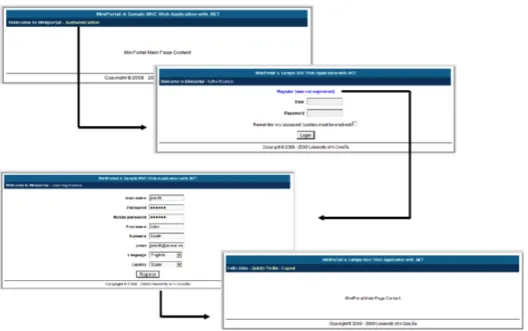
(8) MARCOS GESTAL, JOSÉ VÁZQUEZ, ENRIQUE FERNÁNDEZ-BLANCO, DANIEL RIVERO, JUAN R. RABUÑAL, JULIAN DORADO AND ALEJANDRO PAZOS. 84. provides the DataSets function, which reduces. data traffic by retrieving the data describing the relational data base and operating with. the latter before consolidating the changes in a sole connection. By using the DAO prototype,. students experience firsthand how to completely. separate the Data Base connection logic from the business logic operations, thus encapsulating. the persistence of an independent layer that can suffer changes with no repercussions in the. upper layer. Figure 3 shows the architecture to achieve such separation.. In MiniPortal, students are shown the. division of a business application, following the Model-View-Controller (MVC), in a practical. manner. Such pattern is the basis to understand the separation of business application layers, as. well as their scalability. It also exemplifies the use of certain design models (Session Facade, Business Delegate, Factory, etc.) to encapsulate. each layer’s functions. For example, in the type. case, we use the Facade example in order to. achieve this separation of functions gathered. from use cases (operations supported by the. application). Figure 4 shows such use cases. the basic operations on a current account, i.e. creation, search, cash deposits or withdrawals, as well as transfers between different accounts.. As with MiniPortal, MiniBank uses. different design and architectural patterns typical in business applications, in order to. achieve the separation of the layers’ different functions.. As. with. MiniPortal,. MiniBank. uses DAO and Facade extensively to achieve the separation between the business logic,. persistence and the remaining functions. Figure 6 shows the model facade with all use cases in the application.. On the other hand, MiniBank tries to. cover aspects MiniPortal does not contemplate and that students should use in their practical. assignment. Thus, we show aspects related to the automatic generation of identifiers for data base storage, transaction management. or Page-by-Page iterator pattern (that allows. results pagination when these are too many to be shown at once).. Implementing View and Controller with ASP.NET. in MiniPortal. In the implementation of the. Once the design has been implemented, during. (data to be accessed on different pages). Also,. i.e. data presentation and the way it interacts. part-sample, we put special emphasis on the. management of the data stored in the session we show how to develop tests (using TestProject as a tool within .NET), how to use configurable parameters externally, etc. With. the. other. complete. example. (MiniBank), students are shown a simplification. of bank account management. The domain objects, which are to be persistent in the data. base, can be seen in Figure 5. MiniBank is. the second submittal of the practical assignment, students implement the application’s web layer,. with the business logic previously created. In order to do this, they follow MVC and then. implement the application’s controller and view with ASP.NET. Additionally, they are. introduced another series of good practices when developing layers and strategies (Andrew and Schafer, 2006).. To exemplify the concepts developed. a more complete and complex application. in the application’s view and controller,. authentication, as seen in the previous example.. internationalization, page parameter pass,. than MiniPortal because, even though it does not register new users, it does have user. Besides authentication, MiniBank considers [RIDU]: Revista Digital de Investigación en Docencia Universitaria June 2015 - Volume 9 – Issue 1 | LIMA (PERU). MiniPortal shows aspects related to page navigability (see Figure 7), profile management, model method calls, etc.. ISSN: 2223 - 2516.
(9) EXAMPLE-BASED LEARNING: DEVELOPMENT OF BUSINESS APPLICATIONS WITH .NET TECHNOLOGIES. 85. Figure 4. Screenshot of MiniPortal Use Cases. Figure 5. MiniBank Domain Objects. Figure 6. Screenshot of MiniBank Use Cases [RIDU]: Revista Digital de Investigación en Docencia Universitaria June 2015 - Volume 9 – Issue 1 | LIMA (PERU). ISSN: 2223 - 2516.
(10) MARCOS GESTAL, JOSÉ VÁZQUEZ, ENRIQUE FERNÁNDEZ-BLANCO, DANIEL RIVERO, JUAN R. RABUÑAL, JULIAN DORADO AND ALEJANDRO PAZOS. 86. One of the main aspects here are the. different controller architectures that can be. implemented even if the behavior is the same.. The controller implemented with .NET follows an allocated architecture with a Page-Controller philosophy, while in other frameworks like. Struts, there is only one generic controller for the whole Application-Controller application.. At this point, we highlight the benefits and. drawbacks of each architecture and where each one is more appropriate. We also introduce aspects related to web development within. the framework, as are the difference between observing the complete panorama and partial. perspectives, the inclusion of JavaScript (Harold. & Means, 2004) to make the structure more dynamic, etc. Some of the technologies and concepts here are AJAX, JQuery, among others.. On the other hand, MiniBank is a little. simpler, but it is useful to remind students of the concepts already seen with MiniPortal. However,. everything related to results pagination (see Figure 8) through the Page-by-Page archetype,. commonly used in the presentation of search results, for example, is new.. Implementing the Model with ORM Entity Framework Once the concepts based on ADO.NET have been internalized, students are explained. how these are translated into the ORM Entity Framework (Leman, 2010). They will have to use the latter to implement persistence.. Therefore, students have been developing the other parts of the MVC with a temporary. persistence. Additionally, students are asked to substitute the latter for the corresponding. of recently implemented applications, thanks to its flexibility and easy maintenance. We. seek. to. make. our. students. knowledgeable of the current development trend and to make them experience, firsthand, a usual. process in information technology increase, as is technology migration. Additionally, this. change seeks to make them aware of the advantages implied in the separation of design. layers, as changes will be limited to a certain. section, without modifying codes or altering the functions of upper layers.. EVALUATION. As discussed earlier, this course is eminently. practical. Therefore, evaluation is based on that. aspect. In consequence, instructors evaluate the. practical assignment after its submittal. The group presents their defense of the assignment. submitted. This defense includes verifying the. implementation of the practical assignment through a checklist of critical points. Another aspect to evaluate during the process is the. correct understanding by the group of the. concepts applied in the development of the. activity. Based on the seriousness of the mistakes detected, if any, the web application will be evaluated from 0 to 10 points.. Additionally, students will render a test.. The objective of this evaluation is to determine if the student acquired the concepts correctly. The test is composed of a series of multiple. questions, where only one answer is correct. Unanswered questions obtain no points, and those answered incorrectly subtract points.. In order to pass the course you must: (1). data persistence layer, implementing it with. have obtained at least 5 over 10 for the web. For this reason, we introduce this last concept. for students who meet those two conditions is. ORM Entity Frameworks. This technology is a current trend based on dependency injection.. here. This concept is the basis for the majority [RIDU]: Revista Digital de Investigación en Docencia Universitaria June 2015 - Volume 9 – Issue 1 | LIMA (PERU). application, and (2) have obtained at least 4.5. over 10 in the test. In principle, the final score. the final grade, which is the weighted sum of ISSN: 2223 - 2516.
(11) EXAMPLE-BASED LEARNING: DEVELOPMENT OF BUSINESS APPLICATIONS WITH .NET TECHNOLOGIES. 87. the practice and the test scores. Given that this. which are directly applicable for graduated. only 40%. Although instructors would like. cases, translates into the students’ enrollment. is a practical course, the practical assignment represents 60% of the final grade, and the test the practical assignment to have more weight, university regulations do not allow it.. CONCLUSIONS. According to students’ surveys, this course is one of the most popular in the program, despite being one of the courses with the highest work. students, so we notice their greater interest and involvement. This greater involvement, in many in a continuous cycle of training and recycling. of the subject concepts (López, 2002), which is very beneficial for their work life, so as not to produce the obsolescence effect (Rodríguez & Barrios, 2014).. REFERENCES. load (or maybe because of it). This happens. Andrew, R. y Schafer, D. (2006). HTML Utopia:. the results of their work constantly, and can. Boehm, B. W., Madachy, R. y Steece, B. (2000).. because students, in creating a real web application -even with limited functions-, see interact with their application. The explanatory. methodology, based on real case study of applications, strengthens students’ training,. Designing Without Tables Using CSS (2nd. ed.). Collingwood: SitePoint.. Software cost estimation with Cocomo II with Cdrom. Upper Saddle River, NJ: Prentice Hall PTR.. avoiding long and dull theoretical sessions. Bugeja, M. J. (2007). Distractions in the. apply in their practical project, consolidate. Comas, O. y Lastra, R. S. (2014). La obsolescencia. (De Miguel Díaz et al., 2006). These concepts, taught through examples they can and must their. acquisition.. Additionally,. explaining. concepts based on examples triggers more student participation, generating comments. or suggestions to the instructor, which he can later introduce to the explanation with. wireless classroom. The Chronicle of higher education, 53(21), C1-C4.. de los saberes frente a las necesidades. de aprender; un caso de estudio. Reencuentro, 69, 22-27.. Gamma, E., Helm, R., Johnson, R. y Vlissides, J. M. (1995). Design Patterns: Elements. of Reusable Object-Oriented Software.. feedback. Such exchange of ideas motivates. A Pattern Language: Towns/Buildings/. a continuous improvement process in the. instructor, which translates in the increase of teaching quality and a faster adjustment to the audience (Navarro, 2007).. Regarding the examples, we can say they. Construction. Wesley.. J. y Pazos, A. (2010). Basics of Web. Application Design: an Example-Based Learning Approach. Paper presented. we can observe that students’ queries are just a Finally, carrying out a real and functional. practical assignment, adjusting to the growth. standards for this type of projects in the industry, triggers extra motivation in students. They see concepts and generate contents. [RIDU]: Revista Digital de Investigación en Docencia Universitaria June 2015 - Volume 9 – Issue 1 | LIMA (PERU). Addison-. Gestal, M., Rivero, D., Rabuñal, J. R., Dorado,. are highly accepted. Analyzing the server logs, small part of them all.. Reading:. Grimes,. at the International Conference on Computer Supported Education. F.. (2002).. Microsoft. .NET. for. Programmers. New York: Manning Publications.. Harold, E. R. y Means, W. S. (2004). XML in a. Nutshell: A Desktop Quick Reference. ISSN: 2223 - 2516.
(12) 88. MARCOS GESTAL, JOSÉ VÁZQUEZ, ENRIQUE FERNÁNDEZ-BLANCO, DANIEL RIVERO, JUAN R. RABUÑAL, JULIAN DORADO AND ALEJANDRO PAZOS. Figure 7. Example of Interaction with the MiniPortal Web Interface. Figure 8. Example of Interaction through the MiniBank Web Interface. [RIDU]: Revista Digital de Investigación en Docencia Universitaria June 2015 - Volume 9 – Issue 1 | LIMA (PERU). ISSN: 2223 - 2516.
(13) EXAMPLE-BASED LEARNING: DEVELOPMENT OF BUSINESS APPLICATIONS WITH .NET TECHNOLOGIES. Leman,. López,. (3rd. ed.). California: O’Reilly. J.. (2010).. Programming. 89. Entiry. Framework. Build Data Centric Apps with ADO.NET Entity Framework 4 (2nd. ed.). California: O’Reilly. J.. G.. (2002).. Motivación. y. autoaprendizaje: elementos clave en el. aprendizaje y estudio de los alumnos. Ensayos: Revista de la Facultad de Educación de Albacete (17), 191-218.. Miguel Díaz, M. de, Alfaro Rocher, I., Apodaca Urquijo, P., Arias Blanco, J., García Jiménez,. E.. y. Lobato. Fraile,. C.. (2006). Metodologías de enseñanza. y aprendizaje para el desarrollo de competencias:. orientaciones. para. el profesorado universitario ante el Espacio Europeo de Educación Superior. Prieto. Madrid: Alianza Editorial. Navarro,. del. L.. profesor. (2007).. Autoeficacia. universitario:. eficacia. percibida y práctica docente. Narcea Ediciones.. Torre Llorente, C. de la, Zorrilla Castro, U.,. Calvarro Nelson, J. y Ramos Barroso,. M. A. (2011). Guía de Arquitectura N-Capas orientada al Dominio .NET 4.0. Madrid: Krassis Press.. Zeldman, J. y Marcotte E. (2009). Designing. with Web Standards. San Francisco: New Riders.. [RIDU]: Revista Digital de Investigación en Docencia Universitaria June 2015 - Volume 9 – Issue 1 | LIMA (PERU). ISSN: 2223 - 2516.
(14) MARCOS GESTAL, JOSÉ VÁZQUEZ, ENRIQUE FERNÁNDEZ-BLANCO, DANIEL RIVERO, JUAN R. RABUÑAL, JULIAN DORADO AND ALEJANDRO PAZOS. 90. Attachment I Development Frameworks (2nd Submittal) Group Code: Dev.Fr.____. Date: ____. Observations:. Student 1 Student 2 Student 3 CHECKPOINT. OK. COMMENTS. Repository 1. Practical assignment submitted on, deadline? 2. Correct repository structure Corrections Submittal 1. (note the corrections and solutions adopted) 3. Is the entity model now correct?. 4. Does the practical assignment compile and execute correctly? [Deactivate cookies]. Use Cases - Product. 5. Obtain all products [keyword search of product title]. 5.1. Allows to specify category as an option to restrict the search. 5.2. Search result includes:. a) Name, registry date. b) Category name and seller, DTO/DAO Call/ EagerLoad?. - User. c) Link “See comments”. d) Link “Add comments”. 6. Register user [fields should be validated] 7. Modification of registry information. 8. Authentication [with the possibility to remember password] and exit. - Comment. 9. Add comment about the product a) Requires authentication. [RIDU]: Revista Digital de Investigación en Docencia Universitaria June 2015 - Volume 9 – Issue 1 | LIMA (PERU). ISSN: 2223 - 2516.
(15) EXAMPLE-BASED LEARNING: DEVELOPMENT OF BUSINESS APPLICATIONS WITH .NET TECHNOLOGIES. 91. b) [usability] Reports “Operation successfully completed” (optionally, it can redirect to the page “See comments” or show a link to that page). Other options may be valid.. c) [improvement] Is the name of the product shown when commenting?. d) Where is the commenting user ID obtained?. SessionManager.Comment/SessionManager.. GetUserSession ()/Codebehind access Session directly. 10. Obtain existing comments on a product. a) Link “See comments” only shows when necessary (comments>0). ● 1 call per product/1 call per gridview. b) Includes commenting user pseudonym. c) How do you recover the pseudonym? Call to DAO– CustomVO–Navegac-service. d) Does it have pagination support?. - Ratings. 11. [improvement] Is the name of the product shown when rating?. 12. Rating includes number and justifying comment 13. Each user can rate the same product once. 13.1. How is the error indicated? Link disappears/ exception shown. 14. Own products may not be rated. 14.1. How is the error indicated? Link disappears/ exception shown. 15. [usability] Reports “Operation successfully completed” (optionally, it can redirect to the page “See ratings” or show a link to that page). 16. Rating view includes list of ratings, median and total 16.1. Name of rater can be seen (DTO/navigation/ CustomVO). 16.2. Is everything performed with only one model call?. 17. For each rating, date, user pseudonym, vote and text are shown. - Favorite. 18. Add product to user’s favorite list 19. Obtain user’s favorite products 20. Delete favorite 21. Others. [RIDU]: Revista Digital de Investigación en Docencia Universitaria June 2015 - Volume 9 – Issue 1 | LIMA (PERU). ISSN: 2223 - 2516.
(16) MARCOS GESTAL, JOSÉ VÁZQUEZ, ENRIQUE FERNÁNDEZ-BLANCO, DANIEL RIVERO, JUAN R. RABUÑAL, JULIAN DORADO AND ALEJANDRO PAZOS. 92. 21.1. Link “See favorites” always visible for authenticated users. 21.2. Favorite name is a link to view details. Optional: AJAX. 22. Where is it applied?. 23. Justification/knowledge of use mode 24. Library used. Optional: Cached search 25. Cache creation (global.asax):. ICacheManager cacheManager = CacheFactory. GetCacheManager();. 26. Servicio.Find() - Before a call against DAO, cache is verified object o1 = cacheManager.GetData(“query”);. 27. Cache update after new query. 28. Cache update after a registered query (to update result) cacheManager.Add(“testkey2”, “Some Text”);. 29. Configuration in EL5.0 (expiry, numMax elements) Optional: tagging comments. 30. Add one or more tags on a comment 30.1. Obtain existing tags. 31. Obtain comments related to a tag 32. Comment view includes tag view. 33. It is possible to add/delete block tags. 33.1. Delete tags: shows previously added tags. 34. Tag cloud. a) Tag is a link to the comments related to the tag. b) Number of comments related to each tag is considered for size. Usability. 35. What is the application’s degree of usability?. [What happens when a new comment is added? Is. the user informed that the operation was completed successfully?]. fair, good, very good. Visual aspect. 36. [improvement] What does the application look like? (Usability aside)? [Are style pages used? Are icons used instead of links?]. 37. Pagination ObjectDataSource / Next-Previous. [RIDU]: Revista Digital de Investigación en Docencia Universitaria June 2015 - Volume 9 – Issue 1 | LIMA (PERU). fair, good, very good. ISSN: 2223 - 2516.
(17) EXAMPLE-BASED LEARNING: DEVELOPMENT OF BUSINESS APPLICATIONS WITH .NET TECHNOLOGIES. 93. View (general aspect) 38. There is no HTLM code in the controller 39. Tag script not used in view layer Internationalization 40. Use of Local Resources Files 41. Use of Global Resources Files 42. On what grounds are languages selected (user profile, search engine preferences, etc.) 42.1. Pages derive from SpecificCulturePage only when necessary Web.config *Safety: Access control to add rating page * Does the application work without cookies? Knowledge about setting options What facades does the application have? (User, Group, Comment, Favorite, Recommendation, Tag (Opt. 2) , Event) See SessionManager, have new methods been included? Report quality: [ ] Very bad, [ ] Bad, [ ] Average, [ ] Good, [ ] Very good Global impression: [ ] S, [ ] A, [ ] Not, [ ] Sob, [ ] MH. [RIDU]: Revista Digital de Investigación en Docencia Universitaria June 2015 - Volume 9 – Issue 1 | LIMA (PERU). ISSN: 2223 - 2516.
(18) 94. MARCOS GESTAL, JOSÉ VÁZQUEZ, ENRIQUE FERNÁNDEZ-BLANCO, DANIEL RIVERO, JUAN R. RABUÑAL, JULIAN DORADO AND ALEJANDRO PAZOS. Attachment II Unified Evaluation Template of the Course Call:. Dev.Fr.. Group:. EXAM. Student 1: Student 2: Student 3:. Basic part: 7 points. A1. A2. Design: 1.5 points □ Bad (0). □ Fair (0.40). □ Average. □ Good (1.2). Has not corrected. corrected all. design. instructions. Very serious. design errors.. Serious design. errors. Has not. mistakes of the first mistakes of the submittal. Class. instructions have. not been followed. MVC not followed. Usage cases missing. Notes:. Grade. first submittal.. (0.80). No/minor. errors. Class instructions. Class instructions have been have not been. followed. MVC pattern not followed.. Usage cases. followed.. Most use cases are present.. missing.. [RIDU]: Revista Digital de Investigación en Docencia Universitaria June 2015 - Volume 9 – Issue 1 | LIMA (PERU). A3. The design is good. Class have been. followed. Some structure. improvements are included.. All usage cases are present.. □ Very good (1.5) The design is. very good. Class. instructions have been followed.. Most structure improvements are included, possible in. practice. Creation decision very. well supported.. ISSN: 2223 - 2516.
(19) EXAMPLE-BASED LEARNING: DEVELOPMENT OF BUSINESS APPLICATIONS WITH .NET TECHNOLOGIES. 95. Implementation: 1 point □ Bad (0). □ Fair (0.25). □ Average (0.5). □ Good (0.75). □ Very good (1). implementation. implementation. implementation. implementation. implementation. The. contains. serious errors.. The. contains many errors. It does. The. contains no. serious errors.. It does not work not work properly It works properly properly. Class. in some cases.. Class instructions. followed. Method. or attribute. instructions. Class instructions. Method or. or attribute syntax. Exceptions not. documented.. have not been followed.. attribute syntax is not correct. documented.. have not been is not correct.. Exceptions not. have been. followed. Method. The. contains no. errors. It works properly. Class. properly. Class. Method or. attribute syntax. Exceptions are. documented.. have been followed.. Exceptions are. documented.. documented.. errors. It works. instructions have. attribute syntax. most cases).. contains no. instructions. syntax is correct (at least in. The. is correct.. been followed. Method or is correct.. Exceptions are Good. Good. implementation. followed.. Improvements. implementation practices are. practices are followed.. are made.. Performance issues are. considered.. Notes:. [RIDU]: Revista Digital de Investigación en Docencia Universitaria June 2015 - Volume 9 – Issue 1 | LIMA (PERU). ISSN: 2223 - 2516.
(20) MARCOS GESTAL, JOSÉ VÁZQUEZ, ENRIQUE FERNÁNDEZ-BLANCO, DANIEL RIVERO, JUAN R. RABUÑAL, JULIAN DORADO AND ALEJANDRO PAZOS. 96. Defense 1.5 points A1. □ Bad (0). □ Fair (0.40). □ Average (0.80). □ Good (1.2). □ Very good (1.5). A2. □ Bad (0). □ Fair (0,40). □ Average (0.80). □ Good (1.2). □ Very good (1.5). A3. □ Bad (0). □ Fair (0.40). □ Average (0.80). □ Good (1.2). □ Very good (1.5). The student. The student has. The student. The student. The student. the concepts. used in the. the concepts. the concepts. concepts used. has very little knowledge of used in the practical. assignment.. little knowledge of the concepts practical. questions asked.. knowledge of used in the. assignment. He/ practical she answers a. He/she cannot few questions. answer. has acceptable. has good. knowledge of used in the practical. assignment. He/ assignment. she can answer. He/she can. questions asked. answer. has very good. knowledge of the in the practical. assignment. He/ she can answer. questions asked with clarity. His. questions asked explanations are with clarity. His supported. The explanations. are supported.. student has a very good knowledge. of the concepts in the course.. Notes:. [RIDU]: Revista Digital de Investigación en Docencia Universitaria June 2015 - Volume 9 – Issue 1 | LIMA (PERU). ISSN: 2223 - 2516.
(21) EXAMPLE-BASED LEARNING: DEVELOPMENT OF BUSINESS APPLICATIONS WITH .NET TECHNOLOGIES. 97. Report: 1 point □ Bad (0). □ Fair (0.25). □ Average (0.5). Lacking many. requirements.. including the. quality information.. Redundant or. Report makes no. Diagrams. Report does not. meet requirements. sections.. Redundant or bad Diagrams are not representative.. contribution to the correction. of the practical assignment.. Report does not meet. Report meets. □ Good (0.75). □ Very good (1). Good writing.. Very good. Report meets. requirements,. requirements.. sections.. sections: Global. correction. information.. interface, a. Lacking some bad quality are not. representative.. following. architecture,. model, graphic section for. Facilitates. of practical. assignment.. each additional. Report meets. requirements. writing.. Facilitates. correction. of practical. assignment. Every important aspect. is reflected in the. part, known. report.. problems.. Notes:. Sample quality: 0.5 points □ Bad (0) Notes:. □ Fair (0.2). □ Average (0.3). □ Good (0.4). □ Very good (0.5). □ Average (0.3). □ Good (0.4). □ Very good (0.5). □ Good (0.4). □ Very good (0.5). Usability/Browsability 0.5 points □ Bad (0) Notes:. □ Fair (0.2). Improvements/Optimizations: 0.5 points □ Bad (0) Notes:. □ Fair (0.2). □ Average (0.3). General functioning of the practical assignment (global perception): 0.5 points □ Bad (0) Notes:. □ Fair (0.2). □ Average (0.3). [RIDU]: Revista Digital de Investigación en Docencia Universitaria June 2015 - Volume 9 – Issue 1 | LIMA (PERU). □ Good (0.4). □ Very good (0.5). ISSN: 2223 - 2516.
(22) 98. MARCOS GESTAL, JOSÉ VÁZQUEZ, ENRIQUE FERNÁNDEZ-BLANCO, DANIEL RIVERO, JUAN R. RABUÑAL, JULIAN DORADO AND ALEJANDRO PAZOS. Optional parts (3 points). Comment tags (optional) Score: 1.5 points. A1: A2: A3:. □ Bad (0) Notes:. □ Fair (0.40). □ Average (0.80). □ Good (1.20). Search cache (optional) Score: 0.75 points. □ Very good (1.5). A1: A2: A3:. □ Bad (0) Notes:. □ Fair (0.20). □ Average (0.40). □ Good (0.60). AJAX (optional): Score: 0.75 points. □ Very good (0.75). A1 A2: A3:. □ Bad (0). Notes:. □ Fair (0.20). □ Average (0.40). □ Good (0.60). □ Very good (0.75). © The authors. This article is being published by the Educational Quality Department’s Research Area Revista Digital de Investigación en Docencia Universitaria, Universidad Peruana de Ciencias Aplicadas (UPC). This is an open-access article, distributed under the terms of the Attribution-ShareAlike 4.0 International Creative Commons License (http://creativecommons.org/licenses/by-sa/4.0/), which allows the non-commercial use, distribution and reproduction in any media, provided the original work is properly cited.. [RIDU]: Revista Digital de Investigación en Docencia Universitaria June 2015 - Volume 9 – Issue 1 | LIMA (PERU). ISSN: 2223 - 2516.
(23)
Figure


Documento similar
Although acyclic sequential state machines are rather versatile as models for sequential processes in the context of FMS (as the success of the S 3 PR and S 4 PR classes prove), this
For an online collaboration scenario, MONDO provides an online collaborative modeling tool, where users can open, view and edit models stored in the VCS backends using a web
Therefore, the definition of convergence according to the method of Phillips and Sul (2009) is based on the new theory of economic growth, where it is considered that the
Knowledge Applications Development for SMEs Business Management System Improvement ENTERprise Information Systems (pp.. Real Options in Management and Organizational Strategy: A
According to Gil (2010), cooperative learning is defined as a learning process based on group work, collective construction of knowledge and the development of mixed
He is the author of the book Development of Multimedia Applications, joint author of the book Introduction to Information Technologies, and the eBooks Creativity and
The development of digital competencies of both teachers and students contributes to the adoption of new technologies that sup- port the learning process (Blau et al., 2020;
In this paper an ECA rule simulator is presented, which uses a Petri net model, named Conditional Colored Petri Net (CCPN), to depict ECA rules as a Petri net
