BENEMÉRITA
UNIVERSIDAD AUTÓNOMA DE PUEBLA
FACULTAD DE LENGUAS
Students´ reasons to study a major in English Language Teaching: a
case study at a University in Central Mexico.
A thesis submitted to the Faculty of Languages for the degree of
LICENCIATURA EN LA ENSEÑANZA DEL
INGLÉS
By:
IVÁN RODRÍGUEZ DESIÓN
Thesis Director:
MTRA: GICELA CUATLAPANTZI PICHÓN
Students´ reasons to study a major in English Language
Teaching: a case study at a University in Central Mexico.
This thesis has been read by the members of the
Thesis Committee of
Iván Rodríguez Desión
And it is considered worthy of approval in partial fulfillment of the
requirements for the degree of
LICENCIATURA EN LA ENSEÑANZA DEL INGLÉS
Mtra. Gicela Cuatlapantzi Pichón
Thesis director
Mtra. María Fátima Encinas Prudencio Lic. María del Rosario Villa Rojas
ABSTRACT
This thesis explores students´ reasons to do a major in English Language
Teaching (LEI). It was a case study carried out at a language department of a
public University in Central Mexico. The aims of this research were to analyze
students’ reasons to study English Language Teaching, to identify if the new
name of the program (LEI) has helped students to choose it according to
intrinsic motives, and to identify if students´ reasons for doing a major in ELT
have changed according to the new name.
A questionnaire with open-ended questions was administrated to 183
students who enrolled at the Bachelor in English Teaching (LEI). The results
were compared with a similar investigation which was done in 2008 when the
English department offered the Bachelor in Modern Languages (LEMO).
Findings indicate that most LEI students´ reasons belong to the extrinsic
category since they enrolled at this language department without the intention
of being English Language Teachers. It seemed that the new name of the
program did not help as much because a great number of students chose this
career because they liked English, but not because they wanted to be English
teachers. More results, detailed reasons and implications are described within
DEDICACIONES
Dedico ésta tesis a mi mamá HebertaDesiónDesión y a mi papá Sixto
Rodríguez Rodríguez quiénes me han apoyado en todo momento y me han dado
su amor y comprensión en los momentos difíciles que uno atraviesa en la vida.
A mi hermano Sixto Rodríguez Desión, quien me ha extendido su mano para
ayudarme.
A mi sobrina Itzel Rodríguez Muños, quien siempre me ha sacado un sonrisa
en los momentos que lo he necesitado.
A mis amigos Jaime Cohetero Herrera, Yanely, Pilar y Cesar con quienes
pasé momentos agradables en la facultad de idiomas y me brindaron su amistad y
cariño.
ACKNOLEDGEMENTS
I would like to thank the following people for their contribution to make it possible.
I want to thank my thesis director Mtra. Gicela Cuatlapantzi Pichón who gave me
her support and her time making corrections and giving me feedback. Besides, she
was an excellent teacher since I knew her, thanks to her I learned a lot. I am proud
to be directed by this amazing professor and person.
I want to thank the students who participated as subjects because without their
answers this thesis would not have been possible to do and to the teachers who
gave me part of their time class and in some cases a complete hour to administer
the questionnaire.
TABLE OF CONTENTS
CHAPTER ONE: INTRODUCTION TO THE PROBLEM ...9
1.0 Introduction to the problem ...9
1.1 Rationale...11
1.2 Location Research ...11
1.3 Purpose of the study ...12
1.4 Research aims ...13
1.5 Research questions ...13
1.6 Significance of the study ...14
1.7 Chapter conclusion ...14
CHAPTER TWO: LITERATURE REVIEW ...16
2.0 Introduction and chapter overview ...16
2.1 Defining Reasons and motives ...18
2.1.1 Defining intrinsic, extrinsic and altruistic reasons or motives ...20
2.2 Previous studies about motives to become teachers ...21
2.2.1 The Easter Caribbean States ...21
2.2.2 Choosing primary teaching ...22
2.2.3 Information and Communication Technology ...23
2.2.4 University Brunei Darussalam ...23
2.2.5 Ghana Africa ...24
2.2.6 Tanzania ...25
2.2.7 In-service teachers´ perceptions of teaching as a career ...25
2.2. 8 Motivations and Expectation for entering the Basic Education Teacher Career: A study of Three Generations of Teacher-Trainees in Mexico ...26
2.3 History of the English department ...27
2.3.1 Requirements to get the degree in English Language Teaching ...29
3.7 Chapter Conclusion ...37
CHAPTER FOUR: DATA ANALYSIS ...38
4.1 Introduction ...38
4.1.2 The purpose and Research Questions ...38
4.2 Results ...39
4.2.1 Results of question number 1 and 2 (LEMO generation) ...39
4.2.2 Results of question number 1 (LEI generation) ...41
4.2.3 Differences ...42
5.1 Answer to research questions ...51
5.2 Limitations of the study ...53
5.3 Further research ...53 4.1LEMO questionnaire (question number one)………... 40
4.2LEMO questionnaire (question number two)………... 40
4.3LEI questionnaire (question number one)……… 41
4.4Yong (1995)……….. 43
4.5Variety of answers……… 44
4.6 Question number eight……… 45
9
CHAPTER ONE: INTRODUCTION
1.0 Introduction to the problem
The idea of choosing a career is an important decision that students have to
make at the end of high school. The decision that they make is based on different
reasons or motives: to earn much money, to get a secure job, to help children, to
be useful to the society, to have long holidays and so on. However, it is
indispensable to set up boundaries to analyze motives or reasons and concepts
will be the guide.
Studies that have explored people´s reasons or motives to become a
teacher have been done in different areas. Kyriacou & Coulthard (2000) explored
how teaching was viewed at the University of York, where 29% of the students
were studying National Curriculum arts subjects (e.g English, history, languages,
music), 37% were studying National Curriculum science subjects (e.g biology,
chemistry, mathematics, physics, technology), and 33% were not studying National
Curriculum subjects (e.g. educational studies, philosophy, politics, social policy).
Another case was the study done by Johnson, Mckeown, & McEwen (1999 ) about
males and females’ perceptions about choosing primary teaching in the United
Kingdom.
The present study is not focused on exploring students´ motives from other
areas or female and male perceptions about choosing primary teaching as a
career. This research is focused on exploring students´ motives to study a major at
10 many other majors, over time it has taken different names. Before the study was
carried out, it was known as Bachelor in Modern Languages (LEMO).
A similar thesis was done in this area and in the same place, the thesis was
called Teacher trainees´ motives for entering into an English Language teaching
career in a public University in Central Mexico. This thesis was written by Ramon
López Rosas, a student who did the major in the same field at the same language
department. However, this work was presented in 2008 and a year later in the
name of the department was changed from LEMO to LEI. The coordinators
decided to change the name of the Bachelor in Modern Languages (LEMO) from
Bachelor in English Teaching (LEI) due to the fact that they projected that students
would have a clearer idea about the major.
Before establishing concepts that will guide this study, it is necessary to
clarify that other researchers, who have carried out similar studies, used different
terms. For example, Brown (1992) supported her research by using altruistic,
pragmatic and developmental concepts. Nonetheless, in this study the concepts
that are going to be used along this text will be those used by Yong (1995):
intrinsic, altruistic and extrinsic motives or reasons. As a first point, it is possible to
say that intrinsic reasons cover aspects related to working with children or people;
the honor to be a teacher and the perception that teaching is a caring profession.
As a second point, altruistic reasons represent two main desires: the desire to work
with children and adolescents and to serve or contribute to the society/country.
Finally, the third point, which is extrinsic, points out to material benefits such as job
11 The results obtained in this study will be compared to the previous work
done by López (2008).
1.1 Rationale
This research came to the surface from a question made by a teacher in one
of my courses. The teacher asked a student: “why are you studying English?” The
student replied: “because I want to be someone”.
The answer referred to a general idea but it did not answer the question
made by the teacher. For this reason, as a student of this major, I decided to ask
other students a similar question; some of them replied that they were studying
English Teaching because they like the language; some wanted to travel to a
foreign country. In contrast, a great number of them said they chose this career
because they wanted to be English language teachers, they added that they loved
working with people. Nevertheless, another group seemed that they did not have
any idea since they reported they did not pay attention to the new name of this
major.
Therefore, I became interested in exploring students´ reasons to become an
English teacher.
1.2 Location of Research
This research was done at a language department school of a large
Mexican University in Central Mexico. The language department of this university
offers two undergraduate programs the Bachelor in English Teaching (LEI) and the
12 When students finish the program, they obtain a degree in English
Teaching. Students of this program have the chance to take five elective subjects
and if they take these in sequence they obtain a diploma on translation or on
Spanish Teaching. They also have to study another foreign language and obtain a
level A2 according to the Common European Framework of Reference for
Languages (CEFR).
The previous program (LEMO) offered two areas of specialization: English
Language Teachers and translation. They did not have to get a certification in
another foreign language according to the CEFR, but they had to study other
foreign language and accredit al list four levels that the program has.
1.3 Purpose of the study
Arroyo (2003) stated that in Mexico, the issue is that there is a general idea
about the importance of learning English and it obeys to oppression ideologies that
he called as P. Terborg paradigm, such as economic treatments and globalization.
The purpose of this study is to find out the reasons why students decide to become
English teachers. They might have been pushed by their parents to study English
teaching (ET); some students perhaps had certain knowledge on English and they
decided to study this major, maybe they did not analyze the new name;
consequently, some of them are here for other reasons. There is a wide range of
factors and motives that pushed students to be here; therefore, it is central to know
13
1.4 Research aims
The aims of this study are the following:
To analyze students’ reasons to study English Language Teaching (ELT).
To identify if the new name of the program (LEI) has helped students to
choose it according to intrinsic motives.
To identify if students´ reasons for doing a major in ELT have changed
according to the new name.
1.5 Research questions
I will take into account two questions that Yong (1995) made at the moment
of doing his research at the University of Brunei Darussalam. The questions were
adapted according to the context and the aims.
RQ1. What are the students´ reasons to study a major in English Language
Teaching?
RQ2. Did students enroll at department English with the intention of being
English language Teachers?
RQ3. Does the new name of the undergraduate program help students to
know that at the end the major they will be English language teachers?
14
1.6 Significance of the study
Nowadays, studying a foreign language is something that has been required
by the economic environment and the globalization phenomena. These factors
affect countries in different ways. García (2003b) and Michel (2005) point out that
in Mexico El Tratado de Libre Comercio (TLC) was the event that prompted to
teach English in different schools and the fact that La Comision Nacional para la
Educación (UNESCO) proposed to learn a second or a third foreign language
specifically English as global communication language. As a result, many schools
(private and public schools) opened their doors offering courses to learn English.
Some of these courses were focused on developing English Language for
business and others set it up as requirement to end a major, but other institutions
offered courses to train English teachers.
The purpose of this work is to understand the students´ reason at the
moment of choosing English Teaching as a major. Consequently, this research is
important because it helps us to know if students really want to become English
teachers. This may have a significant impact on the academic life of future
teachers since it may guide coordinators and administrative people when
evaluating and improving the new program.
1.7 Chapter conclusion
This chapter presenteda general view about this research and the concerns
over the theme. Different points such as introduction to the problem, location of
research, purpose of the study, the aims, the research questions and the
15 In chapter number two, main points about the literature review and
theoretical concepts will be considered. The literature review will give readers an
idea of similar studies done in different places and time and how they share some
features. Yet, some articles and books have diverse conclusions. In addition, some
concepts will be defined because these words will guide this study and without
16
CHAPTER TWO: LITERATURE REVIEW
2.0 Introduction and chapter overview
Nowadays, a lot of people around the world are learning different languages
and English is not the exception. However, some people back up the idea that
learning English is based on oppression ideologies.
For example, García (2003a) and Michel (2005) mentioned that on the
Global age in México, English is considered as an important tool that people need
to learn. According to them, it is based on economic and social ideas, such as,
getting a better job and as a result to have a better life style. Researchers and the
intellectual community promote the learning of English by designing methods and
techniques to learn it. The social ideology is fostered by the Globalization
phenomena and with the Tratado de Libre Comercio de América del Norte
(TLCAN or TLC). These oppression ideologies were called as P. Terborg
paradigm and he defined it as esquemas mentales relacionados con ideologías
específicas (García, 2003a, p.3).
Arroyo (2003) mentioned the TLC as one of the factors that have made
Mexican people want to learn English and French. It was possible to see the
demand of learning English as a foreign language by paying attention on the
number of universities which offered this option. In 1994, this demand increased
and the Universidad Autónoma de México (UNAM) opened its doors to many
students, but in 2006 this demand decreased. Nonetheless, García (2003b) stated
that it was due to the fact that other private schools opened their doors to students
17 Universidad Autónoma de Puebla (BUAP), people in charge of designing the
curriculum, created tronco común at this university followed this ideas. Benemérita
Universidad Autónoma de Puebla (2009).
On the other hand, Ultreras (2010) mentioned classic reasons for learning
English: new technology has been created in English-Speaking countries; English
opens doors to other cultures; to travel because you could always find a person
who speaks English if you are lost or need something and because people want to
study in a foreign country.
Melhim-A & Rahman (2009) followed similar statements, their arguments
were that learning English is important because it is the second language in terms
of the number of people who speak it; it is the second only to Mandarin; it is the
primary language used on the World Wide Web and in the political and business
areas; it represents the pop culture. In the case of Malaysia, where there are
various ethnic groups with their own unique language, English is the best way to
communicate among them. Then, the importance of English is not in the number of
people who speak it, it is in the way they use it.
Another important point is that some authors use different concepts at the
moment of talking about motives. For example, in the research done at a college in
Kuala Lumpur for the 1986/87 academic years, Noran (1990) used the concept
Factors (FAC) instead of intrinsic, extrinsic, altruistic motives. He placed different
motives into different factors which emphasized a specific feature, for example;
(FAC1) personal consideration; FAC2 looking at external reasons attached to the
job; FAC3 touch on idealistic reasons related to teaching; FAC2 refers to agreeable
18 Another study that explored reasons or motives to study an undergraduate
program was carried out by Garza, Pinales, Solano, Torres, Velázquez (2005).
Theyfound out that at El Centro de Estudios Tecnológicos Industriales y de
Servicios 155 (CETis 155) in Mexico City, students chose the major in computer
science because they thought it will have a great future. This research was based
on some questions as categories to motives or reasons: 1) Antecedentes de
estudios similares (de un amigo o familiar) 2) Fuentes de motivación 3) Presión de
tutores 4) Según el grado de influencia percibida por parte de los padres hacia el
estudiante 5) Deseos personales por estudiar la carrera 6) Razón por la cual la
seleccionaron.
Therefore, in this chapter and precisely in point 2.1 concepts like motives
and reasons will be defined; in 2.1.2 intrinsic, altruistic and extrinsic reason will be
demarcated; 2.2 will be about some studies related to the topic, and in 2.3 a brief
history of the place will be given where this research was done.
2. 1 Defining Reasons and motives
The fact of studying a major implies many different motivations or reasons,
so it is important to use concepts which enclose all these motives and understand
what motives, motivations or reasons are. In addition, it is imperative to clarify that
some authors use these concepts indifferently and could confuse readers.
According to the American Heritage Dictionary, reason is the basis or motive
for an action, decision, or conviction. It is also a declaration made to explain or
19 need or similar impulse that acts as an incitement to action. In addition, it is an
incitement to action.
In the previous definitions, the two concepts were related and the word
reason and motive had similar characteristics. Some articles titles use the term
motive and in the text reason is used instead of motives; for example, Yong´s
(1995) and, Brown´s (1994) studies. Authors such as Ryan & Deci (2000) used the
concept motivations; meanwhile Kwok-wai (2005) used the term motives. In short,
motivations and reasons are used as synonyms and for the purpose of this study;
they will be taken in the same way.
The word motivation can be explained according to three different theories.
The first one defines motivation in relation to rewards, where Skinner and Watson
developed this theory as a way of reinforcing behavior; the second one is a
cognitive definition: the Drive Theory states that the motion steams come from
basic innate drives; and the most famous theory of motivations come from
Abraham Maslow, where motivations are taken as needs in the Pyramid of need,
starting from the satisfaction of physical needs to getting to self actualization,
20 Ryan & Deci (2000) pointed out that motivation must not be taken as a
unitary phenomenon. Indeed, there are different kinds of motivations: intrinsic,
extrinsic and altruistic. For them, motivation means “to be moved for something”
(2000, p. 54).
2.1.1 Defining intrinsic, extrinsic and altruistic reasons or motives
Students´ motives can be placed into three categories: intrinsic, extrinsic
and altruistic. This work is not focused on determining which of these categories is
better or what the level of motivation is. The aim here is to identify students´
reasons at the moment of enrolling at the English Teaching Department.
Firstly, Edward & Deci (in Brown, 1994,p.155) state the following:
Intrinsically motivated activities are ones for which there is no apparent reward except the activity itself. People seem to engage in the activities for their own sake and not because they lead to an extrinsic reward….Intrinsically motivated behaviors are aimed at bringing about certain internally rewarding consequences, namely, feelings of competence and self-determination.
Ryan & Deci (2000) define extrinsic motivations as:
a construct that pertains whenever an activity is done in order to attain some separable outcome (p. 60).
Watt, Richardson, Klusmann, Kunter, Beyer, Trautwein, Baumert (2012)
pointed out that some motives or reasons could be confused because people might
have both. Ryan & Deci (2000) commented about it:
a student (intrinsically) who does the work because she personally believes it is valuable for her chosen career is also extrinsically motivated because she too is doing it for its instrumental value rather than because she finds it interesting (p. 60).
Yet, in this research we are going to take into account three motivations or
21
The quality of life motivations as detrimental to producing teachers who are fully engaged with and committed to the profession” (Sparkers (1988) in Watt et al. 2012, p. 794).
On the other hand, altruistic reasons refers to the desire to work with
children and adolescents, to be of service or to contribute to the society/country
and to help others who are in difficulty Yong (1995).
2.2 Previous studies about motives to become teachers
Literature shows that in metropolitan-countries there is a tendency towards
intrinsic and altruistic reasons (Hammond, 2002). This inclination is supported by
Bastick (2000) who argues that in metropolitan-countries teachers´ salaries tend
not to keep pace with salaries of comparable middle management in the
commercial sectors and there are more opportunities for employment in the
commercial sectors that in developing countries where it does not come from the
commercial sector, it comes from the governments who tend to be the major
employers. Hence, Akyeampong & Stephens (2002) found out that in a developing
country, reasons for being teachers fell dawn into altruistic reasons. In other words,
it is not possible to generalize that in metropolitan-countries teachers´ reasons are
based on intrinsic and altruistic reasons meanwhile in developing countries
teachers´ reasons fall into extrinsic reasons.
2.2.1 The Easter Caribbean States
There are many studies about teaching, some of them point out to
metropolitan- countries, such as the case of The Eastern Caribbean State (EC)
and Jamaica carried out by Brown (1992). In this case, 271 graduates of six
22 instrument was a questionnaire and according to this, most of the responses
tended to the intrinsic category. It means that in both cases, EC and Jamaica, the
foremost reason was “love and wanting to help children". The second one was to
make contribution to the society and the third one was “no other available job”.
Then, the motives tend to be intrinsic in these places.
2.2.2 Choosing primary teaching
Another study reveals a similar leaning; it means that those who decided to
be teachers were due to altruistic reasons, although the study is about
perspectives of males and females in training. This study was done at the United
Kingdom by Johnston, Mackeown & MacEwen (1999). The sample was formed by
334 first, second and third year of Bachelor of Education (BEd) teacher trainees,
15% of them were female and 85% male. The instruments were questionnaires
and recordings. The rank value of perception of primary teaching was a list from 1
to 12, in other words, from the most important to the least important. The findings
revealed that the first four reasons were picked in this order: 1 working with
children, 2 perceived job satisfaction, 3 contribution to society, 4 imparting
knowledge. In this particular case, motives fell into the altruistic category.
Nevertheless, this study is not complete due to the fact that altruistic
reasons were just a part of the story and influence played a great roll at the
moment of choosing teaching. In short, an idea still remains in the United Kingdom
23
2.2.3 Information and Communication Technology
A study at the University of Warwick was carried out by Hammond (2002)
where 15 trainees took a post-graduate certificate in education. The subjects came
from different places and most of them had work experience. The instruments to
gather the data were observation and interview by using open and semi-structured
questions. According to the data gathered, the most common motive chosen by the
subjects were the positive experience of teaching and helping learners that gave
them a great satisfaction. In short, this study fell into the altruistic category.
2.2.4 University Brunei Darussalam
Yong (1995) found out that at the department of Education of University
Brunei Darussalam, students got the opportunity to obtain a degree as teachers in
primary and secondary schools in the state. Although, some students’ reasons to
study that career were intrinsic and altruistic, most of the teachers’ trainees did the
major based on extrinsic motivations.
In this case, extrinsic motivations were the following: students failed to pass
the exam to study another career, they did not have the qualifications; or they
failed their A level examination. Another extrinsic reason was the “influence of
others”, especially their parents’; or they were inspired by their previous teachers.
The third extrinsic reason was salary, job security, vacations and working hours. It
means that teachers were civil service employees, but the term of the service was
permanent giving them job security. Apart from it, teachers got vacations and they
24
2.2.5 Ghana Africa
On the other hand, in Ghana Africa, Akyeampong & Stephens (2002)
reached the conclusion that students chose the career in teaching for altruistic
motivations; due to the background they had:
Teaching is unusual in that those who decide to enter or have had exceptional opportunity to observe members of the occupation at work: unlike most occupation today, the activities of teachers are not shield from youngsters…Those planning to teach form definite ideas about the nature of the role (Lortie, (1975) in Akyeampong & Stephens, 2002, p.265)
In other words, the identity that the students had was related to their family
background and their experiences with their previous teachers who played a great
role. In addition, their family was an important foster because a high percentage of
the students´ parents were teachers, the rest were farmers and traders. In the case
of the farmers, students reveled that they wanted to become teachers to overcome
the limiting economic conditions of their family. Besides, students got an image
about good and bad teachers. For them, those good teachers were capable of
contextualizing and making the learning experience real, also, demonstrated
effective interpersonal relationship; to be capable of using effective teaching
methods; to show love and care towards children; to dedicate and to be punctual
and committed to children´s learning.
In this case, Akyeampong & Stephens (2002) stated that all these
characteristics made them to take up the career in teaching based on altruistic
motivations. Theses motivations were possible to see when they expressed their
expectations and aspirations. Most of these students declared to choose this
career because they were interested in working with children and raising the
25 the idea of respect and appreciation from local communities towards teachers. In
general terms, in this study, students made their decision based on altruistic
reasons.
2.2.6 Tanzania
In Tanzania the reasons of being a teacher were similar to those of the
University of Brunei Darussalam. According to Towse, Kent, Osak, Kirua (2002)
students’ reasons were justified because they obtained a poor academic
background. As consequence, they were not able to follow the career that they
wanted. Other factor which stopped them to enrolling at university was money. This
study exposed that fees were an obstacle to enroll at university because their
families did not have enough money to pay it. Besides, some of them had to
contribute to their family incomes. Other reason was parental pressure and lack of
capital to set up their business. In addition, they had high probabilities to leave the
teaching career owing to low salary, the poor conditions of service and working
environment. In short, many students chose teaching as their last option. They did
not show any real desire to teach making their decisions on extrinsic motivations.
2.2.7 In-service teachers´ perceptions of teaching as a career
Different researchers have seen many ways in which teachers are
commitment with their job, in some cases it is reflected in their job by doing their
best and in some cases the long time that they are willing to do it. In a study done
by Kwok-wai (2005), he found out that many teachers used to leave their job the
26 The subjects were 106 in-service teacher students, of which 95 (86.6%)
enrolled in Mixed Mode Bachelor of education (MMBEd) and 11 (10.4%) in
Postgraduate Diploma in education (PGDE) program. However, the number of
PGDE program was too small and they were grouped with the MMBEd
participants. The instrument was a questionnaire which was applied to 106
in-service teachers at the University of Hong Kong where 21 items were lead to
measure the motives to take up teaching as a career and 34 to examine teachers´
commitment in teaching. Besides, the rated scale was from 1(Strongly Disagree) to
5 (Strongly Agree).
The results showed that most of the subjects made their decision according
to intrinsic and altruistic reasons. This result seems to be related to the fact that the
subjects had already got the Certificate in Education qualification and they wanted
to upgrade their qualification. For this reason, this study could not explain why
teachers leave their job in the first years, but explained that those who took a
previous course or had a great experience in teaching before choosing a career in
the same field, based their decision on intrinsic and altruistic reasons. This event is
not unique, the same case happened to those graduates who were certified in
teaching agriculture at secondary education in Midwestern state during the spring
of 2003 (Harms & Knobloch, 2005).
2.2.8 Motivations and Expectations for entering the Basic Education Teacher Career: A Study of Three Generations of Teacher-Trainees in Mexico
Another study done by García & Organista (2006) was focused on
27 of three generations of junior students from the Normal school of Mexico City who
studied three different curricula.
The number of subjects was 144 students who belonged to the curricula 75
and at the end of the high school and Normal school they would obtain a degree in
childhood education; 140 belonged to the curricula 84 and at the end of the
bachelor they would obtain a degree in childhood education; 116 belonged to the
curricula 97 and at the end of the bachelor they would obtain a degree in childhood
education. The instrument was a questionnaire that was applied to students who
belonged to the curricula 75, but for the others, the questionnaire was modified
without affecting the results. It was a longitudinal study; in other words, information
was gathered in different time periods with equivalent samples and it was
compared.
The results showed that almost half of the students chose the career based
on intrinsic reasons: Curricula 75, 57% intrinsic and 49% extrinsic; curricula 84,
43% intrinsic, 57% extrinsic; curricula 97, 59% intrinsic, 41% extrinsic and as
García (2007) said in another study, students who took up teaching as a career
base on intrinsic reasons were committed to education.
2.3 History of the English department
The history of the English department (ED) ,where the study was carried
out, started in 1981 when the idea of creating a department to teach English as a
foreign language was presented in the fourth conference called Encuentro
Académico de la Asociacion Mexicana de Maestros de Lenguas (AMMLEX) at the
28 necessity to create a career in English Teaching as well as a program for
upgrading teachers. In addition, the authorities gave teachers and researchers the
sufficient tools and autonomy to make decisions about methods, texts, approaches
and objectives that should be applied according to the current trends in teaching of
that period.
In 1983, this process began and was based on the program Superación
Academica and many teachers and researchers were hired. These new staff came
from the Facultad de Filosofia y Letras de la Universidad Autónoma de
Puebla(UAP), from ICUAP, from the UNAM, from the UAM Xochimilco and other
institutions such as Instituto Anglo Mexicano and the British Council. In 1984 this
department was considered part of the Facultad de Folosofía y Letras. The
courses were given in the Carolino and the Arronte buildings.
In 1986 el departamento de idiomas became into The Teaching Centre of
foreign Languages (Centro de Enseñanza de LenguasExtranjeras).
In 1992 the language department obtained its own place and was
established at the Alfonso Reyes building.
In 1993 the Teaching Centre of foreign Languageschanged its name to
Bachelor in Modern Languages (LEMO). Bachelor in Modern Languages- kept the
same system: square blocks. This department offered two bachelors, one focus on
English Teaching and better known as the name of Bachelor in Modern Languages
(LEMO) and another in Translation.
In 1994 was created de Escuela de Lenguas formed by the Centro de
Lenguas Extranjeras and the LEMO left to be undergone to the Philosophy and
29 In 1995 this large Mexican University in Central Mexico adopted the credit
system and the Language department was not the exception. In addition, Tronco
común (subjects that students have to take apart from the subjects of their career)
was added to the curricula and subjects such English and French were taken
under the administration of the Language Department (LD).
In spring of 2001 started the program Licenciatura Abierta en la Enseñanza
de Inglés. In 2004 the program called Cursos Estacionales was restructured and
changed its name to Cursos de Extencsión Universitaria CEU. In July the H.
Consejo Universitario approved the creation of the Maestria en la Enseñanza del
Inglés(Master in English Teaching) which allowed to became the Escuela de
Lenguas (Language School) into facultad (Department).
Finally in 2009 a new program was approved and it was the Modelo
Universitario Minerva, changing the name of the bachelor in Modern Languages
(LEMO) (Licenciatura en Lenguas Modernas) into Bachelor in English Teaching
(LEI) (Licenciatura en la Enseñanza del Inglés). In addition, was offered Bachelor
in French Teaching (LEF) (Licenciatura en la Enseñanza del Frances) (Huerta,
2005).
To have a better idea about this department and the last two programs, the
curricula LEMO and LEI are showed in Appendixes A and B.
2.3.1 Requirements to get the degree in English Language Teaching
Nowadays, the language department offers two bachelors; Bachelor in
English Teaching (LEI) and Bachelor in French Teaching (LEF). The name of the
30 (LEMO) (Licenciatura en Lenguas modernas) led students to a misunderstanding
of what they were going to study. Therefore, the name Bachelor in English
Teaching (LEI) (Enseñanza del Inglés) was created with the intention of making
students know that they were going to study to become English Language
teachers. Although the name was changed, some students enrolled this career for
different reasons.
This department offers the major in English Teaching and students can
finish it in three, four and a half and six years. This major is not focused on a
specific level (Kinder garden, elementary school, secondary school, High School,
etc.). There are some schools that focus on a specific level; for example, public
schools such as Normal superior del Estado offers the career in English Teaching
focused on Secondary school and High School. To solve this situation, students
who study at this language department have some elective areas of specialization:
Translation, teaching children, teaching teenagers and teaching Spanish as a
foreign language. If a student wants a diploma in any of those areas, the number of
subjects that he/she needs to course are five.
On the other hand, all students of this university need to get the certificate in
A2 in a foreign language according to the Common European Framework to obtain
their degree. They are free to choose the foreign language as well as the place to
study it. Most students of this department study their foreign language at the
Centro de Lenguas Extranjeras (CELE) of the same department, where different
foreign languages are offered.
Apart from these requirements, if a student did not fail any subject, he or she
31 an international certificate in English. For those who fail one or more subject during
the major, they have to present a thesis but it is not necessary to pass an
international certification in English.
2.4 Chapter Conclusion
To conclude, in this chapter some concepts were defined and some studies
were seen to understand that it is not possible to determine if in
metropolitan-countries students have the predisposition of doing a major in teaching based on
intrinsic and altruistic reasons or if in developing countries students based their
decision on extrinsic reasons. In other words, there is not an inclination or it is not
32
CHAPTER THREE: METHODOLOGY
3.0 Introduction
At the moment of doing a thesis it is inevitable to talk about the methodology.
However, before starting talking about it, it is crucial to discuss about the context
and 3.1 shows it; 3.2 is the space for subjects; 3.3 is the part where the method is
defined; in 3.4 the instrument is determined and in 3.4.1 the instrument is provided;
3.5 refers to the data collection procedure; 3.6 shows the data analysis in chapter
four; finally the chapter conclusion is in 3.7.
3.1 Setting
This study was carried out at a public University in Central Mexico. This
university is one of the most required for applicants who try to enroll at this
University every year and it is divided in different departments. Therefore, this
research was done at the language department. In other words, it is the
department which offers the bachelor in English Teaching and French Teaching.
3.2Subjects
The participants of this research are part of the language department and
they study the bachelor in English Teaching. Therefore, in this research 18 males
and 45 females were considered, most of them are between 18 and 23 years old,
only two females are in their 30´s. These subjects belong to the generation 2011,
better known as LEI and they are under the program called Minerva. This
generation was chosen because those who belonged to the first LEI generation
33
3.3 Research Methodology
The concept method is something that has been discussed for many
researchers. Indeed, the discussion around it is not new; Greek philosophers were
the first who talked about it and the problem of defining it still continues. As a first
moment, the Greeks defined it as the path to follow. Although, it is still valid we
have to consider other features that have changed the meaning of the concept
over time, such as the context. The context and topic has pushed many
researchers to choose a specific method. For this reason, in this research the
method and instruments will be explained to justify the nature of this thesis.
When we talk about method and especially about doing a thesis, it is crucial
to consider the field because each context gets its particular method. In general
terms, researchers can identify methods for researching such as logical, deductive,
scientific, comparative, contrast and statistic methods.
On the other hand, at the moment of doing a thesis it is necessary to
consider three main paradigms to research: the quantitative, qualitative and
mix-method. In other words, choosing one or another depends on the topic, context
and many other characteristics.
Creswell (2003) stated that quantitative research gets certain features, it is
mainly focused on applying surveys with closed questions and researches have to
analyze the information in an objective form or use positive claims. Here, it is
possible to measure information by employing strategies such as experiments and
surveys, besides, surveys present closed questions because these have to yield
statistic data. Meanwhile, researchers who use the qualitative method make claims
34 instruments used are interviews, text and image data. Here, the questionnaire
presents open-ended questions. On the other hand, mix-methods use strategies
and instruments such as traditional surveys (quantitative), observations and
interviews (qualitative data). In short, it is a triangulation at the moment of
collecting numerical and texts information and this approach tries to obtain the best
of both methods.
Therefore, in this research the method that will be taken into account is the
qualitative method. This resolution was based on the idea that it is not possible to
quantify the students´ reasons or motives. Besides, the title of this thesis is a case
study at a University in Central Mexico and Croswell defined a case study as:
An exploration of a “bounded system” or case (or multiple cases) over time through detailed, in –depth data collection involving multiple sources of information rich in context. This bounded system is bounded by time and place, and it is the case being studied-a program, an event, an activity, or individual (1997, p. 61).
Although this investigation is mainly qualitative it has some quantitative
aspects since some results had to be found out only through the number of
participants’ answers.
3.4 Instruments
The instrument to carry out this research was the questionnaire. However,
there is a variety of questionnaires and each one of them gets their own procedure.
There are different types of questionnaires which have their own problems at the
moment of designing or at the moment of administering them. In this research,
questionnaire was elected and contained open-end questions, closed questions
and multiple choice questions. However, Cohen et al (2000) warned about
35 could break the rules of the principles of numerical data, borrowing from one
paradigm (quantitative) to inform another (qualitative).
3.4.1 Questionnaire
It is vital to clarify that the method or paradigm and the instrument that were
elected in this research broke the principle of numerical date that Cohen et al.
(2000) has mentioned. It was because it was necessary to know the percentages
of reasons and motives that people had at the moment of choosing a career in
English Teaching. Consequently, the method chosen was qualitative and the
instrument was a questionnaire. In this case through the questionnaire was
possible to gather hard data, which allowed obtaining the percentage of reasons
and motives which are qualitative.
In addition, some questions were taken from Lopez (2008) and Yong (1995)
and adapted (See appendix C). The questions were written in Spanish because
some questions might be confusing for the subjects at the moment of answering it.
3.5 Data collection Procedure
The procedure of gathering information was done in four steps. The first one
was the piloting of the questionnaire. The pilot instrument was administered
randomly to 15 participants. It was done with the intention of knowing if the
questions were clear.
The second step was to review the pilot questionnaire scrutinizing if the
answers fit with the questions. If the answers were not related to the questions this
36 some subjects wrote in the questionnaire that they did not understand some
questions; therefore, the instrument was redesigned.
The third step was to follow the trace of those students who enrolled in 2011
at the English language department. Most of them were taking a subject called
Lengua Meta IV (Target Language IV). The way to approach to them was by
checking their schedule and identifying the classroom where they were taking
classes.
Finally, it was crucial to ask for permission to the teachers. They accepted
gladly. Instructions were given to the students about the instrument but it was not
given an explanation about the categories (intrinsic, extrinsic, and altruistic
reasons) to avoid having a predisposition at the moment of answering the
questions.
3.6 Data analysis
The information gathered was analyzed by using the software called Excel.
This program is one of the programs of Microsoft office and four questions were
analyzed:
1. ¿Cuál es la razón principal por la que decidiste estudiar en LEI?
2. ¿Qué otras cinco razones te hicieron decidir estudiar para maestro?
8. ¿De las siguientes opciones enumera aquellos motivos que te hicieron decidir
estudiar la Licenciatura en la Enseñanza del Inglés; siendo el numero 1 el de
mayor importancia y el último el de menor importancia (no es necesario
enumerar todas las opciones, sólo las que creas necesarias así como el no
37 9. ¿Antes de elegir estudiar en LEI, sabías que al finalizar la carrera tendrías el
perfil de profesor en la enseñanza del inglés?
The first two questions were adopted from the study done by Lopez (2008)
and questions number 8 was adopted and adapted from Yong (1995). The last
question was added to the questionnaire.
Each question was place on Excel and each subject was assigned a number from
1 to 83. It was done in this way because the first and second question are related
to each other. In the case the answers were not related, it might mean that
students did not answer sincerely.
Results obtained from questions 1 were placed in a table and compared with
a similar table designed by Lopez (2008). Nevertheless, at the moment of the
comparison, some complication arose, especially some options that were in the
intrinsic category. Therefore, these problems were explained in chapter four. Lopez
(2008) analyzed two generations. The first one that he analyzed was beginners
and the second one was advanced students. For this reason, LEI generation was
compared with the advanced subjects chosen by Lopez (2008).
3.7 Chapter Conclusion
In this chapter some elements were explained, such as the methodology,
the instrument and the subjects. In addition, it was justified the use of the method
38
CHAPTER FOUR: DATA ANALYSIS
4.1 Introduction
This chapter focuses on analyzing the data and showing the results
obtained from gathering information about students´ reasons to study a major in
English Language Teaching: a case study at a University in Central Mexico.
In chapter one the idea of comparing the results of this research with those
obtained from López (2008) was mentioned, but he placed some intrinsic motives
that did not fit with the category related to it. For this, during the analysis these
discrepancies will be explained.
On the other hand, LEI generation was analyzed and the results were
showed in different tables which were classified according to Yong´s (1995)
perspective: extrinsic, intrinsic and altruistic. In addition, other questions were
included to analyze the date, such as question number seven, eight and nine,
which were placed into a subparagraph called real reasons because at the moment
of analyzing the date they were more reliable and another sub-paragraph called
extra questions which gave us an idea about the number of students who paid
attention to the name and the curricula to this ED.
4.1.2 The purpose and Research Questions
The purpose of this research is to know about the students´ reasons for
doing a major in English Teaching. For this, it was indispensable to have some aim
39 RQ1. What are the students´ reasons to study a major in English Language
Teaching?
RQ2. Did students enroll for the undergraduate program with the intention of
being English language teachers?
RQ3. Does the new name of the undergraduate program help students to
know that at the end the major they will be English Languages Teachers?
RQ4. What are the main similarities and differences when comparing the
results of this study to the results obtained by López (2008)?
4.2 Results
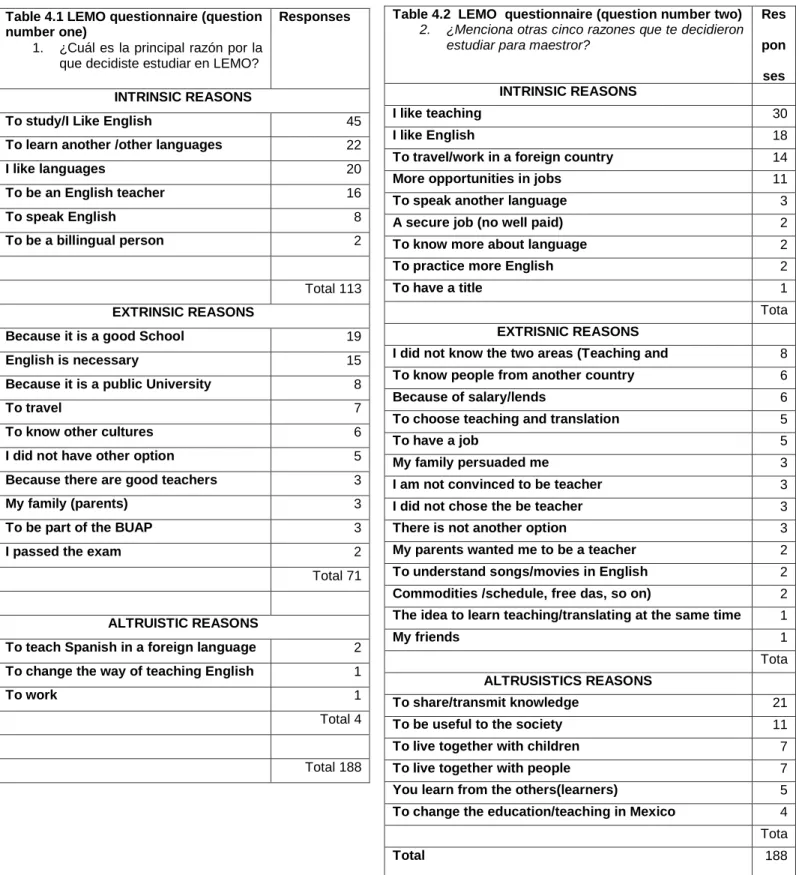
The analysis of the questions was done one by one. Table 4.1 and 4.2 show
the results obtained from Lopez (2008) above LEMO generation. The first table
illustrates the answer to question number one and the second to question number
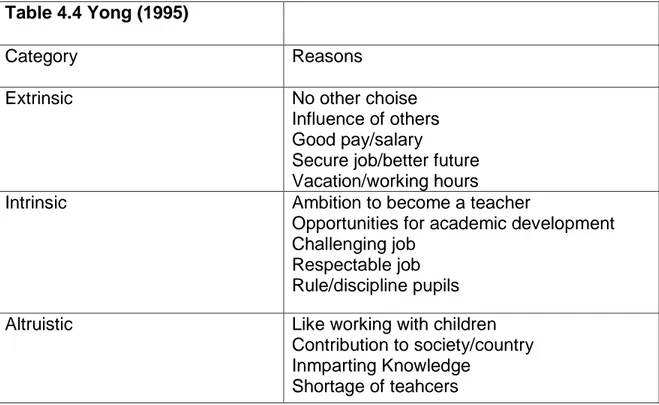
two proposed by him. The data was analyzed according Yong´s (1995) (see table
4.4).
4.2.1 Results of question number 1 and 2 (LEMO generation)
The next tables contain the subject´s responses. In table 4.1, there are the
results obtained from LEMO generation according to question number one and
40
To study/I Like English 45
To learn another /other languages 22
I like languages 20
Because it is a public University 8
To travel 7
To know other cultures 6
I did not have other option 5
Because there are good teachers 3
My family (parents) 3
To be part of the BUAP 3
I passed the exam 2 Total 71
ALTRUISTIC REASONS
To teach Spanish in a foreign language 2
To change the way of teaching English 1
To work 1
Total 4
Total 188
Table 4.2 LEMO questionnaire (question number two)
2. ¿Menciona otras cinco razones que te decidieron estudiar para maestror?
To travel/work in a foreign country 14
More opportunities in jobs 11
To speak another language 3
A secure job (no well paid) 2
To know more about language 2
To practice more English 2
To have a title 1 Tota
l 83
EXTRISNIC REASONS I did not know the two areas (Teaching and translation) and(aantratranslating
translating)
8
To know people from another country 6
Because of salary/lends 6
To choose teaching and translation 5
To have a job 5
My family persuaded me 3
I am not convinced to be teacher 3
I did not chose the be teacher 3
There is not another option 3
My parents wanted me to be a teacher 2
To understand songs/movies in English 2
Commodities /schedule, free das, so on) 2
The idea to learn teaching/translating at the same time 1
My friends 1
To live together with children 7
To live together with people 7
You learn from the others(learners) 5
To change the education/teaching in Mexico 4 Tota
l 55
41 The results showed a tendency and it is that most of the students chose this major
based on intrinsic reasons.
4.2.2 Results of question number 1 (LEI generation)
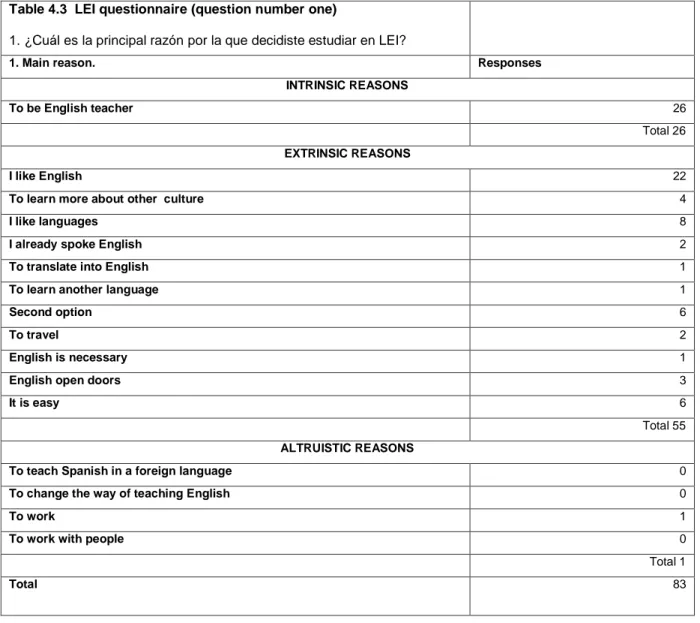
In table 4.3 the results of question number one from generation LEI are showed.
Table 4.3 LEI questionnaire (question number one)
1. ¿Cuál es la principal razón por la que decidiste estudiar en LEI?
1. Main reason. Responses
I already spoke English 2
To translate into English 1
To learn another language 1
Second option 6
To teach Spanish in a foreign language 0
To change the way of teaching English 0
To work 1
To work with people 0
Total 1
42 The results obtained from LEMO and LEI generation are different. In the case of
LEMO generation the tendency goes toward intrinsic reasons and in the case of
LEI generation it goes toward extrinsic reasons. In the case of LEI generation we
have that 26 students’ reasons to study at this department were intrinsic, 55
participants´ reasons were extrinsic and only one subject´s reasons was altruistic.
LEI responses about question number two were not showed in a table because
most of the students gave a variety of answers which were not related.
Consequently it was not possible to measure them. These points will be clarified in
4.2.3 and 4.2.4.
4.2.3 Differences
According to López (2008) LEMO generation enrolled at this ED because of
intrinsic reasons, meanwhile the results of this study showed that students decided
to study this major due to extrinsic reasons. However, LEMO generation´s results
had some week points at the moment of analyzing the data. For example, López
(2008) categorized the following options into the Intrinsic category: To study/I like
English, to learn another/other language(s), I like languages, to speak English, to
be a bilingual person. Some people might think that they belong into this category
since they are related to Languages; nevertheless, they are not related to English
Teaching. For example, students could have studied English because they liked
languages, or because they wanted to be bilingual, but not neccessarly because
they wanted to be English Language Teachers. Although, López (2008) followed
the model proposed by Yong, those options that he place in table 4.1 and 4.2 do
43
Table 4.4 Yong (1995)
Category Reasons
Extrinsic No other choise
Influence of others Good pay/salary
Secure job/better future Vacation/working hours
Intrinsic Ambition to become a teacher
Opportunities for academic development Challenging job
Respectable job Rule/discipline pupils
Altruistic Like working with children
Contribution to society/country Inmparting Knowledge
Shortage of teahcers
4.2.4 Variety of answers
Table 4.3 showed that LEI generations tended to choose to extrinsic
reasosn, but there is not a table related to question number two ¿Qué otras cinco
razones te hicieron decidir estudiar para maestro? because most of the subjects
gave answers which were not related. For example, a subject wrote a) I like
teaching b) a secure job c) because of the salary d) to be useful to the society and
e) My parents wantedme to be a teacher. In this case, it is not possible to put the
student’ s reasons into a specific category (intrinsic, extrinsic or altruistic) since all
44
Table 4.5 Variety of answers
1. ¿Cuál es la razón por la que decidiste estudiar en LEI? Porque quería aprender inglés
2. ¿Qué otras cinco razones te hicieron decidir estudiar para maestro? Porque todos los maestros de la facultad decían que terminaríamos como profesores
Porque al empezar a estudiar inglés me comenzó a gustar
1. ¿Cuál es la razón por la que decidiste estudiar en LEI? Porque soy bueno para inglés
2. ¿Qué otras cinco razones te hicieron decidir estudiar para maestro? No es una carrera saturada
Creo que esta carrera tiene futuro ya que están implementando inglés desde kinder
1. ¿Cuál es la razón por la que decidiste estudiar en LEI? Porque me gusta éste idioma
2.¿Qué otras cinco razones te hicieron decidir estudiar para maestro? Porque me hacía sentir bien
Porque quiero viajar
1. ¿Cuál es la razón por la que decidiste estudiar en LEI? Porque quería aprender más idiomas
2. ¿Qué otras cinco razones te hicieron decidir estudiar para maestro? La idea de poder viajar a otros países para conocer la cultura
45 2. ¿Qué otras cinco razones te hicieron decidir estudiar para maestro? Convivir
Aprender más idiomas Querer viajar
Conocer más gente
Then, it was not possible to establish a relationship between the first question and
the second one. Also, when they answered question number two, they were told
that it was not neccesary to give five answers if they did not have that number of
reasons; therefore, some students did not give five answers in question two.
4.3 Real reasons
Question number eight of the questionnaire was the last philtre to confirm
students´ reasons and it was analyzed according to Yong´s (1995) model. Table
4.6 shows the options given to the subjects and this question gave the students a
great number of options. These were placed in disorder and students had to write a
number from one to four where 1 was the most important and 4 the least important.
They had the option to put more without repeating the previous numbers, but only
the first four numbers were taken into account. If the answers in this chart were
related to the anwers given in question number one (which was analized according
to Yong´s (1995) model) it will mean that their reasons were confirmed.
4.6 Question number eight
8.- De las siguientes opciones enumera aquellos motivos que te hicieron decidir estudiar la Licenciatura en la Enseñanza del Inglés; siendo el numero 1 el de mayor importancia y el último el de menor importancia (no es necesario enumerar todas las opciones, sólo las que creas necesarias, así como el no repetir números).
Porque no tuve otra
opción
Por vocación Porque te gusta trabajar
46
Porque es un reto personal Por la escases de
profesores de Ingles
(1,2,3,4) into the same category (intrinsec, extrinsec, altruistic) he/she belonged to
it, but if the numbers were not placed into the same group, the subject was not
considered as part of it. In this case, the value of the number was added (1=10,
2=9, 3=8, 4=7) and according to it, the students´ answers were put into a specific
category. For example, if a student placed 1 and 3 into the intrinsic category and 2
and 4 into the extrinsic category, the value was :10+8=18 9+7= 16, then the
subject´s answer was placed into the intrinsic category.
Other cases appeared in which the main answer(1) was placed in the space
about vocation, but another number was placed in second option. Nevertheless,
second option means that this university gave him/her an opportunity to choose
another career due to the fact he/she did not get enough points to study the major
he/she wanted. Therefore, those students who chose this option were
47 chose the option I wanted to be a translator and as in the previous case, they
followed the same path.
Table 4.7 ilustrates the options given in table 4.6 into their category
according to Yong (1995)..
4.7 Order of motives or reasons based on Yong´s (1995) model Intrinsic reasons
Por vocación
Porque ser profesor es un trabajo respetable
Por oportunidades académicas Porque es un reto personal
Para fomentar disciplina en los alumnos
Por satisfacción personal y profesional (carreras complementarias
Extrinsic reasons
Porque no tuve otra opción
Por la influencia de otros(influencia o presión de padres, amigos)
Para tener un trabajo seguro/Para tener un mejor futuro
Porque trabajar como profesor implica tener vacaciones/Por tener un horario específico
Porque en estos tiempos el idioma inglés es necesario Para trabajar en el ámbito turístico
Porque en ésta carrera no hay matemáticas Porque ya sabía un poco de inglés
Porque fue mi segunda opción Porque quería ser traductor
Para viajar
Altruistic reasons
Porque te gusta trabajar con gente
Para contribuir a la sociedad o a tu país a mejorar la educación
Para compartir conocimiento
Por la escases de profesores en Inglés
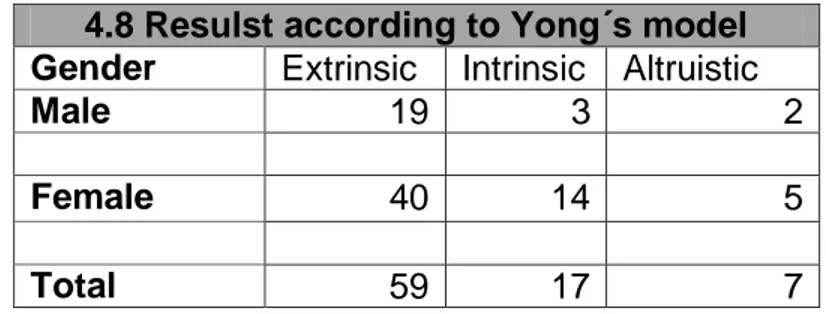
Finally, table 4.8 indicates the results obtained using Yong´s (1995)
48 This table shows that 59 students decided to do a major in English Teaching
basing their decisions on extrisnic reasons, 17 on intrinsic and 7 on altruistic. Into
the intrinsic category there are 19 males and 40 females, in the intrinsic category
there are 3 males and 14 females, and into the altruistica category we can find 2
males and 5 females. In a nutshell, most of the students of LEI generation 2011
enrolled at this major basing their decisions on extrinsic reasons.
4.4 Extra questions
The fact is that most of the participants decided to study English Teaching
basing their decisions on extrinsic reasons but it does not explain why a great
number of students did it. In the next tables and paragraps, extra information tries
to explain the cause of this fenomena. The results came from some extra
questions which were asked to the subjects.
Table 4.9 Name of the major
7.- Al momento de elegir estudiar la licenciatura en la enseñanza del inglés (LEI), prestaste atención a:
El nombre de la carrera
La currícula
Ninguna de las anteriores
ambas
36 20 21 6
4.8 Resulst according to Yong´s model Gender Extrinsic Intrinsic Altruistic
Male 19 3 2
Female 40 14 5