1
THE ATTITUDE OF STUDENTS AND TEACHERS
TOWARDS SLANG
A thesis submitted to the school of Languagues
for the Degree of Licenciatura en Lenguas
Modernas
By Martha Karen Schreiner Barrientos
Benemérita Universidad Autónoma de Puebla
2
THE ATTITUDE OF STUDENTS AND TEACHERS TOWARDS SLANG
This thesis has been read by the members of the thesis committee of
Martha Karen Schreiner Barrientos
And is considered worthy of approval in partial fulfillment of the requirement for the degree of
LICENCIATURA EN LENGUAS MODERNAS
_________________________________ Leonel Ojeda Ruíz
Michael Witten Rocío Vélez Tenorio
3
Con toda mi luz y amor para las personas que han hecho todo en la vida para que yo siga avanzando, por motivarme y darme la mano en este bello camino, a ustedes por siempre mi corazón y mi agradecimiento. Son mi pedazo de cielo:
Papá, Mamá, Pedrito y Abuela Martha.
4
Acknowledgement
5
TABLE OF CONTENTS
Page
1.CHAPTER I: Introduction 8
1.1 Introduction to the problem 9
1.2 Purpose of the study 9
1.3 Research Questions and Hypotheses 10
1.4 Significance of the Study
2.6.2 Views towards Slang in a foreign languages classroom 26
2.7 Conclusions 31
3. CHAPTER III: Methodology
3.1 Introduction 33
3.2 Chapter Overview 33
3.3 Subjects and samples 34
3.4 Method of Data Collection 35
3.5 Instruments 35
3.6 Procedures and data Analysis 36
3.7 Chapter Conclusion 39
4. CHAPTER IV: Results
4.1 Introduction 43
4.2 Obtaining the Attitude towards Slang 43
4.3 Students perception of Slang 44
4.4 Attitude towards Slang 46
4.5 Reasons behind those attitudes 48
5. CHAPTER V: Conclusions
5.1 Summary 54
5.2 Conclusions 55
6 5.4 Limitation of the study
6. References
57
7
TABLE OF APPENDICES
Page
8
LIST OF FIGURES
Page
1. Table One: Opinion Towards Slang 42
2. Table Two: Slang/Rude words? 44
3. Table Three: Attitude of Teachers 46
4. Table Four: Position of Teachers 47
5. Table Five: Which do Students Prefer? 48
6. Table Six: Where do they find Slang? 49
7. Table Seven: Will they change? 50
8. Table Eight: Did you learn Slang in the Classroom? 51
9
CHAPTER I: INTRODUCTION 1.1 Introduction to the problem
When a group of students learn a second language in an academic institution, the aspect of the language known as slang is typically left apart and overshadowed by other matters from that language. Regarding the English language courses in Mexico, Mexican teachers particularly seem to pay a high amount of attention to the “academic” English, and leave the informal vernacular out. As to the students, since they do not get in touch with slang thanks to the teachers’ refusal, they cannot really grasp its importance to the language.
This study was carried out in a universityof modern languages in central Mexico. Both qualitative and quantitative approaches were used, by means of interviews to students and teachers about their attitudes towards slang. Once the interviews were done the predominant attitudes towards slang among the study participants were collected. Next the study attempted to assess the reasons for those attitudes.
From a theoretical perspective, this study focused mostly on the different theories or attitudes regarding the use of slang by teachers and students, which is important for the design and development of classes that could feature slang as a topic. This bring us to the pedagogical perspective: Teachers’ attitudes in the matter of slang are important as they should decide whether it is important or not to teach it to students in the classroom, and also how students’ contact zone between the slang and the academic language is defined.
1.2 Purpose of the Study
10
- To gather and examine teachers’ and students’ attitudes regarding the use of slang in the classroom, and the reasons behind this attitude. As explained above, slang is a relatively new issue, and its importance is highly debated among language researchers.
- To find out the predominant attitudes among teachers and students at the University of modern languages where this research study takes place regarding slang, and finally:
- To suggest that more research studies of this kind be done, so that teachers are able to come to agreements when it comes to polemic topics such as slang, and also so that they can understand and develop better ways to approach them.
1.3 Research Questions/Hypotheses
RQ1 What is the attitude of most teachers and students towards slang being used in the classroom?
RQ2 What are the reasons behind this attitude towards slang?
1.4 Significance of the Study
As I have mentioned earlier, slang is a topic long overshadowed by other aspects of the second language, such as the Academic language, but it is also an important part of it.
Objectives
In order to achieve the aims described above, the researcher plans to carry out the following steps:
11
limited by the classroomsetting. Another reason foroutside interviewswas to get teachers “out of their territory” and get them to talk about something as polemic as slang in the classroom.
12
CHAPTER II: LITERATURE REVIEW 2.1 Introduction
The first time I noticed slang within the English language was in American films (mostly action or comedy). Of course I didn’t know what slang was back then, because, even though there’s slang in the Mexican Spanish too, I never knew nor cared about it; I just used it. So I regarded those slang words in the films as any other kind of words, and whenever I looked up those words in the dictionary, oftenI couldn’t find them, though sometimes I did.
I have studied English, since I was 9 or 10 years old. Also, I had the opportunity to live in the United States for a year, specifically in Michigan, McAllen, Texas and North Carolina and I picked up bits of English slang along the way. A few examples of these informal expressions that I learned are: What’s up, dude?, How’s it going?, What’s up, gal?… and others. Of course, I was not aware of the fact that what I was learning was slang, until now that I am in the process of studying it. However, I have never been taught
slang in the classroom, in my English classes. And whenever I would use one slang word that I had learnt from songs or films or in the United States, in an essay, for example, I was told by the teacher that those words should never be used in a formal, because they are informal. This awakened in me the interest for this informal language. Why is it not used in the classroom? Why do teachers not teach informal language, even though it is used many
times in a real English context, as I have experienced?
13 2.2 Key Terms
DEFINITION OF TERMS
-SLANG: It is the informal part of the language. It is a very wide and varied extension of the language, used by the general population, which is opposite to the academic language, mostly employed by scholars and intellectuals. There are several types of slang, depending on social status, social group, region, and even different contexts of occupations (for example, the military has given birth to several slang words that are different from that of the civil population).
-ACADEMIC LANGUAGE, as mentioned above, is used mostly by educated people, in opposition to the informal language, used by most of the population. Although this research refers mainly to slang, it is important to define Academic language, and establish the regarding the use of a second language in the classroom. Teachers’ ideas may have a strong influence onthe students, consequently it is important that they have a defined set of ideas in regard of to how the second language must be used in the classroom.
2.3LinguisiticIdiologies in the classroom
14
The ideologies that both teachers and learners hold are hardly ever explored in an open and critical way, yet these ideologies come to define how students build knowledge through theirexplorationsof language as a cognitive, communicative tool (Wake, 2005). In my opinion, teachers have to find a way to make students interested in experimenting with the language in a communicative manner, and the ideologies come to play a meaningful role in this process. In my view, a teacher cannot impose his or her linguistic ideologies to the students, but certainly teachers can explain them to the learners so that they can come up with their own ideologies regarding language.
Academic settings comprise a situation of language contact, which can take place in the classroom, and ideology and the language have been shown to be tied to issues of social class. Language contact in academic settings is by nature intrinsically inclusive of inequity. The languages and ideologies at play in the classroom are defined by a disproportion of access and power amongst learners and between learners and teachers. (Wake, 2005).
Teachers have different ideas regarding the language and what specific aspects of the language to teach. These ideas vary according to the culture the teachers come from, and the background and education that teachers have or had. These factors make it very difficult for language teachers to agree as to whether there is a better way to teach a language, and what topics should be avoided or not.
15
really a definite agreement on how to teach at an international level. I suppose that, for example, in the Arab countries, many topics are avoided by the teachers, and seen as controversial or even taboo, because of the religious censorship of the Islam.
In this particular research study, I addressed exclusively Mexican teachers at the faculty of modern languageswherethis study took place.
Along with the culture, background and education of ateacher, prejudices come to play an important role in the teaching of a language. Teachers may feel that certain aspects of the language they teach are not as important as others. Another point to take into consideration is that teachers might not only disagree in what should be taught in the classroom but also in the means to teach it. In this particular research project I focused one of these aspects of the English language that is overshadowed by others. I am referring, of course, to slang.
In addition, one topic I am interested in is “the contact zone theory”, which deals with the struggle between formal and informal language; specifically how students use one and reject the other, and why that happens.
2.3.1 Contact zone theory
What defines formal writing? How does academic writing differ from writing for other contexts? As a future English language teacher, I must be conscious of the nature of
formal and informal writing and how can I pass instruction to my students about the differences between these kinds of writing. For this, the “contact zone theory” gives me a heads-up.
16
happens.The new technologies have brought words and expressions into the language as well. Thismakes it difficult for teachers to draw and maintain a definite line between the formal and informal language that students use. However, teachers may take advantage of these new technologies for developing students’ writing skills, since students are already comfortable using them for writing (McMillan-Clifton, 2007).
What are the methods that teachers use to prevent students from mixing both
formal and informal languages? This is a question I expect to be able to answer by interviewing teachers about their methods.
Harris (1997, pp.117, cited by Wake) defines the contact zone as “a contested space where many discourses and cultures may meet and struggle with each other”. In order to avoid, or at least “soften” this struggle, peer review could be a good idea. Students review each others’ written work and compare it to their own. However, it would be just for essay drafts, not the final ones,those are onlyfor each student and the teacher to see.
2.4 Classroom Language
In an English language classroom, the language most used by the teacher and students is English, it has been shown the best way to learn a language is by producing (speaking or writing) words and sentences; in other words, by using it. We could say that the language employed in the classroom by both teachers and learners determines, in a great deal, what is learned and how it is learned (Wilkinson & Silliman, 2001).
17
oral communication (Wilkinson & Silliman, 2001). These factors affect students’ usage of syntax, meaning and communicational purposes.
The way children use language in the classroom is greatly influenced by how children experience language use at home, with their parents. “Through these experiences, children are motivated to learn about literacy events, functions, artifacts, forms, and conventions before they learn to read and write” (Morrow, 1993, pp.49-67; van Kleeck&Schuele, 1987, pp.13-31; Whitehurst &Lonigan, 1998, pp.848-872, cited by Wilkinson & Silliman, 2001).However, as Cherry (1979) points out, parents do not usually evaluate how well children use the language, whereas teachers do. In consequence, when children enter school, they already have expectations regarding the classroom. But it may just happen that some students have difficulty learning how to participate and communicate appropriately in the classroom, and this may result in educational failure. Also, students from different backgrounds and children from immigrants may provide a cultural diversity in the classroom from which their peers may benefit, and new words (possibly from the culture they come from, and slang among it) to enrich the language used in the classroom.
McColl (2009) suggests that the target language is used for “real purposes”: what people in the classroom (both teacher and students) need to say, either greetings, procedures like calling the roll, instructions, and so on
18
Mostly, the English spoken in the classroom is the academic, formal English, which is considered more correct. In the next section of this chapter, I explain the characteristics of this type of English. However, for the remainder of this section I discuss features of informal English.
In many classroom settings informal English is often left out by teachers especially in essays or written exercises. There is more than one type of informal English, however. Idioms, which are taught in the classroom to a certain degree, and slang, which is banned by many teachers and therefore, not many students know about it. It is slang, its usage in the classroom and teachers and students’ attitudes which is the central issue of this research. I explain the characteristics of slang in another section of this chapter in more detail.
19
In the next section, the concept of communicative methodology is introduced. The way teachers deal with communicative processes while teaching their students the English language, and using the language as well in the classroom.
2.4.1 Communicative Methodology
The communicative method focuses mainly on the student's ability to convey his or her ideas in the target language, in this case English (Van Hattum, 2006), Al-Humaidi (1999) say that communicative language teaching is an approach rather than a method, since methods are regarded as fixed teaching systems and approaches are philosophies that can be applied to a variety of ways in the classroom.
In the English classes, teachers often attempt to maketheir lessons be as real as possible. For achieving this they make use of several different methods, such as recordings of conversations, films, role-plays and dialogue drills. However, oftenthese methods and activities betray their purpose: the recordings may sound extremely rehearsed, or in the role-plays, students are told to use only academic English and not the informal one, or in the dialogue drills, teachers focus mostly on the correctness of students’ spelling, instead of the production of words and phrases.
As Richards and Rogers (1986, pp.2) point out:
…learning activities are selected according to how well they engage the learner in meaningful and authentic language use (rather than merely mechanical practice of language patterns).
20
mistakes in pronunciation and spelling when practicing (Van Hattum, 2006). Such issues take the reality out of the activities, which then become boring and uninteresting. Teachers should look for ways to stop this from happening, and also to improve the communication between the students in a real way.
In this research, I intend to investigate how teachers cope with these difficulties regarding the communicative methodology of the activities mentioned above, or if they make use of different activities to achieve real success with the students. Also,because students’ opinions regarding the teachers’ methods are very important and should be taken into account, I asked students their opinion about such activities and methods, and whether they fulfill their purpose.
Van Hattum (2006) suggests that a teacher should simulate a normal pronunciation of the target language, that is, without overdoing the accent and pretending not to understand errors that are typical of first language interference. I tried to ask teachers whether they have employed this method and how it worked for them.
Also, culture is strongly tied with language. Indeed, “If one wants to speak with people, communicate with them and have good contact, only knowing their language is not enough. One has to know at least that much of their culture, especially of their rules of politeness, as not to cause unpleasant situations” (Van Hattum, 2006). So, as students learn the language, they have to learn the culture as well.
21
are scarce in the Arab world, and that the education facilities are not as advanced as in more developed countries, so as to provide materials for the teachers and the students. I ask myself: Is it the same situation in Mexico? Do we lack the innovation and imagination necessary to put this approach into action? Or has it been already tested and discarded?
These questions I hope to see answered somewhat by means of interviews to teachers. So I tooknow how teachers feel about it.
2.5Academic English
An academic English language definition is featured by Terry Wing (2006, pp.1) from Solomon & Rhodes (1995) as “the language functions and structures used in the classroom (...) vocabulary, lexis, and syntax, (...) and the sociolinguistic concept of using particular styles of language (or stylistic registers) to accomplish various academic tasks.”
However, Wing (2006, pp. 1) defines academic language as “the language used in instruction by the teacher, as well as formal language used in formal writing”.
In an English language classroom, teachers start by teaching some “survival” formula that students practice religiously by means of repetitions and drills. Phrases such as May I go to the bathroom?, It is nice to meet you, Thank you very much, My name is..., and others, and students repeat them several times in simulated conversations or dialogues among themselves as part of the learning process. These drills may well be considered some of the academic tasks mentioned before.
22
rude swear words, the dark face of the language. Academic language is, then, accepted and encouraged.
Now, it should be noted that both the academic and the social (informal) English are not two different languages but merely that the academic English is more demanding and necessary for the students’ success in the classroom. This is in a great deal because of the factor aforementioned: that teachers prefer it ahead of the social language.
In the internet website www.ColorinColorado.org/webcastsin the 2007 webcast, named Becoming bilingual, it is mentioned that it is important that English language students learn the academic English since an early age, because it helps them meet the standard-based curriculum, succeed in their future schooling and basically become academically-proficient in English.
Wing (2006) also suggests that teachers ask themselves if they are using too much academic English, and if so, how they could tune down their language to the students’ level of understanding. In fact, I understand this as an advice to teachers to resort to informal English (if needed, slang), in order that their students understand them more easily. Indeed, a teacher should be aware of his/her students’ needs, and look for different, innovative ways to solve them, like Picard (2006, cited by Wing) mentions for example, develop tasks that make students aware of structure, cohesion, coherence and organization in a text, with completion or fill-in exercises.
23
with three instructional goals in mind: to use English to communicate in social settings, to use English to succeed academically in all content areas and to use English in socially and culturally appropriate ways. Now it is for teachers to decide on the best way to achieve these goals, and for that they rely on multiple materials and different models of teaching.
In its 2007 webcast, the website Colorín Colorado, featuring Dr. Robin Scarcella,also suggests that there are two types of academic English. The one that is integral and part of the Academic content taught in the classroom and the one used to teach that content and deliver instruction –provide directions, explain processes, make assignments, discuss grades, plan school events...; a functional academic language. And it is up to teachers to know how to make the distinction between these two kinds of academic language and how to employ them in an appropriate way.
Finally, I wish to state that I am not at all against the instruction of the academic English. I consider it to be of great importance to the success of the English language students in the classroom, even if sometimes the activities and materials used bythe teachers do not achieve theirpurpose. However, I do think it is important that teachers consider the growing importance of the informal type of English known as slang and that students need to learn it in a communicative approach (as mentioned in section 2.4.1) as well.
2.6 Slang
Slang is "language which takes off its coat, spits on its hands -- and goes to
work."
24
Slang is the informal, vernacular language used mainly by the low and middle
classes among the American population. It has existed for centuries, and one of its main characteristics is that tends to change according to important events happening, new technology emerging and social groups introducing new words and expressions into the everyday lexicon. Here I feature some slang definitions, as taken from research articles about the matter.
Slang is defined as a “non-standard vocabulary of a given culture or subculture”. In other words, slang is typically a non-standard word, not a phrase as is an idiom. (...) Slang words may or may not have alternative literal meanings. They may be ‘made up’ words” (Burke, 1998, pp. 1)
“Slang often suggests that the person utilizing the words or phrases is familiar with the hearer's group or subgroup (...) Slang has no societal boundaries or limitations as it can exist in all cultures and classes of society as well as in all languages” (Bullard & Johnson, 1997).
Also, the Internet provides a space where people may speakto many concerns and ideas, like the slang matter. In a blog I found with the title Does slang prevent young
people from being able to communicate properly?Posted in the
webpagehttp://debatewise.org/debates/3082-does-slang-prevent-young-people-from-being-able-to-communicate-properly, the following definition of slang is given:
25 2.6.1 Sources of slang
This section features an extract about the multiple sources that slang may come from, as well as factors that may modify it as society moves forward. Slang has been part of the language since immemorial times. However, it has not always been the same kind of slang. Times change, new technology comes into use, important events happen in the
world and each of these factors causes the appearance of a new word or expression that may or may not become part of the slang, and eventually part of everyday vocabulary.
Immigrants also introduce new words into the English lexicon. An example of this is the word kosher, which is now used for everything that seems acceptable, and that originally described a Jewish dish. Sports also are the source for several everyday expressions and words, which were first part of football or baseball lingo. An expression like “hit below the belt” comes from boxing, “to get one’s feet wet” is taken from swimming and “being out of someone’s league” is from baseball (Burke, 1998).
I think it is highly important to know the many types of slang, and the origin of idiomatic expressions and phrases, in order to understand them better and also perhapsto predict their possible future.
I mentioned above that immigrants from different parts of the world introduce new words and expressions into the English language. This has slowly caused the birth of several types of slang. For example, the Afro-American people (especially teenagers and young adults) have their own slang, their own kind of speech, which differs greatly from the average Caucasian American English.
26
War and Persian Gulf War gave birth to several expressions that arose in the Army, like roger (used in the Army to acknowledge an order from a superior) and which is now used for making it clear that you understood something, even if you do not belong in the Army.
Burke (1998) maintains that slang is not only used by the lower classes, rather
2.6.2 Views toward slang in the foreign language classroom
In this section I include both views supporting and rejecting the use of slang by students in the classroom. Slang is usually left out by English language teachers, who prefer the academic language for students to learn. Most teachers seem to consider that teaching slang means teaching rude words, and that this is highly unethical from teachers and harmful for students whom they feel should not be using such language.
27
Nicholas Harris reportedly told this media: “It is hard because the people I hang around with always use slang.” (BBC News, Wednesday, 7th July, 2004, http://news.bbc.co.uk/2/hi/uk_news/england/london/3871911.stm)
However, there are also researchers who believe that slang should be taught in the classroom. Here I feature some of their opinions.
Fein (2011) in his essay Promoting Vulgarity by Teaching Slang in the Classroom, marks some reasons why slang should not be taught in the classroom, according to him. The bold sentences are his opinions and the rest of the paragraph states my views regarding his.
- A lack of knowledge about slang expressions by English teachers who do not speak it as their first language. Indeed, non-native speakers of the English language, who nevertheless teach it, often may not be familiar with several slang expressions, because they are not part of their vocabulary. Teachers would not know in whatcontexts is an expression correct and boundaries to that expression.
- Inappropriate use of slang words by students. This point is related to the previous one. If teachers do not know the right meaning of a slang word or expression and the contexts in which it can be used, students cannot acquire this information in the classroom. If teachers nevertheless try to teach them to their students, they will not use them in an appropriate context or with the right meaning.
28
this is misinformation. Teaching slang does not necessarily mean teaching rude words at all. I explain this view of mine further in the next paragraphs.
Up until now I have featured the negative views toward slang being used in the classroom. From here on I shall present the positive ones. Not that a teacher should devote to only teaching rude words to students and how to use them. I am merely saying that a teacher could teach certain light vulgar words to his/her students and in which contexts would that word fit, in order that when the students feel compelled to use that rude word, they do not commit a mistake that might embarrass them. As Burke (1998, pp.5) points out:
“As educators, we need not promote the actual use of slang, idioms, and certainly not vulgarities, but we do have a responsibility to familiarize the non-native speaker with this type of language. After all, whether we like it or not, this non-standard English has existed for years and will continue to exist.”
As to the students, since they are not encouraged by their teachers to learn slang on their own, they might find it quite difficult to actually grasp its importance in the language. As mentioned before, students eventually get to learn rude words, but maybe not in the right context (some swearwords may be used in more than one right context), and they certainly do not care much for light, not rude slang, which is, I daresay, slightly more important than naughty words.
As Fein (2011, pp.1) puts it:
29
have deliberately omitted. I am not, by the way, advocating that we acquaint our students with obscene slang.” students would rather learn only rude words, and leave the rest of slang out. I consider both extremes equally shortsighted.
However, I agree to a certain degree with the blog mentioned above (Does slang prevent young people from being able to communicate properly?), which features several
opinions as to whether slang prevents young people from communicating properly. Some of the reasons mentioned are these: where it is not. In my opinion, if teachers taught students different contexts in which slang works, the result would be that students could get to practice among themselves with slang, which would become a meaningful activity for them.
30
wearisome practicing of just academic English, and it could mean introducing them to the concept of slang, by showing them its appearance in written works of literature.
A different, though not unrelated issue arises from the fact that students today aremore acquainted with technology that ever in the history of education. No doubt that this has brought several benefits to teachers, institutions and the overall concept of education. But this seems like a double-edged sword, with risks. One riskis that a new type of informal language has surged among the students from their constant contact with technology (social networks, Internet sites, and cellphones, among others).
31
and purposes, by comparing this “tech-slang” to English (or any other language) and showing students how both languages work.
2.7 Conclusion
The use of slang is a polemic topic, if not a taboo, in the classroom. Teachers usually ban its use in the classroom, in essays and paper works. In the newspaper article aforementioned (BBC, July 2004), it is mentioned how teachers apply techniques with the purpose of slowly eradicate slang from the classroom, such as keeping count of how many times students use a slang word, and introduce an alternate, academic synonym for that particular word.
I do not seek to demerit academic English. I am just merely pointing out that the other face of the American English; the informal language (slang) is left out by teachers and in my opinion that should not be so.
32 addition to the formal side of the language. Methods such as interviews to both teachers and students of said university were used, regarding their opinions and attitudes toward the informal language, and especially its usage inside the classroom. Then, through the analysis of the data, I tried to define whether slang is accepted or rejected by most students and teachers at the university. Indeed, informal language, or slang has since long been somewhat overshadowed by other aspects of the language, considered more appropriate for students to learn. Consequently, this study also seeks to shed light upon this “taboo” topic, and the reasons behind teachers’ and students’ reactions towards it.
3.2 Chapter Overview
This chapter describes the methods and procedures used to conduct this research, as well as the participants (students and teachers) who participated in it. It features data from the participants’ background and/or current conditions. The materials used for the research were carefully devisedand I also watched over my way of conducting interviews and/or tests in order to avoid making the participants uncomfortable or unwilling to participate.
3.3 Subjects and samples
33
study they were all English-language teachers with several years of experiencein the field. I tried to gather opinions from foreign teachersas well as Mexican teachers in order to have views from teachers who speak English as their first language andthoseas a second language.
The second group consisted of the students from the same language faculty. Fifty students of the aforementioned university participated in the study. Their ages ranged from 18 to 23 years. At the time of the study they all were studying English as a foreign language and were all in an English language teacher preparation program. Since the university this research took place in is public, it is sensible to assume that some are fromfamilies of middle extraction. I interviewed an equal number of male and female students (25 males and 25 females) because customarily in Mexican society, men are more prone to use informal language than women.Consequently I felt it would be interesting to see if such a pattern is likewise reproduced when both men and women (non-native speakers) use the English language.
I wondered if younger people in general are likely to be interested in informal language, when it comes to a language other than their first language (Spanish), so age wasalso a factor for this research.I will compare student responseswith the teacher responses asthe teacher participants were older than the student participants.
3.4 Method of Data Collection
34
this research project. These participants would be the ones interviewed regarding their (students and teachers) attitudes toward slang being used in the classroom.
The interviews were structured since they have an established organization that the semi-structured interviews do not possess. This was particularly important for me since I would find it somewhat difficult to maintain organization when interviewing a person if the interview were to differ from what I expect. I felt more at ease with an interview that already had an established structure. As for the questions in the interview, I used both closed-ended (yes/no) and open-ended questions, since my study is both qualitative and quantitative, I had a feeling from the beginning that I would findinteresting information in the interviews.
3.5 Instruments
The first interview consisted of questionnairesaimed at the teachers and the students; the questionnaire for teachers had 5 questions, 2 of them intended to inquiry about their attitude, and 3 to try and discover the reasons for these attitudes. The questionnaire for students had 8 questions, 2 of them intended to inquiry about their contact with slang, 3 of them intended to inquiry about their attitude, and the last 3 intended to determine the reasons for these attitudes.
I designed the questionnaires as non-biased and impartial as possible as well as easy to answer, for both the students and the teachers. I did not query about the participants’ prejudices toward formal or informal language, but rather collected solid information about their standpoints and opinions.
35
number of students have breaks between their classes and therefore are available for a quick interview. As for the teachers, I tried not to bother or be overly importunate with them in any way. I also was carefulto conduct the interviews, since the topic of slang is, if not forbidden, left apart by the teachers.
3.6 Procedures and data Analysis
I first used the short questionnaire in order to identify potential participants in this research. The questionnaire consisted of three short questions, the first two, asking whether that person was willing to participate in a research project about slang and if that was the case, if that person was willing to be interviewed in relation with his/her stance toward slang.
The third question just was to know the interviewee’s stance toward slang.
Then, once I had the participants identified (11 teachers and fifty students) I
As for the open questions, I had them examined independently, as follows:
-Could you give me your definition of slang?
36 -Do you know American slang words?
I made a small list of 15 commonly used or known slang words, and had the students identify the meaning or accepted translation of each of the words.
-Do you think that slang and rude words are different? Why?
I tried to find patterns in the students' perceptions of slang and rude words.
-Books, magazines, films and songs: which do you use the most? -Have you seen or heard slang in books, magazines, films or songs? -From the four above, in which have you seen or heard most slang?
For these questions, I made graphics of the most used of these media by the students, and the media that students signaled as most filled with slang.
-Why are you in favor ofor against students learning slang in the classroom? I assorted students by their reasons pro or against slang being used in the classroom, again, trying to find patterns in their answers. I made a list of the most common reasons.
-Do you think that your attitude toward slang may change when you become a teacher? Why?
37
As for the teachers' answers to the interviews, I did the same thing as with the students' yes/no questions. I did graphics according to YES/NO categories. As for the open questions:
-Could you give me your definition of slang?
I sortedthe teachers' answers by the most common definitions of slang, with key words such as "informal", "rude", and others. I then tried then to find patterns in the way that teachers perceive slang.
-Do you think that slang and rude words are different? Why?
I tried to find patterns in the teachers' perceptions of slang and rude words.
When you were a student, in your English language classes were you taught American slang by your teacher?
I had the teacher interviewed give me a list of some words that he/she was taught when she/he was a student.
-Why are you in favor or against students learning slang in the classroom? I sortedthe teachers by their reasons pro or against slang being used in the classroom, again, trying to find patterns in their answers. I then made a list of the most common reasons.
38
Since the teachers interviewed may feel that telling namesof fellow teachers who teach slang, would be close to telling on them or gossiping, I just had this question examined like a Yes/No question.
Chapter Conclusion
In this chapter, I explained the resources and methods used for obtaining the information and the off analysis.
39
APPENDIX I: INTERVIEW QUESTIONS FOR STUDENTS
1. Could you give me your definition of slang? 2. Do you know American Slang words?
3. Do you think that Slang and rude words are different? Why? 4. Books, magazines, films and songs, which do you use de most? 5. Have you seen or heard slang in books, magazines, films or songs? 6. From the 4 above, in which have you seen or heard most slang?
7. Why are you in favor or against students learning slang in the classroom? 8. Do you think that your attitude toward slang may change when you become a
40
APPENDIX II: INTERVIEW QUESTIONS FOR TEACHERS 1. Could you give me your definition of Slang?
2. Do you think that slang and rude words are different? Why?
41
CHAPTER IV: RESULTS
4.1.Introduction
The purpose of this fourth chapter is to present the results of the application of all the questionnaires mentioned in chapter III that were applied to students at random at the university and the results concerning slang of the students. Specific conclusions about these results and the implications are also provided.
The results will be presented in the following way. First of all, the results obtained referring to what the attitude of the students and teachers towards slang is will be presented and discussed based on the research question: “What is the attitude of most teachers and students towards slang being used in the classroom?” Second of all, the results obtained referring to the reasons of such attitudes will be presented and discussed based on the research question: “What are the reasons behind this attitude towards slang?” Finally, the results obtained referring to extra questions of the questionnaire will be presented and discussed.
4.2.Obtaining the Attitudes towards slang.
As it was stated in the method section, a questionnaire was applied to several students around the university. This was applied to find out their attitudes towards slang. The reason why it was applied to students at random was that those students will have different levels of proficiency in English and different experiences regarding slang.
42
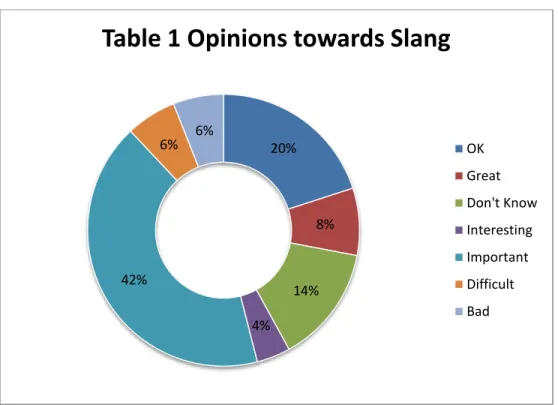
Based on these results it was possible to establish the different ways in which students perceive slang and also, the percentage of students that don’t know what slang is.
4.3.Students Perception of Slang
The first statement regarded the opinion of students towards slang. In this section, 50 students selected randomly gave their opinion about slang, but this time it was regarding the aspect of rudeness. 6 students said they think slang is rude, practically the same as saying offensive words. Those students were reluctant to using slang in the classroom. 31 students said they believe slang and rude words to be completely different. They think slang is important when learning a foreign language. Those students were interested in including slang in the classroom.
43
6 students said they don’t know what slang is, and if it is rude or not.
As shown by the results, more than half the students believe that more than half the students believe slang to be different from rude words. This is a positive aspect of the results, since this positive attitude shows there are no prejudices towards slang. 14% of the rest of the students claimed language is rude depending on the use of the language, the purpose and the message of the speaker defines whether the language is rude. I consider this important because it shows a very good understanding of how the language works. Based on those results I believe the answer to the research question: “What is the attitude of most students towards slang being used in the classroom” is: they have a very positive attitude and are willing to learn slang as much as possible, as any other cultural aspect of the language.
12%
62% 14%
12%
Table 2 Slang=Rude?
Slang= Rude
Slang ≠ Rude
Slang ~ Rude
44 4.4.Attitudes towards slang (Teachers)
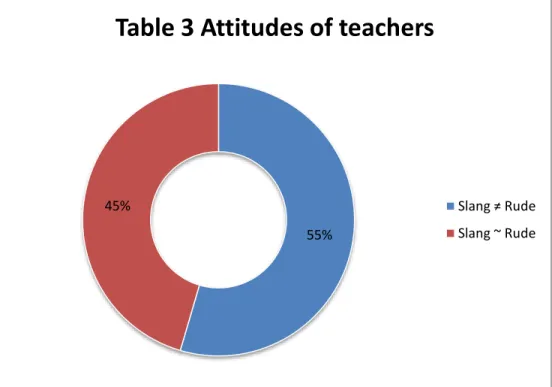
The second statement regarded the attitudes of the students towards slang, now the attitudes of the teachers are needed to answer the first research question. In this section, 11 teachers of the university gave their opinion about teaching and using slang in the classroom. 6 teachers said they clearly believe slang to be different from rude words.
5 teachers said they believe slang and rude words overlap depending on the use, they raise awareness that there should be some caution in teaching slang. They believe that it must be clear when to use the Standard English and when to use slang.
I consider based on this answers that the teachers have no prejudices about slang. All of them are conscious of the importance of culture in language and that slang is part of such culture.
The next question was focused on inquiring if the teachers are in favor or against students learning slang in the classroom.
55% 45%
Table 3 Attitudes of teachers
Slang ≠ Rude
45
9% of the teachers actually believe that there must be some regulation about how to teach slang, and make students understand that languages is needed to be used according to the place and situation.
Based on those results I believe the answer to the research question: “What is the attitude of most teachers towards slang being used in the classroom” is: they have a very positive attitude and are willing to use slang in the classroom, but there must be awareness of when to use slang and how to use it.
4.5.Reasons behind those attitudes.
The final statement regarded the answer of the first Research Question. In this section, an attempt to explain the reasoning about the attitudes mentioned is made. Some questions in the questionnaire were focused on gathering information about how students have contact with slang.
91% 9%
Table 4 Position of Teachers
Favor
46
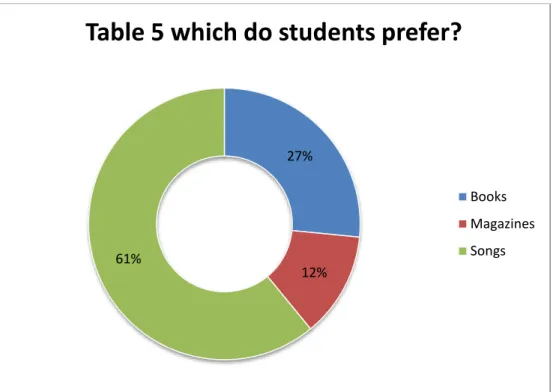
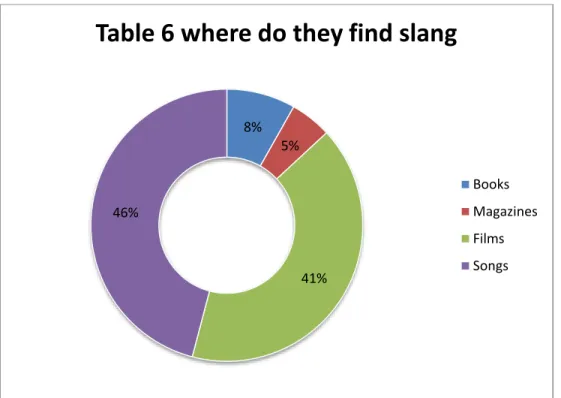
The following results are only concerned with the preferences of the students and the contact they have with slang. Table 5 shows the results of which media students like the most and Table 6 shows the results of where students are having contact with slang.
27%
12% 61%
Table 5 which do students prefer?
Books
Magazines
47
46% of the students have their principal contact with slang in music. 41% have contact with slang in movies and the rest of the students have contact with it in books and magazines.
The following figure deals with what the students believe, whether their attitude will change their attitude regarding slang when they start working as teachers.
8% 5%
41% 46%
Table 6 where do they find slang
Books
Magazines
Films
48
According to table 7, 46% of the students said their attitude towards slang will be the same when they start working as teachers. 31% of the students believe they will change their practice regarding slang. 17% of the students do not know if they will change or not, and 6% of the students said that depends on the level they will teach, the purpose of the class and the students.
Finally, table 8 and table 9 show if the teachers interviewed were taught slang when they were learning English and if they know if their colleagues are using slang in their classroom.
31%
46% 17%
6%
Table 7 will they change?
Change
Won't Change
Don't Know
49
I believe these results are important, basically 55% of the teachers were not taught slang when they were learning English given that number and the apparent 36% of the teachers that do not use slang in their classes could be related to why students only perceive
36%
9% 55%
Table 8. Did you learn slang in the
classroom?
Yes
A little
No
46%
36% 18%
Table 9 Use of Slang in Classroom
Colleagues Teach it
Colleagues don't teach it
50
to be having contact with slang in movies and songs but they seem to miss it in the classroom.
51
CHAPTER V: CONCLUSIONS 5.1 Summary
The overriding purpose of this study was to determine the attitudes of teachers and students towards slang, as well as the reasons of these attitudes. To accomplish that goal it became necessary toreach a prerequisite goal. Determining what students and teachers know about slang. Related to that effort, it became necessary to add some questions about the definitions of slang, and the contact in the past. To provide for thepossibility that the knowledge of slang could be perceived and measured as acomponent of these attitudes intended to be found. This chapter reports the conclusions and recommendationsthat resulted from this study.
Two versions of a questionnaire instrument were developed and applied to students and teachers of the University of Modern Languages in BUAP. One version of the questionnaire was designed to be applied to teachersof the university. The alternateversion was designed to be applied to students from the same institution.
All respondents were asked several open questions that were related to the topic of slang. They were askedo specify definition, attitude and some opinions about slang.
Finally, all the data was recollected and sorted out in a manner that was possible to be quantified. Through the use of the questionnaire instruments developed for this study, and the use of qualitative and quantitative methods data were collected which addressed the research problems posed in the firstchapter of this thesis.
5.2 Conclusions
52
classroom, even teaching some slang in their classes. Nevertheless, it is important to take into account the comment of some teachers that there exists the need to specify when to use formal and informal English.
The attitude of students towards slang is positive, they believe it is important to learn it, and are willing to use it in the classroom. Nevertheless, there is still a percentage of students that have not had contact with slang. There is a bit of a problem in those points, there exists the claim that teachers are taking into account slang in their classes, and also there is a percentage of students that have not had contact with slang. In making this comparison significant differences are shown. Both claims are contradictory, and I believe it is necessary either to make students aware of what slang is, or create specific techniques to separate the formal from the informal speaking practices.
It can be implied something significant from this study, and that is that students are really excited about learning the language, and that they are open to learn as much as possible. Such excitement can lead to have better language users, users that can apply formal and informal varieties of the language according to their necessities.
This research identifiedone aspect to be concern about and that is the level students have in their use of the standard variation, even if they are open to learn slang, it must be taken into account that they have their Standard English in a better level, so providing them of a better opportunity to master variations of the language without too much difficulty.
53
The mean scores indicate that teaching will be taking into consideration more and more the informal variations of the language, since students today are very excited about learning those variations. They also show that they are prepared to distinguish which are the appropriate settings for each variation.
5.3 Directions for further search
The following recommendations are offered for related research in thefield of Informal Variations of the language.
1. Given the changing nature of teaching as a practice, a series of longitudinalstudies, based on this model, would document trends and thereby increase the precision of determining how slang is being perceived by teachers and students.
2. Given that this study provides a basis for concluding that informal variations of the language contributes to focusing on something students want to learn, it would be recommended to make an experiment to compare the motivation of students that have use of informal variations in the classroom, and the motivation of students that have not use of informal variations in the classroom.
5.4 Limitations of the study
The following recommendations are offered as possible ways to improvethis study.
1. In this study, the only instrument used was questionnaires; the addition of more instruments would provide more detailed results.
54
55
REFERENCES
Academic Language for English Language Learners Dr. Robin Scarcella, University of California at Irvine Delia Pompa, National Council of La Raza
Academic Language in the Classroom Terry Wing (2006)
BBC News, Wednesday, 7th July, 2004,
http://news.bbc.co.uk/2/hi/uk_news/england/london/3871911.stm
Bullard, Winona. Johnson, Fox, Kelly. “Slang” 12 Dec. 1997. 2 Feb 2004 Does slang prevent young people from being able to communicate properly?
http://debatewise.org/debates/3082-does-slang-prevent-young-people-from-being-able-to-communicate-properly
Language Ideology in Schooling Practice ©2005 Donna Wake , La Salle University
Lassiter, Wood & Sakowicz, as taken from Teacher Blogs > Teaching Now -
http://blogs.edweek.org/teachers/teaching_now/2011/06/is_it_ok_4_students_2_use_text-speak.html?print=1- by Liana Heitim, 2011
Louise C. Wilkinson &Elaine R. Silliman
Handbook of Reading Research: Volume III, 2001
Majid Al-Humaidi 1999
Communicative Language Teaching
Promoting Vulgarity by Teaching Slang in the Classroom DAVID A. FEIN
UNIVERSITY OF NORTH CAROLINA AT GREENSBORO (2011) TCC 2007 Proceedings
The Confluence: Process Theory, Contact Zones, and Online Composition, by Alexis McMillan-Clifton
Adjunct Writing Faculty, Highline Community College, Des Moines, WA. [email protected]
56
What Is the Difference Between Social and Academic English?By: Colorín Colorado (2007)
Without Slang and Idioms, Students are in the Dark!
David Burke, in the September/October 1998 issue of ESL Magazine. Woolard, K. &Schieffelin, B. (1994).Language ideology. Annual Review of Anthropology, 23: 55-82.
www.ColorinColorado.org/webcasts